Changbaishan
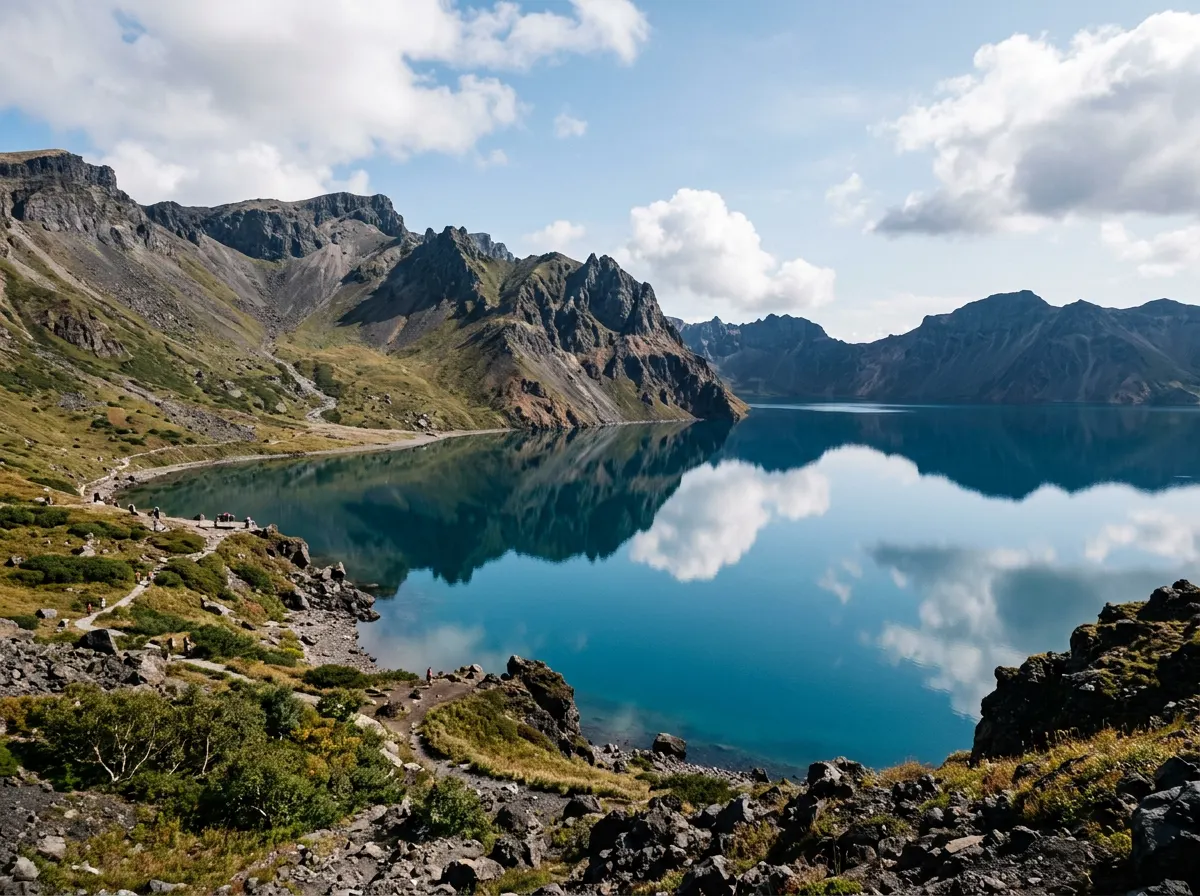
Changbaishan (长白山, Chángbáishān, "Eternally White Mountain") is a massive active volcano straddling the border between China\'s Jilin province and North Korea. At its summit, at 2,189 meters above sea level, sits Tianchi (天池, Heavenly Lake) — a deep blue crater lake formed by a colossal eruption around 946 CE, one of the largest volcanic events in recorded human history. The mountain is sacred in Korean and Manchu tradition: the Manchu people, founders of the Qing dynasty, considered Changbaishan the birthplace of their ancestors, and the mountain remains a powerful symbol in Korean identity (it appears on North Korea\'s national emblem). For visitors, Changbaishan offers a rare combination of volcanic drama, alpine scenery, and seasonal variety — wildflowers in summer, blazing autumn foliage, and deep powder snow from November to April that supports the best ski resort in northeast China. The honest downside: Tianchi is famously shy, hidden by cloud and fog roughly 70% of the time. You can climb the mountain three days in a row and never see the lake. Plan at least two summit attempts, check the weather obsessively, and treat a clear view of Tianchi as a gift rather than a guarantee. Budget roughly ¥150 per day for mid-range comfort. Two to three days is the minimum; four if you want to ski in winter. Changbaishan also rewards winter travelers: the ski resort at the North Slope is one of the best in northeast China, and the frozen Tianchi and snow-covered hot springs are atmospheric in their own way. Changbaishan also rewards a multi-day visit rather than a day trip. The North Slope (Tianchi + waterfall + hot springs) and the West Slope (also Tianchi but different view + Manchu border) are each a full day, and the Erdao Baihe valley between them is the base for overnight stays with hot-spring hotels, Manchu cuisine, and a slower pace than the day-tripper crowd.
Why Changbaishan in 2026.
A sacred volcano on the China-North Korea border with a crater lake at the summit — Heavenly Lake — plus thundering waterfalls, steaming hot springs, birch forests, and northeast China's best skiing.
Quick Answer
Changbaishan (长白山, Chángbáishān, "Eternally White Mountain") is a massive active volcano straddling the border between China\'s Jilin province and North Korea. At its summit, at 2,189 meters above sea level, sits Tianchi (天池, Heavenly Lake) — a deep blue crater lake formed by a colossal eruption around 946 CE, one of the largest volcanic events in recorded human history. The mountain is sacred in Korean and Manchu tradition: the Manchu people, founders of the Qing dynasty, considered Changbaishan the birthplace of their ancestors, and the mountain remains a powerful symbol in Korean identity (it appears on North Korea\'s national emblem). For visitors, Changbaishan offers a rare combination of volcanic drama, alpine scenery, and seasonal variety — wildflowers in summer, blazing autumn foliage, and deep powder snow from November to April that supports the best ski resort in northeast China. The honest downside: Tianchi is famously shy, hidden by cloud and fog roughly 70% of the time. You can climb the mountain three days in a row and never see the lake. Plan at least two summit attempts, check the weather obsessively, and treat a clear view of Tianchi as a gift rather than a guarantee. Budget roughly ¥150 per day for mid-range comfort. Two to three days is the minimum; four if you want to ski in winter. Changbaishan also rewards winter travelers: the ski resort at the North Slope is one of the best in northeast China, and the frozen Tianchi and snow-covered hot springs are atmospheric in their own way. Changbaishan also rewards a multi-day visit rather than a day trip. The North Slope (Tianchi + waterfall + hot springs) and the West Slope (also Tianchi but different view + Manchu border) are each a full day, and the Erdao Baihe valley between them is the base for overnight stays with hot-spring hotels, Manchu cuisine, and a slower pace than the day-tripper crowd.
| Worth visiting | Yes, for one of China's most dramatic volcanic landscapes. Tianchi alone — an enormous blue crater lake ringed by jagged peaks, half in China and half in North Korea — justifies the trip. Add the waterfall, hot springs, and skiing, and Changbaishan is one of northeast China's essential destinations. |
|---|---|
| Recommended days | 2-4 days (2 days in summer/autumn, 3-4 days if skiing in winter) |
| Best time to visit | July-September for accessible hiking and wildflowers; late September-early October for autumn foliage; December-March for skiing. Avoid May-June (lingering snow blocks trails) and Chinese holiday weeks. |
| Daily budget | $50 (backpacker) / $150 (mid-range) / $400+ (luxury) |
| Family friendly | Moderate — the North Slope is accessible by shuttle bus and boardwalks (stroller-friendly to the waterfall). The summit involves a steep climb on stairs; not suitable for very young children or those with mobility issues. The ski resort has beginner slopes. |
| Solo friendly | Yes — safe, well-organized with mandatory shuttle buses that make logistics easy, and the hiking and hot springs work well solo. |
| Airport | Changbaishan Airport (NBS) — about 30 km from the West Slope entrance. Flights from Beijing (2.5h), Shanghai (3h), Changchun (1h). Limited winter schedules. |
| High-speed rail | Yes — Changbaishan Station on the new Shenyang-Baishan HSR line (opened 2025): Shenyang (2.5h), Changchun (2.5h), Dalian (4h). The station is about 40 km from the North Slope entrance. |
| Language | Mandarin with a northeastern accent. Korean is spoken by the ethnic Korean minority in the area. English is rare outside international hotels in the resort zone. |
| Currency | CNY (¥) — Alipay and WeChat Pay work at the resort hotels and the main park gates. Cash is useful for small vendors, hot-spring egg sellers, and rural guesthouses. |
| Time zone | China Standard Time (UTC+8) |
| Last updated | 2026-06-18 |
Want a Changbaishan plan built for you?
Jump to:
Tianchi·Changbai Waterfall·Hot Springs·Underground Forest·Ski Resort·North vs. West vs. South Slope·Weather·Getting There·Getting Around·Where to Stay·Hikes & Walks·Skiing in Detail·Tips & Warnings·Wildflowers & Autumn Foliage·Wildlife & Birdwatching·Yanji Day Trip·Hot Springs in Depth·Border Geopolitics·Practical Logistics·Manchu Heritage & Wildlife Beyond the Park·FAQ
Why visit Changbaishan? Is it worth the journey?
Changbaishan requires effort. It is in a remote corner of Jilin province, hours from any major city, and the summit — the single reason most people come — is hidden by cloud on the majority of days. And yet, on a clear morning when you climb the last steps to the crater rim and Tianchi opens below you, it is one of the most extraordinary sights in China. The lake is enormous — 9.8 square kilometres of impossibly blue water, 384 metres deep, held in a volcanic crater ringed by jagged peaks. Half of it is in North Korea; you can see North Korean guard posts on the far shore. The silence at the summit, broken only by wind and the occasional call of a alpine chough, is total. The scale, the colour, and the knowledge that you are standing on an active volcano that once produced one of the largest eruptions in human history combine to make Tianchi a genuinely humbling place. Beyond Tianchi, Changbaishan holds a rare concentration of volcanic features: the 68-metre Changbai Waterfall, the steaming hot-spring fields with their vivid mineral colours, the surreal Underground Forest growing in a volcanic collapse crater, and the Green Abyss Pool. The mountain changes dramatically with the seasons — wildflowers and green slopes in July and August, blazing birch and larch forests in late September, deep snow from November to April, and the most reliable powder skiing in northeast China. Is it worth it? If you get a clear day at Tianchi, absolutely. If you do not — and the odds are against you — the waterfall, hot springs, forest walks, and hot-spring pools still make a satisfying trip, but you will leave with the nagging sense of unfinished business. The best strategy is to plan at least two summit attempts (from different slopes if possible) and to accept that Changbaishan, like any great mountain, sets its own terms.
What is Tianchi and why is it sacred to Koreans and Manchus?
Tianchi (天池, "Heavenly Lake") is a volcanic crater lake at 2,189 metres above sea level, formed when the Changbaishan volcano's cone collapsed after a colossal eruption around 946 CE. That eruption — now known as the Millennium Eruption — was one of the largest volcanic events of the past 2,000 years, ejecting an estimated 100-120 cubic kilometres of material and sending ash as far as Japan and Greenland. The caldera that remained filled with water over centuries, forming the deepest alpine lake in China (up to 384 metres) and one of the clearest — visibility in the lake can exceed 20 metres. The mountain holds deep cultural and spiritual significance. For the Manchu people, Changbaishan is the mythical birthplace of their ancestors — legend holds that the founder of the Manchu Aisin Gioro clan was born from a divine maiden who bathed in a lake on the mountain. When the Manchu established the Qing dynasty in 1644, they declared Changbaishan a sacred mountain and restricted access, preserving its forests and wildlife for centuries. For Koreans, the mountain (called Baekdusan in Korean, 백두산) is the spiritual homeland. Korean foundation mythology traces the Korean people to Dangun, said to have been born on Baekdusan. The mountain appears on North Korea's national emblem, and North Korean propaganda claims that Kim Jong-il was born on its slopes (historians place his birth in the Soviet Union). The border between China and North Korea runs directly through the crater lake, and from the Chinese side you can see North Korean guard posts and hiking parties on the far shore — a geopolitical curiosity that adds a layer of tension to the natural beauty. The mountain remains volcanically active. The last minor eruption was in 1903, and seismic activity and ground deformation in the early 2000s prompted international monitoring. The hot springs, steaming vents, and occasional tremors are reminders that Changbaishan is a sleeping giant, not a dead one.
What is the Millennium Eruption and how did it shape Changbaishan?
Around 946 CE, Changbaishan erupted with a violence that ranks it among the largest volcanic events of the Common Era. The eruption — classified as a VEI 7, comparable to the 1815 Tambora eruption — blasted an estimated 100-120 cubic kilometres of volcanic material into the atmosphere, collapsed the mountain's cone into the caldera that now holds Tianchi, and deposited ash across Korea, Japan, and as far as the Greenland ice sheet, where a sulphate spike dated to 946 CE confirms the global reach of the event. The eruption reshaped the mountain entirely. Before 946, Changbaishan was a classic conical stratovolcano. After, it was a truncated caldera with a rim of jagged peaks and a vast crater that would slowly fill with rainwater and snowmelt to become Tianchi. The geological record of the eruption is preserved in thick layers of pumice and ash on the mountain's slopes, and in the volcanic rocks and mineral deposits that colour the hot-spring zone today. The Millennium Eruption is sometimes called the "Tianchi eruption" or the "Baegdusan eruption" in the scientific literature, and its precise dating was only established in the 2010s through carbon-dating of wood samples buried in the ash. The event is recorded in historical chronicles from Korea and Japan, which describe "thundering from the heavens" and "ash falling like snow." Understanding this eruption is the key to understanding Changbaishan's landscape — every feature, from the crater lake to the hot springs to the dramatic cliff faces, is a product of that single, world-shaping event.
Which slope should I visit: North Slope, West Slope, or South Slope?
Changbaishan has three access points on the Chinese side, each offering a different experience of the mountain. They are managed separately with different tickets, and choosing between them is the most important decision you will make in planning your trip. The North Slope (北坡, Běi Pō) is the oldest, most developed, and most popular access point. It has the best infrastructure — a paved road to the summit shuttle station, a large visitor centre, and extensive boardwalk networks — and it accesses the Changbai Waterfall, the hot springs, the Underground Forest, Small Heavenly Lake, and the Green Abyss Pool. The Tianchi view from the North Slope is slightly restricted by the crater rim, showing about two-thirds of the lake. The summit is reached by a shuttle bus (¥85) to a high point, then a steep climb of 1,442 stairs to the crater rim. The North Slope base area has the most hotels and restaurants and is the best option for first-time visitors. The West Slope (西坡, Xī Pō) is quieter, more natural, and offers a fuller panorama of Tianchi — the view from the West Slope crater rim shows the entire lake and more of the surrounding peaks. The climb to the summit is longer but gentler, about 1,440 m of uphill walking on a maintained path, taking 40-60 minutes at a steady pace. The West Slope is also the base for the ski resort and has the more upscale hotels (Hyatt, Sheraton, Westin). In summer, the West Slope accesses an alpine wildflower zone that is one of the mountain's hidden highlights — in July, the slopes above 1,500 m are carpeted with lilies, irises, and rhododendrons. The South Slope (南坡, Nán Pō) is the wildest and least visited, offering the closest and most dramatic view of Tianchi from the crater rim. Access is restricted and unpredictable — the South Slope is open only in summer (roughly July-September), permits are required, and the road can close without notice. For most visitors, the South Slope is not a practical option. If it is open and you have the time, it is the best view of the three. Recommendation: North Slope for first-time visitors who want the full range of attractions and the easiest logistics. West Slope for returning visitors, skiers, and anyone who wants a fuller Tianchi panorama. Combine both slopes over 2-3 days for the best odds of a clear view. Buy tickets on the official Changbaishan WeChat mini-program or through your hotel. North and West Slope tickets are separate (¥125 each as of June 2026).
When is the best time to visit Changbaishan?
Each season at Changbaishan is dramatically different, and the best time depends on what you want to see. Summer (July-August) is the most accessible season. The summit road is reliably open, the hiking trails on all slopes are clear of snow, and the alpine wildflower bloom on the West Slope in July is spectacular. Temperatures at the summit are 5-15°C, while the base areas are 15-28°C. The downside: this is peak domestic tourism season, the shuttle bus queues can be long, and Tianchi visibility is at its lowest — roughly 30% of days are clear. Summer is the best season for combining Changbaishan with other northeast China destinations. Autumn (September-early October) is the consensus best season. The weather is more stable, with clearer skies and better summit visibility (closer to 40-50% of days). The birch and larch forests on the lower slopes turn brilliant gold in late September, and the mountain is spectacular. Temperatures are cool (summit 0-10°C, base 5-20°C). The first two weeks of October are peak autumn foliage and very busy with domestic tourists; the National Day Golden Week (October 1-7) brings extreme crowds — avoid if possible. Late September is the sweet spot. Winter (November-March) is the ski season. The resort on the West Slope operates from late November to late March, with natural powder snow and temperatures of -15 to -25°C at the resort (colder at the summit). Tianchi freezes over completely and the summit may be inaccessible on the coldest days. Winter is not the season for a first visit unless skiing is your primary goal. The hot springs are at their most magical in winter — soaking in an outdoor pool in -20°C air, with snow falling on your shoulders, as steam rises into the cold air, is one of Changbaishan's best experiences. Spring (April-June) is the most challenging season. Snow still blankets the upper slopes through May, trails are muddy and partially blocked, and the summit may be closed. June is unpredictable — some years the snow clears in early June, others linger into July. Spring is the least recommended season for a first visit. The mountain wakes up slowly, and you risk finding trails closed and summit access blocked.
How to get to Changbaishan: flights, high-speed rail, and connections?
Changbaishan is remote, and reaching it requires planning. Most visitors arrive by a combination of flight or high-speed rail to one of the gateway cities, followed by a transfer to the mountain. Changbaishan Airport (NBS, 长白山机场) is the most direct option, located about 30 km from the West Slope entrance and 80 km from the North Slope. It handles flights from Beijing (2.5 hours, ¥600-1,200), Shanghai (3 hours, ¥800-1,500), Changchun (1 hour, ¥300-600), and a handful of other cities. The schedule is seasonal — summer and winter have daily flights; spring and autumn may have only 2-3 flights per week. The airport has shuttle buses to the West Slope resort zone (¥30, 30 min) and taxis to both slopes (¥150-250 to North Slope). The new high-speed rail station, Changbaishan Station (长白山站), opened in 2025 on the Shenyang-Baishan HSR line, has transformed access. From Shenyang, the HSR takes 2.5 hours (¥150-220 second class). From Changchun, about 2.5 hours (¥130-190). From Dalian, about 4 hours (¥250-350). The station is about 40 km from the North Slope entrance; shuttle buses and taxis are available (taxi ¥100-150). The HSR station has made Changbaishan viable as a long weekend trip from Shenyang or Changchun. The traditional gateway city is Yanji (延吉), the capital of the Yanbian Korean Autonomous Prefecture, about 3 hours by bus or car from the North Slope (180 km). Yanji has its own airport and HSR connections and is worth a day or two in its own right — it is the most Korean city in China, with bilingual signage, Korean restaurants, and a distinctive K-pop-infused culture. From Beijing, the most efficient route is: fly to Changbaishan Airport (2.5 h) or HSR to Shenyang (3 h) then transfer to Changbaishan HSR (2.5 h). Total travel time from Beijing is 6-8 hours regardless of route.
How to get around Changbaishan and between the slopes?
Changbaishan operates a mandatory shuttle-bus system within each slope area — private cars are not permitted beyond the park gates. Once you enter the North Slope or West Slope gate, you board a park shuttle that stops at a series of attractions. The shuttles are frequent (every 5-10 minutes in peak season), included in the ¥85 shuttle fee (separate from the ¥125 park entry), and have Chinese-language announcements with some English signage. For the summit (Tianchi), you transfer to a smaller summit shuttle at the last shuttle stop before the crater rim. The summit shuttle (an additional ¥85 on the North Slope) takes you to a high drop-off point, from which you walk the final section to the crater rim. Between the North Slope and West Slope: the entrances are about 75 km apart by road (1.5 hours). There is no direct shuttle between them. You will need a taxi or a pre-arranged driver (¥300-400 one-way). Your hotel can arrange this. If you are staying in the West Slope resort zone and visiting the North Slope (or vice versa), budget 3 hours of road travel round-trip. For exploring the area beyond the mountain: taxis are available at the park gates and hotels. Didi is unreliable in Changbaishan — the area is too rural. Arrange drivers through your hotel front desk; they will quote fixed prices for common routes (North Slope to West Slope, airport transfers, etc.). Having the hotel write the destination in Chinese is essential — most drivers do not speak English. In winter, road conditions can be poor. The mountain roads to the summit are cleared regularly but can close after heavy snow. The ski resort area on the West Slope has a free shuttle bus connecting the hotels, the gondola, and the resort village. The closest proper town for supplies, restaurants beyond hotel dining, and ATMs is Erdaobaihe (二道白河), about 5 km from the North Slope entrance. It has a supermarket, several Korean and Chinese restaurants, and a Bank of China ATM.
Where to stay in Changbaishan: North Slope vs. West Slope vs. nearby towns?
Your choice of base shapes the entire trip. The two slopes are 75 km apart, and staying on one side means a 1.5-hour drive to reach the other. The North Slope base area has the widest range of accommodation, from budget guesthouses (¥80-200/night) to mid-range hotels (¥250-500/night) to a handful of upscale options. The Holiday Inn Changbaishan North Slope (¥400-700) is the most established international brand. The North Slope area also has the hot-spring resort hotels — the Changbaishan Imperial Hot Spring Hotel and the Lanjing Hot Spring Hotel offer outdoor thermal pools fed by the mountain's geothermal water (¥600-1,200/night including hot-spring access). Staying at a hot-spring hotel on the North Slope is the best way to end a day of hiking. The West Slope resort zone (万达长白山国际度假区, Wanda Changbaishan International Resort) is a purpose-built alpine resort with international chain hotels: Hyatt Regency, Sheraton, Westin, Holiday Inn, and Hampton by Hilton. Rooms run ¥600-2,000/night depending on the season and brand. The resort has restaurants, shops, a small cinema, and a man-made lake. In winter, most hotels offer ski-in/ski-out access. In summer, the resort is quieter but the gondola operates for sightseeing. The West Slope resort zone is more expensive but more polished than the North Slope — choose it if you prioritize comfort, skiing, and a resort atmosphere. Erdaobaihe town (二道白河镇) is the budget option, about 5 km from the North Slope entrance. It is a real town — not a resort — with cheap guesthouses (¥60-150/night), local Korean restaurants, a supermarket, and an ATM. The trade-off is a 10-15 minute taxi ride to the park gate each morning. Best for backpackers and independent travelers who prefer local character to resort convenience. For a combined North + West Slope trip, split your stay: 1-2 nights near the North Slope, 1-2 nights at the West Slope resort. Moving between them takes half a day, so plan around the transfer.
What are the best hikes and walks on Changbaishan?
Changbaishan is best experienced on foot, and the best walks are on the North Slope, all accessed by the park shuttle system. The Changbai Waterfall boardwalk (1.5 km each way, easy, 40-60 minutes) starts from the last shuttle stop before the summit transfer. It follows the Erdaobaihe River upstream through the hot-spring zone — steaming vents, boiling pools, and vividly coloured mineral deposits — to the base of the 68-metre waterfall. The path is a wooden boardwalk with stairs in places; it is accessible for anyone with reasonable fitness. The hot-spring eggs sold at the halfway point (温泉鸡蛋, ¥10 for 3) are an essential Changbaishan experience. The summit climb (North Slope: 1,442 stairs, steep, 20-30 minutes up; West Slope: 1,440 m trail, moderate, 40-60 minutes up) is the payoff walk. On the North Slope, the stairs climb steeply from the summit shuttle drop-off to the crater rim. They are well maintained but relentless; take your time, especially at 2,000+ metres where the air is thinner. At the top, you emerge onto a viewing platform with Tianchi spread below. The Underground Forest boardwalk (3 km loop, easy, 1.5-2 hours) is the most unusual walk on the mountain. The boardwalk descends gradually into a volcanic collapse crater where full-size pine and birch trees grow 50-70 metres below ground level. The air is cooler and wetter, the light is filtered through the trees, and the silence is striking. The loop ends at a viewpoint over the forest floor. The Small Heavenly Lake loop (easy, 30 minutes) circles a quiet green crater lake through silver birch forest. Less dramatic than the main sights but peaceful and reliable — the lake is visible regardless of summit weather. In winter, hiking is limited to the lower slopes. The summit is generally inaccessible, and the boardwalks may be icy or closed. The ski resort trails are the winter substitute for hiking. Altitude note: the summit of Changbaishan is 2,189 m, high enough to cause mild altitude symptoms in sensitive individuals. Most people are fine, but if you are prone to altitude sickness, ascend slowly and stay hydrated.
What is Changbaishan skiing like and when is the season?
Changbaishan International Ski Resort on the West Slope is the best ski area in northeast China and a genuine destination resort by Chinese standards. It was developed by the Wanda Group in the 2010s and has matured into a polished operation with 43 trails across 7 km², served by 7 lifts including a gondola and high-speed quads. The terrain: roughly 30% beginner, 50% intermediate, 20% advanced. The vertical drop is 350 m — modest by Alpine or Rocky Mountain standards but respectable for China. The longest run is about 2.5 km. The snow is natural, dry, and reliable — Changbaishan catches Siberian storm systems that drop cold, light powder from November through March. The best conditions are typically in January and February when the base is deepest and the snow quality is at its peak. The resort has a terrain park, a half-pipe, and night skiing on selected trails. Ski school is available with English-speaking instructors at a premium (¥500-800/hour). Lift tickets are ¥400-600/day depending on the season; multi-day passes offer discounts. Equipment rental is ¥200-300/day for skis/boots/poles; higher-end demo gear is available at the resort shops. Off the slopes: the resort village has a cluster of restaurants (Chinese hotpot, Korean BBQ, Western pub food), a few bars, a cinema, and a small shopping street. The hot-spring pools at the resort hotels are the essential post-ski ritual — the Hyatt and Westin have the best outdoor thermal pools, and soaking in 40°C water with snow falling around you is unforgettable. Practical ski notes: the resort is busiest during Chinese New Year (late January or February, dates vary) when prices spike and slopes are crowded. The best value is in December (pre-holiday) and March (spring skiing, softer snow, smaller crowds). Temperatures on the slopes in January and February routinely drop to -20 to -25°C — dress in serious layers, cover all exposed skin, and bring hand warmers. Frostbite is a real risk on the coldest days; the resort closes lifts if the temperature drops below -30°C. For non-skiers in winter: the gondola operates for sightseeing, the hot springs are at their best, and the snow-covered birch forests are beautiful for walks. But if you are not skiing and winter is your only window, consider a summer or autumn visit instead — the mountain is at its most generous in the warm months.
What practical tips, warnings, and honest negatives should I know?
1. TIANCHI VISIBILITY IS A GAMBLE. The summit is hidden by cloud on roughly 70% of days. The best odds are in September and October (clear skies more frequent). The worst odds are in July and August (summer humidity). Plan at least two summit attempts, ideally from different slopes, and check the forecast obsessively on the morning of your visit. If the summit is clouded in, do the waterfall and forest walks instead and try again the next day. There is no refund if you do not see the lake. 2. THE PARK IS EXPENSIVE. As of June 2026: park entry ¥125, shuttle bus ¥85, summit shuttle (North Slope only) ¥85. That is ¥210-295 per person per slope per day. A two-day visit covering both slopes can cost ¥420-590 in tickets alone before accommodation, food, or transport. Budget accordingly. 3. SUMMER WEEKENDS ARE PACKED. Changbaishan is one of northeast China's most popular domestic tourism destinations. In July and August, weekends bring long queues for the shuttle buses and summit stairs. Mid-week visits are noticeably quieter. The October Golden Week (October 1-7) brings extreme crowds — avoid. 4. THE SUMMIT HAS NO SHELTER. The crater rim is exposed and windy with no buildings, no toilets, and no food vendors (except sometimes a small snack cart). Dress in layers even in summer — the summit temperature can be 10-15°C colder than the base. Bring water, a windproof jacket, sunscreen, and a hat. The UV exposure at 2,189 m is significant even on cloudy days. 5. THE NORTH KOREA BORDER IS VISIBLE BUT DO NOT TAKE PHOTOS TOWARD IT. Chinese guards may ask you to delete photos taken facing North Korean guard posts or military installations on the far shore. Enjoy the view; keep your camera pointed at the lake and the Chinese side. 6. THE HOT-SPRING EGGS ARE A TOURIST TRAP — AND WORTH IT. ¥10 for three eggs boiled in geothermal water sounds like a markup, and it is, but the texture — custardy whites, firm yolks — is genuinely unusual and the experience of eating them while looking at the steaming vents that boiled them is part of the Changbaishan ritual. 7. ALTITUDE CAN AFFECT YOU. At 2,189 m, the summit air has about 78% of the oxygen at sea level. Most people are fine, but if you are sensitive to altitude, ascend the stairs slowly, take breaks, and descend if you feel dizzy, nauseous, or short of breath. There is no medical facility at the summit. 8. WINTER IS SERIOUSLY COLD. January temperatures at the base are -15 to -25°C; at the summit they can drop below -40°C with wind chill. If you are skiing or visiting in winter, bring thermal base layers, a heavy down jacket, insulated boots, thick gloves, a balaclava, and hand warmers. Exposed skin can freeze in minutes. 9. DRONES ARE BANNED. Changbaishan is a national nature reserve with a sensitive border zone. Drones are prohibited throughout the park. Security checks at the entrance gates will confiscate them. 10. HOTEL CHECK-IN REQUIRES YOUR PASSPORT. Standard for China. Budget guesthouses in Erdaobaihe town may refuse foreign guests — book through Trip.com with the "accepts foreign guests" filter.
What wildflowers and autumn foliage can I see at Changbaishan?
Changbaishan has two distinct seasonal color events, and timing your visit to catch one of them is the single best way to make the mountain feel intimate rather than overwhelming. The wildflower bloom happens in July on the West Slope, above roughly 1,500 metres elevation. As the snow finally clears in late June, the alpine meadows burst into flower almost overnight. The dominant species are Changbaishan lilies (Lilium distichum, a delicate orange-and-red Turk's-cap lily unique to the region), irises (Iris sanguinea, deep purple), and rhododendrons (Rhododendron aureum, a low creeping shrub with pale yellow flowers). The bloom peaks in the third and fourth weeks of July and is largely over by mid-August. The best place to see it is on the West Slope trail above the upper shuttle stop, where the maintained path passes through open alpine meadows. The flowers are at their most photogenic in the early morning, before the afternoon clouds roll in and the wind picks up. Bring a macro lens if you have one — the lily detail is extraordinary. The autumn foliage is the more famous event. Changbaishan sits in a transition zone between the cold-temperate forests of Siberia and the mixed forests of northeast China, and the result is a forest composition that changes color dramatically in September and early October. The lower slopes (below 1,500 m) are dominated by birch (Betula platyphylla) and larch (Larix gmelinii), both of which turn brilliant gold. The mid-slopes add maple (Acer mono) and rowan, which turn red and orange. The upper slopes above the tree line (roughly 2,000 m) are bare tundra — volcanic rock and low alpine vegetation that holds no fall color but provides the dramatic grey-black backdrop that makes the gold forests below pop. The peak foliage window is narrow. The first leaves turn in mid-September at the highest elevations, the color cascades down the mountain through the month, and by the second week of October most leaves have dropped. The very best week is usually the last week of September, when the mid-slopes are at peak gold and the summit is still accessible. The West Slope is widely considered the best place to see the foliage, because the maintained trail passes through birch groves on the way to the summit. The North Slope is also excellent — the Underground Forest and the waterfall boardwalk pass through the same forest types. The National Day Golden Week (October 1-7) is the worst time to see autumn at Changbaishan, because it coincides with peak foliage but also brings the largest crowds of the year. If you can, go in the last week of September instead. If you must go in early October, plan to be on the trails at sunrise to beat the shuttle-bus queues, and accept that you will be sharing the mountain with thousands of domestic tourists. One practical note for photographers: the autumn light on Changbaishan is exceptional. The lower latitude (around 42°N) and the clean post-monsoon air combine to give warm golden light that lasts well into the afternoon. Mornings are often foggy in the valleys, which burns off by mid-morning to reveal the mountain in clear air. The most dramatic shots are usually from the West Slope trail, looking back across the Tianchi caldera with the gold forests in the foreground.
What wildlife and birdwatching opportunities exist around Changbaishan?
Changbaishan is one of the best-preserved temperate ecosystems in northeast Asia, and the national nature reserve around the mountain harbors a surprising concentration of wildlife for a place this accessible. The reserve is part of the broader Changbaishan Biosphere Reserve, designated by UNESCO in 1979, and the protected area extends across both the Chinese and North Korean sides of the border. The mammal most visitors hope to see is the Siberian tiger (Panthera tigris altaica), but realistic expectations matter here. The tigers live in the deep forest on the lower slopes and rarely venture near the tourist areas. The Chinese side of the reserve has an estimated 8-12 wild tigers, mostly in remote areas accessible only with special permits and accompanied by armed rangers. You are essentially never going to see one on a normal visit. If tiger-tracking is the goal, the more realistic option is the Siberian Tiger Park near Harbin, which is a breeding and conservation facility (not a zoo, but also not a wild encounter) — a very different experience from Changbaishan itself. The animals you can realistically see at Changbaishan are the smaller mammals. Red deer (Cervus elaphus) and roe deer (Capreolus pygargus) are common on the lower slopes, especially in the birch forest around the Underground Forest area. Siberian chipmunks and ground squirrels are abundant near the boardwalks and will come remarkably close to humans. Eurasian red squirrels are in the forest but harder to spot. The North Korean border fence runs through the forest on the lower slopes and is sometimes visited by Amur leopards on the Chinese side — there are estimated to be only a few dozen in the entire region, so do not count on it, but the possibility adds tension to early-morning walks. The birds are a quieter but more reliable highlight. The forests around Changbaishan host over 200 recorded bird species, and the migration seasons (April-May and September-October) bring waves of Siberian passage migrants. Resident species you are likely to encounter include: - Hazel grouse (Tetrastes bonasia): common in the birch forest, often heard before seen, a small brown grouse that lives in family groups. - Siberian jay (Perisoreus infaustus): bold and curious, often approaching hikers on the West Slope trail in late summer. - Eurasian three-toed woodpecker (Picoides tridactylus): the dominant woodpecker in the conifer forest, identifiable by its drumming. - Common raven (Corvus corax): abundant at all elevations, particularly bold at the summit where they scavenge food scraps. - Alpine chough (Pyrrhocorax graculus): the well-known bird of the Changbaishan summit — a small yellow-billed crow that lives year-round above the tree line and is the only bird you are likely to see at the crater rim. - Mandarin duck (Aix galericulata): on the lower rivers and ponds, including the small lake at Erdaobaihe town, beautiful in late autumn plumage. The best birdwatching is in the early morning (5:30-8:00 AM) along the lower trails on the North Slope, particularly the Underground Forest boardwalk before the shuttle buses start running. Bring binoculars. A Chinese bird guide app (e.g., the Merlin app, which has a China pack) is more useful than a field guide book for ID. A final wildlife note: the Erdaobaihe River, which flows from the waterfall, supports a small run of trout (introduced) and is open for catch-and-release fly fishing in summer. The river banks are accessible from the waterfall boardwalk. Fishing gear can be rented from shops in Erdaobaihe town.
Is Yanji worth visiting as a day trip or overnight from Changbaishan?
Yanji (延吉), the capital of the Yanbian Korean Autonomous Prefecture, is the most underrated gateway to Changbaishan. It is about 180 km (3 hours by road) from the North Slope and has an airport and HSR station with good connections to the rest of China. Most travelers treat it as a transit stop, but Yanji deserves at least a day on its own — it is the most Korean city in China, and the food and culture are distinctive enough to justify the detour. The Korean influence is everywhere. About 30% of Yanji's population is ethnic Korean (朝鲜族, Cháoxiǎnzú), and the Korean language is widely spoken alongside Mandarin. Street signs are bilingual, and many restaurants operate primarily in Korean. The cultural texture is closer to Seoul than to Shanghai — K-pop plays in coffee shops, Korean cosmetics shops line the main streets, and the food is the food of the Korean peninsula, adapted to Chinese ingredients but recognizable to anyone who has eaten in Korea. The food is the main reason to come. Yanji is famous across China for its cold noodles (延吉冷面, Yánjí lěngmiàn), which are different from the Korean naengmyeon most visitors will have tried — they are served in a beef broth (rather than the watery North Korean style), with sliced beef, Asian pear, cucumber, and a dab of mustard. The signature restaurant is Chunhua Cold Noodles (春华冷面), a local institution. Korean BBQ in Yanji is exceptional and cheap — the city has hundreds of places serving beef, pork, and lamb on tabletop grills, and the quality of the meat is consistently good. Other dishes to try: tteokbokki (rice cakes in spicy sauce, ¥20-30), Korean fried chicken (the Chinese term is 韩式炸鸡, ¥40-60 for a whole chicken), bibimbap, kimchi jjigae, and the local grilled fish. The night market along the Burhatong River (布尔哈通河) is a good one-stop introduction. Beyond the food, Yanji has a small but worthwhile set of sights. The Yanbian Museum (延边博物馆) covers the history of the Korean minority in China — modest but informative. The Yanji Dinosaur Museum is more interesting than it sounds (the Yanbian region has yielded important Jurassic fossils). The Korean Folk Village (朝鲜族民俗园) outside the city center is a recreated traditional Korean village with thatched-roof houses and dance performances. For a quieter experience, the riverside parks along the Burhatong are pleasant for a morning walk. Practical logistics: Yanji has direct flights to Beijing (2.5 h), Shanghai (3 h), Seoul (3.5 h, when operating), and several other cities. The HSR station connects to Changchun (2 h), Shenyang (4 h), and other northeast China cities. From Yanji to Changbaishan, the best options are: pre-arranged driver (¥400-500, 3 hours), public bus (¥80-100, 4 hours, less frequent), or HSR to Changbaishan Station plus a 40 km taxi (¥100-150). Most visitors combine Yanji with Changbaishan by flying into Yanji, doing 1-2 days in Yanji, then transferring to the mountain. A cultural note that surprises many foreign visitors: Yanji is also one of the most popular destinations in China for Korean Chinese newlyweds to take wedding photos. The Korean-style photo studios in the city are famous across the country, and on weekends you will see couples in elaborate hanbok (Korean traditional dress) posing for wedding portraits in the parks and at the Korean Folk Village. It is a reminder that the Korean-Chinese identity here is not a museum piece but a living culture. If you have only 24 hours in Yanji: morning Korean breakfast at the central market (try the steamed dumplings and rice porridge), walk along the Burhatong River to the Yanbian Museum, lunch of cold noodles, afternoon at the Korean Folk Village or the dinosaur museum, evening Korean BBQ, and a final walk through the neon-lit Korean shopping streets before bed. It is a compact, satisfying day.
What is the deeper story of the hot springs at Changbaishan?
The hot springs at Changbaishan are not an afterthought — they are the reason the mountain is still here, in a sense. The geothermal field is direct evidence that the volcano beneath the summit is alive, and the steam rising from the ground on the North Slope is the same energy that produced the 946 CE Millennium Eruption. The geothermal system sits on the north flank of the volcano, along the fault lines that radiate from the central caldera. Rainwater and snowmelt percolate down through fractured volcanic rock, reach depths of 2-3 km where they come into contact with hot rock near the magma chamber, and rise back to the surface through the same fault lines as superheated mineral water. The spring water emerges at the surface at 83°C — too hot to touch — and the boiling pools and steaming vents along the waterfall boardwalk are the visible expression of this deep circulation. The mineral content is what gives the hot springs their vivid colors. As the water rises through different rock layers, it dissolves minerals and carries them to the surface. Where the water emerges and cools, the minerals precipitate out as colored deposits: sulphur yellow, iron red, copper green, manganese black. The colors are not added by anyone — they are the natural chemistry of the volcanic system, and the effect is what makes the hot-spring zone so visually striking. The boardwalk passes within a few meters of several vents, and the colors are most vivid on a sunny morning when the steam rises cleanly. The hot-spring eggs (温泉鸡蛋, wēnquán jīdàn) are boiled directly in one of the natural pools. The temperature is too low to actually cook the eggs in the same way boiling water does, so the result is unusual — the whites set to a custardy texture while the yolks stay firm and slightly orange. The combination is a one-time-in-China culinary experience, and the ¥10 for three eggs is the most money you will ever spend on something so simple. Eat them standing on the boardwalk with steam rising around you. Beyond the public boardwalk, the hot-spring water is piped to several resort hotels in the area, where it fills outdoor thermal pools. The two main hot-spring hotel zones are: - North Slope hot-spring hotels (the Changbaishan Imperial Hot Spring Hotel, the Lanjing Hot Spring Hotel, and a handful of smaller options). These are clustered near the North Slope entrance, about 5 km from Erdaobaihe town. The pools are outdoor, surrounded by forest, and open year-round. In winter, soaking in 40°C water while snow falls on your shoulders is one of the most memorable experiences in northeast China. - West Slope resort hotels (Hyatt Regency, Sheraton, Westin, Holiday Inn). The Wanda resort complex has the most upscale hot-spring pools in Changbaishan. The Hyatt's outdoor pool is the most photogenic, set in a Japanese-inspired garden with the ski slopes visible in the background in winter. Day access to the resort pools is sometimes available for non-guests (¥150-300) — ask at the concierge. A practical warning about the hot springs: the mineral content makes the water smell strongly of sulphur (the classic "rotten egg" smell). It is harmless but persistent — your hair and skin will smell of it for hours after a soak. The resort pools use slightly treated water to reduce the smell, but the natural boardwalk vents and the Imperial Hot Spring pools are unfiltered. People with sensitive skin should limit their soak to 15-20 minutes. Pregnant women should consult a doctor before extended soaking — the heat and mineral content can be intense. The geothermal energy is not just a tourist amenity. China has explored developing Changbaishan as a geothermal power source, and there are small-scale pilot projects in the area. The hot-spring water is also bottled commercially and sold across northeast China as a health drink — you will see it in hotel minibars and convenience stores under local brand names. None of this is visible to the casual visitor, but it is the larger context for the steam rising from the boardwalk.
How does the China-North Korea border work on the ground at Changbaishan?
The border running through Tianchi is the most geopolitically loaded lake view in northeast China. The lake is split between China and North Korea, with the China side accessible from the west slope and the North Korea side closed to foreign visitors.
What does a typical day at Changbaishan actually look like, and how should I plan the timing?
The single biggest mistake visitors make at Changbaishan is treating the mountain as a checklist. Tianchi, waterfall, hot springs, Underground Forest, lake — they are all on the map, and they all look close, and it feels like a reasonable day to knock them all off. It is not. The mountain is enormous, the shuttle buses have queues, the altitudes are real, and rushing between sights will leave you tired, frustrated, and unlikely to see Tianchi at all. The right way to plan a Changbaishan day is around the rhythm of the mountain itself. Here is how a well-paced summer day on the North Slope actually unfolds. Wake at 05:30 in your hotel. Eat a real breakfast (the North Slope hotels offer early buffet service starting at 06:00 specifically for the Tianchi-bound guests). Take a 06:30 taxi to the North Slope gate, arriving by 06:45. The gate opens at 07:00. Be among the first 200 people through — the first summit shuttle leaves at 07:30, and the early shuttles have shorter queues and better summit light. The shuttle takes you up through birch and larch forest, gaining about 1,000 meters of elevation in 20 minutes. At the summit shuttle drop-off, you have a choice: the 1,442 stairs to the crater rim, or a coffee at the small summit shelter before the climb. Take the stairs. Allow 30 minutes for the climb with breaks. At the rim, you have the crater lake spread below — and you have about 20-30 minutes of optimal viewing before the clouds typically build. By 09:30 or 10:00, descend back to the shuttle drop-off. Take the next shuttle to the waterfall stop, arriving around 10:15. Walk the 1.5 km boardwalk through the hot-spring zone to the base of Changbai Waterfall — about 40 minutes with stops for photos and the obligatory hot-spring eggs (¥10 for 3). The waterfall is most photogenic in late morning light, with the spray catching the sun. From the waterfall base, the next shuttle takes you to Small Heavenly Lake (30-minute loop) and the Green Abyss Pool (20-minute detour). Allow about 90 minutes for both. By 13:00, take the shuttle to the Underground Forest trailhead. Eat a packed lunch at the picnic area before the descent. The 3 km boardwalk loop through the volcanic collapse crater takes 1.5-2 hours — it is cooler and quieter than the rest of the mountain, and the slower pace is welcome after the morning. By 15:00 or 15:30, exit the park at the main gate. Taxi back to the hotel. Hot-spring soak at 16:00 — the outdoor pools are quietest in late afternoon. Dinner at the hotel restaurant or in Erdaobaihe town by 18:30. Sleep early. Repeat (or transfer to West Slope) the next day if you have the time. That is a full, satisfying, non-rushed North Slope day. Most visitors try to compress it into a half-day, which means missing either Tianchi or the Underground Forest or rushing through both. The mountain rewards a slower pace. A winter day at Changbaishan has a different rhythm. The ski resort opens at 08:30, and the first lift queues form by 09:00. If you are a serious skier, be on the first gondola at 08:30 and ski until 12:30, then break for a hot lunch in the resort village. The afternoon (13:30-16:00) is for groomer runs and the terrain park — the snow is usually softer by then, but visibility often deteriorates. By 16:00, finish the day and head straight to the resort hotel hot-spring pool. Soak until 18:00. Dinner by 19:00. Repeat. If you are a non-skier in winter, the gondola operates for sightseeing in the morning, the hot springs are open all day, and the lower boardwalks on the North Slope remain accessible (though snowy) for forest walks. A practical timing note that many first-time visitors miss: the park shuttle bus ticket is sold separately from the park entry, and the bus is mandatory — you cannot walk the mountain roads. The shuttle has a fixed schedule that operates roughly 07:00-17:00 in summer (07:30-16:30 in winter). The summit shuttle has a tighter window (07:30-14:00 in summer, often closed in winter). If you arrive at the gate at 11:00 AM and hope for a leisurely summit visit, you will be disappointed — by the time you queue for the shuttle, ride up, climb the stairs, and descend, you will be pressed for time, and the cloud cover will be at its worst. The mountain rewards early starts. Finally, a word on the Tianchi weather gamble. The single most useful thing you can do is check the live webcam feed from the crater rim (the Changbaishan official WeChat account posts one daily, and several hotel lobby screens display it). The summit visibility forecast is more reliable than the base-area weather forecast. If the webcam shows clear skies at 06:00, go. If it shows cloud at 06:00, sleep in, do the waterfall and hot springs, and check again at 11:00 — sometimes the cloud clears by midday. The mountain gives no guarantees, but it does give clear signals if you know where to look. One last timing detail that catches first-time visitors: the long summer evenings at this latitude. Changbaishan sits at about 42°N, the same latitude as Boston or Rome, and in late June the sun does not set until 19:30 and full darkness does not arrive until after 20:30. The mountain is usable until late — most visitors have dinner by 19:00 and are in their hotel rooms by 21:00, but the West Slope resort zone stays lively until 22:00, the Erdaobaihe night market runs until 23:00 in summer, and the hot-spring pools are at their most atmospheric after sunset. If you have the energy after a full day on the mountain, a late soak under the stars with the temperature dropping around you is a fitting reward. The other rhythm the mountain imposes is seasonal. Summer (July-August) is the busiest and most predictable in terms of access, but the Tianchi odds are worst and the trails are crowded. Autumn (September to early October) is the consensus sweet spot — fewer clouds, golden foliage, comfortable temperatures, and the trails begin to empty after the first week of October once domestic school holidays end. Winter (November-March) is a fundamentally different destination — ski resort rather than hiking mountain — and most of the hiking infrastructure is closed. Spring (April-June) is messy and unrewarding; trails are muddy, summit access is unpredictable, and the wildflowers and autumn colors are still weeks away. The mountain does not reward a hurried visit in shoulder seasons; it rewards patience in peak seasons. A note on photography, since the mountain is one of the most-photographed landscapes in northeast China. The Tianchi crater rim is the obvious money shot, but the conditions are unforgiving — harsh midday light, frequent flat cloud cover, and the constant problem of fitting the entire lake into a frame from a constrained viewing platform. The best crater-rim shots happen in the first hour after sunrise and the last hour before sunset, when the angled light catches the water and the surrounding peaks. The waterfall boardwalk is more forgiving — dappled forest light, the moving water providing natural blur, and the steam from the hot springs adding atmosphere in the cooler morning air. The Underground Forest is at its most photogenic in late September, when the birch leaves turn gold and the contrast with the dark volcanic walls of the collapse crater is at its peak. Bring a polarizing filter; the volcanic rocks and the lake water both respond well to polarization, and the difference in the final image is significant. For smartphone users, the same advice applies. The best photos at the summit are taken with the phone held horizontally and the camera pointed slightly downward to include the lake surface. The default portrait orientation crops out most of the crater and produces a disappointing image. The West Slope trail offers the single best smartphone composition on the mountain — at the top of the trail, with the lake spread below and the surrounding peaks visible, a wide horizontal shot captures the scale in a way the North Slope rim cannot match.
What Manchu heritage and wildlife experiences can travelers find around Changbaishan beyond the main park?
Most visitors leave Changbaishan having climbed the crater rim and walked the waterfall boardwalk without realizing that the surrounding region is one of the most culturally layered and ecologically rich corners of northeast China. The mountain does not end at the park gate — beyond it lie Manchu and Hezhen heritage sites, a North Korean border market, ginseng fields, and a tiger reintroduction programme that quietly runs in the forests most tourists never enter. The Manchu heritage trail begins in Erdaobaihe (二道白河), the gateway town to the North Slope, where the Manchu presence is older than the Qing dynasty. The town sits on the traditional hunting and ginseng-gathering grounds of the Jurchen ancestors of the Manchus, and small museums in the area preserve the language, shamanic practices, and household crafts that the Qing court tried to standardize after 1644. About 30 km north of Erdaobaihe, in the village of Baishan (not to be confused with the city of the same name), a small wooden Manchu clan temple has been maintained by descendants of the Aisin Gioro clan since the 18th century — modest, rarely visited, and instructive for anyone curious about the religious layer beneath the founding myth of Changbaishan as the dynasty's sacred mountain. Further north, in Heilongjiang province, the town of Fuyuan (抚远) and the fishing villages along the Heilong (Amur) and Ussuri rivers preserve Hezhen (赫哲族) culture — a Tungusic people who hunted with eagles and lived on sturgeon. The Hezhen population fell below 500 in the 1950s but recovered modestly after government recognition in 1981, and the Fuyuan Hezhen Cultural Village (赫哲族文化村) and the larger museum at Tongjiang (同江) display fish-skin garments, birch-bark canoes, and the embroidered patterns that the Hezhen women still produce. The area is a long detour (roughly 700 km by road from Changbaishan) but a worthwhile one for travelers whose interest in the region is cultural rather than scenic. Closer to Changbaishan, the Korean border market at Erdao Baihe (not to be confused with Erdaobaihe town) — a small bazaar on the Chinese side of the Tumen River — sells North Korean cigarettes, ginseng, and traditional medicines. The market is officially open to foreign tourists only when accompanied by a registered guide; ask your hotel in Erdaobaihe to arrange the permit, which usually takes 24-48 hours and costs ¥200-400 per person. Bargaining is expected, and the experience is more about the geopolitical texture than the goods. The ginseng (人参, rénshēn) heritage is more accessible. The Changbai Mountain ginseng-cultivation tradition was inscribed on China's national intangible cultural heritage list in 2008, and the surrounding counties — Fusong (抚松), Jingyu (靖宇), and Changbai — produce roughly 60% of China's commercial ginseng. Several farms near Erdaobaihe open to visitors: the Changbaishan Ginseng Museum in Fusong county (about 60 km east of the mountain) has English signage and a working demonstration garden. Fresh ginseng (鲜人参) is sold seasonally in September and October; dried roots (红参, hóngshēn, the steamed and dried form) are available year-round. Prices range from ¥100 for a small dried root to ¥5,000+ for a 30-year-old wild-simulated specimen. Buying outside authorized stores is risky — most roadside "wild ginseng" is cultivated. The Siberian tiger reintroduction programme is the most ambitious conservation story on the mountain. The National Forestry and Grassland Administration's Northeast Tiger and Leopard National Park (东北虎豹国家公园), established in 2017 and operational from 2021, covers about 14,100 km² across Jilin and Heilongjiang provinces — roughly the area of Connecticut — and is anchored on the Changbaishan forests. Camera-trap surveys published in 2022 documented at least 55 wild Amur tigers (Panthera tigris altaica) and 56 Amur leopards (Panthera pardus orientalis) on the Chinese side of the border, up from roughly 20 and 10 respectively in the early 2010s. Visitors cannot enter the core breeding area, but the park authority operates a small visitor centre at Hunchun (珲春), 200 km east of Changbaishan, with live camera-trap footage and interpretive panels. A second centre near Baishan town is planned for 2027. The UNESCO Tianshan Biosphere Reserve connection is more indirect but worth clarifying: Changbaishan is its own UNESCO Biosphere Reserve (designated 1979), but the Tianshan forests of Xinjiang share the same boreal ecosystem research network, and foresters from both regions have collaborated on the Siberian pine (Pinus sibirica) restoration programmes since the 1990s. The Changbaishan's old-growth Korean pine and broadleaf forests are the largest remaining stand in northeast Asia. For travelers who want to engage the region beyond the crater lake, the practical pattern is: 1-2 days in Erdaobaihe (ginseng farm + Manchu heritage walk), 1-2 days in Changbaishan proper (summit + waterfall), and an optional 1-2 day extension to Fuyuan for Hezhen culture or to Hunchun for the tiger park. None of these are mainstream tourist attractions, but they are the reason the mountain's surrounding region is one of the most distinct cultural-ecological zones in China.
Top attractions
Tianchi / Heavenly Lake (天池, Tiānchí)
The jewel of Changbaishan: a 9.8 km² crater lake at 2,189 m elevation, up to 384 m deep, ringed by 16 peaks. The lake straddles the China-North Korea border — the northern half is Chinese, the southern half is North Korean. The water is an extraordinary deep blue on clear days, the surrounding peaks are jagged and volcanic, and the silence at the summit is total. Accessible from the North Slope (via a steep staircase of 1,442 steps from the shuttle-bus drop-off) and the West Slope (a gentler but longer climb). The South Slope offers the most panoramic view but has limited and unpredictable access. The lake is frozen from roughly November to June. Visibility is the critical factor — Tianchi is hidden by cloud on roughly 70% of days, with the best odds in September and October. ¥125 for the park entry plus ¥85 for the summit shuttle bus.
Wikimedia Commons · CC-BY-SA
Changbai Waterfall (长白瀑布, Chángbái Pùbù)
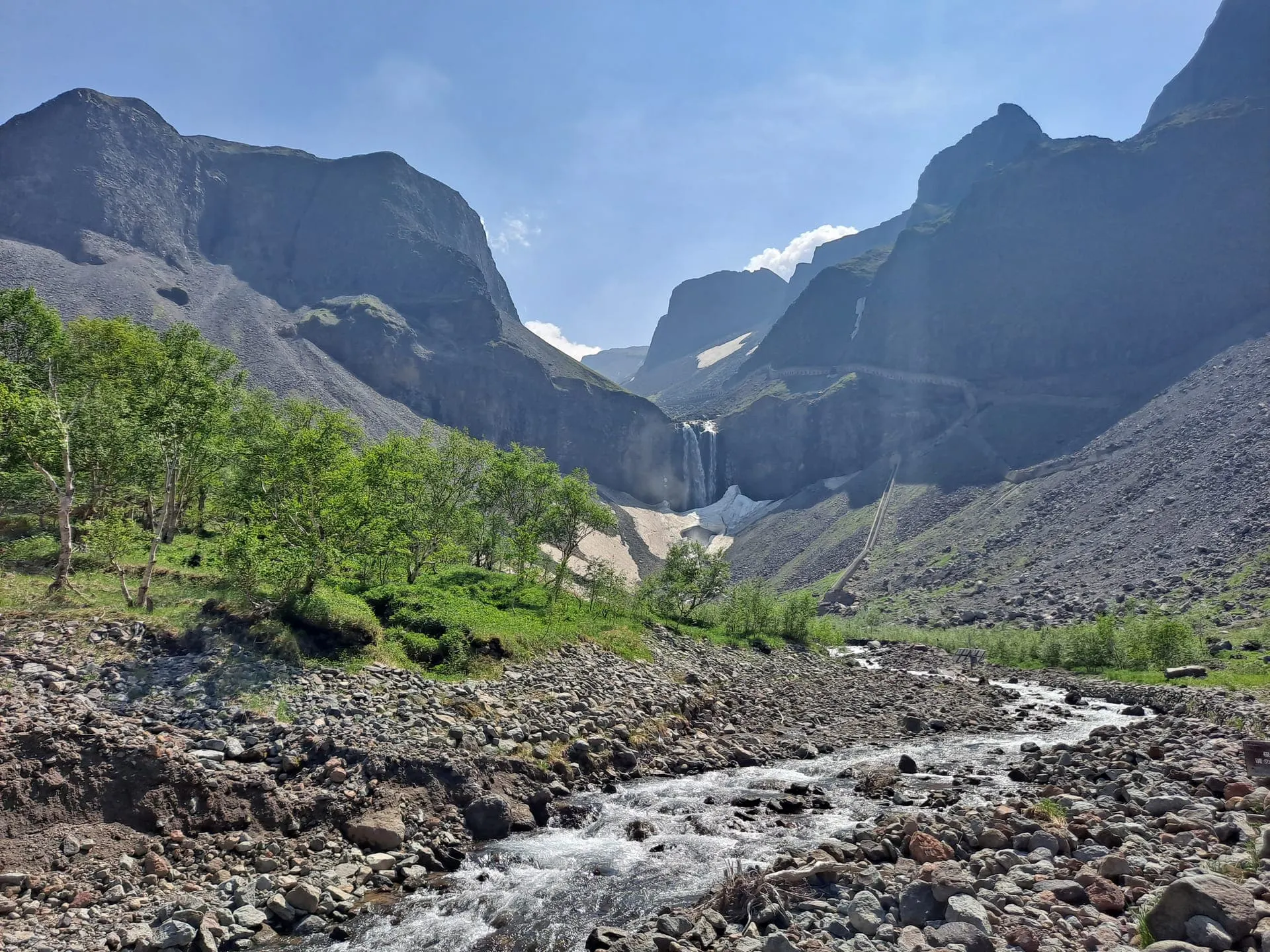
A 68-meter waterfall on the north face, where the overflow from Tianchi cascades over a black volcanic cliff. It is the source of the Songhua River (松花江, Sōnghuā Jiāng) and the most dramatic waterfall in northeast China. In winter the falls partially freeze into spectacular ice formations; in summer the spray creates rainbows in the morning sun. A 1.5 km boardwalk from the North Slope shuttle stop leads to the viewing platform. Accessible year-round. The walk passes the hot spring zone — steaming vents and mineral-stained rock in vivid yellows, greens, and oranges. Included in the park entry ticket.
Wikimedia Commons · CC-BY-SA
Underground Forest (地下森林, Dìxià Sēnlín)
A surreal sunken forest in a volcanic collapse crater on the North Slope, where full-grown pine and birch trees grow 50-70 meters below the surrounding ground level. A 3 km boardwalk loop descends into the crater, ending at a viewpoint over the forest floor far below. The microclimate is cooler and wetter than the surface, and the silence is remarkable. Allow 1.5-2 hours for the full loop. Included in the park entry. Best in autumn when the birch leaves turn gold.
Wikimedia Commons · CC-BY-SA
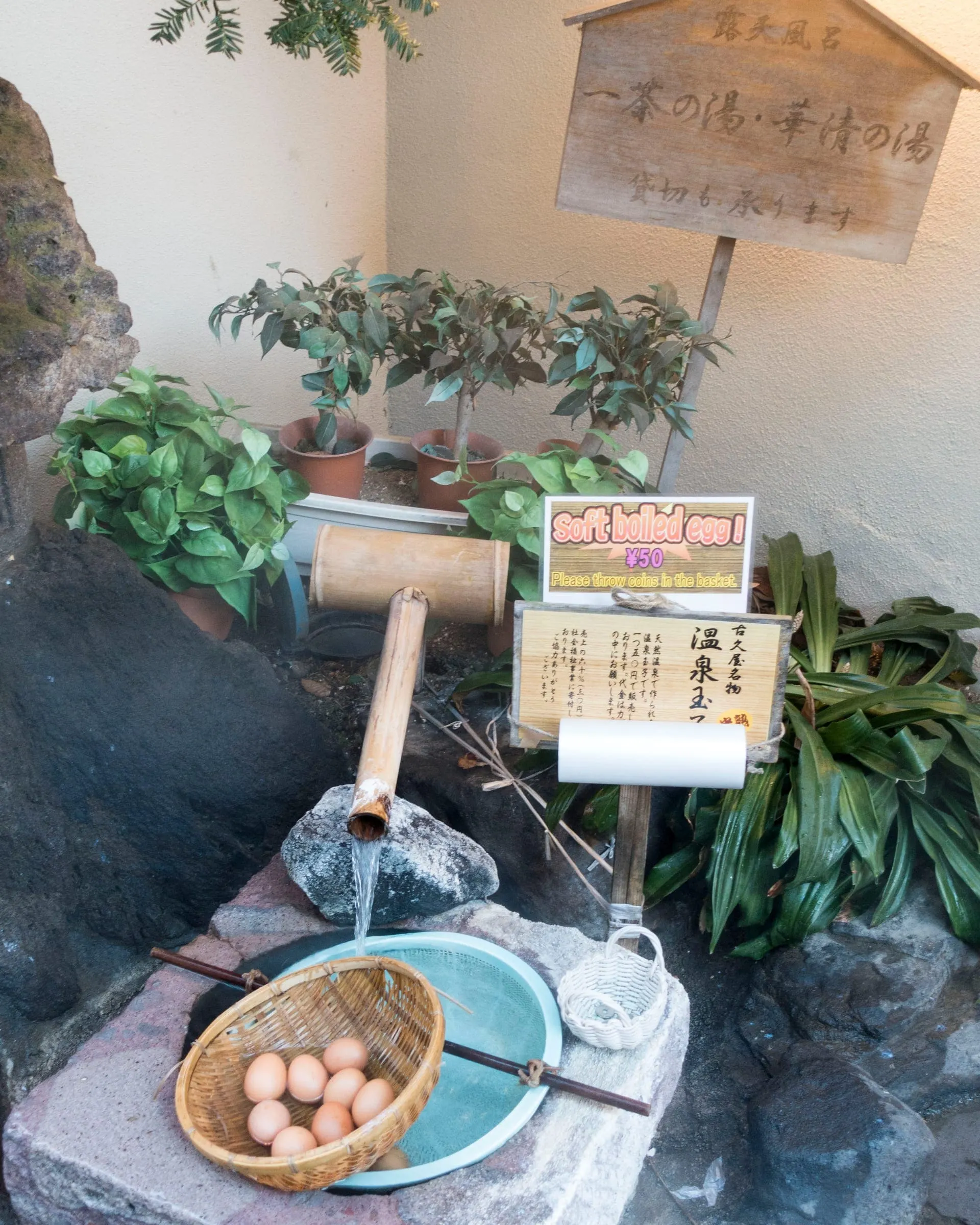
Changbaishan Hot Springs (长白山温泉, Chángbáishān Wēnquán)
A geothermal field on the North Slope with dozens of steaming vents, boiling pools, and mineral deposits in vivid colours — sulphur yellow, iron red, copper green. The hot-spring area sits along the boardwalk to the waterfall. Vendors sell eggs boiled in the 83°C spring water (温泉鸡蛋, wēnquán jīdàn) — the whites are soft and custardy, the yolks firm, and they are the well-known Changbaishan snack (¥10 for 3). Several resort hotels outside the park pump in hot-spring water for outdoor thermal pools — the best way to end a day of hiking in any season.
Wikimedia Commons · CC-BY-SA
Small Heavenly Lake (小天池, Xiǎo Tiānchí)
A smaller, quieter crater lake about 1 km from the main waterfall shuttle stop on the North Slope, ringed by birch forest. Less dramatic than Tianchi but far more reliable — it is visible every day regardless of summit weather. The lake is a deep green and the surrounding forest is beautiful in autumn (late September). A 30-minute loop walk circles the lake. Included in the park entry.
Wikimedia Commons · CC-BY-SA
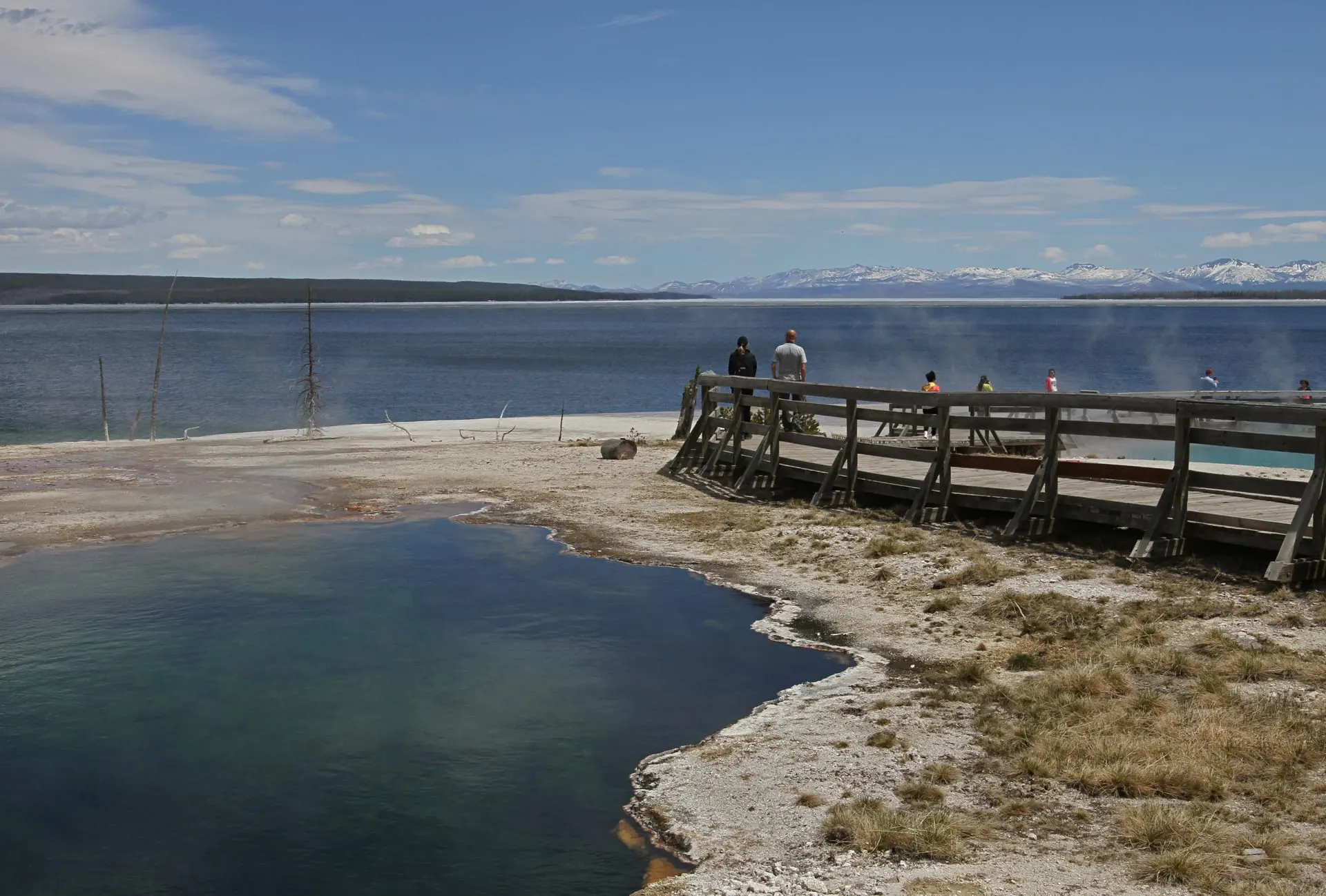
Green Abyss Pool (绿渊潭, Lǜyuān Tán)
An emerald-green plunge pool fed by a 26-meter waterfall on the North Slope, surrounded by a wooden boardwalk. The water colour comes from dissolved minerals and the depth of the pool. It is photogenic in any season and particularly dramatic in winter when the waterfall freezes into a curtain of blue ice. A 20-minute detour from the main shuttle route. Included in the park entry.
Wikimedia Commons · CC-BY-SA
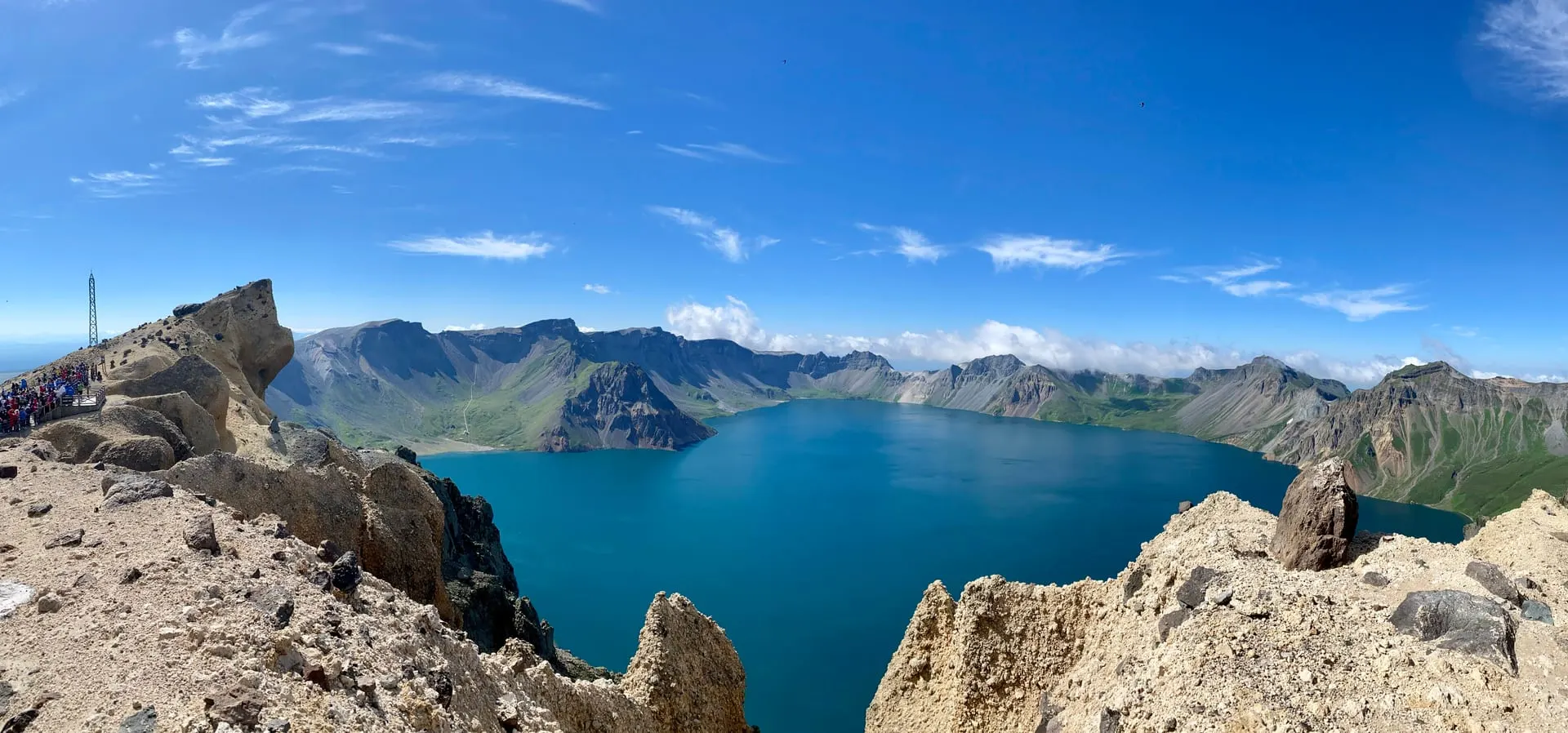
Changbaishan International Ski Resort (长白山国际滑雪场)
The best ski resort in northeast China, on the West Slope near the万达 (Wanda) resort complex. 43 trails across 7 km², with a vertical drop of 350 m and a season running roughly late November to late March. The snow is natural, dry, and reliable — Changbaishan gets heavy snowfall from Siberian fronts and the powder can be genuinely excellent. The resort has beginner, intermediate, and advanced terrain, plus a terrain park. Lift tickets ¥400-600/day depending on season; equipment rental ¥200-300/day. The resort hotels (Hyatt, Sheraton, Westin, Holiday Inn) offer ski-in/ski-out access. Summer operations include a gondola for sightseeing and mountain biking.
Wikimedia Commons · CC-BY-SA
STAY
Where to stay in Changbaishan
Pick a base that matches the trip you want — imperial-central for sightseeing, hutong belt for character, Chaoyang for nightlife, or Qianmen for budget.
North Slope base (北坡山门)
Closest to waterfall, hot springs, and most attractions — best for first-time visitors and hikers
#north-slope-baseWest Slope resort (万达度假区)
International chain hotels, ski-in/ski-out, upscale dining — best for skiers and comfort-focused travelers
#west-slope-resortErdaobaihe town (二道白河镇)
Real town near North Slope with budget guesthouses, Korean restaurants, supermarkets — best for backpackers
#erdaobaiheYanji (延吉) — gateway city
Korean-Chinese cultural capital 180 km away, airport + HSR, excellent food — best for combining with Changbaishan
#yanji
ITINERARIES
Sample itineraries from Changbaishan
Three ready-made routes, from a 1-day imperial sprint to a 5-day deep dive. Copy the day-by-day plan and adapt to your own pace.
- 1 DAY
Changbaishan Express: North Slope in One Day
A fast-paced day covering the North Slope highlights: summit attempt, waterfall, hot springs, and the Underground Forest.
- Time-limited travelers
- Transit stops
- Gambling on a clear summit day
- Day 01
Morning
Arrive at North Slope gate by 07:30 (earliest entry). Take shuttle to summit transfer station, then summit shuttle to crater rim. If Tianchi is visible — stay, photograph, absorb. Allow 1-1.5 hours at the summit.
Afternoon
Descend to the waterfall shuttle stop. Walk the hot-spring boardwalk to Changbai Waterfall (1.5 km, 40 min). Eat hot-spring eggs (¥10/3). Continue to Small Heavenly Lake and Green Abyss Pool (1 hour). Late afternoon: Underground Forest boardwalk loop (3 km, 1.5 hours).
Evening
Exit park by 17:00. Hot-spring soak at a North Slope hot-spring hotel (¥150-250 day access). Dinner at a Korean restaurant in Erdaobaihe town.
- 2 DAYS
Changbaishan Two Slopes: North + West
The best strategy for maximizing Tianchi visibility — two summit attempts from different slopes, plus the best of both sides.
- First-time visitors who want the best odds
- Photographers
- Hikers
- Day 01
Morning
North Slope: summit attempt at 07:30. If clear — Tianchi. If not — waterfall and hot springs first, check summit conditions again mid-morning. Changbai Waterfall and hot-spring walk (2 hours).
Afternoon
Small Heavenly Lake loop. Green Abyss Pool. Underground Forest boardwalk (3 km, 1.5 hours). Late lunch at park cafe.
Evening
Hot-spring soak at North Slope hotel. Korean BBQ dinner in Erdaobaihe town. Stay overnight at North Slope base.
- Day 02
Morning
Transfer to West Slope (1.5 hours, ¥300-400 taxi, leave by 06:30). Enter West Slope by 08:00. Take shuttle to the trailhead, then hike 1.4 km to the West Slope crater rim — this side gives the fuller Tianchi panorama. Allow 3 hours round-trip.
Afternoon
Summer: walk the Wildflower Zone (July-August). Winter: ski half-day. All seasons: gondola ride for mountain views. Lunch at West Slope resort.
Evening
Transfer back to North Slope or directly to Changbaishan Airport/HSR station. If time allows, final hot-spring soak.
- 3 DAYS
Changbaishan + Yanji Korean Culture Loop
Combine Changbaishan with Yanji — the most Korean city in China — for a northeast China trip that mixes volcanic drama with food culture.
- Food travelers
- Culture enthusiasts
- Travelers flying into/out of Yanji
- Day 01
Morning
Arrive Yanji by flight or HSR. Morning: Yanji Dinosaur Museum, Yanbian University campus walk, Yanji Park (people-watching, outdoor K-pop dance groups).
Afternoon
Korean lunch: cold noodles (Naengmyeon, ¥25) at a local restaurant. Explore the Korean Folk Village. Shop for Korean cosmetics and snacks on the main pedestrian street.
Evening
Korean BBQ dinner (¥80-150/person). Walk Yanji's neon-lit streets — Korean and Chinese signage side by side, K-pop from every shop. Stay overnight in Yanji.
- Day 02
Morning
Early transfer to Changbaishan North Slope (3 hours by car, ¥400-500, leave by 06:00). Arrive by 09:00. North Slope: summit attempt, waterfall, hot springs, Underground Forest (full day).
Afternoon
Continue North Slope attractions. Hot-spring eggs. Small Heavenly Lake and Green Abyss Pool.
Evening
Hot-spring soak at North Slope hotel. Dinner at Korean restaurant in Erdaobaihe. Stay overnight at North Slope base.
- Day 03
Morning
Second summit attempt from North Slope if yesterday was clouded. Otherwise, transfer to West Slope for a different perspective (1.5 hours). Hike West Slope trail to crater rim.
Afternoon
Return to Yanji (3 hours). If time: Yanbian Museum for Korean-Chinese history. Final Korean meal — try spicy rice cakes (Tteokbokki, ¥20-30) and Korean fried chicken.
Evening
Fly out of Yanji or take evening HSR to next destination.
BUDGET
What a Changbaishan trip costs
Per-person, per-day costs across three spending tiers. Excludes international flights and visa fees.
| Line item | Backpacker | Mid-range | Luxury |
|---|---|---|---|
| Hostel / budget guesthouse (per night) | $12 | $25 | $60 |
| Mid-range hotel / resort hotel (per night) | $40 | $80 | $250 |
| Park entry + shuttle + summit shuttle (per slope) | $32 | $32 | $42 |
| Local meal (per person) | $5 | $10 | $25 |
| Korean BBQ dinner (per person) | $12 | $20 | $40 |
| Ski lift ticket (winter, per day) | $55 | $70 | $85 |
| Ski equipment rental (per day) | $30 | $40 | $50 |
| Hot-spring day access | $20 | $30 | $40 |
| Taxi between North and West Slope | $40 | $50 | $60 |
| Daily total (excluding accommodation) | $50 | $80 | $200 |
| Total per day | $296 | $437 | $852 |
$ USD per person per day, before international flights and visas. Last verified: Q3 2026.
STAY SAFE
Emergency contacts in Changbaishan
Save these three numbers before you board the plane. China uses different hotlines than most countries — there's no 911.
- POLICE
110
- AMBULANCE
120
- FIRE
119
- TOURIST HOTLINE
12301
- ENGLISH-SPEAKING ER
Yanbian University Hospital (延边大学附属医院) in Yanji — 132 Juzi Street, Yanji, +86 433 266 0000. For summit emergencies, alert park staff or shuttle-bus drivers — they are trained in first response. Medical evacuation from the mountain may be required for serious injuries.
Problems travelers hit in Changbaishan
- Why is my Alipay not working?You linked a foreign Visa or Mastercard to Alipay but every transaction is rejected at the merchant.
- My China visa was denied — what now?Your L visa application was refused at the Chinese consulate and your trip is in 2–4 weeks.
- My passport was lost or stolen in China — what do I do?Your passport is gone (theft or loss) and you're in mainland China without travel documents.
- Why can't I book on 12306 with my foreign card?You tried to book a high-speed rail ticket on 12306.cn and your foreign Visa/Mastercard is rejected at checkout.
- Why is my VPN not working in China?You arrived in China, opened your VPN, and it will not connect at all or connects but no traffic loads.
- Why can't I book a Tibet trip on my own?You try to book Lhasa flights and hotels yourself but the booking fails, or you're turned away at the Lhasa airport without a permit.
Book activities in Changbaishan
These are licensed tour operators and booking platforms we've vetted independently. Booking through these links may earn us a commission — see our affiliate disclosure. This never affects our editorial recommendations or the price you pay.
Frequently asked questions
How likely am I to see Tianchi?
Which slope is better: North or West?
When is the best month to visit Changbaishan?
How do I get from Beijing to Changbaishan?
Can I see North Korea from Changbaishan?
What should I pack for Changbaishan?
Show all 21 FAQs
How much does it cost to visit Changbaishan?
Is Changbaishan family-friendly?
Can you swim in Tianchi?
Is there a cable car to the summit?
What are the hot-spring eggs and should I try them?
Is Changbaishan a good ski destination compared to Japan or Europe?
Can I visit Changbaishan in winter without skiing?
Do I need a guide for Changbaishan?
What is the closest city to Changbaishan?
Can I see Siberian tigers in the wild at Changbaishan?
When does the autumn foliage peak at Changbaishan?
Is Yanji worth a stop on the way to or from Changbaishan?
Are the hot springs safe to soak in?
Can I cross into North Korea from Changbaishan?
Do I need to book hotels in advance for Changbaishan?
References

Related guides & destinations
Guide
China for Adventure Travelers 2026: Hiking, Cycling, Climbing, and Rafting
China’s best outdoor adventures: Tiger Leaping Gorge trek, Great Wall camping, Huangshan and Zhangjiajie hiking, Erhai Lake and Yangshuo cyc
Guide
How We Research 2026: NihaoVisit’s Methodology for China Travel Information
How NihaoVisit sources, verifies, and maintains 700+ pages of China travel information — our source hierarchy, fact-checking process, update
Guide
Fact-Checking Log 2026: Verified China Travel Information — NihaoVisit
A public log of fact-checking verification passes on NihaoVisit, showing what was verified, when, and against which sources — covering visa
Guide
Best Time to Visit China 2026: Month-by-Month Weather, Crowds, and Prices
The best time to visit most of China is April–May and September–October. Winter (Dec–Feb) is cold but cheap; summer (Jun–Aug) is hot and cro
Guide
VPN for China 2026: Which VPNs Work, eSIM Alternatives, and the Complete Pre-Trip Checklist
Most Western apps and websites are blocked in mainland China. A reliable VPN is essential for Google, Gmail, WhatsApp, Instagram, and most n
Guide
China SIM Card and eSIM Guide 2026: Stay Connected Without WeChat
A Chinese SIM or eSIM lets you use mobile data, maps, and ride-hailing without WiFi. Here is how to get one, the cost, and which provider to