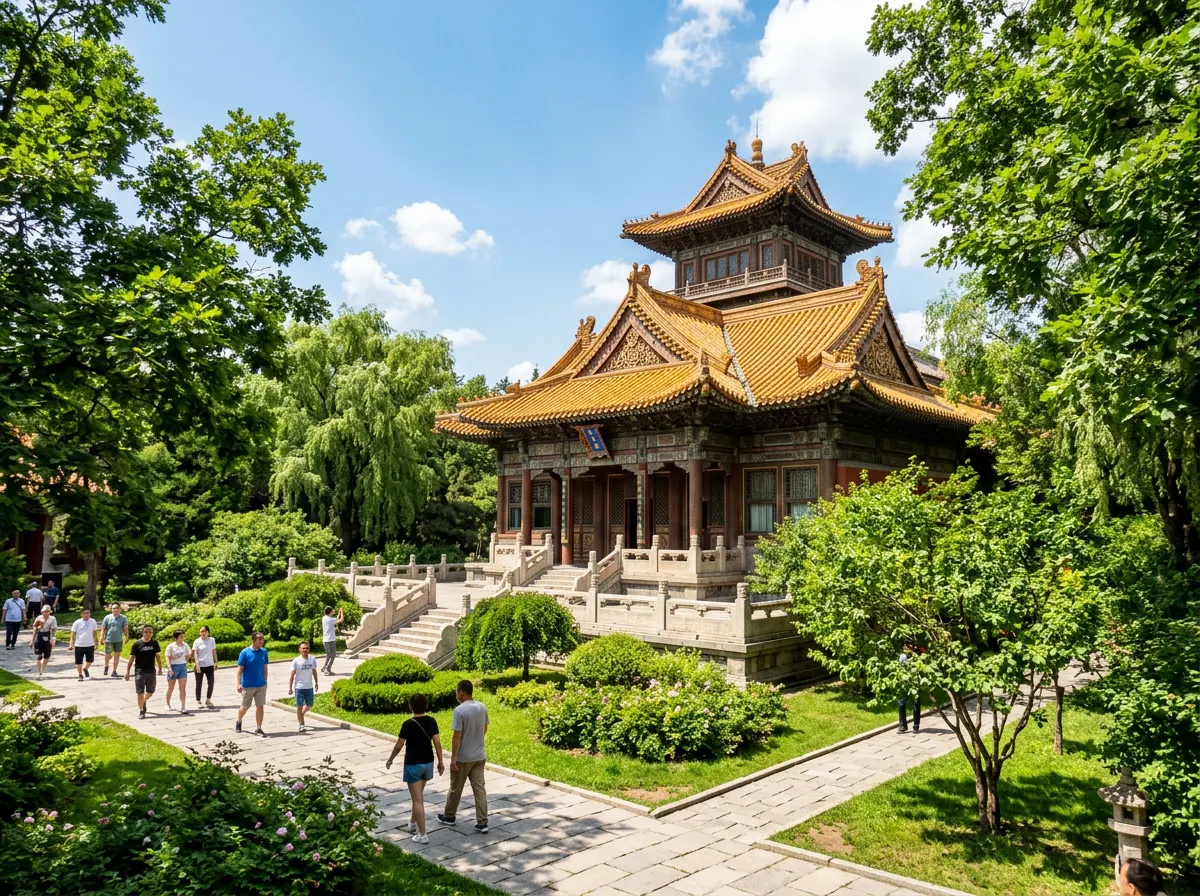
Changchun
Changchun (长春, Chángchūn — "Long Spring") is the capital of Jilin province in China's northeast (东北, Dōngběi), a city of 9 million whose name is a cruel joke: the winter lasts six months, the temperature drops to -25°C, and the "long spring" is about three weeks in April. The city's modern identity was forged by two forces. First, the Japanese occupation: between 1932 and 1945, Changchun was renamed Xinjing (新京, "New Capital") and served as the capital of Manchukuo (满洲国), the puppet state Japan installed in northeast China with the last Qing emperor, Puyi (溥仪), as its figurehead. The Japanese built a modern capital from scratch — broad European-style boulevards, imposing government buildings, a comprehensive railway system — and the architectural legacy survives in the Puppet Emperor's Palace (伪满皇宫, Wěi Mǎn Huánggōng) and the cluster of Japanese-era government buildings around People's Square (人民广场). Second, the automobile: after 1949, Changchun became the center of China's auto industry. First Automobile Works (FAW, 第一汽车制造厂) produced China's first domestically manufactured vehicle — the Hongqi (红旗, "Red Flag") limousine — and remains one of the country's largest automakers. The city's wide boulevards, built by the Japanese, proved perfect for an auto city. Today, Changchun is a northeastern industrial hub with a distinctive architectural heritage, a strong film industry (the Changchun Film Studio was China's first post-1949 film production base), and a winter ice-festival culture that rivals Harbin's at a fraction of the crowds. Two full days covers the main sights. Budget roughly ¥200-400 per day for mid-range comfort.
Why Changchun in 2026.
Jilin's capital — the former Manchukuo puppet capital, China's Detroit for auto manufacturing, and a northeastern city of broad boulevards, Russian architecture, and winter ice festivals that few foreign travelers ever see.
Quick Answer
Changchun (长春, Chángchūn — "Long Spring") is the capital of Jilin province in China's northeast (东北, Dōngběi), a city of 9 million whose name is a cruel joke: the winter lasts six months, the temperature drops to -25°C, and the "long spring" is about three weeks in April. The city's modern identity was forged by two forces. First, the Japanese occupation: between 1932 and 1945, Changchun was renamed Xinjing (新京, "New Capital") and served as the capital of Manchukuo (满洲国), the puppet state Japan installed in northeast China with the last Qing emperor, Puyi (溥仪), as its figurehead. The Japanese built a modern capital from scratch — broad European-style boulevards, imposing government buildings, a comprehensive railway system — and the architectural legacy survives in the Puppet Emperor's Palace (伪满皇宫, Wěi Mǎn Huánggōng) and the cluster of Japanese-era government buildings around People's Square (人民广场). Second, the automobile: after 1949, Changchun became the center of China's auto industry. First Automobile Works (FAW, 第一汽车制造厂) produced China's first domestically manufactured vehicle — the Hongqi (红旗, "Red Flag") limousine — and remains one of the country's largest automakers. The city's wide boulevards, built by the Japanese, proved perfect for an auto city. Today, Changchun is a northeastern industrial hub with a distinctive architectural heritage, a strong film industry (the Changchun Film Studio was China's first post-1949 film production base), and a winter ice-festival culture that rivals Harbin's at a fraction of the crowds. Two full days covers the main sights. Budget roughly ¥200-400 per day for mid-range comfort.
| Worth visiting | Yes, if you are interested in World War II history from the Asian perspective, early-20th-century architecture, or industrial heritage. The Puppet Emperor's Palace is one of China's most unusual historical sites — the palace where the last emperor lived as a Japanese puppet — and the city's Japanese-era boulevards and buildings are unlike anything else in China. |
|---|---|
| Recommended days | 2-3 days |
| Best time to visit | May-June (spring flowers, comfortable temperatures) and September-October (autumn colors, crisp air). January-February for the ice festival. Avoid the depth of winter (December-February) if you dislike extreme cold (-20 to -25°C is normal) |
| Daily budget | $30 (backpacker) / $80 (mid-range) / $200+ (luxury) |
| Family friendly | Yes — the Puppet Emperor's Palace is educational for older children, the Changchun Film Studio theme park is genuinely fun for families, and the winter ice festival is magical for kids. The extreme winter cold is the main challenge for young children |
| Solo friendly | Yes — compact, safe, good metro, and the historical sites work well for solo exploration |
| Airport | Changchun Longjia International Airport (CGQ) — 35 km east of the city. Flights from Beijing (2h), Shanghai (3h), Seoul (2h), Tokyo (3h). Metro Line 2 connects to the airport (¥8, 50 min) or taxi ¥100-130 (45 min) |
| High-speed rail | Yes — Changchun Station (长春站) and Changchun West (长春西站): Harbin (1h), Shenyang (1.5h), Beijing (4.5h), Dalian (3h). The Harbin-Dalian HSR line makes Changchun a natural stop between the two |
| Language | Mandarin with strong Dongbei (东北) dialect — distinctive accent, colorful slang, generally friendly and direct. English is rare outside international hotels and the Puppet Emperor's Palace |
| Currency | CNY (¥) — Alipay and WeChat Pay work everywhere. Cash useful for street-food stalls and winter market vendors |
| Time zone | China Standard Time (UTC+8) |
| Last updated | 2026-06-18 |
Want a Changchun plan built for you?
Jump to:
Why Visit·Manchukuo & Puyi·Puppet Emperor's Palace·Japanese Architecture·Film Studio·Getting There·Getting Around·Where to Stay·Itineraries·When to Go·Food·Winter Survival·Practical Tips·Emergency Contacts·FAQ
Why visit Changchun? Is a northeastern industrial city worth the trip?
Changchun is not on any standard foreign-tourist China itinerary, and that is both its weakness and its appeal. It is a northeastern industrial city — wide boulevards, Soviet-style apartment blocks, a working auto plant — with a single extraordinary historical site (the Puppet Emperor's Palace), a distinctive architectural heritage (Japanese colonial-era buildings), and a winter culture that few foreign travelers experience. The case for Changchun rests on three things. First, the Puppet Emperor's Palace — the residence of Puyi (溥仪), China's last emperor, during his years as the figurehead ruler of the Japanese puppet state of Manchukuo (1932-1945). The palace is a genuinely unusual historical site: a hybrid of Japanese modernism and Chinese imperial symbolism, filled with the personal effects of a man who was emperor at age 2, puppet at 26, prisoner of war at 39, and a gardener in Mao's China at 53. Puyi's life story — told in Bernardo Bertolucci's 1987 film The Last Emperor — is one of the most extraordinary biographies of the 20th century, and the palace where he lived his puppet years is the best place to encounter it. Second, the Japanese architectural legacy. Changchun was built as a modern capital by the Japanese between 1932 and 1945, and the city's layout — broad, tree-lined boulevards radiating from circular plazas, government buildings in a distinctive "Asia Revival" style — survives more intact than in any other former Japanese-occupied city. The Eight Departments of Manchukuo (伪满八大部) on Xinmin Street are a time capsule of 1930s colonial architecture, and walking them gives you a sense of what the Japanese envisioned for their mainland empire. Third, the winter culture. Changchun's winter is long (November through March), cold (-20 to -25°C is normal in January), and dark (sunset at 16:00). The city has adapted with an ice-and-snow festival that rivals Harbin's at a fraction of the crowds, a cross-country ski culture centered on Jingyuetan Park, and a winter food scene built around hot pot, grilled meat, and the hearty, calorie-dense cuisine of China's northeast. The honest downside: Changchun is not a beautiful city. The architecture outside the Japanese-era core is functional Soviet-style blocks and generic modern high-rises. The city is industrial — FAW's auto plant employs 120,000 people and the city's identity is tied to manufacturing. The winter is genuinely punishing. The food is hearty but unrefined. Changchun is a destination for travelers who want to understand a specific piece of 20th-century Chinese history and experience a Chinese city that is not curated for tourists. If you want beautiful scenery, go to Guilin. If you want to stand in the rooms where the last emperor lived as a puppet, and walk the boulevards built by a colonial power for a state that no longer exists, Changchun delivers.
What was Manchukuo, and who was Puyi?
Manchukuo was a Japanese puppet state in Manchuria from 1932 to 1945. The state was presented to the world as an independent country, but it was controlled entirely by the Japanese Kwantung Army, which appointed Japanese officials to all key positions and dictated policy from the commander's office. The Japanese installed Puyi (溥仪, Pǔyí, 1906-1967) — the last emperor of the Qing dynasty — as the "Chief Executive" of Manchukuo (later "Emperor" in 1934). Puyi had been emperor of China from 1908 to 1912 (ages 2 to 6), then lived in exile in the Forbidden City until he was expelled in 1924. The Japanese found him in Tianjin, promised him the restoration of his throne, and installed him in Changchun — renamed Xinjing (新京, "New Capital") — as a figurehead. Puyi had no real power. His palace was bugged. His phone was tapped. His decisions were vetted by Japanese advisors. He was a prisoner in a palace, performing imperial rituals for a state that existed only on paper. Manchukuo lasted 13 years. During that time, the Japanese built a modern infrastructure — railways, highways, dams, factories, and a planned capital city with European-style boulevards and modern buildings — using forced Chinese labor. The state was used as a base for Japan's invasion of the rest of China (1937) and as a resource-extraction colony (Manchurian coal, iron, and soybeans fueled the Japanese war machine). The occupation was brutal: millions of Chinese civilians were conscripted for forced labor, and the infamous Unit 731 (a biological warfare research unit that conducted experiments on live human subjects) was headquartered in Harbin, 240 km north. When Japan surrendered in August 1945, Puyi attempted to flee to Japan but was captured by Soviet troops at Shenyang airport. He spent five years in Soviet custody, testified at the Tokyo War Crimes Tribunal (where he described his puppet status), and was extradited to China in 1950. He spent 10 years in a re-education camp, was released in 1959, and lived out his final years as a gardener at the Beijing Botanical Garden and then as a researcher at the Chinese People's Political Consultative Conference. He died in 1967, age 61, during the Cultural Revolution. Puyi's autobiography, From Emperor to Citizen (我的前半生, Wǒ de Qiánbànshēng, 1964), is a fascinating, self-serving, and deeply sad account of his life. It was ghostwritten, heavily edited by the Communist Party for propaganda purposes, and should be read critically — but it is the primary source for understanding the mind of the last emperor. The Puppet Emperor's Palace in Changchun preserves the physical setting of this story. The palace is not grand — it is a converted salt-tax office with Japanese additions — but walking its rooms, seeing Puyi's study, his throne room, his wife's quarters, and the air-raid shelter where he hid from Allied bombing, gives you a tangible sense of what it meant to be a puppet emperor in a puppet state.
How do you get to Changchun?
Changchun is the transportation hub of central northeast China, well-connected by HSR and air. BY HIGH-SPEED RAIL: Changchun has two HSR stations. Changchun Station (长春站) is the older station in the city center, served by Metro Lines 1 and 3, with G-class high-speed trains and conventional trains. Changchun West (长春西站) is the newer HSR station 12 km west of the center, on Metro Line 2, serving primarily G-class high-speed trains on the Harbin-Dalian line. Key HSR connections from Changchun Station: Harbin (1 hour, ¥90-120 second class), Shenyang (1.5 hours, ¥140-180), Dalian (3 hours, ¥280-350), Beijing (4.5 hours, ¥400-520). From Changchun West: Harbin West (1 hour), Shenyang (1.5 hours), Dalian North (2.5 hours). Both stations are modern with English signage. Book on 12306 or Trip.com 1-7 days ahead. The Harbin-Changchun-Shenyang-Dalian HSR line is one of China's busiest, and Changchun is a natural stop between Harbin and Shenyang. A classic northeast China itinerary — Harbin (2-3 days) → Changchun (2 days) → Shenyang (2 days) → Dalian (2 days) — is easily done by HSR, with each leg 1-2 hours. BY AIR: Changchun Longjia International Airport (CGQ) is 35 km east of the city center. It handles domestic flights from Beijing (2h, ¥600-1,200), Shanghai (3h, ¥800-1,500), Guangzhou (4h, ¥1,000-2,000), and most major Chinese cities, plus international flights from Seoul (2h), Tokyo (3h), and a growing number of Asian destinations. Metro Line 2 connects the airport to the city center (¥8, 50 minutes). A taxi costs ¥100-130 (45 minutes). The airport is modern and efficient, with English signage. BY CONVENTIONAL TRAIN: Changchun Station also serves overnight sleeper trains from Beijing (8-10 hours, ¥260-350 for a hard sleeper) and other cities. The HSR has largely replaced sleepers for domestic travel, but the overnight option is available and saves a hotel night. GETTING AROUND THE NORTHEAST: Changchun is ideally positioned for exploring China's northeast. Harbin (哈尔滨) is 1 hour north — the "Ice City" with its world-famous winter festival and Russian architecture. Shenyang (沈阳) is 1.5 hours south — the Manchu imperial palace and the 9.18 Memorial Museum. Dalian (大连) is 3 hours south — the port city with Russian and Japanese heritage and beaches. Jilin City (吉林市) is 40 minutes east — the Rime Island (雾凇岛) phenomenon where winter fog freezes on trees along the Songhua River, creating a surreal white landscape. A 7-10 day northeast loop starting and ending in Beijing or Dalian is one of China's most underrated travel experiences.
How do you get around Changchun?
Changchun has an efficient metro system, an extensive bus network, and the wide boulevards that make taxi and DiDi travel fast. METRO: Five lines (1, 2, 3, 4, 8) as of June 2026, with more under construction. Line 1 runs north-south through the city center, serving Changchun Station, People's Square (人民广场), and the Puppet Emperor's Palace area. Line 2 runs east-west, connecting Changchun West Station, the city center, and the airport (eastern extension). Lines 3 and 4 are light rail lines serving the southern and northern suburbs. Fares are ¥2-6 depending on distance. Signs and announcements are in Chinese and English. Pay with Alipay's transport QR code or buy single-journey tickets from machines. Trains run roughly 06:00-22:00. The most useful metro stops for visitors: Changchun Station (Lines 1, 3 — city center, transport hub), People's Square (人民广场, Line 1 — Japanese-era government buildings), Weixing Square (卫星广场, Line 1 — near the Puppet Emperor's Palace, 15-minute walk or short taxi), Jingyuetan (净月潭, Line 3 — forest park), and Changchun West Station (长春西站, Line 2). TAXI AND DIDI: Taxis are plentiful with flagfall of ¥8 for the first 2.5 km, then ¥2 per km. A ride within the city center costs ¥10-20. DiDi works well in Changchun and is often easier than hailing a taxi — the app handles language and payment. Taxi drivers speak the Dongbei dialect with a strong accent; have your destination written in Chinese characters. BUSES: ¥1-2 flat fare, extensive coverage, but Chinese-only announcements and signs. The tram network (有轨电车) — including a historic tram line from the Manchukuo era — still operates on Line 54 (Hongqi Street to Xi'an Road) and is a charming way to see the city's older neighborhoods. ¥1 per ride. WALKING: Changchun's Japanese-era boulevards are broad, tree-lined, and pleasant for walking in good weather. The Puppet Emperor's Palace area, Xinmin Street (the Eight Departments), and People's Square are all within a walkable radius — about 3 km from the Palace to People's Square. In winter, walking is possible but unpleasant — the cold is penetrating, the sidewalks can be icy, and you will want to limit outdoor time to 30-45 minutes between indoor warm-up stops.
What is the Puppet Emperor's Palace, and how should you visit it?
The Puppet Emperor's Palace (伪满皇宫博物院, Wěi Mǎn Huánggōng Bówùyuàn) is the single essential site in Changchun and the reason most visitors come to the city. It is the complex where Puyi — the last Qing emperor — lived from 1932 to 1945 as the figurehead ruler of the Japanese puppet state of Manchukuo. The "palace" is misleadingly named. It is not a grand imperial compound like Beijing's Forbidden City — it is a converted government office building (originally the Jilin-Heilongjiang Salt Tax Bureau) that the Japanese renovated and expanded into a residence and administrative complex. The architecture is a bizarre and revealing hybrid: Japanese modernism (clean lines, functional layouts, Western-style interiors) with Chinese imperial motifs (yellow-glazed roof tiles, dragon decorations, ceremonial gates) awkwardly applied. The hybrid style perfectly expresses Puyi's situation: a Chinese emperor in a Japanese-controlled state, performing tradition for an audience that was not watching. The palace has two main sections. The Inner Court (内廷, Nèitíng) is the residential area — Puyi's study, his bedroom, his wife Wanrong's quarters, the family dining room, and the Buddhist shrine where Puyi prayed. The rooms are preserved with original or period-appropriate furnishings: Puyi's Western-style bed, his desk with the telephone that was tapped by the Japanese, the gramophone he used to listen to Western classical music (he was an obsessive record collector). The study is the most atmospheric room — Puyi's desk, his books, his personal seal, and the sense of a man who spent his days signing documents he had not written and could not change. The Outer Court (外廷, Wàitíng) is the ceremonial area — the throne room, the audience halls, the banquet hall, and the offices of Puyi's Japanese "advisors." The throne room is the visual climax: a Chinese imperial throne (carved dragons, yellow silk) in a Western-style room with a Japanese-influenced ceiling, watched over by a portrait of Puyi in imperial robes. The effect is simultaneously impressive and pathetic — the throne of an emperor who ruled nothing. Other key areas: the Tongde Hall (同德殿), the largest building in the complex, added in 1938 and designed to look more Japanese than Chinese (the Japanese were tightening control); the air-raid shelter in the courtyard where Puyi hid during Allied bombing raids; and the exhibition halls covering the history of the Japanese occupation of Manchuria, including the atrocities committed by Unit 731 and the forced-labor system. HOW TO VISIT: The palace is open 08:30-17:00 (last entry 16:00) in summer and 09:00-16:30 in winter. Entry is ¥80 as of June 2026. The English audio guide (¥30) is essential — the story is complex, the Chinese-only signage assumes knowledge of Chinese history, and the audio guide provides the biographical and historical context that makes the palace meaningful. Allow 2-3 hours. Visit in the morning — the palace is quieter before 10:00. The palace is located at 5 Guangfu Road North (光复北路5号), about 3 km east of People's Square. Take Metro Line 1 to Weixing Square (卫星广场), then walk 15 minutes or take a taxi (¥10). Bus 264 stops directly at the palace entrance. The palace is a museum of a specific, uncomfortable history. It does not glorify Puyi or Manchukuo — the exhibitions are critical of the Japanese occupation and Puyi's collaboration. It is a site for understanding, not celebration, and it is one of the most historically dense and emotionally complex museum experiences in China.
What is the Japanese architectural legacy in Changchun?
Changchun's urban form — the broad boulevards, the circular plazas, the tree-lined avenues — is a Japanese colonial creation. When the Japanese made Changchun the capital of Manchukuo in 1932, they built a planned city from scratch, designed by Japanese urban planners and architects who were influenced by European city planning (particularly Haussmann's Paris and the City Beautiful movement in the United States) and Japanese modernism. The city's layout radiates from Datong Square (大同广场, now People's Square/人民广场), with eight boulevards extending outward like spokes. Government buildings, banks, and cultural institutions lined these boulevards, built in a style the Japanese called "Asia Revival" (興亞式, Xīngyà Shì) — a fusion of Western neoclassical massing, Japanese modernist detailing, and Chinese traditional roof forms. The style was intended to project Manchukuo's official ideology of "ethnic harmony" (五族協和) among Chinese, Manchu, Japanese, Korean, and Mongol peoples, while in reality the state was a Japanese-run dictatorship. The best-preserved Japanese-era buildings are the Eight Departments of Manchukuo (伪满八大部), clustered on Xinmin Street (新民大街) — a 1.5-km boulevard that was the government district of the puppet state. Key buildings: - The former State Council (now Jilin University Medical School, 新民大街828号): The largest and most impressive of the Eight Departments, a massive structure with a central tower and Chinese-style roof on a Western neoclassical body. The building housed the Manchukuo cabinet and is the best single example of the Asia Revival style. - The former Justice Ministry (now Jilin University Bethune Medical Department, 新民大街828号): A more restrained design with Art Deco influences and a Chinese roof. The courtyard has a statue of Norman Bethune, the Canadian doctor who served with the Communist forces and is a hero in China. - The former Foreign Affairs Ministry (now a Jilin University building): A smaller, elegant building with a curved driveway and Japanese-influenced gardens. - The former Transportation Ministry (now Jilin University): Notable for its clock tower and the integration of Japanese and Chinese architectural elements. - The former Military Headquarters (now Jilin University First Hospital): A severe, fortress-like building that reflects its original purpose. Other Japanese-era sites: the Datong Police Station (now Changchun Public Security Bureau), the former Bank of Manchuria (now a branch of the People's Bank of China) on People's Square, and the former Yamato Hotel (now the Chunyi Hotel, 春谊宾馆) — the Japanese-era luxury hotel where VIP visitors to Manchukuo stayed. Walking Xinmin Street from south to north (about 1.5 km) takes you past most of the Eight Departments. The buildings are not open to the public (they are university and government offices), but the exteriors, the boulevard's scale, and the sense of walking through a 1930s colonial capital are the attraction. Combine with People's Square (人民广场) for the full Japanese-era urban-planning experience. The Japanese architectural legacy in Changchun is complicated. These are beautiful buildings built by a brutal colonial regime for a puppet state. They are part of China's architectural heritage but also monuments to occupation. The Chinese government's approach has been to preserve the buildings while repurposing them — they are now Chinese institutions occupying former colonial buildings, which is its own form of reclamation.
What are good itineraries for Changchun?
TWO-DAY ITINERARY (the standard approach): Day 1 — Start at the Puppet Emperor's Palace at 08:30 (when it opens, to beat the tour groups). Allow 2.5-3 hours with the English audio guide. The palace is the essential site and sets the historical context for everything else. Late morning: taxi to Xinmin Street (15 minutes, ¥15). Walk the Eight Departments from south to north (1.5 km, 1 hour). Lunch at a Dongbei restaurant near People's Square — try guobaorou (锅包肉, ¥38-58) and suancai dumplings (酸菜饺子, ¥25-35). Afternoon: People's Square and the surrounding Japanese-era buildings. Walk the square (the former Datong Square, the center of Manchukuo's capital), photograph the Bank of Manchuria building and the Yamato Hotel, and get a sense of the city's colonial-era urban planning. Late afternoon: Changchun Film Studio Museum (¥90, 1.5-2 hours) — China's first film studio, a museum of Chinese cinema history from the 1940s to the 1980s. Evening: dinner at a Dongbei restaurant — try the charcoal-grilled meat (烧烤, shāokǎo, ¥60-100/person) that is Changchun's winter specialty. Day 2 — Morning: Jingyuetan National Forest Park (¥30). In summer, rent a bike (¥30-50/hour) and ride the 20-km loop road through pine and larch forest. In winter, cross-country skiing (¥100-200 for equipment rental and trail pass) or just walk the snow-covered forest paths. The park is a genuine escape from the city and Changchun's best outdoor space. Allow 2-3 hours. Lunch near the park or return to the city. Afternoon: Choose your interest. Option A (history): return to the Puppet Emperor's Palace area and visit the Northeast Anti-Japanese War Memorial (东北抗联纪念馆, free), which covers the Chinese resistance to the Japanese occupation. Option B (art): Changchun World Sculpture Park (¥30, 1.5 hours) — 450+ sculptures from 216 countries, including five original Rodins. Option C (local life): South Lake Park (free, 1-2 hours) — Changchun's largest urban park, paddle boats in summer, ice skating in winter, always full of local families. Evening: final Dongbei dinner — try the "three fresh" hot pot (三鲜火锅, sānxiān huǒguō, ¥80-120/person) or the northeastern classic disanxian (地三鲜, ¥25-35 — stir-fried potato, eggplant, and green pepper). THREE-DAY ITINERARY: Add a day trip on Day 3. Option A: Jilin City (吉林市, 40 minutes by HSR, ¥30-40) for the Rime Island (雾凇岛) phenomenon — in winter (December-February), fog from the Songhua River freezes on the willow trees along the riverbank, creating a surreal white landscape that is one of China's four natural wonders (along with Guilin's karst, Yunnan's stone forest, and the Yangtze Three Gorges). The rime is not guaranteed — it requires specific temperature and humidity conditions — but when it appears, it is spectacular. The best viewing is at dawn (arrive by 06:30-07:00). In summer, Jilin City is a pleasant riverside town with a Ming-dynasty temple and less to see. Option B: deeper Changchun exploration — the Changchun Movie Wonderland theme park (长影世纪城, ¥240) if you have children or want a Chinese theme-park experience, or the FAW auto plant museum (一汽红旗文化展馆, ¥50) if you are interested in industrial heritage and China's auto industry. ONE-DAY SPRINT: Puppet Emperor's Palace (08:30-11:00, 2.5 hours with audio guide). Xinmin Street walk (11:00-12:00). Lunch (12:00-13:00). Changchun Film Studio Museum (13:30-15:00). People's Square and Japanese-era buildings (15:00-16:00). This covers the essential historical sites. You will miss the outdoor spaces and the winter festival, but you will understand why Changchun matters.
When is the best time to visit Changchun?
Changchun has one of the most extreme climates of any major Chinese city — the temperature swings from -30°C in winter to 35°C in summer. The best time to visit depends on what you want to experience. SPRING (April-May): Spring in Changchun is short and intense. April is cool (5-15°C) and the city's trees — especially the willows on the boulevards — explode into green. May is the most pleasant month of the year: 10-25°C, low humidity, clear skies, and the city's parks in full bloom. This is the best window for comfortable sightseeing and outdoor exploration. The downside: spring is brief (about 6 weeks) and there are no festivals or special events. SUMMER (June-August): Summer is hot (25-32°C) and humid, but less punishing than central and southern China. The city's tree-lined boulevards provide shade, and the parks are green and pleasant. July and August are the peak domestic tourism season — the Puppet Emperor's Palace is busiest, and hotel prices rise modestly. Summer is the best season for Jingyuetan Park (cycling, hiking, lake activities) and the Changchun Film Festival (August, dates vary — a minor event by international standards but adds energy to the city). AUTUMN (September-October): The best season for comfortable temperatures and clear skies. September is warm (15-25°C); October is crisp (5-15°C). The autumn colors in Jingyuetan Park and on the city's boulevards peak in early-to-mid October. The light is beautiful — the low autumn sun on the Japanese-era buildings creates long shadows and warm tones. This is the best season for photography. National Day (October 1-7) is crowded; the rest of October is moderate and excellent. WINTER (November-March): Changchun's winter is long, cold, and dark — but it is also the season that defines the city's identity. November is the transition (0 to -10°C, first snow). December through February is the deep freeze: daytime highs of -10 to -15°C, nighttime lows of -20 to -25°C, with occasional drops to -30°C. Snow is frequent but not heavy (Changchun is drier than Harbin). The sun sets around 16:00 in December, and the short days take adjustment. The winter compensations: the Changchun Ice and Snow Festival (December-February, peak January) with illuminated ice buildings and snow sculptures at Jingyuetan Park; the cross-country skiing at Jingyuetan (the Vasaloppet China race in January); the winter food culture (hot pot, grilled meat, hearty stews); and the general northeastern winter atmosphere — steam rising from street-food stalls, the crunch of snow underfoot, the city's residents bundled in heavy coats moving quickly between warm indoor spaces. Winter survival: dress in layers (thermal base layer, fleece or wool mid-layer, down coat, windproof outer layer), insulated boots with good grip (sidewalks are icy), a hat that covers your ears, insulated gloves, and a scarf to cover your face. The cold is manageable with proper clothing — Changchun residents live in it for five months every year — but it is not to be underestimated. Limit outdoor time to 30-45 minutes between indoor warm-up stops. All indoor spaces (hotels, restaurants, museums, metro) are heated to 20-25°C. If you want the ice festival without the Harbin crowds, Changchun in January is an excellent choice. If you want comfortable sightseeing, May or September is ideal. If you hate cold, avoid November through March entirely.
What should you eat in Changchun?
Changchun's food is Dongbei cuisine (东北菜, Dōngběi Cài) — the cooking of China's northeast, characterized by hearty, calorie-dense dishes designed for a cold climate. The flavors are savory rather than spicy (chili is used sparingly), the portions are large, and the cooking techniques emphasize braising, stewing, and charcoal grilling. Dongbei cuisine is not refined — it is peasant food, honest and filling — and it is one of China's most underrated regional cuisines. DONGBEI ESSENTIALS: Guobaorou (锅包肉, guōbāoròu, ¥38-58). The signature dish of Dongbei cuisine and the one you must eat. Thin slices of pork loin are battered, deep-fried until crisp, then tossed in a sweet-and-sour sauce of sugar, vinegar, soy, and ginger. The exterior is crackling-crisp, the interior is tender, and the sauce is sticky and bright. It was invented in Harbin in the early 20th century and has spread across the northeast. Every Dongbei restaurant serves it; the version at Chunfa Restaurant (春发饭店) near People's Square is the standard-bearer in Changchun. Suancai (酸菜, suāncài, ¥25-45). Fermented Napa cabbage, the northeastern version of sauerkraut, made by lacto-fermenting cabbage in clay jars buried in the ground. It is used in stews (酸菜炖排骨, suāncài dùn páigǔ — suancai braised with pork ribs, ¥48-68), dumplings (酸菜饺子, suāncài jiǎozi, ¥25-35 for a plate), and hot pot. The flavor is sour, funky, and warming — it is the taste of Dongbei winter. Charcoal-grilled meat (烧烤, shāokǎo, ¥60-100/person). Dongbei barbecue is a social institution. Skewers of lamb, beef, pork, chicken wings, squid, and vegetables are grilled over charcoal at your table (in some restaurants) or at a central grill, seasoned with cumin, chili, and salt. The meat is accompanied by cold beer (哈尔滨啤酒, Hā'ěrbīn Píjiǔ — Harbin Beer, ¥8-15 per bottle) and loud conversation. The best shāokǎo streets are around Guilin Road (桂林路) and Hongqi Street (红旗街). Disanxian (地三鲜, dìsānxiān, ¥25-35). "Three fresh from the earth" — stir-fried potato, eggplant, and green pepper in a savory soy-garlic sauce. It is a simple, cheap, and ubiquitous Dongbei dish that is almost always vegetarian (confirm no meat stock). Every Dongbei restaurant serves it, and the best versions achieve a perfect balance of textures: crisp potato, silky eggplant, crunchy pepper. Dongbei dumplings (东北饺子, Dōngběi jiǎozi, ¥25-40 for a plate of 15-20). The northeast is China's dumpling heartland. The wrappers are thicker than southern Chinese dumplings, the fillings are heartier (pork and suancai, lamb and carrot, beef and onion), and the dipping sauce is soy, vinegar, and garlic. Dumpling shops are everywhere; Dongfang Jiaozi Wang (东方饺子王) is a reliable chain with English picture menus. Iron pot stew (铁锅炖, tiěguō dùn, ¥80-150/person). A communal dining experience: a large iron pot is heated at your table, filled with meat (chicken, fish, or pork ribs), vegetables, potatoes, and noodles, and stewed for 30-40 minutes while you drink beer and eat cold appetizers. The stew is rich, savory, and deeply warming — winter food in its purest form. The restaurants around Nanhu Road (南湖大路) specialize in iron pot stew. COLD-WEATHER STREET FOOD: Baked sweet potatoes (烤地瓜, kǎo dìguā, ¥5-10) from barrel ovens on street corners — the smell is the signature of Dongbei winter. Candied hawthorn berries on a stick (冰糖葫芦, bīngtáng húlu, ¥5-10) — tart fruit coated in hard sugar, sold from street carts. Grilled corn (烤玉米, kǎo yùmǐ, ¥5-8). These are winter street foods, available from November through March. FOR VEGETARIANS: Dongbei cuisine is meat-heavy — the cold climate produces calorie-dense food culture. Vegetarian options: disanxian (地三鲜, confirm no meat stock), suancai tofu stew (酸菜豆腐, ¥25-35), cucumber salad (拍黄瓜, pāi huángguā, ¥15-20), and steamed bread (馒头, mántou, ¥2-3). The phrase "wǒ chī sù" (我吃素, I eat vegetarian) is essential. A printed vegetarian card is recommended. The honest food assessment: Dongbei cuisine is not the most sophisticated regional Chinese cooking, but it is among the most satisfying in cold weather. A meal of guobaorou, suancai dumplings, and a Harbin beer on a freezing January evening, with the windows fogged up from the indoor heat and the snow falling outside, is one of the great simple pleasures of Chinese travel.
What practical tips do you need for Changchun?
1. WINTER IS THE REAL DEAL. Changchun in January is -20 to -25°C with wind chill. This is not "cold for China" — it is genuinely cold by any standard. Dress in layers: thermal base layer (synthetic or wool, not cotton — cotton holds moisture and loses insulation), fleece or wool mid-layer, down coat (rated to at least -20°C), windproof outer layer, insulated waterproof boots with good grip (sidewalks are icy), a hat that covers your ears, insulated gloves (mittens are warmer than gloves), and a scarf or neck gaiter to cover your face. The cold is manageable with proper clothing but dangerous without it — frostbite on exposed skin can occur in 10-15 minutes at -25°C. 2. THE PUPPET EMPEROR'S PALACE AUDIO GUIDE IS ESSENTIAL. The palace's story — Puyi, Manchukuo, Japanese occupation, collaboration, war crimes — is complex, and the Chinese-only signage assumes knowledge of Chinese history. The English audio guide (¥30) provides the biographical and historical context that makes the palace meaningful. Without it, you are looking at old furniture in an old building. With it, you are walking through one of the most extraordinary life stories of the 20th century. 3. CHANGCHUN IS A WINTER FESTIVAL ALTERNATIVE TO HARBIN. Harbin's Ice and Snow Festival is world-famous and deservedly so — but it is also extremely crowded, expensive, and tourist-saturated. Changchun's Ice and Snow Festival (December-February, peak January) at Jingyuetan Park and the Changchun Ice and Snow New World is smaller but still impressive, with illuminated ice buildings, snow sculptures, and ice slides. The crowds are a fraction of Harbin's, the prices are lower, and the experience is more relaxed. If you want the ice-festival experience without the Harbin crowds, Changchun is the smart choice. 4. THE JAPANESE-ERA BUILDINGS ARE EXTERIORS ONLY. The Eight Departments and other Japanese-era buildings are now government offices and university departments. You can photograph the exteriors, walk the boulevards, and appreciate the architecture, but you cannot enter. Manage expectations accordingly. 5. CHANGCHUN IS A TRANSIT HUB, NOT A DESTINATION CITY. The city works best as part of a northeast China itinerary — Harbin → Changchun → Shenyang → Dalian — rather than as a standalone destination. It is a 2-3 day stop, not a 5-day stay. Combine it with other northeastern cities for a fuller picture of the region. 6. THE DONGBEI DIALECT IS STRONG. Changchun residents speak Mandarin with a distinctive Dongbei accent — the tones are flatter, the "r" sound is more pronounced (the "érhuà" phenomenon), and the vocabulary includes colorful local slang. It is still standard Mandarin and you will be understood if you speak standard Mandarin, but the accent can be challenging for Chinese learners. 7. CASH IS LESS NECESSARY THAN IN REMOTE AREAS. Alipay and WeChat Pay work everywhere in Changchun — it is a modern Chinese city with full mobile-payment infrastructure. Carry ¥100-200 in cash for street-food stalls in winter markets, but you can pay for almost everything with your phone. 8. THE CITY IS SAFE. Changchun has low crime rates and is safe to walk at any hour. The main risks are traffic (northeastern drivers are assertive — cross at marked crossings), icy sidewalks in winter (wear boots with grip), and the cold (frostbite risk on exposed skin at -20°C and below). 9. CHANGCHUN FILM STUDIO IS TWO SEPARATE ATTRACTIONS. The Film Studio Museum (¥90) is the historical museum covering Chinese film history. The Changchun Movie Wonderland (长影世纪城, ¥240) is the theme park with movie-themed rides and shows. They are in different locations. The museum is for film history; the theme park is for families and entertainment. Choose accordingly. 10. COMBINE WITH JILIN CITY FOR THE RIME ISLAND. Jilin City (吉林市) is 40 minutes east by HSR (¥30-40). In winter (December-February), the Rime Island (雾凇岛) phenomenon — fog from the Songhua River freezing on willow trees — creates a surreal white landscape. The rime appears on roughly 50-60 days per winter and is best viewed at dawn. It is one of China's four natural wonders and a spectacular winter day trip from Changchun.
What are the emergency contacts and health information for Changchun?
Police: 110. Ambulance: 120. Fire: 119. Traffic accident: 122. Changchun Tourism Complaint Hotline: 0431-88775670 (Mandarin, office hours). Medical facilities: The First Hospital of Jilin University (吉林大学第一医院, 0431-88782222) is the city's best hospital, located on Xinmin Street near the Eight Departments. It is a large teaching hospital with emergency, surgical, and comprehensive inpatient capability. Some departments have English-speaking doctors. The China-Japan Union Hospital of Jilin University (吉林大学中日联谊医院, 0431-84995120) is another major hospital with good facilities. For serious medical emergencies requiring Western-standard care, medical evacuation to Beijing (4.5 hours by HSR, 2 hours by air) may be necessary. There is NO international hospital in Changchun with Western-trained, English-speaking staff. The nearest international hospital is in Beijing (Beijing United Family Hospital, 北京和睦家医院, 010-59277000). Comprehensive travel insurance covering medical evacuation is recommended, especially in winter when weather can delay transport. Winter-specific health: Frostbite is a real risk at Changchun's winter temperatures (-20 to -25°C). Exposed skin — fingers, ears, nose, cheeks — can develop frostbite in 10-15 minutes at -25°C with wind. Signs: numbness, white or greyish-yellow skin, skin that feels unusually firm or waxy. Treatment: move to a warm area, remove wet clothing, immerse affected area in warm (not hot) water (37-39°C), do not rub or massage frozen tissue, seek medical attention for anything beyond superficial frostnip. Hypothermia is a risk with prolonged outdoor exposure — shivering, confusion, slurred speech — and requires immediate warming and medical attention. Tap water is not potable. Bottled water is ¥2-3 and available everywhere. Most hotels provide complimentary bottled water and a kettle. Air quality in Changchun is moderate — better than Beijing or Shenyang, worse than coastal cities. The annual average AQI is roughly 60-80. Winter inversions can push the AQI above 150 on some days. Check aqicn.org and carry an N95 mask if you are sensitive. The cold air in winter is generally cleaner than summer haze.
How does Changchun compare to Harbin and Shenyang?
Changchun sits between Harbin to the north and Shenyang to the south, and the three cities form a natural northeast China itinerary. Understanding their differences helps you allocate time. CHANGCHUN VS. HARBIN (哈尔滨, 1 hour north by HSR): Harbin is the more famous city — the "Ice City" with the world's largest ice festival, the Russian architectural legacy (St. Sophia Cathedral, the old Russian quarter), and a stronger international identity (Harbin has always been a more cosmopolitan city, with Russian, Jewish, and European influences). Harbin is the better choice for a first-time northeast China visitor: the ice festival is spectacular, the Russian architecture is photogenic, and the city has more tourist infrastructure. Changchun is the better choice for visitors interested specifically in World War II history (the Manchukuo story is centered here, not Harbin) and those who want a less touristy experience. Harbin's winter festival crowds are intense — Changchun's festival is a more relaxed alternative. CHANGCHUN VS. SHENYANG (沈阳, 1.5 hours south by HSR): Shenyang is the historical capital of the Manchu people — the Shenyang Imperial Palace (沈阳故宫) was the Manchu court before they conquered China and built the Forbidden City. Shenyang also has the 9.18 Memorial Museum (the "September 18 Incident" of 1931 when Japan staged an explosion as a pretext to invade Manchuria), the Zhaoling Tomb (one of the two Manchu imperial tombs outside Beijing), and a more established tourist infrastructure. Shenyang is the better choice for Qing dynasty history and Manchu culture. Changchun is the better choice for the Manchukuo puppet-state history and Japanese colonial architecture. Shenyang is larger (8 million urban population) and more industrial; Changchun is more compact and its sights are more concentrated. A CLASSIC NORTHEAST ITINERARY: Harbin (2-3 days — ice festival in winter, Russian architecture, Zhongyang Street) → Changchun (2 days — Puppet Emperor's Palace, Japanese architecture) → Shenyang (2 days — Imperial Palace, 9.18 Museum, Zhaoling Tomb) → Dalian (2 days — port city, Russian and Japanese heritage, beaches). Each leg is 1-2 hours by HSR. Total: 8-10 days for a comprehensive northeast loop. This itinerary works in all seasons; the winter version is dominated by the Harbin and Changchun ice festivals, while the summer version emphasizes the cities' parks and outdoor spaces.
What is the Puppet Emperor's Palace and why is it important?
The Puppet Emperor's Palace (伪满皇宫, Wěi Mǎn Huánggōng) is the single most important historical site in Changchun and the central monument to the Japanese puppet state of Manchukuo (1932-1945). It served as the residence and office of Puyi (溥仪, 1906-1967), the last emperor of the Qing dynasty, who was installed as the figurehead emperor of Manchukuo by the Japanese Kwantung Army. Puyi reigned in name only — the real power was with the Japanese military commanders — but the palace was built and furnished to mimic a real imperial residence, and the complex today stands as one of the most unsettling and thought-provoking historical sites in China. The palace complex includes the original residential building (勤民楼, Qínmín Lóu, where Puyi conducted official business), the living quarters (缉熙楼, Jīxī Lóu, with European Art Deco furnishings Puyi brought from Beijing), the concubine's quarters, the Japanese administrative buildings, and the salt-storage cellars where Puyi's treasury was kept (the salt was intended to prevent rats from damaging the documents and valuables). The museum exhibits are exceptional: original furniture, photographs, documents, clothing, and personal effects of Puyi and his family, including the famous photograph of Puyi being crowned Emperor of Manchukuo at age 26, and the final photographs from August 1945 when he fled the palace as Soviet forces advanced. The palace is also deeply connected to the 1962 Bertolucci film "The Last Emperor" (末代皇帝) — many scenes were filmed here and in Beijing's Forbidden City. Visitors familiar with the film will recognize specific rooms. The story of Puyi — emperor at age 3, deposed by the 1911 revolution, puppet emperor of Manchukuo at age 26, captured by the Soviets, returned to China, imprisoned as a war criminal, pardoned in 1959, lived as an ordinary gardener in Beijing until his death in 1967 — is one of the 20th century's most remarkable life arcs. Allow 2-3 hours for the palace and its several exhibitions. The palace is 4 km from the city center — take bus 264 (¥1) or a taxi (¥15-20).
What are the Japanese-era buildings worth seeing beyond the Puppet Emperor's Palace?
Changchun's Japanese-era architecture is the city's most distinctive urban feature. In the 1930s, the Japanese occupiers built a modern administrative capital from scratch on a green-field site, importing the European neoclassical and modernist styles popular in Tokyo at the time. Many of these buildings survive, scattered across the city center and around the South Lake and People's Square areas. The most worthwhile to visit, beyond the Puppet Emperor's Palace: 1. The old Manchukuo State Council Building (伪满国务院旧址, Wěi Mǎn Guówùyuàn Jiùzhǐ) — now the Jilin Provincial Museum's main hall, a large neoclassical building with a distinctive central tower and grand interior staircase. Houses provincial museum exhibits on Jilin history, nature, and culture. ¥0 entry. 1-2 hours. 2. The Cultural Square (文化广场, Wénhuà Guǎngchǎng) area — a series of preserved Japanese-era buildings surrounding a large public square, including the old Manchukuo General Bank, the Manchukuo Supreme Court, the Manchukuo Police Department, and the Manchukuo Broadcasting Corporation. Most are now government or office buildings; admire from outside. 30-60 minutes. 3. The South Lake Park (南湖公园, Nánhú Gōngyuán) — a large urban park with several preserved Japanese-era pavilions and the famous Nanhu Hotel (南湖宾馆, Nánhú Bīnguǎn), the former official guesthouse of the Manchukuo state where Puyi hosted Japanese and Manchukuo officials. The hotel grounds are open to the public; the buildings can be viewed but not entered. 1-2 hours. 4. The Xinmin Avenue (新民大街, Xīnmín Dàjiē) — the main north-south avenue from the Japanese era, lined with grand government buildings in European-influenced styles. Walking the avenue from the Puppet Emperor's Palace (north end) to People's Square (south end) gives a good sense of the Japanese-era city planning. 1-2 hours including the museum. These sights are concentrated in central Changchun and can be combined in a single half-day walking tour. The Japanese-era architecture is one of Changchun's most distinctive features and is the primary reason to visit for travelers interested in colonial and 20th-century Chinese history.
What is the Changchun Film Studio and the city's film history?
Changchun Film Studio (长春电影制片厂, Chángchūn Diànyǐng Zhìpiàn Chǎng, commonly abbreviated 长影) was established in 1945 and was the first state-owned film production base in the People's Republic of China. From 1949 through the 1980s, the studio produced many of the most influential Chinese films of the early communist era, including the famous "Bridge" (桥, 1949, considered the first Chinese feature film of the new China), "The White-Haired Girl" (白毛女, 1950), and dozens of revolutionary classics that defined Chinese cinema for two generations. The studio also produced animation, including the famous "Havoc in Heaven" (大闹天宫, the Monkey King animated feature, widely considered one of the finest Asian animations ever made). The Changchun Film Studio is now part of a larger cultural complex called the Changchun Film Town (长影世纪城) on the western outskirts of the city, which combines the original studio buildings (now a museum), film-themed amusement attractions, and the Changchun Movie Metropolis theme park. The Museum of Changchun Film Studio (长影旧址博物馆, ¥80 entry) is the most worthwhile part for visitors — the restored 1937-era studio buildings house exhibitions on Chinese film history with original sets, costumes, and props from the studio's classic productions. Allow 2-3 hours. For travelers interested specifically in Chinese cinema, the film studio is one of the must-see sights in Changchun. For travelers without a specific interest in film, the museum is interesting but skippable in favor of more time at the Puppet Emperor's Palace or the South Lake Park area.
What is the Changchun Jingyuetan Theme Park and is it worth visiting?
Jingyuetan (净月潭, Jìngyuètán, "Pure Moon Pond") is a large reservoir and surrounding national forest park on the southeastern edge of Changchun, about 18 km from the city center. The park covers 96 square kilometers, making it one of the largest urban forest parks in Asia — roughly equivalent in size to all of Manhattan. The reservoir was built in the 1930s as part of the Japanese-era Manchukuo development; the surrounding forests were planted by the Japanese (largely larch and red pine) and now constitute a remarkable urban forest with hiking trails, a ski resort, and a Buddhist temple complex. The park is best for outdoor activities and is a popular escape from the industrial city for Changchun residents. In summer, activities include hiking the forest trails (5-20 km), renting bicycles (¥30-50 per day), and the lakeside scenery. In winter, Jingyuetan Ski Resort (净月潭滑雪场, ¥200-300 lift tickets) is one of the largest and most accessible ski resorts in northeast China — a popular weekend ski destination for Harbin and Changchun residents. The park also hosts the annual Changchun Jingyuetan International Forest Walking Festival (typically September), with thousands of participants on the forest trails. For the city's signature experience, Jingyuetan is most rewarding in autumn (October) when the larch forests turn gold — one of the most spectacular autumn foliage displays in northeast China. Allow a half-day to a full day. The park is accessible by light rail from central Changchun (Line 3, terminus Jingyuetan, ¥2-4) or taxi (¥40-50). The park entry is ¥30. Combine with a visit to the nearby Jilin Animation Institute (吉林动画学院) for anime-themed exhibitions, or the Northeast Normal University campus for the modern Chinese university experience.
Top attractions
Puppet Emperor's Palace (伪满皇宫博物院, Wěi Mǎn Huánggōng Bówùyuàn)
The palace where Puyi (溥仪), the last Qing emperor, lived as the puppet ruler of Manchukuo from 1932 to 1945. The complex is a bizarre architectural hybrid — Japanese modernism with Chinese palace motifs, Western interiors with Asian imperial symbolism. The exhibitions cover Puyi's tragic life (emperor at 2, puppet at 26, prisoner of war at 39, gardener at 53) and the history of the Japanese occupation of Manchuria. ¥80 as of June 2026. Allow 2-3 hours. The English audio guide (¥30) is essential — the story is too complex for the Chinese-only signage.
Eight Departments of Manchukuo (伪满八大部, Wěi Mǎn Bā Dà Bù)
Eight Japanese-era government buildings clustered around Xinmin Street (新民大街) and People's Square (人民广场), built between 1932 and 1936 in a style the Japanese called "Asia Revival" (興亞式) — a fusion of Western neoclassicism, Japanese modernism, and Chinese roof forms. The buildings now house Chinese government offices and Jilin University departments. The best-preserved are the former State Council (now Jilin University Medical School), the former Justice Ministry (now Jilin University Bethune Medical Department), and the former Foreign Affairs Ministry. Walk Xinmin Street for the best concentration.
Changchun Film Studio (长春电影制片厂, Chángchūn Diànyǐng Zhìpiànchǎng)
China's first post-1949 film studio, founded 1945 on the site of the former Manchukuo Film Association (满映). The studio produced most of China's classic revolutionary films and is now a museum and theme park. The museum covers Chinese film history from the 1940s through the 1980s, with original equipment, film clips, and propaganda posters. The theme park (Changchun Movie Wonderland, 长影世纪城) is a Chinese-style Universal Studios with movie-themed rides and shows. Museum ¥90, theme park ¥240 as of June 2026.
Jingyuetan National Forest Park (净月潭国家森林公园, Jìngyuètán Guójiā Sēnlín Gōngyuán)
A 200-square-kilometer forest park 18 km southeast of the city center, centered on a crescent-shaped reservoir built by the Japanese in 1934. The park is Changchun's main outdoor recreation area: hiking and cycling in summer, cross-country skiing in winter, and the Vasaloppet China cross-country ski race each January. The forest is primarily Korean pine and larch. ¥30 entry. The park is large — the loop road is 20 km — and a bike rental (¥30-50/hour) is the best way to explore.
Changchun World Sculpture Park (长春世界雕塑公园, Chángchūn Shìjiè Diāosù Gōngyuán)
A 92-hectare park displaying over 450 sculptures by artists from 216 countries, collected since the park's founding in 2003. The quality varies dramatically — some pieces are genuinely interesting, many are forgettable — but the park is a pleasant green space and the Rodin gallery (five original Rodin sculptures, including a cast of The Thinker) is a legitimate surprise in northeast China. ¥30. Allow 1.5-2 hours. Best in summer when the gardens are green.
South Lake Park (南湖公园, Nánhú Gōngyuán)
Changchun's largest urban park, a 222-hectare lake and surrounding gardens built by the Japanese in 1933. In summer, the lake has paddle boats, the willow-lined paths are pleasant for walking, and the park fills with local families. In winter, the lake freezes over and becomes an ice-skating rink. The park is a genuine local gathering place — old men playing chess, couples in paddle boats, children on the playground — and gives you a sense of Changchun's daily life that the historical sites do not. Free entry.
Changchun Ice and Snow Festival (长春冰雪节, Chángchūn Bīngxuě Jié)
Changchun's winter festival runs December through February, centered on the Jingyuetan Park and the Changchun Ice and Snow New World (长春冰雪新天地). It is smaller and less famous than Harbin's ice festival (240 km north), which is exactly the point — the ice sculptures are nearly as impressive, the crowds are a fraction of Harbin's, and the prices are lower. The ice-and-snow sculpture park at Jingyuetan (¥150-200) is the main venue, with illuminated ice buildings, snow sculptures, and ice slides. The festival peaks in January.
ITINERARIES
Sample itineraries from Changchun
Three ready-made routes, from a 1-day imperial sprint to a 5-day deep dive. Copy the day-by-day plan and adapt to your own pace.
- 2 DAYS
2-Day Changchun Essentials
The standard visit: Puppet Emperor's Palace, Japanese architecture, film studio, and Jingyuetan Park. Covers the city's historical and natural highlights.
- First-time visitors
- History enthusiasts
- Those on a northeast China HSR tour
- Day 01
Morning
Puppet Emperor's Palace (08:30-11:30, 3 hours with English audio guide). The essential site — Puyi's residence as puppet emperor, the history of Manchukuo, one of China's most unusual museums.
Afternoon
Xinmin Street walk (1.5 km, 1 hour) — the Eight Departments of Manchukuo. Lunch near People's Square (Dongbei cuisine). People's Square and surrounding Japanese-era buildings (1 hour). Changchun Film Studio Museum (1.5-2 hours, ¥90).
Evening
Dinner at a Dongbei barbecue restaurant on Guilin Road (¥60-100/person). Charcoal-grilled meat, Harbin beer, loud conversation — the Dongbei evening experience.
- Day 02
Morning
Jingyuetan National Forest Park (¥30). Summer: rent a bike (¥30-50/hour), ride the 20-km loop. Winter: cross-country skiing (¥100-200) or walk the snow-covered forest. 2-3 hours.
Afternoon
Choose: Changchun World Sculpture Park (¥30, Rodin gallery) or South Lake Park (free, local life, paddle boats/ice skating). If winter and January: Changchun Ice and Snow Festival at Jingyuetan (¥150-200, evening visit for illuminated sculptures).
Evening
Farewell Dongbei dinner — iron pot stew (铁锅炖, ¥80-150/person) or a final plate of guobaorou. If winter, baked sweet potatoes (¥5-10) from a street cart for the walk back to your hotel.
- 3 DAYS
3-Day Changchun + Jilin City Winter Trip
Winter-specific itinerary: Changchun's historical sites and ice festival plus a day trip to Jilin City for the Rime Island phenomenon.
- Winter travelers
- Photographers
- Those who want the northeast winter experience
- Day 01
Morning
Puppet Emperor's Palace (3 hours with audio guide). Bundle up — the palace has outdoor courtyards between buildings.
Afternoon
Xinmin Street walk (dress warmly, 1 hour outdoor). Lunch (hot soup and dumplings recommended). Changchun Film Studio Museum (indoor, 1.5-2 hours). People's Square area (quick outdoor walk, 30 min).
Evening
Dongbei barbecue dinner. Early bed — tomorrow starts very early.
- Day 02
Morning
HSR Changchun → Jilin City (40 min, ¥30-40). Depart by 06:00 — arrive Jilin City by 06:45. Transfer to Rime Island (30-40 min by taxi, ¥80-100). Arrive by 07:30 for the dawn rime viewing. The crystalline ice on the willow trees is most spectacular in the first hours of daylight. Allow 2 hours.
Afternoon
Return to Jilin City. Visit the North Hill Park (北山公园) for winter scenery and the Confucian temple. Lunch in Jilin City — try the Songhua River fish (松花江鱼, ¥50-80). HSR back to Changchun (40 min).
Evening
Changchun Ice and Snow Festival at Jingyuetan or Changchun Ice and Snow New World (¥150-200). Evening is the best time — the ice buildings are illuminated and the atmosphere is magical. Hot chocolate or warm soy milk from the festival stalls.
- Day 03
Morning
Recovery morning. Sleep in. Late breakfast at a dumpling shop (Dongfang Jiaozi Wang for English picture menu). Visit South Lake Park — frozen lake, ice skating, winter atmosphere.
Afternoon
Changchun World Sculpture Park (indoor Rodin gallery is a warm refuge) or revisit the Puppet Emperor's Palace if you want more time. Last-minute Dongbei food shopping — buy packaged suancai or Dongbei rice as souvenirs.
Evening
Depart Changchun — HSR to Harbin (1 hour north) or Shenyang (1.5 hours south) or fly out. You have experienced the Manchukuo history, the northeast winter, and one of China's four natural wonders.
- 7 DAYS
Northeast China HSR Loop: Harbin + Changchun + Shenyang (7 Days)
The classic northeast China itinerary: Russian-influenced Harbin, Manchukuo-history Changchun, and Manchu-imperial Shenyang. Three cities, three distinct historical layers, all connected by HSR.
- History and culture enthusiasts
- First-time northeast China visitors
- Those who want a comprehensive regional experience
- Day 01
Morning
Arrive Harbin. Check into hotel near Zhongyang Street (中央大街).
Afternoon
Zhongyang Street walk — the cobblestone pedestrian street with Russian and European architecture. St. Sophia Cathedral (圣索菲亚教堂, ¥20).
Evening
Harbin dinner — Russian-influenced cuisine (Harbin sausage, borscht, Russian bread). If winter: Harbin Ice and Snow World (¥330, evening visit).
- Day 02
Morning
Harbin: Sun Island (太阳岛) for snow sculptures (winter) or riverside park (summer). Harbin Jewish history sites — the old synagogue and Jewish cemetery.
Afternoon
Harbin: Unit 731 Museum (free, 1.5 hours from city center by taxi) — the biological warfare research unit that conducted experiments on live human subjects. Heavy but essential history.
Evening
Final Harbin evening. Zhongyang Street at night, illuminated ice sculptures along the street in winter.
- Day 03
Morning
HSR Harbin → Changchun (1 hour, ¥90-120). Arrive Changchun by 10:00. Check into hotel near People's Square.
Afternoon
Puppet Emperor's Palace (3 hours with audio guide). The essential Changchun site.
Evening
Dongbei dinner — guobaorou, suancai dumplings, Harbin beer.
- Day 04
Morning
Xinmin Street Japanese architecture walk. Changchun Film Studio Museum.
Afternoon
Jingyuetan Park (cycling/skiing depending on season) or Sculpture Park.
Evening
If winter: Changchun Ice and Snow Festival. If summer: Dongbei barbecue on Guilin Road.
- Day 05
Morning
HSR Changchun → Shenyang (1.5 hours, ¥140-180). Arrive Shenyang by 10:00. Check into hotel.
Afternoon
Shenyang Imperial Palace (沈阳故宫, ¥60) — the Manchu imperial court before they conquered China. Smaller than Beijing's Forbidden City but more intimate and with distinctive Manchu architectural features. 2 hours.
Evening
Shenyang dinner — Liaoning cuisine, similar to Dongbei but with more seafood influence. Try the Shenyang-style grilled chicken (沈阳烤鸡, ¥50-70).
- Day 06
Morning
9.18 Memorial Museum (九一八历史博物馆, free) — the "September 18 Incident" of 1931 when Japan staged an explosion as a pretext to invade Manchuria. A powerful, patriotic museum. 2 hours.
Afternoon
Zhaoling Tomb (昭陵, ¥50) — the tomb of Huangtaiji, the Manchu emperor who laid the groundwork for the Qing conquest of China. A large park with a burial mound, spirit way, and stone animals. 1.5 hours.
Evening
Shenyang's Zhongjie (中街) pedestrian street — shopping, street food, and the city's evening energy.
- Day 07
Morning
Shenyang: Liaoning Provincial Museum (free) — one of China's best provincial museums, with excellent Manchu and Qing dynasty collections. 2 hours.
Afternoon
Depart Shenyang — HSR to Beijing (3 hours), Dalian (2 hours), or onward.
Evening
Trip complete. You have traveled through three layers of northeast Chinese history: Russian-influenced Harbin, Japanese-puppet-state Changchun, and Manchu-imperial Shenyang.
STAY SAFE
Emergency contacts in Changchun
Save these three numbers before you board the plane. China uses different hotlines than most countries — there's no 911.
- POLICE
110
- AMBULANCE
120
- FIRE
119
- TOURIST HOTLINE
0431-88775670 (Changchun Tourism Complaint Hotline)
- ENGLISH-SPEAKING ER
010-59277000 (Beijing United Family Hospital — nearest international facility, 4.5 hours by HSR or 2 hours by air)
Problems travelers hit in Changchun
- Why is my Alipay not working?You linked a foreign Visa or Mastercard to Alipay but every transaction is rejected at the merchant.
- My China visa was denied — what now?Your L visa application was refused at the Chinese consulate and your trip is in 2–4 weeks.
- My passport was lost or stolen in China — what do I do?Your passport is gone (theft or loss) and you're in mainland China without travel documents.
- Why can't I book on 12306 with my foreign card?You tried to book a high-speed rail ticket on 12306.cn and your foreign Visa/Mastercard is rejected at checkout.
- Why is my VPN not working in China?You arrived in China, opened your VPN, and it will not connect at all or connects but no traffic loads.
- Why can't I book a Tibet trip on my own?You try to book Lhasa flights and hotels yourself but the booking fails, or you're turned away at the Lhasa airport without a permit.
Book activities in Changchun
These are licensed tour operators and booking platforms we've vetted independently. Booking through these links may earn us a commission — see our affiliate disclosure. This never affects our editorial recommendations or the price you pay.
Frequently asked questions
Is Changchun worth visiting?
How do I get to Changchun from Beijing?
Who was Puyi and why is his story important?
What is the Puppet Emperor's Palace and how much time do I need?
How cold does Changchun get in winter?
Is Changchun's ice festival as good as Harbin's?
Show all 20 FAQs
Can I see the Japanese-era architecture in Changchun?
What is Dongbei cuisine and what should I eat?
How many days do I need in Changchun?
What is the best time of year to visit Changchun?
Is Changchun safe for tourists?
Can I combine Changchun with Harbin and Shenyang?
What is the Rime Island and should I visit it?
Do I need a guide for Changchun?
What is the Changchun Film Studio and is it worth visiting?
What is the best food in Changchun?
How does Changchun's winter affect tourism?
What is the best way to experience Changchun's industrial heritage?
Is Changchun worth visiting as a standalone destination or only as a northeast loop add-on?
What is the practical reality of getting around Changchun for non-Mandarin-speaking visitors?
References

Related guides & destinations
Guide
How We Research 2026: NihaoVisit’s Methodology for China Travel Information
How NihaoVisit sources, verifies, and maintains 700+ pages of China travel information — our source hierarchy, fact-checking process, update
Guide
Fact-Checking Log 2026: Verified China Travel Information — NihaoVisit
A public log of fact-checking verification passes on NihaoVisit, showing what was verified, when, and against which sources — covering visa
Guide
Best Time to Visit China 2026: Month-by-Month Weather, Crowds, and Prices
The best time to visit most of China is April–May and September–October. Winter (Dec–Feb) is cold but cheap; summer (Jun–Aug) is hot and cro
Guide
VPN for China 2026: Which VPNs Work, eSIM Alternatives, and the Complete Pre-Trip Checklist
Most Western apps and websites are blocked in mainland China. A reliable VPN is essential for Google, Gmail, WhatsApp, Instagram, and most n
Guide
China SIM Card and eSIM Guide 2026: Stay Connected Without WeChat
A Chinese SIM or eSIM lets you use mobile data, maps, and ride-hailing without WiFi. Here is how to get one, the cost, and which provider to
Guide
Solo Female Travel in China 2026: Safety, Tips, and Real Experiences
China is one of the safer destinations for solo female travelers. Petty theft is rare, violent crime against tourists is extremely uncommon,