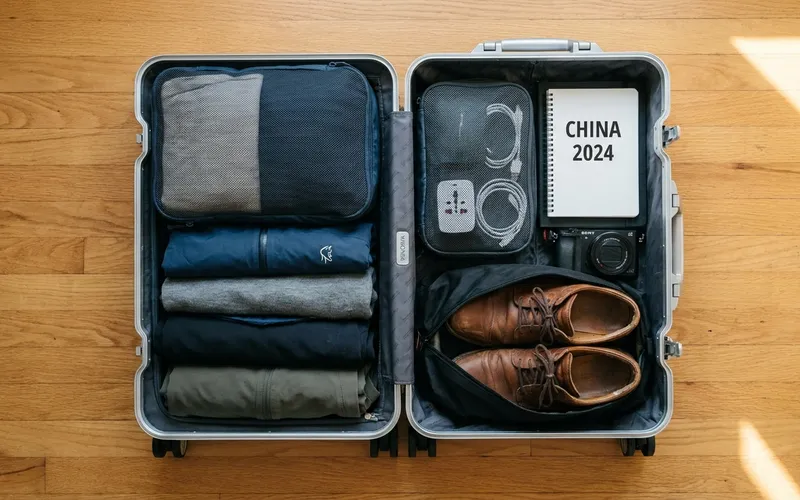
China Packing List 2026: What to Bring for Every Season
What to pack for China by season: VPN and SIM setup, plug adapters, clothing for summer monsoon or Beijing winter, prescription medications, and gifts to bring from home.
Memorize these before anything else.
Quick Answer
What should I pack for a trip to China?
Four items most Western visitors forget: a VPN app installed before departure, a Type I electrical adapter, prescription medications with a Chinese-translated doctor’s letter, and a small gift if visiting business contacts or homestay families.
Source: U.S. Department of State — China
| Plug type | Type I (three flat prongs in a V shape); 220V / 50Hz |
|---|---|
| VPN setup | Install and test before arrival — Apple Store is restricted inside China |
| Prescription rule | Bring a doctor’s letter translated into Chinese for controlled substances |
| Summer humidity | 70–90% in southern China; quick-dry fabrics essential |
| Winter lows | Beijing −10°C, Harbin −25°C, Shanghai 0–8°C |
| Tap water | Not drinkable anywhere — use bottled, boiled, or filtered water only |
| ATM access | Bank of China and ICBC ATMs accept foreign cards; max ~¥3,000 per withdrawal |
| Hotel laundry | ¥15–30/kg wash-and-fold; many 3-star+ hotels have free guest laundry rooms |
| Tipping | Not expected anywhere — service charge included; round up only if you wish |
| Sleeper train bedding | Soft-sleeper and hard-sleeper berths include clean sheets, pillow, and quilt |
| Customs cash limit | ¥20,000 (about $2,800) without declaration; above that, file a form |
| Last updated | 2026-06-19 |
| Last updated |
What electronics, adapters, and connectivity gear do I need?
How should I pack clothing for the season I am visiting?
Summer (June–August): lightweight, quick-dry, light colors. Pack a compact rain jacket or poncho — southern China gets afternoon thunderstorms almost daily, and a folding umbrella is sold everywhere for ¥10–20. Humidity is brutal in Guangzhou, Shanghai, and Chengdu; choose merino or technical fabrics over cotton. Winter (December–February): serious cold-weather gear if visiting northern China. Beijing and Xi’an average −5 to −10°C with wind chill; Harbin (famous for the Ice Festival) hits −25°C. A windproof down jacket, thermal base layers, gloves, and a hat are mandatory. Spring and autumn (March–May, September–November) are the most pleasant — pack layers for 5–25°C swings. Bring one dressy outfit if invited to a banquet or business dinner. Region-by-region: Shanghai winters are damp and hover around 0–8°C — the cold penetrates because most older apartments south of the Yangtze lack central heating. Guangzhou stays warm year-round (15°C in January). Chengdu is overcast and drizzly much of the year. Lhasa and Tibetan Plateau towns swing 20°C between day and night even in summer — pack a down jacket for evenings regardless of season. If traveling during Spring Festival (late January or February), expect crushing crowds on trains and at temples; book accommodations months ahead and carry snacks for closures. Footwear follows the season: breathable mesh trainers in summer, insulated waterproof boots in northern winter, and grippy trail shoes for any temple or Wall visit. Pack one light long-sleeve for museums and temples that require covered shoulders — the Forbidden City, Buddhist caves at Datong, and Confucian temples have signs but no enforced rule, and staff sometimes turn away tank tops. Silk scarves pack tiny and double as shoulder cover, sun protection, and a gift. If your trip includes Yunnan (Kunming, Lijiang, Shangri-La) in any season, the UV is stronger than the thermometer suggests — pack a brimmed hat and SPF 50. For cruises on the Yangtze (Chongqing–Yichang), bring a warm layer for the air-conditioned dining saloon; temperatures drop 5–8°C below deck at night even in May.
Sources: U.S. Department of State — China travel information, UK FCDO — foreign travel advice: China
What medications and health supplies should I bring?
Bring prescription medications in original labeled containers, with a copy of the prescription and a doctor’s letter on letterhead listing the generic drug name, dose, and medical necessity — translated into Simplified Chinese if possible. Some Western drugs are restricted or unavailable in China even with a local prescription; ibuprofen, common antibiotics, and birth control are often hard to source. Pack a small medical kit: anti-diarrheal (loperamide), oral rehydration salts, antihistamines, motion sickness pills (sleeper trains), pain reliever, band-aids, and any personal prescriptions. Stomach issues are common in the first week — avoid raw vegetables and unpeeled fruit, drink only bottled or filtered water, and pack wet wipes for handwashing when soap is unavailable. Check routine vaccinations are current: hepatitis A and B, typhoid, and (for rural stays) Japanese encephalitis and rabies pre-exposure. Carry a digital thermometer and a copy of your blood type. Chinese pharmacies (look for the green cross) stock paracetamol, traditional remedies, and basics, but staff rarely speak English — the Pleco app has a medical phrase section. Avoid buying prescription drugs locally without a Chinese prescription; counterfeit medication is a real risk in unregulated markets. If you wear glasses, bring a spare pair and a copy of your prescription — opticians are everywhere but re-glazing takes 1–2 days. For allergy sufferers, pack enough antihistamines for the whole trip; spring tree pollen in Beijing and Shanghai is heavy. Buy traveler’s diarrhea antibiotics (ciprofloxacin or azithromycin) from your home doctor before leaving; they are sold without prescription in some Chinese pharmacies but the brands are unfamiliar. Bring melatonin if you struggle to sleep — jet lag from a 12–15 hour time difference is real, and hotel blackout curtains in older Chinese properties let in significant light. Pack a N95 mask for severe pollution days in Beijing or Xi’an in winter (AQI regularly exceeds 200 from December to February); a regular cloth mask is useless for PM2.5. Mosquito repellent with 30–40% DEET is essential for Yangtze cruises, Guilin rice terraces, and Hainan — dengue fever is present in the south from May to November. A small bottle of hand sanitizer (under 100 ml for carry-on) saves you in rush-hour metro crowds where soap runs out fast. Sunscreen for sensitive skin: European and Australian formulas are hard to find, and Chinese brands like Mentholatum and Bawang Tea leave a white cast.
Sources: UK FCDO — foreign travel advice: China, Wikipedia — China
What toiletries and personal items should I pack or skip?
Skip: shampoo, conditioner, body wash, toothbrush, toothpaste, razor — all provided by every Chinese hotel from budget to 5-star, and quality is usually fine. Pack: your preferred skincare (Western brands are expensive in China), sunscreen (Chinese brands are good but expensive for foreign brands), insect repellent for rural areas, menstrual products if you have brand preferences (Chinese pharmacies sell pads but tampon selection is limited), and any specialty items like contact lens solution. Slippers are provided by all hotels and many restaurants. Hair dryers are in most rooms. Bathrobes are 4-star and above. Avoid overpacking toiletries — a 100ml travel kit for the flight and airport transfers is plenty. Western-brand skincare (La Roche-Posay, CeraVe) costs 30–50% more in Chinese malls than at home — bring your own. Sunscreen: ANESSA and Biore are excellent local brands at ¥60–120 from Watsons pharmacies. Deodorant is hard to find outside Tier-1 cities because antiperspirant use is uncommon — bring a stick from home. Contact lens solution (ReNu, Opti-Free) is sold at pharmacies but costs more; bring a travel bottle. Floss and interdental brushes are sold at Watsons but cost 2–3x home prices; stock up before departure. Pack a small bottle of laundry detergent pods if you plan to use a hotel self-laundry room — Chinese hotels usually provide generic powder, but the scent is strong and may trigger allergies. A quick-dry travel towel is a backup when budget hotels skip the bath towel or it’s threadbare. Solid shampoo and conditioner bars save space and survive checked baggage without leaking. Lip balm with SPF is critical for Lhasa, Dunhuang, and northern winter; Chinese chapsticks (Mentholatum, ¥10) are fine, but high-SPF options are scarce. Refillable silicone travel bottles beat the flimsy ones at Daiso and survive a Beijing-to-Xi’an train ride in a stuffed backpack.
Sources: U.S. Department of State — China travel information, UK FCDO — foreign travel advice: China
What gifts and miscellaneous items should I bring?
For business contacts, homestay families, or guides, small gifts from your home country are appreciated: local food specialties (chocolate, coffee, maple syrup), branded pens, or small handicrafts. Avoid bringing expensive or political items (luxury watches, political symbols) — they create awkward obligation. Useful miscellaneous items: a reusable water bottle (filter inside China), packing cubes (helps organize shared hotel rooms), a lightweight daypack for daily outings, a small umbrella (¥20 if bought there, but useful to have immediately on arrival), an English-Chinese translation app downloaded for offline use (Google Translate works with a VPN; Pleco is the recommended dictionary app), photocopies of your passport and visa stored separately from the originals, and ¥500–1,000 in small RMB bills for the first day before setting up mobile payments. For guides and drivers, ¥50–100 per day per person in a red envelope (hongbao) at trip end is the standard gratuity even though tipping is not expected elsewhere. Do not wrap gifts in white paper — white is associated with mourning in Chinese culture; red or gold is auspicious. Avoid gifting clocks, sharp objects (knives, scissors), or anything in sets of four, as these carry unlucky associations. If bringing food gifts, declare them at customs; vacuum-sealed items clear faster. A small photo book or postcard set from your home region is a thoughtful, low-obligation gift for homestay hosts. Tea, whisky, and high-end biscuits travel well and suit a wide range of recipients. For business banquits, a small flag pin from your country is appropriate and fits in a coat pocket. Avoid umbrellas as gifts (the word 伞, sǎn, sounds like 散, separation). Avoid shoes and green hats as gifts (green hats signal infidelity in Chinese culture). Books in English about your home country are a hit with English-speaking academics; skip novels in translation.
Sources: UK FCDO — foreign travel advice: China, Wikipedia — China
What SIM card or eSIM should I use for mobile data in China?
Buy a China Unicom or China Mobile SIM at the airport on arrival, or order one online before departure for pickup at your first hotel. A tourist SIM with 30 GB of data and 100 minutes costs about ¥100–150 as of 2026 and runs for 30 days. China Unicom generally has the best foreign-phone compatibility because it supports the widest range of international LTE bands; China Mobile is cheaper but slower on some imported handsets. Avoid China Telecom SIMs unless your phone is fully compatible — they often drop to 2G on foreign devices. An easier option is a travel eSIM such as Airalo, Holafly, or Nomad: install before you fly, activate on landing, and skip the airport counter queue. eSIMs route through a Hong Kong gateway, so Google, Gmail, and WhatsApp often work without a VPN — though speeds cap around 4G and coverage can lag in rural areas. eSIM data costs $5–15 for 1–5 GB over 7–10 days. Verify your phone is unlocked and eSIM-compatible before buying. Keep your home SIM active for two-factor authentication texts, but turn off data roaming to avoid $10/MB charges. Enable Wi-Fi calling at your hotel so family can reach you on your usual number. Signal is excellent in cities and along HSR corridors, but expect dead spots in remote western regions like rural Sichuan or the Tibet routes. Registering a physical SIM requires your passport — counters at Beijing Capital (PEK), Pudong (PVG), and Baiyun (CAN) process activation in 15–20 minutes. Top up data through the carrier app or at any convenience store (7-Eleven, FamilyMart, Lawson) by quoting your phone number; ¥30 buys 1–2 GB extra. Disable Wi-Fi assist on iPhones to avoid burning cellular data when hotel Wi-Fi drops.
Sources: U.S. Department of State — China travel information, UK FCDO — foreign travel advice: China
What should I pack for hiking the Great Wall or Zhangjiajie?
The Great Wall at Mutianyu, Jinshanling, and Jiankou involves steep, uneven stone steps — pack broken-in trail shoes with grip, not sandals. Bring a small daypack (15–20 L) with 1.5 L of water, snacks, sunscreen, a hat, and a light windbreaker. Sections like Jiankou are unrestored and require both hands free; leave bulky camera bags at the hotel. Avoid the Great Wall in midsummer (July) when steps are slippery after rain and the heat reaches 35°C. For Zhangjiajie and Huangshan (Yellow Mountain), pack layers — summits sit 1,200–1,800 m above the surrounding valley and can be 10°C colder with wind. A thin fleece, a rain shell, and grippy shoes are mandatory; wooden steps become treacherous when wet. Pack a 20–30 L daypack and leave the rolling suitcase at the base hotel in Wulingyuan or Tunxi. Trekking poles help on the thousands of stone stairs at Huangshan, and knee braces are wise for the long descents. Carry cash for the cable cars (¥65–80 one way) and bring small bills for bottled water vendors on the wall. Do not rely on finding a restroom mid-hike — use facilities at the entrance and base stations. Carry a screenshot of the trailhead map in case signal drops. Jinshanling and Simatai close at 17:00, so start early to avoid being shepherded off. Pack a small towel and a change of socks for the bus ride back; feet swell on long descents. For Zhangjiajie, the Bailong elevator (¥72) and Tianmen Mountain cable car (¥258 round trip) cut climbing but still leave 4–6 hours of walking. A headlamp is wise for Huangshan sunrise tours; the trail is uneven and pre-dawn light is poor. A 1 L Platypus-style soft flask packs flat when empty, freeing space for snacks. Bring blister plasters (Compeed or similar) — once a heel rubs raw on stone, the rest of the trip is misery. If visiting Avatar Zhangjiajie in winter, micro-spikes for your shoes (¥40 at Taobao, available at Wulingyuan vendors) are essential because the sandstone steps ice over. A 20,000 mAh power bank charges your phone for the day and powers a USB hand warmer in winter.
Sources: U.S. Department of State — China travel information, UK FCDO — foreign travel advice: China
How should I handle laundry and clothing care on a long trip?
For trips under 10 days, pack enough underwear and socks for the whole stay and skip laundry. For longer trips, plan to do laundry every 5–7 days. Hotel laundry is convenient but pricey — ¥15–30 per kg for wash-and-fold, or ¥25–50 per shirt for pressed service. Budget travelers should look for self-service laundromats near universities and in residential neighborhoods, where wash-and-dry runs ¥10–15 per kg as of 2026. Many 3-star and above hotels now have a free guest laundry room with washers and dryers — ask at check-in. Sink-washing works for underwear and quick-dry shirts: bring a flat sink stopper (¥5 at Daiso-style shops) and a travel packet of detergent. Hang items on the retractable clothesline most hotel bathrooms provide, or string a paracord line across the shower rail. Humidity in southern China doubles drying time — pack merino and synthetic fabrics that dry overnight, and avoid heavy cotton jeans. For stains, Chinese convenience stores sell Tide travel packets and stain-removal pens for ¥5–10. Never pack more than 7 days of clothing; the rule is to pack for one week and do laundry on a schedule. Dry cleaning is available at 4-star+ hotels (¥20–60 per item) but turnaround is 24–48 hours, so plan ahead. Silk and wool items should go to a specialist dry cleaner found in every shopping mall, not the hotel — prices are ¥30–60 per garment as of 2026. Never machine-wash a silk qipao or cashmere; hand-wash in cold water with baby shampoo and flat-dry. Pack a small bottle of wrinkle-release spray for quick freshen-ups between laundries — Chinese hotel irons are often shared and slow. A universal sink stopper (the folding silicone kind) works in Chinese washbasins, which often have non-standard drains. Bring 4–5 universal sink stopper adaptors if you rely on a specific style; Daiso in Shanghai and Beijing stocks them for ¥10. Quick-dry underwear and socks from Uniqlo (AIRism, HEATTECH) survive Chinese humidity and dry overnight on the hotel line.
Sources: UK FCDO — foreign travel advice: China, Wikipedia — China
What documents and copies should I carry each day in China?
Carry your original passport every day — hotels, train stations, attractions, and sometimes police checkpoints require it, and you can be fined for not having ID. Keep a color photocopy of your passport photo page, visa page, and entry stamp in a separate bag or luggage compartment. Store scanned copies in an encrypted cloud drive and email them to yourself. Write your hotel’s name and address in Chinese characters on a card in your wallet — show it to taxi drivers or passersby if you get lost. Carry your travel insurance policy number and the 24-hour assistance hotline, plus the phone number for your embassy in Beijing. If you have a serious medical condition, wear a medical alert bracelet or carry a card in Chinese describing it. Keep a printed list of your prescription medications with generic names and doses. For HSR and domestic flights, you’ll show your passport at check-in and again at boarding — have it accessible, not buried in a backpack. Leave one copy of your full itinerary and passport with someone at home. Do not carry your social security card, birth certificate, or unnecessary credit cards — they only create risk if lost. Carry a backup credit card and some US dollars (widely exchangeable) in case your cards are blocked by fraud alerts. Notify your bank of your travel dates before departure. Register your trip with your embassy’s citizen service (the US STEP program, UK LOCATE) so they can reach you in an emergency. Keep a photo of your luggage and its contents for insurance claims if a bag goes missing. A 24-hour hot wallet under the shirt is a low-risk way to carry the passport on crowded subways; Chinese pickpocketing is rare but not zero. A small notecard with your hotel address in Chinese plus a 24-hour taxi company number (e.g., Didi’s hotline 400-000-0666) helps in the rare event of language difficulty. Print your visa details: visa type (L, M, F), number of entries, and expiry date — you may need them at hotel check-in.
Sources: U.S. Department of State — China travel information, UK FCDO — foreign travel advice: China
What should I pack for sleeper trains and long HSR journeys?
Chinese sleeper trains (Z, T, and K series) and the modern HSR (G and D series) demand different packing. For a soft-sleeper berth on an overnight Z-train, pack a small overnight bag — large suitcases don’t fit in the berth storage and must go in the luggage rack at the end of the carriage. Bring earplugs and an eye mask: lights dim around 22:30, but passengers chat and the PA announces stops. A neck pillow and a light blanket improve sleep; trains provide bedding but it’s thin. Pack wet wipes and tissues — sleeper car restrooms run out of paper and soap by morning. A 10,000 mAh power bank is essential because older trains have no outlets at the berth; HSR trains have outlets under every seat and at the carriage ends. Bring snacks and instant noodles (hot water dispensers are in every carriage), plus a reusable cup or thermos. For HSR day trips over 4 hours, noise-canceling headphones and downloaded films help — train Wi-Fi is unreliable and blocked from foreign sites. Keep your passport and ticket QR code accessible for the conductor. Lock your bag to the berth ladder with a small cable lock overnight. Soft sleepers cost ¥400–700 for an overnight Beijing–Xi’an run; hard sleepers are ¥200–350 but have no door. The top bunk has less headroom and no window view — request a lower berth at booking if prone to motion sickness. Showers are not available on regular trains; pack deodorant and a change of clothes for arrival. Arrive 30 minutes early — Chinese stations are vast and boarding closes 5 minutes before departure. A foldable wash basin lets you wash face and feet at the berth; hot water from the dispenser works for a quick sponge bath. Bring a small fan or cooling towel for summer sleeper carriages, where air conditioning is uneven and bunks near the carriage end can be 5°C warmer. A deck of cards or a small book helps fill the long evenings when lights are dimmed by 22:30. Pack a dry change of socks for overnight trains; feet swell from sitting and cabin air is dry. Bring 2 L of water plus electrolyte tablets for a 14-hour Z-train from Shanghai to Chengdu — the carriage air is bone-dry and headaches are common.
Sources: U.S. Department of State — China travel information, UK FCDO — foreign travel advice: China
What should I pack if I am traveling with kids in China?
Pack more diapers and formula than you think you’ll need for the first 48 hours — Chinese brands differ, and finding your preferred Western brand outside Tier-1 cities is hard. Carry a foldable stroller only if your child still naps in it; Chinese sidewalks and subway stations have stairs and crowds that make strollers harder than a soft carrier. A baby carrier or hiking backpack is better for the Great Wall, temples, and crowded markets. Bring child-safe snacks, a sippy cup, and a small first-aid kit with fever reducer (ibuprofen or acetaminophen), band-aids, and any prescription medications. Pack a compact changing pad — public restrooms rarely have changing tables. Formula: customs allows a reasonable personal supply; bring pre-measured portions in a dispenser. For toddlers, bring a harness or wrist link for crowded places like the Forbidden City or Shanghai Metro at rush hour. Chinese hotels provide cribs on request but supply is limited — reserve at booking. Carry a printed card with your hotel address in Chinese in case you get separated. Tap water isn’t safe even for brushing a child’s teeth — use bottled. Pack a small blanket or scarf — Chinese air conditioning in malls, trains, and restaurants runs cold by Western standards, and children chill quickly. Bring a familiar snack or comfort item for long flights and train rides. Children under 1.2 m ride most HSR and metro trains free with an adult; kids 1.2–1.5 m get half-fare. Carry a recent passport photo of each child in case of separation. Pharmacies (look for the green cross) stock pediatric fever syrup but brands are local — bring your own. A child-sized mask (KN95) for pollution days in Beijing, and a small inflatable footrest for long HSR rides make travel more bearable. Bring 1–2 small toys or coloring books for restaurant waits — Chinese restaurants rarely have kids’ menus and waits can stretch 30 minutes at popular spots. A lightweight umbrella stroller with a rain cover doubles as a bassinet in the airport and folds into overhead HSR storage.
Sources: UK FCDO — foreign travel advice: China, Wikipedia — China
What should I pack for cruises, river boats, or island trips?
A Yangtze River cruise (Chongqing–Yichang, 4–6 nights) requires different prep than city travel. Pack layers: cabin air conditioning is strong, and deck temperatures can be 8–10°C cooler at night. Bring a light windbreaker for the open-deck sail-aways and shore excursions to the Three Gorges Dam or Shennv Stream. Anti-vertigo medication helps for the narrower gorges where the boat lists. For Huangshan (Yellow Mountain) sunrise and Zhangjiajie cable cars, a small headlamp and a thermos for hot tea make pre-dawn starts bearable. Pack binoculars for river cruises and a waterproof phone pouch for the smaller sampan rides in Guilin. For Hainan (Sanya) beach stays, pack reef-safe sunscreen, a rash guard, and water shoes — coral cuts are common and tetanus boosters should be current. Beach hotels provide towels; budget island homestays often do not. Hainan typhoon season (June–September) brings sudden storms; a compact umbrella and a dry bag protect your phone and documents. For Gulangyu (Xiamen) or Putuoshan island trips, the ferries run on time but the wait can be long — pack water and snacks. Cruise cabin safes fit passports, iPads, and a small amount of cash; leave the rest in the hotel safe on the mainland. A power strip with USB ports is critical on older Yangtze cruise ships that place the only outlet behind the bed. Bring laundry zip bags for damp swimwear; a wet swimsuit in a backpack ruins everything else.
Sources: U.S. Department of State — China travel information, UK FCDO — foreign travel advice: China
What photography, drone, and electronics rules should I prepare for?
Drones (DJI Mavic, Autel, etc.) are allowed for personal use in most of China but require registration with the CAAC (Civil Aviation Administration of China) for any drone over 250 g. The DJI Fly app does not work in mainland China without a VPN and a China-region account; switch your DJI account region before departure. Many tourist sites ban drones outright: the Forbidden City, Tiananmen Square, all military zones, airports, and the Great Wall at Badaling and Mutianyu. Flying near government buildings or police stations is illegal. Bring spare batteries — Chinese security may ask you to power on the drone, and dead batteries look like a prohibited device. Mirrorless and DSLR cameras are fine; large professional tripods and long lenses attract questions at airport security. Photography of police officers, military, customs facilities, and airport security is forbidden. Do not photograph people in private settings without asking; street photography of markets, performances, and crowds is generally fine. A small travel tripod (Manfrotto Befree, Peak Design) is useful for night shots of the Bund in Shanghai or the Hong Kong skyline from Shenzhen. A polarizing filter cuts haze in Beijing and Xi’an; a UV filter protects lenses from dust. Bring more SD cards and a portable SSD than you think — buying a quality 128 GB SD card in China costs ¥150–250 (about 2x US prices). A power bank under 100 Wh is allowed on flights and HSR trains; over 100 Wh and under 160 Wh requires airline approval. Carrying a GoPro or Insta360 is a fun way to record the Bund light show or the Harbin Ice Festival; a small floating handle grip is wise for any boat tour.
Sources: U.S. Department of State — China travel information, UK FCDO — foreign travel advice: China, Wikipedia — China
What should I pack for business meetings and banquets?
Pack one dark business suit (navy or charcoal) and one dress shirt per meeting day, plus a tie — Chinese business dress is slightly more formal than American tech-casual. Leather shoes should be polished; carry a small travel-size polish and a shoehorn. Business cards (mingpian) printed in English on one side and Simplified Chinese on the other are expected — bring at least 200 cards; printing 200 cards in China takes 24 hours and costs ¥80–150. Present and receive cards with both hands; examine the card, do not pocket it immediately. Gift giving in business: bring a small gift from your home country (whisky, premium tea, branded pen) only after the first meeting when rapport is established. Avoid clocks, knives, and umbrellas as gifts. For banquets, the host orders; try a small portion of every dish. Toasting (ganbei) is common — keep your glass below your senior’s when toasting. Bring 5–10 red envelopes (hongbao) with ¥100–500 each for tips to drivers, guides, and excellent service staff. Pack a small notebook and quality pen — Chinese executives notice details. A portable Wi-Fi hotspot or local SIM is critical for video calls; WeChat, DingTalk, and Feishu are the dominant business apps. A folding phone stand and USB-C hub make hotel room video calls more comfortable. Carry a small stock of business cards in your wallet, not checked luggage — you may give out 10–20 at a single networking event.
Sources: UK FCDO — foreign travel advice: China, Wikipedia — China
What packing mistakes ruin a China trip, and how do I avoid them?
Mistake 1: not testing the VPN before flying. The first morning in a Shanghai hotel, a visitor with no working VPN cannot reach Gmail, Google Maps, WhatsApp, or Instagram. Test the VPN in your home airport. Mistake 2: a 110V hair dryer in a 220V outlet. The tool dies instantly and may trip the room breaker. Use only dual-voltage (110–240V) tools or buy local. Mistake 3: assuming hotels provide everything. They provide shampoo, soap, slippers, and a hair dryer — but rarely conditioner, deodorant, or laundry detergent. Bring small bottles. Mistake 4: not telling your bank. Cards are blocked within hours of suspicious charges; a 30-second call before departure saves a 2-hour call from a Chinese hotel lobby. Mistake 5: over-packing. You cannot carry more than 20 kg on most Chinese domestic flights without paying ¥30+/kg excess. Pack for one week, do laundry. Mistake 6: forgetting to download offline maps. Google Maps works in China with a VPN but is slow; Apple Maps has mainland China data but is hit-or-miss. Download Maps.me or the Chinese Amap app as backup. Mistake 7: bringing strong-smelling food gifts. Vacuum-sealed is fine; loose dried sausage confuses customs scanners. Mistake 8: ignoring the power bank rule. Anything over 100Wh is confiscated at security. Check the spec sticker before packing. Mistake 9: not breaking in new shoes. Blisters on Day 2 of a Beijing walking tour end the trip. Walk 5–10 km in new shoes for two weeks before departure. Mistake 10: bringing only credit cards. While Alipay and WeChat Pay are now foreigner-friendly, 20–30% of small vendors still want cash. Carry ¥500–1,000 in small bills. Mistake 11: assuming tap water is fine. Even locals boil or filter. Bottled water costs ¥2–3 from any shop. Mistake 12: bringing political gifts. Magazines, T-shirts, or books with political themes create awkward moments at best, customs issues at worst. Stick to food, tea, or handicrafts.
Sources: U.S. Department of State — China travel information, UK FCDO — foreign travel advice: China, Wikipedia — China
Frequently asked questions
Can I bring prescription opioids or ADHD medication?
Are there items banned from my luggage?
Should I bring my own toilet paper?
Do I need a power bank for long HSR trips?
Should I pack a reusable bag?
What kind of shoes should I bring for China?
Do I need a VPN installed before arriving in China?
Should I bring cash or rely on digital payment?
What should I pack for a winter trip to northern China?
Can I use my hair dryer or straightener from home in China?
Should I pack a sleep sheet or pillow for sleeper trains?
What should I pack for Spring Festival (Chinese New Year)?
Can I bring dried food, coffee, or snacks into China?
How do I pack for high-altitude destinations like Tibet or Yunnan?
Is a portable Wi-Fi hotspot (egg) better than a local SIM?
What should I bring to a homestay or rural village stay?
How do I pack for a 2-week multi-city trip without overpacking?
Do I need to bring chopsticks and a teacup?
What gear helps with the language barrier?
References

Written by
NihaoVisit Editorial TeamIn-house editorial team (not individual bylined experts) · Primary-source research: official government portals + on-site verification · Quarterly content audits for visa, transport, and price accuracy
Real problems this guide solves
Decisions this guide informs
- Alipay or cash — which to use more?Default to Alipay in cities. Carry ¥500–¥1,000 cash for rural areas, taxis without QR codes, and as backup.
- Should I take HSR or fly between Beijing and Shanghai?Take HSR for Beijing-Shanghai — cheaper, more reliable, and ends in the city center. Fly only for routes over 1,500 km.
- Do I really need a VPN in China?Yes if you need any Western app daily; No if you can live without Gmail/Maps/WhatsApp for the trip duration.
Related guides & destinations
Guide
Travel Insurance for China 2026: Coverage, Providers, and Claims
Travel insurance is essential for China. Hospitals require upfront payment, medical costs can be high, and adventure activities like hiking
Guide
China with Kids 2026: Family-Friendly Travel, Tickets, and Safety
How to travel China with children: booking child train and flight tickets, finding family-friendly hotels, navigating stroller-friendly attr
Guide
How We Research 2026: NihaoVisit’s Methodology for China Travel Information
How NihaoVisit sources, verifies, and maintains 700+ pages of China travel information — our source hierarchy, fact-checking process, update
Guide
Fact-Checking Log 2026: Verified China Travel Information — NihaoVisit
A public log of fact-checking verification passes on NihaoVisit, showing what was verified, when, and against which sources — covering visa
Guide
VPN for China 2026: Which VPNs Work, eSIM Alternatives, and the Complete Pre-Trip Checklist
Most Western apps and websites are blocked in mainland China. A reliable VPN is essential for Google, Gmail, WhatsApp, Instagram, and most n
Guide
Solo Female Travel in China 2026: Safety, Tips, and Real Experiences
China is one of the safer destinations for solo female travelers. Petty theft is rare, violent crime against tourists is extremely uncommon,
Book activities in China Packing List 2026: What to Bring for Every Season
These are licensed tour operators and booking platforms we've vetted independently. Booking through these links may earn us a commission — see our affiliate disclosure. This never affects our editorial recommendations or the price you pay.