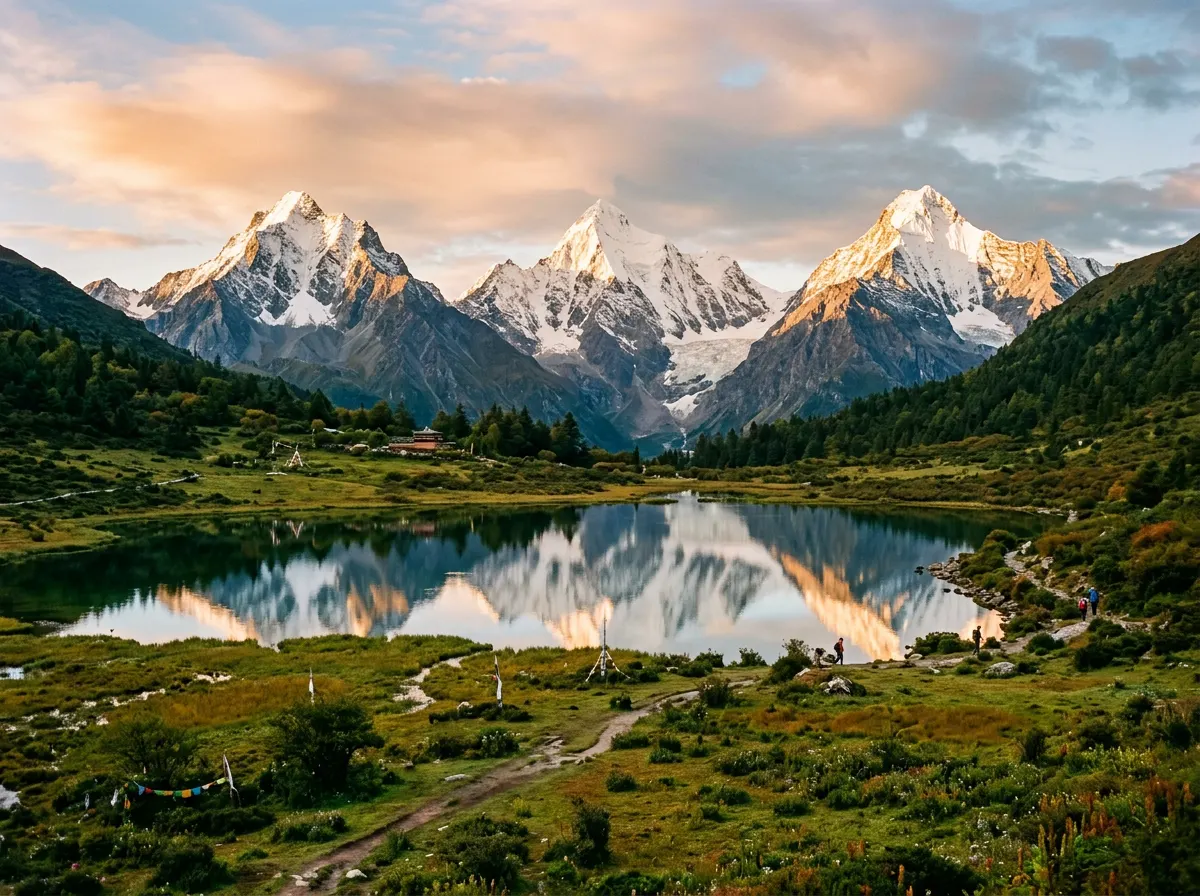
Daocheng Yading
Daocheng Yading (稻城亚丁, Dàochéng Yàdīng) is a high-altitude nature reserve in western Sichuan province, on the edge of the Tibetan Plateau, that protects three sacred snow mountains — Chenrezig (仙乃日, Xiānnǎirì, 6,032m), Jampelyang (央迈勇, Yāngmàiyǒng, 5,958m), and Chanadorje (夏诺多吉, Xiànuòduōjí, 5,958m) — plus the glacial lakes, alpine meadows, and primeval forests that surround them. The reserve sits at elevations between 3,800m and 4,700m, which means altitude sickness is a real risk and the hiking is genuinely strenuous. The landscape was the inspiration for James Hilton's fictional Shangri-La in his 1933 novel Lost Horizon, and the "last Shangri-La" tag has stuck because the scenery genuinely earns it — golden larch forests in October, mirror-still turquoise lakes reflecting 6,000-meter peaks, grasslands where yaks graze against a backdrop of permanent snow. Getting here requires a flight to Daocheng Yading Airport (the world's highest civilian airport at 4,411m), then a 2-hour drive, and at least 2 full days inside the reserve. Spend your first day at 2,900m (Shangri-La Town) to acclimatize before ascending to 3,900m (Yading Village) and the higher trailheads. Drink 3-4 liters of water daily, avoid alcohol, take Diamox if prescribed by your doctor, and descend immediately if altitude symptoms worsen — the nearest hospital capable of treating serious altitude illness is 1.5 hours away by car. Pack layered clothing, waterproof hiking boots with ankle support, sun protection (SPF 50+, UV sunglasses, hat), and trekking poles — buy them at the Shangri-La Town stalls for ¥30-50 if you do not bring your own. Flights are frequently delayed by fog, snow, or high winds so build in a buffer day. This is not a casual stop on a China itinerary — it is a destination you commit to. Budget roughly ¥300-500 per day for mid-range comfort, plus the ¥266 park entry and ¥120 sightseeing bus.
Why Daocheng Yading in 2026.
The "last Shangri-La" — three sacred snow peaks above 6,000m, turquoise glacial lakes at 4,500m, and Tibetan villages scattered across the high Sichuan-Tibet frontier. One of the most spectacular alpine landscapes on Earth. Plan for altitude acclimatization and at least 2 full days inside the reserve.
Quick Answer
Daocheng Yading (稻城亚丁, Dàochéng Yàdīng) is a high-altitude nature reserve in western Sichuan province, on the edge of the Tibetan Plateau, that protects three sacred snow mountains — Chenrezig (仙乃日, Xiānnǎirì, 6,032m), Jampelyang (央迈勇, Yāngmàiyǒng, 5,958m), and Chanadorje (夏诺多吉, Xiànuòduōjí, 5,958m) — plus the glacial lakes, alpine meadows, and primeval forests that surround them. The reserve sits at elevations between 3,800m and 4,700m, which means altitude sickness is a real risk and the hiking is genuinely strenuous. The landscape was the inspiration for James Hilton's fictional Shangri-La in his 1933 novel Lost Horizon, and the "last Shangri-La" tag has stuck because the scenery genuinely earns it — golden larch forests in October, mirror-still turquoise lakes reflecting 6,000-meter peaks, grasslands where yaks graze against a backdrop of permanent snow. Getting here requires a flight to Daocheng Yading Airport (the world's highest civilian airport at 4,411m), then a 2-hour drive, and at least 2 full days inside the reserve. Spend your first day at 2,900m (Shangri-La Town) to acclimatize before ascending to 3,900m (Yading Village) and the higher trailheads. Drink 3-4 liters of water daily, avoid alcohol, take Diamox if prescribed by your doctor, and descend immediately if altitude symptoms worsen — the nearest hospital capable of treating serious altitude illness is 1.5 hours away by car. Pack layered clothing, waterproof hiking boots with ankle support, sun protection (SPF 50+, UV sunglasses, hat), and trekking poles — buy them at the Shangri-La Town stalls for ¥30-50 if you do not bring your own. Flights are frequently delayed by fog, snow, or high winds so build in a buffer day. This is not a casual stop on a China itinerary — it is a destination you commit to. Budget roughly ¥300-500 per day for mid-range comfort, plus the ¥266 park entry and ¥120 sightseeing bus.
| Worth visiting | Yes, if you are physically fit and willing to handle high altitude. The landscape is world-class — three sacred peaks, turquoise glacial lakes, and autumn larch forests that rival any alpine scenery on the planet. |
|---|---|
| Recommended days | 2-3 days inside the reserve, plus 1-2 days for travel to/from Chengdu or Shangri-La |
| Best time to visit | Mid-October (autumn colors peak, clear skies) and late May to June (wildflowers). Avoid July-August (monsoon rains obscure peaks) and December-March (heavy snow closes trails) |
| Daily budget | $50 (backpacker) / $120 (mid-range) / $300+ (luxury) |
| Family friendly | Low — the altitude (4,000m+) is dangerous for young children, the hiking is strenuous, and medical facilities are basic |
| Solo friendly | Moderate — safe and rewarding, but the isolation means you rely heavily on your own preparation. Solo hikers should carry a satellite communicator |
| Airport | Daocheng Yading Airport (DCY) — world's highest civilian airport at 4,411m. Flights from Chengdu (1h, ¥800-1,500), Chongqing (1.5h). The airport is 120km from the reserve (¥100-150 by shared taxi, 2 hours) |
| High-speed rail | No. The nearest HSR station is in Chengdu. The Chengdu-Shangri-La railway is under construction with a Kangding stop planned. As of June 2026, the only access is by air or an epic bus ride from Chengdu (2 days via Kangding and Litang) |
| Language | Tibetan (Kham dialect) and Sichuan Mandarin. English is essentially non-existent outside a handful of guesthouse owners who have learned from foreign hikers |
| Currency | CNY (¥) — mobile payment is available in Daocheng town but unreliable inside the reserve. Carry ¥500+ in cash |
| Time zone | China Standard Time (UTC+8) |
| Last updated | 2026-06-18 |
Want a Daocheng Yading plan built for you?
Jump to:
Why Visit·The Three Sacred Peaks·Getting There·Altitude & Acclimatization·Hiking Routes·Where to Stay·When to Go·Food & Supplies·Practical Tips·Emergency Contacts·Itineraries·FAQ
Why visit Daocheng Yading? Is it worth the effort?
Daocheng Yading is the single most spectacular alpine landscape I have seen in China, and I say that having visited Zhangjiajie, Jiuzhaigou, and the Yellow Mountains. The combination — three 6,000-meter snow peaks rising directly from turquoise glacial lakes, surrounded by golden larch forests in autumn — is world-class scenery that would draw crowds measured in millions if it were in Switzerland. Because it is in western Sichuan, at 4,000+ meters, accessible only by a flight to the world's highest airport and a long winding road, it remains relatively uncrowded by Chinese domestic tourism standards (though "uncrowded" here means 3,000-5,000 visitors per day in October peak, not empty). The reserve protects the three sacred mountains of Tibetan Buddhism — Chenrezig, Jampelyang, and Chanadorje — which have been pilgrimage sites for centuries. Tibetan pilgrims circumambulate the peaks on a multi-day kora (转山, zhuǎn shān), and the spiritual dimension adds real weight to the landscape. You will see prayer flags strung across mountain passes, mani stone piles along the trails, and Tibetan pilgrims prostrating at the viewpoints. The honest downsides: (1) The altitude is genuinely dangerous. At 4,000-4,700m, altitude sickness affects roughly 50% of visitors to some degree, and the nearest hospital with altitude-treatment capability is a 2-hour drive away. (2) The logistics are punishing. You fly to the world's highest airport (4,411m — the cabin crew remind passengers to move slowly after landing), then drive 2 hours to the reserve entrance, then hike at elevations where every step feels like you are breathing through a straw. (3) The weather is unpredictable and can ruin your trip. I have met travelers who spent 3 days in Daocheng and never saw the peaks — just grey mist and rain. (4) The infrastructure inside the reserve is basic: wooden boardwalks, squat toilets, no restaurants above Chonggu Temple, and no phone signal on most trails. This is not a casual destination. It is a place you commit 5-7 days to, train for physically, and accept that you might get altitude-sick and have to descend. If those conditions sound acceptable, the reward is one of the finest alpine landscapes in Asia.
What are the three sacred peaks of Yading and why do they matter?
The three sacred mountains of Yading are Chenrezig, Jampelyang, and Chanadorje. Tibetan Buddhists believe that circumambulating the peaks (performing a kora) accumulates spiritual merit, and the mountains have drawn pilgrims from across the Tibetan plateau for at least 800 years. Chenrezig (仙乃日, Xiānnǎirì), named for Avalokiteshvara, the Bodhisattva of Compassion, is the northernmost peak and the tallest at 6,032 meters. It has a broad, throne-like shape with a permanent snow cap and glaciers that feed the streams running down to Pearl Lake. The peak is best viewed from Pearl Lake (珍珠海, Zhēnzhū Hǎi) at 4,080m, a jade-green lake at its base reached by a forest trail from Chonggu Temple. On a still morning — and "still" is the key word because the reflection vanishes the moment a breeze touches the water — the peak mirrors perfectly in the lake. This is the most accessible of the three viewpoints and can be reached by anyone who can manage a 1.5-hour forest walk. Jampelyang (央迈勇, Yāngmàiyǒng), named for Manjushri, the Bodhisattva of Wisdom, is the central peak and the one most visitors find the most beautiful. It is a near-perfect pyramid of snow and ice, steep-sided and symmetrical, rising abruptly from the alpine meadows of the Luorong Pasture. The classic photograph of Yading — golden larch trees in the foreground, a yak-dotted meadow, and a perfect snow pyramid in the background — is Jampelyang from Luorong Pasture. The peak is also visible from Milk Lake, where it reflects in the turquoise water, and from the upper sections of the Five-Color Lake trail. Jampelyang was first climbed in 2022 by a Chinese expedition after decades of climbing bans due to its sacred status. Chanadorje (夏诺多吉, Xiànuòduōjí), named for Vajrapani, the Bodhisattva of Power, is the eastern peak. It has a sharper, more angular profile than the other two, with dramatic ridgelines and less continuous snow cover. It is best seen from the upper Milk Lake trail and from certain points on the Luorong Pasture boardwalk. The peak catches the last light of sunset dramatically — it glows orange-red against a darkening sky while the other peaks are already in shadow. A full kora (pilgrimage circuit) around all three peaks takes 3-5 days and reaches altitudes above 4,800m. This is a serious backcountry undertaking requiring a guide, camping equipment, and altitude experience. Most visitors experience the peaks via the day-hike trails from the Luorong Pasture and Chonggu Temple, which offer excellent views without multi-day commitment. The peaks were "discovered" by the outside world through the photographs of Joseph Rock, an Austrian-American botanist and explorer who spent years in western China in the 1920s and 1930s. Rock's photographs and National Geographic articles introduced the landscape to the West, and James Hilton used Rock's descriptions as inspiration for the fictional valley of Shangri-La in Lost Horizon (1933). Whether Yading is the "real" Shangri-La is debated — Zhongdian (now officially renamed Shangri-La City) in Yunnan also claims the title — but the landscape matches Hilton's description better than any alternative.
How do you get to Daocheng Yading?
There are two ways to reach Daocheng Yading, and "easy" is not one of them. BY AIR (the standard approach): Daocheng Yading Airport (DCY, 稻城亚丁机场) is the world's highest civilian airport at 4,411 meters above sea level. The runway is 4,200 meters long (longer than standard to compensate for the thin air that reduces lift). Flights operate from Chengdu Shuangliu (CTU) daily, about 1 hour, ¥800-1,500 one-way as of June 2026. Flights from Chongqing (CKG) operate 3-4 times per week, about 1.5 hours, ¥900-1,600. Flights from Xi'an operate seasonally (May-October). There are no direct flights from Beijing, Shanghai, or Guangzhou — you must connect through Chengdu. Important: Book flights at least 2 weeks ahead during the October peak. Weather cancellations are common — the airport closes in fog, snow, or high winds, sometimes for days at a time. Schedule at least one buffer day in Chengdu on each end of your trip for flight disruptions. Morning flights are more reliable than afternoon ones because mountain weather deteriorates through the day. From the airport to the Yading reserve: The airport is about 120 km from the Yading scenic area entrance in Shangri-La Town (香格里拉镇, Xiānggélǐlā Zhèn — not to be confused with Shangri-La City in Yunnan). The drive takes about 2 hours on a winding mountain road that passes through Daocheng town (稻城县, 35 km from the airport) and crosses several 4,500m+ passes. Shared taxis and minibuses meet every flight and charge ¥100-150 per person to Shangri-La Town. A private taxi costs ¥400-600. The road is paved and in good condition as of 2026, but landslides in the rainy season (July-August) can cause delays. BY BUS (the scenic-punishment approach): From Chengdu's Xinnanmen Bus Station (新南门汽车站), a bus runs to Daocheng town via Kangding (康定), Xinduqiao (新都桥), and Litang (理塘). This is a 2-day journey with an overnight stop in Kangding. Day 1: Chengdu to Kangding (7-8 hours, ¥120-150), crossing the Erlang Mountain tunnel and descending into the Tibetan town of Kangding at 2,560m. Day 2: Kangding to Daocheng (10-12 hours, ¥180-220), crossing multiple 4,500m+ passes including the spectacular Zheduo Pass (折多山, 4,298m) and the grasslands around Litang (理塘, 4,014m — one of the highest towns in the world). From Daocheng town, you need a shared taxi to Shangri-La Town (¥50, 1.5 hours). The bus route is genuinely scenic — the high grasslands, prayer-flag-draped passes, and Tibetan villages between Xinduqiao and Litang are among the most beautiful road landscapes in China — but it is exhausting, altitude-intensive, and not recommended unless you have experience on high-altitude Chinese bus routes. The road is paved throughout but is two lanes with frequent truck traffic. Once you reach Shangri-La Town (also called Riwa, 日瓦), you are at 2,900m — lower than the reserve, and therefore a good place to acclimatize for a night before entering. The Yading scenic area entrance is 3 km from town. From the entrance gate, a mandatory sightseeing bus (¥120 round trip, included in the park ticket) takes you 34 km up a winding road to Zhaguanbeng (扎灌崩), the drop-off point at 3,800m. From there it is a 500-meter walk to Chonggu Temple at 3,880m — the trailhead for all hikes. The bus ride takes about 1 hour and is itself scenic, with viewpoints over the Yading valley and the first glimpse of Chenrezig.
How bad is the altitude, and how do you acclimatize?
The altitude in Daocheng Yading is the single biggest challenge of visiting, and I want to be completely blunt about it because the glossy tourism materials are not. You will be sleeping at 2,900-4,000m, hiking at 3,800-4,700m, and arriving via an airport at 4,411m. Altitude sickness (急性高原病, jíxìng gāoyuán bìng) is not a remote possibility — it is the expected experience for roughly half of visitors. The physiology: At 4,500m, the air contains roughly 55% of the oxygen it does at sea level. Your body compensates by breathing faster, increasing heart rate, and — over days — producing more red blood cells. The problem is that the first two compensations are immediate but insufficient, and the third takes 3-7 days. Altitude sickness symptoms include headache (the universal first sign), nausea, dizziness, fatigue, loss of appetite, and shortness of breath. Severe altitude sickness — high-altitude pulmonary edema (HAPE) or high-altitude cerebral edema (HACE) — can kill you within hours if you do not descend. How to acclimatize for Yading specifically: 1. FLY TO CHENGDU FIRST AND SPEND 2 NIGHTS THERE. Chengdu is at 500m — normal altitude. This seems obvious but many travelers rush straight from sea-level home countries to the 4,411m airport, which is asking for trouble. 2. DO NOT FLY DIRECTLY FROM CHENGDU TO DAOCHENG AND START HIKING THE SAME DAY. The airport is at 4,411m. Stepping off the plane at that altitude with no acclimatization is a shock to your system. Spend your first night in Daocheng town (3,700m) or, better, Shangri-La Town (2,900m). Shangri-La Town is lower and has better hotels — it is the smarter choice for your first night. 3. ASCEND GRADUALLY. The ideal schedule: Night 1 in Shangri-La Town (2,900m), Night 2 at Yading Village inside the reserve (3,900m), and only then start hiking on Day 3. This gives your body time to begin producing red blood cells. 4. TAKE DIAMOX (ACETAZOLAMIDE). This prescription medication speeds acclimatization by acidifying your blood and stimulating breathing. Start taking it 24 hours before ascending. The standard dose is 125-250mg twice daily. Side effects include tingling in fingers and toes (harmless, if annoying), increased urination (it is a diuretic), and making carbonated drinks taste metallic. Consult a travel doctor before your trip — I am not one. 5. DRINK WATER OBSESSIVELY. Dehydration worsens altitude symptoms. Aim for 3-4 liters per day at altitude. The dry mountain air and increased breathing rate dehydrate you faster than you expect. 6. AVOID ALCOHOL FOR THE FIRST 48 HOURS. Alcohol depresses respiration and worsens dehydration. After you are acclimatized, one beer at 4,000m will hit like three at sea level. 7. KNOW WHEN TO DESCEND. If your headache does not respond to ibuprofen, if you become confused or unsteady, if you develop a persistent cough or breathlessness at rest — descend immediately. The sightseeing bus runs back to the entrance gate throughout the day. A descent of 500-1,000m usually resolves symptoms within hours. The park sells portable oxygen canisters (¥30-50) at the entrance, Chonggu Temple, and Luorong Pasture. These provide a few minutes of enriched oxygen and can take the edge off a headache, but they are not a substitute for proper acclimatization. Do not plan to hike on supplemental oxygen — it runs out quickly and masks the symptoms you need to monitor. Who should NOT visit Yading: anyone with a history of HAPE or HACE, anyone with significant heart or lung conditions, pregnant women (the effects of altitude on fetal development are not well studied), and children under about 8 (they cannot reliably communicate altitude symptoms).
What are the hiking routes inside Yading Nature Reserve?
The Yading reserve has two main hiking zones: the shorter, easier trail to Pearl Lake from Chonggu Temple, and the longer, harder trail to Milk Lake and Five-Color Lake from Luorong Pasture. Most visitors do both over two days. DAY 1: THE PEARL LAKE TRAIL (珍珠海徒步, Zhēnzhū Hǎi Túbù). Trailhead: Chonggu Temple (冲古寺, 3,880m). Destination: Pearl Lake (珍珠海, 4,080m). Distance: 3 km round trip (1.5 km each way). Elevation gain: 200m. Time: 1.5-2.5 hours round trip. Difficulty: Easy to moderate — a well-maintained forest path with stone steps and wooden boardwalks, but the altitude makes any climb feel harder. The trail winds through old-growth larch and fir forest, past prayer flag clusters and mani stone piles, before emerging at the lake. Chenrezig rears up directly behind the lake — the peak-to-lake vertical drop is nearly 2,000 meters and the scale is hard to process. The lake is jade-green, surrounded by larch trees that turn gold in October. In summer (June-August), rhododendrons bloom along the lower trail. This is the most accessible of Yading's major viewpoints and works for anyone in reasonable fitness. DAY 2: THE MILK LAKE AND FIVE-COLOR LAKE TRAIL (牛奶海/五色海徒步). This is the main event. Trailhead: Luorong Pasture (洛绒牛场, 4,150m). You reach Luorong Pasture from Chonggu Temple via an electric cart (¥80 round trip, 20 minutes each way, runs 08:00-17:00). The cart ride itself is beautiful, with Jampelyang growing larger through the windshield. From Luorong Pasture, the trail climbs steadily for 5 km to Milk Lake (牛奶海, 4,500m), then a further 0.5 km steeply up to Five-Color Lake (五色海, 4,700m). Total distance: 11 km round trip from Luorong Pasture. Elevation gain: 550m. Time: 5-8 hours round trip. Difficulty: Strenuous — not technically difficult, but the combination of altitude and sustained climbing makes this one of the hardest day hikes that casual visitors attempt in China. The trail surface varies: the first 2 km are a gravel path and wooden boardwalk through the pasture, relatively flat. The next 2 km climb steeply on a mix of stone steps, dirt path, and exposed rock — this is the hardest section, gaining about 350m at altitudes where every step costs. The final 1 km to Milk Lake levels out across a high glacial valley. Milk Lake appears suddenly after a final rise — a startlingly turquoise oval of water ringed by white calcium-carbonate deposits, with Jampelyang's snow pyramid reflected on the surface in still conditions. The color is most vivid between 10 AM and 2 PM when the sun is high. The lake is sacred to Tibetans — you will see prayer flags and possibly pilgrims — and swimming or wading is strictly prohibited. From Milk Lake, the trail to Five-Color Lake climbs sharply for 300m in elevation over about 500m of distance. This is the cruellest section of the hike — you are already at 4,500m, already tired, and now you climb what feels like a vertical staircase. It takes 30-45 minutes. At the top, Five-Color Lake is smaller than Milk Lake but the panorama is the best in the reserve: you can see all three sacred peaks, Milk Lake below, and the Luorong valley stretching away to the north. The lake itself shifts between blue, green, and purple depending on the light and the mineral content of the water. Many exhausted hikers skip Five-Color Lake because they are too tired. Do not skip it. The view is the reward for the entire journey. HORSE OPTION: From Luorong Pasture, you can hire a horse (actually a small Tibetan pony) to carry you partway up the trail. The horse station is at the trailhead, and the horses go about 3 km up to a drop-off point below the steep climb to Milk Lake. Cost is ¥300 one-way as of June 2026. Horses are limited — about 30 per day — and are allocated first-come-first-served starting at 08:00. In October peak, the line for horses forms before 07:00. The horse only goes up, not down, and only in good weather (no horses in rain or snow). Riders must weigh under 80 kg. The horse saves about 1.5 hours of climbing and significant energy, but you still have to hike the steepest section to Milk Lake and back down on your own. CRITICAL TRAIL ADVICE: - Start early. The Luorong Pasture electric cart begins at 08:00. Be on the first cart. The trail takes 5-8 hours and you need to be back at Luorong Pasture by 17:00 when the last cart departs. If you miss the last cart, you are walking an additional 7 km downhill to Chonggu Temple — doable but miserable after a long day. - Bring more water than you think you need (2 liters minimum per person for the Milk Lake hike). There is no potable water on the trail. - Carry high-energy snacks. There is no food for sale above Chonggu Temple. - Wear hiking boots with ankle support. The trail is rocky, uneven, and can be muddy. - Bring a rain jacket even on clear mornings. Mountain weather changes in minutes. - Trekking poles reduce knee strain on the descent significantly. Bring them or buy cheap ones in Shangri-La Town (¥30-50). - Phone signal is absent on most of the trail. Download offline maps. Tell someone your planned route and expected return time. - The trail closes in heavy rain or snow. Check conditions at the visitor center before setting out.
Where should you stay: Shangri-La Town, Yading Village, or Daocheng?
There are three places to sleep when visiting Yading, and your choice affects your acclimatization, comfort, and trip efficiency. SHANGRI-LA TOWN (香格里拉镇, Xiānggélǐlā Zhèn, also called Riwa/日瓦, 2,900m). This is the best base for most visitors. The town sits at the lowest elevation of the three options — 2,900m — which makes it the safest place to acclimatize and the most comfortable for sleeping. It is 3 km from the Yading reserve entrance gate, and most hotels offer free shuttle or a ¥10 taxi ride. The town has the best hotel selection: mid-range chains like Holiday Inn Express (¥400-600/night), local boutique hotels (¥250-450), and a handful of basic guesthouses (¥120-200). Restaurants, pharmacies, ATMs, and outdoor-gear shops line the main street. The downside: you have to re-enter the reserve each day, which means paying the sightseeing bus fare again (¥60 for a second-day bus ticket if you keep your first-day ticket) and spending 1 hour each way on the bus. For a 2-day visit, that is acceptable for the comfort and safety of sleeping at 2,900m. YADING VILLAGE (亚丁村, Yàdīng Cūn, 3,900m). This is a small Tibetan village located inside the reserve, about 30 minutes up the sightseeing bus route from the entrance gate. Staying here means you are already inside the scenic area when you wake up — no re-entry needed, no bus ride on day 2. The village has about 20 guesthouses, ranging from basic Tibetan homestays (¥150-250, shared bathroom, no heating) to slightly nicer guesthouses with private bathrooms and electric blankets (¥300-500). There are a couple of small restaurants serving Tibetan and basic Sichuan food. The downside: you are sleeping at 3,900m. If you have not fully acclimatized, you will not sleep well — altitude insomnia, headache, and restless sleep are very common here. The guesthouses are basic by any standard: hot water is unreliable, heating is by electric blanket only (rooms are cold at night even in summer), and the squat toilets are shared. I have stayed at Yading Village twice. Once was fine; the second time I barely slept due to altitude headache. Staying here is efficient but uncomfortable. Recommended only if you have experience sleeping at altitude and have spent at least one night at 3,000m+ previously on the trip. DAOCHENG TOWN (稻城县, Dàochéng Xiàn, 3,700m). The county seat, about 75 km from the reserve entrance. This is too far to be a practical base — you would spend 3+ hours per day commuting to and from the reserve on winding mountain roads. The town has the best infrastructure (proper hospital, large supermarkets, more hotel choice) and is useful as an acclimatization stop on arrival from the airport, but it is not a base for exploring Yading. Stay here only on your first night after flying in if you want to acclimatize at 3,700m before moving to Shangri-La Town or Yading Village. MY RECOMMENDATION: Night 1 in Shangri-La Town (acclimatize at 2,900m, comfortable sleep). Night 2 in Yading Village (if you are feeling good at altitude — this maximizes your time inside the reserve). Night 3 back in Shangri-La Town or Daocheng town. If you react poorly to altitude, stay all nights in Shangri-La Town and accept the extra bus commute.
When is the best time to visit Daocheng Yading?
The Yading season runs roughly from late April to early November. Outside this window, the reserve is technically open but heavy snow closes the upper trails and the sightseeing bus may not run. MID-OCTOBER (October 10-25): The consensus best window. The larch forests turn brilliant gold, the skies are the clearest of the year (the monsoon has ended, winter has not yet set in), and the daytime temperatures are 5-15°C at the scenic area — cool but comfortable for hiking. This is also the busiest window, with 3,000-5,000 visitors per day. Hotels in Shangri-La Town sell out 1-2 weeks ahead. Book everything early. The first snowfall usually arrives in late October, dusting the peaks and making the scenery even more dramatic, but can also close the Milk Lake trail temporarily. LATE MAY TO JUNE: The spring window. Wildflowers — rhododendrons, blue poppies, edelweiss — carpet the alpine meadows. The weather is warming but still unpredictable: sunny mornings, cloudy afternoons, rain possible any day. Daytime temperatures of 8-18°C. Fewer crowds than October (1,000-2,000 visitors/day). The peaks still have heavy snow cover, which makes them more dramatic but also means some high sections of trail may still be closed by snow. June is the best month for photographers who want wildflowers AND snow peaks. JULY TO AUGUST: The monsoon window. This is the rainy season on the eastern Tibetan Plateau. The peaks are frequently obscured by clouds, the trails are muddy, and the wildflowers are past peak. On the plus side, the landscape is at its greenest, the temperatures are the warmest (10-22°C), and crowds are moderate (Chinese school holidays mean domestic family travel, but fewer serious hikers). If you get lucky with a clear day, the contrast of green meadows against snow peaks is beautiful. If you get unlucky — and the odds are roughly 50-50 — you will see grey mist and rain. I have visited Yading in August once; two of three days were rainy and overcast, and I never saw Jampelyang. The third day was clear and everything was worth it. Go in July-August only if your schedule has no flexibility. SEPTEMBER: The shoulder month. Early September can still catch the tail of the monsoon; late September is when the larch trees begin turning. Temperatures of 8-18°C. Moderate crowds. A good window if you want to avoid October crowds but still catch autumn colors — aim for the last week of September. APRIL AND EARLY MAY: The thaw window. The reserve reopens after winter. Snow still covers the upper trails, and the Milk Lake trail may be closed. The landscape is brown and dormant, not yet green. Daytime temperatures of 0-10°C. The lowest crowds of the season. Only worth it if you specifically want solitude and are okay with limited trail access. NOVEMBER TO MARCH: Winter closure. The reserve is technically open but the Milk Lake trail is almost always closed by snow, the sightseeing bus runs on a reduced schedule (if at all), and temperatures drop to -15°C at night. The landscape under snow is beautiful — I have seen photographs — but visiting in winter requires serious cold-weather gear, flexibility, and acceptance that you may not reach the core scenic area. The airport frequently closes for snow days at a time. Not recommended except for experienced winter mountaineers.
What should you eat and how should you prepare for food and supplies?
Food in the Yading area is functional rather than memorable. This is high-altitude, remote western Sichuan — the culinary sophistication of Chengdu does not reach here. Set your food expectations accordingly. IN SHANGRI-LA TOWN: The town has about 20-30 restaurants, mostly serving Sichuan food (川菜) and Tibetan food (藏餐). Sichuan restaurants are the most reliable — dishes like mapo tofu (麻婆豆腐, ¥25-35), twice-cooked pork (回锅肉, ¥30-40), stir-fried vegetables (¥18-25), and rice (¥3-5 per bowl). The spice level is adjustable if you say "bùyào là" (不要辣, no spice) or "wēi là" (微辣, mildly spicy). Tibetan restaurants serve yak-meat dishes: yak stew (牦牛肉炖, máoniú ròu dùn, ¥60-80), yak momo (Tibetan dumplings, ¥30-40 for a plate), butter tea (酥油茶, sūyóu chá, ¥10-15), and tsampa (糌粑, roasted barley flour mixed with butter tea, ¥15-20). The butter tea is an acquired taste — salty, greasy, and unlike any tea you have had — but it is warming at altitude and Tibetans swear by it for altitude adjustment. The best restaurant in Shangri-La Town, in my experience, is a Sichuan place called Chuan Wei Xuan (川味轩) on the main street — the mapo tofu and the stir-fried potato slivers (酸辣土豆丝, suānlà tǔdòu sī, ¥20) are solid, the kitchen is clean, and the owner is used to foreign guests. For breakfast, Tibetan-run shops sell yak-milk yogurt (¥10-15), steamed buns (包子, bāozi, ¥2 each), and boiled eggs (¥3 each). There is a small supermarket on the main street that sells bottled water, instant noodles, packaged bread, chocolate, and other hiking supplies. INSIDE THE RESERVE: Food options are extremely limited. Chonggu Temple has a small snack stand selling instant noodles (¥15-20, hot water provided), packaged bread, and bottled water/sodas. Luorong Pasture has a similar stand with the same items plus boiled eggs and sometimes yak jerky. That is it. There are no restaurants, no hot meals, and no food for sale above Luorong Pasture. You MUST bring your own food for the Milk Lake hike. Pack high-energy, portable items: chocolate, nuts, dried fruit, energy bars, packaged bread or crackers. Bring at least 2 liters of water per person — there is no potable water on the trail and you should not drink from streams (giardia and other pathogens are present in the yak-grazed watershed). YADING VILLAGE has 2-3 small restaurants serving basic Tibetan and Sichuan food (¥30-60 per meal). The quality is low, the hygiene standards are what you would expect at 3,900m in a remote Tibetan village, and the prices are higher than Shangri-La Town. Eat simply — noodle soup (面条, miàntiáo, ¥20-25), stir-fried vegetables with rice (¥25-30), boiled eggs — and avoid meat dishes that may have been sitting unrefrigerated. WHAT TO BRING FROM CHENGDU (seriously, do this): If you are flying via Chengdu, stock up at a Chengdu supermarket before your flight. Buy: high-energy snacks (nuts, dried fruit, chocolate, energy bars), instant oatmeal packets for breakfast, packaged bread or crackers, instant coffee if you need it, and electrolyte powder or tablets for the water you will be drinking at altitude. The selection and quality in Shangri-La Town is limited and prices are 30-50% higher than Chengdu. I fill half my daypack with food before leaving Chengdu and have never regretted it. WATER: Tap water is NOT potable anywhere in the Yading area. Drink only bottled water or boiled water. Your guesthouse will provide a kettle and bottled water. Brush your teeth with bottled water. At altitude, you need to drink more than usual — dehydration worsens altitude symptoms — so carry water constantly.
What practical tips do you need for Yading?
1. ALTITUDE INSURANCE AND EVACUATION. Standard travel insurance may not cover altitude-related illness. Check your policy — if it excludes "mountaineering" or "altitude sickness," get a policy that covers trekking above 4,000m. Medical evacuation from Yading to Chengdu costs ¥20,000-50,000 and you do not want to pay that out of pocket. World Nomads and Allianz both offer policies that cover high-altitude trekking up to specified elevations — read the fine print. 2. CASH IS KING INSIDE THE RESERVE. Mobile payment (Alipay/WeChat) works in Shangri-La Town and at the reserve entrance gate. Inside the reserve — Chonggu Temple, Luorong Pasture, the horse rental station — mobile signal is unreliable and Alipay frequently does not work. Carry at least ¥500 in cash, preferably in small bills (¥10, ¥20, ¥50). The snack stands and horse handlers cannot make change for ¥100 bills. ATMs in Shangri-La Town accept foreign cards (ICBC and Agricultural Bank of China machines are the most reliable) but occasionally run out of cash during peak season. 3. TOILETS ARE SQUAT AND BASIC. Inside the reserve, toilets are squat-style and are not cleaned frequently. At Milk Lake and Five-Color Lake, there are no toilets at all — the "facilities" are rocks behind which you do your business. Carry your own toilet paper and hand sanitizer. The toilets at the reserve entrance gate and at Chonggu Temple are your last chance for something resembling cleanliness. 4. SUN PROTECTION IS NON-NEGOTIABLE. At 4,000-4,700m, the UV radiation is roughly 50% stronger than at sea level, and the sun reflects off snow, water, and light-colored rock. You will burn in 15-20 minutes without protection. Wear SPF 50+ sunscreen, a wide-brimmed hat, and UV-protective sunglasses. Lip balm with SPF is essential — chapped, sunburned lips at altitude are painful and take days to heal. I forgot lip balm on my first Yading trip and regretted it for a week. 5. THE WEATHER CHANGES IN MINUTES. A clear blue sky at 9 AM can become grey rain by 11 AM, which can become snow by 2 PM. Dress in layers: a moisture-wicking base layer, an insulating mid-layer (fleece or light down), and a waterproof/windproof outer shell. Bring a rain jacket even if the morning forecast is clear. A rain cover for your daypack is also essential — your spare layers, food, and phone need to stay dry. 6. PHONE AND INTERNET. China Mobile has the best signal coverage on the trails; China Unicom and China Telecom are weaker. At Pearl Lake, most carriers have signal. At Milk Lake and Five-Color Lake, there is no signal on any carrier as of June 2026. Download offline maps (Maps.me or Organic Maps work well in China) and save your guesthouse address and the park emergency number (0836-5727276) to your phone before entering. The guesthouses in Shangri-La Town and Yading Village have WiFi, but it is slow — satellite backhaul is the only option in this region. 7. THE PARK TICKET SYSTEM. Entry to Yading costs ¥266 (peak season, April-November) or ¥160 (off-peak, December-March) as of June 2026. This includes the mandatory sightseeing bus from the entrance gate to Zhaguanbeng (¥120 value). The ticket is valid for 3 days; on your second day, show your first-day ticket plus a photo of yourself in the park (taken on day 1) at the ticket office to get a ¥60 second-day bus ticket. Buy tickets at the entrance gate or through the official WeChat mini-program "稻城亚丁景区" (Chinese only). The park opens at 07:00 and the last entry is at 17:00; the last sightseeing bus back from Zhaguanbeng departs at 18:00. 8. LANGUAGE BARRIER. English is essentially non-existent. The reserve staff speak Mandarin and Tibetan. Guesthouse owners in Shangri-La Town who have hosted foreign hikers may know a few English words. Download a Chinese-English translation app with offline capability (Pleco, Baidu Translate). Save key phrases in Chinese characters: "I need to go down" (我需要下山, wǒ xūyào xiàshān — for altitude sickness), "where is the toilet" (卫生间在哪里, wèishēngjiān zài nǎlǐ), "how much" (多少钱, duōshǎo qián), "I want to hire a horse" (我想雇马, wǒ xiǎng gù mǎ). A printed card with these phrases is useful when your phone is dead. 9. RESPECT TIBETAN CULTURE. You are traveling through a Tibetan Buddhist region with living religious traditions. Do not touch prayer wheels or religious objects without permission. Do not photograph pilgrims or monks without asking — a gesture at your camera and a smile is usually understood. Walk clockwise around temples, stupas, and mani stone piles (always keep the sacred object on your right). Do not swim or wade in the sacred lakes. Dress modestly at Chonggu Temple (covered shoulders and knees). The Tibetan communities around Yading have hosted outsiders for decades and are generally welcoming, but they are not a tourist attraction — they are people going about their lives in a remote and difficult environment. 10. THE NEAREST MEDICAL FACILITY IS FAR AWAY. The Shangri-La Town health clinic can treat minor issues (cuts, mild altitude sickness with oxygen). For anything serious — severe altitude sickness, fractures, appendicitis — you need to get to Daocheng County Hospital (2 hours by car from Shangri-La Town) or, better, the hospital in Kangding (8+ hours) or Chengdu (flight + ground transport). Comprehensive travel insurance with evacuation coverage is essential. Carry a basic medical kit: ibuprofen (for altitude headache), Diamox (if prescribed), plasters, antiseptic wipes, anti-diarrhea medication, and any personal prescription medications. The pharmacy in Shangri-La Town stocks basic Chinese and Tibetan medicines but not Western brands.
What are the emergency contacts and health information for Daocheng Yading?
Police: 110. Ambulance: 120. Fire: 119. These numbers work from any phone but operate in Mandarin only. Yading Scenic Area Emergency: 0836-5727276 (Mandarin — the park service center can coordinate rescue within the reserve). The Daocheng County People's Hospital (稻城县人民医院) is the nearest hospital with emergency and basic inpatient capability, located in Daocheng town about 75 km (1.5 hours by car) from Shangri-La Town. It can treat altitude sickness with oxygen and basic medications, but it is a county-level hospital with limited equipment and no English-speaking staff. For serious altitude illness (HAPE or HACE), the hospital can stabilize you for transfer to Chengdu. There is NO international hospital anywhere within reasonable distance. The nearest facility with Western-trained doctors and English-speaking staff is in Chengdu (Chengdu United Family Hospital, 成都和睦家医院, 028-8558 8888). In a serious emergency, the fastest evacuation route is by road to Daocheng Yading Airport (2 hours) and then a medical evacuation flight to Chengdu (1 hour), weather permitting. Realistically, if you have a serious medical event inside the reserve — a heart attack, a bad fall, severe altitude sickness — you are looking at a minimum of 4-6 hours from incident to arrival at a capable hospital, and potentially much longer in bad weather. This is not scaremongering. I want you to understand the remoteness of this destination because the marketing materials describe it as a "nature reserve" that sounds like a national park with rangers and facilities. It is not. It is a high-altitude wilderness area on the edge of the Tibetan Plateau, hours from medical care, with basic infrastructure. Go prepared. Tap water is not potable. Drink only bottled or boiled water. Dehydration at altitude is a real risk — you are breathing harder, the air is dry, and you are losing more water than you realize. Drink 3-4 liters per day. Altitude can suppress thirst — drink on a schedule rather than waiting to feel thirsty. Yaks are everywhere on the trails, and they are not domesticated pets. They are large (300-500 kg), unpredictable, and can be aggressive if they feel threatened. Give yaks a wide berth. Do not approach calves — mothers are protective. If a yak blocks the trail, wait for it to move or detour around it at a safe distance. Yak-related injuries are rare but have happened.
What are good itineraries for Daocheng Yading?
5-DAY ITINERARY (the practical minimum): Day 1 — Fly Chengdu to Daocheng Yading Airport (morning flight recommended). Transfer to Shangri-La Town (2 hours, ¥100-150 by shared taxi). Check into hotel, rest, acclimatize. Drink water, walk slowly, do not hike. Evening: explore the main street, buy supplies, eat at a Sichuan restaurant. Sleep at 2,900m. Day 2 — Enter the reserve at 08:00. Take the sightseeing bus (1 hour) to Zhaguanbeng. Walk 500m to Chonggu Temple (3,880m). Hike the Pearl Lake trail (1.5 hours up, 1 hour at the lake, 1 hour down). This is your "acclimatization hike" — short enough to test your altitude response without overcommitting. If you feel good, continue: walk back to Chonggu Temple, take the electric cart (¥80, 20 min) to Luorong Pasture (4,150m) for the classic Jampelyang view. Return by electric cart and bus to Shangri-La Town by 17:30. Night in Shangri-La Town or transfer to Yading Village for the night. Day 3 — The big day. Be on the first sightseeing bus (departs Shangri-La Town entrance at 07:00). Transfer to electric cart at Chonggu Temple. Arrive Luorong Pasture by 08:30. Start the Milk Lake hike immediately — you need 5-8 hours. Aim to reach Milk Lake by 11:30-12:00 (lunch at the lake), then push to Five-Color Lake by 13:00, then descend. The descent takes 2-3 hours. You must be back at Luorong Pasture by 17:00 for the last electric cart. This day will exhaust you — schedule nothing for the evening except food and sleep. Day 4 — Recovery and flexibility. If weather on Day 3 was bad, use Day 4 as a second attempt at the Milk Lake hike. If Day 3 was successful, spend Day 4 at a relaxed pace: re-visit Pearl Lake in morning light, walk the boardwalk around Luorong Pasture, photograph Chonggu Temple in detail. Leave the reserve by early afternoon. Transfer to Daocheng town (1.5 hours, ¥50) and visit a Tibetan monastery or the Daocheng White Pagoda (稻城白塔) in Daocheng town before dinner. Day 5 — Fly Daocheng to Chengdu. If the flight is in the afternoon, visit the Daocheng County Museum or walk the high grasslands outside town before heading to the airport. 7-DAY ITINERARY (slower, safer acclimatization): Day 1 — Fly Chengdu to Daocheng. Night in Daocheng town (3,700m). Day 2 — Morning in Daocheng (White Pagoda, county museum). Afternoon: transfer to Shangri-La Town (2,900m). Night in Shangri-La Town. Day 3 — Pearl Lake day hike (acclimatization). Return to Shangri-La Town for the night. Day 4 — Milk Lake and Five-Color Lake day hike. Night in Yading Village. Day 5 — Recovery day. Late morning return to Shangri-La Town. Afternoon: day trip to the nearby Bangpo Monastery (邦普寺, Bāngpǔ Sì) or the Red Grassland (红草地, Hóng Cǎodì — a seasonal wetland that turns red in October, ¥10 entry). Day 6 — Buffer day for weather. If flights are canceled, this day absorbs the delay. If weather is good, explore the Tibetan villages in the valley south of Shangri-La Town or do a short hike. Day 7 — Fly Daocheng to Chengdu. This is not a destination you can squeeze into 3 days. The travel time alone — Chengdu to Daocheng airport (1 hour flight + 2 hours check-in/transfer), airport to Shangri-La Town (2 hours), Shangri-La Town to the core scenic area (1.5 hours by bus and cart) — means that a "3-day trip" gives you one day inside the reserve, which is barely enough for Pearl Lake. Five days is the practical minimum.
How does Yading compare to other Chinese mountain destinations?
Yading occupies a specific niche in Chinese mountain travel: it is more remote and more spectacular than the Yellow Mountains (黄山), higher and more committed than Jiuzhaigou (九寨沟), and less tourist-developed than Zhangjiajie (张家界). Each comparison reveals something about what Yading is and is not. YADING VS. JIUZHAIGOU (九寨沟): Both are in Sichuan. Both feature turquoise lakes. Both are at altitude (Jiuzhaigou is 2,000-3,000m, Yading is 3,800-4,700m). The key difference: Jiuzhaigou is designed for mass tourism — paved paths, shuttle buses throughout, boardwalks over every lake, restaurants and shops at intervals, and crowds that reach 20,000-30,000 per day in peak season. Yading has a single sightseeing-bus route, a single electric-cart route, and beyond Luorong Pasture you are on rocky trails with no services. Jiuzhaigou is a walk in a park; Yading is a hike in the mountains. Jiuzhaigou is more accessible and more comfortable; Yading is more dramatic and more rewarding for people who want to earn their views. YADING VS. YELLOW MOUNTAINS (黄山): The Yellow Mountains are lower (1,800m peaks), more accessible (HSR to Huangshan North, cable car to the summit area), have far better infrastructure (hotels on the summit, paved paths throughout), and are defined by granite peaks, pine trees, and sea-of-clouds phenomena. Yading is defined by snow peaks, glacial lakes, and altitude. The Yellow Mountains are a cultural landscape — generations of poets and painters have depicted them. Yading is a natural landscape that overwhelms through scale and raw beauty. Both are essential Chinese mountain experiences; they serve different travelers. YADING VS. ZHANGJIAJIE (张家界): Zhangjiajie has the sandstone pillars, the glass bridge, the Avatar landscape, and a theme-park energy that Yading entirely lacks. Zhangjiajie is more accessible (airport with direct flights from major cities, HSR connection, developed tourist town), has more "attractions" (the glass bridge, the Bailong Elevator, Tianmen Mountain's cliff road), and is better for families and casual tourists. Yading is better for serious hikers and landscape photographers who want to work for their views. YADING VS. THE ANNAPURNA REGION (Nepal): This is the comparison that best captures what Yading offers. The Yading landscape — 6,000m snow peaks, glacial lakes at 4,500m, alpine meadows with yaks, Tibetan Buddhist culture — is essentially a compact version of the Annapurna Sanctuary trek. The difference: Annapurna requires 7-14 days of trekking to reach the high viewpoints, while Yading lets you reach a similar landscape in a single day hike from a bus-accessible trailhead. Yading is Annapurna-lite — less remote, less committing, less culturally immersive than a multi-day trek through Nepali villages, but accessible to travelers who have 5-7 days rather than 2-3 weeks. If you have trekked in Nepal, Yading will feel familiar in landscape but compressed in scale. If you have not, Yading is an excellent introduction to high-altitude trekking in the Tibetan cultural sphere. YADING VS. TIBET (Mt. Everest, Mount Kailash, Namtso): Yading is in Sichuan, not Tibet Autonomous Region, but it shares much of the Tibetan cultural and ecological character of central Tibet. The key difference: Yading is accessible by regular flight and a 2-hour drive, while Tibet requires permits, organized tours, and longer travel. The landscapes are comparable — Yading's 6,000m peaks are similar in scale to many peaks in central Tibet. For most foreign visitors who do not want to commit to the Tibet permit process, Yading is the practical alternative that captures much of the experience.
What is the local Kham Tibetan culture around Daocheng and how do visitors encounter it?
Daocheng and the surrounding region are part of the Kham (康, Khampa) cultural area — the historical Tibetan region that today spans western Sichuan, eastern Tibet Autonomous Region, northern Yunnan, and southern Qinghai. Kham Tibetans are distinct from the better-known Lhasa-area Tibetans: they speak a different dialect of Tibetan, have a more martial historical reputation (the Khampa men were warriors, often resisting Chinese central authority for centuries), and have a distinct material culture — different dress, different jewelry, different food. Daocheng's Tibetan population is predominantly Kham. Visitors encounter Kham Tibetan culture in three ways. First, through the architecture: the villages around Daocheng have traditional Tibetan houses — low, whitewashed stone and wood buildings with flat roofs used for drying crops and storing fodder, prayer flags on the roof corners, and a small shrine room (经堂, jīngtáng) with Buddhist altars. The Tibetan villages on the road to Litang are especially well preserved. Second, through the food: yak meat (牦牛肉, máoniú ròu), yak butter tea (酥油茶, sūyóu chá — a salty, oily tea made with yak butter), tsampa (roasted barley flour eaten as a porridge or dumpling), and Tibetan-style dumplings (馍, mó) appear on local restaurant menus. The flavor is heavy, distinctive, and an acquired taste for many foreign visitors. Third, through the religious sites: small Buddhist monasteries (some functional, some in ruin) dot the valleys around Daocheng. The most accessible for visitors is the Chonggu Monastery (冲古寺, Chōnggǔ Sì) inside the Yading reserve at the base camp area — a small but active Tibetan Buddhist monastery with resident monks, prayer halls, and the customary procession around the three sacred peaks as part of the annual pilgrimage. The Tibetan cultural presence in Daocheng is real but muted — the town itself is more Chinese than Tibetan in commercial character, and most local interactions will be with Chinese residents. For a deeper Tibetan cultural experience, continue overland to Litang (4,014m, 4-5 hours by minibus), which is one of the most authentically Tibetan towns in Sichuan and home to the Ganden Thubchen Choekhorling Monastery — a major Gelug-school Tibetan Buddhist monastery with over 400 monks. Litang is also famous as the birthplace of the 7th and 10th Dalai Lamas and remains a center of Tibetan religious life. Litang is accessible from Daocheng as a 2-3 day side excursion, but the altitude and logistics make it challenging. A note on cultural respect: Daocheng's Tibetan communities have seen a massive influx of Chinese tourists over the past decade, and the cultural impacts — from commercialization to litter to disrespectful photography of nomads and monasteries — are real. Travelers should ask before photographing people, treat monasteries and prayer sites with the same respect you would expect in any place of worship, and follow Leave No Trace principles on the trails. The communities that have welcomed visitors to Yading for centuries deserve visitors who give back rather than just extract.
Top attractions
Chenrezig Peak (仙乃日, Xiānnǎirì — 6,032m)
The northernmost and tallest of the three sacred peaks, representing the Bodhisattva of Compassion. Best viewed from Pearl Lake (珍珠海, Zhēnzhū Hǎi) at 4,080m, a 1.5-hour hike from Chonggu Temple. The peak reflects perfectly in the lake on still mornings.
Jampelyang Peak (央迈勇, Yāngmàiyǒng — 5,958m)
The central sacred peak, representing the Bodhisattva of Wisdom. A perfect pyramid of snow and ice, widely considered the most beautiful of the three. Best viewed from the Luorong Pasture (洛绒牛场, Luòróng Niúchǎng) at 4,150m, or up close on the Milk Lake hike.
Chanadorje Peak (夏诺多吉, Xiànuòduōjí — 5,958m)
The eastern sacred peak, representing the Bodhisattva of Power. A sharp, angular mountain with dramatic ridges. Best viewed from the upper section of the Milk Lake trail, where the peak rises sheer above the glacial valley.
Milk Lake (牛奶海, Niúnǎi Hǎi — 4,500m)
A glacial lake of startling turquoise color, ringed by a white calcium-carbonate shore that gives it the "milk" name. The 5km trail from Luorong Pasture climbs 350m and takes 3-4 hours at altitude. The lake sits at the base of Jampelyang, and on clear days the peak reflects in the water. The color is most vivid between 10 AM and 2 PM.
Five-Color Lake (五色海, Wǔsè Hǎi — 4,700m)
A smaller lake 300m above Milk Lake, named for the shifting colors created by minerals and light. Reaching it requires a steep 30-minute climb from Milk Lake that at 4,600m+ feels like a marathon. The views back over Milk Lake and the three peaks are the best panorama in the reserve. Many hikers skip it due to altitude exhaustion — do not be one of them.
Pearl Lake (珍珠海, Zhēnzhū Hǎi — 4,080m)
The easiest of the three major lakes to reach — a 1.5-hour forest walk from Chonggu Temple with minimal elevation gain. The lake sits at the base of Chenrezig, and the peak reflection here on a still morning is the most photographed single image in the reserve. The water is a deep jade green, surrounded by larch forest that turns gold in October.
Chonggu Temple (冲古寺, Chōnggǔ Sì — 3,880m)
A small Tibetan Buddhist temple at the entrance to the core scenic area, built in the 8th century and rebuilt multiple times. It serves as the trailhead for the Pearl Lake hike and the junction for the sightseeing bus and electric cart to Luorong Pasture. The temple itself is modest — a white-walled monastery with golden prayer wheels — but its setting, framed by Chenrezig rising behind it, is magnificent.
Luorong Pasture (洛绒牛场, Luòróng Niúchǎng — 4,150m)
A broad alpine meadow at the base of Jampelyang, where Tibetan herders graze yaks in summer. This is the trailhead for the Milk Lake and Five-Color Lake hikes, and the most common place to encounter the "aerial boardwalk" — elevated wooden walkways built across the wetlands. The pasture itself, with yaks grazing against the snow-peak backdrop, is a classic high-Tibet scene. The electric cart from Chonggu Temple drops you here (¥80 round trip, 20 minutes).
STAY
Where to stay in Daocheng Yading
Pick a base that matches the trip you want — imperial-central for sightseeing, hutong belt for character, Chaoyang for nightlife, or Qianmen for budget.
Shangri-La Town (香格里拉镇)
Best base at 2,900m — hotels, restaurants, and safe altitude for sleeping
#shangri-la-townYading Village (亚丁村)
Inside the reserve at 3,900m — efficient but uncomfortable, altitude insomnia common
#yading-villageDaocheng Town (稻城县)
County seat at 3,700m — useful for acclimatization on arrival, too far for daily access
#daocheng-townLuorong Pasture (洛绒牛场)
Alpine meadow at 4,150m — trailhead for Milk Lake, yak herds, and the best Jampelyang view
#luorong-pastureChonggu Temple Area (冲古寺)
Trail hub at 3,880m — temple, Pearl Lake trailhead, electric cart to Luorong Pasture
#chonggu-temple-area
ITINERARIES
Sample itineraries from Daocheng Yading
Three ready-made routes, from a 1-day imperial sprint to a 5-day deep dive. Copy the day-by-day plan and adapt to your own pace.
- 5 DAYS
5-Day Yading from Chengdu (Practical Minimum)
The shortest trip that gives you two full days inside the reserve. Fly in, acclimatize, do the Pearl Lake day on Day 2, the Milk Lake/Five-Color Lake big day on Day 3, a buffer day on Day 4, and fly out on Day 5.
- Hikers with limited time
- Fit travelers
- Those willing to accept altitude risk for efficiency
- Day 01
Morning
Fly Chengdu (CTU) to Daocheng Yading Airport (DCY) — take the earliest morning flight, 1 hour
Afternoon
Shared taxi to Shangri-La Town (2 hours, ¥100-150). Check into hotel. Rest — no hiking today.
Evening
Walk the main street of Shangri-La Town. Buy snacks and supplies for the hikes. Sichuan dinner, early bed. Sleep at 2,900m.
- Day 02
Morning
Enter reserve at 08:00. Sightseeing bus (1 hour) to Zhaguanbeng. Walk to Chonggu Temple. Hike Pearl Lake trail (1.5 hours up).
Afternoon
Return from Pearl Lake (1 hour down). If feeling good, electric cart to Luorong Pasture for Jampelyang view. Return by bus to town by 17:00.
Evening
Evaluate altitude response. If bad headache or nausea, rest. If fine, consider moving to Yading Village for the night. Dinner in town.
- Day 03
Morning
Be on the FIRST bus at 07:00. Electric cart to Luorong Pasture by 08:30. Start Milk Lake hike immediately. Aim to reach Milk Lake by 11:30.
Afternoon
Push to Five-Color Lake (30 min up from Milk Lake). Lunch at the lakes. Descend — 2-3 hours down. Must reach Luorong Pasture by 17:00 for last cart.
Evening
You will be exhausted. Eat, rehydrate, sleep. Do not plan anything else. Congratulate yourself — you just completed one of China's hardest day hikes.
- Day 04
Morning
Recovery morning. If weather on Day 3 was bad, second attempt at Milk Lake. If Day 3 was successful, relaxed re-visit of Pearl Lake or Luorong Pasture.
Afternoon
Exit reserve by early afternoon. Transfer to Daocheng town (1.5 hours, ¥50). Visit the White Pagoda, explore the Tibetan quarter.
Evening
Celebration dinner in Daocheng town. Try yak hotpot (牦牛火锅, máoniú huǒguō, ¥80-120) — warming, rich, and earned.
- Day 05
Morning
Breakfast in Daocheng. Last-minute photos of the high grasslands. Transfer to airport (30 min from Daocheng town, ¥50).
Afternoon
Fly Daocheng to Chengdu (1 hour). Connect to onward flights or enjoy a hot-pot recovery meal in Chengdu.
Evening
Collapse into a proper bed at 500m altitude. Your body will thank you for the oxygen.
- 7 DAYS
7-Day Yading with Slower Acclimatization
The safer, more comfortable version. Extra time for acclimatization, a full recovery day, and a weather buffer. Recommended for first-time high-altitude visitors.
- First-time high-altitude visitors
- Photographers who need weather flexibility
- Travelers who prioritize comfort and safety
- Day 01
Morning
Fly Chengdu to Daocheng. Morning flight recommended.
Afternoon
Transfer to Daocheng town (30 min from airport, ¥50). Check into hotel. Very gentle walk around town — nothing strenuous.
Evening
Early dinner, early bed. Drink water constantly. Acclimatize at 3,700m. Note: you may feel the altitude — mild headache is normal.
- Day 02
Morning
Gentle morning in Daocheng. Visit the White Pagoda (白塔) — a massive white stupa complex, walk slowly, watch Tibetan pilgrims circumambulate.
Afternoon
Transfer to Shangri-La Town (1.5 hours, ¥50). Check into hotel at 2,900m — you will breathe noticeably easier here.
Evening
Explore Shangri-La Town. Buy hiking supplies. Familiarize yourself with the reserve entrance location. Early bed.
- Day 03
Morning
Enter reserve at 08:00. Bus to Zhaguanbeng. Pearl Lake hike — your altitude test. Go slowly, drink water, monitor how you feel.
Afternoon
If Pearl Lake goes well, electric cart to Luorong Pasture for Jampelyang views. If not, return to town and rest.
Evening
Dinner in town. Decide: if you feel strong, move to Yading Village tomorrow for efficient Day 4 access. If not, stay in town.
- Day 04
Morning
THE BIG DAY. First bus at 07:00. Electric cart to Luorong Pasture. Milk Lake and Five-Color Lake hike — 5-8 hours. Start early.
Afternoon
Continue hike. Lunch at Milk Lake. Five-Color Lake for the panorama. Descend by 16:00 to catch last cart.
Evening
You earned a rest. Dinner, rehydrate, sleep. If staying in Yading Village, enjoy the short walk to your guesthouse.
- Day 05
Morning
Recovery day. Sleep in. Late breakfast. If you moved to Yading Village, return to Shangri-La Town.
Afternoon
Optional: visit Bangpo Monastery (邦普寺) near Shangri-La Town — a small, active Tibetan monastery with fewer tourists than the reserve. Or return to the reserve for gentle photography.
Evening
Relaxed dinner. Pack for departure.
- Day 06
Morning
Weather buffer day. If yesterday was clear, use today for a relaxed exploration — visit the Red Grassland (红草地, seasonal, ¥10) or walk the Tibetan villages south of town.
Afternoon
If you missed the Milk Lake hike due to weather on Day 4, today is your second chance. Otherwise, rest.
Evening
Final dinner in Shangri-La Town. Try the yak-meat dishes you have been eyeing.
- Day 07
Morning
Transfer to Daocheng Yading Airport (2 hours from Shangri-La Town, ¥100-150).
Afternoon
Fly to Chengdu. Your body will appreciate the oxygen at 500m.
Evening
Back in Chengdu. Hot pot. Congratulations — you have visited one of China's most remote and spectacular landscapes.
- 10 DAYS
Sichuan Highlands Loop: Chengdu + Kangding + Yading (10 Days)
A grand Sichuan highlands road trip that pairs Yading with the grasslands, monasteries, and Tibetan towns of the Kangding-Litang corridor. Best done as a one-way road trip with a driver.
- Road trip enthusiasts
- Photographers
- Travelers who want Tibetan culture alongside alpine scenery
- Day 01
Morning
Arrive Chengdu. Rest, eat, prepare supplies.
Afternoon
Explore Chengdu — Wenshu Monastery, Jinli Ancient Street, or just eat. Stock up on hiking snacks and supplies at a Chengdu supermarket.
Evening
Famous Chengdu hot pot dinner (¥80-120). Early bed.
- Day 02
Morning
Private car or bus from Chengdu to Kangding (康定, 7-8 hours, ¥120-180 by bus). Cross the Erlang Mountain tunnel — the landscape shifts from Sichuan basin to Tibetan plateau.
Afternoon
Arrive Kangding (2,560m). Check into guesthouse. Walk the old town — the Anjue Temple (安觉寺) and the rushing river through the town center.
Evening
Tibetan dinner in Kangding — yak momo, butter tea. Acclimatization begins. Sleep at 2,560m.
- Day 03
Morning
Morning in Kangding. Hike to the Paoma Mountain (跑马山) viewpoint for a panorama of the town and surrounding peaks (free, 1-2 hours).
Afternoon
Drive Kangding to Xinduqiao (新都桥, 2-3 hours, 3,460m). Xinduqiao is a Tibetan town famous among Chinese photographers for its golden poplar trees in autumn and the panoramic grasslands.
Evening
Sunset photography at the Xinduqiao grasslands. The light here in October is legendary. Sleep at 3,460m — altitude will be more noticeable.
- Day 04
Morning
Drive Xinduqiao to Litang (理塘, 4-5 hours, 4,014m). Cross the Zheduo Pass (4,298m), the Kazila Pass (4,716m), and the high grasslands. The landscape is sweeping, treeless, and starkly beautiful.
Afternoon
Arrive Litang — one of the highest towns in the world. Visit the Litang Monastery (理塘寺, Lǐtáng Sì), a major Gelugpa Tibetan Buddhist monastery with 1,000+ monks.
Evening
Tibetan dinner in Litang. The town is at 4,014m — sleep will be difficult. Drink water, take Diamox if prescribed, and do not drink alcohol.
- Day 05
Morning
Morning prayers at Litang Monastery — monks chanting in the assembly hall at dawn is a profound experience. Photography allowed in the courtyard, not inside the hall.
Afternoon
Drive Litang to Daocheng (3-4 hours, 3,700m). The road crosses the Rabbit Mountain Pass (兔儿山, 4,696m) with bizarre granite formations. Descend into Daocheng.
Evening
Arrive Daocheng town. Rest — you have been at altitude for several days and should be acclimatizing. Check into hotel. Tibetan or Sichuan dinner.
- Day 06
Morning
Daocheng to Shangri-La Town (1.5 hours, ¥50). Check into hotel at 2,900m — breathe deeply.
Afternoon
Enter Yading reserve in the afternoon (less crowded). Do the Pearl Lake hike as a warm-up. Return by last bus.
Evening
Evaluate altitude response. If good, prepare for tomorrow's big hike. If bad, rest and consider adjusting schedule.
- Day 07
Morning
THE BIG DAY. First bus at 07:00. Milk Lake and Five-Color Lake hike. All day.
Afternoon
Continue hike. Reach both lakes, photograph everything, descend by 16:00.
Evening
Rest. You have earned dinner and a bed. The hardest physical day of the trip is behind you.
- Day 08
Morning
Recovery morning. Gentle re-visit of favorite Yading viewpoints or rest in Shangri-La Town.
Afternoon
Drive Shangri-La Town back to Daocheng. Visit the Red Grassland if in season (October).
Evening
Relaxed dinner in Daocheng. Reflect on the journey — you have crossed the eastern Tibetan Plateau and stood at the base of three sacred peaks.
- Day 09
Morning
Fly Daocheng to Chengdu (1 hour).
Afternoon
Arrive Chengdu. Hot shower, proper coffee, and the joy of breathing at 500m. Visit People's Park for a tea-house experience.
Evening
Farewell hot pot dinner. Chengdu's food will taste better than ever after a week at altitude.
- Day 10
Morning
Last Chengdu morning. Visit the Giant Panda Breeding Research Base (¥58, morning is most active) or shop for Sichuan pepper and tea as souvenirs.
Afternoon
Depart Chengdu — flight home or onward travel.
Evening
Trip complete. Yading, the grasslands, the monasteries — one of China's great highland journeys.
BUDGET
What a Daocheng Yading trip costs
Per-person, per-day costs across three spending tiers. Excludes international flights and visa fees.
| Line item | Backpacker | Mid-range | Luxury |
|---|---|---|---|
| Park entry (3-day ticket, peak season) | $37 | $37 | $37 |
| Electric cart (round trip, Chonggu-Luorong) | $12 | $12 | $12 |
| Round-trip flights (Chengdu — Daocheng) | $220 | $280 | $420 |
| Airport transfers (shared taxi round trip) | $28 | $42 | $120 |
| Accommodation (per night) | $17 | $56 | $85 |
| Meals (per day) | $10 | $20 | $40 |
| Tibetan pony hire (one-way, Milk Lake trail) | $0 | $42 | $42 |
| Hiking supplies (water, snacks from town) | $5 | $8 | $14 |
| Total per day | $329 | $497 | $770 |
$ USD per person per day, before international flights and visas. Last verified: Q3 2026.
STAY SAFE
Emergency contacts in Daocheng Yading
Save these three numbers before you board the plane. China uses different hotlines than most countries — there's no 911.
- POLICE
110
- AMBULANCE
120
- FIRE
119
- TOURIST HOTLINE
0836-5727276 (Yading Scenic Area Service)
- ENGLISH-SPEAKING ER
028-8558 8888 (Chengdu United Family Hospital — nearest international facility, reachable by medical evacuation flight)
Problems travelers hit in Daocheng Yading
- Why is my Alipay not working?You linked a foreign Visa or Mastercard to Alipay but every transaction is rejected at the merchant.
- My China visa was denied — what now?Your L visa application was refused at the Chinese consulate and your trip is in 2–4 weeks.
- My passport was lost or stolen in China — what do I do?Your passport is gone (theft or loss) and you're in mainland China without travel documents.
- Why can't I book on 12306 with my foreign card?You tried to book a high-speed rail ticket on 12306.cn and your foreign Visa/Mastercard is rejected at checkout.
- Why is my VPN not working in China?You arrived in China, opened your VPN, and it will not connect at all or connects but no traffic loads.
- Why can't I book a Tibet trip on my own?You try to book Lhasa flights and hotels yourself but the booking fails, or you're turned away at the Lhasa airport without a permit.
Book activities in Daocheng Yading
These are licensed tour operators and booking platforms we've vetted independently. Booking through these links may earn us a commission — see our affiliate disclosure. This never affects our editorial recommendations or the price you pay.
Frequently asked questions
Is Daocheng Yading worth the effort to get there?
How bad is the altitude sickness risk in Yading?
How do I get from Chengdu to Daocheng Yading?
How many days do I need in Daocheng Yading?
What is the best month to visit Yading?
Can I visit Yading in winter?
Show all 20 FAQs
What should I pack for Yading?
Are there horses or porters available for the Milk Lake hike?
Can I do Yading as a day trip from Shangri-La Town?
Is Yading suitable for children?
Do I need a guide for Yading?
What is the toilet situation in Yading?
Can I fly a drone in Yading?
Is there WiFi and phone signal in Yading?
How expensive is a trip to Yading?
What is the kora pilgrimage around the three sacred peaks?
What is the Daocheng Solar Radio Telescope and other astronomy sites in the area?
How do I get to Daocheng without flying (the overland route)?
What is the best season for photography in Yading?
How does Daocheng Yading compare to other famous Chinese mountain destinations?
References

Related guides & destinations
Guide
China for Adventure Travelers 2026: Hiking, Cycling, Climbing, and Rafting
China’s best outdoor adventures: Tiger Leaping Gorge trek, Great Wall camping, Huangshan and Zhangjiajie hiking, Erhai Lake and Yangshuo cyc
Guide
How We Research 2026: NihaoVisit’s Methodology for China Travel Information
How NihaoVisit sources, verifies, and maintains 700+ pages of China travel information — our source hierarchy, fact-checking process, update
Guide
Fact-Checking Log 2026: Verified China Travel Information — NihaoVisit
A public log of fact-checking verification passes on NihaoVisit, showing what was verified, when, and against which sources — covering visa
Guide
Best Time to Visit China 2026: Month-by-Month Weather, Crowds, and Prices
The best time to visit most of China is April–May and September–October. Winter (Dec–Feb) is cold but cheap; summer (Jun–Aug) is hot and cro
Guide
VPN for China 2026: Which VPNs Work, eSIM Alternatives, and the Complete Pre-Trip Checklist
Most Western apps and websites are blocked in mainland China. A reliable VPN is essential for Google, Gmail, WhatsApp, Instagram, and most n
Guide
China SIM Card and eSIM Guide 2026: Stay Connected Without WeChat
A Chinese SIM or eSIM lets you use mobile data, maps, and ride-hailing without WiFi. Here is how to get one, the cost, and which provider to