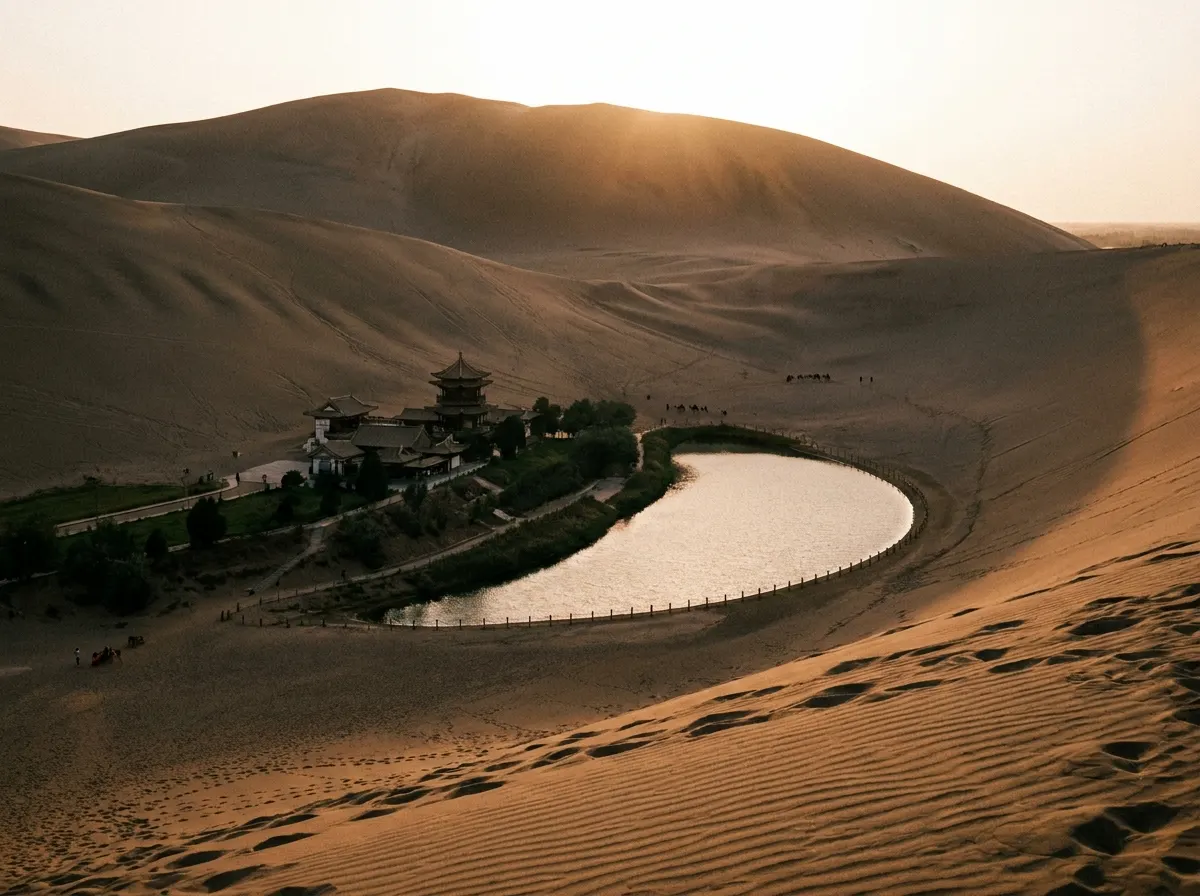
Dunhuang
Dunhuang is an oasis town in Gansu province, the western gateway of the Hexi Corridor on the ancient Silk Road. The Mogao Caves (a UNESCO site) hold one of the world's most important collections of Buddhist art — carvings, murals, and manuscripts spanning a thousand years. The Mingsha Sand Dunes and Crescent Moon Spring offer a desert spectacle of dunes and a spring that has never dried up. Plan 2-3 days. Dunhuang is reachable by air from Beijing, Xi'an, and Lanzhou, and by high-speed rail, and the airport connects directly to several major Chinese cities. Spring and autumn are the best seasons, with mild daytime weather, while summer brings intense desert heat and winter can see temperatures well below freezing, especially on overnight desert excursions.
Why Dunhuang in 2026.
Silk Road oasis. The Mogao Caves with their vast Buddhist murals, the singing sand dunes of Mingsha, and the Crescent Moon Spring — one of China's most atmospheric desert destinations.
Quick Answer
Dunhuang is an oasis town in Gansu province, the western gateway of the Hexi Corridor on the ancient Silk Road. The Mogao Caves (a UNESCO site) hold one of the world's most important collections of Buddhist art — carvings, murals, and manuscripts spanning a thousand years. The Mingsha Sand Dunes and Crescent Moon Spring offer a desert spectacle of dunes and a spring that has never dried up. Plan 2-3 days. Dunhuang is reachable by air from Beijing, Xi'an, and Lanzhou, and by high-speed rail, and the airport connects directly to several major Chinese cities. Spring and autumn are the best seasons, with mild daytime weather, while summer brings intense desert heat and winter can see temperatures well below freezing, especially on overnight desert excursions.
| Best time to visit | April-June and September-October; avoid summer heat and winter cold |
|---|---|
| Daily budget | $50 (backpacker) / $130 (mid-range) / $320+ (luxury) |
| Language | Mandarin (Gansu dialect; English in tourist areas) |
| Currency | CNY (¥) — Alipay/WeChat Pay in city; cash useful for desert trips |
| Time zone | China Standard Time (UTC+8) |
| Last updated | 2026-06-16 |
Want a Dunhuang plan built for you?
What are the Mogao Caves?
The Mogao Caves are hundreds of Buddhist cave-temples carved into a cliff face on the Silk Road, about 25km southeast of Dunhuang. Construction began in 366 CE and continued for roughly a thousand years, producing one of the world's largest and most significant collections of Buddhist art — statues, murals, and manuscripts. The site is a UNESCO World Heritage listing and is managed by the Dunhuang Academy, which limits visitor access to a rotating selection of caves to protect the fragile paintings. Visits begin with a digital film at the visitor center, followed by a shuttle to the caves and a guided tour.
How do I get to Dunhuang?
Dunhuang is reachable by air and rail. Dunhuang Mogao International Airport has flights from Beijing, Shanghai, Xi'an, Lanzhou, and other cities. High-speed rail from Lanzhou takes several hours. Dunhuang is the classic starting or ending point for a Hexi Corridor Silk Road tour, connecting eastward to Jiayuguan, Zhangye, and Lanzhou. Distances in Gansu are vast, so plan travel time.
How many days do I need in Dunhuang?
Two to three days covers the essentials. Day 1: the Mogao Caves (a half-day with the film and tour) plus the Dunhuang Museum in the afternoon. Day 2: Mingsha Sand Dunes and Crescent Moon Spring at sunset, plus the night market in the evening. An optional Day 3 goes deeper into the desert to Yumen Pass and the Yardang landforms — a long full-day excursion. Most travelers pair Dunhuang with Xi'an or the broader Hexi Corridor.
Should I do a Silk Road tour from Dunhuang?
Yes — Dunhuang is the classic starting point for a Hexi Corridor tour. The typical 5-7 day route runs Dunhuang to Jiayuguan (the Great Wall's western end) to Zhangye (the Danxia Rainbow Mountains) to Lanzhou, following the ancient trade corridor through Gansu province. Trains and roads connect the stops efficiently. The journey covers over a thousand kilometers of Silk Road history, from Buddhist cave art to desert fortresses to rainbow-colored mountains.
Can I see the singing sand dunes at sunset?
Yes — the Mingsha dunes are spectacular at sunset, when the low light turns the sand gold and the heat drops. Arrive 2-3 hours before sunset to climb the dunes (a 30-45 minute walk in sand), then watch the sun drop from the top. Camel rides are popular. The adjacent Crescent Moon Spring, a small lake that has persisted in the desert for centuries, is lit up after dark. The "singing" refers to the sound the sand makes when sliding down the dune faces.
When is the best time to visit Dunhuang?
April to June and September to October are the best months — mild days, cool nights, and the most comfortable weather for the desert. Summer (July-August) is extremely hot, with temperatures regularly exceeding 40°C. Winter is bitterly cold, though the crowds vanish and the desert light can be beautiful. Spring can bring dust storms. Avoid the October Golden Week, when domestic tourist numbers surge.
What should I eat in Dunhuang?
Dunhuang's food reflects its Silk Road location — northwestern Chinese with Central Asian influences. Signature items include donkey-meat yellow noodles (a local specialty), lamb skewers, Dunhuang apricots (in season in summer), naan-style flatbreads, and hand-pulled noodles. The Shazhou Night Market is the atmospheric place to try everything, with stalls serving grilled meats, noodles, and local fruit under lantern light.
Is Dunhuang good for families?
Yes — Dunhuang is excellent for families. The sand dunes have camel rides, sand sledding, and paragliding, all engaging for children. The Mogao Caves are educational for older children. The night market is fun and lively. The long Yardang day tour (4+ hours each way) is the one sight to skip with young children. Pace the itinerary around the heat and carry plenty of water.
Is Dunhuang safe?
Yes — Dunhuang is a safe, tourist-oriented town. Crime is rare. The main risks are summer heat (carry water and sunscreen and avoid midday desert exposure), the dry climate (stay hydrated), and occasional spring dust storms. The dunes have shade structures. The Mogao Caves are well-managed with shuttles and guides. Standard desert-travel precautions apply.
What makes the Mogao Caves a thousand years of Buddhist art?
The Mogao Caves are not a single monument but a cliff face carved into nearly five hundred cave-temples over the course of a millennium. Work began in 366 CE, when a wandering monk named Yuezun saw a vision of golden light and began carving the first cave. From that modest opening, generations of monks, pilgrims, artisans, and patrons kept adding, gilding, repainting, and restoring. At its peak, the complex held more than a thousand caves; around 735 survive today, stacked in layers up the sandstone cliff above the Daquan River. The Dunhuang Academy, founded in 1944, oversees conservation and rotates public access across the most important caves to limit humidity and human damage. A standard ticket admits you to roughly eight to ten caves, and visits are strictly guided to protect the paintings. Inside, the caves hold painted clay sculptures of Buddhas, bodhisattvas, and guardian figures, ranging from small devotional icons to the colossal nine-story Buddha of Cave 96, which towers 35 meters up the cliff face and can be seen from the visitor path. The murals — more than 2,000 painted panels across roughly 45,000 square meters — make up one of the largest contiguous bodies of religious painting in the world, depicting Buddhist sutras, donor portraits, scenes from the life of the historical Buddha, and even daily life of Silk Road travelers. Some murals blend Indian, Persian, Central Asian, and Chinese stylistic elements, telling the story of how Buddhism absorbed and adapted as it moved east. The Library Cave, Cave 17, sealed for centuries before its accidental discovery in 1900, yielded around 50,000 manuscripts, printed documents, paintings, and silk textiles from the 4th through 11th centuries — a documentary record so vast that it founded the modern discipline of Dunhuang studies. Photography inside the caves is forbidden. Allow three to four hours for the entire visit, including the introductory digital film at the visitor center, the shuttle to the site, and the guided tour.
What is the Library Cave and why do the Dunhuang manuscripts matter?
Cave 17 at Mogao, known as the Library Cave, is the single most important documentary find in early medieval Asia. A monk named Wang Yuanlu, who was restoring the Mogao complex in the late nineteenth century, discovered a hidden antechamber sealed behind a wall. Inside, layered bundles of manuscripts, printed scrolls, painted banners, and personal documents had been stored for centuries, probably as a community archive donated by a nearby monastic community and then forgotten during a period when the Silk Road trade routes shifted away from Dunhuang. When the cave was opened in 1900, the cache contained material dating roughly from the 4th to the 11th centuries — handwritten sutras in Chinese, Tibetan, Sanskrit, Khotanese, Sogdian, and Uyghur; official seals and tax records; the world's oldest complete printed book, a copy of the Diamond Sutra dated 868 CE; medical and astronomical texts; music scores; even a children's primer. Many of these manuscripts were sold or dispersed in the early twentieth century to foreign explorers, including the British archaeologist Aurel Stein and the French Sinologist Paul Pelliot, and now sit in collections in London, Paris, St. Petersburg, and Beijing. The find reshaped scholarship on the Silk Road — the texts revealed the everyday administrative, commercial, and religious life of the route in unprecedented detail. A faithful replica of Cave 17, recreated at the Mogao visitor center, lets visitors see how the manuscripts were stacked and stored, and learn the conservation story without entering the fragile original.
What are the nine-story Buddha and the giant statues of Mogao?
The most arresting single sight at Mogao is Cave 96, whose interior contains a colossal sitting Buddha that rises 35.5 meters from a platform to the roof of the cave. The figure was begun in the Tang dynasty (the cave itself is dated to 695 CE), then enlarged over the centuries; the external nine-story wooden facade that visitors see today was added during the Song dynasty and reinforced repeatedly, the last time in 1935. From the visitor pathway below, the Buddha's face is just visible between the eaves of the facade. Inside the cave, the statue is overwhelming — the kneeling worshippers in Tang-dynasty murals at its base give a sense of scale. Two other giant Buddhas share the cliff: Cave 130, holding a 26-meter standing Buddha begun in the Tang dynasty, and Cave 148, with a Tang reclining Buddha representing the Buddha entering nirvana. These colossal statues were pilgrimage magnets, and Cave 96 in particular is often paired with a more intimate cave in the same group to give a sense of the full artistic range at Mogao. The construction technique is also remarkable — the giant Buddhas are carved from the living rock and then finished with a clay layer that was painted and gilded; later restorations sometimes raised the floor of the cave and effectively buried the lower parts of older statues, which is why excavation has revealed multiple generations of art in some caves.
Why Dunhuang mattered to the Silk Road
Dunhuang was a hinge of Eurasian commerce for roughly a millennium. The town sits at the western end of the Hexi Corridor, the narrow Gansu passage that connects the Chinese heartland to the Tarim Basin and onward to Central Asia, the Indian subcontinent, and Persia. Just west of Dunhuang, the corridor pinches tight and travelers had to choose between two punishing desert routes — the northern route through Hami and Turfan, or the southern route via the oasis of Miran and the jade-trading post of Khotan. Anyone moving between China and the West had to stop at Dunhuang to rest, resupply, and prepare. Because of that role, the town accumulated extraordinary wealth, religious diversity, and artistic traffic. Buddhist monks traveled from India and Central Asia to translate sutras into Chinese at Mogao; Sogdian merchants used Dunhuang contracts now preserved in the Library Cave; Tang dynasty administrators garrisoned the frontier here; later waves of Tibetan, Uyghur, and Tangut rulers fought for control. The art at Mogao preserves that layered traffic — you can see Indian iconography filtered through Central Asian form, then re-expressed in Tang Chinese style, then repainted under Tibetan or Western Xia patrons in later centuries. The Silk Road declined as maritime trade rose in the Song and Ming periods, and Dunhuang shrank back into a small frontier outpost. The rediscovery of the Library Cave in 1900 and the opening of the caves to modern scholarship in the twentieth century reframed Dunhuang as one of the great cultural crossroads of the premodern world.
What makes Mingsha Sand Dunes and Crescent Moon Spring a desert spectacle?
A few kilometers south of Dunhuang, the Mingsha Shan — literally the Singing Sand Dunes — rise in long crescent-shaped ridges up to 200 meters above the oasis. The name comes from the resonant sound the dry sand makes when it slides down the steep dune faces in dry weather, caused by the uniform grain size and the warm, low-humidity air. The dunes have been a tourist draw since at least the Han dynasty, and Tang-era poets wrote about the sound. Today visitors climb the dunes — a 30 to 45 minute walk in soft sand — and slide down on sandboards or on foot. At the base of the dunes, tucked into a low curve between ridges, sits Crescent Moon Spring (月牙泉), a small sickle-shaped lake that has not dried up for centuries despite being entirely surrounded by mobile sand. The spring is fed by an underground aquifer; the surrounding dune ridges act as natural windbreaks that keep the surface from being buried. Crescent Moon Spring is small but photogenic, framed by a traditional Chinese pavilion and lit up after dark. The combined park has camel rides, paragliding, sand sledding, and small power-dune-buggy circuits. Sunset is the most popular time — the sand turns gold and orange, the heat drops, and the spring lights up. Allow two to three hours at minimum, longer if you climb high on the dunes or queue for a camel ride. The park closes in the late evening but the spring is illuminated through the night, with a viewing area accessible from outside the gate for visitors who just want to see the lights.
What desert sports can you do at Mingsha?
A camel ride along the base of the Mingsha dunes is the most photographed Dunhuang experience after the Mogao Caves. Rides range from short circuits near the gate (twenty to thirty minutes) to longer one-hour treks that climb partway up the dunes and back, and sunset rides that include a pause at a high vantage point. Camels here are domestic Bactrian two-humpers and the trekking caravans are organized and well-managed. For adrenaline, the dunes offer sand-sledding (plastic boards rented at the gate, slid down the lower dune faces), paragliding from the ridge tops (organized tandem flights booked on-site, weather permitting), and small motorcycle and dune-buggy circuits. Helicopter flights over the dunes and the adjacent Gobi have been introduced in recent years. None of these activities require advance booking for individuals in low season, though peak summer and the October Golden Week can get crowded. Camel rides in particular should be booked at the gate the day of, and operators usually stage departures throughout the day. Children under a certain height are typically not permitted on camel rides for safety; sand-sledding and paragliding have minimum age requirements enforced by the operators. Carry water, sunscreen, and a cover for your phone and camera — fine sand gets into everything.
What can you find at the Shazhou Night Market?
The Shazhou Night Market, just east of the Drum Tower in central Dunhuang, comes alive after sunset. Rows of red-lantern-lit stalls serve northwestern Chinese street food with strong Silk Road influences — lamb skewers grilled over charcoal, hand-pulled noodles, the local donkey-meat yellow noodles, naan-style flatbreads baked in clay ovens, and seasonal fruit from the oasis, especially the famous Dunhuang apricots in July and August. The apricots are small, intensely flavored, and served fresh, dried, or in sweet syrups. There is also an indoor section with a stage for nightly folk performances, and a smaller crafts-and-souvenir section selling camel-wool products, jade, painted reproduction murals, and Silk Road themed gifts. The market is family-friendly, busy but not chaotic, and a good place to spend two or three hours after a day of sightseeing. Prices are higher than backstreet restaurants but the food quality is generally good, and the atmosphere is uniquely Dunhuang. The market is open roughly from late afternoon into the night, with peak crowds after dinner; vendors close gradually. Cash and mobile payment both work. The nearby bar street has a handful of more Western-oriented cafes and small music venues for travelers looking for a quieter evening.
Why visit the Dunhuang Museum before or after Mogao?
The Dunhuang Museum, on the eastern edge of town, is the free and underrated complement to the Mogao Caves. The collection covers Silk Road history, the development of Buddhist cave art at Mogao, Han and Tang dynasty frontier artifacts, and modern conservation work. Highlights include a high-quality replica of Cave 257 (the Nine-Colored Deer mural) and a recreated section of Cave 17, the Library Cave, showing the manuscript cache as it was discovered. The museum is well laid out with bilingual labels and takes roughly ninety minutes to walk through. Most travelers visit it as a warm-up on arrival day or as a quieter follow-up to Mogao, particularly because replicas make it easy to see what you couldn't photograph inside the real caves. The museum is closed on Mondays. Entry is free with passport. A small shop sells official replicas, books, and Dunhuang-themed gifts at fairer prices than the night market stalls.
How do you get to Dunhuang by air?
Dunhuang Mogao International Airport (敦煌莫高国际机场, DNH) sits about 13km east of town and has direct flights from a small but useful set of Chinese cities. The most useful connections are Beijing (roughly three and a half hours), Shanghai (around four and a half hours via a stop or direct on certain airlines), Xi'an (about two and a half hours), and Lanzhou (about one and a half hours). There are also seasonal and occasional direct flights from Chengdu, Guangzhou, and other major cities. Domestic carriers operating the routes include China Eastern, China Southern, Hainan, and Spring Airlines. Flights can be cancelled or delayed by sandstorms in spring — check the forecast and pad your schedule if connecting onward. The airport has shuttle buses to central Dunhuang and a taxi queue; the ride to most hotels is twenty to thirty minutes and costs around ¥40-50. There is no high-speed rail station at the airport; rail passengers use Dunhuang Railway Station (敦煌站) instead.
How do you reach Dunhuang by high-speed rail via Lanzhou or Xi'an?
Dunhuang Railway Station sits on the Dunhuang–Golmud branch line, with high-speed services (G and D trains) running east to Liuyuan and onward to Lanzhou, and conventional trains connecting further east. From Lanzhou, a high-speed service to Dunhuang takes around six to seven hours via Jiayuguan and Liuyuan; from Xi'an, travelers typically change at Lanzhou West or Lanzhou Zhongchuan, with a total journey time of roughly nine to eleven hours. The Lanzhou–Dunhuang route is one of the most scenic train trips in northwestern China, threading the Hexi Corridor past the Great Wall remnants at Jiayuguan, the Danxia Rainbow Mountains near Zhangye, and the long flat desert approach to the Gansu–Xinjiang border. Sleeper trains (Z and T services) are also available and remain popular for budget travelers. Dunhuang's railway station is about ten kilometers from the town center, with shuttle bus and taxi service. Book train tickets well in advance during peak season and the October Golden Week; the Dunhuang-bound trains sell out first.
When is the best season to visit Dunhuang and how do you avoid the summer heat?
The best months to visit Dunhuang are April to June and September to October. Days are mild (typically 18-28°C), nights cool (5-15°C), and rainfall is minimal. Crowds are heaviest in the May Day and October Golden Week holidays, when hotel prices climb and tickets can be tight. Summer (July and August) is brutally hot — daytime temperatures above 38°C are routine, the desert surfaces can exceed 60°C, and midday sightseeing is uncomfortable. If you must visit in summer, schedule outdoor activities for early morning and evening, and plan the Mogao Caves for the air-conditioned visitor center. Winter (December to February) is cold and dry, with daytime temperatures around 0°C and occasional snow; the Mogao Caves remain open, the dunes are uncrowded, and the desert light is beautiful, though the night market is reduced. Spring (March to early April) brings occasional dust storms that can reduce visibility and delay flights. Pack layers year-round — desert temperature swings of 20°C between day and night are normal.
Is Yardang National Geopark worth a full-day desert excursion?
Yardang National Geopark (雅丹国家地质公园), about 180km northwest of Dunhuang deep in the Gobi, is a landscape of wind-eroded yardangs shaped over millions of years into spires, ridges, and animal-like silhouettes across a broad desert plain. The drive out takes around three hours each way and crosses some of the most sparsely populated terrain in China, with almost no services en route. Most travelers visit as part of a one-day coach tour from Dunhuang, typically combined with the Han-dynasty Yumen Pass and the Han Great Wall remnant at Hecang. Tours depart early morning (around 7-8am) and return late evening. The yardangs themselves are dramatic — particularly in late afternoon when the low light carves strong shadows — and the sight of an endless plain of eroded rock formations is unforgettable. Photography is excellent. The park is remote, dry, and very hot in summer; bring water, sun protection, layers, and a windbreaker. Cell phone signal is unreliable. Some travelers opt for the "ghost city" sunset excursion, which combines the yardangs with a desert sunset experience on the return. Most visitors with only two or three days skip Yardang; most visitors with four or more days consider it essential.
Are the Western Thousand Buddha Caves the quieter sister of Mogao?
The Western Thousand Buddha Caves (西千佛洞) are a smaller, less-visited Buddhist cave complex about 35km west of Dunhuang, dating from roughly the same period as Mogao and sharing stylistic roots. Only around twenty caves survive, but the murals are in some cases better preserved than those at Mogao because the site has been far less visited over the centuries. Wall paintings here include rare Northern Wei and Western Wei (5th-6th century) panels, and the iconography and palette are noticeably different from Mogao, reflecting the western terminus of the Silk Road. Visits are by guided tour arranged through the Dunhuang Academy, and access is more limited than at Mogao (typically a small number of caves opened at any one time). The caves are best visited as a half-day detour on the way to or from Yumen Pass and Yardang. Few independent travelers make it here, which is part of the appeal — you will likely have the small visitor pavilion to yourself.
What does the White Horse Pagoda reveal about Dunhuang's history?
The White Horse Pagoda (白马塔) sits in the older southern part of Dunhuang town and is the city's most distinctive small monument. The pagoda, a tapering earthen tower about twelve meters tall, is dated to the late Tang dynasty and is said to commemorate the legendary white horse of the Indian monk Kumarajiva, who is associated with the early transmission of Buddhism along the Silk Road. (Some local traditions link it instead to a Tang-era general.) The pagoda is weathered but well preserved, and the surrounding small park is a peaceful spot to see a less-touristed corner of the town. The site is walkable from central Dunhuang and is a useful ten-minute stop on a wander through the old quarter. Other smaller historical sites in and around the town — including fragments of the Han and Tang city walls, small Tang-dynasty tombs in the western suburbs, and the modest Dunhuang Old Town cultural park — round out the picture of a frontier town that was once a hinge of continental trade.
What photography tips should you follow in Dunhuang?
Photography is one of the highlights of a Dunhuang trip, but the conditions are unusual and worth planning for. The Mogao Caves themselves are entirely off-limits to photography inside — guards will ask you to put phones and cameras away before entering each cave. Outside the caves, the cliff face, the visitor pavilion, and the replica caves at the visitor center offer plenty of good shots. The Mingsha dunes reward golden-hour light; the best window is roughly the last ninety minutes before sunset. Crescent Moon Spring is best photographed at dusk and after dark with a tripod, when the spring and the surrounding pavilions are lit. Yardang is a long-lens and late-afternoon landscape. The night market is best shot handheld at high ISO. Practical concerns: fine desert sand gets into equipment, so bring a sealed bag, change lenses only in shelter, and consider a rain cover even when there is no rain. Wind is normal. Carry a microfiber cloth and brush for sensor cleaning. Bring more battery than you think — cold desert nights and continuous shooting drain power quickly. Mobile phone signal is generally good in town but drops off in the Yardang park and along the long desert roads.
What etiquette, language, and cultural notes should travelers know in Dunhuang?
Dunhuang is a small oasis town in Gansu province, and the local culture reflects the northwestern Chinese mainstream with a distinct Silk Road twist. Mandarin is the working language, and the local Gansu accent is generally intelligible to other Chinese speakers; English is spoken at the major tourist sites, high-end hotels, and the better restaurants but rarely on the street. A few words of Mandarin go a long way — nǐ hǎo (hello), xiè xiè (thank you), and duōshǎo qián (how much) cover most situations. The local population is ethnically Han Chinese with a Hui Muslim minority; pork is widely available but there are several long-established halal restaurants serving northwestern Chinese and Hui cuisine. Modest dress is fine for travelers at all sites; the Mogao Caves do not have a strict dress code, but conservative clothing is respectful at the religious caves. The night market is lively but safe; photography of vendors is generally fine if you ask first. Tipping is not customary in mainland China and is not expected at restaurants or hotels; guides and drivers appreciate a small tip for excellent service.
Where to stay in Dunhuang and how to choose a base
Most Dunhuang travelers stay in the modern city center, a compact grid of hotels and restaurants between the Drum Tower and the night market. Mid-range international-brand hotels and small boutique properties are clustered here, all within a short walk of the night market and most restaurants. A smaller cluster of upscale desert-resort-style hotels sits between the city and the Mingsha dunes, offering quieter rooms and dune views at higher prices. For budget travelers, the city center has a number of clean, simple Chinese-chain hotels at ¥150-300 a night. Pick the city center if your priority is walkable food, easy evening access to the night market, and proximity to the bus station; pick the dune-side hotels if you want a quieter atmosphere and don't mind driving in for dinners. Booking well in advance is essential for the October Golden Week, the May Day holiday, and the busy September-October shoulder season. For longer stays or a Silk Road-themed splurge, a handful of guesthouses near the Mogao visitor center offer early-morning access to the caves.
How should you spend 3 days in Dunhuang?
A balanced three days covers the essential Dunhuang experiences without rushing. Day 1: arrive, settle in, and visit the Dunhuang Museum in the late afternoon, then wander the Shazhou Night Market in the evening. Day 2 (Mogao day): pre-booked morning ticket at the Mogao Caves — the digital film at 9am, shuttle to the site, guided cave tour, return to town for lunch. Afternoon free for an optional West Lake park walk or a quiet tea. Evening sunset visit to Mingsha Dunes and Crescent Moon Spring (about 90 minutes at the dunes is enough if you skip the camel ride). Day 3 (desert day): full-day coach tour to the Yardang National Geopark, combining Yumen Pass and Han Great Wall remnant en route. Return to Dunhuang late evening. This itinerary assumes arrival on Day 1 morning and departure on Day 4 morning, or a tighter Day 1 afternoon arrival with the museum on Day 2 and Mogao on Day 3. Travelers with an extra day should add the Western Thousand Buddha Caves, the White Horse Pagoda, or a longer camel trek at Mingsha.
What to skip on a short Dunhuang trip
If you have only two days in Dunhuang, skip the Yardang National Geopark — the three-hour drive each way consumes most of a day, and it is secondary to the Mogao Caves and dunes. The Western Thousand Buddha Caves are also skippable on a tight schedule (the route passes them on the way to Yardang, so they really only fit a longer itinerary). The night market and a local Silk Road dinner are good for an evening, but you can skip a long shopping browse at the souvenir stalls if you are not interested in jade or camel products. Camel rides at Mingsha are atmospheric but short — skip if you have already ridden camels elsewhere in China. The Dunhuang Museum is genuinely worth the 90 minutes if you have time; it is genuinely skippable if you have already seen the Mogao replicas at the visitor center. The Drum Tower in the center of town is purely a landmark and can be photographed from outside in a minute.
How do you combine Dunhuang with the rest of the Hexi Corridor?
Dunhuang is the classic western terminus of a Hexi Corridor Silk Road trip. The standard routing goes east from Dunhuang through Jiayuguan (home of the western end of the Ming Great Wall and the Overhanging Great Wall section), then Zhangye (the spectacular Danxia Rainbow Mountains), and finally Lanzhou, the provincial capital and a useful flight and rail hub. The full east-bound corridor can be done in five to seven days by train or private car; a focused four-day version skips Zhangye or shortens Jiayuguan. Dunhuang also works as a starting point for travelers heading west into Xinjiang — the next major stops are Hami and Turfan, both reachable by rail or road. Most operators run a Dunhuang–Jiayuguan–Zhangye–Lanzhou loop, with optional extensions to Turfan and Urumqi further west. The journey covers well over a thousand kilometers of Silk Road history, from cave temples and desert fortresses to rainbow-colored sandstone mountains and the cosmopolitan provincial capital.
What do you need to know about visa, payments, and connectivity in Dunhuang?
Foreign visitors to Dunhuang enter China on a standard tourist (L) visa, which requires an invitation letter or pre-approved booking from a licensed Chinese travel agency for most independent travelers. As of 2026, several unilateral visa-free and transit-visa-free policies apply to specific passport holders, and these are worth checking on the official Chinese government sites before booking. Inside Dunhuang, mobile payment (Alipay and WeChat Pay) is universal in the city center, the Mingsha park gates, and the night market. Foreign credit cards are accepted at the international hotels and the high-end restaurants but rarely at small stalls. Cash is useful for the desert-side vendors and as a backup. ATMs in town accept foreign cards (the Bank of China and ICBC branches near the Drum Tower are reliable). Connectivity: a Chinese SIM card is the simplest option; foreign eSIMs with China roaming work in town but drop off in the Yardang park and on the long desert drives. The local timezone is China Standard Time (UTC+8) across the entire country. Dunhuang is in the far west of China geographically but uses the same time zone as Beijing, so sunrise and sunset are roughly two hours later than you might expect.
How did Dunhuang grow from a Han frontier garrison to a Silk Road metropolis?
Dunhuang's recorded history begins in the second century BCE, when the Han dynasty pushed its frontier west into the Hexi Corridor to break the Xiongnu confederation's grip on the trade routes. The Han established Dunhuang as a frontier commandery and garrison town, building defensive walls and watchtowers that survived in fragments along the corridor. Jade, silk, and horses moved through the town under Han protection, and the early Buddhist art at Mogao took root under this Han-dynastic stability. Through the centuries that followed, Dunhuang prospered under successive regimes: the Western Jin, the Northern Wei, the Sui, the Tang, the Tibetan Empire, the Western Xia, the Yuan, and ultimately the Ming and Qing. Each regime left artistic traces — Tang murals of donors in silk robes, Tibetan-style Buddhist paintings, restored cave facades. The town's fortunes turned in the Song dynasty, as maritime trade began to replace overland Silk Road traffic and the corridor slowly lost its centrality. By the Ming dynasty, Dunhuang had shrunk to a small frontier outpost and the Mogao caves were largely abandoned to the desert. The rediscovery of the Library Cave in 1900 by the Daoist priest Wang Yuanlu, and the subsequent international excavation campaigns of Aurel Stein, Paul Pelliot, Sergei Oldenburg, and others, brought the caves back into global attention and seeded the modern discipline of Dunhuang studies. Today Dunhuang is a county-level city in Gansu province with a small permanent population, a thriving tourist economy, and a research presence anchored by the Dunhuang Academy.
What should you look for inside the Mogao caves?
The Mogao murals reward a slow, close look. Most visitors who try to take everything in at once end up with a blur of color; those who learn to read a few key motifs get far more from each cave. Start with the donor portraits — rows of small painted figures along the lower walls, often accompanied by inscriptions listing the donor's name, family, and reason for sponsoring the cave. These portraits are a visual census of Dunhuang society across centuries, and they show shifts in clothing, hairstyle, and ethnicity over time. Next, look at the Jataka tales — sequential panels illustrating episodes from the Buddha's previous lives — which were painted both as religious instruction and as moral entertainment. The Nine-Colored Deer mural in Cave 257 is one of the most famous. The sutra paintings — illustrations of Buddhist scripture — are technically dazzling and often blend iconographic conventions from India, Central Asia, and China. Finally, the sky-riding Devas, flying apsaras, and celestial musicians painted in the upper registers of the caves give a sense of how the painters imagined the Buddhist heavens. A good guided tour will direct attention to a few specific features in each cave rather than trying to cover every wall; an English audio guide is available at the visitor center for travelers who prefer a self-paced visit.
How are the Mogao Caves being saved?
The Mogao Caves face continuous conservation challenges, and the Dunhuang Academy's work is a major part of why the site remains open. The principal threats are humidity from human breath and skin (the caves were sealed for centuries before tourism opened in the late 1970s), wind-driven sand from the desert, and salt crystallization in the porous sandstone walls. The Academy has responded with a layered program: limiting daily visitor numbers, restricting flash photography, capping humidity in each visited cave, monitoring wall paintings with sensors, and developing painstaking in-situ conservation techniques developed jointly with international partners. A purpose-built digital exhibition at the visitor center lets visitors experience high-resolution replicas of the most important caves, which both reduces pressure on the originals and provides a richer visual experience than is possible inside the dim caves themselves. The Academy has also been a pioneer in global heritage training, hosting international conservators and publishing field-leading research. Travelers who care about heritage preservation will find the Dunhuang Academy a model of how a fragile site can be opened to the public without sacrificing the long-term survival of the art.
Why has Crescent Moon Spring never dried up?
Crescent Moon Spring is one of the natural curiosities of northwestern China. The spring sits in a low swale between two arms of a crescent-shaped sand dune, about 100 meters long and 25 meters at its widest. Despite being entirely surrounded by mobile dunes, it has not dried up in recorded history — references in Tang dynasty texts already describe it. The geological explanation is straightforward in outline: an underground aquifer feeds the spring through fissures in the underlying bedrock, and the surrounding dune ridges act as natural windbreaks that keep sand from burying the surface. The water level has fluctuated; in the 1990s it dropped significantly, and a 2010s restoration project by the local government deepened the spring basin and raised the water table, restoring the surface area. The spring is now framed by a small traditional Chinese pavilion and landscaped walkways, and at night the spring and pavilion are lit up — a view many visitors rate as their favorite single image in Dunhuang. The site is reached via the same park entrance as the Mingsha dunes, and a visit to Crescent Moon Spring is usually combined with climbing or riding the dunes.
Why is Dunhuang a film and literature destination?
Dunhuang's dramatic landscapes have made it a recurring location for Chinese film and documentary work. The dunes and the ruined Han passes have stood in for frontier deserts in dozens of period films, including several major wuxia and historical dramas shot on location. Documentaries about the Silk Road, the Library Cave, and the conservation of Mogao are widely available on Chinese streaming platforms, with several award-winning productions in the last decade. The Japanese novelist Yasushi Inoue wrote a celebrated novel, "Tonkō" (Dunhuang), centered on the Library Cave's discovery; English translations are available. Western readers will find Peter Hopkirk's "Foreign Devils on the Silk Road" a useful popular history of the Stein and Pelliot expeditions and the dispersal of the Library Cave manuscripts. Travel reading worth packing: the UNESCO World Heritage listing page for Mogao (whc.unesco.org), a single-volume Silk Road history (such as Peter Frankopan's "The Silk Roads"), and any of several Dunhuang-specific art books published by the Dunhuang Academy. The Mogao visitor center bookshop carries a curated selection.
What Silk Road street food should you try at the Dunhuang night market?
Beyond the standard grilled lamb skewers and hand-pulled noodles, the Shazhou Night Market and the surrounding alleys have a handful of dishes worth targeting. The first is donkey-meat yellow noodles (驴肉黄面), a Dunhuang specialty of thick hand-cut wheat noodles served with sliced stewed donkey meat in a thin broth; the meat is mild and slightly sweet and pairs unusually well with the noodles. The second is the local version of the northwestern Chinese lamb stew (胡羊焖饼), in which flatbread is layered into a slow-cooked lamb and vegetable stew and absorbs the broth as it cooks. The third is the Dunhuang-style apricot: the local Li (李) and Xing (杏) varieties are small, intensely flavored, and sold fresh, dried, candied, or as a sweet syrup dessert. Naan-style flatbreads (馕) are baked in clay ovens and sold hot — buy them straight from the oven. The night market also serves a wide range of fruit juices, sour plum drinks (酸梅汤), and yogurt; the local yogurt is dense and slightly sour, often served with sugar. For dessert, look for the white mulberries (桑葚) in early summer and the dried grapes and dates in autumn. Most stalls take cash or mobile payment; menus are in Chinese only, so point and smile, or watch what the locals are ordering.
What day trips can you take from Dunhuang to Suoyang and the Western Xia citadel?
Suoyang City (锁阳城, literally "city of cynomorium") is the ruins of a Tang and Western Xia frontier garrison about 150km southeast of Dunhuang, in the desert beyond the modern town of Guazhou. The site is the largest ancient fortress ruin in Gansu, with intact rammed-earth walls, an inner citadel, and the remains of a Buddhist temple complex. Suoyang was a waystation on the Hexi Corridor branch connecting Dunhuang to the Qilian Mountain passes, and it features in several episodes of Tang and Western Xia history. The site is rarely visited and has a haunting quality — the walls still rise several stories above the desert floor, the inner citadel stands in profile, and the surrounding plain is empty for tens of kilometers. A handful of Chinese-language interpretive signs give the basic history; English signage is limited. Suoyang is a long full-day excursion and is best combined with the more famous sites of Dunhuang only if you have a specialist interest in frontier archaeology; most travelers skip it. Local drivers in Dunhuang can arrange private trips to Suoyang on request, and it is occasionally included in extended Silk Road coach tours.
What wildlife and ecology will you find in the Dunhuang oasis?
The Dunhuang oasis is fed by the Dang and Daquan rivers, which carry snowmelt from the Qilian Mountains south of town. That thin ribbon of water supports a dense band of irrigated farmland, poplar groves, and pasture that contrasts sharply with the surrounding desert — and with it a surprising variety of wildlife. In the oasis proper you will see Eurasian tree sparrows, magpies, hoopoes, and the occasional Eurasian kestrel. The Daquan riverbed, especially near the Mogao Caves, is a regular wintering site for the endangered black-necked crane. In the surrounding desert and semi-desert the more common species include the Bactrian camel (now mostly domesticated but with wild populations still in parts of the Lop Nur region), the goitered gazelle (mostly seen in the outer desert), the Tibetan wild ass (kulan, in the very outer desert), and on rare occasions the snow leopard in the high Qilian. Birders should not skip the Dang river wetlands in spring and autumn, when migratory waterfowl stop over. Travel in the oasis is straightforward; travel into the deeper desert requires a 4WD and ideally a local guide familiar with the route.
What remains of camel culture and the modern herders of Dunhuang?
The two-humped Bactrian camel is the well-known animal of Dunhuang. Domesticated for at least three thousand years on the steppes of Central Asia and Mongolia, the Bactrian camel is the species that carried Silk Road caravans across the desert corridors, and the small domestic herds still kept on the outskirts of Dunhuang are direct working descendants of that tradition. Today the herds are used primarily for tourism at the Mingsha dunes, but a handful of camel breeders also keep the tradition of camel-hair textile production alive — camel wool is woven into blankets, coats, hats, and scarves, and remains the warmest practical textile for the desert winter. Camel milk and dried camel milk products are sold at the night market and at a few dedicated shops; the flavor is slightly saltier and thinner than cow milk. Camel meat is occasionally served in northwestern Chinese restaurants, although it is less common than lamb. Visitors interested in camel culture can usually arrange a half-day visit to a local herder through their hotel; this is also a good way to see the broader oasis landscape outside the town.
What family-friendly itineraries work with kids in Dunhuang?
Dunhuang is one of the better destinations in northwestern China for families with children. The Mingsha dunes are the obvious draw — children generally love the sand, and the camel rides, sand-sledding down the dune faces, and small motorcycle circuits keep them entertained for hours. The Mogao Caves work for older children (roughly eight and up) who can stay engaged through a guided tour; younger children will find the caves dim and the explanations hard to follow. The Dunhuang Museum has hands-on displays and reproduction caves that work well for short attention spans. The night market is lively and family-friendly, with plenty of grilled skewers, sweets, and small souvenirs. For a half-day excursion that works for kids, the White Horse Pagoda park is walkable from the town center and the Western Thousand Buddha Caves are too long a trip for small children. The Yardang day trip is the one excursion to skip with kids — the long drive is uncomfortable and the open desert is hot and featureless from a child's perspective. Pace the itinerary around the heat, carry plenty of water, and schedule indoor time (the museum, the visitor center, hotel pool) for midday.
When should you visit each Dunhuang site for the smallest crowds?
The Mogao Caves are slightly less crowded on weekday mornings and noticeably quieter on Tuesday and Wednesday. Weekends and Chinese holidays are the busiest, and tickets sell out fastest in those windows. The Mingsha dunes are at their quietest just after sunrise and just before the park closes at night; midday in summer is the busiest window because of tour groups. The Dunhuang Museum is closed on Mondays, so plan a museum visit on any other day. The night market is busiest on Friday and Saturday evenings. The Yardang coach tours operate daily but book out faster on weekends. For travelers who want a more contemplative visit to the dunes, the early-morning window (roughly 6-8am in summer) has the best light, the coolest sand, and the fewest visitors; the late-afternoon sunset window has the more dramatic light but is the most popular. For travelers who want a contemplative Mogao visit, the first guided tour of the day is generally the quietest. If your schedule allows, plan Mogao for a Tuesday or Wednesday morning, the museum for a Tuesday afternoon, and the dunes for the following morning at sunrise — you will avoid most of the tour-group density.
What scams should you watch out for in Dunhuang?
Dunhuang is not a high-scam destination, but a few things to watch for. At the night market, bargain politely on souvenir stalls but be cautious of jade sellers — fake jade is common, prices are inflated for foreigners, and the quality cannot be assessed visually. At the Mingsha dunes, buy camel ride tickets only from the official operator at the gate; unofficial touts at the road outside the park sometimes sell inflated tickets that don't include the park entrance. Taxi drivers at the airport and railway station occasionally quote inflated prices to foreign arrivals; the shuttle bus and meter taxis are both reliable alternatives. At restaurants, the menu should be visible before you sit; check the price of seafood and specialty items before ordering. The "tea ceremony" and "art student gallery" scams occasionally seen elsewhere in China are rare in Dunhuang but worth being politely skeptical of any free gift that comes with a high-pressure sales pitch. When hiring a driver for the Yardang or Yumen Pass day trip, book through your hotel rather than from a street tout; hotels use known drivers with proper insurance and clear pricing. For the Silk Road coach tours, the official pickup-point operators inside the bus station are safer than the drivers who approach travelers in the parking lot.
What does the Dunhuang Academy do today?
The Dunhuang Academy (敦煌研究院), founded in 1944 by Chang Shuhong, is both the custodian of the Mogao Caves and a leading international center for cave temple conservation and study. The Academy oversees the Mogao Caves, the Western Thousand Buddha Caves, the Yulin Caves (a related site in Guazhou county), and several smaller sites. Its conservation team has trained conservators from across Asia and developed protocols now in use at cave sites from Afghanistan to Japan. The Academy runs a small research library, publishes a peer-reviewed journal on Dunhuang studies, and hosts international conferences. It also runs the policy on visitor access: tickets are released in waves, group sizes are capped at around 25 people, and a small number of "special caves" can be visited by separate ticket for travelers who want a deeper experience. The Academy's visitor-center replicas of the Library Cave and several painted caves are themselves the product of years of conservation-grade reproduction work and are well worth the time to visit. The Academy also maintains a working artist studio on site, where conservators and traditional painters continue to practice the techniques used in the original murals — a small but excellent window into how the cave art was made.
What changes in Dunhuang when you visit in winter?
Visiting Dunhuang in winter (December through February) is a different experience from the shoulder seasons. The crowds vanish — the night market is reduced, the dunes are nearly empty at sunset, and the Mogao Caves are easy to book. The cost is the cold: daytime temperatures hover around freezing, nights drop well below, and desert wind chill is significant. The dunes can be snowy, which is photogenic but uncomfortable to climb. The Yardang Geopark tour is generally still operating but shorter hours and earlier returns. The Han Great Wall remnant near Yumen Pass is more impressive in winter because the low light picks out the rammed-earth layering; the surrounding plain is barren but starkly beautiful. For travelers who don't mind the cold and want a quieter experience, winter is excellent — you will have the caves and the dunes largely to yourself, the cost of hotels drops by a third or more, and the empty desert has a strong contemplative quality. Pack serious cold-weather gear, thermal layers, and a windproof outer shell. Camel rides are still available year-round but operators limit them in icy conditions; check at the gate on cold mornings. The Mingsha park remains open but some sections of the upper dunes may be closed for safety when frozen.
How do you connect Dunhuang to a broader Silk Road or Northwest China trip?
Most travelers who come to Dunhuang end up building it into a broader northwestern China trip. The classic east-bound route through the Hexi Corridor covers Dunhuang, Jiayuguan (where the Ming Great Wall ends at a dramatic mountain pass), Zhangye (the Danxia Rainbow Mountains, accessible by a short detour), and Lanzhou (the provincial capital with a major airport and HSR hub). Total time: 5-7 days. The west-bound extension from Dunhuang into Xinjiang covers Hami (known for its melons), Turfan (the Turfan Depression below sea level, with the Bezeklik cave complex and the ancient city of Gaochang), and Urumqi (the regional capital and a flight hub for Central Asia). This full Dunhuang-to-Urumqi route is a minimum of 7-10 days. Travelers with more time can extend further into Khotan and Kashgar, or loop back south through Qinghai and the Tibetan Plateau. Most of the corridor is well-served by high-speed rail, and a private driver with a minivan is the most flexible option for stops between rail stations. For travelers who prefer a single-country Silk Road loop, an alternative routing is Dunhuang — Hami — Turfan — Dunhuang by air, returning for a second visit to the caves with a fresh appreciation.
How can you travel sustainably and responsibly in Dunhuang?
Dunhuang sits at the edge of an increasingly fragile desert ecosystem, and a few small choices by travelers help. Stay on marked paths in the Mingsha dunes — off-path walking damages the fragile cryptogamic soil crust that stabilizes the dunes and can take decades to recover. Do not collect anything from the desert, including the Yardang park and the road to Yumen Pass. Carry out your trash, particularly plastic water bottles, which accumulate in the desert faster than they break down. Support the Dunhuang Academy by buying tickets through the official site rather than third-party resellers, and by visiting the replica caves at the visitor center rather than asking guides to open restricted caves. Choose locally-owned restaurants and small hotels where possible — the night market vendors and the family-run guesthouses in the old town are good places to direct tourism revenue. For travelers interested in conservation volunteering, the Dunhuang Academy occasionally hosts small international conservation programs; check the Academy website for current opportunities. Camel rides at the dunes are a legitimate use of working animals but choose operators that limit daily ride counts and provide proper water and rest breaks — ask at the gate before booking. For water, the cleanest choice is a refillable bottle refilled at your hotel or a filtered station; single-use plastic bottles can be returned at recycling points in the city center but rarely in the desert park.
Should you stay in the city center or the desert-edge resorts in Dunhuang?
Choosing where to stay in Dunhuang shapes the rhythm of the trip. The city center cluster, around the Drum Tower, is the practical choice for first-time visitors. Walking distance to the night market, the museum, restaurants, and the bus station makes logistics painless, and the streets are lively from morning to late evening. Mid-range international-brand hotels here (including Holiday Inn Express, Jinjiang Inn, and a handful of local chains) cost roughly ¥300-500 a night in shoulder season. For a quieter atmosphere and dune views, the desert-edge cluster sits between the city and the Mingsha park, about 15 minutes drive from the center. These properties are mostly upscale Chinese resort brands and a handful of boutique guesthouses, with rates from ¥600 into the four figures. The trade-off is that you will need a taxi or hotel shuttle for dinner, the night market, and most city-center restaurants. For families with small children, the city center is usually more convenient. For couples and photographers who want empty-dune sunrise shots without a 6am taxi, the desert-edge properties earn their premium. A third option, a small number of guesthouses near the Mogao visitor center, suits travelers who want early-morning access to the caves without a 25-minute drive from town.
When should you align your visit with Dunhuang's festival calendar?
A handful of annual events give Dunhuang its festival rhythm. The Silk Road International Cultural Expo, held in the city in early September, brings trade exhibitions, music performances, and a noticeable spike in hotel demand. The Dunhuang International Dance Festival, hosted in late summer, features dance performances staged at the Mogao visitor center and the night market. The annual equestrian show at the dunes, drawing on Dunhuang's Silk Road cavalry heritage, runs in summer. For most travelers, the practical calendar is shaped less by festivals than by Chinese public holidays: the May Day window (May 1-5), the Mid-Autumn Festival (September or October depending on the lunar calendar), and the National Day Golden Week (October 1-7) bring large crowds, inflated hotel prices, and sold-out train and flight tickets. The Mogao Caves in particular book out completely during Golden Week. Aim for late April, late May, mid-September, or any quiet week in October for the best balance of weather, crowds, and cost.
What are the rules on photography permits, drones, and special-access tours at Mogao?
Drones are effectively banned in the tourist zones of all three Dunhuang-area sites. The Dunhuang Academy restricts drone use at Mogao to licensed researchers, the Mingsha park prohibits drones within the main dune area, and the Yardang Geopark has a no-drone policy inside the visitor zones. Helicopter flights over the dunes are an alternative for travelers who want aerial footage, and are organized by local operators (typically ¥800-1500 per person for a 15-20 minute flight, weather permitting). For photographers who want a deeper visit to Mogao, the Dunhuang Academy offers a small number of "special cave" tickets per day, covering a few of the most important painted caves (including Cave 220, with its celebrated Tang-dynasty musicians, and Cave 321, with its early Tang Buddhist narrative). These special cave tickets must be arranged through the Academy's official ticketing site in advance and are limited to a handful of visitors per cave per day; photography inside remains prohibited, but the smaller group size and the additional caves make the visit much richer.
What should you read or watch before visiting Dunhuang?
A few hours of pre-trip reading sharpens a Dunhuang visit considerably. For the Library Cave story, the most readable single account is "The Diamond Sutra: The Story of the World's Earliest Dated Printed Book" by Susan Whitfield, who draws on the British Library's Dunhuang manuscript collection. For a broader Silk Road context, Peter Frankopan's "The Silk Roads" and Valerie Hansen's "The Silk Road: A New History" are the best modern single-volume treatments. Peter Hopkirk's "Foreign Devils on the Silk Road" tells the story of the foreign expeditions that dispersed the Library Cave manuscripts. For the art, the Dunhuang Academy itself publishes a series of high-quality art books on the cave murals, available at the Mogao visitor center shop. For film, the best documentaries include the BBC's "The Silk Road" series, the PBS "Silk Road: The Journey of the West" episode on Dunhuang, and the Chinese documentary "Dunhuang" (2010), which won several domestic awards. Yasushi Inoue's novel "Tonkō" (available in English as "Tonkō: A Novel of the Silk Road") is the best-known piece of fiction set around the Library Cave discovery and makes evocative pre-trip reading. For travelers who want a deeper art-historical treatment, Roderick Whitfield's "The Art of Central Asia and the Silk Road" and the multi-volume Dunhuang Mogao Caves art series are excellent companions to the visit. The Dunhuang Academy also publishes a journal of Dunhuang studies that occasionally includes translations of recent Chinese-language scholarship; check the Academy's website for open-access back issues. For travelers who prefer podcasts, the BBC's "In Our Time" has a strong episode on the Silk Road, and the British Library's own podcast has featured multiple interviews with curators of the Dunhuang manuscript collection. Most of these can be sampled on a long train ride east from Dunhuang.
Top attractions
Mogao Caves (莫高窟)
UNESCO site with hundreds of carved cave-temples, thousands of Buddhist statues, and vast murals spanning the 4th–14th centuries. Allow 3–4 hours.
Mingsha Mountain & Crescent Moon Spring (鸣沙山月牙泉)
Singing sand dunes rising 200m above the oasis, with a crescent-shaped spring that has never dried up. Camel rides, sand-sledding, sunset views.
Yumen Pass (玉门关)
Han-dynasty Silk Road fortress, a modest ruin deep in the Gobi. Combined with the Han Great Wall remnant and Yardang landforms on the same desert circuit.
Yardang National Geopark (雅丹)
Wind-eroded rock formations 180km northwest of Dunhuang in the Gobi. Dramatic late-afternoon light; full-day excursion.
Dunhuang Museum
Free museum covering Silk Road history and Mogao artifacts, with high-quality replica caves. Allow 90 minutes.
Western Thousand Buddha Caves (西千佛洞)
Smaller, quieter sister complex to Mogao, 35km west. Northern Wei and Western Wei murals, fewer visitors.
Shazhou Night Market (沙州夜市)
Red-lantern street-food market in central Dunhuang — lamb skewers, donkey-meat noodles, and the famous Dunhuang apricots in summer.
White Horse Pagoda (白马塔)
Tang-dynasty earthen pagoda in the older southern quarter, traditionally linked to the monk Kumarajiva's horse. A peaceful small stop.
STAY
Where to stay in Dunhuang
Pick a base that matches the trip you want — imperial-central for sightseeing, hutong belt for character, Chaoyang for nightlife, or Qianmen for budget.
City Center (Drum Tower area)
Walkable hub with hotels, restaurants, and the night market a short walk away
#city-centerMingsha Desert Edge
Quieter desert-resort cluster with dune views, 15 min drive from the old town
#mingshaMogao Visitor Center area
A handful of guesthouses near the caves for early-morning access
#mogao
ITINERARIES
Sample itineraries from Dunhuang
Three ready-made routes, from a 1-day imperial sprint to a 5-day deep dive. Copy the day-by-day plan and adapt to your own pace.
- 2 DAYS
Dunhuang in 2 Days (Classic)
Mogao Caves, Mingsha dunes, night market. The essential Dunhuang.
- First-timers
- Tight schedule
- Day 01
Morning
Arrive, check in. Afternoon: Dunhuang Museum for context.
Afternoon
Shazhou Night Market in the evening — lamb skewers and naan.
Evening
Rest early for tomorrow.
- Day 02
Morning
Mogao Caves — morning ticket with 9am digital film. 3–4 hours total.
Afternoon
Lunch in town. Late afternoon: Mingsha Sand Dunes. Climb the dunes for sunset, visit Crescent Moon Spring.
Evening
Final night market dinner. Depart next morning.
- 3 DAYS
Dunhuang in 3 Days (with Desert)
2-day classic plus a full-day desert excursion to Yardang and Yumen Pass.
- Silk Road enthusiasts
- Photographers
- Day 01
Morning
Arrive. Dunhuang Museum.
Afternoon
Shazhou Night Market.
Evening
Walk the old quarter.
- Day 02
Morning
Mogao Caves — morning ticket.
Afternoon
Rest in town. Late afternoon: Mingsha dunes and sunset.
Evening
Night market or local restaurant.
- Day 03
Morning
Full-day desert excursion — Yumen Pass, Han Great Wall, Yardang Geopark.
Afternoon
Return to Dunhuang late evening.
Evening
Farewell dinner. Depart next morning.
BUDGET
What a Dunhuang trip costs
Per-person, per-day costs across three spending tiers. Excludes international flights and visa fees.
| Line item | Backpacker | Mid-range | Luxury |
|---|---|---|---|
| Accommodation (per night) | $25 | $80 | $250 |
| Meals (3 per day) | $10 | $25 | $80 |
| Local transport | $5 | $15 | $40 |
| Top attraction (Mogao Caves, Mingsha dunes) | $30 | $50 | $80 |
| Daily essentials | $5 | $15 | $40 |
| Total per day | $75 | $185 | $490 |
$ USD per person per day, before international flights and visas. Last verified: Q3 2026.
STAY SAFE
Emergency contacts in Dunhuang
Save these three numbers before you board the plane. China uses different hotlines than most countries — there's no 911.
- POLICE
110
- AMBULANCE
120
- FIRE
119
- TOURIST HOTLINE
12301
Problems travelers hit in Dunhuang
- Why is my Alipay not working?You linked a foreign Visa or Mastercard to Alipay but every transaction is rejected at the merchant.
- My China visa was denied — what now?Your L visa application was refused at the Chinese consulate and your trip is in 2–4 weeks.
- My passport was lost or stolen in China — what do I do?Your passport is gone (theft or loss) and you're in mainland China without travel documents.
- Why can't I book on 12306 with my foreign card?You tried to book a high-speed rail ticket on 12306.cn and your foreign Visa/Mastercard is rejected at checkout.
- Why is my VPN not working in China?You arrived in China, opened your VPN, and it will not connect at all or connects but no traffic loads.
- Why can't I book a Tibet trip on my own?You try to book Lhasa flights and hotels yourself but the booking fails, or you're turned away at the Lhasa airport without a permit.
Book activities in Dunhuang
These are licensed tour operators and booking platforms we've vetted independently. Booking through these links may earn us a commission — see our affiliate disclosure. This never affects our editorial recommendations or the price you pay.
Frequently asked questions
How do I book Mogao Caves tickets?
Can I visit Mogao Caves independently?
What is the best Dunhuang food?
Is Dunhuang good for kids?
Is Dunhuang safe?
What is the Crescent Moon Spring?
Show all 25 FAQs
How far is the Yardang Geopark?
What is the Yumen Pass?
Can I buy tea or souvenirs in Dunhuang?
What should I pack for Dunhuang?
Is Dunhuang expensive?
What is the single biggest mistake travelers make in Dunhuang?
Why are the Mogao Caves a UNESCO World Heritage Site?
What is the Library Cave (Cave 17)?
How tall is the nine-story Buddha at Mogao?
How do I fly to Dunhuang from Beijing or Shanghai?
Can I take a high-speed train to Dunhuang?
When should I avoid visiting Dunhuang?
Are the Western Thousand Buddha Caves worth a visit?
Is the Yardang Geopark a day trip or can I stay overnight?
Can I photograph the Mogao Caves?
Do I need a guide in Dunhuang?
What is the White Horse Pagoda?
How hot does it get in summer in Dunhuang?
What is the best sunset experience in Dunhuang?
References

Related guides & destinations
Guide
Silk Road Itinerary: Xi’an to Kashgar (15 Days) 2026
A 15-day Silk Road overland route from Xi’an to Kashgar via Lanzhou, Zhangye, Jiayuguan, Dunhuang, Turpan, and Urumqi. Combines the Terracot
Guide
How We Research 2026: NihaoVisit’s Methodology for China Travel Information
How NihaoVisit sources, verifies, and maintains 700+ pages of China travel information — our source hierarchy, fact-checking process, update
Guide
Fact-Checking Log 2026: Verified China Travel Information — NihaoVisit
A public log of fact-checking verification passes on NihaoVisit, showing what was verified, when, and against which sources — covering visa
Guide
Best Time to Visit China 2026: Month-by-Month Weather, Crowds, and Prices
The best time to visit most of China is April–May and September–October. Winter (Dec–Feb) is cold but cheap; summer (Jun–Aug) is hot and cro
Guide
VPN for China 2026: Which VPNs Work, eSIM Alternatives, and the Complete Pre-Trip Checklist
Most Western apps and websites are blocked in mainland China. A reliable VPN is essential for Google, Gmail, WhatsApp, Instagram, and most n
Guide
China SIM Card and eSIM Guide 2026: Stay Connected Without WeChat
A Chinese SIM or eSIM lets you use mobile data, maps, and ride-hailing without WiFi. Here is how to get one, the cost, and which provider to