Emeishan
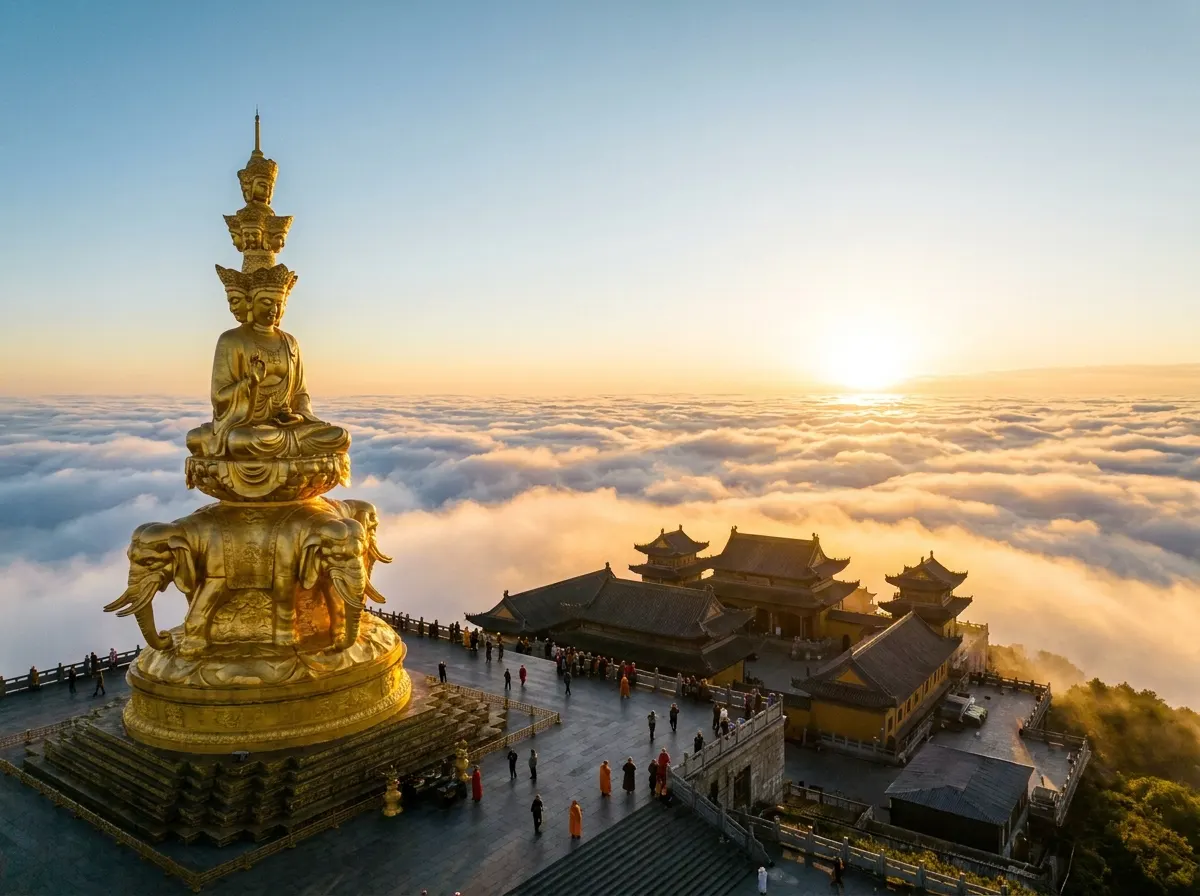
Emeishan (峨眉山, Éméi Shān) is one of China's Four Sacred Buddhist Mountains (四大佛教名山, Sì Dà Fójiào Míngshān) and a UNESCO World Heritage Site since 1996, rising to 3,079 meters in western Sichuan province. It is the bodhimanda (道场, dàochǎng) of Samantabhadra (普贤菩萨, Pǔxián Púsà), the Bodhisattva of Universal Virtue and Practice, often depicted riding a white six-tusked elephant. The mountain has been an active Buddhist site since the 1st century CE, making it one of the oldest continuously operating Buddhist centers in China. The highlight — and the image on every Sichuan tourism poster — is the Golden Summit (金顶, Jīndǐng), where the gilded 48-meter statue of Samantabhadra rises above a sea of clouds at 3,079 meters, backed by sunrise, stars, or the rare and spectacular "Buddha's Light" (佛光, fóguāng) — an optical glory phenomenon that projects the viewer's shadow onto the clouds, ringed by a rainbow. The mountain is also famous — or infamous — for its wild Tibetan macaques (猴子, hóuzi), which have learned to shake down hikers for snacks along the ascent path. The honest downside: Emeishan is crowded, commercialized, and expensive by Chinese mountain standards — the entry fee (¥160 as of June 2026), the cable cars, and the summit hotels add up fast. But the summit at sunrise on a clear morning is one of the most transcendent experiences in Chinese travel, and the monastery trail — dozens of working temples strung along ancient stone paths through cloud forest — gives you a sense of what Chinese Buddhist pilgrimage has meant for two millennia. Mount Emei is also a base for the surrounding Buddhist temple network, and travelers with two or three days can combine the mountain with the Leshan Giant Buddha and a slow visit to one of the smaller monastery towns south of the main scenic area.
Why Emeishan in 2026.
UNESCO-listed sacred Buddhist mountain in Sichuan, home to the Golden Summit at 3,079m, a Sea of Clouds that stretches to the horizon, and monasteries where monks have chanted for 2,000 years.
Quick Answer
Emeishan (峨眉山, Éméi Shān) is one of China's Four Sacred Buddhist Mountains (四大佛教名山, Sì Dà Fójiào Míngshān) and a UNESCO World Heritage Site since 1996, rising to 3,079 meters in western Sichuan province. It is the bodhimanda (道场, dàochǎng) of Samantabhadra (普贤菩萨, Pǔxián Púsà), the Bodhisattva of Universal Virtue and Practice, often depicted riding a white six-tusked elephant. The mountain has been an active Buddhist site since the 1st century CE, making it one of the oldest continuously operating Buddhist centers in China. The highlight — and the image on every Sichuan tourism poster — is the Golden Summit (金顶, Jīndǐng), where the gilded 48-meter statue of Samantabhadra rises above a sea of clouds at 3,079 meters, backed by sunrise, stars, or the rare and spectacular "Buddha's Light" (佛光, fóguāng) — an optical glory phenomenon that projects the viewer's shadow onto the clouds, ringed by a rainbow. The mountain is also famous — or infamous — for its wild Tibetan macaques (猴子, hóuzi), which have learned to shake down hikers for snacks along the ascent path. The honest downside: Emeishan is crowded, commercialized, and expensive by Chinese mountain standards — the entry fee (¥160 as of June 2026), the cable cars, and the summit hotels add up fast. But the summit at sunrise on a clear morning is one of the most transcendent experiences in Chinese travel, and the monastery trail — dozens of working temples strung along ancient stone paths through cloud forest — gives you a sense of what Chinese Buddhist pilgrimage has meant for two millennia. Mount Emei is also a base for the surrounding Buddhist temple network, and travelers with two or three days can combine the mountain with the Leshan Giant Buddha and a slow visit to one of the smaller monastery towns south of the main scenic area.
| Worth visiting | Yes, if you can handle the climb — the Golden Summit at sunrise is one of the best mountain experiences in China. |
|---|---|
| Recommended days | 2-3 days (1 day for a cable-car ascent, 2-3 for the full hiking experience) |
| Best time to visit | April-June and September-October (avoid July-August crowds/rain, winter ice, and Chinese public holidays) |
| Daily budget | $45 (backpacker) / $130 (mid-range) / $350+ (luxury) |
| Family friendly | Moderate — cable car to summit works for families, but the hiking trail is steep, the macaques are aggressive, and high altitude affects some children |
| Solo friendly | Excellent — safe, well-marked, sociable on the trail, and the monastery guesthouses welcome solo travelers |
| Airport | Chengdu Tianfu International Airport (TFU) — 1.5 hours by HSR from Chengdu to Emeishan Station, then 15-minute bus to the mountain base |
| High-speed rail | Yes — Chengdu East to Emeishan Station (1.5 hours, ¥65-95 second class), with frequent departures throughout the day |
| Language | Mandarin with Sichuan dialect; English signage at the summit and main temples, but spoken English is rare |
| Currency | CNY (¥) — Alipay and WeChat Pay accepted at ticket offices, cable cars, and summit hotels; carry ¥300-500 cash for monastery guesthouses and small temple donations |
| Time zone | China Standard Time (UTC+8) |
| Last updated | 2026-06-18 |
Want a Emeishan plan built for you?
Jump to:
Why Visit·Buddhist History·Getting There·Ascending the Mountain·Where to Stay·Golden Summit Experience·Monkeys·Itineraries·Weather·Practical Tips·Sleeping Buddha·Wanfo Top·Leshan Day Trip·Tang-Song History·Emei Zhuyeqing Tea·Four Sacred Mountains·Trail Food·Seasons and Festivals·Biodiversity and Vegetation Zones·Hot Springs·Emei Martial Arts·Emergency Contacts·Wildlife and Buddhist Festivals
Why visit Emeishan? Is it worth the climb?
Emeishan is not a casual day trip. It is a genuine mountain — 3,079 meters of vertical relief, a full hiking ascent of 30+ kilometers and 2,500 meters of elevation gain that takes two days on foot. The mountain demands effort, and that effort is part of what makes the summit meaningful. The draw is tripled. First, the Golden Summit at sunrise: the Samantabhadra statue, 48 meters of gilded bronze, rising out of the cloud sea, catching the first light of morning, with the distant snow peaks of the Tibetan Plateau — Minya Konka (7,556m), the highest peak in Sichuan — visible on exceptionally clear winter days. It is a genuinely humbling sight, and the photos, however good, do not capture the scale or the cold thin air or the sound of monks chanting in the summit temple. Second, the monastery trail: Emeishan has more than 30 working Buddhist temples along its ascent route, some grand (Wannian, Baoguo), many small and intimate, housing a handful of monks or nuns. Walking from temple to temple through cloud forest, stopping for tea and incense, is a pilgrimage experience that predates tourism and still feels genuine in 2026 — especially on the quieter middle and upper trail sections where the day-trippers thin out. Third, the biodiversity: Emeishan's elevation span — from 500m subtropical forest to 3,079m alpine zone — makes it one of the most biodiverse sites in temperate China. The mountain has over 3,200 plant species, including 100+ that exist nowhere else on Earth. The vegetation shifts visibly as you climb: bamboo groves → mixed broadleaf forest → fir and hemlock → dwarf rhododendron → alpine scrub. The honest downside: Emeishan is commercialized and expensive. The entry fee (¥160 as of June 2026), the cable cars (¥65-120 per segment), the summit hotels (¥400-1,200 per night), and the food (¥40-80 per meal in mountain restaurants) add up. On summer weekends and holidays, the summit can feel less like a sacred site and more like a crowded viewing platform. The macaques, billed as charming wildlife, are aggressive food thieves that some visitors find genuinely frightening. And the weather is fickle — the summit is socked in by cloud roughly 200 days a year, and you can do the full climb and see nothing but grey. That said, on a clear October morning with the cloud sea below and the statue catching the sun, it is worth every step.
What is the Buddhist history of Emeishan?
Emeishan is one of the Four Sacred Buddhist Mountains of China, the others being Wutai Shan, Putuo Shan, and Jiuhua Shan. Each is the bodhimanda of a specific bodhisattva.
How to get to Emeishan from Chengdu and beyond?
Emeishan is one of China's most accessible sacred mountains, thanks to the high-speed rail connection from Chengdu. Emeishan Station (峨眉山站, Éméi Shān Zhàn) is the dedicated high-speed rail station, about 10 minutes by bus or taxi from the mountain base at Baoguo Temple. From Chengdu East Station, G-class HSR trains run frequently (roughly every 30 minutes during daylight hours) and take about 1.5 hours, costing ¥65-95 for a second-class seat. Buy tickets on 12306 or Trip.com. From Chengdu Shuangliu International Airport (CTU) or Chengdu Tianfu International Airport (TFU), take the metro or a DiDi to Chengdu East Station for the HSR connection — budget about 1 hour from either airport to the station. From other Sichuan destinations: Leshan (乐山), home of the Giant Buddha, is only 40 minutes away by HSR (¥25-40), making a Leshan-Emeishan combination a natural 2-3 day itinerary. Chongqing is about 2.5 hours by HSR. Xi'an is 4-5 hours by HSR via Chengdu. Once you arrive at Emeishan Station, bus route 1 (¥2) runs directly to the Baoguo Temple tourist center in about 15 minutes. A taxi or DiDi costs ¥15-20. At the Baoguo Temple tourist center, you buy your mountain entry ticket (¥160 as of June 2026) and decide your ascent strategy: hiking from the base (the full pilgrimage), or taking the mountain bus to Leidongping (2,430m) and then the cable car to the Golden Summit. The mountain bus from Baoguo Temple to Leidongping takes about 2 hours, costs ¥90 round-trip, and departs roughly every 15 minutes from 06:00 to 16:00. It is a winding mountain road — if you get carsick, take medication before boarding.
How to ascend Emeishan: hiking route, cable cars, and difficulty?
Emeishan offers two fundamentally different experiences: the cable-car ascent (1 day, minimal effort, summit focus) and the hiking ascent (2-3 days, full pilgrimage, monastery trail). Most visitors do a hybrid — bus to a mid-point, cable car to the summit, hike down part of the trail. The classic hiking route starts at Baoguo Temple (551m) and ascends through 30+ temples to the Golden Summit (3,079m). The full ascent is roughly 30-35 kilometers and involves about 2,500 meters of elevation gain, typically done over two days with an overnight at a monastery on the upper mountain (Xixiangchi or Leidongping, around 2,000-2,400m). Day 1: Baoguo Temple → Qingyin Pavilion → Hongchunping → Xixiangchi (about 6-8 hours of walking). Day 2: Xixiangchi → Leidongping → Golden Summit (about 3-4 hours), then bus down. The trail is stone-paved throughout, well-marked (Chinese and English signs), and has food and drink stalls roughly every 1-2 kilometers. The difficulty is moderate to challenging — the steps are relentless, the altitude makes breathing harder above 2,500m, and the weather can shift from sun to rain in minutes. For the cable-car approach: Take the mountain bus from Baoguo Temple to Leidongping (2 hours, ¥90 round-trip). From Leidongping, walk 20-30 minutes on a paved path to the Jieyin Hall cable-car station, then take the cable car (¥65 one-way, ¥120 round-trip as of June 2026) up the final 600 meters of elevation to the Golden Summit. The cable car ride is 5-8 minutes and delivers you to within a 5-minute walk of the Samantabhadra statue. This approach misses the monastery trail entirely — it is efficient but hollow. A better compromise: bus up to Wannian Temple, spend an hour there, then bus to Leidongping and cable car to the summit, then hike down part of the trail the next day. A word on altitude: the Golden Summit is at 3,079 meters. Most people feel the effects — mild headache, shortness of breath on stairs, faster fatigue. This is normal and not dangerous for healthy adults, but it is real. Drink extra water, ascend gradually, and if you feel significantly unwell (severe headache, nausea, confusion), descend immediately. The mountain clinic at Leidongping can provide oxygen (¥30-50 for a canister).
Where to stay on Emeishan: summit hotels, monastery guesthouses, and the base town?
Accommodation on Emeishan splits into three zones: the mountain base (Emeishan town/Baoguo Temple area), the mid-mountain monastery trail, and the summit zone (Leidongping/Golden Summit). The mountain base at Baoguo Temple has the widest range of options, from budget hostels (¥60-100 for a dorm bed) to mid-range hotels (¥200-400) to the luxury Emeishan Grand Hotel (¥600-1,000). Staying at the base is comfortable and convenient for a next-morning ascent but means you miss sunrise on the summit unless you take the pre-dawn bus (departure around 04:30 in summer). Monastery guesthouses (寺庙客房, sìmiào kèfáng) along the hiking trail are the most atmospheric option. Temples including Qingyin Pavilion, Hongchunping, Xixiangchi (Elephant Bathing Pool), and Wannian Temple offer simple guest rooms to pilgrims and hikers. Rates are ¥50-120 per person per night. Rooms are basic — hard bed, shared bathroom, no heating (even in winter) — but the experience of sleeping in a working monastery, waking to chanting, and stepping out onto a mountain path in pre-dawn mist is unforgettable. Most monastery guesthouses cannot be booked online as of June 2026 — you show up, ask for a room, and pay in cash. They rarely fill completely except during Golden Week. Leidongping (2,430m) has a cluster of mid-range hotels (¥300-600 per night) including the Leidongping Hotel and several smaller guesthouses. This is the most popular overnight stop for visitors who want to reach the summit for sunrise without hiking the full trail — wake at 05:00, walk 20 minutes to the cable-car station, take the first car up (starts around 05:30-06:00 depending on season). The Golden Summit has one hotel: the Jinding Hotel (金顶大酒店, Jīndǐng Dà Jiǔdiàn), with rooms from ¥600 to ¥1,500 as of June 2026. Staying here guarantees you are on the summit for sunrise — just walk out the door — but the price is high, the rooms are basic for the cost, and booking well ahead is essential for weekends and holidays. Neighborhoods: Baoguo Temple area (mountain base, most convenient, largest selection), Leidongping (high-altitude hub, practical but charmless), summit zone (maximum atmosphere, maximum cost), and the monastery trail (atmosphere unmatched, comfort minimal). For most first-time visitors: one night at Baoguo on arrival, one night at Leidongping before the summit sunrise.
What are you actually going to see: the Golden Summit experience in detail?
The Golden Summit at sunrise is the reason most people come to Emeishan, and it is best understood as a sequence rather than a single moment. Arrive at the summit by about 05:30 (in summer — adjust for season; sunrise is around 06:00-06:30 in June and 07:30-08:00 in December). The air is cold, often close to freezing even in summer, always several degrees colder than Leidongping. The Samantabhadra statue is lit from below by floodlights in the pre-dawn dark, and the effect is dramatic — the gilded bronze glows against the dark sky. The summit temple (Huazang Temple) is already active with monks chanting morning sutras, and visitors are welcome to stand at the back of the hall. As first light approaches (about 30 minutes before official sunrise time), the eastern sky shifts through grey to pink to orange. If the cloud sea is present — and it is, on roughly 60% of mornings outside the rainy season — it appears first as a grey mass below the summit, then as the light hits it, as a glowing white ocean stretching to the horizon, with only the highest peaks of the Daxiangling range poking through as islands. The Samantabhadra statue catches the light before anything else at summit level, because of its height (48 meters), and the gilded surfaces reflect a warm gold that seems to generate its own light. The sun itself rises quickly once it clears the horizon — the actual sunrise from first edge to full disk takes about 3-4 minutes — and the moment when the sun, the statue, and the cloud sea align is the photograph everyone wants. The statue's four faces represent Samantabhadra's omnidirectional compassion; the best angle for photography is from the southeast side of the viewing platform, looking northwest, which catches the sunrise light on the statue's eastern face. After sunrise, spend time on the summit. Walk the full viewing platform loop (about 15 minutes at a slow pace). On exceptionally clear days — most common in October-November and January-February — you can see the Minya Konka range (7,556m) to the west, the highest peak in Sichuan, permanently snow-covered. The temple is worth a thorough visit after the sunrise crowd thins (by about 07:30-08:00, the crowds descend and the summit quiets). The "Buddha's Light" (佛光, fóguāng) is an optical glory — a circular rainbow around the viewer's shadow projected onto the clouds below — that occurs when the sun is behind you and the summit is above a cloud layer. It is rare (maybe 10-15% of clear-cloudy mornings) and genuinely spectacular. The Chinese Buddhist tradition interprets it as an auspicious sign of spiritual attainment, and pilgrims who see it are considered especially blessed. No one can predict it; you either get lucky or you do not.
What should I know about the Emeishan monkeys and how do I survive them?
Emeishan's Tibetan macaques (藏酋猴, zàngqiúhóu) are famous across China and notorious among hikers who have been on the wrong end of a monkey encounter. These are not the distant, shy monkeys of a nature documentary — they are habituated, confident, and opportunistic food thieves that patrol the main hiking trail in several zones, particularly between Qingyin Pavilion and Hongchunping. The macaques are large (up to 20 kg for adult males), strong, and unafraid of humans. They have learned that hikers carry food, and they will approach, stare, and if they see an opportunity — an unzipped bag, a visible water bottle, a snack in your hand — they will take it. They are not typically aggressive without provocation, but they are assertive, and if you try to fight them for your food, they will bite or scratch. Monkey bites require immediate medical attention (rabies risk) and a visit to the mountain clinic or a hospital in Emeishan town. How to coexist: keep all food sealed inside your backpack, not in side pockets or hand. Do not eat while walking through monkey zones. Do not carry plastic bags visibly — monkeys associate them with food. Do not make eye contact with a monkey that is staring at you — they interpret it as a challenge. Do not smile at them (showing teeth is a threat gesture in primate body language). If a monkey climbs on you — and they sometimes do, especially if you are carrying a bag they want to investigate — stay calm, stand still, and wait; they will usually lose interest and climb off. Do not run, scream, or try to hit them — this escalates the situation. The mountain management has stationed "monkey guards" (猴管, hóuguǎn) in the worst monkey zones — staff in orange vests who carry slingshots (used to fire small pebbles near aggressive monkeys, not at them) and who can help if a monkey is being persistently aggressive. Walk near the guards if you are nervous. Honest assessment: the monkeys are an interesting part of the Emeishan experience — Tibetan macaques in the wild are fascinating to observe at a distance — but the aggressive begging behavior is a result of decades of human feeding, and the close encounters can be legitimately frightening. If you have a genuine fear of monkeys, stick to the cable-car route and avoid the Qingyin Pavilion → Hongchunping trail section entirely.
What are 1-day, 2-day, and 3-day itineraries for Emeishan?
One-day cable-car sprint (summit only, no hiking): Start at Emeishan Station by 08:00. Bus to Baoguo Temple tourist center, buy your entry ticket, mountain bus to Leidongping (depart by 09:00, arrive 11:00). Walk 20 minutes to Jieyin Hall, cable car to Golden Summit. Spend 2-3 hours at the summit: the Samantabhadra statue, Huazang Temple, the cloud sea views. Lunch at the summit restaurant (¥50-80, indifferent quality). Cable car down by 14:00, bus back to Baoguo Temple by 16:00, visit Baoguo Temple briefly, then HSR back to Chengdu. This is efficient but misses the soul of the mountain. Two-day hybrid (summit + monastery trail, recommended): Day 1 — Arrive Emeishan, visit Baoguo Temple (1 hour), then mountain bus to Wannian Temple station, cable car or hike to Wannian Temple (2-3 hours with temple visit). Continue hiking on the monastery trail: Wannian → Qingyin Pavilion → Hongchunping (2-3 hours, monkey alert). Overnight at Hongchunping monastery guesthouse or a mid-mountain hotel. Day 2 — Early start, hike to Leidongping (3-4 hours depending on starting point), cable car to Golden Summit for late-morning summit views (sunrise not possible with this schedule), then bus down and HSR back. This combines the summit with a real taste of the monastery trail. Three-day full pilgrimage (hiking, monasteries, summit sunrise): Day 1 — Arrive Emeishan, visit Baoguo Temple, start hiking: Baoguo → Qingyin Pavilion → Hongchunping → Xixiangchi (6-8 hours of walking). Overnight at Xixiangchi monastery guesthouse (about 2,070m). Day 2 — Continue hiking: Xixiangchi → Leidongping → cable car to Golden Summit (3-4 hours). Afternoon at the summit. Overnight at Jinding Hotel or Leidongping. Day 3 — Summit sunrise, relaxed morning, cable car and bus down, visit any missed temples at the base. HSR back to Chengdu in the afternoon. This is the full Emeishan experience, and the two-night, two-day hiking approach allows you to appreciate the mountain's scale and the monastery trail properly.
What is the monthly weather on Emeishan and the best time to visit?
January: Mountain base 2-8°C, summit -10 to -2°C. Snow on the upper mountain. The summit is bitterly cold but stunning under snow. The monastery trail is icy — microspikes recommended. Low tourist numbers, peaceful temples. Average 8 rainy/snowy days at summit. February: Base 4-12°C, summit -8 to 0°C. Still winter conditions on the upper mountain. Snow scenery at its peak. Chinese New Year brings crowds. Average 9 precipitation days. March: Base 8-16°C, summit -4 to 4°C. Snow begins to melt, trail conditions variable. The first green appears at lower elevations. Unpredictable — can be sunny and warm or sleeting. Average 14 rainy days. April: Base 12-20°C, summit 0-8°C. Spring arrives on the lower mountain — azaleas bloom, green returns. The summit is still cold. The first comfortable month for hiking. Avoid the Qingming Festival (early April) weekend. Average 16 rainy days. May: Base 16-24°C, summit 4-12°C. The best spring month for hiking. Warm but not hot at mid-elevations, the summit is cold but manageable. Rhododendrons bloom on the upper mountain in late May. Avoid Labour Day (first week). Average 18 rainy days. June: Base 20-28°C, summit 8-16°C. Start of the rainy season. Afternoon thunderstorms are common on the summit. The cloud sea is frequent — good for the Buddha's Light, bad for distant visibility. Dragon Boat Festival brings domestic tourists. Average 19 rainy days. July: Base 23-32°C, summit 10-18°C. Peak rainy season. Hot and humid at the base, warm on the summit. The hiking trail is at its greenest. Afternoon storms are near-daily. The cloud sea is very common. Domestic summer holidays bring crowds. Average 20 rainy days. August: Base 23-33°C, summit 10-18°C. Still peak rainy season, peak domestic tourism. The summit can be socked in for days. If you get a clear morning, it is spectacular, but you need luck. Average 19 rainy days. September: Base 18-27°C, summit 6-14°C. Rain tapers off. The start of the autumn window. Mid-September onward is one of the best periods for clear weather and manageable crowds. Average 16 rainy days. October: Base 12-20°C, summit 0-10°C. The consensus best month. Dry, crisp, the highest probability of clear summit days. Autumn colors at mid-elevations (late October). Avoid National Day Golden Week (first week — Emeishan is mobbed). Average 12 rainy days. November: Base 8-15°C, summit -4 to 4°C. First snow possible on the summit. Quiet, cold, clear days are frequent. An underrated month — the summit clarity is excellent, and the crowds are gone. Average 8 rainy days. December: Base 3-10°C, summit -8 to 0°C. Winter returns. Snow on the upper mountain. The summit in snow is beautiful and almost empty. The monastery trail is icy and difficult. Average 8 precipitation days.
What practical tips and warnings should I know for Emeishan?
1. ALTITUDE IS REAL AT 3,079 METERS. The Golden Summit elevation is high enough to cause mild altitude symptoms in most people — headache, shortness of breath, fatigue. For the vast majority of healthy adults, this is uncomfortable but not dangerous. Ascend gradually, hydrate aggressively, and descend if symptoms worsen. Serious altitude sickness (HACE/HAPE) is extremely rare at 3,079m but possible in susceptible individuals. 2. THE SUMMIT IS 10-15°C COLDER THAN THE BASE. Even in July, when the base is 32°C, the summit at dawn is around 10°C. Bring layers regardless of the season. In winter (November-March), summit temperatures drop to -10°C and wind chill makes it feel colder. The summit hotels rent heavy coats (¥30-50 per day) if you are underdressed. 3. THE WEATHER IS FICKLE — PLAN FOR CLOUD. The summit is in cloud roughly 200 days a year. You can do the full 30km climb and see nothing but grey at the top. This is the nature of mountains, especially in Sichuan. To maximize your chances: visit in October or November, check the forecast (though mountain microclimates mock forecasts), and accept that the cloud is, in its way, part of Emeishan's atmosphere. The monastery trail is worthwhile even in cloud; the summit without a view is not. 4. THE MACAQUES ARE NOT A JOKE. They will steal your food, climb on you, and may bite if provoked. Keep all food sealed inside your bag, avoid the monkey-heavy Qingyin-Hongchunping trail section if you are nervous, and follow the monkey guard's instructions. A monkey bite means a hospital visit and rabies shots — take this seriously. 5. THE SUMMIT SUNRISE REQUIRES AN OVERNIGHT ON THE MOUNTAIN. The first mountain bus from Baoguo Temple departs around 06:00-06:30, well after sunrise. To see sunrise on the summit, you must stay at Leidongping or the Jinding Hotel. At Leidongping, wake at 04:30-05:00 (season-dependent), walk 20 minutes, and take the first cable car (starts 05:30-06:00). At the Jinding Hotel, you walk outside. 6. EMEISHAN IS EXPENSIVE FOR A CHINESE MOUNTAIN. The entry fee (¥160) + mountain bus (¥90) + cable car round-trip (¥120) + summit accommodation (¥400-1,200) + food (¥150-250 per day) adds up to roughly ¥800-1,700 for a weekend visit. Budget accordingly. 7. THE HIKING STEPS ARE RELENTLESS. The path is stone-paved throughout, which means stairs — thousands of them. Downhill is harder on knees than uphill. Trekking poles are helpful, especially on the descent. The full climb is not technical but is physically demanding. 8. TEMPLE ETIQUETTE IS ENFORCED. Emeishan's monasteries are active religious sites. Dress modestly (shoulders and knees covered), do not photograph monks without permission, speak quietly in temple halls, and step over thresholds (not on them). If you attend morning chanting, stand quietly at the back — do not talk, do not use your phone. 9. BRING CASH FOR MONASTERY GUESTHOUSES. Most monastery guesthouses on the trail accept cash only and cannot be booked online. Carry ¥500-800 in cash for guesthouse fees, temple donations, and small trail-side food stalls. 10. THE LESHAN GIANT BUDDHA IS 40 MINUTES AWAY BY HSR. Combine Emeishan with the Leshan Giant Buddha (乐山大佛, Lèshān Dàfó) for a natural 2-3 day Sichuan Buddhist itinerary: 1 day Leshan, 2 days Emeishan. Leshan is the world's largest stone Buddha (71 meters), carved into a cliff face in the 8th century, and the HSR connection makes the combination easy.
What is the Giant Sleeping Buddha of Emeishan and how do I see it?
The Giant Sleeping Buddha of Emeishan is a 4,000-meter natural mountain outline that, viewed from the right angle, resembles a reclining Buddha — head, torso, and feet all visible along the ridge line. The best vantage is from the Golden Summit on a clear day.
What is Wanfo Top and is it worth the detour?
Wanfo Top (万佛顶, Wànfó Dǐng) — the Ten Thousand Buddha Summit — is the literal highest point of Emeishan, at 3,099 meters, just 20 meters higher than the Golden Summit. It is also the least-visited summit, because it is more difficult to reach. Most visitors to Emeishan do not make it to Wanfo Top, and that is part of its appeal: it is the mountain's quietest, emptiest summit, with the best view back toward the Golden Summit itself. Wanfo Top sits at the south end of the summit ridge, about 2-3 kilometers on foot from the Golden Summit, depending on whether you take the connecting cable car. The Wanfo cable car (万佛顶索道, Wànfó Dǐng Suǒdào) is a smaller, slower line than the main Jieyin Hall cable car — it was opened in 2020 and runs from a midpoint station near the Golden Summit down to a base station at the foot of the Wanfo Top ridge. From the top of the cable car, it is a short walk to the actual summit, where there is a small viewing platform, a stone stele marking the elevation, and a tiny shrine. The view back across to the Golden Summit's Samantabhadra statue is the postcard shot: the 48-meter gilded figure, framed by the Wanfo Top ridge in the foreground, with the cloud sea extending to the horizon. Is it worth the detour? Honestly, only if you are spending two nights on the mountain and have a relaxed morning on the summit. Wanfo Top adds an extra 2-3 hours to a Golden Summit visit (cable car round-trip, plus the walk at the top), and the view from the Wanfo Top platform itself is less dramatic than the view from the Golden Summit — the drama at Wanfo is the view back to the Golden Summit, not the view out to the horizon. If you have only one morning on the summit, spend it at the main platform with the Samantabhadra statue. If you have a second morning, walk or cable-car to Wanfo Top for the quiet and the reverse view. The Wanfo Top cable car has practical quirks. It does not run in high wind, and it closes for maintenance more often than the main Jieyin Hall line. As of June 2026, the cable car operates from roughly 08:00 to 16:00 in the high season and is closed entirely in winter (the upper mountain's snow and ice make the access road unsafe). Check with the summit hotel or the cable car station for same-day status — signage at the Golden Summit announces open/closed. The round-trip cable car fare is comparable to the Jieyin Hall line (¥65-120 range, check the current rate at the station). If you are a hiker, the Wanfo Top ridge is also accessible on foot from the Golden Summit via a roughly 5-kilometer ridgeline trail that descends, then climbs, then descends again to the Wanfo Top platform. The trail is exposed (no tree cover above 2,800m), often muddy, and recommended only for confident hikers in good weather. Most Wanfo Top visitors take the cable car, and there is no shame in that — the cable car window is the best seat in the house for the approach to the summit.
How do I do a Leshan Giant Buddha day trip from Emeishan?
The Leshan Giant Buddha (乐山大佛) is the natural day-trip partner for Emeishan, sitting at the confluence of three rivers about 40 minutes south by HSR. The 71-meter Tang-dynasty Maitreya is the largest stone Buddha in the world.
What is the Tang-Song literary and Neo-Confucian history of Emeishan?
Emeishan is not only a Buddhist mountain — it is also a Tang-Song dynasty literary and philosophical landmark. The most famous poem is Li Bai's moonlit ascent, and the mountain's Neo-Confucian academies shaped the Cheng-Zhu school.
What is Emei Zhuyeqing tea and how do I taste it?
Emei Zhuyeqing (峨眉竹叶青) is the signature green tea of Emeishan, named for the bamboo-leaf shape of its leaves. Light, sweet, and slightly grassy, it is one of China's most respected green teas.
How does Emeishan fit into China's Four Sacred Buddhist Mountains?
Emeishan is one of the Four Sacred Buddhist Mountains of China — the others being Wutai Shan, Putuo Shan, and Jiuhua Shan. Each is a bodhimanda of a specific bodhisattva.
What is the food like on the Emeishan hiking trail?
Food on the Emeishan trail is one of the mountain's underappreciated features. The monastery trail is lined with small family-run restaurants and food stalls every 1-2 kilometers, and the monastery guesthouses serve vegetarian meals that are, more often than not, the best meals of the trip. The food is honest Sichuan Buddhist cuisine: heavy on tofu, mushrooms, bamboo shoots, mountain greens, and Sichuan pepper, light on the heavy oils of secular Sichuan cooking. The most distinctive Emeishan food is monastery vegetarian (素食, sùshí). At the working temples along the trail — Wannian, Xixiangchi, Qingyin Pavilion, Hongchunping — the kitchen serves lunch and dinner to pilgrims and hikers. The dishes are vegan (no meat, no eggs, no dairy, no alliums in the strictest kitchens) and built around mountain vegetables: bamboo shoots picked from the surrounding forest, tofu made locally, mushrooms foraged from the cloud forest, wild greens that vary by season. A typical monastery meal is 4-6 dishes plus rice and tea, for ¥25-50 per person. The cooking is restrained and well-balanced — the Sichuan pepper is present but not aggressive, the salt is measured, the oil is light. The point is to support a clear-headed day on the trail, not to dazzle. The trail-side food stalls, which are not affiliated with the monasteries, serve a slightly different version of the same idea: tofu, rice, noodles, eggs, dumplings, simple stir-fries. The famous Emeishan trail dish is "snow tofu" (雪花豆腐, xuěhuā dòufu) — soft tofu served in a clear broth, sometimes with mountain greens and Sichuan pepper. The stall version is ¥15-25 per bowl. It is not gourmet, but after 6 hours of climbing it is one of the most satisfying bowls of anything in China. Other common trail foods: rice with preserved vegetables (¥10-15), noodles in broth (¥15-20), fried eggs (¥5-10), boiled corn on the cob (¥5), sweet potatoes (¥5). Bottled water is sold at every stall and is the only safe drinking water on the mountain. A 500ml bottle is ¥5-10; a 1.5L bottle is ¥10-15. Carry at least 1.5L per person for a full day on the trail — the elevation and the climb will dehydrate you faster than you expect. Hot water (开水, kāishuǐ) is available at every monastery guesthouse for free; you can refill your thermos, and the monastery guesthouses often provide thermos bottles at the front desk for guest use. At the summit, food is more expensive and less interesting. The Jinding Hotel has a restaurant serving basic buffet (¥80-120 per person, indifferent quality) and a small snack bar with instant noodles, sausages, and bottled drinks. The Golden Summit restaurants are essentially the only dining option at the top, and the prices reflect the captive market. A simple strategy: bring your own snacks and water to the summit, and treat the summit food as a backup rather than the main plan. For hikers: the family-run stalls close earlier than the monastery kitchens. Most stalls are open from roughly 08:00 to 18:00 in the high season. The monastery kitchens serve lunch at 11:30-13:00 and dinner at 17:30-19:00. If you are doing a multi-day hike, coordinate your schedule with the monastery meal times — the meals are the highlights of a long day on the trail, and the communal seating in the monastery dining halls is itself a memorable part of the experience.
What do I need to know about Emeishan's seasons and seasonal festivals?
Emeishan follows the standard Chinese tourist rhythm — Golden Week crowds, summer heat, and a winter low season. The best window is mid-March through May.
What is the biodiversity and vertical vegetation of Emeishan, and how do the elevation zones shape the climb?
Emeishan's most underrated feature is not the Golden Summit, the Samantabhadra statue, or the monastery trail — it is the 2,500 meters of vertical ecological gradient that you walk through on the way up. The mountain spans subtropical forest at its base, temperate broadleaf forest in the middle slopes, subalpine conifer forest higher up, and alpine scrub at the summit. The climate zones stack on top of each other in a way that you would normally need to drive a thousand kilometers to experience, and the change is visible with your own eyes as you climb — you do not need a botanist to notice when the bamboo ends and the fir begins, or when the fir gives way to twisted rhododendron and bare alpine rock. The recognized vegetation bands, climbing from Baoguo Temple (551m) to the Golden Summit (3,079m), are roughly: low-altitude evergreen broadleaf forest from the base to about 1,000m, dominated by camphor, lacquer, and sweet gum trees, with a hot humid climate and a noisy cicada chorus in summer; mid-elevation evergreen and deciduous mixed forest from 1,000m to about 1,800m, with the first Chinese fir (杉木, shānmù) and the famous Emeishan stands of arrow bamboo (箭竹, jiànzhú) — a small-leafed bamboo that forms dense thickets and is the preferred food of the giant panda in nearby reserves; the subalpine cloud forest from 1,800m to 2,500m, where the air is permanently humid, the trees are draped with moss and epiphytes, and the famous Emeishan rhododendrons begin to appear (the mountain has over 60 species of rhododendron, and the late-May bloom on the upper slopes is one of the summit's most underrated spectacles); the fir-hemlock zone from 2,500m to 2,900m, with tall straight conifers and an understory of bamboo grass; and the alpine scrub and meadow zone above 2,900m, with twisted dwarf rhododendron, lichen-covered rocks, and a tundra-like exposure to the wind. The cloud forest in particular is special. From roughly 1,800m to 2,500m, the Emeishan forest is often wrapped in mist and cloud for hours at a time, and the trees are thickly draped with mosses, lichens, ferns, and orchids. The atmosphere is primeval — it looks like a film set for a Jurassic Park scene, and the explanation is the collision of warm moist air from the Sichuan Basin with the cooler mountain air, producing persistent condensation at this elevation band. The cloud forest is a real ecosystem (sometimes called the "elfin forest" in older travel literature), and walking through it in the late afternoon, when the cloud settles in and the light filters green through the canopy, is one of the great unsung pleasures of the climb. Emeishan's biodiversity numbers are impressive. The mountain is home to over 3,200 plant species, of which more than 100 are endemic to Emeishan (found nowhere else on Earth). The fauna is similarly rich: in addition to the ubiquitous Tibetan macaques, the forest hosts the Emeishan liocichla (峨眉薮鸲, a small colorful bird found only on this mountain and a handful of nearby peaks), the giant panda has occasionally been documented at the lower elevations (rare; the major panda reserves are further north), and the red panda lives in the bamboo zone. The mountain also has an important amphibian population, including several species of stream-dwelling frogs in the cloud forest. For visitors who care about natural history as well as Buddhist culture, the climb is genuinely a vertical traverse through several climate zones in a single day. The practical implication for hikers is that the temperature drops about 0.6°C for every 100 meters of elevation gain, and the humidity rises as you climb into the cloud forest. The base in summer can be 32°C and steamy; the summit in summer is 10-15°C and dry. The transition through the cloud forest in between is humid, cool, and the place where the trail becomes slippery if it rains. Bring layers, bring a rain shell, and accept that you will experience four or five different microclimates in a single day on the trail. This is the mountain's most distinctive non-Buddhist feature, and it is part of why the 30-kilometer hike feels like more than just a workout. For naturalists, the most rewarding section of the climb is the transition from the bamboo zone into the cloud forest, roughly between 1,600m and 2,200m. This is the heart of Emeishan's endemic range, and birders in particular come here specifically to look for the Emeishan liocichla, which is small, shy, and generally easy to miss without a guide. Several of Emeishan's small wu guan (武馆) — the local name for the wild bird and orchid guides — can be hired at the trailhead for a half-day walk, and the cost is typically ¥200-300 for a guide who knows the bird calls, the orchid blooms by season, and the best hidden waterfalls. The orchids are another highlight: the mountain has over 30 species of wild orchid, and the spring bloom (April-May) in the cloud forest is one of China's underrated botanical events. None of this is essential for the average visitor, but for the traveler who arrives with a field guide and a pair of binoculars, Emeishan reveals a parallel natural world that most tourists never see. A final note on climate change: the vegetation bands on Emeishan are slowly shifting uphill as temperatures rise. The bamboo line that historically ended around 2,500m is now creeping higher, and the alpine scrub zone above 2,900m is shrinking. The cloud forest, which depends on persistent condensation at the right elevation, is the most vulnerable band. Researchers from Sichuan University have been monitoring the shifts since the 1990s. The mountain you climb in 2026 is ecologically richer than the mountain your parents climbed in the 1990s, but less rich than the one your children may climb in 2050. The fact that you can still walk through a 2,500-meter gradient of intact forest is the result of the protected-area status (Emeishan has been a national nature reserve since 1978) and the steep topography, which has limited logging and development. Visit soon, visit carefully, and tread lightly on the steps.
What is the hot spring tradition at Baoguo Temple, and how do I plan a hot spring visit?
Three kilometers from Baoguo Temple sits the Emeishan Hot Spring (峨眉山温泉, Éméishān Wēnquán) — a hot spring complex that has been drawing pilgrims and visitors to the mountain for centuries. It lies on the road toward the mountain bus departure point. The springs are not as famous as the mountain itself, and most foreign visitors never hear about them, but the locals know: a hot spring soak after the climb is the proper Emeishan experience, and skipping it means missing one of the mountain's quiet pleasures. The springs themselves emerge from the granite at temperatures of 60-70°C and are rich in minerals — primarily sulfur, calcium, and magnesium — that give the water a faint sulfurous smell (mild, not unpleasant) and a silky feel on the skin. The mineral composition is similar to other Sichuan mountain hot springs and is considered beneficial for joint pain, skin conditions, and general recovery after physical exertion — which is, of course, exactly what most Emeishan visitors need. The spring water is also piped down to the Baoguo Temple area hotels, so even a non-pilgrim staying at the base can get a hot spring bath without a special excursion. The Emeishan Hot Spring Resort (峨眉山温泉度假区) is the main commercial complex, with both outdoor and indoor pools, private bath rooms, massage, and a hotel. Day visitors pay a ticket of roughly ¥120-180 (as of June 2026) for access to the public pools, which include a large outdoor pool, several smaller thermal pools at different temperatures, a cold plunge, and a sauna area. Towels, robes, and slippers are provided. The complex is family-friendly, well-maintained, and open from roughly 09:00 to 23:00. Private bath rooms (温泉包间) for couples or small groups cost ¥200-400 per room per hour, depending on the size and the inclusions. The water is genuinely hot — too hot for some pools to enter directly — so most visitors spend 15-30 minutes soaking at a time, with breaks. For hikers, the timing is part of the appeal. The natural rhythm is: climb for two or three days, finish the descent, check into a base hotel, and book a hot spring bath for the late afternoon or evening. The combination of tired legs, warm mineral water, the smell of sulfur, and the mountain air is restorative in a way that no amount of ordinary hotel rest can match. Many Chinese hikers consider the hot spring as integral to the Emeishan experience as the summit itself. There are also smaller, more local hot spring operations closer to Wuxiangang (the bus station area), with more modest facilities and lower prices (¥40-80 for a basic public bath). These are less polished but more authentic, and the clientele is overwhelmingly Chinese — which, for visitors who want to see how domestic tourists actually use the mountain, is itself an attraction. The water quality is the same (all the springs in the area emerge from the same geological source); what differs is the surrounding infrastructure. Etiquette and practical notes: bring your own swimsuit (rentals exist but are basic). Shower thoroughly before entering the pool — this is a strict rule at all Chinese hot springs, both for hygiene and as a matter of public etiquette. Tattoos are fine; nudity is not (this is China, not Germany or Japan — you must wear a swimsuit). The pools are mixed gender in the public areas, though some larger resorts have gender-segregated hours or sections. Photography is generally not allowed in the bathing areas. Children are welcome. The peak times are weekends and evenings; if you want a quieter soak, visit on a weekday morning or early afternoon. The historical note: the hot springs have been used for at least 1,000 years. The Ming-dynasty travel writer Xu Xiake (徐霞客, 1587-1641) — the most famous of all Chinese travel writers — visited the springs in 1637 and described them in his travel diary. Xu's description is still considered the literary benchmark for the Emeishan hot spring experience, and a line of his is sometimes quoted on the wall of the modern resort: "the hot water emerges from the rock as if from a kettle, and one's fatigue vanishes after a single soak." The modern resort, for all its commercialism, is honoring a tradition that long predates tourism. For the truly dedicated hot spring enthusiast, the Emeishan hot springs can be combined with a visit to the Emeishan town geothermal area (峨眉山地热田) — a separate, less touristy hot spring zone about 8 kilometers east of the main resort, accessible by local bus from Baoguo Temple. This is where the source wells are located, and the locals use it more for therapeutic than recreational purposes. Several small clinics here offer traditional Chinese medicine (TCM) hot spring treatments that combine the mineral water with herbal soaks and acupuncture. A TCM hot spring session runs ¥200-500 and is genuinely popular with older Chinese tourists and with athletes recovering from injuries. None of this is a substitute for the main resort, but it provides a way to engage with the hot spring tradition that goes beyond the standard tourist pool experience. The combination of hot spring + mountain is the Emeishan version of the classic Japanese onsen + mountain experience, and it is worth considering when you plan your itinerary. A reasonable 3-day plan that incorporates the hot spring: Day 1 — arrive, hot spring in the evening, sleep well. Day 2 — climb the mountain (bus + cable car or partial hike), overnight at Leidongping. Day 3 — summit sunrise, descend, hot spring in the late afternoon, sleep. Day 4 — depart. This rhythm alternates between the active high-altitude experience and the restorative low-altitude soak, and it leaves the body in better shape than a climb-and-leave plan. The hot spring is not just an add-on — it is, for many repeat visitors, the reason to return.
What is the Emei martial arts (Emei quan) tradition, and how does it connect to the mountain's Buddhist and Taoist heritage?
Emeishan is associated, in Chinese popular culture, with one of the four great martial arts traditions of China: the Emei school (峨眉拳, Éméi Quán). It sits alongside Shaolin (Buddhist, Henan), Wudang (Taoist, Hubei), and Kunlun (the syncretic northwestern tradition). The Emei school is said to have been founded by the legendary Taoist priestess Bai Yuchan (白玉蟾, 1194-1229) of the Southern Song dynasty, who reportedly meditated and developed a fighting art in the caves and temples of the mountain. Whether the historical details are accurate is debated by martial arts historians, but the cultural association between Emeishan and a distinct combat tradition is ancient and widely accepted. The Emei tradition is distinctive in several ways. First, it is the only one of the four major schools that is specifically associated with a female founder (or at least founder-figure), and the school has historically had a significant female lineage — many of the most famous Emei masters in literary and cinematic tradition are women. Second, the Emei school integrates Buddhist, Taoist, and Confucian philosophical elements in a way that the other three schools do not, reflecting the syncretic religious culture of Sichuan. A practitioner of Emei quan is expected to study Buddhist meditation and Taoist internal alchemy (内丹, nèidān) alongside the physical techniques, and the martial art is conceived as a form of spiritual cultivation as much as a fighting system. Third, the Emei style emphasizes small, precise strikes, joint locks, and pressure-point attacks rather than the large external strikes of the Shaolin tradition; the style is more "internal" than Shaolin, more "physical" than Wudang, and has a distinct flavor that comes from its mountain geography and its religious syncretism. The most famous literary association of Emei martial arts is the wuxia (武侠) martial arts novel tradition of the 20th century. Jin Yong (金庸), the most widely read Chinese novelist of the 20th century and a Sichuan native, used Emeishan as a setting in several of his novels, and his Emei school is portrayed as a major sect in the martial arts world. The modern popular conception of Emei martial arts — the white-robed female swordswomen, the cloud-walking lightness skills, the integration of swordplay and meditation — derives primarily from Jin Yong and his contemporary Gu Long, not from any single historical lineage. For visitors who grew up reading these novels, walking the monastery trail of Emeishan is walking through a setting they have been imagining since childhood. For visitors who want to learn about the tradition directly, there are a few options. The Emeishan city has several small martial arts schools (武馆, wǔguǎn) that teach Emei quan to domestic and foreign students, with one-week and one-month programs available. These are not monasteries and not religious institutions — they are sports and cultural schools, with a curriculum mixing modern wushu (sport martial arts) competition forms and traditional Emei-style techniques. A typical one-week introductory program costs ¥2,000-3,500 and includes daily training (2-3 hours), accommodation, and basic Chinese language instruction. A serious month-long program runs ¥6,000-10,000. None of these schools are affiliated with the Emeishan scenic area itself; they are independent commercial operations in the city of Emeishan (峨眉山市) and the surrounding towns. Visitors who are serious martial artists or have a particular interest in the tradition should research individual schools in advance — quality and authenticity vary widely. For visitors who want a more cultural (less athletic) introduction to the tradition, the Emeishan Museum (峨眉山博物馆) at the Baoguo Temple tourist center has exhibits on the history of the mountain's martial arts traditions, including weapons, manuscripts, and photographs of historical masters. The museum is small (1-2 hours) and somewhat dated, but it provides a useful context for understanding the cultural significance of the Emei school within the broader landscape of Chinese martial arts. The honest assessment: the modern Emei martial arts tradition is more cultural than functional. The contemporary schools teach a form of physical culture that connects participants to a literary and historical tradition, but the fighting techniques themselves are not particularly distinct from other modern wushu curricula, and the claims of authentic lineage transmission are often exaggerated. For the visitor, the most useful framing is: Emeishan is a place where the four-way intersection of Buddhism, Taoism, Confucianism, and folk religion produced a unique cultural synthesis, and the Emei martial arts tradition is one expression of that synthesis. The mountain itself is the attraction; the martial arts are a colorful footnote.
What are the emergency contacts for Emeishan?
Police: 110. Ambulance: 120. Fire: 119. Mountain rescue: 0833-5522555 (Emeishan Scenic Area emergency hotline). The mountain has a medical clinic at Leidongping (2,430m) for altitude issues, minor injuries, and monkey bites. For serious medical emergencies, patients are evacuated by vehicle to Emeishan People's Hospital (峨眉山市人民医院) in Emeishan town, about 1 hour from Leidongping. Tap water on the mountain is not potable — drink bottled water or boiled water (available at all monastery guesthouses and hotels). Bottled water costs ¥5-10 on the trail, ¥3-5 at the base. All guesthouses provide kettles and boiled water for tea. Air quality on Emeishan is excellent — the forest and elevation keep the AQI below 30-40 year-round. The mountain is very safe. The main risks are: falls on icy or wet stone steps (the path is slippery in rain and ice), monkey bites (avoidable with caution), altitude sickness (rare but possible), and hypothermia on the summit in winter (dress appropriately). Pickpocketing is rare.
What wildlife and Buddhist calendar events should visitors time their Emeishan trip around?
Emeishan rewards visitors who plan around either the wildlife calendar or the Buddhist ritual calendar, and ideally both, because the two cycles interact in ways that most foreign visitors do not realize when they book. The mountain is one of the few places in China where the natural and the religious calendars genuinely coincide. The bird migration season overlaps with the Buddha Bathing Festival. The macaque feeding closure overlaps with the winter monastic retreat. The autumn hawk migration overlaps with the Ullambana ceremony. Visiting without awareness of these cycles means you miss what the mountain is actually for. The four major Buddhist festivals on Emeishan follow the lunar calendar, so the Gregorian dates shift each year, but the seasonal pattern is fixed. The first is the Buddha Bathing Festival (浴佛节, Yufo Jie), celebrated on the 8th day of the 4th lunar month, usually late April or May in the Gregorian calendar. On this day, all working monasteries on the mountain perform a bathing ceremony for a small statue of the infant Buddha, using sweet tea poured from a small ladle. The ceremony is repeated throughout the day, and visitors are welcome to participate by pouring tea over the statue themselves. It is one of the most photogenic and accessible Buddhist rituals in China. The second is the Ullambana Festival (盂兰盆节, Yulanpen Jie), on the 15th day of the 7th lunar month, usually August. Ullambana is the Buddhist equivalent of the Confucian Ghost Festival: families make offerings to ancestors and wandering spirits, and monasteries hold memorial services for the deceased. On Emeishan, the celebration is concentrated at the larger working monasteries, particularly Baoguo and Fuhu. The third is the Vassa retreat (安居, Anju), the three-month summer monastic retreat that begins in the middle of the 4th lunar month (mid-July) and ends in the middle of the 7th lunar month (mid-October). During Vassa, monks stay in their monasteries and intensify their practice, and visitors will notice more chanting at scheduled times and a more contemplative atmosphere. The fourth is the Wuzhen (悟真) equinox and solstice ceremonies at Huazang Temple (华藏寺) on the summit, short public observances held at sunrise on the four cardinal days of the solar year. The wildlife calendar is just as variable. The most important cycle to know about is the November macaque feeding closure. Every November, the Emeishan Scenic Area Authority implements a month-long ban on tourists feeding the Tibetan macaques (藏猕猴, Macaca thibetana) that inhabit the middle elevations of the mountain, particularly the Qingyin Pavilion to Hongchun Ping trail section. The reason is straightforward: years of unregulated feeding by tourists have made the macaques aggressive, increasingly unafraid of humans, and prone to attacking visitors who are not carrying food. The 2020 macaque attack on a Korean tourist that went viral on Chinese social media prompted the strict feeding ban, and the November closure is part of a broader effort to restore natural foraging behavior. The ban is enforced by park rangers stationed at the key macaque encounter zones. Visitors who ignore the ban are fined 200-500 RMB. Outside the closure, the macaques are still present year-round, but the most aggressive encounters are concentrated in the May-October peak season when tourist traffic is highest. The bird and butterfly seasons are also worth knowing. The spring bird migration (March-May) brings dozens of migratory species through the lower elevations of the park, including several species of pheasant, the silver pheasant, and the Chinese bamboo partridge. The autumn hawk migration (September-November) is the most dramatic natural event on the mountain: hundreds of Chinese goshawks and Japanese sparrowhawks pass over the summit on their way south, and the summit and upper cable car stations are the best viewing points. The butterfly season is in May and June, when the mid-elevation meadows support tens of thousands of butterflies, including several endemic species. None of this requires a guide; the trails are well-marked and the wildlife is visible from the regular paths, but a pair of binoculars multiplies the value. The flowering cycles of the mountain flora are also distinct events that draw Chinese tourists but are largely unknown to international visitors. The azalea bloom (杜鹃花, Dujuanhua) is in late April and early May, when the upper elevations of the mountain (above 2,000m) are covered in flowering rhododendron shrubs, particularly the unique Emeishan rhododendron (峨眉杜鹃) which grows only above 2,500m. The peak bloom lasts about two weeks and is the most popular photography season for Chinese visitors. The mountain magnolia bloom is in March and is concentrated in the lower elevations, with several large specimens near Baoguo Temple. For visitors who want to time their trip around one of these natural or religious cycles, the practical advice is: book accommodation well in advance (2-3 months) for the spring azalea season, the autumn hawk migration, and the Buddha Bathing Festival. The mountain gets crowded during these windows, and the summit hotels and Leidongping guesthouses sell out. For visitors who want a quieter experience with good wildlife and decent weather, the late October to early November window after the October National Day holiday is ideal: the autumn colors are at their peak, the macaque feeding closure begins, the hawk migration is in full swing, and the crowds have thinned. The downside is that the summit is often cold and may be dusted with snow by late November, so pack accordingly.
Top attractions
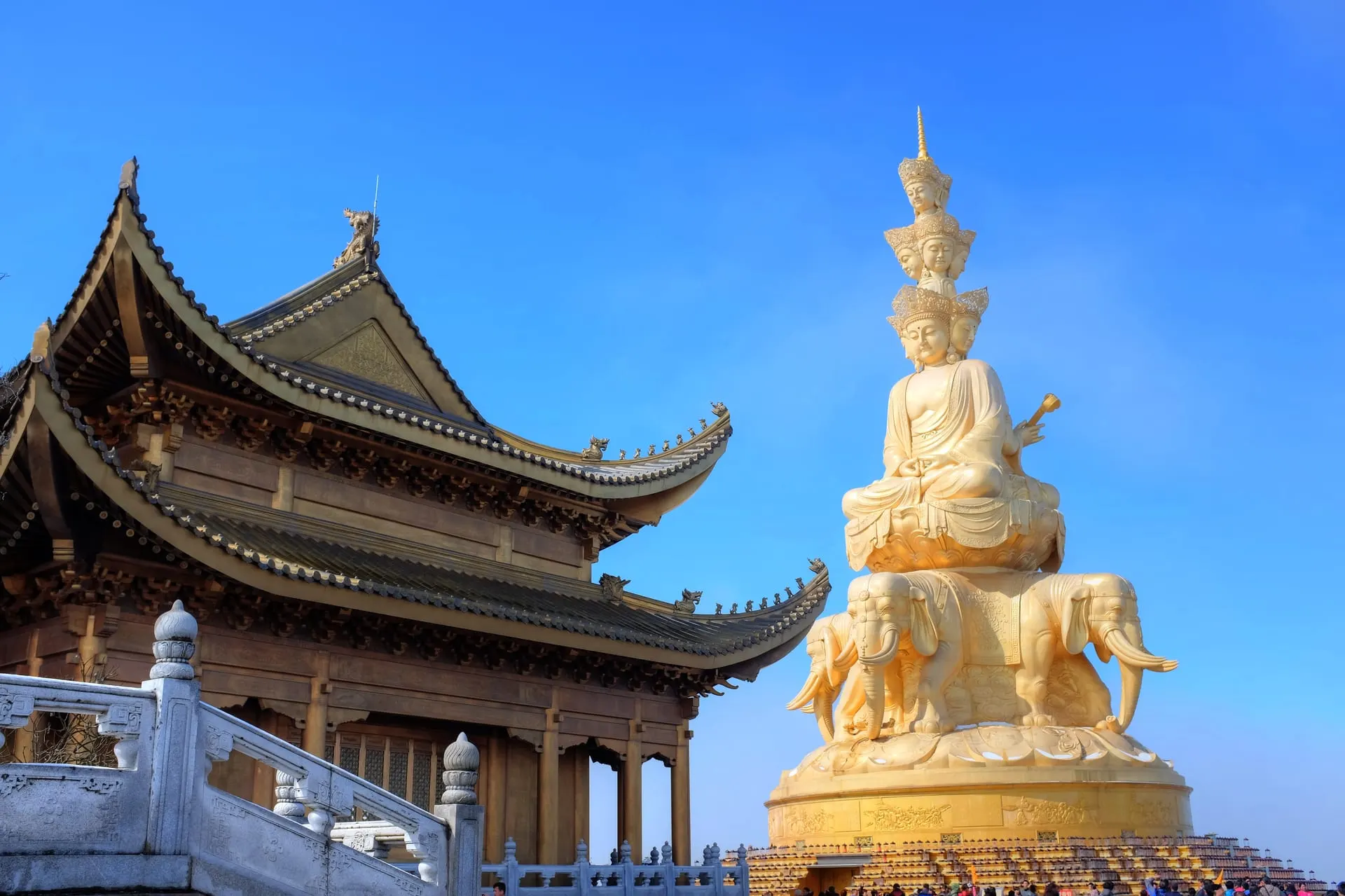
Golden Summit (金顶, Jīndǐng)
The 3,079m summit of Emeishan, dominated by the 48-meter gilded bronze statue of Samantabhadra on a four-faced pedestal. The summit temple — Huazang Temple (华藏寺) — is the mountain's spiritual peak. On clear mornings, the Sea of Clouds (云海, yúnhǎi) spreads below like a white ocean, and the sunrise over the distant Minya Konka range (7,556m) is unforgettable. ¥160 mountain entry included; cable car extra.
Wikimedia Commons · CC-BY-SA
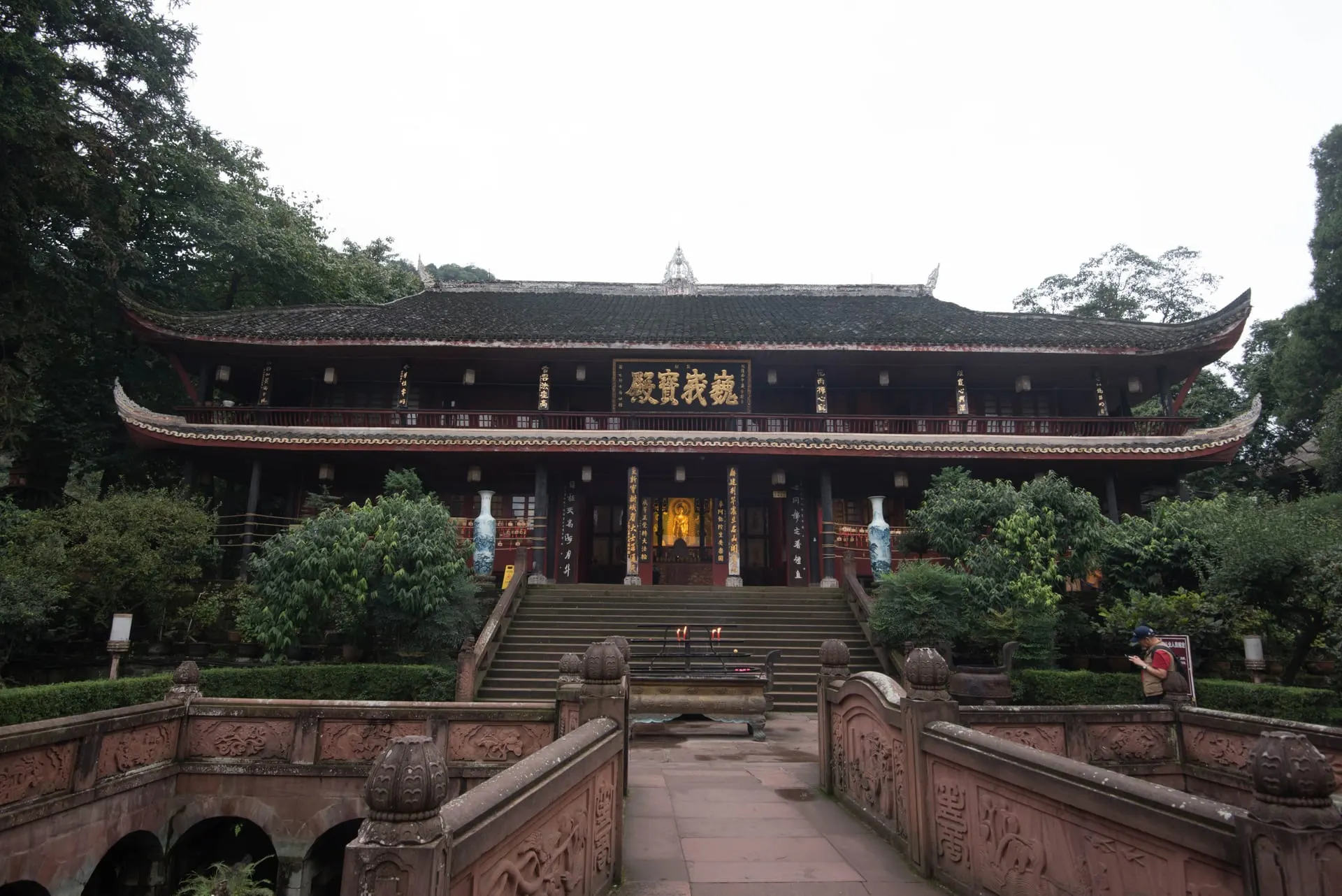
Wannian Temple (万年寺, Wànnián Sì)
One of Emeishan's oldest and most important monasteries, founded in the 4th century. The centerpiece is a 7.85-meter bronze statue of Samantabhadra on a white elephant, cast in 980 AD during the Northern Song dynasty and weighing 62 tons. The temple is reached by a scenic 2-3 hour hike or a short cable car ride from the Wannian station. ¥10 temple entry as of June 2026.
Wikimedia Commons · CC-BY-SA
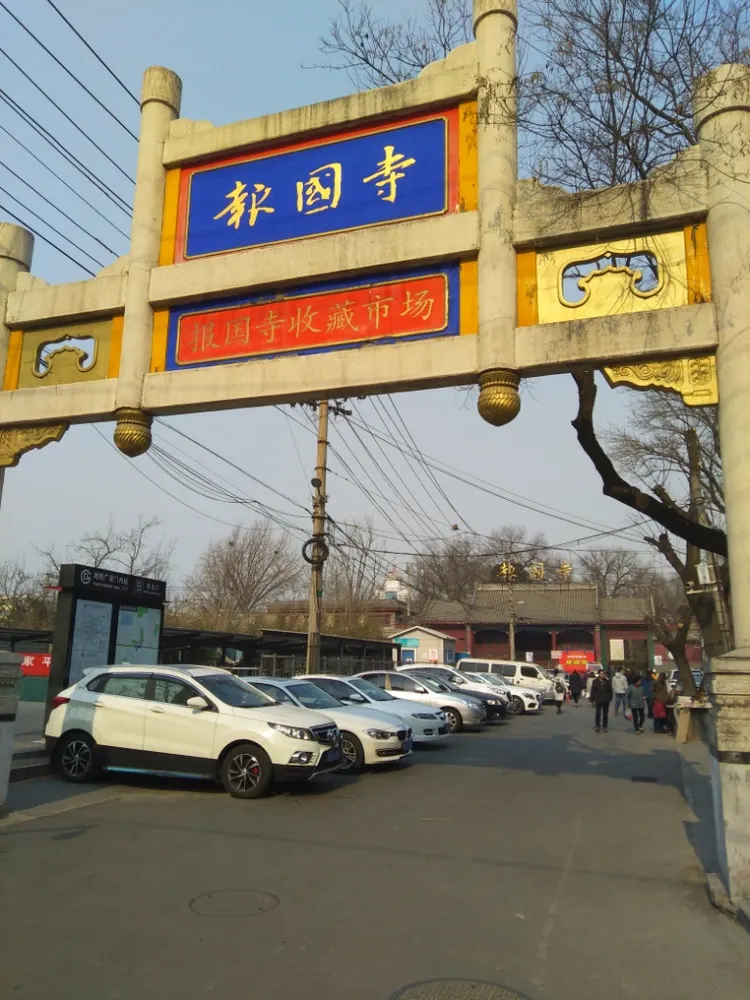
Baoguo Temple (报国寺, Bàoguó Sì)
The gateway temple at the mountain base (551m), built during the Ming dynasty and the official starting point of the Emeishan pilgrimage. The temple houses a 2.4-meter porcelain Buddha statue from the Ming dynasty and serves as the mountain's administrative center. Free with mountain entry ticket.
Wikimedia Commons · CC-BY-SA
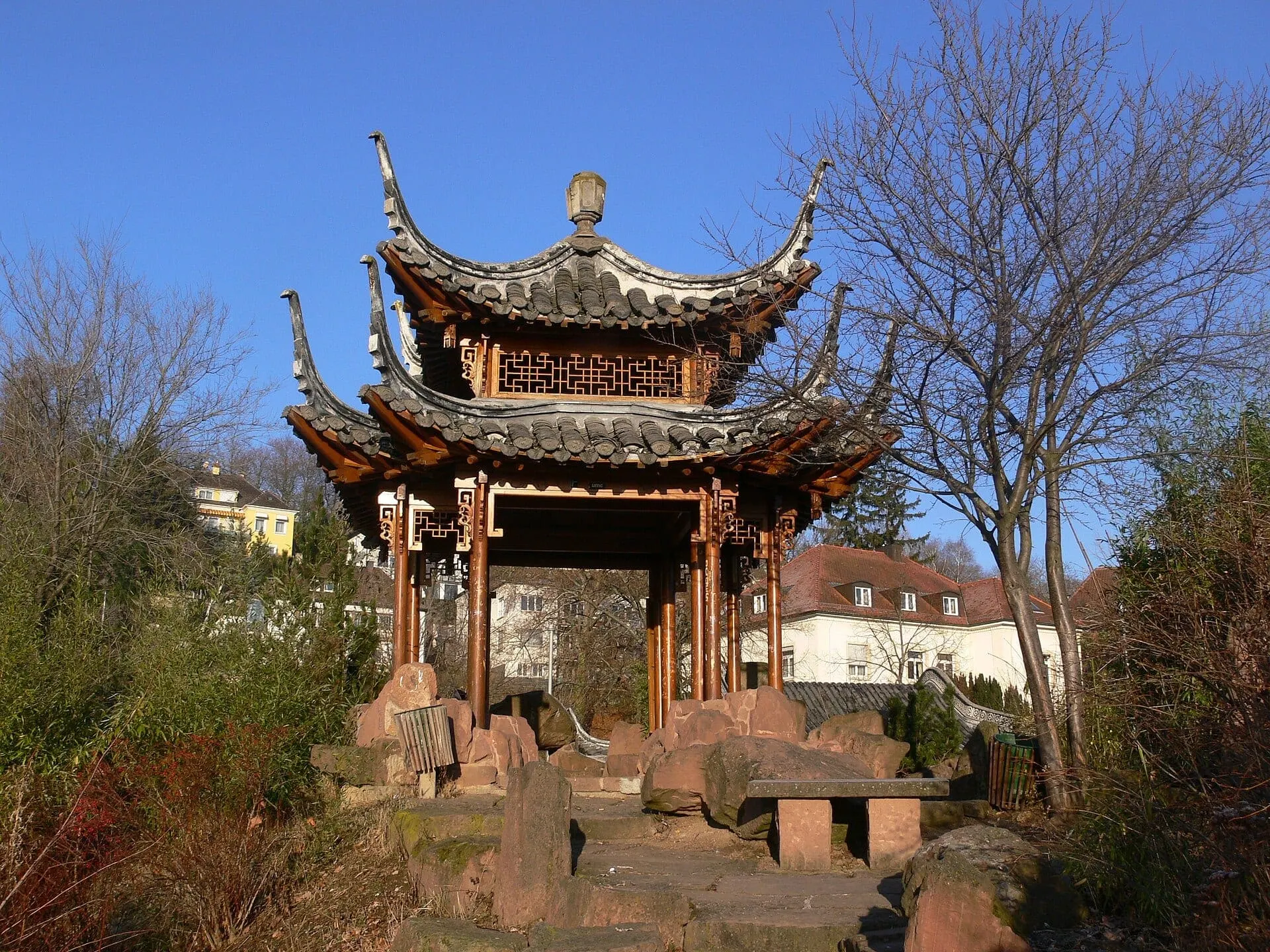
Qingyin Pavilion (清音阁, Qīngyīn Gé)
A Ming-dynasty pavilion set dramatically in a deep gorge where two mountain streams converge, surrounded by forest. The sound of water bouncing off the rocks is the defining acoustic of the lower mountain. The pavilion is a popular rest point on the ascent and a short detour from the main trail. Free with mountain entry.
Wikimedia Commons · CC-BY-SA
Monkey Zone — Hongchunping Area (洪椿坪猴区, Hóngchūn Píng Hóu Qū)
The stretch of trail between Qingyin Pavilion and Hongchunping is Emeishan's most macaque-dense zone. Tibetan macaques (藏酋猴, zàngqiúhóu) patrol the path, and they are skilled, bold, and opportunistic — they will snatch food from unzipped bags, grab water bottles, and climb on hikers' shoulders. Fascinating to observe; keep all food sealed and hidden. Free (the monkeys charge nothing, but they will take your snacks).
Wikimedia Commons · CC-BY-SA
Jiulao Cave (九老洞, Jiǔlǎo Dòng)
A limestone cave complex on the middle mountain, associated with a legend of nine immortals who lived and meditated here. The cave system is extensive (over 1,500 meters of explored passages as of June 2026), with stalactites, a small underground stream, and Buddhist shrines in the entrance chamber. Guided access only (¥20 for a short tour).
Wikimedia Commons · CC-BY-SA
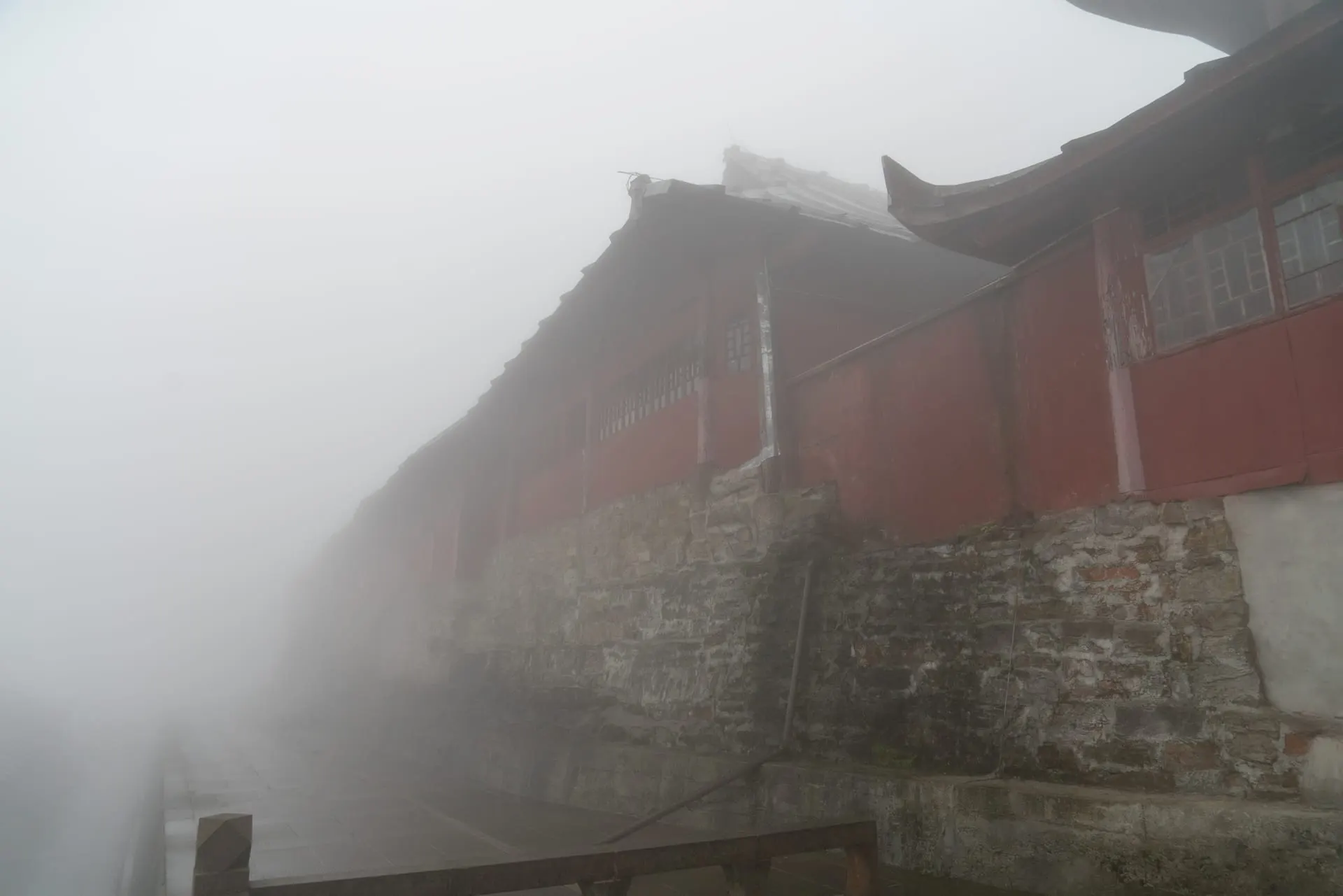
Leidongping (雷洞坪, Léidòng Píng)
The high-altitude transit hub at 2,430m, where the mountain road ends and the final ascent begins. The last cable car station to the Golden Summit departs from here. Altitude effects become noticeable from this elevation. The area has several hotels and restaurants for overnight stays before a summit sunrise attempt. Free with mountain entry.
Wikimedia Commons · CC-BY
STAY
Where to stay in Emeishan
Pick a base that matches the trip you want — imperial-central for sightseeing, hutong belt for character, Chaoyang for nightlife, or Qianmen for budget.
Baoguo Temple / Mountain Base
The gateway town — largest hotel selection, restaurants, and the official start of the pilgrimage at 551m
#baoguo-temple-baseQingyin Pavilion Area
Lower-mountain forest gorge with the scenic pavilion and the monkey zone — the most beautiful section of the lower trail
#qingyin-pavilion-zoneLeidongping (2,430m)
High-altitude transit hub — the last cable car to the summit, mid-range hotels, and the practical base for a summit sunrise
#leidongpingGolden Summit (Jinding, 3,079m)
The spiritual peak — Samantabhadra statue, cloud sea, sunrise, and the most expensive real estate on the mountain
#golden-summitMonastery Trail (Xixiangchi area)
The high-mountain pilgrimage trail with working monasteries, cloud forest, and the quietest overnight experience on the mountain
#monastery-trail
ITINERARIES
Sample itineraries from Emeishan
Three ready-made routes, from a 1-day imperial sprint to a 5-day deep dive. Copy the day-by-day plan and adapt to your own pace.
- 1 DAY
One-Day Cable Car Sprint
Summit-only via bus and cable car. Efficient but misses the monastery trail — best for those with limited time or mobility.
- Day-trippers from Chengdu
- Travelers with limited mobility
- Those who want the summit photo without the hike
- Day 01
Morning
Arrive Emeishan Station by 08:00. Bus to Baoguo Temple tourist center (¥2, 15 min). Buy entry ticket (¥160) and mountain bus to Leidongping (depart 09:00, arrive 11:00).
Afternoon
Walk 20 min to Jieyin Hall cable car station. Cable car to Golden Summit (5-8 min). 2-3 hours at summit: Samantabhadra statue, Huazang Temple, cloud sea views. Lunch at summit restaurant. Cable car down by 14:00, bus back to base by 16:00.
Evening
Brief visit to Baoguo Temple if time. HSR back to Chengdu (17:00-18:00 departure, arrive 18:30-19:30).
- 2 DAYS
Two-Day Hybrid (Summit + Monastery Trail)
The recommended approach: lower monastery trail on Day 1, summit on Day 2. Combines the mountain's best elements.
- Most visitors
- First-time pilgrims
- Those wanting summit + trail in limited time
- Day 01
Morning
Arrive Emeishan Station by 09:00. Baoguo Temple entry formalities. Bus to Wannian Temple station, cable car or hike to Wannian Temple (visit 1-2 hours — the 980 AD bronze Samantabhadra).
Afternoon
Hike the monastery trail: Wannian → Qingyin Pavilion → Hongchunping (2-3 hours). Watch for macaques in the Qingyin-Hongchunping zone. Overnight at Hongchunping monastery guesthouse or nearby hotel.
Evening
Monastery vegetarian dinner (¥25-40). Evening walk through the quiet temple courtyards.
- Day 02
Morning
Early start — continue hiking or take the mountain bus to Leidongping. Cable car to Golden Summit. Late-morning summit exploration (sunrise not possible with this schedule).
Afternoon
Lunch at the summit or Leidongping. Cable car and bus down to Baoguo Temple by 14:00-15:00.
Evening
Visit Baoguo Temple if not seen on Day 1. HSR back to Chengdu (16:00-17:00 departure).
- 3 DAYS
Three-Day Full Pilgrimage
The complete Emeishan experience — hiking, monasteries, summit sunrise, and a relaxed pace.
- Hikers and pilgrims
- Slow travelers
- Those who want the full Buddhist mountain experience
- Day 01
Morning
Arrive Emeishan. Visit Baoguo Temple (1 hour). Start hiking: Baoguo → Qingyin Pavilion (2-3 hours). Lunch at Qingyin Pavilion.
Afternoon
Continue: Qingyin Pavilion → Hongchunping → Xixiangchi (4-5 hours, monkey alert on the lower section). Arrive Xixiangchi by late afternoon.
Evening
Overnight at Xixiangchi monastery guesthouse (¥50-120, cash only). Monastery vegetarian dinner. Sleep early for tomorrow's final ascent.
- Day 02
Morning
Early start: Xixiangchi → Leidongping (2-3 hours of hiking). Cable car from Leidongping to Golden Summit. Arrive summit by late morning.
Afternoon
Full afternoon at the Golden Summit: the statue, Huazang Temple, cloud sea, walking the full viewing platform loop.
Evening
Overnight at Jinding Hotel (summit, ¥600-1,500, book ahead) or descend to Leidongping hotel (¥300-600). Sleep early for sunrise.
- Day 03
Morning
Wake at 05:00-05:30 (season-dependent). Summit sunrise — the Samantabhadra statue catching first light. Optional morning chanting at Huazang Temple (06:00-06:30).
Afternoon
Brunch at summit or Leidongping. Cable car and bus down to Baoguo Temple. Visit the Emeishan Museum at the base if interested.
Evening
HSR back to Chengdu (afternoon departure, arrive evening).
BUDGET
What a Emeishan trip costs
Per-person, per-day costs across three spending tiers. Excludes international flights and visa fees.
| Line item | Backpacker | Mid-range | Luxury |
|---|---|---|---|
| Mountain entry ticket (as of June 2026) | $22 | $22 | $22 |
| Mountain bus round-trip (Baoguo-Leidongping) | $13 | $13 | $13 |
| Cable car round-trip (Jinding) | $17 | $17 | $17 |
| Dorm bed / budget guesthouse (per night) | $12 | $0 | $0 |
| Mid-range hotel (per night) | $0 | $50 | $0 |
| Jinding Hotel / luxury (per night) | $0 | $0 | $160 |
| Monastery vegetarian meal | $4 | $6 | $0 |
| Mountain restaurant meal | $0 | $10 | $15 |
| Monastery guesthouse (per night) | $12 | $14 | $0 |
| Incense and temple donations | $2 | $3 | $5 |
| Total per day | $82 | $135 | $232 |
$ USD per person per day, before international flights and visas. Last verified: Q3 2026.
STAY SAFE
Emergency contacts in Emeishan
Save these three numbers before you board the plane. China uses different hotlines than most countries — there's no 911.
- POLICE
110
- AMBULANCE
120
- FIRE
119
- TOURIST HOTLINE
0833-5522555 (Emeishan Scenic Area emergency/mountain rescue)
- ENGLISH-SPEAKING ER
Emeishan People's Hospital (峨眉山市人民医院) in Emeishan town — 1 hour from Leidongping; limited English-speaking staff
Problems travelers hit in Emeishan
- Why is my Alipay not working?You linked a foreign Visa or Mastercard to Alipay but every transaction is rejected at the merchant.
- My China visa was denied — what now?Your L visa application was refused at the Chinese consulate and your trip is in 2–4 weeks.
- My passport was lost or stolen in China — what do I do?Your passport is gone (theft or loss) and you're in mainland China without travel documents.
- Why can't I book on 12306 with my foreign card?You tried to book a high-speed rail ticket on 12306.cn and your foreign Visa/Mastercard is rejected at checkout.
- Why is my VPN not working in China?You arrived in China, opened your VPN, and it will not connect at all or connects but no traffic loads.
- Why can't I book a Tibet trip on my own?You try to book Lhasa flights and hotels yourself but the booking fails, or you're turned away at the Lhasa airport without a permit.
Book activities in Emeishan
These are licensed tour operators and booking platforms we've vetted independently. Booking through these links may earn us a commission — see our affiliate disclosure. This never affects our editorial recommendations or the price you pay.
Frequently asked questions
Is Emeishan worth visiting?
How many days do I need for Emeishan?
How do I get from Chengdu to Emeishan?
How difficult is the Emeishan hike?
Can I see the sunrise on the Golden Summit as a day trip from Chengdu?
Are the Emeishan monkeys dangerous?
Show all 20 FAQs
What is the best month to visit Emeishan?
How much does Emeishan cost?
Can I stay in a monastery on Emeishan?
What is the Golden Summit and why is it famous?
Do I need to bring warm clothes to Emeishan?
Can I combine Emeishan with the Leshan Giant Buddha?
Is Emeishan suitable for children?
What does the Golden Summit Samantabhadra statue represent?
Is the Emeishan summit visible from Chengdu?
What is the Giant Sleeping Buddha of Emeishan?
What is Wanfo Top and is it worth a visit?
Can I visit the Leshan Giant Buddha as a day trip from Emeishan?
What is Emei Zhuyeqing tea and where do I try it?
What is the connection between Emeishan and the Tang poet Li Bai?
References

Related guides & destinations
Guide
China Vegetarian Guide 2026: What Vegans and Vegetarians Actually Eat
Vegetarianism in China is harder than in the West but doable. Here is what to eat, where to find pure-veg restaurants, and which dishes to a
Guide
Sichuan Itinerary: Pandas, Mountains & Food (9-10 Days) 2026
A 9-10 day Sichuan itinerary pairs Chengdu’s pandas and hot pot with Leshan’s Giant Buddha, Mount Emei, and the Jiuzhaigou and Huanglong par
Guide
How We Research 2026: NihaoVisit’s Methodology for China Travel Information
How NihaoVisit sources, verifies, and maintains 700+ pages of China travel information — our source hierarchy, fact-checking process, update
Guide
Fact-Checking Log 2026: Verified China Travel Information — NihaoVisit
A public log of fact-checking verification passes on NihaoVisit, showing what was verified, when, and against which sources — covering visa
Guide
Best Time to Visit China 2026: Month-by-Month Weather, Crowds, and Prices
The best time to visit most of China is April–May and September–October. Winter (Dec–Feb) is cold but cheap; summer (Jun–Aug) is hot and cro
Guide
VPN for China 2026: Which VPNs Work, eSIM Alternatives, and the Complete Pre-Trip Checklist
Most Western apps and websites are blocked in mainland China. A reliable VPN is essential for Google, Gmail, WhatsApp, Instagram, and most n