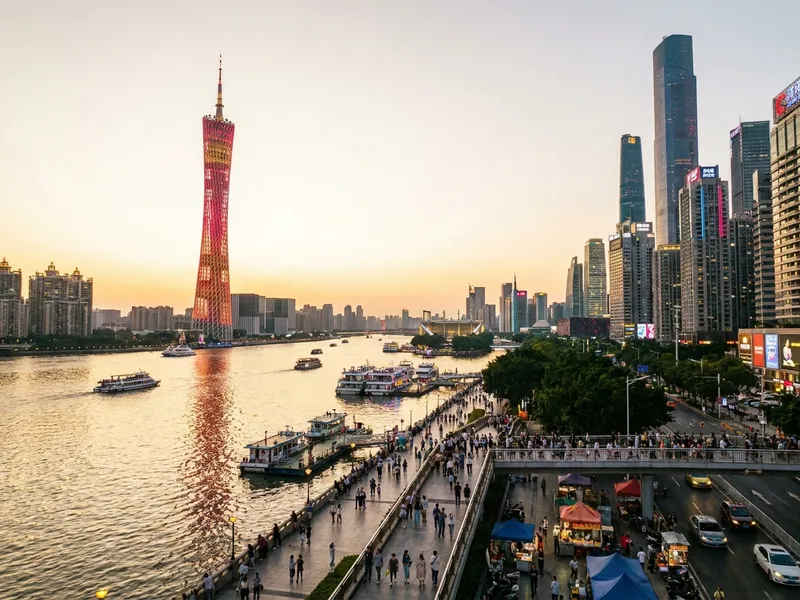
Guangzhou
Guangzhou (广州, Guǎngzhōu), historically Canton, is the capital of Guangdong Province and southern China’s great metropolis of 22 million — a 2,200-year-old trading port that has been open to the world longer than almost any other Chinese city, the birthplace of the Cantonese cuisine (yum cha, dim sum, roast goose, wonton noodles) that the world knows as ‘Chinese food,’ and the economic engine of the Pearl River Delta manufacturing belt. The layers stack deep: the Han-era port of Panyu that grew into the Tang and Song entrepôt, the Qing ‘Thirteen Factories’ that held a near-monopoly on China’s foreign trade from 1757 to 1842, the flashpoint of the Opium Wars, and the 1978 reform-and-opening frontier that made the Delta the factory of the world. For a visitor, the headline experiences are the Canton Tower and the illuminated Pearl River skyline, the colonial-era Shamian Island, the exquisite Chen Clan Ancestral Hall of Lingnan craft, the Five Rams Statue in Yuexiu Park, the Sacred Heart Cathedral, and above all the food — the yum cha tea-house breakfasts and the dim sum, the roast-meat shops and the wonton noodles, the Cantonese cuisine at its purest source. Two to three days covers the city and the food; a fourth adds a day trip to the culinary capital Shunde, the Kaiping watchtowers, or a high-speed run to Hong Kong (40 minutes) or Macau. As of late 2025, citizens of 45+ countries including the US, UK, Canada, Australia, and most of the EU enter China visa-free for up to 30 days, and Guangzhou is a 144-hour visa-free transit city.
Why Guangzhou in 2026.
The 2,200-year-old southern gateway of China — the birthplace of Cantonese cuisine, the eternal port of the Maritime Silk Road, and the boom-city heart of the Pearl River Delta.
Quick Answer
Guangzhou (广州, Guǎngzhōu), historically Canton, is the capital of Guangdong Province and southern China’s great metropolis of 22 million — a 2,200-year-old trading port that has been open to the world longer than almost any other Chinese city, the birthplace of the Cantonese cuisine (yum cha, dim sum, roast goose, wonton noodles) that the world knows as ‘Chinese food,’ and the economic engine of the Pearl River Delta manufacturing belt. The layers stack deep: the Han-era port of Panyu that grew into the Tang and Song entrepôt, the Qing ‘Thirteen Factories’ that held a near-monopoly on China’s foreign trade from 1757 to 1842, the flashpoint of the Opium Wars, and the 1978 reform-and-opening frontier that made the Delta the factory of the world. For a visitor, the headline experiences are the Canton Tower and the illuminated Pearl River skyline, the colonial-era Shamian Island, the exquisite Chen Clan Ancestral Hall of Lingnan craft, the Five Rams Statue in Yuexiu Park, the Sacred Heart Cathedral, and above all the food — the yum cha tea-house breakfasts and the dim sum, the roast-meat shops and the wonton noodles, the Cantonese cuisine at its purest source. Two to three days covers the city and the food; a fourth adds a day trip to the culinary capital Shunde, the Kaiping watchtowers, or a high-speed run to Hong Kong (40 minutes) or Macau. As of late 2025, citizens of 45+ countries including the US, UK, Canada, Australia, and most of the EU enter China visa-free for up to 30 days, and Guangzhou is a 144-hour visa-free transit city.
| Best time to visit | October–December (cool, dry, clear). Avoid the hot humid summer and the April–June rains. |
|---|---|
| Daily budget | $60 (backpacker) / $150 (mid-range) / $400+ (luxury) |
| Language | Cantonese (primary), Mandarin; English in tourist areas, hotels, and the Canton Fair |
| Currency | CNY (¥) — Alipay and WeChat Pay accept foreign Visa/Mastercard as of 2024 |
| Time zone | China Standard Time (UTC+8) |
| Last updated | 2026-06-15 |
Want a Guangzhou plan built for you?
Why is Guangzhou the eternal gateway of southern China?
Guangzhou is the city that taught the world what ‘Chinese’ meant — not through politics or empire, but through trade and food. For more than two thousand years it has been the great southern port of China, the terminus of the Maritime Silk Road that connected Guangzhou to Southeast Asia, India, the Arab world, and eventually Europe, and through that trade it exported the Cantonese language, the Cantonese cuisine, and the Cantonese diaspora that became the global face of China. Every Chinatown in the world, almost every ‘Chinese’ restaurant abroad, and the English word ‘Cantonese’ trace back to this city. Guangzhou (then romanised as Canton) was the only Chinese port legally allowed to trade with the West from 1757 to 1842 — the era of the Thirteen Factories and the Canton System — and the friction of that trade produced the Opium Wars, the Treaty of Nanjing, and the opening of modern China. For a visitor today, Guangzhou is a vast, modern, layered metropolis of 22 million — the financial and manufacturing capital of the Pearl River Delta, one of the richest regions on earth — that still carries its trading-port and Cantonese soul in the yum cha tea houses, the roast-meat shops, the colonial lanes of Shamian, the Lingnan craft of the Chen Clan Academy, and the riverside night skyline. It is warmer, more relaxed, more southern, and more food-obsessed than Beijing or Shanghai, and it is the indispensable stop for any traveller who wants to understand the Cantonese half of Chinese culture. Combined with nearby Hong Kong, Macau, and the culinary capital Shunde, Guangzhou is the anchor of one of the richest regional journeys in Asia.
What is the history of Guangzhou: From Panyu Port to Canton to Mega-city?
Guangzhou is one of the oldest continuously inhabited cities in the world, and its story is the story of China’s engagement with the sea. The area was founded as the town of Panyu in 214 BCE under the Qin, and it grew as the southern terminus of the Maritime Silk Road through the Han, Tang, and Song — by the Tang dynasty it was one of the great ports of the world, with Arab and Persian merchant quarters and a foreign population in the tens of thousands, and the Guangxiao and Six Banyan temples date from this era. The Ming and Qing kept Guangzhou as the principal southern port, and in 1757 the Qianlong Emperor closed all other Chinese ports to foreign trade, leaving Guangzhou (Canton) as the sole legal window — the ‘Canton System,’ run through the thirteen licensed hongs (trading houses) along the Pearl River. For 85 years, every Western good coming into China and every tea, silk, and porcelain leaving it passed through Canton, and the city became fabulously rich and cosmopolitan. The friction of that monopoly — specifically the British trade in opium to offset the silver drain of the tea trade — produced the First Opium War (1839–42), the British capture of Guangzhou, and the Treaty of Nanjing that ceded Hong Kong and opened the other treaty ports, ending Canton’s monopoly. Guangzhou remained a major port through the late Qing and the Republic (Sun Yat-sen, the founder of modern China, was from a nearby village and based his early governments here), and after 1949 it became, with the 1978 reform and opening, the frontline of the export boom — the Pearl River Delta became the factory of the world, and Guangzhou its commercial brain. The Canton Fair (founded 1957) is still the world’s largest trade fair, the high-speed rail connects Guangzhou to Hong Kong in 40 minutes, and the city’s GDP rivals a mid-sized European country. For a visitor, the layers — the Tang temples, the Qing trading lanes, the colonial Shamian, the Republican Sun Yat-sen sites, and the sci-fi towers of Zhujiang New Town — compress 2,200 years of China’s encounter with the world into one walkable city.
What is the geography and climate of Guangzhou, and when should I visit?
Guangzhou sits on the Pearl River (Zhujiang) in the heart of the Pearl River Delta, the low-lying alluvial plain where the West, North, and East rivers converge before emptying into the South China Sea. The delta is one of the most densely populated and economically productive regions on earth — the ‘Greater Bay Area’ megaregion that includes Guangzhou, Shenzhen, Hong Kong, Macau, Dongguan, and Foshan and holds over 70 million people — and Guangzhou is its historical and cultural anchor. The city itself is flat and spread along both banks of the Pearl, with the old city (Liwan, Yuexiu) on the north bank and the modern financial district (Zhujiang New Town, Tianhe) on the north and east, all stitched together by one of the longest metro systems in the world. The climate is humid subtropical, just south of the Tropic of Cancer — warm to hot year-round, with a long wet summer and a short mild dry winter. The best months are October to December: cool (18–25°C), dry, clear, and the most comfortable time to walk the city and eat outdoors. January–March are mild (12–20°C) but grey, humid, and drizzly — the ‘returning south’ dampness. April to June is the wet season (the plum and typhoon rains), hot and very humid. July–September are hot (33°C+), humid, and typhoon-prone. The single best window for most travellers is mid-October to mid-December: the food is at its best, the walking is comfortable, and the Canton Fair (each spring and autumn) brings the city’s trading energy to life. Avoid the hot, humid summer and the wet spring if you can. Guangzhou’s air quality is among the best of China’s megacities.
How do I get to Guangzhou and get around?
Guangzhou Baiyun International Airport (CAN), 28 km north of the city, is one of China’s three great hubs, with direct flights from every major Chinese city and dense international routes across Asia, Europe, and Australia. The metro airport line reaches the city in about 50 minutes, and an airport express bus or a DiDi (¥100–120) takes 40 minutes to central Tianhe. For domestic and regional travel, the headline is the high-speed rail: Guangzhou South station (Guangzhounan) is one of the busiest HSR hubs on earth, with trains to Hong Kong West Kowloon in 40 minutes, Shenzhen in 30 minutes, Wuhan in 4 hours, Beijing in 8 hours, and Guilin in 3 hours; Guangzhou station (in the city centre) and Guangzhou East handle the regional and conventional routes. Guangzhou is also a 1-hour high-speed train or a 2-hour ferry from Hong Kong. Within the city, the Guangzhou Metro is excellent — 16 lines, bilingual, reaching every district, ¥2–14 a ride, works with Alipay/WeChat Pay QR codes. The headline sights (Shamian, the Chen Clan Hall, the Six Banyan Temple, Shangxiajiu, Yuexiu, the Canton Tower, Zhujiang New Town) are all on the metro. Taxis are metered and cheap (flagfall ¥10) but most drivers speak Cantonese or Mandarin only — use DiDi (China’s ride-hailing app, which accepts foreign phone numbers and cards via Alipay/WeChat Pay, with an in-app translator). The APM driverless people-mover connects the Canton Tower to the Zhujiang New Town CBD underground. Walking the old city (Liwan, Shamian, Shangxiajiu) is the best way to see the Cantonese heart; the modern districts are too spread out to walk. Cashless payment is universal — link a foreign Visa/Mastercard in Alipay or WeChat Pay before you arrive.
Where should I stay in Guangzhou?
The right base depends on what you want to do, but the central districts put everything within reach. For the modern, business-and-skyline experience, Zhujiang New Town (the Pearl River New Town CBD in Tianhe) is the headline — the Canton Tower is across the river, the IFC and the Four Seasons, the Mandarin, the Rosewood, and the W cluster here, and the AP MTR line runs through. For the food and the old Cantonese atmosphere, the Liwan and Yuexiu districts (the old city west and north) are the heart — Shamian Island, Shangxiajiu, the Chen Clan Hall, the Six Banyan Temple, and the yum cha tea houses are all here, and the boutique courtyard hotels and the mid-range Chinese chains fill the lanes. For Canton Fair visitors, the Pazhou area (the exhibition complex) has the dedicated fair hotels and the new Hyatts and Marriotts. Budget travellers are well served: Guangzhou has hostels and budget hotels across the old city and along the metro lines, with dorm beds from ¥60–100 and decent doubles from ¥250–400, particularly around Beijing Road, the railway station, and Haizhu Square. The luxury end is among the best in southern China — the Four Seasons in the IFC tower (the 70th-to-100th-floor hotel), the Mandarin Oriental, the Rosewood, the Park Hyatt, and the Garden Hotel are the landmarks. A common and effective split is a Zhujiang New Town or Tianhe hotel for the modern skyline and the Canton Tower, with old-city days in Liwan and Shamian. Book ahead during the Canton Fair weeks (each April and October) when hotel rates double and the best rooms vanish; outside those, supply is generous.
What are the top attractions in Guangzhou?
The headline pair is the Canton Tower and the illuminated Pearl River skyline, best seen from an evening river cruise or the Haixinsha and Huacheng squares. Cross the river to the tower for the observation deck and the tilted skywalk; the Zhujiang New Town CBD around the tower is the modern architectural showcase. The second essential is the historic Cantonese core: Shamian Island (the 19th-century colonial concession of tree-lined avenues and European buildings, the most photogenic district in the city), the Chen Clan Ancestral Hall (the 1894 Lingnan craft masterpiece of wood, brick, stone, and pottery carving), and the Shangxiajiu and Beijing Road pedestrian streets of qilou-arcade shop-houses. The deeper layer is the religious and historical Guangzhou: Yuexiu Park and the Five Rams Statue (the city’s symbol), the Guangzhou Museum in the Zhenhai Tower, the 537 CE Six Banyan Trees temple and its Flowery Pagoda, the Guangxiao Temple (the Chan-Buddhist foundation site), the Sacred Heart Cathedral (the 1888 all-granite Gothic), and the Sun Yat-sen Memorial Hall. For a green escape, Baiyun Mountain on the northern edge is the city’s forested lung. And for the modern spectacle, the Canton Fair Pazhou complex (during fair weeks) and the APM line through the Zhujiang CBD show the trading and financial capital at work. Two to three days covers the core and the food; a fourth adds a day trip to Shunde, Foshan, or the Kaiping watchtowers.
What food should I eat in Guangzhou?
Eating in Guangzhou is the single best reason to visit, because this is where the Cantonese cuisine the world calls ‘Chinese food’ was created and is still practiced at its highest level. The Cantonese kitchen is built on freshness, lightness, and the clean expression of quality ingredients: seafood from the delta, roast meats, delicate steaming, the clear soups, and the famous yum cha tea-house tradition. The headline experience is yum cha (‘drink tea’) — the morning and lunchtime tea-house ritual of pot after pot of jasmine or pu’er tea alongside bamboo baskets of dim sum (the steamed and fried snacks), pushed on carts or ordered from a card: har gow shrimp dumplings, siu mai pork-and-shrimp dumplings, char siu bao BBQ pork buns, cheung fun rice-noodle rolls, chicken feet, taro cakes, egg tarts. The old tea houses (the Guangzhou, the Panxi, the Lianxianglou) and the modern ones (the Bingsheng, the Tao) are the places; budget ¥100–200 per person for a proper yum cha. Beyond dim sum, eat the roast meats — the Cantonese roast goose, char siu pork, and crisp-skin roast pork from the roast-meat shops (the Bing Sheng, the signature Guangzhou roast-goose restaurants) displayed in windows across the old city; the wonton noodles (wonton min) in clear broth; the rice in clay pots (bo zai fan) with Chinese sausage and cured meats; the congee with thousand-year eggs; the stir-fried river fish and the steamed grouper; and the famous Cantonese desserts (the mango pomelo sago, the double-skin milk, the silky tofu pudding). The street food of Shangxiajiu and Beijing Road (the beef offal, the radish cakes, the sugarcane juice) and the fresh seafood of the Pearl River delta round it out. For a splurge, the Michelin-starred Cantonese (the Jiang by Chef Fei, the Lingnan Hall) do the refined tasting version. Vegetarians are well served (the Buddhist temples, the tofu dishes), and the food is rarely searingly hot — it is delicate, fresh, and accessible. A two-day food crawl through Guangzhou is one of the great eating experiences in Asia.
What is a good itinerary for Guangzhou?
A standard Guangzhou visit is 2–3 days. Day 1 — the old Cantonese city: Shamian Island in the morning (the colonial lanes, the riverside walk), the Chen Clan Ancestral Hall (the Lingnan craft), a yum cha lunch at a traditional tea house, then Shangxiajiu and Beijing Road for the qilou arcades and the street food, ending at the Six Banyan Temple. Day 2 — the modern skyline: the Canton Tower (go up the 488 m observation deck), the Huacheng and Haixinsha squares of Zhujiang New Town, the APM line, the Guangdong Museum, and the Pearl River night cruise. Day 3 — the historical and the green: Yuexiu Park and the Five Rams Statue, the Guangzhou Museum in the Zhenhai Tower, the Sacred Heart Cathedral, the Sun Yat-sen Memorial Hall, and Baiyun Mountain for the sunset view. Day 4 (optional) — a day trip: the culinary capital Shunde (40 minutes west, the hometown of many Cantonese chefs, with its own Michelin-rated food scene and the Qinghui Garden), or Foshan (the Lingnan culture and martial-arts city, the Ancestral Temple), or the Kaiping watchtowers (the UNESCO-listed fortified diaolou villages 2 hours west). A fifth day adds the high-speed run to Hong Kong (40 minutes) or Macau. For most visitors, 3 days covers the city and the food comfortably, and Guangzhou is the natural anchor of a Pearl River Delta loop (Guangzhou → Shunde → Macau → Hong Kong, or the reverse). Build in slow time for the yum cha breakfasts and the tea-house afternoons — those are the experiences that define the city, not the ticked checklist of sights.
What practical information do I need: visa, money, connectivity?
Visa-free entry: as of late 2025, China’s unilateral visa-free policy covers 45+ countries, including the US, UK, Canada, Australia, New Zealand, and most of the EU, for tourism stays up to 30 days. Guangzhou is also a 144-hour (6-day) visa-free transit city for citizens of 54 countries arriving and departing via different international airports or eligible ports (the cruise port and the HSR to Hong Kong qualify), with an onward ticket. Check the current list at en.nia.gov.cn. Money: CNY (¥) is the currency; ¥100 ≈ US$14 in mid-2026. Alipay and WeChat Pay both accept foreign Visa and Mastercard as of 2024 — link the card, top up the in-app balance, and scan QR codes everywhere. Carry ¥200–400 in cash for the smallest street stalls and temple donations. Tipping is not customary in restaurants or taxis and may be refused. Connectivity: a personal SIM (China Mobile or Unicom, ¥100–200/month, with your passport at the airport) is more reliable than hotel WiFi. Google (including Gmail and Maps), Facebook, Instagram, WhatsApp, X, and YouTube are all blocked by the Great Firewall — install and test a VPN (Astrill, ExpressVPN, NordVPN) before arrival. Apple Maps works without a VPN and is decent in Guangzhou; Baidu Maps and Amap are the local standards. Tap water is not potable; drink bottled or boiled water (the Cantonese custom of hot tea makes boiled water everywhere). English is spoken at top hotels, the Canton Fair, and major tourist restaurants, but a translation app (Pleco, Baidu Translate) helps for the street food and the Cantonese-speaking shops. Guangzhou is very safe; the main challenges are the hot humid summer and the Canton Fair hotel-price spikes.
What are the best day trips from Guangzhou?
Guangzhou sits at the heart of the Pearl River Delta, one of the densest and most rewarding day-trip territories in China, and the high-speed rail makes all of it easy. The headline day trip is Shunde (the ‘hometown of Cantonese chefs,’ 40 minutes west by HSR or car) — the culinary capital of the delta, with its own Michelin-rated food scene (the Shunde fish sashimi, the water-milk double-skin pudding, the roast goose), the exquisite Qinghui Garden (a classical Lingnan garden), and the Daliang food street; it is the single best food day trip from Guangzhou and a pilgrimage for serious eaters. Foshan, adjacent to Shunde, is the Lingnan-culture and martial-arts capital — the Ancestral Temple (with its lion-dance and Wong Fei-hung heritage), the ceramics, and the Lingnan architecture. The two are often combined. Further afield, the Kaiping watchtowers (the diaolou, 2 hours west) are a UNESCO-listed landscape of fortified, partly-Western watchtowers built by returned overseas Chinese in the early 20th century, scattered across rice-paddy villages — one of the most distinctive architectural landscapes in China. Hong Kong is 40 minutes by high-speed train from Guangzhou South (or a 2-hour ferry), making a cross-border day trip or an onward leg effortless. Macau is a 1-hour ferry or HSR. The Dongguan and Shenzhen factory cities are 30–60 minutes away for business travellers. And for nature, the Dinghu Mountain nature reserve (near Zhaoqing, 1 hour west) is a subtropical forest and a UN biosphere reserve. For most visitors, one day trip — Shunde for the food, or Kaiping for the watchtowers — rounds out a Guangzhou stay perfectly, and the Delta loop (Guangzhou–Shunde–Macau–Hong Kong) is one of the great short regional journeys in Asia.
What is the Canton Fair and should I time a visit for it?
The China Import and Export Fair — the Canton Fair (Guangjiaohui) — is the world’s largest trade fair, founded in 1957 and held in Guangzhou each spring and autumn in three five-day phases. It brings roughly 200,000 international buyers to the vast Pazhou exhibition complex to meet tens of thousands of Chinese manufacturers across every product category — electronics, machinery, textiles, home goods, food — and it is the living expression of Guangzhou’s identity as the trading capital of China. For a casual tourist it is not a ‘sight’ in the usual sense, but it shapes the city during its weeks: the hotels fill and double in price, the airport and the metro buzz with foreign buyers from every continent, and the riverside bars and the Shamian cafes are full of the global trade diaspora. Timing a tourist visit around the Canton Fair is generally a mistake (the hotel prices and the crowds are brutal), but for anyone in the import-export world, or for a traveller who wants to witness the sheer scale of Chinese manufacturing, it is an extraordinary spectacle — and foreign visitors can register and attend. Outside the fair weeks, the Pazhou complex is a marvel of modern architecture to drive past, and the riverside parks around it are pleasant.
What cultural etiquette and tips should I know?
Guangzhou is the most relaxed and foreigner-friendly of the great Chinese cities, with a 2,000-year trading-port culture of openness and a huge international business community (especially around the Canton Fair). The pace is southern — slower and more casual than Beijing or Shanghai — and the food is the centre of social life. A few norms help. The yum cha tea-house breakfast is a leisurely, communal ritual; share the dim sum baskets, top up each other’s tea (tapping two fingers on the table to thank the pourer is the Cantonese custom), and let the meal run two hours. At restaurants, tipping is not expected (a 10–15% service charge is sometimes added at higher-end places); round up the taxi or add a small note for a guide. Cantonese is the first language and the heart of the local identity — it is spoken at home, on the street, and in the tea houses — but Mandarin is universal and English works at the top hotels, the Canton Fair, and the major tourist restaurants. The Cantonese take pride in their language and their cuisine; respect both and you will be warmly received. In temples (the Six Banyan, Guangxiao, Hualin), dress modestly, remove hats, and be quiet; do not photograph monks or rituals without asking. The Sacred Heart Cathedral holds Mass in Cantonese and is an active Catholic parish — respectful visitors are welcome outside services. Guangzhou is extremely safe — violent crime is rare and it is comfortable to walk Shamian, the old city, and Zhujiang New Town at any hour. The summer heat and humidity are the main physical challenge; pace the outdoor sightseeing for October–December or the morning and evening. Cashless payment is near-universal (Alipay and WeChat Pay both take foreign cards), but carry some cash for the smallest stalls. The city’s trading-port cosmopolitanism, its Cantonese warmth, and its food make it one of the most welcoming major cities in China for a foreign visitor.
What is Cantonese culture and why did it become the global face of China?
Cantonese culture is one of the most distinctive and globally influential of the regional Chinese cultures, and for most of the world it was, for over a century, the face of China itself. The reasons are historical: Guangzhou was China’s principal southern port and the only legal window for Western trade from 1757 to 1842, and the Cantonese — the people of the Pearl River Delta — were therefore the Chinese the West first and longest encountered. When the Opium Wars, the turmoil of the late Qing, and the early-20th-century upheavals drove millions of southern Chinese abroad, it was overwhelmingly Cantonese who founded the Chinatowns of San Francisco, New York, Vancouver, Sydney, Singapore, and Kuala Lumpur, opened the first Chinese restaurants abroad, and gave the English language the words ‘Cantonese,’ ‘chow mein,’ ‘dim sum,’ ‘kumquat,’ ‘ketchup’ (from a Hokkien-Cantonese fish-sauce term), and ‘long time no see.’ The global Chinese diaspora is, in its largest strand, a Cantonese diaspora. The Cantonese language (Yue Chinese) is spoken by roughly 85 million people in the Delta and by tens of millions more in Hong Kong, Macau, and the overseas communities, and it is as distinct from Mandarin as French is from Spanish — a different tone system, vocabulary, and grammar. Cantonese cuisine, Cantonese opera, the lion dance, the dragon boat festival, and the Cantonese emphasis on freshness, family, and pragmatism are the cultural package. Within China, the Cantonese are known for their business acumen (the Pearl River Delta is the richest region), their food obsession (‘eating in Guangzhou’ is a national proverb), and their openness to the outside world. For a visitor, understanding that Guangzhou is the source of the global ‘Chinese’ image — the food, the language, the diaspora — reframes the city as a cultural capital, not just a stop on a tour, and the Cantonese pride in this heritage is real and warm.
What was the Canton System and the Thirteen Factories?
From 1757 to 1842, the Qing dynasty restricted all of China’s Western maritime trade to a single port, Guangzhou (Canton), through a tightly controlled system known as the Canton System. Under it, Western merchants (the British, the Americans, the Dutch, the French, the Danes, the Swedes) were confined to a single riverside street of thirteen ‘hongs’ or ‘factories’ (warehouses-and-residences) on the Pearl River just downstream of the old city — the famous ‘Thirteen Factories’ (Shisanhang) — and they could trade only through a guild of licensed Chinese merchants (the Cohong), only in the trading season, and only for silver. They could not bring families, learn Chinese, reside permanently, or enter the city walls. It was a deliberately closed, tightly controlled window onto China, and it made the Cohong merchants (the Houqua, the Mowqua) among the richest men in the world, and Canton the only place a Westerner could legally buy tea, silk, porcelain, and rhubarb. The system collapsed under its own contradictions: the British East India Company, bleeding silver to pay for the tea it could not otherwise source, began shipping Indian opium into Canton in growing volume, the Qing attempted to suppress the trade (Commissioner Lin Zexu’s 1839 destruction of 20,000 chests of opium at Humen, just downriver), and the resulting First Opium War ended in British victory, the Treaty of Nanjing (1842), the ceding of Hong Kong, and the opening of the other treaty ports — Shanghai most of all. The Thirteen Factories burned in 1856, and the site is now a small memorial park and a stretch of the old city; the Humen (Bocca Tigris) forts where the war was fought are a museum an hour downriver. For a visitor, the Canton System is the key to understanding both Guangzhou’s former global monopoly and the origin of the Opium Wars that opened modern China — and it explains why Canton was, for so long, the West’s China.
What is Lingnan architecture and the craft of the Pearl River Delta?
The Pearl River Delta produced its own regional culture, known as Lingnan (‘south of the mountains’), whose warm-climate, trading-port architecture and craft are among the most distinctive in China. The signature Lingnan building type is the qilou (or tong lau) arcade shop-house — a narrow, deep building with a covered colonnaded sidewalk on the street front, shading pedestrians from sun and rain, lining the commercial streets of old Guangzhou (Shangxiajiu, Beijing Road, Enning Lu) and across the delta in Hong Kong, Macau, and the overseas Chinatowns. The Lingnan classical garden (the Qinghui Garden in Shunde, the Yuyin Shanfang in Panyu) is the southern counterpart to the Suzhou gardens, with pavilions, ponds, and lush subtropical planting. The Chen Clan Ancestral Hall is the supreme showcase of Lingnan decorative craft. The Lingnan crafts are extraordinary: the richly coloured wood, brick, stone, and pottery relief carving of the Chen Clan Hall and the Shamian buildings; the Canton porcelain (the overglaze-enamel ‘Guangcai’ export ware, painted in Canton for the Western market); the Canton silk and the Guang embroidery (Guangxiu, the dense, colourful embroidery of the south); the ivory carving (the Canton ivory balls of nested openwork spheres); the Canton lacquer and the furniture; and the Cantonese opera (Yueju, with its elaborate makeup, acrobatics, and the piercing sung style, UNESCO-listed). For a visitor, the Chen Clan Hall, the Shamian architecture, the Guangdong Museum, and the Lingnan garden at the Orchid Garden are the entry points, and a piece of Guangcai porcelain or Guang embroidery is one of the most meaningful Guangzhou souvenirs. The Lingnan tradition is the craft expression of the trading-port culture — open, colourful, and technically brilliant.
What mistakes do first-time visitors commonly make in Guangzhou?
The most common mistake is treating Guangzhou as a transit or business stopover and missing its depth. Visitors passing through on the way to Hong Kong, or in for the Canton Fair, often skip the yum cha breakfasts, the Shamian walks, the Chen Clan Hall, and the old-city food — and leave with a thin impression of a modern business city. Guangzhou is the source of the Cantonese culture the world knows, and it rewards two to three slow days built around the food and the old lanes. The second mistake is underestimating the food or eating only in hotel and tourist restaurants — the real Cantonese cuisine is in the yum cha tea houses, the roast-meat shops, the congee and wonton-noodle stalls, the clay-pot-rice places, and the Shunde and Panyu restaurants, and a translation app and a willingness to queue unlock it. A third mistake is timing it for the wrong season: the summer (June–September) is brutally hot and humid and typhoon-prone, and the Canton Fair weeks (April and October) double the hotel prices — come mid-October to mid-December instead. Fourth is staying only in the Zhujiang New Town CBD and missing the old city — the modern towers are impressive, but the Cantonese soul is in Liwan, Shamian, and Yuexiu, and a base there is more atmospheric. Fifth is skipping the day trips — Shunde (the food), Foshan (the Lingnan culture), and the Kaiping watchtowers are among the most rewarding half- and full-day trips in the region, and the high-speed rail makes them effortless. Sixth is not learning the yum cha etiquette — tapping two fingers to thank a tea pourer, sharing the dim sum, letting the meal run its course — which marks you as respectful and is warmly received. Finally, do not skip the Pearl River night cruise and the Canton Tower at sunset; together they are the modern-Guangzhou counterpart to the colonial Shamian.
What is the Maritime Silk Road and Guangzhou’s role as its great port?
The Maritime Silk Road was the sea-borne trade network that connected China to Southeast Asia, India, the Arab world, and eventually East Africa and Europe for nearly two millennia, with Guangzhou as its Chinese terminus. From the Han dynasty onward, ships left the Pearl River for the Nanhai (the South China Sea) laden with silk, porcelain, and tea, and returned with spices, ivory, glass, frankincense, and the horses and gems of the West; by the Tang dynasty (7th–10th centuries) Guangzhou was one of the great ports of the medieval world, with a large Arab and Persian merchant quarter (the ‘Fanfang’), and Arab sources record fleets of Cantonese junks reaching the Persian Gulf and East Africa. The Song and Yuan kept the trade; the Ming sent the great admiral Zheng He out from the delta; and the Qing made Guangzhou the sole legal port for the Western trade. The archaeological evidence of this trade is spectacular and visible. The Maritime Silk Road museum in Guangzhou and the provincial museum hold the finds: Tang porcelain meant for the Arab market, the Song nanhai shipwrecks with their intact cargoes, and most famously the Nanhai One — a Song merchant junk raised whole from the seabed with 18,000 relics, displayed in a purpose-built aquarium-museum at Yangjiang down the coast. The Qin-Han Nanyue King Tomb museum (the 2,000-year-old tomb of the Nanyue king Zhao Mo, found in 1983 in central Guangzhou) holds the Persian silver boxes, the African ivory, and the frankincense that prove Guangzhou was an international port already in the 2nd century BCE. For a visitor, the Maritime Silk Road is the deep layer beneath the Canton trade — 2,000 years of Guangzhou as the window between China and the sea — and the Nanyue Tomb and the Maritime Silk Road museum are the two essential sites for it.
What are the Nanyue Kingdom and the origins of Cantonese civilisation?
The Nanyue kingdom ruled the Pearl River Delta from 204 to 111 BCE as a short-lived, spectacular independent southern state founded by the former Qin general Zhao Tuo from his capital at Panyu. The Nanyue kingdom lasted 93 years (204–111 BCE) before the Han emperor Wu reconquered it, but it left behind one of the most astonishing archaeological sites in China: the tomb of the second Nanyue king, Zhao Mo, discovered in 1983 beneath a hill in central Guangzhou, undisturbed for 2,100 years. The Nanyue King Tomb museum is one of the great archaeological museums in China. The tomb — built of stone, with chambers for the king, his concubines, and his guards (all buried with him) — held over 1,000 artefacts: the king’s jade burial suit (made of 2,291 jade plaques sewn with red silk), the imperial seal of gold, the Persian silver, the African ivory, the frankincense, the bronze and the pottery. It is the proof that Guangzhou was already a wealthy, cosmopolitan, internationally-trading city in the 2nd century BCE — connected to Persia and Africa through the early Maritime Silk Road — and it is the foundational site of Cantonese civilisation. For a visitor with any interest in history, the Nanyue King Tomb (¥12) is the single most important museum in Guangzhou and a stunning window onto the deep, 2,200-year roots of the city, the kingdom, and the trade that defined it.
What is the Zhujiang New Town and the modern CBD?
The Zhujiang New Town (‘Pearl River New City’) is Guangzhou’s modern financial and architectural heart — the CBD on the north bank of the Pearl, across from the Canton Tower. It is the southern Chinese counterpart to Shanghai’s Pudong or Beijing’s Guomao: a district of skyscrapers, riverside parks, cultural institutions, and luxury malls, built to demonstrate Guangzhou’s status as one of the great megacities of Asia. The landmark towers — the 432-metre Guangzhou IFC (the West Tower, with the Four Seasons hotel on its top 30 floors), the 530-metre Guangzhou CTF Finance Centre (the East Tower, Guangzhou’s tallest), and the Guangzhou International Finance Center — form a skyline across the river from the Canton Tower, and the Haixinsha and Huacheng squares (the ‘Flower City Square’) are the vast public spaces between them. Beyond the towers, the district holds the Guangdong Museum (the striking ‘black box’ of regional history and Lingnan craft), the Guangzhou Opera House (the Zaha Hadid-designed twin-pebble building, one of her great works), the Guangzhou Library, and the second Guangzhou IFC. The APM driverless people-mover runs underground through the district. For a visitor, an afternoon-and-evening in Zhujiang New Town — the museums, the Haixinsha square, the Canton Tower sunset, and the Pearl River cruise — is the essential modern-Guangzhou experience, the counterweight to the colonial Shamian and the old-city lanes. The contrast between the two — the 2,200-year-old trading port and the 21st-century megacity — is the defining texture of modern Guangzhou.
What is the Cantonese opera and the performing-arts heritage?
Cantonese opera (Yueju) is a 400-year-old synthesis of song, dance, mime, acrobatics, and stylised combat performed in Cantonese, and the art most closely tied to the Pearl River Delta’s identity and diaspora. A Cantonese opera performance shares the broad structure of Beijing opera (the painted faces, the codified gestures, the high-pitched singing, the acrobatic fight scenes) but with a distinct southern musical style — the piercing strings, the clappers, the Cantonese-language lyrics — and a more popular, less courtly tone. The stories are drawn from the Chinese classics, the southern folk legends, and the delta’s own history, and the form was carried by the emigrants to every Cantonese diaspora community, where it became the cultural anchor of the Chinatowns. Cantonese opera was inscribed by UNESCO as Intangible Cultural Heritage in 2009. For a visitor, a Cantonese opera performance is a striking and accessible cultural experience, and the modern Guangzhou Opera House (the Zaha Hadid twin-pebble building in Zhujiang New Town) and the traditional Liyuan and Jiangnan theatres are the venues. The Guangdong Cantonese Opera Theatre runs regular shows; the Cantonese Opera Art Museum in the old city (in the Lychee Bay area, a beautiful Lingnan complex) explains the tradition with costumes, recordings, and live demonstrations. Beyond opera, Guangzhou is a major performing-arts centre — the Guangzhou Symphony Orchestra, the Xinghai Concert Hall, the contemporary theatre, and the growing live-music and indie scene of the riverside districts. An evening of Cantonese opera or a concert at the Opera House is the essential cultural counterpoint to the food and the old-city walk.
How does Guangzhou fit into the Pearl River Delta and a Greater Bay Area trip?
Guangzhou is the historical and cultural anchor of the Pearl River Delta and the natural hub for any ‘Greater Bay Area’ trip across Guangzhou, Shenzhen, Hong Kong, Macau, Dongguan, Foshan, and Zhuhai. The high-speed rail and the ferry network stitch the delta together so tightly that a multi-city loop is effortless: Guangzhou (the history, the food, the Cantonese culture) → Shunde and Foshan (the Lingnan craft and the food) → Macau (the Portuguese heritage and the casinos) → Hong Kong (the finance and the open internet) → Shenzhen (the tech and the modern boom) → back to Guangzhou, in 5–7 days, all on trains under an hour. The delta is the densest, richest, most internationally-connected corner of China, and it is the single best region in the country for a slow, food-and-culture-focused trip. For a larger China itinerary, Guangzhou is the southern gateway and the natural partner to Guilin (the karst landscape, 3 hours by HSR), the Yangtze River cruise cities, and the inland south. Most first-time China trips focus on the Beijing–Xi’an–Shanghai axis and add a southern leg of Guangzhou, Hong Kong, and Macau (or Guilin and Yangshuo) as the warm, Cantonese, subtropical counterweight to the north. The 40-minute Hong Kong HSR, the 144-hour visa-free transit, and the dense international flights make Guangzhou an easy entry or exit point. For most visitors, a 2–3 day Guangzhou stop inside a Delta loop or a larger southern itinerary is the standard use; for food-focused travellers, Guangzhou is the indispensable destination, the source of the cuisine. Budget mid-range at ¥700–1,100/day, the best value of the Chinese megacities.
What is the Shamian Island and the colonial heritage of Guangzhou?
Shamian Island is a small sandbank in the Pearl River, just off the old city of Liwan, and Guangzhou’s most atmospheric district — a 19th-century enclave of tree-lined avenues and European colonial buildings. Its history is the colonial chapter: after the Second Opium War and the 1859 treaty, the British and French concessions were relocated from the destroyed Thirteen Factories to Shamian, and the foreign trading companies, banks, consulates, and churches built their sandstone and stucco premises along its two main avenues and its central green, which they occupied until the 1940s. Today Shamian is a preserved heritage district, free to wander, and the single best place in Guangzhou to walk slowly. The banyan trees, the colonial villas (many now boutique cafes, galleries, and the historic Shamian Hotel), the riverside promenades on both banks, the Catholic and Protestant churches, and the small parks make it a two-hour refuge from the dense old city. The photographic-wedding industry loves it; you will see dozens of couples in qipao and suits posing against the balconies. Pair Shamian with the adjacent Lychee Bay (Lizhiwan) creek and the Enning Road qilou arcade street for a full old-Cantonese afternoon. It is the colonial layer of Guangzhou’s trading-port history — the physical record of the foreign presence that shaped the city — and the most pleasant district in the city to simply be in.
Top attractions
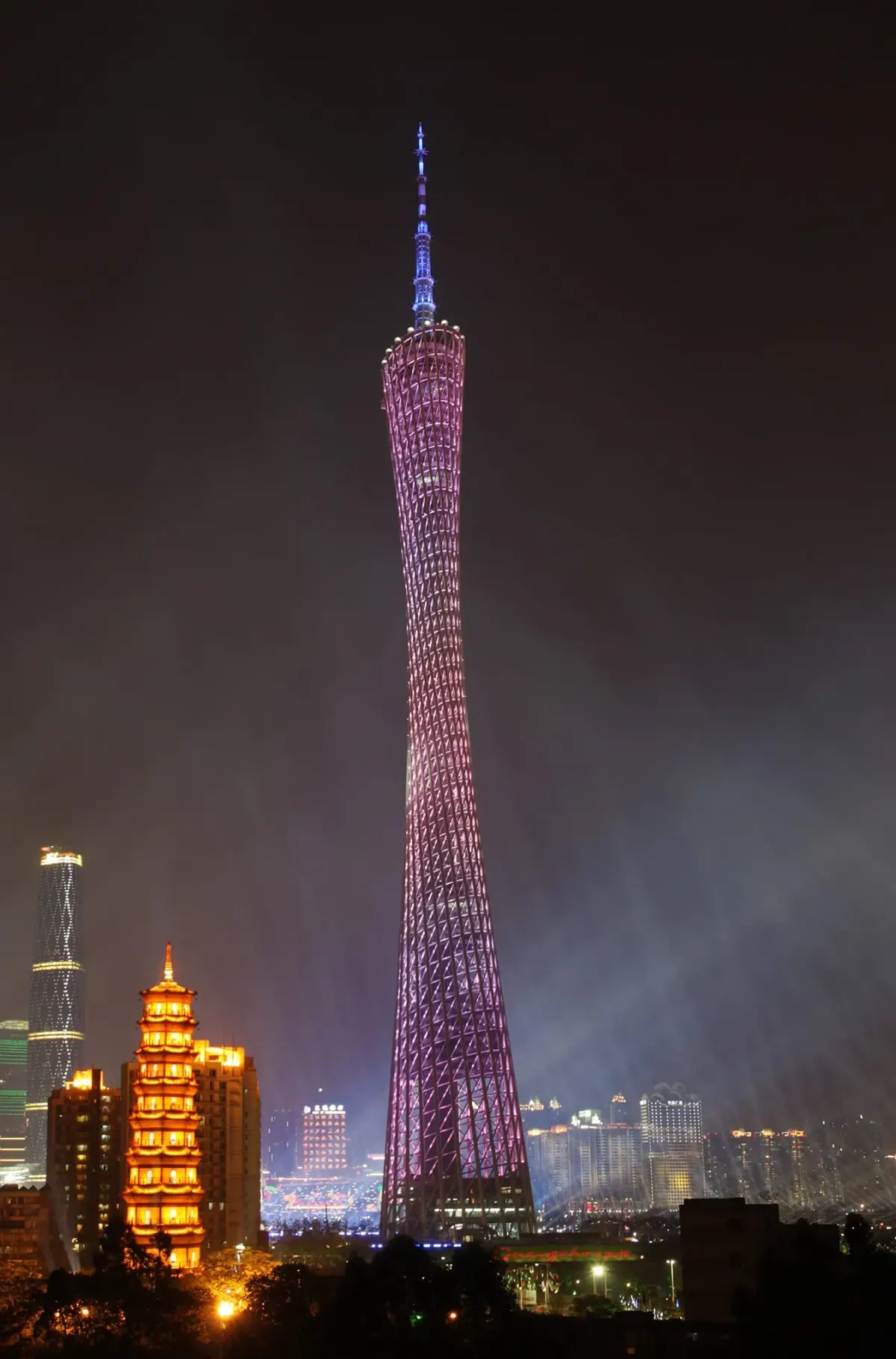
Canton Tower (广州塔, "the Slim Waist")
The 600-metre Canton Tower (2010), China’s second-tallest, with the 488 m observation deck, the world’s highest Ferris wheel around its crown, and the tilted skywalk. The defining icon of the modern skyline. ¥150–398 by level.
Wikimedia Commons · CC-BY-SA
Shamian Island (沙面岛)
A 19th-century sandbank island of tree-lined avenues and European colonial buildings (British and French concession era). The most atmospheric and photogenic district in Guangzhou. Free to wander.
Wikimedia Commons · CC-BY-SA
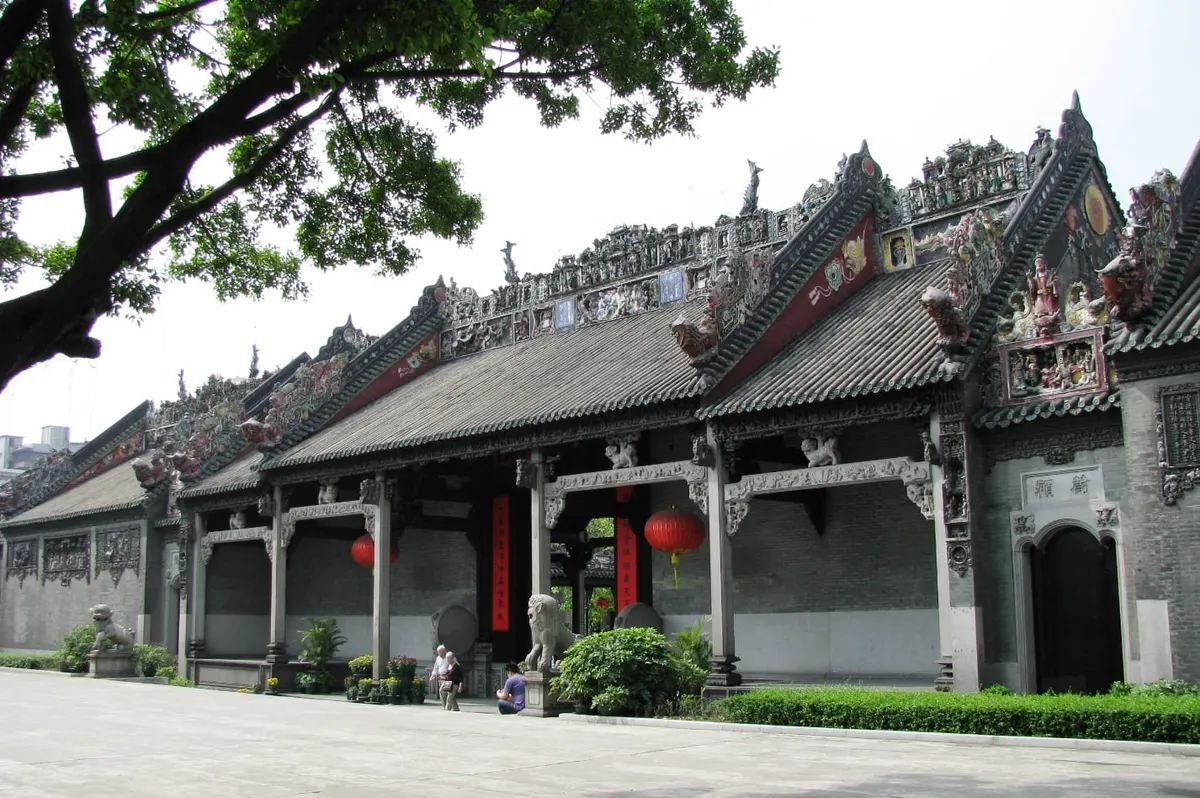
Chen Clan Ancestral Hall (陈家祠)
An 1894 Qing clan academy turned museum of Lingnan folk craft — intricate wood, brick, stone, and pottery carving, ivory and embroidery. One of the finest traditional buildings in south China. ¥10.
Wikimedia Commons · CC-BY-SA
Yuexiu Park and the Five Rams Statue (越秀公园五羊)
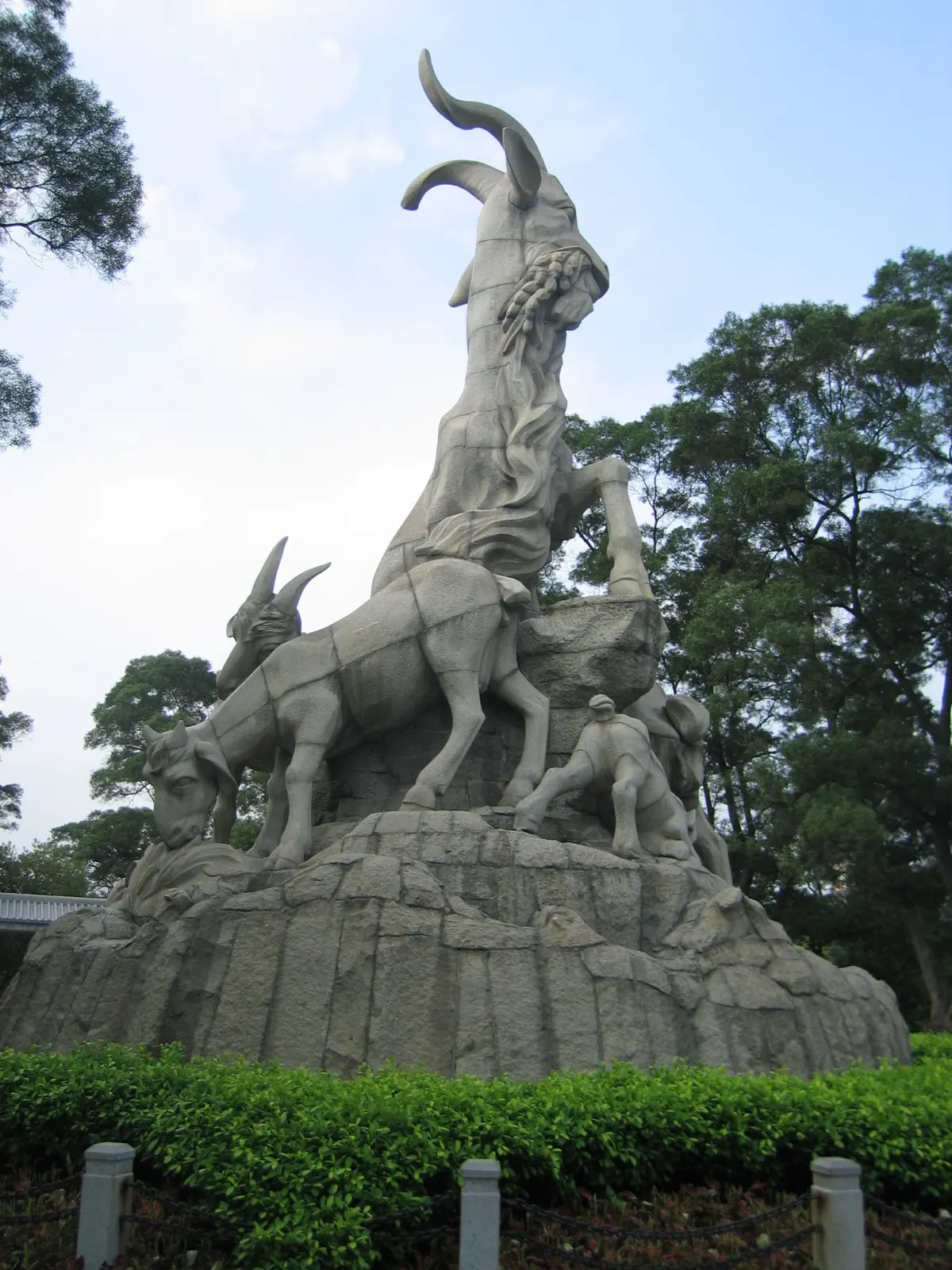
Guangzhou’s largest park, holding the Five Rams Statue (the city’s symbol, from a 2,000-year-old legend) and the Zhenhai Tower (the 1380 Ming tower, now the Guangzhou Museum). ¥10 for the tower; park free.
Wikimedia Commons · CC-BY-SA
Pearl River Night Cruise (珠江夜游)
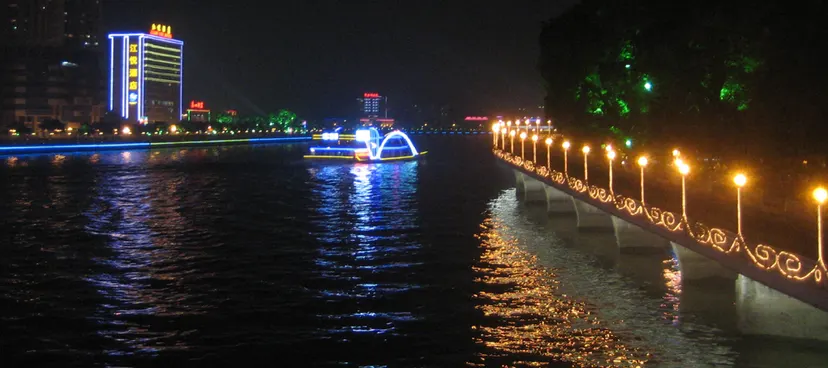
A 1–2 hour evening boat cruise past the illuminated Canton Tower, the Haixinsha bridge, and the lit-up Zhujiang New Town skyline. The signature Guangzhou night experience. ¥80–150. From Tianzi or Xidi pier.
Wikimedia Commons · CC-BY-SA
Temple of the Six Banyan Trees (六榕寺花塔)
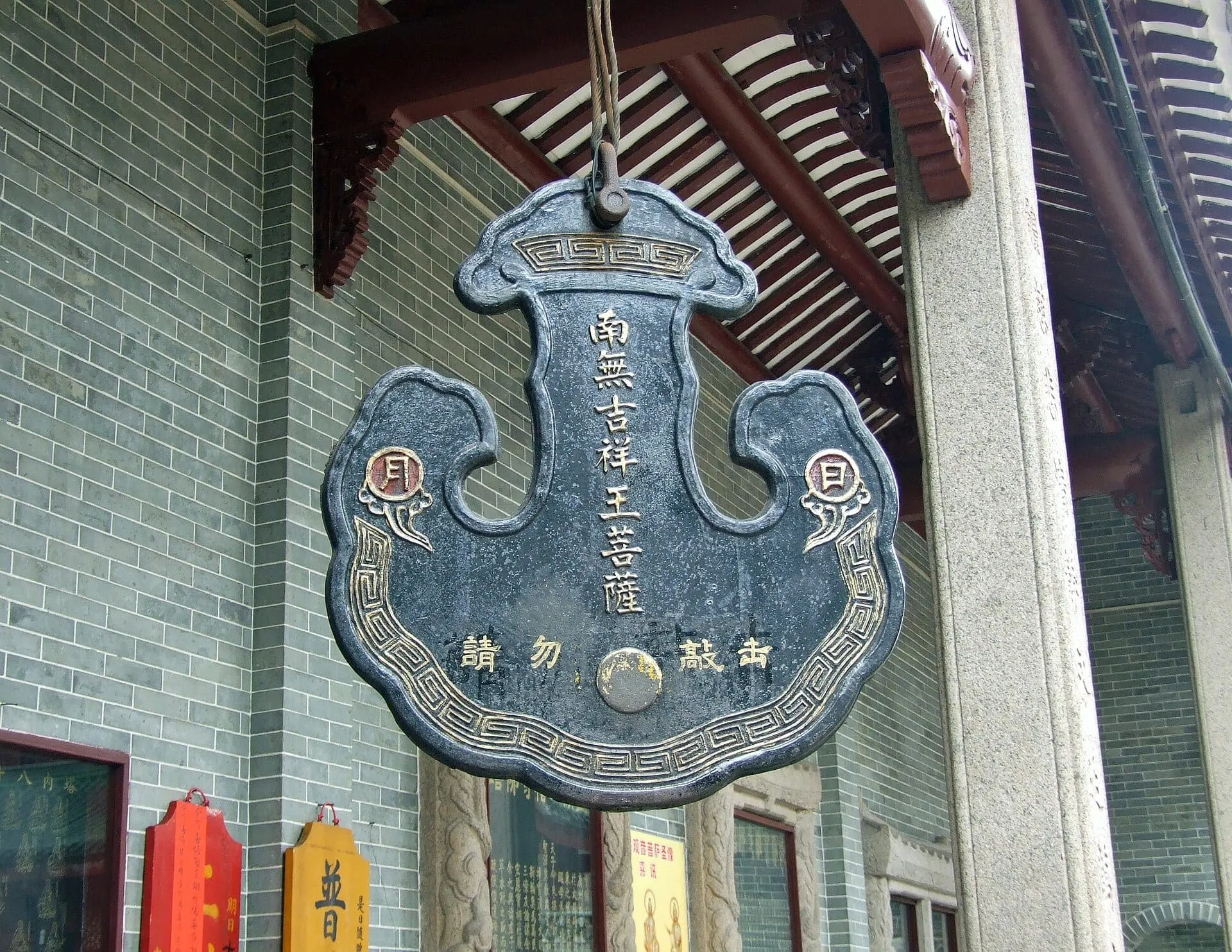
A 537 CE Liang-dynasty Buddhist temple with the 57-metre Flowery Pagoda (rebuilt 1097), named by the Song poet Su Dongpo. An active, atmospheric temple in the old city. Free.
Wikimedia Commons · CC-BY-SA
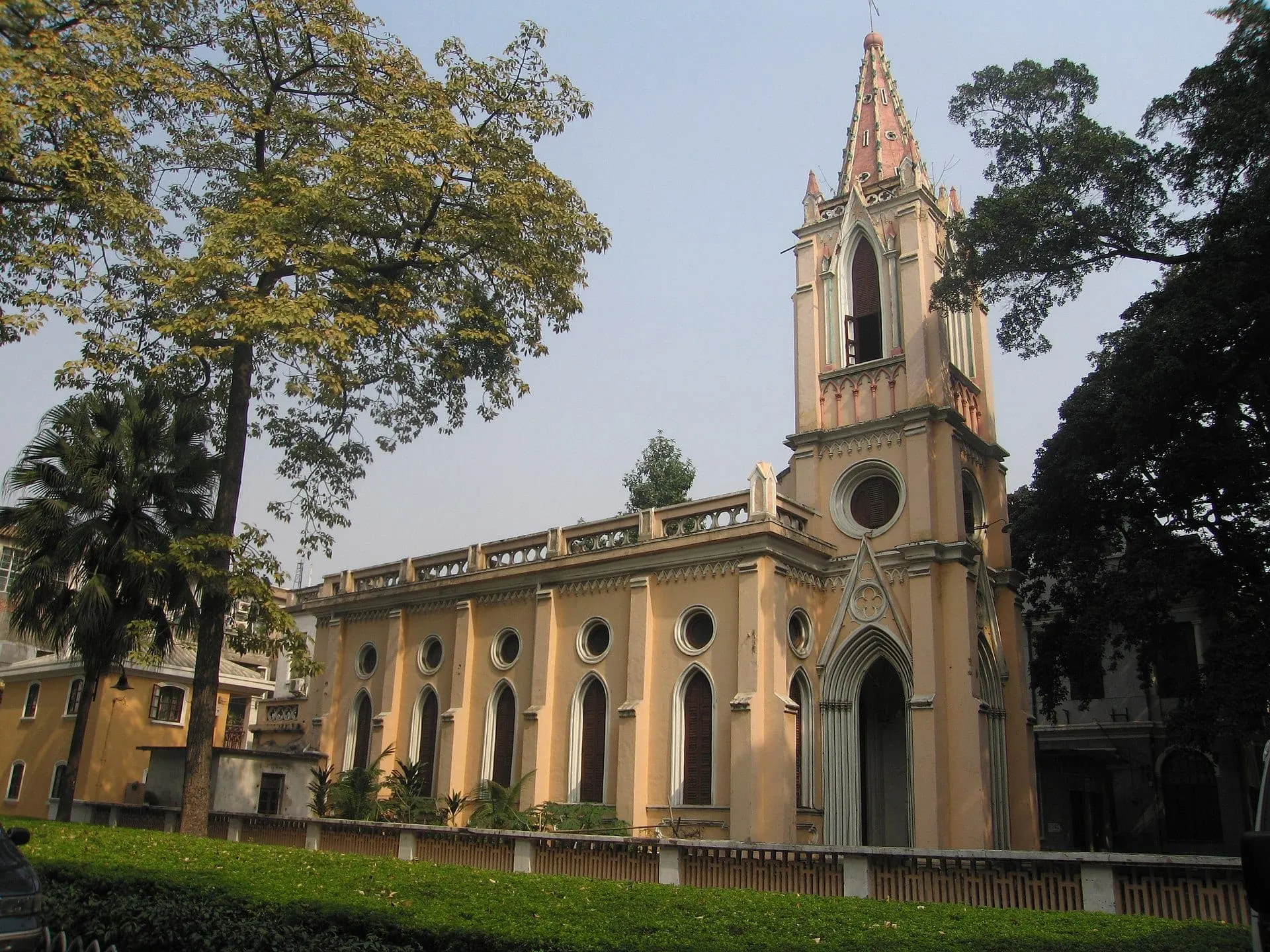
Sacred Heart Cathedral (石室圣心大教堂)
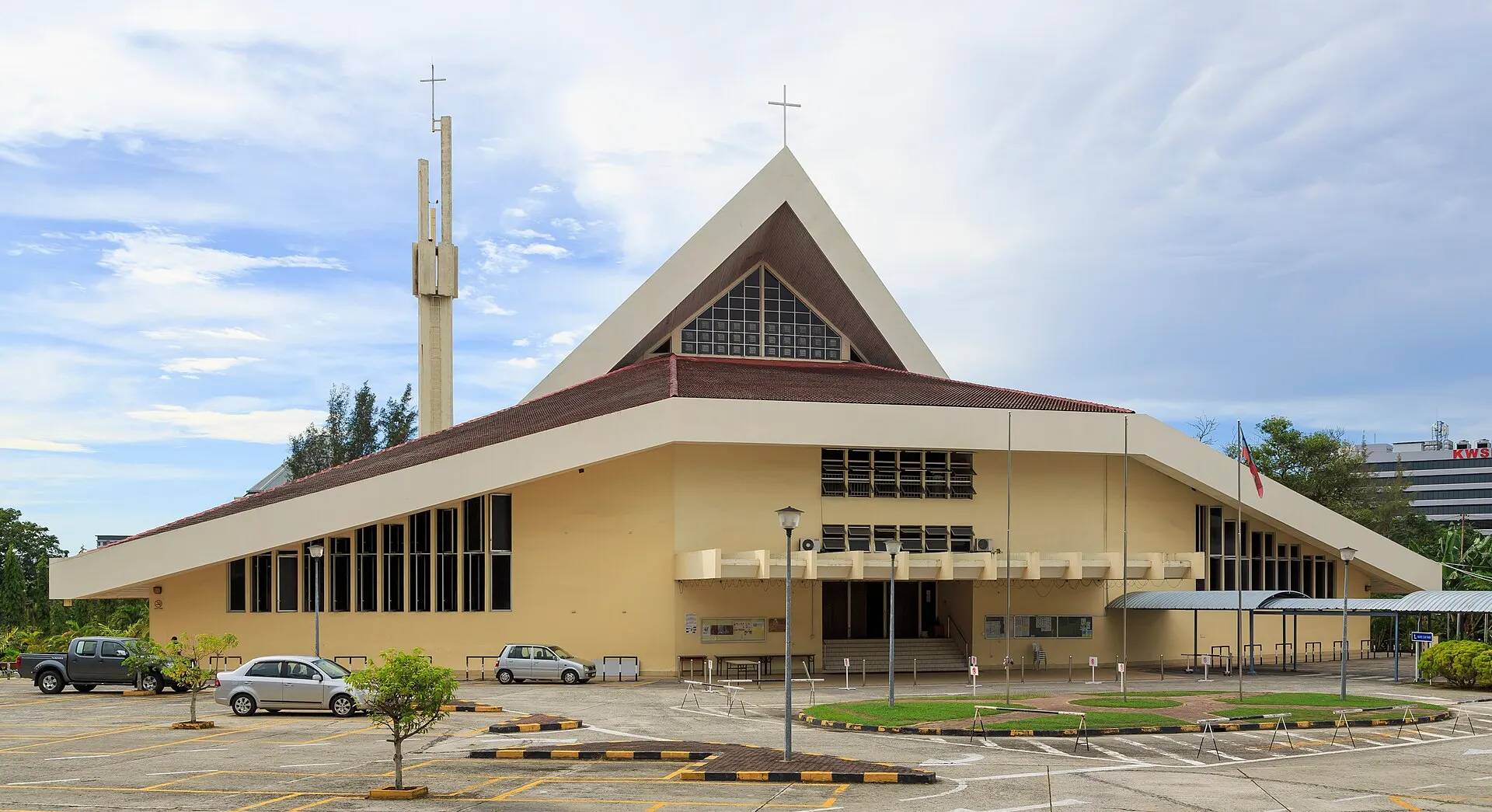
An 1888 Gothic cathedral built entirely of granite, modelled on Paris’s Notre-Dame, the largest all-granite Gothic church in East Asia. A startling piece of Europe in old Guangzhou. Free.
Wikimedia Commons · CC-BY-SA
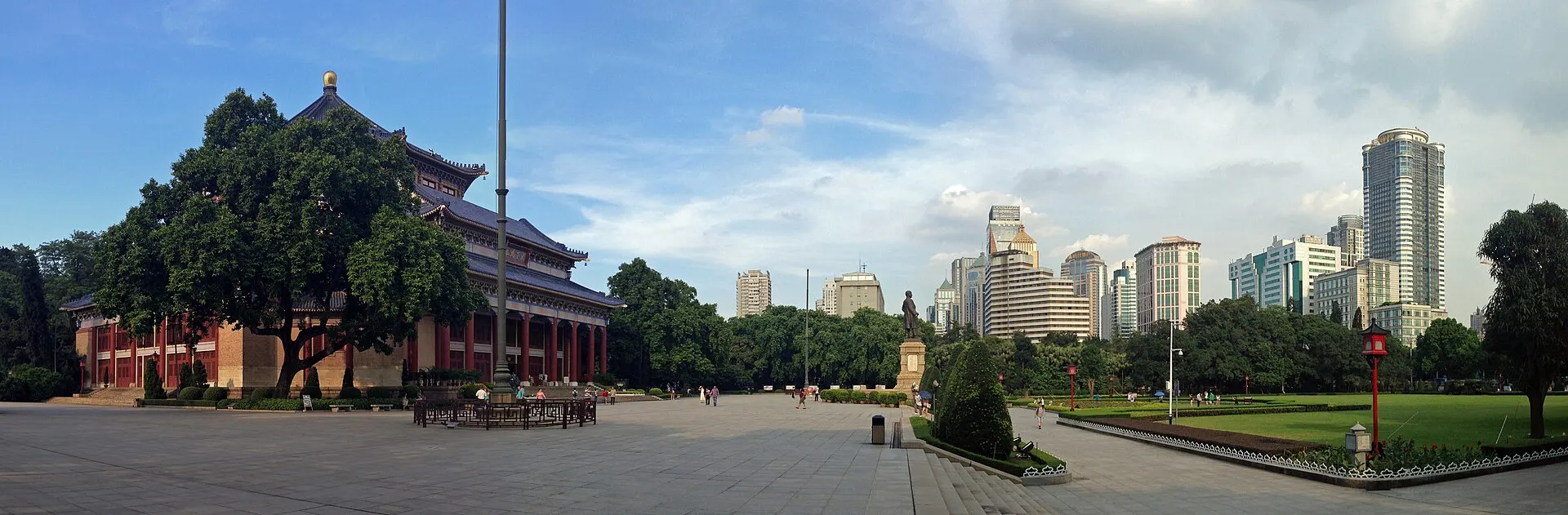
Sun Yat-sen Memorial Hall (中山纪念堂)
A 1931 octagonal memorial hall designed by Lü Yanzhi on the site of Sun Yat-sen’s presidential office, set in gardens. The most important Republican-era building in Guangzhou. ¥10.
Wikimedia Commons · CC-BY-SA
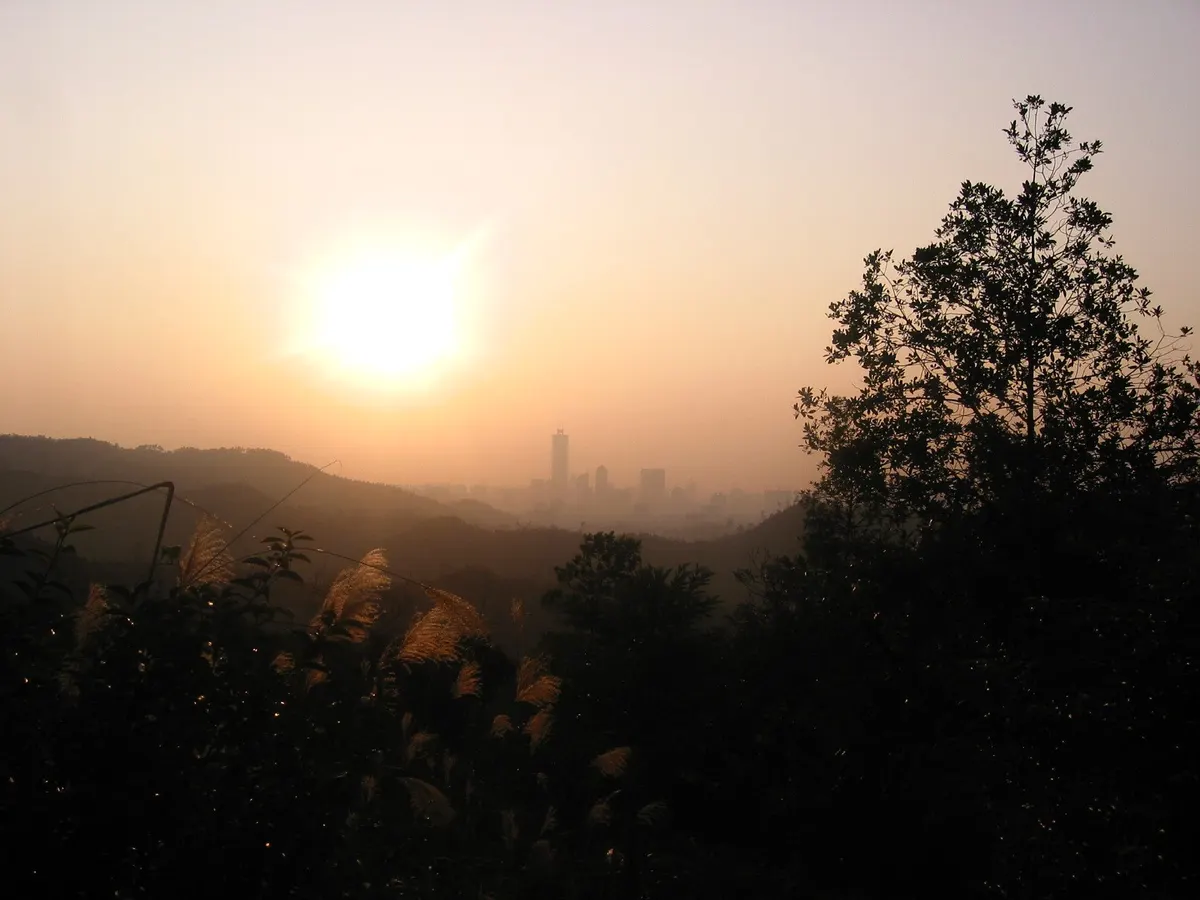
Baiyun Mountain (白云山)
Guangzhou’s ‘city lung’ — a forested mountain park on the northern edge with walking trails, cable car, and the Moxing Ridge summit view over the city. ¥5 entry; cable car ¥25.
Wikimedia Commons · CC-BY-SA
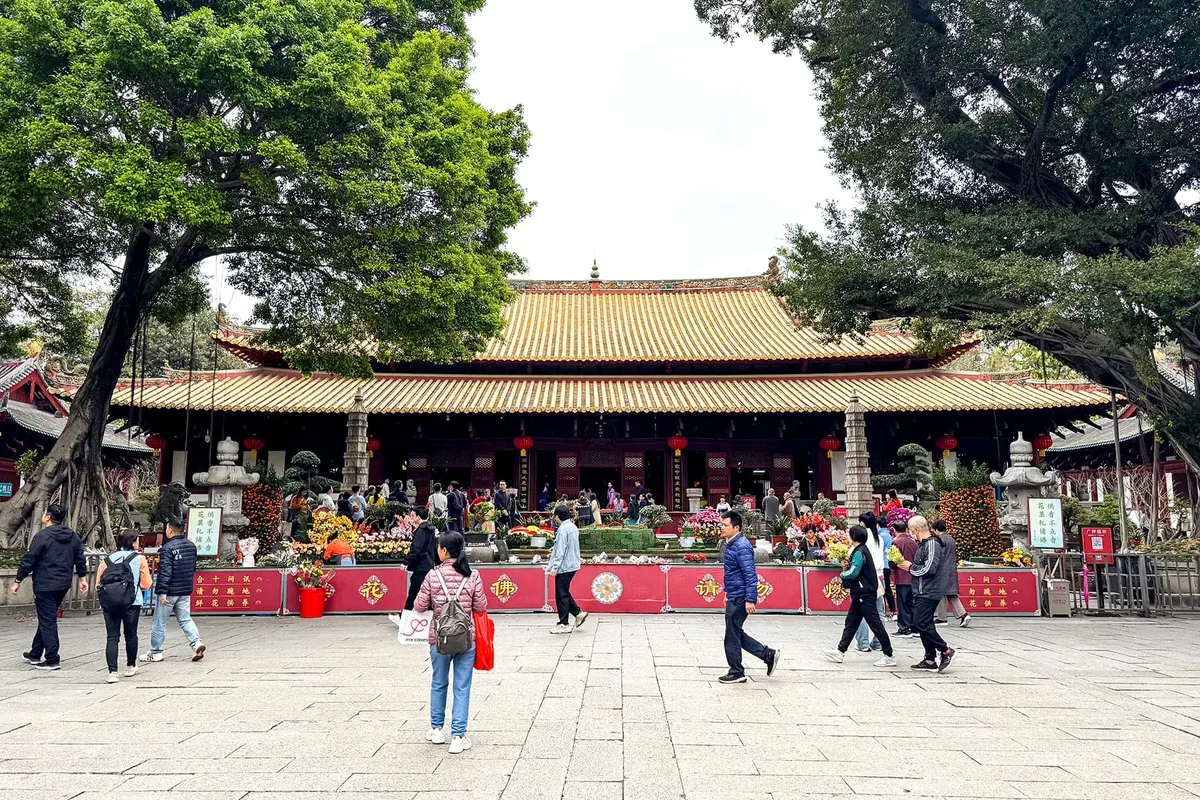
Guangxiao Temple (光孝寺)
The oldest Buddhist temple in Guangzhou (4th century), where the Sixth Patriarch Huineng was ordained in 676 CE — a foundational site of Chan (Zen) Buddhism. Quiet and historic. ¥5.
Wikimedia Commons · CC-BY-SA
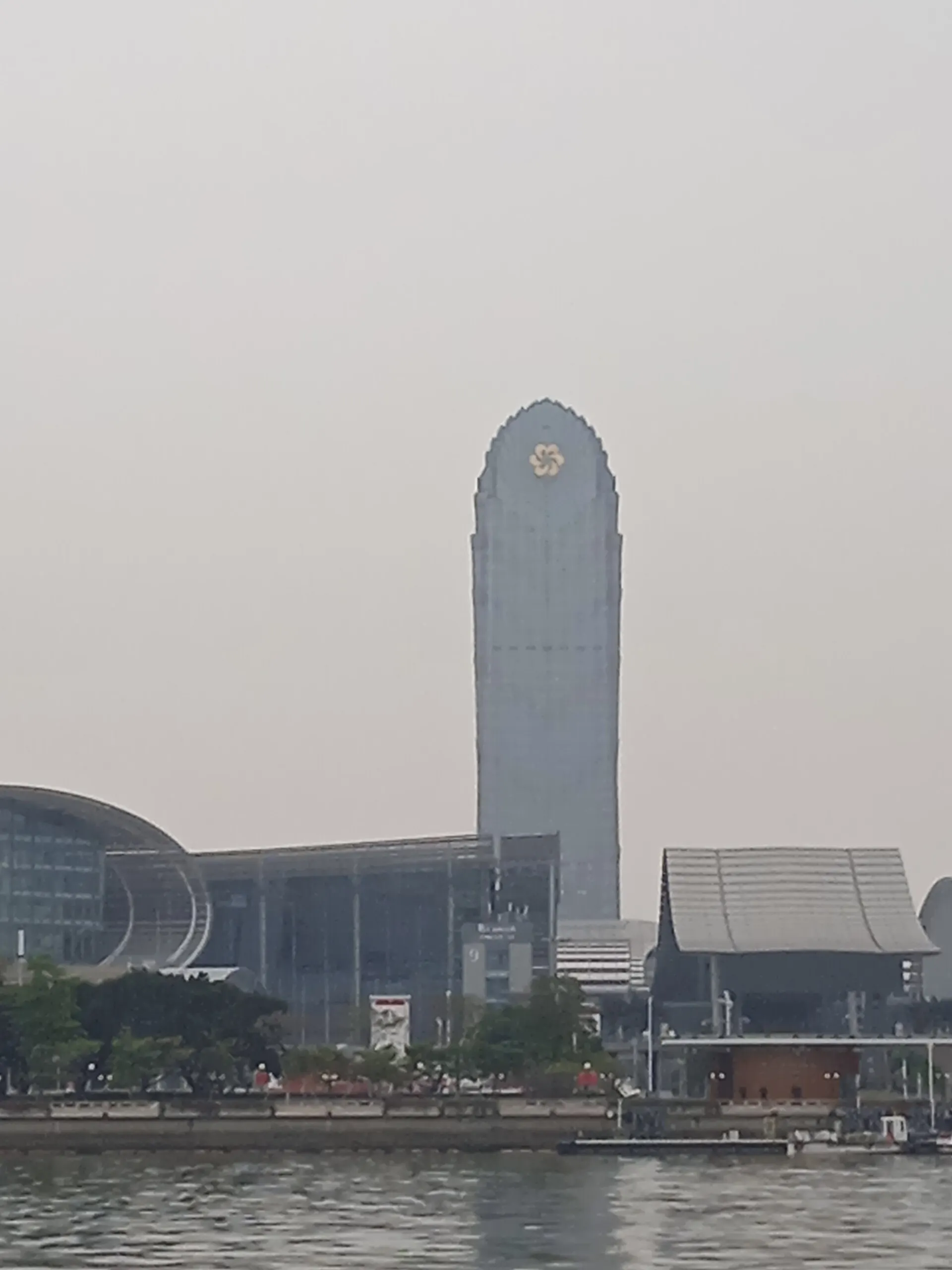
Canton Fair Pazhou Complex (广交会琶洲展馆)
The China Import and Export Fair (the Canton Fair), founded 1957 and held each spring and autumn, is the world’s largest trade fair. The vast Pazhou complex is open to the public during fair weeks and a marvel of scale year-round.
Wikimedia Commons · CC-BY-SA
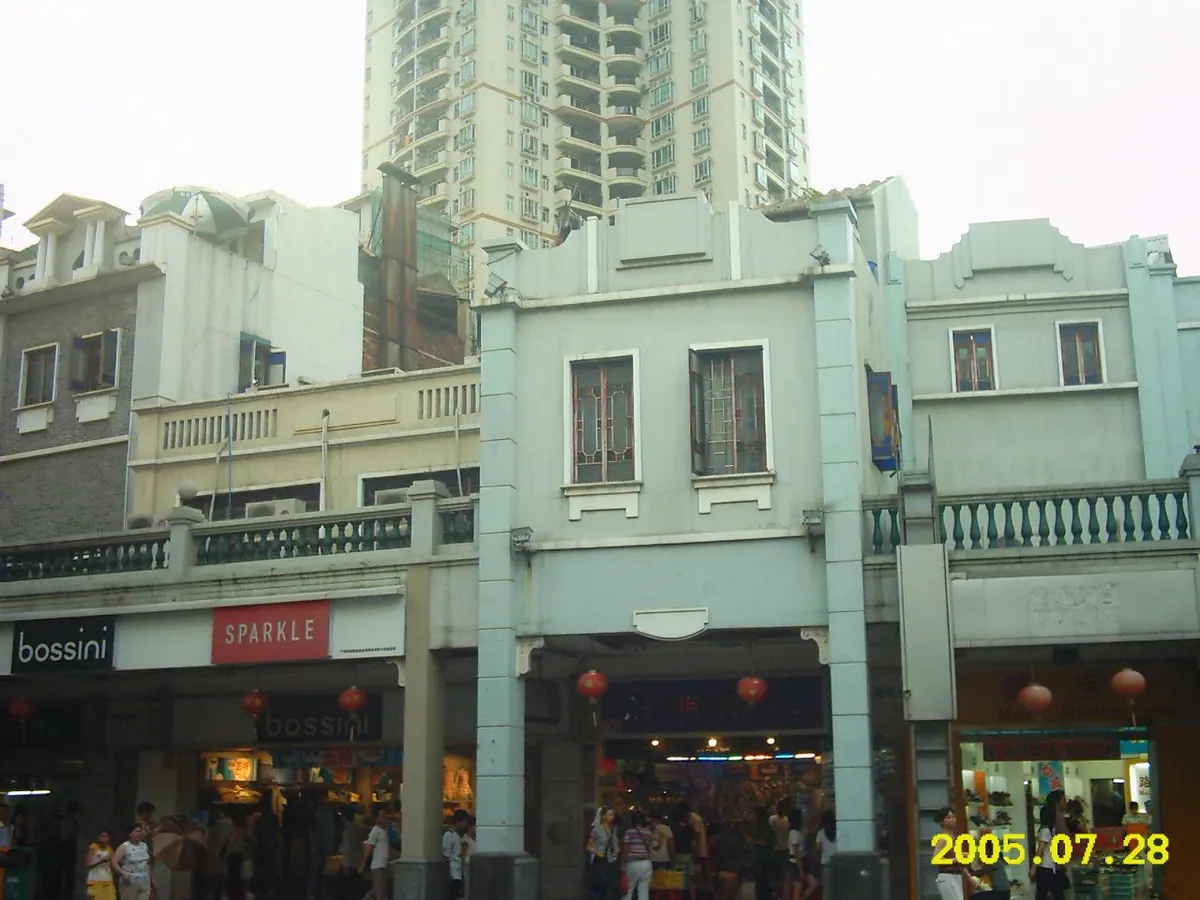
Shangxiajiu Pedestrian Street (上下九步行街)
The old Xiguan (west-of-the-city) commercial street of Tong Lau shop-houses, qilou arcades, traditional snack shops, and silk and tea stores. The atmospheric heart of old Cantonese Guangzhou. Free to walk.
Wikimedia Commons · CC-BY-SA
STAY
Where to stay in Guangzhou
Pick a base that matches the trip you want — imperial-central for sightseeing, hutong belt for character, Chaoyang for nightlife, or Qianmen for budget.
Tianhe (天河)
Modern CBD — skyscrapers, Canton Tower views, luxury malls. Four Seasons, Ritz-Carlton, Grand Hyatt.
#tianheYuexiu & Liwan (越秀·荔湾)
Old Guangzhou heart. Shamian Island colonial architecture, Chen Clan Ancestral Hall, traditional dim sum.
#yuexiu-liwanHaizhu (海珠)
Canton Tower area across the river. Mid-range hotels with Pearl River views. Canton Fair complex nearby.
#haizhuShamian Island (沙面)
European concession-era island. Quiet, leafy, boutique hotel in historic building. Best for atmosphere.
#shamian-island
ITINERARIES
Sample itineraries from Guangzhou
Three ready-made routes, from a 1-day imperial sprint to a 5-day deep dive. Copy the day-by-day plan and adapt to your own pace.
- 1 DAY
Guangzhou in One Day
Cantonese essentials — dim sum, Canton Tower, Shamian Island, and a Pearl River cruise.
- Layovers
- Canton Fair visitors
- Quick stop on a Greater Bay Area trip
- Day 01
Morning
Dim sum brunch at Panxi Restaurant, Shamian Island wander
Afternoon
Chen Clan Ancestral Hall, Canton Tower ascent at sunset
Evening
Pearl River night cruise, Beijing Road night market
- 3 DAYS
Classic 3-Day Guangzhou
Cantonese food, Lingnan architecture, colonial heritage, and a Kaiping day trip.
- Foodies
- First-time visitors
- Culture enthusiasts
- Day 01
Morning
Chen Clan Ancestral Hall, dim sum brunch at Panxi
Afternoon
Shamian Island, Sacred Heart Cathedral, Qingping Market
Evening
Canton Tower ascent, Pearl River night cruise, flower city square light show
- Day 02
Morning
Temple of the Six Banyan Trees, Guangxiao Temple, Yuexiu Park (Five Rams Statue)
Afternoon
Guangdong Museum, Guangzhou Opera House exterior, Zhujiang New Town
Evening
Beijing Road night market, Shangxiajiu arcade stroll, Cantonese dinner
- Day 03
Morning
Day trip to Kaiping Diaolou (2h bus/train) — UNESCO fortified towers
Afternoon
Zili Village and Majianlong cluster, return to Guangzhou
Evening
Farewell dim sum at Diandude, Pearl River riverside bar
- 4 DAYS
4-Day Guangzhou & Shenzhen
Guangzhou plus a day in Shenzhen — Greater Bay Area duo with dim sum and tech.
- Business + leisure
- Greater Bay Area explorers
- Shopping enthusiasts
- Day 01
Morning
Chen Clan Ancestral Hall, dim sum, Shamian Island
Afternoon
Canton Tower, Guangdong Museum, Huacheng Square
Evening
Pearl River cruise, Beijing Road
- Day 02
Morning
Yuexiu Park, Temple of Six Banyan Trees, Guangxiao Temple
Afternoon
Shangxiajiu Pedestrian Street, Qingping Market, Sacred Heart Cathedral
Evening
Cantonese seafood dinner on Shamian Island
- Day 03
Morning
HSR to Shenzhen (30 min), OCT-LOFT creative park
Afternoon
Shenzhen Bay Park coastal walk, Huaqiangbei electronics market
Evening
Sea World dining complex, return to Guangzhou or stay in Shenzhen
- Day 04
Morning
Kaiping Diaolou day trip or Baiyun Mountain hike
Afternoon
Last dim sum, souvenir shopping, airport
Evening
Depart
BUDGET
What a Guangzhou trip costs
Per-person, per-day costs across three spending tiers. Excludes international flights and visa fees.
| Line item | Backpacker | Mid-range | Luxury |
|---|---|---|---|
| Hotel (per night) | $15 | $60 | $220 |
| Meals (per day) | $12 | $35 | $100 |
| Local transport | $3 | $10 | $25 |
| Attractions | $8 | $20 | $50 |
| Total per day | $38 | $125 | $395 |
$ USD per person per day, before international flights and visas. Last verified: Q3 2026.
STAY SAFE
Emergency contacts in Guangzhou
Save these three numbers before you board the plane. China uses different hotlines than most countries — there's no 911.
- POLICE
110
- AMBULANCE
120
- FIRE
119
- TOURIST HOTLINE
12301 (China National Tourism Administration hotline)
- ENGLISH-SPEAKING ER
Guangzhou United Family Hospital (广州和睦家医院) — 24/7 English-speaking, +86 20 8710 6000, 31 Pazhou Avenue, Haizhu. Also: CanAm International Medical Center +86 20 8386 8988.
Problems travelers hit in Guangzhou
- Why is my Alipay not working?You linked a foreign Visa or Mastercard to Alipay but every transaction is rejected at the merchant.
- My China visa was denied — what now?Your L visa application was refused at the Chinese consulate and your trip is in 2–4 weeks.
- My passport was lost or stolen in China — what do I do?Your passport is gone (theft or loss) and you're in mainland China without travel documents.
- Why can't I book on 12306 with my foreign card?You tried to book a high-speed rail ticket on 12306.cn and your foreign Visa/Mastercard is rejected at checkout.
- Why is my VPN not working in China?You arrived in China, opened your VPN, and it will not connect at all or connects but no traffic loads.
- Why can't I book a Tibet trip on my own?You try to book Lhasa flights and hotels yourself but the booking fails, or you're turned away at the Lhasa airport without a permit.
Compare Guangzhou with
Book activities in Guangzhou
These are licensed tour operators and booking platforms we've vetted independently. Booking through these links may earn us a commission — see our affiliate disclosure. This never affects our editorial recommendations or the price you pay.
Frequently asked questions
How many days do I need in Guangzhou?
Do I need a visa for Guangzhou?
Is Guangzhou safe for tourists?
What is yum cha and where should I do it?
When is the best time of year to visit Guangzhou?
How do I get from Guangzhou to Hong Kong or Macau?
Show all 43 FAQs
What is the Canton Tower and should I go up it?
Can I use Alipay or WeChat Pay in Guangzhou?
Is Guangzhou expensive?
How do I get from Baiyun Airport to the city?
What is the Pearl River night cruise and is it worth it?
What is Shunde and why is it the best food day trip from Guangzhou?
Is Guangzhou a good destination for families with kids?
How do I see the Chen Clan Ancestral Hall and why is it special?
What is the Canton Fair and can a tourist attend?
Can I do a day trip from Guangzhou to Hong Kong or Macau?
Is Guangzhou worth visiting in winter?
What should I pack for Guangzhou?
What is the difference between Guangzhou, Shenzhen, and Hong Kong?
What is the Nanyue King Tomb and why is it a must-see?
Can I drink the tap water in Guangzhou?
How accessible is Guangzhou for travellers with disabilities?
Is Guangzhou a good destination for solo travellers?
What is the Guangdong Museum and should I visit?
What is the Kaiping watchtowers day trip and is it worth it?
What is the best overall advice for a first trip to Guangzhou?
What is the Yuexiu Park and the Five Rams Statue?
How much does a Guangzhou trip cost?
Can I visit Guangzhou as a visa-free transit stop?
What is the Sacred Heart Cathedral and the Christian heritage of Guangzhou?
Is Guangzhou good for older travellers?
What is the Shamian Island and the best time to walk it?
What is the Chimelong resort and is it worth a day?
What is the Enning Road and the Xiguan old-city lanes?
How do I handle the Cantonese language barrier?
What is the best area to stay in Guangzhou?
What is the Guangzhou climate and weather year-round?
What is the Beijing Road and how does it compare to Shangxiajiu?
Can I do a Guangzhou food crawl in one day?
What is the Sun Yat-sen heritage in Guangzhou?
Is Guangzhou good for families with children?
What is the best way from Guangzhou Baiyun Airport to the city center?
How does Guangzhou compare to Hong Kong for food?
References

Related guides & destinations
Guide
Guangzhou Baiyun Airport (CAN) to City Center 2026: Metro, DiDi, Taxi, and Late-Night Options
Guangzhou Baiyun International Airport (CAN) is 28 km north of the city center. Metro Line 3 is the cheapest and most reliable transfer at ¥
Guide
8 Best Chinese Food Cities 2026: Chengdu, Guangzhou, Xi’an, Shanghai, Wuhan, Hangzhou, Changsha, Kunming
A ranked guide to the 8 essential Chinese food cities, from UNESCO-designated Chengdu to mushroom-mad Kunming. Each has signature dishes, wh
Guide
How We Research 2026: NihaoVisit’s Methodology for China Travel Information
How NihaoVisit sources, verifies, and maintains 700+ pages of China travel information — our source hierarchy, fact-checking process, update
Guide
Fact-Checking Log 2026: Verified China Travel Information — NihaoVisit
A public log of fact-checking verification passes on NihaoVisit, showing what was verified, when, and against which sources — covering visa
Guide
Best Time to Visit China 2026: Month-by-Month Weather, Crowds, and Prices
The best time to visit most of China is April–May and September–October. Winter (Dec–Feb) is cold but cheap; summer (Jun–Aug) is hot and cro
Guide
VPN for China 2026: Which VPNs Work, eSIM Alternatives, and the Complete Pre-Trip Checklist
Most Western apps and websites are blocked in mainland China. A reliable VPN is essential for Google, Gmail, WhatsApp, Instagram, and most n