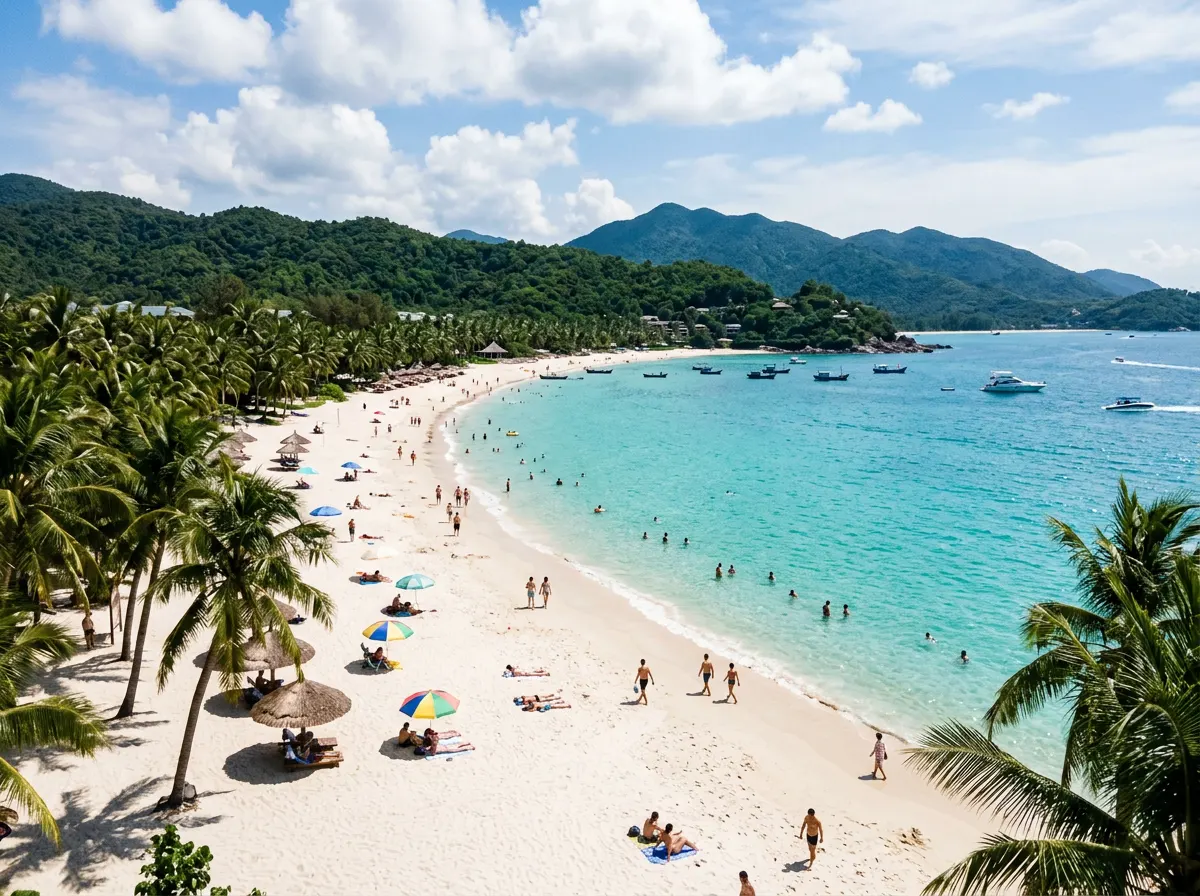
Hainan
Hainan is China's only tropical province and its easiest beach destination — often called "China's Hawaii." Most visitors base in Sanya on the south coast, where resorts cluster around Yalong Bay, Dadonghai, and Haitang Bay. Three to five days covers beach time, Wuzhizhou Island, the Nanshan Buddhist cultural area, and the tropical coastline. The same China visa or visa-free rules that apply to Beijing and Shanghai cover Hainan. Best from November to April (dry); July to September is typhoon season.
Why Hainan in 2026.
China's only tropical province. Sanya on the south coast has year-round warm water, beach resorts, and visa-free entry for many passport holders.
Quick Answer
Hainan is China's only tropical province and its easiest beach destination — often called "China's Hawaii." Most visitors base in Sanya on the south coast, where resorts cluster around Yalong Bay, Dadonghai, and Haitang Bay. Three to five days covers beach time, Wuzhizhou Island, the Nanshan Buddhist cultural area, and the tropical coastline. The same China visa or visa-free rules that apply to Beijing and Shanghai cover Hainan. Best from November to April (dry); July to September is typhoon season.
| Best time to visit | November-April (dry, less humid); year-round warm water |
|---|---|
| Daily budget | $70 (backpacker) / $150 (mid-range) / $400+ (luxury) |
| Language | Mandarin (Hainanese dialect; English at major resorts) |
| Currency | CNY (¥) |
| Time zone | China Standard Time (UTC+8) |
| Last updated | 2026-06-16 |
Want a Hainan plan built for you?
What makes Hainan different from the rest of China?
Hainan is China's southernmost and only tropical province — an island in the South China Sea with a climate closer to Southeast Asia than to the mainland. Palms, mangoes, and coffee grow here, the sea stays warm year-round, and the pace is famously relaxed. For travelers it offers something no other Chinese province does: a genuine beach-and-resort vacation, plus a distinct local Li and Miao minority culture in the interior mountains. It is the country's designated free-trade and tourism island, which also shapes its visa rules and duty-free shopping. Geographically the island sits about 35 kilometers off the mainland across the Qiongzhou Strait, separated from Guangdong Province by a body of water that has defined its trade and migration patterns for centuries. Administratively Hainan is its own province (the smallest in China by area after the municipality-level cities), with Haikou as the capital and Sanya as the tourism-focused second city on the south coast. The interior is mountainous and densely forested, the coast is lined with coconut and betel-nut palms, and the entire island sits inside the tropical zone. For travelers used to northern or central China, the sense of stepping into a different country is real: the humidity, the vegetation, the laid-back dress code, the prevalence of beachwear and flip-flops in everyday Sanya life all stand apart from the rhythm of Beijing or Shanghai. The island's identity is also distinct linguistically and culturally — the Hainanese dialect of Min Chinese spoken by a large share of the local population is mutually unintelligible with Mandarin, and the Li, Miao, and Hui communities in the central mountains preserve their own languages and customs. Understanding this layered identity — mainland Chinese infrastructure and governance, a tropical physical setting, and indigenous and diaspora culture — is the first step to enjoying Hainan as more than just a beach stop.
Is Hainan visa-free for foreigners?
Yes, for most travelers the same China visa or 30-day visa-free entry that applies to Beijing and Shanghai also covers Hainan, so no special island permit is needed. Hainan has historically offered additional visa-free schemes for certain nationalities and group arrivals, but those rules change, so confirm your specific passport's current status before booking. The practical upshot is that Hainan is one of the most accessible beach destinations in China for foreign visitors. The recent expansion of China's unilateral visa-free entry scheme to passport holders of 38 countries — most of the European Union, the United Kingdom, Australia, New Zealand, South Korea, Japan, Malaysia, Singapore, and several South American states — covers Hainan fully: travelers from these countries can simply present their passport on arrival at Sanya Phoenix or Haikou Meilan airport and stay for up to 30 days without any advance visa paperwork. For passport holders outside the visa-free list, a standard L (tourist) visa is required and is straightforward to obtain from a Chinese consulate or visa application center; processing typically takes 4-7 business days. Hainan also runs the Hainan Free Trade Port, which since 2025 has progressively opened additional visa-on-arrival and short-stay options tied to the port's economic zones — these are mainly relevant to business travelers but worth checking if your nationality is borderline. As of 2026, the most current and authoritative source for visa rules is the National Immigration Administration of China website or the Chinese embassy in your home country; third-party travel sites often lag behind the latest policy changes.
Is Sanya worth a beach-only trip?
Yes. Many travelers do Hainan as a standalone beach vacation or as a relaxing add-on after touring the cities. Sanya has direct international flights from several Asian cities, and its resort infrastructure is the most developed of any beach destination in China. If you want sea, sand, and a slow pace without sightseeing pressure, Sanya delivers. Travelers seeking culture or history will find less here than elsewhere in China. The framing of "beach-only" is also worth unpacking: Sanya is genuinely a resort destination in the international sense, with bay after bay of swimmable water, an international airport 20-30 minutes from the major hotel zones, and enough on-site restaurants, beach clubs, pools, and water-sport operators that you can comfortably spend a week without leaving your resort footprint. For travelers who like to mix beach with light activity, day trips to Wuzhizhou Island, the Nanshan Buddhist Cultural Zone, and the Yanoda rainforest in the interior add variety without sacrificing the slow pace. The risk is the opposite of "too little to do" — many visitors find that they have booked too few days and wish they had planned a slower week rather than a hurried 3-4 day stop. If your itinerary includes Beijing, Shanghai, or Xi'an and you have to choose where to spend your beach days, Sanya is the most seamless way to add tropical downtime to a China trip.
When is the best time to visit Hainan?
November to April is the best window — dry, sunny, and less humid, with pleasant evenings. May and June and October are quieter and often good value. July to September is typhoon season, when flights and ferries can occasionally be disrupted, so build a buffer day into your plans. Sea temperatures stay warm year-round, so the beach is viable in any month; the variable is mostly rain, humidity, and storm risk. December and January are the peak months for domestic tourism, and resort prices reflect that — the Christmas-through-Chinese-New-Year stretch in particular can be 50-100% more expensive than shoulder seasons and is when advance booking becomes essential. The shoulder months of November and March-April are typically the best balance of good weather, manageable crowds, and reasonable prices. Hainan's typhoon season runs roughly from June through September, with August and September historically the most active; a single typhoon will rarely shut down an entire trip, but travelers should expect a higher chance of rain days, occasional flight cancellations, and rougher sea conditions for snorkeling and boat trips. The wet-season heat can also be exhausting — humidity regularly exceeds 85% and daytime highs reach the mid-30s Celsius, which is fine for beach lounging but uncomfortable for sightseeing. Sea water temperatures stay between about 22 and 29 degrees Celsius year-round, so swimming is always an option. The single most underrated window for a Hainan trip is late October through mid-November: typhoon season has ended, the worst of the wet-season humidity has broken, hotel prices have dropped back from summer highs, and the beaches are at their quietest before the December domestic rush begins.
How do I get to Hainan?
Most visitors fly into Sanya Phoenix International Airport, which has domestic flights from across China and international flights from several Asian cities. The provincial capital, Haikou, on the north coast, is another gateway connected to Sanya by a fast high-speed rail line across the island. Some travelers combine Haikou (cheaper, more local character) with Sanya (the resort scene). Ferries also link Hainan to the mainland for those driving. The cross-sea high-speed rail link opened in stages through the late 2010s and now connects the Guangdong rail network to Haikou directly, making train arrival one of the most scenic options in China: trains run from Guangzhou South to Haikou East in roughly 3 to 3.5 hours via Zhanjiang and the cross-sea bridge-tunnel across the Qiongzhou Strait. From Haikou the circumferential Hainan high-speed rail runs the full length of the island to Sanya in about 1.5 hours, with stops at Qionghai, Boao, Wanning, and Lingshui along the way. Domestic flights into Sanya are frequent from Beijing (about 4 hours), Shanghai (about 3.5 hours), Guangzhou (about 1.5 hours), and most major Chinese cities; fares vary widely by season but are usually competitive with high-speed rail once you factor in airport transfer time. International flights into Sanya are limited but growing — direct services from cities such as Singapore, Bangkok, Kuala Lumpur, Seoul, Tokyo, and several Russian and Central Asian cities operate during the winter season. For travelers already in Southeast Asia, Sanya is a natural add-on to a longer regional trip, with visa-free 30-day entry for many passports making logistics easy.
Where should I stay in Sanya?
Match the bay to your budget and style. Yalong Bay has the best-known beach and the densest cluster of international resorts. Dadonghai is closer to the city and more mid-range, lively and convenient. Haitang Bay is the newer luxury zone, farther from downtown, with large resorts and big duty-free shopping. Backpackers and budget travelers often base in Haikou or in Sanya city itself and day-trip to the beaches. Each bay has a different personality, so match the area to your priorities. Yalong Bay is the safest first-time pick — the water is consistently the cleanest of the three, the beach is wide and well-maintained, and the resort corridor is designed for self-contained stays. Expect to pay international resort rates (USD 200-500+ per night in peak season) and to be relatively isolated from non-resort dining and shopping. Dadonghai is the most eclectic: a long public beach lined with mid-range hotels, Russian-language cafes, seafood restaurants, and a noticeably more local atmosphere than Yalong Bay. It is also the closest major beach to central Sanya, so non-resort dining, the Sanya First Market, and the central shopping streets are all within walking distance. Haitang Bay is the new luxury development zone, with the largest concentration of new five-star properties, the giant Haitang Bay duty-free shopping complex, and several integrated resort-and-shopping complexes. It is about 30-40 minutes from Sanya airport and even farther from downtown, so it works best for travelers who plan to spend most of their trip on-resort and do not mind driving for off-site dinners. Sanya Bay, the closest bay to the airport and downtown, has a long but rougher public beach, fewer international resorts, and is the most affordable option. For pure budget travel, base in Haikou or in Sanya city center (away from the beach) and use ride-hail to reach the resort beaches for the day.
What should I eat in Hainan?
Hainan's signature is Hainanese chicken rice (wenchang chicken), a dish that traveled the world via Southeast Asia but originated here — tender poached chicken with flavored rice and dipping sauces. Beyond that, expect fresh seafood (often bought live at markets like Sanya's First Market and cooked to order), tropical fruit, coconut-based dishes, and the four famous Hainan dishes (wenchang chicken, Jiaji duck, dongshan mutton, and hele crab). Food is generally lighter and less oily than northern Chinese cuisine. Hainan's culinary heritage is shaped by its tropical climate, its coastal location, and its long history of trade with Southeast Asia, which is why so many of its dishes have recognizable cousins across the South China Sea. Wenchang chicken is the most famous export: a small free-range chicken raised in Wenchang on the east coast, poached gently, chilled, and served with flavored rice cooked in the poaching liquid, accompanied by chili-ginger-lime and dark-soy dipping sauces. The fresh seafood market culture is one of the most distinctive Hainan dining experiences — at Sanya's First Market (第一市场) and similar markets across the island, you choose live fish, prawns, crabs, mantis shrimp, or shellfish from the ice displays, then take them to one of the surrounding restaurants which will cook them to order for a small per-dish cooking fee. Beyond chicken, look for jiaji duck (嘉积鸭), a small flavorful duck from the town of Jiaji in Qionghai, typically braised or roasted with a sweet-savory glaze; hele crabs (和乐蟹), mud crabs from Hele town steamed with garlic and vermicelli; and dongshan lamb (东山羊), a mountain-raised goat from the Dongshan range. Tropical fruit — mango, papaya, lychee, passion fruit, dragon fruit, and the enormous Hainan coconut — is sold everywhere from markets to resort buffets. Local coffee, grown in the central highlands and roasted dark, is a small but distinctive regional product. For breakfast, try a bowl of hainan rice noodles (海南粉) or houtuo fan (后安粉), thin rice noodles in a hot seafood or pork broth topped with peanuts, dried shrimp, and a squeeze of lime.
Can I dive or do water sports in Hainan?
Yes. Wuzhizhou Island is the main center for snorkeling and diving, with operators offering dives and water sports; visibility is best in the drier months. Jet skis, parasailing, and banana boats operate off the main beaches. Conditions vary by season and recent weather, so check sea state on the day. Hainan is not a world-class dive destination — the draw is convenience and warm water rather than exceptional marine life. Several dive shops around Sanya offer PADI Open Water certification courses as well as fun dives for certified divers, with typical depths of 8-18 meters and a focus on coral garden dives, artificial reef structures, and occasional pelagic encounters. The reefs around Wuzhizhou Island and the smaller islands off the southeast coast are reasonably healthy but do not approach the biodiversity of the Coral Triangle; visibility ranges from 5-10 meters in average conditions to 15+ meters on the best winter days. Water temperatures stay between 22 and 29 degrees Celsius year-round, so a 3mm wetsuit is sufficient in winter and most divers skip the suit entirely in summer. Beyond Wuzhizhou, water sports available off the main resort beaches include parasailing, jet skiing, sea walking (helmet diving for non-divers), banana-boat rides, and glass-bottom boat tours. The Sanya Marina and Dadonghai Bay host most of the boat operators. For experienced divers looking for something more challenging, drift dives around the southeast corner of Hainan and the deeper walls off Wuzhizhou offer stronger currents and bigger fish. Dive certification through a Chinese dive shop is cheaper than in most Western countries but requires patience with the language barrier; non-Chinese-speaking divers should book through one of the international dive operators that cater to resort guests.
How much does a Hainan trip cost?
Hainan spans a wide price range. International resorts can run several hundred US dollars a night in peak season, while budget guesthouses and local food are inexpensive. The biggest cost variables are accommodation (resort vs guesthouse) and the season (winter high season is priciest). Duty-free shopping is a draw for mainland visitors but less relevant to most foreign travelers. Plan for resort prices if you want the beach-resort experience, or Haikou-based budget travel if you do not. As a rough budget framework: a backpacker-style Hainan trip focused on Haikou with day trips to the beaches can be done for USD 50-80 per day including a budget hotel, local food, public transport, and one or two paid attractions. A mid-range trip based in a 3-4 star Sanya hotel with on-site restaurants and occasional taxis runs about USD 150-250 per day for two people. A luxury trip centered on a Yalong Bay or Haitang Bay international resort with on-site dining, spa, and water sports typically starts at USD 400-600 per day for two and can run much higher at peak season or in premium room categories. The biggest single cost variable is the resort itself — international brand hotels in Sanya in peak season (December-January and Chinese New Year) routinely price above USD 400 per night for a standard room, while the same properties in May, June, or October can drop to USD 150-200. Outside of the resort zone, food and transport in Hainan are inexpensive by Chinese standards: a Hainanese chicken rice lunch runs about CNY 40-80, a seafood dinner for two at a mid-range restaurant runs CNY 300-600, and a cross-town DiDi ride is typically under CNY 50. The duty-free shopping complex at Haitang Bay is one of the largest in Asia and offers genuine savings on luxury goods, cosmetics, and electronics for travelers departing directly from Hainan — but the savings are most relevant for residents who can claim refunds, and most foreign leisure travelers find the beach a better use of their time than the mall.
What is Yalong Bay and why is it famous?
Yalong Bay (亚龙湾) is a roughly 7-kilometer crescent of white sand on the southeastern edge of Sanya, generally regarded as the best beach in mainland China. The bay is sheltered by headlands on both ends, the water is calm and visibly clear, and the surrounding hills are still forested rather than developed, which gives the whole area a resort feel that other Chinese beaches struggle to match. The bay is lined with a dense cluster of international five-star resorts — Marriott, Ritz-Carlton, Hilton, Sheraton, Pullman, and several domestic luxury brands — and the infrastructure (restaurants, beach clubs, water-sport operators) is built around guests who are staying on-site. The public beach accesses remain open, so day visitors can also use the sand, although parking and facilities are easier from one of the resort driveways. Allow a full day to relax, swim, and walk the length of the bay; many travelers spend several days anchored here as part of a Sanya trip. The main practical caveats: peak-season weekends are busy with domestic tourists, and the better snorkeling is found offshore at Wuzhizhou Island rather than directly off the bay. The bay is also home to the Yalong Bay Tropical Paradise Forest Park, a forested reserve inland from the beach with walking trails through the rainforest and several viewpoints overlooking the bay — well worth half a day for travelers who want to add a nature walk to a beach day. Beyond the bay itself, the surrounding area includes the Yalong Bay Golf Club, the Yanoda rainforest (about 1.5 hours drive inland), and a number of smaller seafood villages that feed the resort restaurants. The bay water temperature varies between about 22 degrees in February and 29 degrees in August, comfortable for swimming year-round, and the typical winter swell is mild enough for children and less confident swimmers. The one real caution is jellyfish, which appear in the warmer months and are best avoided by swimmers with sensitive skin — most resorts post warnings and provide vinegar stations for stings. Sunscreen is essential: tropical sun on the white sand is intense, and most visitors underestimate it.
What is Wuzhizhou Island worth visiting?
Wuzhizhou Island (蜈支洲岛), a small tropical island 30 minutes by ferry from the coast north of Yalong Bay, is the single best day trip from Sanya for clear water and snorkeling. The island is privately developed but offers well-organized day tickets that include the ferry, beach access, changing rooms, and lunch options. The water around the island is consistently clearer than at any of the mainland beaches, visibility often reaches 10 meters or more in the dry months, and a fringing coral reef supports tropical fish that draw snorkeling and beginner scuba divers. Activities on and around the island include glass-bottom boat tours, parasailing, banana-boat rides, jet skis, semi-submersible submarines, and shore dives for certified divers. The downsides are real but manageable: day-trip crowds, a strict entry fee that is among the highest of any Sanya attraction, and a sales-driven atmosphere that some travelers find overdone. Go early in the morning to beat the crowds and the midday heat; allow a full day including ferry transfers. The island itself is about 1.5 square kilometers in area, with a perimeter walking trail that takes 2-3 hours at a relaxed pace, several smaller beaches beyond the main arrival bay, and a forest interior with viewpoints. Marine life includes clownfish, parrotfish, butterflyfish, sea cucumbers, and occasional sea turtles; the reef is heavily visited and shows signs of stress in the busiest sections but remains impressive by Chinese coastal standards. PADI-certified dive shops on the island offer shore dives, boat dives, and full Open Water certification courses; a single shore dive with full equipment typically costs CNY 400-600, and the standard 3-4 day Open Water course runs about CNY 2,800-3,500. For non-divers, sea-walking (helmet diving) is a popular alternative that requires no certification and gives a similar close-up view of the reef. Plan to arrive at the ferry terminal by 8:30 a.m. to catch the first boat, and stay until the last ferry back around 5:30 p.m. for a full day.
Why is the Nanshan Buddhist Temple and its 108-meter Guanyin statue worth a visit?
The Nanshan Buddhist Cultural Zone (南山文化旅游区), a large coastal religious park about 40 kilometers west of central Sanya, centers on the 108-meter statue of Guanyin that stands in the sea just offshore. The statue is one of the tallest religious statues in the world, taller than the Statue of Liberty, and was consecrated in 2005 after several years of construction. The figure is rendered with three aspects facing the sea — one facing inland, holding a sutra, one facing the sea with a string of prayer beads, and one holding a lotus — symbolizing wisdom, compassion, and peace. The surrounding park includes a large Buddhist temple complex, a vegetarian restaurant that serves elaborate Buddhist cuisine, beach walks along landscaped gardens, and a series of smaller statues and shrines along the seafront promenade. Allow a full half-day to a full day. The cultural zone pairs naturally with a westward drive to Tianya Haijiao on the same day. Visitors should dress modestly inside the temple halls and observe the standard rules of Chinese Buddhist sites (no loud conversation, no pointing at statues, no flash photography). The 108-meter height is not arbitrary — 108 is an auspicious number in Buddhism, representing the 108 earthly temptations a person must overcome to reach enlightenment, and many of the park's design choices reference this number. The statue is built from a stainless steel framework clad in bronze and titanium, and from certain vantage points inside the park you can walk a circular platform at the base that brings visitors almost up to the level of the lotus throne. Inside the park there is also the Nanshan Temple itself, a working Buddhist monastery with a large main hall, a striking 360-degree Guanyin sculpture that rotates slowly in a domed pavilion, a series of carved relief walls depicting Buddhist parables, and a vegetarian restaurant that serves elaborate multi-course Buddhist meals at very reasonable prices (CNY 80-150 per person for a full set meal). The vegetarian cuisine alone is worth the trip for travelers interested in Chinese Buddhist food traditions. Allow at least 3-4 hours to do the site justice; many travelers spend the full day combining the temple complex, the Guanyin platform, and a slow walk along the coastal gardens. The cultural zone is also one of the best places in Sanya to buy Buddhist-themed souvenirs, prayer beads, and high-quality incense, though be prepared for assertive vendors near the main temple buildings.
What is the story behind Tianya Haijiao?
Tianya Haijiao (天涯海角, "the edge of the sky and the corner of the sea") is a rocky coastline west of Sanya where inscribed boulders stand at the surf line, each carved with classical Chinese phrases. The name and the inscriptions come from a Tang-dynasty literary tradition in which "tianya" and "haijiao" referred to the most remote place a person could be sent — used both poetically and as a real destination for exiled officials. The site became a romantic landmark in the 20th century, and couples still visit to be photographed beside the famous "天涯" boulder. Beyond the romance, the stones themselves are interesting geological specimens — large granite boulders that have been smoothed and shaped by tropical weathering. The coastal park is well set up for visitors, with paved walkways, shaded rest areas, coconut groves, and small food and souvenir stalls. Plan 2-3 hours; it pairs naturally with Nanshan on a single west-of-Sanya day, or with the Sanya Bay sunset if you stay closer to town. Mornings are cooler and less crowded than afternoons. The most famous inscriptions are on boulders titled 天涯 ("tianya," edge of the sky), 海角 ("haijiao," corner of the sea), and 南天一柱 ("nantian yizhu," a single pillar holding up the southern sky), each carved in calligraphy attributed to Qing-dynasty officials who visited the site between the 17th and 19th centuries. The site's romantic associations really took hold in the 1980s and 1990s, when mainland Chinese tourism began to take off and the phrase "let's go to tianya haijiao together" became a popular shorthand for couples committing to a long journey or marriage. Today newlyweds and couples regularly pose for wedding-style photographs against the famous boulders, and the site has become one of the most Instagrammed locations on the south coast. Beyond the romance, the surrounding coastal park includes several kilometers of well-maintained seafront promenade, a large coconut grove, food stalls serving fresh coconut water and grilled seafood, and a small beach at the western end where the surf is gentle enough for wading. The combination of historical inscriptions, tropical vegetation, and accessible beach makes Tianya Haijiao more interesting than its reputation as a touristy wedding backdrop suggests — it rewards an unhurried visit rather than a quick photo stop. The park is fully paved and wheelchair-accessible.
What can I see and do at the Xinglong Tropical Botanical Garden?
The Xinglong Tropical Botanical Garden (兴隆热带植物园), a large research-and-display garden about an hour northeast of Sanya, is one of the best half-day excursions for travelers interested in tropical agriculture rather than beaches. The garden was established in 1957 as a research station and contains more than 1,200 species of tropical and subtropical plants from Southeast Asia, Latin America, and Africa. Highlights include coffee and cocoa plantations (Hainan produces much of China's coffee), black pepper and vanilla vines, cardamom and cinnamon, dozens of palm species, a curated orchid collection, and tropical fruit orchards where visitors can sample fresh cacao, dragon fruit, and mangoes depending on the season. The on-site processing center sells freshly roasted Hainan coffee and packaged tropical spices at sensible prices. Allow 2-4 hours; the garden is large and shaded, and most travelers pair it with a stop at a nearby hot-spring resort or with the Wenchang space-launch area further east. Public buses run from Sanya to Xinglong but are slow and infrequent — a hired car or taxi for the half-day is the practical choice. The Xinglong region itself was historically settled by overseas Chinese returning from Southeast Asia in the mid-20th century, and the local culture still reflects this heritage in the architecture of the surrounding town and the predominantly Southeast Asian cooking styles found in local restaurants. Several hot-spring resorts in the Xinglong area make use of the natural geothermal water that bubbles up through the volcanic geology of the central highlands; travelers can soak in outdoor pools surrounded by tropical vegetation for a few hours between garden visits. The gardens are well laid out for visitors who want to move at their own pace: paved walking paths connect different plant collections, shaded benches are scattered throughout, and English signage at the most visited sections helps orient non-Chinese readers. For travelers who want a more substantive agricultural experience, several coffee and cocoa farms nearby offer hands-on tours including bean-to-cup tastings and chocolate-making demonstrations. The garden is most photogenic in the morning light and after an afternoon rain shower, when the tropical foliage is at its most lush.
Can I visit the Wenchang Space Launch Center?
The Wenchang Space Launch Center (文昌航天发射场), on Hainan's northeast coast about 90 minutes from Haikou, is China's newest rocket launch facility and the site of high-profile missions including crewed flights and lunar probes. The launch site is not generally open to casual tourists, but visitors can view launches from designated public viewing areas around Longlou town and the nearby beaches when scheduled launches are open to the public — a popular and patriotic activity for domestic visitors. The associated Wenchang Space Launch Center Exhibition Hall provides detailed background on China's space program, with English signage in some sections and full-scale rocket models outside. Even outside of launch windows, the site draws visitors for its symbolism and for the rocket-themed streetscape of the surrounding town. Launch schedules are published by the China Manned Space Agency; if you specifically want to see a launch, plan around the published calendar rather than the other way around. The Wenchang facility is favored for launches of the Long March 5, Long March 7, and Long March 8 rockets, and has hosted Tianzhou cargo missions and Shenzhou crewed missions since 2016. Its coastal location near the equator allows rockets to carry heavier payloads than northern inland launch sites. The viewing experience for a major launch is genuinely memorable: thousands of domestic tourists gather on the coastal viewing areas, the countdown is broadcast on big screens, and the roar of the engines carries across several kilometers of beach and coconut groves. Outside of launch windows, the exhibition hall and the surrounding Longlou town are worth a half-day detour for travelers interested in China's space program, with full-scale rocket models, mission memorabilia, and detailed exhibits on the Long March family of launch vehicles. The town itself is small and tourist-friendly, with several themed restaurants and hotels, and the drive from Haikou passes through some of the most scenic rural Hainan landscape including traditional villages, coconut plantations, and views of the South China Sea.
What is Bo'ao and why does it matter?
Bo'ao (博鳌) is a small coastal town on Hainan's east coast, best known as the permanent home of the Boao Forum for Asia (BFA), a high-level economic conference founded in 2001. The town itself is small, but the Boao Asia Forum permanent site is large and architecturally distinctive, with a modern conference center, landscaped waterfront, and a riverside promenade along the Wanquan River. Visitors can tour the main conference venue and the surrounding gardens on non-event days, and the broader Boao area is a quiet, well-kept resort destination with several international hotel brands, a mangrove-lined waterfront, and the nearby Yudai Beach (玉带滩), a narrow sandbar that separates the Wanquan River from the South China Sea. Boao is a useful overnight stop between Haikou and Sanya, especially for travelers interested in modern Chinese political and economic history rather than beaches alone. The town is reached by high-speed rail from either Haikou or Sanya, with a dedicated Boao station. The Boao Forum was conceived by several former Asian political leaders as a neutral venue for high-level dialogue on regional economic cooperation, and it has grown into one of the most important annual gatherings of Asian policymakers, with parallel tracks on financial regulation, sustainable development, healthcare, and technology. The permanent site includes a striking modern conference hall built on stilts over the Wanquan River estuary, surrounded by landscaped gardens and walking paths. Even outside the annual forum week (typically late March or early April), the site is open to visitors and includes a permanent exhibition on the forum's history and the participating countries. Yudai Beach is the natural highlight of the broader Boao area: a narrow strip of sand several kilometers long that separates the river from the open sea, with calm river water on one side and surf on the other. Boat trips up the Wanquan River from Boao are a popular local activity, passing through mangrove forests and traditional fishing villages. The town has a quieter, more refined atmosphere than Sanya and is favored by domestic travelers seeking a beach-resort experience away from the bigger resort zones.
What is Hainanese cuisine and what should I try?
Hainanese cuisine is one of the eight great culinary traditions of China and is shaped by the island's tropical climate, its abundance of seafood, and its historical trade connections to Southeast Asia. The most internationally famous dish is Hainanese chicken rice — poached chicken served with flavored rice cooked in the poaching liquid, accompanied by chili-ginger and dark-soy dipping sauces — a dish that traveled with Hainanese immigrants to Singapore, Malaysia, and Hong Kong, where it became a national icon, and that retains its purest form back on the island. The signature local version is called wenchang chicken (文昌鸡), named for the town of Wenchang, where the breed is raised. Beyond chicken, look for jiaji duck (a small flavorful duck from Jiaji town), hele crabs (andaman-style mud crabs steamed with garlic and vermicelli), dongshan lamb from the southern mountains, and an enormous range of fresh seafood — grouper, mantis shrimp, sea urchin, scallops — typically purchased live from a market like Sanya's First Market and taken to a nearby restaurant to be cooked to order. Hainan rice noodles (海南粉) are a breakfast staple: thin rice noodles served in a hot seafood broth with peanuts, dried shrimp, and a squeeze of local lime. Tropical fruit — mango, papaya, passion fruit, lychee, and the famously large Hainan coconut — is fresh, cheap, and available everywhere. Food is generally lighter, fresher, and less oily than northern Chinese cooking, with seafood and coconut milk featuring more prominently. The seafood market culture in Hainan deserves special mention because it is one of the most distinctive culinary experiences on the island. At Sanya's First Market (第一市场), the largest in the city, you walk past rows of stalls displaying live fish, prawns, mantis shrimp, crabs, lobsters, shellfish, and tropical fish in tanks and on ice. You select what you want, agree on a price (be prepared to bargain, especially in tourist-heavy areas), then take the seafood to one of the surrounding restaurants, which charges a small per-dish cooking fee and will steam, grill, salt-bake, or stir-fry your selection to order. The cooking fee is typically CNY 15-30 per dish depending on the preparation, and the experience is the closest thing in mainland China to the seafood markets of Southeast Asia. Coconut-based desserts are another Hainanese specialty: coconut rice (糯米椰), coconut jelly (椰子冻), and coconut sago puddings are widely available, and the island's fresh coconuts — sold on every beach and at every market — are among the largest and sweetest in the world. For travelers interested in Hainan coffee, the Xinglong region produces most of China's robusta crop, and local coffee shops serve a strong, dark-roasted brew that is best tried with condensed milk in the local style. Local snacks worth trying include qiongzhou bran noodles, li bing (Hainan pancakes made with coconut), and tropical fruit jams.
How does the visa-free 30-day entry work for the 38 countries?
China's unilateral visa-free entry policy allows passport holders of 38 listed countries to enter mainland China for up to 30 days without a visa. Hainan is fully covered by this policy: travelers from these 38 countries can fly into Sanya Phoenix International Airport or Haikou Meilan International Airport and stay on the island for up to 30 days without a visa, just by presenting their passport on arrival. The 30-day window is a single continuous stay; if you want to re-enter after the 30 days are up, you need to leave and re-enter (a quick Hong Kong or Macau weekend trip is the usual reset for travelers who want more time). For travelers from countries not on the visa-free list, the standard Chinese tourist visa (L visa) is required and is straightforward to obtain from a Chinese consulate or visa center. Visa rules update frequently, so always confirm your nationality's current status on the Chinese embassy website or with a travel agent before booking flights. Beyond the 30-day visa-free scheme, Hainan also benefits from the broader Hainan Free Trade Port framework, which since 2025 has progressively introduced additional visa-on-arrival options for business travelers and a separate policy for tour groups from selected countries. The visa-free 30-day scheme is reciprocal in spirit with similar schemes recently adopted by many of the listed countries for Chinese passport holders, though the specific lists and conditions on each side differ. The practical effect for foreign leisure travelers is that Hainan has become dramatically easier to visit than it was five years ago: a European or Australian visitor can book a flight and arrive without any advance paperwork, present their passport at immigration, and be on the beach within hours. The 30 days is generous for a tropical vacation and is enough to combine a Hainan beach stay with side trips to Hong Kong, Macau, or one of the southern mainland cities. Travelers should be aware that the 30 days is a single continuous stay — it cannot be split across multiple entries without leaving and re-entering the country — and that the policy is subject to change, so always check the latest National Immigration Administration (NIA) guidance before travel.
How do I reach Hainan by high-speed rail via Leizhou?
The most interesting rail approach to Hainan for travelers coming from the western mainland is via the Leizhou Peninsula high-speed line. Trains run from Guangzhou South and several other Guangdong cities south to Zhanjiang, then continue on the newly opened Guangdong-Hainan cross-sea link through the Leizhou Peninsula and across the Qiongzhou Strait to Haikou. The cross-sea portion includes a striking bridge-and-tunnel combination: high-speed trains roll onto a dedicated rail bridge for the first stretch of water, then enter a tunnel under the deeper part of the strait, and emerge on the Hainan side near Haikou. The total journey from Guangzhou to Haikou takes about 3 to 3.5 hours, and from Haikou you can connect onward to Sanya on the circumferential Hainan high-speed line (another 1.5 hours). This routing is a dramatic engineering experience in its own right and is the most scenic train approach to the island. It also lets travelers combine Hainan with a Guangdong itinerary — for example, a few days in Guangzhou, a few days in Hainan, and a return overland via the cross-sea link — without flying. The cross-sea link itself is one of the most impressive pieces of modern Chinese railway engineering: it combines a cable-stayed bridge across the shallower northern part of the strait with a tunnel under the deeper southern section, allowing trains to maintain high-speed operation across the entire journey. From the train window you see the Qiongzhou Strait open up, the coastal mangrove forests of the Leizhou Peninsula give way to open water, and after the tunnel you emerge onto the northern Hainan coast with views of the island's interior mountains. The Leizhou Peninsula itself is a worthwhile detour: the city of Zhanjiang has a local culture and food scene distinct from the rest of Guangdong, the surrounding peninsula includes several coastal scenic areas, and the historic French colonial architecture in some of the smaller towns adds unexpected texture. From Zhanjiang, regular high-speed services continue to other Guangdong cities (Guangzhou, Shenzhen, Foshan) and onward to the broader national rail network, so a Hainan visit can be combined with a wider southern China rail itinerary. Booking tickets is straightforward through the 12306 app or any China railway booking service; bring your passport to enter the station and board, as the Chinese rail system requires ID matching the ticket. Fares from Guangzhou to Haikou run about CNY 350-550 second class, CNY 550-750 first class, depending on the specific service and time of day.
Why is November to April the best time to visit Hainan?
November through April is Hainan's dry season, with low rainfall, comfortable humidity, calm seas, and reliably sunny days — the best window for beach time, diving visibility, and outdoor dining. November through April is the dry season, with monthly rainfall under 100 millimeters, humidity in the comfortable 60 to 75 percent range rather than the sticky 80 to 90 percent of summer, and reliably sunny days broken only by occasional cold fronts that push temperatures down for a day or two. Sea conditions are calmer, visibility for diving and snorkeling is best, and the long evenings are pleasant enough for outdoor dining. By contrast, May through October is hot, humid, and wet, with June through September bringing the bulk of the annual rainfall and a meaningful typhoon risk: tropical storms typically pass through the South China Sea several times each summer and early autumn, occasionally disrupting flights, ferries, and beach activities for a day or two at a stretch. If your schedule is flexible, target December through March for the most reliable weather; if you want fewer crowds and lower prices, late April, May, and October are good compromises that trade a slightly higher chance of rain for better hotel rates and thinner beaches. The seasonal rhythm of domestic tourism also matters: December through Chinese New Year is peak season, with hotel prices at their highest and resort pools and beaches crowded with mainland holiday-makers; the shoulder months of November and March-April see good weather with noticeably thinner crowds and lower rates; May-June and October are the best value months for budget-conscious travelers willing to accept a higher rain risk. Sea conditions for diving are best from November through April, when visibility around Wuzhizhou Island and the southeast coast often exceeds 10 meters; summer typhoon activity stirs up sediment and reduces visibility. For travelers specifically planning around typhoon risk, the practical advice is to avoid the August-September peak of typhoon season, build at least one buffer day into international flight connections, and keep a flexible itinerary in case boat trips or outdoor activities are canceled. The coastal temperature rarely drops below 18 degrees even in the coolest months, and the sea stays warm enough for swimming year-round, so the dry season's appeal is mostly about comfort, visibility, and crowd levels rather than any dramatic weather advantage.
Top attractions
Yalong Bay
Long crescent of white sand, the best-known beach in China, lined with international resorts. About 30 min from Sanya airport.
Wuzhizhou Island
Tropical island reached by a short ferry, known for snorkeling, glass-bottom boats, and clear water.
Nanshan Buddhist Cultural Zone
Coastal Buddhist park featuring a towering Guanyin statue by the sea, about 40 km from Sanya. Allow several hours.
Tianya Haijiao
Scenic "Edge of Sky and Sea" coastline with inscribed boulders, a traditional Chinese romantic landmark.
Xinglong Tropical Botanical Garden
Sprawling tropical garden about an hour northeast of Sanya, planted with coffee, cocoa, pepper, and hundreds of tropical species. Allow half a day.
Problems travelers hit in Hainan
- Why is my Alipay not working?You linked a foreign Visa or Mastercard to Alipay but every transaction is rejected at the merchant.
- My China visa was denied — what now?Your L visa application was refused at the Chinese consulate and your trip is in 2–4 weeks.
- My passport was lost or stolen in China — what do I do?Your passport is gone (theft or loss) and you're in mainland China without travel documents.
- Why can't I book on 12306 with my foreign card?You tried to book a high-speed rail ticket on 12306.cn and your foreign Visa/Mastercard is rejected at checkout.
- Why is my VPN not working in China?You arrived in China, opened your VPN, and it will not connect at all or connects but no traffic loads.
- Why can't I book a Tibet trip on my own?You try to book Lhasa flights and hotels yourself but the booking fails, or you're turned away at the Lhasa airport without a permit.
Book activities in Hainan
These are licensed tour operators and booking platforms we've vetted independently. Booking through these links may earn us a commission — see our affiliate disclosure. This never affects our editorial recommendations or the price you pay.
Frequently asked questions
How many days do I need in Hainan?
When is the best time for Hainan?
Is Sanya expensive?
Can I dive in Hainan?
Is Hainan good for families?
Do I need a visa for Hainan?
Show all 36 FAQs
How is Hainan different from beaches in Southeast Asia?
What should I pack for Hainan?
Can I buy duty-free in Hainan?
Is Hainan safe?
What is there to do beyond the beach?
What is the single biggest mistake travelers make in Hainan?
How do I get from Haikou to Sanya?
Is Hainan safe for solo travelers?
What is the best area to stay in Sanya for first-time visitors?
Can I take a ferry from Hainan to the mainland?
What is Hainanese coffee and where can I try it?
What mobile apps do I need for a Hainan trip?
Is Hainan good for a winter sun holiday?
What is the Hainan International Convention and Exhibition Center and can tourists visit?
Can I climb any volcanoes in Hainan?
Is Hainan suitable for a honeymoon?
What is the best way to get around Hainan island?
Can I see the Li and Miao minority culture in Hainan?
Where can I surf or kite-surf in Hainan?
What is Yanoda Rainforest and is it worth visiting?
Where are the best hot springs in Hainan?
What is a good family itinerary for Hainan with young children?
What can I do on a rainy day in Hainan?
Where are the best seafood markets in Sanya?
How do I avoid tourist traps in Hainan?
What is the weather like in Hainan month by month?
What can I see in the interior of Hainan beyond the coast?
Can I visit Hainan as part of a longer China trip?
What local Hainanese cultural experiences go beyond the resorts?
Is Haikou worth visiting or should I go straight to Sanya?
References

Related guides & destinations
Guide
How We Research 2026: NihaoVisit’s Methodology for China Travel Information
How NihaoVisit sources, verifies, and maintains 700+ pages of China travel information — our source hierarchy, fact-checking process, update
Guide
Fact-Checking Log 2026: Verified China Travel Information — NihaoVisit
A public log of fact-checking verification passes on NihaoVisit, showing what was verified, when, and against which sources — covering visa
Guide
Best Time to Visit China 2026: Month-by-Month Weather, Crowds, and Prices
The best time to visit most of China is April–May and September–October. Winter (Dec–Feb) is cold but cheap; summer (Jun–Aug) is hot and cro
Guide
VPN for China 2026: Which VPNs Work, eSIM Alternatives, and the Complete Pre-Trip Checklist
Most Western apps and websites are blocked in mainland China. A reliable VPN is essential for Google, Gmail, WhatsApp, Instagram, and most n
Guide
China SIM Card and eSIM Guide 2026: Stay Connected Without WeChat
A Chinese SIM or eSIM lets you use mobile data, maps, and ride-hailing without WiFi. Here is how to get one, the cost, and which provider to
Guide
Solo Female Travel in China 2026: Safety, Tips, and Real Experiences
China is one of the safer destinations for solo female travelers. Petty theft is rare, violent crime against tourists is extremely uncommon,