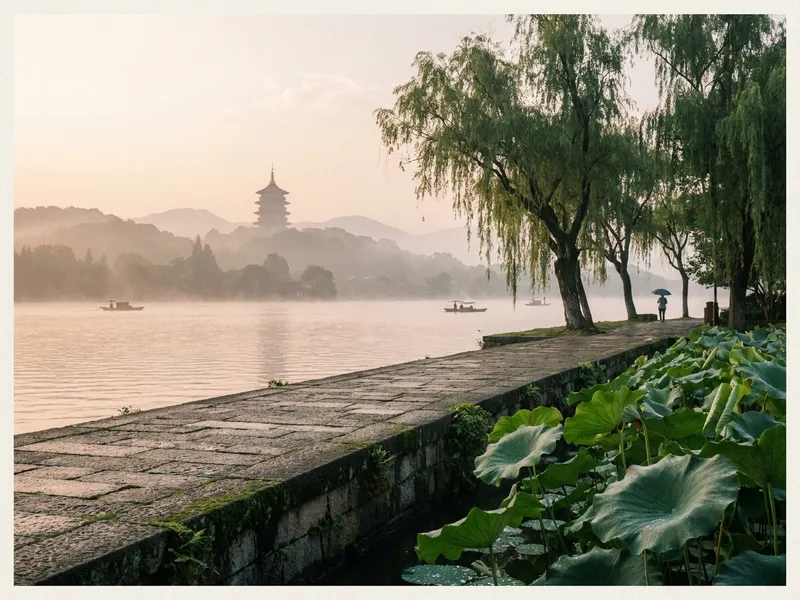
Hangzhou
Hangzhou sits 180 km southwest of Shanghai on the southern shore of West Lake and has been celebrated as the most beautiful city in China for 1,000 years. The West Lake cultural landscape was inscribed on the UNESCO World Heritage List in 2011 and includes 60+ historic pagodas, temples, gardens, causeways, and bridges within its 6.4-square-kilometer surface. The Lingyin Temple, founded in 326 AD, is one of the largest and wealthiest Buddhist temples in China; the Longjing (Dragon Well) tea terraces on the hillsides west of the lake produce Chinas most famous green tea; the Leifeng Pagoda is a 5-story Tang-dynasty reconstruction overlooking the southern lake; and Hefang Old Street preserves the late-Qing shopping district with silk shops, tea houses, and the Hu Qing Yu Tang Chinese pharmacy. Hangzhou is also the home of Alibaba Group, one of the worlds largest e-commerce companies, and its modern skyline balances glass towers with ancient canals. The city offers the Ten Classic Scenes of West Lake, a 1,700-year-old Buddhist temple complex, the finest green tea in China, and a living cultural heritage of silk, tea, and calligraphy. Most travelers visit on a 2-3 day side trip from Shanghai, easily reached by 60-minute high-speed rail; visa-free entry of 30 days applies to most Western passports. The best times to visit are March-May for spring blossoms and the Longjing tea harvest, and September-November for autumn foliage and the Mid-Autumn moon over West Lake. Hangzhou is compact, safe, and easy to navigate, with a modern metro system, bike-friendly lake paths, and English widely spoken at major sites.
Why Hangzhou in 2026.
Hangzhou is the capital of Zhejiang Province and one of Chinas most celebrated cities, home to the UNESCO-listed West Lake, the Lingyin Buddhist Temple, the Longjing tea terraces, the Grand Canal, the Alibaba headquarters, the Leifeng Pagoda, and the historic Hefang Old Street, all within 60 minutes of Shanghai by high-speed rail. The city has been a center of Chinese culture, silk production, and tea cultivation for over 2,000 years, and today blends ancient temples and tea villages with one of the worlds most advanced technology ecosystems.
Quick Answer
Hangzhou sits 180 km southwest of Shanghai on the southern shore of West Lake and has been celebrated as the most beautiful city in China for 1,000 years. The West Lake cultural landscape was inscribed on the UNESCO World Heritage List in 2011 and includes 60+ historic pagodas, temples, gardens, causeways, and bridges within its 6.4-square-kilometer surface. The Lingyin Temple, founded in 326 AD, is one of the largest and wealthiest Buddhist temples in China; the Longjing (Dragon Well) tea terraces on the hillsides west of the lake produce Chinas most famous green tea; the Leifeng Pagoda is a 5-story Tang-dynasty reconstruction overlooking the southern lake; and Hefang Old Street preserves the late-Qing shopping district with silk shops, tea houses, and the Hu Qing Yu Tang Chinese pharmacy. Hangzhou is also the home of Alibaba Group, one of the worlds largest e-commerce companies, and its modern skyline balances glass towers with ancient canals. The city offers the Ten Classic Scenes of West Lake, a 1,700-year-old Buddhist temple complex, the finest green tea in China, and a living cultural heritage of silk, tea, and calligraphy. Most travelers visit on a 2-3 day side trip from Shanghai, easily reached by 60-minute high-speed rail; visa-free entry of 30 days applies to most Western passports. The best times to visit are March-May for spring blossoms and the Longjing tea harvest, and September-November for autumn foliage and the Mid-Autumn moon over West Lake. Hangzhou is compact, safe, and easy to navigate, with a modern metro system, bike-friendly lake paths, and English widely spoken at major sites.
| Best time to visit | March-May for the spring blossoms along Su Causeway and the Longjing tea harvest; September-November for autumn foliage and the Mid-Autumn moon over West Lake; avoid the first week of October (Golden Week) and the late-September Mid-Autumn Festival |
|---|---|
| Daily budget | $300 (backpacker) / $800 (mid-range) / $3500+ (luxury) |
| Language | Mandarin (Putonghua) with the local Hangzhou Wu dialect among older residents; English is widely spoken in hotels, West Lake area, Lingyin Temple, and Hefang Street tourist areas |
| Currency | CNY (¥); Visa, Mastercard, and American Express accepted at hotels, malls, and most restaurants via Alipay and WeChat Pay Tour Card |
| Time zone | China Standard Time (UTC+8), no daylight saving time |
| Last updated | 2026-06-14 |
Want a Hangzhou plan built for you?
What is Hangzhou: Why Hangzhou Deserves a Visit?
Hangzhou is the most celebrated city in eastern China and one of the easiest to reach, sitting just 180 km southwest of Shanghai on the Beijing-Hangzhou Grand Canal high-speed rail corridor. The city has been called the most beautiful in China for 1,000 years: Marco Polo visited in the 13th century and called it the finest and most splendid city in the world, and the Chinese saying above mentions paradise three times: Shang you tian tang, xia you su hang (in heaven there is paradise; on earth there are Suzhou and Hangzhou). Most visitors know Hangzhou for one image: the willow-lined shores of West Lake, with pagodas reflected in its still waters and mist-shrouded hills rising in the distance. That image is UNESCO-recognized and well-deserving of the hype. But Hangzhou is far more than a lakeside postcard. It is the capital of Zhejiang Province and one of Chinas most populous cities (12+ million residents), the historic center of the silk industry, the birthplace of the Longjing green tea, the home of Alibaba Group and the wider Chinese tech industry, and the southern terminus of the worlds longest canal. For independent travelers, Hangzhou offers something Shanghai cannot: a slower pace, a UNESCO-protected lakeside landscape, the finest green tea in China, a 1,700-year-old Buddhist temple complex, and a living cultural heritage of silk, tea, and calligraphy, all reachable in 60 minutes from central Shanghai by HSR. Two to three days is the ideal length of stay — one day for West Lake and Lingyin Temple, a second for the Longjing tea terraces and Hefang Old Street, and a third for the Grand Canal, Xixi Wetland, or a Qiantang River tide-watching excursion. Hangzhou also rewards repeat visits: the city changes dramatically with the seasons, from the cherry blossoms of March to the osmanthus-scented autumn evenings of October, and each season brings a different palette of colors, fragrances, and cultural events. The West Lake Lotus Festival in July, the Longjing tea harvest in April, the Qiantang River Tide Watching Festival in September, and the Lantern Festival at Leifeng Pagoda in February all offer distinct experiences that reward travelers who return.
What is the history of Hangzhou: From Southern Song Capital to Tech Capital?
Hangzhou began as a small Qiantang River settlement in the Qin dynasty (around 222 BC) and grew slowly through the Han, Wei, and Tang eras as a modest prefectural town. Its history pivots in 1127, when the Jurchen Jin conquest of northern China forced the Song imperial court to flee south and establish Hangzhou as the capital of the Southern Song dynasty (1127-1279). Under Emperor Gaozong and his successors, Hangzhou grew into one of the largest and wealthiest cities in the world, with a population of over 1 million in the late 12th century — far larger than any European city at the time. Marco Polo visited in the late 13th century and described it as the finest and most splendid city in the world. The Southern Song era also produced the West Lakes Ten Classic Scenes (Shi Jing), the canon of literary and visual references that still define Hangzhou tourism today. The Yuan, Ming, and Qing dynasties saw Hangzhou decline in political importance but retain its cultural and commercial status as the center of silk, tea, and porcelain production. The Grand Canal, completed under the Sui dynasty in 610 AD, linked Hangzhou to Beijing and made the city one of the busiest inland ports in East Asia. The 19th-century Taiping Rebellion devastated the city in 1861-1862; the late-Qing reforms and the Republican era brought some modernization but also political turmoil. After 1949, Hangzhou industrialized rapidly and the population grew from 600,000 in 1949 to over 1 million by 1970. The 1999 founding of Alibaba Group in Jack Mas Hangzhou apartment transformed the city into the unofficial capital of Chinas e-commerce industry; the 2016 G20 Summit hosted in Hangzhou cemented its modern status; and the 2022 Asian Games brought new infrastructure and global attention. Today Hangzhou is one of Chinas wealthiest cities by GDP per capita, a UNESCO Creative City of Crafts and Folk Art (2014), and the spiritual home of Chinese tea culture. The citys historical layers are visible to the observant traveler: the Southern Song Imperial Street excavations beneath modern Yanan Road, the Republican-era villas hidden in the hills above West Lake, the Soviet-style industrial buildings of the 1950s in the Gongshu District, and the glass-and-steel tech campuses of the Binjiang District all coexist within a few kilometers of each other.
What is the geography and climate of Hangzhou, and when should I visit?
Hangzhou sits in the southern Yangtze River Delta at the head of the Qiantang River estuary, 180 km southwest of Shanghai and 175 km southeast of Nanjing. The municipality covers 16,850 square kilometers, although the urban core clusters around West Lake, the Qiantang River, and the tech corridors of the Binjiang District. The terrain is more varied than Suzhou or Shanghai: Hangzhou is ringed by mountains, with the southern shore of West Lake bordered by the lush hills of the Nanping range and the citys eastern edge abutting the Qiantang River plain. The citys highest natural point is 1,506 meters above sea level on the Lianhua Peak, although the urban core sits at around 20 meters. West Lake itself covers 6.4 square kilometers and is fed by the Qiantang River through a system of historic canals. Hangzhou has a humid subtropical climate with four distinct seasons and is on the same latitude as New Orleans, Charleston, and Marrakech. Summers (June-August) are hot and humid, with average July highs of 34°C and lows of 25°C, frequent afternoon thunderstorms, and the East Asian monsoon bringing typhoon-influenced rain bands from the Pacific. Winters (December-February) are mild by northern Chinese standards, with January averaging daytime highs of 8°C and nighttime lows of 2°C; snow is rare and melts within hours. Spring (March-May) is short and rainy, with the East Asian plum-rain front in April-June bringing persistent light rain and humidity, but also the spectacular cherry blossoms along Su Causeway. Autumn (September-November) is the best season by a wide margin: warm dry days, cool nights, the Mid-Autumn Festival moon over West Lake, and the osmanthus fragrance that perfumes the city in October. The best months are March-May and September-November, with the caveat that the first week of October (National Day Golden Week, October 1-7) brings enormous domestic crowds; the late-September Mid-Autumn Festival and the late-April to early-May Labor Day holiday are similarly busy. For photographers, the golden hours around West Lake are exceptional: dawn in spring brings mist rising from the water, while autumn sunsets paint the hills in layers of orange and gold. The city receives approximately 1,450 mm of rainfall annually, with the wettest months being June and September. Typhoons occasionally affect Hangzhou in late summer, though the city is far enough inland that direct hits are rare; the main impact is heavy rain and temporary transport delays.
How to Get There: Flights, Trains, and the Shanghai-Hangzhou HSR
Hangzhou Xiaoshan International Airport (HGH) is 27 km east of the city center and one of China's busiest, with direct flights to London, Frankfurt, Tokyo, Seoul, Singapore, Bangkok, Sydney, and Melbourne. The airport is connected to the city center by a metro extension (line 1 and line 19) and a 30-minute airport shuttle bus service; a taxi to central Hangzhou takes 45-60 minutes and costs ¥120-150. The airport opened a new Terminal 4 in 2022, doubling capacity and adding more international routes. For most international travelers, however, the Shanghai-Hangzhou HSR is the easiest and most popular entry route. The Shanghai-Hangzhou HSR connects Shanghai Hongqiao Railway Station directly to Hangzhou East Railway Station and Hangzhou Railway Station (the central station on metro line 1, in the heart of the city), with journey times of 45-60 minutes from Hongqiao and frequent service every 5-15 minutes during peak hours. Second-class tickets cost ¥73, first-class ¥117, business class ¥233. The HSR runs from 6am to 10pm, with up to 200 daily services. From Nanjing, the HSR takes 1 hour 15 minutes and costs ¥130 second class. From Suzhou, the HSR takes 1 hour 15 minutes and costs ¥90. From Beijing, the HSR takes 4.5-5.5 hours and costs ¥540 second class. From Guangzhou, the HSR takes 6-7 hours and costs ¥790. Hangzhou has four main railway stations: Hangzhou Railway Station (central, on metro line 1), Hangzhou East Railway Station (the largest HSR hub, on metro line 1 and line 4), Hangzhou South Railway Station (for HSR services to the south), and Hangzhou West Railway Station (under construction, due to open 2026). Within the city, the metro has 12 operational lines and 250+ stations covering the main attractions. West Lake is on Line 1 at Longxiang Bridge Station, Lingyin Temple on Line 3 at Huanglongdong Station plus bus 7, Leifeng Pagoda on Line 4 at Shuihu Station, and Hefang Old Street on Line 1 at Ding Road Station. The metro is clean, efficient, and signposted in both English and Chinese. For travelers arriving by car, Hangzhou is on the G25 and G60 expressways, with direct connections to Shanghai, Nanjing, and Ningbo.
How do I get around Hangzhou: Metro, Taxi, DiDi, and Bike Share?
Hangzhou has one of the best public transport systems in China and was the first Chinese city to introduce a public bike-share program. The metro is the workhorse: 12 lines, 250+ stations, ¥2-9 per ride depending on distance, English and Chinese signage, and clean air-conditioned cars. The metro runs from roughly 6am to 11pm, with frequencies of 3-7 minutes during peak hours and 8-12 minutes at off-peak times. A reloadable Hangzhou Tong transportation card can be bought at any station for ¥20 (refundable deposit) and works on the metro, buses, the tourist ferries on West Lake, and the city bike share. Taxis in Hangzhou are metered and reasonable; flag-fall is ¥11 for the first 3 km and ¥2.5 per additional km (¥3.5 at night), and an average cross-city ride costs ¥30-60. DiDi operates throughout the city and is the safest and most foreigner-friendly option; the English-language app works smoothly, fares are typically 10-20% lower than taxi meters, and the GPS tracking means you cannot be overcharged. Always insist on the meter or use DiDi; unmarked cabs at the railway stations and West Lake occasionally overcharge tourists. Hangzhou is one of the best cities in China for cycling: the flat terrain around West Lake and along the Qiantang River, the 16-km West Lake perimeter path, and the 11-km Grand Canal waterfront path all reward two wheels. The Hangzhou Public Bike system is the citys legacy: red bikes available at docking stations with a Hangzhou Tong card for ¥1 per hour. Bike share is also available through Meituan Bike and HelloRide (¥1.5 per 30 minutes via the WeChat app). The West Lake tourist ferries are a unique experience: ¥70 for a circular route of the 10 classic scenes. For day trips to Wuzhen, Xitang, or Fuyang, tourist coaches depart from Hangzhou East Bus Terminal (¥30-80 round-trip) or you can hire a private driver for ¥400-600 per day. The city also has an extensive bus network with over 500 routes, though buses are less foreigner-friendly than the metro due to limited English signage. The BRT (Bus Rapid Transit) lines on Zhongshan Road and Chaoyang Road are the most useful for tourists. For airport transfers, the airport metro line (Line 19) connects Xiaoshan Airport to the city center in 30 minutes for ¥8.
Where should I stay in Hangzhou?
Hangzhous accommodation is concentrated in four areas, each with a distinct character. The West Lake area is the most atmospheric and the best for first-time visitors. Boutique hotels and restored Republican-era mansions cluster here: the Aman Fayun (¥4,500, the most exclusive property, hidden in a tea-plantation valley south of West Lake), the Four Seasons Hangzhou at West Lake (¥2,800, a luxury heritage property on the western shore), the Hyatt Regency Hangzhou (¥900), the Sofitel Westlake (¥900), and the Midtown Shangri-La Hangzhou (¥800) are all within walking distance of the lake. Mid-range options include the Holiday Inn Express Hangzhou Westlake East (¥450), the Crystal Orange Hotel Hangzhou Westlake (¥500), and a number of locally run 3-star hotels from ¥250-400. The Hefang Old Street and Southern Song Imperial Palace area south of the lake is the cultural core, with restored Qing-era courtyard mansions and a more boutique flavor. The Huajiashiji Holiday Inn (¥600), the Yintai Hangzhou (¥700), and the Banyan Tree Hangzhou (¥1,500) are popular mid-range and luxury choices. The Binjiang District east of the Qiantang River is the modern skyline, with the international business hotels that serve the tech tenants. The InterContinental Hangzhou (¥1,200), the Marriott Hangzhou Qianjiang (¥900), the Conrad Hangzhou (¥1,400), and the Radisson Blu Hangzhou Xintiandi (¥700) are all on or near the Qianjiang River. The Xixi Wetland area west of the city is the newest hotel district, with the Banyan Tree Hangzhou Xixi (¥1,500), the Sheraton Hangzhou Wetland Park Resort (¥800), and the Pullman Hangzhou Xixi (¥600) all on the wetlands edge. For backpackers, the Hangzhou Ruyi Youth Hostel (¥60-120 per bed) near West Lake and the Westlake International Youth Hostel (¥80-150) on Nanshan Road are the best options. Book at least 2 weeks ahead during the Spring Festival, Golden Week, and the Mid-Autumn Festival. For travelers seeking an authentic local experience, several courtyard guesthouses in the hills above Longjing village offer rooms in traditional tea-farm houses with home-cooked meals and morning tea-picking demonstrations. These are typically booked through Chinese platforms like Ctrip or Meituan and require some Mandarin ability, but the experience of waking up in a tea terrace with West Lake visible in the distance is unmatched.
What are the top attractions in Hangzhou?
Hangzhous signature attraction is West Lake (Xi Hu), a 6.4-square-kilometer freshwater lake at the heart of the city and the centerpiece of the UNESCO-listed West Lake Cultural Landscape (inscribed 2011, expanded 2024). The lake is surrounded by 60+ pagodas, temples, gardens, causeways, and bridges, and the canonical Ten Classic Scenes (Shi Jing) have been celebrated by Chinese poets and painters for 1,000 years. Walking or cycling around the 16-km perimeter path takes 4-5 hours; the boat tours (¥70) hit the highlights in 90 minutes; the Su Causeway and Bai Causeway (built by the Northern Song poet Su Dongpo in 1085 and the Tang poet Bai Juyi in 822 respectively) are the most well-known walks. Free to enter, open 24 hours. The Lingyin Temple (Temple of the Souls Retreat), founded in 326 AD during the Eastern Jin dynasty, is one of the largest and wealthiest Buddhist temples in China. Highlights include the 24.8-meter camphor-wood statue of Sakyamuni Buddha (the largest of its kind in China), the Hall of the Four Heavenly Kings with its 1,000-year-old reliefs, and the adjacent Flying Peak (Feilai Feng), a limestone hill with 470+ Buddhist stone reliefs and statues carved into the rock face between the 10th and 14th centuries. Entry ¥75 plus ¥45 for Flying Peak. The Leifeng Pagoda on the southern shore of West Lake is a 5-story, 71-meter pagoda originally built in 975 AD during the Northern Song dynasty, collapsed in 1924, and reconstructed in 2002; the reconstruction houses a museum of excavated Buddhist artifacts and a glass-walled elevator to the top floor. Entry ¥40. The Longjing Tea Plantations on the hillsides west of the lake produce Chinas most famous green tea; the China National Tea Museum (¥30) is the best place to learn about tea production; walking paths through the terraced gardens are free. Other standouts include Hefang Old Street (¥0, with the Hu Qing Yu Tang Chinese pharmacy founded 1874), the Six Harmonies Pagoda on the Qiantang River (¥30), the Grand Canal Hangzhou section (UNESCO 2014), and the Xixi National Wetland Park (¥80 plus ¥60 boat ride). The Jingci Temple at the foot of Nanping Hill is a functioning Buddhist monastery with a 10-ton bronze bell that is struck 108 times on New Years Eve; visitors are welcome at morning chanting sessions. The China National Silk Museum on Nanshan Road traces 5,000 years of silk production and is free to enter.
What local food should I try in Hangzhou?
Hangzhou cuisine (Hangbang cai) is a sub-tradition of Zhejiang cooking, one of China's eight great culinary traditions. Hangzhou cuisine specifically is characterized by fresh ingredients, light seasoning, an emphasis on texture, and a slightly sweet finish reminiscent of Suzhou. The most famous Hangzhou dish is West Lake Vinegar Fish (Xi Hu Cu Yu) — a live grass carp poached in vinegar and sugar, served with the vinegar broth and ginger. The dish was invented by Dingsheng Restaurant in the Southern Song dynasty. Other classics include Dongpo Pork (Dongpo Rou) — a 1,000-year-old braised pork belly dish named for the Northern Song poet Su Dongpo — Longjing Shrimp (Longjing Xia Ren) — river shrimp stir-fried with Dragon Well tea leaves — Beggars Chicken (Jiao Huo Ji) — a whole chicken wrapped in lotus leaves and baked in clay — and West Lake Water Shield Soup (Xi Hu Shui Qin), a delicate soup made from the water shield plant harvested from West Lake in March. For street food, Hefang Old Street has dumpling stalls, scallion pancake shops, the famous Dingsheng Cake shop (founded 1983), and the Wu Dalang Shaobing stalls. The local restaurant scene has a handful of standouts: the Louwailou (founded 1673, the most famous traditional restaurant, on Solitary Hill in West Lake), the Zhi Wei Guan (founded 1913, the second most famous traditional restaurant, on Hefang Old Street), the Green Tea Restaurant (a chain serving affordable Hangzhou classics), the Grandma`s Home (a Hangzhou-based chain with regional flavors), and the Jin Sha (in the Four Seasons Hangzhou for refined Hangbang cai). The Hefang Old Street teahouses serve Longjing tea with traditional Hangzhou snacks; the Aman Fayun and the Four Seasons both offer formal tea ceremonies in their gardens. For breakfast, try the Hangzhou-style congee (zhou) at any local diner — a rice porridge with preserved vegetables, peanuts, and sometimes pork. The city also has a growing specialty coffee scene, with independent roasters in the Xihu Tiandi and Binjiang districts serving pour-over coffee alongside Longjing tea. For a unique experience, book a tea-pairing dinner at one of the Longjing village family houses, where each course is matched with a different grade of Longjing tea.
What is a good 1- to 3-day itinerary for Hangzhou?
One Day in Hangzhou: Start at dawn on Su Causeway on the western shore of West Lake, watching the mist rise off the water and the lotus flowers open. Walk the causeway north to Solitary Hill (Gu Shan) and visit the Zhejiang Provincial Museum (free, book ahead). Continue west to the Yue Fei Temple (¥25) and the Tomb of General Yue Fei, then walk to the Leifeng Pagoda (¥40) on the southern shore. Lunch at Louwailou (founded 1673) on Solitary Hill for West Lake Vinegar Fish and Longjing Shrimp. In the afternoon, take a West Lake boat tour (¥70, 90 minutes) hitting the Three Pools Mirroring the Moon island and the Lotus in the Breeze at Crooked Courtyard. End the day at Hefang Old Street for dinner at Zhi Wei Guan (founded 1913) and shopping at the silk shops and the Hu Qing Yu Tang Chinese pharmacy. Three Days in Hangzhou: Day 1 as above. Day 2: Take a taxi to Lingyin Temple (¥75) and the Flying Peak grottoes (¥45) for the 1,700-year-old Buddhist complex and the 470+ stone reliefs. Walk west to the Longjing Tea Plantations, visit the China National Tea Museum (¥30), and have lunch at a family tea house with Longjing tea tasting (¥50-150). Walk down to the Nine Creeks Misty Trees (¥0) for a 4-km hike through tea terraces and bamboo forests. Return to central Hangzhou for dinner. Day 3: Take a day trip to Wuzhen water town (the East Scenic Zone is the most atmospheric, ¥150 entry) — the 1,300-year-old town has 100+ stone bridges, the Mao Dun Former Residence, and the night view of the lanterns reflected in the canals. Alternative: visit the Grand Canal Heritage Park for a walk along the UNESCO-listed canal and a boat ride, or take the Qiantang River tide-watching excursion in autumn. End your trip with a visit to the Alibaba Xixi Park Campus (free, advance booking required) for the modern face of Hangzhou. Optional Day 4: Visit Xixi National Wetland Park (¥80 plus ¥60 boat ride) for the lotus gardens and the Three Causeways, or take the boat to the Three Pools Mirroring the Moon island in the middle of West Lake for sunrise. For a more relaxed pace, spread the Day 1 activities across two days, adding the China National Silk Museum and the Jingci Temple bell on the second afternoon.
What practical information do I need for Hangzhou: Visa, Money, Connectivity, and Language?
Visa: Most Western passport holders (US, UK, EU, Australia, Canada, Japan, South Korea, New Zealand, Singapore) can visit China visa-free for up to 30 days. Hangzhou is covered under the same policy as Shanghai. China also offers 240-hour visa-free transit through Shanghai Pudong or Hongqiao airports if you are continuing to a third country, with Hangzhou covered as a destination. Hangzhou Xiaoshan International Airport also offers its own 240-hour visa-free transit zone for travelers connecting from a third country. Check the latest rules with your nearest Chinese consulate before booking, as the policy is updated frequently. The 30-day visa-free policy allows multiple entries and exits, so you can visit Hangzhou, then Shanghai, then return to Hangzhou without issue. Money and Payment: The currency is the Chinese Yuan Renminbi (CNY, ¥), with an exchange rate of roughly ¥7.2 to US$1. Cash works everywhere. Alipay and WeChat Pay both accept foreign Visa, Mastercard, and American Express cards via the Tour Card feature — set this up before arrival through the Alipay app. WeChat Pay works similarly. Most mid-range and luxury hotels, restaurants, and shops accept both. The Longjing tea family houses sometimes accept only cash; the West Lake perimeter path and Hefang Old Street stalls are also cash-heavy. ATMs are widespread and accept foreign cards; ICBC, Bank of China, and 7-Eleven ATMs all work. Currency exchange is available at the airport, major hotels, and Bank of China branches. SIM Cards and Connectivity: Buy a China Unicom or China Mobile tourist SIM at the airport arrivals hall for ¥80-150 with 10-30 GB of data valid for 7-30 days. eSIM is supported on most modern iPhones and Androids. Public Wi-Fi is patchy; hotel Wi-Fi is reliable. A VPN is needed to access Google, Gmail, Facebook, Instagram, YouTube, and Western news sites — install and test yours before arrival. Language: Standard Mandarin (Putonghua) is the official language and is understood everywhere. The local Hangzhou dialect is a member of the Wu Chinese family and is mutually unintelligible with Mandarin — older residents speak it among themselves. English is widely spoken in hotels, museums, the major tourist sites, and the Alibaba campus; elsewhere it is rare. Keep a translation app on your phone. Electricity and Plugs: 220V, 50Hz, with Type A, C, and I plugs. Bring a universal adapter. Time zone is China Standard Time (UTC+8), with no daylight saving time. Tap water is not drinkable. Health and Safety: Hangzhou has excellent hospitals, including the Sir Run Run Shaw Hospital and the Zhejiang University First Affiliated Hospital, both with international clinics. Bring any prescription medications with you; pharmacies are common but may not stock Western brands. The city is very safe, with low violent crime rates.
What are the best day trips from Hangzhou?
Hangzhous location at the head of the Qiantang River estuary and the southern end of the Grand Canal makes it an ideal base for several rewarding day trips. The most popular are the water towns of Wuzhen, Xitang, and Nanxun. Wuzhen, 80 km northeast of Hangzhou, is the most famous water town in China and the home of the modern writer Mao Dun. The East Scenic Zone is the most atmospheric, with 100+ stone bridges and the night view of the lanterns reflected in the canals; the West Scenic Zone is the more modern UNESCO-listed heritage area. Xitang, 110 km northeast, is famous for its 104 bridges and the spectacular night view of the lanterns reflecting in the canal; it was the filming location for the Mission Impossible III movie. Nanxun, 90 km north, is the most architecturally refined water town, with the Grand Canal mansions of the late-Qing silk merchants. For travelers with more time, a day trip to Shanghai by HSR takes 45-60 minutes and opens the Bund, the French Concession, the Shanghai Tower, the Yu Garden, and the Shanghai Museum. Suzhou, 175 km north, is the home of the UNESCO-listed Classical Gardens and the Pingjiang Road canal. Huangshan (Yellow Mountain), 280 km west, is one of Chinas most spectacular mountain landscapes and a UNESCO World Heritage Site (4-5 days recommended, with overnight stays on the mountain). Shaoxing, 60 km southeast, is the home of the Yellow Wine, the Lu Xun Former Residence, and the Calligraphy Sage Sage Wang Xizhi. For families, Shanghai Disneyland is 90 minutes by HSR plus metro; the Hangzhou Safari Park (Xianghu Forest Animal World) is closer but smaller. For a more active excursion, the Tianmu Mountain and the West Tianmu Mountain in Linan are forested mountain ranges with hiking trails, tea plantations, and Buddhist temples; the Thousand Island Lake (Qiandao Hu), 150 km southwest, has 1,000+ forested islands formed by the Xinanjiang Hydroelectric Dam and offers boat cruises, kayaking, and lakeside resorts. Moganshan, 60 km north, is a historic mountain retreat where Shanghai elites built villas in the 1920s; today it offers boutique hotels, hiking trails, and bamboo forests. Anji, 90 km northwest, is the bamboo capital of China and the filming location for Crouching Tiger, Hidden Dragon; the Anji Bamboo Expo Park and the Tianhuangping pumped-storage power station are the main attractions.
What cultural etiquette and practical tips should I know?
Hangzhou is one of the easiest Chinese cities in which to navigate cultural differences. As a long-standing center of culture, scholarship, and refined living, the city is comparatively low-key and tolerant. A few practical pointers help visitors blend in. Tipping is not customary in restaurants or taxis; some high-end restaurants add a 10-15% service charge. Round up the fare or hand the driver the small change if you want to acknowledge good service, but do not insist. Chopsticks should never be stuck vertically into a bowl of rice — this is associated with funeral incense. Use the serving chopsticks or the reverse end of your own to take food from shared plates. Smoking is restricted indoors and at tourist sites but still common on the street; most restaurants have smoking sections. The legal drinking age is 18; Hangzhou local beers include the Tsingtao, the Master Kong Beer, and a small craft brewery scene; Hangzhou is also the home of Shaoxing yellow wine, traditionally paired with Hangzhou cuisine. Bargaining is expected at the Hefang Old Street antique stalls but not in restaurants or shops with fixed prices; Longjing tea prices are generally fixed at the family houses, although direct-from-the-farm sales at the Longjing village can be negotiated. When entering a temple, cross the threshold with one foot only (not both), avoid pointing at the Buddha statues, and ask before photographing worshippers. The Lingyin Temple, the Jingci Temple (at the foot of Nanping Hill), and the Lingyin Flying Peak have functioning Buddhist communities; visitors are welcome at services and the morning chanting. Personal space is closer than in the West, especially in markets and on the metro, but staring is not considered rude. Hangzhous Longjing tea culture expects quiet attention — tea ceremonies are meditative, with the four steps of seeing the tea, smelling it, tasting it, and reflecting. Finally, always carry your passport: hotels must register foreign guests with the local police within 24 hours of check-in, and you may need to show your passport when buying train tickets, entering certain museums, or registering for a SIM card. Dress modestly when visiting temples — shoulders and knees should be covered. Photography is allowed at most tourist sites but flash photography is prohibited inside temple halls and museums. Queueing is generally orderly in Hangzhou, though elderly locals may cut in line at bus stops — this is culturally accepted and not worth confronting.
What is the silk heritage of Hangzhou and where can I buy authentic silk?
Hangzhou has been the center of Chinese silk production for over 2,000 years, since the Han dynasty when the citys mulberry trees and silkworm farms supplied the imperial court. The Silk Road that connected China to Central Asia and Europe began with Hangzhou silk, and the citys silk weavers developed techniques — brocade, damask, and gauze — that were prized from Rome to Kyoto. The China National Silk Museum on Nanshan Road (free entry, open 9am-5pm) is the best place to understand this heritage: it traces 5,000 years of silk production from Neolithic cocoons to modern haute couture, with live demonstrations of sericulture, reeling, and weaving. The museum also houses a collection of imperial robes from the Ming and Qing dynasties that illustrates the symbolic language of Chinese silk — dragons for the emperor, phoenixes for the empress, and specific colors and patterns that denoted rank and occasion. For buying silk, Hefang Old Street has dozens of silk shops, but quality varies widely. The most reliable vendors are the China Silk City (Zhongguo Sichou Cheng) on Xinhua Road, a four-story wholesale market with everything from raw silk fabric to finished scarves and qipao dresses; the Hangzhou Silk Museum shop, which sells certified museum-quality reproductions; and the Xinglong Silk shop on Hefang Street, which has been in business since 1926. Expect to pay ¥200-500 for a good silk scarf, ¥800-2,000 for a silk qipao, and ¥100-300 per meter for silk fabric. The best quality is mulberry silk (sang can si); ask for the silk content percentage — 100% mulberry silk is the premium grade. Avoid street vendors selling silk for under ¥50; it is usually polyester. The silk shopping experience is part of the cultural visit: many shops will demonstrate the burn test (real silk smells like burning hair and crumbles to ash, while synthetic melts into a hard bead) and show you how to check the momme weight, which measures silk density. Hangzhou silk is also the basis for several related crafts: the citys fan makers use silk for painted folding fans, the umbrella makers produce silk parasols, and the embroidery workshops create silk thread paintings that can take months to complete. The Xihu Tiandi area has several studios where visitors can watch embroidery artists at work and commission custom pieces. The annual Hangzhou Silk Expo, held each October, brings together international designers and traditional weavers for exhibitions, fashion shows, and workshops open to the public.
How does Hangzhou blend ancient tradition with modern technology?
Hangzhou is the most striking example in China of a city that has preserved its ancient heritage while building one of the worlds most advanced technology ecosystems. The contrast is visible everywhere: the Aman Fayun hotel, a restored tea-village monastery, sits 15 minutes from the Alibaba Xixi Park Campus, where 20,000 engineers work on artificial intelligence and cloud computing. The West Lake causeways, built by Tang and Song dynasty poets, are now lined with QR codes that trigger augmented-reality guides when scanned by a smartphone. The Grand Canal, a 1,400-year-old waterway, has been fitted with smart sensors that monitor water quality and traffic in real time. This duality is not accidental. Hangzhous tech industry grew out of its cultural infrastructure: the citys universities, particularly Zhejiang University (founded 1897, now ranked among the top 3 in China), produced the engineering talent that founded Alibaba, NetEase, and dozens of other tech giants. The city government has actively promoted this blend, designating Hangzhou a UNESCO Creative City of Crafts and Folk Art in 2014 while simultaneously investing in 5G infrastructure, smart-city sensors, and autonomous vehicle test zones. For visitors, the tech side of Hangzhou is surprisingly accessible. The Alibaba Xixi Park Campus offers weekend tours that include the Cainiao Smart Logistics Network, where robots sort 1 million packages per day; the Tmall Smart Living Store, where facial recognition replaces checkout lines; and the Fliggy Hotel, where room service is delivered by robot. The Hangzhou Metro is fully contactless, with facial-recognition gates at major stations. The West Lake scenic area has free public Wi-Fi, drone photography services, and AI-powered language translation kiosks. Even the traditional tea houses in Longjing village now accept Alipay and WeChat Pay, and many offer live-streamed tea ceremonies to online audiences. The 2022 Asian Games accelerated this fusion: the Games Village was built as a smart-city showcase, with autonomous shuttles, solar-powered streetlights, and a digital twin of the city that visitors can explore in VR at the Hangzhou Planning Exhibition Hall. The citys digital infrastructure extends to tourism as well: the West Lake scenic area has an official WeChat mini-program that provides real-time crowd density maps, audio guides in 12 languages, and augmented-reality overlays that show how the lake looked during the Southern Song dynasty. The Hangzhou Tourism Commission has partnered with Alibaba to create a smart tourism platform that integrates transport, accommodation, attraction tickets, and restaurant reservations into a single app. For tech-interested travelers, the Hangzhou Innovation and Technology Museum in the Binjiang District traces the citys evolution from silk and tea to semiconductors and AI, with interactive exhibits and a startup incubator showcase.
What are the Ten Classic Scenes of West Lake and why do they matter?
The Ten Classic Scenes of West Lake (Xi Hu Shi Jing) are the canonical landscape views that have defined Hangzhous aesthetic identity for 1,000 years. First catalogued during the Southern Song dynasty (1127-1279), these scenes were chosen by imperial painters and poets as the most evocative moments of the lake across the four seasons. They are not fixed viewpoints but seasonal and atmospheric conditions — a specific mist at dawn, a particular lotus bloom in July, the moon reflected through three stone pagodas — that transform an already beautiful landscape into something transcendent. The ten scenes are: Dawn on the Su Causeway in Spring (Su Di Chun Xiao), when the willows and peach trees along the 2.8-km causeway burst into bloom; Lotus in the Breeze at Crooked Courtyard (Qu Yuan Feng He), where the lotus flowers of the Crooked Courtyard garden open in July and August; Autumn Moon over the Calm Lake (Ping Hu Qiu Yue), the full moon reflected in the still water of the lake center, best viewed from the Solitary Hill pavilion; Remnant Snow on the Bridge in Winter (Duan Qiao Can Xue), when the Broken Bridge at the north end of Bai Causeway retains a dusting of snow after a rare Hangzhou snowfall; Listening to Orioles Singing in the Willows (Liu Lang Wen Ying), the willow groves on the eastern shore where orioles nest in spring; Viewing Fish at Flower Harbor (Hua Gang Guan Yu), the koi ponds and flower gardens at the southern end of the Su Causeway; Three Pools Mirroring the Moon (San Tan Yin Yue), the three stone pagodas in the lake that each contain five holes, so that moonlight shines through 15 beams of light on the Mid-Autumn Festival; Evening Bell Ringing at the Nanping Hill (Nan Ping Wan Zhong), the sound of the Jingci Temple bell carried across the water at dusk; Leifeng Pagoda in the Sunset (Lei Feng Xi Zhao), the golden light on the reconstructed pagoda at sunset; and Twin Peaks Piercing the Clouds (Shuang Feng Cha Yun), the view of the two mountain peaks south of the lake emerging from morning mist. Each scene has been painted by every major Chinese landscape artist, from the Song dynasty masters to the modern painter Pan Tianshou. For travelers, the scenes are best experienced in sequence over a full day: start at dawn on Su Causeway, move to the lotus gardens by mid-morning, take a boat to the Three Pools Mirroring the Moon island for the afternoon, and end at Leifeng Pagoda for sunset. The West Lake tourist ferries (¥70) are designed to hit the major scenes in a 90-minute loop. The concept of the Ten Scenes has been so influential that it has been copied by other Chinese cities — Suzhou, Yangzhou, and even Beijing have their own versions — but the original Hangzhou scenes remain the standard by which all others are measured. The scenes are not merely aesthetic categories; they are also philosophical statements about the relationship between nature and human perception, and about the Chinese ideal of finding beauty in transient moments.
What are the best shopping experiences in Hangzhou beyond silk and tea?
While silk and Longjing tea dominate Hangzhous shopping reputation, the city offers several other distinctive retail experiences that reward curious travelers. The Wangxingji Fan Shop on Hefang Old Street, founded in 1822, is one of the oldest fan makers in China and still produces hand-painted sandalwood and silk folding fans using techniques unchanged for 200 years. A hand-painted fan costs ¥200-800 and makes an exceptional gift. The Hu Qing Yu Tang Chinese Pharmacy, founded in 1874, is a working traditional medicine shop that sells herbs, tonics, and patent medicines in a Qing-era courtyard building. Visitors can consult with a traditional Chinese medicine practitioner (¥50-100) for a pulse diagnosis and prescription, or simply browse the drawers of dried roots, mushrooms, and animal products. The Southern Song Imperial Street (Yujie) is a reconstructed shopping district south of Hefang Street that recreates the merchant culture of the 12th-century capital, with craft workshops for paper-making, bamboo weaving, and pottery. For modern shopping, the Yanan Road commercial district is Hangzhous equivalent of Fifth Avenue, with the Intime Department Store, the Hangzhou Tower, and the MixC Mall. The Xintiandi area in the Binjiang District has boutique fashion and design stores. The Hangzhou Creative Design Center in the Gongshu District is a converted factory complex with studios for local designers, independent fashion brands, and ceramic artists. For food souvenirs, the Zhi Wei Guan snack shop on Hefang Street sells packaged versions of Hangzhou classics — Dongpo Pork, West Lake Vinegar Fish, and Longjing tea biscuits — that can be packed for travel. The Dingsheng Cake shop, founded in 1983, sells the traditional Hangzhou rice cakes that were once imperial tribute items. The best time to shop is weekday mornings, when Hefang Street is quiet and shopkeepers have time to explain their products. Avoid weekends and Golden Week, when the street is packed with domestic tourists.
What is there to do in Hangzhou after dark?
Hangzhos evening offerings extend well beyond the daytime tourist circuit and provide some of the most memorable experiences in the city. The West Lake Music Fountain, held nightly at 19:00 and 20:00 near the Longxiang Bridge metro station, is a 15-minute synchronized water, light, and music show that draws crowds of locals and visitors alike. Arrive 30 minutes early for a good viewing spot. The Impression West Lake show, directed by Zhang Yimou (the filmmaker behind the Beijing Olympics opening ceremony), is an outdoor performance on the lake itself, with dancers and acrobats performing on floating platforms against the backdrop of the hills and pagodas. Shows run from March to December, tickets ¥360-680, and the evening performances are the most atmospheric. Hefang Old Street transforms after sunset, with the red lanterns illuminating the Qing-era facades, street performers playing traditional instruments, and the teahouses filling with locals playing mahjong. The Nanshan Road bar district, along the eastern shore of West Lake, has a string of cocktail bars, jazz clubs, and live music venues that cater to both expats and affluent locals. The 1949 Bar, the JZ Club, and the Mao Livehouse are the best-known venues. For a quieter evening, the West Lake night cruise (¥90) circles the lake after dark, with the pagodas and causeways illuminated and the city skyline reflected in the water. The Binjiang District across the Qiantang River has the most modern nightlife, with rooftop bars at the InterContinental and Conrad hotels offering panoramic views of the river and the city lights. The Hangzhou Grand Theatre, designed by the French architect Paul Andreu, hosts classical concerts, opera, and ballet performances throughout the year. For a truly local experience, join the evening square dancing groups that gather at parks around West Lake — foreigners are welcome to join the synchronized routines, and it is one of the most authentic ways to connect with local culture. The Qianjiang New City light show, held on the riverbank every Tuesday, Friday, and Saturday evening, projects animations onto the facades of 30+ skyscrapers in a coordinated display that rivals Hong Kongs Symphony of Lights.
What is the Longjing tea culture and how do I experience it?
Longjing tea, also known as Dragon Well tea, is the most famous green tea in China and the signature agricultural product of Hangzhou. Grown on the terraced hillsides west of West Lake, the tea has been cultivated for over 1,200 years and was granted imperial tribute status during the Qing dynasty. The leaves are pan-fired in large woks to produce the flat, jade-green appearance and sweet, nutty flavor that distinguish Longjing from other green teas. The official Longjing growing area is divided into five villages, with Meijiawu and Longjing village being the most accessible to visitors. The tea harvest runs from late March to early May, with the leaves picked before Qingming Festival (around April 5) commanding the highest prices. A visit to Longjing village during harvest season is one of the most atmospheric experiences in Hangzhou: terraces of tea bushes climb the hillsides, women in straw hats pluck the top leaves into bamboo baskets, and the air smells of fresh tea. The China National Tea Museum, located near Longjing village, is the best place to learn about tea history, processing, and ceremony. Entry is free, and the museum includes traditional tea houses, processing demonstrations, and a collection of antique tea wares. To experience Longjing culture properly, book a tea-tasting session at one of the family-run tea houses in Longjing or Meijiawu village. A typical session costs ¥50-150 per person and includes three grades of tea, explanations of the differences, and lessons in the correct brewing temperature and timing. The best tea houses also serve home-cooked country food — bamboo shoots, freshwater fish, and local vegetables — making it easy to spend a half day in the village. For purchasing tea, buy directly from the farmers in the village or from the museum shop. Prices range from ¥500 per kilogram for everyday grade to ¥10,000+ for pre-Qingming first flush. Be wary of street vendors and tourist shops selling cheap Longjing; genuine Hangzhou Longjing should have a sweet, chestnut-like aroma and flat, uniform leaves.
What are the best family-friendly activities in Hangzhou?
Hangzhou is one of the most family-friendly major cities in China, combining outdoor spaces, cultural experiences, and modern attractions that engage children of different ages. West Lake itself is a natural playground: the 16-km perimeter path is flat and suitable for strollers, rented family bicycles are widely available, and the tourist ferries feel like an adventure for younger children. The Three Pools Mirroring the Moon island, reachable by boat, has pavilions and paths that are manageable for short legs. The Hangzhou Safari Park in Xianghu, about 30 minutes south of the lake, has tigers, elephants, giraffes, and a safari bus that drives through enclosures. The Xixi National Wetland Park offers boat rides through lotus ponds and reed beds, with wooden walkways that are safe for children. For hands-on culture, the China National Tea Museum runs short tea-ceremony workshops for families, and several silk shops on Hefang Street offer demonstrations of silk reeling and weaving. Older children and teenagers often enjoy the Alibaba Xixi Park Campus tour, where they can see robot sorting centers and smart retail demonstrations. The Hangzhou Paradise theme park in Binjiang has roller coasters and water rides. On hot summer days, the indoor malls and museums provide air-conditioned relief. Most family-friendly hotels, including the Hyatt Regency and the Midtown Shangri-La, offer connecting rooms, kids menus, and babysitting services. A relaxed two-day family itinerary might include West Lake on day one and a choice of Lingyin Temple, the safari park, or Xixi Wetland on day two. For families with very young children, the West Lake boat rides are stroller-accessible and the Leifeng Pagoda has an elevator. The citys parks and green spaces are clean and well-maintained, with drinking fountains and rest areas at regular intervals. The metro system is also family-friendly, with elevators at most stations and priority seating for families with small children.
Top attractions
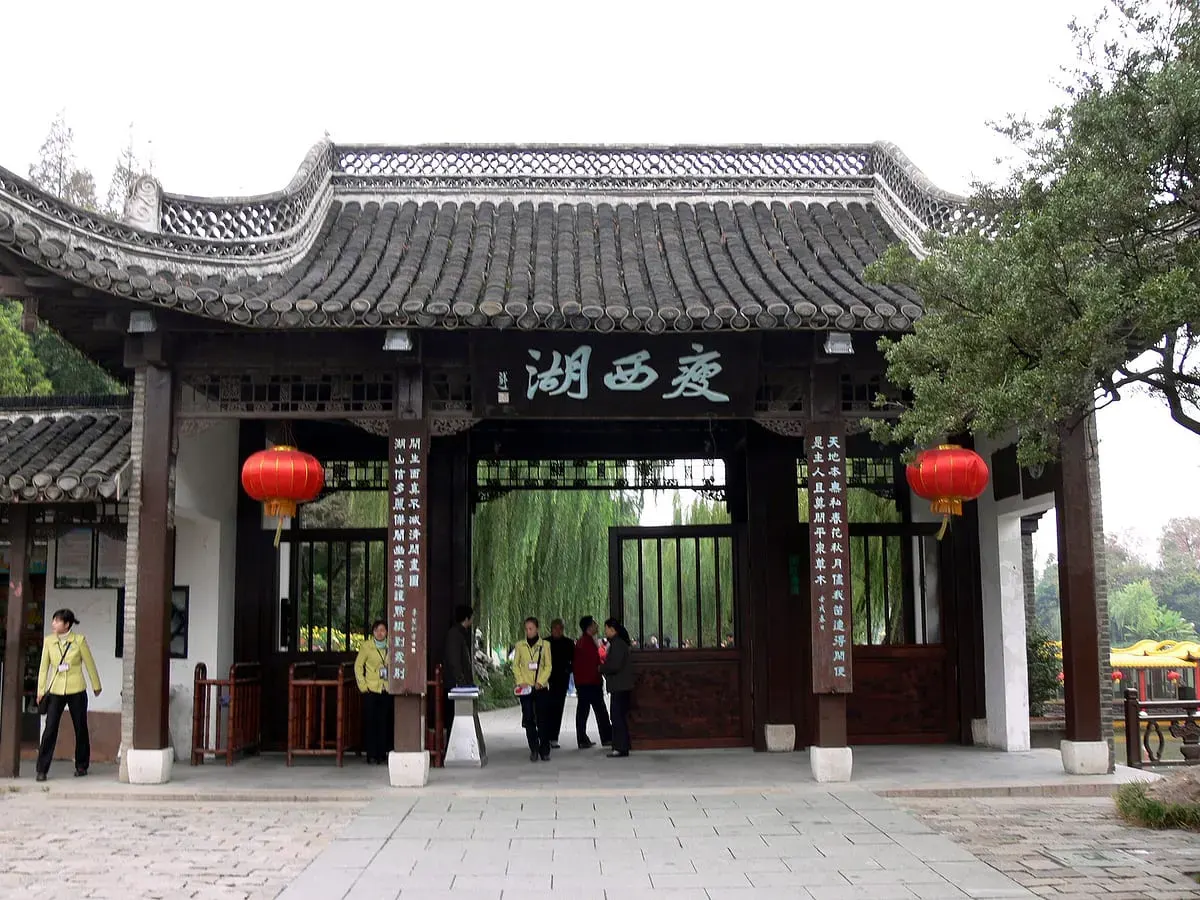
West Lake (Xi Hu)
A 6.4-square-kilometer freshwater lake at the heart of Hangzhou and the centerpiece of the UNESCO-listed West Lake Cultural Landscape (inscribed 2011). Surrounded by 60+ pagodas, temples, gardens, causeways, and bridges; 10 classic scenes (Shi Jing) have been celebrated by Chinese poets and painters for 1,000 years. Free to enter, open 24 hours.
Wikimedia Commons · CC-BY-SA
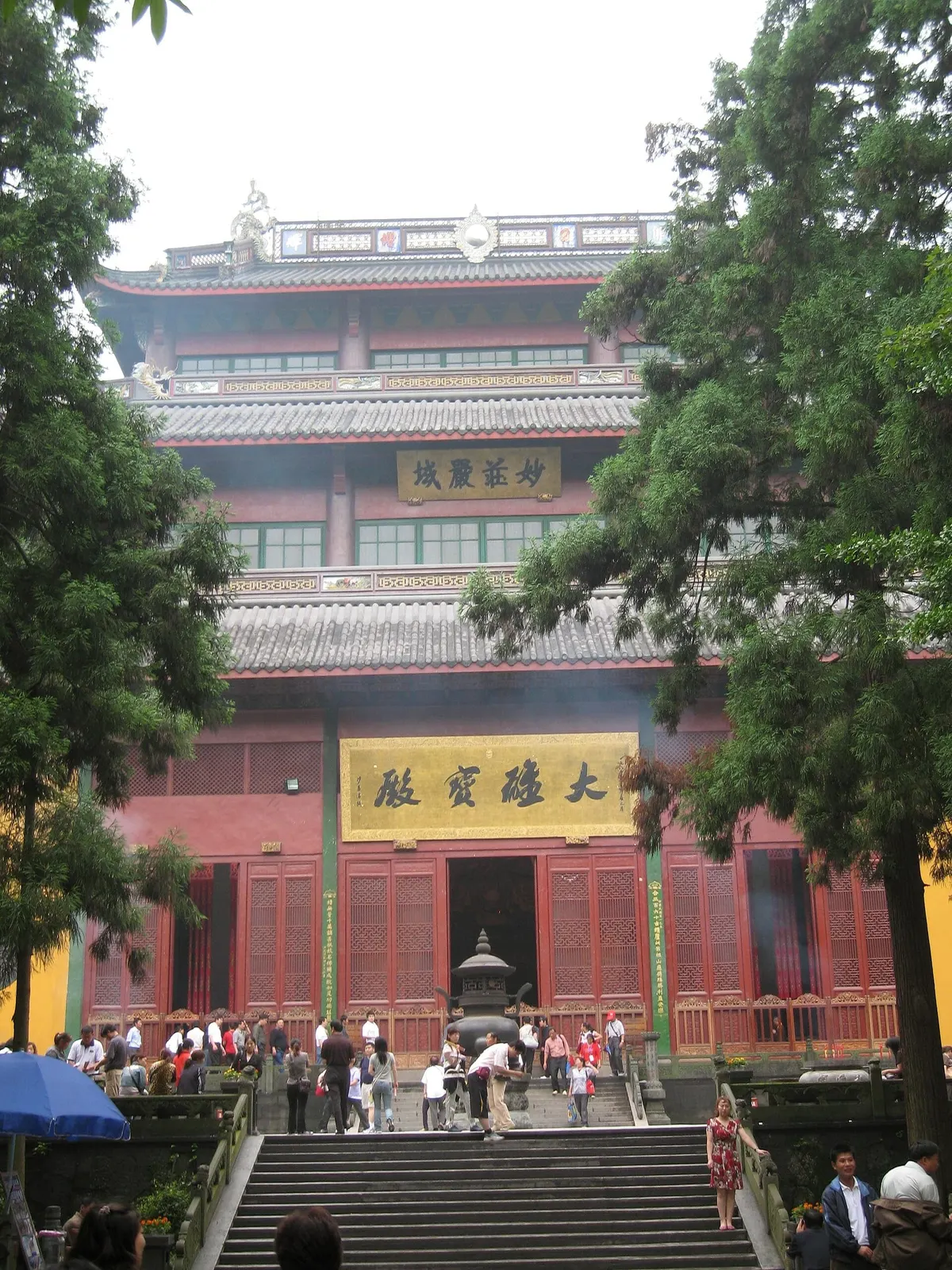
Lingyin Temple (Temple of the Souls Retreat)
A 1,700-year-old Buddhist temple founded in 326 AD during the Eastern Jin dynasty, one of the largest and wealthiest in China. Houses a 24.8-meter camphor-wood statue of Sakyamuni Buddha (the largest of its kind in China) and the 1,000-year-old Shibaodi reliefs. Entry ¥75 plus ¥30 for the Flying Peak grottoes.
Wikimedia Commons · CC-BY-SA
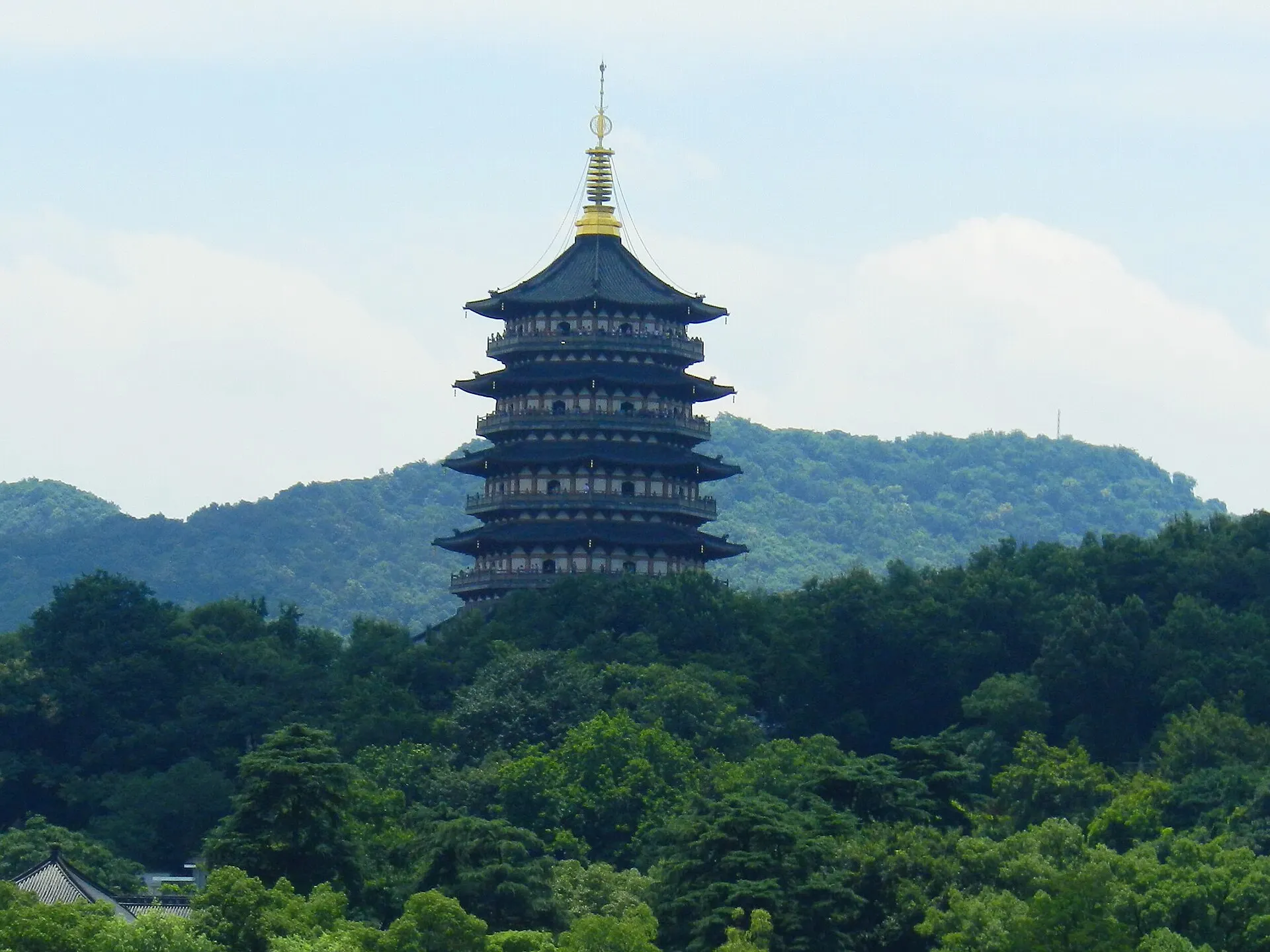
Leifeng Pagoda (Leifeng Ta)
A 5-story, 71-meter pagoda on the southern shore of West Lake, originally built in 975 AD during the Northern Song dynasty, collapsed in 1924, and reconstructed in 2002. Houses a museum of excavated Buddhist artifacts and a glass-walled elevator to the top floor with panoramic lake views. Entry ¥40.
Wikimedia Commons · CC-BY-SA
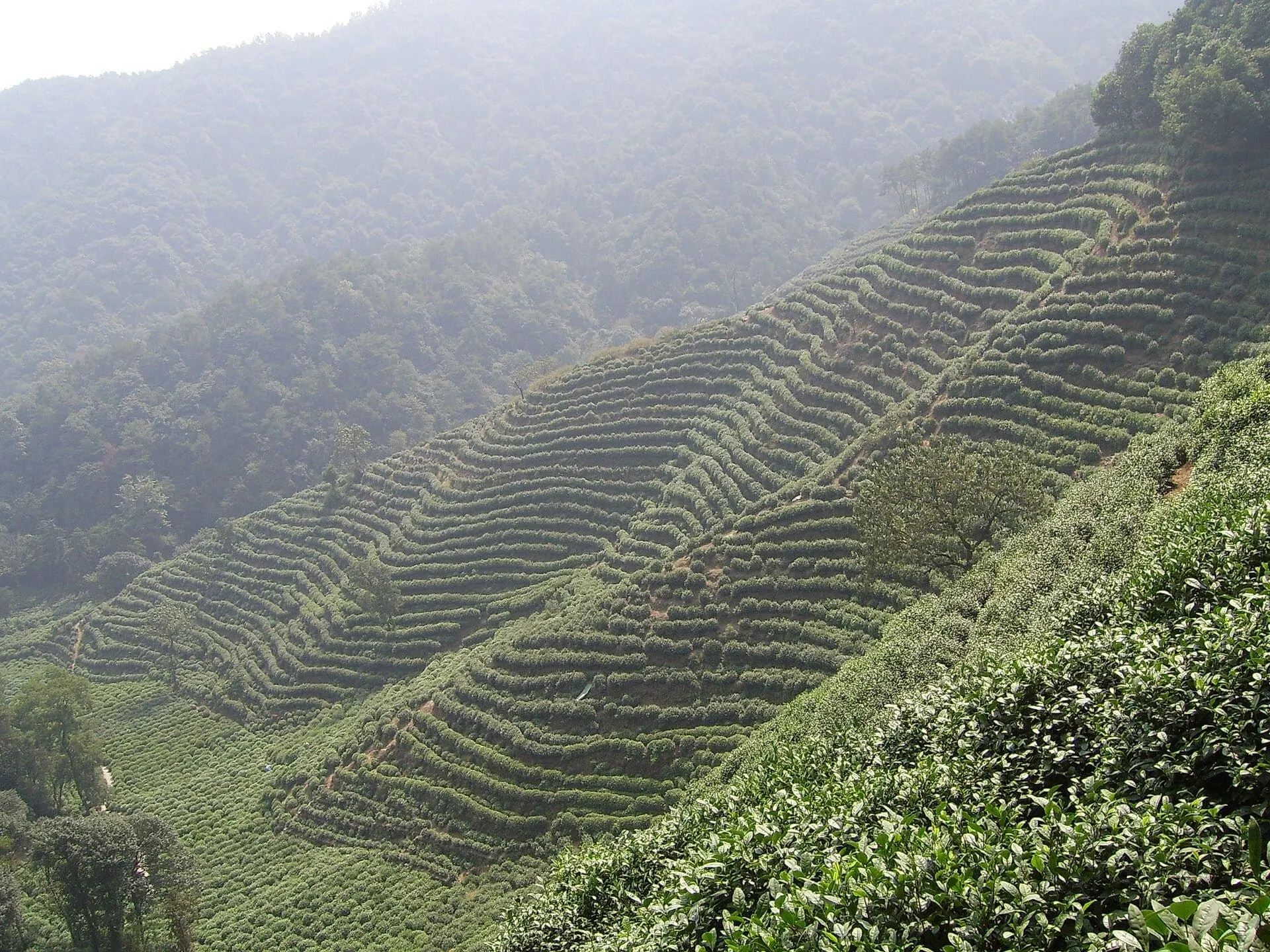
Longjing Tea Plantations (Dragon Well)
The centuries-old tea terraces on the hillsides west of West Lake where the world-famous Longjing (Dragon Well) green tea is grown. Includes the China National Tea Museum, family tea houses, and walking paths through terraced gardens of tea bushes. Free entry to the terraces; tea tastings ¥50-150.
Wikimedia Commons · CC-BY-SA
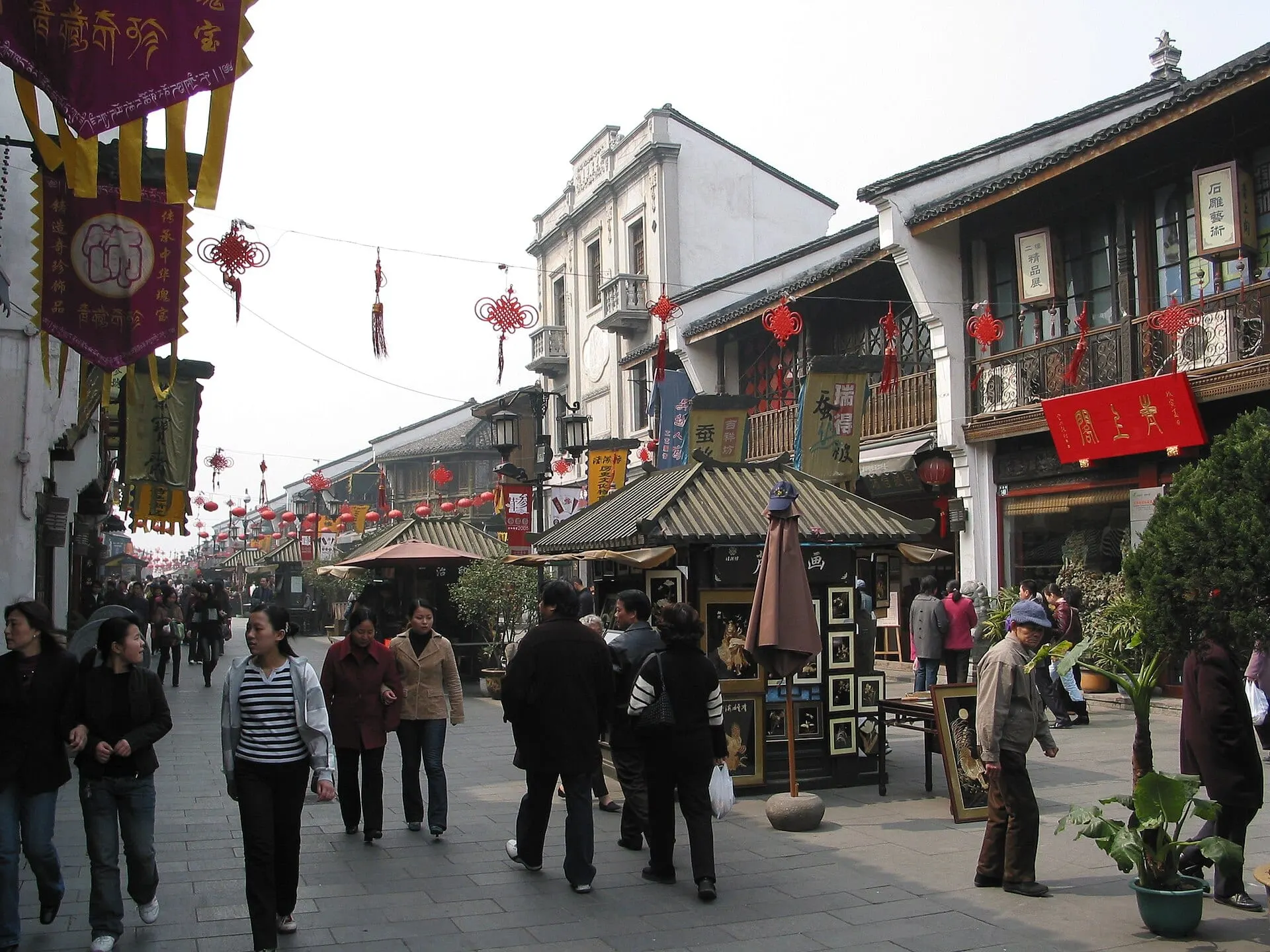
Hefang Old Street (He Fang Jie)
A restored 1,800-meter late-Qing shopping street south of West Lake, with traditional silk shops, tea houses, the Hu Qing Yu Tang Chinese pharmacy (founded 1874), the Southern Song Imperial Palace museum, and the Wangxingji Fan Shop (founded 1822). Free to enter, open 10am-10pm. Best in the late afternoon and evening.
Wikimedia Commons · CC-BY-SA
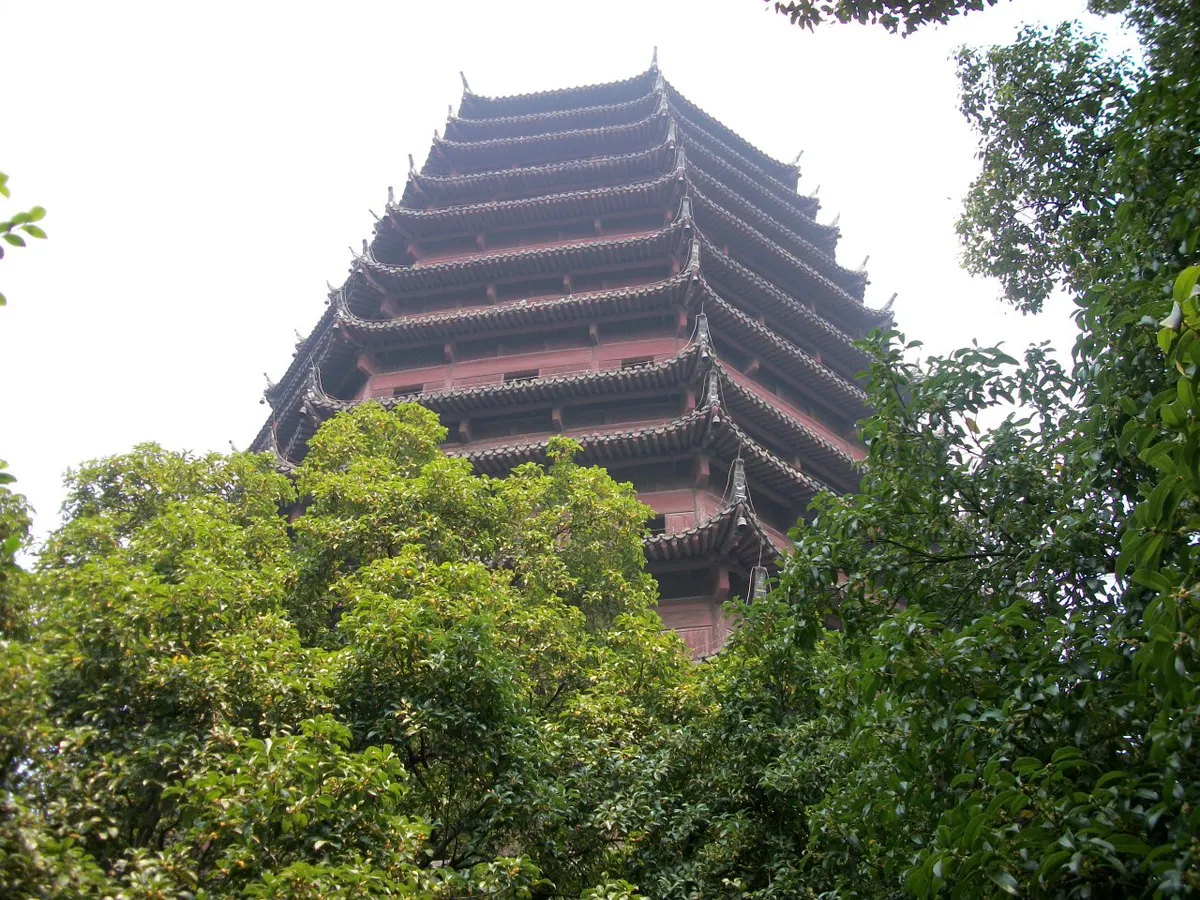
Six Harmonies Pagoda (Liuhe Ta)
A 7-story, 60-meter pagoda on the north bank of the Qiantang River, built in 970 AD during the Northern Song dynasty and still one of Chinas tallest wooden pagodas. The name Six Harmonies refers to the six Buddhist concepts of harmony. Entry ¥30, climb to the top for panoramic river views.
Wikimedia Commons · CC-BY-SA
Grand Canal (Hangzhou Section)
A 1,776-kilometer canal connecting Beijing to Hangzhou, the longest artificial waterway in the world and a UNESCO World Heritage Site (inscribed 2014). The Hangzhou section preserves the Qilidian wharf, the Fuyi Granary, and the Gongchen Bridge (built 1631). Walk or take a boat tour from the Qilidian Heritage Park.
Wikimedia Commons · CC-BY-SA
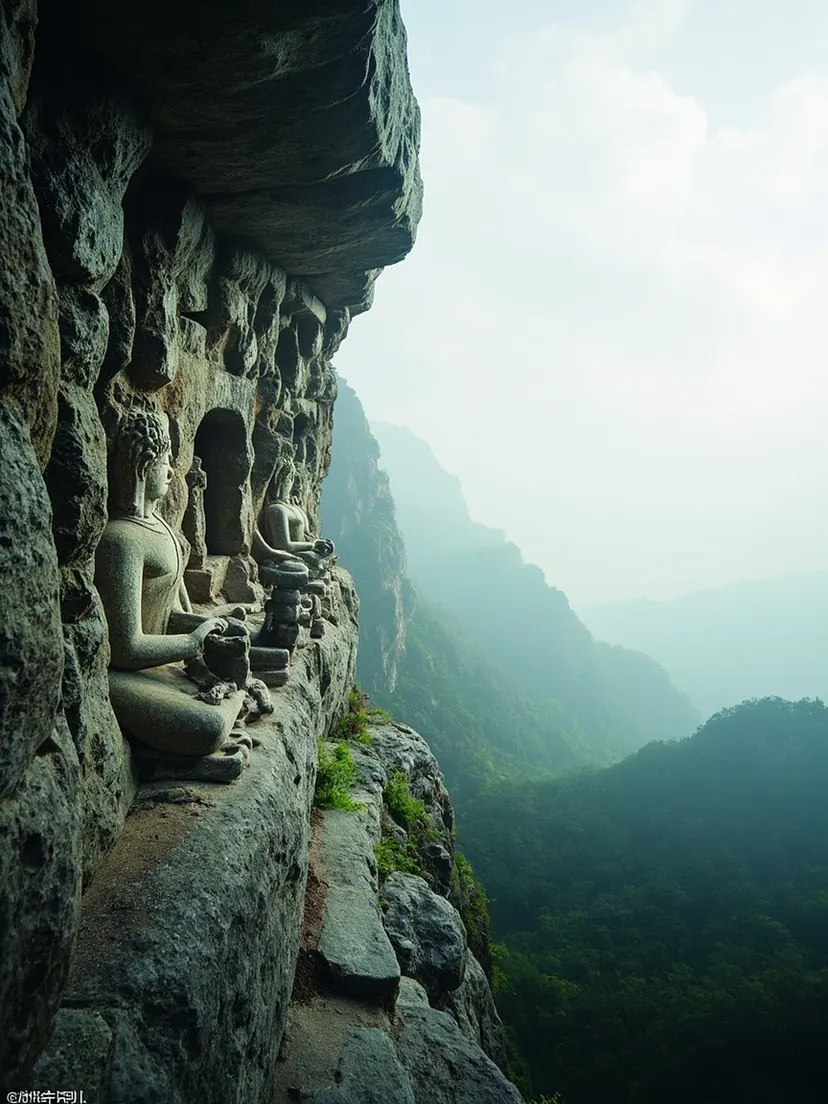
Lingyin Flying Peak (Feilai Feng)
A limestone hill just outside Lingyin Temple with 470+ Buddhist stone reliefs and statues carved into the rock face between the 10th and 14th centuries. Includes the Laughing Buddha, the Bodhisattva Samantabhadra, and the largest relief of Maitreya in China. Entry ¥45.
Wikimedia Commons · CC-BY-SA
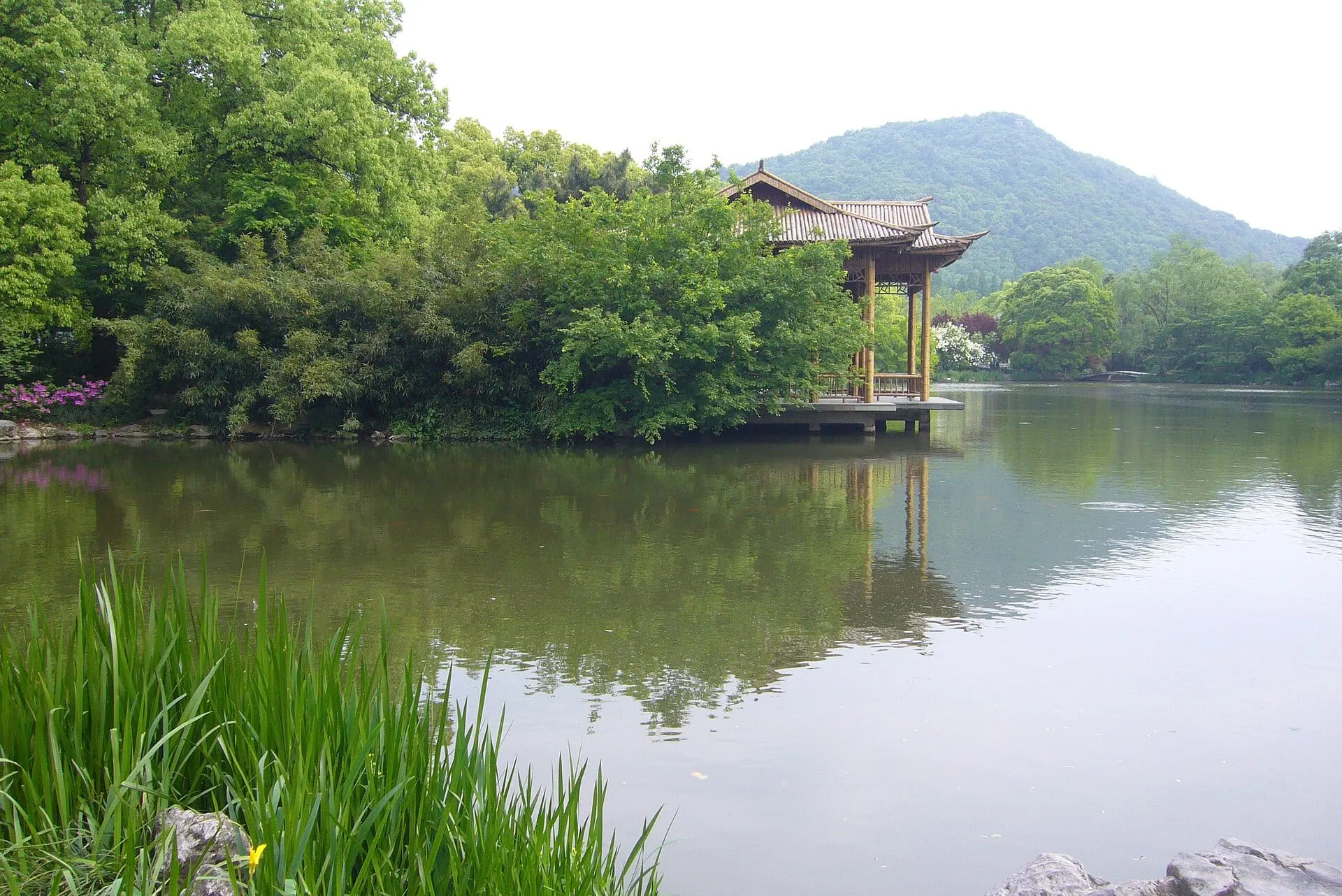
Xixi National Wetland Park
A 10-square-kilometer wetland reserve in western Hangzhou, with 6 km of walking paths, traditional water villages, the Lotus Garden, the Three Causeways, and the Wetland Museum. Best visited in autumn for the reed beds or in spring for the lotus flowers. Entry ¥80 plus boat ride ¥60.
Wikimedia Commons · CC-BY-SA

Qiantang River and Tide
The largest tidal bore in the world rolls up the Qiantang River estuary south of Hangzhou, with tidal bores reaching 3.5 meters and a wall of advancing water several hundred meters wide. Best viewed on the 18th day of the eighth lunar month at the Yanguan Tide-Watching Park, 50 km east of Hangzhou.
Wikimedia Commons · CC-BY-SA
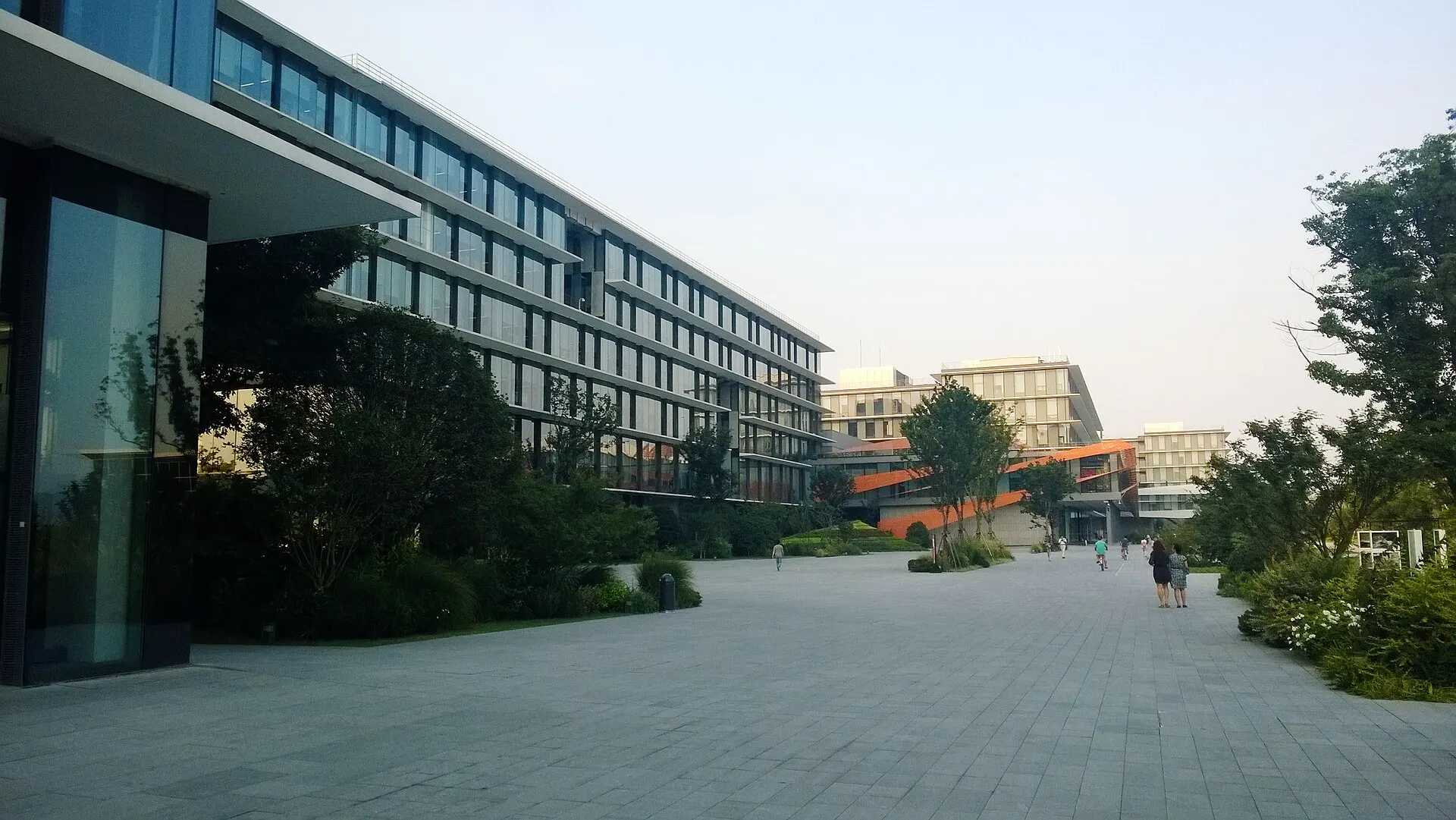
Alibaba Xixi Park Campus
The headquarters of Alibaba Group, founded by Jack Ma in 1999 in his Hangzhou apartment, now one of the worlds largest e-commerce companies. The Xixi campus is open to the public on weekends and features the Alibaba Visitor Center, the Cainiao Smart Logistics Network, and the Fliggy Hotel. Free, advance booking required.
Wikimedia Commons · CC-BY-SA

Su Causeway and Bai Causeway
Two historic causeways across West Lake, built by the Northern Song poet Su Dongpo (Su Causeway, 1085 AD) and the Tang poet Bai Juyi (Bai Causeway, 822 AD). Each causeway has 3 stone bridges and is lined with willows, peach trees, and plum trees. Walking or cycling across them is one of the West Lake classics.
Wikimedia Commons · CC-BY-SA
STAY
Where to stay in Hangzhou
Pick a base that matches the trip you want — imperial-central for sightseeing, hutong belt for character, Chaoyang for nightlife, or Qianmen for budget.
West Lake (Xi Hu)
The 6-km lake that has defined Hangzhou for 1000 years — gardens, pagodas, walking paths.
#west-lakeLingyin Temple area
A 1700-year-old Buddhist temple complex at the foot of a forested hill — a half-day escape.
#lingyin-temple
ITINERARIES
Sample itineraries from Hangzhou
Three ready-made routes, from a 1-day imperial sprint to a 5-day deep dive. Copy the day-by-day plan and adapt to your own pace.
- 1 DAY
Hangzhou in One Day
West Lake circuit, Lingyin Temple, and Longjing tea — the essential Hangzhou day.
- Shanghai side trips
- Weekend getaways
- Quick cultural immersion
- Day 01
Morning
West Lake bike ride — Broken Bridge, Su Causeway, Leifeng Pagoda ascent
Afternoon
Lingyin Temple and Feilai Peak grottoes, Longjing tea village for tea tasting
Evening
Hefang Street evening walk, West Lake night cruise, dinner at Lou Wai Lou
- 3 DAYS
Classic 3-Day Hangzhou
West Lake, tea culture, Buddhist temples, and Xixi Wetland.
- First-time visitors
- Couples
- Tea and garden lovers
- Day 01
Morning
West Lake — Su Causeway walk, boat to Mid-Lake Pavilion, Leifeng Pagoda
Afternoon
Hefang Street, Hu Qing Yu Tang traditional medicine museum, Southern Song Imperial Street
Evening
West Lake musical fountain show (nightly), lakeside dinner
- Day 02
Morning
Lingyin Temple and Feilai Peak — allow 2-3 hours for the grottoes and halls
Afternoon
Longjing tea village — tea tasting and plantation walk, China National Tea Museum
Evening
Hangzhou cuisine at Zhi Wei Guan (知味观) — beggar's chicken, Dongpo pork
- Day 03
Morning
Xixi National Wetland Park — boat ride through water villages and persimmon groves
Afternoon
Grand Canal historical block — Gongchen Bridge, Canal Museum, traditional craft workshops
Evening
Farewell lakeside dinner, Impression West Lake show (Zhang Yimou-directed water spectacle)
- 4 DAYS
4-Day Hangzhou & Water Towns
Hangzhou plus day trips to Suzhou's classical gardens and Wuzhen water town.
- Culture enthusiasts
- Garden lovers
- Photographers
- Day 01
Morning
West Lake circuit, Su Causeway, boat ride
Afternoon
Leifeng Pagoda, Jingci Temple, lakeside tea terrace
Evening
Hefang Street, lakeside dinner
- Day 02
Morning
Lingyin Temple, Feilai Peak
Afternoon
Longjing tea village, tea museum, Meijiawu tea plantation walk
Evening
Grand Canal night cruise, canal-side dinner
- Day 03
Morning
HSR to Suzhou (1.5h) — Humble Administrator's Garden, Tiger Hill
Afternoon
Suzhou Museum (I.M. Pei), Pingjiang Road canal walk, Suzhou silk workshop
Evening
Return to Hangzhou, late dinner at Wushan Night Market
- Day 04
Morning
Xixi Wetland half-day — morning boat ride when the light is best
Afternoon
China National Silk Museum, last West Lake walk, tea shopping
Evening
Depart
BUDGET
What a Hangzhou trip costs
Per-person, per-day costs across three spending tiers. Excludes international flights and visa fees.
| Line item | Backpacker | Mid-range | Luxury |
|---|---|---|---|
| Hotel (per night) | $15 | $60 | $220 |
| Meals (per day) | $12 | $35 | $100 |
| Local transport | $3 | $10 | $25 |
| Attractions | $10 | $25 | $60 |
| Total per day | $40 | $130 | $405 |
$ USD per person per day, before international flights and visas. Last verified: Q3 2026.
STAY SAFE
Emergency contacts in Hangzhou
Save these three numbers before you board the plane. China uses different hotlines than most countries — there's no 911.
- POLICE
110
- AMBULANCE
120
- FIRE
119
- TOURIST HOTLINE
12301 (China National Tourism Administration hotline)
- ENGLISH-SPEAKING ER
Sir Run Run Shaw Hospital (邵逸夫医院) — International Clinic with English-speaking staff, +86 571 8600 6114, 3 Qingchun East Road. Also: Hangzhou United Family Hospital (杭州和睦家医院) +86 571 8533 6888.
Problems travelers hit in Hangzhou
- Why is my Alipay not working?You linked a foreign Visa or Mastercard to Alipay but every transaction is rejected at the merchant.
- My China visa was denied — what now?Your L visa application was refused at the Chinese consulate and your trip is in 2–4 weeks.
- My passport was lost or stolen in China — what do I do?Your passport is gone (theft or loss) and you're in mainland China without travel documents.
- Why can't I book on 12306 with my foreign card?You tried to book a high-speed rail ticket on 12306.cn and your foreign Visa/Mastercard is rejected at checkout.
- Why is my VPN not working in China?You arrived in China, opened your VPN, and it will not connect at all or connects but no traffic loads.
- Why can't I book a Tibet trip on my own?You try to book Lhasa flights and hotels yourself but the booking fails, or you're turned away at the Lhasa airport without a permit.
Compare Hangzhou with
Book activities in Hangzhou
These are licensed tour operators and booking platforms we've vetted independently. Booking through these links may earn us a commission — see our affiliate disclosure. This never affects our editorial recommendations or the price you pay.
Frequently asked questions
Do I need a visa to visit Hangzhou?
How many days do I need in Hangzhou?
When is the best time to visit Hangzhou?
How do I get from Shanghai to Hangzhou?
How do I pay for things without a Chinese bank account?
Is Hangzhou safe for tourists?
Show all 25 FAQs
What is the best local food in Hangzhou?
What is Longjing tea and how do I buy it?
How does Hangzhou compare to Suzhou for tourism?
What is the best way to see West Lake?
Is Wuzhen water town worth visiting?
Where should I stay in Hangzhou?
How much does a trip to Hangzhou cost?
Can I visit Hangzhou on a cruise stop?
What is the Qiantang River tidal bore?
Is Hangzhou worth visiting with kids?
What is Alibaba and can I visit the campus?
Can I see Hangzhou in winter?
What is the Grand Canal and why is it famous?
What is the best way to photograph West Lake?
What is the Impression West Lake show and is it worth seeing?
How do I avoid crowds at West Lake and the major temples?
What is the Hangzhou metro like for tourists?
Can I cycle around West Lake?
What is Lingyin Temple and is it worth visiting?
References

Written by
NihaoVisit Editorial