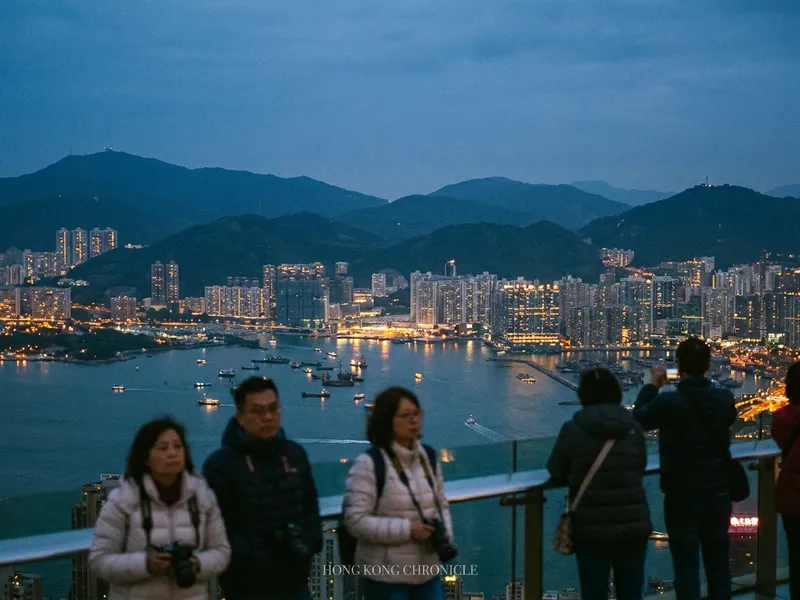
Hong Kong
Hong Kong (香港, Xiānggǎng, 'Fragrant Harbour') is a Special Administrative Region of China with its own immigration, currency, and legal system, and the most generous visa-free entry in Asia: roughly 170 countries visit visa-free, British passport holders for up to 180 days and US, Canadian, and Australian for 90. Unlike mainland China, Google, WhatsApp, Instagram, and the open internet all work normally — no VPN needed. The city packs more into a small footprint than almost anywhere on earth: the world's most photographed skyline from Victoria Peak, a 100-year-old green-and-white Star Ferry crossing the harbour for less than US$1, Michelin-starred dim sum next to HK$40 noodle shops, 263 islands reachable by cheap public ferry, and a subtropical mountain range that drops straight into the sea on the south side of Hong Kong Island. Three to four days covers the skyline, the harbour, Lantau Island's Tian Tan Buddha, a south-side beach and hike, and a dim sum crawl; a fifth day adds a Macau ferry trip. Hong Kong is also the smoothest international gateway into mainland China, with high-speed trains to Shenzhen (15 minutes) and Guangzhou (under an hour), and a direct line to Guilin in 3.5 hours.
Why Hong Kong in 2026.
A vertical city of skyscrapers, neon street markets, Michelin-starred dim sum, and 263 islands — Asia's most English-friendly metropolis and the easiest gateway into mainland China.
Quick Answer
Hong Kong (香港, Xiānggǎng, 'Fragrant Harbour') is a Special Administrative Region of China with its own immigration, currency, and legal system, and the most generous visa-free entry in Asia: roughly 170 countries visit visa-free, British passport holders for up to 180 days and US, Canadian, and Australian for 90. Unlike mainland China, Google, WhatsApp, Instagram, and the open internet all work normally — no VPN needed. The city packs more into a small footprint than almost anywhere on earth: the world's most photographed skyline from Victoria Peak, a 100-year-old green-and-white Star Ferry crossing the harbour for less than US$1, Michelin-starred dim sum next to HK$40 noodle shops, 263 islands reachable by cheap public ferry, and a subtropical mountain range that drops straight into the sea on the south side of Hong Kong Island. Three to four days covers the skyline, the harbour, Lantau Island's Tian Tan Buddha, a south-side beach and hike, and a dim sum crawl; a fifth day adds a Macau ferry trip. Hong Kong is also the smoothest international gateway into mainland China, with high-speed trains to Shenzhen (15 minutes) and Guangzhou (under an hour), and a direct line to Guilin in 3.5 hours.
| Best time to visit | October–December (cool, dry, clear); March–April (warm, pleasant). Avoid June–August humidity. |
|---|---|
| Daily budget | $70 (backpacker) / $200 (mid-range) / $550+ (luxury) |
| Language | Cantonese (primary), Mandarin, English (official; the most widely spoken English in Asia) |
| Currency | Hong Kong Dollar (HK$) — pegged at about 7.8:1 to the US dollar; foreign cards widely accepted |
| Time zone | Hong Kong Time (UTC+8) |
| Last updated | 2026-06-15 |
Want a Hong Kong plan built for you?
What is Hong Kong: A Vertical City Between Two Worlds?
Hong Kong is one of the most densely packed and vertically dramatic cities on earth — a metropolis of more than 7.4 million people shoehorned onto a small archipelago, where 70-storey residential towers rise straight out of subtropical mountains that plunge into the South China Sea. It is a Special Administrative Region (SAR) of China, returned by Britain in 1997 after 156 years of colonial rule, and it operates under the ‘one country, two systems’ principle: its own immigration control, its own currency (the Hong Kong dollar), its own common-law legal system, and its own Cantonese-first culture. For a visitor, that means Hong Kong feels distinct from mainland China in ways that matter: English is an official language and genuinely spoken everywhere, Google and WhatsApp work without a VPN, the internet is open, and Western credit cards and phones work seamlessly. It is at once the most Chinese and the most international of Asian cities — a Cantonese harbour town overlaid with British colonial architecture and global finance, where a Michelin-starred dim sum lunch and a heritage tram ride can sit in the same afternoon.
What is the history of Hong Kong: From Fishing Village to Global Hub?
Hong Kong’s deep history is older than its British chapter, but the modern city dates to 1842, when Britain seized the island after the First Opium War and established a free port. The Kowloon peninsula was added in 1860, and the New Territories — the vast majority of the land area, including Lantau — were leased for 99 years in 1898. Over the next century Hong Kong grew into one of the world’s great ports, a manufacturing powerhouse, and then a global financial centre, its population grew through successive waves of migration from other parts of China. The 1997 handover to China, under the Sino-British Joint Declaration, created the ‘one country, two systems’ framework and a 50-year guarantee of Hong Kong’s distinct way of life. The years since have been turbulent: the 2003 SARS outbreak, the 2014 Umbrella Movement, and the 2019 anti-extradition protests and subsequent national security law of 2020 reshaped the city’s politics and atmosphere. Through it all Hong Kong has remained pragmatic, safe, and operational — the streets are clean, the MTR runs on time, the food is exceptional, and the skyline is still the one the world photographs.
What is the geography and climate of Hong Kong, and when should I visit?
Hong Kong is an archipelago of 263 islands plus the Kowloon peninsula and the New Territories, totalling about 1,100 square kilometres. Only a quarter is built up; the rest is protected country park, mountains, and coastline. The harbour between Hong Kong Island and Kowloon is one of the deepest natural ports in the world and the city’s defining feature. The climate is humid subtropical: hot, wet, and frequently typhoon-affected from June to September (the typhoon season peaks in August and September); warm and pleasant from October to December, the consensus best time to visit, with clear skies, low humidity, and 20–25°C; cool and grey from January to February; and warm but increasingly humid from March to May. The single best months for most travellers are late October to mid-December — dry, comfortable, and clear enough to see the skyline from the Peak. Avoid the summer if you can: 33°C with 90% humidity and the risk of a typhoon disrupting ferries and outdoor plans is the city at its least pleasant.
How do I get to Hong Kong: Flights, High-Speed Rail, and Ferries?
Hong Kong International Airport (HKG), built on reclaimed land at Chek Lap Kok, is one of the world’s great hubs, with direct flights from every major city globally and a spectacular approach over the harbour. The Airport Express train reaches Central in 24 minutes for HK$115 — the fastest airport-to-city link in Asia. For mainland China connections, the Hong Kong section of the high-speed rail terminates at West Kowloon station, a remarkable building where you clear both Hong Kong and mainland Chinese immigration in one place: trains reach Shenzhen in 15 minutes, Guangzhou in under an hour, and Guilin in about 3.5 hours. Ferries still matter: TurboJET and Cotai Water Jet run the 1-hour crossing to Macau roughly every 15 minutes, and there are direct ferries and bridge-bus links to the Pearl River Delta cities. An increasing number of visitors arrive overland from Shenzhen via the MTR or the new bridge to Macau and Zhuhai. Within the region, Hong Kong is the natural hub for a southern China loop: fly in, spend a few days, then train onward to Guilin, Guangzhou, or Yangshuo.
How do I get around Hong Kong: MTR, Trams, Ferries, and the Octopus Card?
Hong Kong has one of the best public transport systems on earth. The Octopus card — a contactless smart card you top up and tap on everything — is the key to all of it. The MTR subway is fast, bilingual, spotless, and reaches almost everywhere on Hong Kong Island, in Kowloon, and into the New Territories and Lantau. The double-decker trams (the ‘ding dings’) run along the north shore of Hong Kong Island for a flat HK$3 and are a cheap sightseeing ride. The Star Ferry crosses the harbour for under HK$5. Buses and green minibuses fill the gaps, including the dramatic south-side routes over the island’s mountains. Taxis are plentiful, metered, and reasonably priced, though most drivers speak limited English — have your destination in Chinese or use a map. Ride-hailing (Uber operates) and the local HKTaxi app are useful. Buy an Octopus card at the airport or any MTR station, load HK$200–500, and use it for transit, ferries, convenience stores, and many restaurants; it is the single most useful object a visitor carries.
Where should I stay in Hong Kong?
The classic choice is Central on Hong Kong Island or Tsim Sha Tsui (TST) on the Kowloon side — both put you at the heart of the harbour and the transport network. Central (and neighbouring Admiralty and Wan Chai) suits business travellers, shoppers, and anyone who wants the Island side, with landmark hotels like the Mandarin Oriental, the Four Seasons, and the Upper House, plus mid-range options along Queens Road. Tsim Sha Tsui, in Kowloon, offers the best skyline views across the harbour and a denser, more budget-friendly hotel scene (the Peninsula is the grande dame; the Rosewood and K11 ARTUS are the modern luxury picks; the InterContinental Grand Stanford and the Marco Polo are solid mid-range). For better value, look at Mong Kok or Yau Ma Tei in Kowloon — lively, authentic, and 15 minutes by MTR from Central. Causeway Bay on the Island is the shopping hub. For a resort feel, Repulse Bay or Stanley on the south side — the Repulse Bay Hotel and the Fullerton Ocean Park offer beach and harbour views. Budget travellers should know that Hong Kong hotel rooms are small and not cheap — a 4-star room starts around HK$1,200–1,800 — but the location and transport make up for it. Hostels and guesthouses cluster in the Mirador and Chungking Mansions in TST; check recent reviews carefully. A few booking pointers. Hong Kong hotels add a service charge to published rates, so a HK$1,500/night room is typically HK$1,650–1,800 with service charge and any tourism levy. Book through major hotel chains (Marriott, Hyatt, IHG) for loyalty points; use Trip.com or Booking.com for the best rates on independent and chain hotels; consider the Airbnb and serviced-apartment scene in Sai Ying Pun and Kennedy Town for longer stays. The Peak, Tsim Sha Tsui, and Causeway Bay are the three classic neighbourhoods, and for families the Island Shangri-La or the Kowloon Shangri-La (both with a 25-metre pool) are reliable. For a stay with personality, the Fleming in Wan Chai is a boutique design hotel, the Pottinger in Central is small and elegant, and the Murray is a 1969 modernist landmark restored by Hyatt. Avoid Chungking Mansions unless you really know the building and the owner — the safety and hygiene vary widely, reviews are mixed, and most experienced travellers stay in modern hotels nearby.
What are the top attractions in Hong Kong?
The unmissable trio is Victoria Peak, the Star Ferry, and a dim sum meal. Take the Peak Tram up the steep incline to the Sky Terrace for the skyline panorama — go for sunset so you see the city in daylight, at dusk, and lit up at night. Ride the Star Ferry across the harbour at least twice; it is the cheapest great view in the world. Eat dim sum at a proper Cantonese restaurant (Tim Ho Wan for Michelin on a budget, or a traditional room like Lin Heung Kui for the chaotic cart experience). Beyond the trio, the full-day essentials are the Avenue of Stars promenade on the Kowloon side for the free skyline view and the nightly Symphony of Lights show at 8 pm; Temple Street Night Market for neon and street food; the Tian Tan Buddha and Po Lin Monastery on Lantau, reached by the Ngong Ping 360 cable car; and a hike — Dragon’s Back on the south side is the most popular, with sea views and a beach finish. Add the Man Mo Temple in Sheung Wan, a ride on the double-decker tram, and a ferry to an outlying island like Lamma or Cheung Chau for a slower, village pace.
What local food should I try in Hong Kong?
Hong Kong is one of the world’s great food cities, and Cantonese cuisine is its backbone. Dim sum is the headline: steamed dumplings, char siu bao (BBQ pork buns), har gow (shrimp dumplings), cheung fun (rice noodle rolls), and egg tarts, served with tea in bamboo steamers from morning to mid-afternoon. Tim Ho Wan offers Michelin-starred dim sum at street prices; Lin Heung Kui is the old-school cart-service experience; and the hotel restaurants (Ming Court, Lung King Heen) do the refined version. Beyond dim sum, eat roast goose (Yat Lok or Kam’s Roast Goose, where the skin is the point), wonton noodles (Mak’s Noodle, with their well-known thin egg noodles and a tiny 18-seat room), congee and rice-roller breakfasts, and egg tarts from the bakeries (Honolulu Coffee Shop for the classic, Tai Cheong for the Dan-Pat style). Hong Kong is also famous for cha chaan teng — local diner-cafes serving Hong Kong-style milk tea (silk-stocking tea, strong and smooth), pineapple buns with cold butter, and French toast with syrup, a colonial-era fusion you cannot get anywhere else. The Dai Pai Dong — open-air food stalls, now reduced in number and mostly in Central, Wan Chai, and Sham Shui Po — are the authentic casual experience: stir-fried seafood, typhoon-shelter crab, and claypot rice, cooked in front of you on a wide wok. For street food, hit Temple Street in Yau Ma Tei, Mong Kok’s Fa Yuen Street, and the dai pai dong on Stanley Market for seafood with a view. On the islands, Sok Kwu Wan on Lamma and Po Doi O on Lamma are the seafood legends. The Lau Fau Shan and Tai O on Lantau are the oyster- and shrimp-paste spots. For more upscale, Hong Kong has more Michelin-starred restaurants than almost any city, and many are worth the splurge: Lung King Heen (three stars, Four Seasons), Caprice (three stars, Four Seasons, French), Sushi Saito and Sushi Shikon (Tokyo-level omakase), Amber (two stars, the Landmark Mandarin), and the Mandarin’s Man Wah (Cantonese refinement). The fine-dining scene sits alongside a deep tea culture, a vibrant cocktail-bar world (Dr Fern’s, the Old Man, stockington), and a growing craft-beer scene in Sheung Wan and Sai Ying Pun. For a non-Cantonese detour, the city has strong Sichuan (Sichuan Garden, Wang Yi), Shanghainese, and Cantonese-fusion options. The unifying truth about Hong Kong’s food: a great meal can cost HK$50 in a cha chaan teng or HK$5,000 at a three-star counter, and the city supports both with equal seriousness, craftsmanship, pride, and a deep sense of culinary heritage.
What is a good 2- to 4-day itinerary for Hong Kong?
Two days cover Hong Kong's essentials, with extra days adding Lantau, islands, and Macau. Day 1 — Hong Kong Island: ride the Star Ferry to Central, dim sum lunch, walk to the Mid-Levels escalator and Man Mo Temple, take the Peak Tram up for sunset, dinner in Soho or Lan Kwai Fong. Day 2 — Kowloon and the harbour: Tsim Sha Tsui promenade and Avenue of Stars, a museum (the M+ or the Hong Kong Museum of Art), Temple Street Night Market at dusk, and the 8 pm Symphony of Lights. Three-day adds: Day 3 — Lantau Island, the Ngong Ping 360 cable car, the Big Buddha, and Tai O fishing village; or a south-side day with Dragon’s Back hike and a beach, ending in Stanley or Repulse Bay. Four-day deep dive adds: Day 4 — a ferry to an outlying island (Lamma for seafood, Cheung Chau for a village pace), or a Macau day trip by ferry. If you have only one day, focus on the Peak, the Star Ferry, dim sum, and the TST skyline view — that distills the city. Build in slow time for tea, a tram ride, and wandering the wet markets; Hong Kong rewards aimless exploration as much as sightseeing.
What practical information do I need: Visa, Money, Connectivity?
Hong Kong maintains one of the world’s most generous visa-free regimes. Roughly 170 countries can visit without a visa: British passport holders for up to 180 days, and US, Canadian, Australian, and most EU citizens for 90 days. Your passport must be valid at least one month beyond your stay, and you may be asked to show an onward ticket. This is separate from mainland China: the mainland 30-day visa-free policy does not cover Hong Kong, and entering Hong Kong then mainland China (or vice versa) counts as two separate border crossings. Check your exact allowance on the Hong Kong Immigration Department (IMMD) site. Money: the Hong Kong dollar (HK$) is pegged at about 7.8 to the US dollar; ATMs are everywhere and foreign cards widely accepted. Tipping: 10% service charge is often added to restaurant bills; round up or add 5–10% for good service. Connectivity: no firewall — Google, WhatsApp, Instagram, Facebook, and the open internet all work normally. You will need a VPN only if you cross into mainland China. A local SIM or roaming works fine; the MTR and most indoor spaces have free public WiFi.
What are the best day trips from Hong Kong?
The standout day trips are Macau, Lantau Island, and the outlying islands. Macau, a 1-hour ferry ride (or a bridge-bus) away, is a former Portuguese colony with a UNESCO-listed historic centre, egg tarts, casinos, and its own visa-free entry for most Western passports — book the TurboJET ferry in advance for the best times. Lantau, Hong Kong’s largest island, combines the Ngong Ping 360 cable car, the Tian Tan Buddha, the Po Lin Monastery, and the stilt-house fishing village of Tai O, with the chance of spotting pink dolphins. The outlying islands offer a slower pace: Lamma for seafood at Sok Kwu Wan and a hippie vibe at Yung Shue Wan; Cheung Chau for a car-free fishing village, windsurfing, and the famous mango mochi; and Peng Chau for quiet artist-community calm. On Hong Kong Island itself, the south side — Ocean Park, Stanley Market, Repulse Bay, and the Dragon’s Back or Victoria Peak hikes — makes a great half- or full-day escape from the downtown density. For serious hikers, the MacLehose Trail in the New Territories is one of the world’s great long-distance walks. All of these are reachable by cheap public ferry, bus, or MTR.
What cultural etiquette and practical tips should I know?
Hong Kong is a fast-moving, efficient, and broadly foreigner-friendly city, but a few local norms help. Punctuality matters; queueing is strict and locals take it seriously. In restaurants, a 10% service charge is usually added — no need to tip heavily, but rounding up or adding small change for good service is appreciated. In temples, dress modestly, remove hats, and do not point directly at statues; a small incense offering is welcome. Cantonese is the first language, but English is official and widely spoken in central areas, hotels, and transport — though less so in the New Territories and among older taxi drivers, so have addresses in Chinese or use a map. The MTR bans eating and drinking, enforced with fines. Locals walk fast and stand on the right on escalators. Hong Kong is extremely safe — violent crime is rare and it is comfortable to walk anywhere at night. Tipping hotel porters (HK$20) and taxi rounding is sufficient. The city is cashless-tilting via Octopus and contactless cards, but carry some cash for small markets and street food. The summer heat and humidity are intense; carry water and pace outdoor activity. A note on the political atmosphere: the 2019 protests and the 2020 national security law reshaped Hong Kong’s civic life, and certain public discussions are now sensitive. For visitors this is rarely visible — the city remains safe, orderly, and welcoming, and tourists are not affected. Read the current UK, US, or your government’s travel advice before you go for the latest entry and behaviour guidance. Day-to-day, Hong Kong in 2026 feels like its practical, low-friction self: efficient, English-friendly, and easy to navigate, with the world-class food, skyline, and hiking that have always drawn people there.
What hiking and country parks does Hong Kong offer?
About 40% of Hong Kong’s land area is protected country park — subtropical mountains, forest, and coastline that drop straight into the South China Sea, all within a short bus ride of the dense downtown. The headline hike is Dragon’s Back, a ridge walk along the south side of Hong Kong Island with sweeping sea views and a beach finish at Big Wave Bay (2–3 hours, moderate, bus 9 from Shau Kei Wan MTR). The most famous long-distance walk is the MacLehose Trail in the New Territories, a 100-kilometre path over the Sai Kung peninsula that National Geographic named one of the world’s best hikes — doable in stages or as a multi-day adventure. Victoria Peak itself has a leafy circular walk around the summit, and the Lantau Trail loops the Big Buddha’s island for two-day trekkers. Lion Rock, between Kowloon and the New Territories, offers the well-known ridge view that symbolises the ‘Lion Rock spirit’. For experienced hikers, Sunset Peak on Lantau is the highest accessible summit on a developed island in Hong Kong, with a sea of silvergrass and an overnight refuge available; Tai Long Wan in Sai Kung, reached by a tougher multi-hour trek or a sampan from Sai Kung town, is one of the most beautiful unspoilt bays in the territory, with waterfalls, white sand, and shark-free swimming. Family-friendly options include the flat, paved Wilson Trail sections, the Family Trail on Lamma, and the easy reservoir loops in the central New Territories. Hiking season runs October to April, when it is cool and dry; summer hiking is dangerously hot and humid and best avoided midday. Carry water, sun protection, and a phone; trails are well marked but remote sections have no shade or shops. The government’s hiking app and the Oasiz and TrailWatch apps have full maps. The reward is a side of Hong Kong most visitors never see — green mountains, quiet bays, and a view back over the skyline that puts the city’s density in startling perspective. Finish any south-side hike with a swim and a seafood dinner at Shek O, Stanley, or Repulse Bay.
What shopping and nightlife should I experience?
Hong Kong is one of the world’s great shopping cities, from luxury flagships to chaotic street markets. The luxury strip is Canton Road in Tsim Sha Tsui and the malls of Central (Landmark, IFC) and Causeway Bay (Times Square, Sogo) — global brands, tax-free, and often cheaper than Europe. For something more local, the markets are the real draw: the Ladies’ Market in Mong Kok for clothes and souvenirs, Temple Street in Yau Ma Tei for night-market atmosphere and electronics, the Sneaker Street, and the jade and bird markets. Bargain at the markets (aim for 50–60% of the asking price, good-humouredly) but not in the malls. For antiques and art, wander Hollywood Road and the Cat Street area in Sheung Wan, now anchored by Tai Kwun and the art galleries of the Central police-station complex. Department stores and the bigger malls (Harvey Nichols, Lane Crawford, Sogo, Harbour City) are the reliable luxury anchors; for a calmer local-shopping feel, the Causeway Bay pedestrian area and Russell Street have everything from cosmetics to electronics. Electronics: the prices are competitive with Japan and Singapore, and the Shenzhen border is close enough to justify a day trip for computer and phone gear. Books, stationery, and design shops cluster in Sheung Wan and the Tai Kwun complex. For groceries and a sense of local life, visit a wet market in Mong Kok (Tung Choi Street is the most photogenic) and the Sheung Wan dried-seafood street. Always carry an Octopus card — many markets and small shops now accept it, and it speeds up everything. Nightlife clusters in a few zones. Lan Kwai Fong (LKF) in Central is the expat and tourist bar district — loud, crowded, and fun for a big night out; the neighbouring Soho and Wyndham Street offer cocktail bars and wine bars. Wan Chai has a more local, slightly gritty bar scene, with the Lockhart Road strip a classic. Tsim Sha Tsui and Mong Kok have rooftop bars (Ozone at the Ritz-Carlton was long the highest in the world) and live music. The liveliest late-night street market is Temple Street, open until midnight or later, with fortune-tellers, Cantonese opera, and street food. For a calmer evening, a sundowner on the TST promenade watching the skyline light up, or a cocktail at the Peninsula lobby, is hard to beat. The city stays up late; the MTR closes around 1 am, after which night buses and taxis take over.
How does Hong Kong differ from mainland China for travellers?
The practical differences are large and mostly make Hong Kong easier for a Western visitor. Visas: Hong Kong has its own, far more generous visa-free regime (roughly 170 countries, UK 180 days, US/Canada/Australia 90), separate from mainland China’s — entering one then the other is two crossings. Internet: Hong Kong’s internet is open (Google, WhatsApp, Instagram, YouTube all work); mainland China’s is behind China's internet firewall, and a VPN is needed to access them. Currency: Hong Kong uses the Hong Kong dollar (pegged to USD), the mainland uses the Renminbi (CNY); you cannot freely use one in the other, though exchange is easy. Payment: Hong Kong runs on Octopus cards, contactless foreign cards, and Apple/Google Pay; the mainland runs on Alipay and WeChat Pay (which now accept foreign cards too). Language: Hong Kong is Cantonese first with strong English; the mainland is Mandarin with limited English outside major hotels. Legal system: Hong Kong retains common law; the mainland is a separate civil-law jurisdiction. The upshot is that Hong Kong is the easier ‘soft landing’ into China — acclimatise there for a few days, then take the high-speed rail into Shenzhen or Guangzhou when you are ready for the mainland. The contrast, only 15 minutes apart by train, is striking.
Is Hong Kong good for families and older travellers?
Yes — Hong Kong is an excellent family and older-traveller destination, with world-class infrastructure, safety, and English. The headline attractions are family-friendly: Ocean Park (pandas, aquarium, cable cars over the sea) and Hong Kong Disneyland on Lantau, the Peak Tram, the Star Ferry, the Ngong Ping 360 cable car, and the beaches on the south side. The MTR is fully accessible with lifts at most stations, and the transport system is forgiving for anyone who gets lost — bilingual, frequent, and cheap. For older travellers, the south-side bus routes, the Peak, the trams, and the harbour ferries deliver the city’s highlights with minimal walking; the hiking and the outlying islands can be skipped in favour of museums (the M+, the Hong Kong Museum of Art, the Science Museum) and dim sum. Practical family points: strollers are manageable on the MTR and in malls but the city is hilly, so plan routes. Hotel pools and the public beaches (Repulse Bay, Stanley, Big Wave Bay) are reliable child-pleasers. The summer heat is the main challenge for families — pace outdoor activity, use the air-conditioned malls and museums midday, and save the Peak and hikes for the cooler months. English-language paediatric and medical care at the private hospitals (Hong Kong Sanatorium, Matilda) is excellent if needed. Children enter on their own passports under your visa-free eligibility. With a bit of planning, Hong Kong is one of the most comfortable major Asian cities to visit with children or with older relatives.
What is Hong Kong’s film, pop culture, and cinematic legacy?
Hong Kong’s cultural reach far exceeds its size, and for several decades it was the Hollywood of Asia. The city’s film industry — Cantonese and Mandarin cinema from the 1960s through the 2000s — produced Bruce Lee, Jackie Chan, Chow Yun-fat, Wong Kar-wai, and John Woo, and defined martial-arts, action, and art-house cinema for global audiences. Wong Kar-wai’s ‘In the Mood for Love’ and ‘Chungking Express’ made the neon rain and midnight noodle shops of Central and Mong Kok landmark; the Chungking Mansions in Tsim Sha Tsui, a labyrinthine residential and commercial block, gave the latter film its name and remains a surreal place to wander (or to find cheap guesthouses and South Asian food). Bruce Lee’s legacy is marked by his statue on the Avenue of Stars and the Bruce Lee exhibition at the Hong Kong Heritage Museum in Sha Tin. Cantonese pop (Cantopop) was the soundtrack of the Chinese-speaking world from the 1980s to the 2000s — Leslie Cheung, Anita Mui, and the ‘Four Heavenly Kings’ — and though Mandopop and K-pop have since overtaken it, the city’s live music and independent cinema scene remain strong. The annual Hong Kong International Film Festival and the Art Basel fair keep the city on the global cultural calendar. For a visitor, the cinematic Hong Kong is easy to find: ride the Mid-Levels escalator at night (the setting for Chungking Express), eat at a midnight dai pai dong, or stand on the TST waterfront where a hundred films have framed the skyline. The city looks and feels like a movie set because, for decades, it was one.
What temples, religions, and festivals define Hong Kong?
Hong Kong is a city of layered faiths — Buddhism, Taoism, Confucianism, Christianity, and folk religion all coexist and interweave, and the temples are among its most atmospheric sights. On Hong Kong Island, the 1847 Man Mo Temple in Sheung Wan, dedicated to the gods of literature and war, hangs with giant suspended incense coils that smoke the twilight air — the oldest and most photogenic temple on the island. Wong Tai Sin Temple in Kowloon is the city’s most active, where locals come to shake bamboo fortune sticks (kau chim) and have them interpreted; it is colourful, loud, and genuinely lived-in. The Chi Lin Nunnery and Nan Lian Garden in Diamond Hill offer a serene Tang-dynasty-style wooden complex and lotus pond, a startling calm contrast to the surrounding towers. On Lantau, the Po Lin Monastery and the Tian Tan Buddha are the great Buddhist landmarks. Other major temples worth a visit: the Tin Hau Temple in Yau Ma Tei and at Causeway Bay, dedicated to the goddess of the sea and a reminder of the city’s fishing-village roots; the Sik Sik Yuen Wong Tai Sin complex in its Kowloon hillside, with the Taoist, Buddhist, and Confucian halls all under one roof; and the small but busy Pak Tai Temple in Wan Chai, easy to combine with a neighbourhood wander. The Christian heritage is real too — the pink-arched St Andrew’s Church in Wan Chai (1906), the Gothic-styled Hong Kong Cathedral in Central (1849), and the Kowloon Masjid and Islamic Centre in Tsim Sha Tsui are all open to visitors and reflect the city’s long history of religious tolerance. The festival calendar is rich. Chinese New Year (January or February) brings the night parade, fireworks over the harbour, and temple crowds; the Cheung Chau Bun Festival in spring features the famous tower of stacked buns; the Mid-Autumn Festival (September or October) lights up the city with lanterns and mooncakes; and the Hungry Ghost Festival in summer honours ancestral spirits. The Tin Hau festival celebrates the goddess of the sea, a reminder of Hong Kong’s fishing-village roots. Visiting a temple during a festival is one of the most rewarding cultural windows; check the lunar calendar against your dates. Dress modestly (covered shoulders), remove hats indoors, and be quietly respectful — photography is usually fine in the courtyards but not during ceremonies.
How should I handle Hong Kong’s weather, typhoons, and summer heat?
Hong Kong’s weather is a major factor in how much you enjoy the city, and timing around it matters more than in most destinations. The best months are October to mid-December — dry, clear, and 20–25°C, with the skyline visible from the Peak and hiking at its most pleasant — followed by March to April, which are warm and relatively low-humidity. The summer, from June to September, is genuinely punishing: 33°C with 90% humidity, frequent heavy downpours, and the risk of typhoons. If you visit in summer, plan indoor activities (museums, malls, the aquarium) for the midday heat, hydrate constantly, and accept that you will sweat through your clothes within minutes of stepping outside. Typhoons are the headline summer risk. Hong Kong has a clear, well-understood warning system — the numbered T1, T3, T8, T9, and T10 signals — and when a T8 (or higher) is hoisted, virtually everything shuts: offices close, ferries and buses stop, schools and many shops shut, and you stay indoors. The system is so reliable that fatalities are extremely rare; the disruption is the main inconvenience. Monitor the Hong Kong Observatory’s app or website and your hotel’s notices, and follow the lead of locals. Typhoons usually pass in a day. The rainy season (May to September) brings sudden short downpours — always carry an umbrella — but they rarely last long. Pack for the season: light, breathable layers and rain gear in summer; a light jacket for aggressive air-conditioning year-round and for cool January mornings.
What is a realistic budget for a Hong Kong trip?
Hong Kong is one of the world’s more expensive cities, but the spread between budget and luxury is wide. A backpacker day runs HK$400–600: a TST hostel or guesthouse dorm bed (HK$150–250) or a basic double (HK$300–500), a cha chaan teng breakfast and noodle-shop lunch (HK$60–100), one proper dim sum meal (HK$120–200), MTR and Star Ferry (HK$50–80), and the Octopus deposits. Free sights — the Peak promenade, the TST skyline, the temples, the south-side beaches, the Mid-Levels escalator — fill the rest. A mid-range day runs HK$900–1,500: a 4-star hotel in Central or TST (HK$1,200–1,800 — the biggest single cost), a proper dim sum meal (HK$300–500), one or two paid attractions (Ngong Ping 360, a museum show), and casual dinners (HK$200–400 each). This is the budget most independent foreign travellers settle on, and it buys an excellent three-to-four-day trip. A luxury day runs HK$3,000–7,000+: a five-star hotel (the Mandarin, Peninsula, Four Seasons, Rosewood, Upper House — HK$3,000–8,000/night), Michelin-starred dinners (Lung King Heen, the Ritz-Carlton’s Tin Hee, Tate), private drivers, and premium experiences. The two big one-off costs are the hotel and the high-speed rail to mainland China if you are using HK as a gateway. Plan HK$1,000–1,500/day mid-range for a comfortable trip, less if you stay in TST hostels and eat at cha chaan teng. Carry some HK$ cash; credit cards are accepted almost everywhere but small markets still prefer cash.
What are Hong Kong’s best museums, galleries, and cultural venues?
Hong Kong punches well above its weight in museums and cultural venues, and several are landmarks in their own right. The headline new venue is M+ in West Kowloon, the city’s museum of contemporary visual culture, opened in 2021 in a Herzog & de Meuron tower on the harbour — Asia’s first global museum of 20th- and 21st-century visual culture, with a permanent collection that rivals the Tate Modern for breadth. Across the lawn, the Hong Kong Palace Museum (opened 2022) is a partnership with Beijing’s Forbidden City that brings 900+ imperial artefacts to a striking new building. Together they have transformed West Kowloon into the city’s cultural quarter. The Hong Kong Museum of Art, also on the TST waterfront, is the long-standing local fine-arts and antiquities museum — older, smaller, and free, with a strong view over the harbour. The Hong Kong Museum of History, in Tsim Sha Tsui East, is a love-letter to the city’s 6,000-year story (including the heartbreaking ‘Hong Kong Story’ exhibit on the handover). The Heritage Museum in Sha Tin covers Cantonese opera, Bruce Lee, and local culture. For contemporary art, the Central gallery district (Tai Kwun, the repurposed colonial police-station complex, Pace and Perrotin galleries) is the heart. The Flagstaff House Museum of Tea Ware, in Hong Kong Park, is a quiet favourite. Most charge under HK$20 and free-entry days are common. For a slower evening, the Hong Kong Cultural Centre on the TST waterfront hosts concerts and the Hong Kong Ballet.
What mistakes do first-time visitors commonly make in Hong Kong?
The most common mistake is staying only on the Hong Kong Island side and missing the Kowloon skyline view from TST. Most first-timers go up the Peak and feel they have ‘done’ Hong Kong, then leave without ever seeing the island from the harbour side at night — the postcard view that opens the city up. Walk the TST promenade at the Symphony of Lights at 8 pm. The second mistake is underestimating the south side: the beaches, Stanley, Repulse Bay, the Dragon’s Back hike, and the whole country-park half of the island are missing from many first itineraries, and they are a huge part of what makes Hong Kong distinctive. A third is timing. Visitors in July or August without realising the humidity, the typhoon risk, and the 33°C heat find themselves wilting. Time Hong Kong for October to December or March to April, and the city becomes a delight. Fourth is treating Hong Kong as a ‘stopover’ for a single night; the city really needs three days, and rushing it means leaving with the impression of a hard-edged business city rather than the layered, green, harbour-facing place it actually is. Fifth is assuming a mainland China visa covers Hong Kong (it does not) or vice versa. Sixth is not buying an Octopus card on arrival — it makes every transport interaction faster and cheaper. Finally, do not leave without at least one dim sum meal, one ferry ride, and one hike; those three experiences sum up what makes Hong Kong, Hong Kong. A few practical, last-minute tips round it out. Tap water is technically safe but tastes chlorinated — drink bottled or boiled. Tipping is already in the 10% service charge at most restaurants; round up taxis and tip hotel porters HK$20. The MTR closes around 1 am — plan late-night transport, especially from LKF. Pack light: a light jacket for the aggressive air-conditioning, comfortable walking shoes, an umbrella in summer, and a power adapter (the British three-pin plug). Carry a small amount of HK$ cash for dai pai dong and markets. And be open to the south side, the markets, the islands, and the hikes — the parts of Hong Kong most visitors miss are the parts that turn a business-city impression into a love affair.
What is the role of Cantonese in Hong Kong’s identity?
Cantonese is the first language of most Hong Kongers and the soul of the city’s identity, distinct from the Mandarin of the mainland and from other Chinese dialects. It is a Yue Chinese tongue native to Guangdong province and Hong Kong, with nine tones and a famously difficult tonal range for non-native speakers, but also one of the most musical and expressive of the Chinese languages. Nearly 90% of Hong Kongers speak Cantonese as their mother tongue, and the city’s film, music (Cantopop), and literature are anchored in it. While Mandarin fluency is now near-universal among younger Hong Kongers, Cantonese remains the marker of local identity and the language of everyday life — the dai pai dong orders, the wet-market banter, the local news broadcasts. For a visitor, the practical implications are mostly positive. English is an official language and is the lingua franca of hotels, transport, museums, restaurants in tourist areas, and most service interactions; Mandarin is also widely understood. Signage, menus, and the MTR are fully bilingual (Chinese, mostly traditional characters, and English). Outside the central business districts and the New Territories, however, English drops off — older taxi drivers and stall-holders may speak little. Learn a few basic Cantonese phrases to be polite: do1 ze2 (hello, with the rising tone on do1), m̀h’gòi (thank you), and be careful to distinguish ‘gō’ (thank you) and ‘m̀h’gòi’ (don’t mention it) — the tones matter. Cantonese is the first language of most Hong Kongers and central to the city's cultural life. While Mandarin fluency is now near-universal among younger Hong Kongers, Cantonese remains the language of everyday life — the dai pai dong orders, the wet-market banter, and the local news broadcasts. Most visitors simply hear it as the language of the city and find it the most melodious Chinese dialect to listen to.
What colonial architecture and heritage sites are worth seeing?
For 156 years, from 1841 to 1997, Hong Kong was a British colony, and the architecture of that period remains woven into the urban fabric. Most of it is Victorian and Edwardian; some is the 20th-century modernism of the post-war decades. The headline colonial site is Tai Kwun, the revitalised Central Police Station compound in the heart of the city: three declared monuments (the old Central Police Station, the Central Magistracy, and Victoria Prison) restored into a single arts and heritage complex with galleries, restaurants, and a beautiful inner courtyard. It is a model of sensitive adaptive reuse. The other must-see is the Hong Kong Museum of History in Tsim Sha Tsui East, whose ‘Hong Kong Story’ exhibit walks you through 6,000 years in eight galleries, from the Neolithic to the handover — the single best orientation to the city. Beyond the two, look for: the Flagstaff House Museum of Tea Ware in Hong Kong Park (1846, Hong Kong’s oldest surviving colonial building, now a tea museum with free entry); the St Andrew’s Church complex in Wan Chai (1906, an unusual pink-washed example of colonial Gothic, in active use); the Central Government Offices and the Legislative Council building (the ‘Government Hill’ area on Government Hill, closed to the public but visible from the outside); the historic Murray House in Stanley (a 19th-century colonial building dismantled and rebuilt by the harbour); and the St. John’s Cathedral in Central (1849, the oldest Anglican church in the Far East). Walking the historic Stone Slabs Street in Sheung Wan, the Hollywood Road antiques strip, and the small lanes of Tai Ping Shan reveal what the city looked like before the towers. For a slower contrast, take the ferries to Cheung Chau, Peng Chau, or Lamma, where the fishing-village layout is closer to pre-modern Hong Kong than almost anywhere else.
What are the best off-the-beaten-path and local experiences?
The classic Hong Kong — Peak, Star Ferry, Big Buddha — is the spine of a first visit, but the city rewards several layers beyond it. For something off the tourist map, take the trams the full length of Hong Kong Island (east to Shau Kei Wan or Causeway Bay, then a bus over to Stanley or Repulse Bay for a beach afternoon) and you have seen the layers of the city in a single day. The streets between the MTR stations are where Hong Kong actually lives: explore the lanes behind Nathan Road in Yau Ma Tei (the wholesale flower market on Flower Market Road is open before dawn, a riot of colour and smell), the bird market in Mong Kok (Yuen Po Street, mornings, where retirees bring their caged songbirds to gossip), and the goldfish and turtle market on Tung Choi Street. Sai Kung, in the eastern New Territories, is a working fishing town that has resisted over-tourism — hire a sampan to the nearby uninhabited islands, eat the freshest seafood in Hong Kong at the waterfront restaurants, and take a short hike to the Hung Hom Kiu stone arch. Lamma Island is the easiest car-free escape from the city: the 30-minute ferry from Central, the Family Trail between Sok Kwu Wan and Yung Shue Wan, and a seafood lunch at Sok Kwu Wan. For a quieter island, Cheung Chau is even smaller, with a pirate history, a beach, and the famous mango mochi. For a half-day inside the city, the old Ten Thousand Buddhas Monastery in Sha Tin (a 10-minute MTR ride from TST, free, 30-minute climb, 13,000 painted statues) is hauntingly beautiful and almost empty. The best night out is the Temple Street night market for fortune-tellers and street food, or a drink at the Sevva rooftop in Central for the 360-degree skyline view.
What is the festival and seasonal calendar in Hong Kong?
Hong Kong’s festival calendar is one of the densest and most spectacular in the world, weaving together lunar Chinese holidays, Cantonese folk festivals, and international events. The big four that move the city are Chinese New Year (January or February, by lunar calendar), the Dragon Boat Festival (fifth day of the fifth lunar month, May or June), the Hungry Ghost Festival (seventh lunar month, August or September), and Mid-Autumn Festival (fifteenth day of the eighth lunar month, September or October). Chinese New Year is the headline — a city-wide pause when offices close, the night parade runs, fireworks explode over the harbour (the well-known 8 pm Victoria Harbour show), and the temples fill with incense. The Cheung Chau Bun Festival in late April or May, on the car-free island of Cheung Chau, features a tower of stacked steamed buns climbed by competitors, a Bun Carnival parade, and a folk opera tradition. The Mid-Autumn Festival lights up the parks, harbour, and country parks with paper lanterns, mooncakes, and lion dances — a magical evening to be outside. The Dragon Boat Festival centres on dragon-boat races in many bays, with Stanley, Sai Kung, and Aberdeen as the most photogenic sites. Cantonese folk festivals worth catching if your dates align: Tin Hau (the sea goddess, celebrated in April or May at temples in Yau Ma Tei, Causeway Bay, and Lei Yue Mun with colourful processions and floating lanterns), Yu Lan (Hungry Ghost Festival, with effigies burned and operatic stages set up in parks), and the Tai Hang Fire Dragon Dance in the Mid-Autumn Festival (a 67-metre dragon of incense sticks writhes through the streets of Tai Hang over three nights, an extraordinary UNESCO-recognised event). On the secular side, the Hong Kong Arts Festival (February–March) and Art Basel Hong Kong (March) bring global culture to the West Kowloon Cultural District. The Hong Kong Sevens rugby tournament (late March or early April) is the city’s loudest, most fun sporting event. The Hong Kong Marathon, the Longines Hong Kong International Races, and the Hong Kong Philharmonic’s busy season all round out the calendar. Confirm dates on the official tourism board site — the lunar ones shift each year, so always double-check before booking around the headline Chinese holidays and major sporting events of the calendar year.
How does the Octopus card and cashless payment work in Hong Kong?
The Octopus card, launched in 1997, is the contactless smart card that runs Hong Kong’s daily economy and is the single most useful object a visitor carries. Buy one at the Airport Express station, any MTR station, or convenience stores; it costs HK$200 (a HK$50 deposit plus HK$150 in credit, with a HK$20 on-loan). Tap on entry and exit of the MTR, on buses, the Star Ferry, trams, minibuses, and many taxis. It also works at 7-Eleven, Circle K, and many supermarkets, restaurants, vending machines, and tourist attractions. Top up at any MTR station, in convenience stores, or with a phone that has NFC and the Octopus app. A typical 3-day trip needs HK$300–500 of Octopus credit. Return the card at the airport MTR for a refund of the deposit and unused credit (with a small processing fee). The Octopus card is supplemented by increasingly universal contactless payment. Since 2024, the MTR has accepted foreign contactless cards (Visa, Mastercard, Amex), Apple Pay, Google Pay, and UnionPay on its gates — you tap in and out with a phone or card, no Octopus needed. The downside is the absence of a stored-value cushion and the daily cap rules. For the broadest experience, carry both: an Octopus card for transit, traditional markets, and small vendors, and a contactless foreign card or Apple/Google Pay for bigger spend in hotels, restaurants, and the big chains. Alipay and WeChat Pay also work at large retailers, hotels, and many tourist-facing restaurants, though the acceptance is lower than in mainland China. Hong Kong Dollars (HK$, pegged at ~7.8 to USD) are still the unit of account; exchange at banks, hotels, or licensed money-changers in Central and Kowloon — avoid the airport counters for large amounts. Hong Kong is a genuinely cashless-tilting society, and the frictionless payment system is one of the best in the world.
What is the MTR and how do I navigate Hong Kong’s transport?
The MTR (Mass Transit Railway) is the city’s metro system, opened in 1979, now running ten lines, the Airport Express, and a Light Rail network in the northwest New Territories. It has about 100 stations, 270 km of track, and is the cleanest, most efficient subway in Asia. Every station is signposted in English and Chinese, with announcements in Cantonese, Mandarin, and English. Trains run from roughly 6 am to 1 am, with the Airport Express opening at 5:54 am and closing later. Fares are distance-based and payable by Octopus card, foreign contactless card, Apple/Google Pay, or single-ride tickets from a vending machine (select English, tap the destination on the map, pay). The colour-coded lines are intuitive: the red Tsuen Wan Line and blue Island Line cover Hong Kong Island and the harbour crossing; the green Kwun Tong Line and red Tsuen Wan Line serve Kowloon; the orange Tung Chung Line runs to Lantau Island and the Big Buddha. The East Rail Line, with its newest extension to Admiralty, connects the central districts to the New Territories border and the mainland via Lo Wu and Lok Ma Chau. Beyond the MTR, the rest of the network is integrated and Octopus-compatible. The Tramway, running the north shore of Hong Kong Island from Kennedy Town to Shau Kei Wan, is the city’s 1904 double-decker icon, a flat fare of HK$3 that’s the best-value ride in the world. The Peak Tram is a separate funicular up to Victoria Peak, separate from the MTR. Ferries matter: the Star Ferry (HK$5, the postcard) plus the outlying island ferries to Cheung Chau, Lamma, Lantau, and Peng Chau from the Central Ferry Piers. Buses and the green minibuses fill in the rest of the territory, including the dramatic south-side bus routes. For the New Territories east, hire a taxi to the trailhead or take the MTR to the nearest station. The system is well-integrated: you can use an Octopus card on almost everything, change between MTR, tram, ferry, and bus in a single journey with through-ticketing, and the MTR app provides real-time timetables and step-free route planning. For the average visitor, the MTR plus Star Ferry plus one day of tram is enough to see the highlights.
Top attractions
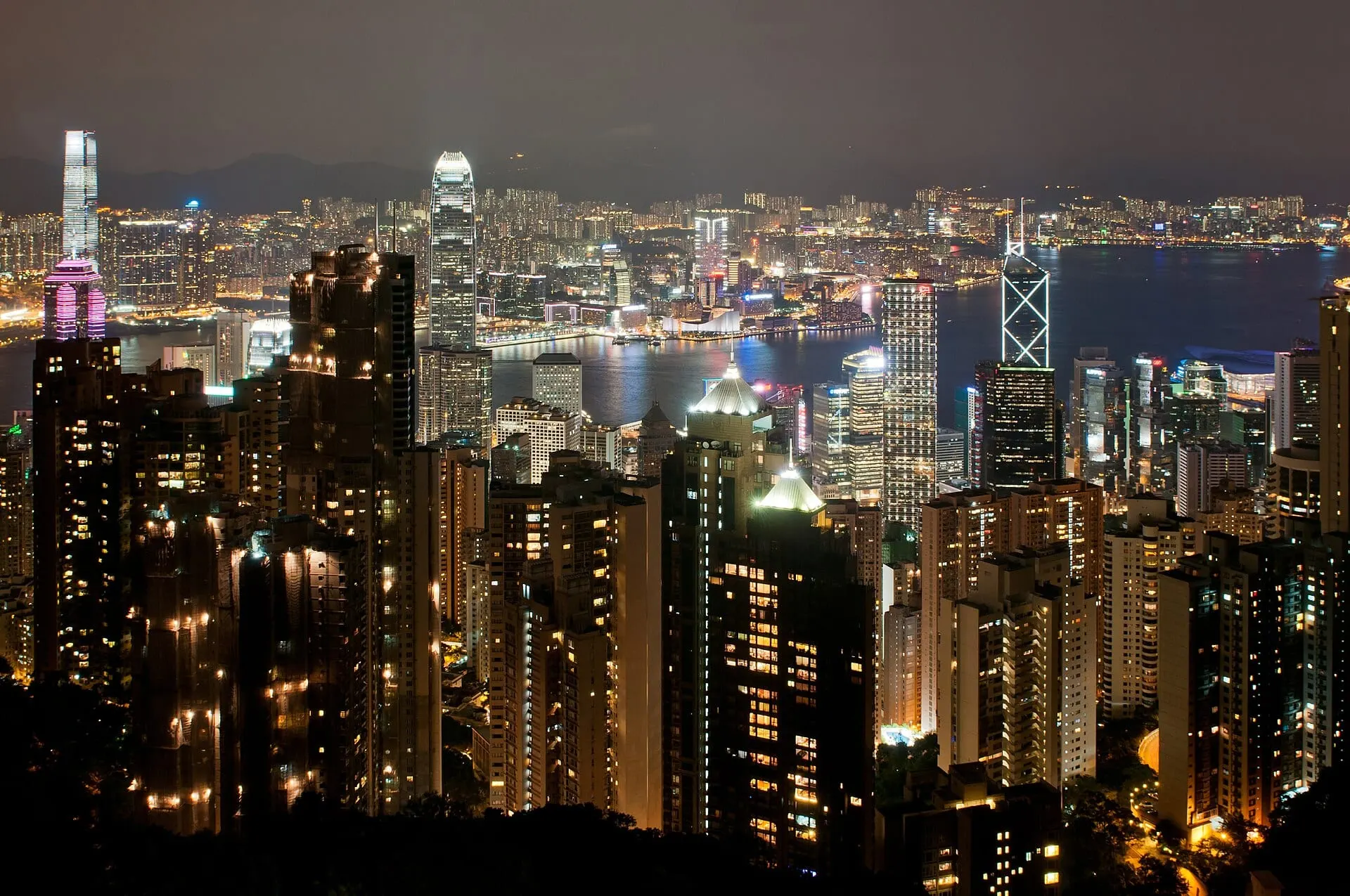
Victoria Peak (The Peak)
The 552-metre summit above Central, with the postcard skyline and harbour panorama. Take the Peak Tram funicular up and the Sky Terrace 428 for the top view. Best at sunset and after dark.
Wikimedia Commons · CC-BY-SA
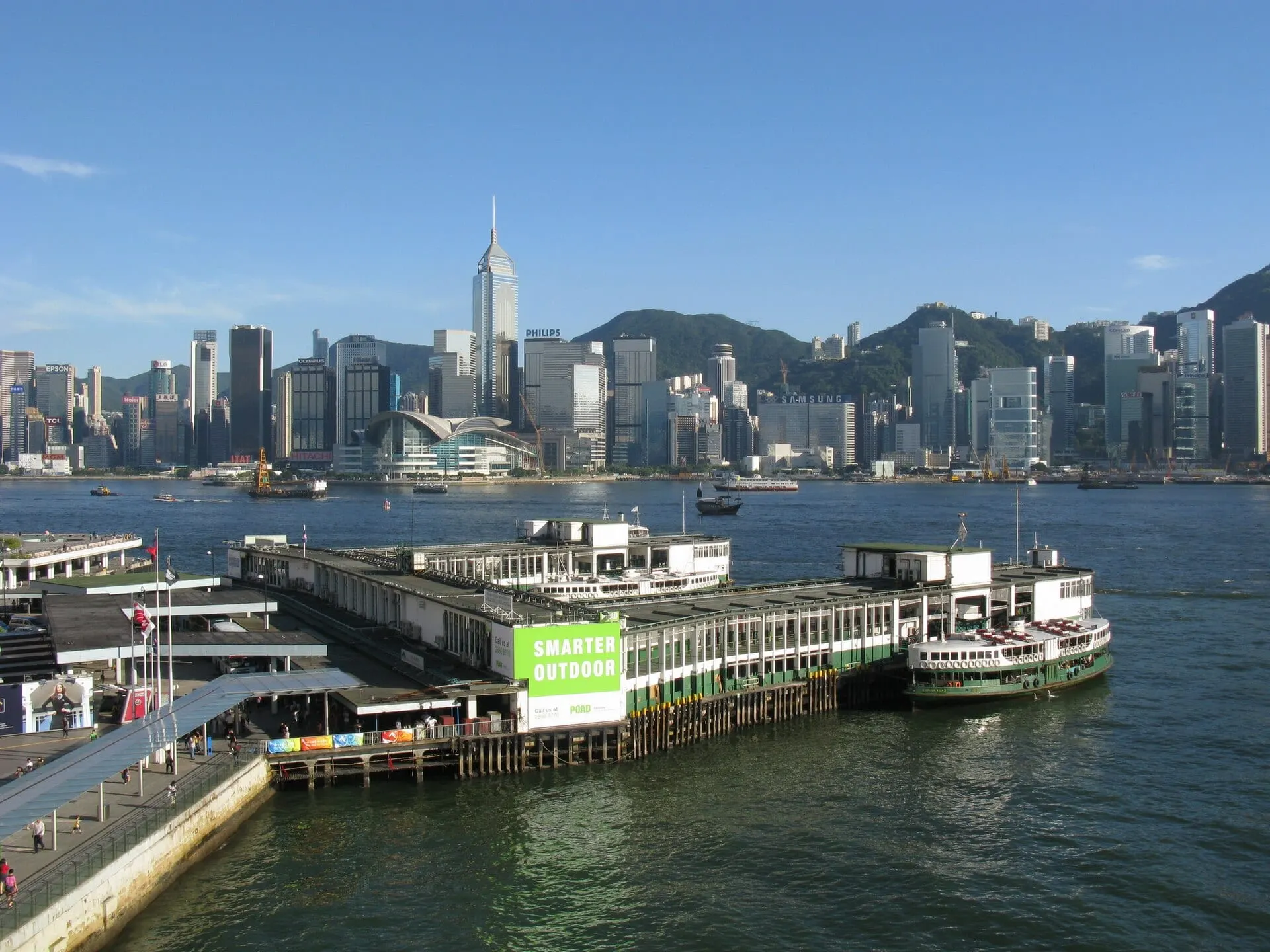
Star Ferry
The green-and-white double-deck ferry that has crossed Victoria Harbour since 1888. The 10-minute Central-to-Tsim Sha Tsui run is one of the best-value boat rides on earth (HK$5). Best at dusk.
Wikimedia Commons · CC-BY-SA
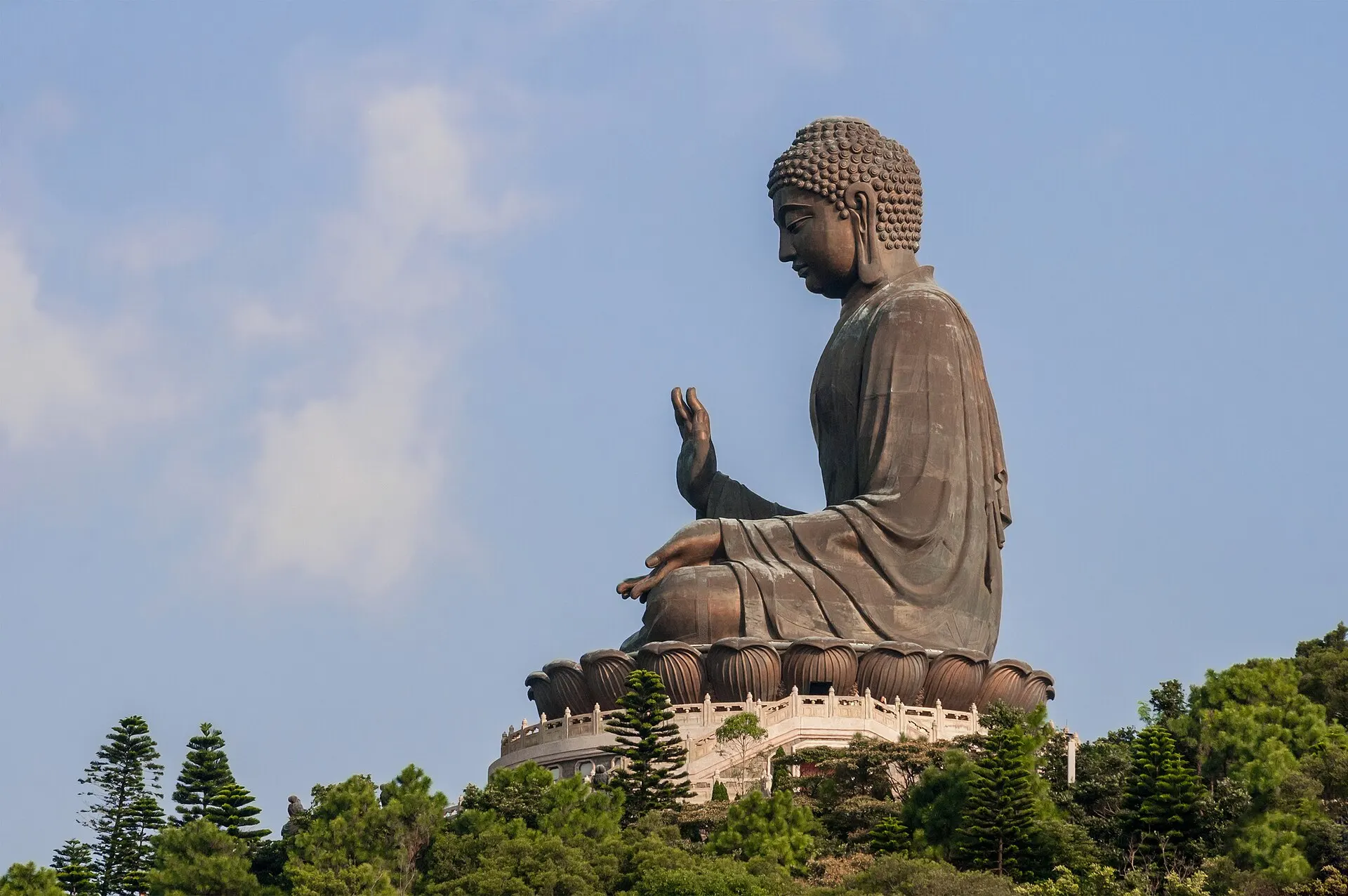
Tian Tan Buddha (Big Buddha)
A 34-metre seated bronze Buddha on a Lantau Island hilltop, reached by the Ngong Ping 360 cable car. Climb 268 steps to the base. Day trip from the city.
Wikimedia Commons · CC-BY-SA
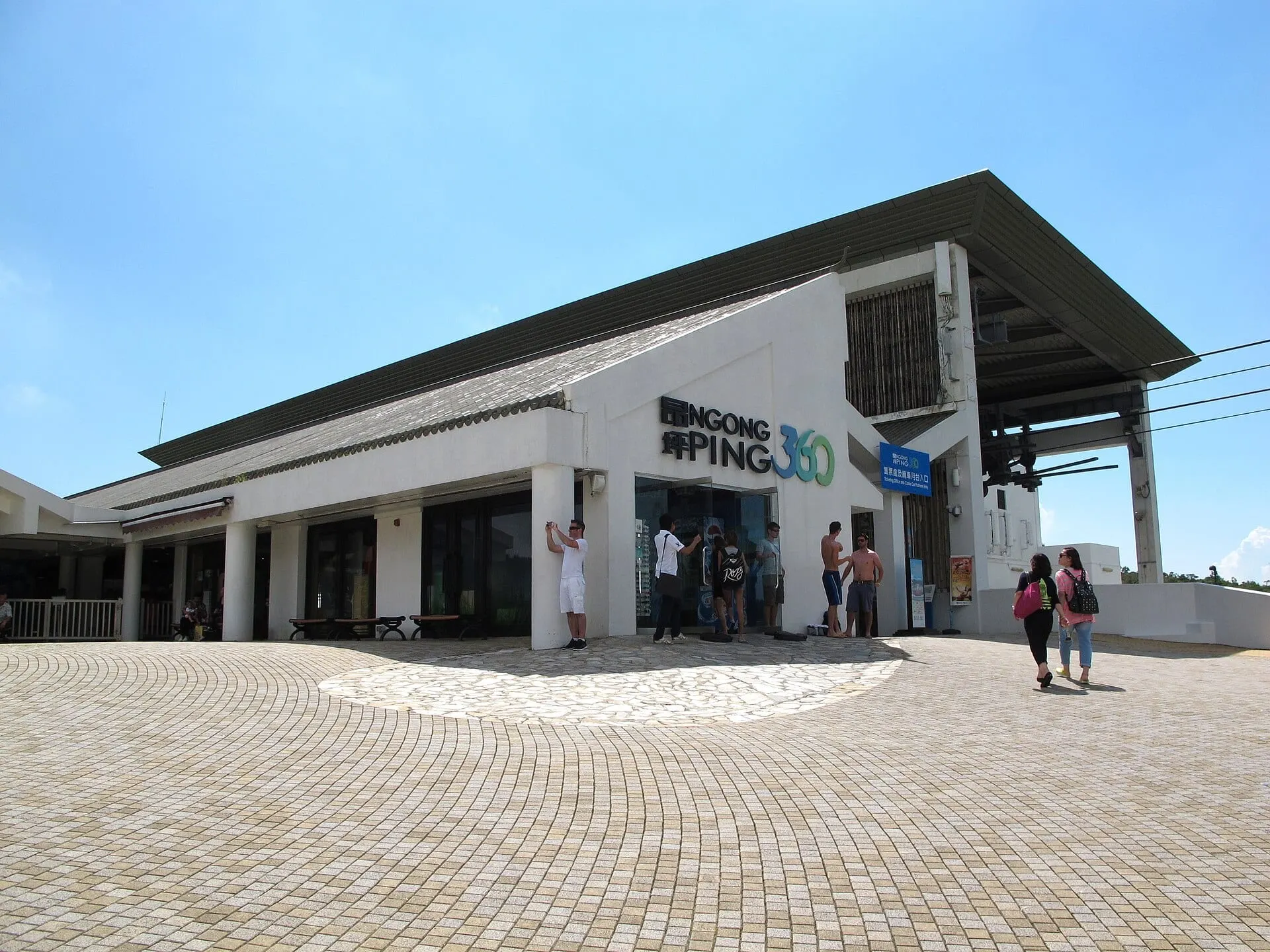
Ngong Ping 360 Cable Car
A 25-minute gondola ride from Tung Chung up over the South China Sea and Lantau peaks to the Big Buddha. Book the crystal cabin with the glass floor for the views.
Wikimedia Commons · CC-BY-SA
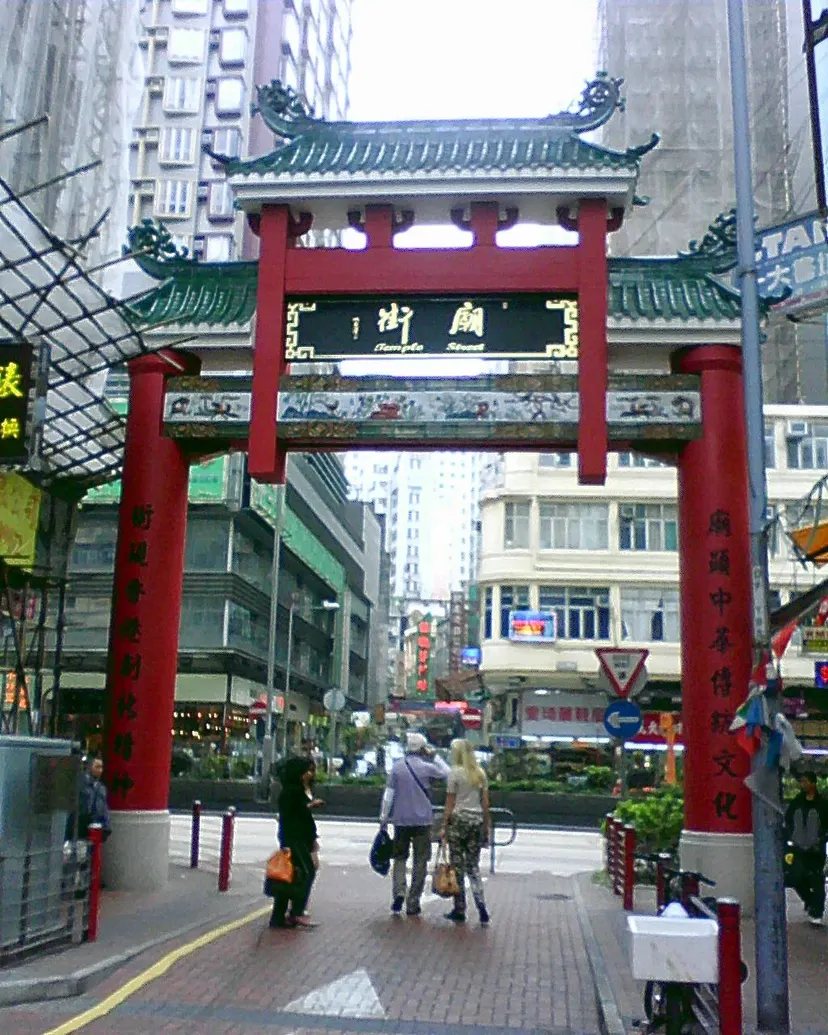
Temple Street Night Market
Kowloon’s atmospheric night market: fortune tellers, Cantonese opera, street food (claypot rice, oysters), knock-off goods, and neon. Best after dark. Yau Ma Tei.
Wikimedia Commons · CC-BY-SA
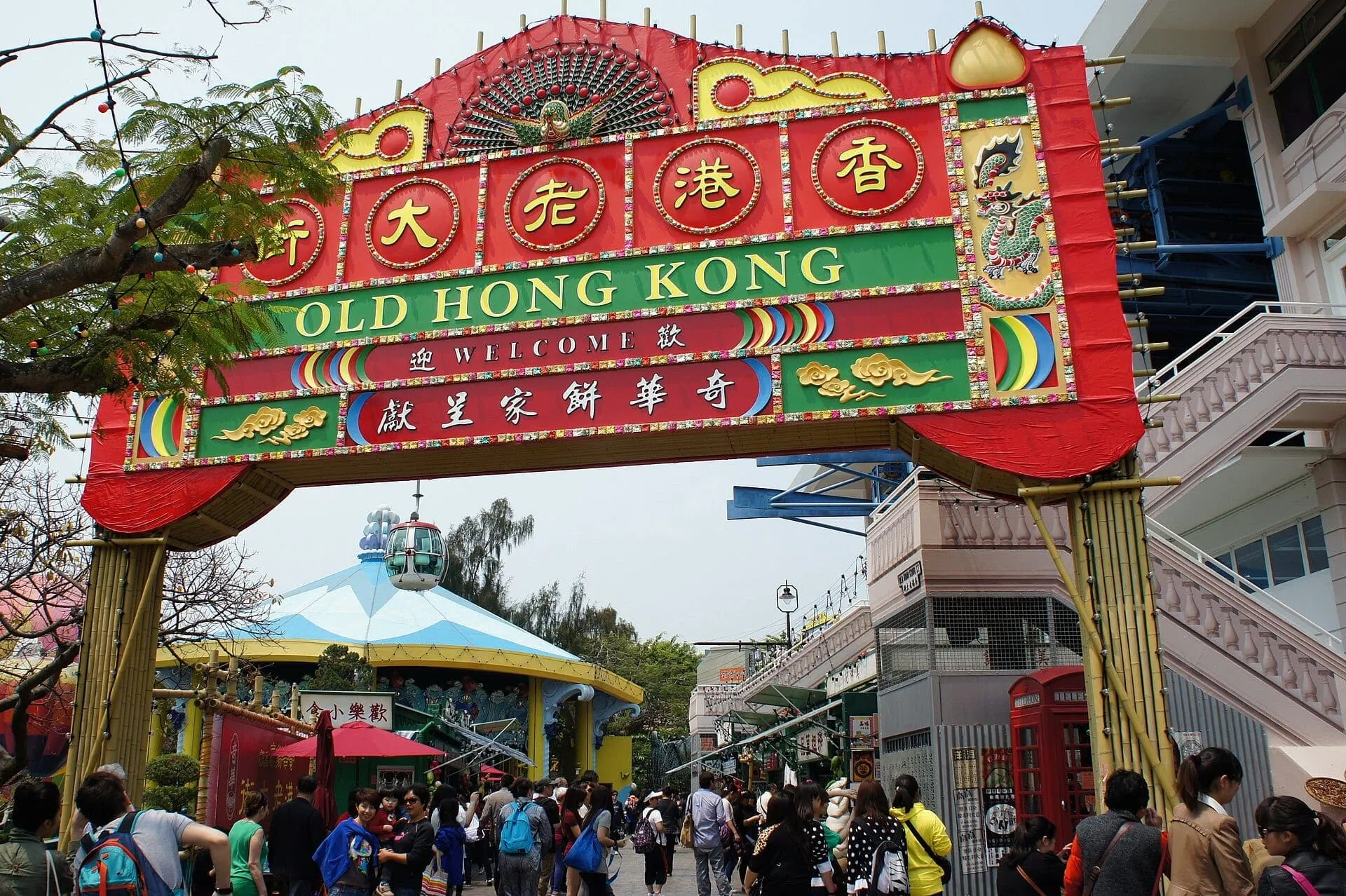
Ocean Park Hong Kong
A hillside-and-bay theme park with pandas, a giant aquarium, and cable cars over the sea. The local favourite over Disneyland. Aberdeen, south side.
Wikimedia Commons · CC-BY-SA
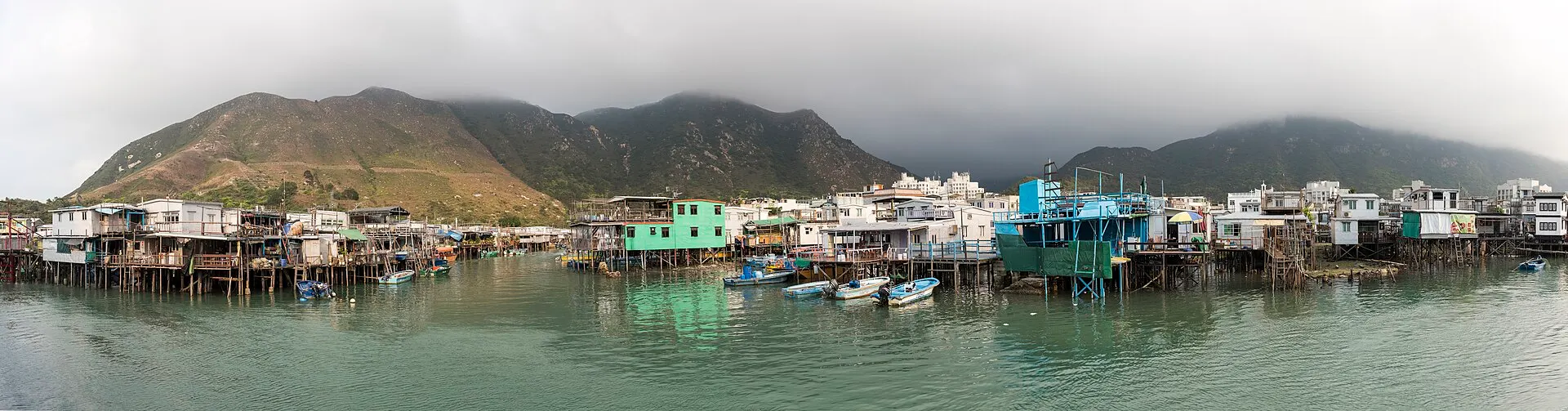
Lantau Island and Tai O Fishing Village
Hong Kong’s largest island: the Big Buddha, the Po Lin Monastery, and Tai O, a stilt-house fishing village where pink dolphins sometimes appear. Day trip.
Wikimedia Commons · CC-BY-SA
Dragon’s Back Hike
The most popular hike in Hong Kong — a ridge walk along the south side of Hong Kong Island with sea views, ending at Big Wave Bay. 2–3 hours, moderate. Bus 9 from Shau Kei Wan.
Wikimedia Commons · CC-BY-SA
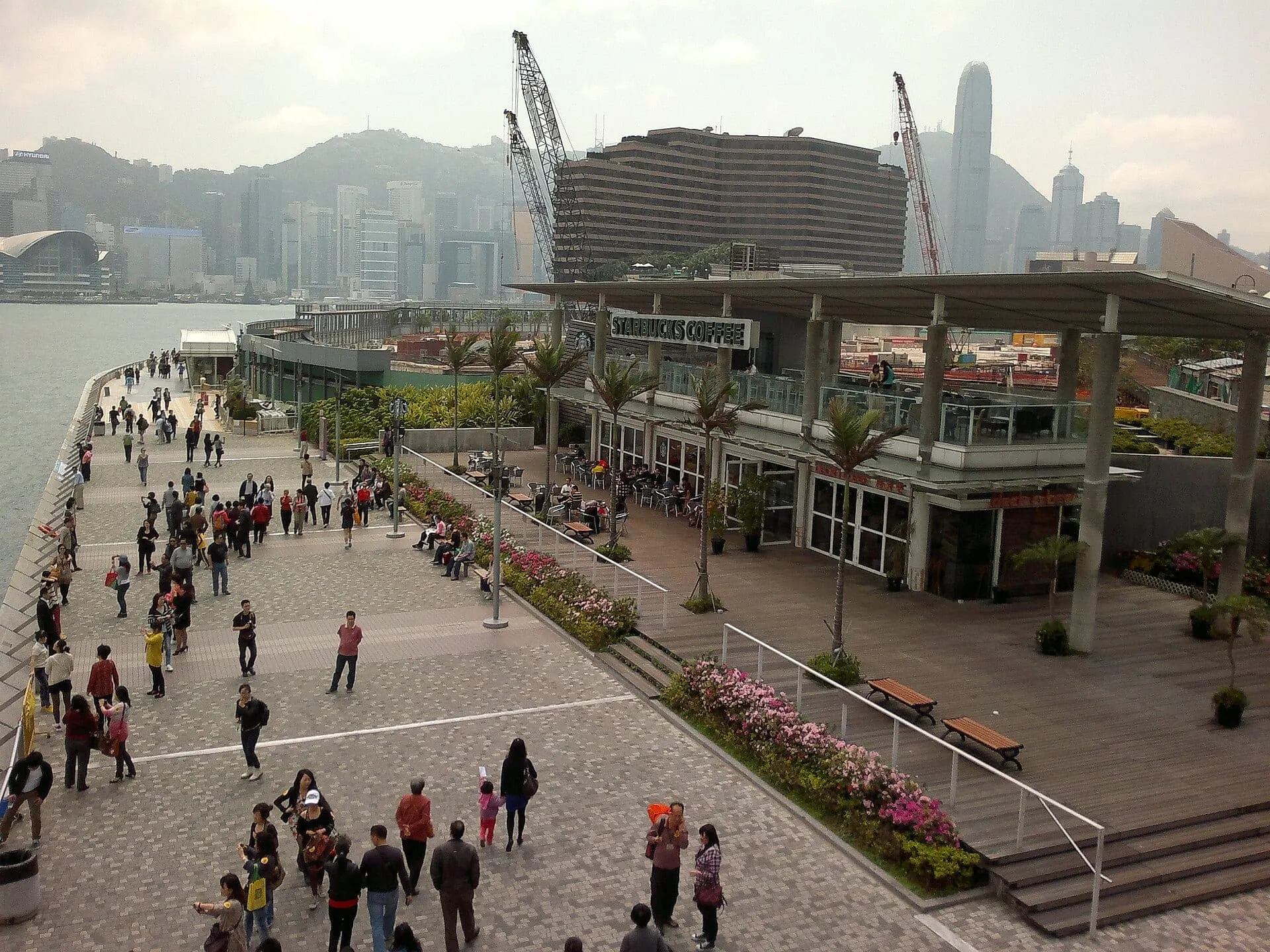
Avenue of Stars and Tsim Sha Tsui Promenade
The Kowloon-side waterfront walk with the best free view of the Hong Kong Island skyline, a Bruce Lee statue, and the nightly 8 pm ‘Symphony of Lights’ show.
Wikimedia Commons · CC-BY-SA
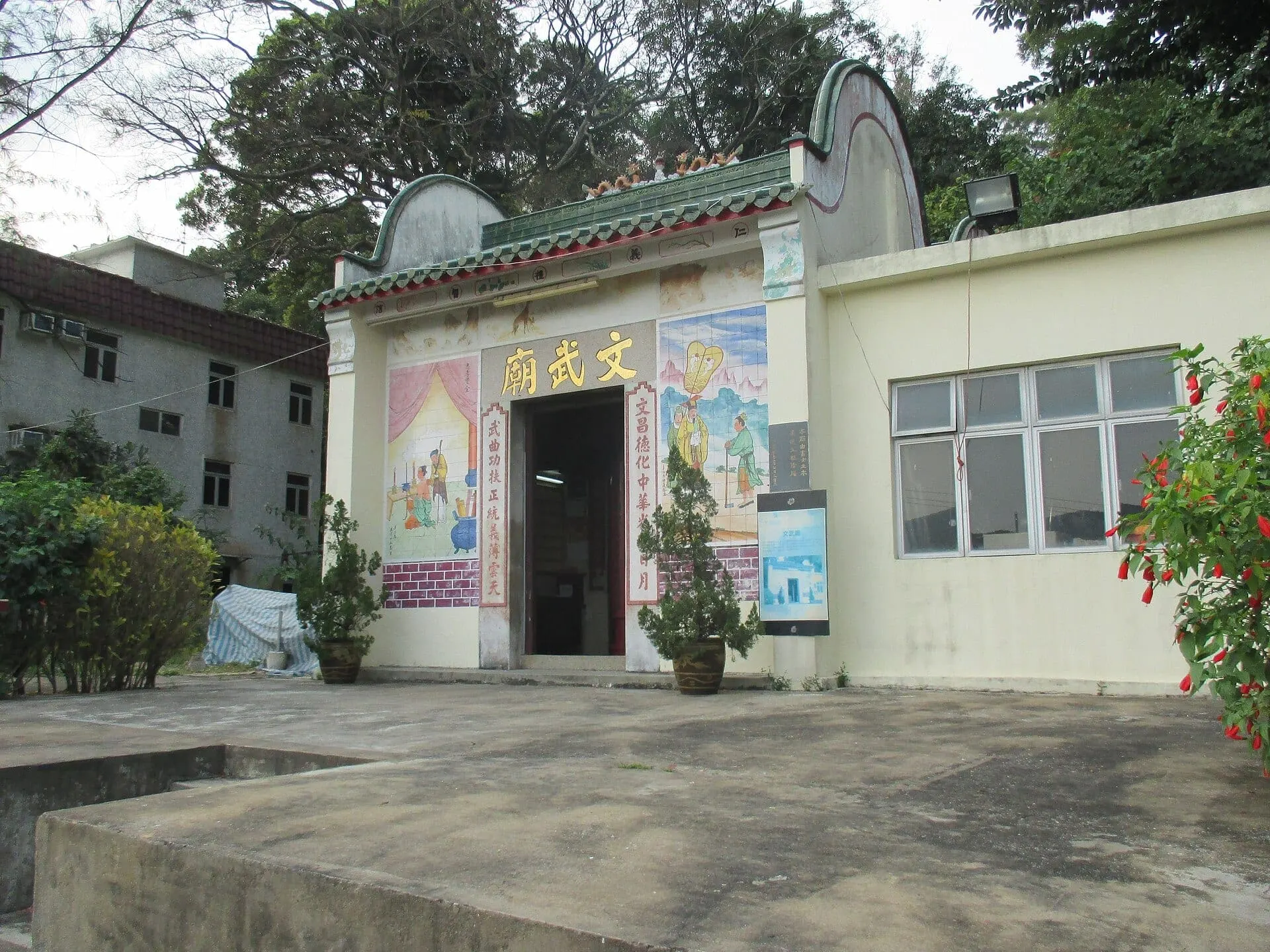
Man Mo Temple
An 1847 Taoist temple in Sheung Wan dedicated to literature and war, hung with giant incense coils. The oldest and most atmospheric temple on Hong Kong Island. Free.
Wikimedia Commons · CC-BY-SA
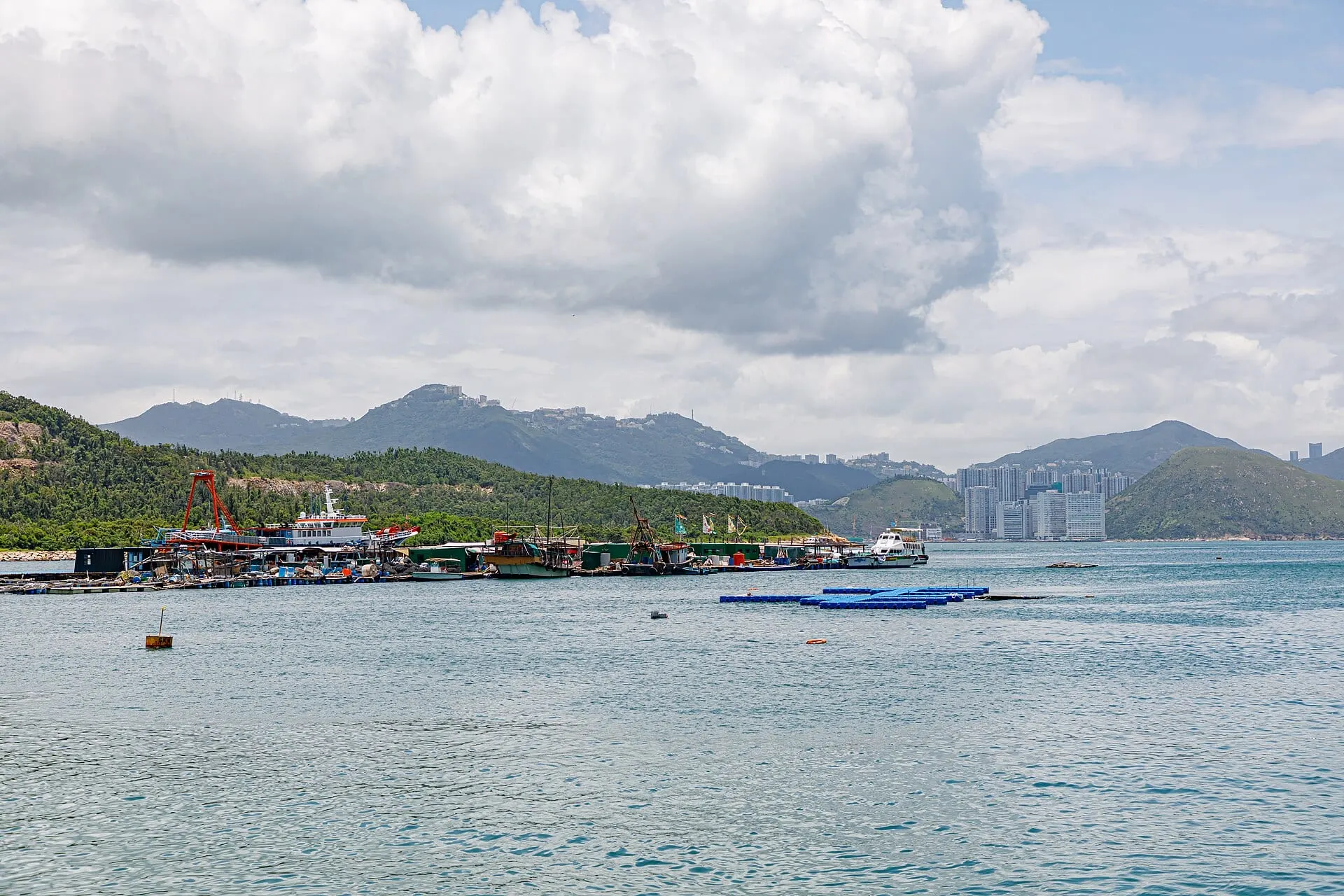
Lamma Island
A car-free island 30 minutes by ferry from Central, known for seafood restaurants at Sok Kwu Wan, a relaxed hippie vibe at Yung Shue Wan, and the easy Family Trail between them. Day trip.
Wikimedia Commons · CC-BY-SA
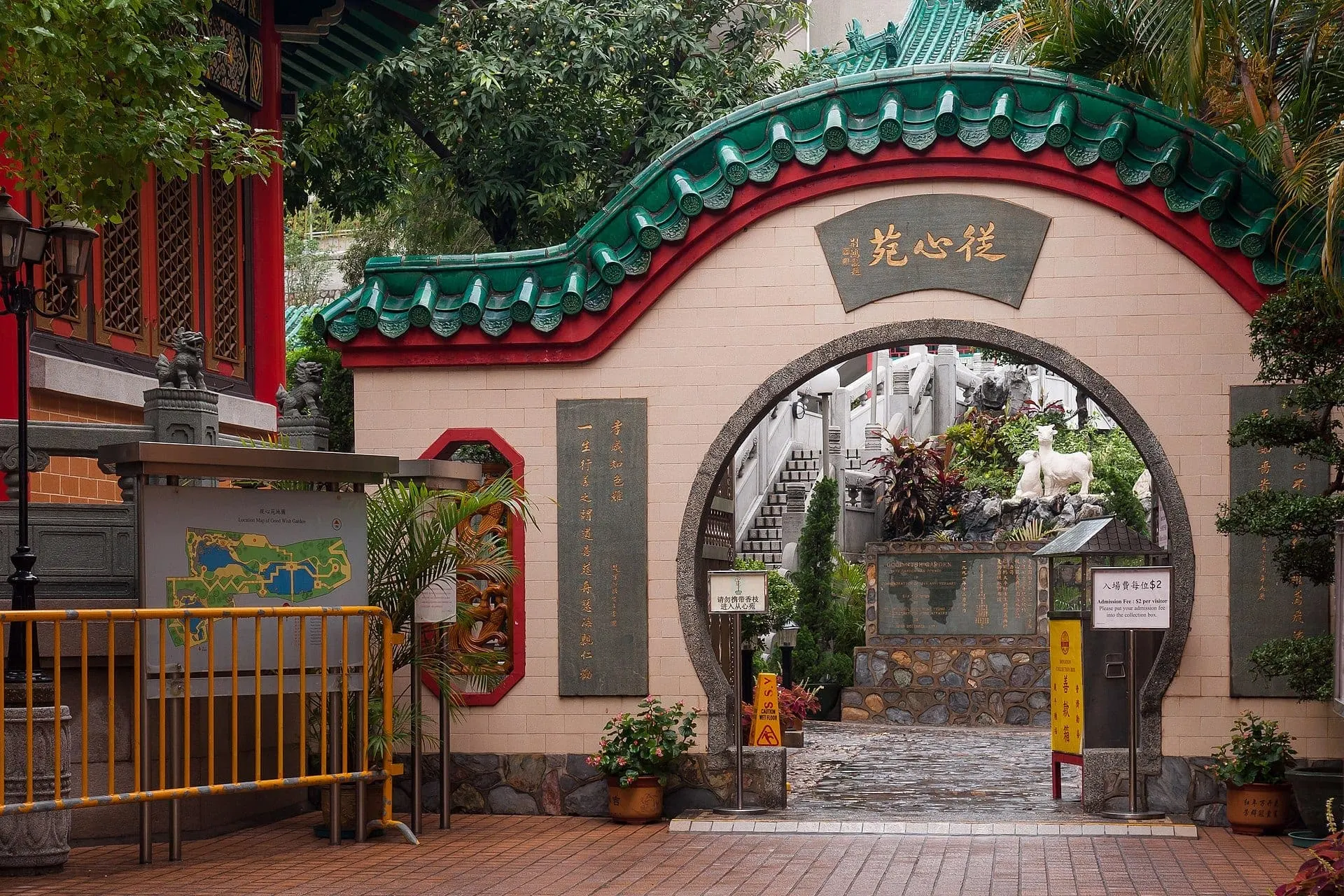
Wong Tai Sin Temple
A vast, colourful temple in Kowloon where locals come to shake bamboo fortune sticks (kau chim). One of the most active and photogenic temples in the city. Wong Tai Sin MTR.
Wikimedia Commons · CC-BY-SA
STAY
Where to stay in Hong Kong
Pick a base that matches the trip you want — imperial-central for sightseeing, hutong belt for character, Chaoyang for nightlife, or Qianmen for budget.
Central (and SoHo)
The financial core and the bar-and-restaurant hill — the urban adult Hong Kong.
#centralTsim Sha Tsui (TST)
The Kowloon side — skyline view of HK Island, museums, the Avenue of Stars.
#tsim-sha-tsuiMong Kok
Dense, neon, the most Hong-Kong-y neighborhood — street markets and dai pai dong.
#mong-kokShek O (Southside beaches)
A small beach town on the south side of the island — escape from the urban density.
#shek-o
Problems travelers hit in Hong Kong
- Why is my Alipay not working?You linked a foreign Visa or Mastercard to Alipay but every transaction is rejected at the merchant.
- My China visa was denied — what now?Your L visa application was refused at the Chinese consulate and your trip is in 2–4 weeks.
- My passport was lost or stolen in China — what do I do?Your passport is gone (theft or loss) and you're in mainland China without travel documents.
- Why can't I book on 12306 with my foreign card?You tried to book a high-speed rail ticket on 12306.cn and your foreign Visa/Mastercard is rejected at checkout.
- Why is my VPN not working in China?You arrived in China, opened your VPN, and it will not connect at all or connects but no traffic loads.
- Why can't I book a Tibet trip on my own?You try to book Lhasa flights and hotels yourself but the booking fails, or you're turned away at the Lhasa airport without a permit.
Decisions Hong Kong informs
- Is Hong Kong worth adding to a mainland China trip?Yes if you have 2+ days and want a decompression zone; Hong Kong counts as a "third country" for 240-hour transit re-entry.
- Shanghai or Hong Kong — which for a first visit?Pick Hong Kong if English-only matters or you have ≤4 days; pick Shanghai for the "real China" first-timer experience.
Compare Hong Kong with
Book activities in Hong Kong
These are licensed tour operators and booking platforms we've vetted independently. Booking through these links may earn us a commission — see our affiliate disclosure. This never affects our editorial recommendations or the price you pay.
Frequently asked questions
How many days do I need in Hong Kong?
Do I need a visa for Hong Kong?
Is Hong Kong expensive?
Do I need a VPN in Hong Kong?
Can I day-trip to Macau from Hong Kong?
What is the Octopus card and do I need one?
Show all 48 FAQs
Is Hong Kong safe for tourists?
What is the best time of year to visit Hong Kong?
How do I get from the airport to the city?
What should I pack for Hong Kong?
Can I use my phone and apps normally in Hong Kong?
Is Hong Kong a good base for visiting mainland China?
What is the Symphony of Lights and when is it?
What is the best area to stay for a first-time visitor?
Can I use Alipay or WeChat Pay in Hong Kong?
What is the Peak Tram and is it worth it?
What is the best dim sum restaurant for a first visit?
Is it safe to drink tap water in Hong Kong?
What is the Lantau Island Big Buddha cable car experience like?
How accessible is Hong Kong for travellers with disabilities?
Is the Star Ferry cheap enough that I should ride it multiple times?
Should I visit Hong Kong Disneyland if I have been to the other Disney parks?
How do I get from Hong Kong International Airport to downtown quickly?
What is the best itinerary for one day in Hong Kong?
What apps should I download before arriving in Hong Kong?
What is the cheapest way to see Hong Kong’s skyline?
Is Hong Kong a good destination for short layovers?
How do I get from Hong Kong to Macau for a day trip?
What is the best time to see the Symphony of Lights?
What are the best local crafts and products to buy in Hong Kong?
What is the best time of year for outdoor activities in Hong Kong?
What is the difference between Hong Kong Island and Kowloon?
What is the best way to plan a Hong Kong trip with kids?
Is English widely spoken in Hong Kong?
What souvenirs should I buy in Hong Kong?
What is the difference between a Hong Kong stop and a Hong Kong trip?
How is the street art and creative scene in Hong Kong?
What is the best day trip from Hong Kong to a Chinese mainland city?
What are the best ways to see Hong Kong at night?
What is the West Kowloon Cultural District, and is it worth a half-day?
What is the best dim sum for non-Cantonese speakers?
Is Hong Kong worth visiting?
How many days should I spend in Hong Kong?
Is Hong Kong expensive?
Is Hong Kong safe for tourists?
Do I need a visa for Hong Kong?
Can I pay with Alipay in Hong Kong?
What is the best time to visit Hong Kong?
References
- Hong Kong Tourism Board — Discover Hong Kong
- Hong Kong Immigration Department — Visa Requirements (IMMD)
- MTR Corporation — Subway and Airport Express
- Ngong Ping 360 — Lantau Cable Car
- Wikipedia — Hong Kong
- UK Government — Hong Kong Travel Advice
- TurboJET — Hong Kong to Macau Ferries
- Agriculture, Fisheries and Conservation — Hong Kong Hiking Trails

Related guides & destinations
Guide
3 Weeks in China: The Grand Tour (Beijing to Hong Kong) 2026
A comprehensive 21-day China grand tour covering Beijing (4), Xi’an (3), Chengdu (3), Guilin/Yangshuo (3), Shanghai (3), and Hong Kong (2),
Guide
Best Dim Sum in Hong Kong 2026: 10+ Tim Ho Wan, Lin Heung, Lung King Heen & The Dim Sum Hall of Fame
Hong Kong is the world’s dim sum capital. This guide covers 12 spots from the cheapest Michelin-starred Tim Ho Wan to 3-star Lung King Heen,
Guide
How We Research 2026: NihaoVisit’s Methodology for China Travel Information
How NihaoVisit sources, verifies, and maintains 700+ pages of China travel information — our source hierarchy, fact-checking process, update
Guide
Fact-Checking Log 2026: Verified China Travel Information — NihaoVisit
A public log of fact-checking verification passes on NihaoVisit, showing what was verified, when, and against which sources — covering visa
Guide
Best Time to Visit China 2026: Month-by-Month Weather, Crowds, and Prices
The best time to visit most of China is April–May and September–October. Winter (Dec–Feb) is cold but cheap; summer (Jun–Aug) is hot and cro
Guide
VPN for China 2026: Which VPNs Work, eSIM Alternatives, and the Complete Pre-Trip Checklist
Most Western apps and websites are blocked in mainland China. A reliable VPN is essential for Google, Gmail, WhatsApp, Instagram, and most n