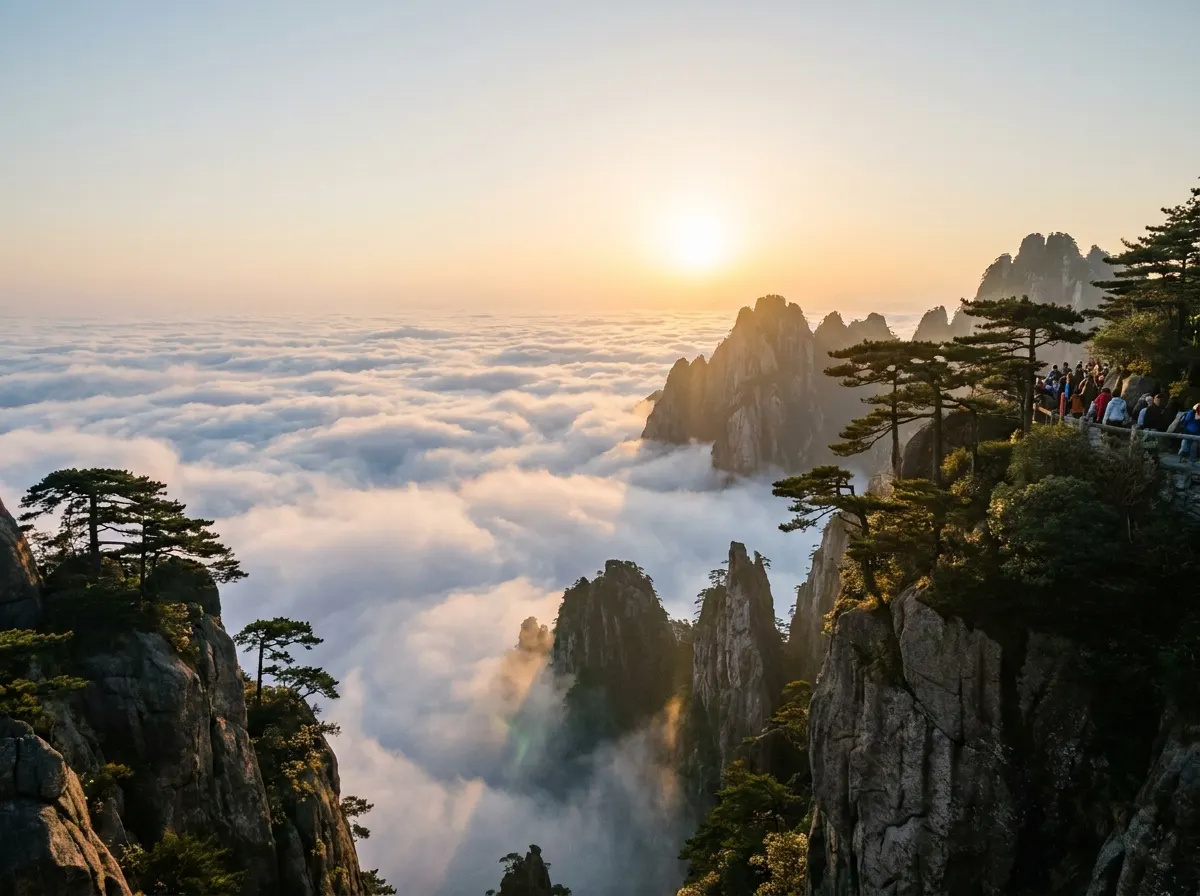
Huangshan (Yellow Mountain)
Huangshan ("Yellow Mountain") in Anhui province is a UNESCO site famous for its granite peaks, "sea of clouds" (sunrise above the clouds), and ancient pine trees clinging to cliffs. The 1,864m Lotus Peak is the highest. Plan 2-3 days: take a cable car up, stay overnight on the summit, watch sunrise, then descend to the Hongcun and Xidi ancient villages. Best months: April-May, September-November. Avoid weekends and Golden Week.
Why Huangshan (Yellow Mountain) in 2026.
UNESCO World Heritage granite peaks. Sea of clouds, hot springs, and the pine trees that have inspired Chinese landscape painting for 1,000 years.
Quick Answer
Huangshan ("Yellow Mountain") in Anhui province is a UNESCO site famous for its granite peaks, "sea of clouds" (sunrise above the clouds), and ancient pine trees clinging to cliffs. The 1,864m Lotus Peak is the highest. Plan 2-3 days: take a cable car up, stay overnight on the summit, watch sunrise, then descend to the Hongcun and Xidi ancient villages. Best months: April-May, September-November. Avoid weekends and Golden Week.
| Best time to visit | April-May and September-November for the best cloud views |
|---|---|
| Daily budget | $50 (backpacker) / $130 (mid-range) / $350+ (luxury) |
| Language | Mandarin (Anhui dialect; English limited, signage helps) |
| Currency | CNY (¥) — cash useful for village restaurants |
| Time zone | China Standard Time (UTC+8) |
| Last updated | 2026-06-16 |
Want a Huangshan (Yellow Mountain) plan built for you?
How do I plan a Huangshan trip?
Three days is the minimum for a complete Huangshan experience. Day 1: Arrive in Huangshan City or Tangkou Town, then visit Hongcun village in the afternoon. Day 2: Take the shuttle bus and cable car up the mountain, hike to your summit hotel, and watch sunset from a viewpoint. Day 3: Wake before dawn for the sunrise hike (Lion Peak or Bright Summit), descend by cable car, and visit Xidi village on the way back. Add a fourth day for the hot springs at the foot of the mountain if you want a slower pace. Book summit accommodation one to two months ahead in peak season, because rooms sell out quickly. Budget roughly $90-180 per day mid-range including lodging, meals, transport, and tickets — re-check prices before booking. A common four-day plan front-loads travel on day one (arrive Huangshan City, taxi to Tangkou, drop heavy bags at your base hotel, light Hongcun stroll), reserves day two for the mountain ascent and sunset, day three for sunrise and a summit loop (Bright Summit to Flying Rock to Beihai), and day four for Xidi and a leisurely Tunxi Old Street walk before the return train. Reverse this order if your train departs in the morning. Travelers who skip the overnight summit and day-trip the mountain usually regret it: the round-trip cable car plus a long summit loop still eats eight to ten hours, the last cable car descends by 17:30 in most seasons, and the sunrise — the single best Huangshan experience — is impossible without staying on top. Plan the overnight. The single most common planning mistake is booking only one summit night and then losing the sunrise to weather. Build a 25% buffer: schedule two consecutive nights on the summit if your calendar allows, so a clouded-out first sunrise gets a second chance. Another common mistake is booking a base hotel in Tangkou thinking it saves money; it does, but it also eliminates the sunrise and forces a long cable-car queue. Last practical detail: the mountain is in the East China Time zone, but the body-clock effect of a pre-dawn wake-up and a 10°C summit temperature drop is real. Budget a recovery afternoon in Huangshan City on the day you descend.
What is the sea of clouds?
The "sea of clouds" (云海, yúnhǎi) is a weather phenomenon where clouds settle below the granite peaks, making the mountains appear to float above a white ocean. It forms most often in spring (April-May) and autumn (September-November) after a rain system clears and cold air traps moisture in the valleys. Sunrise above the clouds is the well-known Huangshan photograph. Probability runs 50-70% on clear days in good seasons and drops near zero in summer stable weather or dry winter stretches. The effect is most dramatic from high viewpoints such as Bright Summit, Lion Peak, and Beginning-to-Believe Peak. Local hotels post a next-day forecast at the front desk so you can set your alarm correctly. The phenomenon requires three conditions to converge: a temperature inversion that traps moist air in the valleys, light wind to keep the cloud layer stable, and a clear sky above the peaks so the rising sun can illuminate the cloud tops from the side. Forecasters rate each day on a five-point cloud-sea index. Front desk staff brief guests at 20:00 with the next morning's probability and the recommended viewing point. Bring a tripod and a slow shutter speed: the cloud layer moves visibly across a 30-second exposure, producing the dreamlike flowing mist that defines Huangshan postcards. Pack a lens cloth and a plastic bag for your camera, because humidity condenses on cold metal the moment you step outside. There is a secondary phenomenon that visitors sometimes confuse with the cloud sea: rime ice (雾凇), which forms on the pines in winter when supercooled fog freezes on every branch, turning the trees into glass sculptures. Rime ice days follow a clear cold night with high humidity; they are not predictable three days out but the front desk will know by 18:00 the night before. The two phenomena together — a low cloud sea and rime-ice pines at dawn — produce the most photogenic Huangshan mornings of the year. If you hear the front desk announce "tomorrow morning, rime ice," set two alarms. The prime viewing windows are 05:00-06:30 for sunrise and 16:30-17:30 for sunset; both are when the sun rakes across the cloud layer at a low angle and reveals the texture of the waves below.
Where should I stay on the mountain?
Three categories of lodging serve summit visitors. Summit hotels (¥800-2,500 per night, roughly $110-350) sit closest to the sunrise viewpoints and fill first; examples include Beihai, Xihai, and Paiyunlou. Mid-mountain hotels cost less but add 30-45 minutes to your pre-dawn hike. The budget option is a base hotel in Tangkou Town, which limits you to a single long day on the mountain and removes the sunrise experience. Most travelers stay exactly one night on the summit and descend the next morning. Book early through Trip.com or the official Huangshan Tourism site, and expect shared bathrooms at lower price points. Bring snacks, since summit restaurant meals run high. The Beihai hotel cluster is the most popular for first-time visitors because it sits within 15 minutes' walk of Lion Peak, Beginning-to-Believe Peak, and the start of the West Sea Grand Canyon loop. Paiyunlou (白云宾馆) is the closest hotel to Bright Summit, the highest sunrise platform. Xihai Hotel is the newest and quietest, with renovated rooms and reliable hot water — a real advantage after a freezing pre-dawn walk. Room types are tightly standardised: a "standard" twin is 14-18 square meters with one double or two single beds, a kettle, and a small TV. Suites and triple rooms exist but are rare in peak season. WiFi is patchy above 1,600 m, and power outlets may be limited; bring a charged power bank. Heat runs from mid-October to mid-April, and some older hotels do not have air conditioning because summer summit temperatures rarely exceed 22°C. Dining at summit hotels is functional rather than memorable. Buffets run ¥120-180 at dinner for Chinese and Western staples (rice, dumplings, noodles, fried eggs, a couple of vegetable dishes), and a la carte is rarely worth the price. The smarter move is to bring instant noodles, chocolate, jerky, and energy bars from the convenience stores in Huangshan City or Tangkou; the summit hot-water taps work all night. Vegetarians will struggle outside the buffet. Porters are available at the base of each cable car for ¥50-100 per piece of luggage — worth it if you are carrying more than a 30-litre pack. The mountain enforces a hard check on the cable cars for oversized luggage; small overnight packs slide in fine, but anything bigger than 22 inches will be turned away.
Which cable car should I take?
Three cable cars serve the mountain, and the choice affects your route. Yuping Cable Car (Jade Screen) lands closest to the summit hotels and the famous Welcoming Guest Pine, making it the most popular ascent — arrive by 8 AM to avoid 30-60 minute lines after 10 AM. Taiping Cable Car on the north side sees fewer crowds and pairs well with a descent via Yuping. Yungu Cable Car serves the eastern trails and works as an alternative descent to avoid backtracking. Round-trip cable car tickets cost roughly ¥170-240 ($24-34) per person depending on the route; re-check current pricing on the official site. Most first-time visitors ascend via Yuping and descend via Yungu or Taiping. Cable cars shut down in high winds (typically above 50 km/h gusts) and during electrical storms, so always have a Plan B involving the on-foot routes. The most popular on-foot route is the "eastern steps" trail from Ciguang Pavilion to the summit, a 7.5 km, 3-4 hour climb used historically by scholars and now mostly by fit hikers. The western steps trail is shorter but steeper. Both trails require proper hiking shoes, water, and rain gear. Cable car queues on weekends in October and on national holidays can exceed 90 minutes; buying a combined "ticket plus cable car" pass online seven days ahead gives you a dedicated entrance lane and saves real time.
How fit do I need to be for Huangshan?
Moderate fitness is required, but cable cars remove the steepest 1,000-plus steps. Once on top, trails between viewpoints involve rolling stone stairs — some sections climb 200-400 steps at a stretch. The Bright Summit (光明顶) is the most accessible highlight and reachable by a gradual paved path. The West Sea Grand Canyon (西海大峡谷) is the most demanding loop, with narrow steps carved into cliffs; allow three to four hours and skip it in rain or ice. Travelers with knee issues should bring walking sticks (rental ¥5 at the base) and consider descending by cable car rather than hiking down. Children aged seven and up usually manage the summit trails with breaks. Pace yourself: the most common mistake is racing the first two hours of trail and bonking on the second day. Plan a 15-minute rest every hour, carry at least one liter of water per person, and accept that you will not cover every viewpoint in a single summit overnight — pick two or three highlights (Welcoming Guest Pine + Bright Summit sunrise + West Sea Canyon loop) and skip the rest. Altitude is not the issue; the issue is the volume of stair climbing. Most summit trails are equivalent in load to climbing 30-50 floors of stairs over a four-hour hike. People who do not exercise regularly often complete the easier routes but report sore knees for two days after. Bring elastic bandage wraps and ibuprofen.
When is the best season to visit Huangshan?
Spring (April-May) and autumn (September-November) offer the best balance of weather, cloud probability, and comfortable temperatures. Summer (June-August) brings heat, thunderstorms, and peak domestic crowds, especially during school holidays. Winter (December-February) delivers snow-covered pines and few visitors, but ice closes some trails and summit temperatures can drop to -15°C; bring crampons. Avoid the two Golden Week holidays (early October and late January/early February for Lunar New Year) when domestic tourism surges and hotels double in price. Weekdays in shoulder seasons give the best experience for photography and quiet trails. April is the favourite of repeat visitors because rhododendrons bloom across the middle elevations, the cloud sea peaks in late morning, and the sun is gentle enough for long summit loops. October is the other standout month: autumn foliage sets the valleys on fire, and the post-National-Day crowd tapers after the 7th. Photographers should target the second and third week of October and the last week of April. Summer is workable but humid: the sea of clouds forms less often, afternoon thunderstorms roll in by 15:00, and the cable car queues at the Yuping entrance can exceed 90 minutes. Winter is the sleeper pick for fit travellers who want solitude and snow-encrusted pines; bring crampons, gloves, and a down jacket, and confirm with your hotel which trails are open (the West Sea Grand Canyon and parts of the north entrance close in deep snow).
What are the Hongcun and Xidi ancient villages?
Hongcun and Xidi are UNESCO World Heritage villages dating to the Ming and Qing dynasties, located about 60-70 km from the Huangshan summit entrance. Hongcun (宏村) is famous for its South Lake mirror reflection and the 900-year-old water-channel system that runs through every courtyard. Xidi (西递) is quieter and showcases intricate stone carving on merchant mansions. Each village charges roughly ¥104 ($15) entry and needs two to three hours to explore. Most visitors pair one village with the day before or after their summit trip. Hongcun is more photogenic and more crowded; Xidi is calmer and better for architecture lovers. Both are walkable and flat, offering relief after the mountain. Hongcun was laid out in the shape of an ox: the main water channel is the "ox intestine," the South Lake is the "ox stomach," and the four corner bridges are the "ox legs." The system still functions: water from the nearby Jiyin Spring runs through every home, past the doorsteps of 140 households, and exits through an underground canal. Early morning (07:00-08:30) is the best time to photograph South Lake, when the mirror reflection is glassy and the village is still. Xidi was built by the Hu clan, descendants of the last Tang-dynasty emperor, who settled here in the Song dynasty. Look for the "stone relief wall" near the village entrance: 32 carved slabs depicting historical scenes, each finer than the next. Local B&Bs in both villages let you wake inside the scene; book a courtyard room two months ahead for peak October weekends.
How do I get to Huangshan from major cities?
High-speed rail is the most practical route. Huangshan North Station (黄山北站) connects to Shanghai Hongqiao in roughly 2.5-3 hours (¥180-250), to Hangzhou in about 1.5 hours, and to Beijing in about 5.5 hours with one transfer. From the station, a shuttle bus runs to Tangkou (the mountain base) in 50 minutes for about ¥30. Direct flights serve Huangshan Tunxi International Airport (TXN) from Beijing, Shanghai, Guangzhou, and a handful of other cities. Self-driving is possible but parking at the mountain base fills early in peak season. Buy rail tickets 1-2 weeks ahead, especially around holidays, via Trip.com or the official 12306 system. The "Huangshan North + bus" combo is faster door-to-door than flying for most Shanghai and Hangzhou origins once you count airport transfer, security, and the 70 km taxi from TXN to Tangkou. Nanjing South to Huangshan North is a popular three-hour HSR ride (¥200) that combines well with a broader Yangtze delta trip. From Huangshan North, a free airport-style shuttle loops to the city centre every 30 minutes, but the dedicated Tangkou coach is faster; buy the Tangkou ticket at the station tourist desk (window 4 or 5) before exiting. Travellers arriving very late (after 22:00) should overnight in Huangshan City and continue to Tangkou in the morning; the last Tangkou bus departs around 19:30. Taxis from the airport or station to Tangkou cost ¥150-200, agreed in advance.
What should I pack for Huangshan?
Pack for changeable mountain weather and steep stairs. Sturdy hiking shoes are mandatory — sneakers with grip work, sandals do not. Bring a rain jacket (weather shifts fast), warm layers (the summit runs 10°C cooler than the base), sun hat and sunscreen, two liters of water, high-energy snacks, a headlamp for the pre-dawn sunrise hike, and a walking stick. Avoid large backpacks; they are exhausting on stone steps and most summit hotel rooms are small. In winter add crampons, gloves, and a warm hat. A small power bank helps because cold drains phone batteries fast. Leave heavy luggage at your Tangkou or Huangshan City hotel and carry only an overnight pack up the cable car. The four most common packing regrets: (1) too-small daypack — you need 25-30 litres to fit a spare layer, water, snacks, and a camera; (2) cotton clothes — cotton absorbs sweat, then chills you at the summit; merino or quick-dry is far better; (3) no cash — small vendors on the summit, the walking-stick rental at the base, and village restaurants in Hongcun and Xidi often reject foreign cards; and (4) no headlamp with a red-light mode — the stone steps to the sunrise platforms are unlit, white headlamps dazzle other hikers, and red light preserves night vision for photography. Pack a thin plastic bag for your phone (sudden rain at the summit), a small towel, and toilet tissue — public summit restrooms are clean but do not stock paper. Sun protection matters more than most travellers expect: the UV index above 1,800 m is 30-40% higher than at sea level, and snow reflection in winter can cause sunburn in 20 minutes. Final tip: pack a small daypack rain cover, not just an internal dry bag. Summit rain is often horizontal and wind-driven; an uncovered pack wets every layer inside within 10 minutes.
How is Huangshan connected to Chinese landscape painting?
Yellow Mountain has been the single most influential subject in Chinese landscape painting for 1,000 years. Song-dynasty painters such as Guo Xi and the monk-painter Shike went to the mountain to draw its granite peaks, twisted pines, and sea of clouds, establishing the compositional vocabulary of "shan shui" (mountain-water) painting. Ming-dynasty artists like Shen Zhou and the individualist Shitao returned repeatedly, and the Welcoming Guest Pine appears in scrolls as early as the 14th century. The mountain taught Chinese painters three ideas that became standard: asymmetrical composition with a dominant peak, mist as a positive compositional element, and the human figure as a small, contemplative presence within a vast landscape. Visit the painting galleries in Tunxi Old Street and the Huizhou Museum in Huangshan City to see this lineage; the Huizhou Museum holds several Song- and Yuan-dynasty originals. The most accessible modern bridge is a one-hour calligraphy-and-ink class at the Cheng Daode Memorial Hall in Tangkou, where local artists will teach you to paint a single Huangshan peak in the traditional brush style.
What are the named pines of Huangshan?
The "Four Famous Pines" (黄山四名松) are the Welcoming Guest Pine (迎客松, the most famous), the See-Off Guest Pine (送客松), the Coiled Dragon Pine (盘龙松), and the Harp Pine (竖琴松). Botanically all are Pinus hwangshanensis, a pine species endemic to the mountain that grows laterally from vertical cliffs to maximize sunlight on the rock face. The pines are mostly 300-1,000 years old, with a few specimens dated by core samples to 1,500 years. The Welcoming Guest Pine, planted roughly in the late Tang dynasty, has its lateral branch supported by an iron rod (invisible from the front viewing platform) and is monitored continuously by the park service. There are also dozens of less famous named pines, each with a literary name. Visitors on the West Sea Grand Canyon loop pass the "Twin-Peak Pine," the "Black Tiger Pine," and the "Folding-Broom Pine." The best collection is along the 1 km of trail from Beihai to Beginning-to-Believe Peak, where a different named pine appears every 50-100 m.
What is the West Sea Grand Canyon loop?
The West Sea Grand Canyon (西海大峡谷) is the single most dramatic trail on the mountain, a 4-5 hour loop that descends 600 m into a granite gorge and climbs back out via the "Sky-Sea Staircase." The trail is closed in winter ice, after heavy rain, and during thunderstorms. The full loop combines a steep descent to the canyon floor, a one-way traverse through the "First Ring" and "Second Ring" of the canyon, and a 3 km return climb. Most visitors only do the "First Ring" (2 hours, 200 m vertical) and return the way they came. The full loop requires fit knees and good weather. Highlights: the "Magic Lantern" rock formation near the second ring, the views back toward Lotus Peak and Bright Summit, and the rare chance to see wild macaques, which forage at the canyon rim in the early morning. Carry at least 1.5 L of water per person, start before 10:00, and be back at the rim by 14:00 to allow for afternoon storms.
Why do the granite peaks look so distinctive?
The Huangshan peaks are the eroded roots of an 800-million-year-old seabed thrust upward by tectonic collision and exposed by 200 million years of weathering. The exposed granite developed three orthogonal joint systems (sets of parallel cracks), which is why the mountains fracture into vertical cliffs, columnar peaks, and rounded boulders rather than sharp ridges. Frost wedging split the original mass into 77 named peaks; chemical weathering then rounded the tops and bottoms, leaving the well-known "turtle-shell" or "ink-blob" silhouettes. The dark grey granite is interspersed with patches of moss and pine that thrive on the thin soils in the cracks. Geologists call the resulting landform "granite peak forest" (花岗岩峰林), and it is the defining feature of the UNESCO inscription. The same geological process created the rocky tors of the South China ranges and inspired the dramatic rock formations in classical Chinese gardens.
What is the best route to sunrise at Lion Peak?
Lion Peak (狮子峰) is the second-most-popular sunrise point, after Bright Summit, and the more dramatic of the two. The classic route starts at 04:00 from any Beihai-area hotel, walks 15-20 minutes on lit stone steps to the Lion Peak viewpoint, and watches the sun rise from behind the "Cool Pavilion" cliff face (清凉台). The light arrives first on the higher peaks — Bright Summit, Lotus Peak, and the Tiandu Peak ridge — and then sweeps down into the canyon. Arrive by 04:30 in spring and autumn; by 05:00 in summer; by 05:30 in winter. The 360° viewing platform at the peak is small and crowded; the smart move is to walk another 100 m to the "Dispel-Clearness Platform" (散花坞), which is quieter and has a clean line of sight to the eastern horizon. Bring a headlamp (the steps are unlit past the hotel cluster), gloves, and a thermos of hot water from the hotel. After sunrise, descend via the Beginning-to-Believe Peak loop, which is 4 km and three hours back to Beihai, with a detour to the famous "Mobile Pen Peak" (梦笔生花) rock formation.
What is the Hongcun water-channel system?
The 900-year-old water-channel system in Hongcun is a Ming-dynasty feat of hydraulic engineering designed by the village founder Wang Zhenxi and his feng-shui consultant. The total length is 1,200 m, and water flows from Jiyin Spring 1 km above the village through stone-lined channels past every doorstep, then exits underground at the lower end. The system has four uses: domestic water, fire suppression, microclimate cooling, and aesthetic reflection (the South Lake mirror). The channels are at a precise 0.3% gradient; if the gradient is disturbed by modern construction upstream, the entire system fails. The village committee maintains it with annual dredging. Visitors can walk the channel paths for free from the village perimeter; the "formal" ticket enters through South Lake, but the back streets that follow the water channels are free. Photograph the system early (07:00-08:00) when the water is still; the wind picks up by 10:00 and the reflections break up. The South Lake (南湖) half is the famous image; the North Lake (北湖) side is quieter and shows the channel crossings more clearly.
How did Huizhou merchants shape Anhui culture?
The Huizhou merchants (徽商) were one of China's four great merchant clans during the Ming and Qing dynasties, alongside the Shanxi, Cantonese, and Jiangnan (Suzhou) groups. They left the poor mountain valleys of southern Anhui as teenagers, apprenticed in pawnshops and salt warehouses across the empire, and returned home wealthy after twenty or thirty years. They then built the stone mansions, ancestral halls, and memorial archways that today make up the UNESCO Huizhou architecture. The merchant code emphasized frugality, education, and reinvestment: every Huizhou family was expected to fund sons through the imperial examinations, regardless of the cost, because official rank was the ultimate social insurance. A single successful scholar would lift the family for generations. The result is an unusual concentration of high-quality vernacular architecture in the mountain villages: every successful merchant built, every scholar decorated, and the merchant-scholar families intermarried. Walk through Hongcun, Xidi, Tangyue Memorial Archways, and Huizhou Ancient City to see this culture encoded in stone, wood, and brick carving. The stone relief work in Xidi, the carved brick in Tangyue, and the wooden lattice screens in Hongcun are all expressions of the same merchant wealth. The local cuisine, dress, and dialect also preserve the Huizhou identity.
How do I plan a 7-day Anhui trip around Huangshan?
A week in southern Anhui combines Huangshan with the broader Huizhou cultural landscape. Day 1: Fly or HSR to Huangshan; transfer to Tangkou, light Hongcun stroll. Day 2: Ascent via Yuping cable car, sunset at Beginning-to-Believe Peak. Day 3: Sunrise at Lion Peak, summit loop including West Sea Grand Canyon, second summit night. Day 4: Sunrise at Bright Summit, descent via Yungu, afternoon at Xidi, evening at Tunxi Old Street in Huangshan City. Day 5: Day trip to Huizhou Ancient City in Shexian, then Tangyue Memorial Archways, return to Huangshan City. Day 6: HSR to Jingdezhen (1.5 h) for porcelain museums and kiln sites, return to Huangshan City. Day 7: Optional day at Qiyun Mountain Taoist sanctuary, then HSR to Shanghai or Hangzhou. This route covers all three UNESCO sites (Huangshan, Hongcun, Xidi), the Huizhou cultural region, and the porcelain capital. Pack light, plan two summit nights, and book the in-village Hongcun B&B for one night to wake up to the South Lake view.
What is special about Anhui tea culture?
Southern Anhui is one of China's historic tea regions, and the Huangshan Maofeng (黄山毛峰) and Keemun Black Tea (祁门红茶) varieties both rank among the country's top ten teas. Huangshan Maofeng is a green tea grown on the lower slopes of the mountain; the plucking standard is a single bud with one unfurled leaf, and the finished tea has a distinctive sweet, orchid-like aroma. Keemun is a black tea grown further west in Qimen county; it has a smooth, malty flavor and is the base of the "English Breakfast" blend exported to Europe since the 19th century. The tea-house culture in Tunxi Old Street is the easiest way to taste both: most shops offer free tastings and will explain the brewing differences (Maofeng brews at 80°C; Keemun at 95°C). A small tea-purchase (¥80-200) supports the local industry and ships home. Avoid "Anhui Maofeng" sold in Shanghai and Beijing souvenir shops; the genuine article is grown only on the Huangshan slopes and the villages above Tangkou, and the price reflects the labour-intensive plucking.
How do I get from Huangshan City to the mountain base?
Three practical routes connect Huangshan City (Tunxi district) to the southern mountain base at Tangkou. (1) The official Tangkou coach: 50 minutes, ¥30, departs from Huangshan North Station and from the long-distance bus station near Tunxi Old Street every 30-60 minutes from 06:00 to 19:00. (2) Taxi or ride-hailing: ¥120-150, 50 minutes, available 24 hours, ideal for late arrivals. (3) Pre-booked hotel shuttle: many Tangkou and summit hotels offer pickup from the airport, station, or city centre for ¥100-200 per car. The coach is the cheapest and works for most travellers; taxis make sense for groups of three or four. Self-driving is possible but parking at the southern entrance costs ¥50-80 per day and fills before 09:00 in October. The northern entrance at Taiping Cable Car is 70 km from the city and has its own shuttle from the Taiping township. The eastern entrance at Yungu Cable Car is served by shuttle from the Yungu township bus station. All three base towns have convenience stores, simple restaurants, and luggage storage.
Top attractions
Yellow Mountain (Huangshan) Scenic Area
UNESCO site with 77 named peaks, hot springs, and ancient pines. ¥190 entry; cable cars ¥80-160. Allow 2-3 days.
Hongcun Ancient Village (宏村)
900-year-old UNESCO village, water channels, Ming-Qing architecture. ¥104 entry. Iconic South Lake view.
Xidi Ancient Village (西递)
UNESCO village, Ming-Qing merchant homes with intricate stone carving. ¥104. Less crowded than Hongcun.
Tunxi Old Street (屯溪老街)
1km-long Song-dynasty-era street in Huangshan City, with traditional Anhui medicine shops, tea houses, and Huizhou inkstones.
Huizhou Ancient City (徽州古城)
Restored Song-dynasty prefectural capital with city wall, Xu Guo stone archway, and Dou Tang governor's mansion.
STAY
Where to stay in Huangshan (Yellow Mountain)
Pick a base that matches the trip you want — imperial-central for sightseeing, hutong belt for character, Chaoyang for nightlife, or Qianmen for budget.
Tangkou Town
The mountain base — shuttle bus and cable car terminals, convenience stores, and the best budget hotels
#tangkouSummit — Beihai Hotel Cluster
The highest and most convenient overnight base; 15-minute walk to Lion Peak sunrise
#summit-beihaiHuangshan City (Tunxi)
The transport hub with Tunxi Old Street, tea houses, and direct HSR connections; 50 minutes from the mountain
#huangshan-city-tunxiHongcun & Xidi Ancient Villages
UNESCO villages with courtyard B&Bs; wake up to South Lake reflections; 60–70 km from the mountain
#hongcun-xidi
ITINERARIES
Sample itineraries from Huangshan (Yellow Mountain)
Three ready-made routes, from a 1-day imperial sprint to a 5-day deep dive. Copy the day-by-day plan and adapt to your own pace.
- 1 DAY
Huangshan Summit Overnight (2 Days)
The essential Huangshan experience — summit overnight, sunset and sunrise, and the best viewpoints.
- First-time visitors
- Weekend travellers from Shanghai or Hangzhou
- Photographers
- Day 01
Morning
HSR to Huangshan North; shuttle to Tangkou; drop luggage at base hotel; light lunch
Afternoon
Ascend via Yuping cable car (arrive by 14:00); Welcoming Guest Pine; hike to summit hotel (1–2 hours); check in
Evening
Sunset from Bright Summit or Paiyunlou terrace; hotel dinner buffet; check front desk for tomorrow's cloud-sea forecast
- 2 DAYS
Complete Huangshan (3 Days)
Two summit nights, full West Sea Grand Canyon loop, and Hongcun village — the gold-standard Huangshan trip.
- Hikers
- Photography-focused travellers
- Those who want the full experience
- Day 01
Morning
Arrive Huangshan; shuttle to Tangkou; ascend via Yuping cable car; Welcoming Guest Pine
Afternoon
Summit loop: Beihai to Beginning-to-Believe Peak; check into summit hotel
Evening
Sunset at Bright Summit; hotel dinner; confirm cloud-sea forecast for sunrise
- Day 02
Morning
05:00 wake-up; sunrise at Lion Peak (20-min walk); return for hotel breakfast
Afternoon
Full West Sea Grand Canyon loop (descend First and Second Ring, traverse floor, climb Sky-Sea Staircase; 4–5 hours); late lunch at summit snack stand
Evening
Second sunset at Flying Rock; farewell summit dinner; early bed
- 3 DAYS
Huangshan + Huizhou Culture (4 Days)
The mountain plus the UNESCO villages, Tunxi Old Street, and Anhui tea culture at a relaxed pace.
- Culture and history buffs
- Families
- Tea lovers
- Day 01
Morning
Arrive Huangshan City; visit Tunxi Old Street for tea tasting and Huizhou inkstone shops
Afternoon
Transfer to Tangkou; afternoon Hongcun village — South Lake, water channels, courtyards
Evening
Hongcun B&B dinner; evening walk through lantern-lit lanes
- Day 02
Morning
Ascend Huangshan via Yuping cable car; Welcoming Guest Pine; hike to summit hotel
Afternoon
Beihai to Beginning-to-Believe Peak loop; check into summit hotel
Evening
Sunset at Bright Summit; hotel dinner; check cloud-sea forecast
- Day 03
Morning
Sunrise at Lion Peak; hotel breakfast; descend via Yungu cable car
Afternoon
Hot springs recovery soak (2–3 hours); then Xidi village for stone carvings
Evening
Return to Huangshan City; farewell Anhui dinner — stinky mandarin fish and hairy tofu
BUDGET
What a Huangshan (Yellow Mountain) trip costs
Per-person, per-day costs across three spending tiers. Excludes international flights and visa fees.
| Line item | Backpacker | Mid-range | Luxury |
|---|---|---|---|
| Budget Guesthouse / Hostel Dorm | $10 | $25 | $60 |
| Mid-range Hotel (3-4 star) | $20 | $50 | $140 |
| Luxury / Summit Hotel | $35 | $120 | $350 |
| Local Meal (per person) | $4 | $8 | $18 |
| Mid-range Restaurant Meal | $10 | $20 | $45 |
| Local Transport (daily) | $5 | $15 | $40 |
| Attraction Entry Fees (daily avg, incl. cable cars) | $25 | $40 | $60 |
| Daily Total (per person) | $50 | $130 | $350 |
| Total per day | $159 | $408 | $1063 |
$ USD per person per day, before international flights and visas. Last verified: Q3 2026.
STAY SAFE
Emergency contacts in Huangshan (Yellow Mountain)
Save these three numbers before you board the plane. China uses different hotlines than most countries — there's no 911.
- POLICE
110
- AMBULANCE
120
- FIRE
119
- TOURIST HOTLINE
12301
Problems travelers hit in Huangshan (Yellow Mountain)
- Why is my Alipay not working?You linked a foreign Visa or Mastercard to Alipay but every transaction is rejected at the merchant.
- My China visa was denied — what now?Your L visa application was refused at the Chinese consulate and your trip is in 2–4 weeks.
- My passport was lost or stolen in China — what do I do?Your passport is gone (theft or loss) and you're in mainland China without travel documents.
- Why can't I book on 12306 with my foreign card?You tried to book a high-speed rail ticket on 12306.cn and your foreign Visa/Mastercard is rejected at checkout.
- Why is my VPN not working in China?You arrived in China, opened your VPN, and it will not connect at all or connects but no traffic loads.
- Why can't I book a Tibet trip on my own?You try to book Lhasa flights and hotels yourself but the booking fails, or you're turned away at the Lhasa airport without a permit.
Book activities in Huangshan (Yellow Mountain)
These are licensed tour operators and booking platforms we've vetted independently. Booking through these links may earn us a commission — see our affiliate disclosure. This never affects our editorial recommendations or the price you pay.
Frequently asked questions
Is Huangshan worth visiting in winter?
Do I need a guide for Huangshan?
What is the best Huangshan photo spot?
Can I do Huangshan as a day trip from Shanghai?
How much does a Huangshan trip cost?
Is Huangshan suitable for children?
Show all 46 FAQs
Do I need to book cable car tickets in advance?
Are credit cards accepted on Huangshan?
What is the elevation of Huangshan?
How cold does Huangshan get?
Can I see the sunrise if it rains?
Is Huangshan wheelchair accessible?
What is the Welcoming Guest Pine?
Can I stay overnight on the summit?
What is Anhui cuisine known for?
How do I visit the hot springs at the foot of Huangshan?
Is there a direct bus from Huangshan airport to Tangkou?
What is the best day trip from Huangshan City?
When do cable cars close for the day?
Is tap water safe to drink in Huangshan?
Do summit hotels accept foreign credit cards?
How difficult is the Huangshan hike?
What is the best season for the Huangshan sea of clouds?
Which sunrise viewpoint is best: Lion Peak, Bright Summit, or Beginning-to-Believe Peak?
Which cable car should I take up and which should I take down?
How far in advance do I need to book a summit hotel on Huangshan?
Hongcun or Xidi: which ancient village should I visit if I only have time for one?
What specific gear and precautions do I need for winter hiking on Huangshan?
How can I avoid crowds on Huangshan?
What is the month-by-month probability of seeing the sea of clouds on Huangshan?
What food is available on the mountain and what should I budget for summit meals?
How fit do I specifically need to be for the West Sea Grand Canyon loop?
What should I wear on Huangshan by season?
Can I combine Huangshan with Hangzhou or Suzhou in one trip?
What is the best Huangshan hot springs experience, and which one should I choose?
What time of year can I see snow on Huangshan?
What are the best camera settings and techniques for photographing the Huangshan sea of clouds?
Is Huangshan worth visiting in fog or rain, or should I reschedule?
What are the best non-Huangshan scenic areas near the mountain?
What is the best time of day to photograph each major Huangshan viewpoint?
How do I find and buy good Huangshan Maofeng tea?
What is a realistic packing list for one summit night on Huangshan?
How much cash should I specifically bring for the Huangshan mountain segment?
What is the rime ice phenomenon on Huangshan and when can I see it?
How do I combine Huangshan with Jingdezhen for a porcelain-and-mountains trip?
What are the best photo spots and techniques for the Xihai Grand Canyon specifically?
References

Related guides & destinations
Guide
Best Places to Visit in China in Autumn 2026: Fall Foliage, Clear Skies, and Golden Season
Autumn (September–November) is widely considered the finest season to travel in China. Top picks: Jiuzhaigou for October foliage, Huangshan
Guide
How We Research 2026: NihaoVisit’s Methodology for China Travel Information
How NihaoVisit sources, verifies, and maintains 700+ pages of China travel information — our source hierarchy, fact-checking process, update
Guide
Fact-Checking Log 2026: Verified China Travel Information — NihaoVisit
A public log of fact-checking verification passes on NihaoVisit, showing what was verified, when, and against which sources — covering visa
Guide
Best Time to Visit China 2026: Month-by-Month Weather, Crowds, and Prices
The best time to visit most of China is April–May and September–October. Winter (Dec–Feb) is cold but cheap; summer (Jun–Aug) is hot and cro
Guide
VPN for China 2026: Which VPNs Work, eSIM Alternatives, and the Complete Pre-Trip Checklist
Most Western apps and websites are blocked in mainland China. A reliable VPN is essential for Google, Gmail, WhatsApp, Instagram, and most n
Guide
China SIM Card and eSIM Guide 2026: Stay Connected Without WeChat
A Chinese SIM or eSIM lets you use mobile data, maps, and ride-hailing without WiFi. Here is how to get one, the cost, and which provider to