Jiayuguan
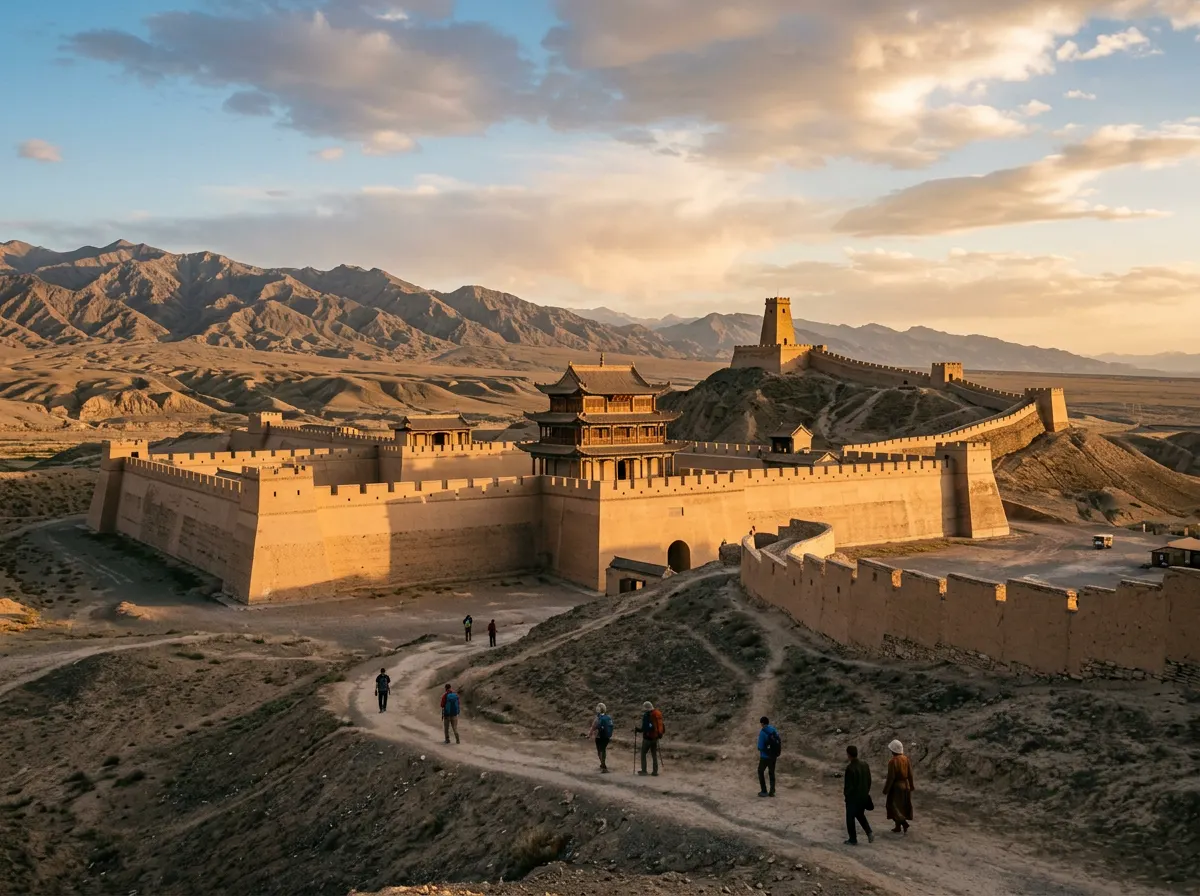
Jiayuguan (嘉峪关, Jiāyùguān) is not a big city — roughly 300,000 people — but it holds one of the most evocative sites on the Chinese Silk Road: Jiayuguan Fort (嘉峪关关城), the western terminus of the Ming dynasty Great Wall. Built in 1372, the fort is a massive walled compound at the narrowest point of the Hexi Corridor, where the Qilian Mountains meet the Gobi Desert. It is the largest and best-preserved pass on the entire Great Wall system — a fortress so imposing that the Chinese called it "the Impregnable Pass Under Heaven" (天下第一雄关). From the top of the gate tower, you can see the Great Wall snaking west into the desert and the snow-capped Qilian peaks rising to the south. The Overhanging Great Wall (悬壁长城, Xuánbì Chángchéng), 8 km north of the fort, climbs a 150-meter ridge at a 45-degree angle — it is the most dramatic section of wall on the Ming frontier. Jiayuguan is a 1-2 day stop, compact and well-organized, best visited as part of a Hexi Corridor itinerary linking Zhangye (1.5h by HSR) and Dunhuang (3.5h by HSR). Budget roughly ¥100-160 per day for mid-range comfort.
Why Jiayuguan in 2026.
The western end of the Ming Great Wall — Jiayuguan Fort stands where the wall meets the Gobi Desert and the Qilian Mountains, with the Overhanging Great Wall climbing a sheer ridge and the Wei-Jin tombs holding 1,700-year-old brick murals.
Quick Answer
Jiayuguan (嘉峪关, Jiāyùguān) is not a big city — roughly 300,000 people — but it holds one of the most evocative sites on the Chinese Silk Road: Jiayuguan Fort (嘉峪关关城), the western terminus of the Ming dynasty Great Wall. Built in 1372, the fort is a massive walled compound at the narrowest point of the Hexi Corridor, where the Qilian Mountains meet the Gobi Desert. It is the largest and best-preserved pass on the entire Great Wall system — a fortress so imposing that the Chinese called it "the Impregnable Pass Under Heaven" (天下第一雄关). From the top of the gate tower, you can see the Great Wall snaking west into the desert and the snow-capped Qilian peaks rising to the south. The Overhanging Great Wall (悬壁长城, Xuánbì Chángchéng), 8 km north of the fort, climbs a 150-meter ridge at a 45-degree angle — it is the most dramatic section of wall on the Ming frontier. Jiayuguan is a 1-2 day stop, compact and well-organized, best visited as part of a Hexi Corridor itinerary linking Zhangye (1.5h by HSR) and Dunhuang (3.5h by HSR). Budget roughly ¥100-160 per day for mid-range comfort.
| Worth visiting | Yes — Jiayuguan Fort is the definitive Ming Great Wall terminus, the Overhanging Great Wall is spectacular, and the Wei-Jin tombs are a hidden gem |
|---|---|
| Recommended days | 1-2 days |
| Best time to visit | May-June and September-October (clear skies, manageable temperatures; avoid July-August midday heat and winter winds) |
| Daily budget | $35 (backpacker) / $100 (mid-range) / $260+ (luxury) |
| Family friendly | Yes — the fort has open courtyards for children to explore, the Overhanging Wall is an exciting climb for older kids, and the sites are compact |
| Solo friendly | Yes — the fort is easy to explore alone, the logistics are straightforward, and the city is small and safe |
| Airport | Jiayuguan Airport (JGN) — 10 km northeast, flights from Xi'an (2.5h), Lanzhou (1.5h), Beijing (3h), limited schedule |
| High-speed rail | Yes — Zhangye (1.5h, ¥65-90), Lanzhou (5h, ¥210-290), Dunhuang (3.5h, ¥130-180), Urumqi (7h, ¥350-430) |
| Language | Mandarin with Gansu dialect; English is rare outside hotels |
| Currency | CNY (¥) — Alipay and WeChat Pay widely accepted; carry ¥200 cash for small vendors |
| Time zone | China Standard Time (UTC+8) |
| Last updated | 2026-06-18 |
Want a Jiayuguan plan built for you?
Jump to:
Jiayuguan Fort·Overhanging Wall·Wei-Jin Tombs·History·Silk Road & Hexi Corridor·Inside the Wei-Jin Tomb Murals·Other Great Wall Sites to Compare·Hekou & Mongolia Border·Photography Tips·Food·Getting There·Getting Around·Top Attractions·Where to Stay·Weather·Tips·Itineraries·Practical Info·Emergency Contacts·FAQ
Why visit Jiayuguan? Is a 600-year-old fort worth a special trip?
Jiayuguan Fort is where the Great Wall of China ended. Not the eastern end at Shanhaiguan on the Bohai Sea — the western end, where the wall ran out of China and into the desert. Standing on the gate tower and looking west, you see the Gobi Desert stretching to the horizon with the wall disappearing into it — a thin line of rammed earth vanishing into the haze. Behind you, the Qilian Mountains rise white-capped and impassable. This is the narrowest point of the Hexi Corridor, the strategic choke point where every Silk Road caravan, every army, every envoy, and every exile had to pass through. Beyond the gate was "outside the pass" (关外, guān wài) — exile, the unknown, the barbarian lands. Inside was the empire. The fort itself is magnificent — not a ruin, but a fully walled Ming dynasty military compound with inner and outer walls, three gate towers, corner watchtowers, a parade ground, a temple, and a command post. It is the largest and best-preserved pass on the entire Great Wall system, restored but not Disneyfied. The Overhanging Great Wall, 8 km north, climbs a ridge at an angle that genuinely makes you question the sanity of the soldiers who built it. The Wei-Jin tombs, 20 km northeast, contain 1,700-year-old brick murals of extraordinary vitality — farmers, musicians, cooks, hunters — painted by hands that have been dust for nearly two millennia. Jiayuguan is a small city — 300,000 people, one main street, an economy built on steel and tourism. It is not a destination in itself. It is a stop on the Hexi Corridor, the 1,000-km passage between the Qilian Mountains and the Gobi Desert that was the Silk Road. The classic route: Zhangye (2 days, Danxia landforms) → Jiayuguan (1-2 days, Great Wall fort) → Dunhuang (2-3 days, Mogao Caves). Jiayuguan is the military history chapter between Zhangye's natural landscapes and Dunhuang's Buddhist art. One full day covers the main sites. Two days lets you add the Wei-Jin tombs and see the fort at both sunrise and sunset.
What is the history of Jiayuguan: the end of the Ming Great Wall?
Jiayuguan Fort was built in 1372, just four years after the Ming dynasty expelled the Mongol Yuan from China. The Ming emperors had decided on a defensive strategy — rather than expanding into Central Asia as the Han and Tang had done, they would fortify the frontier and control access. Jiayuguan was the linchpin: the narrowest point on the Hexi Corridor, only 15 km wide between the Qilian Mountains and the Heishan (Black Mountains), where a single fortress could control all movement between China and Central Asia. The fort was expanded and reinforced over the next 150 years. By the mid-16th century, it was a self-contained military city with barracks for 1,000 soldiers, granaries, wells, temples, and a sophisticated defense system of interlocking walls, gates, and beacon towers. The Overhanging Wall and the First Strategic Post were added in 1539, extending the defensive line north and south to the mountain barriers. The combined system made Jiayuguan essentially impassable to an attacking army. The fort was never taken by force. Its military career ended not with a siege but with the decline of the Silk Road — as sea trade replaced overland routes and the Qing dynasty expanded China's borders far to the west, Jiayuguan lost its strategic purpose. By the 19th century, it was a backwater garrison. The fort fell into disrepair and was restored in the 1980s-2000s to its current state. The psychological significance of Jiayuguan is as important as the military one. For Chinese civilization, the fort marked the boundary between order and chaos, civilization and wilderness. Exile "beyond the pass" (关外) was a feared punishment. The gate towers face west — toward the unknown — and the fort's Chinese name, 嘉峪关 (Jiāyùguān), means "Excellent Valley Pass," a deceptively gentle name for the most formidable fortress on the frontier. The Wei-Jin tombs, built 1,000 years before the fort, tell a different story — of a time when the Hexi Corridor was a settled, prosperous region with a mixed population of Han Chinese, Central Asian traders, and steppe peoples. The brick murals show a world of abundant food, music, and daily contentment — a reminder that the Corridor was a place of life and exchange, not just military confrontation.
What is the Silk Road history of Jiayuguan and the Hexi Corridor?
Jiayuguan sits at the western tip of the Hexi Corridor (河西走廊, Héxī Zǒuláng), a 1,000-km natural passage between the Qilian Mountains to the south and the Gobi Desert and Inner Mongolian plateau to the north. At its narrowest point — between Jiayuguan and Jiuquan — the corridor is barely 15 km wide. That pinch is why Jiayuguan Fort was built here in 1372. A single fortified pass could seal the entire overland route between China proper and the Tarim Basin to the west. The Hexi Corridor was the eastern trunk of the Silk Road. Goods from Chang'an (modern Xi'an) traveled west through the corridor to Dunhuang, where the road forked — north through the Gansu corridor toward the Jade Gate (Yumen Pass) and the Taklamakan, or southwest toward the Pamirs and ultimately Persia and Rome. Silk, tea, porcelain, and paper moved west. Gold, silver, horses, jade, spices, and ideas moved east. Buddhism traveled the Silk Road into China — the cave temples at Dunhuang (Mogao Caves) and Maijishan were built by merchants, monks, and pilgrims using the same trade routes that brought rhubarb and pistachios to the Roman Empire. Jiayuguan was the customs post, the military checkpoint, and the psychological gate. Westbound caravans paid their duties here. Officials recorded names. Soldiers checked papers. Exiles wept. The Chinese expression "beyond the pass" (关外, guān wài) became shorthand for exile, the unknown, the ends of the earth. Han dynasty soldiers garrisoned at Jiayuguan in the 1st century BCE carved their names into cliff faces — those inscriptions survive as some of the earliest physical traces of Chinese presence in the corridor. The Tang dynasty poet Wang Zhihuan wrote his famous verse at a fortress tower near here: "The sun sets behind the long desert walls / The Yellow River rolls into the ocean" (白日依山尽, 黄河入海流) — the line that opens the most-quoted classical poem in Chinese. The corridor's strategic importance changed over time. Under the Han (2nd century BCE – 2nd century CE), it was the western frontier and the launchpad for campaigns into Central Asia. Under the Tang (7th-9th centuries), it was a cosmopolitan trade artery bustling with Sogdian merchants, Nestorian monks, and Tibetan envoys. Under the Ming (14th-17th centuries), it was the defensive limit — the Ming built the Great Wall here precisely because they could not hold the lands beyond. The Qing (17th-20th centuries) expanded China's borders far to the west, swallowing Xinjiang and Mongolia, and the corridor lost its frontier status entirely. Today the Silk Road is a heritage theme, not a living road. You can drive the corridor in three days on the G30 expressway, and the HSR covers Zhangye to Jiayuguan to Dunhuang in a single comfortable day. But standing at Jiayuguan Fort at sunset and looking west, the layers of history are visible: the Han inscriptions in the cliff faces, the Ming walls, the Qilian snow, the desert haze. You are looking at a place where two millennia of trade, war, and pilgrimage converged into a single strategic gate. UNESCO designated the Great Wall — including the Jiayuguan section — a World Heritage Site in 1987.
What are the Wei-Jin tombs really like inside the brick murals?
The Wei-Jin tombs are the most underestimated site on the Hexi Corridor. Most travelers skip them for the fort. The murals inside the one open tomb (Tomb 6) are extraordinary — vivid 1,700-year-old paintings of daily life that feel startlingly modern in their intimacy and warmth. I would put them on par with the Dunhuang murals in human interest, though they cover completely different ground: Dunhuang is Buddhist cosmology and courtly patronage; Wei-Jin is peasants cooking dinner. The site itself: the Wei-Jin tomb complex (魏晋墓群) is a sprawling cemetery of over 1,400 brick tombs from the Wei and Jin dynasties (3rd-5th centuries CE), scattered across the Gobi 20 km northeast of Jiayuguan. The Wei dynasty here refers to the Cao Wei of the Three Kingdoms period; the Jin is the Western Jin. Together they cover the period when the Hexi Corridor was a relatively settled, prosperous, multi-ethnic region under successive Han Chinese warlords and governors. You cannot enter most of the tombs. Tomb 6 is the only one open to visitors. It is a small, sloped brick chamber — perhaps 4 meters deep and 3 meters wide — entered through a low doorway. Inside, every brick is painted. The technique is unusual: the murals were painted on individual bricks before the tomb was assembled, so each brick is essentially a portable painting. The pigments are mineral — iron oxide reds, malachite greens, charcoal blacks — and they have survived 17 centuries under the desert with remarkably little fading. What you actually see: scenes of farming (plowing with oxen, threshing grain, harvesting), cooking (kneading dough, roasting meat, brewing), domestic life (a woman combing her hair, children playing), entertainment (acrobats, musicians with pipa and sheng, dancers), hunting (horsemen chasing deer with bows), and formal banquets (people seated around low tables with food and wine). The figures are lively, the colors saturated, the gestures natural. There is a kitchen scene that looks like a still life of 4th-century cookware. There is a wine-pouring scene where a man holds a ceramic jar tilted at exactly the right angle. There is a picture of a woman applying makeup that is so intimate it could be a photograph. The viewing setup: the tomb is small and you view the murals through a glass panel set into the entrance. The lighting inside the tomb is dim — guides use a flashlight to highlight details. Photography is generally not allowed inside (the murals are fragile and the lighting is insufficient for handheld shots anyway). Allow 15-20 minutes inside the tomb itself. The site also has a small exhibition hall with replicas and context panels. Why it matters: these tombs were built by the Han Chinese garrison and their families — soldiers, merchants, minor officials — who lived and died in the Hexi Corridor. They are not imperial tombs or royal mausoleums. They are ordinary people, painted with extraordinary care. The murals are the closest thing you will find in China to a first-person record of what daily life actually looked like 1,700 years ago. They are also a useful counterweight to the fort: the fort is power, the tombs are people. Practical: ¥50 admission. Reachable by taxi or hired car (¥40-50 from the city, 25 minutes). Allow 1.5 hours including the drive. The tombs have minimal shade — go in the morning. Combine with the fort for a full historical day. There is a small shop at the entrance selling replica murals as prints.
How does Jiayuguan Fort compare to other Great Wall sites I should know about?
Foreign visitors to China often conflate "the Great Wall" with the restored sections near Beijing. Jiayuguan Fort is fundamentally different — different geography, different purpose, different atmosphere. Understanding the differences helps you appreciate what Jiayuguan actually is. Jiayuguan vs. the Beijing sections (Badaling, Mutianyu, Jinshanling). The Beijing sections climb forested mountains north of Beijing. They are 16th-century Ming wall, restored, popular, with cable cars and tourist infrastructure. The experience is scenic — wall snaking over green ridges — and visitor-friendly. Jiayuguan is desert wall. The wall does not snake over hills here; it stands on the flat at the edge of the Gobi, then runs up the cliff face of the Overhanging Wall. The experience is strategic and stark. Jiayuguan is harder to reach, less crowded (except at peak domestic holidays), and far more atmospheric if you appreciate historical authenticity. The Beijing sections are the wall as landscape; Jiayuguan is the wall as frontier. Jiayuguan vs. Shanhaiguan (eastern terminus). Shanhaiguan (山海关, Shānhǎiguān) in Hebei is where the Ming wall meets the Bohai Sea — the eastern terminus. It has its own massive fort (the "First Pass Under Heaven," 第一关), a beach where the wall enters the water, and a longer tourist infrastructure. Shanhaiguan is more accessible from Beijing (2.5 hours by HSR) and more heavily visited. Jiayuguan is more remote, more atmospheric, and offers the Qilian Mountains as a backdrop that Shanhaiguan lacks. If you have to choose, Jiayuguan feels more like the frontier. Jiayuguan vs. Wild Wall sections (Jiankou, Gubeikou). For travelers who want unrestored, crumbling wall, the Jiankou and Gubeikou sections near Beijing are the famous options. Jiayuguan is heavily restored — the fort, the Overhanging Wall, and the First Strategic Post were rebuilt in the 1980s-2000s. The closest option near Jiayuguan for unrestored wall is the Xuanbi Great Wall south section (10 km south of the fort), where the rammed earth is crumbling back into the desert. It is a short detour and rewards purists. Jiayuguan vs. Han dynasty wall (Dunhuang, Yumen Pass). The Han Great Wall at Yumen Pass (90 km northwest of Dunhuang) is older than the Ming wall — built in the 1st century BCE, it is a low, weathered earthen ridge running straight into the desert for tens of kilometers. It is the "real" ancient wall, the wall that the Han emperor Wu built to defend the Silk Road. The Han wall is unrestored, crumbling, and atmospheric in a way the Ming wall rarely is. If you continue your trip to Dunhuang, the Han wall at Yumen Pass complements Jiayuguan beautifully: Jiayuguan is the Ming frontier, Yumen is the Han frontier. Jiayuguan vs. fortress passes further west (Jiayuguan, Yumenguan, Yang Pass). The Han dynasty maintained a chain of passes west of Jiayuguan — Yumen Pass (Jade Gate), Yang Pass (Yang Guan), and a string of beacon towers along the Gansu-Xinjiang border. These passes are ruins in the desert, far from cities, and require dedicated excursions. They carry the same Silk Road atmosphere as Jiayuguan but with none of the restoration and very few visitors. They are the wall's western outliers. The honest summary: Jiayuguan Fort is the most complete and impressive Ming pass fortress in existence. If you want to understand what the Great Wall was for — defense, control, signaling, frontier psychology — Jiayuguan is the single best site in China. If you want scenic wall-and-mountain landscapes, the Beijing sections are better. If you want romantic unrestored ruins, the Wild Wall near Beijing or the Han wall at Dunhuang are better. Jiayuguan's specific gift is the sense of standing at the edge of an empire and looking out.
What is the Hekou border crossing and is Mongolia accessible from Jiayuguan?
The Hekou border crossing (河口口岸, Hékǒu Kǒu'àn) is the Mongolia-China border post on the Hexi Corridor, roughly 350 km north of Jiayuguan, near the town of Hekou in Inner Mongolia. It is the closest land border crossing to Mongolia for travelers in the Jiayuguan / Zhangye / Dunhuang corridor. Foreign travelers can in principle cross to Mongolia from here, but the logistics are non-trivial and the route is far less developed than the more famous crossings at Erenhot (on the Beijing-Ulaanbaatar railway) or Zamyn-Üüd. Practical status as of 2026: Hekou is officially open for border crossing, but the schedule is limited — typically a few days per week with reduced hours. Crossings are subject to closure without notice. The Mongolian side is the town of Gashuunsukhait (嘎顺苏海特口岸), a small border settlement connected by a sealed road to the Mongolian mining town of Tsagaan Khad and onward to Dalanzadgad and Ulaanbaatar. There is no train; you must arrange a vehicle (typically a shared jeep or a tour) on the Mongolian side in advance. Visa requirements: a Chinese visa for entry (or visa-free eligibility for your nationality) and a Mongolian visa. Mongolia offers visa-free entry to many nationalities for stays of up to 30 days, but you must confirm your nationality's eligibility at the nearest Mongolian consulate or the e-visa portal. The border post does not issue visas on arrival — both visas must be obtained in advance. Why cross from Jiayuguan rather than Erenhot? The Erenhot crossing (on the Beijing-Ulaanbaatar railway) is far more established, with daily trains, a wide range of tour operators, and direct transport. Travelers going overland from central or eastern China almost always use Erenhot. The Hekou crossing is for travelers already on the Hexi Corridor who specifically want to enter Mongolia from the south — typically people heading to the Gobi Desert (Gurvansaikhan National Park, the Flaming Cliffs, Khongoryn Els sand dunes) without backtracking east. The Gobi Desert is the main draw: it is one of the world's last great untouched landscapes, with dinosaur fossil sites (Bayanzag), massive sand dunes, and nomadic herder camps. Logistics if you do cross: arrange a tour in advance through a Mongolian tour operator based in Ulaanbaatar or Dalanzadgad. Most Gobi tours depart from Dalanzadgad, and the Hekou-to-Dalanzadgad leg is the hardest part to arrange. Some operators run jeep transfers from Hekou to Dalanzadgad (8-10 hours on rough roads); others require you to find a local driver on the day, which is risky for non-Mongolian speakers. Independent overland travel without a tour is not realistic — the road is unpaved in places, fuel is limited, and English is rare outside Dalanzadgad. If the Hekou crossing is closed or complicated, the practical alternative is to fly. Jiayuguan Airport has limited international flights; Lanzhou or Xi'an have more options. From Xi'an you can fly to Ulaanbaatar (4 hours, multiple airlines, several flights per week). This is by far the easier route and is what most foreign travelers heading to Mongolia actually use. For most Jiayuguan visitors, Mongolia is a curiosity rather than a plan. The Gobi is a serious expedition requiring 1-2 weeks and significant budget. The Hekou crossing is the romantic route but requires preparation. If you are on a standard 6-8 day Hexi Corridor trip, skip it.
What photography tips help capture the fort and Overhanging Wall at their best?
Jiayuguan is one of the most photographable sites on the Hexi Corridor — the light is strong, the geometry is dramatic, and the scale is large. But the strong light and the open exposure also make it easy to come back with flat, washed-out images. A few specific tips from shooting the fort and the wall. Best time of day. Late afternoon, 1-2 hours before sunset, is the consensus best time. The low sun lights the rammed-earth walls from the side, throwing the gate towers into relief and turning the walls gold. The Qilian Mountains turn pink at sunset, and the Gobi behind the wall glows orange. The fort closes at 18:00-18:30 in summer and 17:00-17:30 in winter — check the closing time and arrive at least 2 hours before closing to get the full sunset experience. Early morning (08:00-09:30) is also good — softer light, fewer visitors, cooler temperatures — but the sun rises in the east and lights the back of the fort, so the front-facing gate towers are in shadow until mid-morning. The Rouyuan Tower (柔远楼). The western gate tower of the fort is the well-known shot — the wall extending west into the Gobi, the tower in the foreground, the mountains behind. The best vantage point for this composition is from inside the fort, slightly elevated, looking out through the western gate. The Rouyuan Tower itself is also photogenic from below, looking up — the perspective makes the tower loom. The Overhanging Wall. Two compositions dominate. The first is from below, looking up at the wall climbing the ridge — the angle and the dramatic foreshortening make the wall look nearly vertical. The second is from the top, looking south toward the fort visible across the plain. The top composition requires the 400-step climb and works best in morning light (the wall faces east). For the bottom composition, you do not need to climb — just walk to the base of the restored section. Lens choices. A wide-angle lens (16-35mm full-frame equivalent) is essential for the fort interiors and the Overhanging Wall from below. A standard zoom (24-70mm) covers most other situations. A telephoto (70-200mm) is useful for compressing the view of the wall running into the desert and for isolating details on the gate towers. Bring the longest lens you have if you want clean shots of the wall and the mountains together. Filters. A polarizing filter is genuinely useful — it deepens the blue sky, cuts glare on the rammed earth, and helps with the dust haze over the Gobi. A graduated ND filter is helpful for balancing the bright sky against the darker walls in midday shots. UV filters are unnecessary on modern digital sensors. The Wei-Jin tombs. Photography inside Tomb 6 is generally not permitted and the lighting is insufficient for handheld shots. The exterior of the site — the Gobi setting, the low entrance — is photogenic. The brick murals are best appreciated in person; reproductions and replica prints are sold at the site museum for those who want a take-home image. Weather hazards. Wind is constant — bring a microfiber cloth and clean your lens frequently, especially after switching lenses in the open courtyards. Spring dust storms (March-May) can coat equipment in fine Gobi dust; a rain cover or ziplock bag for your camera is not paranoid. The sun is strong — your LCD screen can be hard to read; use the viewfinder, or chimp shots with your hand shading the screen. Drone use. Drone permits in China are restrictive. Flying a drone at the fort or Overhanging Wall without prior permission from the local public security bureau is illegal and will likely result in confiscation and a fine. If you want aerial shots, plan ahead and arrange permits weeks in advance — or hire a local operator with permits.
How did the beacon-tower signal-fire system work on the Ming frontier?
Jiayuguan was not a single isolated fortress — it was the hub of a wider communication and defense network that stretched along the entire Ming northern frontier. The Great Wall Museum at the fort entrance has excellent exhibits on this system, and walking the fort itself, you can see the elements of it still in place. Understanding the signal system gives the visit a layer of meaning that pure sightseeing misses. The basic problem: the Ming frontier ran for thousands of kilometers, from Jiayuguan in the west to Shanhaiguan on the Bohai Sea, with deep incursions of wall and watchtowers into the Ordos and Inner Mongolian plateau. An enemy raid could move fast — Mongol cavalry covered 100 km a day. A messenger on horseback carrying news from the frontier to Beijing would take days. The Ming solution was the beacon-tower signal-fire system (烽火台, fēnghuǒtái), a chain of fortified signal stations spaced 10-15 km apart along the wall and out into the frontier steppe. Each beacon tower was a raised earthen platform, typically 5-10 meters tall, topped with a wooden signal frame and a fuel store (wood, dried dung, wolf dung). A standardized signal code conveyed both the size of an approaching enemy force and the direction. One smoke column by day or one fire by night plus one cannon shot meant roughly 100 enemies. Two of each meant roughly 500. Three meant 1,000 or more. Five meant 10,000 or more — an invasion. Variations of the signal — specific numbers of torches, flags, or combinations of fire and smoke — could indicate cavalry versus infantry, mounted archers versus lancers, and the direction of approach (north, south, east, west). The signal code was standardized across the entire system, so a beacon keeper in Shanxi could read a signal fired in Gansu. Speed: a correctly raised signal could be passed from tower to tower in roughly 3-5 minutes per station. A raid spotted at Jiayuguan in the morning could be signaled to Dunhuang or to Lanzhou within hours — far faster than a mounted messenger. Beijing received frontier alerts via the same system in 1-2 days, a journey that would take a rider a week or more. The Jiayuguan beacon network included the First Strategic Post (south, on the Taolai River cliff), the Overhanging Wall ridge (north), and a string of additional beacon towers extending west into the desert along the Hexi Corridor. The chain was connected visually — each tower had line-of-sight to the next. At night the fires were visible from 20 km away; by day the smoke columns were visible from further. The system was as much a deterrent as a warning — Mongol raiders knew that the moment they crossed the frontier, every garrison from the Gobi to Beijing would know. What you see today at Jiayuguan: the First Strategic Post (长城第一墩) is one of the original beacon towers in the chain — the westernmost signal post of the entire Ming Great Wall. It is a weathered earthen mound today (originally taller, with a wooden signal frame on top), sitting on the Taolai River cliff. From the fort itself, you can see the position of additional beacon towers on the surrounding ridges. The Great Wall Museum has a model of the Jiayuguan signal network and explains the code in detail. The Overhanging Wall, while primarily a defensive wall, also incorporated watchtower positions along its ridge. For travelers interested in military history, the signal system is one of the most underrated parts of the Jiayuguan experience. The fort is the hub; the Overhanging Wall and the First Strategic Post are the spokes. Together they tell the story of how a pre-industrial empire defended a 10,000-km frontier in real time.
What to eat in Jiayuguan: Gansu beef noodles and frontier fare?
Jiayuguan food is Gansu cuisine with a frontier twist — hearty, wheat-based, built around beef, lamb, and noodles. The city's steel-industry workforce means there are also excellent Sichuan and northeastern Chinese restaurants alongside the local Gansu options. The essential foods: Lanzhou beef noodles (兰州牛肉面, Lánzhōu niúròu miàn). The universal Gansu staple. Hand-pulled wheat noodles in clear beef broth with sliced beef, radish, chili oil, and green onion. ¥10-18 per bowl. Jiayuguan does a solid version — look for shops with visible noodle-pulling. Order 二细 (èr xì, medium-thick) for the standard experience. Grilled lamb skewers (烤羊肉串, kǎo yángròu chuàn). Jiayuguan's proximity to the Qilian pastures means excellent lamb. The night-market stalls along Xinhua Road (新华路) serve charcoal-grilled skewers seasoned with cumin, chili, and salt. ¥3-6 per skewer. Order by the handful — five skewers minimum. Jiayuguan roasted whole lamb (嘉峪关烤全羊, Jiāyùguān kǎo quán yáng). A local specialty for groups — a whole lamb roasted over charcoal for 3-4 hours until the skin is crisp and the meat falls apart. ¥600-1,000 for a whole lamb (feeds 8-12 people). Available at specialty restaurants — order a day in advance. Not practical for solo travelers or couples, but if you are in a group, it is a memorable meal. Gansu cold noodles (甘肃凉皮, Gānsù liángpí). Cold wheat-starch noodles with vinegar, chili oil, sesame paste, cucumber, and bean sprouts. ¥8-12 per bowl. A perfect light lunch in summer. Dapanji (大盘鸡, dàpánjī). "Big plate chicken" — a Xinjiang dish that has spread throughout the Hexi Corridor. Chicken braised with potatoes, peppers, and chili, served on a massive platter with hand-pulled noodles to soak up the sauce. ¥60-90 for a large plate (feeds 2-3 people). Stewed lamb with bread (羊肉泡馍, yángròu pàomó). The Gansu version of the Xi'an classic — chunks of lamb in rich broth with torn flatbread soaking in the bowl. ¥25-40. Hearty winter food. For vegetarians: Lanzhou beef noodles can be ordered without meat (素面, sù miàn). Cold noodles (凉皮) are vegetarian by default. Sichuan restaurants in the city have vegetable stir-fries and mapo tofu (麻婆豆腐) — ask for no meat (不要肉, bùyào ròu). A printed vegetarian card in Chinese is recommended.
How to get to Jiayuguan: high-speed rail, flights, and Hexi Corridor connections?
Jiayuguan South Railway Station (嘉峪关南站) is the high-speed rail station, about 8 km south of the city center on the Lanzhou-Urumqi HSR line. This is how almost all foreign visitors arrive. From Zhangye: 1.5 hours, ¥65-90 second class, multiple daily trains. From Lanzhou: 5 hours, ¥210-290. From Dunhuang: 3.5 hours, ¥130-180. From Urumqi: 7 hours, ¥350-430. The HSR station is connected to the city center by taxi (¥15-20, 15 min) and bus 12 (¥1, 25 min). Jiayuguan Airport (JGN) is 10 km northeast of the city with limited flights — primarily from Xi'an (2.5 hours, ¥500-900), Lanzhou (1.5 hours, ¥400-600), and Beijing (3 hours, ¥800-1,400). The HSR is generally more practical for most itineraries. Jiayuguan Railway Station (嘉峪关站, conventional rail) is in the city center and handles slower K/T trains. Most travelers use Jiayuguan South (HSR). Jiayuguan is a natural stop on the Hexi Corridor itinerary. The classic westbound route: Lanzhou → Zhangye (2 days) → Jiayuguan (1-2 days) → Dunhuang (2-3 days). Eastbound: Dunhuang → Jiayuguan → Zhangye → Lanzhou. The HSR connections are excellent and the distances are manageable — no single leg is more than 5 hours.
How to get around Jiayuguan: taxis, buses, and site access?
Jiayuguan is a compact city and the sites are well-connected. Taxis are the easiest transport — flagfall is ¥5, a ride to the fort costs ¥15-20 (6 km west of the city center), to the Overhanging Wall ¥25-30 (8 km north), to the Wei-Jin tombs ¥40-50 (20 km northeast). A half-day taxi circuit covering the fort, Overhanging Wall, and First Strategic Post costs ¥120-150. A full day adding the Wei-Jin tombs costs ¥200-250. Arrange through your hotel front desk. Public bus: Bus 4 runs from the city center to the fort (¥1, 20 min). Bus 6 runs to the Overhanging Wall area. The Wei-Jin tombs have no public bus — you need a taxi or hired car. Bus routes and announcements are Chinese-only. DiDi operates in Jiayuguan with reasonable supply in the city center, thinner at the sites. For the fort and Overhanging Wall, DiDi is fine. For the Wei-Jin tombs, arrange a return pickup with the driver. The combined ¥110 ticket for the fort includes the Overhanging Wall and the First Strategic Post. You can visit them on the same day or across multiple days — the ticket is valid for one entry at each site. The Wei-Jin tombs require a separate ticket (¥50). Walking: the city center is walkable. The fort is not walkable from the city (6 km, no pedestrian path along the highway). Always use transport.
What are the top attractions in Jiayuguan, ranked and described?
1. Jiayuguan Fort (嘉峪关关城). ¥110 (combined ticket). The definitive western terminus of the Ming Great Wall and the largest pass fortress on the entire wall system. The fort is a walled rectangle roughly 700 by 500 meters, with inner and outer walls, three gate towers (the Guanghua Tower to the east, the Rouyuan Tower to the west, and the central gate), corner watchtowers, a parade ground, a Guandi Temple, and a command post. Climb the Rouyuan Tower for the well-known view west — the wall snaking into the Gobi, the Qilian Mountains on the left, the Black Mountains on the right. The fort is restored (1980s-2000s) but the restoration is well-done — the scale and setting are authentic. Allow 2-3 hours. The Great Wall Museum at the entrance provides excellent context — visit it first. Best in late afternoon when the setting sun turns the rammed-earth walls gold. 2. Overhanging Great Wall (悬壁长城). Included in combined ticket. A 1.5-km restored section of the Ming wall that climbs a 150-meter ridge at a 45-degree angle. The climb is about 400 steep steps. At the top, a beacon tower offers a panorama: the Gobi stretching north, the fort visible to the south, the Qilian peaks on the horizon. The wall literally hangs off the cliff face — from the base, it looks like it is about to slide off the ridge. Built in 1539 as the northern defense spur. Allow 1-1.5 hours. Go in the morning when the light is on the wall and temperatures are cooler. If you are short on time or not physically up for the climb, the fort alone is sufficient — the Overhanging Wall is spectacular but not essential. 3. Wei-Jin Tomb Murals (魏晋墓壁画). ¥50. A 1,700-year-old cemetery of over 1,400 brick tombs scattered across the Gobi 20 km northeast of the city. Only one tomb (Tomb 6) is open to the public, but the brick murals inside are extraordinary — scenes of farming, cooking, hunting, feasting, music, and dancing painted with brush and mineral pigments on individual bricks. The paintings are intimate and lively, showing daily life with a warmth that survives the millennia. The tomb is small and you view the murals through a glass panel, but the experience is powerful — you are standing in a 1,700-year-old burial chamber looking at paintings that have never been moved. The site has few visitors (most tourists skip it for the fort) and the Gobi setting is stark and silent. Allow 1.5 hours including the 25-minute drive each way. A genuine hidden gem. 4. First Strategic Post (长城第一墩). Included in combined ticket. The westernmost beacon tower of the Ming Great Wall — a weathered earthen mound on a cliff above the Taolai River canyon, 7 km south of the fort. The tower itself is a dirt pile and honestly unimpressive. But the canyon setting — a sheer 56-meter drop into the Taolai River gorge — is dramatic, with a glass-bottomed viewing platform extending over the cliff edge. The site takes 30-45 minutes. Combine with the fort (it is on the way). Worth it for the canyon view; do not go just for the tower. 5. Jiayuguan Great Wall Museum (嘉峪关长城博物馆). Free with combined ticket. A well-designed museum at the fort entrance with exhibits on Great Wall history, construction techniques (rammed earth vs. brick, signal-fire systems, logistics), and the specific role of Jiayuguan in the Ming defense network. The models of the pass system and the beacon-tower communication network are excellent. Allow 45 minutes to 1 hour. Visit before entering the fort for context. 6. Xuanbi Great Wall — South Section. A less-visited, more ruined section of the Overhanging Wall running along the Taolai River canyon rim south of the fort. More atmospheric than the restored northern section — the wall is crumbling rammed earth rather than rebuilt brick, and you will likely be alone. Requires a car to access (10 km south of the fort). No separate ticket needed with the combined pass. Allow 30 minutes for photos. For Great Wall purists who prefer ruins to restorations. 7. Qiyi Glacier (七一冰川). ¥100 (if open). A retreating glacier at 4,300m in the Qilian Mountains, 116 km southwest of Jiayuguan. It was marketed as "Asia's most accessible glacier" — drive to 3,800m, hike 2 hours to the glacier tongue. However, as of June 2026, access is restricted due to glacial retreat and safety concerns. Check locally at your hotel or the Jiayuguan tourism office before planning — it may be closed or require a guide. If open: full-day excursion, bring warm layers, water, and altitude tolerance. The glacier has retreated dramatically in the past 20 years and is not the spectacle it once was.
Where to stay in Jiayuguan: neighborhoods, prices, and recommendations?
The city center along Xinhua Road (新华路) and near the Donghu Lake (东湖) is the best base. It is walking distance to restaurants, the night market, and the bus stops for the fort. Mid-range options: Jiayuguan Hotel (嘉峪关宾馆, ¥200-350), Jinjiang Inn Jiayuguan (¥180-280). The Jiayuguan International Hotel (嘉峪关国际大酒店) is the top city-center option at ¥350-500. Near Jiayuguan South Railway Station (嘉峪关南站) there is a cluster of budget chain hotels (¥120-200) convenient for late HSR arrivals or early departures. The station area is functional and charmless. Near the fort (Jiayuguan Fort area, 6 km west of the city): a few guesthouses and small hotels have opened near the fort entrance. Staying here lets you be at the fort for opening time (08:00) and sunset. Prices run ¥150-250 per night. The tradeoff: few restaurants, no nightlife, and you are 6 km from the city center. For backpackers: the Jiayuguan Youth Hostel near the city center has dorm beds at ¥45-60 and a helpful English-speaking desk for Silk Road travel advice. A note on seasons: Jiayuguan hotels fill up during the summer Silk Road tourism peak (July-August) and the National Day holiday (first week of October). Book 3-7 days ahead during these periods. The rest of the year, walk-in availability is generally fine. Foreigner registration: as everywhere in China, hotels must register foreign guests. Budget hotels may refuse foreign guests. Book through Trip.com with the foreign-guest filter.
What is the weather in Jiayuguan and when is the best time to visit?
Jiayuguan has a cold desert climate — hot summers, cold winters, very low precipitation, and strong winds year-round. January: -13°C to -3°C. Cold, windy, dry. The fort is bleak but atmospheric. Lowest tourist numbers. February: -9°C to 2°C. Still cold. Spring Festival may bring domestic visitors. March: -3°C to 10°C. Warming but windy. Dust storms from the Gobi possible. April: 4°C to 18°C. Pleasant — cool mornings, warm afternoons. The start of the good season. May: 10°C to 24°C. Excellent. Clear skies, comfortable temperatures, Qilian peaks snow-capped. The first great month. June: 15°C to 29°C. Good — warm but not scorching. Long daylight hours for sightseeing. July: 18°C to 32°C. Hot. The fort has minimal shade. Sightsee early morning or late afternoon. August: 17°C to 31°C. Marginally cooler than July. Peak domestic tourism — the fort is crowded. September: 11°C to 25°C. Excellent — cooling down, clear skies, the best photography month. Fort walls glow gold in autumn light. October: 3°C to 16°C. Good — crisp, clear, autumn colors. Cold at night. The second-best month. November: -5°C to 6°C. Getting cold. Fewer tourists. The fort is atmospheric in the low light. December: -12°C to -2°C. Cold, windy, quiet. Lowest prices. The consensus best months are May, June, September, and October. July and August are hot and crowded but visitable with morning/late-afternoon timing. Winter (November-March) is cold but the fort under snow with the Qilian peaks behind it is a magnificent sight — if you can handle the cold and the wind, winter Jiayuguan has a stark, solitary beauty that the summer crowds erase. Wind is a constant factor — the Hexi Corridor funnels wind between the mountain ranges, and Jiayuguan is famously windy. Bring a windproof jacket year-round. In spring (March-May), wind speeds can exceed 40 km/h, kicking up Gobi dust.
What are the top tips, warnings, and things to know about Jiayuguan?
1. THE COMBINED TICKET IS THE ONLY TICKET. The Jiayuguan Fort ticket (¥110) is a combined pass that includes the Overhanging Wall and the First Strategic Post. You cannot buy a fort-only ticket. The pass is valid for one entry at each site and can be used across multiple days. Keep your ticket — you will need to scan it at each site. 2. THE FORT IS RESTORED, NOT A RUIN. If you are expecting a crumbling, atmospheric ruin like the Wild Great Wall sections near Beijing, you will be disappointed. Jiayuguan Fort was heavily restored in the 1980s-2000s and looks crisp and complete — rebuilt walls, repainted gate towers, smooth paving. It is an excellent restoration that conveys the original scale and power of the fortress, but it does not feel ancient. The Overhanging Wall is similarly restored. For authentic, unrestored Great Wall, the Xuanbi south section is the closest option near Jiayuguan. 3. THE FIRST STRATEGIC POST IS ANTI-CLIMACTIC. The "westernmost beacon tower of the Ming Great Wall" is a weathered earthen mound. It looks like a large dirt pile. The reason to visit is the Taolai River canyon and the glass viewing platform over the cliff edge — that part is genuinely dramatic. Go for the canyon, not the tower. 4. THE WEI-JIN TOMBS ARE WORTH THE DETOUR. Most visitors skip them, which is a mistake. The 1,700-year-old brick murals are extraordinary — vivid, intimate, and unlike anything else on the Hexi Corridor. The site gets a tiny fraction of the fort's visitors. You need a taxi or hired car (¥40-50 from the city, 25 minutes). The tomb is small and the murals are viewed through glass, but the experience is powerful. 5. WIND IS A CONSTANT. The Hexi Corridor is a natural wind tunnel between the Qilian Mountains and the Gobi. Jiayuguan is windy year-round, especially in spring (March-May). A windproof jacket is essential. On high-wind days (40+ km/h), the Overhanging Wall climb is unpleasant and potentially unsafe — check conditions before going. 6. THE SUN IS STRONG AT 1,700M ALTITUDE. Jiayuguan city sits at roughly 1,700m. UV radiation is stronger than at sea level. The fort, Overhanging Wall, and First Strategic Post have minimal shade. Sunscreen, hat, and sunglasses are essential. Carry water — there is limited water available at the sites. 7. THE FORT AT SUNSET IS THE BEST TIME. The rammed-earth walls glow gold in late-afternoon light, the Qilian Mountains turn pink, and the crowds thin. The fort closes at 18:00-18:30 (summer) or 17:00-17:30 (winter). Arrive 2-3 hours before closing for the best light. 8. THE QIYI GLACIER MAY BE CLOSED. As of June 2026, access to Qiyi Glacier is restricted due to glacial retreat. Do not plan your itinerary around it without confirming access. Check with your hotel, the Jiayuguan Tourism Bureau, or recent traveler reports before committing a day to it. 9. JIAYUGUAN IS A STEEL TOWN. The city's economy is built on the Jiuquan Iron and Steel Company (酒钢, Jiǔgāng), one of China's largest steel producers. The city is functional, modern, and not charming. The fort, Overhanging Wall, and Wei-Jin tombs are the draw — the city itself is a base. Set expectations accordingly.
What are good 1-day and 2-day itineraries for Jiayuguan?
1-day plan (recommended for most travelers): Morning — Wei-Jin Tomb Murals (¥50, leave at 08:00, arrive 08:30, spend 1 hour). Return to the city by 10:00. Late morning: Jiayuguan Great Wall Museum (45 min), then the fort (2-3 hours). Lunch at a city-center noodle shop (¥15-30). Afternoon: Overhanging Great Wall (1-1.5 hours) and First Strategic Post (30 min). Return to the city by 17:00. Evening: lamb skewers and cold beer at the Xinhua Road night market. This covers all five main sites in a full but manageable day. Hire a taxi for the day (¥200-250) for efficiency. 2-day plan (for a relaxed pace): Day 1 — Morning: Wei-Jin tombs (08:00-10:00). Late morning: Great Wall Museum, then the fort (through early afternoon — spend 3 unhurried hours). Lunch. Late afternoon: Overhanging Great Wall and First Strategic Post. Sunset at the fort (return for evening light on the walls). Day 2 — Morning: Xuanbi Great Wall south section for a quieter, more ruined wall experience. Midday: visit the Jiayuguan City Museum (free, 1 hour, good Silk Road exhibits). Afternoon: walk Donghu Lake (东湖), the city's central park, for a view of the Qilian Mountains across the water. Afternoon HSR to Dunhuang or Zhangye. The 2-day plan is for travelers who want to see everything without rushing and who appreciate a slow morning. If you are on a tight Hexi Corridor schedule, the 1-day plan is sufficient. Combine with Zhangye and Dunhuang for a 6-7 day Hexi Corridor itinerary: Day 1-2: Zhangye (Danxia, Mati Temple). Day 3: HSR Zhangye → Jiayuguan (1.5h). Day 3-4: Jiayuguan (1-day plan, overnight). Day 4: HSR Jiayuguan → Dunhuang (3.5h). Day 5-7: Dunhuang (Mogao Caves, Mingsha Sand Dunes, Crescent Moon Lake, Yumen Pass). This is the classic Silk Road route and works beautifully.
What practical information do I need: visa, money, internet, language?
Visa-free entry: As of June 2026, citizens of 45+ countries can enter China visa-free for up to 30 days. Confirm your eligibility with the nearest Chinese consulate. Money: CNY (¥). ¥100 ≈ US$14. Alipay and WeChat Pay are accepted at the fort ticket office, hotels, restaurants, and most city-center businesses. Link a foreign Visa/Mastercard before traveling. Carry ¥200-300 in cash for small vendors and the night market. ATMs at Bank of China and ICBC in the city center accept foreign cards. Internet: China's Great Firewall applies. Install and test a VPN before arriving. Internet speeds in Jiayuguan are decent in the city. Mobile signal is weak at the Wei-Jin tombs and First Strategic Post — download offline maps before heading to these sites. Language: Mandarin is spoken universally. English is rare outside hotel front desks. A translation app (Pleco, Baidu Translate) is essential. Save your hotel address and key site names in Chinese characters. Health: Jiayuguan city is at 1,700m — altitude sickness is unlikely but you may notice mild shortness of breath on the Overhanging Wall steps. The main health concerns are sun exposure (strong UV, minimal shade at all sites) and dehydration (dry climate, wind accelerates moisture loss). Carry water and wear sun protection. Fort logistics: The fort opens roughly 08:00-18:00 (summer) or 08:30-17:30 (winter). Last entry is 30-60 minutes before closing. The Great Wall Museum at the entrance has clean toilets and a small cafe. There are toilets at the fort interior but no food — eat before arriving.
What are the emergency contacts and health information for Jiayuguan?
Police: 110. Ambulance: 120. Fire: 119. Traffic accident: 122. These work from any phone. English-speaking operators are unlikely — have your hotel make the call if possible. International medical care: Jiayuguan First People's Hospital (嘉峪关市第一人民医院) is the main hospital and can handle most emergencies. English-speaking staff are very limited. For serious medical issues, medical evacuation to Lanzhou (5 hours by HSR) or Xi'an (2.5 hours by air) may be necessary. Comprehensive travel insurance covering medical evacuation is recommended. Sun and wind exposure: the main health risks are sunburn (strong UV at 1,700m, minimal shade) and dehydration (dry climate, constant wind). Carry at least 1.5 liters of water per person for a day of sightseeing. Sunscreen, hat, and lip balm are essential — the wind chaps lips quickly. Altitude: 1,700m rarely causes altitude sickness. The Overhanging Wall steps (400 steps, steep) may cause shortness of breath — rest as needed. Tap water is not potable. Bottled water is widely available (¥2-3). Hotels provide kettles. Air quality: generally better than eastern Chinese industrial cities. Spring dust storms (March-May) from the Gobi can push the AQI high. An N95 mask is useful in spring.
Top attractions
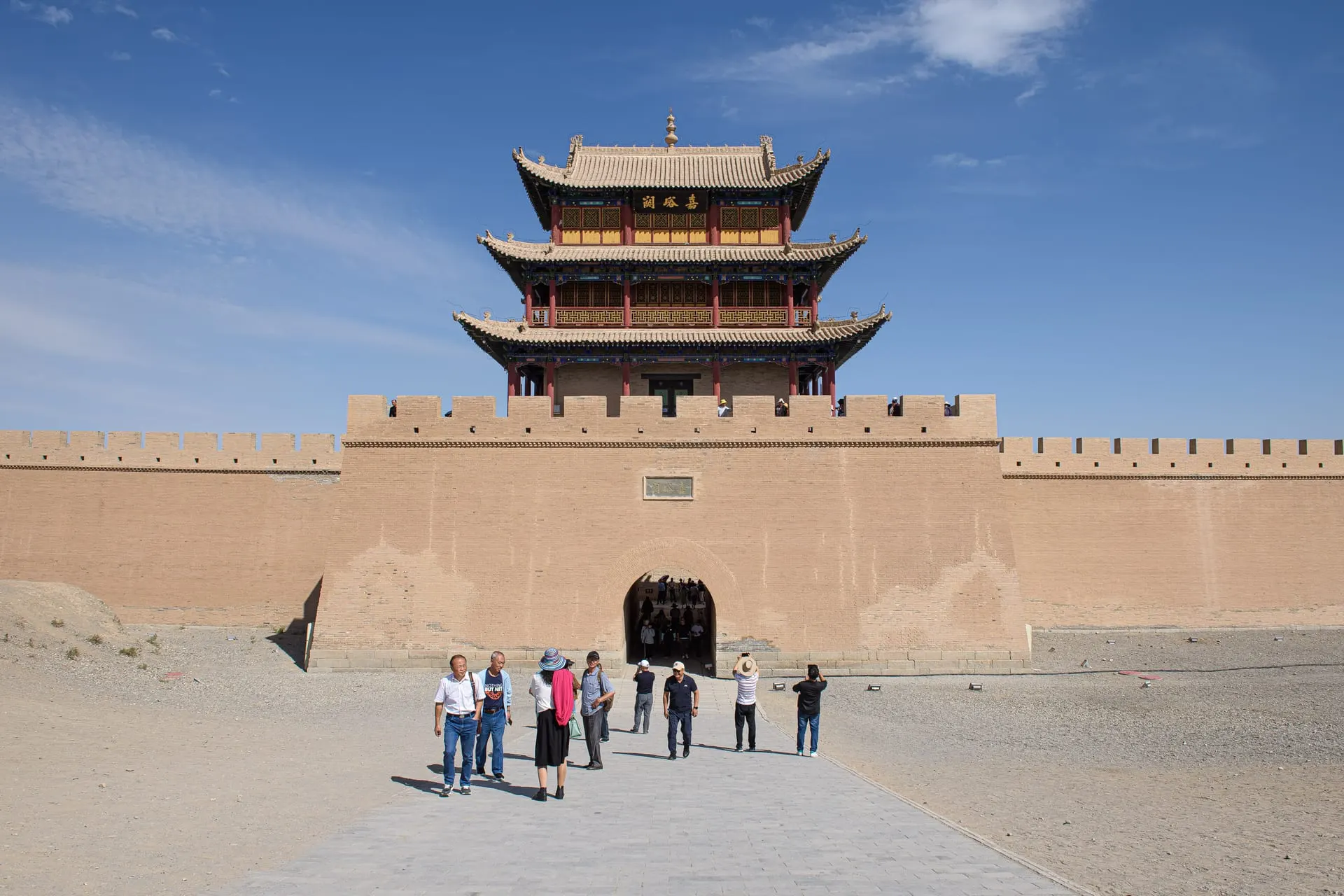
Jiayuguan Fort (嘉峪关关城, Jiāyùguān Guānchéng)
The western terminus of the Ming Great Wall, built in 1372 at the narrowest point of the Hexi Corridor. A massive walled fortress with inner and outer walls, three gate towers, corner watchtowers, and a moat. Known as "the Impregnable Pass Under Heaven" (天下第一雄关). ¥110 (combined ticket includes Overhanging Wall and First Strategic Post). Allow 2-3 hours. Best in late afternoon when the setting sun lights the fortress walls gold.
Wikimedia Commons · CC-BY-SA
Overhanging Great Wall (悬壁长城, Xuánbì Chángchéng)
A restored section of the Ming Great Wall that climbs a 150-meter ridge at a 45-degree angle — the wall literally hangs off the cliff face. Built in 1539, it was the northern defense spur of the Jiayuguan pass system. The climb is steep (about 400 steps) but the view from the top — the Gobi Desert stretching north, the fort visible to the south — is worth the burn. Included in the ¥110 combined ticket. Allow 1-1.5 hours.
Wikimedia Commons · CC-BY-SA
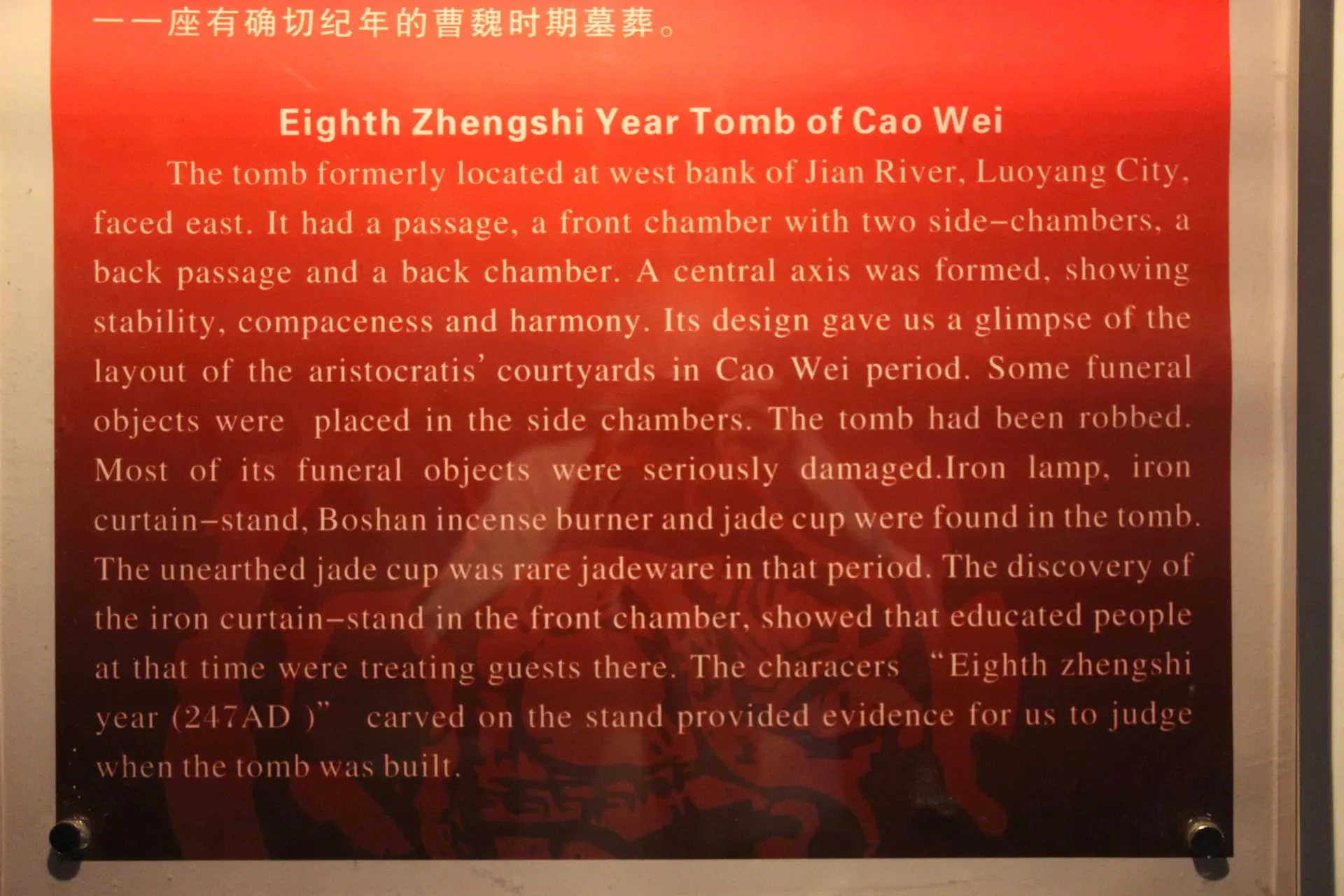
Wei-Jin Tomb Murals (魏晋墓壁画, Wèi Jìn Mù Bìhuà)
A 1,700-year-old cemetery of over 1,400 brick tombs from the Wei and Jin dynasties (3rd-5th centuries CE), 20 km northeast of the city. The tombs contain extraordinary brick murals depicting daily life — farming, cooking, hunting, music, feasting — painted with vivid color and surprising intimacy. Only one tomb (Tomb 6) is open to visitors, but the murals inside are worth the trip alone. ¥50. Allow 1.5 hours including the drive. A hidden gem — far fewer visitors than the fort.
Wikimedia Commons · CC-BY-SA

First Strategic Post of the Great Wall (长城第一墩, Chángchéng Dìyī Dūn)
The westernmost beacon tower of the Ming Great Wall — a weathered earthen mound standing on a 56-meter cliff above the Taolai River canyon. Built in 1539, it was the first warning post in the Jiayuguan defense system. The tower itself is unimpressive (it looks like a dirt pile), but the canyon setting — a sheer drop into the Taolai River gorge — is dramatic. Included in the ¥110 combined ticket. Allow 45 min. Combine with the fort.
Wikimedia Commons · CC-BY-SA
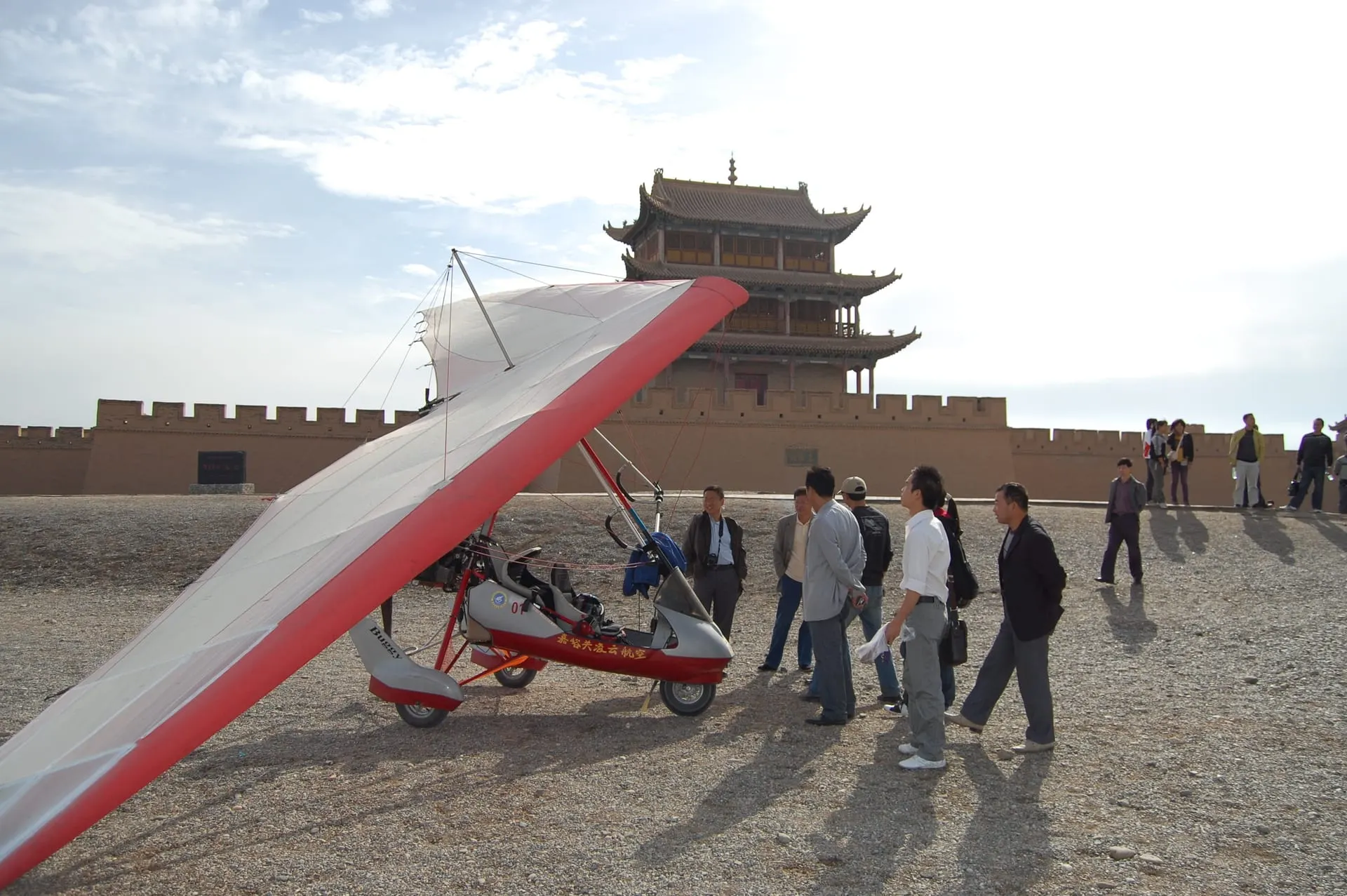
Jiayuguan Great Wall Museum (嘉峪关长城博物馆)
A well-designed museum at the fort entrance covering the history, construction, and defense systems of the Great Wall, with a focus on the Jiayuguan pass. Good exhibits on signal-fire communication, wall construction techniques, and the logistics of garrison life. Free with the combined ticket. Allow 45 min-1 hour. Best visited before entering the fort for context.
Wikimedia Commons · CC-BY-SA
Xuanbi Great Wall (悬壁长城 — South Section)
A less-visited southern section of the Overhanging Wall that runs along the Taolai River canyon rim. More ruined and atmospheric than the restored northern section. No separate ticket needed if you have the combined pass. Requires a car to access (10 km south of the fort). Allow 30 min for photos.
Wikimedia Commons · CC-BY-SA
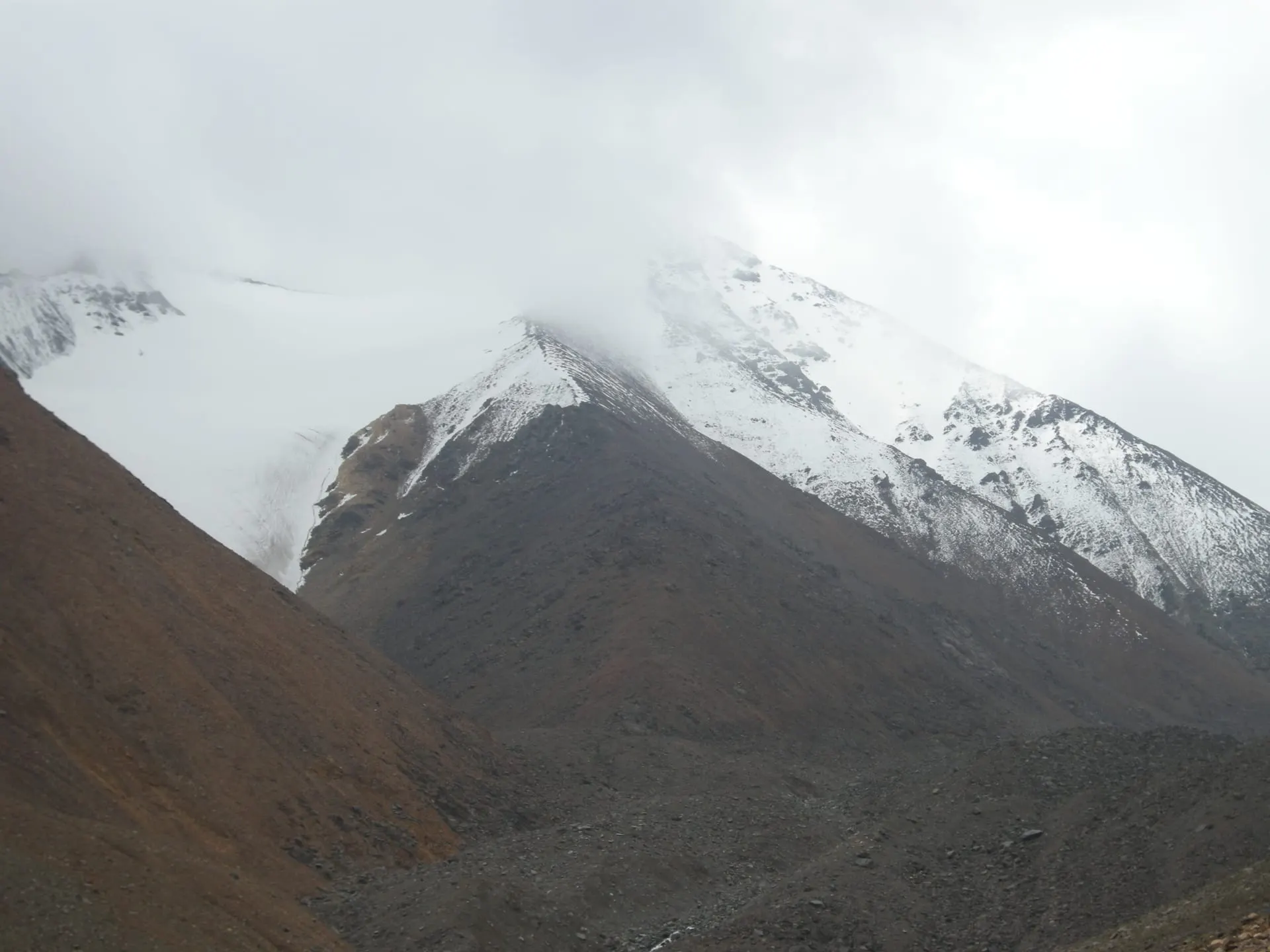
Qiyi Glacier (七一冰川, Qīyī Bīngchuān)
A retreating glacier at 4,300m in the Qilian Mountains, 116 km southwest of Jiayuguan. It was one of Asia's most accessible glaciers — you could drive to 3,800m and hike 2 hours to the glacier tongue. However, as of June 2026, access is restricted due to glacial retreat and safety concerns. Check locally before planning — it may be closed. If open: ¥100, full-day excursion, bring warm layers and altitude tolerance.
Wikimedia Commons · CC-BY-SA
STAY
Where to stay in Jiayuguan
Pick a base that matches the trip you want — imperial-central for sightseeing, hutong belt for character, Chaoyang for nightlife, or Qianmen for budget.
City Center / Xinhua Road (市中心/新华路)
Walking distance to restaurants, night market, bus stops — the most convenient base
#city-centerDonghu Lake Area (东湖)
Quieter residential area with lake views and Qilian Mountain panoramas, 2 km east of the center
#donghu-lakeJiayuguan Fort Area (关城景区)
Guesthouses near the fort entrance — best for photographers wanting sunrise/sunset access
#fort-areaJiayuguan South Station Area (嘉峪关南站)
Budget chain hotels, convenient only for late HSR arrivals or early departures
#south-station
ITINERARIES
Sample itineraries from Jiayuguan
Three ready-made routes, from a 1-day imperial sprint to a 5-day deep dive. Copy the day-by-day plan and adapt to your own pace.
- 1 DAY
1-Day Jiayuguan Complete
All five main sites in a full, efficient day — the definitive one-day Jiayuguan experience.
- Most travelers on a Hexi Corridor itinerary
- Day 01
Morning
Wei-Jin Tomb Murals (¥50, leave 08:00, arrive 08:30, spend 1h). Return to city. Great Wall Museum (45 min), then Jiayuguan Fort (¥110 combined ticket, 2-3h).
Afternoon
Lunch — Lanzhou beef noodles (¥15). Overhanging Great Wall (1-1.5h). First Strategic Post (30 min) for the canyon view.
Evening
Return to city by 17:00. Sunset at the fort if you want a second visit. Dinner: lamb skewers at Xinhua Road night market.
- 2 DAYS
2-Day Jiayuguan Relaxed
All sites at a comfortable pace with time for sunset at the fort and quieter wall sections.
- Travelers who want to see everything without rushing
- Day 01
Morning
Wei-Jin tombs (08:00-10:00). Great Wall Museum (10:30-11:15). Jiayuguan Fort (11:15-14:00).
Afternoon
Late lunch. Overhanging Great Wall (15:00-16:30). First Strategic Post (17:00-17:30).
Evening
Return to fort for sunset (if energy allows — the ticket is valid for one entry, so check re-entry policy or use Day 2). Night market dinner.
- Day 02
Morning
Xuanbi Great Wall south section for quiet, ruined-wall atmosphere. Jiayuguan City Museum (free, 1h).
Afternoon
Donghu Lake walk. Dinosaur Museum if traveling with children. Afternoon HSR to Dunhuang or Zhangye.
Evening
Departure.
- 6 DAYS
Hexi Corridor 3-City Link (Zhangye + Jiayuguan + Dunhuang)
The classic Silk Road route covering Zhangye Danxia, Jiayuguan Great Wall, and Dunhuang Mogao Caves.
- First-time Silk Road travelers wanting the complete Hexi Corridor experience
- Day 01
Morning
Arrive Zhangye via HSR from Lanzhou or Xi'an.
Afternoon
Giant Buddha Temple. Danxia Geopark from 14:00 through sunset.
Evening
Zhangye night market.
- Day 02
Morning
Mati Temple (morning excursion).
Afternoon
Return to Zhangye. HSR to Jiayuguan (1.5h, afternoon train). Arrive Jiayuguan evening.
Evening
Check in. Xinhua Road night market for lamb skewers.
- Day 03
Morning
Wei-Jin tombs. Great Wall Museum. Jiayuguan Fort.
Afternoon
Overhanging Great Wall. First Strategic Post. Fort at sunset.
Evening
Dinner in Jiayuguan.
- Day 04
Morning
HSR Jiayuguan → Dunhuang (3.5h, morning train). Arrive Dunhuang by early afternoon.
Afternoon
Mingsha Sand Dunes and Crescent Moon Lake (late afternoon — best light, cooler temperatures). Camel ride.
Evening
Dunhuang night market (沙洲夜市).
- Day 05
Morning
Mogao Caves (book 2-4 weeks ahead, allow 3-4h for the tour).
Afternoon
Dunhuang Museum (free, 1-2h). Free time in the city.
Evening
Second night market dinner or cultural performance (敦煌盛典).
- Day 06
Morning
Yumen Pass and Han Great Wall ruins (full-day excursion, 90 km northwest).
Afternoon
Return to Dunhuang. Fly out or HSR back to Lanzhou.
Evening
Departure.
BUDGET
What a Jiayuguan trip costs
Per-person, per-day costs across three spending tiers. Excludes international flights and visa fees.
| Line item | Backpacker | Mid-range | Luxury |
|---|---|---|---|
| Backpacker (per day) | $120 | $0 | $0 |
| Mid-range (per day) | $0 | $325 | $0 |
| Luxury (per day) | $0 | $0 | $650 |
| Total per day | $120 | $325 | $650 |
$ USD per person per day, before international flights and visas. Last verified: Q3 2026.
STAY SAFE
Emergency contacts in Jiayuguan
Save these three numbers before you board the plane. China uses different hotlines than most countries — there's no 911.
- POLICE
110
- AMBULANCE
120
- FIRE
119
- TOURIST HOTLINE
0937-12301
- ENGLISH-SPEAKING ER
Jiayuguan First People's Hospital (嘉峪关市第一人民医院), 0937-6202120 — limited English, medical evacuation to Lanzhou for serious cases
Problems travelers hit in Jiayuguan
- Why is my Alipay not working?You linked a foreign Visa or Mastercard to Alipay but every transaction is rejected at the merchant.
- My China visa was denied — what now?Your L visa application was refused at the Chinese consulate and your trip is in 2–4 weeks.
- My passport was lost or stolen in China — what do I do?Your passport is gone (theft or loss) and you're in mainland China without travel documents.
- Why can't I book on 12306 with my foreign card?You tried to book a high-speed rail ticket on 12306.cn and your foreign Visa/Mastercard is rejected at checkout.
- Why is my VPN not working in China?You arrived in China, opened your VPN, and it will not connect at all or connects but no traffic loads.
- Why can't I book a Tibet trip on my own?You try to book Lhasa flights and hotels yourself but the booking fails, or you're turned away at the Lhasa airport without a permit.
Book activities in Jiayuguan
These are licensed tour operators and booking platforms we've vetted independently. Booking through these links may earn us a commission — see our affiliate disclosure. This never affects our editorial recommendations or the price you pay.
Frequently asked questions
Is Jiayuguan Fort worth visiting compared to the Great Wall near Beijing?
How many days do I need in Jiayuguan?
What is the combined ticket and what does it include?
Are the Wei-Jin tombs worth visiting?
Is the Overhanging Great Wall a difficult climb?
Can I visit Jiayuguan as a day trip from Zhangye?
Show all 25 FAQs
Is Jiayuguan Fort crowded?
What is the best way to combine Jiayuguan with Zhangye and Dunhuang?
Is the First Strategic Post worth visiting?
What should I wear for Jiayuguan?
Is Jiayuguan suitable for children?
What is the single best experience in Jiayuguan?
Why is Jiayuguan called "the Impregnable Pass Under Heaven"?
What is the difference between Jiayuguan Fort and the Overhanging Great Wall?
Can I see the Qilian Mountains from Jiayuguan?
What is the Taolai River and why is it important?
Is Jiayuguan safe for solo travelers, including women?
How much cash should I bring to Jiayuguan?
Is Jiayuguan Fort accessible for travelers with mobility issues?
What is the Hekou border crossing and can I go to Mongolia from Jiayuguan?
Is English spoken at Jiayuguan Fort?
What is the closest alternative to Jiayuguan if I cannot make it to Gansu?
What should I know about signal beacons and the wall defense network when visiting the fort?
Are there good side trips from Jiayuguan beyond the immediate area?
What is the best season for photography at the fort?
References

Related guides & destinations
Guide
China Itineraries 2026: 7, 10, and 14-Day Plans That Actually Work
A 7-day trip focuses on the Golden Triangle (Beijing/Xi’an/Shanghai). A 10-day trip adds Chengdu or Guilin. A 14-day trip covers the north a
Guide
Great Wall Section Comparison 2026: Mutianyu vs Badaling vs Jinshanling vs Jiankou
There are over 20 visitor-accessible sections of the Great Wall within a few hours of Beijing. Here is how to pick the right section for you
Guide
How We Research 2026: NihaoVisit’s Methodology for China Travel Information
How NihaoVisit sources, verifies, and maintains 700+ pages of China travel information — our source hierarchy, fact-checking process, update
Guide
Fact-Checking Log 2026: Verified China Travel Information — NihaoVisit
A public log of fact-checking verification passes on NihaoVisit, showing what was verified, when, and against which sources — covering visa
Guide
Best Time to Visit China 2026: Month-by-Month Weather, Crowds, and Prices
The best time to visit most of China is April–May and September–October. Winter (Dec–Feb) is cold but cheap; summer (Jun–Aug) is hot and cro
Guide
VPN for China 2026: Which VPNs Work, eSIM Alternatives, and the Complete Pre-Trip Checklist
Most Western apps and websites are blocked in mainland China. A reliable VPN is essential for Google, Gmail, WhatsApp, Instagram, and most n