
Jinan
Jinan (济南, Jǐnán) is the capital of Shandong province, a city of 9 million wedged between the Yellow River to the north and the Tai'an massif to the south. It is called the City of Springs (泉城, Quán Chéng) for a reason that becomes obvious the moment you walk into the old city: crystal-clear artesian water gushes up from limestone aquifers at 72 named sites, filling moats, canals, pools, and teahouses across the urban core. The headliner is Baotu Spring (趵突泉, Bàotū Quán), a trio of jets that have been gushing for over 3,500 years and were praised by the Qianlong Emperor. Daming Lake (大明湖, Dàmíng Hú) is a sprawling lotus-filled lake ringed by willow trees and Ming-Qing pavilions. Thousand Buddha Mountain (千佛山, Qiānfó Shān) rises 285 meters just south of the center with cliffside carvings dating from the Sui dynasty. Jinan is also the best base for side trips to Mount Tai (泰山, Tài Shān), China's most sacred peak, just 20 minutes away by high-speed rail. The honest downside: Jinan's air quality is among the worst in Shandong — inversions trap coal-combustion particulates and the winter AQI routinely exceeds 150. The traffic is legendary. And the city's rapid modernization has erased large swaths of the old spring-fed alleyways that once gave Jinan its nickname 'the Venice of the East.' Come in April or October, budget ¥120-220 per day for mid-range travel, and plan 2-3 days for the city plus at least one full day for Mount Tai.
Why Jinan in 2026.
Shandong's capital, the City of Springs — 72 named artesian springs feed Baotu Spring Park, Daming Lake, and a water culture that has shaped the city for 3,000 years. Buddhist mountain temples and Lu cuisine round out the picture.
Quick Answer
Jinan (济南, Jǐnán) is the capital of Shandong province, a city of 9 million wedged between the Yellow River to the north and the Tai'an massif to the south. It is called the City of Springs (泉城, Quán Chéng) for a reason that becomes obvious the moment you walk into the old city: crystal-clear artesian water gushes up from limestone aquifers at 72 named sites, filling moats, canals, pools, and teahouses across the urban core. The headliner is Baotu Spring (趵突泉, Bàotū Quán), a trio of jets that have been gushing for over 3,500 years and were praised by the Qianlong Emperor. Daming Lake (大明湖, Dàmíng Hú) is a sprawling lotus-filled lake ringed by willow trees and Ming-Qing pavilions. Thousand Buddha Mountain (千佛山, Qiānfó Shān) rises 285 meters just south of the center with cliffside carvings dating from the Sui dynasty. Jinan is also the best base for side trips to Mount Tai (泰山, Tài Shān), China's most sacred peak, just 20 minutes away by high-speed rail. The honest downside: Jinan's air quality is among the worst in Shandong — inversions trap coal-combustion particulates and the winter AQI routinely exceeds 150. The traffic is legendary. And the city's rapid modernization has erased large swaths of the old spring-fed alleyways that once gave Jinan its nickname 'the Venice of the East.' Come in April or October, budget ¥120-220 per day for mid-range travel, and plan 2-3 days for the city plus at least one full day for Mount Tai.
| Worth visiting | Yes — for the springs, which are unique among Chinese cities, and as the best base for climbing Mount Tai. The water culture is genuinely distinctive. |
|---|---|
| Recommended days | 2-3 days for Jinan, plus 1 full day for Mount Tai |
| Best time to visit | April-May and September-October (avoid December-February — cold, grey, and AQI often above 150) |
| Daily budget | $30 (backpacker) / $95 (mid-range) / $230+ (luxury) |
| Family friendly | Yes — Baotu Spring Park, Daming Lake boating, and the zoo are great for kids. Thousand Buddha Mountain has gentle trails. |
| Solo friendly | Yes — compact, walkable old city, excellent HSR connections, and plenty of quiet teahouses for solo downtime |
| Airport | Jinan Yaoqiang International Airport (TNA) — 30 km northeast, connected by Airport Bus Line 1 (¥20, 50 min) and DiDi (¥100-130, 45 min) |
| High-speed rail | Yes — Beijing (1.5h), Shanghai (3.5h), Nanjing (2h), Qingdao (2.5h), Mount Tai/Tai'an (20 min), Qufu (30 min) |
| Language | Mandarin with Shandong dialect (山东话); English is sparse but improving at major hotels and the HSR station |
| Currency | CNY (¥) — Alipay and WeChat Pay accept foreign Visa/Mastercard |
| Time zone | China Standard Time (UTC+8) |
| Last updated | 2026-06-18 |
Want a Jinan plan built for you?
Jump to:
Baotu Spring·Daming Lake·Thousand Buddha Mountain·Getting Around·Where to Stay·Food & Lu Cuisine·Mount Tai Day Trip·Itineraries·Weather·Summer Heat·Qufu Day Trip·Spring Culture·Buddhist Heritage·Daming Lake & Neighborhoods·Tips & Warnings·Emergency Contacts·FAQ
Why visit Jinan? Is it worth going to the City of Springs?
Jinan is not on most foreign tourists' China map, and Shandong's provincial capital usually loses the attention battle to Qingdao (beaches, beer) and Qufu (Confucius). But Jinan has something no other major Chinese city has: artesian spring water bubbling up from the ground in the middle of a dense urban core. The limestone aquifer beneath the city is under enough pressure that water forces its way to the surface at 72 named locations — and many more unnamed ones — in parks, temple courtyards, hotel lobbies, and residential alleyways. The result is a city with a hydrological personality: canals, moats, pools, and teahouses built around water sources that have been flowing continuously for millennia. The three reasons to come, ranked: the springs (genuinely unique among Chinese cities), Mount Tai access (the sacred mountain is 20 minutes away by HSR), and Lu cuisine (鲁菜, Lǔ cài), the foundation cuisine of Chinese imperial cooking. Baotu Spring has been famous since the Shang dynasty — the name appears in the Spring and Autumn Annals (770-476 BCE) — and when the Qianlong Emperor toured his empire in the 18th century, he declared Baotu 'the best spring under heaven' (天下第一泉, Tiānxià Dìyī Quán). The honest downside is significant. Jinan's winter air quality is poor — coal heating, industrial emissions, and the topographic bowl between the Yellow River and the Tai'an massif trap particulates from November through February. On a bad day, the AQI hits 200+ and you can taste the air. The traffic is some of the worst in Shandong — the city has been building a metro since 2015 but only three lines were operational as of June 2026, and the road network groans under 3 million+ cars. And Jinan's modernization has been brutal to its architectural heritage: the old city of spring-fed hutong-style alleyways has been largely erased by office towers and shopping malls. What remains is still worth the trip — but understand that you are seeing fragments of the old spring city, not a preserved water town.
What is the history of Jinan: from Longshan black pottery to Shandong capital?
Jinan's recorded history stretches back over 4,000 years. The Longshan culture (龙山文化, Lóngshān Wénhuà), which flourished in the Yellow River valley around 2600-2000 BCE, is named after the Longshan site just east of the modern city. Longshan black pottery (黑陶, hēi táo) — eggshell-thin, burnished to a metallic sheen — is one of the great achievements of Neolithic Chinese ceramics, and the Shandong Museum has the world's best collection. During the Zhou dynasty (1046-256 BCE), Jinan was part of the state of Qi (齐国), one of the most powerful of the Spring and Autumn and Warring States periods. The city's name appears in written records from the Han dynasty (206 BCE-220 CE) as 'Jinan Commandery' (济南郡). Its position at the intersection of the Ji River (济水, now silted into the Yellow River) and the north-south route through the Tai'an mountains made it a strategic garrison and market town. The springs have always defined Jinan. The Northern Wei geographer Li Daoyuan (郦道元) described Baotu Spring in his 6th-century Commentary on the Water Classic (水经注, Shuǐjīng Zhù) as 'gushing forth like a wheel, leaping like a fountain.' The Tang poet Li Bai visited and wrote verses about the springs. The Qianlong Emperor's 1748 visit and his calligraphic plaque at Baotu Spring cemented the spring's imperial prestige. In the 19th century, Jinan was one of the first inland Chinese cities opened to foreign trade under the Treaty of Tientsin — a German concession was established in 1904, and the German-built railway station (demolished in 1992, a cultural loss that still angers locals) connected Jinan to Qingdao and Tianjin. The city industrialized rapidly under German, then Japanese, then Chinese rule. Today Jinan is Shandong's political, educational, and transport center — Qingdao may have the beaches and the beer, but Jinan has the provincial government, Shandong University (one of China's oldest), and the province's main HSR junction.
What makes Jinan's springs so special — and are they still flowing?
The springs are the result of a specific and fragile geology. Jinan sits in a topographic basin where the southern mountains (the Tai'an massif) are limestone — porous, fractured, and tilted northward at roughly 15 degrees. Rainwater and snowmelt percolate into the limestone, travel north underground, and hit a barrier of impermeable igneous rock (gabbro) just beneath the old city. The water has nowhere to go but up, and it erupts at the surface under artesian pressure. The springs have been flowing continuously for at least 3,500 years. Are they still flowing? Yes — but the flow has diminished. In the 1970s and 1980s, groundwater extraction for industry and the growing city caused several springs to stop flowing entirely. Baotu Spring went dry for the first time in recorded history in 1972, a shock that prompted the city to ban groundwater pumping in the spring-protection zone. The flow has since been stabilized, but in dry years the smaller springs can still slow to a trickle. As of June 2026, Baotu Spring is flowing strongly in the spring and summer months — the best time to see it is April through October after the spring rains recharge the aquifer. The water at Baotu Spring bubbles up from three main vents, the center jet reaching about 30 cm above the pool surface. The water temperature is a constant 18°C year-round — in winter, steam rises from the pools, and in summer, the water feels icy-cold. It is potable and genuinely delicious: mineral-rich, slightly sweet, and clean. Several teahouses around the spring park serve tea brewed with the spring water (¥30-80 per pot), and the taste difference from tap-water tea is noticeable. Black Tiger Spring (黑虎泉, Hēihǔ Quán), a 15-minute walk south of Baotu along the old city moat, is the most dramatic spring for sheer volume. Water pours from three carved stone tiger heads at about 500 liters per second into a moat channel. Locals have been collecting drinking water here for centuries — you will see a permanent queue of people with plastic jugs filling up at the outlet. Join them. The water is free and cleaner than anything from a bottle.
How to get to Jinan: flights, high-speed rail, and connections
Jinan Yaoqiang International Airport (TNA) is about 30 km northeast of the city center. It handles domestic flights to all major Chinese cities plus international connections from Seoul (1.5h), Tokyo (3h), Bangkok (4.5h), and Singapore (5.5h). The airport is small and functional — do not expect shopping or dining beyond basic noodle shops. From the airport to the city: Airport Bus Line 1 runs to Jinan Railway Station and the city center (¥20, about 50 minutes, every 30 minutes 06:00-20:00). A DiDi or taxi costs ¥100-130 and takes about 45 minutes. Jinan's metro does not yet connect to the airport as of June 2026 — the extension is under construction with no firm opening date. High-speed rail is Jinan's transport superpower. Jinan West (济南西站, Jǐnán Xī Zhàn) is the main HSR station, 12 km west of the center and served by Metro Line 1. Direct G-class trains connect to Beijing South (1.5 hours, ¥185-260 second class), Shanghai Hongqiao (3.5 hours, ¥350-480), Nanjing South (2 hours, ¥190-270), Qingdao (2.5 hours, ¥140-200), and — critically — Tai'an (20 minutes, ¥25-35), the station for Mount Tai. Jinan Station (济南站) in the city center serves slower D-class and K/T trains plus some high-speed services. Jinan East (济南东站) is a secondary HSR station on the east side. For Mount Tai: take any G-class train from Jinan West or Jinan Station to Tai'an (泰安, Tài'ān) — the trip is 17-20 minutes and trains run roughly every 20 minutes from 06:00 to 22:00. From Tai'an station, bus K3 or a ¥20 taxi takes you to the Mount Tai trailhead. You can feasibly leave Jinan at 07:00, summit Mount Tai, and be back for dinner. Buy tickets on the 12306 app or Trip.com.
How to get around Jinan: metro, bus, DiDi, and spring-route walking
Jinan's metro system is a work in progress. As of June 2026, three lines are operational (1, 2, and 3), and Line 1 is the most useful for visitors — it connects Jinan West Station to the western suburbs, but it does not reach the old city spring district. The metro is clean, bilingual, and underused by locals, but its geography is inconvenient for sightseeing. Fares are ¥2-6. Pay with Alipay's transport QR or single-journey tickets from machines. The reality is that most tourists get around by DiDi, bus, or walking. The spring district — Baotu Spring, Five Dragon Pool, Black Tiger Spring, Daming Lake, and Furong Street — is compact and walkable. You can cover all five on foot in a single afternoon along the old city moat path (护城河, Hùchéng Hé), a landscaped walking route that follows the Ming-era city wall moat for about 6 km. The walk from Baotu Spring to Black Tiger Spring to Daming Lake is the single best thing you can do in Jinan. Buses cost ¥2 flat fare and reach everywhere, including Thousand Buddha Mountain (Bus 2, 16, 48, K51, K56, K68 from the city center — get off at Qianfoshan stop). Routes and announcements are Chinese-only, which makes buses challenging without a translation app. DiDi is the easiest option for anything beyond walking distance. A ride within the spring district is ¥8-15; from the city center to Jinan West Station is ¥35-50; to the airport is ¥100-130. Taxis are everywhere (flagfall ¥9 for 3 km, then ¥1.5 per km) but the language barrier is high. Shared bikes (Meituan yellow and Hello blue) are scattered across the city at ¥1.5 per 30 minutes. The cycling path around Daming Lake is excellent — flat, shaded by willow trees, and entirely off-road. Do not cycle in traffic — Jinan drivers are aggressive and the bike lane is often an afterthought.
What are the top attractions in Jinan, ranked and described?
1. Baotu Spring Park (趵突泉公园). ¥40 as of June 2026. The headliner and the one thing you absolutely must see in Jinan. The park is a compact, beautifully maintained Ming-Qing garden built around the three gushing spring vents. The center jet pulses about 30 cm above the water surface — not geyser-scale, but mesmerizing to watch because the water is so clear you can see every pebble on the bottom 3 meters down. The park has two teahouses, a small museum about Jinan spring culture, and a pavilion with the Qianlong Emperor's calligraphy. Go at opening (07:00) to see the springs without the tour-group crush. Allow 1-1.5 hours. 2. Daming Lake (大明湖). The northern boundary of the old spring district. It is a large, lotus-choked lake ringed by a 4 km willow-lined path, with islands, arched bridges, and classical pavilions. The perimeter walk is free; the central island area with the Lixia Pavilion (历下亭, Lìxià Tíng) costs ¥30. Rowboats and pedal boats rent for ¥40-60/hour. The lake is at its best in July and August when the lotus flowers are in full bloom — acres of pink blossoms rising from the green water. In winter, the lake sometimes freezes over, which is a rare sight in eastern China. 3. Thousand Buddha Mountain (千佛山). ¥30. A 285-meter hill just south of the city center — not tall, but steep enough for a proper walk. The main draw is the Sui-dynasty (581-618 CE) Buddhist cliff carvings along the lower path: rows of weathered Buddhas, bodhisattvas, and guardians carved into the limestone. At the summit, a 20-meter golden standing Buddha was installed in 1996 — it is new and slightly kitschy, but the 360-degree view over Jinan is genuine. The best time to climb is 06:00-08:00, when local retirees do their morning exercises and the air is clearest. The cable car (¥20 one-way, ¥30 round-trip) runs from 08:00 to 17:00. 4. Black Tiger Spring (黑虎泉). Free, open 24 hours. Walk here from Baotu Spring along the moat path (10 minutes). The three stone tiger heads pour water into the moat at thunderous volume. The scene of locals filling water jugs is the most authentic slice of Jinan daily life you will see. The water is cold, clean, and drinkable — fill a bottle from the designated spouts. 5. Five Dragon Pool (五龙潭). ¥5. A quarter the crowds of Baotu Spring for a fraction of the price. Five interconnected pools, the deepest a startling turquoise-blue, fed by underwater springs that create a subtle boil on the surface. The park has a Tang-dynasty temple pavilion and excellent koi. Bring a book and sit by the water for an hour — this is where Jinan locals come to escape their own city. 6. Shandong Museum (山东博物馆). Free, reservation via WeChat. The Neolithic Longshan black pottery is world-class — eggshell-thin goblets and vessels burnished to a dark metallic gloss from 4,000+ years ago. The Han-dynasty stone tomb carvings are outstanding. The Confucian culture gallery provides useful context for a Qufu visit. Allow 2 hours. Closed Mondays. 7. Furong Ancient Street (芙蓉街). Free. This 400-meter lane is the closest Jinan gets to a preserved old street, with Qing-era shopfronts, spring-water channels running alongside the cobblestones, and a dense concentration of Shandong snack stalls. It is touristy — undeniably — but the food is real and the side alleys hold quiet courtyard bars. Try youxuan (油旋, ¥5), a flaky spiral pastry griddled with scallion oil, and Shandong-style jianbing (¥8-12). Best from 17:00 onward.
Where to stay in Jinan: neighborhoods and typical prices
The Spring District / Quancheng Square area (泉城广场, Quánchéng Guǎngchǎng) is the best base. You are within walking distance of Baotu Spring, Daming Lake, and Furong Street, with Metro Line 2 nearby. Mid-range options include Atour Hotel (¥300-450), Ji Hotel Quancheng Square (¥220-350), and the Jinan Silver Plaza Quancheng Hotel (¥400-600). The InterContinental Jinan (¥800-1,300) is the top pick for luxury, with a central location and an excellent breakfast buffet. Near Daming Lake is quieter and greener, with lake-view rooms available at the Shangri-La Jinan (¥900-1,400) and several mid-range properties in the ¥250-400 range. This is the best area if you want morning lakeside walks and a calmer atmosphere. The Jinan West Station area has a cluster of budget chain hotels (Hanting, 7 Days Inn, ¥120-220) convenient for late HSR arrivals or early Mount Tai departures. It is a 25-minute metro ride from the spring district and has zero charm. For backpackers: the Jinan Shuyuan International Youth Hostel near Daming Lake has dorm beds at ¥45-65 and a courtyard atmosphere. The Quancheng Square area also has a handful of small hostels in the ¥50-80 range. For luxury travelers, the Shangri-La and InterContinental are the two picks — the Shangri-La has the better lake views, the InterContinental the better location.
What to eat in Jinan: Lu cuisine, the imperial foundation of Chinese cooking
Lu cuisine (鲁菜, Lǔ cài) is the cuisine of Shandong and the oldest, most influential of China's eight great regional cuisines. It is the foundation on which imperial court cuisine (宫廷菜, gōngtíng cài) was built, and its techniques — particularly quick-frying (爆, bào), braising in soy sauce (红烧, hóngshāo), and soup-making (汤, tāng) — underpin much of northern Chinese cooking. Lu cuisine is not spicy; it is savory, balanced, and deeply reliant on stock quality. The dishes you must eat, with characters and pinyin because you will need to point at menus: Sweet-and-sour carp (糖醋鲤鱼, tángcù lǐyú). The signature dish of Jinan. A whole Yellow River carp is scored, floured, deep-fried into an arched shape, and draped in a glossy sweet-tart vinegar-sugar sauce. The fish stands arched on the plate, scales crisped like glass. ¥88-138 at most restaurants. Quanjude Jinan (全聚德济南店, not the Beijing roast-duck chain) near Quancheng Square serves the canonical version. Dezhou braised chicken (德州扒鸡, Dézhōu pájī). A whole chicken is braised in soy sauce, rock sugar, star anise, and a dozen spices until the meat literally falls off the bone at the touch of a chopstick. Originating from Dezhou, 90 km north of Jinan, it is sold at railway stations across China as the ultimate train food — wrapped in wax paper, eaten cold, and genuinely delicious. ¥35-55 for a whole bird. Buy one at Jinan West Station for your Mount Tai day trip. Nine-turn large intestine (九转大肠, jiǔ zhuàn dàcháng). A Jinan original that divides diners. Pork intestines are braised, fried, and braised again in a sweet-savory sauce of soy, sugar, vinegar, and five-spice. The name means 'nine turns' — a reference to the labor-intensive preparation and the depth of flavor. It is rich, chewy, and an acquired texture for Western palates. ¥68-98. Yanxitang (燕喜堂), near Daming Lake, is the traditional specialist. Be adventurous — or skip it without guilt. Shandong jianbing (山东煎饼, Shāndōng jiānbing). Not the stuffed crepe of Beijing/Tianjin street corners — the Shandong version is a large, thin, crispy pancake made from mixed grains (millet, soybean, wheat), griddled until lacy and crackling, and eaten rolled around scallions, pickles, fermented bean paste, and sometimes egg. It is the original jianbing, the ancestor of all others. ¥8-12 on Furong Street. Yóuxuán (油旋). A Jinan-specific spiral pastry made by winding a strip of wheat dough around itself, flattening it, and griddling it with scallion oil and salt until it is golden, flaky, and fragrant. The pastry peels apart in spirals. ¥5 each. The best are made fresh at small stalls off Furong Street — watch for the griddle. For vegetarians: Lu cuisine is more vegetable-friendly than Hunan or Sichuan but still uses meat stocks. Sweet-and-sour carp can be ordered as sweet-and-sour tofu (糖醋豆腐). Buddhist vegetarian restaurants near Thousand Buddha Mountain serve full vegetarian menus (¥40-60).
How to do a Mount Tai day trip from Jinan?
Mount Tai (泰山, Tài Shān) is China's most sacred mountain — the Eastern Great Mountain (东岳, Dōngyuè) of the Five Great Mountains of Chinese cosmology — and a UNESCO World Heritage site. Emperors climbed it to perform the fengshan sacrifices (封禅, fēngshàn) to heaven and earth. Confucius stood at its summit and said 'the world is small' (登泰山而小天下). It is not the tallest mountain in China (1,545 meters), nor the most dramatic — but it is the most culturally significant, period. From Jinan, take any G-class train from Jinan West or Jinan Station to Tai'an (20 minutes, ¥25-35, trains every 20 minutes). From Tai'an station, take bus K3 (¥2, 30 minutes) or a taxi/DiDi (¥20, 15 minutes) to the Hongmen (红门) trailhead for the classic walking ascent, or to the Tianwaicun (天外村) bus terminal for the tourist-bus-to-cable-car option. The classic route: Hongmen → Middle Gate to Heaven (中天门, Zhōng Tiānmén) → South Gate to Heaven (南天门, Nán Tiānmén) → Jade Emperor Peak (玉皇顶, Yùhuáng Dǐng). The climb is 6,600+ stone steps, gains 1,300 vertical meters, and takes 4-6 hours up, 2-3 hours down. It is an enormous physical effort, especially in summer heat. The easier version: tourist bus from Tianwaicun to Middle Gate (¥30, 30 minutes), then cable car to South Gate (¥100 one-way, 10 minutes), then walk the final 20 minutes to the summit. The honest advice: the climb is unforgettable but genuinely strenuous. The steps are ancient, uneven, and relentless. In summer, the heat and humidity make the climb dangerous for anyone not in solid cardiovascular condition. If you are fit and the weather is cool (April-May or September-October), walk up and cable-car down. If you are short on time or fitness, bus up, cable car up, summit, cable car down. The summit is crowded, commercialized, and still worth it — the views over the Shandong plain, the sunrise if you stay overnight, and the sense of standing where 72 emperors and countless pilgrims have stood. Entry to Mount Tai: ¥125 as of June 2026. Pack water, snacks, a rain jacket, and layers — the summit can be 10°C colder than the base. Avoid weekends and Chinese holidays when the staircase becomes a solid column of people.
What are good 1-day, 2-day, and 3-day itineraries for Jinan?
One-day sprint: Start at Baotu Spring Park at 07:00 (opening) for the springs before the crowds. Walk along the moat path to Five Dragon Pool (¥5, 45 minutes), then continue to Black Tiger Spring to see the locals collecting water. Mid-morning: Furong Street for youxuan and Shandong jianbing (¥15-20). Late morning: walk or bus to Thousand Buddha Mountain — climb or cable-car to the summit for the city panorama (1.5-2 hours). Lunch at a Lu-cuisine restaurant near Quancheng Square for sweet-and-sour carp (¥80-120). Afternoon: Daming Lake perimeter walk (free, 1.5 hours) and boat rental if weather permits. Evening: return to Furong Street area for dinner and a side-alley bar. Two-day plan: Day 1 as above. Day 2: Mount Tai day trip — 07:00 train to Tai'an, climb or bus/cable-car to the summit, lunch at the summit (basic noodles, ¥30-50), descend, train back by 18:00. Evening: restorative Lu-cuisine dinner at Yanxitang near Daming Lake. Three-day plan adds: Day 3 morning at the Shandong Museum (free, 2 hours) for Longshan black pottery and Han stone carvings. Afternoon: visit the Lingyan Temple (灵岩寺, Língyán Sì) — a Tang-dynasty Buddhist temple 45 km south of Jinan with preserved Song-dynasty painted clay arhats that are among the most exquisite Buddhist sculptures in China. Bus or DiDi from the city (1 hour, ¥150-200 round-trip DiDi). The temple grounds are quiet, forested, and a perfect antidote to urban Jinan. Alternatively, use Day 3 for a Qufu day trip (Confucius's hometown, 30 minutes by HSR) to see the Confucius Temple, Mansion, and Cemetery — the three Confucian sites that form Shandong's other UNESCO World Heritage complex.
What is the monthly weather and the best time to visit Jinan?
January: -3 to 4°C. Cold, grey, dry. The worst month for air quality — inversions trap coal particulates. The springs are steaming in the cold air, which is eerily beautiful. Lowest hotel prices of the year. February: -1 to 7°C. Still cold, still grey. Spring Festival (dates vary) brings transport chaos but fascinating temple fairs at Thousand Buddha Mountain. March: 5 to 14°C. The thaw begins. Cherry and apricot blossoms appear. Air quality improves. Still chilly. April: 12 to 22°C. The first truly pleasant month. Peach blossoms, green willows around Daming Lake, spring water flow is at its peak. The best month for Mount Tai. May: 18 to 28°C. Warm, mostly dry, excellent all around. Avoid the Labour Day holiday (first week of May). June: 23 to 33°C. Summer arrives. Humidity climbs. The lotus leaves on Daming Lake are green and spreading. Afternoon thunderstorms clear the air periodically. July: 26 to 35°C. Hot, humid, the rainy season (average 200 mm). The lotus flowers peak on Daming Lake — acres of pink blossoms. Afternoon heat is punishing. August: 25 to 34°C. Marginally less hot than July but still oppressive. The second half of the month is slightly cooler. More rain. September: 19 to 29°C. The relief month. Humidity drops around mid-September. Crystal-clear skies. The second-best month for Mount Tai. October: 13 to 22°C. The consensus best month. Dry, crisp, clear, cool mornings and warm afternoons. The osmanthus trees bloom. National Day (first week) is a crush — avoid it. The rest of October is perfect. November: 5 to 13°C. Cold sets in. Leaves fall. Air quality starts to decline. Still walkable, but the spring parks feel melancholy. December: -2 to 5°C. Winter, grey, poor air. The springs steam. Hotels are cheapest. Thousand Buddha Mountain is bleak.
What practical information do I need: visa, money, internet, and language?
Visa-free entry: As of June 2026, citizens of 45+ countries can enter China visa-free for up to 30 days. Confirm your eligibility with the nearest Chinese consulate before booking. Money: CNY (¥). ¥100 ≈ US$14 as of June 2026. Alipay and WeChat Pay are accepted everywhere in Jinan — link a foreign Visa/Mastercard in the app before you travel. Cash is useful for street-food stalls, small teahouses, and temple donations. ATMs at ICBC and Bank of China accept foreign cards (per-transaction limit about ¥2,500-3,000). Carry ¥200-300 in cash. Tipping is not customary. Internet and VPN: China's Great Firewall blocks Google, Facebook, Instagram, WhatsApp, YouTube, X, and most Western news. Install and test a VPN (ExpressVPN, Astrill, NordVPN) before arriving. A Chinese SIM card (¥100-200 for 30 days, 30-50 GB) from China Mobile or China Unicom at the airport is reliable. Airalo and similar eSIMs provide data but no Chinese phone number, which you may need for DiDi and some restaurant queue systems. Language: Mandarin is universal in Jinan. The local Shandong dialect (山东话, Shāndōng huà) is a Mandarin variant — easier for Mandarin learners to follow than southern dialects — but still different enough to confuse. English is rare outside the InterContinental, Shangri-La, and Jinan West Station. A translation app (Pleco, Baidu Translate) is essential. Useful phrases: nǐ hǎo (你好, hello), xièxie (谢谢, thank you), duōshǎo qián (多少钱, how much), wèishēngjiān zài nǎlǐ (卫生间在哪里, where is the bathroom). For ordering: 'bùyào là' (不要辣, no spice) is not usually necessary — Lu cuisine is not spicy — but 'wǒ chī sù' (我吃素, I'm vegetarian) is helpful.
What tips, warnings, and things should I avoid in Jinan?
1. WINTER AIR QUALITY IS SERIOUS. Jinan's AQI from November to February regularly exceeds 150 and can hit 250+. Check aqicn.org daily. Carry N95 masks. Avoid the city entirely in December-January if you are sensitive to air pollution. The combination of coal heating, industrial emissions, and the topographic bowl between the Yellow River and Mount Tai makes Jinan one of Shandong's worst cities for air quality. 2. MOUNT TAI WEATHER CHANGES FAST. The summit can be 10-15°C colder than the base, with sudden fog, rain, and wind. Check the Tai'an forecast before departing. Do not climb Mount Tai in thunderstorms — the summit is exposed and lightning strikes are a real risk. If heavy rain is forecast, take the cable car or postpone. 3. JINAN TRAFFIC IS BRUTAL. The city has over 3 million vehicles and a metro system that does not yet reach the spring district. Allow 50% more time than you think you need for any road trip. DiDi is the best option but not fast. Do not rent a car. 4. THE SPRINGS ARE SEASONAL. Baotu Spring's flow varies significantly — strong in spring after snowmelt and rain, weaker in dry winters. If seeing the springs at full force matters to you, come in April-May or after summer rains in August-September. 5. BAOTU SPRING PARK GETS PACKED. From 09:00 to 16:00, especially on weekends, the park fills with tour groups from across China. Go at opening (07:00) or an hour before closing. The difference in experience is dramatic. 6. AVOID THE TRAIN STATION AREA AT NIGHT. Jinan Station (the older city-center station, not Jinan West) has the usual sketchy ecosystem — touts, overpriced food, and occasional pickpocketing. Pass through, do not linger. 7. BOOK MOUNT TAI TRAIN TICKETS AHEAD. The Jinan-Tai'an trains are popular with domestic tourists, especially on weekends. Buy tickets 2-3 days ahead on weekends, 1 day ahead on weekdays. 8. THE OLD CITY IS MOSTLY GONE. Jinan's spring-fed alleyways and courtyard houses (the 'Venice of the East' neighborhoods) have been largely demolished since the 1990s. What remains is fragmentary. This is a city the government chose to modernize aggressively. If you want a preserved spring town, go to nearby Zhoucun Ancient Town or even further to Pingyao. Jinan gives you springs and skyscrapers together — accept that. 9. LU CUISINE RESTAURANTS CLOSE EARLY. Many traditional Lu-cuisine restaurants stop seating by 20:30. The night-market and street-food scene is much less developed than in southern Chinese cities. Plan dinner earlier than you would in Changsha or Chengdu. 10. A POSITIVE TIP: Visit the Shandong Normal University area in the south of the city for student-priced Lu-cuisine restaurants, cheap tea houses, and a less touristy atmosphere. The campus is pleasant for an evening walk and the food stalls outside the east gate serve excellent jianbing.
What are the emergency contacts and health information for Jinan?
Police: 110. Ambulance: 120. Fire: 119. Traffic accident: 122. These numbers work from any phone. English-speaking operators exist in theory; in practice, Mandarin is standard. Your hotel front desk is your best first call in any emergency. International hospital: Shandong Provincial Hospital (山东省立医院) in the city center has some English-speaking staff in the international VIP wing. Qilu Hospital of Shandong University (山东大学齐鲁医院) is the province's top-ranked hospital and can handle most medical situations. For serious medical emergencies, medical evacuation to Beijing (1.5 hours by HSR) or Shanghai (3.5 hours by HSR) should be considered — comprehensive travel insurance with evacuation coverage is essential. Tap water is not potable. Bottled water costs ¥2-3 per bottle. Most hotels provide complimentary bottled water and a kettle. Air quality in Jinan in 2026 is moderate in spring and autumn (AQI 70-100) and poor in winter (AQI 150-250). Check aqicn.org daily and carry an N95 mask. Summer thunderstorms clear the air quickly. The spring water itself is clean — it has been naturally filtered through kilometers of limestone — and is safe to drink directly from the springs.
Why is Jinan so hot in summer — and how should I plan around the heat?
Jinan sits in a sheltered basin south of the Yellow River and is one of eastern China's hottest cities in summer, with daytime highs of 33-35°C and humidity above 40°C heat index.
What is the Qufu Confucian day trip from Jinan like — and is it worth the detour?
Qufu (曲阜, Qūfǔ) is the birthplace of Confucius (551-479 BCE) and the spiritual heart of Confucianism, and it sits 30 minutes south of Jinan by high-speed rail on the Beijing-Shanghai HSR line. The town is small and walkable, centered on three contiguous UNESCO World Heritage sites: the Confucius Temple, the Confucius Mansion, and the Confucius Cemetery. Together they form one of the most significant cultural sites in China and a near-mandatory stop for anyone interested in Chinese history or philosophy. The logistics are simple. From Jinan West Station, take any G-class high-speed train to Qufu East (曲阜东站) — the trip is 20-30 minutes, ¥35-50 second class, with trains roughly every 20-30 minutes from 06:00 to 22:00. From Qufu East, bus K01 runs to the Confucius Temple entrance in about 20 minutes (¥2), or a DiDi/taxi is ¥20-30 (10 minutes). The full temple-mansion-cemetery complex is a combined ticket: ¥140 as of June 2026, valid for three days, with the three sites walkable from each other in a circuit of about 4 km. The Confucius Temple is the centerpiece and the oldest. Construction began in 478 BCE, the year after Confucius died, when the Duke of Lu converted three rooms of the sage's house into a memorial hall. The current complex is mostly Ming and Qing dynasty (1368-1911 CE), but it sits on the original site. The scale is enormous — 9 courtyards stretching north-south over 1.3 km, 466 rooms, more than 1,000 steles recording imperial visits, the largest collection of steles in China, and 2,100-year-old cypress trees planted by emperors. The central Dacheng Hall (大成殿, Dàchéng Diàn) is one of the great wooden buildings of imperial China, comparable in scale to the Hall of Supreme Harmony in the Forbidden City. Plan 1.5-2 hours for the temple alone. The Confucius Mansion sits directly east of the temple and was the residence of Confucius's direct descendants — the Kong family — who ruled the temple domain as hereditary nobles for over 2,000 years, making them the longest-lasting noble lineage in Chinese history. The 77th-generation descendant of Confucius (Kong Decheng) was the last hereditary duke and died in 2008. The mansion has 152 courtyards, 480 rooms, and a vast archive of family records. The highlight is the inner residential quarters and the ceremonial halls. Plan 1 hour. The Confucius Cemetery (孔林, Kǒng Lín) is a 2 km walk west of the temple and the most contemplative of the three sites. It is a forested cemetery covering over 180 hectares — the largest family cemetery in the world, with over 100,000 Kong-family tombs spread under ancient cypress and pine trees. Confucius himself is buried near the center under a simple mound, marked by a stone stele. Walking the tree-lined avenues between the tombs is quiet, almost eerie, and the air is noticeably cooler. Plan 1.5 hours including the walk from the temple. A note on the Confucius Forest sub-site: this is the same site, but the term is sometimes used to distinguish the forested burial area from the temple-and-mansion cultural zone. The forest is what you walk through to reach Confucius's tomb, and it is itself a UNESCO element — the planting, the cypress groves, and the 2,300-year continuity of burial use make it a cultural landscape as well as a cemetery. A Qufu day trip from Jinan needs 6-8 hours. A realistic timeline: 07:30 HSR from Jinan, 08:00 arrive Qufu, 08:30 at the temple, 11:00 exit temple, 11:30 mansion, 12:30 lunch in Qufu old town (try Kongfu cuisine — Confucian ritual banquets that simulate the dishes served at imperial Confucian ceremonies, ¥80-150 per person at restaurants near the south gate), 14:00 walk to the cemetery, 15:30 exit, 16:00 HSR back to Jinan, 16:30 in Jinan for the evening. The combined ticket is ¥140 and you can move at a relaxed pace within it. Is it worth the detour? Yes, for almost every visitor. Qufu is the single most important Confucian site in the world, and there is no equivalent elsewhere — even visitors who arrive skeptical of Confucianism usually leave moved by the scale and continuity of the place. The only visitors who should skip Qufu are those on a 1-day Jinan sprint or with very limited mobility, because the temple and cemetery involve a lot of walking on uneven stone. If you have three days in Jinan, dedicate one of them to Qufu. The Confucius Temple is to Chinese civilization what the Vatican is to Catholicism — the comparison is approximate but the gravity is similar.
How does Jinan's spring culture shape daily life — and what local rituals should I see?
Jinan's identity as the City of Springs is not a tourism slogan — it is a working hydrological system that organizes daily life for the city's 9 million residents. The same artesian water that fills Baotu Spring's pools flows through 72 named springs, hundreds of unnamed seepages, and an extensive network of canals and moats that the Ming-dynasty city planners built specifically to take advantage of the aquifer. Walking through the old city, you will see spring channels running along the bases of buildings, under footbridges, and through residential courtyards. The springs are not scenery; they are infrastructure. The most visible spring ritual is water collection at Black Tiger Spring (黑虎泉, Hēihǔ Quán). Every morning from about 05:00 to 09:00, and again in the early evening, you will find a permanent queue of local residents — mostly retirees, but also young parents and office workers on their way home — with plastic jerry cans, glass bottles, and stainless steel thermoses. They are filling up with spring water to take home for drinking and cooking. The water is free, clean, naturally filtered through limestone, and noticeably better-tasting than tap water. The queue is patient, friendly, and almost entirely Chinese-language; you can join it with a bottle and you will be welcomed. Bring a 1- or 2-liter bottle — the spring spouts are at knee height and the water comes out cold (18°C year-round) and fast. The scene of 20-30 people quietly queuing at a stone spring at 06:30 on a winter morning is one of the most authentic slices of urban China you will see in Jinan, and it has been going on every day for centuries. The teahouse culture built around the springs is the second pillar of local life. The Baotu Spring Park has two teahouses, one directly overlooking the main spring pools, where you can sit with a pot of Longjing or jasmine tea brewed with spring water (¥30-80) and watch the water bubble up. In the old days, Jinan's literati met at these teahouses to compose poetry and discuss affairs of state. Today, retired men gather at the teahouse tables in the morning to play chess and dominoes, and office workers come for an after-work cup. The spring teahouses are not just for tourists — they are the social hubs of the spring district. Spend an hour at one. The teahouse overlooking the spring at the south end of the park has the best view. The third ritual is the spring festivals. Every year on the third day of the third lunar month (the Qingming-adjacent Cold Food Festival, dates vary March-April), Jinan holds the Baotu Spring Tea Festival with calligraphy, traditional music, and tea ceremonies in the spring park. The Lantern Festival (15th day of the first lunar month, January-February) brings lanterns and Tang-poetry recitations to Daming Lake. The Daming Lake Lotus Festival runs from late June through August, with nighttime boat tours of the lotus beds (¥60-80) and traditional music performances on the lakeside pavilions. If your visit coincides with one of these, prioritize it — they are the moments when the spring culture becomes most visible. The fourth local ritual is the spring-water teapot collection. Many Jinan households own a small ceramic or glass pot specifically for spring water, and you will see people filling them at Black Tiger Spring, Baotu Spring, or the smaller neighborhood springs. Spring water has a different mineral balance than tap water — slightly sweet, almost no chlorine, very low hardness — and the locals insist it makes better tea. They are right. Buy a ¥10-20 ceramic pot at any of the spring-adjacent shops and start a daily spring-water-and-tea habit of your own. The fifth element is the spring-water swimming. In summer, you will see locals — usually older men — swimming in the deeper spring pools at Five Dragon Pool and a few other designated spring sites. This is a longstanding Jinan tradition that the city tolerates because spring water is cold enough (18°C) to be refreshing and the spring pools are large enough to be safe. It is not really a tourist activity, but if you are an experienced swimmer, ask at your hotel whether the local spring pools are open to visitors that week. Most are not — they are de facto members-only clubs for the surrounding neighborhood — but the older springs at the western edge of Baotu Spring Park are sometimes open to the public in the early morning. The deeper meaning of the spring culture is that Jinan residents see their water as a living, ongoing relationship between the city and the landscape, not a resource to be exploited. The 1972 crisis — when Baotu Spring went dry for the first time in recorded history — was a generational trauma that the city still references. When the city banned groundwater pumping in the spring-protection zone and the springs recovered, the recovery was treated as a civic achievement on par with a war victory. The springs are not a museum exhibit. They are a thing the city did, and is still doing.
What Buddhist heritage sites near Jinan are worth a half-day beyond Thousand Buddha Mountain?
Shandong is one of the historical heartlands of Chinese Buddhism, and Jinan sits at the convergence of two important Buddhist transmission routes into northern China. The result is a dense cluster of Buddhist heritage sites in and around the city, of which Thousand Buddha Mountain is only the most central. Two of the most worthwhile additions to a Jinan itinerary are within easy reach. Lingyan Temple (灵岩寺, Língyán Sì) is the standout. It sits 45 km south of Jinan in the Tai'an foothills, in a quiet valley surrounded by forested hills. The temple was founded in the Eastern Jin dynasty (around 351 CE) and reached its peak under the Tang, when it was one of the four great Buddhist temples in China — the other three were in Henan, Hubei, and Zhejiang. Today it is best known for its 40 painted clay luohan (罗汉, luóhàn — arhats, enlightened Buddhist disciples) statues, carved in the Song dynasty (around 1060-1100 CE) and considered some of the finest Buddhist figurative sculpture in China. Each of the 40 luohan is a unique individual: different faces, postures, expressions, robes, ages. They sit in life-size niches along the side corridors of the main hall, gazing outward with expressions that range from serene to fierce to whimsical. The German sinologist Ernst Boerschmann photographed them in the early 20th century and compared them to the works of Rodin — a generous but not unreasonable comparison. Allow 90 minutes for the temple. Lingyan Temple logistics: bus from Jinan's Long-distance Bus Station (济南长途汽车站) runs directly to the temple (¥25, 90 minutes, several daily), or a DiDi round-trip is ¥150-200 with 90 minutes each way. The temple is also a popular stop on the way back from Mount Tai — if you are returning from Tai'an by HSR, you can stop at Tai'an station, take a DiDi to Lingyan (40 minutes, ¥80-100), visit the temple, and then return to Jinan from Tai'an. The temple grounds are free; the luohan hall is ¥40. Allow 4-5 hours including transit. If you can spare a half-day, this is the most rewarding cultural detour from Jinan. The second site worth knowing is Pizhou Pagoda (辟支塔, Pìzhī Tǎ) on the grounds of Lingyan Temple itself — a 54-meter Tang-dynasty brick pagoda dating to the 8th century, with nine stories and a distinctive tapered profile. It is one of the tallest surviving Tang pagodas in China and a major draw for visitors interested in Tang architecture. The Pizhou Pagoda is included in the Lingyan Temple ticket. The third site, much closer to the city, is the Thousand Buddha Mountain's hidden attraction: the Shentong Temple (神通寺, Shéntōng Sì) ruins, a Sui-dynasty temple complex at the eastern foot of the mountain, founded in 611 CE. The temple was destroyed in the late Tang but the Thousand Buddha Cliff (千佛崖) — a 60-meter limestone cliff face with over 210 small Buddhist statues carved into niches — survives. The statues are smaller and less dramatic than the Luoyang Longmen Grottoes, but the site is rarely visited and has a contemplative, almost forgotten quality. The cliff is a 15-minute walk from the eastern entrance to Thousand Buddha Mountain and is included in the ¥30 park ticket. Allow 45 minutes. The fourth is the Jinan City God Temple (府学文庙, Fǔxué Wénmiào) in the old city, a Ming-Qing Confucian-and-Buddhist temple complex that has been converted into a small museum of Jinan folk religion. It is not strictly Buddhist — it is a syncretic complex where Confucian, Buddhist, and Daoist deities are worshipped side by side — but the Buddhist hall contains a 5-meter gilded bronze Maitreya Buddha cast in 1703 (Kangxi era, Qing dynasty). The temple is small, free, and uncrowded. Allow 45 minutes. For visitors interested in Buddhist architecture and the history of Chinese Buddhism, the Jinan region is unusually rich — a half-day for Lingyan and its Tang pagoda, plus an hour for the Shentong ruins, turns a standard 2-day Jinan trip into a much more substantive Buddhist-heritage itinerary. The combination of Buddhist sites plus the Confucian sites in Qufu (30 minutes by HSR) makes Jinan one of the best bases in China for the religious and philosophical foundations of traditional Chinese culture.
What should I know about Daming Lake and the Jinan neighborhoods worth exploring?
Daming Lake (大明湖, Dàmíng Hú) is a 106-acre urban park in the historic heart of Jinan, and it deserves a slow half-day rather than a quick photo stop. The lake is fed by multiple springs on its north side, which means the water is constantly replenished and stays cleaner than a typical urban lake. The lake is 4 km around its perimeter, ringed by a willow-shaded path, four islands, and over 40 classical pavilions dating to the Tang, Song, Ming, and Qing dynasties. The free outer perimeter path gives you 80% of the experience; the ¥30 island-and-pavilion ticket covers the remaining 20%. The best Daming Lake experience, in order of timing: sunrise (06:00-07:00) for mist on the water and locals doing tai chi on the lakeside; mid-morning (09:00-11:00) for a paddle-boat ride into the lotus beds (¥40-60/hour, available from the south dock); late afternoon (17:00-18:30) for the golden-light photography; and evening (19:00-21:00, summer only) for the lotus-bed lantern boat tours. The lotus flowers peak in July and August — acres of pink blooms rising from dark green pads — and the path along the south shore is the best place to see them. The lake occasionally freezes in deep winter (rare in eastern China, but it happens), and the locals flock to watch. If you are in Jinan between January 15 and February 5, check the local news for freezing alerts. For neighborhoods beyond the spring district: Quancheng Square (泉城广场, Quánchéng Guǎngchǎng) is the modern civic center, a 9-hectare plaza with the Quancheng symbol (a stylized spring motif) and the Jinan Memorial Tower, surrounded by shopping malls, the provincial government buildings, and the city's main bookshop. Worth 30 minutes. Spring City Square Pedestrian Street (泉城路, Quánchéng Lù) is the main shopping drag, a 1 km pedestrian-only stretch of mid-range Chinese brands, tea shops, and a few foreign-brand outposts. It is not a destination in itself but it is the cleanest, safest evening-stroll zone in central Jinan. Furong Street (芙蓉街, Fúróng Jiē), already covered for food, doubles as the city's most distinctive old-quarter fragment and is worth a slow walk after dinner. The university district around Shandong University (山东大学) and Shandong Normal University (山东师范大学) in the south of the city is where younger Jinan lives — student-priced Lu-cuisine restaurants, bubble-tea shops, cheap bookshops, and a less touristy atmosphere than the spring district. The Shandong Normal University campus itself is pleasant for an evening walk: tree-lined paths, a small lake, and food stalls outside the east gate serving excellent jianbing and youxuan at half the Furong Street prices. If you are a long-stay visitor looking for a non-touristy evening, the university area is the move. For shopping, Jinan is not a major destination — most visitors go to Qingdao for souvenirs and Shanghai or Beijing for serious retail. But the Jinan-specific items are worth knowing. Spring-water calligraphy inkstones (泉水砚, quánshuǐ yàn) are a local specialty — soft stone quarried in the western suburbs, used by calligraphers because the local spring water produces unusually smooth ink. A small inkstone is ¥80-200. Jinan-style lacquerware (济南漆器, Jǐnán qīqì) is a Qing-dynasty craft tradition revived in the 1980s, with characteristic red-and-black geometric patterns — small boxes and trays are ¥100-400. Longshan black pottery replicas (龙山黑陶, Lóngshān hēi táo) are sold at the Shandong Museum gift shop, with eggshell-thin goblets in the original Longshan shapes for ¥150-500. Tsingtao beer is brewed in Qingdao but widely available, and a single ¥5 bottle on a Daming Lake bench at sunset is the Jinan experience in miniature. A final note on Jinan's pace. The city is slower than Beijing, Shanghai, or even Qingdao. Cafes and teahouses are common; the spring district is walkable and quiet after 21:00; the food culture is built around long meals and family-style serving. The pace is one of the city's underrated pleasures — Jinan is a place to slow down, sit by a spring pool with a pot of tea, watch the locals queue for water at Black Tiger Spring, and let the city's hydrological rhythm set your own. If you arrive in Jinan rushing, the springs will slow you down. The water has been doing this for 3,500 years.
How Jinan fits into a larger Shandong and China itinerary
Jinan is the natural hub for a Shandong province loop. The classic Shandong itinerary: 2 days Jinan (springs, Lu cuisine), 1 day Mount Tai, 1 day Qufu (Confucius Temple, Mansion, Cemetery — 30 minutes by HSR from Jinan), then 2 days Qingdao (German architecture, Tsingtao beer, beaches) via 2.5-hour HSR. This 6-7 day loop covers Shandong's three UNESCO sites (Mount Tai, Qufu, Qingdao's German concession area is on the tentative list) plus the provincial capital. Fly into Jinan, out of Qingdao (or reverse). For a broader China itinerary: Jinan makes a natural stop on a Beijing-Shanghai HSR journey. The train from Beijing to Shanghai passes through Jinan — break the trip with 2 days in Jinan and 1 day at Mount Tai. Beijing (3-4 days) → Jinan (2 days) → Mount Tai (1 day) → Nanjing (2 days) → Shanghai (3 days) is a classic 11-12 day route. Jinan does not have the international profile of Beijing, Xi'an, or Shanghai. It is a second-tier destination for foreign travelers and that is not a criticism — it is exactly why you should go if you have already seen the big three. Jinan shows you a Chinese provincial capital that is not polished for tourism, where the sights are unique (springs), the cuisine is foundational (Lu), and the side trip (Mount Tai) is world-class. It is a better first stop in Shandong than Qingdao if you care about culture and food over beaches and beer.
Top attractions
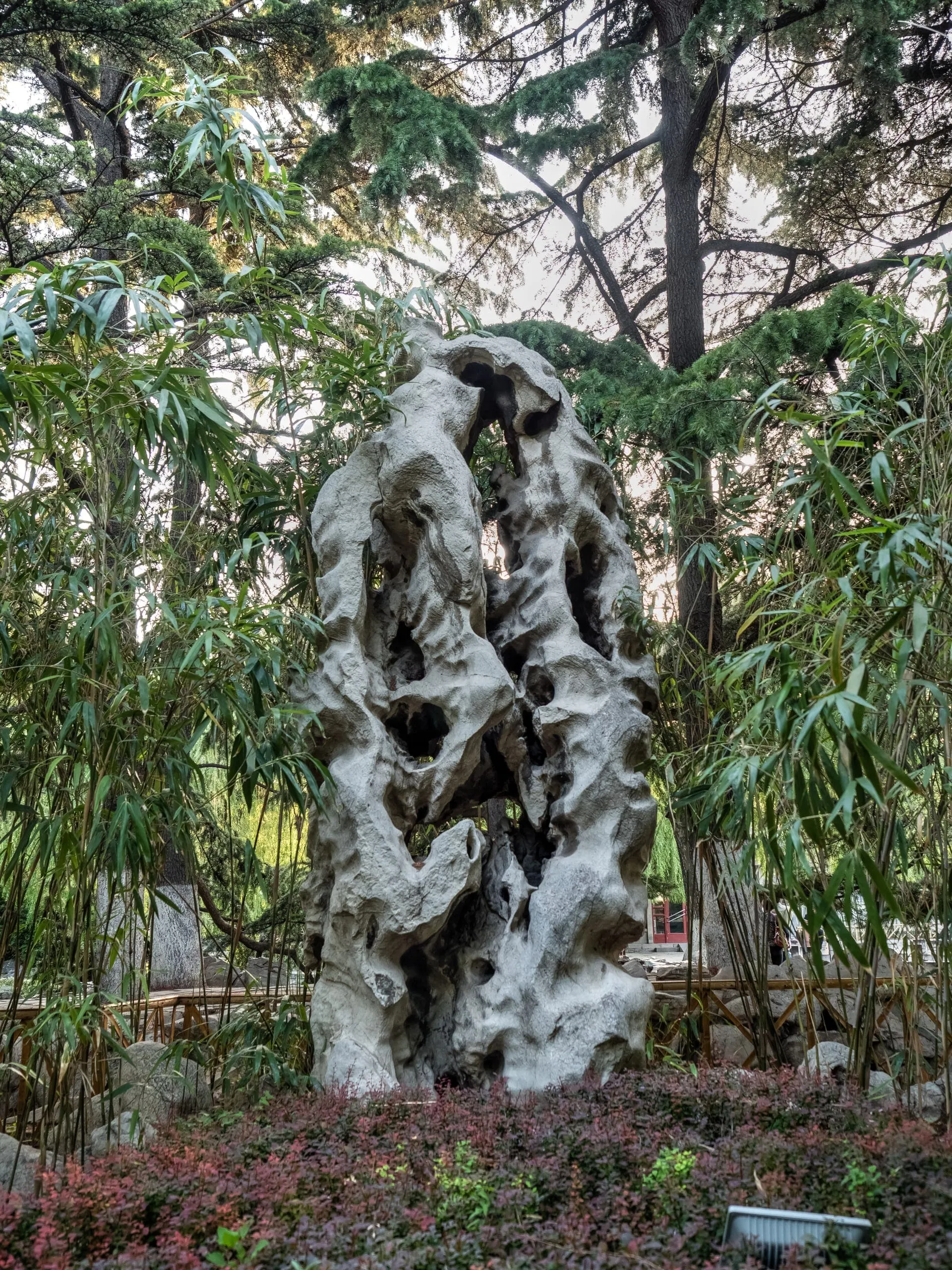
Baotu Spring Park (趵突泉公园, Bàotū Quán Gōngyuán)
The crown jewel of Jinan's springs — three gushing artesian jets in a landscaped Ming-Qing garden with pavilions, koi ponds, and a teahouse. ¥40 as of June 2026. The water is drinkable from designated fountains.
Wikimedia Commons · CC-BY-SA
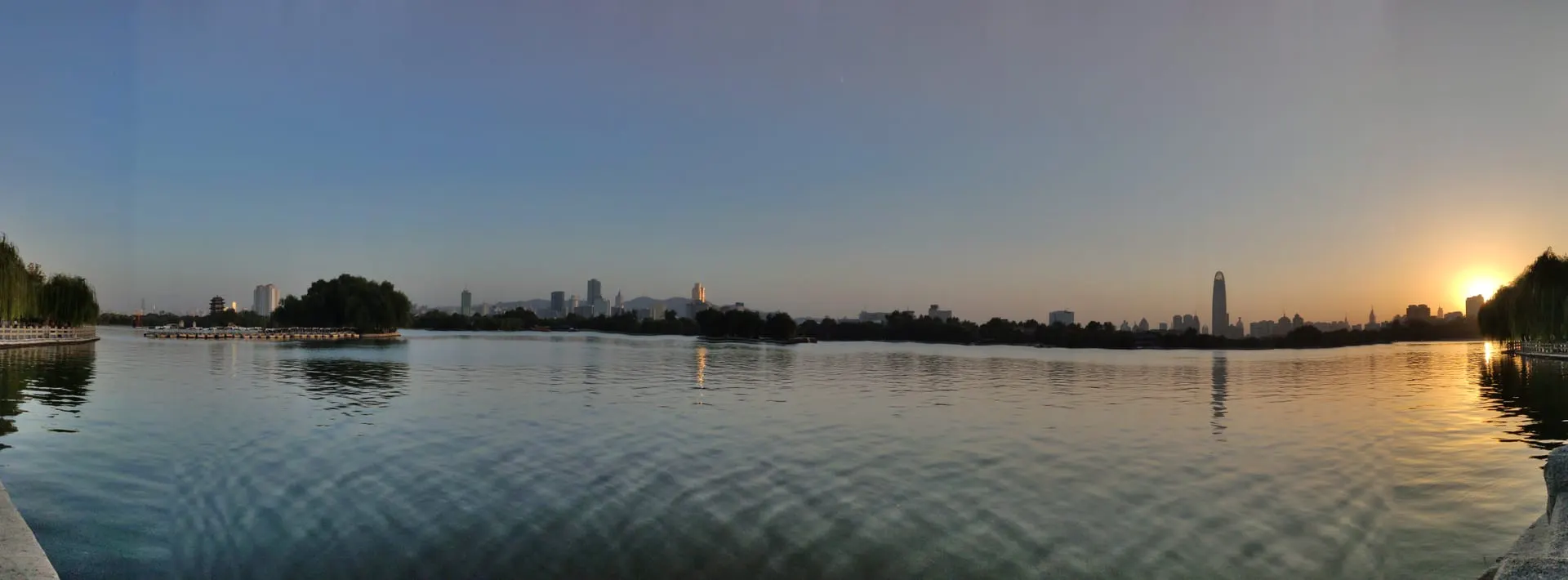
Daming Lake (大明湖, Dàmíng Hú)
A 46-hectare lake in the heart of the old city, ringed by willow trees, lotus beds, and classical pavilions. Free entry to the main perimeter; ¥30 for the island pavilion area. Boat rentals ¥40/hour.
Wikimedia Commons · CC-BY-SA
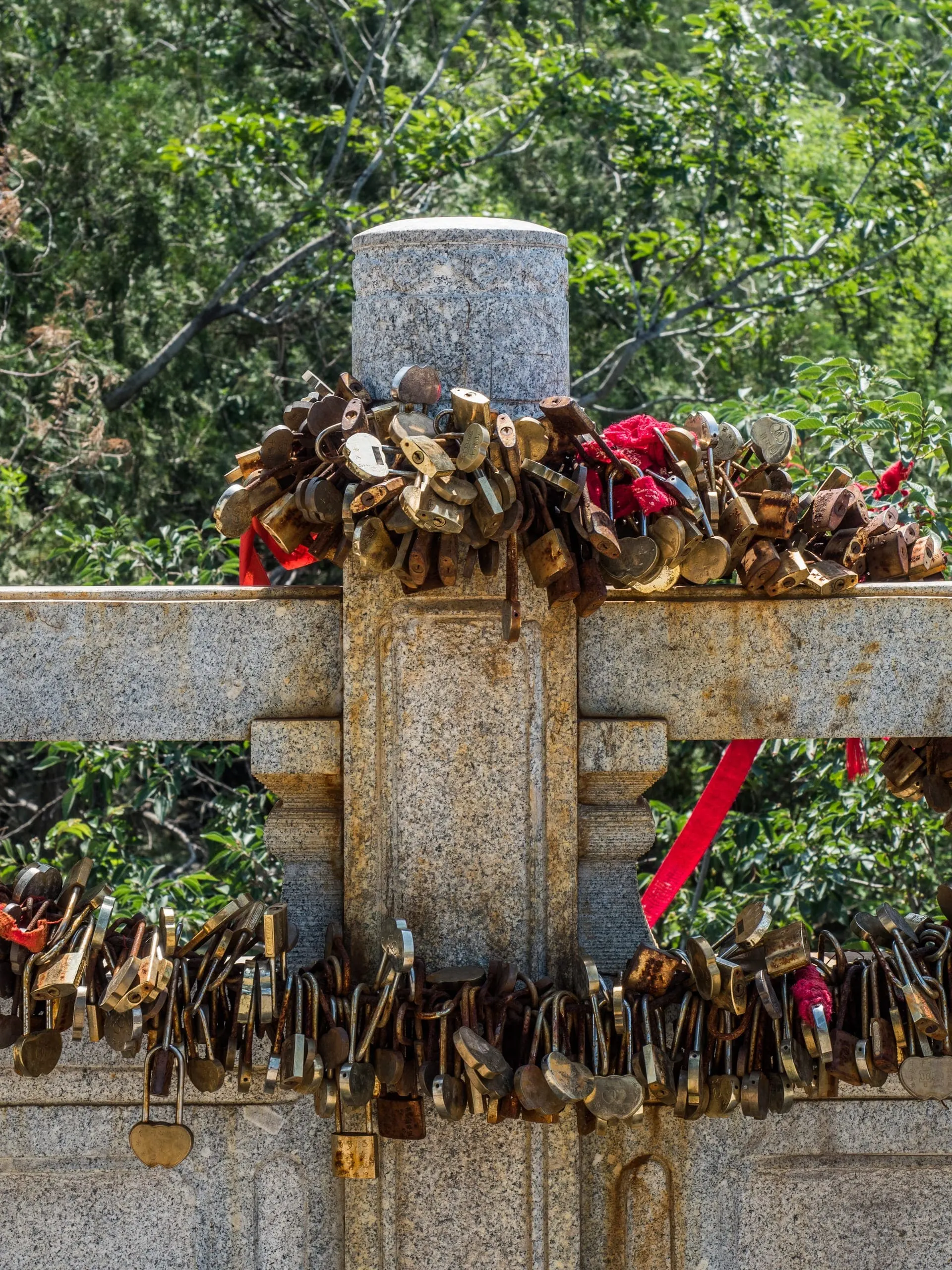
Thousand Buddha Mountain (千佛山, Qiānfó Shān)
A 285m hill with Sui-dynasty (581-618 CE) Buddhist cliff carvings, a giant golden Buddha at the summit, and sweeping city views. ¥30. Cable car available (¥20 one-way). The best morning walk in Jinan.
Wikimedia Commons · CC-BY-SA
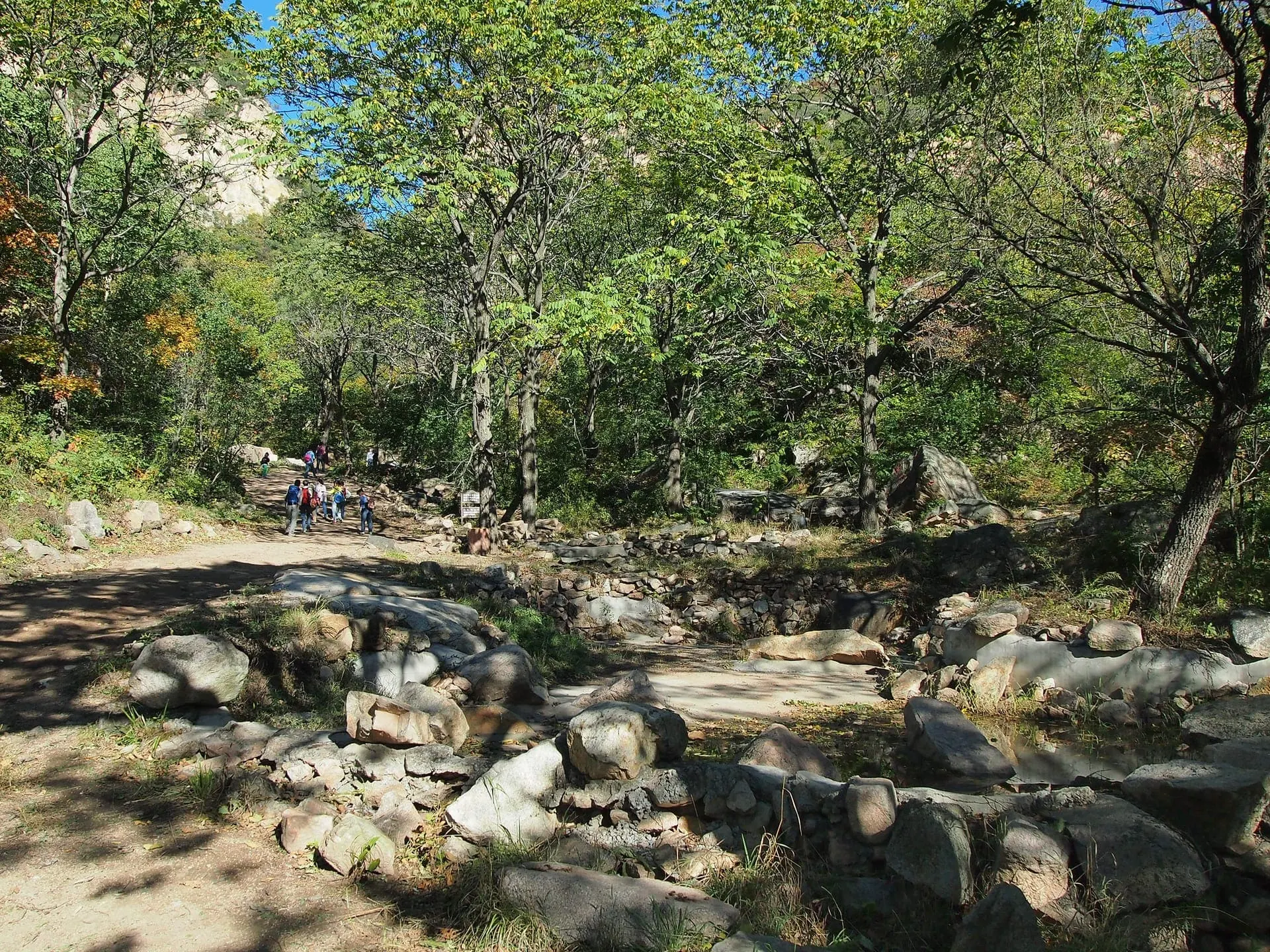
Five Dragon Pool (五龙潭, Wǔlóng Tán)
A quieter spring-fed park with five interconnected pools, the deepest of which plunges to 20 meters and glows an eerie turquoise. ¥5. Better for peaceful reflection than Baotu — fewer crowds, more locals.
Wikimedia Commons · CC-BY-SA
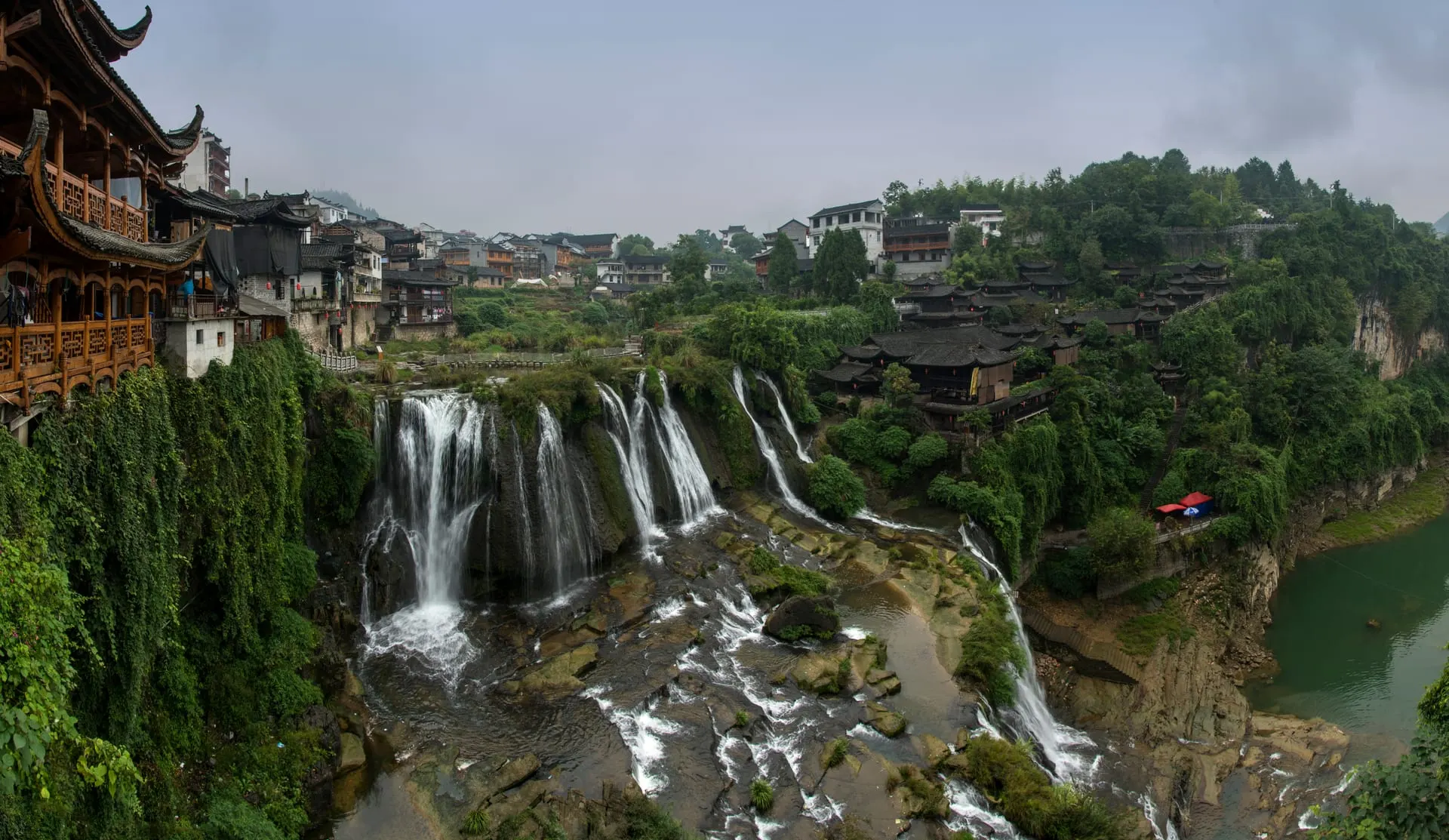
Furong Ancient Street (芙蓉街, Fúróng Jiē)
A narrow 400-meter lane lined with snack stalls, spring-water channels, and Qing-era shopfronts. The street follows an old spring-fed canal. Famous for Shandong jianbing (煎饼) and oil旋 (yóuxuán, spiral pastry). Free.
Wikimedia Commons · CC-BY-SA
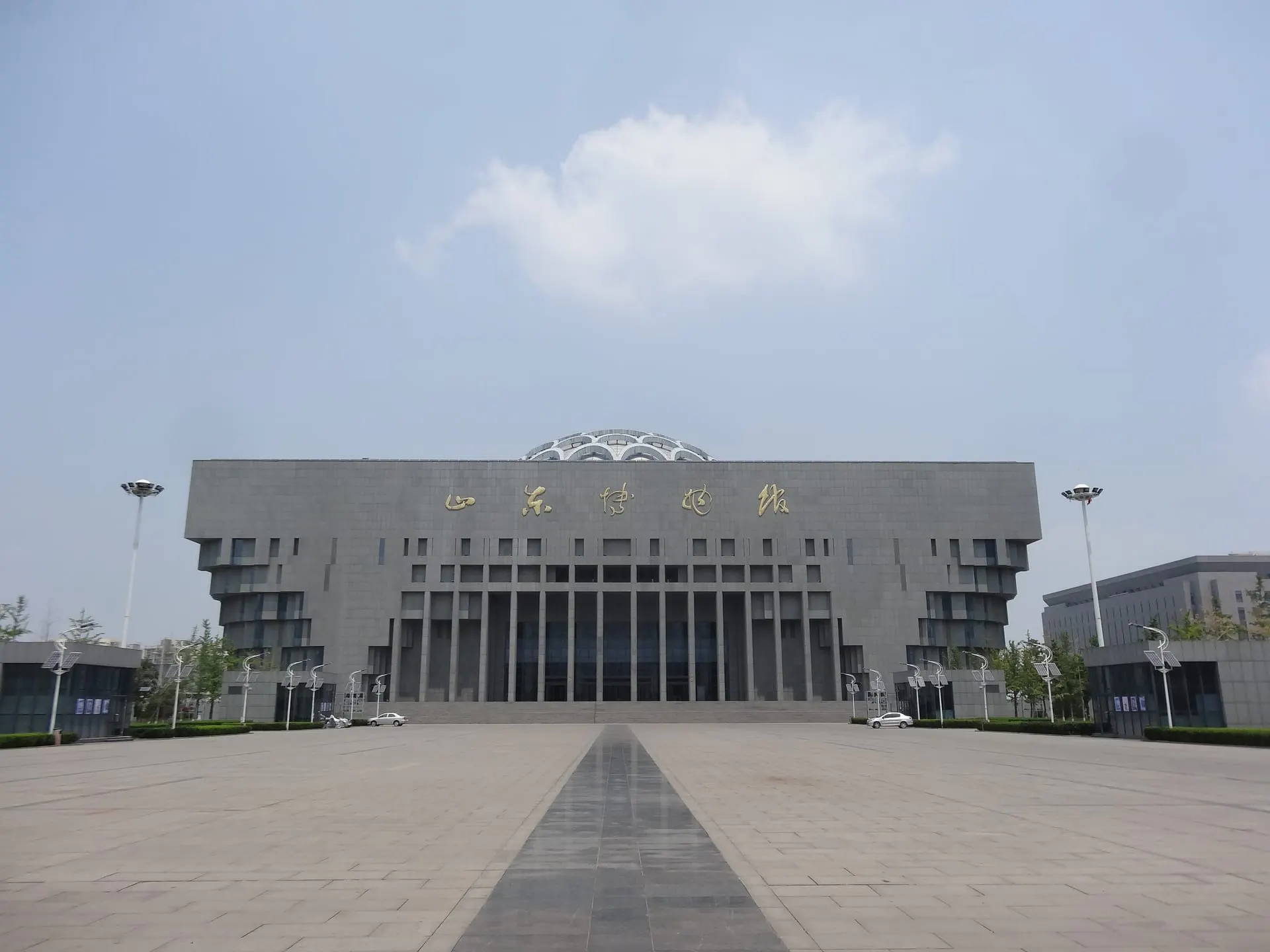
Shandong Museum (山东博物馆, Shāndōng Bówùguǎn)
Provincial museum with strong Neolithic Longshan culture collections (black pottery 4,000+ years old), Shang bronzes, Han stone carvings, and a gallery on Confucian culture. Free, reservation required.
Wikimedia Commons · CC-BY-SA
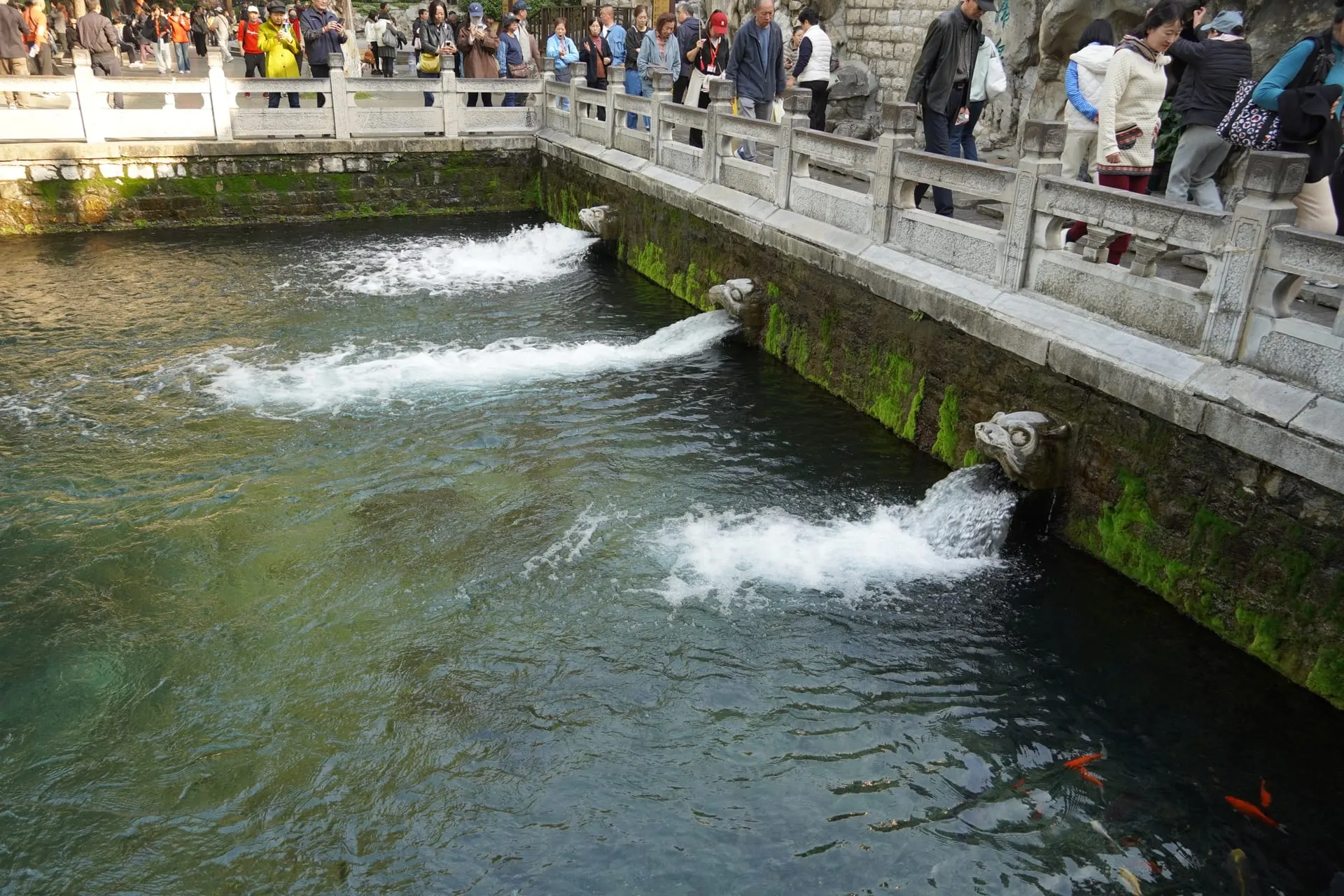
Black Tiger Spring (黑虎泉, Hēihǔ Quán)
A dramatic spring where water pours from three carved stone tiger heads into a moat alongside the old city wall. Locals queue with plastic jugs to collect drinking water. Free, open 24 hours.
Wikimedia Commons · CC-BY-SA
STAY
Where to stay in Jinan
Pick a base that matches the trip you want — imperial-central for sightseeing, hutong belt for character, Chaoyang for nightlife, or Qianmen for budget.
Spring District (泉城路)
Walkable core with Baotu Spring, Daming Lake, and Furong Street food — the historic heart on foot
#spring-districtLicheng District (历城区)
University area with student-priced Lu cuisine, Shandong Normal University, and local flavor
#lichengShizhong District (市中区)
Commercial center with Quancheng Square, malls, and the best mid-range hotels
#shizhongJinan West Station Area (济南西站)
HSR hub with budget chain hotels — functional, charmless, convenient for Mount Tai departures
#jinan-west
ITINERARIES
Sample itineraries from Jinan
Three ready-made routes, from a 1-day imperial sprint to a 5-day deep dive. Copy the day-by-day plan and adapt to your own pace.
- 2 DAYS
Jinan Springs Weekend
A compact weekend covering the springs, mountain, lake, and Lu cuisine — perfect for a Beijing-Shanghai HSR stop.
- Short stays
- First-time visitors
- Weekend break from Beijing or Shanghai
- Day 01
Morning
Baotu Spring Park (07:00 opening), Five Dragon Pool, Black Tiger Spring via moat path
Afternoon
Thousand Buddha Mountain climb, Shandong Museum (book ahead)
Evening
Furong Street food crawl — youxuan, jianbing, sweet-and-sour carp dinner
- Day 02
Morning
Daming Lake perimeter walk, boat rental (40 min)
Afternoon
Lingyan Temple or Qufu day trip (optional extension)
Evening
Dezhou braised chicken and Tsingtao beer, Daming Lake sunset walk
- 4 DAYS
Jinan + Mount Tai Cultural Loop
Complete Jinan spring experience plus a full-day Mount Tai ascent — the essential Shandong cultural pilgrimage.
- Cultural travelers
- Active travelers
- UNESCO site collectors
- Day 01
Morning
Baotu Spring Park early, moat walk to Black Tiger Spring
Afternoon
Thousand Buddha Mountain, Shandong Museum
Evening
Lu cuisine dinner at Yanxitang
- Day 02
Morning
Five Dragon Pool, Daming Lake boating
Afternoon
Furong Street, rest and pack for Mount Tai
Evening
Early dinner, buy train tickets and supplies for tomorrow
- Day 03
Morning
07:00 HSR to Tai'an, begin Hongmen ascent of Mount Tai
Afternoon
Continue climb to South Gate and Jade Emperor Peak
Evening
Summit sunset, cable car down, late HSR back to Jinan
- Day 04
Morning
Restful morning — Daming Lake tea house
Afternoon
Lingyan Temple (Tang-dynasty Buddhist site) or Qufu Confucius Temple
Evening
Farewell Lu cuisine dinner
- 7 DAYS
Shandong Grand Tour
The full Shandong province circuit: Jinan springs, Mount Tai, Qufu Confucian sites, and Qingdao's German coast.
- First-time Shandong visitors
- Culture + nature combo seekers
- Longer China trips
- Day 01
Morning
Arrive Jinan, Baotu Spring Park, Five Dragon Pool
Afternoon
Daming Lake walk, Furong Street
Evening
Lu cuisine welcome dinner
- Day 02
Morning
Thousand Buddha Mountain, Shandong Museum
Afternoon
Black Tiger Spring, moat walk, rest
Evening
Local restaurant near Shandong Normal University
- Day 03
Morning
HSR to Tai'an (20 min), climb Mount Tai
Afternoon
Summit exploration, descent via cable car
Evening
Return to Jinan, light dinner
- Day 04
Morning
HSR to Qufu (30 min), Confucius Temple
Afternoon
Confucius Mansion and Cemetery
Evening
Return to Jinan, final Lu cuisine meal
- Day 05
Morning
HSR to Qingdao (2.5h), check in
Afternoon
Zhanqiao Pier, old German architecture walk
Evening
Tsingtao Beer Street, fresh seafood
- Day 06
Morning
Laoshan Mountain coastal hike
Afternoon
Qingdao Beer Museum, Number One Bathing Beach
Evening
Seafood dinner, Zhongshan Road night walk
- Day 07
Morning
Badaguan villa district, Xiaoqingdao Island
Afternoon
Final seafood lunch, depart from Qingdao Airport
Evening
Departure
BUDGET
What a Jinan trip costs
Per-person, per-day costs across three spending tiers. Excludes international flights and visa fees.
| Line item | Backpacker | Mid-range | Luxury |
|---|---|---|---|
| Accommodation (per night) | $10 | $10 | $10 |
| Meals (per day) | $0 | $38 | $75 |
| Local transport (per day) | $10 | $20 | $30 |
| Attractions (per day) | $10 | $20 | $30 |
| Mount Tai (full day) | $10 | $20 | $30 |
| Total per day | $40 | $108 | $175 |
$ USD per person per day, before international flights and visas. Last verified: Q3 2026.
STAY SAFE
Emergency contacts in Jinan
Save these three numbers before you board the plane. China uses different hotlines than most countries — there's no 911.
- POLICE
110
- AMBULANCE
120
- FIRE
119
- TOURIST HOTLINE
12301
- ENGLISH-SPEAKING ER
Shandong Provincial Hospital VIP Wing / Qilu Hospital of Shandong University
Problems travelers hit in Jinan
- Why is my Alipay not working?You linked a foreign Visa or Mastercard to Alipay but every transaction is rejected at the merchant.
- My China visa was denied — what now?Your L visa application was refused at the Chinese consulate and your trip is in 2–4 weeks.
- My passport was lost or stolen in China — what do I do?Your passport is gone (theft or loss) and you're in mainland China without travel documents.
- Why can't I book on 12306 with my foreign card?You tried to book a high-speed rail ticket on 12306.cn and your foreign Visa/Mastercard is rejected at checkout.
- Why is my VPN not working in China?You arrived in China, opened your VPN, and it will not connect at all or connects but no traffic loads.
- Why can't I book a Tibet trip on my own?You try to book Lhasa flights and hotels yourself but the booking fails, or you're turned away at the Lhasa airport without a permit.
Book activities in Jinan
These are licensed tour operators and booking platforms we've vetted independently. Booking through these links may earn us a commission — see our affiliate disclosure. This never affects our editorial recommendations or the price you pay.
Frequently asked questions
Is Jinan worth visiting for foreign tourists?
How many days do I need in Jinan?
How do I get from Jinan to Mount Tai?
When is the best time to visit Jinan?
Are the Jinan springs still flowing?
What is Lu cuisine and what should I eat in Jinan?
Show all 20 FAQs
Can I drink the Jinan spring water?
Is Jinan safe for tourists?
Can I visit both Qufu and Mount Tai from Jinan?
What should I pack for Jinan?
What is the best Lu cuisine restaurant in Jinan?
Is Jinan family-friendly?
Do I need a guide for Jinan?
What is the single best day in Jinan?
What is the connection between Jinan and Confucius?
Why is Jinan so hot in summer and when should I avoid the city?
How do I do a Qufu day trip from Jinan and is it worth it?
What is Lingyan Temple and how do I visit it from Jinan?
Where can I see the locals collecting spring water in Jinan?
Is Jinan a good base for a longer Shandong trip and how do I extend my stay?
References

Related guides & destinations
Guide
How We Research 2026: NihaoVisit’s Methodology for China Travel Information
How NihaoVisit sources, verifies, and maintains 700+ pages of China travel information — our source hierarchy, fact-checking process, update
Guide
Fact-Checking Log 2026: Verified China Travel Information — NihaoVisit
A public log of fact-checking verification passes on NihaoVisit, showing what was verified, when, and against which sources — covering visa
Guide
Best Time to Visit China 2026: Month-by-Month Weather, Crowds, and Prices
The best time to visit most of China is April–May and September–October. Winter (Dec–Feb) is cold but cheap; summer (Jun–Aug) is hot and cro
Guide
VPN for China 2026: Which VPNs Work, eSIM Alternatives, and the Complete Pre-Trip Checklist
Most Western apps and websites are blocked in mainland China. A reliable VPN is essential for Google, Gmail, WhatsApp, Instagram, and most n
Guide
China SIM Card and eSIM Guide 2026: Stay Connected Without WeChat
A Chinese SIM or eSIM lets you use mobile data, maps, and ride-hailing without WiFi. Here is how to get one, the cost, and which provider to
Guide
Solo Female Travel in China 2026: Safety, Tips, and Real Experiences
China is one of the safer destinations for solo female travelers. Petty theft is rare, violent crime against tourists is extremely uncommon,