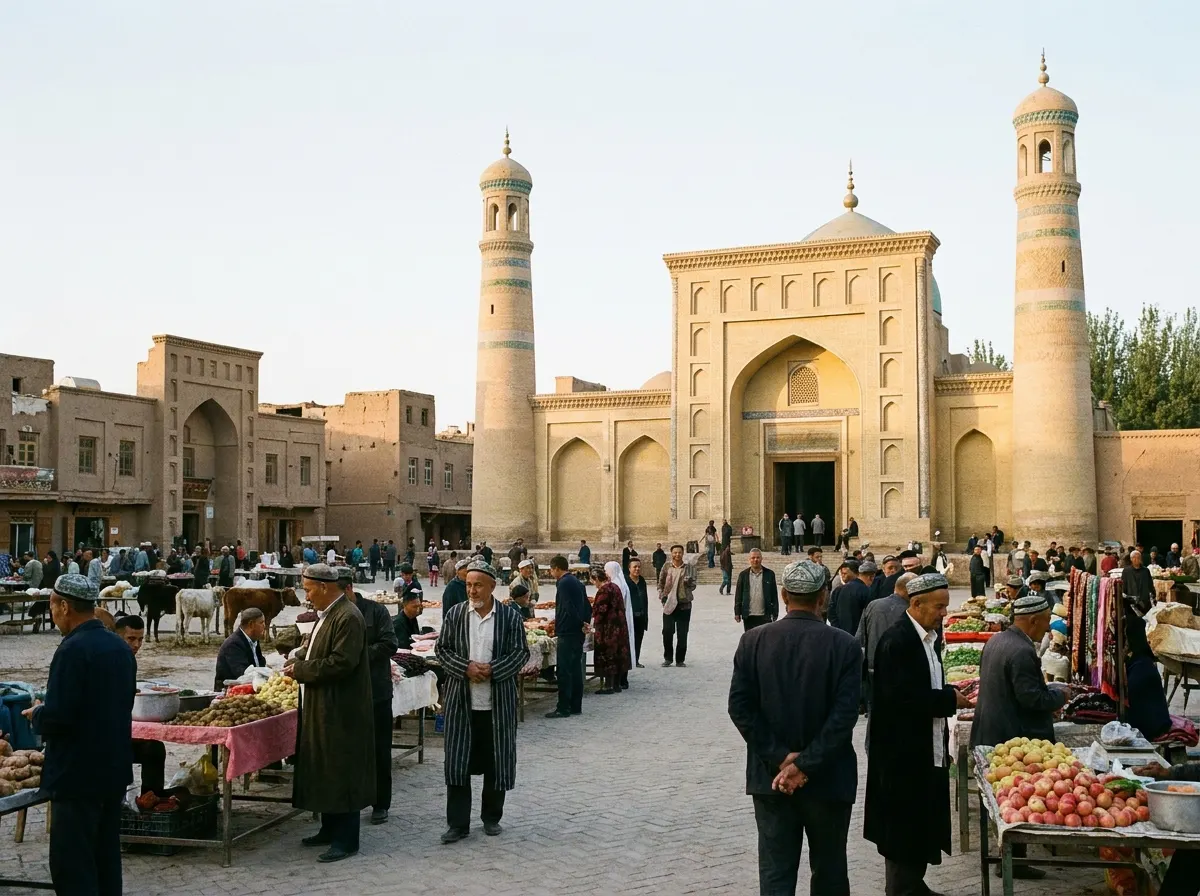
Kashgar
Kashgar (喀什, Kāshí) is China's westernmost city, 4,000 km from Beijing and closer to Baghdad than to Shanghai. It is one of the last places on earth where you can still feel what the Silk Road must have been like — a desert-edge trading city where Uyghur, Kyrgyz, Tajik, and Han cultures meet, where the Sunday Livestock Bazaar has been running for over 1,000 years, and where the call to prayer still echoes from the Id Kah Mosque. The Kashgar Old City (高台民居, Gāotái Mínjū) is a labyrinth of mud-brick houses and narrow alleys that people still live in — it is not a museum, it is a neighborhood. Karakul Lake sits at 3,600 meters under Muztagh Ata (7,546m), two hours away on the Karakoram Highway. Kashgar is complicated — security presence is heavy, the altitude takes adjustment, and Uyghur is spoken more than Mandarin — but for travelers who want to see a China that defies every stereotype, it is one of the most compelling cities in the country. Budget roughly ¥120-180 per day for mid-range comfort, and give yourself at least three days.
Why Kashgar in 2026.
Xinjiang's westernmost city, a Silk Road crossroads where Uyghur culture, Central Asian bazaar life, and the edge of the Taklamakan Desert collide. The Sunday Bazaar, Id Kah Mosque, and the old city are unlike anywhere else in China.
Quick Answer
Kashgar (喀什, Kāshí) is China's westernmost city, 4,000 km from Beijing and closer to Baghdad than to Shanghai. It is one of the last places on earth where you can still feel what the Silk Road must have been like — a desert-edge trading city where Uyghur, Kyrgyz, Tajik, and Han cultures meet, where the Sunday Livestock Bazaar has been running for over 1,000 years, and where the call to prayer still echoes from the Id Kah Mosque. The Kashgar Old City (高台民居, Gāotái Mínjū) is a labyrinth of mud-brick houses and narrow alleys that people still live in — it is not a museum, it is a neighborhood. Karakul Lake sits at 3,600 meters under Muztagh Ata (7,546m), two hours away on the Karakoram Highway. Kashgar is complicated — security presence is heavy, the altitude takes adjustment, and Uyghur is spoken more than Mandarin — but for travelers who want to see a China that defies every stereotype, it is one of the most compelling cities in the country. Budget roughly ¥120-180 per day for mid-range comfort, and give yourself at least three days.
| Worth visiting | Yes — Kashgar offers a cultural experience unlike any other Chinese city. The Sunday Bazaar alone justifies the trip. |
|---|---|
| Recommended days | 3-4 days |
| Best time to visit | May-June and September-October (avoid winter Nov-Mar when temperatures drop below freezing and the Karakoram Highway can close) |
| Daily budget | $40 (backpacker) / $120 (mid-range) / $300+ (luxury) |
| Family friendly | Moderate — the bazaar and old city are fascinating for children, but altitude at Karakul Lake (3,600m) and long travel times are challenges for young kids |
| Solo friendly | Yes — the old city is walkable, the bazaar is endlessly absorbing alone, and the backpacker infrastructure is reasonable |
| Airport | Kashgar Laining International Airport (KHG) — 10 km north of the city, flights from Urumqi (2h), Xi'an (4h), Chengdu (4.5h) |
| High-speed rail | No high-speed rail — conventional rail from Urumqi takes 20-24h. Most travelers fly. |
| Language | Uyghur (primary) and Mandarin (spoken by officials, younger residents, and Han population); English is extremely rare |
| Currency | CNY (¥) — Alipay and WeChat Pay are common in the city center; cash is essential for the bazaar and rural areas |
| Time zone | Theoretically China Standard Time (UTC+8), but locals unofficially use Xinjiang Time (UTC+6) — double-check all meeting times |
| Last updated | 2026-06-18 |
Want a Kashgar plan built for you?
Jump to:
Id Kah Mosque·Old City·Sunday Bazaar·History·Food·Getting There·Getting Around·Top Attractions·Where to Stay·Weather·Altitude & Tips·Itineraries·Practical Info·Emergency Contacts·Silk Road Legacy·Festival Calendar·Photography Guide·Uyghur Culture & Realities·FAQ
Why visit Kashgar? Is it worth going all the way out there?
Kashgar is far. Four thousand kilometers from Beijing. Four and a half hours from Xi'an by air. Two time zones west of Shanghai. For most travelers, getting here is a serious commitment of time and money. The question "is it worth it?" is fairer here than for almost any other destination in China. The answer is yes, if you want to see a side of China that exists nowhere else. Kashgar is not Han China. It is Uyghur, Central Asian, Silk Road. The faces on the street are Turkic, not Han. The food is Central Asian — lamb, naan, pilaf, yogurt. The architecture is mud-brick and Islamic tilework, not concrete towers and glass malls. The Sunday Livestock Bazaar has been running since before the Tang dynasty and still feels like a medieval trade fair. The honest cautions are real: security is heavy. Armed police and checkpoints are visible throughout the city. You will be asked for your passport repeatedly. The time-zone confusion is genuine — Xinjiang unofficially runs two hours behind Beijing, so when your phone says 10:00 the sun says 08:00 and shops just opened. English is essentially nonexistent outside your hotel. The altitude at Karakul Lake (3,600m) will leave you breathless if you are not acclimatized. But the Old City at dusk, with the smell of lamb kebabs and cumin drifting through alleys too narrow for cars, the sound of Uyghur conversation and the adhan from Id Kah, the sight of children playing football in tiny squares between mud-brick houses — it is one of the most transporting experiences in China. You are not looking at an exhibit. You are in a living, breathing Central Asian city that happens to be inside Chinese borders. That tension — between the Uyghur reality and the Chinese state — is ever-present, and it is part of what makes Kashgar so complicated and so unforgettable.
What is the history of Kashgar: Silk Road crossroads and Uyghur culture?
Kashgar has been a trading city for over 2,000 years. It sits at the western edge of the Taklamakan Desert, where the northern and southern Silk Road routes rejoined before the final push across the Pamirs into Central Asia and Persia. Every caravan going east or west passed through here. The city's name in Uyghur, K̡ǝxk̡ǝr, likely derives from an Old Persian word meaning "place of gathering" — which is exactly what it was. The city was contested for centuries: Chinese, Turkic, Mongol, Tibetan, and Arab powers all held it at various points. The Kara-Khanid Khanate brought Islam in the 10th century, making Kashgar one of the first cities in what is now China to convert. Marco Polo passed through in 1273 and described a city of "many merchants and artisans." The 19th-century Great Game between Britain and Russia played out here — Kashgar was a British consulate town, a Russian intelligence post, and a prize in the competition for Central Asian influence. Kashgar became part of the People's Republic of China in 1949, and the modern era has brought rapid change. The city's economy has grown with trade across the Pakistan border (the Karakoram Highway, completed in 1979, is the highest paved international road in the world), oil and gas development in the Tarim Basin, and Belt and Road infrastructure investment. The population is roughly 500,000, predominantly Uyghur, with significant Han, Kyrgyz, and Tajik minorities. The Old City underwent a massive reconstruction program between 2009 and 2015. Buildings deemed seismically unsafe were demolished and rebuilt in a modified traditional style. The result is controversial. The new Old City is safer, cleaner, and has modern plumbing, but the rebuilding displaced families and erased some of the organic density that made the original district so distinctive. Many remaining houses were renovated rather than demolished, and the area is still a living Uyghur neighborhood, not a theme park. Walking the alleys, you will see laundry hanging from balconies, children doing homework in doorways, and old men playing chess on street corners.
What to eat in Kashgar: Central Asian food at the edge of China?
Kashgar food is Central Asian, not Chinese. You will not find rice bowls, stir-fries, or chopsticks in most local restaurants. This is lamb, bread, yogurt, and tea country. The cuisine is halal and strongly influenced by Uyghur, Uzbek, and Kyrgyz traditions. The essential foods, with Uyghur and Chinese names: Polo (抓饭, zhuāfàn). Uyghur pilaf — rice cooked with chunks of lamb, carrot, onion, and cumin in lamb fat until the grains are separate, glossy, and aromatic. It is the region's signature dish, eaten with the right hand (or a spoon if you prefer), often topped with a piece of lamb shank. A plate costs ¥20-35 at a local restaurant. The best polo in Kashgar is at Tuman Polo (吐曼抓饭) near the Old City. Lamb kebabs (烤肉, kǎoròu / Uyghur: kawap). Skewered lamb grilled over charcoal, seasoned with cumin, salt, and chili powder. The meat is chunkier and fattier than Chinese lamb skewers further east. ¥3-6 per skewer. Order by holding up fingers — five skewers minimum is a reasonable start. The best are from street-side grills where the meat is cut and skewered in front of you. Naan (馕, náng). Round flatbreads baked in clay tandoor ovens, the staple carbohydrate of Uyghur life. Kashgar naan is thinner, larger, and crispier than the denser Uyghur naan from Urumqi. ¥2-5 each. Plain naan with sesame is the basic version; look for varieties topped with chopped lamb, onion, or cumin. Eat fresh from the oven — after a few hours naan turns hard and leathery. Laghman (拉条子, lātiáozi). Hand-pulled wheat noodles served with a stir-fry of lamb, peppers, tomatoes, onions, and cumin. It is the Uyghur answer to lo mein and it is excellent — the noodles are chewy and the sauce is rich and slightly spicy. ¥15-25 per plate. Look for restaurants with a window where you can see the noodle-pulling in action. Samsa (烤包子, kǎo bāozi). Flaky baked pastries stuffed with minced lamb, onion, and cumin, cooked in a tandoor until golden and crisp. ¥3-5 each. Eat them hot — the filling should be juicy, the pastry shattering. The best samsa in Kashgar comes from the tandoor bakeries around the Id Kah Mosque. Pomegranate juice (石榴汁, shíliú zhī). Kashgar and the surrounding oasis towns are famous for pomegranates, and fresh-squeezed pomegranate juice is sold everywhere from autumn through spring. ¥8-15 per glass at street stalls. It is sharp, tannic, and intensely fruity — nothing like bottled juice. For vegetarians: the options are limited but better than in Han China. Laghman can be ordered meat-free (素, sù). Naan is vegan. Fruit — melons, grapes, pomegranates, figs — is extraordinary and abundant in season (May-October). Yogurt (酸奶, suānnǎi) is fresh, tangy, and served with a sprinkle of sugar. A printed vegetarian card in Uyghur and Chinese is essential — Uyghur restaurants are less accustomed to vegetarian requests than restaurants in eastern China.
How to get to Kashgar: flights, trains, and the Karakoram Highway?
Kashgar Laining International Airport (KHG) is the practical arrival point for almost all foreign visitors. The airport is 10 km north of the city center, connected by taxi (¥25-35, 20 minutes) and the airport bus (¥15, 30 minutes to the city center). There is no metro in Kashgar. Flights are the only realistic option for most travelers. Direct flights from Urumqi (乌鲁木齐) take 2 hours and cost ¥500-900 one-way. From Xi'an (4 hours, ¥800-1,400), Chengdu (4.5 hours, ¥1,000-1,600), and Lanzhou (3 hours, ¥600-1,000) there are multiple daily connections. From Beijing (5.5 hours, ¥1,200-2,000) flights are less frequent but available. Book on Trip.com or Ctrip with 5-14 days advance. Train: there is no high-speed rail to Kashgar. The conventional rail journey from Urumqi takes 20-24 hours and passes through the Taklamakan Desert — it is a cultural experience, not a convenience. A hard sleeper costs ¥280-350, a soft sleeper ¥450-550. The train runs daily. This is a serious commitment of time and comfort, but the desert scenery and the slow transition from Han to Uyghur culture as you move west are genuinely interesting for travelers with time. The Karakoram Highway (KKH, 中巴友谊公路), the highest paved international road in the world, connects Kashgar to Pakistan via the Khunjerab Pass (4,693m). Foreigners can drive as far as Tashkurgan without a special permit. The KKH is spectacular — snow peaks, glaciers, alpine lakes, and Kyrgyz yurt camps — and is the route to Karakul Lake. You can hire a car with driver in Kashgar for ¥600-800 per day for the KKH route. Beyond Tashkurgan, a special permit is required to reach the Pakistan border (Khunjerab Pass, open May-November).
How to get around Kashgar: taxis, walking, and day trips?
Kashgar is a walkable city for the core sights. The Id Kah Mosque, the Old City, and the Grand Bazaar are all within 20-30 minutes on foot from each other. The Old City is best explored entirely on foot — the alleys are too narrow for cars and the joy is in getting lost. Taxis are the main transport for distances beyond walking range. Flagfall is ¥5 for the first 3 km, then ¥1.5 per km. A ride across town costs ¥10-20. Taxis are plentiful and cheap. The language barrier is high — always have your destination written in Chinese characters. Uyghur taxi drivers may not speak Mandarin well; Han drivers may not speak Uyghur. Pointing at addresses on your phone works. DiDi operates in Kashgar but the car supply is thinner than in eastern cities. The app works with a foreign phone number. Budget 5-10 minutes for a car to arrive. For the Sunday Livestock Bazaar, take a taxi (¥15-20 from the city center, 20 minutes). For Karakul Lake and the Karakoram Highway, hire a car with driver (¥600-800 per day) or join a tour (¥300-500 per person for a shared group day trip). For Tashkurgan, you need a car and driver for at least 2 days — the drive is 5-6 hours each way from Kashgar. Buses exist but are Chinese-only with no English signage, no announcement system, and routes that are opaque to non-speakers. They are not practical for foreign tourists. Shared bikes are not available in Kashgar.
What are the top attractions in Kashgar, ranked and described?
1. Sunday Livestock Bazaar. Free. The single most memorable thing in Kashgar. Every Sunday, farmers and traders from across southern Xinjiang converge on a dusty field northeast of the city center to trade animals — sheep, goats, cattle, donkeys, horses, camels — in a scene that has barely changed in a thousand years. Men in traditional Uyghur doppa hats negotiate with hand gestures and exaggerated expressions; animals are prodded, examined, and led away. The animal-trading section peaks from 09:00 to noon. The food section alongside it serves fresh polo, kebabs, and naan from open-air kitchens. Arrive early — by 13:00, the animal trading winds down. The bazaar is 5 km northeast of the center; a taxi costs ¥15-20. 2. Id Kah Mosque (艾提尕尔清真寺). ¥45. The largest mosque in China and the spiritual center of the Uyghur world. The yellow-tiled facade with its arched entrance portal is Kashgar's defining landmark. The interior prayer hall is large but relatively plain — the power of the place is in the scale of the compound (120,000 m²) and the sense that this has been the heart of the city since 1442. Visit outside prayer times, especially Friday noon when the square fills. Dress conservatively — shoulders and knees covered, shoes off inside. The square in front is a people-watching epicenter in the evening. 3. Kashgar Old City (高台民居). Free. The old city is not one site but hundreds — a maze of mud-brick houses, narrow cobbled alleys, carved wooden doors, and small courtyard mosques that climbs up from the Id Kah Mosque eastward. Walk without a map. The best streets are the ones with no signage. Look for: the copper-working street (铜器街), where artisans hammer bowls and plates; the hat-making alley; the spice sellers with sacks of cumin, chili, and saffron; and the residential back lanes where kids ride bicycles past doorways hung with embroidered curtains. The old city survived the 2009-2015 reconstruction and remains a living neighborhood. Late afternoon light (16:00-18:00 in summer) makes the mud-brick glow. 4. Apak Khoja Tomb (香妃墓). ¥30. A 17th-century mausoleum complex 5 km northeast of the city center, famous for its blue-green glazed tile dome and the legend of the Fragrant Concubine (香妃), a Uyghur noblewoman who married the Qianlong Emperor in 1760 and whose body was supposedly brought back here for burial. The tilework is exquisite, the surrounding cemetery has thousands of earthen grave mounds, and the attached mosque is a fine example of Uyghur Islamic architecture. An hour is enough. 5. Karakul Lake (喀拉库勒湖). ¥50. This is the landscape Kashgar is famous for. The lake sits at 3,600m on the Karakoram Highway, an otherworldly blue-green expanse with the snow-draped massifs of Muztagh Ata (7,546m) and Kongur Tagh (7,649m) rising behind it. On a clear day — which is most days outside winter — the reflection of the mountains in the still water is one of the best photographic subjects in China. Kyrgyz herders bring yaks and camels for photos (¥10-20 for a photo). The altitude is serious: spend at least one full day in Kashgar (1,289m) before going up. Drink water, move slowly, and watch for headache and nausea. The lake is 2-2.5 hours from Kashgar by car. 6. Tashkurgan Stone Fort (石头城). ¥30. A ruined fortress from the Tang dynasty at 3,100m, in the Tajik-majority town of Tashkurgan, 5-6 hours south of Kashgar on the KKH. The stone walls and watchtowers perch on a cliff above a golden grassland valley with the Pamir peaks rising in the distance. The fort was a garrison on the Silk Road protecting the route into the Wakhan Corridor. It is atmospheric and largely untouristed. The town of Tashkurgan is worth seeing in its own right — the Tajik people are ethnically Persian, not Turkic, and the women's red embroidered dresses are distinct from Uyghur clothing. 7. Kashgar Grand Bazaar (喀什大巴扎). Free. A huge covered market complex east of the Old City, selling everything Central Asia produces. The carpet section is the highlight — Uyghur, Kyrgyz, and Turkmen rugs in wool and silk, from ¥200 for a small wool piece to ¥5,000+ for a large silk carpet. Bargaining is expected. The dried-fruit section sells raisins, apricots, figs, dates, and walnuts of astonishing quality. The knife section sells traditional Uyghur pichak (belt knives) — beautiful objects, but you cannot take them on a plane or train. The bazaar is open daily from roughly 10:00 to 19:00 Xinjiang Time. For visitors with limited time, the Sunday Bazaar, Id Kah Mosque, and Old City are the top three — you can do all three in a day if Sunday is that day. Karakul Lake needs a separate day. Tashkurgan needs two days minimum.
Where to stay in Kashgar: neighborhoods, prices, and recommendations?
The Old City area is the best base for first-time visitors. Staying in or adjacent to the Old City puts you walking distance from the Id Kah Mosque, the alleys, and the Grand Bazaar. Several renovated traditional courtyard houses have been converted into guesthouses with Uyghur interiors — carved wooden ceilings, courtyard gardens, and rooftop terraces with Old City views. Prices run ¥200-400 per night. The Kashgar Old City Youth Hostel (喀什老城青年旅舍) has dorm beds at ¥50-70 and a rooftop with one of the best views in the city. The Pamir Youth Hostel is a backpacker institution with English-speaking staff and reliable tour information. Around People's Square (人民广场) and Seman Road (色满路) is the modern city center with mid-range chain hotels: Atour, Ji Hotel, Jinjiang Inn (¥180-350 per night). This area has more Han-oriented restaurants, better Wi-Fi, and easier access to ATMs and services. It is less atmospheric than the Old City but more convenient for practical needs. The area around Kashgar Railway Station (喀什火车站) has budget hotels (¥100-180) and is convenient only for late-night train arrivals or early departures. It is far from everything else and not recommended as a base for sightseeing. For luxury, the Radisson Blu Kashgar (喀什丽笙酒店) near People's Square has rooms from ¥600-1,000 with international-level comfort. The Yinrui International Hotel (银瑞国际酒店) is a local luxury option from ¥400-700. Neither has Old City character, but both offer reliable English-speaking front desks, which are otherwise very hard to find in Kashgar. A note on foreigner registration: every hotel in Kashgar, including small guesthouses, must register foreign guests with the Public Security Bureau. Small guesthouses sometimes refuse foreign guests because they lack the registration system. Book through Trip.com with the "accepts foreign guests" filter enabled, or call ahead to confirm.
What is the weather in Kashgar and when is the best time to visit?
Kashgar has a cold desert climate. It is dry — annual precipitation is around 60 mm, about the same as Las Vegas — with large daily temperature swings and extreme seasonal differences. January: -12°C to -2°C. Bitterly cold, dry, grey. Most tourists stay away. The Karakoram Highway may close due to snow. Hotels are at their cheapest. February: -8°C to 4°C. Still cold but brightening. The Spring Festival (dates vary) brings some domestic tourism. March: 0°C to 13°C. The start of spring. Dust storms can reduce visibility dramatically — the Taklamakan sends sand across the city on windy days. April: 7°C to 22°C. Warming up, though dust storms still possible. Trees begin to green. Late April is the beginning of the comfortable window. May: 12°C to 27°C. Excellent. Warm but not hot, clear skies, the poplars are green, melons start appearing in the markets. The first great month to visit. June: 16°C to 32°C. Hot but still dry. The Karakoram Highway and Khunjerab Pass are open. The landscape is at its greenest. The second great month. July: 19°C to 35°C. Peak summer heat. Manageable because humidity is very low, but midday sightseeing is unpleasant. August: 18°C to 34°C. Similar to July. The melon and grape season is at its glorious peak — worth the heat if you love fruit. September: 12°C to 28°C. Excellent. Cooling down, still dry, the autumn fruit harvest begins — pomegranates, figs, grapes. The third great month. October: 4°C to 20°C. The last good month. Crisp mornings, warm afternoons, autumn colors in the poplar groves. The Karakoram Highway typically closes at the end of October. November: -4°C to 9°C. Getting cold. The Sunday Bazaar moves partially indoors. The KKH is usually closed. December: -10°C to -1°C. Cold, dry, quiet. The low tourist season. The consensus best months are May, June, September, and October. July and August are hot but acceptable with low humidity. April and November are marginal. December through February is winter — possible but not recommended. The Karakoram Highway to Karakul Lake and Tashkurgan is typically open May through October.
What are the top tips, warnings, and things to know before going to Kashgar?
1. THE TIME ZONE SITUATION IS CONFUSING IN PRACTICE. All of China officially uses Beijing Time (UTC+8), but in Xinjiang the sun rises two hours later. Locals unofficially use Xinjiang Time (UTC+6). This means: when your phone says 10:00, the sun position says 08:00, shops just opened, and your lunch reservation might mean 12:00 or 14:00 Beijing Time. Always confirm times explicitly: "Beijing Time or Xinjiang Time?" (北京时间还是新疆时间?, Běijīng shíjiān háishì Xīnjiāng shíjiān?). Train tickets, flights, and official schedules are always Beijing Time. 2. ALTITUDE IS REAL. Kashgar city sits at 1,289m — low enough that most people feel fine. But Karakul Lake is at 3,600m and Tashkurgan at 3,100m. If you go up the Karakoram Highway immediately after flying in from sea level, you are at significant risk of altitude sickness (AMS). Spend at least one full day in Kashgar before going higher. Drink water, avoid alcohol, move slowly, and descend immediately if you develop a persistent headache, nausea, or shortness of breath at rest. 3. SECURITY PRESENCE IS HEAVY AND VISIBLE. Armed police, checkpoints, and surveillance cameras are present throughout the city. You will be asked for your passport — carry it at all times, not a copy. Police checks on intercity buses and at highway checkpoints are routine. They are generally professional and brief with foreigners. Do not photograph police, military, or checkpoints. 4. PASSPORT IS ESSENTIAL AT ALL TIMES. Hotels require it for check-in. Police checkpoints require it. You need it to buy intercity bus or train tickets. A photocopy is not sufficient. Keep your passport in a secure but accessible place. 5. DRESS CONSERVATIVELY IN RELIGIOUS SITES. At the Id Kah Mosque and other mosques, cover shoulders and knees, remove shoes before entering prayer halls, and avoid loud conversation. Women should carry a scarf to cover hair if visiting during prayer times. Non-Muslims are generally welcome outside prayer times, but observe what locals do and follow suit. 6. THE SUNDAY BAZAAR IS NOT A TOURIST SITE — IT IS A FUNCTIONING LIVESTOCK MARKET. The animal-trading area is dusty, muddy after rain, and not designed for visitors. Wear closed shoes you do not mind getting dirty. Do not stand between a camel and where it wants to go. Ask before photographing traders — most will agree with a smile, but politeness matters. 7. INTERNET IS SLOW. Wi-Fi speeds in Kashgar are noticeably slower than in eastern China. VPNs struggle more here — the network infrastructure is older and connections to servers outside China are throttled. Download offline maps, translation packs, and any reference material before arriving. Do not assume you can troubleshoot connectivity issues once you are here. 8. CASH IS STILL KING AT THE BAZAAR. Alipay and WeChat Pay are accepted at shops, hotels, and restaurants in the city center. But at the Sunday Livestock Bazaar, at small food stalls, and in the Old City's smaller shops, cash is essential. Carry ¥300-500 in small bills (¥5, ¥10, ¥20). ATMs at Bank of China and ICBC accept foreign cards — withdraw cash in the city before heading to the bazaar. 9. THE LEGENDARY SUNDAY BAZAAR HAS SHRUNK. The bazaar remains impressive, but it is smaller than its pre-2015 peak. The animal-trading area has moved to a more controlled site, and some of the spontaneous chaos that made the old bazaar famous has been regulated. It is still worth getting up early for — just do not expect exactly the Willem Diepraam photo-essay version. 10. A counter-intuitive tip: the best time to photograph the Old City is 07:30-09:00 Xinjiang Time (09:30-11:00 Beijing Time in summer), when the light is golden, the alleys are empty, and you can hear the sounds of breakfast — tea being poured, naan dough slapping against tandoor walls. By 10:00 Xinjiang Time, tour groups arrive.
What are good 2-day, 3-day, and 4-day itineraries for Kashgar?
2-day plan: Day 1 — Morning at the Id Kah Mosque (spend 45 minutes, then explore the square). Walk into the Old City and spend 2-3 hours getting lost in the alleys — head for the copper-working street, the hat-makers, and the residential back lanes. Lunch: polo and kebabs near the Id Kah Mosque (¥30-50). Afternoon at the Apak Khoja Tomb (¥30, 1 hour) and the Grand Bazaar for carpets and dried fruit. Evening: walk back to Id Kah Square for the sunset crowds, then dinner at a Uyghur restaurant near the Old City (¥40-70). Day 2 — If it is Sunday, the Livestock Bazaar from 09:00 to noon, then afternoon revisiting the Old City in better light. If it is not Sunday, hire a car for the Karakoram Highway day trip: leave at 08:00, arrive at Karakul Lake by 10:30, spend 2 hours at the lake, eat lunch at a Kyrgyz yurt camp, return to Kashgar by 17:00. 3-day plan: Days 1-2 as above. Day 3 — If you skipped Karakul Lake on Day 2, hire a car for the full Karakoram Highway day trip. If you already did the lake, use Day 3 for a deeper Old City exploration: visit the Kashgar Prefecture Museum (free, 1-2 hours, good Silk Road exhibits), walk the food streets northeast of the Old City, see a Uyghur muqam music performance (ask your hotel about evening performances), and eat your way through the Grand Bazaar food section. 4-day plan: Add a Tashkurgan overnight. Day 3 — Drive the KKH south: stop at Karakul Lake for an hour, continue through the subashi wetlands (wild camels, yaks grazing), arrive in Tashkurgan by late afternoon. Visit the Stone Fort (¥30) at golden hour. Overnight in Tashkurgan (basic hotels ¥120-250). Day 4 — Morning walk through the Tajik town, drive back to Kashgar (5-6 hours). This is one of the great road trips in China. The scenery — the Pamirs, the Kongur massif, the golden grasslands of the Taghdumbash Pamir — is world-class. You need a car and driver for this (¥600-800 per day) and altitude tolerance.
What practical information do I need: visa, money, internet, language?
Visa-free entry: As of June 2026, citizens of 45+ countries can enter China visa-free for up to 30 days. This includes Kashgar and Xinjiang. Confirm your eligibility with the nearest Chinese consulate before booking. Money: CNY (¥). ¥100 ≈ US$14. Alipay and WeChat Pay are accepted at most city-center establishments; link a foreign Visa/Mastercard before you travel. Carry ¥300-500 in cash for the bazaar, street-food stalls, and small Old City shops. ATMs at Bank of China, ICBC, and Agricultural Bank accept foreign cards. Cash advances on foreign credit cards are possible at bank counters with your passport. Internet: China's Great Firewall blocks Google, Facebook, Instagram, WhatsApp, YouTube, X, and most Western sites. Kashgar has slower internet speeds than eastern China. Install and test a VPN (ExpressVPN and Astrill have the best track record in Xinjiang) before arriving. Download offline Google Maps (for GPS), offline translation packs in Pleco, and any reference material before leaving Urumqi or another large city with better connectivity. Language: Uyghur is the primary language of daily life among Uyghurs. Mandarin is spoken by officials, police, younger Uyghurs, and the Han population. English is essentially nonexistent outside your hotel front desk (and even there it is limited). A translation app is required, not recommended. Pleco has the best Chinese-English dictionary but does not support Uyghur. Baidu Translate has a Uyghur mode that works offline if you download the pack. Microsoft Translator supports Uyghur text translation. Useful phrases: "rahmat" (Uyghur for thank you), "bir polo" (one polo), "bir laghman" (one laghman). The hotel desk can write destination names in Uyghur and Chinese.
What are the emergency contacts and health information for Kashgar?
Police: 110. Ambulance: 120. Fire: 119. Traffic accident: 122. These work from any phone. English-speaking operators exist in theory but Mandarin or Uyghur is the practical reality. Your hotel front desk is your best first call in any emergency. International medical care: Kashgar Prefecture People's Hospital (喀什地区人民医院) is the main hospital and can handle most emergencies. English-speaking staff are very limited. For serious medical issues, medical evacuation to Urumqi (2 hours by air) or Chengdu (4.5 hours) may be necessary. Comprehensive travel insurance covering medical evacuation is essential — more so here than in eastern Chinese cities. Altitude sickness: if you develop a persistent headache, nausea, dizziness, or shortness of breath at Karakul Lake or Tashkurgan, descend immediately. The drive back to Kashgar (1,289m) resolves most AMS symptoms within hours. Oxygen canisters are sold at Karakul Lake (¥30-50) but are a temporary fix, not a substitute for descending. Tap water is not potable anywhere in Kashgar. Bottled water is cheap (¥2-3) and available everywhere. Hotels provide kettles for boiling. Air quality: generally better than eastern China with lower industrial pollution, but spring dust storms (March-May) can push the AQI above 200. Carry an N95 mask during spring, especially if you have respiratory sensitivity. Sun exposure: at Kashgar's latitude and with the altitude of surrounding sites, UV radiation is strong year-round. Sunscreen, sunglasses, and a hat are essential, especially at Karakul Lake where the snow reflection doubles the UV dose.
What was Kashgar's role on the ancient Silk Road, and what traces of it remain today?
Kashgar was not just a stop on the Silk Road — it was one of the great hinge points where the road forked and reformed. Every caravan traveling between Han China and the Mediterranean had to pass through either Kashgar or its neighbors (Yarkand, Khotan) before pushing into the Pamirs and onward to Samarkand, Bukhara, Isfahan, Baghdad, and Antioch. The city sat at the exact western gate of the Taklamakan Desert, where the northern and southern Silk Road routes rejoined after their long detour around the impassable dune sea. A merchant leaving Kashgar heading east could either turn north toward Turpan and Dunhuang, or south toward Khotan and the Yutian route — both converged on Chang'an (modern Xi'an) more than 3,000 km away. The economy of Kashgar was built on this geography for over 2,000 years. Chinese silk moved west. Roman glass moved east. Central Asian horses, prized by Chinese emperors, came through Kashgar on the way to the imperial stud farms. Uyghur merchants in Kashgar learned to speak Sogdian, then Persian, then Chagatai Turkish, then Mandarin — depending on which empire was dominant at the time. By the Tang dynasty, the city was cosmopolitan in the literal sense: its bazaars sold Bactrian camels, Bukharan carpets, Chinese porcelain, Indian muslin, and Persian turquoise side by side. The Sunday Livestock Bazaar's modern form is a direct descendant of that medieval trade fair; the negotiating gestures, the inspection of teeth and hooves, the dusty open ground — these are not performances for tourists, they are habits that have continued, with adjustments, for a thousand years. What traces remain? The most tangible Silk Road artifact in Kashgar is the Apak Khoja Tomb — its blue-green glazed tiles are a synthesis of Persian, Uyghur, and Chinese decorative traditions, exactly the kind of cross-cultural fusion that defined the route. The Id Kah Mosque, built in 1442, is a rare example of a Central Asian Islamic structure on Chinese soil. The Old City's mud-brick construction technique (sun-dried bricks, carved wooden columns, second-floor summer rooms with ventilation holes) is shared with cities across the Tarim Basin and into Uzbekistan — a continuous architectural tradition that pre-dates modern borders. The copper-working street in the Old City still hammers Uyghur-style teapots and serving trays using techniques that have changed little since the Kara-Khanid era. The intangible traces are stronger. The Uyghur language itself is Turkic with heavy Persian and Arabic loanwords, a layered vocabulary that mirrors the city's role as a meeting point. Uyghur polo (zhuāfàn) is recognizably the same dish as Uzbek plov and Afghan pulao — the rice-and-lamb pilaf traveled the Silk Road with the people who cooked it. The doppa hats sold in the Grand Bazaar are worn by Uyghurs in Kashi and by Tajiks in Tashkurgan, where the women's red embroidered dresses echo patterns found in Afghanistan and northern Pakistan. Even the call to prayer from Id Kah, which sounds Arab in origin, is delivered in a Central Asian Turkic dialect that linguists trace back to the Chagatai literary tradition. For travelers interested in the Silk Road dimension specifically, the Kashgar Prefecture Museum (喀什地区博物馆, free) is worth the visit — it has a modest but well-curated collection of Silk Road artifacts: coins from various empires, fragments of textiles, pottery, and Buddhist pieces from the pre-Islamic period when Kashgar's religious landscape was completely different. The museum is small enough to see in 1-2 hours. Allow more time if you also want the natural history sections, which cover the Tarim Basin's wildlife and the mummified remains found in the surrounding desert. The honest reality: Kashgar's Silk Road identity is now largely a memory preserved in architecture, food, language, and one weekly market. The caravanserais that once sheltered merchants are gone. The physical road itself has been replaced by highways and the Karakoram corridor to Pakistan. But the cultural memory is real, and walking the Old City, eating polo with your hand, and watching a Kyrgyz trader haggle over a camel at the Sunday Bazaar, you are still touching the Silk Road — just its modern, regulated, complicated end.
What festivals, religious holidays, and cultural events should travelers know about in Kashgar?
Kashgar's calendar is shaped by two overlapping cycles: the Islamic lunar calendar (which determines religious observances) and the solar agricultural calendar (which determines seasonal festivals). Together they produce a rhythm of celebrations that no other Chinese city follows. Eid al-Fitr (开斋节, Kāizhāi Jié) marks the end of Ramadan and is the biggest holiday of the year. For one month before Eid, observant Uyghurs fast from dawn to sunset — restaurants in the Old City close during the day, and the energy of the city shifts noticeably. Eid al-Fitr itself runs for three days: families dress in new clothes, visit the cemetery to honor the dead, gather for large meals of polo, samsa, and lamb, and children receive red envelopes (红包, hóngbāo) of money from elders. The Id Kah Square fills with thousands of worshippers for the special Eid morning prayer. For travelers, Eid is a fascinating time to be in Kashgar — the city is alive, the food is at its best, and the family gatherings spill into the streets. The practical caveat: many shops and restaurants close for the first 1-2 days, and transport bookings become difficult as everyone travels. The dates shift earlier by 10-11 days each year on the solar calendar; check the Islamic calendar for your travel year. Eid al-Adha (古尔邦节, Gǔ'ěrbāng Jié), 70 days after Eid al-Fitr, is the second major Islamic holiday. It commemorates Ibrahim's willingness to sacrifice his son, and is marked by the ritual slaughter of sheep — you will see families with freshly slaughtered lambs on doorsteps, the meat divided into thirds for family, neighbors, and the poor. The Id Kah Mosque prayer is again the focal point. Expect 3-4 days of disrupted business. Nawruz (诺鲁孜节, Nuòlǔzī Jié), the Persian/Central Asian New Year on March 21, is widely celebrated in Kashgar despite being officially unrecognized in China. Uyghur families prepare a Nawruz table with seven items beginning with the letter "sh" or "s" in Persian (apple, vinegar, garlic, sumac, wheat sprouts, and others) symbolizing health, patience, and prosperity. Music, dancing, and traditional dress fill Id Kah Square in some years. Nawruz has a particular significance for the Tajik minority in Tashkurgan — it is their biggest holiday. If your visit falls around March 21 and you can extend south to Tashkurgan, the Tajik Nawruz celebration is one of the most visually striking events in Xinjiang, with the red-embroidered dresses and Pamir eagle-dance performances. The Sunday Bazaar is, in its own way, a weekly festival. The animal-trading section peaks around the post-harvest months (September-October) when farmers have surplus livestock to sell — the scale is significantly larger in autumn than in spring. Plan your visit accordingly. The Korla Fragrant Pear Festival and other regional agricultural events occasionally spill over into Kashgar in September-October. The Kashgar Prefecture holds an annual Tourism Festival (often in September) with Uyghur dance performances, muqam music, and handicraft exhibitions — dates vary year to year, ask your hotel. Local wedding seasons cluster in late autumn (after the harvest) and late spring (before the summer heat) — you may stumble across a Uyghur wedding procession in the Old City, with a band, decorated cars, and dancing in the streets. Uyghur weddings are joyous public events; if you encounter one, watch respectfully from a distance and ask before photographing. Muqam (木卡姆, Mùkǎmǔ) is the Uyghur classical music tradition — a 12-muquam cycle of instrumental and vocal pieces recognized by UNESCO as Intangible Cultural Heritage. Performances are less frequent than they used to be, but some teahouses and cultural centers around the Old City still host evening muqam sessions. Ask your hotel — the Pamir Youth Hostel and a handful of Old City guesthouses know the current schedule. A live muqam performance, with the rawap (Uyghur fiddle), tanbur (long-necked lute), and dutar, is one of the most intimate cultural experiences in Xinjiang. Practical festival planning: Eid dates shift each year, so do not assume a specific month. If avoiding crowds matters to you, check the Islamic calendar before booking. If experiencing a major festival matters, plan your trip around Eid al-Fitr or Eid al-Adha — book accommodation 2-3 months in advance, expect higher prices, and accept that some museums and sights may close for the day of prayer. Outside of these major holidays, the city settles into a quieter rhythm that is also worth experiencing — most weeks, Kashgar offers a balance between the everyday life of an Uyghur trading city and the occasional cultural performance that brings the heritage into public view.
How should photographers approach Kashgar, and what are the real rules?
Kashgar is one of the most photographed cities in China, and one of the easiest places to make a serious mistake with a camera. The rules are stricter here than in eastern China, the cultural sensitivities are higher, and the consequences of getting it wrong can range from a confiscated memory card to a police escort to the station. With planning, you can come away with extraordinary images and stay out of trouble. The hard rules first. Do not photograph: police officers or armed personnel in uniform; military installations or vehicles; checkpoints and surveillance cameras; government buildings (including the local Public Security Bureau); bridges and major infrastructure in southern Xinjiang; prison facilities; and the interiors of mosques during prayer. The rules apply regardless of whether you are a professional or a tourist, regardless of whether you are shooting from a public space, and regardless of whether you think you have a creative justification. If a checkpoint officer tells you to put the camera away, comply immediately and without argument — explanation in English will not help. The reality is that Kashgar's security apparatus is sensitive about being photographed, full stop. The soft rules next. At the Id Kah Mosque, do not photograph worshippers during prayer — the call goes out five times a day, and during each call the courtyard fills with men praying shoulder to shoulder. Photographing them is forbidden. Outside prayer times, photograph the architecture freely. Women should be cautious about photographing Uyghur women in headscarves — many will agree if you ask politely, but some will refuse. Children are generally happy to be photographed if you gesture and smile first. At the Sunday Bazaar, traders will often invite you to take their photo — wait for the nod or wave before raising the camera. The best light in Kashgar is the same as anywhere in the desert belt: the hour after sunrise and the hour before sunset. For the Old City alleys, the magic window is roughly 07:30-09:00 Xinjiang Time in summer (about 09:30-11:00 Beijing Time) — the alleys are empty, the light is golden on the mud-brick, and you can hear the sounds of breakfast preparation (the slap of naan dough on tandoor walls, the pouring of tea, the call of vendors). By 10:00 Xinjiang Time, tour buses begin arriving and the alleys fill with cameras. Late afternoon (16:00-18:00 Beijing Time) is the second window, especially for the carved wooden doors of renovated houses, which glow when raked by low light. For Id Kah Mosque, the square in front is the well-known shot — the yellow-tiled facade framed by the plane trees, with Uyghur families and dancers in the foreground. The best time is just before sunset, when the facade catches warm light and the square begins to fill with evening crowds. Arrive 45 minutes before sunset to find your spot. Friday around noon, when the square is packed for Jumu'ah (Friday prayer), is a dramatic scene but photographing worshippers at prayer is forbidden — restrict yourself to wide establishing shots that include the architecture. For the Sunday Bazaar, the animal-trading section is the more photogenic half. The dawn-to-noon trading is your window. The light is best in the first two hours. A telephoto lens (70-200mm equivalent) lets you work from a respectful distance — close enough for portrait-quality faces and detailed hand gestures, far enough that you are not intruding. A wide-angle (24-70mm) captures the scale of the dusty field and the crowd. Wear neutral colors — bright red or white draw attention. A scarf over your camera strap and a small bag reduce your profile as a tourist. For the Karakoram Highway and Karakul Lake, the photography is unrestricted. The lake at midday (12:00-14:00 Xinjiang Time) gives the strongest turquoise-blue color. Late afternoon brings out the deep blue and the best reflection of Muztagh Ata. Cloud cover produces the most dramatic mountain images, even though the standard postcard view is sunny. Technical considerations: dust is the enemy. The Taklamakan sends fine grit into everything, and changing lenses in the Old City or at the bazaar is risky. A rain cover or a sealed plastic bag for your camera is essential. Bring more microfiber cloths than you think you need. Spare batteries drain faster in cold (winter and Tashkurgan) and at altitude (Karakul Lake). Memory cards: bring at least 2-3x what you would normally carry — you will shoot more than you expect. Finally, the ethics. Kashgar's Uyghur population is not a photography subject. They are people whose daily life has become a backdrop for tour buses. Many are genuinely warm and welcoming; many are tired of being asked to pose. Treat every interaction as you would want to be treated. The best photographs come from conversations, not intrusions — sit at a teahouse, buy a glass of pomegranate juice, wait for the moment to come to you, and the camera will follow naturally. The image you remember longest will not be the wide shot of the Id Kah facade; it will be the old Uyghur man at the Sunday Bazaar who, after watching you for ten minutes, gestured for you to come closer and showed you how to read the ears of his prize sheep. Two more practical notes. First, drones: small consumer drones are technically not permitted in Kashgar airspace, and even registered commercial drone operations face tight restrictions in Xinjiang. Bringing a drone is not worth the risk — security personnel will confiscate it at the first checkpoint, and the legal consequences can escalate. If you need aerial footage of the Karakoram Highway or Karakul Lake, work with a registered operator in Urumqi who has the necessary permits. Second, drone photography from the public viewpoint at Karakul Lake is common, but the same restrictions apply — expect to be asked to land it by park staff or police. For most travelers, a good zoom lens and a stable perch are the safer and more reliable path. One final thought: Kashgar rewards the photographer who slows down. The temptation with a city this visually dense is to fire off hundreds of frames in an hour and move on. Resist it. Spend an entire morning in one alley. Sit on a wooden bench outside a copper workshop and watch the same street for an hour. The light will shift, the people will cycle through, and you will begin to see the city as its residents do — not as a collection of postcard images but as a place where time moves at a different pace. Those are the photographs no tour group will ever get.
What is the deeper story behind Uyghur culture in Kashgar today, and what should travelers understand before going?
Kashgar is the cultural heart of the Uyghur people and one of the most distinctive cities in China. It is a Central Asian oasis town whose language, food, architecture, and daily rhythm feel closer to Samarkand than to Beijing. As a border region, expect routine travel-document checks. Carry your passport, and be prepared for ID checks at transport hubs and hotel registration, which is strictly enforced. Beyond that, the focus here is the living Uyghur culture, which is genuinely, vividly alive. The Sunday Bazaar still happens every week with thousands of animals traded in real commerce. The Old City is still a living neighborhood — children ride bicycles through the alleys, families hang laundry from carved wooden balconies, old men play chess on the edges of small squares. The call to prayer still echoes from Id Kah five times a day. The Uyghur language dominates signage, conversation, and the radio. The food is still Central Asian halal — polo, samsa, laghman, kebabs, pomegranate juice — not Han Chinese stir-fries. What cultural elements are most worth experiencing? First, the music — muqam is the Uyghur classical tradition, a 12-muqam cycle with roots in the Silk Road era. UNESCO inscribed it on the Intangible Cultural Heritage list in 2005. Live performances are rarer than they were a decade ago, but a handful of teahouses and cultural centers still host evening sessions. Ask at your hotel; the Pamir Youth Hostel and Old City guesthouses are the best bets. Second, the dance — Uyghur sanam dance is performed at weddings, cultural events, and sometimes informally in Id Kah Square in the evenings. The movements are characteristically Central Asian: small steps, expressive hands, tilted head, rotating wrists. Third, the crafts — copper-working, doppa hat-making, carpet weaving, instrument making, leatherwork, and jade carving are still practiced in the Old City workshops. The copper-working street (铜器街) is the most concentrated place to see artisans at work. Food culture runs deeper than the restaurant menu. The tradition of communal polo — a large plate of rice-and-lamb pilaf shared from a single dish with the right hand — is a cultural ritual as much as a meal. Sharing a plate with an Uyghur family, if you are invited, is one of the most intimate experiences in Xinjiang. Hospitality is non-negotiable in Uyghur culture: tea will appear, fruit will be pressed on you, and refusal is taken as an insult. The Uyghur tea tradition — black tea with cardamom, served in small piala bowls — is its own ritual, often accompanied by dried fruit, nuts, and bread. The fruit culture is itself extraordinary: melons, grapes, pomegranates, figs, mulberries, apricots, pears, and apples from the surrounding oasis farms reach a quality you will not find elsewhere in China. The August-September fruit season is when Kashgar is at its sensory peak. Finally, the practical: how do you, as a foreign visitor, behave respectfully? Treat Uyghur culture as a living contemporary culture, not as something exotic. Spend money in Uyghur-run businesses rather than chain establishments. Learn five Uyghur words (rahmat, yaxshi, bir, ikki, üch — thank you, good, one, two, three). Buy a doppa or a small carpet as a souvenir rather than a mass-produced keychain. Accept invitations to Uyghur homes if they come — they will not come often, and they are meaningful when they do. Be patient with the language barrier. Kashgar is a city of layered realities, and the more open you are, the richer the experience.
What is the Sunday Bazaar really like, and how should a first-time visitor approach it?
The Kashgar Sunday Bazaar is not a single market but a layered system of trading grounds on the eastern edge of the old city, each section serving a different commercial function. The most famous part is the livestock market (牲畜巴扎), where Uyghur, Kyrgyz, and Tajik farmers bring sheep, goats, cattle, donkeys, horses, and camels to trade in a dusty field several kilometers outside the city center. Trading starts before dawn and winds down by early afternoon. The sight — hundreds of animals held in pens, farmers in doppa caps haggling in Uyghur, dust rising under the Pamir light — is one of the most photographed and most economically real scenes left on the old Silk Road. It is not a performance for tourists; the animals change hands for real money and the negotiating gestures have been refined over centuries. The livestock market is held on Sundays. The broader general bazaar (大巴扎) operates daily but expands significantly on Sundays, with thousands of stalls selling clothing, footwear, hardware, fabrics, spices, dried fruit, nuts, carpets, doppa hats, knives, musical instruments, and household goods. The craft and souvenir bazaars run daily, with copper workshops, knife-makers, instrument-makers, and carpet vendors clustered along specific streets in the Old City. Approach the Sunday Bazaar with realistic expectations and a clear plan. Most visitors come for the livestock trading, which means arriving by 07:00-08:00 and leaving by noon. The rest of the day is less photogenic and less interesting. Bring a dust mask, sunglasses, comfortable walking shoes, and small bills. Photography is permitted but the rule is to ask before pointing your camera at a person or a specific animal — most traders will agree if you gesture and smile first. The market grounds are not stroller-friendly and the dust is significant; do not bring very young children or anyone with serious respiratory issues. The etiquette of bargaining is its own tradition. Start at roughly 50% of the asking price, expect to settle at 60-70% for a successful deal, and do not take offense if a trader walks away — it is a negotiating technique, not a rejection. Buy nothing from a trader who pressures you; the bazaar has hundreds of stalls and the genuine sellers will let you leave and think about it. The Sunday Bazaar rewards patience and a sense of humor more than a checklist of things to buy. Many of the best moments happen when you stop trying to transact and simply watch the morning unfold.
Top attractions
Kashgar Sunday Bazaar (喀什大巴扎)
One of Central Asia's largest and most famous markets, held every Sunday. Thousands of vendors selling livestock, carpets, spices, knives, and everything in between. The livestock section starts at dawn.
Id Kah Mosque (艾提尕尔清真寺)
The largest mosque in China, dating from 1442, able to hold 20,000 worshippers. The yellow-tiled façade and minarets are the icon of Kashgar. Open to non-Muslim visitors outside prayer times.
Kashgar Old City (喀什老城)
A maze of narrow mud-brick lanes, two-story Uyghur courtyard homes, and small workshops — one of the best-preserved traditional Islamic city centres in Central Asia. Undergoing sensitive restoration since 2010.
Apak Khoja Mausoleum (阿帕克霍加墓)
Also called the Fragrant Concubine Tomb. The holiest Muslim site in Xinjiang, a 17th-century tiled mausoleum complex 5km northeast of the old city.
Karakul Lake (喀拉库勒湖)
A high-altitude glacial lake at 3,600m on the Karakoram Highway, with Muztagh Ata (7,546m) and Kongur Tagh (7,649m) reflected in its waters. A 4-hour drive from Kashgar.
Karakoram Highway (KKH)
The legendary road from Kashgar through the Karakoram to Pakistan. Even a short section — to Karakul Lake and back — is one of the world's great mountain drives.
Abakh Khoja Tombs
The 17th-century tiled mausoleum of the Kashgar region's Islamic religious leaders, with a distinctive Central Asian dome and a legend about a Qing-dynasty "Fragrant Concubine."
Uyghur Food Streets (美食街)
Hand-pulled laghman noodles, lamb kebabs grilled over charcoal, Central Asian pilaf (polo), naan bread fresh from the tandoor, and the Kashgar night market atmosphere.
STAY
Where to stay in Kashgar
Pick a base that matches the trip you want — imperial-central for sightseeing, hutong belt for character, Chaoyang for nightlife, or Qianmen for budget.
Kashgar Old City
Maze of Uyghur courtyard homes, craft workshops, and narrow lanes around Id Kah Mosque
#old-cityId Kah Square area
The social heart — mosque, restaurants, teahouses, and the bazaar entrance
#id-kahEast City (Bazaar district)
The Sunday Bazaar site and modern Uyghur commercial district
#east-city
ITINERARIES
Sample itineraries from Kashgar
Three ready-made routes, from a 1-day imperial sprint to a 5-day deep dive. Copy the day-by-day plan and adapt to your own pace.
- 2 DAYS
2-Day Kashgar Highlights
The essential Kashgar experience: Old City, Sunday Bazaar (if timing works), and Karakul Lake. Compact but covers the three things that make Kashgar unique.
- Travelers with limited time who want the core Kashgar experience
- Day 01
Morning
Id Kah Mosque (¥45, 45 min) and the square. Walk into the Old City for 2-3 hours of alley exploration — copper street, hat-makers, residential lanes.
Afternoon
Apak Khoja Tomb (¥30, 1h). Grand Bazaar for carpet browsing, dried fruit, and knife shops.
Evening
Sunset at Id Kah Square. Uyghur dinner near the Old City — lamb kebabs, polo, fresh naan.
- Day 02
Morning
If Sunday: Livestock Bazaar from 09:00 to noon. If not Sunday: drive the Karakoram Highway to Karakul Lake (leave 08:00, arrive 10:30).
Afternoon
At Karakul Lake: lakeshore walk, yak photos, Kyrgyz lunch in a yurt. Drive back by 17:00.
Evening
Final Old City walk at sunset. Last Uyghur meal — try samsa and laghman.
- 3 DAYS
3-Day Kashgar Immersion
Old City deep dive, Sunday Bazaar, Karakul Lake, and time to absorb Uyghur culture at a relaxed pace.
- Travelers who want to understand Kashgar, not just photograph it
- Day 01
Morning
Id Kah Mosque at opening (08:30 summer). Old City exploration — copper street, hat-makers, residential back lanes. Take photos at golden hour (09:30-11:00 Beijing Time).
Afternoon
Apak Khoja Tomb (¥30). Kashgar Prefecture Museum (free) for Silk Road exhibits. Grand Bazaar for carpets and dried fruit.
Evening
Uyghur muqam music performance at a local teahouse (ask your hotel). Dinner at Tuman Polo for the best pilaf in town.
- Day 02
Morning
Sunday Livestock Bazaar — arrive 09:00. Explore animal trading area until noon. Eat breakfast polo and kebabs from open-air food stalls.
Afternoon
Deep Old City exploration: find the smaller neighborhood mosques, the spice alley, the musical instrument makers. Sit at a teahouse and watch life pass.
Evening
Evening at Id Kah Square. Second Uyghur dinner — try a different restaurant tonight.
- Day 03
Morning
Karakoram Highway day trip. Leave 08:00, stop at Opal village for the Wednesday market if timing aligns. Karakul Lake by 10:30.
Afternoon
Lakeshore exploration, yak photos, Kyrgyz lunch. Visit the Sand Mountain (白沙山) viewpoint on the return drive.
Evening
Final Kashgar dinner. Walk the Old City one last time at dusk.
- 4 DAYS
4-Day Kashgar + Tashkurgan Road Trip
The full Kashgar experience plus the spectacular Karakoram Highway drive to Tashkurgan, one of the best road journeys in China.
- Travelers with time who want the definitive southern Xinjiang experience
- Day 01
Morning
Id Kah Mosque and Old City exploration. Spend the morning in the alleys.
Afternoon
Apak Khoja Tomb. Grand Bazaar. Kashgar Prefecture Museum.
Evening
Acclimatization day — stay at 1,289m. Uyghur dinner near Id Kah. Prepare for altitude tomorrow.
- Day 02
Morning
If Sunday: Livestock Bazaar 09:00-noon. If not Sunday: more Old City exploration and food streets.
Afternoon
Free time in the Old City. Teahouse visit. Last Kashgar errands.
Evening
Pack for Tashkurgan trip. Early night.
- Day 03
Morning
KKH south: leave 08:00. Stop at Karakul Lake (1 hour). Photos with Muztagh Ata.
Afternoon
Continue south through subashi wetlands. Wild camels, yak herds. Arrive Tashkurgan late afternoon.
Evening
Stone Fort (¥30) at golden hour. Tajik dinner in Tashkurgan. Overnight in basic hotel (¥120-250).
- Day 04
Morning
Morning walk through Tajik town. Visit local market. Tashkurgan Museum if open.
Afternoon
Drive back to Kashgar (5-6 hours). Stop at Karakul Lake again for different light.
Evening
Arrive Kashgar. Final Uyghur dinner. End of trip.
BUDGET
What a Kashgar trip costs
Per-person, per-day costs across three spending tiers. Excludes international flights and visa fees.
| Line item | Backpacker | Mid-range | Luxury |
|---|---|---|---|
| Accommodation (per night) | $20 | $80 | $250 |
| Meals (3 per day) | $10 | $25 | $70 |
| Local transport | $5 | $15 | $40 |
| Top attraction (Id Kah, Apak Khoja) | $10 | $15 | $25 |
| Daily essentials | $5 | $12 | $35 |
| Total per day | $50 | $147 | $420 |
$ USD per person per day, before international flights and visas. Last verified: Q3 2026.
STAY SAFE
Emergency contacts in Kashgar
Save these three numbers before you board the plane. China uses different hotlines than most countries — there's no 911.
- POLICE
110
- AMBULANCE
120
- FIRE
119
- TOURIST HOTLINE
0998-12301
- ENGLISH-SPEAKING ER
Kashgar Prefecture People's Hospital (喀什地区人民医院), 0998-2962120 — limited English
Problems travelers hit in Kashgar
- Why is my Alipay not working?You linked a foreign Visa or Mastercard to Alipay but every transaction is rejected at the merchant.
- My China visa was denied — what now?Your L visa application was refused at the Chinese consulate and your trip is in 2–4 weeks.
- My passport was lost or stolen in China — what do I do?Your passport is gone (theft or loss) and you're in mainland China without travel documents.
- Why can't I book on 12306 with my foreign card?You tried to book a high-speed rail ticket on 12306.cn and your foreign Visa/Mastercard is rejected at checkout.
- Why is my VPN not working in China?You arrived in China, opened your VPN, and it will not connect at all or connects but no traffic loads.
- Why can't I book a Tibet trip on my own?You try to book Lhasa flights and hotels yourself but the booking fails, or you're turned away at the Lhasa airport without a permit.
Book activities in Kashgar
These are licensed tour operators and booking platforms we've vetted independently. Booking through these links may earn us a commission — see our affiliate disclosure. This never affects our editorial recommendations or the price you pay.
Frequently asked questions
Is Kashgar safe for foreign tourists?
Do I need a special permit to visit Kashgar or Xinjiang?
What is the Sunday Bazaar like and is it still authentic?
How many days do I need in Kashgar?
Can I visit Kashgar as a vegetarian?
What is the time difference in Kashgar?
Show all 20 FAQs
What is the altitude and will I get altitude sickness?
Is there high-speed rail to Kashgar?
What should I wear in Kashgar?
Can I take photos in Kashgar?
How do I get from Kashgar to Pakistan?
What is the Uyghur culture like in Kashgar today?
Is Kashgar suitable for families with children?
Do I need to speak Chinese or Uyghur to visit Kashgar?
What is the single best experience in Kashgar?
Is Kashgar safe for foreign visitors?
What is the best time to visit Kashgar?
How long should I plan for Kashgar?
Do I need a permit to visit Kashgar?
What is the food like in Kashgar?
References

Related guides & destinations
Guide
Silk Road Itinerary: Xi’an to Kashgar (15 Days) 2026
A 15-day Silk Road overland route from Xi’an to Kashgar via Lanzhou, Zhangye, Jiayuguan, Dunhuang, Turpan, and Urumqi. Combines the Terracot
Guide
How We Research 2026: NihaoVisit’s Methodology for China Travel Information
How NihaoVisit sources, verifies, and maintains 700+ pages of China travel information — our source hierarchy, fact-checking process, update
Guide
Fact-Checking Log 2026: Verified China Travel Information — NihaoVisit
A public log of fact-checking verification passes on NihaoVisit, showing what was verified, when, and against which sources — covering visa
Guide
Best Time to Visit China 2026: Month-by-Month Weather, Crowds, and Prices
The best time to visit most of China is April–May and September–October. Winter (Dec–Feb) is cold but cheap; summer (Jun–Aug) is hot and cro
Guide
VPN for China 2026: Which VPNs Work, eSIM Alternatives, and the Complete Pre-Trip Checklist
Most Western apps and websites are blocked in mainland China. A reliable VPN is essential for Google, Gmail, WhatsApp, Instagram, and most n
Guide
China SIM Card and eSIM Guide 2026: Stay Connected Without WeChat
A Chinese SIM or eSIM lets you use mobile data, maps, and ride-hailing without WiFi. Here is how to get one, the cost, and which provider to