Lhasa
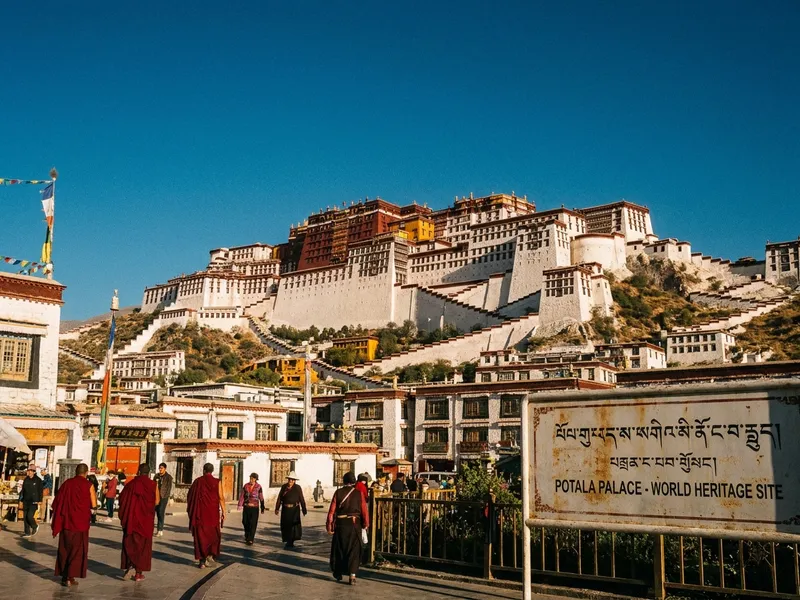
Lhasa (拉萨, Lāsà, 'Place of the Gods') is the capital of the Tibet Autonomous Region, set in a Himalayan valley at 3,650 metres (12,000 feet) — one of the highest cities on earth and the cultural and spiritual centre of Tibetan Buddhism. The skyline is dominated by the Potala Palace, the 13-storey, 1,000-room winter seat of the Dalai Lamas built in 1645, and the Jokhang Temple, founded in 647 and considered the holiest site in Tibetan Buddhism. Foreign visitors cannot travel independently in Tibet: a Tibet Travel Permit (TTP) is mandatory, arranged in advance only through a registered tour operator, and all movement is in an organised group with a guide and a dedicated vehicle. Plan at least 4–5 days in Lhasa itself plus 2–3 days for altitude acclimatisation on arrival, and a further 4–8 days if you want to reach Everest Base Camp or Mount Kailash. The best months are April to June and September to October; winter is cold and many mountain roads close. The journey — whether by the world's-highest Qinghai-Tibet Railway from Xining, or by flight over the Himalayas from Chengdu or Kathmandu — is itself a once-in-a-lifetime experience, and the monasteries, palaces, pilgrims, and high-altitude light make Lhasa one of the most distinctive destinations on the planet.
Why Lhasa in 2026.
Tibet's capital and spiritual heart — the Potala Palace, Jokhang Temple, and the highest pilgrimage destination in the world at 3,650 metres.
Quick Answer
Lhasa (拉萨, Lāsà, 'Place of the Gods') is the capital of the Tibet Autonomous Region, set in a Himalayan valley at 3,650 metres (12,000 feet) — one of the highest cities on earth and the cultural and spiritual centre of Tibetan Buddhism. The skyline is dominated by the Potala Palace, the 13-storey, 1,000-room winter seat of the Dalai Lamas built in 1645, and the Jokhang Temple, founded in 647 and considered the holiest site in Tibetan Buddhism. Foreign visitors cannot travel independently in Tibet: a Tibet Travel Permit (TTP) is mandatory, arranged in advance only through a registered tour operator, and all movement is in an organised group with a guide and a dedicated vehicle. Plan at least 4–5 days in Lhasa itself plus 2–3 days for altitude acclimatisation on arrival, and a further 4–8 days if you want to reach Everest Base Camp or Mount Kailash. The best months are April to June and September to October; winter is cold and many mountain roads close. The journey — whether by the world's-highest Qinghai-Tibet Railway from Xining, or by flight over the Himalayas from Chengdu or Kathmandu — is itself a once-in-a-lifetime experience, and the monasteries, palaces, pilgrims, and high-altitude light make Lhasa one of the most distinctive destinations on the planet.
| Best time to visit | April–June and September–October (clear skies, open roads). Avoid winter when mountain passes close. |
|---|---|
| Daily budget | $80 (backpacker) / $220 (mid-range) / $550+ (luxury) |
| Language | Tibetan and Mandarin; English only via your tour guide and at top hotels |
| Currency | CNY (¥) — cash is essential; card acceptance is very limited outside Lhasa |
| Time zone | China Standard Time (UTC+8) |
| Last updated | 2026-06-15 |
Want a Lhasa plan built for you?
What is Lhasa: The Spiritual Heart of Tibet?
Lhasa is unlike anywhere else in China, or arguably anywhere on earth. It is a Himalayan valley city of about 900,000 people set at 3,650 metres altitude, ringed by 5,500-metre mountains, and for 1,400 years it has been the spiritual and political capital of the Tibetan world. The name itself — Lhasa, ‘Place of the Gods’ — signals its sacred status: for Tibetan Buddhists, travelling here on pilgrimage is a life’s aim, and the sight of devotees performing full-body prostrations along the Barkhor circuit, day and night, is one of the most powerful images of religious devotion anywhere. The skyline is defined by the Potala Palace, the colossal white-and-red palace-fortress that was the winter seat of the successive Dalai Lamas from the 17th century until 1959, and by the Jokhang Temple, the 7th-century shrine around which the entire old city was built. For a foreign visitor, Lhasa is a high-altitude collision of the sacred and the modern: narrow Tibetan alleys of teahouses and pilgrims open onto a 21st-century Chinese city of glass towers, military checkpoints, and Mandarin signage. The contrast is the point. Lhasa is the gateway to the Tibetan Plateau and to a culture — monastic Buddhism, nomadic herding, thangka painting, high-altitude agriculture — that remains one of the most distinctive living cultures on the planet.
What is the history of Lhasa and Tibet?
The Tibetan story reaches back more than a thousand years. The Tibetan Empire, at its 7th-century peak under Songtsen Gampo, controlled an area from the Chinese plains to the borders of Persia, and it was Songtsen Gampo who unified the Tibetan plateau, moved his capital to Lhasa, and built the Jokhang Temple in 647 to house Buddhist images brought by his Nepali and Chinese wives. The introduction of Buddhism transformed Tibet, and over the following centuries a uniquely Tibetan form of Vajrayana Buddhism took root, organised into schools (Nyingma, Kagyu, Sakya, and eventually the Gelug or ‘Yellow Hat’ school that produced the line of Dalai Lamas). The Great Fifth Dalai Lama unified temporal and spiritual power in the 1640s, began construction of the Potala Palace in 1645, and established the theocratic system that governed Tibet until the 20th century. The modern chapter is the most turbulent. The 13th Dalai Lama declared independence from a collapsing Qing China in 1912; the 14th Dalai Lama fled to India in 1959 after a failed uprising against the new People’s Republic, which had asserted control over Tibet from 1951; the Cultural Revolution destroyed most of the monasteries; and the rebuilding and relaxation of the 1980s and 1990s brought the partial revival you see today. The Tibet Autonomous Region was formally established in 1965. The result is a city and region that is today politically fully integrated into China but culturally and religiously Tibetan, with the relationship between the two a sensitive and contested topic. For a visitor, the practical effect is that Lhasa’s monasteries are active and beautiful, the Tibetan culture is alive and visible, the Chinese presence is large and modernising, and certain political discussions — the Dalai Lama, independence, the 2008 unrest — are off-limits.
What is the geography and altitude of Lhasa, and when should I visit?
Lhasa sits in the Lhasa River valley, a tributary of the Yarlung Tsangpo (Brahmaputra), on the southern edge of the Tibetan Plateau at 3,650 metres above sea level. The surrounding mountains rise to 5,000–5,500 metres, and the plateau itself extends north for hundreds of kilometres at an average elevation above 4,500 metres. This extreme altitude — Lhasa has about two-thirds the oxygen density of sea level — is the single biggest factor in any visit, and it shapes both how you feel and how you must plan. The climate is surprisingly dry and sunny: Lhasa receives over 3,000 hours of sunshine a year, earning it the nickname ‘City of Sunlight’, with cold nights and warm days, very low humidity, and a monsoon season that barely reaches this far west. The best months to visit are April to June and September to October, when the skies are clear, the days are comfortable (15–22°C), and the high mountain passes to Namtso and Everest are open. July and August are the warmest but are the brief rainy season and the peak domestic tourism period. Winter (November to March) is cold (nighttime lows to -10°C), and many high passes to the lakes and Everest close with snow; Lhasa itself stays open and is uncrowded, but you cannot reach the well-known landscapes. The single best windows for most travellers are May, late September, and October: clear skies for photography, manageable altitude if you acclimatise, and the great overland routes (to Everest, Kailash, Namtso) fully open. Always build flexibility into a Tibet itinerary for weather and road closures.
What permits do I need to visit Lhasa and Tibet?
This is the single most important practical point, and it is completely different from the rest of China. Foreign travellers cannot visit the Tibet Autonomous Region independently. You need three documents on top of your Chinese visa: (1) the China visa itself (or visa-free entry under the unilateral policy, which applies to the Tibet permit process for eligible nationalities — confirm current status with a tour operator, as the rules shift), (2) the Tibet Travel Permit (TTP, or ‘Letter’), issued by the Tibet Tourism Bureau and obtainable only through a registered Tibet tour operator who submits your passport details 15–20 days in advance, and (3) for any travel outside Lhasa prefecture, additional regional permits — the Alien Travel Permit (PSB permit) for Everest Base Camp, the military permit for the Mount Kailash area, and the foreign-affairs permit for border zones. The mechanics: you book a tour (group or, for a premium, a private one) with a licensed Tibet operator, who arranges the TTP and sends it to you (often physically, as a paper permit you collect at your entry airport or train station). You cannot board a flight or train to Lhasa without it. Once in Tibet, your guide and driver are with you for all movement outside the hotel, and certain sites (the Potala interior, military zones, border areas) have timed, guided, and restricted entry. The rules change — sometimes the minimum group size is five, sometimes one is permitted for a private tour, sometimes certain nationalities (notably journalists, diplomats, and some nationalities) face extra restrictions — so the right move is to contact a reputable Tibet specialist operator (Tibet Travel, Tibet Vista, China Travel’s Tibet desk) at least 4–6 weeks before your intended travel, give them your passport, and let them handle the permits. The system is restrictive, but it is well-trodden and reliable if you book early.
How do I get to Lhasa: Flights and the Qinghai-Tibet Railway?
There are two main ways in, and both are experiences in themselves. By air, Lhasa Gonggar Airport (LXA) is about 65 km from the city, across the Yarlung Tsangpo, and has daily flights from Chengdu (2.5 hours, the most frequent), Chongqing (3 hours), Xi’an (3.5 hours), Beijing (4.5 hours), and Kunming, plus the dramatic 90-minute flight from Kathmandu, Nepal, that crosses the Himalaya and offers views of Everest on a clear day. The airport is high (3,570 m), so you arrive already at altitude and must move gently for the first 48 hours; the airport bus or a pre-arranged transfer reaches the city in about an hour. Flying in means a sudden jump from sea level to 3,650 m, which is harder on the body than the gradual train ascent; plan a quiet first 48 hours. The alternative, and for many travellers the highlight of the trip, is the Qinghai-Tibet Railway — the world’s highest railway, opened in 2006, running 1,956 km from Xining in Qinghai to Lhasa over the Tanggula Pass at 5,072 m. The journey takes about 22 hours from Xining, or up to 40 hours from Beijing or Shanghai with connections; the carriages are pressurised and oxygen-enriched, the scenery crosses permafrost tundra, nomad camps, and herds of wild antelope, and it is genuinely one of the great train rides on earth. The classic routing is to fly into Xining (or Beijing, then connect), spend a day acclimatising in Xining at 2,275 m, and take the train to Lhasa — the gradual ascent helps with altitude. Within Tibet, all foreign travel is by private 4WD with your guide and driver along the Friendship Highway and the side routes; there is no independent bus or train travel for foreigners outside Lhasa prefecture, and the high passes (Kamba La, Karo La, Gyatso La, Lalung La) close seasonally with snow. The Lhasa-to-Shigatse and Lhasa-to-Nyingchi sections of high-speed-style rail have opened in recent years, but for tourists the 4WD with a Tibetan driver who knows the roads, the weather, and the monasteries remains the way the plateau is travelled. Build buffer days for road closures — Tibet is vast, the weather is volatile, and a closed pass can add a day to any overland route. Whichever way you arrive, the Tibet Travel Permit is checked at check-in; you cannot board a flight or train without it.
How do I acclimatise to Lhasa’s altitude safely?
Altitude is the one thing every visitor must take seriously. Lhasa at 3,650 m has about 35% less oxygen than sea level, and most lowlanders feel it within hours: a mild headache, shortness of breath on exertion, disturbed sleep, and reduced appetite are nearly universal and usually manageable. The risk is acute mountain sickness (AMS), which can progress to the dangerous high-altitude pulmonary or cerebral oedema (HAPE/HACE) in a small percentage of cases. The rules are simple and well-validated: ascend gradually if possible (the train from Xining helps; flying straight in from sea level is harder), rest for the first 24–48 hours with no strenuous activity and no sightseeing beyond gentle walks, drink 3–4 litres of water a day, avoid alcohol and sedatives for the first 48 hours, and eat light carbohydrate meals. Many travellers take Diamox (acetazolamide) prophylactically, starting a day before ascent; consult your doctor, as it is a prescription diuretic with side effects. Locally, the Tibetan remedy is Hongjingtian (rhodiola) and the ever-present yak-butter tea. The key warning signs that require immediate descent and medical attention: a severe or worsening headache that does not respond to paracetamol, persistent vomiting, ataxia (loss of balance), confusion, or a wet cough and breathlessness at rest. Lhasa has hospitals that handle altitude cases, but the definitive treatment for severe AMS is descent. For trips to higher destinations — Namtso at 4,718 m, Everest Base Camp at 5,200 m, Kailash at 4,700 m — acclimatise fully in Lhasa for at least three nights before ascending further. Most visitors acclimatise within 2–3 days and then feel well.
What are the top sights in Lhasa?
The unmissable three are the Potala Palace, the Jokhang Temple, and the Barkhor circuit, all walkable within the old city. The Potala is the icon: the 13-storey white-and-red palace on Red Hill, 1,000 rooms of chapels, tombs, and audience halls, climbed by a series of stone stairways. Entry is strictly timed and ticketed (¥200, limited daily slots, book through your tour operator days in advance), and you walk a prescribed route through the most sacred chapels and the gold-roofed stupas of the 5th and 13th Dalai Lamas. Allow 2–3 hours and visit in the morning when the light is best and crowds thinnest. The Jokhang, founded in 647, is the holiest temple in Tibetan Buddhism — a constant flow of pilgrims prostrates outside, and inside you can follow the pilgrim circuit past the Jowo Shakyamuni statue, the most venerated image in Tibet. ¥85, allow 1.5 hours. The Barkhor is the kora — the clockwise pilgrim circuit — around the Jokhang, a square of old streets filled with markets selling prayer flags, turquoise, silver, incense, and thangkas, and a steady stream of devotees spinning prayer wheels and performing prostrations at dawn and dusk. It is the spiritual heart of Lhasa and one of the most atmospheric walks in Asia. Beyond the core, Sera Monastery (famous for the 3–5 pm monk debates), Drepung (once the world’s largest monastery), Norbulingka (the Dalai Lama’s summer palace and garden), Ganden (the head Gelug monastery, 40 km east), and Ramoche Temple round out the city. Half-day or full-day excursions reach Yamdrok and Namtso lakes. Two to three full days of sightseeing, after two days of acclimatisation, is the standard Lhasa stay.
What food and drink should I try in Lhasa?
Tibetan food is hearty, high-calorie fare shaped by altitude, cold, and nomadic herding — designed to sustain people at 4,000 m, not to be delicate. The staples are tsampa (roasted barley flour, mixed with yak-butter tea into a dough and eaten by hand), yak meat in every form (dried, in dumplings called momos, in noodle soup called thenthuk, and in the rich yak-meat stews), yak-butter tea (po cha, a salty, buttery churned tea that is the national drink and genuinely warming at altitude), and Tibetan sweet tea (a milky, spiced tea served in the thousands of teahouses that are the social centres of the city). Tibetan bread (balep), yak yoghurt (sho, dense and sour, served with sugar), and dried yak cheese strips round out the everyday diet. The teahouse culture is central to Lhasa life. Spend an afternoon in a Tibetan teahouse — the Ani Sangkhung Nunnery teahouse, the Tashi 1, the Makye Ame overlooking the Barkhor — drinking sweet tea, eating yak momos, and watching the city go by. For a meal, try a Tibetan restaurant for momos (the best are at the small places around the Barkhor), thenthuk noodle soup, and yak curry; the Lhasa Kitchen and the Dunya Restaurant (run by Tibetans) are reliable. Sichuan and Han Chinese food is everywhere (Lhasa has a large Han population), so if you want spice or familiar Chinese dishes, you will find them easily. For altitude, eat light, carbohydrate-rich meals; heavy yak-meat feasts are best after you have acclimatised. Beer (Lhasa Beer, a light lager) is brewed locally; avoid alcohol in the first 48 hours. Vegetarians are well served by the Buddhist-influenced diet, with tofu, potato, and vegetable momos widely available.
What is a good itinerary for Lhasa?
A standard Lhasa-focused trip is 6–8 days including travel and acclimatisation. Days 1–2: arrive (by flight or the Qinghai-Tibet Railway) and rest — gentle walks, tea-house afternoons, the Barkhor circuit at a slow pace, and no sightseeing beyond what you can reach on foot. Day 3: Potala Palace in the morning (timed entry) and Norbulingka summer palace in the afternoon. Day 4: Jokhang Temple and the Barkhor market, plus the Tibet Museum for orientation. Day 5: Sera Monastery (with the 3–5 pm monk debate) and Drepung Monastery. Day 6: a day trip to Ganden Monastery and its ridge kora, or to Yamdrok Lake. If you have 10–14 days, add the overland journey to Everest Base Camp: Days 7–10 a 4-day loop via Yamdrok Lake, the Karola Glacier, Gyantse (the Kumbum stupa), and Shigatse (the Tashilhunpo Monastery, seat of the Panchen Lama), reaching Everest Base Camp at 5,200 m on day 9, and returning to Lhasa or exiting via the Friendship Highway to Kathmandu. A longer 15–20-day version adds the Mount Kailash yatra (a 3-day kora at 4,700 m, sacred to Hindus, Buddhists, Bon, and Jains), one of the great pilgrimages of Asia. For most first-time visitors, the 8-day Lhasa-plus-Everest-Baseline trip is the sweet spot: it gives you the culture, the monasteries, the high plateau, and a view of the world’s highest mountain. Build buffer days for weather, road closures, and altitude; Tibet rewards slow travel.
What practical information do I need: money, connectivity, behaviour?
Money: the currency is the Chinese yuan (CNY, ¥), and you must carry cash — ATMs that accept foreign cards are scarce and unreliable, and card acceptance outside top Lhasa hotels is very limited. Bring enough cash (¥1,000–3,000 for a typical week) and exchange at a Bank of China branch in Lhasa; your tour guide will help. Alipay and WeChat Pay work in some central Lhasa shops but assume they will not work in monasteries, rural areas, or with Tibetan vendors. Tipping your guide and driver at the end of the trip (¥100–200/day per person for the guide, half that for the driver) is expected and appreciated. Connectivity: Tibet’s internet is behind the Great Firewall and more restricted than mainland China — Google, Gmail, WhatsApp, Instagram, Facebook, YouTube, and most Western sites and apps are blocked, and even with a VPN the connection is slow and frequently drops, especially outside Lhasa. Buy a Chinese SIM (China Mobile or China Telecom) at the Lhasa airport or a city branch with your passport, or use an eSIM; expect throttled speeds. SMS and WeChat to a Chinese number work; calls and texts to foreign numbers can be unreliable. Behaviour and etiquette: Tibet is deeply religious and politically sensitive. Always walk clockwise around stupas, temples, and prayer wheels; do not photograph inside temples without permission, and never photograph military or police; remove hats and speak quietly in monasteries; do not touch religious objects or anyone’s head; dress modestly. Avoid political discussion, the Dalai Lama’s image (his photograph is restricted), Tibetan independence, and the 2008 unrest — these topics are sensitive and can create serious problems for your guide and for you. Respect the devotion you see; the pilgrims at the Jokhang and on the Barkhor are performing one of the most important acts of their lives, and a quiet, respectful visitor is welcome.
What are the best day trips and overland journeys from Lhasa?
Lhasa is the base for some of the most spectacular high-altitude landscapes and monasteries on earth, all reached by 4WD with your guide and driver. The half-day and full-day options include Yamdrok Lake (a sacred turquoise lake at 4,440 m, reached by the Kamba La pass — half a day), Namtso Lake (the ‘Heavenly Lake’ at 4,718 m, one of the highest salt lakes on earth — a long day trip or better an overnight), Ganden Monastery (the head Gelug monastery on a dramatic ridge 40 km east, with a stunning kora hike), and the Drak Yerpa cave hermitage (a cliffside meditation complex 30 km northeast, one of Tibet’s most atmospheric sites). The headline multi-day journey is the Everest Base Camp overland trip. The classic 4-day there-and-back from Lhasa, or the 6-day one-way continuing to Kathmandu, follows the Friendship Highway west over the Kamba La pass to Yamdrok Lake, on to the Karola Glacier and the town of Gyantse (home to the stunning Pelkor Chode monastery and the Kumbum, the 35-metre 108-chapel stupa), then to Shigatse — Tibet’s second city and the seat of the Tashilhunpo Monastery, the great monastery of the Panchen Lama. From Shigatse the route climbs over the Gyatso La and Lalung La passes to the town of Tingri and the Rongbuk Monastery at 5,000 m, then the final approach to Everest Base Camp at 5,200 m, where the north face of the world’s highest mountain towers directly above. The overnight at Rongbuk or in a tent camp at EBC under a sky of impossible clarity and star density is the trip’s high point. The longer 15–20 day Mount Kailash and Lake Manasarovar journey heads west across the Changtang plateau to the remote far west, with the 3-day, 52 km kora around the sacred mountain at altitudes up to the 5,630 m Drolma La pass — a true pilgrimage. The Friendship Highway from Lhasa to Kathmandu, through Shigatse, Tingri, and the Himalaya to the border, is one of the great road journeys in Asia. All of these require the regional permits and full acclimatisation, and they are arranged through your Tibet operator as part of your tour. Build buffer days — the passes close seasonally and a weather delay is normal.
What cultural and religious etiquette should I know?
Tibetan Buddhist culture is rich, visible, and governed by etiquette that a respectful visitor should learn. The most important: always move clockwise around sacred objects — stupas, chortens, temples, prayer wheels, and the Barkhor circuit. Walking counter-clockwise is a serious breach. Spin prayer wheels with your right hand, always clockwise. Remove hats and shoes where required (monastery chapels, sometimes homes), and never point the soles of your feet at a person or a religious object — tuck them under you or to the side. Do not touch anyone’s head (the head is sacred) or religious objects on altars. Speak softly in monasteries, switch phones to silent, and do not interrupt chanting or debates. Photography is complicated: the exteriors of monasteries and the streets are generally fine (ask before photographing people, and expect to pay a small fee for posed portraits), but the interiors of many chapels are off-limits or carry a photography fee (¥50–100 per chapel). Always ask; if in doubt, do not shoot. Never photograph military, police, checkpoints, or border zones. Dress modestly — covered shoulders and knees for temple visits, regardless of the temperature. The political dimension: discussions of the Dalai Lama (whose image is restricted in Tibet), Tibetan independence, the 1959 exile, the 2008 unrest, and human-rights are sensitive and can create real problems for your Tibetan guide, who is monitored, and for you. Avoid these topics in public, on phones, and online. Treat the Tibetan people and their devotion with warmth and respect — the pilgrims you see are performing acts of enormous physical and spiritual commitment, and a humble, curious visitor is welcome. Learn a few Tibetan words — ‘tashi delek’ (hello and blessing) goes a very long way.
What festivals and religious events shape the Lhasa year?
The Tibetan calendar is lunar and the festival year is one of the most vivid in Asia, rooted in the agricultural cycle and the Buddhist liturgical calendar. The biggest is Losar, the Tibetan New Year, falling in February or March, a 15-day celebration of the new year with family gatherings, offerings, cham (monastic masked dance), and the famous giant thangka unfurled at Drepung and Sera monasteries on the first day. The Sho Dun (‘Yogurt Festival’) in late August is the second great festival — for a week, the giant thangkas are unveiled at Drepung and Norbulingka, and Lhasans picnic in the parks with yogurt and opera. The Saga Dawa in May or June, marking the Buddha’s birth, enlightenment, and death, is the holiest month for pilgrimage, when kora circuits are at their busiest and most powerful. Other notable events: the Bathing Festival (early autumn, when Tibetans bathe in rivers believed to be purifying), the Harvest Festival in farming areas, the cham dances at monasteries throughout the year, and the Great Prayer Festival (Monlam), the largest gathering of monks, revived in the 1980s. The timing of these festivals is lunar and shifts against the Western calendar; a good Tibet operator will tell you which coincide with your dates. Visiting during a festival — particularly Losar or Sho Dun — is one of the most rewarding ways to experience Tibetan culture, with the monasteries and Barkhor at their most alive. Note that some festival dates are politically sensitive (large gatherings are monitored), and access can be restricted in certain years; confirm current access with your operator before planning around a festival.
What are the schools of Tibetan Buddhism and the great monasteries?
Tibetan Buddhism is organised into four major schools, all visible in and around Lhasa, and an understanding of them enriches any monastery visit. The oldest is the Nyingma (‘Ancient’) school, founded in the 8th century by Padmasambhava, the teacher who brought Buddhism to Tibet; its monasteries include Mindrolling and the cave hermitages. The Kagyu school, founded in the 11th century and known for the line of the Karmapa and the ascetic ‘yogi’ tradition, includes the great Tsurphu and Drigung monasteries. The Sakya school, a scholarly tradition founded in 1073, gave Tibet its only theocratic rulers before the Gelug, and its mother monastery lies 130 km west of Shigatse. The dominant school in Lhasa is the Gelug (‘Virtuous’, or ‘Yellow Hat’) school, founded by Tsongkhapa in the late 14th century and led by the successive Dalai Lamas and Panchen Lamas. The three great Gelug monasteries near Lhasa — Sera, Drepung, and Ganden — were for centuries the universities of Tibet, housing tens of thousands of monks, and they remain the architectural and spiritual heart of the city’s religious life. The monk debating sessions at Sera (3–5 pm daily) are a uniquely dynamic form of Buddhist pedagogy — pairs and groups of monks argue points of doctrine with elaborate physical gestures, and visitors are welcome to watch. The Potala and the Jokhang are common to all schools, the shared sacred centre. When visiting, recognise that each monastery belongs to a school with its own practices, lineages, and protectors; a knowledgeable guide makes the difference between seeing buildings and understanding a living, 1,200-year-old intellectual tradition.
What art, music, and craft can I experience in Lhasa?
Tibetan art is overwhelmingly religious in subject and extraordinary in craft. The signature form is the thangka — a painted or embroidered scroll of a deity, mandala, or teacher, painted with mineral pigments on cotton, framed in silk, and used in meditation and teaching. A fine thangka takes months to years to paint and is one of the most portable and meaningful things you can bring home; the best are painted by artists in Lhasa, Shigatse, and the Kathmandu Valley, and reputable dealers (ask your guide) can be found around the Barkhor and in the old town. Murals cover the walls of every monastery, often 400–600 years old, depicting the life of the Buddha, the Dalai Lamas, protector deities, and the medical and astronomical tantras. Statuary — gilded bronze figures of Buddhas, bodhisattvas, and the fierce protectors — fills the chapels of the Potala, the Jokhang, and the great monasteries. Music and performance: monastic chanting (the deep, polyphonic overtone chant of Tibetan monks is unique and haunting), the long horns and cymbals of the ritual orchestras, and the cham masked dances performed at festivals. Tibetan folk music and dance — the circle dances, the nomadic songs — are alive in the teahouses and at festivals. Crafts include silverwork (the teapots, the jewellery), turquoise and coral jewellery (a defining feature of Tibetan dress), carpets (the distinctive geometric knotted-pile rugs), and the carved wooden furniture and painted doorways of the old houses. The Tibet Museum, the Norbulingka, and the small workshops around the Barkhor are the best places to see and buy. Photography of art inside chapels is often restricted or fee-paying; ask first, and consider buying postcards or a book to support the monasteries.
What is Tibetan medicine and should I experience it?
Tibetan medicine (Sowa Rigpa) is one of the world’s great traditional medical systems. It was codified in the 12th century by Yuthok Yontan Gonpo and integrates Ayurvedic, Chinese, and Greco-Arab influences with the Tibetan theory of the three humours (rlung, mkhris-pa, bad-kan — wind, bile, phlegm). It is a holistic system that diagnoses by pulse, urine, and tongue examination and treats with herbal and mineral compounds, dietary advice, and behaviour change. The medical paintings (men-thang) of the Atlas of Tibetan Medicine, depicting anatomy, pathology, and the medicinal plants, are among the masterpieces of Tibetan art, and originals and reproductions are displayed at the Tibet Medical and Astrological Institute in Lhasa. For a visitor, the practical encounter with Tibetan medicine is usually the high-altitude remedies: Hongjingtian (rhodiola) capsules, sold everywhere, are a mild adaptogen many locals and travellers swear by; yak-butter tea and tsampa are the everyday altitude diet. For anything beyond altitude adjustment, do not self-prescribe — see a practitioner at the Mentsikhang (the traditional Tibetan medical hospital in Lhasa) or a recognised clinic, and treat it as a complement to, not a replacement for, standard medicine, especially for serious conditions. The pharmacology is real (several compounds are now studied in Western labs, including for altitude and circulation), but quality and dosing vary. A respectful curiosity about Sowa Rigpa is welcome; treating it as exotic superstition is not. The traditional medical hospitals in Lhasa welcome respectful visitors, and the Mentsikhang has a small display of the medical paintings and the materia medica.
How does Lhasa fit into a larger Tibet or China itinerary?
Lhasa is the unavoidable hub for any Tibet trip, and most routes either begin or end here. The classic 8–10 day ‘Lhasa and Everest Base Camp’ loop starts and ends in Lhasa, with the overland journey to EBC and back via Gyantse and Shigatse. The 14–20 day ‘Lhasa to Mount Kailash’ route heads west across the Changtang plateau to the sacred mountain and Lake Manasarovar, with the 3-day kora, and either returns to Lhasa or exits via Kashgar or Kathmandu. The one-way ‘Lhasa to Kathmandu’ journey along the Friendship Highway, crossing the Himalaya, is one of the great road trips in Asia and a popular way to finish. For a larger China itinerary, Lhasa pairs naturally with Sichuan (fly from Chengdu, itself worth 2–3 days for the pandas, the teahouses, and the Tibetan exile community of Kangding), with Qinghai (the Xining start of the Tibet Railway, plus the great Kumbum Monastery and Qinghai Lake), and with Yunnan (the Tibetan region of Shangri-La, reachable overland through the scenic Kham region). Many travellers combine a Tibet permit-assisted trip with a visa-free stay in Beijing, Xi’an, or Shanghai beforehand, since the mainland visa-free policy applies and the Tibet permit is arranged in parallel. Budget realistically: a Tibet trip with permits, guide, vehicle, and the overland routes is the most expensive destination in China — typically US$150–300 per day all-in mid-range — and the permits and group logistics mean you book well ahead and travel at the operator’s schedule, not your own spontaneity.
What is everyday Tibetan life and culture like in modern Lhasa?
Modern Lhasa is a city of about 900,000, of whom roughly half are ethnic Tibetan and half Han Chinese, with a small Hui Muslim community running much of the old-town commerce. The old Tibetan quarter — the Barkhor and the lanes around the Jokhang — is where the traditional life remains most visible: teahouses serving sweet tea and yak momos, pilgrims in traditional chuba robes, silver workshops, and the constant clockwise flow of kora walkers. The newer parts of the city, east and north of the Potala, are a 21st-century Chinese city of glass towers, shopping malls, wide boulevards, and a growing middle class. The two coexist, sometimes uneasily, and the contrast is a defining feature of the city. Everyday Tibetan life in Lhasa revolves around family, faith, and the teahouse. Most Tibetans are observant Buddhists who perform kora daily, celebrate the festivals, and consult lamas for major decisions. The economy is a mix of traditional crafts, tourism, government work, and the growing service sector; many young Tibetans are bilingual in Tibetan and Mandarin and increasingly fluent in English through the tourism industry. Nomadic herding continues on the plateau outside the city, though it is in decline as families settle. For a visitor, the most authentic encounters are in the teahouses, the Barkhor market, and the smaller monasteries, where a respectful, curious outsider is welcome. Avoid treating Tibetans as living museum exhibits — they are a modern people navigating enormous change — and engage with them as people. The Tibetan sense of hospitality is genuine, and a simple ‘tashi delek’ and a shared pot of sweet tea open more doors than any amount of paid sightseeing ever could, and the warmth you receive in return is the real reward of travelling in Tibet and the memory most visitors carry home longest.
What is the story of the Tibetan empire and the Guge Kingdom?
The Tibetan story reaches back more than a thousand years. The Tibetan Empire of the 7th to 9th centuries, under Songtsen Gampo, Trisong Detsen, and their successors, was one of the great powers of medieval Asia — at its peak it controlled an area from the Chinese plains (it even sacked the Tang capital Chang’an in 763) to the borders of Persia and the Aral Sea, and it fielded armies that ranged across Central Asia. This was the era when Buddhism was formally adopted, the Tibetan script was created (based on Devanagari), and the great temples of central Tibet — the Jokhang, Ramoche, and Samye — were founded. The empire fragmented in the 9th century, and Tibet entered a 300-year period of decentralised regional rule. The most spectacular post-imperial civilisation was the Guge Kingdom in far western Tibet, centred on the citadel of Tsaparang and the present-day town of Zanda, which flourished from the 10th to the 17th centuries as a centre of the Buddhist revival and a hub on the trans-Himalayan trade routes. The Guge ruins — a vast cave-and-citadel complex carved into the red-earth canyons, with extraordinary 1,000-year-old murals in the surviving cave chapels — are one of the most remarkable and least-visited archaeological sites in Asia, reachable on the long journey to Mount Kailash. Other remnants of Tibet’s deep past include the Yumbulagang, the legendary first building in Tibet (in the Yarlung valley near Tsetang), the Samye Monastery (the first Buddhist monastery in Tibet, founded 779, laid out as a mandala), and the cliffside burial complex of the ancient Zhangzhung culture near Kailash. For a visitor with time, the journey from Lhasa to the Yarlung valley, Samye, and (for the ambitious) western Tibet reveals a 1,400-year civilisational arc that the modern political focus obscures.
What is Tibetan dress, jewellery, and traditional craft?
Tibetan dress is among the most distinctive and beautiful of any living culture, shaped by altitude, nomadic herding, and a deep love of ornament. The signature garment is the chuba — a long, thick, usually woollen robe with long sleeves, worn with one or both arms free and the sleeves tied at the waist, adapting to the huge temperature swings of the plateau. Urban chuba are tailored and elegant; nomadic chuba are sheepskin-lined for winter. Underneath, Tibetans wear shirts and, for women, a striped apron (pangden) in bright colours marking married status. Boots are traditionally of colourful felt and leather; nomadic boots reach the knee. Jewellery is central to Tibetan identity and a defining feature of every festival and pilgrimage. Turquoise — the national stone, believed to bring health and protection — is set in silver in elaborate necklaces, rings, earrings, and the famous headdresses of Amdo and Kham women, sometimes weighing several kilos. Coral, amber, dzi beads (etched agate beads of great age and value), silver and gold filigree, and carved conch and bone are the other materials. A fully dressed Tibetan woman or man at Losar is a dazzling sight. The craft tradition extends to silver teapots and butter lamps, knotted-pile carpets with geometric designs, painted wooden furniture, thangka painting, and the distinctive prayer wheels and malas (rosaries). For a visitor, the Barkhor market and the workshops of the old town are the best places to see and buy, though quality and authenticity vary widely — a knowledgeable guide helps. Buying from the maker, paying fairly, and choosing modern work over ‘antique’ (which is usually restricted) supports the living craft tradition.
What should photographers know about shooting in Tibet?
Tibet is one of the most photogenic places on earth, with crystalline high-altitude light, vast landscapes, extraordinary monasteries and rituals, and strikingly dressed Tibetan people. But photography in Tibet comes with real restrictions that a responsible visitor must respect. Inside monastery chapels, photography is often forbidden or requires a fee (¥50–100 per chapel) paid to the monastery; always ask before raising a camera, and respect a refusal. Never photograph military installations, police, checkpoints, soldiers, border zones, or anything related to security — this is taken very seriously and can cause major problems for you and your guide. Avoid photographing politically sensitive images (the Dalai Lama’s photograph, protests) entirely. For people, always ask before photographing, especially monks and pilgrims; many will oblige and some will not, and both are fine. Expect to pay a small fee (¥5–20) for posed portraits in markets and villages. For landscapes, the light is best early and late — dawn at the Potala, sunrise at Yamdrok and Namtso, sunset at Everest’s Rongbuk — and the UV is strong enough to need a polariser and a lens hood. Bring a wide range: wide-angle for the vast plateau and monastery interiors, telephoto for the Cham dances and faces, and a sturdy tripod for the pre-dawn and night shots (Tibet has some of the clearest dark skies on earth). Protect your gear from dust on the overland routes and from the cold at high passes, which drains batteries fast — carry spares in an inside pocket. Treat the photography as a privilege, not a right, and the images you bring home will be among the best of your life.
What wildlife and ecology does the Tibetan Plateau support?
The Tibetan Plateau — the ‘Roof of the World’, averaging over 4,500 m and covering 2.5 million square kilometres — is the largest and highest plateau on earth and a unique ecosystem, sometimes called the ‘Third Pole’ for its vast ice reserves. It is the source of Asia’s great rivers (the Yangtze, Yellow, Mekong, Salween, Brahmaputra, Indus), and its wildlife, though depleted by decades of pressure, is among the most distinctive of any high-altitude ecosystem. The well-known species include the wild yak (massive black bovines, now restricted to the remote Changtang reserve), the Tibetan antelope or chiru (famous for its shahtoosh wool, poached near to extinction and now protected), the kiang (Tibetan wild ass), the argali and blue sheep (the staple prey of snow leopards), the Himalayan marmot and pika, the black-necked crane (sacred to Tibetans and one of the world’s rarest cranes, wintering in the Yarlung valley), and the elusive snow leopard, the apex predator of the high plateau. Most of these species are hard to see on a standard Lhasa-and-EBC trip — they live on the remote Changtang and Kekexili reserves, reachable only on the long overland journeys to Kailash or Qinghai. But the plateau ecology is visible everywhere: the marmots whistling on the passes, the herds of domestic yaks and dri (female yaks), the lammergeier and Himalayan griffon vultures soaring over the monasteries (sky burial is the Tibetan funerary tradition), the ruddy shelducks on the high lakes, and the carpets of blue Himalayan poppy and gentian in the short summer. The high-altitude rangelands support nomadic herders whose yaks, sheep, and goats are the foundation of the Tibetan economy and diet. The plateau is also the front line of climate change — its glaciers are retreating and its permafrost thawing — and the ecological stakes of the region are global, since the rivers that rise here feed nearly two billion people downstream across South, Southeast, and East Asia, making the plateau’s ecological health a matter of global consequence. A respectful, curious visitor who understands this adds depth to every landscape seen and every glacier, lake, and grassland passed on the long overland routes across the plateau.
What is the kora, and how should a respectful visitor observe or join it?
The kora (转经, zhuànjīng) is the Tibetan Buddhist practice of walking clockwise around a sacred site while spinning a prayer wheel, reciting mantras, or simply walking in meditative silence. In Lhasa, the three principal koras are: the outer Nangkor kora around the entire Jokhang and Barkhor neighborhood (about 1 km, 20-30 minutes), the inner Gyenkor kora inside the Jokhang courtyard, and the long Lingkor kora that traces the perimeter of the old city (about 6 km, 2-3 hours). Most pilgrims perform the Nangkor daily before going to work or after lunch; the practice is the most visible expression of living Tibetan Buddhism in Lhasa. The Barkhor kora is the one most visitors will experience. It is also the most photographable — pilgrims in traditional chubas, prostrating practitioners, old women with hand-held prayer wheels, and a constant slow stream of kora walkers passing the Jokhang's main entrance. As a visitor, you can join the kora clockwise, walk in the same direction, and observe without participating. Do not walk counter-clockwise (it is considered spiritually inauspicious). Do not photograph prostrators at close range without asking — they are at prayer. Do not block the flow of kora walkers to take a photo. A wide shot that captures the kora in motion, taken from a respectful distance, is both the most beautiful and the most appropriate image. The best time to observe the Barkhor kora is early morning (07:00-09:00) or late afternoon (16:00-18:00) when the light is golden and the kora is busiest. Prostrations are most concentrated at dawn, when practitioners complete 100,000 prostrations over weeks or months as part of a devotional commitment. The respectful visitor can sit on a wooden bench at the Jokhang entrance and simply watch — the scene reveals itself over an hour better than in a five-minute walk-through.
Top attractions
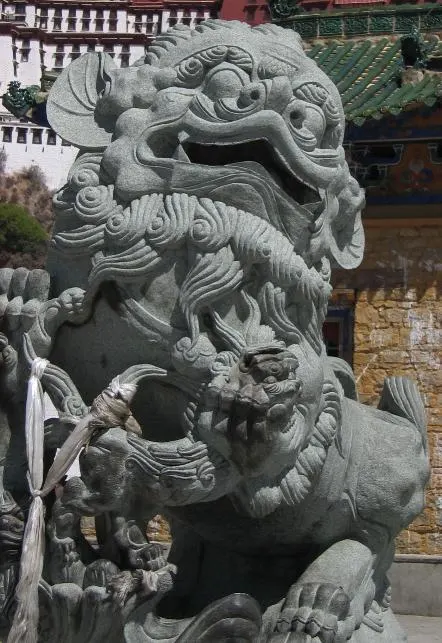
Potala Palace (布达拉宫)
The 13-storey, 1,000-room palace-fortress built in 1645 on Red Hill, former winter seat of the Dalai Lamas and a UNESCO World Heritage Site. ¥200; limited daily entry slots, allow 2–3 hours, book in advance.
Wikimedia Commons · CC-BY-SA
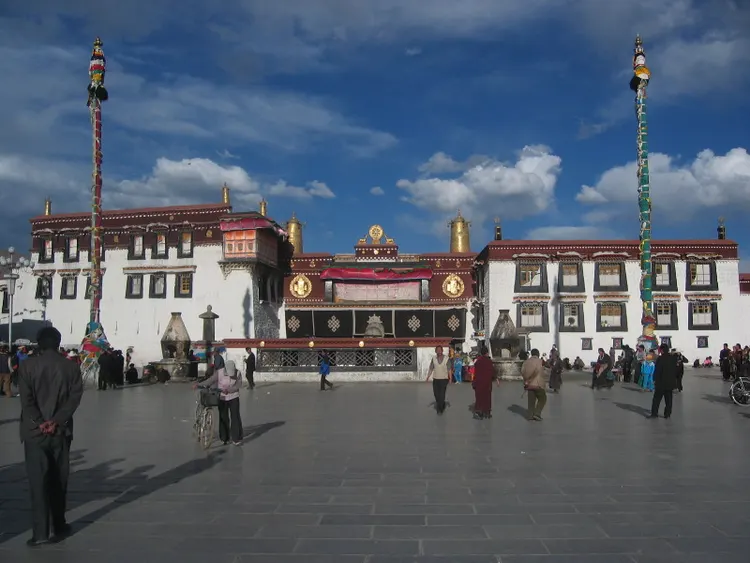
Jokhang Temple (大昭寺)
Founded 647, the most sacred temple in Tibetan Buddhism, housing the Jowo Shakyamuni statue. ¥85. The spiritual centre around which all of Lhasa revolves. Allow 1.5 hours.
Wikimedia Commons · CC-BY-SA
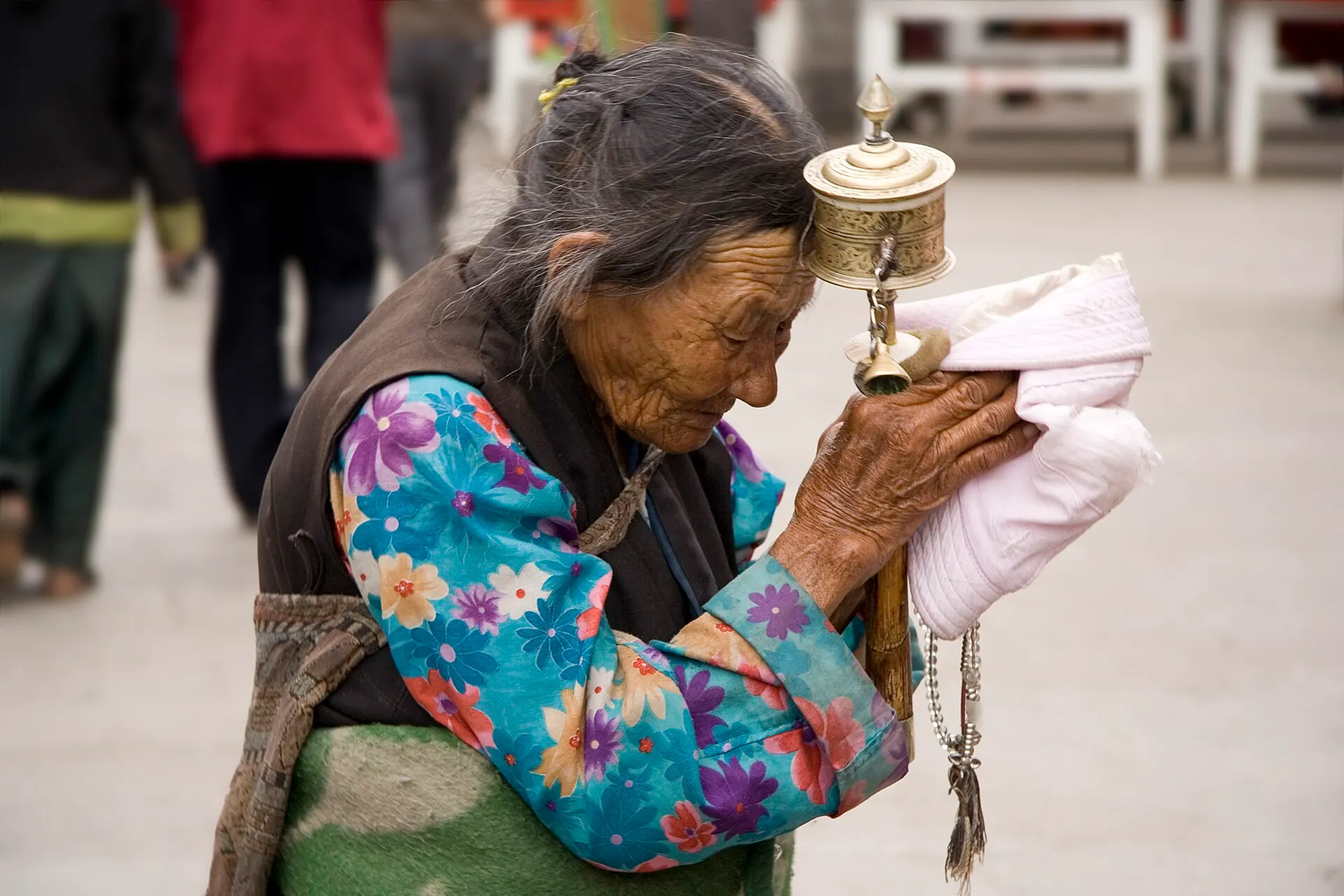
Barkhor Street (八廓街)
The pilgrim circuit around the Jokhang, where Tibetan devotees perform kora (clockwise circumambulation) from dawn. Markets, prayer-wheel shops, teahouses. Free; donations welcome.
Wikimedia Commons · CC-BY-SA
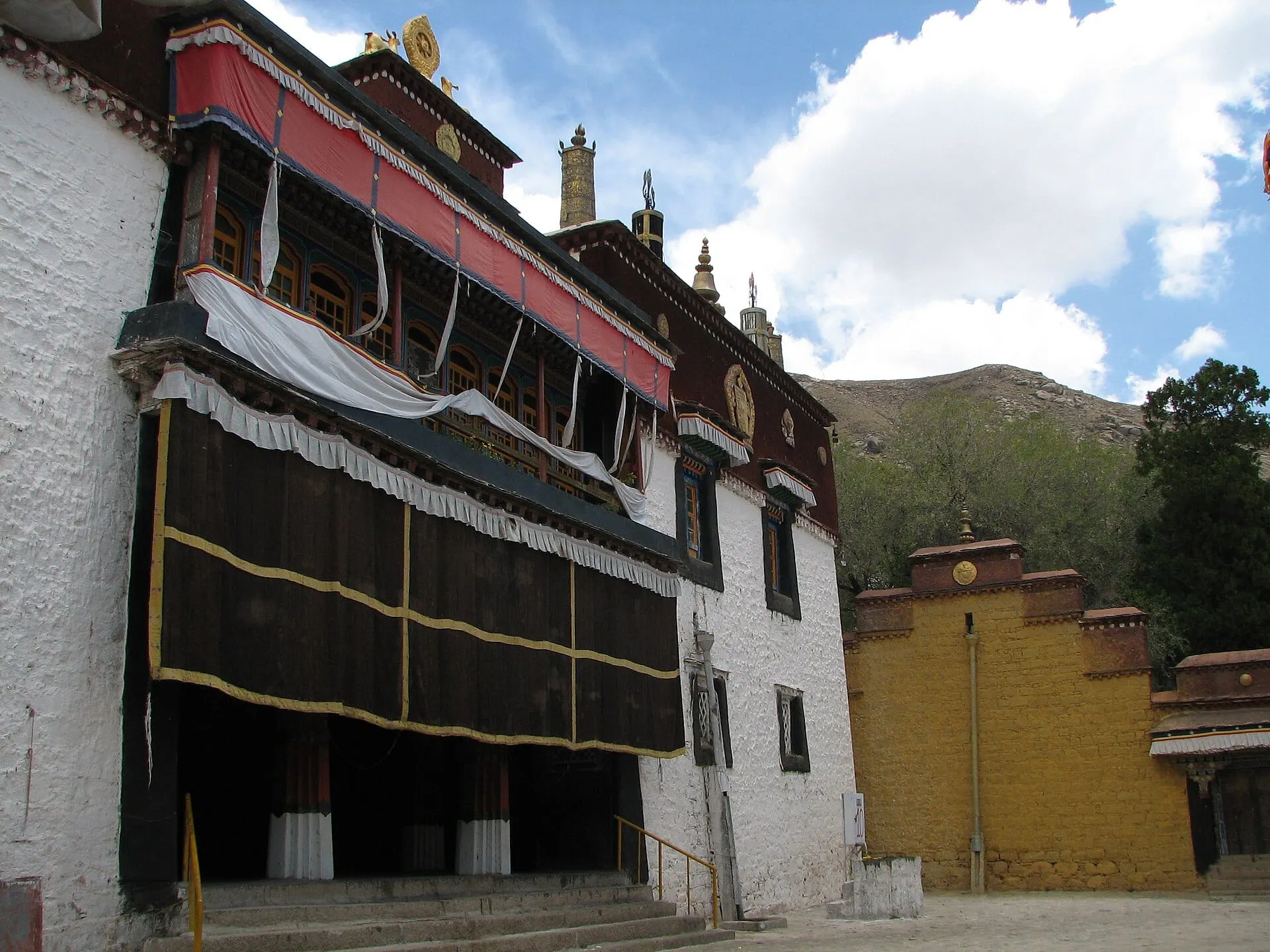
Sera Monastery (色拉寺)
One of the three great Gelug-school monasteries, famous for the daily monk debating sessions in the courtyard (3–5 pm). ¥50, 5 km north of Lhasa.
Wikimedia Commons · CC-BY-SA
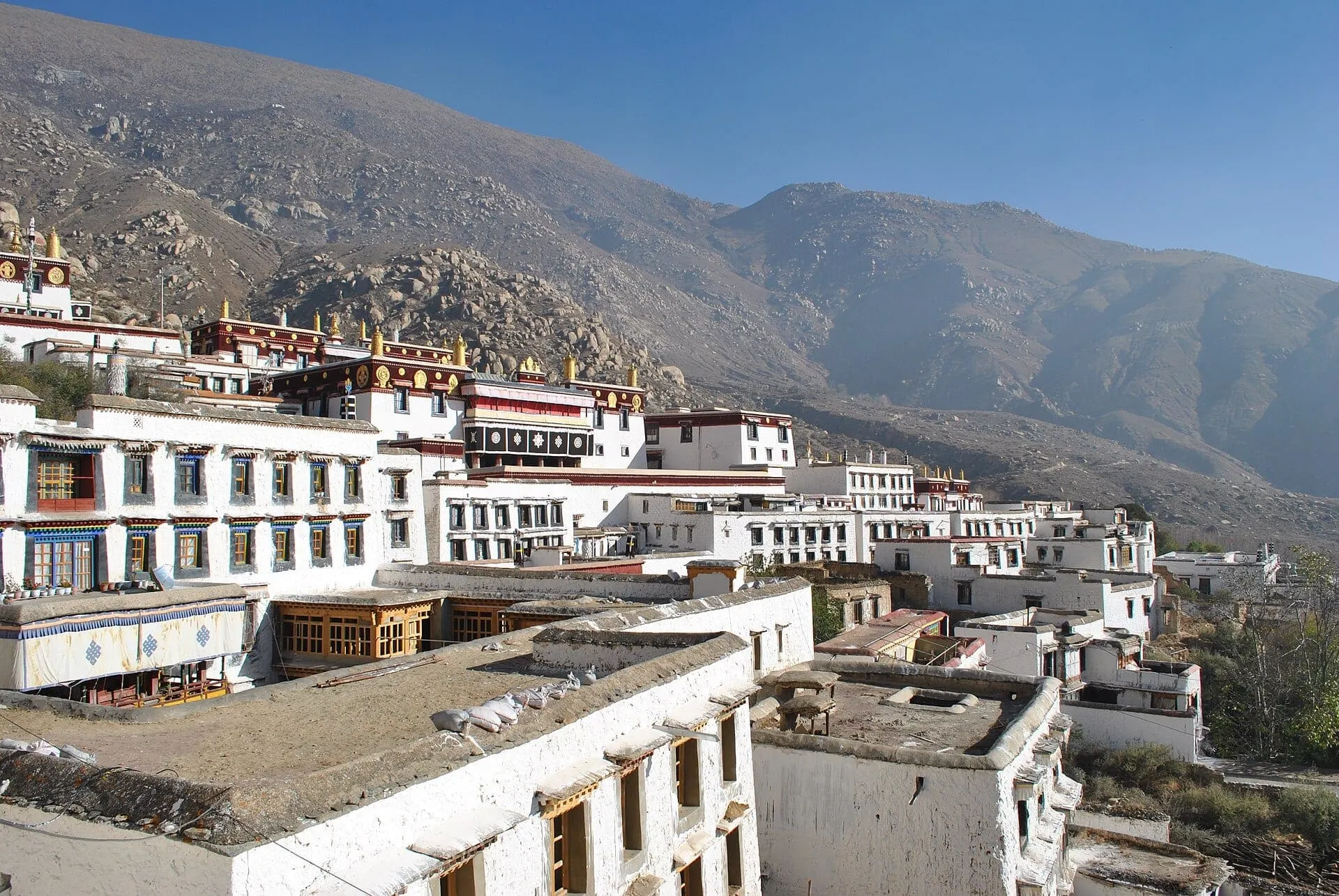
Drepung Monastery (哲蚌寺)
Once the largest monastery in the world, home to 10,000 monks at its peak, founded 1416. ¥50, 8 km west. Dramatic hillside setting.
Wikimedia Commons · CC-BY-SA
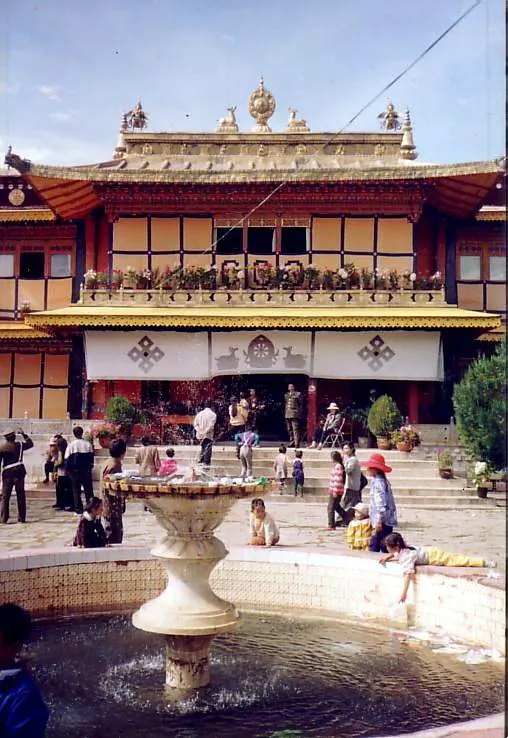
Norbulingka (罗布林卡)
The Dalai Lamas’ former summer palace and garden, a UNESCO site of pavilions, pools, and parks. ¥60. The site of the Sho Dun (Yogurt) Festival each summer.
Wikimedia Commons · CC-BY-SA
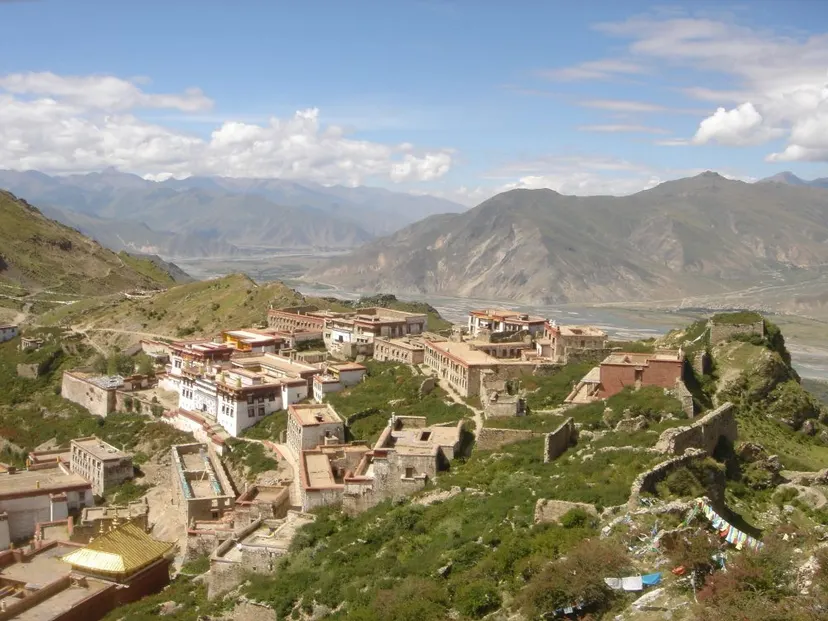
Ganden Monastery (甘丹寺)
Founded 1409 by Tsongkhapa, the head monastery of the Gelug school, dramatically set on a ridge 40 km east of Lhasa. ¥45. Combine with the Ganden kora hike.
Wikimedia Commons · CC-BY-SA
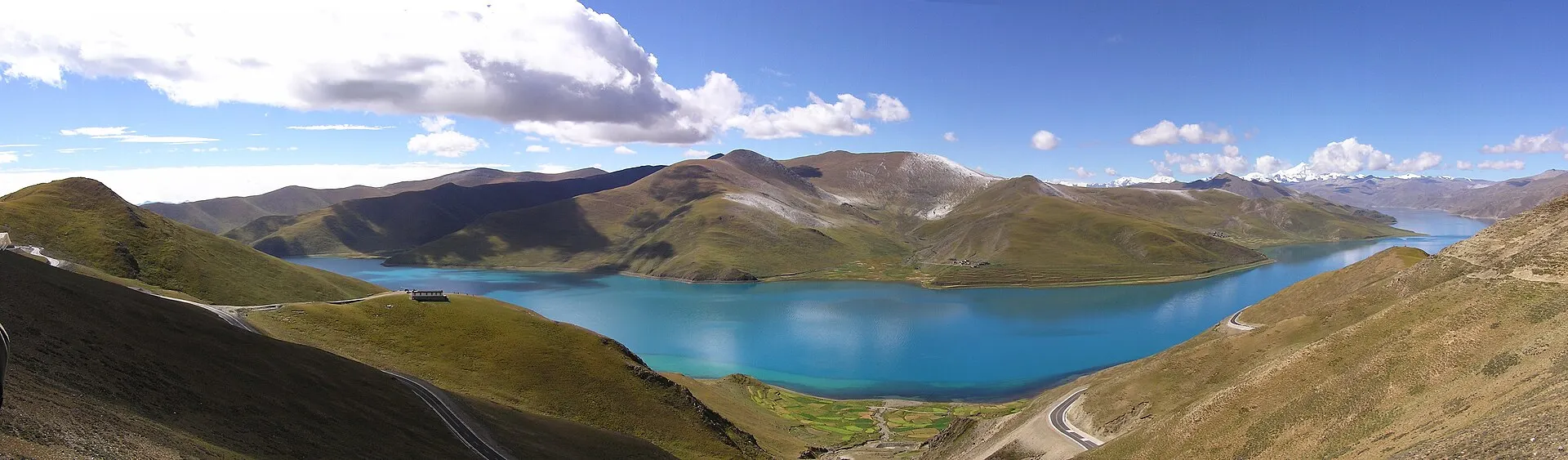
Yamdrok Lake (羊卓雍错)
A sacred turquoise high-altitude lake at 4,440 m, reached by the Kamba La pass. One of Tibet’s three holy lakes. A half-day or full-day excursion from Lhasa.
Wikimedia Commons · CC-BY-SA
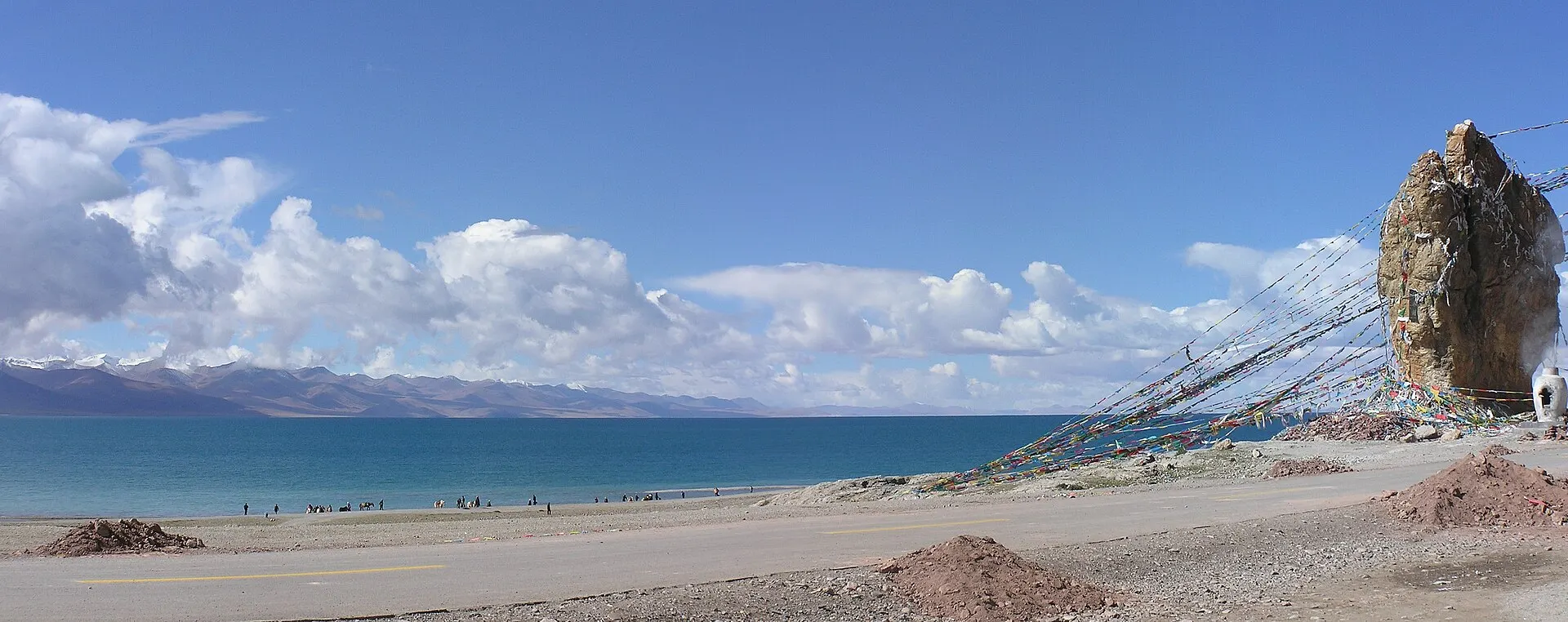
Namtso Lake (纳木错)
The ‘Heavenly Lake’ at 4,718 m, one of the highest salt lakes on earth and one of Tibet’s three holy lakes. A long but spectacular day trip or overnight.
Wikimedia Commons · CC-BY-SA
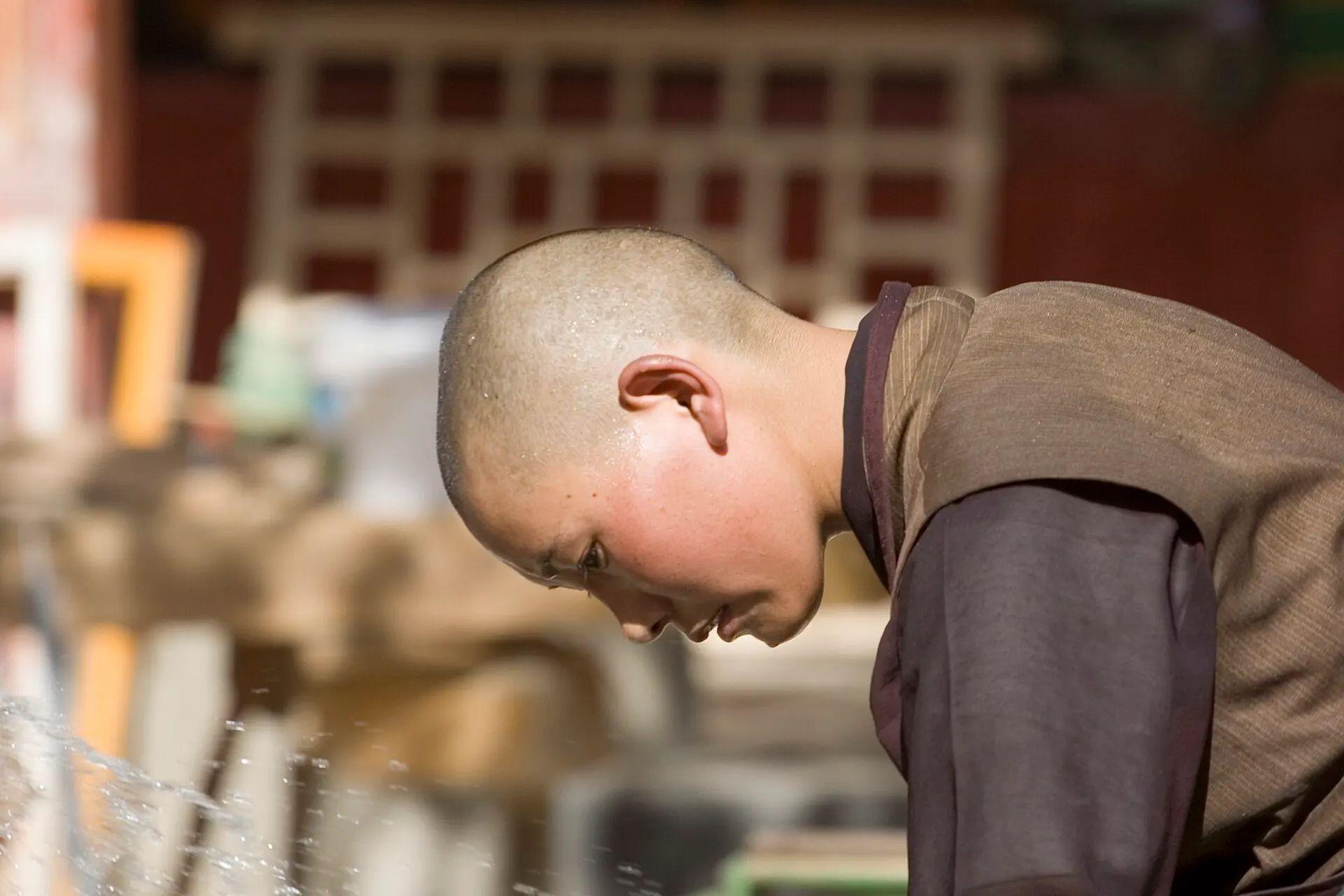
Ani Tsankhung Nunnery (阿尼仓空寺)
A 15th-century nunnery in the Lhasa old town, one of the few active nunneries, with a meditation cave used by the 7th Dalai Lama. Quiet and intimate.
Wikimedia Commons · CC-BY-SA
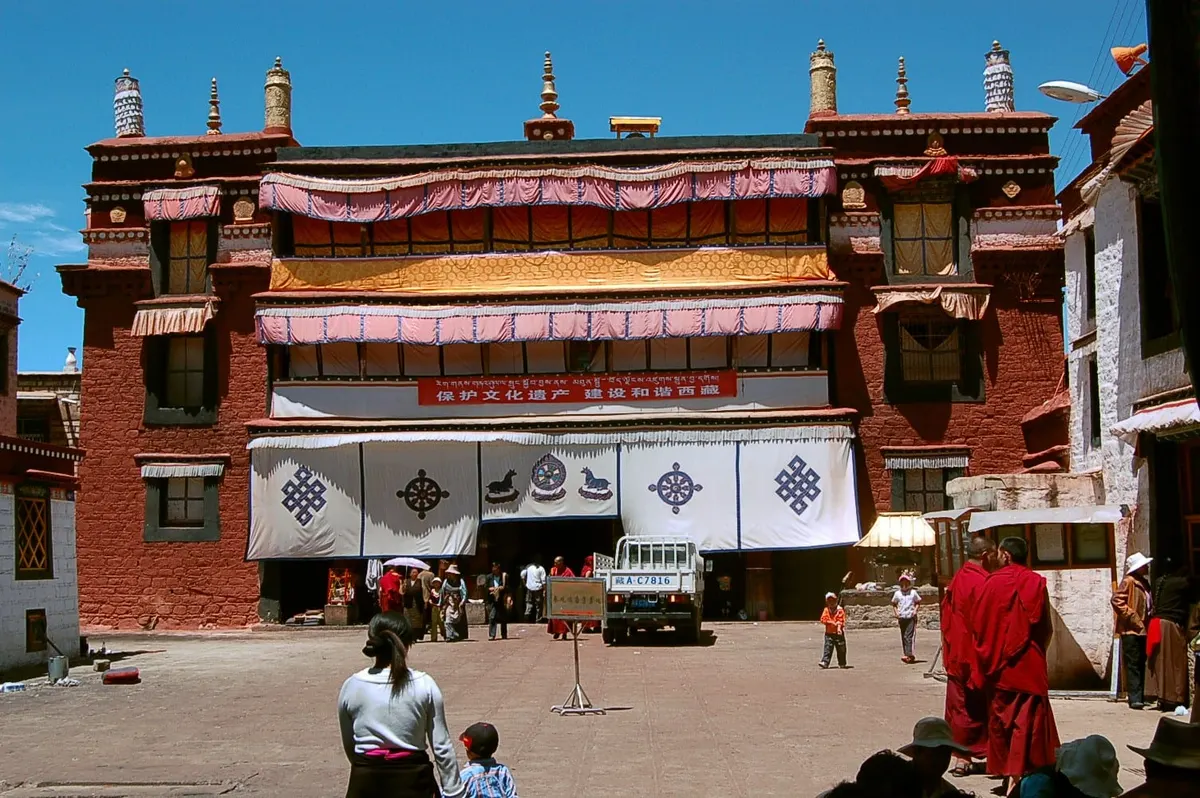
Ramoche Temple (小昭寺)
A 7th-century temple second in sanctity only to the Jokhang, in the old Tibetan quarter. Houses the Jowo Mikyö Dorje statue. ¥20.
Wikimedia Commons · CC-BY-SA
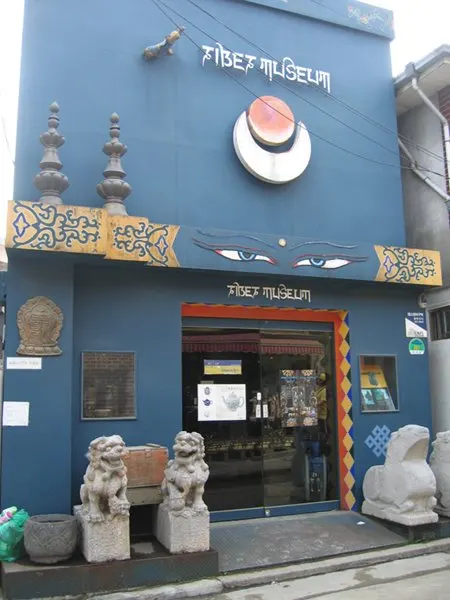
Tibet Museum (西藏博物馆)
A modern museum on Lhasa’s history, art, and culture, near the Potala. Free or ¥20. The best orientation to the region’s 6,000-year story.
Wikimedia Commons · CC-BY-SA
STAY
Where to stay in Lhasa
Pick a base that matches the trip you want — imperial-central for sightseeing, hutong belt for character, Chaoyang for nightlife, or Qianmen for budget.
Barkhor / Old City
The pilgrimage circuit, Tibetan craft shops, rooftop teahouses, and guesthouses around Jokhang
#barkhorPotala District
Hotels with Potala views, the palace square, and the Tibet Museum nearby
#potalaEast Lhasa
Modern hotels, Chinese restaurants, and the new train station area
#lhasa-east
ITINERARIES
Sample itineraries from Lhasa
Three ready-made routes, from a 1-day imperial sprint to a 5-day deep dive. Copy the day-by-day plan and adapt to your own pace.
- 1 DAY
Lhasa Essentials (4 Days)
The minimum Lhasa stay — acclimatisation plus the three unmissable sights. Designed to pair with a 1-day arrival.
- Travellers adding Lhasa to a broader China trip
- Short-leave visitors
- Those unable to do the Everest overland
- Day 01
Morning
Arrive by flight or Qinghai-Tibet Railway; transfer to hotel; complete rest — no sightseeing, gentle walk only
Afternoon
Continue rest; hydrate (3–4 L water); light carbohydrate meal; no alcohol
Evening
Tea-house afternoon on the Barkhor — sit, watch pilgrims, acclimatise; early to bed
- 2 DAYS
Lhasa Cultural Immersion (6 Days)
The standard Lhasa-focused trip — full acclimatisation, all major monasteries, and a day trip to Yamdrok Lake.
- First-time Tibet visitors
- Cultural travellers
- Photographers
- Day 01
Morning
Arrive; rest only — no sightseeing, no stairs, no exertion
Afternoon
Continue resting; gentle Barkhor stroll with guide; sweet tea in a teahouse
Evening
Light dinner; avoid alcohol; drink 3–4 L of water through the day
- Day 02
Morning
Potala Palace timed entry (morning slot); climb the stone stairway slowly; explore chapels and the 5th Dalai Lama's golden stupa (2–3 hours)
Afternoon
Norbulingka summer palace and gardens — a gentle walk after the Potala climb
Evening
Tibetan dinner with yak momos and thenthuk noodle soup; early night
- 3 DAYS
Lhasa + Everest Base Camp (10 Days)
The classic Lhasa-and-Everest trip — culture, monasteries, high passes, and the north face of Everest.
- Adventure travellers
- Bucket-list seekers
- Those with 10+ days
- Day 01
Morning
Arrive Lhasa; rest and hydrate
Afternoon
Barkhor gentle walk with guide
Evening
Teahouse dinner; no alcohol
- Day 02
Morning
Potala Palace (morning timed entry)
Afternoon
Norbulingka and Tibet Museum
Evening
Tibetan dinner in the old town
- Day 03
Morning
Jokhang Temple and Barkhor market; Sera Monastery for the 3 pm monk debate
Afternoon
Drepung Monastery hillside walk
Evening
Rest; prepare for the overland journey starting tomorrow
BUDGET
What a Lhasa trip costs
Per-person, per-day costs across three spending tiers. Excludes international flights and visa fees.
| Line item | Backpacker | Mid-range | Luxury |
|---|---|---|---|
| Tour package (incl. guide, permits, transport) | $100 | $200 | $400 |
| Accommodation (per night) | $25 | $80 | $300 |
| Meals (3 per day) | $15 | $40 | $100 |
| Attraction tickets (Potala, Jokhang) | $30 | $40 | $60 |
| Daily essentials | $10 | $20 | $50 |
| Total per day | $180 | $380 | $910 |
$ USD per person per day, before international flights and visas. Last verified: Q3 2026.
STAY SAFE
Emergency contacts in Lhasa
Save these three numbers before you board the plane. China uses different hotlines than most countries — there's no 911.
- POLICE
110
- AMBULANCE
120
- FIRE
119
- TOURIST HOTLINE
12301
Problems travelers hit in Lhasa
- Why is my Alipay not working?You linked a foreign Visa or Mastercard to Alipay but every transaction is rejected at the merchant.
- My China visa was denied — what now?Your L visa application was refused at the Chinese consulate and your trip is in 2–4 weeks.
- My passport was lost or stolen in China — what do I do?Your passport is gone (theft or loss) and you're in mainland China without travel documents.
- Why can't I book on 12306 with my foreign card?You tried to book a high-speed rail ticket on 12306.cn and your foreign Visa/Mastercard is rejected at checkout.
- Why is my VPN not working in China?You arrived in China, opened your VPN, and it will not connect at all or connects but no traffic loads.
- Why can't I book a Tibet trip on my own?You try to book Lhasa flights and hotels yourself but the booking fails, or you're turned away at the Lhasa airport without a permit.
Compare Lhasa with
Book activities in Lhasa
These are licensed tour operators and booking platforms we've vetted independently. Booking through these links may earn us a commission — see our affiliate disclosure. This never affects our editorial recommendations or the price you pay.
Frequently asked questions
Can I travel to Lhasa independently, without a tour?
Do I need a separate visa for Tibet on top of my China visa?
How many days do I need for a Lhasa trip?
When is the best time to visit Lhasa?
Is altitude sickness a serious risk in Lhasa?
How do I get to Lhasa?
Show all 42 FAQs
Is Lhasa safe for foreign tourists?
Can I use my phone, Google, and WhatsApp in Lhasa?
Do I need to carry cash in Tibet?
What should I pack for Lhasa?
Can I visit Everest Base Camp from Lhasa?
What is the Barkhor and why is it important?
Can I take the Qinghai-Tibet Railway to Lhasa, and is it worth it?
How much does a Tibet trip cost?
What is the Potala Palace and how do I visit it?
What is the difference between the Potala and the Jokhang?
Can I visit Mount Kailash on a Lhasa trip?
What is the weather like in Lhasa through the year?
Is Lhasa good for older travellers or those with health conditions?
What is yak-butter tea and should I try it?
How do I find a reputable Tibet tour operator?
What is the Friendship Highway and is it part of a Lhasa trip?
Can I buy a thangka or Tibetan jewellery in Lhasa?
Is Tibet safe for tourists, and are there access restrictions?
Is it worth travelling in winter to Lhasa?
What is the Tsaparang and Guge Kingdom, and can I visit?
Can I see Mount Everest from the Tibet side?
What are the most important Tibetan Buddhist concepts to understand?
How does the guide system work in Tibet?
What is the best way to acclimatise if I fly straight into Lhasa?
What is the difference between the Dalai Lama and the Panchen Lama?
Can I see a sky burial in Tibet?
What is the difference between the TAR and historic Tibet?
What is the Sho Dun Festival and should I time my visit for it?
What books, films, or music help me understand Tibet before visiting?
What is the Sera Monk Debate and is it worth seeing?
Can I buy traditional Tibetan medicine or herbal remedies?
What is the Norbulingka and the Dalai Lama’s summer palace?
Is it appropriate to talk to monks or visit a monastery as a non-Buddhist?
What is the difference between Lhasa and Shigatse, and should I visit both?
What is the Drigung Til or Tsurphu monastery, and are they worth the detour?
What is the best overall advice for a first trip to Lhasa?
References

Related guides & destinations
Guide
China Itineraries 2026: 7, 10, and 14-Day Plans That Actually Work
A 7-day trip focuses on the Golden Triangle (Beijing/Xi’an/Shanghai). A 10-day trip adds Chengdu or Guilin. A 14-day trip covers the north a
Guide
How We Research 2026: NihaoVisit’s Methodology for China Travel Information
How NihaoVisit sources, verifies, and maintains 700+ pages of China travel information — our source hierarchy, fact-checking process, update
Guide
Fact-Checking Log 2026: Verified China Travel Information — NihaoVisit
A public log of fact-checking verification passes on NihaoVisit, showing what was verified, when, and against which sources — covering visa
Guide
Best Time to Visit China 2026: Month-by-Month Weather, Crowds, and Prices
The best time to visit most of China is April–May and September–October. Winter (Dec–Feb) is cold but cheap; summer (Jun–Aug) is hot and cro
Guide
VPN for China 2026: Which VPNs Work, eSIM Alternatives, and the Complete Pre-Trip Checklist
Most Western apps and websites are blocked in mainland China. A reliable VPN is essential for Google, Gmail, WhatsApp, Instagram, and most n
Guide
China SIM Card and eSIM Guide 2026: Stay Connected Without WeChat
A Chinese SIM or eSIM lets you use mobile data, maps, and ride-hailing without WiFi. Here is how to get one, the cost, and which provider to