Luoyang
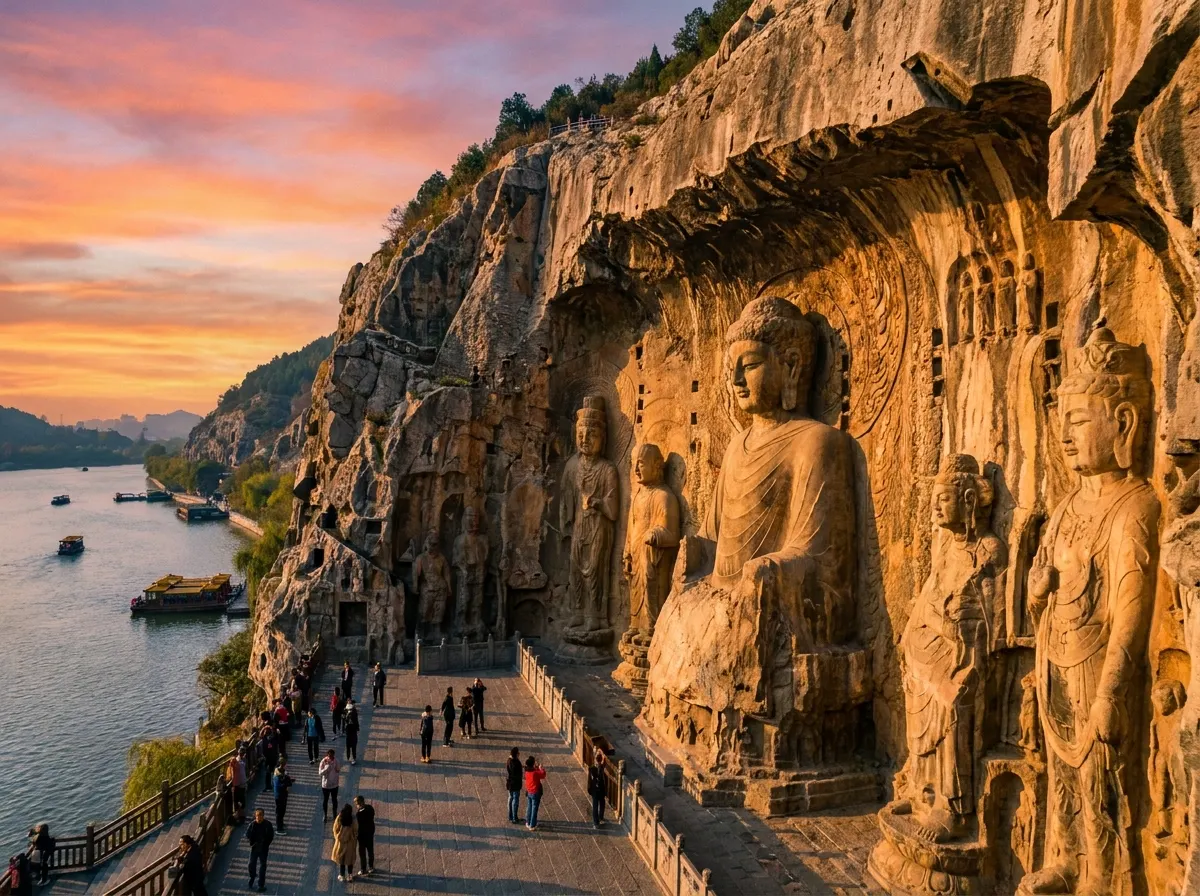
Luoyang was the capital of 13 Chinese dynasties from 1100 BC to the 10th century AD, making it one of China's four ancient capitals alongside Beijing, Xi'an, and Nanjing. The Longmen Grottoes (UNESCO site) has 100,000+ Buddhist statues carved into limestone cliffs over 400 years. Famous for the annual Peony Festival (April). Plan 2-3 days for the city plus a day for the Shaolin Temple nearby. High-speed rail from Xi'an: 1.5 hours.
Why Luoyang in 2026.
Capital of 13 dynasties. The Longmen Grottoes with 100,000+ Buddhist statues, the White Horse Temple, and the famous peony festival.
Quick Answer
Luoyang was the capital of 13 Chinese dynasties from 1100 BC to the 10th century AD, making it one of China's four ancient capitals alongside Beijing, Xi'an, and Nanjing. The Longmen Grottoes (UNESCO site) has 100,000+ Buddhist statues carved into limestone cliffs over 400 years. Famous for the annual Peony Festival (April). Plan 2-3 days for the city plus a day for the Shaolin Temple nearby. High-speed rail from Xi'an: 1.5 hours.
| Best time to visit | April for peonies and mild weather; September-October also good |
|---|---|
| Daily budget | $40 (backpacker) / $100 (mid-range) / $250+ (luxury) |
| Language | Mandarin (Henan dialect; English limited outside hotels) |
| Currency | CNY (¥) — Alipay/WeChat Pay universal in city |
| Time zone | China Standard Time (UTC+8) |
| Last updated | 2026-06-16 |
Want a Luoyang plan built for you?
Is Luoyang worth visiting vs Xi'an?
Luoyang and Xi'an are complementary destinations, not substitutes, and most travelers should see both. Xi'an has the more famous Terracotta Warriors, a larger Muslim Quarter, and a bigger international tourist scene, but Luoyang's Longmen Grottoes are equally important for the history of Chinese Buddhist art and far less crowded. The two cities sit about 1.5 hours apart by high-speed rail, which makes it easy to combine them in a 4-day trip with one base in each city. Xi'an is bigger, busier, and more developed for foreign visitors, with more English signage and a wider hotel selection, while Luoyang is more relaxed, cheaper, and quieter, with an old-capital atmosphere that many travelers prefer after the crowds of Xi'an. If you only have time for one and you care about imperial tombs and street food, pick Xi'an; if you care about Buddhist sculpture, peonies, and a calmer pace, pick Luoyang. For most first-time visitors to central China, the smart move is to fly into Xi'an, spend two days there, then take the morning HSR to Luoyang for two more days before flying home from Zhengzhou or returning to Xi'an.
When is the Peony Festival?
The Luoyang Peony Festival runs from mid-April to early May each year and is the single biggest cultural event in the city. Peonies bloom once a year, and Luoyang's 1,000+ cultivated varieties make it the peony capital of China, a status tied to a Tang-dynasty saying that "Luoyang's soil suits the peony best." The National Peony Garden (国家牡丹园) and Wangcheng Park (王城公园) are the main venues, and each merits 2-3 hours of slow walking among the beds. Most flowers peak in the third week of April, though late-season varieties extend the show into the first week of May. Book hotels 2-3 months ahead, since Luoyang fills up fast during the festival and central room rates can double or triple. Expect big domestic crowds on weekends and over the Qingming public holiday in early April; weekdays are noticeably calmer. Admission to the peony venues runs roughly ¥30-60, and the festival has been held annually since 1983. Outside the festival, the city is much quieter and the gardens are still worth a stop for the landscaping, but the bloom is the main draw.
How do I get from Xi'an to Luoyang?
High-speed rail from Xi'an North Station to Luoyang Longmen Station takes 1-1.5 hours, with 50+ daily trains priced roughly ¥55-130 (about $8-18) for a second-class seat. Trains run from roughly 6:30 AM to 9:30 PM, and booking a day or two ahead is wise on weekends and holidays. Long-distance buses also run on the older G30 expressway (about 3 hours, around ¥70) but are slower and less comfortable than the HSR. Driving takes about 3 hours, with highway tolls near ¥150 and fuel adding another ¥100 or so. The Luoyang airport (LYA) has limited domestic flights only, so Xi'an is usually a better arrival point for international travelers, and Zhengzhou Zhengxin International Airport about 2.5 hours north is the second option. From Luoyang Longmen Station, taxi or DiDi to the Old Town area takes about 25 minutes and costs ¥30-50. Keep your ticket handy for the station exit check, and note that Luoyang Longmen is a smaller station with limited English signage, so screenshot your train number and carriage.
Should I visit Shaolin Temple from Luoyang?
The Shaolin Temple is one of the most popular day trips from Luoyang and well worth a visit for travelers interested in martial arts, Chan (Zen) Buddhism, or mountain scenery. The trip takes about 1.5 hours each way by tourist bus (roughly ¥30 one way) or private car (around ¥300 round trip). The temple is the legendary home of kung fu and the birthplace of Chan Buddhism, founded in the late 5th century AD. Plan a full day for the temple compound, the Pagoda Forest (a graveyard of brick stupas for abbots), the Shaolin Kung Fu Performance (about ¥30 extra and staged several times a day), and the cable car up Song Mountain to the Sanhuangzhai scenic area. Combine the Shaolin day with a 2-day Luoyang stay for a tidy 3-day loop, or pair it with Zhengzhou if you are arriving from the east. Wear comfortable shoes because the site involves a lot of walking, and bring water since food inside is overpriced. Book a guided day tour through your hotel or Trip.com if you want tickets, performance times, and the cable car handled in one package.
Is Luoyang good for kids?
Luoyang is a great family destination, especially for children old enough to engage with history. The Longmen Grottoes are engaging for older children (about 8+) who can appreciate the scale and craftsmanship of the cliff carvings, though the walk is long and there are stairs, so a stroller is not practical. The Shaolin Kung Fu show is universally loved by kids of all ages and is the single most reliable crowd-pleaser in the region. The Peony Festival in April is beautiful for all ages and makes for easy photo backdrops. Luoyang is more relaxed and less crowded than Beijing or Xi'an, which makes it easier to navigate with children and keeps walking distances manageable. The Luoyang Museum has hands-on exhibits and air conditioning that families appreciate on hot summer afternoons, and the Old Town in the evening is a low-key walk with snacks and lanterns. Avoid the midday summer heat at the grottoes with young kids, and build in a hotel pool or rest break in the early afternoon.
Why is the Longmen Grottoes a UNESCO site?
The Longmen Grottoes were inscribed as a UNESCO World Heritage Site in 2000 for their exceptional concentration of Chinese Buddhist stone carving and their evidence of imperial patronage across multiple dynasties. Over 400 years, starting in 493 AD when the Northern Wei dynasty moved its capital to Luoyang, artisans carved more than 100,000 statues and 2,300 inscribed tablets into roughly 1 km of limestone cliffs along the Yi River. The largest figure, the 17-meter Vairocana Buddha in Fengxian Temple, is considered a high point of Tang-dynasty sculpture and is widely believed to have been modeled on Empress Wu Zetian. UNESCO recognizes the site as a masterwork of imperial Buddhist patronage because it shows how religious art, royal power, and technical craft evolved together across the Northern Wei, Sui, and Tang periods. The carvings also document changes in Buddhist iconography, clothing, and facial style over four centuries, which makes the site a kind of stone library for historians of Chinese religion. Vandalism, weathering, and early 20th-century looting damaged many heads, but ongoing conservation has stabilized the most fragile caves.
What is the best time of day to visit the Longmen Grottoes?
Late afternoon is the most dramatic time to visit, when low sunlight hits the western cliffs and brings out the carving detail that flat midday light flattens out. Arrive around 2-3 PM to do the western cliffs first, where the major statues including the Vairocana Buddha are located, then cross the Yi River to the eastern side as the light softens. Avoid midday in summer (35°C and up), when the exposed cliffs get very hot and the stone reflects heat back at visitors. Spring and autumn offer the most comfortable weather and the best photography light, with April through May and September through October as the sweet spots. Weekday afternoons are noticeably less crowded than mornings, since most tour groups arrive in the morning and clear out by lunch. Give yourself 3-4 hours minimum so you can stop, read, and photograph without rushing, and bring water because shade is limited on the western cliff path. The site closes around 6 PM in summer and 5 PM in winter, with last entry an hour before close.
How much time do I need in Luoyang?
Plan 2-3 days for the city plus a day for the Shaolin Temple, with an optional fourth day if you want to slow down. Day 1 covers the Longmen Grottoes (3-4 hours in the afternoon for the best light) and the Luoyang Museum (2 hours, free, closed Mondays). Day 2 adds the White Horse Temple (1.5 hours) and the Peony Festival sites in season, plus the Old Town in the evening for dinner and a Water Banquet. Day 3 is a full-day trip to the Shaolin Temple and Song Mountain, leaving early and returning after sunset. Add an extra day if you want to explore the old town at length, the Luoyang Water Banquet restaurants in depth, the Han Wei Luoyang city ruins, and smaller Tang-dynasty sites like the Qianmu Cemetery or the Luoyang Ancient Tombs Museum. Travelers with only one full day should pick the Longmen Grottoes plus either the museum or the White Horse Temple, and save Shaolin for a separate trip. Two days is the comfortable minimum that does not feel rushed.
What is the White Horse Temple?
The White Horse Temple (白马寺), founded in 68 AD, is considered the first Buddhist temple in China and is widely called the "cradle of Chinese Buddhism." According to tradition, Emperor Ming of the Eastern Han dreamed of a golden man and sent envoys west; they returned with two Indian monks, She Moteng and Zhu Falan, carrying Buddhist scriptures on white horses, and the emperor built the temple to house them. The site holds historic halls, ancient trees, and an international garden zone with replicas of Indian, Thai, and Myanmar temples built jointly with those countries, which gives the complex an unusual pan-Asian character. Plan about 1.5 hours for the main compound, longer if you walk the international gardens and the adjacent Qiyun Pagoda, a small square brick pagoda that is one of the oldest in China. Combine the visit with the nearby Han Wei Luoyang city ruins for serious history fans, though those ruins are mostly foundations and signage and appeal mainly to specialists. The temple is about 12 km east of the Old Town and is reachable by bus, taxi, or DiDi in roughly 30 minutes.
What dynasties ruled from Luoyang as their capital?
Luoyang served as the capital of 13 dynasties and is one of China's four great ancient capitals alongside Beijing, Xi'an, and Nanjing. The 13-dynasty count usually includes the Eastern Zhou (770-256 BC), Eastern Han (25-220 AD), Cao Wei (220-265), Western Jin (265-316), Northern Wei (moved capital to Luoyang in 493), Sui (briefly), Tang (as a secondary capital under Empress Wu Zetian), and several smaller regimes during the Northern and Southern Dynasties period. In total the city held capital status for more than a thousand years, with its peak influence under the Eastern Han and Tang. That long run is why Luoyang is so dense in tombs, temple foundations, and museum holdings, and why the Luoyang Museum is one of the best provincial museums in China for Han through Tang material. The "13 dynasties" framing is the official count used in Chinese textbooks and tourism marketing; historians sometimes argue over exactly which regimes to include, but the broad point that Luoyang was a political center for over a millennium is undisputed.
What should I see at the Luoyang Museum?
The Luoyang Museum is the best single stop for understanding why the city matters historically, and it deserves a solid 2 hours of any visit. The permanent collection covers the full 13-dynasty span, with strengths in Han-dynasty pottery figures, Tang three-color glazed pottery (sancai), bronze ritual vessels, jade burial suits, and Buddhist sculpture rescued from regional sites. The Tang sancai gallery is the highlight for most visitors, with vividly glazed camels, horses, and court figures that show the cosmopolitan reach of the Silk Road into central China. The building itself is modern and well lit, with good English labels on most major pieces, and admission is free with a passport or ID. Arrive early in the day or in the late afternoon to avoid school groups, and pick up the audio guide if you want deeper context without hiring a private guide. The museum is closed on Mondays, which is a common trap for travelers planning their itinerary. Combine it with the nearby Luoyang Ancient Tombs Museum if you want a full day of archaeology; that branch site has relocated Han and Tang tombs reconstructed underground and is genuinely unique.
What is the Luoyang Water Banquet and where do I try it?
The Luoyang Water Banquet (洛阳水席, "water seat") is the city's signature culinary tradition, a formal 24-course banquet where every dish includes soup, broth, or sauce. The banquet is said to date to the Tang dynasty and is traditionally served in a strict sequence, with eight cold appetizers followed by sixteen hot dishes, ending with a final egg-drop soup. The most famous single dish is Mudan Yancai (peony swallow vegetable), a refined radish and vermicelli soup shaped to resemble a peony, named after the city flower. For visitors, the classic venue is Zhenqingtang (真不同), a centuries-old brand near the Old Town that serves the full banquet to groups, though smaller restaurants offer abbreviated versions that are cheaper and faster. Expect to pay roughly ¥150-400 per person depending on whether you book a private room and how many courses are served, and plan for the meal to take 2-3 hours if done properly. Book ahead at the famous houses during the Peony Festival, when local and domestic tourist demand peaks.
How do I get to Luoyang by high-speed rail?
Luoyang is well connected to the national high-speed rail network through Luoyang Longmen Station, which sits about 10 km south of the city center and serves the Zhengzhou-Xi'an HSR line. From Xi'an North the trip is 1-1.5 hours on roughly 50 daily trains, and from Zhengzhou East it is about 45-60 minutes on even more frequent trains, making Luoyang easy to slot into any central-China loop. From Beijing West the direct HSR takes about 4-4.5 hours via Zhengzhou, and from Shanghai Hongqiao it is about 5.5-6.5 hours with one transfer at Zhengzhou or Nanjing. Second-class fares run about ¥55-130 for Xi'an, ¥40-90 for Zhengzhou, ¥350-450 for Beijing, and ¥500-600 for Shanghai depending on the train. Trains sell out on weekends and holidays, so book 1-3 days ahead on the 12306 app or through Trip.com, and screenshot your carriage and seat since station signage is mostly in Chinese. From the station, a DiDi or taxi to the Old Town costs about ¥30-50 and takes 25 minutes; there is also a city bus but it is slow with luggage.
What are the best day trips from Luoyang?
Luoyang makes an excellent base for day trips across the central China plain, with the Shaolin Temple, the Han Wei Luoyang city ruins, and several smaller sites all reachable in under two hours. The Shaolin Temple and Song Mountain combo to the southeast is the headline day trip, taking a full day for the temple, Pagoda Forest, kung fu show, and a cable car up the mountain. To the east, Zhengzhou is 45 minutes by HSR and offers the Henan Museum, one of the best provincial museums in China for Bronze Age material, plus a major airport for onward flights. To the west, Xi'an is 1.5 hours by HSR and works as either a day trip or a multi-day extension, with the Terracotta Warriors, Muslim Quarter, and city wall. North of the city, the Yellow River scenic area at Xiaolangdi offers a dam, boat rides, and dramatic river scenery, especially during the summer flood-release period. Serious history fans can also detour to the Longshan-era Erlitou archaeological site museum, which presents what may be China's earliest dynasty. Two or three day trips paired with two city days gives a rich week in Henan.
Can I do Luoyang as a day trip from Zhengzhou or Xi'an?
Yes, Luoyang works as a long but doable day trip from either Zhengzhou or Xi'an thanks to the fast high-speed rail link. From Zhengzhou East the HSR is 45-60 minutes each way, which means you can leave at 8 AM, be at Luoyang Longmen Station by 9:30, and have a full day for the Longmen Grottoes, the Luoyang Museum, and a Water Banquet dinner before catching a 9 PM train back. From Xi'an North the trip is 1.5 hours each way, which makes a day trip tighter but still feasible if you take an early train and a late return; budget for about 12 hours door to door. The catch is that you only get one full day, so you have to pick between the grottoes and the Shaolin Temple, since Shaolin alone eats most of a day. For travelers with limited time in China, a day trip is a reasonable way to see the headline Longmen Grottoes, but a 2-night stay gives a far better sense of the city and is the better trade if your schedule allows. Pack light, pre-book train tickets, and store luggage at the station if your hotel check-in is later.
Where should I stay in Luoyang?
The best base for most visitors is the Old Town or Wangcheng Square area, which puts you within walking distance of restaurants, the Water Banquet venues, and the evening lantern streets. Mid-range international-style hotels cluster around Wangcheng Square and run ¥300-600 per night, while budget options and guesthouses sit deeper in the Old Town lanes. If your priority is the Longmen Grottoes, staying near Luoyang Longmen Station cuts the morning commute, though the area is quieter and has fewer dinner options. During the April Peony Festival, book 2-3 months ahead since central hotels fill and rates rise sharply, sometimes doubling for weekend nights. Travelers on a tighter budget can find clean business hotels near the train station for ¥150-250, but the dining and walkability are weaker there. For luxury, the handful of five-star hotels along the Luo River offer better views and pools, at roughly ¥800-1500 per night. Avoid staying too far east or west of the center, since traffic across the river can add 20-30 minutes to every trip.
What is the weather like in Luoyang through the year?
Luoyang has a temperate continental climate with four distinct seasons, hot humid summers, cold dry winters, and short but pleasant spring and autumn shoulders. Spring (March to May) is the peak season for tourism because the peonies bloom in April and daytime highs sit in a comfortable 18-25°C range, though sandstorms from the north can occasionally cloud the sky in March. Summer (June to August) is hot and humid, with July highs regularly hitting 35°C and occasional heavy rain; it is the low season for foreign visitors but fine for domestic travelers on school holidays. Autumn (September to November) is the second peak, with dry clear days, highs around 20-25°C, and excellent photography light at the grottoes. Winter (December to February) is cold and dry, with January lows near -4°C and occasional snow, but crowds are thin and hotel rates drop sharply. For most travelers the best windows are mid-April to mid-May and September to October, balancing weather, crowds, and prices.
How did Luoyang become the cradle of Chinese Buddhism?
Luoyang became the cradle of Chinese Buddhism in 68 AD, when Emperor Ming of the Eastern Han sent envoys west and they returned with two Indian monks carrying Buddhist sutras on white horses. To house the scriptures and the monks, the emperor built a temple and named it after the white horses that had carried the holy texts, giving China its first Buddhist temple and the White Horse Temple (白马寺) its name. The site then served as the translation center for the first generation of Chinese Buddhist scholars, and over the next several centuries Buddhism moved from an exotic foreign religion to a mass faith that shaped Chinese art, philosophy, and state ritual. The Longmen Grottoes, begun in 493 AD when the Northern Wei moved their capital to Luoyang, are the physical evidence of how that early spark became a national religious culture. Without Luoyang, the route Buddhism took into East Asia would have been very different, and visitors to the city today walk through the same places where monks first translated Sanskrit sutras into Chinese, where court painters first imagined paradise and bodhisattvas, and where imperial patronage fused with folk piety to produce the uniquely Chinese Buddhist tradition. The White Horse Temple and the Longmen Grottoes together form a UNESCO-recognized religious and artistic record that is unmatched in East Asia, and they explain why Luoyang is on the short list of cities that any serious student of Chinese culture must visit. For foreign travelers, the White Horse Temple is also one of the more accessible religious sites in China because it now hosts an international zone with replicas of Indian, Thai, and Myanmar temples, all built in cooperation with the Buddhist authorities of those countries. Walking through the Indian-style hall with its sandstone carvings and shikhara spire, you get a sense of how the religion first arrived, and then walking through the older Chinese halls you can trace how it was reinterpreted in a local idiom. The combination is unusual and is one of the more thoughtful heritage stops in central China.
What is special about the Eastern Zhou bronze collection in Luoyang?
The Eastern Zhou bronze collection in Luoyang is one of the largest and most important in China, reflecting the city's 500-year status as the political and ritual center of the Zhou royal domain. The Luoyang Museum, the Luoyang Archaeological Museum, and several university collections hold ritual vessels, weapons, and musical instruments that document how Eastern Zhou elites buried their dead, performed ancestral rites, and projected political authority. The most famous pieces include ritual food containers (ding and gui) cast in the 6th to 3rd centuries BC, decorated with taotie masks, dragons, and geometric bands that mark the slow stylistic drift from the rigid symmetry of early Zhou to the more free-form work of the Warring States period. Some of the bronzes were recovered from large tomb complexes on the outskirts of Luoyang, including the Guo State cemetery at Shangcunling and the Zhou royal cemetery at Jin Mausoleum, both of which can be visited on day trips from the city. For foreign visitors with a specific interest in early Chinese bronze, Luoyang is a stronger stop than the more famous collections in Shanghai or Beijing, because the city was the place where most of these vessels were actually used, not just a place where they were later gathered. The Luoyang Museum has good English labels and a small but well-chosen display of Eastern Zhou pieces, and the museum shop sells detailed catalogues that explain the ritual context of each vessel. Serious archaeologists can also arrange visits to the storage facility of the Luoyang Institute of Cultural Relics, where new finds from ongoing digs in the city are processed, though this requires advance notice and a researcher introduction. Even travelers with only a casual interest in early Chinese history will find the bronze galleries a useful counterpoint to the Tang pottery halls, because they show that Luoyang's importance as an imperial center predates its Buddhist heyday by more than a thousand years. The same broad plain that hosted the Zhou kings, the Han capital, and the Tang eastern capital also produces a continuous archaeological record that is exceptionally well preserved in the dry loess soils of the region.
What is Guanlin Temple and why do martial arts fans visit it?
Guanlin Temple (关林) is the tomb and shrine complex dedicated to Guan Yu, the famous general of the late Eastern Han dynasty later deified as the god of war, loyalty, and brotherhood. Guan Yu lived and died in the 3rd century AD, and according to tradition his head was buried at Guanlin after his execution, with the rest of his body buried elsewhere in Hubei, making the Luoyang site a kind of imperial reliquary for one of the most beloved figures in Chinese culture. The temple grounds are organized around a walled tomb mound, the ancestral hall, a stone archway from the Ming dynasty, and a long stone-paved spirit way lined with life-size carved stone lions and guardian figures that rivals the better-known spirit ways of the Ming tombs near Beijing. For martial arts fans and readers of the Romance of the Three Kingdoms, Guanlin is a pilgrimage site rather than just a museum, because Guan Yu is one of the foundational characters of the Chinese martial arts imagination, and many kung fu schools claim descent from his legendary feats of loyalty and physical prowess. The temple hosts the annual Guan Yu birthday festival in the 6th lunar month (usually July), with opera performances, incense offerings, and processions of martial arts groups, and even outside the festival you will see martial artists training in the outer courtyards and burning offerings at the tomb. The site sits about 7 km south of the Old Town, reachable by DiDi or bus in roughly 25 minutes, and admission costs around ¥40. Plan 1.5-2 hours for the main halls, the stone-carving galleries, and the tomb mound, longer if you are interested in the Three Kingdoms historical context. The temple pairs naturally with a Shaolin Temple day trip, because both reflect the martial culture of Henan, and together they give a fuller picture of how military virtue, religious devotion, and folk piety intersect in the region.
How do I plan a day trip to Dengfeng and the Shaolin Temple?
A Shaolin Temple day trip from Luoyang is one of the most rewarding side excursions in central China and deserves careful planning because the site is large and combines several distinct experiences. Start by leaving Luoyang by 8 AM, either on a tourist bus from Wangcheng Square (about ¥30 one way, 1.5 hours), a private car booked through your hotel (around ¥300 round trip), or a day tour that bundles transport, tickets, and a guide. The first stop is the Shaolin Temple itself, founded in 495 AD during the Northern Wei dynasty and the legendary home of Chan (Zen) Buddhism and Chinese kung fu; the temple is large, with multiple halls, a pagoda forest of 240+ brick stupas holding the cremated remains of abbots, and a small but excellent museum of Shaolin martial arts history. Plan 2-3 hours for the temple compound, including the kung fu show, which is staged several times a day in a dedicated theater and showcases the monks' mastery of staff, sword, and bare-hand routines; tickets for the show are around ¥30 and worth the extra time. After lunch at one of the vegetarian restaurants near the temple gate, take the cable car up Song Mountain to the Sanhuangzhai scenic area, which takes about 10 minutes and costs roughly ¥80 round trip; the peak offers dramatic views over the surrounding Zhongyue mountains, and the cliff-face walkways on the way up are a highlight in themselves. The descent and the bus back to Luoyang take another 2-3 hours, so plan to return by 7-8 PM, which leaves time for a late dinner at the Old Town and a walk through the evening lantern streets. If you have two days, spend the night in Dengfeng town, which has a handful of clean mid-range hotels and allows a quieter sunrise visit to the temple and a more relaxed walk through the Pagoda Forest. For travelers with a deeper interest in Chan Buddhism, also consider adding a side visit to the nearby Songyang Academy, one of the four great academies of imperial China and a quiet, atmospheric site that most day-trippers skip.
What is the historical significance of Song Mountain near Luoyang?
Song Mountain (嵩山) is one of the Five Great Mountains of imperial China, the central mountain among the five cosmic pillars, and has been a sacred and political site for more than 3,000 years. Emperors of nearly every major dynasty from the Zhou through the Qing made pilgrimages to the mountain, and the summit is dotted with inscriptions, ritual platforms, and small temples that record these visits. The mountain range also hosts three UNESCO World Heritage sites within a small radius: the Shaolin Temple (cultural landscape, 2010), the Zhongyue Temple (one of the earliest Taoist ritual complexes in China), and the Songyang Academy (one of the four great neo-Confucian academies of the Northern Song). For travelers interested in the full sweep of Chinese civilization, Song Mountain is unusually concentrated, because the same landscape that produced the imperial cosmic-mountain tradition also produced the Chan Buddhist reform movement at Shaolin and the neo-Confucian revival at Songyang. The mountain itself is scenic without being extreme, with several well-marked trails, two working cable cars, and a paved road that reaches the Sanhuangzhai peak, so it is accessible to casual visitors who do not want a full hiking expedition. The Sanhuangzhai summit, at about 1,500 meters, offers wide views over the Zhongyuan plain and a small Taoist shrine that is one of the oldest continually used sacred sites in China. Allow 4-5 hours for a cable-car ascent, a short walk to the summit, and a slow descent, and bring water and a light jacket because the summit is often windy and several degrees cooler than the plain. For visitors who cannot make the full day, the lower slopes of Song Mountain, including the Zhongyue Temple and the Songyang Academy, are reachable in a half-day and provide a dense dose of Chinese cultural history without the mountain climb. Combined with the Shaolin Temple, Song Mountain offers one of the highest concentrations of major historical and religious sites in China, all within a 90-minute drive of Luoyang.
What is the Luoyang Ancient Tombs Museum and who should visit?
The Luoyang Ancient Tombs Museum (洛阳古墓博物馆) is a branch of the Luoyang Museum, located on the northern outskirts of the city, and is one of the most unusual archaeological sites in China. It consists of a series of reconstructed Han and Tang dynasty tombs that were moved from their original locations in and around Luoyang to a single underground gallery, where visitors can walk through them in sequence and see the layout, the brick carvings, the painted murals, and the burial goods exactly as they were placed 1,500-1,800 years ago. The site is one of only a handful of places in the world where ordinary visitors can enter authentic ancient Chinese tombs, and it offers a level of intimacy with the burial culture of imperial China that no amount of museum display can match. For travelers with a serious interest in early Chinese history, archaeology, or the development of Chinese funerary art, the Ancient Tombs Museum is a worth visiting, because it makes concrete the textual descriptions of tomb design in the Han and Tang dynastic histories and the literary accounts of burials in Tang poetry. For casual visitors, the museum is also genuinely interesting because the brick carvings and wall paintings are often colorful and lively, with scenes of daily life, processions, and mythical animals that read almost like underground comic books from the Tang dynasty. Plan 2-3 hours for the full tour, including the walk between the tomb entrances and the separate gallery of funerary objects. The site is reachable by DiDi in about 30-40 minutes from the Old Town, and admission is free with a passport, though a guide costs extra and is recommended because the tomb context is hard to grasp from labels alone. The museum is closed on Mondays, the same as the main Luoyang Museum, so plan the two visits for the same day. Because the tombs are underground and the temperature stays cool year-round, the museum is also a good refuge from Luoyang's hot summer afternoons or cold winter days.
What is the Erlitou Site and is it worth visiting from Luoyang?
The Erlitou Site (二里头遗址), the largest early Bronze Age urban center discovered in China, sits about 30 km east of Luoyang and is widely believed to represent the capital of China's first dynasty, the Xia. The site was discovered in the 1950s, excavated in stages since the 1970s, and is now the focus of an enormous research effort that has reshaped the debate about the origins of Chinese civilization. The on-site museum, opened in 2019, presents the discovery, the layout of the palace-palace-temple district, the bronze foundry remains, and the turquoise-inlaid bronze plaques that suggest early contact with Central Asia, all in modern galleries with good English labels. For travelers who have visited the better-known archaeological sites of central China, Erlitou adds a deeper prehistory to the standard Zhou-Han-Tang story and offers a glimpse of urban life in the Yellow River valley 3,800 years ago. The site is reached by DiDi or a private car in roughly 45 minutes from the Luoyang Old Town, and admission is free with a passport, though a guide costs extra. Plan 2-3 hours for the museum, the palace foundations, and the small archaeological park that marks the original layout. Erlitou is not a stop for casual travelers who have only 2-3 days in Luoyang, but it is a strong half-day side excursion for anyone with an interest in early Chinese history or the origins of kingship in East Asia. Pair it with the Luoyang Museum for a full prehistory-through-Tang arc, and use the day to connect the Eastern Zhou bronzes in the main museum to the much older Erlitou bronzes in the site museum. The site is also one of the key pieces of evidence in the debate about whether the Xia dynasty was historical or legendary, and the museum handles that debate with both scientific restraint and genuine excitement.
How should foreign travelers handle money and connectivity in Luoyang?
Foreign travelers will find Luoyang reasonably easy to navigate financially and digitally, with a few small adjustments. The currency is the Chinese yuan (CNY, ¥), and most prices in this guide are in yuan; ¥100 is roughly $14 at current rates. Cash is rarely needed for foreigners because Alipay and WeChat Pay dominate, and both apps can now link foreign Visa and Mastercard cards through a one-time passport verification that takes 5 minutes. Link your card before arrival in China, and you can pay for almost everything from the Water Banquet to the grottoes entrance fee by scanning a QR code. ATMs that accept foreign cards are concentrated around Wangcheng Square, the train station, and the major hotels, with Bank of China and ICBC branches the most reliable. Avoid independent ATMs in convenience stores, which often charge steep foreign-card fees. For internet access, China's Great Firewall blocks Google, Instagram, WhatsApp, Gmail, and most Western social platforms, so travelers should download a working VPN before entering the country and set it up on a phone plus a laptop. Hotel Wi-Fi is generally fast and reliable in mid-range and luxury properties, but it can be sluggish in budget guesthouses. A cheap Chinese SIM card with data (China Mobile or China Telecom) is the most reliable way to stay connected, available at the airport on arrival or in the city for ¥100-200 for a month of 10-30 GB; bring your passport for registration. DiDi, the Chinese ride-hailing app, is the most reliable way to get a fair-priced taxi in Luoyang, and it has a built-in English interface and accepts foreign credit cards. Tipping is not customary and can confuse staff, so do not leave extra money at restaurants; instead, round up the bill and pay the exact amount. Luoyang is one of the smoother Chinese cities for foreign visitors, with hotels and major attractions accustomed to international guests, but a little preparation on payments and connectivity will save you real time on the ground.
Top attractions
Longmen Grottoes (龙门石窟)
UNESCO site with over 100,000 Buddhist statues carved into a 1km limestone cliff along the Yi River — the apex of Tang-dynasty stone carving. Allow 3 hours.
White Horse Temple (白马寺)
China's first Buddhist temple, founded in 68 CE when two Indian monks arrived with white horses carrying sutras. The temple that started Chinese Buddhism. ¥50.
Shaolin Temple (少林寺)
The birthplace of Chan (Zen) Buddhism and Shaolin kung fu, 80km southeast of Luoyang at the foot of Mount Song. The Pagoda Forest, the martial arts performances, and the working monastery are the draw. ¥100.
Luoyang Peony Festival (洛阳牡丹花会)
Held annually in April, the city's parks explode with hundreds of varieties of tree peonies — Luoyang is the peony capital of China and has cultivated them for 1,500 years.
Luoyang Museum (洛阳博物馆)
A large, modern, free museum with excellent Tang-dynasty exhibits, including Tang sancai (three-colour glazed) ceramics and a scale model of Tang Luoyang. 2 hours well spent.
Guanlin Temple (关林)
The burial place of Guan Yu's head — a temple dedicated to the Three Kingdoms general who was deified as the God of War. 1,000 years of devotion in incense smoke and carved halls.
Luoyang Old City (老城)
The Qing-dynasty old city with the Lijing Gate, narrow lanes of courtyard homes, and the Luoyang Water Banquet restaurant district — a lived-in historic quarter rather than a restored tourist zone.
Mount Song (嵩山)
One of China's Five Great Mountains, a sacred Daoist peak with the Shaolin Temple at its foot and the Songyang Academy (one of China's four great ancient academies) on its slopes.
STAY
Where to stay in Luoyang
Pick a base that matches the trip you want — imperial-central for sightseeing, hutong belt for character, Chaoyang for nightlife, or Qianmen for budget.
Luoyang Old City (Lijing Gate)
Qing-era lanes, Water Banquet restaurants, and the atmospheric old quarter
#old-cityLongmen area
Hotels near the grottoes and the HSR station — quieter but far from dining
#longmenJianxi District
Modern commercial centre with the best hotels, malls, and restaurants
#jianxi
ITINERARIES
Sample itineraries from Luoyang
Three ready-made routes, from a 1-day imperial sprint to a 5-day deep dive. Copy the day-by-day plan and adapt to your own pace.
- 1 DAY
Luoyang Buddhist Art Day
Morning at the Longmen Grottoes for the Vairocana Buddha, afternoon at White Horse Temple, evening Water Banquet in the Old Town.
- Day-trippers from Xi'an or Zhengzhou
- Buddhist art enthusiasts
- Short-stay travelers
- Day 01
Morning
Longmen Grottoes (8 AM-12 PM, ¥90) — walk the west cliff for the major caves, cross the Yi River for the panoramic view back
Afternoon
White Horse Temple (1:30-3 PM, ¥35) — Main Hall, Qiyun Pagoda, international temple zone
Evening
Luoyang Old Town — Water Banquet dinner at Zhenqingtang (¥150-400/person, reserve ahead), then Drum Tower night walk
- 2 DAYS
Luoyang Peonies & Caves Weekend
Spring weekend: peony gardens in full bloom, Longmen Grottoes at golden hour, White Horse Temple, and the Ancient Tombs Museum.
- Spring travelers (April)
- Couples
- Photography enthusiasts
- Day 01
Morning
National Peony Garden (8-10:30 AM, ¥40-60) — best light for flower photography, fewer crowds early
Afternoon
Longmen Grottoes (2-5:30 PM, ¥90) — late afternoon light on the western cliffs is most dramatic
Evening
Luoyang Museum (if time before closing) + Old Town dinner (Banmian noodles and potstickers)
- Day 02
Morning
White Horse Temple (8:30-10 AM, ¥35) — quiet before tour groups arrive
Afternoon
Luoyang Ancient Tombs Museum (1-3 PM, free) — walk through Han and Tang underground tombs
Evening
Water Banquet dinner + Old Town night market skewers and desserts
- 3 DAYS
Luoyang + Shaolin Complete Circuit
Two days for Luoyang's Buddhist caves, temples, and peonies, then a full day at the Shaolin Temple for kung fu and Song Mountain.
- Kung fu and martial arts fans
- Buddhist pilgrimage travelers
- Henan deep divers
- Day 01
Morning
Longmen Grottoes (3-4 hours)
Afternoon
Luoyang Museum (2 hours, free)
Evening
Old Town Water Banquet + Drum Tower
- Day 02
Morning
White Horse Temple (1.5 hours)
Afternoon
Guanlin Temple (1.5 hours, ¥40) or peony garden (April)
Evening
Old Town street food walk: Banmian, guotie, donkey soup
- Day 03
Morning
Drive to Shaolin Temple (8 AM departure, 1.5 hours, ¥300-400 private car) — temple, Pagoda Forest, kung fu show (¥30 extra)
Afternoon
Cable car up Song Mountain to Sanhuangzhai peak (¥80 round trip) — panoramic views
Evening
Return to Luoyang by 7 PM, final dinner in Old Town
BUDGET
What a Luoyang trip costs
Per-person, per-day costs across three spending tiers. Excludes international flights and visa fees.
| Line item | Backpacker | Mid-range | Luxury |
|---|---|---|---|
| Accommodation (per night) | $18 | $70 | $250 |
| Meals (3 per day) | $10 | $25 | $80 |
| Local transport | $5 | $15 | $45 |
| Top attraction (Longmen, Shaolin, White Horse) | $35 | $50 | $70 |
| Daily essentials | $5 | $12 | $30 |
| Total per day | $73 | $172 | $475 |
$ USD per person per day, before international flights and visas. Last verified: Q3 2026.
STAY SAFE
Emergency contacts in Luoyang
Save these three numbers before you board the plane. China uses different hotlines than most countries — there's no 911.
- POLICE
110
- AMBULANCE
120
- FIRE
119
- TOURIST HOTLINE
12301
- ENGLISH-SPEAKING ER
Luoyang Central Hospital (洛阳市中心医院), 24h emergency, some English-speaking staff available during daytime, +86 379 6389 2222
Problems travelers hit in Luoyang
- Why is my Alipay not working?You linked a foreign Visa or Mastercard to Alipay but every transaction is rejected at the merchant.
- My China visa was denied — what now?Your L visa application was refused at the Chinese consulate and your trip is in 2–4 weeks.
- My passport was lost or stolen in China — what do I do?Your passport is gone (theft or loss) and you're in mainland China without travel documents.
- Why can't I book on 12306 with my foreign card?You tried to book a high-speed rail ticket on 12306.cn and your foreign Visa/Mastercard is rejected at checkout.
- Why is my VPN not working in China?You arrived in China, opened your VPN, and it will not connect at all or connects but no traffic loads.
- Why can't I book a Tibet trip on my own?You try to book Lhasa flights and hotels yourself but the booking fails, or you're turned away at the Lhasa airport without a permit.
Compare Luoyang with
Book activities in Luoyang
These are licensed tour operators and booking platforms we've vetted independently. Booking through these links may earn us a commission — see our affiliate disclosure. This never affects our editorial recommendations or the price you pay.
Frequently asked questions
What is the best time to see Longmen Grottoes?
Do I need a guide for Longmen Grottoes?
Can I see the entire Longmen Grottoes in one day?
What is Luoyang's most famous food?
Is Luoyang safe?
Can I combine Luoyang with Xi'an and Kaifeng?
Show all 38 FAQs
Where should I stay in Luoyang?
What is the Luoyang Water Banquet?
How do I get to the Shaolin Temple from Luoyang?
Are there ATMs and foreign-card payments in Luoyang?
What is the Longmen Grottoes ticket price?
Does Luoyang have an airport?
What is special about White Horse Temple for foreign visitors?
Is the Luoyang Museum worth a visit on a short trip?
How long does a Song Mountain day trip take from Luoyang?
What should I eat in Luoyang besides the Water Banquet?
Is Luoyang a good destination in winter?
Do I need a visa to visit Luoyang?
How do I get to the Longmen Grottoes from the Old Town?
Are the peonies in bloom outside of April?
What is the best Luoyang itinerary for two days?
Is Luoyang easy to navigate for non-Chinese speakers?
What is the Luoyang Peony Festival schedule and how do I get tickets?
Can I see the Longmen Grottoes lit up at night?
When exactly is the best week for the Luoyang Peony Festival?
How do I pair Luoyang with Dengfeng beyond just the Shaolin Temple?
What is the best Luoyang street food beyond the Water Banquet?
Are there any ancient city wall remnants to see in Luoyang?
Can I visit the Henan Museum as a day trip from Luoyang?
Where are the best photo spots at the Longmen Grottoes?
What are the most underrated treasures at the Luoyang Museum?
What is a realistic budget for 3 days in Luoyang?
What is a good family itinerary for Luoyang with kids?
How can I find an English-speaking guide in Luoyang?
Is Luoyang worth visiting specifically in winter?
What are the best day trips from Luoyang beyond the Shaolin Temple?
How does Luoyang compare to Kaifeng for history lovers?
What Tang dynasty sites can I see in Luoyang besides the Longmen Grottoes?
References

Related guides & destinations
Guide
How We Research 2026: NihaoVisit’s Methodology for China Travel Information
How NihaoVisit sources, verifies, and maintains 700+ pages of China travel information — our source hierarchy, fact-checking process, update
Guide
Fact-Checking Log 2026: Verified China Travel Information — NihaoVisit
A public log of fact-checking verification passes on NihaoVisit, showing what was verified, when, and against which sources — covering visa
Guide
Best Time to Visit China 2026: Month-by-Month Weather, Crowds, and Prices
The best time to visit most of China is April–May and September–October. Winter (Dec–Feb) is cold but cheap; summer (Jun–Aug) is hot and cro
Guide
VPN for China 2026: Which VPNs Work, eSIM Alternatives, and the Complete Pre-Trip Checklist
Most Western apps and websites are blocked in mainland China. A reliable VPN is essential for Google, Gmail, WhatsApp, Instagram, and most n
Guide
China SIM Card and eSIM Guide 2026: Stay Connected Without WeChat
A Chinese SIM or eSIM lets you use mobile data, maps, and ride-hailing without WiFi. Here is how to get one, the cost, and which provider to
Guide
Solo Female Travel in China 2026: Safety, Tips, and Real Experiences
China is one of the safer destinations for solo female travelers. Petty theft is rare, violent crime against tourists is extremely uncommon,