Macao
Macao (Macau) is a Special Administrative Region of China, returned from Portuguese rule in 1999. The Historic Centre is a UNESCO site with 25+ landmarks, including the Ruins of St. Paul's, A-Ma Temple, and the Senado Square. Macao is also the world's largest casino market (5x Las Vegas revenue). Portuguese-Chinese fusion cuisine (Macanese) is unique. Plan 2-3 days. Easy high-speed ferry from Hong Kong (1 hour) or bus from Guangzhou (2.5 hours).
Why Macao in 2026.
Where Portugal meets China. UNESCO historic center, 30+ casinos, and the world's only fusion of Cantonese and Portuguese cuisine.
Quick Answer
Macao (Macau) is a Special Administrative Region of China, returned from Portuguese rule in 1999. The Historic Centre is a UNESCO site with 25+ landmarks, including the Ruins of St. Paul's, A-Ma Temple, and the Senado Square. Macao is also the world's largest casino market (5x Las Vegas revenue). Portuguese-Chinese fusion cuisine (Macanese) is unique. Plan 2-3 days. Easy high-speed ferry from Hong Kong (1 hour) or bus from Guangzhou (2.5 hours).
| Best time to visit | October-December for the cooler dry season; avoid typhoon season (July-September) |
|---|---|
| Daily budget | $70 (backpacker) / $180 (mid-range) / $500+ (luxury) |
| Language | Cantonese, Mandarin, and Portuguese (English widely spoken) |
| Currency | MOP (Macanese pataca) and HKD both accepted; HKD widely used; ~1 HKD = 1.03 MOP |
| Time zone | China Standard Time (UTC+8) |
| Last updated | 2026-06-16 |
Want a Macao plan built for you?
Is Macao worth a day trip from Hong Kong?
Yes — Macao is one of the most popular day trips from Hong Kong. TurboJET and Cotai Water Jet ferries from Hong Kong (Sheung Wan or Hong Kong-Macau Ferry Terminal) to Macao take 55-60 minutes, with 24+ daily departures at roughly HKD 200-220, re-check before booking. The TurboJET "Cotai Water Jet" is faster (45 minutes). Once in Macao, free casino shuttle buses connect the ferry terminal to most major hotels on the Cotai Strip and the Macao Peninsula.
How many days do I need in Macao?
Two days is the sweet spot for most travelers. Day 1: Historic Centre (Ruins of St. Paul's, Senado Square, A-Ma Temple, St. Dominic's Church, Mount Fortress) plus lunch at a Macanese restaurant, then Cotai Strip (The Venetian, Parisian Macao, Studio City) in the evening. Day 2: Coloane Village (egg tarts at Lord Stow's, Hac Sa Beach, walking) plus Taipa Village (Portuguese charm) and Macao Tower for sunset views. A third day lets you add the Macao Grand Prix Museum and a slower pace in the historic lanes.
What is Macanese food?
Macanese cuisine is one of the world's only authentic fusion traditions — Portuguese colonial ingredients (bacalhau, chorizo, olive oil) married with Chinese techniques and seasonings (soy, ginger, five-spice). Must-try dishes include Portuguese egg tarts (葡式蛋挞, the original invented in Macao in 1989), African chicken (coconut-curry roast chicken), pork chop bun (猪扒包), minchi (ground beef and pork with potatoes and soy), and bacalhau (salt cod) stews. Trusted Macanese restaurants include Restaurante Espaco Lisboa, Riquexo, and the long-running Fernando's on Hac Sa Beach.
Should I gamble in Macao casinos?
Gambling is optional for most foreign visitors — the casino floors are more about spectacle than betting. Entry to the gaming floors is open to anyone 21 or older with photo ID at the door. Minimum bets at table games typically start at HKD 100-500, much higher than Las Vegas, and many VIP rooms demand far larger wagers. For first-time visitors, simply walking the gaming floors of The Venetian, Parisian Macao, and MGM Macau is part of the experience. Avoid the high-roller rooms unless you have a firm budget you can afford to lose.
Is Macao family-friendly?
Yes — Macao is excellent for families with kids of all ages. The Cotai Strip has indoor theme parks and shows: Studio City's Warner Bros. Fun Zone, The Parisian's half-scale Eiffel Tower observation deck, and the House of Dancing Water stage spectacular. The Macao Grand Prix Museum has hands-on racing simulators, and Coloane Village hosts the Macao Giant Panda Pavilion. Macao's compact size (33 km²) keeps transfers short, and the egg tarts and Portuguese bakeries are reliable kid favorites.
When is the best time to visit Macao?
October through December is the best window, with cooler dry weather, low humidity, and clear skies perfect for walking the Historic Centre. March to May is also pleasant but increasingly humid. Avoid July to September, when typhoon season can shut down ferries, casinos, and outdoor attractions for days at a time. Chinese New Year (January or February) brings spectacular celebrations but crowds and premium hotel rates. The Macao Grand Prix in November books up hotels months ahead.
How do I get around Macao?
Macao is compact and easy to navigate on foot, by free casino shuttle, or by public bus. Free shuttle buses run between the ferry terminals, the airport, the border gates, and every major Cotai and Peninsula casino — they are the best deal in town. Public buses cost roughly MOP 6 per ride (exact change or Macau Pass card). Taxis are metered and affordable but scarce at peak hours. Walking is the best way to see the Historic Centre, where many lanes are pedestrian-only.
Where should I stay in Macao?
Pick your base by what you want to do. The Cotai Strip (The Venetian, Wynn Palace, MGM Cotai, Galaxy) is best for casino resorts, shows, and family entertainment, with midweek rates from roughly USD 120-300. The Macao Peninsula is best for the Historic Centre, street food, and budget hotels, with rooms from roughly USD 70-150. Taipa Village offers boutique guesthouses in a quieter Portuguese-flavored setting. Coloane Village has a handful of low-key inns near the beach and Lord Stow's Bakery.
What should I buy in Macao?
Macao is a duty-free shopping hub with no sales tax, making luxury goods, cosmetics, and electronics cheaper than in mainland China or Hong Kong. The Cotai mega-malls (Shoppes at Venetian, The Londoner Mall, Galaxy Macau) stock global luxury brands. Local souvenirs include Koi Kei bakery almond cookies and beef jerky, Portuguese wine, Macanese chili oil, and hand-painted azulejo tiles from the Historic Centre. Avoid counterfeit goods sold in some backstreet shops — customs in many countries seize them.
What is the story behind the Ruins of St. Paul's and the 1835 fire?
The Ruins of St. Paul's are the surviving stone facade of the College of St. Paul and its attached cathedral, built by Jesuit missionaries between 1602 and 1640 atop the site of an earlier 1580 chapel. The complex was a center of Jesuit learning in East Asia, and after a 1762 fire destroyed the college, the cathedral remained in use for nearly another century. On the night of 26 January 1835, a violent typhoon-driven fire swept through the cathedral during a typhoon, and the lead roofing melted and collapsed inward, destroying the wooden nave entirely. Only the carved granitic southern stone wall — and its bronze statues of Jesuit saints, the Virgin, and the crucified Christ — survived. The wall was reinforced as a freestanding facade in 1990 and the crypt opened to visitors in 1995, with relics of Japanese and Vietnamese martyrs. Today it is the most photographed spot in Macao and the centerpiece of the UNESCO Historic Centre inscription (2005).
What makes Senado Square and the pastel colonial buildings special?
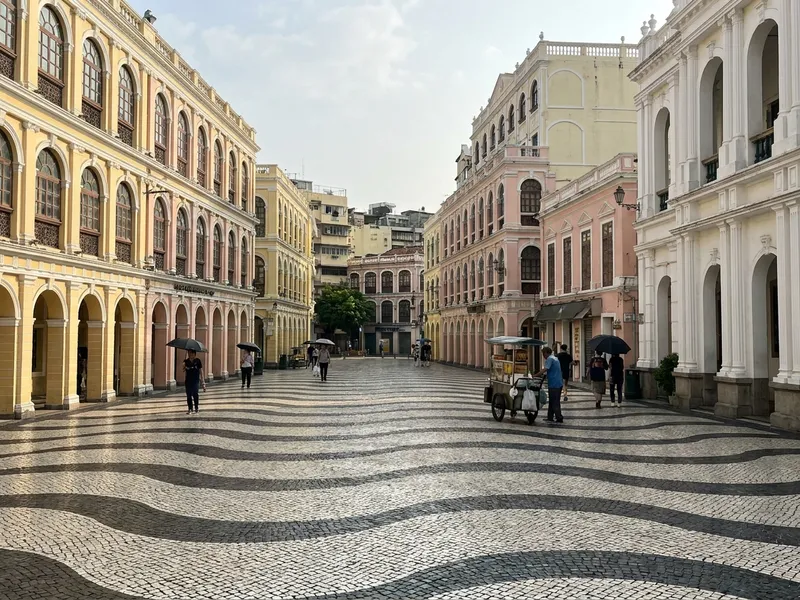
Senado Square (議事亭前地) has been Macao's civic heart since the 16th century, when Portuguese officials gathered here to conduct administration. The square is paved in a distinctive Portuguese wave-patterned calçada of black and cream cobblestones laid in the 1990s restoration, a design imported directly from Lisbon. Surrounding it are some of Macao's best-preserved colonial facades painted in pale yellow, salmon, and mint green — including the Holy House of Mercy (Santa Casa da Misericórdia, 1569), the yellow Senate building, and the neoclassical Loyal Senate. The pastel palette is a deliberate Portuguese colonial style imported from Macau, Goa, and Bahia, and the area is fully pedestrianized except for emergency vehicles. Photographers should arrive at sunrise, when the soft light hits the pastel walls and the square is empty except for elderly residents practicing tai chi.
Why is A-Ma Temple the oldest and most important in Macao?
A-Ma Temple (媽閣廟) sits on the southwestern tip of the Macao peninsula and predates the city itself — it was already established by 1488, more than 60 years before Portuguese ships arrived in 1557. The temple is dedicated to the sea goddess Mazu (Tin Hau), worshipped by southern Chinese and Fujianese sailors for safe passage, and its name is the source of the word "Macao" (the Portuguese rendering of 媽閣, "A-Ma's bay"). Visitors climb a series of incense-scented stone pavilions up the hillside, the highest of which dates to 1605 and contains a Ming-dynasty stone carving. The temple is free, open most of the day, and a 10-minute walk from Senado Square, but is a world apart in atmosphere — incense smoke, fortune sticks, and stone carvings of Chinese junks instead of Portuguese stonework. It is the only remaining active temple in Macao that long predates colonial rule.
What is there to see on the Cotai Strip beyond the casinos?
The Cotai Strip is a 5-kilometre strip of reclaimed land between Taipa and Coloane that opened with The Venetian in 2007 and now houses 7 of the world's 10 largest casinos by gaming floor area. The Venetian Macao (550,000 sq ft gaming floor) has a full-scale recreation of Venice's Grand Canal with indoor gondola rides, painted ceilings, and St. Mark's Square replicas. The Parisian Macao has a half-scale Eiffel Tower with an observation deck on the 7th and 37th floors. Studio City features a 4D Batman dark ride, the Golden Reel figure-8 Ferris wheel, and the Warner Bros. Fun Zone. Wynn Palace operates the free cable car "SkyCab" and the famous Performance Lake with choreographed fire and water shows every 20 minutes. MGM Cotai has the immersive "Spectacle" atrium and Asia's largest LED-covered roof. Most properties are connected by elevated walkways, so you can walk the Strip without stepping outside.
What is Taipa Village and what should I eat there?
Taipa Village is the original township of Taipa, preserved beneath the Cotai Strip's mega-resorts. Its narrow lanes of low pastel houses house some of Macao's most authentic Macanese restaurants and snack shops. Must-eat spots include Tai Lei Loi Kei (the inventor of the pork chop bun 豬扒包), Mok Yi Kei for durian- and mango-based durian ice cream, Pastelaria Fong Kei for Portuguese-style pastries, and Koi Kei Bakery for the chain's almond cookies and pork jerky. The village also has the Taipa Houses-Museum, a cluster of green Portuguese villas from the 1920s. Evening is best: most shops open late and the lanes are lit by old shop signs. Pair the walk with a Portuguese wine at one of the wine bars in the back lanes, and finish at the historic Pou Tai Temple across from the village square.
Is Coloane Village worth a half-day trip from central Macao?
Yes — Coloane Village (路環村) is the most relaxed corner of Macao, and the terminus of the Cotai Strip's bus 26A or 25 from the ferry terminal takes about 40 minutes. The village's pastel houses cluster around leafy Senhor do Mato Square, where the 1632 Chapel of St. Francis Xavier houses a relic of the saint and a 17th-century image of the Virgin. A short walk leads to Lord Stow's Bakery (the original 1989 Portuguese egg tart shop) and to Hac Sa Beach, a black-sand volcanic beach that is Macao's largest natural beach. Seafood restaurants line the beachfront, including Fernando's, a Portuguese-Macanese institution open since 1986. The Macao Giant Panda Pavilion, which houses giant pandas gifted from the mainland, is also on Coloane and free. The pace is slow, the air smells of eucalyptus, and the only "noise" is the call of the resident peacocks.
What can I do at Macao Tower besides eat in the revolving restaurant?
Macao Tower (澳門旅遊塔) is a 338-metre concrete observation and telecommunications spire on the Macao peninsula waterfront, opened in 2001. The 58th-floor observation deck (MOP 145) has glass floors and outdoor viewing platforms with views on clear days to the Pearl River Delta. The 60th-floor 360° Café rotates once per hour, and the 62nd-floor dome houses an Italian restaurant. The tower is best known for the AJ Hackett bungee jump from the 61st floor — at 233 metres it is one of the highest commercial bungee jumps in the world, with optional sky-dive, tower climb, and "mega drop" vertical-zip experiences. Even non-jumpers can do the outdoor Skywalk on a harness along the tower's exterior rim. Sunset visits are most popular; book bungee and Skywalk slots online at least 48 hours in advance during weekends and holidays.
Do I need a separate visa for Macao or is the China visa enough?
Macao operates a fully separate immigration system from mainland China, and almost all visitors need either a Macao visa or a separate visa-free entry. Most Western passport holders (US, UK, EU, Canada, Australia, NZ, Japan, South Korea) get visa-free entry for 30 days, distinct from the mainland's 30-day or 10-day transit schemes. Mainland Chinese residents need a Home Return Permit (回鄉證) and a separate Macao "Exit-Entry Permit" (往來港澳通行證) plus an endorsed visit visa. Hong Kong and Taiwan residents can enter on their existing ID or Mainland Travel Permit. Crucially, a mainland China tourist visa (L) does NOT cover Macao, and a Macao entry does NOT cover the mainland. Plan your visas in advance, count the days separately, and confirm the latest rules with the Macao Immigration Services Public Relations Office before you book flights.
How does the MOP and HKD currency situation work in practice?
Macao's official currency is the Macanese pataca (MOP), but the Hong Kong dollar (HKD) circulates freely and is accepted almost everywhere at 1:1. The peg is roughly 1 HKD = 1.03 MOP and 1 MOP = 0.97 HKD — a near-parity that has held since 1983. Most tourist prices are quoted in "MOP/HKD" interchangeably, and many shops give change in HKD even when you pay in MOP. The best-value strategy is to withdraw MOP from a Banco Nacional Ultramarino (BNU), Bank of China, or Hang Seng ATM on arrival — MOP is slightly preferred at small food stalls and gives you 2–3% better value. Macau Pass is a rechargeable Octopus-style card accepted on buses and many small shops, refundable at the airport on departure.
What is azulejo and where can I see it in Macao?
Azulejo is the well-known blue-and-white tin-glazed ceramic tile that covers the facades, churches, and palaces of Portugal and her former colonies. Macao is the only place in China with a centuries-old azulejo tradition, brought by Portuguese missionaries and merchants from the 16th century onwards. The best preserved in-situ examples are the blue-and-white tile panels in the cloister of St. Dominic's Church, the green-and-white tile fountain at the entrance to Senado Square, and the panels inside the Museum of Macau depicting historical Macao scenes. The Ruins of St. Paul's crypt also features hand-painted azulejo panels of Jesuit saints, a unique fusion of Portuguese and East Asian iconography. Authentic azulejo tiles and azulejo-patterned souvenirs are sold in shops along the Historic Centre; the Macao Museum Shop near the Mount Fortress stocks high-quality reproductions.
How did 400 years of Portuguese-Chinese contact create Macanese food?
Macanese cuisine is the only fusion cuisine in the world with a continuous 400-year written record, dating to the 1557 founding of Macao as a Portuguese trading post. Portuguese settlers brought ingredients that did not exist in China — olive oil, bacalhau (salt cod), chouriço (smoked sausage), piri-piri chili, tomatoes, and potatoes — and married them with Chinese pantry staples of soy, ginger, scallion, five-spice, and oyster sauce. Signature dishes born of this marriage include African chicken (coconut-curry roast chicken, invented in Macao in 1946), minchi (ground pork and beef with potato and soy), pork chop bun (a Portuguese bread roll with Cantonese-style fried pork chop), and the Portuguese egg tart (a 1989 reinterpretation of the pastel de nata). Restaurants like Restaurante Espaco Lisboa, Riquexo, and Lai Heen keep the tradition alive with multi-course Macanese tasting menus; the Macao Government Tourist Office publishes an annual Macanese Food Festival guide in November.
How do I get to Macao from Hong Kong or Zhuhai?
Three main options connect Macao with the surrounding region. TurboJET and Cotai Water Jet ferries run from Hong Kong's Sheung Wan and Hong Kong-Macau Ferry Terminal to Macao's Macau Outer Harbour Ferry Terminal or the Cotai Ferry Terminal every 15–30 minutes, with 55–60 minute crossings and fares around HKD 200–220 economy. From Zhuhai, the Hong Kong–Zhuhai–Macao Bridge (HZMB) bus from the Zhuhai Port runs to Macao's Border Gate in roughly 35 minutes for about CNY 60, an easy option for those already in the Pearl River Delta. From Guangzhou, direct buses from the Tianhe or Pazhou long-distance bus stations run 2.5–3 hours to Macao for CNY 80–120. From the Macao International Airport, direct flights connect with most major East and Southeast Asian cities, and there is no high-speed rail station; the closest HSR is at Zhuhai North, with onward HZMB bus transfers to Macao.
What is the best month to visit Macao and what about typhoons?
October through December is the consensus best window: average highs drop to a comfortable 22–26°C, humidity falls to 60–70%, rainfall drops below 50 mm per month, and typhoon activity ends. March to May is also pleasant but increasingly humid (75–85%). Avoid July to September, when tropical cyclones are statistically 1–2 events per month, the Hong Kong Observatory raises Signal 8 or above 4–6 times per season, and ferries to Hong Kong, HZMB buses, and outdoor attractions can be suspended for 24–72 hours at a stretch. The Macao Grand Prix in mid-November is exciting but books hotels months ahead and raises prices 30–50%. Chinese New Year (late January or February) brings lion dances and fireworks but is the most crowded week. Pack a light jacket for December–February evenings, when lows drop to 12–15°C.
Should I take a day trip from Macao to Zhuhai or the other way around?
Yes — Macao and Zhuhai are best visited as a pair, because the border between them is the HZMB bridge or the short Gongbei–Portas do Cerco crossing. From Macao, the cheap option is a 15-minute walk across the Border Gate to Gongbei in Zhuhai, where the underground Gongbei Market is famous for knockoff goods and the Lovers' Road waterfront leads to the well-known Fisher Girl statue. From Zhuhai, the Chimelong Ocean Kingdom (rated Asia's top theme park) and the Hengqin Chinese Nationalist-era Presidential Palace replica are both within 30 minutes. A typical day trip is Macao in the morning (Senado Square, egg tarts, lunch) and Zhuhai in the afternoon, or the reverse. Note that you still pass through Macao immigration twice and need a valid Macao entry permit, even if you only stay a few hours.
Is a day trip from Hong Kong to Macao worth it or should I stay overnight?
A day trip from Hong Kong works for first-time visitors with limited time, but an overnight stay is significantly better. The TurboJET and Cotai Water Jet ferries from Sheung Wan take 55–60 minutes one-way, leaving roughly 7–8 hours of sightseeing in Macao if you catch the 8 AM ferry and the 8 PM return. That is just enough for the Historic Centre (Ruins of St. Paul's, Senado Square, A-Ma Temple) and one Cotai Strip casino. An overnight stay lets you add the Cotai Strip at night, the Macao Tower sunset, the Macao Grand Prix Museum, and Coloane Village — none of which fit a day trip. Many travelers book one night at The Venetian or Studio City for the "stay-and-gamble" experience, since overnight rates often include a free ferry upgrade and a MOP 200 dining credit. Combining the two cities over 2 nights in Macao plus 3 nights in Hong Kong is a classic itinerary.
What does a perfect three-day Macao itinerary look like?
A three-day Macao itinerary covers the city at a relaxed pace. Day 1 begins with a 9 AM walk through the Historic Centre: Senado Square, the pastel colonial facades, Holy House of Mercy, the Mount Fortress ramparts, and the Ruins of St. Paul's (best photographed before 11 AM crowds). Lunch at Restaurante Espaco Lisboa for authentic Macanese food, then descend to the waterfront and the A-Ma Temple. Late afternoon: ferry to the Macau Outer Harbour and a free shuttle to a Cotai Strip hotel. Day 2 starts with the Cotai Strip walking tour — Venetian (Grand Canal gondola), Parisian (Eiffel Tower), MGM Cotai (Spectacle atrium), Wynn Palace (Performance Lake), and Studio City (Golden Reel Ferris wheel) — with a House of Dancing Water show in the evening. Day 3 is dedicated to Coloane Village: morning Lord Stow's egg tarts, a hike to the Chapel of St. Francis Xavier, lunch at Fernando's on Hac Sa Beach, and the Macao Giant Panda Pavilion. End with a sunset Macao Tower bungee jump or Skywalk and a Macanese dinner at Riquexo. This itinerary covers UNESCO landmarks, Macanese cuisine, Cotai entertainment, and Coloane relaxation without rushing.
What are the best neighborhoods to explore beyond the Historic Centre?
Beyond the Historic Centre, Macao has four distinct neighborhoods worth at least a half-day each. Taipa Village is the original township of Taipa before the Cotai Strip, packed with low pastel houses, Macanese restaurants (Tai Lei Loi Kei for the pork chop bun, Mok Yi Kei for durian ice cream), and the Taipa Houses-Museum. Coloane Village on the southern tip of Coloane is the most relaxed, with the 1632 Chapel of St. Francis Xavier, Lord Stow's Bakery, Hac Sa Beach, and a handful of peacock-strutting squares. The Inner Harbour district (內港) on the western peninsula is the traditional Chinese working harbor with floating restaurants, the Lin Kai Temple, and the Fai Chi Kei herbal medicine street. The Macau Outer Harbour area is modern, with the Macao Science Centre, the Macao Grand Prix Museum, and the Kun Iam Statue facing the Pearl River. Each neighborhood has its own micro-culture and food specialties, and most are reachable by bus or free casino shuttle.
What is there to do in Macao at night besides the casinos?
Macao at night is not just the casinos — the city has a varied evening scene. The Cotai Strip comes alive after dark with the Wynn Palace Performance Lake show (every 20–30 minutes), the Parisian's Eiffel Tower light show, the Studio City Golden Reel Ferris wheel lit in neon, and the MGM Cotai Spectacle atrium. The House of Dancing Water (8 PM most nights at City of Dreams) is a 90-minute aquatic stage spectacular. Rua de São Paulo and the Senado Square lanes host a lively night crowd at the 7 Days Inn bar district and the SOHO Macao area near the Outer Harbour. The Macao Tower bungee jump is open until 9 PM, and the 360° Café rotates dinner above the city. For something quieter, the A-Ma Temple and the Mandarin's House are atmospheric after dark, and the historic Largo do Senado fountain is beautifully lit. Most restaurants serve until 10–11 PM, and the street food stalls near the Border Gate are open until 1 AM.
What is the history of Macao from 1557 to the 1999 handover?
Macao was leased to Portugal in 1557 as a trading post for the China-Japan-Europe trade, after the Portuguese had previously been expelled from other Chinese ports. For the first 250 years it was the dominant European entrepôt in East Asia, controlling the silk, porcelain, and tea trade until the rise of Hong Kong in the 1840s. The 1887 Sino-Portuguese Treaty of Friendship and Trade made the territory a perpetual colony of Portugal rather than a leased territory. During WWII Macao declared neutrality and became a rare haven for refugees from occupied China and Hong Kong, with the population swelling to half a million. The 1966 leftist riots against the Portuguese administration killed 8 and wounded 200, accelerating Lisbon's push for decolonization. In 1987 the Sino-Portuguese Joint Declaration set the 1999 handover, and on 20 December 1999 Macao was returned to China as a Special Administrative Region under "one country, two systems". The handover was widely seen as smoother than Hong Kong's 1997 transition, and Macao today retains its own currency, immigration, legal code, and 50-year guarantee of unchanged economic and administrative systems.
What cultural events and festivals should I time my trip around?
Macao has one of the densest cultural event calendars of any city in Asia. The Macao International Music Festival runs for two weeks in October at the Macao Cultural Centre, with international symphony and jazz acts from MOP 100. The Macao Food Festival in mid-November sets up a 100+ stall night market at the Sai Van Lake Square, with MOP 100 entry plus food vouchers. The Macao Grand Prix in mid-November is the city's signature event, with the F3 and GT races along the 6.2 km Guia street circuit. Chinese New Year (late January or February) brings dragon dances, fireworks, and a public holiday. The A-Ma Cultural and Tourism Festival in March celebrates the sea goddess Mazu. The Macao Arts Festival in March–May features theater, dance, and music at multiple venues. The Feast of St. Anthony in June is celebrated in Coloane. The Macao Light Festival in December illuminates the city's historic facades after dark. Most of these events are free or under MOP 200, and they double the cultural value of a regular sightseeing trip.
How should I plan a family trip to Macao with kids of all ages?
Macao is an excellent family destination, with compact distances and a high density of kid-friendly attractions. Studio City's Warner Bros. Fun Zone (4D Batman dark ride, Looney Tunes area) and the Golden Reel figure-8 Ferris wheel are the most kid-focused. The Parisian Macao's half-scale Eiffel Tower observation deck has kid-height viewing windows. The Venetian's Grand Canal gondola ride is magical for ages 3–10. The House of Dancing Water (90 minutes) and the CotaiArena concerts draw school-age children. The Macao Giant Panda Pavilion on Coloane is a free hit for animal-lovers. The Macao Grand Prix Museum has hands-on racing simulators. The Macao Science Centre near the Outer Harbour has 14 interactive galleries and a planetarium. For a slower day, Coloane's Hac Sa Beach and the Lord Stow's egg tart queue work for all ages. Most Cotai hotels have kids' pools and supervised kids' clubs (Studio City's Kids' City is the best). The compact 33 km² geography keeps taxi and bus rides under 30 minutes between any two points, and the free casino shuttle network is the cheapest way to cover the city.
What is the Macao culinary scene beyond Macanese fusion?
Macao's dining scene is far more diverse than its Macanese reputation suggests. Portuguese tascas (small family restaurants) are concentrated in Taipa Village and Coloane, with long-running Espaco Lisboa, Riquexo, O Castiço, and Fernando's on Hac Sa Beach. Cantonese seafood restaurants line the Inner Harbour, with Michelin-starred Lai Heen at the Ritz-Carlton and the historic Fat Siu Lau (founded 1903, the oldest restaurant in Macao, famous for its Portuguese-style roast pigeon). International fine dining includes the 3-Michelin-starred Jade Dragon at Galaxy, the 2-star Sichuan Court at MGM Cotai, and Robuchon au Dôme at the Grand Lisboa, the only French restaurant in the world to have held 3 Michelin stars for over a decade. Japanese omakase, Korean BBQ, and Thai fine dining are clustered in the Cotai mega-malls. The StarWorld Hotel's Tatami Room has long been a Macao institution for Japanese cuisine. For street food, the Senado Square lanes and the Rua da Felicidade (Happiness Street) host dozens of stalls selling claypot rice, beef offal, fish balls, and egg waffles well into the night. Book Michelin restaurants 2–4 weeks in advance, especially for weekend dinners.
How does Macao's transport network work in detail?
Macao's transport network is small but efficient, with three free shuttle networks, a public bus system, taxis, and walking. Public buses are run by TCM (Transmac) and Reolian, with single rides at MOP 6 paid exact change or via the rechargeable Macau Pass card (MOP 30 initial fee, MOP 100 stored value). Most routes run 6 AM to midnight, with night buses (N1–N6) on the main corridors until 1 AM. The free casino shuttle network is the city's most useful transport: every major Cotai and Peninsula hotel runs shuttles from the ferry terminals, the airport, and the border gates every 10–20 minutes, with no eligibility requirement. Taxis are metered (MOP 17 flagfall, MOP 2 per 260 m after), with a 20% surcharge from Taipa to the Peninsula and vice versa. Uber and Didi are unavailable; local apps like Macau Taxi Call work for phone bookings. Walking is feasible across the Peninsula (3 × 8 km) and Taipa, but the Cotai Strip is best done on the elevated skyway system. The LRT (Light Rail Transit) Macao-Taipa line opened in December 2019, running 12 km from the Border Gate to the Ocean Park station, with a Taipa–Coloane extension under construction.
What should I know about gambling in Macao as a first-timer?
Macao's gambling industry generated USD 36+ billion in gaming revenue in 2023, more than 5x the Las Vegas Strip. The city is the world's largest casino market by far, and the gaming floors of The Venetian, MGM Macau, Galaxy, and Studio City dwarf anything in the US. Entry to gaming floors is open to anyone 21+ with photo ID at the door; the casino asks for ID but does not run a credit check. Table minimums at the mass-market floors are typically HKD 100–500 (about USD 13–65), and high-roller VIP rooms demand HKD 10,000+ minimums. Baccarat dominates the floor (it is the most popular game in Asia), followed by Sic Bo, Fan Tan, and Pai Gow. Dealers speak Cantonese, Mandarin, and English at the major floors. Macao has strict no-photography rules on the gaming floor; security will escort violators out. Smoke-free gaming lounges are required by 2019 law on all main floors. For first-timers, plan to walk the gaming floor, sit at a baccarat table with a HKD 200 budget, and tip dealers with HKD 20–50 chips. Set a firm loss limit before you start and stick to it; the high-roller rooms are not for casual visitors.
What are the best Macao shopping districts and what do they specialize in?
Macao's shopping falls into three distinct districts. The Cotai Strip mega-malls (Shoppes at Venetian, Shoppes at Parisian, The Londoner Mall, Galaxy Promenade) are the luxury hubs, with global brands at duty-free prices — typically 5–15% cheaper than Hong Kong and 20–30% cheaper than mainland China for cosmetics, watches, and leather goods. The Senado Square and Rua de São Paulo pedestrian streets are the souvenir district, with Koi Kei, Choi Heong Yuen, and dozens of small shops selling almond cookies, pork jerky, Portuguese wine, Macanese chili oil, and azulejo tiles. The Inner Harbour district (Rua de Cinco de Outubro and the Red Market area) is the local market, with the Fai Chi Kei dried-seafood street, the Iao Hon market, and traditional Chinese herbal medicine shops. The Broadway Macao, across from Galaxy, is a smaller mall focused on street food and mid-range brands. For authentic Macao design, the Macao Museum Shop near the Mount Fortress stocks reproduction azulejo tiles and Macanese-themed prints, and the Jockey Club Boutique at the Macao Jockey Club (horse racing is the only legal betting outside casinos) sells racing memorabilia.
What is the Macao cultural scene like beyond the casinos?
Macao has a quietly vibrant cultural scene centered on its 1999 handover-era investment in Portuguese-Lusophone ties. The Macao Cultural Centre (CCM) on the Outer Harbour waterfront is the city's main performing arts venue, hosting the Macao International Music Festival in October and the Macao Arts Festival in March–May. The Macao Museum of Art (next door, free admission) holds rotating exhibitions of Chinese calligraphy, contemporary Chinese painting, and Macao historical artifacts. The Museum of Macau, on the Mount Fortress ramparts, is the best single introduction to the city's 450-year history. The Tap Seac Gallery in the historic district showcases contemporary art, often with Portuguese-Lusophone themes. The Creative Macau center in the Inner Harbour district hosts small gallery shows, design pop-ups, and a co-working space. Macao's annual Macao Arts Festival in March brings international theater, dance, and music to the city's squares and historic buildings, and the Macao Literary Festival in March features English-language panels with international authors. The historic Holy House of Mercy (Santa Casa da Misericórdia, 1569) also has a small museum of Christian and Chinese religious art.
What is the Macao International Airport (MFM) and how do I fly in?
Macao International Airport (MFM) sits on an artificial island in the Pearl River Delta, connected to Taipa by two road bridges. It opened in 1995 and now serves 30+ airlines flying to 60+ destinations, including mainland China, Hong Kong, Taiwan, Southeast Asia, Japan, South Korea, and a growing list of long-haul routes. Direct flights connect to most major East and Southeast Asian cities — Beijing, Shanghai, Bangkok, Singapore, Tokyo, Seoul, Manila, Kuala Lumpur, Jakarta, Taipei — and to a handful of long-haul destinations (Helsinki, London Gatwick on charter operators, and seasonal Sydney/Melbourne). Budget carriers AirAsia, Cebu Pacific, and Spring Airlines have the densest regional coverage. The airport has a small but modern terminal with free Wi-Fi, decent food, and a Macau Pass top-up kiosk. From the airport, free casino shuttles run to the Cotai Strip, the AP1 public bus connects to the Peninsula for MOP 6, and a taxi to central Macao is MOP 80–120 (15–20 minutes). For travelers coming from further afield, most route via Hong Kong, Guangzhou Baiyun, or Shenzhen Bao'an and connect onward by ferry, HZMB bus, or high-speed rail.
What are the most photogenic spots in Macao for content creators?
Macao is one of the most photogenic cities in Asia, with European colonial architecture, Chinese temples, and modern mega-resorts within a single frame. The top photography locations: (1) the Ruins of St. Paul's facade at sunrise (around 6:30 AM in summer) is the most well-known shot, with the side staircase free of crowds and the soft light hitting the carved granite. (2) Senado Square's Portuguese wave-patterned cobblestones with the yellow Santa Casa da Misericordia in the background, best at 8 AM before the tourist buses. (3) The A-Ma Temple incense spiral on the highest terrace, where the red temple frames the Pearl River. (4) Coloane Village's pastel houses at golden hour, with the 1632 Chapel of St. Francis Xavier as backdrop. (5) The Parisian Macao's half-scale Eiffel Tower from the Cotai Strip walkway at night, lit in pink and gold. (6) The Venetian Macao's Grand Canal indoor gondola ride under a painted ceiling. (7) Macao Tower at sunset from the waterfront. (8) The Wynn Palace Performance Lake at night with the cable car lights. (9) Rua do Cunha (Taipa Village main street) at dusk with the macanese lanterns. (10) The view of Macao from the Guia Hill Lighthouse at night, when the whole peninsula glitters. Most of these are free and walkable.
How does Macao differ from Hong Kong as a travel destination?
Macao and Hong Kong are often compared as the "two SARs", but the experience of each is strikingly different. Hong Kong is a vertical city of 7+ million people with a globally dominant finance, shipping, and Cantonese culture, while Macao is a smaller city of 680,000 with a Portuguese-Chinese heritage and a global gaming industry. Hong Kong is a hiking and food destination (the Peak, Victoria Harbour, dim sum, the Star Ferry, Lantau Island), while Macao is a heritage and casino destination (UNESCO Historic Centre, Cotai Strip, Macanese cuisine). Hong Kong's pace is faster, its districts more diverse, and its public transport system (MTR) more extensive. Macao's pace is slower, the streets more European, the local food more singular. The HKD/MOP peg means both cities run on nearly the same currency, but Macao is generally 10–20% cheaper for hotels, food, and transport. Most first-time visitors to both cities do 3–4 nights in Hong Kong and 2 nights in Macao, with the TurboJET ferry (55 minutes) or HZMB bus (90 minutes) connecting the two. Both are also great starting points for trips to the mainland via the HZMB bridge to Zhuhai.
What is the LRT and how useful is it for tourists?
The Macau Light Rail Transit (LRT) is a 12-km automated light metro line connecting the Barrier Gate checkpoint through Cotai to the Taipa Ferry Terminal and the airport. It opened in December 2019, with a Taipa-to-Coloane extension under construction. The LRT is useful for a few specific tourist routes: (1) from the Border Gate to the Cotai Strip via the Lotus Bridge station, then a short walk or shuttle to a casino. (2) From the Outer Harbour ferry terminal area (Marina station) to the airport via Taipa Ferry Terminal and Cotai Strip stations. (3) For an elevated view of Taipa Village, the Taipa Ferry station connects to the Cotai Strip's mega-resorts. A single ride is MOP 6–12, payable with the Macau Pass or a one-time token. The LRT is clean, on-time, and air-conditioned, but for most tourist routes the free casino shuttle buses are still faster and more direct. The LRT's strongest use case is getting from the airport to the Cotai Strip without waiting for a casino shuttle, and the future Hengqin extension will link to the mainland HSR network at Zhuhai North.
What should I know about Macao's Portuguese-language heritage today?
Portuguese is one of Macao's two official languages (the other being Chinese, with Cantonese as the everyday spoken tongue), and it is heard in court, on government signage, and in the bilingual Portuguese-Chinese street names. The Portuguese-descended community is small — roughly 1–2% of the 680,000 population — but culturally significant. The Macanese (土生葡人) are an integrated Eurasian community with centuries of mixed Portuguese-Chinese ancestry, and they continue to keep the Macanese language (Patuá, a Portuguese-Cantonese creole), Macanese cuisine, and Catholic traditions alive. Key Portuguese-language sites in Macao include the Holy House of Mercy, the Museum of Macau, the Luís de Camões Garden (named for Portugal's national poet), the Tap Seac Square, and the Santa Sancha Palace (former residence of the Governor, now a hotel). The Macao Portuguese School and the University of Macau's Portuguese language programs keep the language active, and the Macao government's translating service makes it easy for Portuguese speakers to navigate official processes. The Macao government also runs an active "Lusophone" outreach to Portuguese-speaking countries (Brazil, Angola, Mozambique), which brings regular trade and cultural missions to the city.
What is the Macao-Mainland China relationship and what can I do on the mainland from here?
Macao and the mainland operate under the "one country, two systems" framework, with Macao retaining its own currency, immigration, legal code, and economic system for 50 years from the 1999 handover. The relationship is increasingly tight economically: roughly 60% of Macao's visitors are mainland Chinese, and a third of Macao residents cross the border daily for work or shopping. For tourists, the most popular mainland day trips from Macao are Zhuhai (15-minute walk across the Border Gate), Zhongshan (1-hour bus via the HZMB), and Guangzhou (2.5-hour bus or HZMB + high-speed rail). The Hong Kong–Zhuhai–Macao Bridge (HZMB), which opened in 2018, is the longest sea-crossing bridge in the world at 55 km, with Macao-side immigration in the artificial island of Hengqin. From Hengqin, the Hengqin High-Speed Rail station connects to the mainland HSR network, with trains to Guangzhou South in 1 hour, to Shenzhen North in 1.5 hours, and to Beijing West in 8 hours. Mainland visas are separate from Macao entry and must be arranged in advance; the Macao SAR Travel Permit scheme (for mainland residents) is unrelated to the foreign-visa scheme.
What is the Macao Weather Bureau's signal system and how does it affect travel?
The Macao Meteorological and Geophysical Bureau (SMG) uses a typhoon warning system that mirrors Hong Kong's, with five ascending signal levels. Signal 1 (Standby) is a tropical cyclone within 800 km; ferry services to Hong Kong may reduce frequency. Signal 3 (Strong Wind) is sustained winds of 41–62 km/h; outdoor attractions may close. Signal 8 (Gale Force) is sustained winds of 63–117 km/h; almost all ferries to Hong Kong stop, public bus service is suspended, the HZMB bridge closes to buses, schools close, and many businesses shut. Signal 9 (Increasing Gale) and Signal 10 (Hurricane) trigger full city shutdown. Macao has had 2–4 Signal 8+ events per year in the past decade, and they typically last 12–48 hours. The SMG issues a "Cold Weather" warning (yellow, orange, red) when temperatures fall below 12°C, and a "Very Hot" warning (yellow, orange) at 32°C+. Macao also has a rainstorm warning system (yellow, red, black). Travelers in Macao during typhoon season (July–September) should monitor the SMG website, the Macao News app, and the MGTO's Macao Weather portal; have a 24-hour backup plan in case of ferry or airport shutdown.
What is the Mandarin's House and why is it a UNESCO site?
The Mandarin's House (盧家大屋) is a 19th-century Chinese courtyard residence in the heart of the Macao peninsula, off the Senado Square pedestrian street. Built in 1869 by the wealthy Lou family, it is one of the largest and best-preserved traditional Chinese mansions in Macao, with more than 60 rooms arranged around a series of courtyards. The Mandarin's House was added to the UNESCO Historic Centre of Macao World Heritage Site in 2005, alongside the Ruins of St. Paul's and Senado Square, as a unique example of late-Qing architecture. The mansion's features include hand-carved wooden beams, ceramic mosaics in the inner walls, traditional moon gates, and a quiet inner garden. Restoration was completed in 2002 and the house is open to visitors free of charge. The Mandarin's House is a 5-minute walk from Senado Square, and the typical visit takes 30–45 minutes. The narrow Rua de São Paulo lane leading to it is itself a UNESCO-listed heritage street, with the pastel-painted facades of the Holy House of Mercy and the Old Protestant Cemetery as neighbors.
What is the Senado Square wave-patterned cobblestone paving and where can I see it?
The black-and-cream wave pattern at Senado Square is a Portuguese-style calçada portuguesa, hand-laid in the 1990s restoration of the square. The technique originated in Lisbon in the 1840s and was brought to all Portuguese colonies, including Macao, Brazil, and Mozambique. The wave design symbolizes the sea voyages that connected Portugal to its trading posts, and the pattern is now a protected cultural heritage feature. Beyond Senado Square, the same calçada technique can be seen at the entrance of the Ruins of St. Paul's, the Avenida da Praia in Taipa Village, the Largo do Lilau square near A-Ma Temple, and parts of the Inner Harbour waterfront. The craftsmanship is painstaking — each cobblestone is cut and placed by hand by specialist stonemasons, and the patterns are typically commissioned from Portugal or Brazil. The Senado Square restoration was carried out in 1992–1993, and the area is now a pedestrian-only zone. Walking the cobblestones in flat shoes is the best way to appreciate the detail; high heels are uncomfortable on the bumpy surface.
What is the Macao Grand Prix and is it worth planning a trip around?
The Macau Grand Prix is one of the world's most historic street circuits, first run in 1954, and the only F1-equivalent race on public city streets. Held annually in mid-November, the race weekend combines the FIA F3 World Cup, the FIA GT World Cup, the WTCR (now TCR) touring car race, and the legendary motorcycle Grand Prix, all on the 6.2 km Guia street circuit that winds through the Macao Peninsula's hills. Spectators can watch from free general admission hill-side bleachers (Tamagnini Barbosa grandstand, Reservado grandstand) or paid grandstands (MOP 200–2,000). The event draws 100,000+ visitors over the weekend, hotels book 6+ months ahead, and rates triple. Outside race weekend, the Macao Grand Prix Museum near the Outer Harbour Ferry Terminal is open year-round, with 80+ historic race cars, Ayrton Senna's 1983 winning F3 car, and racing simulators. Even if you cannot time your trip to the race, the museum is a worth visiting for motorsport fans.
What is the Macao Light Festival and when does it take place?
The Macao Light Festival is an annual 3-week outdoor lighting and projection mapping festival held in December, organized by the Macao Government Tourism Office. Major historic buildings across the peninsula (Senado Square, the Ruins of St. Paul's facade, the A-Ma Temple waterfront, the Mandarin's House, the Mount Fortress ramparts) are illuminated with light shows, projection mapping, and LED installations. Entry is free, and the festival runs nightly from 7 PM to 10 PM. Past festivals have included Portuguese fado music performances, lantern-making workshops, and Macanese food stalls. The festival is a popular time to visit Macao, as it coincides with the cooler dry season. The full schedule is published on the MGTM website in October each year. For photographers, the 8 PM golden hour is the most atmospheric time. Pair the Light Festival with the Cotai Strip's Wynn Palace Performance Lake show and the Parisian Macao's Eiffel Tower nightly light show for a full evening of outdoor light entertainment.
What is the Macao Museum of Art and what does it hold?
The Macao Museum of Art (MAM) is the city's primary art museum, located on the Outer Harbour waterfront next to the Macao Cultural Centre, in a 5-story building completed in 1999. The permanent collection focuses on Chinese calligraphy, ink painting, and modern Chinese art, with a rotating international loan exhibition. Highlights include a 17th-century stone carving collection, a set of Macao-themed paintings by George Chinnery (the 19th-century British painter who lived in Macao from 1825 to 1852), and a dedicated Macao contemporary art floor. Admission is MOP 10, free on Sundays, and the museum is closed on Mondays. A typical visit takes 90 minutes. Combine a visit with the Macao Cultural Centre next door (which hosts international theater and dance), the Kun Iam Statue across the street, and the Macao Science Centre a 10-minute walk north. The museum shop sells high-quality art prints and Macanese-themed design objects, and the rooftop café has a view over the Pearl River.
What are the day-trip options from Macao to the mainland or Hong Kong?
Macao is well-positioned for day trips to three major destinations. Zhuhai is the easiest: a 15-minute walk across the Gongbei–Portas do Cerco border gate leads to the Gongbei Market (knockoff goods and Chinese snacks), the Lovers' Road waterfront (Fisher Girl statue, beach parks), and the New Yuanmingyuan Palace (a replica of Beijing's Summer Palace). The bus to Chimelong Ocean Kingdom in Hengqin takes 30 minutes, with Asia's largest aquarium. Zhongshan, the hometown of Sun Yat-sen, is a 1-hour HZMB bus ride: visit the Sun Yat-sen Memorial Hall, the Zhongshan Hot Springs resort, and the local dim sum restaurants. Guangzhou is 2.5 hours by HZMB bus plus HSR, with the Canton Tower, the Chen Clan Ancestral Hall, and the Beijing Road pedestrian street. The reverse direction: from Macao to Hong Kong, the TurboJET ferry takes 55–60 minutes to Tsim Sha Tsui or Central, leaving time for a half-day of Hong Kong sightseeing before the evening return.
What is the Macao-issued souvenir passport stamp and how do I get it?
The Macao Government Tourism Office runs a free "Passport Stamp" program that lets visitors collect a unique Macao stamp in their own passport, similar to the Japan tourist stamp books. Stamps are available at 16+ designated locations across the city, including the MGTM Information Counter at the ferry terminal, the airport, the Ruins of St. Paul's, the Mount Fortress Museum, the Mandarin's House, the A-Ma Temple, the Taipa Houses-Museum, the Coloane Lord Stow's Bakery, the Macao Tower, the Macao Grand Prix Museum, and the Macao Museum of Art. Each stamp is unique (a local landmark, a piece of Macanese cuisine, or a cultural symbol), and a completed booklet of 8+ stamps earns a free souvenir. The stamps are an under-the-radar way to remember your visit and to slow down at each landmark. Pick up the booklet at any MGTM counter.
What is the Macao Museum of Macau and is it worth visiting?
The Museum of Macau (澳門博物館) sits on the ramparts of the Mount Fortress, the 17th-century Portuguese military fort that overlooks the Macao Peninsula, a 10-minute walk uphill from the Ruins of St. Paul's. The museum opened in 1998, occupies three floors, and presents the history of Macao in chronological order from pre-Portuguese settlement through the 1999 handover and the present day. The first floor covers Macao's geography and early Chinese communities, the second floor documents the Portuguese colonial era with full-scale dioramas of a traditional Macanese home, a Portuguese street scene, and a Macanese wedding, and the third floor covers the post-1999 SAR era with multimedia displays on the gaming industry, urban development, and the "one country, two systems" framework. Admission is MOP 15, free on Sundays, and the museum is closed on Mondays. The viewing terrace on the third floor offers one of the best free panoramic views of the Macao peninsula. Plan 90 minutes, and combine it with the Mount Fortress rampart walk and the Ruins of St. Paul's in a single half-day.
How should I plan a Macao day for first-time visitors on a tight schedule?
A one-day Macao itinerary for first-time visitors packs the city's three UNESCO highlights and one Cotai experience. Start at 8:30 AM at Senado Square for the pastel colonial facades and the wave-patterned cobblestones before the tour buses arrive. Walk uphill to the Ruins of St. Paul's facade, then continue to the Mount Fortress and the Museum of Macau (allow 90 minutes total for the trio). Descend through the historic lanes to the A-Ma Temple by 11 AM, then lunch at a Macanese restaurant in Taipa Village (Tai Lei Loi Kei for the pork chop bun, or Riquexo for a tasting menu). Take the free Venetian or Parisian shuttle to the Cotai Strip at 2 PM, walk the Venetian's Grand Canal, climb the half-scale Eiffel Tower, and watch the Wynn Palace Performance Lake show. End with sunset at the Macao Tower (observation deck MOP 145) or, for the adventurous, the AJ Hackett bungee jump (book 48 hours ahead). Catch the 9 PM ferry back to Hong Kong. This itinerary fits a single long day and touches all of Macao's signature landmarks.
What is the Macao-China relationship in the post-1999 era and what has changed?
The post-1999 era in Macao has been widely described as a "smooth handover", in contrast to the friction in Hong Kong. Under the Basic Law (Macao's mini-constitution), the SAR retains its own currency (MOP), immigration system, legal code (still based on the Portuguese civil law tradition), press freedom, and economic system. The Macao government is led by the Chief Executive, who is appointed by an Election Committee and confirmed by Beijing. The Legislative Assembly has 33 seats, with 14 directly elected, 12 indirectly elected, and 7 appointed by the Chief Executive. The most visible changes since 1999 have been the rapid growth of the gaming industry (now 50%+ of GDP), the Cotai Strip's development from nothing to the world's largest casino cluster, the 2018 HZMB bridge connection, and the deepening mainland integration via the Hengqin cooperation zone. Mainland Chinese tourism is now the largest single market, with 60%+ of all visitors. Macao residents also benefit from a multi-entry mainland travel permit scheme, and the 2025–2029 Five-Year Plan focuses on economic diversification beyond gaming into finance, high-tech, and Portuguese-Lusophone trade.
What is the Macao passport and travel document status for residents?
Macao residents hold a separate Macao SAR Passport distinct from both the mainland Chinese and Portuguese passports, reflecting the territory's status under the "one country, two systems" framework. The Macao SAR Passport is one of the stronger travel documents in Asia, reflecting Macao's continued "one country, two systems" framework. Macao permanent residents are also entitled to the Macao SAR Travel Permit (回鄉證) for mainland China travel, which allows multiple-entry access without a separate visa. Mainland Chinese residents travelling to Macao use a different Macao Travel Permit (往來港澳通行證) with a pre-approved visit endorsement. The Macao government issues biometric Macao SAR Passports from the Identification Services Bureau (DSI) on the Outer Harbour, with renewal every 10 years for adults and 5 years for minors. Travellers should check the visa-free status of their passport for Macao separately from China's mainland rules, since the two are independent.
Top attractions
Ruins of St. Paul's (大三巴牌坊)
17th-century Portuguese cathedral facade, the most well-known Macao landmark. Free. Best photographed at sunrise before crowds.
Senado Square (议事亭前地)
UNESCO historic center with Portuguese wave-patterned cobblestones, colonial buildings, and pastel-colored shops. Free.
A-Ma Temple (妈阁庙)
500-year-old temple dedicated to the sea goddess Mazu. Macao's oldest temple, free. 10 minutes from Senado Square.
The Venetian Macao (澳门威尼斯人)
The world's largest casino (550,000 sq ft gaming floor) with a recreation of Venice's Grand Canal. Free entry; gambling ¥200+ minimum.
Coloane Village (路环村)
Charming former fishing village with Portuguese pastel houses, the famous Lord Stow's Bakery (egg tarts), and black sand beach. Free.
Macao Tower (澳门旅游塔)
338-metre observation and bungee-jump tower on the peninsula waterfront. Observation deck from MOP 145; the AJ Hackett bungee jump is among the highest commercial drops in the world at 233 m.
Problems travelers hit in Macao
- Why is my Alipay not working?You linked a foreign Visa or Mastercard to Alipay but every transaction is rejected at the merchant.
- My China visa was denied — what now?Your L visa application was refused at the Chinese consulate and your trip is in 2–4 weeks.
- My passport was lost or stolen in China — what do I do?Your passport is gone (theft or loss) and you're in mainland China without travel documents.
- Why can't I book on 12306 with my foreign card?You tried to book a high-speed rail ticket on 12306.cn and your foreign Visa/Mastercard is rejected at checkout.
- Why is my VPN not working in China?You arrived in China, opened your VPN, and it will not connect at all or connects but no traffic loads.
- Why can't I book a Tibet trip on my own?You try to book Lhasa flights and hotels yourself but the booking fails, or you're turned away at the Lhasa airport without a permit.
Book activities in Macao
These are licensed tour operators and booking platforms we've vetted independently. Booking through these links may earn us a commission — see our affiliate disclosure. This never affects our editorial recommendations or the price you pay.
Frequently asked questions
Do I need a visa for Macao?
What is the best egg tart in Macao?
Can I use HKD in Macao?
What is the Cotai Strip?
Is Macao safe?
Does Macao accept Chinese yuan (CNY)?
Show all 34 FAQs
How long is the ferry from Hong Kong to Macao?
Can I visit Macao and Hong Kong on the same visa exemption?
What is the Ruins of St. Paul's?
Are credit cards widely accepted in Macao?
What language do they speak in Macao?
Should I tip in Macao?
How long should I spend at the Ruins of St. Paul's?
What is the Macao Grand Prix Museum?
Can I walk from the ferry terminal to the Historic Centre?
What is the best way to get from Macao airport to my hotel?
Are there any beaches in Macao?
What is the House of Dancing Water show?
Is Macao expensive compared to Hong Kong?
What is the Senado Square wave-patterned cobblestone paving?
Is there a UNESCO World Heritage status for Macao?
What is the Macao Giant Panda Pavilion?
What are the best souvenirs from Macao?
Is the Macao Peninsula walkable end to end?
What is the difference between Macao, Macau, and Macau SAR?
Can I take a casino shuttle bus if I am not staying at the casino?
What is the Guia Lighthouse and is it worth visiting?
What is the Macao Pataca (MOP) and where do I get it?
Is there a Macao light show or nightly performance I should not miss?
What is the Taipa Houses-Museum?
Are there any night markets in Macao?
Can I drink tap water in Macao?
What is the Macao Science Centre?
What are the must-try street foods in Macao?
References

Related guides & destinations
Guide
Tipping in China 2026: What to Tip, What Not To, and the Awkward Middle
Tipping is not customary in mainland China. Tipping can sometimes be refused. In tourist areas, some restaurants and hotels add 10-15% servi
Guide
How We Research 2026: NihaoVisit’s Methodology for China Travel Information
How NihaoVisit sources, verifies, and maintains 700+ pages of China travel information — our source hierarchy, fact-checking process, update
Guide
Fact-Checking Log 2026: Verified China Travel Information — NihaoVisit
A public log of fact-checking verification passes on NihaoVisit, showing what was verified, when, and against which sources — covering visa
Guide
Best Time to Visit China 2026: Month-by-Month Weather, Crowds, and Prices
The best time to visit most of China is April–May and September–October. Winter (Dec–Feb) is cold but cheap; summer (Jun–Aug) is hot and cro
Guide
VPN for China 2026: Which VPNs Work, eSIM Alternatives, and the Complete Pre-Trip Checklist
Most Western apps and websites are blocked in mainland China. A reliable VPN is essential for Google, Gmail, WhatsApp, Instagram, and most n
Guide
China SIM Card and eSIM Guide 2026: Stay Connected Without WeChat
A Chinese SIM or eSIM lets you use mobile data, maps, and ride-hailing without WiFi. Here is how to get one, the cost, and which provider to