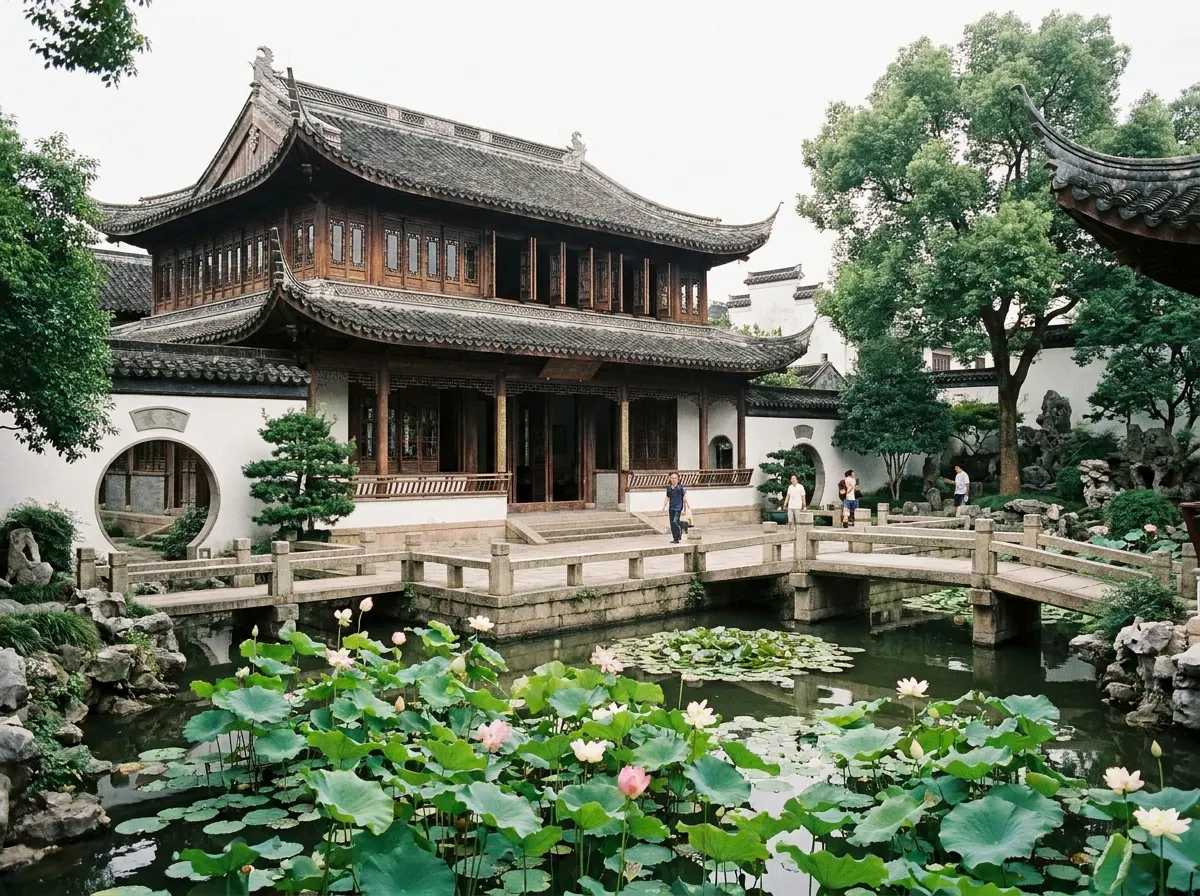
Ningbo
Ningbo (宁波, Níngbō) is a city of 9.5 million on the East China Sea coast of Zhejiang province, and one of China's most historically significant ports — this is where the Maritime Silk Road started, where Portuguese traders landed in the 16th century, and where the British forced open a treaty port in 1842. Today it is China's busiest port by cargo tonnage and a city that balances deep heritage with serious money. The headline draw is Tianyi Pavilion (天一阁, Tiānyī Gé), the oldest private library in China, founded in 1561 and still standing in a serene compound of courtyards, gardens, and carved wooden shelves. But Ningbo rewards slow exploration: the Old Bund (老外滩, Lǎo Wàitān) has the best preserved cluster of 19th-century European-style buildings on China's east coast, Moon Lake (月湖, Yuè Hú) is a pocket of Tang and Song dynasty calm in the city center, and Tiantong Temple (天童寺, Tiāntóng Sì) — a 1,200-year-old Chan Buddhist monastery in the foothills — is one of the most important Zen temples in East Asia, directly ancestral to Japanese Soto Zen. Ningbo is also the gateway to Putuo Mountain (普陀山, Pǔtuó Shān), one of China's four sacred Buddhist mountains, a 90-minute ferry ride away. The food is Zhejiang seafood at its best: fresh yellow croaker, drunken crab, and Ningbo tangyuan (sweet glutinous rice balls in fermented rice wine soup). Two to three days covers the city and a day trip; budget roughly ¥120-250 per day for mid-range comfort.
Why Ningbo in 2026.
Zhejiang's historic port city, home to China's oldest private library, a 1,200-year-old Buddhist temple, and some of the East China Sea's best seafood. A quieter, more grounded alternative to Hangzhou.
Quick Answer
Ningbo (宁波, Níngbō) is a city of 9.5 million on the East China Sea coast of Zhejiang province, and one of China's most historically significant ports — this is where the Maritime Silk Road started, where Portuguese traders landed in the 16th century, and where the British forced open a treaty port in 1842. Today it is China's busiest port by cargo tonnage and a city that balances deep heritage with serious money. The headline draw is Tianyi Pavilion (天一阁, Tiānyī Gé), the oldest private library in China, founded in 1561 and still standing in a serene compound of courtyards, gardens, and carved wooden shelves. But Ningbo rewards slow exploration: the Old Bund (老外滩, Lǎo Wàitān) has the best preserved cluster of 19th-century European-style buildings on China's east coast, Moon Lake (月湖, Yuè Hú) is a pocket of Tang and Song dynasty calm in the city center, and Tiantong Temple (天童寺, Tiāntóng Sì) — a 1,200-year-old Chan Buddhist monastery in the foothills — is one of the most important Zen temples in East Asia, directly ancestral to Japanese Soto Zen. Ningbo is also the gateway to Putuo Mountain (普陀山, Pǔtuó Shān), one of China's four sacred Buddhist mountains, a 90-minute ferry ride away. The food is Zhejiang seafood at its best: fresh yellow croaker, drunken crab, and Ningbo tangyuan (sweet glutinous rice balls in fermented rice wine soup). Two to three days covers the city and a day trip; budget roughly ¥120-250 per day for mid-range comfort.
| Worth visiting | Yes — if you want a historic Chinese port city with real depth, great seafood, and far fewer tourists than Hangzhou or Suzhou. |
|---|---|
| Recommended days | 2-3 days for the city; add 1-2 days for Putuo Mountain |
| Best time to visit | March-May and October-November (avoid July-August — typhoon season, high humidity, and temperatures above 35°C) |
| Daily budget | $30 (backpacker) / $100 (mid-range) / $250+ (luxury) |
| Family friendly | Good — Dongqian Lake, the zoo, and the museums work well for kids; the temples and Old Bund are walkable for all ages |
| Solo friendly | Yes — compact city center, safe, good metro, and the food scene suits solo dining well |
| Airport | Ningbo Lishe International Airport (NGB) — connected by Metro Line 2 (¥7, 30 min to city center) |
| High-speed rail | Yes — Shanghai (2h), Hangzhou (1h), Nanjing (2.5h), Wenzhou (1.5h), Xiamen (5h) |
| Language | Mandarin with Ningbo dialect (宁波话, a Wu Chinese variant); English is uncommon outside international hotels |
| Currency | CNY (¥) — Alipay and WeChat Pay accept foreign Visa/Mastercard |
| Time zone | China Standard Time (UTC+8) |
| Last updated | 2026-06-18 |
Want a Ningbo plan built for you?
Jump to:
Tianyi Pavilion·Moon Lake·Old Bund·Tiantong Temple·Ningbo Museum·Dongqian Lake·Food & Seafood·Getting Around·Where to Stay·Putuo Mountain·Itineraries·Weather·Tips & Warnings·Emergency Contacts·FAQ
Why visit Ningbo? Is it worth going?
Ningbo is not on the standard first-time China itinerary, and that is precisely why you should go. It is one of the most historically significant cities in China that most foreign tourists have never heard of — a port that was trading with Japan, Korea, and Southeast Asia centuries before Shanghai existed as more than a fishing village, and a city that has quietly preserved its heritage while Hangzhou and Suzhou get all the attention. The three reasons to visit, ranked: history, food, and the Old Bund. Tianyi Pavilion alone justifies a stop — it is China's oldest private library, founded in 1561, and walking through its courtyards on a quiet weekday morning is one of the most serene experiences in Zhejiang province. The food is East China Sea seafood at its peak: yellow croaker (黄鱼, huángyú) so fresh it was swimming that morning, drunken crab (醉蟹, zuìxiè) marinated in Shaoxing wine, and Ningbo tangyuan (宁波汤圆, Níngbō tāngyuán) — the sweet glutinous rice balls this city invented. The Old Bund is the best-preserved 19th-century treaty-port streetscape on China's east coast, and unlike Shanghai's Bund, it is not a tourist zoo — you can sit at a riverside bar with a ¥30 beer and watch the Yong River flow past without a selfie stick in sight. The honest downside: Ningbo's weather is not kind. It rains frequently — the city averages over 1,400 mm of precipitation a year — and July through September brings a combination of 35°C+ heat, suffocating humidity, and the risk of typhoons that can shut down ferries to Putuo Mountain and strand you in your hotel. The city center was heavily redeveloped in the 2000s, and blocks of generic high-rises sit awkwardly next to the surviving heritage streets. Ningbo is also a business city — the port employs a huge chunk of the population, and parts of the urban landscape feel more industrial than scenic. Come in spring or autumn, focus on the heritage core, and Ningbo will reward you with experiences that Hangzhou's West Lake crowds will never get.
What is the history of Ningbo: from Tang dynasty port to modern trade giant?
Ningbo's history is the history of Chinese maritime trade. The city was founded as a port during the Tang dynasty (618-907 CE) and became one of China's three major foreign-trade ports during the Song (960-1279), alongside Guangzhou and Quanzhou. The Maritime Silk Road — the sea route that connected China to India, the Middle East, and East Africa — started here, and Ningbo's merchants grew wealthy shipping silk, porcelain, and tea in exchange for spices, ivory, and incense. The city's name tells the story: 宁波 means "calm waves," a hopeful name adopted in 1381 during the Ming dynasty, replacing the earlier Mingzhou (明州). The hope was always that the sea would bring trade, not trouble. Sometimes it did both. Portuguese traders arrived in the 1520s and established an unofficial settlement before being expelled after violent clashes. Japanese pirate-traders (wokou, 倭寇) raided the coast repeatedly in the 16th century, and the Ming court's response — the hai jin (海禁) maritime trade bans — crippled Ningbo's economy for generations. In 1842, the Treaty of Nanjing — which ended the First Opium War — designated Ningbo as one of China's first five treaty ports open to foreign trade. British, French, American, and Dutch merchants built consulates, warehouses, churches, and trading houses along the north bank of the Yong River, creating the Old Bund (老外滩) — a strip of European architecture that still stands and is older than Shanghai's more famous Bund by several decades. Ningbo's treaty-port era was less glamorous than Shanghai's but longer-lived, and the Old Bund preserves the most complete ensemble of 19th-century Western architecture in coastal China outside of Shanghai and Tianjin. The 20th century was unkind but transformative. Ningbo was occupied by Japan from 1941 to 1945. Under Mao, the city industrialised and its port expanded, but it was the post-1978 reform era that truly reshaped Ningbo. The Beilun deep-water port, opened in the 1980s, is now the busiest port in the world by cargo tonnage — surpassing Shanghai and Singapore — handling over 1.2 billion tonnes of cargo annually as of 2026. The Hangzhou Bay Bridge (杭州湾跨海大桥), completed in 2008, shortened the drive from Ningbo to Shanghai from four hours to two. Ningbo today is a wealthy, confident city of nearly 10 million, one of China's richest per capita, and a place where thousand-year-old libraries and billion-ton container terminals coexist in surprising harmony.
What are the top attractions in Ningbo, ranked and described?
1. Tianyi Pavilion (天一阁, Tiānyī Gé). ¥30 as of June 2026. This is the one attraction in Ningbo that you absolutely cannot skip. Founded in 1561 by Fan Qin, a Ming-dynasty official and bibliophile, it is the oldest surviving private library in China and one of the three oldest family libraries in the world. The name "Tianyi" (天 一, "Heavenly One") comes from the I Ching and was chosen as a talisman against fire — the compound's central pond and the arrangement of buildings around water were designed specifically as fire protection. The library once held 70,000 volumes; today it preserves over 300,000 ancient books, including rare Ming and Qing dynasty woodblock prints. The compound is a labyrinth of courtyards, rock gardens, bamboo groves, stone tablets engraved with calligraphy, and the library itself — a two-story wooden building where the collection is kept in locked cabinets, the air scented with insect-repelling herbs. The attached Qin Family Ancestral Temple (秦氏支祠) is a masterpiece of Ningbo-style wood carving and gold leaf. Allow 2 hours minimum. Go on a weekday morning — by 11:00, school groups fill the courtyards. 2. Moon Lake (月湖, Yuè Hú). Free. A crescent-shaped artificial lake dug during the Tang dynasty (636 CE) as the city's water source, now ringed by weeping willows, stone bridges, pavilions, and restored residences of Song and Ming dynasty scholar-officials. The lake is about 1 km end to end and takes 45-60 minutes to walk around at a slow pace. Highlights include the He Mijian Memorial Hall (贺秘监祠, Hè Mìjiàn Cí), the Jushi Pavilion, and the Tiande Nunnery. Locals practice tai chi on the east shore at dawn, play erhu under the pavilions in the afternoon, and stroll the illuminated paths at night. The surrounding Haishu district is Ningbo's old city core, and the narrow lanes north of the lake — Xiaowen Street (孝闻街, Xiàowén Jiē) and Yongshou Street (永寿街, Yǒngshòu Jiē) — hold some of the city's best-preserved traditional shopfronts and small restaurants. Moon Lake is not spectacular in the postcard sense; it is calm, lived-in, and deeply local — exactly the kind of place that a tour bus skips and that makes Ningbo feel like a real city. 3. Old Bund (老外滩, Lǎo Wàitān). Free. A 600-meter waterfront strip on the north bank of the Yong River, lined with consulates, trading houses, churches, and shipping offices built between the 1840s and 1930s. The architecture is a jumble of styles — British neoclassical, French Baroque, Dutch gabled, and Chinese vernacular — and the preservation is surprisingly good, with most buildings restored and repurposed as bars, restaurants, galleries, and boutique shops. The Old Bund Catholic Church (江北天主教堂, Jiāngběi Tiānzhǔ Jiàotáng), built in 1872, is a Gothic Revival landmark with a twin-spired facade that glows under floodlights at night. The Ningbo Shipping Exhibition Hall in a restored 1930s shipping office tells the port's story. Best visited after 17:00, when the riverside promenade fills with locals, the bar lights come on, and the Yong River reflects the city skyline. It is quieter, more manageable, and more authentic than Shanghai's Bund — fewer tourists, more locals, and a genuine neighborhood feel. 4. Tiantong Temple (天童寺, Tiāntóng Sì). ¥50 as of June 2026. Located 25 km east of downtown Ningbo in the Taibai Mountains, this is one of the five great Chan (Zen) Buddhist monasteries of China, with a founding date of 300 CE — making it over 1,700 years old. It is the ancestral temple of the Soto Zen school of Japan; the founder of Japanese Soto Zen, Dogen (道元), trained here from 1225 to 1227 before returning to Japan. The temple complex climbs a forested valley: a 10-minute walk through a grove of ancient pines and cypresses leads to the entrance gate, then a series of halls, courtyards, and meditation rooms rise up the slope. The main hall houses a 12-meter seated Sakyamuni Buddha. The temple is still an active monastery with resident monks, and if you arrive before 08:00, you may hear morning chanting drifting through the halls. The surrounding forest trails are excellent for a post-temple hike. Bus 362 runs from downtown to Tiantong Temple (¥2, about 70 minutes); a DiDi costs ¥60-80 and takes 40 minutes. 5. Ningbo Museum (宁波博物馆, Níngbō Bówùguǎn). Free. Designed by Wang Shu, the first Chinese architect to win the Pritzker Prize (2012), the museum is an architectural statement as much as a collection. The exterior walls are built from recycled grey bricks, tiles, and stone salvaged from villages demolished during Ningbo's rapid urbanisation — a deliberate act of architectural memory. The building evokes a mountain or a fortress, with angular planes, deep-set windows, and a roof garden planted with bamboo. Inside, the collection covers Ningbo's maritime history (ship models, trade maps, export porcelain), the Yue kiln celadon ceramics that Ningbo exported across Asia from the 3rd to 11th centuries, and a rich folk-culture gallery of Ningbo embroidery, wood carving, and wedding customs. Allow 2-3 hours. Located in Yinzhou district; take Metro Line 5 to Ningbo Museum station. 6. Dongqian Lake (东钱湖, Dōngqián Hú). ¥30 for the main scenic area; bike rental ¥50-80 per day. Zhejiang's largest natural freshwater lake, 15 km southeast of the city center, ringed by tea plantations, villages, temples, and a 45-km cycling path. The lake has been a retreat for Ningbo's elite since the Tang dynasty; scattered around the shore are the Southern Song dynasty stone carvings at the Southern Song Stone Carving Park (南宋石刻公园, ¥55), the restored Hanling Old Village (韩岭老街) with its canal-side teahouses, and the Xiaoputuo scenic area with a small island temple reachable by causeway. A full circuit by bike takes 3-4 hours at a relaxed pace. Boats (¥40-80 per person) shuttle between the main piers. It is a full-day outing, best on a clear spring or autumn day. In summer, the humidity makes cycling punishing — go early or skip it. 7. Xuedou Mountain (雪窦山, Xuědòu Shān). ¥150 combined ticket as of June 2026 (includes mountain scenic area, Xuedou Temple, and cable car). Located in Fenghua district, about 50 km south of Ningbo city center. The mountain is home to the Xuedou Temple, founded in the Jin dynasty, and a 57-meter bronze Maitreya Buddha (the future Buddha) seated on a lotus throne on the mountainside — visible for miles. The Qianzhang Waterfall (千丈岩瀑布) drops 186 meters down a sheer cliff face; a viewing platform hangs over the edge. The Miaogao Terrace (妙高台) offers panoramic views of the Fenghua valley. The mountain is associated with Chiang Kai-shek (蒋介石), who was born in the nearby town of Xikou (溪口) and frequently retreated here. Xikou itself — Chiang's birthplace and childhood home — is a preserved walled town with his family residence, the Fenggao House (丰镐房), and the Wenchang Pavilion, now a small museum (¥120 combined Xikou ticket). Xuedou Mountain and Xikou make a combined day trip from Ningbo; bus 988 runs from Ningbo South Bus Station to Xikou (¥12, 90 minutes). 8. Tianyi Square (天一广场, Tiānyī Guǎngchǎng). Free. Ningbo's central plaza, a circular pedestrian complex of malls, fountains, restaurants, and an enormous LED screen that dominates the western side. It is not a heritage site — it is a 2002 construction — but it is where Ningbo comes to shop, eat, and hang out after dark. The fountain light show runs every evening from 19:00. The surrounding streets hold some of the city's best mid-range restaurants and the entrance to the Chenghuang Temple (城隍庙) pedestrian market area, a dense warren of food stalls, clothing shops, and small temples. Tianyi Square is a useful orientation point — the old city (Haishu district) lies to the north and west, the metro interchange is underneath (Lines 1 and 2 at Gulou station, one stop west), and most hotels are within walking distance.
How to get to Ningbo: flights, high-speed rail, and the Hangzhou Bay Bridge
Ningbo Lishe International Airport (NGB) is about 12 km southwest of the city center. It handles domestic flights to most major Chinese cities — Beijing (2.5h), Guangzhou (2.5h), Shenzhen (2.5h), Chengdu (3h), Xi'an (2.5h) — and a growing number of international routes: Hong Kong (2.5h), Seoul (2h), Tokyo (3h), Bangkok (4h), Singapore (5h), and Taipei (1.5h). From the airport, Metro Line 2 runs directly to the city center (¥7, about 30 minutes to Gulou station). A DiDi or taxi costs ¥50-70 and takes 25-35 minutes. High-speed rail is how most domestic visitors arrive. Ningbo Railway Station (宁波站) is in the city center — one of the most conveniently located HSR stations in China, a 10-minute walk from Moon Lake and 15 minutes from Tianyi Pavilion. Direct G-class trains serve Shanghai Hongqiao (2 hours, ¥144 second class), Hangzhou East (1 hour, ¥71), Nanjing South (2.5 hours, ¥189), Wenzhou South (1.5 hours, ¥96), and Xiamen North (5 hours, ¥294). The Shanghai-Ningbo route runs roughly every 30 minutes during daylight hours, making Ningbo an easy day trip or overnight from Shanghai. Ningbo is also on the Hangzhou-Ningbo-Wenzhou-HSR corridor that runs down the Zhejiang coast — a scenic route with sea views between Ningbo and Wenzhou. The Hangzhou Bay Bridge (杭州湾跨海大桥), 36 km long, connects Ningbo directly to Shanghai by road, cutting the driving time from four hours to about two hours. Long-distance buses from Shanghai South Bus Station to Ningbo South Bus Station take 2.5 hours (¥105) and are a budget alternative to the train. Buses also connect Ningbo to Hangzhou (2 hours, ¥68), Suzhou (3 hours, ¥100), and Nanjing (5 hours, ¥150). Buy HSR tickets on the 12306 app (Chinese-only) or Trip.com (English) 3-7 days ahead. The Ningbo Railway Station has clear English signage and self-service ticket machines that accept foreign passports.
How to get around Ningbo: metro, bus, DiDi, and bike share
Ningbo's metro is clean, modern, and steadily expanding. Five lines (1-5) cover the core city as of June 2026, with Line 6 under construction. Fares are ¥2-8 depending on distance. The most useful lines for visitors: Line 1 runs east-west through Tianyi Square and connects to the Beilun port area; Line 2 runs north-south through the railway station, the airport, and the university district; Line 3 connects the old city to Yinzhou district and the southern suburbs; Line 5 serves the Ningbo Museum area. Trains run approximately 06:00-22:30. English signage and announcements are standard. Pay with Alipay's transport QR code, or buy single-journey tickets from English-language machines at every station. DiDi is the most convenient option for point-to-point trips. A ride within the old city (Haishu district) costs ¥10-20; from the city center to Tiantong Temple is ¥60-80; to Dongqian Lake is ¥50-70. The DiDi app accepts foreign phone numbers and has an in-app translation feature. Metered taxis are plentiful (flagfall ¥10 for the first 3 km, then ¥2.5 per km), but the language barrier is significant — always have your destination written in Chinese characters. Buses are ¥2 flat fare and reach the temples and lake areas that the metro misses. Bus 362 runs from the city center to Tiantong Temple; bus 906 goes to Dongqian Lake; bus 988 runs to Xikou and Xuedou Mountain. Route numbers and announcements are Chinese-only, so use a mapping app (Amap/Gaode Maps or Apple Maps with downloaded China data) to track your stop. Ningbo has a well-developed public bike-share system (Ningbo Public Bicycle, ¥1 per hour) with docking stations across the city, though registration requires a Chinese ID — use Hello Bike (blue) or Meituan Bike (yellow) instead, unlocked via Alipay at ¥1.5 per 30 minutes. The Dongqian Lake cycling path is the best ride in the city; the Moon Lake and riverfront areas are also pleasant for casual cycling. The old city core is walkable — Tianyi Pavilion, Moon Lake, and the Drum Tower (Gulou) are all within a 15-minute walk of each other.
Where to stay in Ningbo: neighborhoods and typical prices
Haishu District (海曙区) — the old city core — is the best base for first-time visitors. This area holds Tianyi Pavilion, Moon Lake, the Drum Tower (鼓楼, Gǔlóu), and the Chenghuang Temple pedestrian street, all within walking distance. The Ningbo Railway Station is at the southern edge of this area. Mid-range hotels (Hanting, Ji Hotel, Atour) run ¥250-400 per night. The area has the most character: narrow lanes with traditional breakfast shops, the Drum Tower food street, and the best concentration of local restaurants. This is where you want to be. The Old Bund / Jiangbei (江北区) area on the north bank of the Yong River is quieter and has several boutique hotels set in restored 19th-century buildings. The Marco Polo Ningbo (¥500-700) occupies a renovated riverside warehouse. This area is best if you want evening access to the Old Bund bars and restaurants and do not mind a 15-minute walk or short DiDi to the old city sights. Yinzhou District (鄞州区), south of the old city, is Ningbo's modern CBD — wide boulevards, skyscrapers, the Ningbo Museum, and a cluster of international chain hotels (Shangri-La Ningbo ¥800-1,200, Crowne Plaza ¥600-900, Hilton ¥700-1,000). It is efficient and comfortable but characterless; stay here if you prioritize chain-hotel consistency and do not mind a 10-15 minute metro ride to the old city. For backpackers, Ningbo has fewer hostels than Hangzhou or Shanghai but several reliable options: the Ningbo Haishu Youth Hostel near Moon Lake (dorm beds ¥60-80) and the Ningbo Old Bund International Youth Hostel (¥65-90). For a splurge, the Park Hyatt Ningbo on the shore of Dongqian Lake is one of the most beautiful resort-style hotels in Zhejiang, with lake-view rooms from ¥1,500 — a destination in itself, though it is a 40-minute DiDi from the city center.
What to eat in Ningbo: seafood, tangyuan, and the flavors of the East China Sea
Ningbo cuisine (宁波菜, Níngbō cài) is a cornerstone of Zhejiang cuisine (浙菜, Zhè cài), one of China's eight great culinary traditions. The defining characteristic is an obsession with freshness — Ningbo sits on the East China Sea, and the local cooking philosophy is that seafood should taste of the sea, not of sauce. Flavors are light, clean, and umami-driven: steaming, braising, and quick-frying are the dominant techniques; heavy spicing and deep-frying are rare. The salt level is high by Western standards — Ningbo food is famously "salty" (咸, xián) in Chinese gastronomic taxonomy — but the salt is used to amplify natural seafood sweetness rather than mask it. The foods you must eat: Yellow croaker (黄鱼, huángyú). The fish that defines Ningbo cuisine. Yellow croaker is a small, delicate, silver-skinned fish with sweet white flesh, caught in the East China Sea. The classic preparation is steamed with ginger, scallions, and a splash of Shaoxing wine and soy sauce (清蒸黄鱼, qīngzhēng huángyú) — the fish arrives whole, the flesh flakes off the bone at the touch of a chopstick. ¥88-158 depending on the size. Gang Ya Gou (缸鸭狗), the century-old Ningbo restaurant brand on Chenghuang Temple Street, serves an excellent version. Daiwan Huangyu Mian (大碗黄鱼面, yellow croaker noodle soup, ¥35-55) is the comfort-food version, a bowl of wheat noodles in milky fish broth with a whole small croaker on top. Ningbo tangyuan (宁波汤圆, Níngbō tāngyuán). This is the food Ningbo is most famous for within China — sweet glutinous rice balls filled with black sesame paste and lard, served in a bowl of sweet fermented rice wine soup (酒酿, jiǔniàng). The rice balls are silky, the sesame filling is rich and nutty, and the wine soup is faintly alcoholic and refreshing. Gang Ya Gou (缸鸭狗) is the most famous name — the shop on Chenghuang Temple Street has been serving tangyuan since 1926 — and a bowl of eight costs ¥22-28 as of June 2026. The original Chenghuang Temple location is always crowded; the branch at Tianyi Square is less atmospheric but faster. Drunken crab (醉蟹, zuìxiè). Raw blue swimmer crabs marinated in Shaoxing wine, ginger, and salt for 24-48 hours until the meat "cooks" in the alcohol and becomes translucent, jiggly, and intensely sweet. You eat it cold, sucking the meat directly from the shell. It is a winter dish (the crabs are fattest from November to February) and an acquired texture — the raw, jelly-like consistency alarms some first-timers. But the flavor is extraordinary: sweet crab, fragrant wine, a whisper of ginger. ¥68-128 per crab at seafood restaurants. Shiji Xinyuan (世纪新元) near Moon Lake does a respected version. If raw crab is a step too far, the cooked version — steamed crab with ginger and vinegar (清蒸螃蟹, ¥88-158) — is excellent and less challenging. Ningbo smoked fish (熏鱼, xūnyú). Grass carp is marinated in soy sauce, sugar, and five-spice, then smoked over tea leaves and camphor wood until the exterior is mahogany-dark and the interior is moist. Served cold as an appetizer. Sweet, smoky, slightly chewy. ¥28-48 per plate. Available at almost every Ningbo restaurant. Salt-baked Ningbo mussels (宁波淡菜, Níngbō dàncài). Large, meaty mussels from the Zhoushan archipelago, baked under a crust of sea salt until the shells pop open. The meat is plump, briny, and needs nothing but a squeeze of lemon. ¥48-68 per plate at seafood restaurants along the Old Bund. For vegetarians: Ningbo cuisine is more vegetable-friendly than Hunan or Sichuan cooking, but seafood stock and pork fat are common baseline ingredients. Moon Lake area has several Buddhist vegetarian restaurants: the vegetarian hall at Qita Temple (七塔寺素菜馆, ¥30-50 per person) is the most reliable. The phrase "wǒ chī sù" (我吃素) and "bùyào ròu" (不要肉) are essential. A printed vegetarian card in Chinese helps enormously. Where to eat: Gang Ya Gou (缸鸭狗) on Chenghuang Temple Street for tangyuan and classic Ningbo snacks. Shiji Xinyuan (世纪新元) near Moon Lake for upscale Ningbo seafood. The Old Bund riverfront restaurants — sit outside, order yellow croaker and a cold Tsingtao, watch the river. The Drum Tower food street (鼓楼美食街) for street food: Ningbo rice cakes (年糕, niángāo), pan-fried buns (生煎, shēngjiān), and sesame flatbread (大饼, dàbǐng). Dongqian Lake area for lakeside fish restaurants serving carp and eel caught that morning.
What are good 1-day, 2-day, and 3-day itineraries for Ningbo?
One-day sprint: Start at Tianyi Pavilion at 08:00, when it opens and the courtyards are nearly empty (¥30, 2 hours). Walk 10 minutes south to Moon Lake and loop the lake counterclockwise (1 hour), stopping at the He Mijian Memorial Hall and the tea houses on the east shore. Walk or DiDi 10 minutes to the Drum Tower (鼓楼) for a quick lunch at the food street — Gang Ya Gou for tangyuan and yellow croaker noodles (¥40-60). Afternoon: DiDi to the Old Bund (10 minutes) and walk the waterfront, then cross the Yong River via the Waida Bridge for the river-skyline view. Late afternoon: Metro Line 1 or DiDi to Tianyi Square for shopping and the evening fountain show. Dinner at a seafood restaurant near the Old Bund or Chenghuang Temple area. This day covers the city's core sights, costs roughly ¥150-250 in food and tickets, and gives you a clear sense of Ningbo. Two-day plan: Day 1 as above. Day 2: Rise early and take Bus 362 (¥2, 70 minutes) or DiDi (¥60-80, 40 minutes) to Tiantong Temple (¥50). Arrive by 08:00 to experience the temple before the tour buses. Walk the ancient pine approach, explore the halls, hike the forest trails behind the temple (1-2 hours). Lunch at the temple's vegetarian canteen (¥30) or at a small restaurant at the temple entrance. Afternoon: DiDi or bus back to the city, then Metro Line 5 to Ningbo Museum (free, 2 hours) to see the Wang Shu architecture and the maritime history exhibits. Evening: return to the Old Bund for dinner and drinks — the riverfront is at its best after dark when the lights reflect on the water. Three-day plan adds: Day 3 — choose your day trip. Option A: Putuo Mountain (普陀山). Take a 90-minute ferry from Ningbo's Daxie Ferry Terminal (¥60) or a 70-minute ferry from Zhoushan's Banshengdong Pier (reachable by 2-hour bus from Ningbo South Bus Station). Putuo Mountain is one of China's four sacred Buddhist mountains, an island covered in temples, including the magnificent Puji Temple (普济寺) and the 33-meter Guanyin statue overlooking the sea. Combined island ticket ¥160 as of June 2026. The ferry-plus-bus logistics mean you need a full day, departing Ningbo by 07:00 and returning by 19:00. Option B: Xuedou Mountain and Xikou (¥150 mountain ticket + ¥120 Xikou ticket). Bus 988 from Ningbo South Bus Station to Xikou (¥12, 90 minutes). Explore Chiang Kai-shek's birthplace in the morning, then cable car up Xuedou Mountain for the Maitreya Buddha, Qianzhang Waterfall, and valley views. Return to Ningbo by 18:00. Option B is logistically easier; Option A is spiritually and scenically more impressive. If you have 5-6 days: 2 days Ningbo city, 1 day Xuedou Mountain/Xikou, 2 days Putuo Mountain (overnight on the island — the temple guesthouses are basic but atmospheric, from ¥200 per night), then return to Ningbo for your onward flight or train.
How to visit Putuo Mountain from Ningbo: ferries, tickets, and logistics
Putuo Mountain (普陀山, Pǔtuó Shān) is a small island in the Zhoushan archipelago, about 100 km east of Ningbo by sea. It is one of China's four sacred Buddhist mountains — the one dedicated to Guanyin (观音), the bodhisattva of compassion — and has been a pilgrimage site since the Tang dynasty. The island is covered in temples, the most important of which are Puji Temple (普济寺, Pǔjì Sì), Fayu Temple (法雨寺, Fǎyǔ Sì), and Huiji Temple (慧济寺, Huìjì Sì) at the summit. A 33-meter bronze Guanyin statue (南海观音, Nánhǎi Guānyīn) stands on the southern coast, gazing out to sea. Getting there from Ningbo: The most straightforward route is to take a bus from Ningbo South Bus Station to Zhoushan's Banshengdong Pier (半升洞码头) — buses run roughly every 30 minutes from 06:00 to 17:30, take 2 hours, and cost ¥60. From Banshengdong, ferries to Putuo Mountain run every 20-30 minutes (¥30, 20 minutes). Alternatively, a direct ferry runs from Ningbo's Daxie Ferry Terminal (大榭客运码头) to Putuo Mountain (¥60, 90 minutes), with departures at roughly 07:30, 09:00, 12:00, and 14:00 — check schedules the day before, as times shift seasonally and during typhoon alerts. A third option: HSR from Ningbo to Zhoushan (under construction, expected to open late 2026) will cut the journey to under an hour. Once on the island: The Putuo Mountain entrance ticket is ¥160 (February-November) or ¥140 (December-January) as of June 2026. Individual temples charge small additional fees (¥5-10 each). The island has no cars — you get around by shuttle bus (¥5-10 per ride) or on foot. The main temples are within a 30-40 minute walk of each other along paved paths through subtropical forest. The island is small — about 12.5 square kilometers — and you can see the main temples in a day if you arrive early and move efficiently. But staying overnight is worth it: the island is magical after the last ferry leaves and the day-trippers disappear. Temple guesthouses (¥200-400 per night, bookable through the Putuo Mountain official WeChat account) are basic — thin walls, shared bathrooms — but you wake up to temple bells and the scent of incense. Important warnings: Putuo Mountain is extremely crowded during Chinese holidays (Spring Festival, Labour Day week, National Day week) and on the three Guanyin festival days (the 19th day of the 2nd, 6th, and 9th lunar months). Avoid these dates. Ferries are suspended during typhoon warnings (mostly July-September) — check the weather and the Putuo Mountain WeChat account before departing. The island is expensive by Chinese standards: a simple noodle bowl costs ¥35-50, hotels are ¥400-800 minimum for a private room with bathroom. Budget ¥300-500 per person for a day trip including transport, tickets, and meals; ¥600-1,000 for an overnight.
What is the monthly weather and the best time to visit Ningbo?
Ningbo has a humid subtropical climate with four distinct seasons, abundant rainfall (1,400+ mm annually), and a typhoon season that runs from July through September. The city is on the coast, so temperatures are moderated by the sea in winter but the humidity in summer is punishing. January: 2-9°C. Cold, damp, grey. Rain is common — Ningbo winters are wet, not snowy. The low tourist season. Hotels are cheapest. The Old Bund is atmospheric in winter mist. February: 3-11°C. Still damp. Spring Festival (dates vary) brings crowds and business closures. Plum blossoms begin appearing in Moon Lake park. March: 7-16°C. Unpredictable — warm spells alternate with cold rain. Cherry and magnolia blossoms start. The weather can swing 10°C day to day. Pack layers. April: 12-21°C. The start of the best window. Warming, greening, with manageable humidity. Peach blossoms and azaleas in the temple gardens. A strong month for Dongqian Lake cycling and Tiantong Temple hiking. May: 17-26°C. The best weather month overall — warm but not hot, humid but not oppressive. Everything is green and blooming. Avoid the Labour Day holiday week (May 1-5) when domestic tourism peaks. June: 22-30°C. The plum rain season (梅雨, méiyǔ) — weeks of intermittent rain, high humidity, and grey skies. Dragon Boat Festival (June) brings zongzi (sticky rice dumplings) and dragon-boat races on the Yong River. Not the best sightseeing month, but the rain keeps the crowds away and the city feels quiet. July: 26-36°C. Hot, humid, and the start of typhoon season. Temperatures routinely above 35°C with humidity over 80%. Outdoor sightseeing is unpleasant from 11:00-16:00. Afternoon thunderstorms are common. Ferries to Putuo Mountain may be suspended. Go early morning or stick to museums. August: 26-36°C. The hottest month. Typhoon risk peaks. The sea is warm and the seafood is at its best — crab and yellow croaker are in peak season. If you are in Ningbo in August, plan a seafood-focused visit: eat well, shelter in air conditioning during midday, and walk the Old Bund at night when temperatures drop to the high 20s. September: 22-31°C. Still hot, still humid, typhoon risk remains. Late September begins the transition to autumn — humidity drops, skies clear. Mid-Autumn Festival (dates vary) brings mooncakes and lantern displays at Moon Lake. October: 15-25°C. The consensus best month alongside April. Dry, crisp, blue skies. The osmanthus trees bloom and the whole city smells faintly of apricot. Perfect for walking — Tianyi Pavilion, Moon Lake, the Old Bund, Dongqian Lake. Avoid the National Day Golden Week (October 1-7) when hotels are sold out and domestic tourism peaks. November: 9-18°C. Cool, dry, pleasant. The autumn foliage peaks in mid-November. Fewer tourists, lower hotel prices. A strong month for temple visits and Putuo Mountain — the island is quiet and the winter Guanyin pilgrimage has not yet begun. December: 3-11°C. Cold and damp again. No snow, no holiday crowds (Christmas is not a public holiday in China). The city is quiet, the hotpot restaurants are comforting, and the museums are empty. Good value if you do not mind the grey.
What practical information do I need: visa, money, internet, and language?
Visa-free entry: As of June 2026, citizens of 45+ countries can enter China visa-free for up to 30 days. Confirm your eligibility with the nearest Chinese consulate before booking. Ningbo is not in a special economic zone — standard national visa rules apply. Money: CNY (¥). ¥100 ≈ US$14 as of June 2026. Alipay and WeChat Pay are accepted everywhere in Ningbo, from the metro to street-food stalls. Link a foreign Visa or Mastercard in the app before you travel — do this in your home country, where phone verification is easier. Cash is useful for temple donation boxes, the smallest street-food vendors, Putuo Mountain ferry tickets (the ticket windows sometimes reject foreign cards), and market stalls. ATMs at ICBC and Bank of China branches accept foreign cards (per-transaction limit about ¥2,500-3,000). Carry ¥300-500 in cash for a weekend including a Putuo Mountain day trip. Tipping is not customary and will be refused or cause confusion. Internet and VPN: China blocks Google, Facebook, Instagram, WhatsApp, YouTube, X, and most Western news and social media. Install and test a VPN (ExpressVPN, Astrill, NordVPN) before arriving — do not wait until you land, because you will not be able to download one from within China. A Chinese SIM card (¥100-200 for 30 days with 30-50 GB) from the China Mobile or China Unicom counter at Ningbo Airport is the most reliable option for data. Airalo and similar eSIM brands sell China data packages that work for internet but do not give you a Chinese phone number, which you need for some DiDi verifications and restaurant queuing systems. The SIM card counter at NGB airport is small and may have limited English — have your passport ready and point to a data plan on your phone. Language: Mandarin is the lingua franca. Ningbo has its own dialect (宁波话, Níngbō huà), a variety of Wu Chinese that is mutually unintelligible with Mandarin and even with Shanghainese. Locals switch to Mandarin with outsiders. English is uncommon outside international hotels and the Old Bund tourist-facing businesses. A translation app (Pleco, Baidu Translate, Microsoft Translator) is essential. Save your hotel name, Tianyi Pavilion (天一阁), and your destination addresses in Chinese characters before you lose internet. Useful phrases: nǐ hǎo (你好, hello), xièxie (谢谢, thank you), qǐngwèn (请问, excuse me / may I ask), duōshǎo qián (多少钱, how much), mǎi dān (买单, the bill please), wèishēngjiān zài nǎlǐ (卫生间在哪里, where is the bathroom?), wǒ chī sù (我吃素, I am vegetarian).
What tips, warnings, and things should I avoid in Ningbo?
1. TYPHOON SEASON IS REAL. From July through September, typhoons from the Pacific can hit the Zhejiang coast with 24-48 hours of warning. During a typhoon alert, ferries to Putuo Mountain and Zhoushan are suspended, some outdoor attractions close, and you should stay indoors. Check the Putuo Mountain official WeChat account and your hotel front desk for updates. Do not attempt to visit Putuo Mountain if a typhoon is forecast within 48 hours — you could get stranded on the island. 2. THE RAIN IS RELENTLESS. Ningbo is one of China's rainiest cities. It does not pour every day, but it drizzles often, and the plum rain season (June-July) can deliver weeks of uninterrupted grey damp. Always carry a compact umbrella. Waterproof shoes are not a luxury here — they are practical. 3. SOME BUDGET HOTELS REFUSE FOREIGN GUESTS. Every hotel in China must register foreign guests with the Public Security Bureau, and the process is a bureaucratic hassle that smaller hotels and hostels sometimes avoid by simply refusing foreigners. Book through Trip.com, which has a filter for "foreign guest accepted" (外宾可接待). Call ahead to confirm if you are booking directly. The Marco Polo and Shangri-La chains always accept foreigners; small guesthouses near Dongqian Lake may not. 4. THE OLD BUND IS NOT SHANGHAI'S BUND. The Ningbo Old Bund is smaller, quieter, and more local than Shanghai's — which is its charm. But it also means fewer English menus, fewer international-focused venues, and a more subdued atmosphere outside weekend evenings. Do not expect Shanghai-style glitz. The best nights on the Old Bund are Tuesday-Thursday, when it is busy enough to feel alive but not so packed that you cannot get a riverside seat. 5. PUTUO MOUNTAIN LOGISTICS ARE TRICKY. The island is not a simple day trip — it requires 2+ hours each way by bus and ferry, the island entrance ticket is ¥160, and food and accommodation on the island are significantly more expensive than in Ningbo. Factor in ¥300-500 per person for a day trip and accept that you will be rushing. For a relaxed experience, stay overnight on the island. 6. NINGBO FOOD IS SALTY. Zhejiang cuisine in general runs saltier than other Chinese regional cuisines, and Ningbo-style food — with its emphasis on salt-cured, pickled, and soy-braised seafood — is the saltiest of the province. If you are watching your sodium intake, request "shǎo yán" (少盐, less salt) and "shǎo jiàngyóu" (少酱油, less soy sauce) when ordering. 7. THE NINGBO DIALECT IS IMPENETRABLE. Ningbo dialect (宁波话) is notorious within China for being difficult to understand — there is a Chinese saying: "Rather argue with a Suzhou man than talk to a Ningbo man" (宁听苏州人吵架,不听宁波人说话) because the dialect sounds harsh and guttural even to other Wu Chinese speakers. Everyone speaks Mandarin, but you may hear older locals speaking dialect to each other and wondering why they sound angry — they are not, it is just how Ningbo dialect sounds. 8. TIANYI SQUARE IS NOT TIANYI PAVILION. They share the word "Tianyi" (天一) and are 15 minutes apart on foot, but they are entirely different places — the Square is a 2002 shopping center, the Pavilion is a 450-year-old library. Taxi and DiDi drivers will assume you mean the Square unless you show the characters: 天一阁 for the Pavilion, 天一广场 for the Square. 9. THE DRUM TOWER AREA IS TOURISTY. Gulou (鼓楼), the old Drum Tower and its attached pedestrian street, is Ningbo's most concentrated tourist shopping zone. The food street has some legitimate snacks (the Gang Ya Gou branch is real) but also a lot of overpriced, mediocre stalls aimed at domestic tour groups. Walk through for the atmosphere, eat at Gang Ya Gou, but save your serious meals for the Moon Lake area and the Old Bund. 10. BOOK TIANYI PAVILION TICKETS IN ADVANCE DURING HOLIDAYS. Tianyi Pavilion normally does not require advance booking — you can buy tickets at the gate. But during Chinese holidays (Spring Festival, Labour Day, National Day), the site limits visitor numbers, and tickets can sell out. Check the Tianyi Pavilion WeChat mini-program or ask your hotel to verify availability.
What are the emergency contacts and health information for Ningbo?
Police: 110. Ambulance: 120. Fire: 119. Traffic accident: 122. Tourist complaint hotline: 12301. These numbers work from any phone. English-speaking operators exist in theory; in practice, Mandarin is standard, and you should hand the phone to a local or your hotel front desk whenever possible. International-standard medical care: Ningbo has fewer international medical options than Shanghai or Beijing. The Ningbo No. 1 Hospital (宁波市第一医院) in Haishu district is the city's largest public hospital and has a VIP international wing with some English-speaking staff. The Ningbo Mingzhou Hospital (宁波明州医院) in Yinzhou district also treats foreign patients. For serious medical emergencies, evacuation to Shanghai (2 hours by HSR or 2.5 hours by road) is the standard protocol — comprehensive travel insurance covering medical evacuation is essential. Shanghai has several JCI-accredited international hospitals (Shanghai United Family Hospital, ParkwayHealth) that provide full English-language care. Tap water is not potable. Bottled water costs ¥2-3 per bottle and is sold at every convenience store and street kiosk. Most hotels provide complimentary bottled water and a kettle. Street food hygiene in Ningbo is generally good — the seafood restaurants have high turnover and the city's food-safety enforcement is strict by Chinese standards — but avoid raw crab from street stalls (restaurant drunken crab is fine). Air quality in Ningbo in 2026 is moderate to good. The city's coastal location means sea breezes disperse pollution, and the annual average AQI is roughly 60-80 — better than Beijing or Xi'an, comparable to Shanghai, worse than Shenzhen or Xiamen. Winter inversions can push the AQI above 120; summer sea breezes keep it in the 40-70 range. Check the AQI on aqicn.org. Sensitive visitors should carry an N95 mask for winter days.
How Ningbo fits into a larger China itinerary
Ningbo works best as part of a Zhejiang-focused loop or as an extension of a Shanghai-Hangzhou trip. The classic Zhejiang itinerary is a 6-8 day triangle: 2-3 days Hangzhou (West Lake, Lingyin Temple, tea villages), 2-3 days Ningbo (Tianyi Pavilion, Tiantong Temple, Old Bund), and 1-2 days Putuo Mountain (ferry from Ningbo). This gives you Zhejiang's greatest hits: the polished lake-and-tea capital, the historic port city, and the sacred Buddhist island. Fly into Hangzhou, out of Ningbo (or reverse). For a Shanghai-based trip: Shanghai (3-4 days) → HSR to Hangzhou (1 hour, 2-3 days) → HSR to Ningbo (1 hour, 2 days) → fly out of Ningbo or return to Shanghai by HSR. Ningbo is close enough to Shanghai — 2 hours by HSR — that it works as a standalone 2-day add-on. If you have a week in Shanghai, a 2-day Ningbo side trip is more rewarding than a second round of Shanghai shopping malls. For a broader East China coastal itinerary: Shanghai (3 days) → Suzhou (1-2 days) → Hangzhou (2 days) → Ningbo (2 days) → Putuo Mountain (1-2 days) → HSR to Wenzhou (1.5 hours) or fly out of Ningbo. This covers the Jiangnan (江南) cultural heartland — gardens, canals, tea, lakes, and the sea — over 10-12 days. Ningbo is not a first-time China destination in the way Beijing, Xi'an, and Shanghai are — its sights are subtle rather than monumental. But for second- or third-time visitors to China who have done the classic hits and want a city that rewards slow wandering, good eating, and genuine local atmosphere, Ningbo is one of the most underrated stops on the East China coast. It pairs particularly well with Hangzhou: Hangzhou gives you the postcard China of West Lake and tea terraces; Ningbo gives you the working China of port cranes and thousand-year-old libraries.
Top attractions
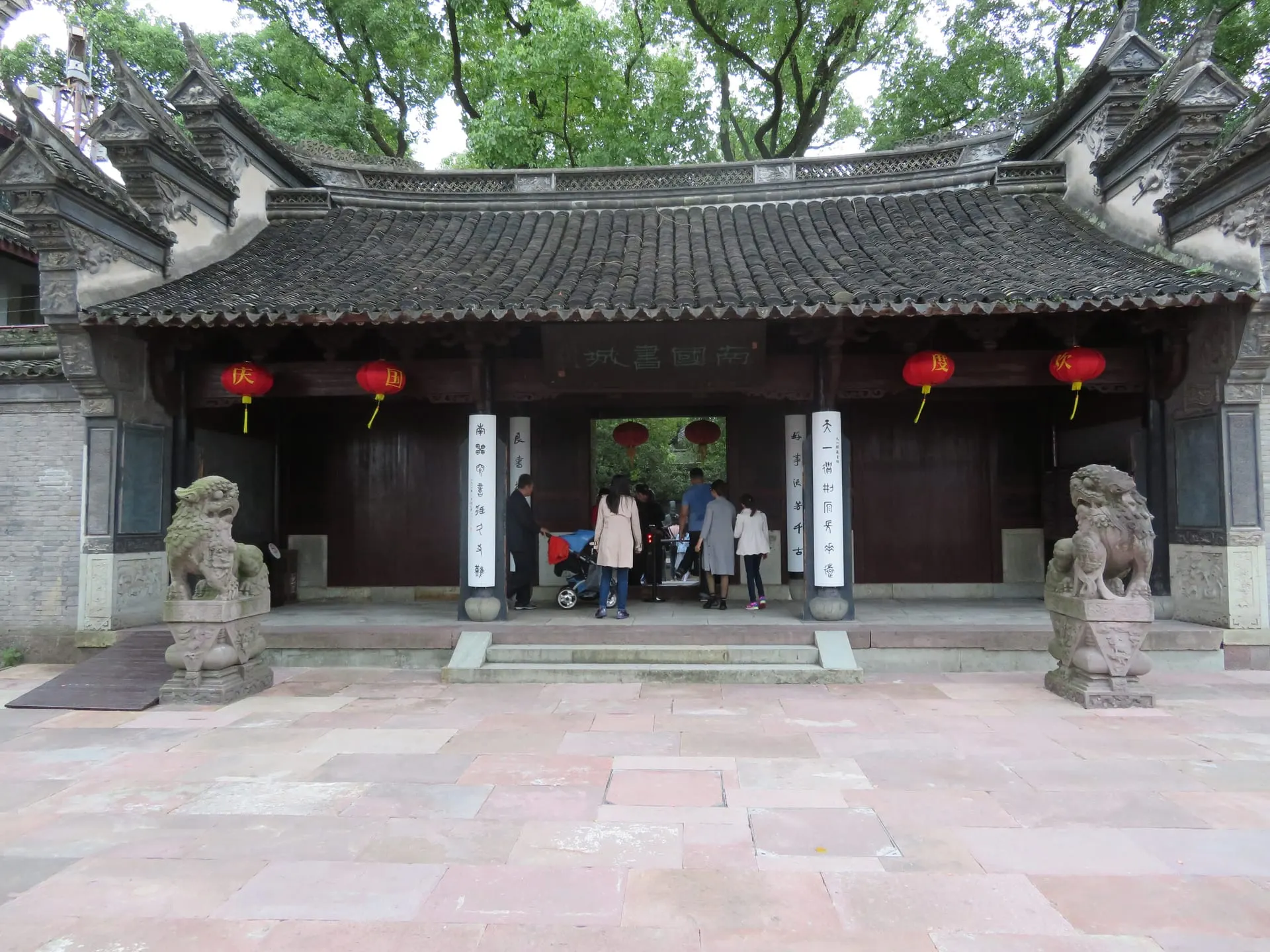
Tianyi Pavilion (天一阁, Tiānyī Gé)
China's oldest surviving private library, founded 1561 by Fan Qin. A sprawling compound of courtyards, rockeries, ponds, and a collection of 300,000+ ancient books. ¥30 as of June 2026. The connected Qin Family Ancestral Temple and the Zunjing Pavilion are part of the ticket.
Wikimedia Commons · CC-BY-SA
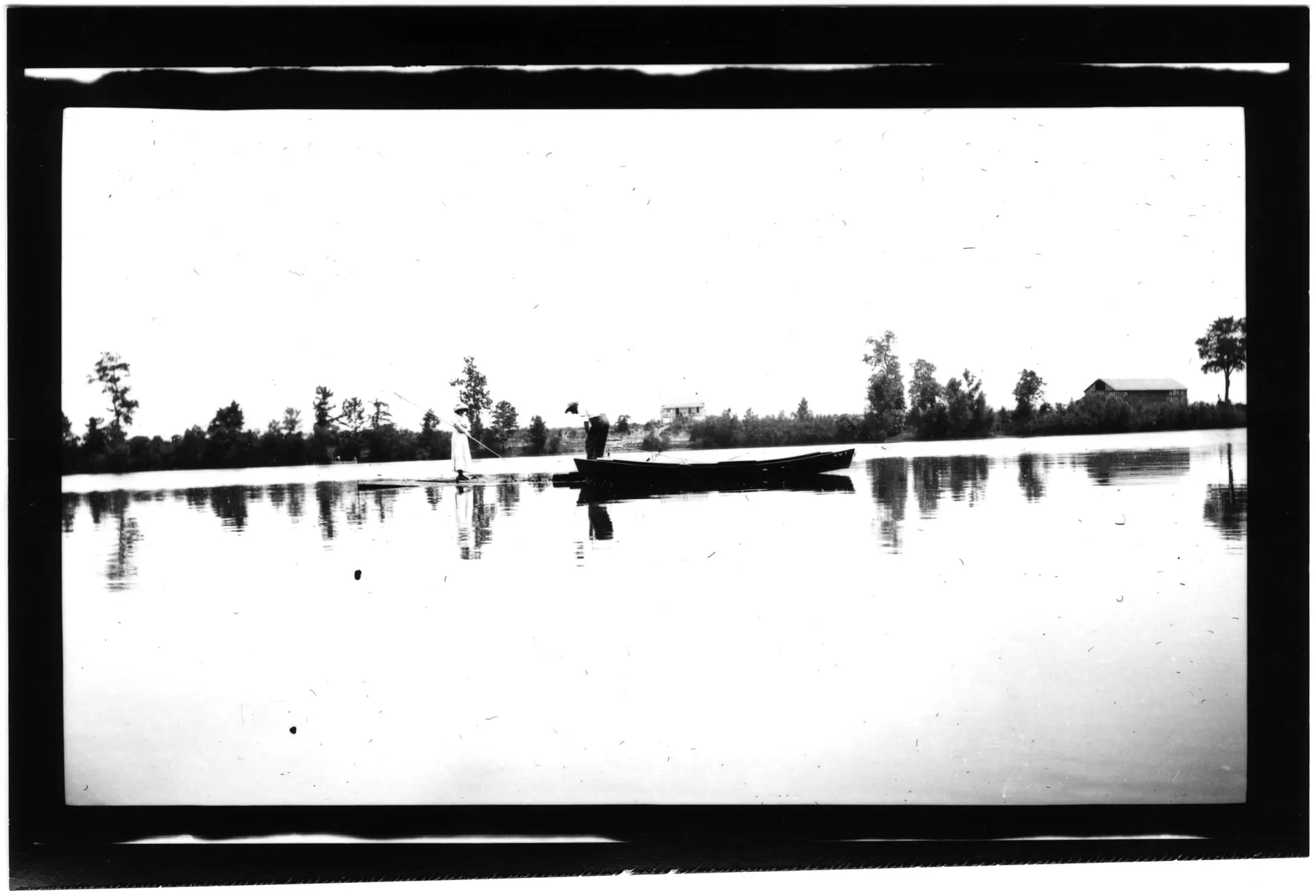
Moon Lake (月湖, Yuè Hú)
A Tang dynasty-era artificial lake ringed by willows, pavilions, teahouses, and restored Ming-Qing residences. Free, open 24 hours. Best at dawn when locals practice tai chi, or at dusk when the pavilion lights reflect on the water.
Wikimedia Commons · CC-BY-SA
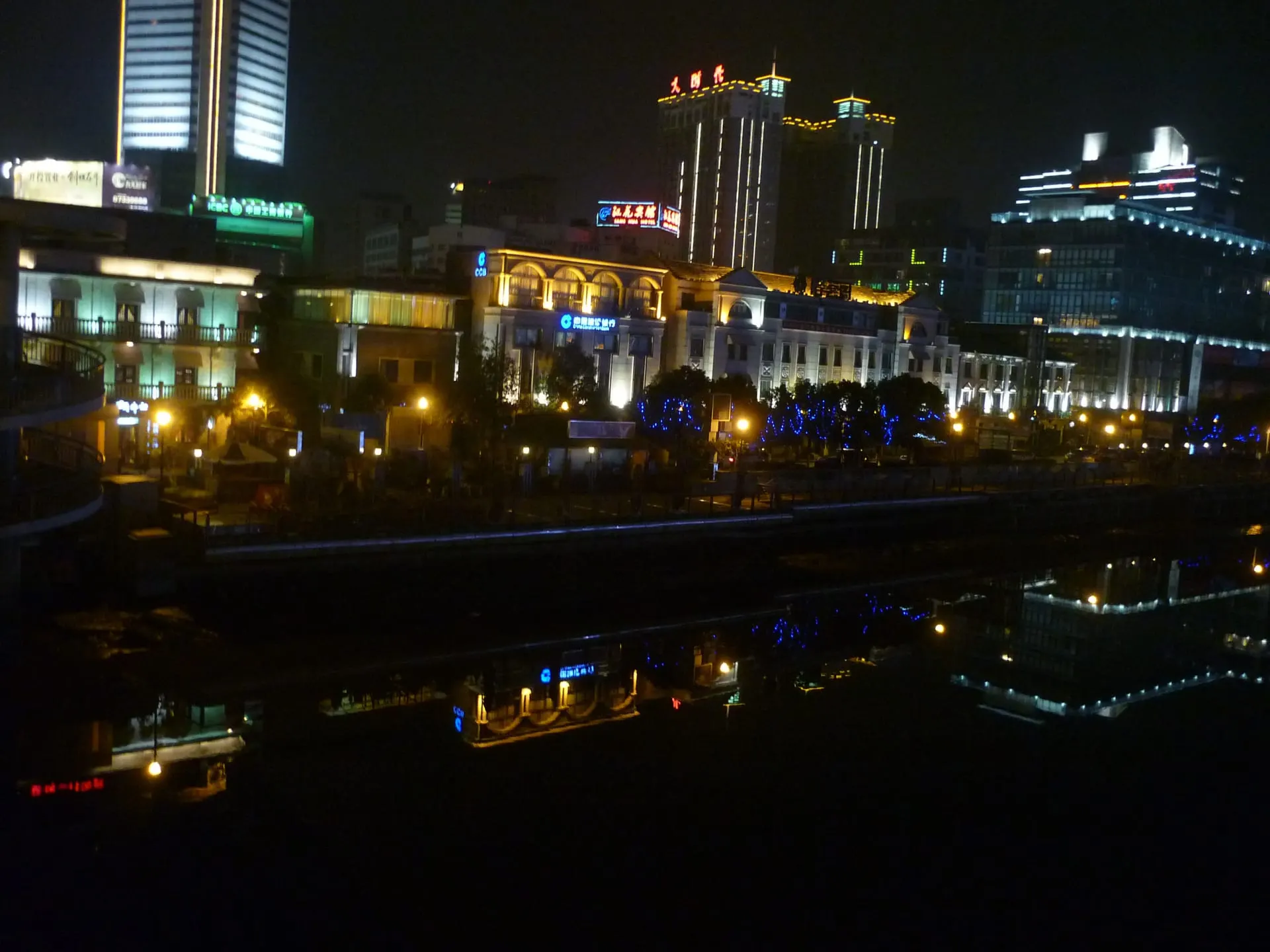
Old Bund (老外滩, Lǎo Wàitān)
A 600-meter waterfront strip of restored 19th-century European-style buildings — consulates, trading houses, shipping offices — now housing bars, restaurants, and galleries. Free. Comes alive after 19:00; quieter and more local than Shanghai's Bund.
Wikimedia Commons · CC-BY-SA
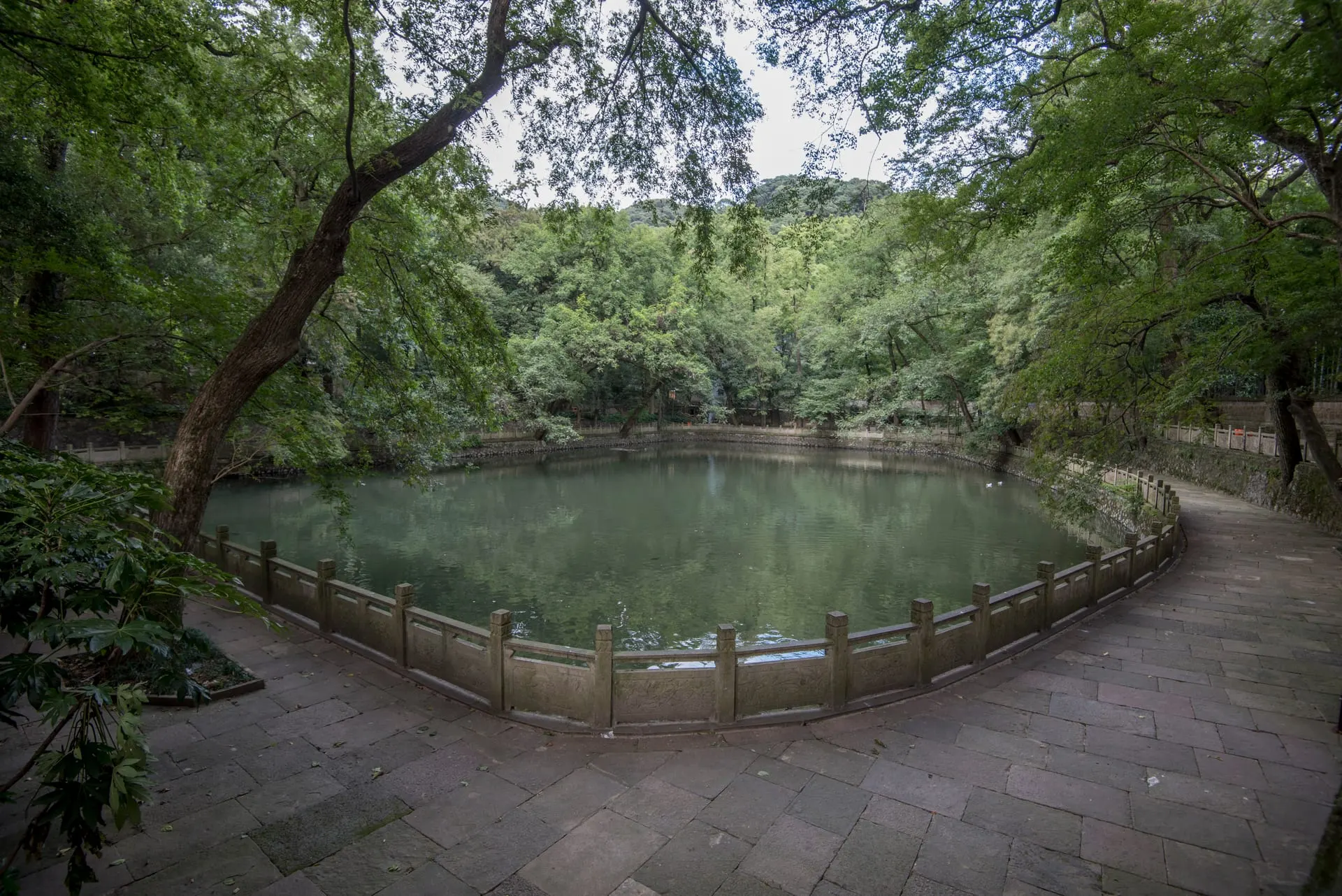
Tiantong Temple (天童寺, Tiāntóng Sì)
One of the five great Chan Buddhist monasteries of China, founded 300 CE. Nestled in a forested valley 25 km east of the city. ¥50. The approach through a grove of ancient pines is one of the most atmospheric temple walks in eastern China.
Wikimedia Commons · CC-BY-SA
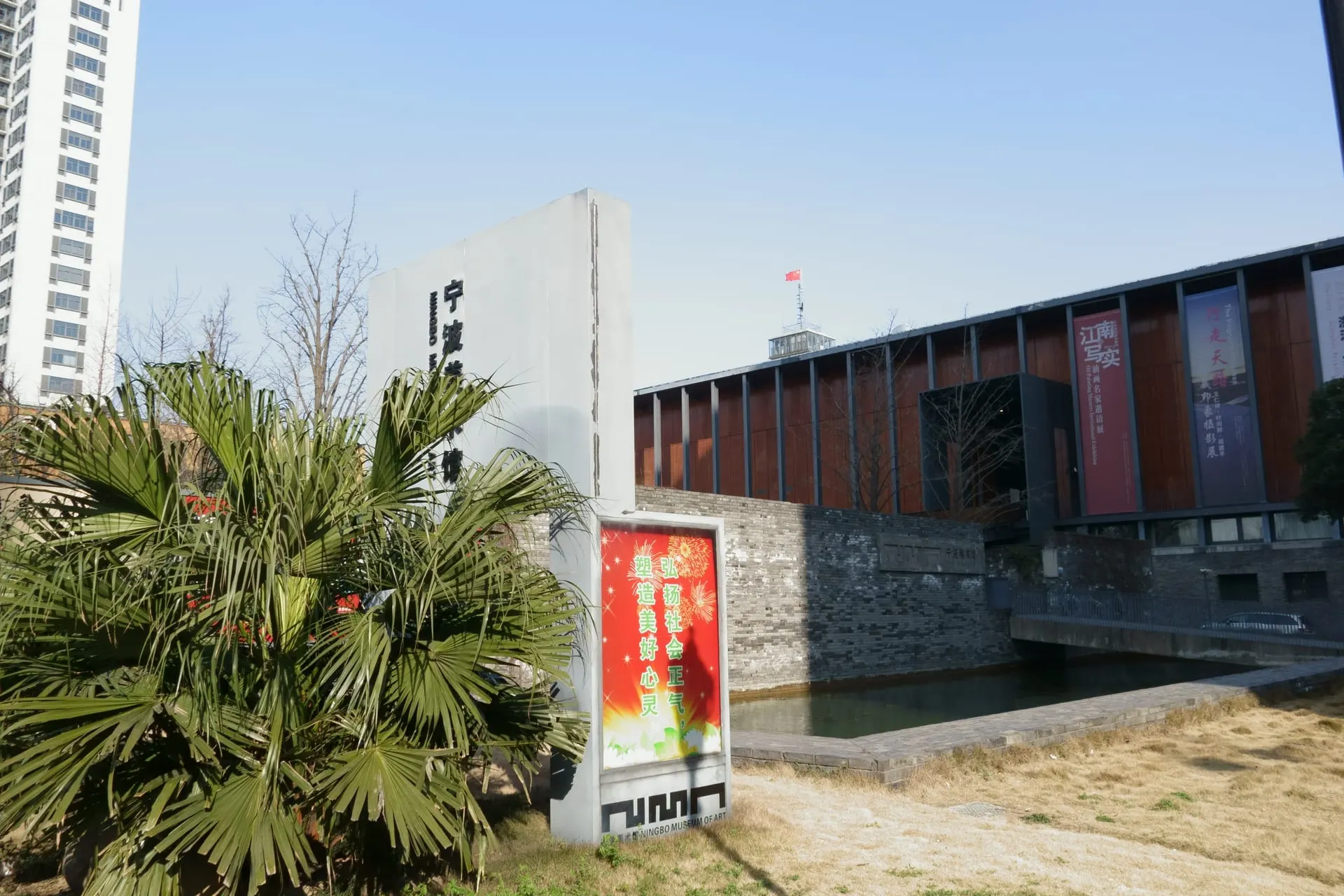
Ningbo Museum (宁波博物馆, Níngbō Bówùguǎn)
Designed by Pritzker Prize winner Wang Shu, the museum is built from recycled bricks and tiles salvaged from demolished villages — a striking architectural statement. Exhibits cover Ningbo's maritime history, Yue celadon ceramics, and local folk culture. Free.
Wikimedia Commons · CC-BY-SA
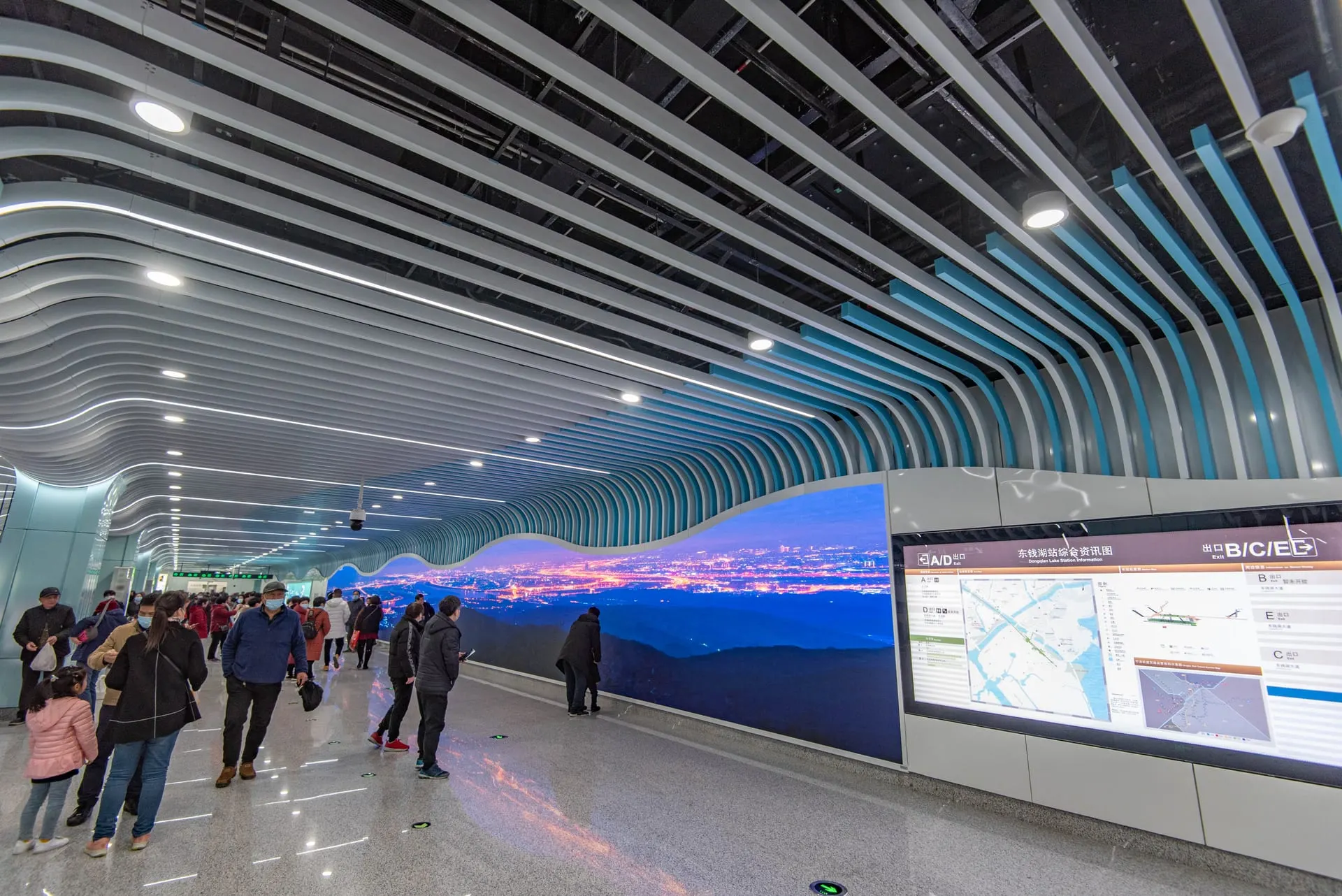
Dongqian Lake (东钱湖, Dōngqián Hú)
Zhejiang's largest natural freshwater lake, 15 km southeast of the city. Cycling paths, boat rides, tea plantations, and scattered temples around the shore. ¥30 for the main scenic area. A full-day outing for relaxed exploration.
Wikimedia Commons · CC-BY-SA
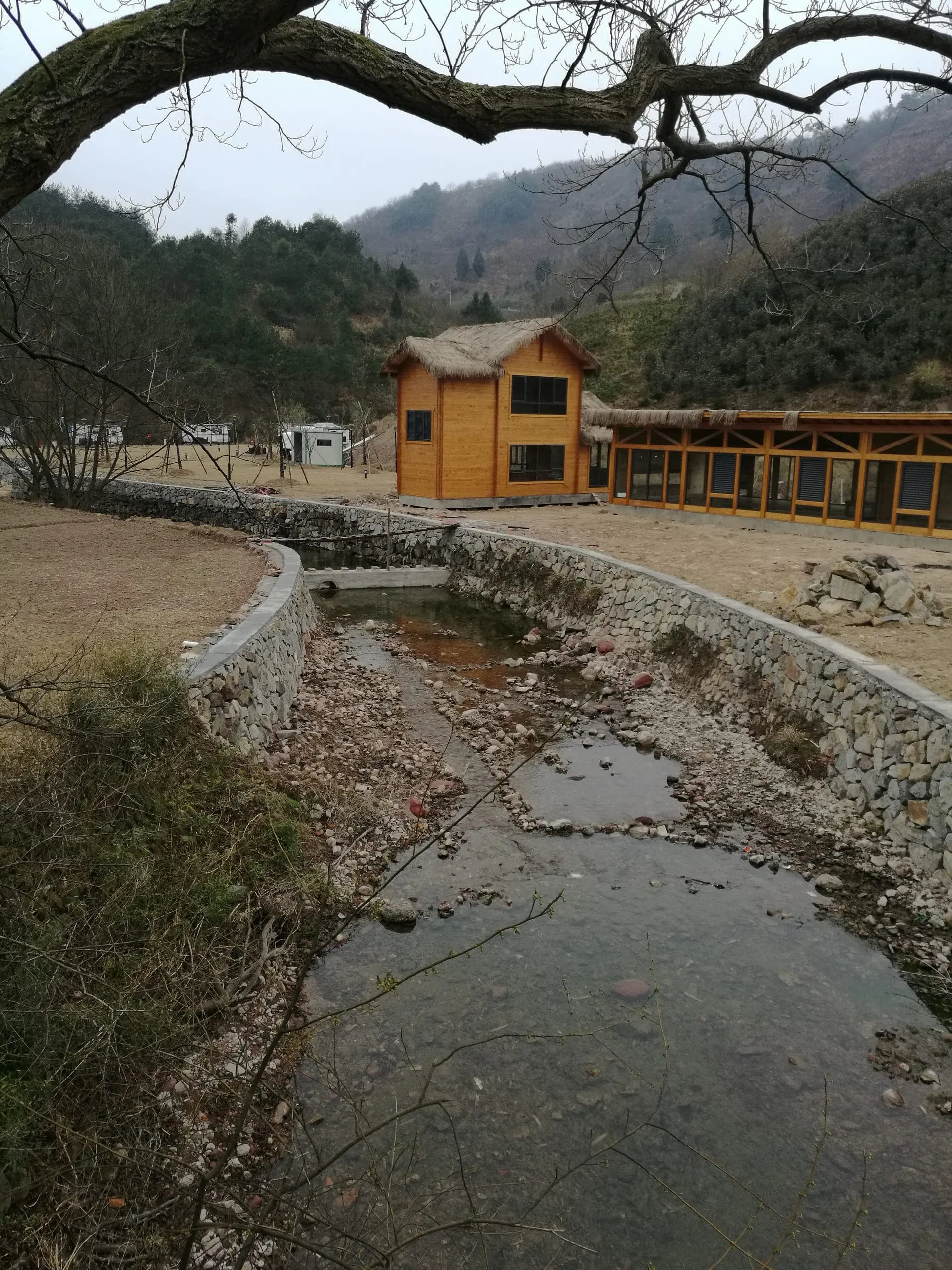
Xuedou Mountain (雪窦山, Xuědòu Shān)
A scenic mountain area in Fenghua district, 50 km south of Ningbo. Waterfalls, forest trails, and the Xuedou Temple with a 57-meter outdoor Maitreya Buddha statue. ¥150 combined ticket. Best visited as a day trip.
Wikimedia Commons · CC-BY-SA
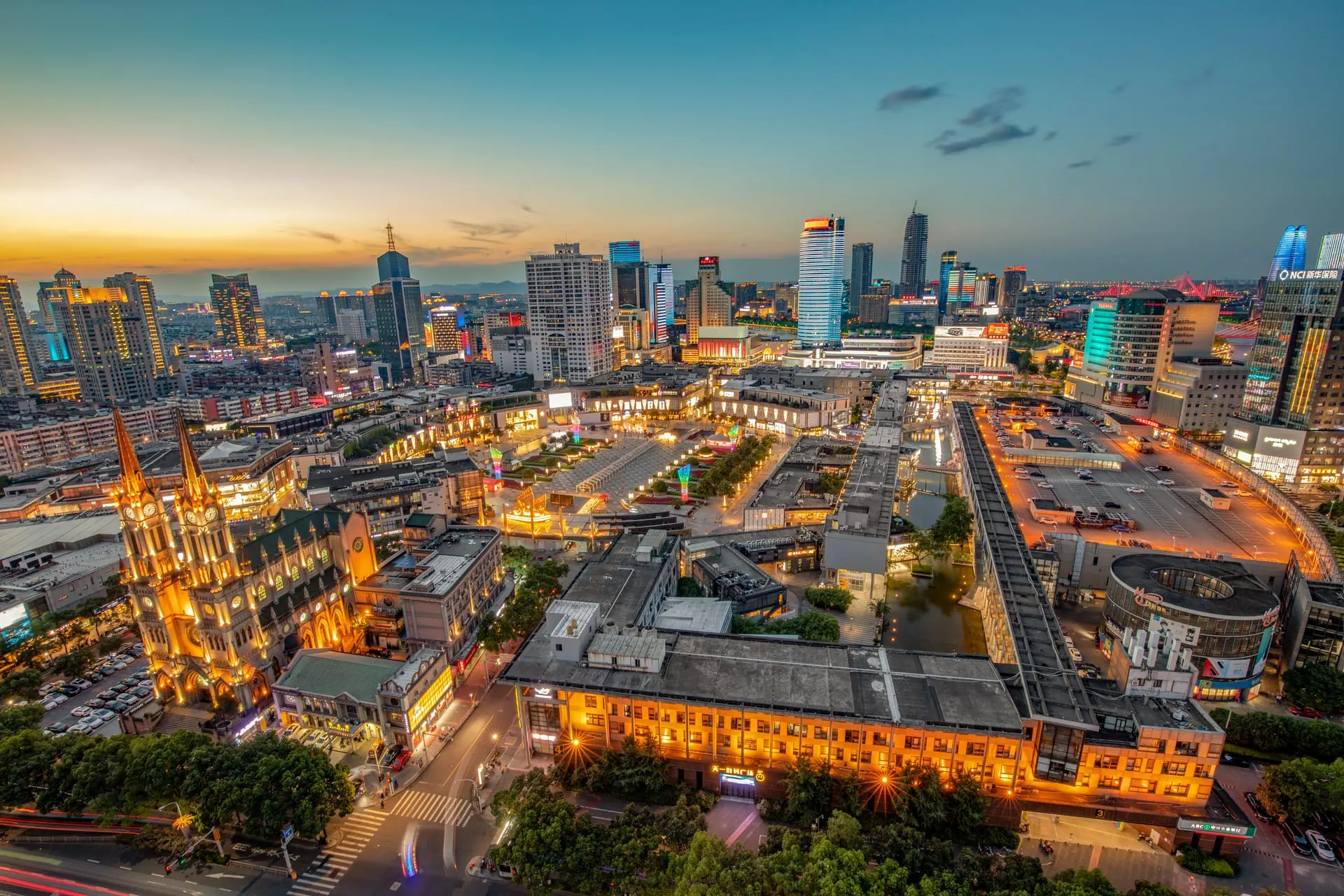
Tianyi Square (天一广场, Tiānyī Guǎngchǎng)
Ningbo's central shopping and entertainment plaza — a circular pedestrian complex with fountains, malls, restaurants, and a giant LED screen. Not a heritage site, but the city's social heart, especially after dark. Free.
Wikimedia Commons · CC-BY-SA
STAY
Where to stay in Ningbo
Pick a base that matches the trip you want — imperial-central for sightseeing, hutong belt for character, Chaoyang for nightlife, or Qianmen for budget.
Haishu (海曙区)
The old city core — Tianyi Pavilion, Moon Lake, Drum Tower, and the best concentration of local restaurants and narrow lanes
#haishuJiangbei / Old Bund (江北区)
19th-century treaty-port waterfront with bars, restaurants, and riverside promenades in restored European-style buildings
#jiangbei-old-bundYinzhou (鄞州区)
Modern CBD with skyscrapers, international chain hotels, the Ningbo Museum, and wide boulevards — efficient but characterless
#yinzhouDongqian Lake (东钱湖)
Lakeside resort area 15 km southeast — cycling paths, tea plantations, temples, and the Park Hyatt for a splurge stay
#dongqian-lakeBeilun (北仑区)
Deep-water port district — the busiest cargo port in the world. Industrial, not touristy, but worth seeing for the sheer scale
#beilun
ITINERARIES
Sample itineraries from Ningbo
Three ready-made routes, from a 1-day imperial sprint to a 5-day deep dive. Copy the day-by-day plan and adapt to your own pace.
- 2 DAYS
Ningbo Essential City
Tianyi Pavilion, Moon Lake, Old Bund, Tiantong Temple, and Ningbo Museum — the five core sights at a comfortable pace with two seafood dinners.
- First-time visitors
- Weekend trips
- Shanghai side trips
- Day 01
Morning
Old City & Riverside — Morning at Tianyi Pavilion (¥30, 2h). Walk to Moon Lake (1h loop). Lunch at Gang Ya Gou for tangyuan and yellow croaker noodles (¥40-60). Afternoon: Drum Tower and Chenghuang Temple food streets. Late afternoon: Old Bund walk, riverside drink. Dinner at a seafood restaurant on the Old Bund riverfront.
- Day 02
Morning
Temples & Museums — Early DiDi to Tiantong Temple (¥50, arrive by 08:00). Walk the pine approach, explore halls, forest hike. Lunch at temple vegetarian canteen (¥30). Afternoon: Metro Line 5 to Ningbo Museum (free, 2h) for Wang Shu architecture and maritime history. Evening: Tianyi Square for fountain show and final dinner.
- 3 DAYS
Ningbo + Putuo Mountain
Two days in Ningbo city plus a full-day pilgrimage to Putuo Mountain — Buddhist island, Guanyin statue, and ancient temples.
- Buddhist pilgrims
- Culture-focused travelers
- Photographers
- Day 01
Morning
Ningbo Heritage Core — Tianyi Pavilion, Moon Lake, Drum Tower food street. Afternoon Old Bund. Evening seafood dinner. Same as Day 1 of the Essential itinerary.
- Day 02
Morning
Putuo Mountain Pilgrimage — Depart Ningbo by 07:00. Bus to Zhoushan Banshengdong Pier (¥60, 2h), ferry to Putuo Mountain (¥30, 20 min). Island entrance ¥160. Visit Puji Temple, Fayu Temple, 33m Guanyin statue. Vegetarian lunch at temple canteen (¥30-50). Return ferry and bus to Ningbo by 19:00. Long day but extraordinary.
- Day 03
Morning
Temples & Departure — Morning at Tiantong Temple (¥50) or Ningbo Museum (free). Relaxed pace before afternoon train or flight. Final Gang Ya Gou tangyuan.
- 5 DAYS
Zhejiang Triangle: Hangzhou + Ningbo
Three days in Hangzhou (West Lake, Lingyin Temple, tea villages) plus two days in Ningbo — the perfect Zhejiang combo.
- Second-time China visitors
- Culture and food travelers
- East China rail trips
- Day 01
Morning
Hangzhou: West Lake — West Lake loop by bike or boat. Leifeng Pagoda, Su Causeway, Guo's Villa. Evening: Hefang Street food and tea.
- Day 02
Morning
Hangzhou: Temples & Tea — Lingyin Temple (¥75) in the morning. Afternoon: Longjing tea village for tea tasting and lunch. Evening: Impression West Lake show.
- Day 03
Morning
HSR to Ningbo + Old City — Morning HSR Hangzhou East to Ningbo (1h, ¥71). Check in, lunch at Gang Ya Gou. Afternoon: Tianyi Pavilion and Moon Lake. Evening: Old Bund seafood dinner.
- Day 04
Morning
Ningbo: Temples & Museums — Morning at Tiantong Temple. Afternoon: Ningbo Museum. Evening: Dongqian Lake sunset walk or Tianyi Square.
- Day 05
Morning
Return or continue — Morning Dongqian Lake cycling or Xikou day trip. Afternoon HSR to Hangzhou or fly out of Ningbo (NGB).
BUDGET
What a Ningbo trip costs
Per-person, per-day costs across three spending tiers. Excludes international flights and visa fees.
| Line item | Backpacker | Mid-range | Luxury |
|---|---|---|---|
| Accommodation (per night) | $12 | $40 | $150 |
| Meals (per day, 3 meals) | $10 | $25 | $60 |
| Local transport (per day) | $5 | $10 | $20 |
| Attractions (per day, 2-3 sites) | $8 | $12 | $25 |
| Day trip to Putuo Mountain | $50 | $70 | $120 |
| HSR Shanghai-Ningbo (one way) | $20 | $20 | $25 |
| Total per day | $105 | $177 | $400 |
$ USD per person per day, before international flights and visas. Last verified: Q3 2026.
STAY SAFE
Emergency contacts in Ningbo
Save these three numbers before you board the plane. China uses different hotlines than most countries — there's no 911.
- POLICE
110
- AMBULANCE
120
- FIRE
119
- TOURIST HOTLINE
12301
- ENGLISH-SPEAKING ER
Ningbo No. 1 Hospital (宁波市第一医院), Haishu District — VIP international wing with some English-speaking staff. For serious emergencies, evacuation to Shanghai United Family Hospital (2h by HSR).
Problems travelers hit in Ningbo
- Why is my Alipay not working?You linked a foreign Visa or Mastercard to Alipay but every transaction is rejected at the merchant.
- My China visa was denied — what now?Your L visa application was refused at the Chinese consulate and your trip is in 2–4 weeks.
- My passport was lost or stolen in China — what do I do?Your passport is gone (theft or loss) and you're in mainland China without travel documents.
- Why can't I book on 12306 with my foreign card?You tried to book a high-speed rail ticket on 12306.cn and your foreign Visa/Mastercard is rejected at checkout.
- Why is my VPN not working in China?You arrived in China, opened your VPN, and it will not connect at all or connects but no traffic loads.
- Why can't I book a Tibet trip on my own?You try to book Lhasa flights and hotels yourself but the booking fails, or you're turned away at the Lhasa airport without a permit.
Book activities in Ningbo
These are licensed tour operators and booking platforms we've vetted independently. Booking through these links may earn us a commission — see our affiliate disclosure. This never affects our editorial recommendations or the price you pay.
Frequently asked questions
Is Ningbo worth visiting for foreign tourists?
How many days do I need in Ningbo?
What is the best way to get from Ningbo Airport to the city center?
Can I use Alipay and WeChat Pay in Ningbo?
What is the best time of year to visit Ningbo?
Is Ningbo safe for tourists?
Show all 23 FAQs
How do I get to Putuo Mountain from Ningbo?
Is Ningbo a good day trip from Shanghai?
What is Tianyi Pavilion and why is it important?
What is Ningbo tangyuan and where should I eat it?
What is Tiantong Temple and is it worth the trip?
What should I eat in Ningbo if I do not eat seafood?
What are the emergency numbers in Ningbo?
Is Ningbo family-friendly?
Do I need a guide for Ningbo?
Is Ningbo a good base for visiting Putuo Mountain?
How does Ningbo compare to Hangzhou?
What is Dongqian Lake and why should I visit?
What is the Ningbo Museum and is it worth a visit?
How do I take a day trip to Xuedou Mountain and Xikou?
What is the best way to experience Ningbo's Old Bund?
What are the best neighborhoods to stay in Ningbo?
How does Ningbo handle the language barrier for English-only travelers?
References

Related guides & destinations
Guide
How We Research 2026: NihaoVisit’s Methodology for China Travel Information
How NihaoVisit sources, verifies, and maintains 700+ pages of China travel information — our source hierarchy, fact-checking process, update
Guide
Fact-Checking Log 2026: Verified China Travel Information — NihaoVisit
A public log of fact-checking verification passes on NihaoVisit, showing what was verified, when, and against which sources — covering visa
Guide
Best Time to Visit China 2026: Month-by-Month Weather, Crowds, and Prices
The best time to visit most of China is April–May and September–October. Winter (Dec–Feb) is cold but cheap; summer (Jun–Aug) is hot and cro
Guide
VPN for China 2026: Which VPNs Work, eSIM Alternatives, and the Complete Pre-Trip Checklist
Most Western apps and websites are blocked in mainland China. A reliable VPN is essential for Google, Gmail, WhatsApp, Instagram, and most n
Guide
China SIM Card and eSIM Guide 2026: Stay Connected Without WeChat
A Chinese SIM or eSIM lets you use mobile data, maps, and ride-hailing without WiFi. Here is how to get one, the cost, and which provider to
Guide
Solo Female Travel in China 2026: Safety, Tips, and Real Experiences
China is one of the safer destinations for solo female travelers. Petty theft is rare, violent crime against tourists is extremely uncommon,