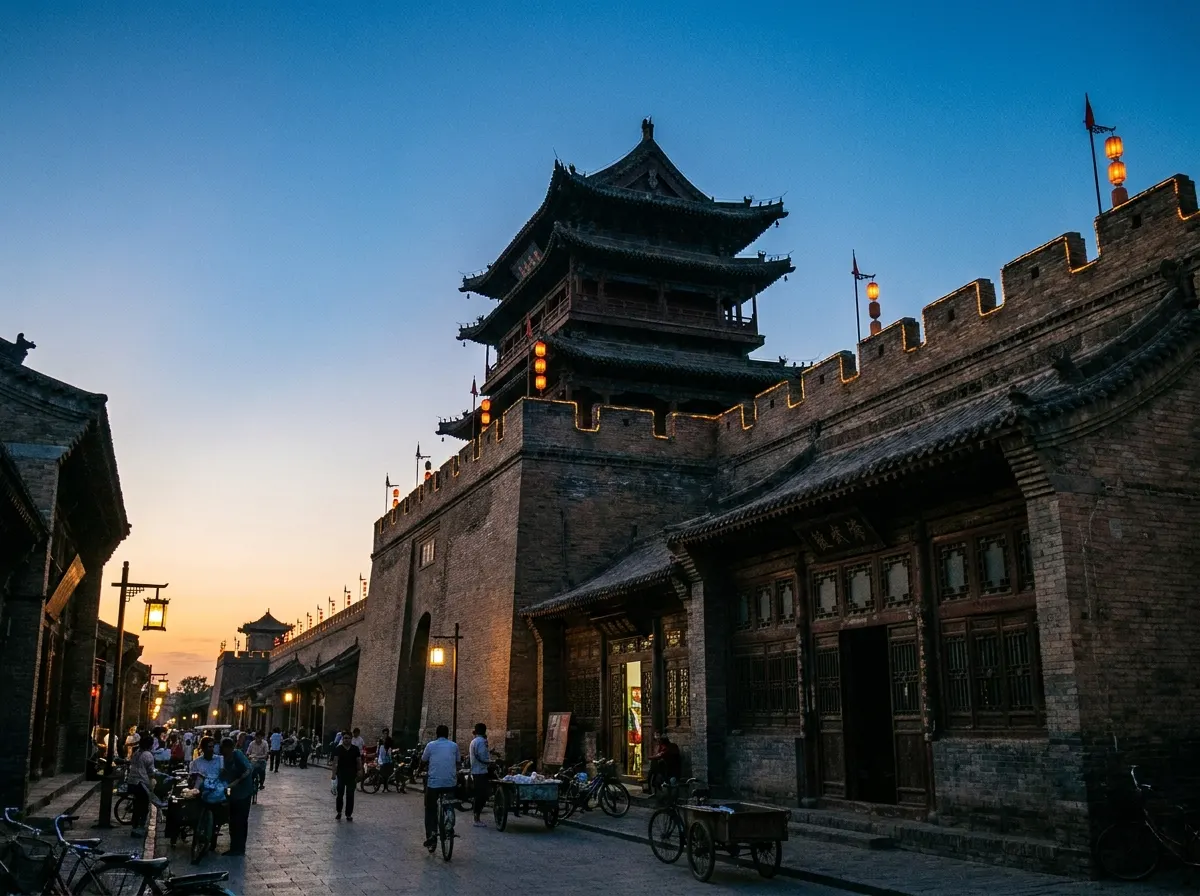
Pingyao
Pingyao is a UNESCO World Heritage site in Shanxi province, famous as the best-preserved ancient walled city in China. The 6km Ming-dynasty city wall is intact, the 2,000+ traditional courtyard homes are still inhabited, and the Rishengchang draft bank (founded 1823) is considered the birthplace of Chinese modern banking. Plan 2 days — 1 day for the Old Town, 1 day for the outlying Shuanglin Temple and Wang Family Compound. High-speed rail from Beijing: 4 hours.
Why Pingyao in 2026.
China's best-preserved ancient walled city. A 2,700-year-old Ming-dynasty town with original city walls, courtyards, and the original Chinese banking headquarters.
Quick Answer
Pingyao is a UNESCO World Heritage site in Shanxi province, famous as the best-preserved ancient walled city in China. The 6km Ming-dynasty city wall is intact, the 2,000+ traditional courtyard homes are still inhabited, and the Rishengchang draft bank (founded 1823) is considered the birthplace of Chinese modern banking. Plan 2 days — 1 day for the Old Town, 1 day for the outlying Shuanglin Temple and Wang Family Compound. High-speed rail from Beijing: 4 hours.
| Best time to visit | April-May and September-October for weather; lantern festival in February is special |
|---|---|
| Daily budget | $40 (backpacker) / $100 (mid-range) / $250+ (luxury) |
| Language | Mandarin (Shanxi dialect; English in Old Town hotels) |
| Currency | CNY (¥) — Alipay/WeChat Pay in most shops; cash useful |
| Time zone | China Standard Time (UTC+8) |
| Last updated | 2026-06-16 |
Want a Pingyao plan built for you?
Is Pingyao worth a special trip?
Yes — Pingyao is one of China's most authentic historical experiences. Unlike reconstructed sites (such as Datong's rebuilt old city), Pingyao's residents still live in the Ming-Qing courtyard homes, and the city has not been turned into a sanitized tourist diorama. Plan two days minimum inside the walls, and add a third day for the Wang Family Compound and Qiao Family Compound (the filming location for Zhang Yimou's "Raise the Red Lantern"). The night atmosphere inside the walls, with red lanterns and quiet alleys, is the highlight for many visitors.
Should I stay inside the Old Town?
Yes — staying inside the walls is the only way to experience Pingyao properly. The Old Town has traditional courtyard hotels (四合院客栈) with prices from roughly ¥150-500 per night, re-check before booking. Staying inside lets you walk the city wall at sunrise before day-trippers arrive and explore the lantern-lit lanes after dinner. The west side of the city is quieter; the south side is closer to the main Ming-Qing Street and its restaurants and shops.
How do I get to Pingyao?
High-speed rail is the most convenient option. Trains from Beijing to Pingyao Ancient City Station take roughly 4 hours (around ¥200-300 second-class, re-check before booking). From Xi'an, the trip is about 3 hours; from Taiyuan (the Shanxi capital), just 30 minutes. The high-speed station sits about 8 km from the Old Town — take a taxi (around ¥30) or the local tourist bus (around ¥5). Flying into Taiyuan Wusu Airport (TYN) and then taking a 1-hour train to Pingyao is also practical.
What is the Pingyao combo ticket?
The combo ticket covers the city wall, Rishengchang, the Qing Void Temple, the city museum, and 20-plus other attractions inside the Old Town. It costs roughly ¥125 and is valid for three days, re-check current pricing before travel. Single attraction tickets run ¥30-80 each, so the combo is excellent value if you plan to visit more than two sites. Buy it at the south gate, the west gate, or any major wall entrance — keep the paper slip, since sites check it on entry.
When is the best time to visit Pingyao?
April-May and September-October offer the best weather, with mild days and crisp nights perfect for walking the wall. February brings the Pingyao Lantern Festival (元宵节, around the 15th day of the lunar new year), when the Old Town glows with thousands of lanterns and hosts folk performances. Summer (June-August) is hot and crowded with domestic tour groups. Winter (December-February) is cold, often below freezing, but the snow-dusted rooftops are unforgettable and crowds are thin.
Is Pingyao good for photography?
Yes — Pingyao is one of China's best photography destinations and hosts the annual Pingyao International Photography Festival every September. The city wall at sunrise and sunset delivers well-known silhouette shots over tiled rooftops. The narrow stone alleys of the Old Town at dusk are atmospheric, especially when red lanterns glow. Photographers should bring a tripod for low-light shots inside the temples and plan two to three days to cover the main angles. The Qiao Family Compound's courtyards are also a classic composition subject.
Why was Pingyao a banking capital?
Pingyao was the financial heart of Qing-dynasty China from 1823 to the early 1900s. The Rishengchang Draft Bank (日昇昌), founded here in 1823, was China's first nationwide bank, issuing paper drafts that let merchants move silver safely across the empire without carts of coin. At its peak, Pingyao housed 22 draft banks (票号) with branches in 80 Chinese cities and as far as Japan, Russia, and Southeast Asia. The collapse came after 1911, when modern banks and war disrupted the network — but the original courtyards and ledgers survive, making Pingyao a living museum of Chinese finance.
Can I walk the entire city wall?
Yes — the full Ming-dynasty wall circuit is 6 km and takes roughly 90 minutes to two hours at a leisurely pace. The wall is roughly 10 meters high, 3-5 meters wide, and has 72 watchtowers and 3,000 crenellations (symbolizing Confucius' 72 disciples and 3,000 students). The surface is uneven brick and stone, so wear sturdy shoes. Start at the south gate (迎熏门) for the best morning light and fewest crowds. The wall closes at sunset in winter and around 7 PM in summer.
What is the Wang Family Compound?
The Wang Family Compound (王家大院) is a vast 250,000 m² Qing-dynasty merchant mansion about 35 km from Pingyao, often called the "Forbidden City of Shanxi." It was built by the Wang merchant family over 300 years and contains 123 courtyards and 1,118 rooms across a hillside. Entry costs roughly ¥55, re-check before booking. Plan a half-day visit — combine it with Shuanglin Temple on the way back to Pingyao for a full day out.
What makes Pingyao a UNESCO World Heritage Site?
Pingyao Ancient City was inscribed as a UNESCO World Heritage site in December 1997, recognized as an outstanding example of a Han Chinese city of the Ming and Qing dynasties preserved to a remarkable degree. The UNESCO listing covers the entire walled Old Town plus the outlying Shuanglin Temple and Zhenguo Temple, and the nomination singled out four cultural criteria: Pingyao is a complete, living, and unaltered example of a traditional Chinese walled city, it preserves the original street pattern, the traditional courtyard houses, the commercial buildings of the Ming-Qing Street, and the city wall itself, and it represents the rise of Chinese modern banking through the Rishengchang Draft Bank and its 21 sister piaohao banks. UNESCO also noted that the city has not been turned into a museum diorama — more than 30,000 people still live and work inside the walls, which is what makes Pingyao qualitatively different from reconstructed old towns like Datong or Lijiang. The integrity of the urban fabric, the authenticity of the building stock (most courtyard homes remain in private hands and are lived in across generations), and the survival of the original drainage, the city wall, the watchtowers, the temple interiors, and the bank courtyards are what justified the inscription. The protective boundary encloses roughly 2.25 square kilometers of the Old Town plus a buffer zone that limits new high-rise construction in the surrounding countryside. Today UNESCO reviews Pingyao periodically for the pressures of mass tourism, the encroachment of modern development on the skyline, and the need to balance visitor infrastructure with the daily life of residents — issues that surfaced most recently in 2024 after reports of overcrowding during the Spring Festival lantern show. Visitors who want to understand what UNESCO saw in Pingyao should walk the wall at sunrise, descend into the residential alleys to see the courtyard doors opening and the neighborhood life unfolding, and visit Rishengchang and the County Government Office to appreciate the financial and administrative apparatus that made the city a regional capital for 500 years.
How long is the Pingyao city wall and how should I walk it?
The Pingyao city wall stretches 6,163 meters in full perimeter, sits roughly 10 meters high and 3 to 5 meters wide at the top, and is studded with 72 watchtowers and around 3,000 crenellations. The wall was built in 1370 during the reign of the Ming Hongwu Emperor, expanded and reinforced in 1370 and again during the Qing dynasty, and has never been demolished or substantially rebuilt. The full circuit takes 90 minutes to two hours at a leisurely pace with photo stops, although fit walkers can complete it in just over an hour. Six gates punctuate the wall: the south gate (Yingxun Men, 迎熏门) is the most photographed and the best place to start; the north gate (Fuxiu Men, 拱极门) faces the old commercial suburbs; the east gate (Chongde Men, 永定门) and the west gate (Yuanwu Men, 太和门) are quieter; and two additional gates served as flood overflows and are no longer open to walkers. The wall is built of rammed earth faced with brick, and the upper surface is uneven — wear sturdy shoes, especially after rain. The wall closes at sunset, around 5:30 PM in winter and 7:00 PM in summer, and entry is included in the combo ticket. A shorter 4 km walk is possible by skipping the southern flood-gate spur and cutting through the West Market area; this is the most popular option for visitors with limited time. Photographers should plan a sunrise or sunset start: the south gate is best at sunrise for warm light over the tiled rooftops, while the west wall is best at sunset for silhouettes against the loess plateau beyond. Lanterns are hung along the wall during the Spring Festival lantern show, and the wall hosts live music performances and small folk-art markets during the Pingyao International Photography Festival every September. Although the wall looks like a single straight rampart, the defensive design is subtle: the south wall was deliberately built in a concave arc to prevent the traditional evil qi from entering the city, and each gate is preceded by an outer barbican with a single controlled entry, the same pattern used at the Forbidden City and the walled cities of the central plains.
Why does Rishengchang matter for the history of Chinese banking?
Rishengchang (日昇昌, literally "Sunrise Prosperity") was founded in 1823 in a former noodle shop on West Street in the Old Town, and is universally regarded as the birthplace of Chinese modern banking. The bank's founder, Lei Lutan (雷履泰), was a former banker at a dye house who saw an opportunity to consolidate the cash-transfer needs of Shanxi merchants into a single trusted network, and by 1826 Rishengchang had branches in every major commercial city in China, from Beijing and Guangzhou to Urumqi and Chengdu. The bank's signature product was the huipiao (汇票), a paper draft that allowed a merchant to deposit silver in one city and withdraw the equivalent — minus a 2-3% exchange fee — in another. The drafts were encoded with invisible ink, hand-written in calligraphic cipher, and reconciled against countersigned ledgers; counterfeiting was a capital offense. At its peak in the 1840s and 1850s, Rishengchang moved more than 8 million taels of silver per year through its draft network, and a single signed draft could be honored at any of the bank's 30-plus branches within 24 hours. The original Rishengchang courtyard is preserved as a museum inside the Old Town: visitors walk through the two-story courtyard buildings, see the original underground silver vault, the back-room counting office with its lead-lined drawers, the upstairs accounting quarters, and a small exhibit of period bank drafts, seals, and account books. The museum does a good job of explaining the ledger system, the cipher used on the drafts, and the social protocols that made a paper note worth 10,000 taels of silver. The walls of the back rooms carry a quote attributed to the founder: "信义为利, 汇通天下" — "Trust is the profit; remittance unites the world." The Rishengchang story does not end well: the bank was looted during the Boxer Rebellion in 1900, struggled to recover, and finally collapsed in 1914 after the rise of modern joint-stock banks made its draft network obsolete. But the courtyard is intact, the business model is documented, and the broader Shanxi banking story is told in the adjacent Xie Tong Qing bank museum and the China Draft Bank Museum (中国票号博物馆), both within walking distance and both included in the combo ticket. For visitors, Rishengchang is the single most important site in Pingyao — it explains the wealth that built the courtyard homes, the merchant mansions in Qi county, and the city wall itself.
Why is Shuanglin Temple called the Museum of Painted Sculpture?
Shuanglin Temple (双林寺), 6 km southwest of the Old Town, holds the most important collection of painted clay Buddhist sculpture in China and is the single most visited outlying site from Pingyao. The temple was founded in the 6th century, but the surviving sculptures date from the Song, Yuan, Ming, and Qing dynasties, with the great majority created during a single extraordinary 70-year rebuilding campaign between 1450 and 1520. UNESCO added Shuanglin Temple to the Pingyao World Heritage site in 1997 specifically because of these sculptures, calling them "an outstanding example of painted Buddhist sculpture of the Ming dynasty" and "a treasure house of Chinese religious art." The temple complex covers 15,000 square meters and contains more than 2,000 painted clay figures, many nearly life-size, distributed across 10 main halls, each dedicated to a Buddhist deity, bodhisattva, or arhat. The most famous sculpture is the Thousand-Armed Guanyin in the Bodhisattva Hall, a 3.6-meter-tall figure with 26 pairs of arms arranged in a peacock-tail pattern around a central serene face; it is widely considered the finest Ming Buddhist sculpture in existence. Equally remarkable is the Sakyamuni Hall with its series of circular carved murals depicting the life of the Buddha, and the Arhat Hall with its 18 life-size painted arhats, each with an individually distinct face, expression, and gesture — a level of naturalism unmatched in earlier Chinese sculpture. The colors are still vivid: the original pigments were mineral-based (malachite green, cinnabar red, azurite blue, lead white) and were sealed with a layer of ox-blood lacquer that has kept the surfaces fresh for 500 years. Photography is allowed but not flash; tripods require advance permission. The site is small enough to cover in 60-90 minutes and is best combined with a Pingyao Old Town afternoon or a Wang Family Compound day trip. Buses from the south gate of the Old Town run to Shuanglin Temple roughly every 20 minutes for ¥5, or you can take a taxi for ¥30 round-trip including wait time. Most visitors combine Shuanglin with the Wang Family Compound, but a stand-alone visit is also rewarding — plan 90 minutes including the return bus, and go in the morning for the best light on the sculptures.
What Shanxi cuisine should I try in Pingyao?
Shanxi cuisine (晋菜) is one of the eight great regional cuisines of China and one of the most underrated by foreign visitors. It is built on wheat rather than rice, leans on Shanxi aged vinegar (one of China's four famous vinegars), and emphasizes knife-cut noodles, oat-based dishes, and slow-braised meats. Inside the Old Town, the four dishes you must try are Pingyao beef (平遥牛肉), Shanxi knife-cut noodles (刀削面), oat noodles (莜面栲栳栳), and the regional aged vinegar (老陈醋). Pingyao beef is the city's signature: a cold-cut braised beef made from yellow cattle raised on the loess plateau, salted, pressed, and stewed for 12 hours in a master stock with shaoxing wine, ginger, and spices. The texture is firm, the flavor savory-sweet, and the color a deep mahogany. It is sold vacuum-sealed in every souvenir shop on Ming-Qing Street and makes a great edible gift (look for the "冠云" Guanyun brand, which holds a protected geographical indication). Shanxi knife-cut noodles are made by holding a block of firm dough in one hand and shaving 1.5-meter-long thin slices directly into a pot of boiling water with a curved knife in the other — a technique that takes years to master. The noodles are served in broth with beef, tomato, or mushroom, and cost around ¥15-25 per bowl at any Old Town noodle shop. Oat noodles (kaolaolaolao) are made from steamed oat flour pressed into long thin rolls and served with a vinegar-garlic dip or a tomato-egg sauce; the name "kaolaolao" comes from the basket-shaped bamboo steamer in which they are cooked. Shanxi aged vinegar has a 3,000-year history and is the only vinegar in China that is brewed and aged rather than chemically produced; the best Pingyao vinegar shops in the Old Town offer free tastings and ship internationally. Beyond these four signature dishes, look for Pingyao's bowl-knife noodles (碗托, a cold mung-bean jelly served with chili oil), steamed fenjiao (粉饺, a glutinous-rice dumpling), and the regional stuffed sugar cakes. The two most recommended restaurants in the Old Town are the De Kwang Mansion courtyard restaurant on Yamen Street, the Renhechang on South Street, and the Wenshangchang (文昌昌) on Yamen Street — all serve authentic local fare in traditional courtyard settings. For street food, the night market near the south gate sets up around 6 PM every evening in summer, with noodle stalls, jianbing, and Pingyao beef skewers. Prices are modest: a full Shanxi dinner for two at a mid-range Old Town restaurant runs ¥80-150, and the food is among the most distinctive in northern China.
What are the best courtyard hotels inside the Pingyao Old Town?
Staying inside a traditional Pingyao courtyard is the only way to experience the city properly, and the Old Town has more than 200 inns and small hotels built into restored Ming-Qing courtyard homes. The classic Pingyao inn (客栈) wraps around a rectangular central courtyard paved with stone, with two-story wooden galleries running off all four sides and a roofed ancestral hall at the rear. Rooms are small by international standards (10-20 square meters is typical), the beds are firm, the walls are thick brick, and the courtyards often host pomegranate or persimmon trees. The best courtyard hotels cluster in three areas: the west side of the Old Town around the County Government Office is the quietest and most atmospheric, with renovated courtyard inns at ¥300-500 per night in shoulder season; the south side near Ming-Qing Street and the south gate is the most convenient and slightly pricier, with mid-range inns at ¥400-600; and the east side near the east gate is the most local-feeling, with budget options at ¥150-300. The most respected courtyard hotels include the Jingbian Mansion (景贤门), a restored Qing merchant mansion with a roof terrace overlooking the wall; the Harmony Inn (锦福楼), a smaller courtyard with a working traditional kitchen; the De Hua Yuan (德华苑), a family-run courtyard in a 200-year-old building; the Pingyao Yuchengyuan (平遥裕成源), with a central courtyard kitchen serving Shanxi breakfasts; and the upscale Pingyao Zhongdu Hotel, a 19th-century merchant mansion converted into a small boutique hotel. Most courtyard hotels offer airport or station pickup (¥30-50 from the HSR station), bicycle rental, and help booking tickets to outlying sites. A few caveats: walls are thick and Wi-Fi can be slow in the older buildings, so check before booking if connectivity matters; courtyard rooms are warm in summer and cold in winter (most have kang bed-stoves or air-conditioning); and the Old Town is pedestrian-only after 8 PM, so plan to arrive at the gate with a porter orporter service. Booking 1-2 weeks ahead is wise in May, June, September, and October; the Lantern Festival in February and the Photography Festival in September book out 2-3 months ahead.
How do I get to Pingyao and what is the best route?
High-speed rail is the dominant way to reach Pingyao, and the city is on the Datong-Xi'an HSR trunk line, the same line that runs through Taiyuan, the Shanxi capital. The dedicated Pingyao Ancient City Station (平遥古城站) is 8 km northeast of the Old Town, has dedicated tourist information, taxi ranks, and a direct tourist bus to the south gate. From Beijing, the fastest trains take 3 hours 50 minutes to 4 hours 30 minutes, with around 8 direct services daily and a second-class fare of ¥200-300. From Xi'an, the trip takes 3 hours to 3 hours 20 minutes, with around 6 daily services. From Taiyuan, the trip is the easiest of all: 30 minutes, with trains every 20-30 minutes throughout the day and a second-class fare of around ¥30-50. The station-to-Old-Town transfer is straightforward: the official tourist bus (Pingyao Bus 1) costs ¥5 and runs every 15-20 minutes from the station forecourt to the south gate; a taxi costs ¥30-40 and is faster (15-20 minutes). Most Pingyao hotels will arrange pickup if you call ahead. Flying is an option but generally less convenient. The nearest commercial airport is Taiyuan Wusu International Airport (TYN), 100 km north of Pingyao, with direct flights from Beijing, Shanghai, Guangzhou, Shenzhen, Chengdu, Hong Kong, and Taipei. From Taiyuan airport, the airport shuttle to Taiyuan South HSR Station takes 30 minutes (¥20), and the HSR from Taiyuan to Pingyao is another 30 minutes — total transit time around 2 hours. Travelers coming from Luoyang, Zhengzhou, or Kaifeng can also take the HSR southbound to Taiyuan and then transfer eastbound to Pingyao, total transit time 3-4 hours. For travelers coming overland from the south (Xi'an, Luoyang) or west (Hohhot, Datong), long-distance buses still serve Pingyao, but the HSR is now significantly faster. Within the city, the Old Town is pedestrian-only, but electric sightseeing vehicles (¥10 per person per ride) loop between the major gates and the main attractions, and bicycle rental is available from most hotels for ¥20-30 per day. For day trips to the Wang Family Compound and Qiao Family Compound, the public bus departs from the south gate bus station; a private car with driver is ¥400-500 per day and is the more comfortable option.
How do I visit the Qiao Family Compound and Wang Family Compound on a day trip?
The two most popular day trips from Pingyao are the Qiao Family Compound (乔家大院) in Qi County, 40 km north of the city, and the Wang Family Compound (王家大院) in Lingshi County, 35 km southwest. Both are Qing-dynasty merchant mansions built by Shanxi merchant clans whose wealth derived directly from the Piaohao draft-banking network that Rishengchang pioneered. The Qiao Family Compound is the smaller of the two but is the more famous, because Zhang Yimou's 1991 film "Raise the Red Lantern" (大红灯笼高高挂) was filmed here. The Qiao mansion covers 4,170 square meters, contains 313 rooms arranged across 6 main courtyards, and is famous for its ornate brick and wood carvings, the central painted opera stage, and the 100-meter-long stone-paved approach road. Entry costs roughly ¥72, and the compound has a small museum, a film set, and a restored merchant bank counter. Allow 2 hours; the on-site restaurant serves Shanxi cuisine. The Wang Family Compound is the larger and arguably the more impressive of the two: it covers 250,000 square meters across a hillside, contains 123 courtyards and 1,118 rooms, and has been called the "Forbidden City of Shanxi" for its scale. The architecture is more formal than the Qiao mansion, with symmetrical courtyards, three-tiered gates, and grand stone lions at every entrance. The Wang clan was the most powerful merchant family in Pingyao for 300 years; their prosperity is visible in the elaborate carvings, the 1,000-meter-long brick-carved wall, and the ancestral halls. Entry is roughly ¥55, and the compound is large enough to require 3 hours. Most travelers combine the two into a single long day, but this is rushed. The better plan is one compound per day, with a side stop. The Qiao Compound pairs well with a stop at the Zhangbi Ancient Village, a 1,500-year-old fortified settlement 15 km away, or the Chang Family Compound. The Wang Compound pairs well with a morning visit to Shuanglin Temple on the return leg to Pingyao. Public buses to the Qiao Compound depart from the Pingyao bus station (north of the city) every 30 minutes for ¥15, journey 60-90 minutes. Public buses to the Wang Compound depart from the Pingyao bus station for Lingshi every 20-40 minutes for ¥20, journey 60-75 minutes. A private car with driver costs ¥400-500 per day and gives the freedom to combine sites and stop at villages along the way. Both compounds are wheelchair-accessible at the main courtyards, but the upper levels involve stairs.
What is a realistic 2-3 day itinerary for Pingyao?
A focused two-day Pingyao itinerary covers the Old Town in full, with one day-trip morning at the Wang Family Compound. Day 1 begins at the south gate at 8 AM, with a 2-hour city-wall walk before the tour groups arrive, followed by the Rishengchang Draft Bank and the County Government Office in mid-morning, lunch at a courtyard noodle shop, the Qing Void Temple and Chenghuang Temple in the afternoon, and an evening stroll along Ming-Qing Street. Day 2 starts with a 7:30 AM bus or taxi to Shuanglin Temple, where the painted sculptures reward a 90-minute visit, then transfers to the Wang Family Compound (or the Qiao Family Compound if you prefer) for a 2-3 hour exploration, returning to Pingyao by 5 PM for a final evening on the south gate area. Add a third day if you want the Qiao Family Compound plus the Zhangbi Ancient Castle, or a leisurely second day inside the Old Town with a calligraphy lesson, a courtyard-restaurant lunch, and an evening Pingyao opera performance. The most common mistake is to try to cover the Old Town plus both family compounds in a single day — this is a 12-hour day with 4+ hours of transit, and you will return exhausted. The two-day plan is the right default for most foreign travelers. For the Lantern Festival or the Photography Festival, the rhythm is different: the Old Town is the main event, and the outlying sites are skipped or shortened. A four-day itinerary could add a Datong day trip (Yungang Grottoes plus Hanging Temple) on Day 3 and a Taiyuan day (Jinci Temple plus the Shanxi Museum) on Day 4, but most travelers will find a more rewarding use of a fourth day in Pingyao itself.
What is the best season to visit Pingyao and what about the weather?
Pingyao is on the Loess Plateau at about 800 meters elevation, with a continental semi-arid climate that produces hot dry summers, cold dry winters, and short sharp springs and autumns. The best months are April-May and September-October, when daytime temperatures sit in the comfortable 15-25°C range and humidity is low. Spring (March-May) brings the early peach and pear blossoms in the Old Town's courtyard gardens, mild sunny days, and a few windy periods; pack a light jacket. Autumn (September-November) is the most popular season, with crisp days, the Photography Festival in mid-September, and the apple and persimmon harvest in the surrounding villages. Summer (June-August) is hot — daytime highs of 30-34°C are common, and the sun is intense — but it is a dry heat, much more comfortable than the humid summers of Beijing or Shanghai. The summer is also the peak domestic tourist season, so the Old Town and the wall can feel crowded. Winter (December-February) is cold and dry, with daytime highs of 0-5°C and nighttime lows dropping to -10 to -15°C; snow is possible but not heavy, and the snow-dusted Old Town is one of the most photogenic scenes in China. Most Old Town hotels do not have central heating, but most courtyard inns install a kang bed-stove or electric heating in the room. Air quality is good year-round; Pingyao is rarely affected by the heavy winter smog of the North China Plain. The shoulder seasons of April and October offer the best combination of weather, prices, and crowd levels.
Is Pingyao accessible for travelers with mobility issues?
Pingyao is partially accessible, and travelers with significant mobility issues should plan carefully. The Old Town itself is walkable, but the cobblestone surface is hard on wheelchairs and walking frames, and the side alleys have stepped thresholds at almost every courtyard gate. The main Ming-Qing Street, the south gate plaza, and the central courtyards of the main museums are mostly flat, paved with large stone slabs, and reachable by wheelchair. The city wall, however, is a serious challenge: the only access is via stone stairs at the gates (15-25 steps up to the wall top), and the wall surface is uneven brick with no ramps. Travelers who cannot manage the wall stairs can still enjoy the wall from below — the south gate plaza gives a good view, and the wall along the south-east corner is best photographed from the small park just outside the south gate. Rishengchang, the County Government Office, the Qing Void Temple, and Chenghuang Temple are all wheelchair-accessible at the main courtyards, but the upper-floor exhibits and the upstairs ancestral halls in some sites are reached only by stairs. Several Old Town hotels have ground-floor rooms and step-free access, including the Jingbian Mansion and the Pingyao Zhongdu Hotel — request these in advance. For travelers who need a private car, the taxi stand at the south gate has driver-only service; for day trips, request a private car with driver through your hotel, and ask for a vehicle with hand controls. The Qiao and Wang Family Compounds are partially accessible at the main courtyards but the upper terraces involve 20-50 steps. Travel agents who specialize in accessible China travel (such as Wheelchair Travel China) can pre-arrange most of the logistics. Travelers with visual impairments will find the cobblestones and stepped thresholds challenging, but the Old Town is small enough to learn the layout quickly; a sighted guide is recommended for the wall and the temples.
What are the top cultural experiences in Pingyao beyond the main sights?
Beyond the wall, the bank, and the temples, Pingyao offers several cultural experiences that deepen a visit. The most rewarding is a calligraphy or Shanxi paper-cutting workshop in a courtyard home. Several Old Town families run half-day workshops where visitors learn the four treasures of the study (brush, ink, paper, inkstone), copy a classical poem in regular script, and try a Shanxi paper-cut of a window flower or zodiac animal. Prices are ¥80-150 per session including the materials and the take-home artwork. The Pingyao opera scene is another highlight: the Chenghuang Temple opera stage hosts traditional Shanxi bangzi (晋剧) performances every afternoon at 3 PM, with 30-45 minute excerpts of classic plays; the music is high-pitched and unfamiliar to most Western ears, but the costumes and the staging are stunning. The Pingyao Lacquerware Workshop on West Street offers guided tours of the 1,000-year-old lacquerware craft, with demonstrations of the 17-step lacquering process and the chance to paint a small lacquerware box. The Pingyao Ancient Government School (平遥古县学) on Chenghuang Street has a small Confucian temple and an old examination hall, plus a permanent exhibit on the imperial examination system. The Pingyao embroidery cooperative in a small courtyard on Yamen Street showcases Shanxi folk embroidery, with women working at embroidery frames; visitors can buy a small hand-embroidered piece for ¥100-300. For travelers with an extra evening, the Pingyao Folk Music Bar near the south gate hosts nightly folk-music performances (Shanxi folk songs, plucked-string instruments) with drinks for ¥50-80 entry. The Pingyao Film Festival (a smaller spring event than the September Photography Festival) is held in May and includes open-air screenings on the south gate plaza.
What is the Pingyao International Photography Festival and when does it happen?
The Pingyao International Photography Festival (平遥国际摄影大展, PIP) is held every September for 10 days, usually from the second or third Friday in September through the following Sunday. It is one of the largest photography festivals in the world and was founded in 2001 by the Pingyao municipal government in partnership with the China Federation of Art Photographers. The festival transforms the Old Town into a giant open-air gallery: exhibits fill the disused diesel-engine factory, the temple courtyards, the city wall, the schoolhouses, and dozens of temporary structures in the alleys. Photographers from more than 50 countries show work; past editions have featured Joel-Peter Witkin, Robert Mapplethorpe, Sebastiao Salgado, and major Chinese photographers such as Wang Fuchun and Yuan Peng. Three categories of exhibits anchor the program: the grand exhibition (large-scale curated shows in the diesel factory), the academy section (university and art-school portfolios), and the open-call section (hundreds of small individual and group shows). The festival is free to enter, though a few ticketed seminars and masterclasses cost ¥100-500. Photographers interested in submitting work do so in April-May each year, with notification in July. Beyond the exhibits, the festival is also a market: photo books, prints, and camera equipment are sold in the open-air stalls. The festival coincides with the September high season, so hotel prices rise 2-3x and courtyard inns book out 3-6 months in advance. If you are planning a trip around the festival, reserve accommodations in the Old Town well ahead of time. If you want a quieter visit, the Old Town returns to its normal low-key self within a few days of the festival's close.
What is the best time of day to walk the Pingyao city wall?
The Pingyao city wall is open from roughly 6:30 AM to 7:00 PM in summer and 7:30 AM to 5:30 PM in winter, with the last entry 30 minutes before closing. The best times to walk are early morning (7-9 AM), late afternoon (4-6 PM in winter, 5-7 PM in summer), and sunset. Early morning is the most rewarding time for most visitors: the light is golden, the air is cool, the crowds are thin, and you can watch the Old Town wake up below you, with courtyard doors opening and the first noodle shops firing up their stoves. Photographers should plan a sunrise start, ideally arriving at the south gate 30 minutes before sunrise to climb the wall and set up before the first light. Late afternoon is the second-best time, with the warm slanting light of the late sun picking out the brick and tile work; this is also the busiest period, with most tour groups arriving between 4 and 6 PM. Sunset is the most photogenic time, but the wall is cleared 15-20 minutes after the official sunset, so photographers should plan to be at a specific section (the south gate tower is the most popular) and descend quickly after the light fades. The worst time to walk is midday, when the sun is directly overhead, the wall surface is hot, and the crowds are at their peak. A useful Pingyao travel tip: enter at the south gate, walk clockwise to the east gate, then to the north gate, then to the west gate, and back to the south gate. This is the direction of most of the historical fortification, the gates are configured for clockwise defensive sweeps, and the prevailing wind in Pingyao is from the northwest, so a clockwise walk keeps the sun and wind at your back for most of the morning. The wall is also illuminated at night during the Spring Festival lantern show and during the September Photography Festival, when late-evening openings are common.
How much does a Pingyao trip cost on different budgets?
A Pingyao trip is more affordable than Beijing or Shanghai but more expensive than many inland Chinese cities, with most of the cost in the courtyard-hotel accommodation and the HSR fare. A realistic budget depends on the season, with April-May, October, and the Photography Festival pushing prices up by 50-100%. Accommodation inside the Old Town ranges from ¥150-300 per night for a budget courtyard inn in shoulder season to ¥400-700 for a mid-range courtyard hotel in the Old Town center, rising to ¥800-1,500 for a high-end restored merchant mansion. Hostel beds in dorm rooms are ¥60-100 per night. Food is one of the better values in China: a Pingyao breakfast (bowl of knife-cut noodles, fried bread stick, and a glass of soybean milk) is ¥15-25; a mid-range lunch in a courtyard restaurant is ¥40-80 per person; a mid-range dinner of Pingyao beef, knife-cut noodles, and Shanxi dumplings is ¥80-150 per person; a cup of coffee is ¥25-40. A full Shanxi banquet for two at a high-end courtyard restaurant (with Pingyao beef, kaolaolaolao, vinegar-braised pork, and the local aged vinegar dessert) is ¥250-400. Transport is inexpensive: the HSR from Beijing is ¥200-300 second-class, from Taiyuan ¥30-50, and the local tourist bus is ¥5. The Pingyao combo ticket is roughly ¥125 and is excellent value. Outlying site tickets: Shuanglin Temple ¥35, Wang Family Compound ¥55, Qiao Family Compound ¥72. A 3-day trip at backpacker level is roughly ¥1,500-2,000 per person (excluding long-distance transport), at mid-range ¥3,000-4,500, and at luxury ¥7,000-12,000. For a more detailed breakdown by category, see the cost tables in the standard reference sources.
What are the visa and payment requirements for visiting Pingyao?
Most Western passport holders can visit China visa-free for up to 30 days under the same policy that covers the rest of mainland China, with Alipay and WeChat Pay widely accepted in the Old Town. China also offers 240-hour visa-free transit through major gateway airports (Beijing, Shanghai, Guangzhou, Chengdu, Xi'an) for travelers continuing to a third country, although the most flexible option is the 30-day visa-free entry. Travelers entering on a 30-day visa-free pass can stay in China up to 30 days total, and Pingyao fits comfortably within that. For longer stays or for citizens of countries not on the visa-free list, a standard L-tourist visa is required; apply at your nearest Chinese consulate with a confirmed itinerary, a hotel booking, and a return ticket. The Chinese visa application process has been streamlined in 2024-2025, with most tourist visas processed in 4-7 business days and expedited 1-3 business days for an extra fee. Money and payment: the currency is the Chinese Yuan Renminbi (CNY, ¥), with an exchange rate of roughly ¥7.2 to US$1 in 2025-2026. Cash works everywhere inside the Old Town. Alipay and WeChat Pay both accept foreign Visa, Mastercard, and American Express cards via the Tour Card feature — set this up before arrival through the Alipay app by linking your foreign card. WeChat Pay works similarly and is more foreigner-friendly than it used to be. Most Old Town hotels, restaurants, and shops accept both mobile payments. Some smaller noodle shops and temple donation boxes are cash-only. ATMs are widespread and accept foreign cards; ICBC, Bank of China, and Postal Savings Bank ATMs all work reliably. The Old Town has a 24-hour ICBC ATM at the south gate and a Bank of China branch on South Street. SIM cards and connectivity: buy a China Unicom or China Mobile tourist SIM at Taiyuan Wusu Airport arrivals hall (¥80-150 for 10-30 GB of data, valid for 7-30 days) for best value; eSIM is supported on most modern iPhones and Androids. Public Wi-Fi is patchy in the Old Town, but most courtyard hotels offer reliable Wi-Fi. A VPN is needed to access Google, Gmail, Facebook, Instagram, YouTube, and Western news sites — install and test yours before arrival.
What are the top photography spots in Pingyao and when is the best light?
Pingyao is one of the most photogenic cities in China and the host of the international photography festival, so the city is built for image-making. The classic shot is the south gate tower at sunrise, looking down over the Old Town: the rising sun catches the curved tiled rooftops, the lanterns along the wall, and the south gate tower's eaves, while the city below is still in shadow. Arrive 30 minutes before sunrise and climb directly to the south gate tower for the best angle. The Ming-Qing Street at night is the second classic shot, with the red lanterns glowing against the dark timber buildings and the polished cobblestones reflecting the warm light. The narrow side alleys off Ming-Qing Street are atmospheric at dusk, especially when the kitchen smoke from a courtyard home drifts through the lantern light. The wall walk at sunset is the third classic, with the silhouettes of the watchtowers against the orange sky and the Old Town's tiled rooftops stretching to the horizon. Other top spots include the corner of the east wall (best in late afternoon), the south gate interior courtyard (a popular spot for portrait photography during the festival), the Rishengchang back courtyard (best in mid-morning with the angled light on the brick carvings), the Shuanglin Temple painted sculptures (best in early morning when the natural light is softest), and the Wang Family Compound's central axis (best at midday for the symmetrical architecture). Drone photography is restricted within the Old Town and the city wall — apply for a special permit through the Pingyao Tourism Bureau if needed. The lantern festival in February and the September photography festival are the most photogenic times to come, but a normal May or October visit offers quieter, equally beautiful light. Photographers should bring a tripod, a 24-70mm zoom, a 70-200mm for wall details, and a polarizing filter to manage the bright midday sun.
Top attractions
Pingyao Ancient City Walls (平遥古城墙)
The most complete Ming-dynasty city walls in China — 6.2km of rammed earth faced with brick, 72 watchtowers, and six gates. Walk the full circuit in 2–3 hours.
Rishengchang Draft Bank (日升昌票号)
The first bank in Chinese history, founded in 1823. The name means "Sunrise Prosperity." The restored offices, vaults, and living quarters tell the story of how Pingyao became China's Wall Street.
Pingyao County Yamen (县衙)
The best-preserved Qing-dynasty county government office in China, with courtrooms, a prison, and administrative halls. ¥120 as part of the town pass.
Ming-Qing Street (明清街)
The main north-south commercial artery, lined with Ming- and Qing-era shopfronts selling lacquerware, paper cuttings, and Shanxi vinegar. Best walked at dusk when the red lanterns come on.
Shuanglin Temple (双林寺)
A 1,500-year-old Buddhist temple 6km southwest of Pingyao with over 2,000 painted clay sculptures from the Song, Yuan, Ming, and Qing dynasties — some of China's finest surviving polychrome statuary.
Wang Family Compound (王家大院)
A sprawling Qing-dynasty merchant mansion 35km from Pingyao, with 123 courtyards and 1,118 rooms — a Shanxi merchant palace larger than many imperial structures. Allow 2–3 hours.
Zhenguo Temple (镇国寺)
A Five Dynasties-period (10th-century) temple 12km northeast of Pingyao, with one of the oldest surviving wooden halls in China — the Wanfo Hall, dated 963 CE.
Zhangbi Ancient Castle (张壁古堡)
A miniature fortress-village 40km from Pingyao with a labyrinth of 1,500m of underground tunnels built for defence during the Sui and Tang dynasties. A fascinating detour.
STAY
Where to stay in Pingyao
Pick a base that matches the trip you want — imperial-central for sightseeing, hutong belt for character, Chaoyang for nightlife, or Qianmen for budget.
Inside the Ancient City Walls
The car-free Ming-Qing grid with courtyard inns, lantern-lit lanes, and all the historic sights
#inside-wallsMing-Qing Street area
The main commercial artery — busiest but most convenient with the best courtyard restaurants
#mingqing-streetEast Lanes (quiet quarter)
Residential lanes with fewer tourists, smaller guesthouses, and a glimpse of the lived-in city
#east-lanes
ITINERARIES
Sample itineraries from Pingyao
Three ready-made routes, from a 1-day imperial sprint to a 5-day deep dive. Copy the day-by-day plan and adapt to your own pace.
- 1 DAY
Pingyao Old Town Immersion
Walk the full city wall at sunrise, explore Rishengchang and the County Government Office, then an evening of Shanxi cuisine and lantern-lit streets.
- Day-trippers from Taiyuan
- Weekend visitors
- First-time Pingyao travelers
- Day 01
Morning
City wall sunrise walk from south gate (6:30-8:30 AM, combo ticket ¥125) + Rishengchang Draft Bank (1 hour)
Afternoon
County Government Office (1.5 hours, live trial reenactment) + Qing Void Temple (1 hour) + Pingyao beef lunch at a courtyard restaurant
Evening
Ming-Qing Street lantern walk + Shanxi dinner (knife-cut noodles, aged vinegar tastings, Pingyao beef) + folk music at a courtyard bar
- 2 DAYS
Pingyao Wall & Merchant Mansions
Day 1 for the Old Town and its banking history; Day 2 for Shuanglin Temple's painted sculptures and the sprawling Wang Family Compound.
- History and architecture lovers
- Photographers
- Couples
- Day 01
Morning
City wall sunrise circuit (2 hours) + Rishengchang (1 hour) + China Draft Bank Museum (30 min)
Afternoon
County Government Office (1.5 hours) + Chenghuang Temple opera (3 PM show) + courtyard lunch
Evening
Sunset photography from the south gate + Pingyao beef dinner + lantern-lit Ming-Qing Street walk
- Day 02
Morning
Shuanglin Temple (7:30-9 AM, ¥35) — 2,000+ painted sculptures, arrive before tour groups
Afternoon
Wang Family Compound (10:30 AM-2 PM, ¥55) — 123 courtyards, hillside views, lunch at the on-site restaurant
Evening
Return to Pingyao by 4 PM, final stroll, buy vacuum-sealed Pingyao beef and aged vinegar as souvenirs
- 3 DAYS
Shanxi Merchant Trail: Pingyao + Qiao + Wang
Full immersion in Shanxi merchant culture: Pingyao's walled city and banks, both great family compounds, and the painted sculptures of Shuanglin Temple.
- Chinese history deep divers
- Architecture enthusiasts
- Photography festival visitors
- Day 01
Morning
City wall sunrise (2 hours) + Rishengchang (1 hour)
Afternoon
County Government Office + Qing Void Temple + Chenghuang Temple
Evening
Ming-Qing Street night walk + Shanxi banquet dinner at De Kwang Mansion
- Day 02
Morning
Qiao Family Compound (8 AM departure, ¥72) — 313 rooms, "Raise the Red Lantern" film set, 2 hours
Afternoon
Zhangbi Ancient Castle (optional, 1.5 hours, ¥60) — 1,500-year-old fortified village with underground tunnels
Evening
Return to Pingyao, night market near south gate, Pingyao beef skewers
- Day 03
Morning
Shuanglin Temple (8-9:30 AM, ¥35) — painted sculptures in morning light
Afternoon
Wang Family Compound (10:30 AM-2 PM, ¥55) — grand scale, hillside terraces
Evening
Return to Pingyao, souvenir shopping (lacquerware, vinegar, beef), farewell courtyard dinner
BUDGET
What a Pingyao trip costs
Per-person, per-day costs across three spending tiers. Excludes international flights and visa fees.
| Line item | Backpacker | Mid-range | Luxury |
|---|---|---|---|
| Accommodation (per night) | $15 | $70 | $250 |
| Meals (3 per day) | $10 | $25 | $70 |
| Local transport | $5 | $15 | $40 |
| Top attraction (town pass, Shuanglin Temple) | $25 | $30 | $40 |
| Daily essentials | $5 | $10 | $30 |
| Total per day | $60 | $150 | $430 |
$ USD per person per day, before international flights and visas. Last verified: Q3 2026.
STAY SAFE
Emergency contacts in Pingyao
Save these three numbers before you board the plane. China uses different hotlines than most countries — there's no 911.
- POLICE
110
- AMBULANCE
120
- FIRE
119
- TOURIST HOTLINE
12301
- ENGLISH-SPEAKING ER
Pingyao People's Hospital (平遥县人民医院), 2 km north of the Old Town, 24h emergency, very limited English, +86 354 562 4109. For serious cases, transfer to Taiyuan (1h HSR) or Beijing (4h HSR).
Problems travelers hit in Pingyao
- Why is my Alipay not working?You linked a foreign Visa or Mastercard to Alipay but every transaction is rejected at the merchant.
- My China visa was denied — what now?Your L visa application was refused at the Chinese consulate and your trip is in 2–4 weeks.
- My passport was lost or stolen in China — what do I do?Your passport is gone (theft or loss) and you're in mainland China without travel documents.
- Why can't I book on 12306 with my foreign card?You tried to book a high-speed rail ticket on 12306.cn and your foreign Visa/Mastercard is rejected at checkout.
- Why is my VPN not working in China?You arrived in China, opened your VPN, and it will not connect at all or connects but no traffic loads.
- Why can't I book a Tibet trip on my own?You try to book Lhasa flights and hotels yourself but the booking fails, or you're turned away at the Lhasa airport without a permit.
Book activities in Pingyao
These are licensed tour operators and booking platforms we've vetted independently. Booking through these links may earn us a commission — see our affiliate disclosure. This never affects our editorial recommendations or the price you pay.
Frequently asked questions
What is the best Pingyao photo spot?
How long should I stay in Pingyao?
What is the best Pingyao food?
Do I need a guide for Pingyao?
Is Pingyao safe?
Can I pay with Alipay and WeChat Pay in Pingyao?
Show all 26 FAQs
What is the Pingyao International Photography Festival?
Is Pingyao accessible for travelers with mobility issues?
What is Shuanglin Temple famous for?
Does Pingyao have a nightlife scene?
What souvenirs should I buy in Pingyao?
Can I visit Pingyao as a day trip from Beijing?
What is the Pingyao Lantern Festival and when is it held?
How does the Pingyao combo ticket work and is it worth it?
Is Pingyao suitable for families with children?
What is the Pingyao County Government Office and is it worth visiting?
Can I get a guide in English in Pingyao?
How do I get from Pingyao to Datong or the Hanging Temple?
What souvenirs and local products are worth buying in Pingyao?
Are there any good hiking opportunities near Pingyao?
What is the best day trip itinerary from Pingyao?
How does Pingyao compare to Lijiang and Datong as historic destinations?
What is the Pingyao Beef Festival and is it worth timing my visit for it?
How safe is Pingyao and what should I watch out for?
Can I take a direct flight to Pingyao?
What cultural etiquette should I know before visiting Pingyao?
References

Related guides & destinations
Guide
Courtyard Hotels and Traditional Guesthouses in China: Siheyuan, Kezhan, and Heritage Stays (2026)
China’s most atmospheric accommodations are not hotels — they are siheyuan courtyard houses in Beijing, kezhan inns in Pingyao, Naxi guestho
Guide
How We Research 2026: NihaoVisit’s Methodology for China Travel Information
How NihaoVisit sources, verifies, and maintains 700+ pages of China travel information — our source hierarchy, fact-checking process, update
Guide
Fact-Checking Log 2026: Verified China Travel Information — NihaoVisit
A public log of fact-checking verification passes on NihaoVisit, showing what was verified, when, and against which sources — covering visa
Guide
Best Time to Visit China 2026: Month-by-Month Weather, Crowds, and Prices
The best time to visit most of China is April–May and September–October. Winter (Dec–Feb) is cold but cheap; summer (Jun–Aug) is hot and cro
Guide
VPN for China 2026: Which VPNs Work, eSIM Alternatives, and the Complete Pre-Trip Checklist
Most Western apps and websites are blocked in mainland China. A reliable VPN is essential for Google, Gmail, WhatsApp, Instagram, and most n
Guide
China SIM Card and eSIM Guide 2026: Stay Connected Without WeChat
A Chinese SIM or eSIM lets you use mobile data, maps, and ride-hailing without WiFi. Here is how to get one, the cost, and which provider to