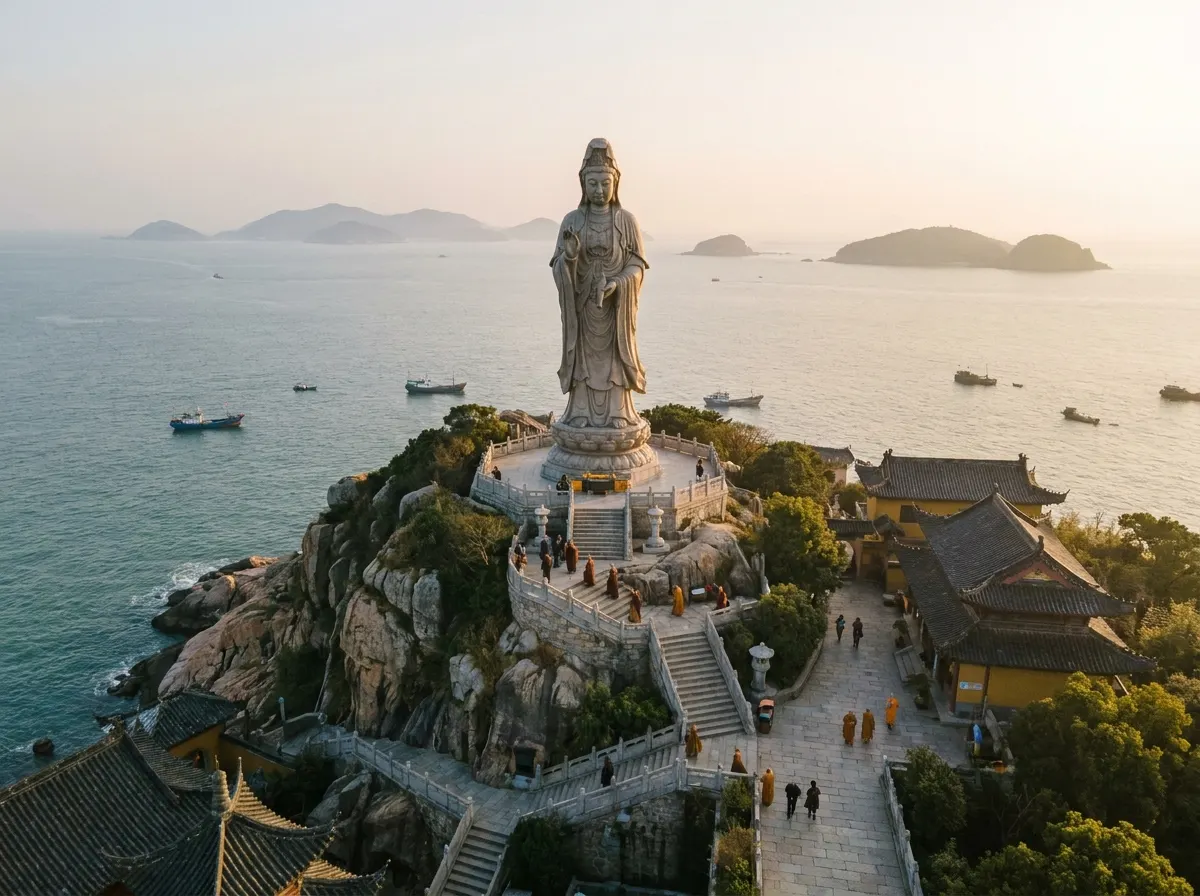
Putuoshan
Putuoshan (普陀山, Pǔtuó Shān) is a small, lush island in the East China Sea off the coast of Zhejiang Province and one of China's Four Sacred Buddhist Mountains (四大佛教名山, Sì Dà Fójiào Míngshān). It is the bodhimanda (道场, dàochǎng) of Guanyin (观音, Guānyīn), the Bodhisattva of Compassion — known in Sanskrit as Avalokitesvara and in Japan as Kannon — and has been a pilgrimage site since the Tang dynasty (7th-10th century). The island is reached by ferry from Zhoushan, and once you step ashore, the air changes: incense drifts from temple courtyards, monks in grey robes walk the coastal paths, and the sound of chanting echoes faintly from halls carved into sea cliffs. Three Great Temples (三大寺, Sān Dà Sì) anchor the pilgrimage route, but the island itself — 12.5 square kilometers of forested hills, sea caves, and golden-sand beaches — is as much the draw as any single building. Plan on two to three days; budget roughly ¥150-250 per day for mid-range comfort. The honest caveat: Putuoshan is not a hidden gem. It gets crowded, especially on weekends and Buddhist holidays, and the ferry ticket + entry-fee combination is more expensive than you might expect for a temple island. But on a misty weekday morning when the Guanyin statue rises out of the sea fog, it is genuinely transcendent.
Why Putuoshan in 2026.
A sacred Buddhist island off Zhejiang's coast, home to Guanyin's bodhimanda, sea-wrapped temples, and vegetarian food worth crossing an ocean for.
Quick Answer
Putuoshan (普陀山, Pǔtuó Shān) is a small, lush island in the East China Sea off the coast of Zhejiang Province and one of China's Four Sacred Buddhist Mountains (四大佛教名山, Sì Dà Fójiào Míngshān). It is the bodhimanda (道场, dàochǎng) of Guanyin (观音, Guānyīn), the Bodhisattva of Compassion — known in Sanskrit as Avalokitesvara and in Japan as Kannon — and has been a pilgrimage site since the Tang dynasty (7th-10th century). The island is reached by ferry from Zhoushan, and once you step ashore, the air changes: incense drifts from temple courtyards, monks in grey robes walk the coastal paths, and the sound of chanting echoes faintly from halls carved into sea cliffs. Three Great Temples (三大寺, Sān Dà Sì) anchor the pilgrimage route, but the island itself — 12.5 square kilometers of forested hills, sea caves, and golden-sand beaches — is as much the draw as any single building. Plan on two to three days; budget roughly ¥150-250 per day for mid-range comfort. The honest caveat: Putuoshan is not a hidden gem. It gets crowded, especially on weekends and Buddhist holidays, and the ferry ticket + entry-fee combination is more expensive than you might expect for a temple island. But on a misty weekday morning when the Guanyin statue rises out of the sea fog, it is genuinely transcendent.
| Worth visiting | Yes — one of the most atmospheric religious sites in China, set on a genuinely beautiful island. Best on a quiet weekday to avoid the pilgrimage crowds. |
|---|---|
| Recommended days | 2-3 days |
| Best time to visit | April-May and September-November (avoid July-August typhoon season and Chinese New Year/Guanyin festival crowds) |
| Daily budget | $50 (backpacker) / $140 (mid-range) / $380+ (luxury) |
| Family friendly | Moderate — beaches and gentle walking paths suit kids, but the island is temple-focused and some steep climbs are unavoidable |
| Solo friendly | Excellent — safe, contemplative, easy to navigate alone, and the vegetarian food is naturally solo-diner friendly |
| Airport | Zhoushan Putuoshan Airport (HSN) — flights from Shanghai (1h), Beijing (2.5h), Xiamen (1.5h), then 15-minute taxi to Zhujiajian ferry terminal + 15-minute ferry |
| High-speed rail | No direct HSR to Putuoshan. Nearest HSR station is Ningbo (宁波), then 2-hour bus or DiDi (¥200-280) to Zhujiajian ferry terminal. Shanghai HSR to Ningbo takes 2 hours. |
| Language | Mandarin with local Zhejiang dialect; temple signs are bilingual (Chinese/English), but spoken English is rare |
| Currency | CNY (¥) — Alipay and WeChat Pay accepted at most temples, restaurants, and the ferry; carry ¥200-300 cash for incense purchases and small donation boxes |
| Time zone | China Standard Time (UTC+8) |
| Last updated | 2026-06-18 |
Want a Putuoshan plan built for you?
Jump to:
Why Visit·Buddhist Significance·Getting There·Getting Around·Where to Stay·Three Great Temples·Vegetarian Food·Itineraries·Weather·Tips·Emergencies·Pilgrim Practices·Beaches & Caves·Sacred Natural Sites·Photography & Light·Three-Step Waterfall·Daily Rhythm·FAQ
Why visit Putuoshan? Is it worth going for foreign tourists?
Putuoshan is not a standard China sightseeing destination. There are no skyscrapers, no night markets, no neon. What it offers is something rarer: a fully intact Chinese Buddhist pilgrimage culture, still genuinely practiced, set on an island of real natural beauty. It is one of the Four Sacred Buddhist Mountains (四大佛教名山, Sì Dà Fójiào Míngshān), each associated with a major bodhisattva: Wutai Shan (Wenshu/Manjusri), Emei Shan (Puxian/Samantabhadra), Jiuhua Shan (Dizang/Ksitigarbha), and Putuo Shan (Guanyin/Avalokitesvara). Among these, Putuoshan is the only one on an island, and the maritime setting — temples on sea cliffs, incense drifting over the water, the sound of waves mixing with chanting — gives it an atmosphere the others cannot replicate. The island has been a Guanyin pilgrimage destination since the Tang dynasty, attracting devotees from across East Asia. Japanese, Korean, and Tibetan pilgrims are common here, and the island has a distinctly pan-Buddhist feel — you will hear chanting in multiple languages, see monks in different-colored robes, and encounter pilgrims prostrating themselves every three steps on the path to Huiji Temple. The honest downside: Putuoshan is expensive by Chinese temple-mountain standards. The ferry (¥60 round-trip) plus the island entry fee (¥180 as of June 2026, seasonal variation applies) means you are ¥240 in before you see a single temple. Accommodation on the island is pricier than on the mainland — a basic guesthouse room runs ¥200-350, and hotels are ¥400-800. Weekends and Buddhist holidays (especially the three annual Guanyin festival days: lunar calendar 2/19, 6/19, 9/19) bring crushing crowds. If you visit on a Guanyin festival day, expect every temple to be shoulder-to-shoulder and accommodation to be fully booked weeks ahead. Choose a quiet Tuesday in April or October, and Putuoshan is one of the best travel experiences in coastal China.
What is the Buddhist significance of Putuoshan and who is Guanyin?
Guanyin (观音, Guānyīn) is the Chinese name for Avalokitesvara, the Bodhisattva of Compassion, one of the most widely venerated figures in Mahayana Buddhism. The Sanskrit name means "the lord who looks down [with compassion]," and Guanyin's defining attribute is the vow to hear the cries of all sentient beings and assist them. In India and Tibet, Avalokitesvara is depicted as male; in China, from roughly the 10th century onward, Guanyin became increasingly depicted as female — often in a flowing white robe, holding a vase of pure water and a willow branch, standing on a lotus or a dragon. This feminine form, especially popular in coastal China, is the Guanyin of Putuoshan. Putuoshan's Buddhist history stretches back to the Tang dynasty (618-907 CE). According to the Flower Garland Sutra (Avatamsaka Sutra), the bodhimanda of Avalokitesvara is Mount Potalaka, an island-mountain in the southern sea. Chinese Buddhist monks identified Mount Potalaka with this small island off the Zhejiang coast, and by the 10th century it was an established pilgrimage site. The association was cemented by a legend: in 863 CE, a Japanese monk named Egaku (惠锷) visited Mount Wutai and acquired a statue of Guanyin. He tried to sail back to Japan with it, but his ship was blocked by a storm and by iron lotus flowers that rose from the sea. He understood this as Guanyin's wish not to leave China, and he built a small shrine — the precursor to the Never-Wanting-To-Leave Monastery (不肯去观音院, Bùkěn Qù Guānyīn Yuàn) — on the shore where the statue remains to this day. Today, Putuoshan receives roughly 10 million visitors a year, the vast majority Chinese pilgrims. The three annual Guanyin festival days — the 19th day of the 2nd, 6th, and 9th lunar months — are the peak, with tens of thousands of pilgrims converging on the island in a single day. The atmosphere is devout, intense, and fascinating to witness, though if you want quiet contemplation, avoid these dates entirely.
How to get to Putuoshan: ferries, flights, and the Shanghai route?
Putuoshan is an island, and access is exclusively by ferry. The most common approach: fly or take the HSR to Ningbo (宁波), then take a bus or DiDi to the Zhujiajian (朱家尖) ferry terminal on the Zhoushan archipelago (about 2 hours from Ningbo, ¥200-280 by DiDi). From Zhujiajian, ferries depart every 15-30 minutes from roughly 06:30 to 20:30, taking 15 minutes and costing ¥30 one-way (¥60 round-trip as of June 2026). From Shanghai, the journey is 4-5 hours door-to-door. Take the HSR from Shanghai Hongqiao to Ningbo (2 hours, ¥150-230 second class), then a 2-hour bus or DiDi to the ferry terminal, then the 15-minute ferry. There are also direct buses from Shanghai South Long-Distance Bus Station to Zhujiajian (4.5-5 hours, ¥130-160), but the HSR + DiDi route is faster and more comfortable. From Zhoushan Putuoshan Airport (HSN), which has direct flights from Shanghai Pudong (1 hour, from ¥600) and Beijing (2.5 hours, from ¥900), it is a 10-15 minute taxi to the Zhujiajian ferry terminal, then the 15-minute ferry. Once you arrive at the Putuoshan ferry terminal on the island itself, the entry fee (¥180 as of June 2026, with seasonal variations — February and December are cheaper at ¥140) is mandatory. The ticket is a card valid for as long as you stay on the island. A practical note: the ferry on peak days (Guanyin festivals, Golden Week, summer weekends) can have waits of 1-2 hours. Buy your ferry ticket on Trip.com or the official WeChat mini-program in advance if you are traveling during peak periods. Arrive at the ferry terminal by 07:30 on festival days. From Hangzhou: Take HSR from Hangzhou East to Ningbo Station (1 hour, ¥85-120), then the 2-hour bus or DiDi to Zhujiajian (¥200-280). Total Hangzhou-to-Putuoshan journey: 3.5-4 hours. This is the standard route for travelers combining Putuoshan with a Hangzhou stop (West Lake, Lingyin Temple). The Hangzhou-Ningbo HSR runs every 15-30 minutes from 06:00 to 22:00, so timing flexibility is excellent. From Suzhou: HSR from Suzhou to Ningbo takes 2.5-3 hours with one change (usually at Hangzhou East), ¥150-200. Then DiDi or bus to the ferry terminal as above. Total Suzhou-to-Putuoshan journey: 5-6 hours. Most travelers from Suzhou break the journey with an overnight in Hangzhou or Ningbo. From Nanjing or other Yangtze Delta cities: HSR to Ningbo (2.5-3 hours from Nanjing, ¥200-280) then the same onward route. The cross-Yangtze bridges and tunnels from northern Jiangsu add time but the overall journey is manageable. From Beijing or other long-distance origins: Fly into Zhoushan Putuoshan Airport (HSN) if available — there are direct flights from Beijing Capital (2.5h, ¥900-1500), Shanghai Pudong (1h, ¥600-900), Xiamen (1.5h, ¥700-1100), and a handful of other cities. Otherwise fly to Shanghai Pudong and continue by HSR to Ningbo. Beijing-Shanghai flying + HSR to Ningbo + bus to ferry + ferry is roughly 7-8 hours door-to-door with a tight connection, 9-10 hours with a relaxed one. Ferry ticket logistics in detail: Tickets can be bought at the Zhujiajian Wugong Wharf (朱家尖蜈蚣峙码头) ferry terminal on the day, or pre-purchased on Trip.com, WeChat, or the official Putuoshan Tourism app. The round-trip ticket (¥60) is valid for return within 30 days, so you do not need to specify a return date. During peak periods, the ferry ticket queues at the terminal can be 60-90 minutes; pre-purchase saves this. For the return trip, allow 30-45 minutes to clear the ferry terminal and reach the last ferry of the day (typically 20:30, but this varies seasonally — confirm with your hotel the day before).
How to get around Putuoshan: shuttle buses, walking, and the cable car?
Putuoshan bans private cars — the island is largely vehicle-free aside from official shuttle buses (景区巴士, jǐngqū bāshì) that connect the main temples, the beaches, and the ferry terminal. The shuttle network is effective and covers six color-coded routes. Fares are ¥5-10 per ride depending on distance, payable in cash or via the island's stored-value transport card. Buses run roughly 06:30-18:00, with reduced service in winter. The best way to experience Putuoshan, however, is on foot. The island is only about 12.5 square kilometers, and the main pilgrimage route — from the ferry terminal up through Puji Temple to Fayu Temple and then up to Huiji Temple — is a beautiful 5-6 kilometer walk along paved paths through forest, with sea views opening up on the coastal stretches. Walking between temples takes 20-40 minutes, and the paths are well-marked with Chinese and English signs. For Huiji Temple at the summit of Foding Mountain (291m), you have two options: climb the 1,088 stone steps (about 40-60 minutes, steep but well-paved) or take the cable car (¥40 round-trip, ¥25 one-way). The cable car runs 07:00-17:00 and the ride takes about 8 minutes. I recommend walking up and riding down — the climb is a pilgrimage experience in itself, with small shrines and incense burners along the steps, and the downhill walk is hard on the knees. There are no DiDi or taxis on the island. If you have limited mobility, rely on the shuttle buses and the cable car — the walking distances between temples are manageable but the terrain is hilly and the steps are many. The shuttle bus routes in more detail: there are six color-coded lines — Red, Yellow, Blue, Green, Purple, and Orange — that cover the entire island. The Red Line (1) is the main spine, running from the ferry terminal to Puji Temple, Fayu Temple, and on to the base of Foding Mountain (with connections to the cable car). The Yellow Line serves the southern coastal attractions — Purple Bamboo Grove, the Never-Wanting-To-Leave Monastery, Chaoyin Cave, and Nanhai Guanyin. The Blue Line runs to Thousand Step Beach and Hundred Step Beach on the eastern shore. Each line has 6-12 stops, and the buses run every 10-20 minutes during operating hours. You can transfer between lines at the major hubs (Puji Temple, ferry terminal). The official shuttle map is available at the ferry terminal visitor center and at most hotel front desks. The stored-value transport card (景区一卡通, jǐngqū yīkǎtōng) costs ¥50 deposit plus whatever value you load (¥50, ¥100, or ¥200 typical). It gives a small discount (¥1-2 per ride) over cash and saves fumbling for change. The deposit is refundable at the ferry terminal on departure. For a 2-day visit, a ¥150-200 card balance plus the deposit covers all shuttle bus travel plus a few cable car trips. Practical walking advice: comfortable shoes with grippy soles are non-negotiable. The temple courtyards are smooth flagstones that become treacherous when wet, the coastal paths have uneven sections, and the Foding Mountain steps are steep. In summer, the humidity makes even short walks between temples sweaty — bring water and a small towel. In winter, the same paths are damp and cold — windproof layers and warm socks help. Photography breaks are inevitable; budget extra time for them and don't try to fit too many temples into one day on foot.
Where to stay on Putuoshan: temple guesthouses, hotels, and area guide?
All accommodation on Putuoshan is clustered in a few compact zones near the ferry terminal and Puji Temple. There are no international chain hotels on the island — accommodation runs from monastery guesthouses to mid-range Chinese hotels. The Puji Temple area is the most convenient base, with the densest concentration of hotels, guesthouses, and vegetarian restaurants. Mid-range hotels like the Putuoshan Hotel (普陀山大酒店) and the CITIC Putuo Hotel run ¥400-700 per night. Budget guesthouses and small inns on the side streets run ¥180-350. The ferry terminal area has a cluster of newer hotels, slightly cheaper (¥250-500), and is convenient for early-morning ferry departures but lacks the atmosphere of the temple zone. Temple guesthouses (寺庙客房, sìmiào kèfáng) are the most memorable option. Puji Temple and Fayu Temple both offer simple guest rooms to pilgrims and visitors. Rooms are spartan — hard bed, small bathroom, no TV — but the experience of waking up to morning chanting and walking the temple grounds before tourists arrive is unmatched. Rates are ¥100-200 per person per night. Book by calling the temple office or asking your hotel to arrange it — online booking is not available for temple stays as of June 2026. Note that temple guesthouses are single-gender (separate male and female wings), lights-out is around 21:00, and vegetarian rules are strictly enforced — no meat, no alcohol, no smoking on the premises. The island's neighborhoods: the Puji Temple zone (central, convenient, lively), the Fayu Temple zone (quieter, greener, more atmospheric), the beach zone near Thousand Step Beach (scenic, limited facilities), and the ferry terminal zone (convenient, functional). For most first-time visitors, the Puji Temple area is the right choice.
What are the Three Great Temples and how should I visit them?
The Three Great Temples (三大寺, Sān Dà Sì) form the pilgrimage backbone of Putuoshan, and visiting all three in one day is the classic experience. I recommend starting at Puji Temple at 07:00, when the morning chanting begins and the courtyards are still cool and sparse. Puji Temple (普济寺, Pǔjì Sì) was founded in 916 AD and is the island's administrative and spiritual headquarters. The layout is classic Chinese Buddhist: a Hall of Heavenly Kings with four guardian deities, a Great Hero Hall with the central Guanyin statue flanked by 32 manifestation figures, and a rear Guanyin Hall. The lotus pond in front of the main gate (放生池, fàngshēng chí, "life-release pond") is filled with turtles and koi released by pilgrims. The Yuanming Lecture Hall (圆通殿, Yuántōng Diàn) to the east is where monks give Dharma talks — visitors are welcome to sit quietly at the back. From Puji, walk 30 minutes along the coastal path (or take the shuttle bus for ¥5) to Fayu Temple (法雨寺, Fǎyǔ Sì). This is the most architecturally beautiful of the three, a Ming-dynasty foundation rebuilt in the Qing, with an ascending sequence of halls climbing a forested hillside. The Nine-Dragon Hall (九龙殿, Jiǔlóng Diàn) is the highlight — its roof ridge carries nine coiling ceramic dragons, a gift from the Kangxi Emperor, and the interior is dark, intimate, and heavy with incense. Fayu is quieter than Puji; spend time here. From Fayu, continue uphill (shuttle bus or walk 20 minutes) to the base of the Foding Mountain steps. Climb the 1,088 steps (or take the ¥25 cable car) to Huiji Temple (慧济寺, Huìjì Sì) at the summit. This is the smallest and simplest of the three — a single courtyard with the main hall, a bell tower, and a view terrace. The Guanyin statue here is said to be particularly responsive to prayers for children, and the temple is popular with couples seeking fertility blessings. The real reward is the panorama: on a clear day, the entire island spreads below, the East China Sea stretches to the horizon, and the Zhoushan archipelago forms a chain of green islands fading into the haze. Incense etiquette: Buy incense (¥5-10) from the temple supply shops, not from touts. Light three sticks, hold them between your palms at forehead level, bow three times, and place them in the censer. Do not wave incense around or throw it — the practice is calm and deliberate. If you do not wish to burn incense, silent observation is perfectly acceptable.
What to eat on Putuoshan: vegetarian Buddhist cuisine and seafood?
Putuoshan is famous for two food cultures that sit in fascinating tension: strict Buddhist vegetarian cuisine (素菜, sùcài) and the fresh seafood of the Zhoushan archipelago. Buddhist vegetarian food on the island is genuine, not a tourist gimmick. The temple restaurants serve simple meals of rice, tofu, seasonal vegetables, mushrooms, and bean-curd dishes prepared without garlic, onion, leeks, or chives (the five pungent roots, 五荤, prohibited in Buddhist cuisine because they are believed to excite the senses). The Puji Temple Vegetarian Restaurant (普济寺素斋, Pǔjì Sì Sùzhāi) is the best-known, serving set meals for ¥30-50 per person — show up at 11:00 for lunch or 17:00 for dinner, buy a ticket from the counter, and join the communal tables. Lunch is the larger meal; by 12:30, many dishes are gone. Fayu Temple also has a smaller vegetarian restaurant (¥25-40), and the Huiji Temple summit complex has a simple vegetarian canteen (¥20-30). Meals are self-service from steam tables, the atmosphere is communal and quiet, and the food is simple but satisfying — do not expect gourmet temple cuisine, but do expect honest, clean vegetarian cooking. Off the temple grounds, the island's restaurants serve local Zhoushan seafood: yellow croaker (黄鱼, huángyú), swimming crab (梭子蟹, suōzixiè), razor clams (蛏子, chēngzi), and abalone farmed in the clear waters around the archipelago. The main restaurant strip is near Puji Temple, and a seafood dinner for two costs ¥120-250 depending on what you order. The tension between the vegetarian temple culture and the seafood restaurant culture is real — many pilgrims observe a vegetarian diet on the island, and the restaurants happily accommodate this. If you eat seafood, do it at the mainland-side restaurants in Zhujiajian before or after your island stay; on the island itself, the vegetarian food is the more interesting experience. Practical food advice: the island's restaurants are more expensive than mainland equivalents — a simple noodle soup costs ¥25-35 and a seafood dinner for two is ¥150-300. Temple vegetarian meals are the best value and the most authentic experience. Bring snacks if you are a fussy eater, as the mini-market selection on the island is limited. The phrase "wǒ chī sù" (我吃素, I eat vegetarian) and "yào yī fèn sùzhāi" (要一份素斋, I want a vegetarian temple meal) are useful.
What are 1-day, 2-day, and 3-day itineraries for Putuoshan?
One-day whirlwind (only if you must — you will miss a lot): Take an early ferry, arrive by 07:30. Walk to Puji Temple (07:30-08:30), shuttle to Fayu Temple (08:30-09:30), then cable car or climb to Huiji Temple summit (09:30-11:00). Lunch at the Huiji Temple vegetarian canteen (11:00-11:30). Descend via cable car, shuttle to Nanhai Guanyin Statue (12:30-13:30), walk to Purple Bamboo Grove and Chaoyin Cave (13:30-14:30), then a final shuttle to the ferry terminal for a 16:00 ferry. This is rushed and you will be tired. If you can stay overnight, do. Two-day plan (the sweet spot): Day 1 — Arrive morning, settle in, visit Puji Temple at a relaxed pace (09:00-11:00), lunch at Puji Temple vegetarian restaurant (11:00-12:00). Afternoon: walk the coastal path to Purple Bamboo Grove and the Never-Wanting-To-Leave Monastery (13:00-14:30), then Nanhai Guanyin Statue (14:30-15:30). Late afternoon: Chaoyin Cave for the wave sounds (16:00-17:00). Evening: seafood dinner near the ferry terminal area. Day 2 — Early start at Fayu Temple (07:00-08:30), climb Foding Mountain steps to Huiji Temple (08:30-10:00), coffee and rest at the summit, descend by cable car (10:30-11:00). Lunch at Fayu Temple vegetarian restaurant. Afternoon: explore the beach — Thousand Step Beach for a long walk (13:30-15:00) — then take the afternoon ferry back. Three-day plan (the immersive experience): Day 1 and 2 as above. Day 3 — Morning meditation or chanting observation at Puji Temple (05:30 — ask your hotel for the chanting schedule), followed by a relaxed breakfast. Late morning: a loop walk along the northern coastal path to visit smaller, less-visited shrines like Fantong Cave (梵洞) and Fanyin Cave (梵音洞), where hermits and nuns have lived for centuries. Lunch at a small guesthouse restaurant. Afternoon: return to Thousand Step Beach for swimming (summer) or a final contemplative temple visit. This third day transforms the trip from sightseeing into something closer to a personal retreat. The smaller shrines and the quiet hours between the main pilgrimage routes are where Putuoshan reveals itself.
What is the monthly weather on Putuoshan and when should you visit?
January: 3-9°C, damp and grey, the lowest tourist season. Ferry service reduced, some guesthouses close. The island is quiet and contemplative but cold. Average 10 rainy days. February: 4-10°C, still cold and damp. The Chinese New Year period brings a surge of pilgrims — book ahead if visiting during Spring Festival. Lantern Festival brings evening ceremonies at Puji Temple. Average 12 rainy days. March: 7-14°C, the first green shoots appear. Mist and fog are common, creating an atmospheric grey that photographers love but sun-seekers will find gloomy. The first Guanyin festival (lunar 2/19, usually March) is extremely crowded. Average 15 rainy days. April: 12-20°C, the start of the best window. Azaleas bloom on the hillsides, the sea is calmer, and the weather is comfortable for walking. Weekends get busy; weekdays remain quiet. Average 14 rainy days. May: 17-25°C, arguably the best month. Warm but not hot, the island is green and flowering, and the sea is blue on clear days. Avoid the Labour Day holiday (first week of May). Average 13 rainy days. June: 21-28°C, the plum rain season (梅雨, méiyǔ) brings weeks of intermittent rain. Humidity is high. The second Guanyin festival (lunar 6/19, usually June/July) draws large crowds. Average 16 rainy days. July: 25-33°C, hot and humid, the start of typhoon season. Swimming is possible at Thousand Step Beach. Avoid if you dislike heat — the humidity makes walking between temples punishing. Average 12 rainy days, but typhoon risk means heavy downpours are possible. August: 26-34°C, the hottest month, peak typhoon season. Ferry service can be suspended during typhoon warnings — always check the forecast and have a backup plan. The island is less crowded than you would expect because domestic tourists avoid the heat. Average 14 rainy days. September: 22-30°C, typhoon season continues through mid-month. The third Guanyin festival (lunar 9/19, usually September/October) is the busiest on the island. Late September begins the autumn window. Average 12 rainy days. October: 17-25°C, along with April, the best month. Dry, crisp, clear skies, comfortable walking temperatures. The autumn light on the temples is beautiful. Avoid the National Day Golden Week (first week of October). Average 8 rainy days. November: 11-19°C, cooler but still pleasant for walking. The leaves turn on the island, fewer pilgrims, and lower hotel prices. One of the most underrated months. Average 8 rainy days. December: 5-11°C, cold and damp, but quiet and contemplative. Ferry service normal, hotel prices at their lowest. If you do not mind the cold and grey, December offers the most solitary Putuoshan experience. Average 8 rainy days.
What practical tips and warnings should I know for Putuoshan?
1. THE FERRY IS YOUR BOTTLENECK. On Guanyin festivals, Golden Week, and summer weekends, the Zhujiajian-Putuoshan ferry can have 1-2 hour queues. Arrive by 07:30, buy tickets on Trip.com in advance, or accept that you will wait. The last ferry back to the mainland is at 20:30 (varies seasonally) — do not miss it, as there is no way off the island after the ferries stop. 2. ACCOMMODATION BOOKS OUT ON FESTIVALS. The three Guanyin festival days (lunar 2/19, 6/19, 9/19) see the island's accommodation reach full capacity weeks in advance. Chinese New Year and Golden Week are similarly packed. If you are visiting during a festival: book a month ahead, or stay in Zhujiajian on the mainland and take the early ferry. 3. THE ENTRY FEE PLUS FERRY COSTS ADD UP. You will pay ¥180 (island entry, seasonal) + ¥60 (ferry round-trip) + ¥5-10 per shuttle bus ride + ¥5 per temple incense fee + ¥6 for Nanhai Guanyin + ¥40 for the cable car. Budget roughly ¥280-320 per person in entry, transport, and temple fees for a 2-day visit. 4. TEMPLE ETIQUETTE MATTERS. Do not point at Buddha statues with your index finger (use an open palm). Do not take photos inside the main halls unless explicitly permitted. Step over the threshold, not on it. Dress modestly — shoulders and knees covered — particularly inside temple halls. Putuoshan is a functioning religious site first and a tourist destination second; respect the pilgrims who are there to worship. 5. THE ISLAND IS EXPENSIVE. Restaurant prices on Putuoshan are 1.5-2x mainland prices. A simple noodle soup: ¥25-35. A bottle of water: ¥5-8. Seafood dinner for two: ¥150-300. Temple vegetarian meals (¥20-50) are the best value. Bring snacks from the mainland if budget is tight. 6. TYPHOON RISK JULY THROUGH SEPTEMBER. Putuoshan is in the East China Sea typhoon corridor. Ferry service is suspended during typhoon warnings, stranding visitors on the island (or on the mainland side). Check the forecast before traveling between July and September, and build a buffer day into your itinerary. 7. NO CARS, NO DIDI, NO TAXIS. The island is vehicle-free except for shuttle buses. If you have mobility limitations, the shuttle bus + cable car combination works, but some temple access paths (particularly Huiji Temple via the steps) are not disability-accessible. The island's terrain is genuinely hilly — comfortable walking shoes are essential. 8. CASH FOR INCENSE AND DONATIONS. Most temple shops, small restaurants, and donation boxes require cash (¥5-20 bills are useful). Alipay and WeChat Pay are accepted at major ticket offices and larger restaurants, but carry ¥300-500 in cash for temple expenses. 9. BOOK AHEAD FOR TEMPLE GUESTHOUSES. Staying in a temple guesthouse is the most memorable Putuoshan experience, but rooms are limited and cannot be booked online. Call your hotel or a Chinese-speaking friend to inquire about availability before arriving. Temple stays are single-gender and enforce vegetarian, no-alcohol, no-smoking rules. 10. THE SUMMER SWIM IS SURPRISINGLY GOOD. Thousand Step Beach is clean, the surf is gentle, and the water temperature is swimmable June through September. There are no formal lifeguards or rental facilities — bring your own swimwear and towel. Early morning (06:00-08:00) is the best time, when the beach is empty and the light is soft.
What are the emergency contacts for Putuoshan?
Police: 110. Ambulance: 120. Fire: 119. Tourist complaint hotline (Putuoshan): 0580-6091123. The island has a small medical clinic near Puji Temple for minor injuries and illness. For anything serious, patients are evacuated by ferry to Zhoushan Hospital (舟山医院) on the mainland, roughly 1 hour from ferry to hospital. Comprehensive travel insurance covering medical evacuation is strongly recommended — Putuoshan is an island with limited medical infrastructure. Tap water on the island is not potable. Bottled water is available everywhere (¥5-8 per 500ml bottle) and all hotels provide kettles. Air quality on Putuoshan is excellent year-round thanks to the maritime location. AQI is typically below 50. The island is extremely safe. The main risks are: slipping on wet stone paths (temple courtyards get very slippery in rain), sunburn on the beach (there is almost no shade), and dehydration on hot summer days during long temple walks. Pickpocketing is virtually unheard of. Pharmacies: A handful of small pharmacies (药店, yàodiàn) cluster near the ferry terminal and Puji Temple, selling standard over-the-counter medications (cold medicine, stomach remedies, motion-sickness pills, bandages). Most pharmacists speak only Mandarin but can identify common Western drug names from the packaging. Bring any prescription medications from home — the pharmacies do not stock Western prescription drugs and the island clinic cannot fill foreign prescriptions. Pharmacies are typically open 08:00-21:00 in summer and 08:00-19:00 in winter. Medical evacuation: For serious illness or injury, the standard procedure is ferry to Zhoushan, then ambulance (or taxi for non-urgent cases) to Zhoushan Hospital, a major general hospital with English-speaking doctors in the VIP/international wing. The ferry ride to Zhoushan is roughly 45 minutes, and from the Zhujiajian wharf to the hospital by taxi is another 30 minutes. Total evacuation time door-to-hospital: roughly 90 minutes in good conditions. In typhoon season, evacuation may be impossible for hours or days — a serious reason to keep your own health reserves (insulin, cardiac meds, EpiPens) accessible, not packed in checked luggage. Common minor health issues and how to handle them: Mild dehydration is the most common issue, especially on hot summer days walking between temples. Drink more water than you think you need. Sunburn on the beach or the unshaded coastal walks — bring high-SPF sunscreen and a hat, as there is little natural shade on the southern coastal paths. Sea-sickness on the ferry — the Zhujiajian-Putuoshan ferry is usually calm, but in choppy conditions (especially during typhoon season) it can be uncomfortable; motion-sickness pills are sold at mainland pharmacies. Mild heat exhaustion or sunstroke in summer — rest in shade, drink electrolytes, and avoid midday outdoor activity. Insect bites — the forested interior has mosquitoes in summer; bring repellent. Stone-step slips — wear shoes with grippy soles and avoid the temple courtyards in rain. Communications: Mobile signal on Putuoshan is good in the temple zones, the ferry terminal, and the main beaches. Less reliable on the northern coastal paths and inside the deep forest. WiFi is available at most hotels but rarely at temple guesthouses. A roaming SIM or a local Chinese SIM with data (China Mobile, China Unicom) is recommended. International roaming works but is expensive; eSIM providers like Airalo can supply data packages for the mainland. VPN requirements for Google, Gmail, WhatsApp, and Instagram apply on Putuoshan as on the mainland — these services are blocked unless you have a working VPN installed before arrival. Language help: Almost no one on Putuoshan outside the larger hotels speaks English. The temple staff, restaurant servers, shuttle bus drivers, and shopkeepers all speak Mandarin (and often local Zhejiang dialect). A translation app with offline Chinese capability (Google Translate with the Chinese pack downloaded, Pleco, or Baidu Translate) is essential. The phrase "wǒ bùshuō Zhōngwén, nǐ néng shuō Yīngyǔ ma?" (我不说中文, 你能说英语吗?, "I don't speak Chinese, do you speak English?") is useful and often greeted with apologetic smiles. Most hotel front desks have at least one English-speaking staff member, and they are your best first call for any on-island issue.
What is the Foding Mountain summit, the 1,088 steps, and the highest peak on Putuoshan?
The summit of Putuoshan is Foding Mountain (佛顶山, Fódǐng Shān), which reaches 291 meters above sea level and hosts Huiji Temple at its peak. The broader island's tallest point is Baibu Ding (百步顶) on the northern ridge, at roughly 1,003 meters by some older measurements. The 1,088 stone steps (千步登, qiānbù dēng, sometimes called the "thousand-step climb") connect the base of Foding Mountain near Fayu Temple to the Huiji Temple plateau. The climb is steep but well-paved, with stone landings every fifty steps offering small shrines, stone Buddhas, and shaded rest points. Pilgrims traditionally count the steps as a form of merit-making, reciting the name of Guanyin (观音, or the mantra "Námó Āmítuófó") at each landing. The climb takes 40-60 minutes at a steady pace, and the cable car (索道, suǒdào) offers an alternative for those who prefer not to walk. The cable car costs ¥40 round-trip (¥25 one-way), operates 07:00-17:00, and the ride itself takes roughly 8 minutes with panoramic views over the island's forested interior and the sea beyond. From the upper cable car station it is a further 10-15 minute walk to Huiji Temple. Most visitors walk up and ride down — the uphill walk is part of the pilgrimage experience, while the downhill puts heavy strain on the knees, particularly in damp weather when the stones can be slick. At the summit, the reward is the view. On a clear day, the entire island spreads below you: the Three Great Temples visible as white-walled clusters among green forest, the Nanhai Guanyin statue a small bronze figure against the southern sea, the Zhoushan archipelago forming a chain of green islands fading into the haze of the East China Sea. The Huiji Temple summit terrace is the best single vantage point on the island for understanding Putuoshan's geography — the relationship between the forested interior, the temple settlements, and the surrounding sea is unmistakable from above. Bring a light layer even in summer; the summit is noticeably cooler and windier than the coast, and mist can roll in quickly. A second, less-visited trail climbs the northern ridge from the inland path near Fayu Temple. This route reaches the island's true high point via a longer, rougher path used by serious hikers and is not recommended without proper footwear. Most casual visitors take the cable car or the 1,088 steps to Huiji Temple, which together constitute the island's signature walk.
How do Buddhist pilgrimages work on Putuoshan: chanting, kowtowing, and the three Guanyin festivals?
Putuoshan remains a functioning Buddhist pilgrimage site first and a tourist destination second, and understanding a few core practices transforms a visit from sightseeing into something much richer. The most striking pilgrim practice is the three-step-one-kowtow (三步一拜, sān bù yī bài) ceremony, in which pilgrims prostrate themselves full-length on the ground, rise, take three steps, and prostrate again — repeating for hours or even days. The most rigorous route runs from Baibu Sha (百步沙, Hundred Step Beach) on the eastern shore all the way up the 1,088 steps to Huiji Temple at the summit, a ceremony that typically takes 12 hours from dusk to dawn. Pilgrims perform this circuit to fulfill vows, pray for sick family members, or accumulate merit; you will see them on the coastal paths and especially on the Foding Mountain steps, moving slowly with wooden prayer beads and a small cloth pad to protect their foreheads and palms. Pilgrim etiquette on Putuoshan is real and worth respecting. Do not step on the wooden threshold of temple doors — step over them. Do not point at Buddha statues with your index finger; use an open palm or the whole hand. Do not take photographs inside the main halls unless signs explicitly permit it, and never photograph worshippers up close without permission. Dress modestly in temple halls — shoulders and knees covered. Women should not touch monks, and physical contact between the sexes is generally avoided in temple spaces. When incense is offered, the standard is three sticks: hold them between the palms at forehead level, bow three times with palms together, and place them upright in the censer. Burning large bundles of incense is discouraged in many temples due to fire risk and air quality — three sticks is sufficient and more respectful. The three Guanyin festival days are the peak of the pilgrimage calendar. They fall on the 19th day of the 2nd, 6th, and 9th lunar months — roughly March, July/August, and October/November in the solar calendar. The 19th day of the 2nd lunar month is Guanyin's birthday (观音诞, Guānyīn dàn); the 6th month day marks Guanyin's enlightenment (观音成道, Guānyīn chéngdào); the 9th month day marks Guanyin's ordination (观音出家, Guānyīn chūjiā). On each of these three days the island receives tens of thousands of pilgrims, the ferries run continuously from dawn to past midnight, and the temples stay open through the night for chanting and offerings. The lunar 2/19 (birthday) is the busiest, the lunar 9/19 (ordination) is the most atmospheric with cool autumn weather. The Duanwu Festival (端午节, Dragon Boat Festival, 5th day of the 5th lunar month, usually June) brings secondary crowds and zongzi rice dumplings at the temple restaurants. Daily chanting schedules are worth knowing. Puji Temple holds morning chanting (早课, zǎokè) from roughly 04:30 to 06:00 — visitors can sit quietly at the back of the Great Hero Hall. Evening chanting (晚课, wǎnkè) runs from roughly 16:30 to 17:30. Fayu Temple has similar but slightly later hours. Attending morning chanting, even once, is one of the most memorable experiences on Putuoshan: the wooden fish drum and bronze bell set the rhythm, monks in grey robes chant sutras in classical Chinese, and incense smoke fills the pre-dawn hall. Photography during chanting is restricted; observe with your senses, not your lens.
What are the best beaches, sea caves, and coastal walks on Putuoshan beyond the temples?
The eastern and northern coasts of Putuoshan hold some of the most beautiful landscapes in Zhejiang, and most visitors never see them. The two signature beaches are Thousand Step Beach (千步沙, Qiānbùshā) on the eastern shore and Hundred Step Beach (百步沙, Bǎibùshā) just to its south. Thousand Step Beach is a 1.7-kilometer crescent of fine golden sand flanked by pine-covered headlands, with gentle surf in summer and almost no development — no changing rooms, no rentals, no vendors. It is the best swimming beach on the island. Hundred Step Beach is shorter (about 350 meters) and is the traditional starting point of the three-step-one-kowtow pilgrimage up to Huiji Temple; it is more atmospheric than swim-friendly. The island's sea caves are a quieter but equally compelling feature. Chaoyin Cave (潮音洞, Cháoyīn Dòng) on the southern coast is the most famous — waves crash into a vertical cleft in the cliff face, producing the "sound of the tide" that Buddhists interpret as the voice of Guanyin. A viewing pavilion sits on the cliff above. To the east, near the entrance to the Never-Wanting-To-Leave Monastery complex, smaller sea caves and tidal pools are accessible at low tide. On the northern coast, Fantong Cave (梵洞) and Fanyin Cave (梵音洞, "Brahma Sound Cave") are the most atmospheric — Fanyin Cave in particular is a deep cleft in the cliff where waves surge in and out with a thunderous echo, and small shrines cling to the rock face above. Pilgrims sometimes meditate here for hours. The coastal walking paths tie all of these together. The southern coastal path runs from the ferry terminal area past Purple Bamboo Grove, the Never-Wanting-To-Leave Monastery, Chaoyin Cave, and on to the Nanhai Guanyin statue — about 4 kilometers in total, paved and shaded in parts, with sea views throughout. Allow 2-3 hours at a leisurely pace. The eastern coastal path runs from Nanhai Guanyin northward along the cliffs above Thousand Step Beach and on to Hundred Step Beach — about 5 kilometers, with the most spectacular sea views on the island. The northern coastal path is rougher and less developed, threading between small fishing coves and the Fantong/Fanyin cave area; it is best for experienced hikers and not recommended in rain. For a half-day beach-and-coast excursion that most day-trippers miss, take a shuttle to Thousand Step Beach, walk south along the beach (about 40 minutes), then climb the small headland path to Hundred Step Beach and on up the lower steps of Foding Mountain. From there the Foding cable car can take you back to the temple zone. This combination — beach, cliff walk, sea views, and the option of reaching Huiji Temple without retracing the busy main path — is the single best non-temple experience on Putuoshan.
What are the sacred natural sites on Putuoshan: ancient trees, Huiyun Cave, and the Matsu Temple?
Beyond the great Buddhist temples, Putuoshan has a constellation of smaller sacred natural sites that most visitors walk past without realizing what they are seeing. The most striking is the Lace Tree Grove (香樟林, Xiāngzhāng Lín, lit. "camphor tree forest"), a stand of ancient camphor trees (Cinnamomum camphora) near Puji Temple, the oldest of which is more than 1,000 years old. Camphor wood is highly prized in Chinese Buddhism — the fragrance is believed to clarify the mind and deter insects — and ancient specimens are often considered minor deities in their own right. Pilgrims circle the oldest trees three times clockwise, touch the bark, and leave small offerings. The grove is freely accessible from the paths behind Puji Temple and is at its most atmospheric in the early morning when the camphor fragrance hangs in the cool air. Huiyun Cave (慧云洞, Huìyún Dòng) on the northern coast is one of the island's oldest Buddhist sites, a sea cave where a Tang-dynasty monk is said to have first practiced on Putuoshan in the late 9th century, predating the construction of Puji Temple. A small shrine marks the cave mouth, and the path down to it threads through old pine forest. The cave itself is only accessible at low tide and requires careful footing on wet rocks. Most visitors skip it; those who go find a peaceful, lightly-visited corner of the island with a strong sense of the place's pre-temple Buddhist history. The Matsu Temple (妈祖庙, Māzǔ Miào) on the eastern shore is a curiosity — a temple to Matsu (妈祖, the Chinese sea goddess, also known as Tianhou 天后) rather than Guanyin. Matsu worship is centered on the Fujian and Zhejiang coastlines, where she is the patron of sailors and fishermen, and Putuoshan's Matsu Temple reflects the maritime culture that has surrounded the island for centuries. The temple is small and lightly visited, but it is worth a stop on the way to Thousand Step Beach for a different angle on the religious life of the island — Guanyin is the patron of compassion, but Matsu is the patron of safe passage over the water, and the two coexist on the island in a way that reflects the lived religious culture of coastal Zhejiang. The temple is free to enter. The Thousand-Year Camphor Court (千年香樟院) behind Puji Temple is a small enclosed courtyard containing several of the oldest camphor trees, with stone seats and a quiet pavilion. It is a favorite meditation spot for temple guests and is essentially unknown to day-trippers. The wild purple bamboo stands in the Purple Bamboo Grove (紫竹林) are another minor natural marvel — the stems of the bamboo here have a faint purplish tint, and the grove has been a poetic subject in Chinese literature since the Song dynasty. The bamboo is concentrated in a small hillside thicket behind the Never-Wanting-To-Leave Monastery and is freely accessible. In total, these smaller sacred natural sites — the Lace Tree Grove, Huiyun Cave, the Matsu Temple, the Thousand-Year Camphor Court, and the purple bamboo stands — can fill a full day on their own. Combined with the three great temples, the Nanhai Guanyin statue, and the beaches, they are what separates a hurried day-trip from a proper Putuoshan immersion.
When is the best light for photography on Putuoshan, and where should you shoot sunrise and night?
Putuoshan is genuinely photogenic in any season, but the light varies dramatically and understanding the timing transforms the result. The single best light of the day is the first hour after sunrise, when the eastern sea is calm, the mist rises off the water, and the temples catch the first warm light of the day from the east. The classic sunrise spot is Thousand Step Beach — the long curve of golden sand framed by pine headlands, with the Zhoushan islands on the horizon. Arrive by 05:30 in summer (sunrise is around 05:00) and by 06:30 in winter (sunrise is around 06:40). The beach is empty at this hour — no vendors, no crowds — and the soft golden light on the sand and the long blue shadows from the pines are unmatched anywhere on the island. The second-best light is the hour before sunset, when the western sky turns amber and the Nanhai Guanyin statue catches the last direct sun. The plaza around the statue is the obvious vantage point, but the better compositions are from the cliff path a few hundred meters to the east, looking back at the statue silhouetted against the sunset sky. The bronze Guanyin figure is 33 meters tall and reads powerfully against any sky. Photographers with telephoto lenses (70-200mm or longer) should also consider the view from the Foding Mountain summit at golden hour, looking south over Huiji Temple toward the Nanhai Guanyin and the sea beyond. Night photography on Putuoshan has its own rewards. The Nanhai Guanyin statue is illuminated after dark, and the bronze figure picks up a soft golden uplight that makes it visible from across the southern bay. The plaza below is usually quiet after 21:00, and long exposures of the statue against the night sky with the sea behind it produce striking images. Puji Temple's main halls are also illuminated in the evening, and the warm yellow light spilling out of the Great Hero Hall onto the courtyard stones is a classic composition. Tripods are recommended for any night photography; the existing light is enough for hand-held shots at high ISO but a tripod produces cleaner results. Quietly ask temple staff before setting up a tripod inside any hall. Seasonal light considerations matter. April and May have the clearest skies and the softest afternoon light, ideal for temple photography without harsh shadows. June through July is the plum rain season (梅雨, méiyǔ) with heavy overcast — useful for forest and waterfall photography, less so for the classic seascapes. September through November brings the driest air and the most dramatic light; the autumn low sun rakes across the temple courtyards at a low angle, producing long shadows and warm tones. Winter (December-February) is the most underrated season for photography — the soft grey light and occasional mist create a mood that suits the island's contemplative character, and the empty beaches and uncrowded temples are easier to photograph without people in frame. A practical note: many temple interiors restrict photography, especially during chanting. Outside the halls, photography is generally welcome. Always be respectful of worshippers — do not photograph people praying up close without permission, and do not use flash in temple halls even where permitted. The ferry terminal and the shuttle buses are also restricted zones — no photography of port infrastructure or customs areas.
What is the Three-Step Waterfall, and how do you climb it from Huiji Temple?
The Three-Step Waterfall (三步泉, Sānbù Quán, or 三叠泉, Sāndié Quán) is the island's best natural attraction — a 29-meter cascade dropping through a forest gorge on Foding Mountain's western flank. The waterfall is reached from the Huiji Temple summit by a 1,090-step descent trail that drops down the western ridge and into the gorge below. The walk is rough underfoot (stone steps, tree roots, occasional wet rock) but well-marked, with painted red arrows on trees and small shrines at intervals. Allow 30-40 minutes to descend. The waterfall itself is at its best in spring and early summer (April through June), when the seasonal runoff is strongest and the three cascades are clearly defined. In July through September, the flow reduces to a thin veil in dry years, and the gorge is more about the cool mist and the forest atmosphere than the visual impact. In autumn (October-November) the leaves turn, and the combination of fall color and falling water is the most photographed scene on the western side of the island. In winter, the falls sometimes freeze, and the ice formations are beautiful in a different way. The pool at the base of the lowest cascade is deep enough to swim in summer — locals and a few adventurous tourists take a quick dip — but the rocks are slippery and the water is cold year-round. There are no lifeguards or facilities. The trail continues past the waterfall up into the western forest, eventually rejoining the Foding Mountain main trail near Fayu Temple; this forms a long loop hike of roughly 5-6 hours (Huiji summit → Three-Step Waterfall → western forest → Fayu Temple → Puji Temple) that is one of the best full-day hikes on the island. Most visitors, however, just descend to the waterfall and return the same way, which is a 2-3 hour round trip. The waterfall is one of the most popular day-trip extensions from Huiji Temple. A common Putuoshan day-trip route: take the cable car up from the base of Foding Mountain, climb the last few minutes to Huiji Temple, then descend via the western trail to the Three-Step Waterfall and either return uphill (steep) or arrange to be picked up at the gorge mouth by the shuttle bus. Hiking poles help for the descent; the steps are uneven in places and the lower portion can be muddy after rain. The trail is closed during heavy rain (rockfall risk) and after typhoons — check with your hotel or the visitor center before setting out. A practical point: the Three-Step Waterfall is technically a separate attraction from the Three Great Temples, but it is included in the same island entry fee (¥180 as of June 2026). There is no additional ticket. The trailhead is clearly marked from the Huiji Temple summit complex, and the path is one-way recommended (down to the waterfall, then back up the same way) — the loop via the western forest requires a guide or careful map-reading.
What is the daily rhythm of Putuoshan: morning chanting, vegetarian noodles, and night illumination?
Putuoshan has a daily rhythm that follows the monastic schedule, and aligning your visit to it is the single best way to feel the island rather than just see it. The day begins around 04:30, when the wooden fish drum at Puji Temple calls the resident monks to the pre-dawn chanting (早课, zǎokè) in the Great Hero Hall. By 05:00 the chanting is in full voice, the incense has been lit, and the first pilgrims of the day are arriving. From 05:30 to 06:30, the air in the temple courtyards is cool, the morning light is soft, and the smell of incense and camphor hangs in the still air. This is the most atmospheric hour on the island, and visitors who make the effort to be up for it remember it longest. The morning chanting ends around 06:00, after which the temples open to visitors and the day-trippers begin arriving on the early ferries. Breakfast on Putuoshan runs from roughly 06:30 to 09:00. The temple vegetarian restaurants open with simple congee (rice porridge), steamed buns (馒头, mántou), pickled vegetables, and soybean milk. The secular restaurants around Puji Temple serve a more standard Chinese breakfast of jianbing (savoury pancakes), youtiao (fried dough sticks), and egg-and-tomato over rice. A typical breakfast costs ¥15-30. By 09:00 the day's temple-visiting has begun in earnest, and the shuttle buses start running at full frequency. Lunch is the main vegetarian meal of the day at the temples, and the temple canteens at Puji, Fayu, and Huiji all serve set vegetarian meals from 11:00 to 13:00. The Puji Temple Vegetarian Restaurant (普济寺素斋) is the largest, with communal tables and a steam-table buffet of 8-15 vegetarian dishes per day — tofu preparations, mushroom dishes, seasonal greens, braised wheat gluten, and steamed rice. Set meals run ¥30-50. Show up by 11:30; by 12:30 the popular dishes are gone. The Huiji Temple summit canteen is smaller (¥20-30) but the views from the dining hall are spectacular. Afternoon is the slow middle of the day, often hot in summer and damp in winter. From 14:00 to 16:00 the temples enter a quieter phase, the day-trippers are at their peak, and most experienced visitors use this window for the beach (Thousand Step Beach is best from 14:00 to 17:00 in summer), the coastal walks, or a rest in the hotel. The sea caves (Chaoyin Cave, Fanyin Cave) are most dramatic at high tide in the late afternoon. Evening on Putuoshan begins around 16:30, when the temples hold evening chanting (晚课, wǎnkè). The chants are shorter than the morning session (about 30-45 minutes) and the atmosphere is softer, with the setting sun coming through the western doors of the halls. After chanting, the temples close to visitors around 17:30 (later in summer, earlier in winter). The day-trippers catch the 17:00 and 18:00 ferries back to the mainland, and the island quiets down dramatically. This is the moment when overnight visitors get their reward — the temples are empty, the paths are peaceful, and the sounds of the sea and the late chanting drift across the courtyards. Dinner runs from 17:30 to 20:30. Temple dining halls serve a second smaller vegetarian meal (often noodles with vegetables, mushroom soup, and steamed buns, ¥15-25). The secular restaurants serve seafood dinners; a typical Zhoushan-style seafood dinner for two costs ¥150-300 depending on what you order. By 20:30 the last restaurants are closing, and the night takes over. The Nanhai Guanyin statue is illuminated from 18:00 to 22:00, and a walk to the statue after dinner is a classic Putuoshan experience — the bronze figure glowing softly against the night sky, the sound of waves on the rocks below. The last ferries leave around 20:30 (varies seasonally), and the island is largely asleep by 22:00. A note on "mala ganbei" (麻辣干杯, "spicy cheers") and the unusual vegetarian versions on Putuoshan: the island has a quirky late-evening tradition of small vegetarian hotpot restaurants and packaged vegetarian noodles that is unique among Chinese sacred mountains. The mala ganbei restaurants serve individual pots of spicy Sichuan-style broth filled with mushrooms, tofu skin, lotus root, and greens — a meatless take on the Chongqing hotpot experience. Packaged vegetarian noodles (素面, sùmiàn) are sold in temple-area shops as instant ramen-style cups and are a popular midnight snack for the monks and the vegetarian-curious pilgrims. The mala ganbei restaurants near Puji Temple are open until 22:00 in peak season and are a memorable after-dinner stop, even for travelers who have never eaten Sichuan food before.
Top attractions
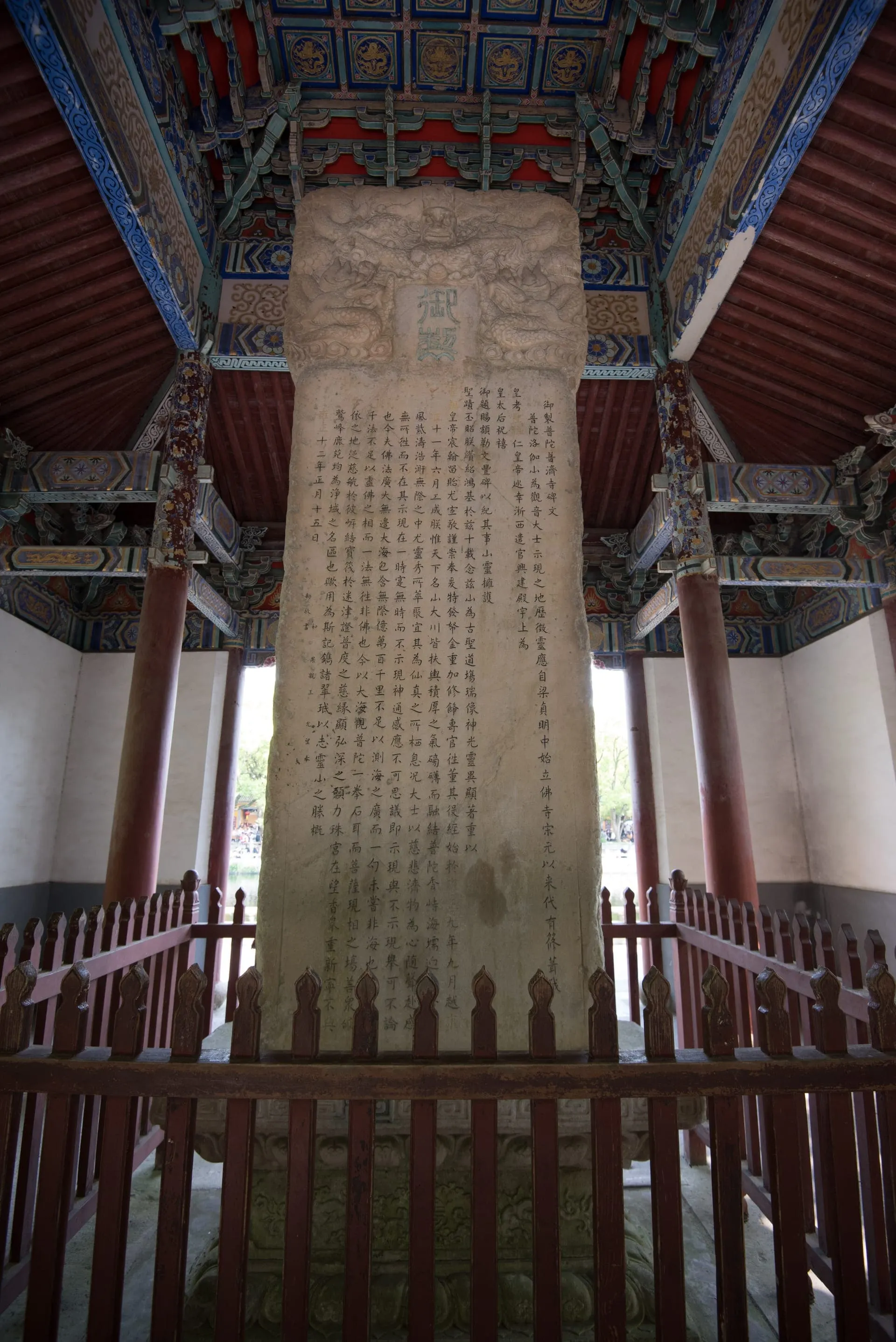
Puji Temple (普济寺, Pǔjì Sì)
The largest and most important of the Three Great Temples, founded in 916 AD during the Later Liang dynasty. The main hall houses an 8.8-meter gilt statue of Guanyin. The temple complex includes the Hall of Heavenly Kings, the Great Hero Hall, and the Guanyin Hall, surrounded by ancient camphor trees and lotus ponds. ¥5 incense fee as of June 2026.
Wikimedia Commons · CC-BY-SA
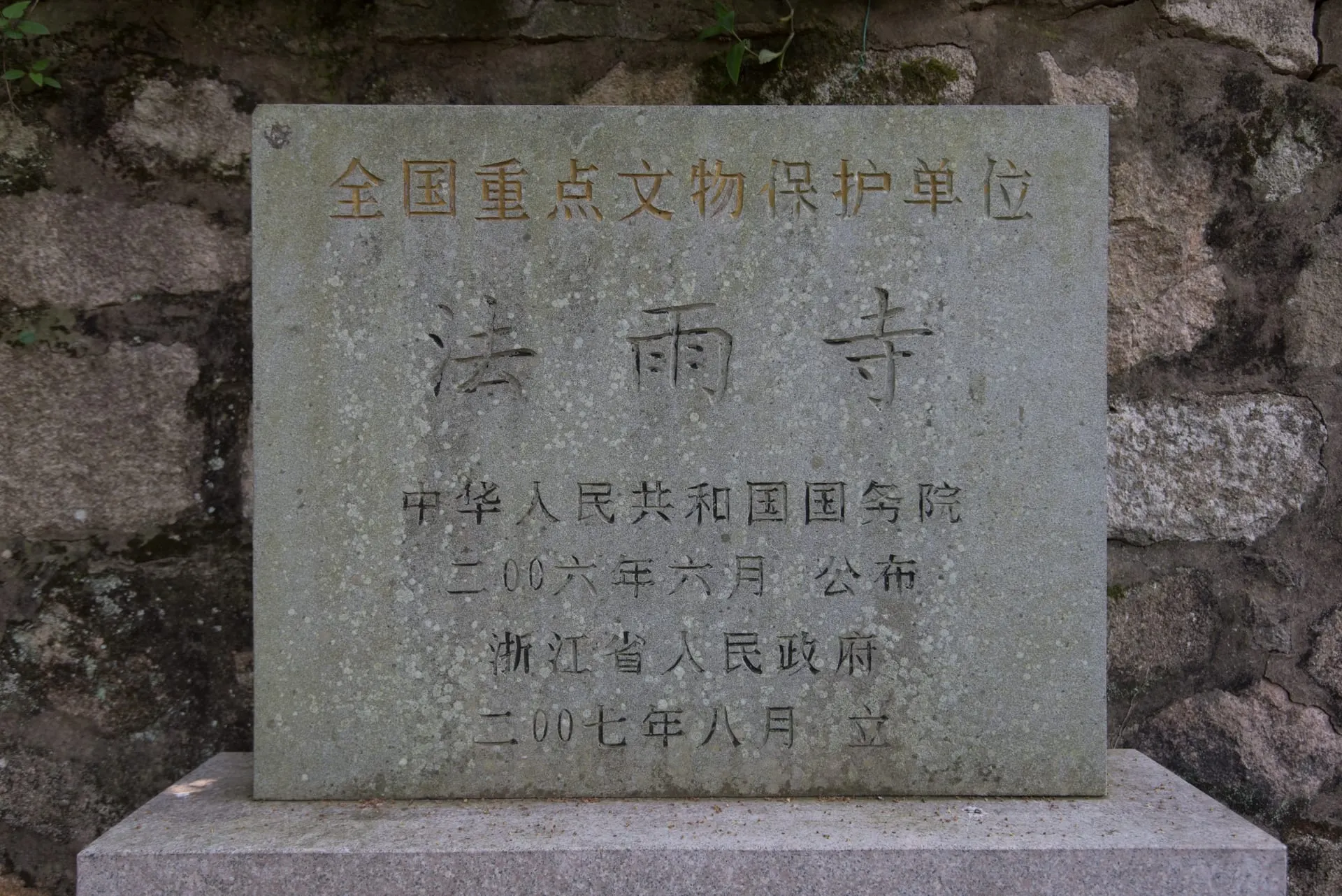
Fayu Temple (法雨寺, Fǎyǔ Sì)
The second of the Three Great Temples, built into the hillside with a dramatic ascending sequence of halls. The Nine-Dragon Hall (九龙殿, Jiǔlóng Diàn) has a roof ridge decorated with nine coiling dragons in glazed tile — a Ming-dynasty imperial gift. The temple feels quieter and more contemplative than Puji, especially in the early morning. ¥5 incense fee.
Wikimedia Commons · CC-BY-SA
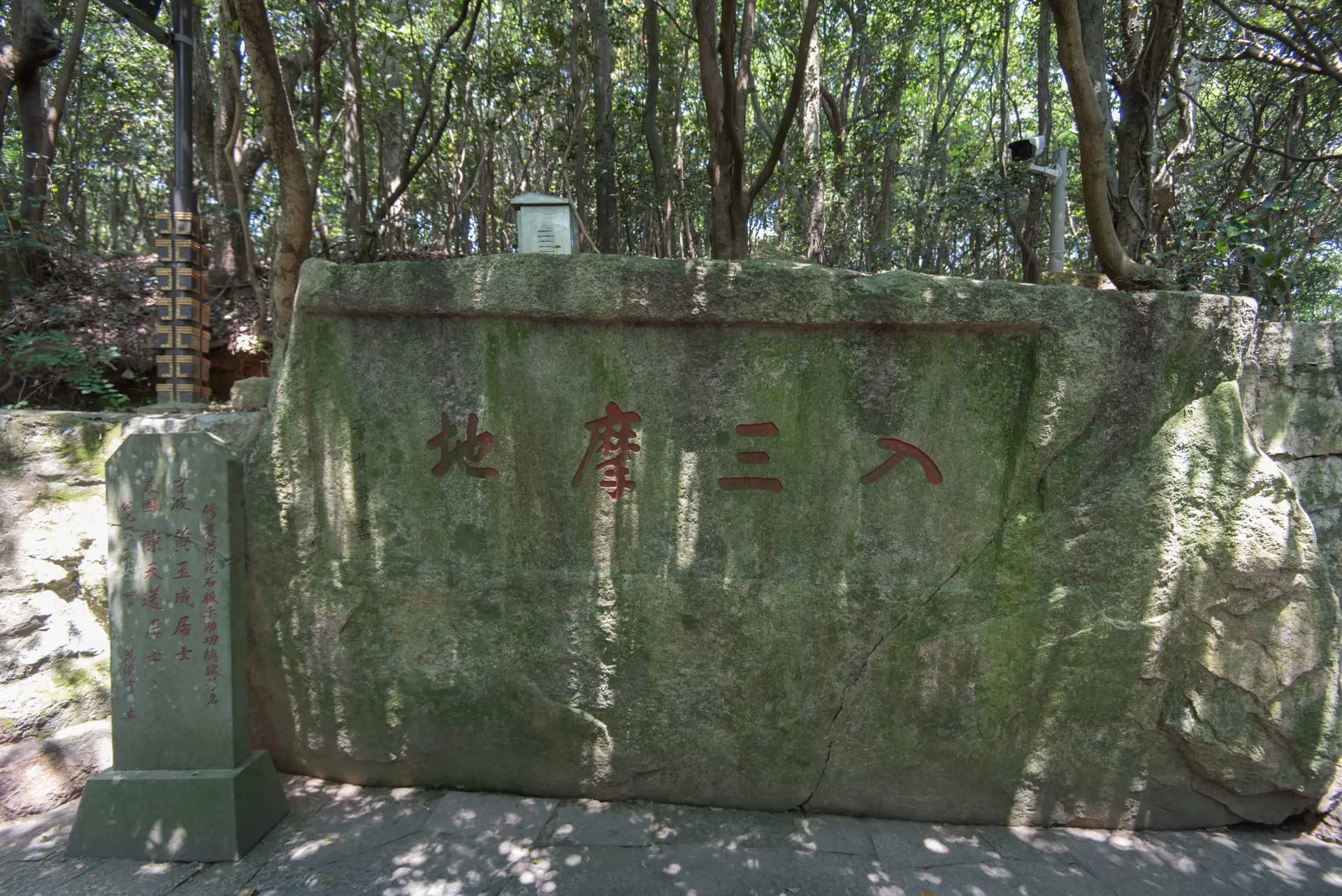
Huiji Temple (慧济寺, Huìjì Sì)
The highest of the Three Great Temples, perched at 291 meters near the summit of Foding Mountain (佛顶山, Fódǐng Shān). Reached by a steep 1,088-step stone staircase or a cable car (¥40 round-trip). The temple is smaller and simpler than the other two, but the view — the entire island spread below, the sea on three sides — makes the climb worth it. ¥5 incense fee.
Wikimedia Commons · CC-BY-SA
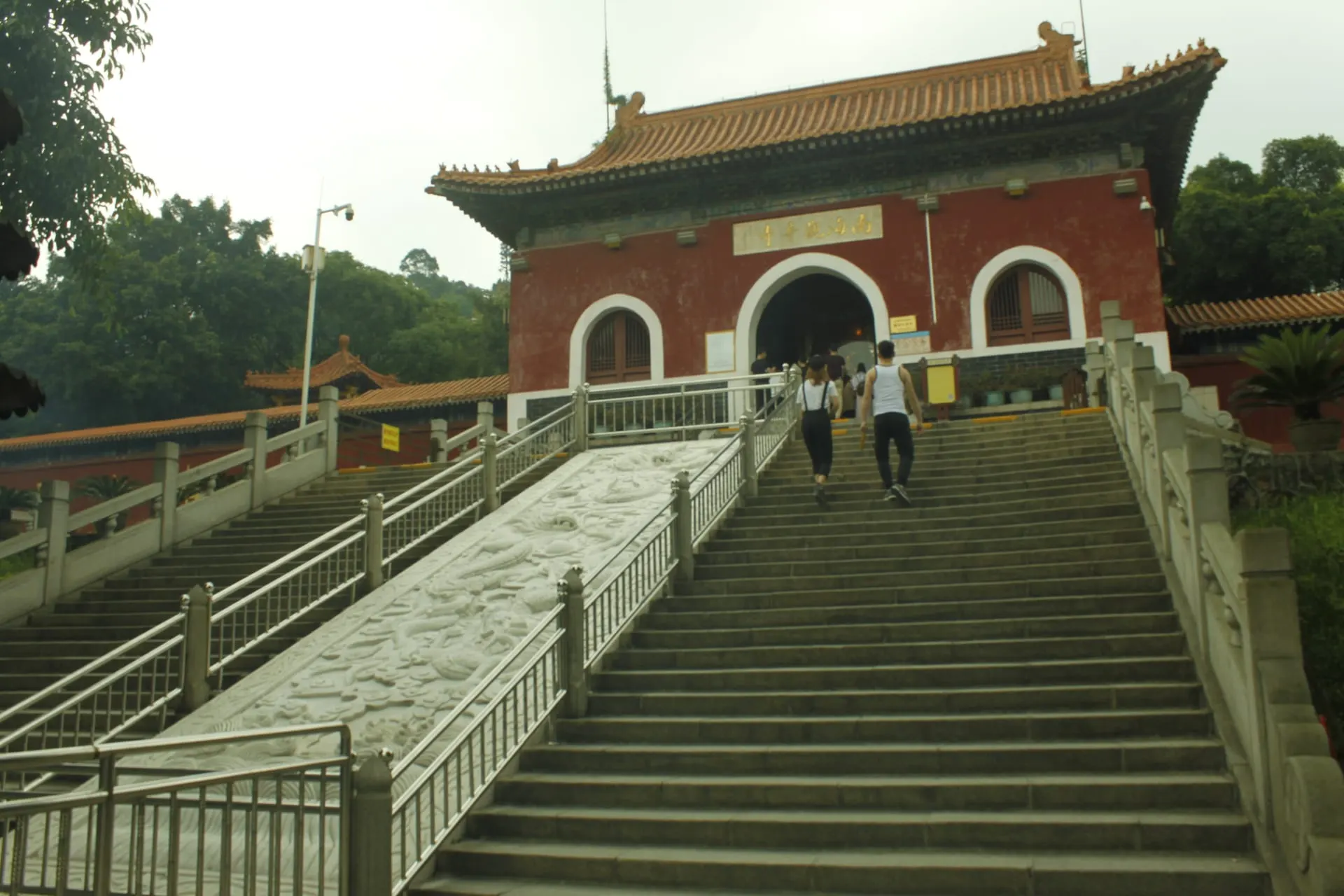
Nanhai Guanyin Statue (南海观音, Nánhǎi Guānyīn)
A 33-meter bronze statue of Guanyin standing on a lotus platform at the southern tip of the island, completed in 1997. The statue faces south over the sea, one hand raised in blessing, and is visible from Zhoushan on clear days. The plaza around the statue fills with pilgrims chanting in unison on Buddhist holidays. ¥6 entry as of June 2026.
Wikimedia Commons · CC-BY-SA
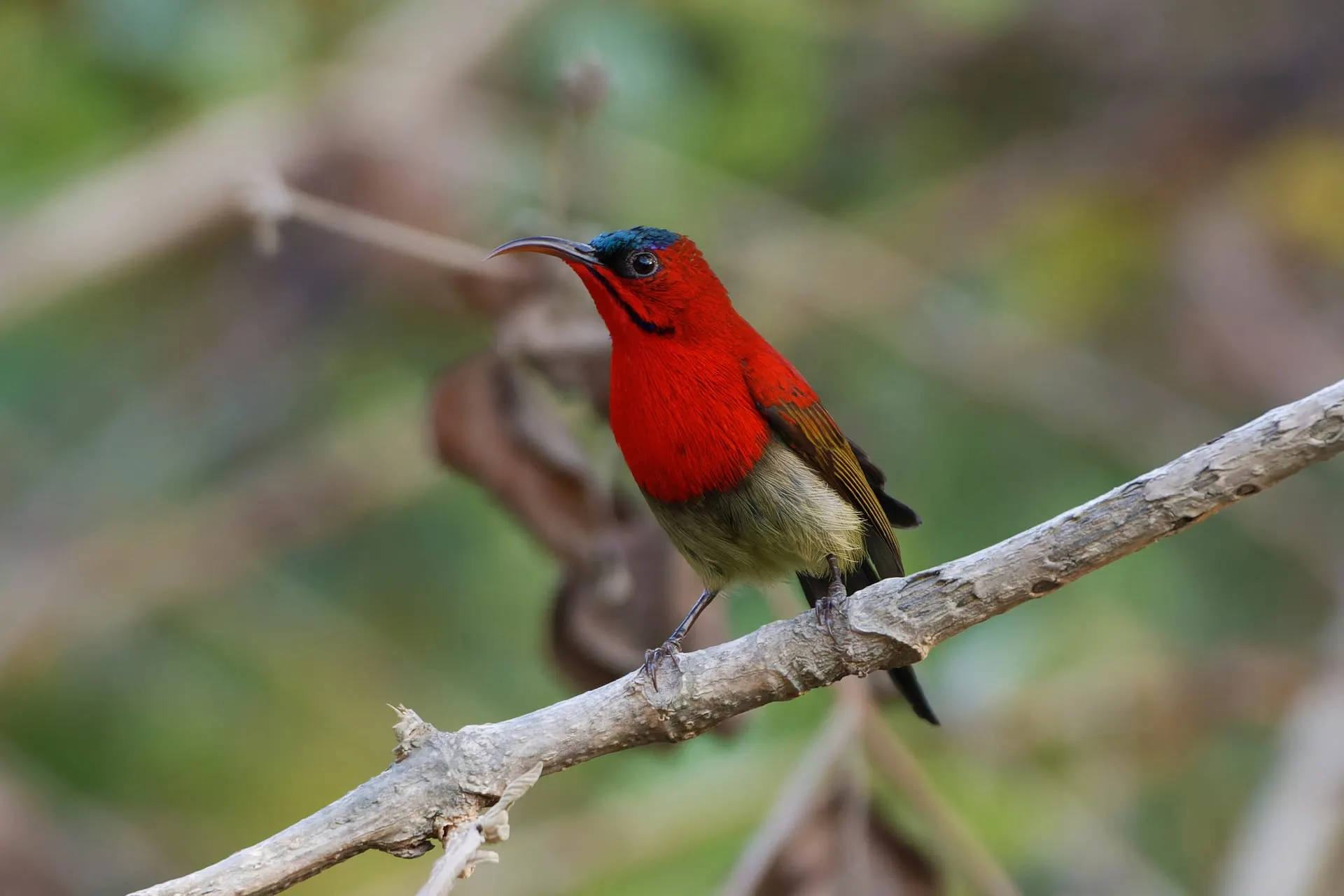
Purple Bamboo Grove (紫竹林, Zǐzhú Lín)
A hillside grove of purple-stemmed bamboo near the southern shore, adjacent to the Never-Wanting-To-Leave Guanyin Monastery (不肯去观音院, Bùkěn Qù Guānyīn Yuàn). The monastery marks the spot where, according to legend, a Japanese monk tried to take a Guanyin statue back to Japan in the 9th century — the sea filled with iron lotus flowers and blocked his ship, so he built a shrine here instead. Free entry.
Wikimedia Commons · CC-BY-SA
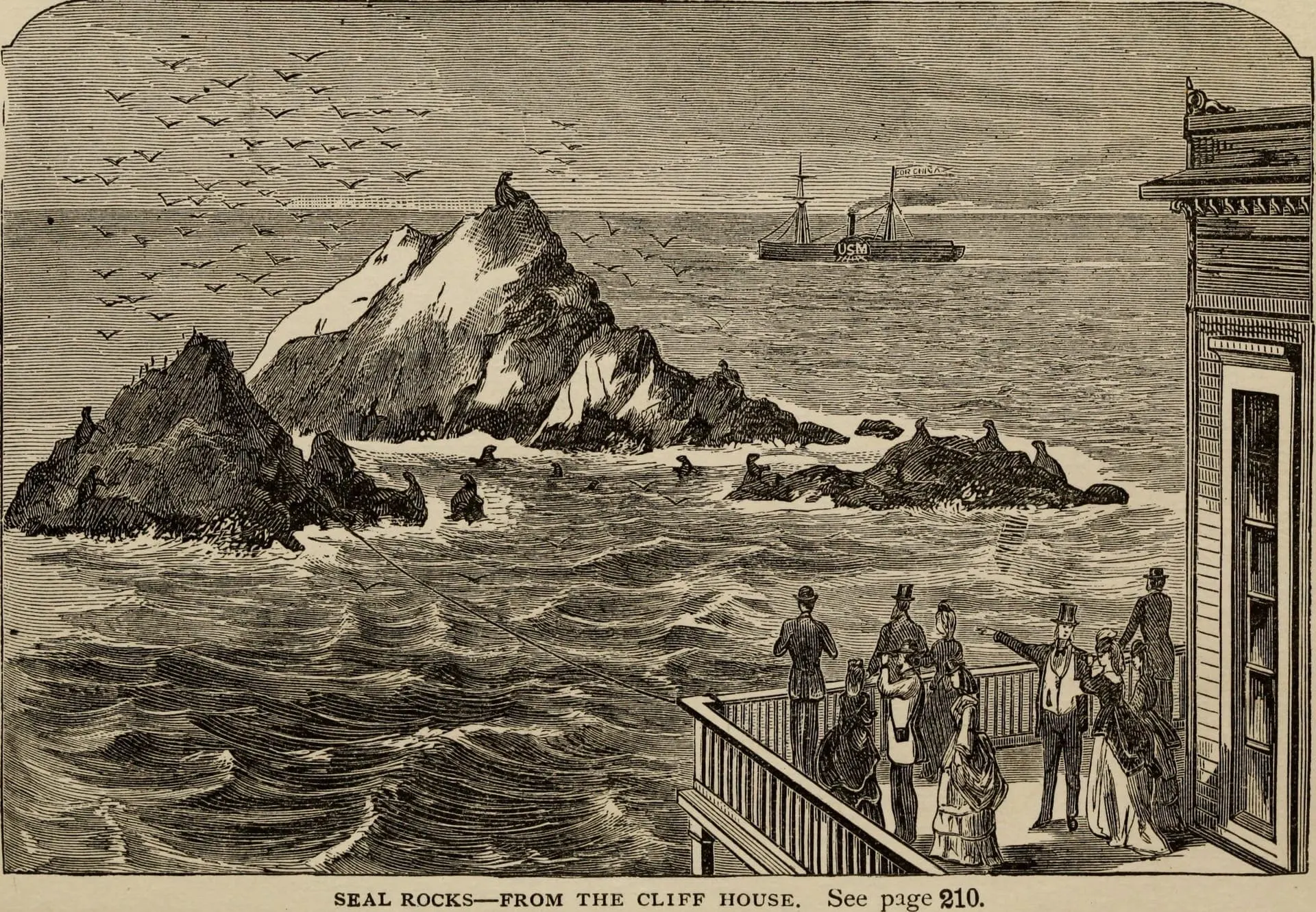
Thousand Step Beach (千步沙, Qiānbùshā)
A 1.7-kilometer crescent of golden sand on the island's eastern shore, flanked by pine-covered headlands. Swimming is permitted in summer (bring your own gear — no rentals on the beach), and the beach is nearly empty at sunrise. The sand is fine and pale, and the surf is gentler than you might expect in the East China Sea. Free entry.
Wikimedia Commons · CC-BY-SA
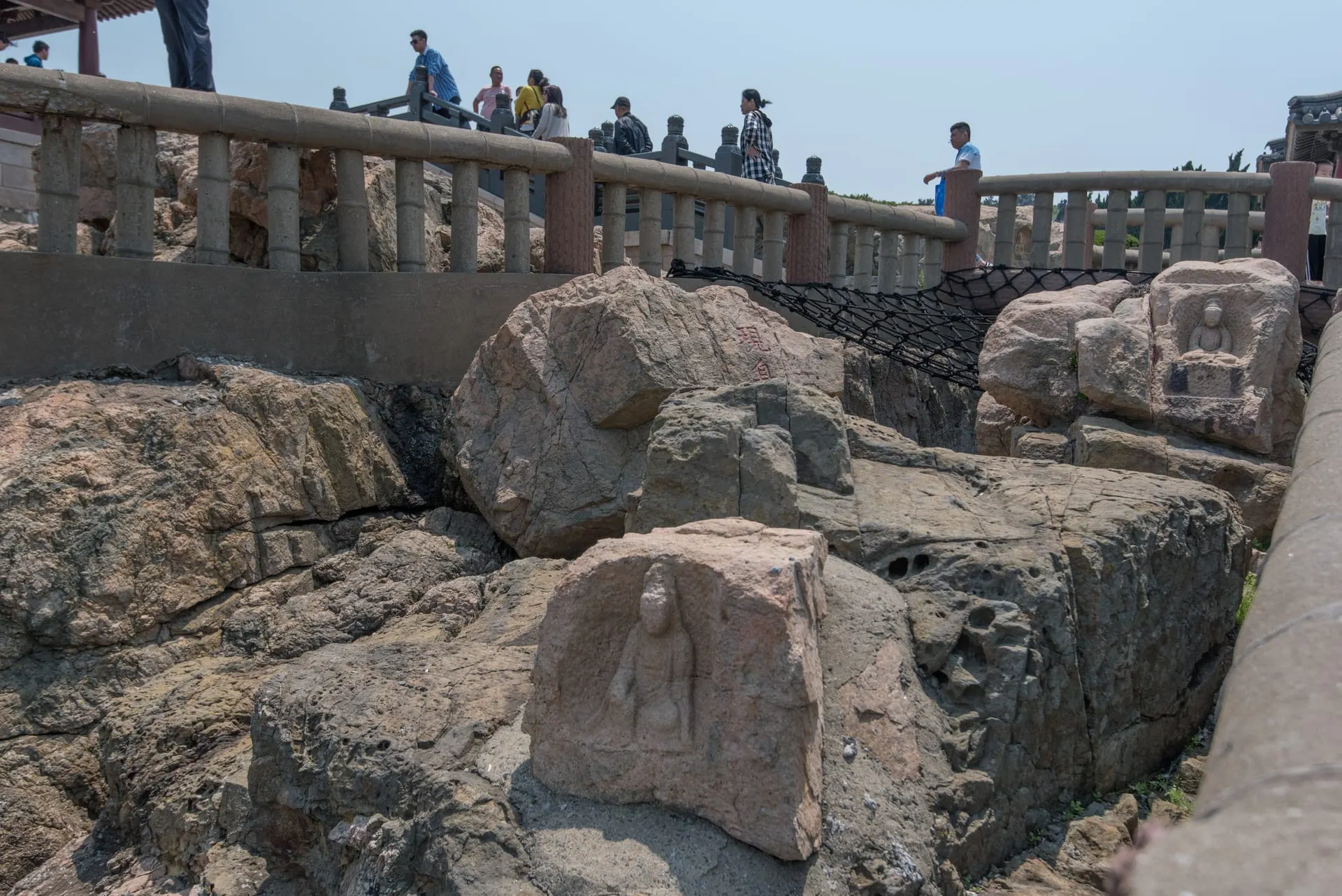
Chaoyin Cave (潮音洞, Cháoyīn Dòng)
A sea cave on the southern coast where waves crash against the rock with a sound that Buddhist tradition interprets as the voice of Guanyin — "chaoyin" means "sound of the tide." A pavilion above the cave offers a view of the East China Sea. Pilgrims sometimes meditate here, timing their breathing to the rhythm of the waves. Free entry.
Wikimedia Commons · CC-BY-SA
STAY
Where to stay in Putuoshan
Pick a base that matches the trip you want — imperial-central for sightseeing, hutong belt for character, Chaoyang for nightlife, or Qianmen for budget.
Puji Temple Area
The island center — temples, restaurants, guesthouses, and the main pilgrimage hub
#puji-temple-areaFayu Temple Area
Quieter, greener hillside zone with the most beautiful temple and forest walking paths
#fayu-temple-areaThousand Step Beach
Scenic eastern shore with the island's best beach and the most peaceful sunrise views
#thousand-step-beachFerry Terminal Area
Functional arrival zone with newer hotels and easy ferry access, but less atmosphere
#ferry-terminal-area
ITINERARIES
Sample itineraries from Putuoshan
Three ready-made routes, from a 1-day imperial sprint to a 5-day deep dive. Copy the day-by-day plan and adapt to your own pace.
- 1 DAY
One-Day Putuoshan Sprint
A fast-paced day covering the Three Great Temples and the Nanhai Guanyin statue. Best as a weekday trip to avoid crowds.
- Travelers with limited time
- Day-trippers from Shanghai/Ningbo
- Active travelers comfortable with a fast pace
- Day 01
Morning
Arrive on the 07:00 ferry. Walk to Puji Temple (07:30-08:30) for morning chanting and temple exploration. Shuttle to Fayu Temple (08:45-09:45) for the Nine-Dragon Hall.
Afternoon
Cable car to Huiji Temple summit (10:00-11:00) for the island panorama. Lunch at Huiji Temple vegetarian canteen (11:00-11:30). Descend and shuttle to Nanhai Guanyin statue (12:30-13:30), then walk to Purple Bamboo Grove and Chaoyin Cave (13:30-14:30).
Evening
Final shuttle to the ferry terminal for the 15:30 or 16:00 ferry. Seafood dinner on the mainland side at Zhujiajian before heading back.
- 2 DAYS
Two-Day Classic Putuoshan
The ideal visit — temples at a relaxed pace, vegetarian meals, a beach walk, and an overnight stay to experience the island after the day-trippers leave.
- Most visitors
- First-time pilgrims
- Couples and solo travelers
- Day 01
Morning
Arrive morning, settle into accommodation near Puji Temple. Visit Puji Temple at a relaxed pace (09:00-11:00), exploring the courtyards, lotus pond, and lecture hall.
Afternoon
Puji Temple vegetarian lunch. Walk the coastal path to Purple Bamboo Grove and the Never-Wanting-To-Leave Monastery (13:00-14:30). Nanhai Guanyin statue (14:30-15:30). Chaoyin Cave for the wave sounds (16:00-17:00).
Evening
Seafood or vegetarian dinner near the ferry terminal area. Evening walk through the quiet temple courtyards — the island transforms after the day-trippers leave.
- Day 02
Morning
Early start at Fayu Temple (07:00-08:30). Climb the 1,088 steps (or cable car) to Huiji Temple (08:30-10:00) for coffee and the summit panorama.
Afternoon
Descend by cable car (10:30-11:00). Lunch at Fayu Temple vegetarian restaurant. Afternoon at Thousand Step Beach for a long walk (13:30-15:00).
Evening
Late afternoon ferry back to the mainland. DiDi or bus to Ningbo for the HSR journey home.
- 3 DAYS
Three-Day Immersive Retreat
Slow travel for those who want meditation, quiet corners, and the northern coastal shrines that most visitors skip.
- Buddhist pilgrims
- Slow travelers
- Those seeking a contemplative experience
- Day 01
Morning
Arrive and settle in. Morning at Puji Temple — attend morning chanting if possible (05:30-06:15), then explore slowly through mid-morning.
Afternoon
Vegetarian lunch. Afternoon at Purple Bamboo Grove, the Never-Wanting-To-Leave Monastery, and Nanhai Guanyin statue. Walk the coastal path back slowly, stopping at small shrines.
Evening
Quiet dinner, early night for tomorrow's hike.
- Day 02
Morning
Full morning for the Three Great Temples: Puji → Fayu → climb to Huiji Temple summit. Lunch at Huiji Temple canteen.
Afternoon
Descend, rest at the beach — swimming in summer, long walk in cooler months. Free afternoon to revisit a favorite temple.
Evening
Seafood dinner, evening walk through the temple zone.
- Day 03
Morning
Explore the northern coastal path — Fantong Cave (梵洞) and Fanyin Cave (梵音洞), less-visited sea caves and shrines where hermits and nuns have lived for centuries. Hike the quieter northern hillside trails.
Afternoon
Return to Puji area for a final vegetarian lunch. Last visit to a favorite temple or meditation spot before departing.
Evening
Afternoon ferry back, relaxed journey home.
BUDGET
What a Putuoshan trip costs
Per-person, per-day costs across three spending tiers. Excludes international flights and visa fees.
| Line item | Backpacker | Mid-range | Luxury |
|---|---|---|---|
| Ferry round-trip (Zhujiajian-Putuoshan) | $8 | $8 | $8 |
| Island entry fee (seasonal, as of June 2026) | $25 | $25 | $25 |
| Budget guesthouse (per night) | $25 | $0 | $0 |
| Mid-range hotel (per night) | $0 | $55 | $0 |
| Luxury hotel (per night) | $0 | $0 | $110 |
| Vegetarian temple meals (per meal) | $4 | $5 | $0 |
| Seafood restaurant dinner | $0 | $14 | $28 |
| Shuttle bus and cable car (daily) | $5 | $8 | $10 |
| Temple incense fees (total for 3 temples) | $2 | $2 | $2 |
| Miscellaneous (snacks, water, donations) | $5 | $8 | $14 |
| Total per day | $74 | $125 | $197 |
$ USD per person per day, before international flights and visas. Last verified: Q3 2026.
STAY SAFE
Emergency contacts in Putuoshan
Save these three numbers before you board the plane. China uses different hotlines than most countries — there's no 911.
- POLICE
110
- AMBULANCE
120
- FIRE
119
- TOURIST HOTLINE
0580-6091123 (Putuoshan Tourism Complaint)
- ENGLISH-SPEAKING ER
Zhoushan Hospital (舟山医院) on the mainland — 1 hour from Putuoshan by ferry and taxi; limited English-speaking staff
Problems travelers hit in Putuoshan
- Why is my Alipay not working?You linked a foreign Visa or Mastercard to Alipay but every transaction is rejected at the merchant.
- My China visa was denied — what now?Your L visa application was refused at the Chinese consulate and your trip is in 2–4 weeks.
- My passport was lost or stolen in China — what do I do?Your passport is gone (theft or loss) and you're in mainland China without travel documents.
- Why can't I book on 12306 with my foreign card?You tried to book a high-speed rail ticket on 12306.cn and your foreign Visa/Mastercard is rejected at checkout.
- Why is my VPN not working in China?You arrived in China, opened your VPN, and it will not connect at all or connects but no traffic loads.
- Why can't I book a Tibet trip on my own?You try to book Lhasa flights and hotels yourself but the booking fails, or you're turned away at the Lhasa airport without a permit.
Book activities in Putuoshan
These are licensed tour operators and booking platforms we've vetted independently. Booking through these links may earn us a commission — see our affiliate disclosure. This never affects our editorial recommendations or the price you pay.
Frequently asked questions
Is Putuoshan worth visiting for non-Buddhist foreign tourists?
How do I get from Shanghai to Putuoshan?
How much does a Putuoshan trip cost?
Can I stay overnight in a temple on Putuoshan?
When should I avoid Putuoshan?
How many days do I need on Putuoshan?
Show all 20 FAQs
What should I wear to visit Putuoshan temples?
Is Putuoshan vegetarian?
Can I swim at Putuoshan?
What is the best temple on Putuoshan?
Do I need to bring incense to Putuoshan?
Is Putuoshan accessible for elderly or mobility-limited visitors?
Can I visit Putuoshan as a day trip from Shanghai?
What is the difference between Putuoshan and other Buddhist mountains in China?
Do I need a guide for Putuoshan?
Is Putuo Shan really a Buddhist site or a tourist trap?
How do I get to Putuo Shan?
When is the best time to visit Putuo Shan?
How much does a Putuo Shan visit cost per day?
What is the Three-Step Waterfall and is it worth the climb?
References

Related guides & destinations
Guide
How We Research 2026: NihaoVisit’s Methodology for China Travel Information
How NihaoVisit sources, verifies, and maintains 700+ pages of China travel information — our source hierarchy, fact-checking process, update
Guide
Fact-Checking Log 2026: Verified China Travel Information — NihaoVisit
A public log of fact-checking verification passes on NihaoVisit, showing what was verified, when, and against which sources — covering visa
Guide
Best Time to Visit China 2026: Month-by-Month Weather, Crowds, and Prices
The best time to visit most of China is April–May and September–October. Winter (Dec–Feb) is cold but cheap; summer (Jun–Aug) is hot and cro
Guide
VPN for China 2026: Which VPNs Work, eSIM Alternatives, and the Complete Pre-Trip Checklist
Most Western apps and websites are blocked in mainland China. A reliable VPN is essential for Google, Gmail, WhatsApp, Instagram, and most n
Guide
China SIM Card and eSIM Guide 2026: Stay Connected Without WeChat
A Chinese SIM or eSIM lets you use mobile data, maps, and ride-hailing without WiFi. Here is how to get one, the cost, and which provider to
Guide
Solo Female Travel in China 2026: Safety, Tips, and Real Experiences
China is one of the safer destinations for solo female travelers. Petty theft is rare, violent crime against tourists is extremely uncommon,