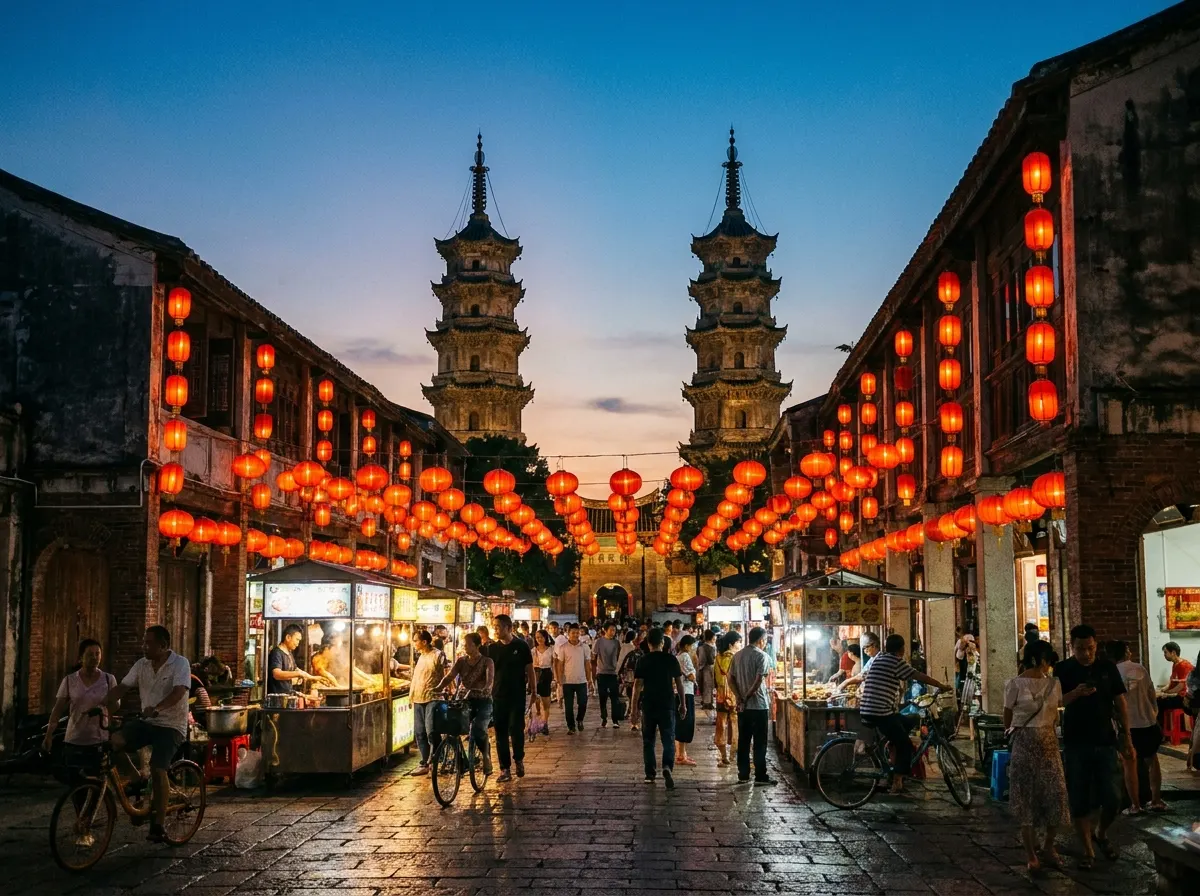
Quanzhou
Quanzhou in Fujian province was the starting point of the Maritime Silk Road and the world's largest port in the 12th-13th centuries. UNESCO's "Historic Monuments of the Song-Yuan Dynasties" includes 16 sites scattered across the city — the Kaiyuan Temple, the Islamic Ashab Mosque, the Hindu-style twin pagodas, and Confucian-Taoist-Buddhist temples. Quanzhou is one of China's most underrated cultural destinations. Plan 2 days. High-speed rail from Xiamen: 30 minutes.
Why Quanzhou in 2026.
UNESCO Maritime Silk Road city. The starting point of China's maritime trade, with Buddhist, Islamic, Hindu, and Christian temples within walking distance.
Quick Answer
Quanzhou in Fujian province was the starting point of the Maritime Silk Road and the world's largest port in the 12th-13th centuries. UNESCO's "Historic Monuments of the Song-Yuan Dynasties" includes 16 sites scattered across the city — the Kaiyuan Temple, the Islamic Ashab Mosque, the Hindu-style twin pagodas, and Confucian-Taoist-Buddhist temples. Quanzhou is one of China's most underrated cultural destinations. Plan 2 days. High-speed rail from Xiamen: 30 minutes.
| Best time to visit | March-May and October-November; avoid summer typhoon season (July-September) |
|---|---|
| Daily budget | $40 (backpacker) / $100 (mid-range) / $250+ (luxury) |
| Language | Minnan (Hokkien) and Mandarin (English limited outside major tourist sites) |
| Currency | CNY (¥) — Alipay/WeChat Pay universal |
| Time zone | China Standard Time (UTC+8) |
| Last updated | 2026-06-16 |
Want a Quanzhou plan built for you?
Why is Quanzhou a UNESCO site?
Quanzhou was inscribed as a UNESCO World Heritage site in 2021 as "Quanzhou: Emporium of the World in Song-Yuan China," recognizing 16 historic monuments that span the Maritime Silk Road. The monuments include Buddhist, Islamic, Hindu, Christian, Manichean, and Taoist religious sites, evidence that Quanzhou hosted Arab, Persian, Indian, and European merchants alongside Chinese residents for over 1,000 years. The site is unusual because the 16 monuments are scattered across the modern city rather than concentrated in a single historic zone, turning a visit into a walking tour through living neighborhoods.
How do I get to Quanzhou?
Quanzhou Jinjiang International Airport (JJN) has direct flights from most major Chinese cities plus limited international routes. High-speed rail from Xiamen takes about 30 minutes, with over 40 daily trains at roughly ¥15-25, re-check before booking. From Fuzhou (the Fujian capital), the trip is about 1.5 hours; from Shanghai, about 5 hours; from Guangzhou, about 4 hours. Many travelers pair Quanzhou with a 2-3 day Xiamen stopover for the full Fujian coastal experience.
What is the best Quanzhou food?
Fujian (Minnan) cuisine is one of China's most underrated regional styles — light, fresh, slightly sweet, with emphasis on seafood and soup. Must-try dishes in Quanzhou include misua soup (面线糊, thin rice noodle soup with seafood, the well-known local breakfast), oyster omelet (海蛎煎, served with sweet chili sauce), beef soup (牛肉羹), spring rolls (春卷), and bamboo-tube rice (竹筒饭). Zhongshan Road and the lanes around West Street are the best places to sample everything. Quanzhou's food is distinctly different from Cantonese or Shanghainese cuisine and rewards adventurous eaters.
Can I do Quanzhou and Xiamen in one trip?
Yes — Quanzhou and Xiamen sit just 30 minutes apart by high-speed rail and complement each other perfectly. Xiamen has the beaches, Gulangyu Island, and a more polished tourist scene; Quanzhou has the dense UNESCO cultural layer and authentic street life. A 3-4 day Fujian coastal trip covering both is one of China's best-kept secrets. Add a one-day side trip to the Tulou earthen buildings in Nanjing County (about 2.5 hours from Xiamen) for the full regional circuit.
Is Quanzhou family-friendly?
Yes — Quanzhou is excellent for families, especially those with older children curious about history. The UNESCO sites are walkable in the city center, and the cultural diversity (Buddhist, Islamic, Hindu, and Christian sites within blocks of each other) is genuinely engaging. Xunpu Village is a hit with families for the flower-hair-ornament photo experience. The Quanzhou Maritime Museum has hands-on exhibits and a real Song-era shipwreck. Quanzhou is one of China's most relaxed cities, with minimal crowding compared to Xiamen or Fuzhou.
When is the best time to visit Quanzhou?
March to May and October to November are the best windows, with warm, dry weather ideal for walking the UNESCO sites. Spring brings blooming banyan trees and comfortable evenings; autumn is sunny and slightly cooler. Avoid July to September, when typhoon season can shut down ferries and outdoor attractions for days. Winter (December-February) is mild by northern China standards, often 10-15°C, but can be drizzly. Chinese New Year adds festive lanterns but also domestic crowds.
What is the Zanhuawei flower hair tradition?
Zanhuawei (簪花围) is a centuries-old Minnan tradition from Xunpu Village, where women wear elaborate headpieces of fresh and silk flowers — jasmine, pomegranate blossoms, and chrysanthemums — secured by hairpins. Originally a marker of fishing-village wives, the style has become a viral photography trend across China, and visitors can pay roughly ¥40-80, re-check before booking, to dress up, have their hair arranged, and be photographed in traditional Minnan clothing. Xunpu Village, about 10 minutes from central Quanzhou, is the most authentic place to experience it.
How do the 16 UNESCO sites connect?
The 16 UNESCO monuments form a network across modern Quanzhou, each illustrating a different layer of the city's maritime history. Highlights include Kaiyuan Temple (Buddhist, with twin Song-dynasty pagodas), the Ashab Mosque (China's oldest surviving Islamic mosque, founded in 1009), the Qingjing Mosque, the Confucian Temple, the Manichean Buddha statue at Cao'an (one of the world's last Manichean relics), and the old customs house at Shihu Port. The Maritime Museum ties them together with Song-era shipwrecks and trade goods. Plan two days to visit the central cluster plus a half-day excursion to the outlying port and statue sites.
Where should I stay in Quanzhou?
Stay in the Licheng District (the old city core) to be within walking distance of Kaiyuan Temple, the Ashab Mosque, Zhongshan Road, and West Street. Boutique courtyard hotels and modern business hotels cluster here at roughly ¥200-500 per night, re-check before booking. The area around West Lake Park is quieter and newer, with several four-star hotels, but requires short taxi rides to the historic sites. Avoid staying near the train station unless you have an early departure — it is too far from the action.
What should I see at Kaiyuan Temple?
Kaiyuan Temple (开元寺) was founded in 686 CE during the Tang dynasty and is the largest Buddhist temple in Fujian province, covering an area of about 78,000 square meters in the heart of old Quanzhou. The temple's defining feature is the pair of five-story stone pagodas flanking its main axis — the East and West Pagodas (东西塔), completed in 1238 and 1237 CE during the Southern Song dynasty. Each pagoda rises about 48 meters and is carved on every face with Buddhist deities, Hindu gods, Buddhist sutras, and scenes of merchants and daily medieval life, making the twin pagodas a complete sculptural record of Quanzhou at its Song-Yuan peak. Visitors should not miss the main Mahavira Hall (大雄宝殿) with its 24 "winge" — carved stone columns each topped with a different mythical creature from Hindu-Buddhist mythology, including winged humans, Garuda, and the legendary "ji" creature. The Hall also houses 24 luohan (arhat) statues, one of the finest Ming-era Buddhist sculpture sets in southern China. Beyond the towers, the temple grounds include a 1,300-year-old banyan tree, a Confucian hall added during the Ming dynasty, the ancient shipwreck timber exhibition hall (built around timbers salvaged from a 13th-century trade vessel), and a roofed stone corridor of Song-era Buddhist stelae. Entry is free and the temple is open roughly 7:30-17:30. Allow at least 90 minutes. Modest dress is required — shoulders and knees covered — and photography is fine but no flash inside the halls. The temple is a 10-minute walk from Quanzhou old town's Zhongshan Road and pairs naturally with the Ashab Mosque a few blocks east. Audio guides in English are available at the entrance for a small deposit.
What makes the Ashab Mosque historically important?
The Ashab Mosque (清净寺, also called Qingjing Mosque) is one of the oldest Islamic houses of worship in China and a foundational monument of Quanzhou's 2021 UNESCO inscription. It was founded in 1009 CE during the Northern Song dynasty by Muslim merchants arriving overland from Central Asia and the Middle East, then the dominant foreign trading community in Quanzhou's port. The mosque predates the much-better-known Great Mosque of Xi'an by roughly 10 years and is built in pure Levantine Abbasid style — stone arches, a flat roof, and walls studded with carved Arabic inscriptions and geometric patterns — almost unique in China, where most surviving mosques adopted Chinese timber-frame architecture. The current structure preserves its original Song-era stone gate, the 12th-century "Holy Battlefield" memorial stele recording Muslim community leaders, the rebuilt Ming-dynasty prayer hall, and a polished stone mihrab oriented toward Mecca. Of the original 10 gates, only the main south gate still stands. After 1,000 years, the mosque remains a working place of prayer for Quanzhou's small Muslim community (descendants of Hui, Arab, and Persian merchants), and the adjacent Muslim Cultural Museum displays Song-era tombstones inscribed in Arabic, Persian, and Tamil, including a 12th-century tombstone from a Hindu convert. Entry is roughly ¥3. The mosque is a 5-minute walk east of Kaiyuan Temple, and visiting both together makes the city's interfaith compact viscerally obvious. Friday prayer services limit interior access from roughly 11:00 to 14:00, so plan a morning or late-afternoon visit. Modest dress is required; scarves are available at the entrance.
What is in the Quanzhou Maritime Museum?
The Quanzhou Maritime Museum (泉州海外交通史博物馆), opened in 1959, is China's only museum dedicated entirely to the history of the Maritime Silk Road and remains one of the country's most underrated regional museums. The museum sits in a modern building on the east bank of the Jinjiang River, a 15-minute walk from old town, and admission is free. The ground-floor East Hall holds the museum's headline exhibit: a 13th-century Song-era sea-going trading vessel raised from a seabed off Quanzhou in 1974. The 24-meter hull is the largest wooden trading ship of its era ever recovered, and the ship is surrounded by its cargo — peppercorns, frankincense, copper coins, ceramics from a dozen Song kilns, and tropical hardwoods that prove the route reached as far as East Africa. The companion hall holds religious carvings recovered from the wreck, including a Hindu Vishnu statue and a Manichean relief, illustrating the multicultural trade the ship carried. Upstairs, a separate building (the "Hui'an Girl's House" and Stone Gallery annex) houses Song-era religious tombstones carved in Arabic, Syriac, and Tamil, as well as one of the world's most important collections of Song-Yuan ship models. The newer West Hall (opened 2017) reconstructs ancient Quanzhou's port, a 4,000-square-meter immersive diorama of the medieval harbor with sound and lighting. Plan at least 90 minutes. English signage is decent but not exhaustive — an audio guide is recommended. The museum is open roughly 9:00-17:00 and is closed on Mondays. The museum shop sells a small selection of Song-era replica ceramics and a well-edited bilingual book on the Maritime Silk Road.
Is West Lake Park worth visiting?
Quanzhou's West Lake Park (西湖公园) is small — about 100 hectares, a fraction of Hangzhou's West Lake — but rewards an hour with humpback bridges, banyan-shaded paths, and a Luban Memorial Pavilion. The West Lake area in Quanzhou was a Song-dynasty garden complex and survived through the Ming and Qing as a civic pleasure ground; what you see today is a 21st-century restoration layered over older plantings. The park centers on an artificial lake crossed by humpback bridges, with paths around the perimeter shaded by banyan and acacia trees. The most photogenic feature is the 12-meter "Luban" Memorial Pavilion, named after the legendary 5th-century BCE carpenter-engineer Lu Ban (鲁班), with a wooden double-eaved roof and a stela recounting his life. Walk the west shore for the "Thousand-Hand Guanyin" statue, a 6-meter-tall white marble bodhisattva set into a hillside grove. The park's northern edge is occupied by a modern Fujian folk-culture museum that is skippable for most visitors, but the south gate opens onto Zhongshan Road, making the park a natural break from the dense old town — a place to sit on a bench, eat a misua soup from a vendor at the gate, and watch local retirees play mahjong. Free entry, open roughly 6:00-22:00. The park is at its best in spring (banyan flowers) and autumn (cooler walks). Avoid midday in summer; humidity is high and shade is patchy. The park is about a 20-minute walk west of the Kaiyuan Temple cluster, or a 10-minute taxi ride.
What is special about Xunpu Village and Zanhuawei?
Xunpu Village (蟳埔村) is a small fishing community on the eastern edge of greater Quanzhou, a 15-minute taxi ride from the old town, now the cultural and photographic heart of contemporary Quanzhou. The village's signature is Zanhuawei (簪花围) — a centuries-old Minnan hair-decoration tradition in which women wear a circular headpiece ("zanhuawei") woven from fresh jasmine, pomegranate blossoms, chrysanthemum, and silk flowers, all pinned around the bun and finished with a hairpin. Originally a marker of fishing-village wives and a tribute offering, the tradition survived in Xunpu partly because the village remained a tight-knit community of fisherfolk. In 2023, the tradition went viral on Chinese social media, and the village now receives hundreds of thousands of visitors a year, most coming specifically to dress up in Zanhuawei and pose for photos in Minnan-style clothing against the oyster-shell-walled houses. The cost is roughly ¥40-80, re-check before booking, and includes the headpiece, the rental outfit (a vivid magpie-magnolia jacket, loose trousers, and a small embroidered shoulder bag), and the hair styling (15-20 minutes). Most visitors spend 60-90 minutes in the village. The village itself is also worth walking: the original fisher families still live among the oyster-shell "miao-yan" houses (walls made of lime and oyster shell, a local engineering tradition for resisting typhoon and salt), and the small Xunpu Tianhou Temple honors the sea-goddess Mazu. Plan to visit in the late afternoon for the best light and to avoid the morning tour buses. The tradition has spread to other parts of China but Xunpu remains the most authentic place to experience it.
What is Minnan culture and where can I experience it?
Minnan (闽南) literally means "south of Fujian" and refers to the regional culture, language (Hokkien, one of the largest Chinese-language branches), architecture, food, and religious practices of coastal Fujian. Quanzhou is the historical heart of Minnan culture, which extends into Xiamen, Zhangzhou, and overseas Chinese communities across Southeast Asia — most of the Hokkien diaspora in Singapore, Malaysia, and the Philippines traces its roots to this stretch of coast. The most distinctive architectural feature of Minnan is the "miao-yan" oyster-shell house, a load-bearing wall of lime and crushed oyster shells used for centuries because it resists typhoon wind and salt corrosion. You can still see a dense cluster of these in Xunpu Village and a few streets in old Quanzhou. The region's other visual signatures are the curved swallow-tail roof eaves (燕尾脊) of Minnan temples and houses, the red-brick walls of traditional homes, and the dense use of carved stone, "jian-nian" cut-and-paste porcelain decoration on temple roofs, and red lanterns hung at family shrines. Minnan food, discussed separately, is one of China's most distinct regional cuisines, with a focus on seafood broths, sweet-savory sauces, fermented condiments, and slow-braised pork. The religious practice is also unique: a fusion of Mahayana Buddhism, Taoist deities, the sea-goddess Mazu (venerated across the Minnan diaspora), ancestor worship, and small gods of house and well. To experience Minnan culture in a day, walk from Kaiyuan Temple through West Street, stop at the Confucian Temple, visit a miao-yan house in Xunpu, and end with a Mazu temple visit. The Quanzhou Intangible Cultural Heritage Center (泉州非物质文化遗产馆) in the old town has a strong free exhibit covering Minnan opera, lacquerware, and the "tea-for-everything" Anxi tea ritual. Quanzhou is a better base for Minnan culture than Xiamen because Xiamen has been gentrified.
What is Quanzhou food like and what should I try?
Quanzhou is one of China's most underrated food cities and the most important center of Minnan cuisine, which is lighter and more seafood-focused than Cantonese or Shanghainese cooking, with a distinctive sweet-savory contrast. The city's signature dishes are best eaten as a 2-3 day "food crawl" centered on the old town and West Street. The headline breakfast is misua soup (面线糊) — paper-thin rice noodles simmered into a translucent porridge-style broth, served with oysters, pork intestine, fried dough sticks, and herbs. Locals eat it from ¥10 paper bowls at street stalls open from 5 a.m. Other must-tries: oyster omelet (海蛎煎, oyster omelet fried with sweet potato starch and topped with a sweet chili-vinegar sauce); beef soup (牛肉羹, a clear beef broth thickened with ground beef, a Fujian-Minnan classic); taro crisps (炸芋片, paper-thin deep-fried taro chips dusted with salt and pepper); herbal jelly (烧仙草, a grass-jelly dessert with taro, red bean, and condensed milk, served cold in summer); and spring rolls (春卷, often the fresh-style Fujian rolls with shredded bamboo and pork). For lunch and dinner, order ginger duck (姜母鸭) — a Quanzhou signature of an entire duck slow-braised with old ginger and rice wine — and the city's Mianxian Hu (面线糊) chain restaurants. The best eating streets are West Street, Zhongshan Road, and the lanes south of Kaiyuan Temple. Prices remain very reasonable: a full Minnan banquet for two is ¥80-150 at most neighborhood restaurants. Vegetarians should look for "su cai" (素菜) restaurants — Quanzhou has an old Buddhist vegetarian tradition tied to Kaiyuan Temple.
How do I get to Quanzhou by high-speed rail from Fuzhou?
High-speed rail is the easiest way to reach Quanzhou from Fuzhou, the capital of Fujian province. Direct G-series and D-series trains run on the Fuzhou-Xiamen coastal HSR line, with about 25-30 departures per day in each direction, and the journey takes roughly 1 hour 15 minutes to 1 hour 45 minutes depending on the specific service. Most trains stop at Quanzhou Station (泉州站) in Fengze District on the modern south side of the city, about 30 minutes by taxi (¥30-40) from the old town and Kaiyuan Temple. A smaller number of slower trains stop at Quanzhou East Station (泉州东站), which is closer to Xunpu Village and a few newer hotel areas. Second-class seats are typically ¥65-95 and first-class seats ¥105-150, re-check before booking. Tickets are easy to buy via Trip.com, 12306, or the China Railway app — advance booking is recommended around Chinese New Year, the May Day holiday, and the October National Day holiday when Fujian coastal tourism peaks. Quanzhou is also well-connected to Xiamen (~30 minutes, ¥15-25), Shenzhen (~3.5-4 hours), Shanghai (~5 hours), and Guangzhou (~4.5-5 hours), all on the same coastal HSR line. The new Fuzhou-Xiamen HSR is reliable, clean, and a comfortable way to combine Quanzhou with Fuzhou for a multi-day Fujian trip. On arrival at Quanzhou Station, taxi and DiDi ride-hailing are available, and the new Metro Line 1 connects the station to the old town in about 25 minutes for ¥3-5.
Is a day trip to Anxi tea country worthwhile?
Yes — Anxi County (安溪县), the birthplace of Tieguanyin (铁观音) oolong tea, sits about 70 km west of Quanzhou and is one of the best day trips you can take from the city. The drive on the expressway takes roughly 1.5 hours each way, or you can take a 20-minute HSR to Anxi Station and then a 30-minute taxi into the tea country. Anxi has been producing Tieguanyin since the 18th century, and the terraced tea gardens carved into the misty hills of the Anxi foothills are genuinely beautiful. Most day-trippers book a half-day tour with a local tea family, which typically includes a walk through the terraces, an explanation of the cultivar and harvest cycle (Tieguanyin is plucked in autumn and winter and goes through a complex withering-rolling-oxidation-roasting process), a hands-on rolling experience, and a sit-down tasting of three or four grades of oolong. Tour prices range from ¥150-300 per person, re-check before booking, including transport from your Quanzhou hotel. Independent travelers can visit the Anxi Tea Museum (free) and a few of the larger commercial gardens near Anxi town, but the best experiences are at family farms. The tea season runs October to May, with autumn-flush Tieguanyin considered the highest grade. Even in summer, the cooler mountain air and shaded gardens are a relief from Quanzhou's humidity. Plan to return to Quanzhou by early evening; the Anxi-HSR return service runs into the late evening but a private driver is more flexible.
When is the best time of year to visit Quanzhou?
The best time to visit Quanzhou is March to May and October to November — a soft six-month shoulder season that avoids both the brutal summer humidity and the typhoon risk. Spring (March-May) is the most popular window: banyan trees leaf out, the weather is warm but not humid (15-25°C), and the Ming-dynasty temple festivals cluster in April. Autumn (October-November) brings the Tieguanyin tea harvest in nearby Anxi, lower humidity, golden-tinged banyans, and slightly cooler evenings (12-22°C). Both seasons are also best for the Xunpu Zanhuawei outdoor photos, which depend on soft natural light. Winter (December-February) is mild by Chinese standards — daytime 10-15°C, occasionally down to 5°C at night — and very quiet, but expect overcast skies and a 30% chance of drizzle. The "Zanhuawei photos" still work, but cafe patios are not as enjoyable. Avoid July to September: the city sits inside the South China Sea typhoon belt, and the joint combination of high heat (32-36°C), sticky humidity, and 5-7 typhoon landfalls per year makes summer the worst time. The October 1-7 National Day holiday is the most crowded week, and Chinese New Year (late January or February) brings domestic tourists but also many closed shops in the days around the holiday itself. Aim for late March, April, or mid-October to early November for the best balance of weather, crowd level, and festival activity. Pack a light jacket year-round: Quanzhou has no central heating and winter indoor temperatures can feel cold.
What other Minnan sites can I visit near Quanzhou?
Quanzhou is the anchor of a dense ring of Minnan cultural sites within 1-2 hours by HSR, making it a stronger base for a Fujian trip than Xiamen. The most notable day trips are: (1) Anxi tea country, described separately; (2) Xiamen, 30 minutes by HSR, for Gulangyu Island's piano museums, colonial-era treaty port architecture, and the beach at Baicheng; (3) the Nanjing Tulou earthen-building clusters, roughly 2.5-3 hours by car west of Quanzhou, where the round rammed-earth Hakka buildings of Tianluokeng and Yunshuiyao date from the 14th-20th centuries and are a separate UNESCO site; (4) Fuzhou, the Fujian capital, 1.5 hours by HSR north, for the Three Lanes and Seven Alleys historic district and the Shi-Zhu (Stone Bamboo) Mountain park; (5) Putian, 40 minutes by HSR, for the Mazu temple at Meizhou Island, the legendary birthplace of the sea-goddess Mazu and a major pilgrimage site for the Hokkien diaspora; (6) Chongwu, 1 hour east, for a Ming-dynasty stone fortress on the coast and one of the best-preserved ancient city walls in Fujian; and (7) Dehua, the porcelain capital, 1.5 hours by car, where Ming-dynasty Blanc de Chine ceramics are still produced by traditional master potters. A 5-7 day Fujian circuit — Quanzhou base, with day trips to Anxi, Xiamen, and one of the Tulou clusters — is one of the most rewarding lesser-known China itineraries for travelers interested in coastal and maritime history, tea culture, and the diaspora story.
Top attractions
Kaiyuan Temple (开元寺)
1,300-year-old Buddhist temple, the largest in Fujian, with the famous twin stone pagodas (East and West Pagodas). ¥0 entry.
Ashab Mosque (清净寺)
1,000-year-old Islamic mosque, the oldest in China. Arabic inscriptions and Ming-Qing renovations. ¥3 entry.
Quanzhou Maritime Museum
Free museum covering the Maritime Silk Road, with the 800-year-old Song-era shipwreck artifacts. Allow 1.5 hours.
West Lake Park (西湖公园)
Smaller than Hangzhou's West Lake, but with the unique "Luban" carpenter memorial and the 12th-century Luoyang Bridge nearby.
Xunpu Village (蟳埔村)
Fishing village famous for women's "Zanhuawei" hair ornaments (flower-decorated hair). 10 minutes from Quanzhou. ¥0 entry.
Luoyang Bridge (洛阳桥)
12th-century Song-dynasty stone bridge built by the monk Cai Xiang across the Luoyang River — one of China's earliest major sea-crossing bridges, with original stone tidal piers still visible. ¥0 entry, 30 minutes by taxi south of old town.
Anxi Tea Country (安溪)
Day-trip into the Anxi mountains, the birthplace of Tieguanyin oolong tea, with terraced tea gardens, picking experiences, and farmhouse tea ceremonies. About 1.5 hours west of Quanzhou by HSR + taxi.
STAY
Where to stay in Quanzhou
Pick a base that matches the trip you want — imperial-central for sightseeing, hutong belt for character, Chaoyang for nightlife, or Qianmen for budget.
Licheng (鲤城)
Old town core with Kaiyuan Temple, West Street, and most UNESCO monuments within walking distance
#lichengFengze (丰泽)
Modern district with Quanzhou Station, shopping malls, and business hotels south of the old town
#fengzeWest Street (西街)
Historic spine of the old city lined with street-food stalls, tea houses, and artisan shops
#west-street-areaXunpu Village (蟳埔)
Fishing village 10 km east famous for Zanhuawei flower-hair tradition and oyster-shell houses
#xunpu
ITINERARIES
Sample itineraries from Quanzhou
Three ready-made routes, from a 1-day imperial sprint to a 5-day deep dive. Copy the day-by-day plan and adapt to your own pace.
- 1 DAY
Quanzhou UNESCO Old Town
A dense one-day walk through the central UNESCO cluster — Kaiyuan Temple, the Ashab Mosque, and West Street.
- Day-trippers from Xiamen
- Travellers with limited time
- UNESCO-focused visitors
- Day 01
Morning
Kaiyuan Temple (90 min) — twin pagodas, Mahavira Hall, 1,300-year-old banyan tree. Walk 5 min east to Ashab Mosque (45 min) — Song-era Arabic inscriptions and stone gate.
Afternoon
Confucian Temple (30 min), then Maritime Museum (90 min) for the Song-era shipwreck. Late afternoon: West Street food stalls for misua soup.
Evening
Zhongshan Road arcade walk under red lanterns. Dinner at a ginger-duck restaurant (姜母鸭). If it is Friday or Saturday, catch a marionette performance at the Quanzhou Marionette Theatre.
- 2 DAYS
Quanzhou Deep Dive
Two full days covering the old town UNESCO cluster plus outlying sites Luoyang Bridge and Xunpu Village.
- Cultural travellers
- Weekend trips
- Photography enthusiasts
- Day 01
Morning
Kaiyuan Temple (90 min), Ashab Mosque (45 min), Confucian Temple (30 min).
Afternoon
Maritime Museum (90 min). Walk the Tumen Street Islamic tombstone corridor. Late afternoon tea tasting on West Street.
Evening
West Street food crawl: misua soup, oyster omelet, beef soup, taro crisps. Zhongshan Road arcade walk. Nanyin music if it is a weekend evening.
- Day 02
Morning
Taxi to Luoyang Bridge (30 min) — walk the full 1,200-m span at low tide to see oyster-bed piers. Continue 20 min to Cao'an Manichean Temple (45 min) for the unique stone statue.
Afternoon
Return to city. Late afternoon: Xunpu Village (15 min taxi) — walk oyster-shell lanes, get Zanhuawei flower-hair photos (¥40-80). Best light 4-5 PM.
Evening
Final dinner in old town: ginger duck banquet. Pick up Tieguanyin tea and Dehua porcelain on Tumen Street.
- 3 DAYS
Quanzhou + Anxi Tea Country
Three days adding a half-day trip to Anxi for Tieguanyin oolong tea — the complete Quanzhou cultural and culinary experience.
- Tea lovers
- Food-focused travellers
- Slow travellers
- Day 01
Morning
Kaiyuan Temple, Ashab Mosque, Confucian Temple. Misua soup breakfast on West Street.
Afternoon
Maritime Museum. Tumen Street shopping for Dehua porcelain and tea.
Evening
West Street food crawl, Zhongshan Road lit by red lanterns. Marionette theatre if showing.
- Day 02
Morning
7:30 AM HSR to Anxi Station (20 min, ¥15-25). Taxi to Gande tea village (30 min, ¥40-50). Walk terraced gardens, hands-on tea rolling, tasting of 3-4 Tieguanyin grades. Tea-family lunch (¥50-80).
Afternoon
Return to Quanzhou by 3 PM. Rest, then late-afternoon Xunpu Village for Zanhuawei photos.
Evening
Ginger duck dinner. Nanyin music performance if available.
- Day 03
Morning
Luoyang Bridge at low tide (check tide tables). Cao'an Manichean statue. Return by late morning.
Afternoon
Quanzhou Intangible Cultural Heritage Center — Minnan opera, puppetry, and lacquerware exhibits. Final West Street snack sweep.
Evening
Depart or continue to Xiamen (30 min HSR).
BUDGET
What a Quanzhou trip costs
Per-person, per-day costs across three spending tiers. Excludes international flights and visa fees.
| Line item | Backpacker | Mid-range | Luxury |
|---|---|---|---|
| Hostel bed (per night) | $12 | $35 | $80 |
| Mid-range hotel / 5-star (per night) | $30 | $70 | $160 |
| Local meal — misua soup, beef soup (per person) | $2 | $5 | $15 |
| Fancy dinner — ginger duck banquet (per person) | $10 | $20 | $60 |
| DiDi across town | $3 | $5 | $10 |
| Kaiyuan Temple (free) / Ashab Mosque (¥3) | $0 | $1 | $3 |
| Maritime Museum (free) | $0 | $0 | $0 |
| Xunpu Village Zanhuawei hair + costume | $6 | $10 | $20 |
| Anxi tea country day trip (HSR + car + tour) | $40 | $60 | $120 |
| Marionette theatre ticket | $8 | $12 | $20 |
| Daily total (excluding accommodation) | $30 | $55 | $130 |
| Total per day | $141 | $273 | $618 |
$ USD per person per day, before international flights and visas. Last verified: Q3 2026.
STAY SAFE
Emergency contacts in Quanzhou
Save these three numbers before you board the plane. China uses different hotlines than most countries — there's no 911.
- POLICE
110
- AMBULANCE
120
- FIRE
119
- TOURIST HOTLINE
12301
- ENGLISH-SPEAKING ER
Quanzhou First Hospital (泉州市第一医院) — 59 Dongjie, Licheng District, +86 595 2227 7021
Problems travelers hit in Quanzhou
- Why is my Alipay not working?You linked a foreign Visa or Mastercard to Alipay but every transaction is rejected at the merchant.
- My China visa was denied — what now?Your L visa application was refused at the Chinese consulate and your trip is in 2–4 weeks.
- My passport was lost or stolen in China — what do I do?Your passport is gone (theft or loss) and you're in mainland China without travel documents.
- Why can't I book on 12306 with my foreign card?You tried to book a high-speed rail ticket on 12306.cn and your foreign Visa/Mastercard is rejected at checkout.
- Why is my VPN not working in China?You arrived in China, opened your VPN, and it will not connect at all or connects but no traffic loads.
- Why can't I book a Tibet trip on my own?You try to book Lhasa flights and hotels yourself but the booking fails, or you're turned away at the Lhasa airport without a permit.
Book activities in Quanzhou
These are licensed tour operators and booking platforms we've vetted independently. Booking through these links may earn us a commission — see our affiliate disclosure. This never affects our editorial recommendations or the price you pay.
Frequently asked questions
What is the Zanhuawei hair decoration?
Is Quanzhou a good day trip from Xiamen?
What is the Maritime Silk Road?
Do I need a guide for Quanzhou?
Is Quanzhou safe?
How is Quanzhou different from Xiamen?
Show all 43 FAQs
What is Kaiyuan Temple famous for?
What is the Ashab Mosque?
Can I pay with foreign credit cards in Quanzhou?
What is the best Quanzhou breakfast?
How far is Xunpu Village from central Quanzhou?
Is Quanzhou crowded with tourists?
How long should I spend in Quanzhou?
What is Tieguanyin tea and where can I taste it in Quanzhou?
Is English widely spoken in Quanzhou?
What is the Mazu temple tradition in Quanzhou?
Are the Luoyang Bridge and other outlying sites worth the trip?
Do I need a visa to visit Quanzhou?
Is Quanzhou walkable or do I need taxis?
What is the Confucian Temple in Quanzhou?
How do I plan an efficient route to visit the 16 UNESCO sites in 2-3 days?
What is the best Minnan food crawl route through Quanzhou?
What can I see carved on the Kaiyuan Temple twin pagodas?
What is the Manichean statue at Cao'an and why is it a UNESCO site?
How do I combine Quanzhou with Xiamen in a 3-4 day itinerary?
What makes the Luoyang Bridge an engineering landmark?
How do I plan a day trip to Anxi tea country from Quanzhou?
What are the current visa rules for visiting Quanzhou?
What is the weather like month by month in Quanzhou?
Is Quanzhou suitable for families with young children?
Is Quanzhou safe for solo female travelers?
What are the best souvenirs to bring home from Quanzhou?
How can I find an English-speaking guide in Quanzhou?
How do I travel from Quanzhou to Fuzhou and how long does it take?
What are the Quanzhou puppet and traditional opera traditions?
How do I get to the Tulou earthen buildings from Quanzhou?
What should I do in Quanzhou on a rainy day?
What is the Quanzhou nightlife and evening scene like?
What is the best Minnan breakfast experience in Quanzhou?
What is the Mazu pilgrimage tradition and when should I visit to see it?
How can I visit Dehua for porcelain from Quanzhou?
What traditional markets and shopping streets should I visit in Quanzhou beyond the tourist sites?
What should I pack and wear for a trip to Quanzhou?
References

Related guides & destinations
Guide
How We Research 2026: NihaoVisit’s Methodology for China Travel Information
How NihaoVisit sources, verifies, and maintains 700+ pages of China travel information — our source hierarchy, fact-checking process, update
Guide
Fact-Checking Log 2026: Verified China Travel Information — NihaoVisit
A public log of fact-checking verification passes on NihaoVisit, showing what was verified, when, and against which sources — covering visa
Guide
Best Time to Visit China 2026: Month-by-Month Weather, Crowds, and Prices
The best time to visit most of China is April–May and September–October. Winter (Dec–Feb) is cold but cheap; summer (Jun–Aug) is hot and cro
Guide
VPN for China 2026: Which VPNs Work, eSIM Alternatives, and the Complete Pre-Trip Checklist
Most Western apps and websites are blocked in mainland China. A reliable VPN is essential for Google, Gmail, WhatsApp, Instagram, and most n
Guide
China SIM Card and eSIM Guide 2026: Stay Connected Without WeChat
A Chinese SIM or eSIM lets you use mobile data, maps, and ride-hailing without WiFi. Here is how to get one, the cost, and which provider to
Guide
Solo Female Travel in China 2026: Safety, Tips, and Real Experiences
China is one of the safer destinations for solo female travelers. Petty theft is rare, violent crime against tourists is extremely uncommon,