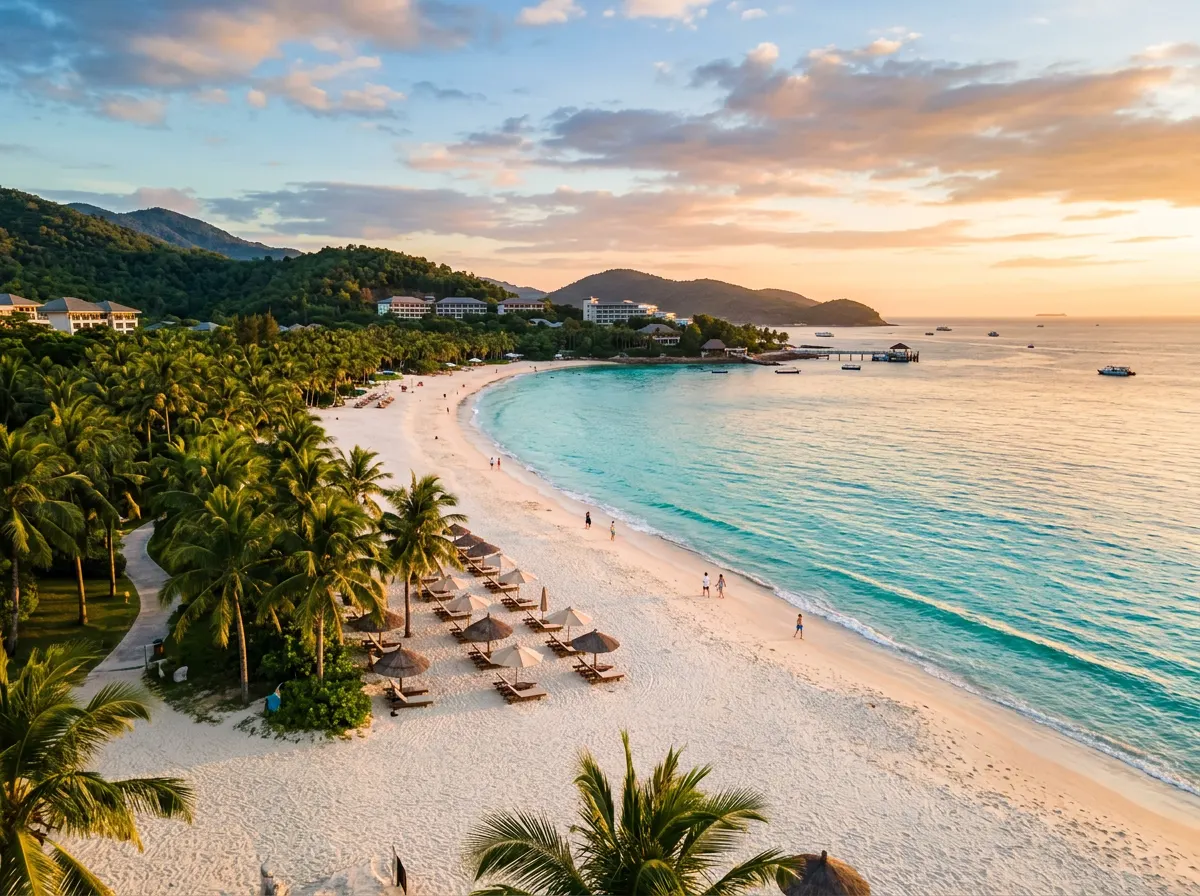
Sanya
Sanya (三亚, Sānyà) is the southernmost city in China, perched on the southern tip of Hainan Island (海南岛, Hǎinán Dǎo), and it is the closest thing China has to a tropical resort destination. Think palm-lined bays, warm turquoise water, fresh coconut stands every hundred meters, and an airport that handles direct flights from Russia, South Korea, and across Southeast Asia. The city spreads across four main bays — Sanya Bay (三亚湾), Dadonghai (大东海), Yalong Bay (亚龙湾), and Haitang Bay (海棠湾) — each with a distinct personality, from the budget-friendly convenience of Dadonghai to the five-star resort seclusion of Yalong Bay. Sanya is also home to the Nanshan Temple complex and its staggering 108-meter Guanyin statue (南山海上观音, Nánshān Hǎishàng Guānyīn), one of the tallest statues in the world, and Wuzhizhou Island (蜈支洲岛), the best diving and snorkeling spot in South China. The city has a unique Hainan-specific visa-free policy covering citizens of 59 countries, making it one of the easiest-entry points into China. The honest trade-off: Sanya is expensive by Chinese standards, crowded with domestic tourists during winter and Chinese New Year, and parts of the coastline have been overbuilt with high-rise hotels. It is not an undiscovered tropical paradise — it is China's mass-market beach getaway, and you need to know which bay to pick and when to come. Budget roughly ¥350-800 per day for mid-range comfort, more if you stay at a five-star resort. Many travelers pair Sanya with Hong Kong (3h flight, often under $200 round-trip) or combine it with a 2-3 day Haikou + Wenchang extension up the eastern coast of Hainan for a fuller island experience. Within Sanya itself, getting from bay to bay is straightforward by DiDi (¥30-80 per trip) and the city's bus network covers all four bays and the main attractions for ¥2-5 per ride, so a rental car is not necessary for most visitors.
Why Sanya in 2026.
China's premier tropical beach destination on Hainan Island's southern coast — white-sand bays, year-round warmth, and the 108-meter Guanyin statue rising from the South China Sea.
Quick Answer
Sanya (三亚, Sānyà) is the southernmost city in China, perched on the southern tip of Hainan Island (海南岛, Hǎinán Dǎo), and it is the closest thing China has to a tropical resort destination. Think palm-lined bays, warm turquoise water, fresh coconut stands every hundred meters, and an airport that handles direct flights from Russia, South Korea, and across Southeast Asia. The city spreads across four main bays — Sanya Bay (三亚湾), Dadonghai (大东海), Yalong Bay (亚龙湾), and Haitang Bay (海棠湾) — each with a distinct personality, from the budget-friendly convenience of Dadonghai to the five-star resort seclusion of Yalong Bay. Sanya is also home to the Nanshan Temple complex and its staggering 108-meter Guanyin statue (南山海上观音, Nánshān Hǎishàng Guānyīn), one of the tallest statues in the world, and Wuzhizhou Island (蜈支洲岛), the best diving and snorkeling spot in South China. The city has a unique Hainan-specific visa-free policy covering citizens of 59 countries, making it one of the easiest-entry points into China. The honest trade-off: Sanya is expensive by Chinese standards, crowded with domestic tourists during winter and Chinese New Year, and parts of the coastline have been overbuilt with high-rise hotels. It is not an undiscovered tropical paradise — it is China's mass-market beach getaway, and you need to know which bay to pick and when to come. Budget roughly ¥350-800 per day for mid-range comfort, more if you stay at a five-star resort. Many travelers pair Sanya with Hong Kong (3h flight, often under $200 round-trip) or combine it with a 2-3 day Haikou + Wenchang extension up the eastern coast of Hainan for a fuller island experience. Within Sanya itself, getting from bay to bay is straightforward by DiDi (¥30-80 per trip) and the city's bus network covers all four bays and the main attractions for ¥2-5 per ride, so a rental car is not necessary for most visitors.
| Worth visiting | Yes, if you want a tropical beach break inside China. Sanya is not Thailand or Bali — it is more developed and more expensive — but the beaches are real, the seafood is excellent, and the Nanshan Guanyin statue alone is worth the trip. |
|---|---|
| Recommended days | 3-5 days |
| Best time to visit | November through March for perfect beach weather (22-28°C, low humidity). Avoid Chinese New Year (late January or February) when hotel prices triple and every beach is packed. Avoid June-September for typhoon season and crushing humidity. |
| Daily budget | $45 (backpacker) / $150 (mid-range) / $400+ (luxury) |
| Family friendly | Excellent — calm water at Yalong Bay and Sanya Bay, Atlantis water park, gentle beach slopes, and family-focused resorts with kids' clubs. Sanya is arguably China's most family-friendly beach destination. |
| Solo friendly | Moderate — safe and easy to navigate, but the resort-heavy layout can feel isolating for solo travelers. Dadonghai is the best base for solo visitors with its backpacker hostels and lively bar scene. |
| Airport | Sanya Phoenix International Airport (SYX) — 11 km northwest of Sanya Bay. Taxi to Sanya Bay ¥30-50 (20 min), to Dadonghai ¥50-80 (30 min), to Yalong Bay ¥100-130 (40 min). Also connected to Haikou (3h north) by Hainan Round-Island HSR. |
| High-speed rail | Yes — Hainan Round-Island HSR connects Sanya to Haikou (1.5-2h, ¥100-130 second class) and eastern-coast towns. No bridge to the mainland — trains cross the Qiongzhou Strait via ferry (cars) or you fly. |
| Language | Mandarin with Hainanese dialect (海南话, Hǎinán huà). English is more common than in inland Chinese cities due to the tourist industry — hotel staff, dive shops, and major restaurants usually have some English. Still, carry a translation app. |
| Currency | CNY (¥) — Alipay and WeChat Pay accept foreign Visa/Mastercard. Cash useful for beach vendors, small seafood stalls, and fruit stands. |
| Time zone | China Standard Time (UTC+8) |
| Last updated | 2026-06-18 |
Want a Sanya plan built for you?
Jump to:
Yalong Bay·Nanshan Guanyin·Wuzhizhou Island·Tianya Haijiao·Beaches Compared·Food & Seafood·Getting Around·Where to Stay·Itineraries·Weather·Tips & Warnings·Visa-Free Entry·Emergency Contacts·FAQ
Is Sanya worth visiting? Is it really "China's Hawaii"?
Yes for some travelers, no for others. Sanya is a high-end Chinese tropical resort that competes with Thailand and Bali on weather and beach quality but costs more, skews to the domestic market, and feels overdeveloped in parts. If you are comparing Sanya to Thailand, Bali, or the Maldives, you will find it more expensive, more developed, and more Chinese in character — the resorts are high-rise rather than thatched-bungalow, the beach bars serve Tsingtao rather than Singha, and the tourist infrastructure is built for the Chinese domestic market rather than Western backpackers. But if you are already traveling in China and want a beach break, or if you are curious about how 1.4 billion people do tropical vacations, Sanya is genuinely interesting and, in parts, beautiful. The case for Sanya: the weather from November to March is near-perfect — sunny, 22-28°C, low humidity, warm water. Yalong Bay has a genuinely beautiful beach with soft white sand and clear water that rivals many Southeast Asian beaches. The Nanshan Guanyin statue is one of the most impressive religious monuments in Asia, and Wuzhizhou Island offers the best tropical diving inside China's borders. The seafood is fresh — caught that morning, cooked that evening, eaten with your feet in the sand. And the Hainan-specific visa-free policy means citizens of 59 countries can enter China directly through Sanya without a visa (see the visa section below for details). The honest downsides: Sanya is expensive. A mid-range hotel that costs ¥250 in Changsha costs ¥500 here. A seafood dinner for two can easily run ¥400-800 at a beachfront restaurant. During Chinese New Year (late January or February), hotel prices triple — ¥800 rooms become ¥2,500, and the beaches are packed shoulder-to-shoulder. The city has also been overdeveloped in stretches: Sanya Bay is lined with 30-story condo towers, and the view from Luhuitou Park reveals a skyline that looks more like Miami than a tropical island. If you want pristine, undeveloped tropical coastline, go to the Philippines. If you want a comfortable, interesting, Chinese tropical resort experience with genuinely good food and a few world-class sights, Sanya delivers.
What are the best beaches in Sanya and how do they compare?
The four main bays define the Sanya experience. Picking the right one for your trip is the single most important decision you will make. Yalong Bay (亚龙湾, Yàlóng Wān): The best beach. A 7.5 km crescent of soft white sand, clear turquoise water, and gentle waves suitable for swimming year-round. The beach is lined with international five-star resorts — Ritz-Carlton, MGM Grand, Sheraton, Marriott, St. Regis — each with its own manicured beachfront. A public-access section at the center of the bay (free entry) lets non-guests use the beach and the water. Water sports rentals: jet skis ¥200-400 per 15 minutes, parasailing ¥300-500, banana boats ¥150 per person. The downsides: the bay is 25 km from Sanya city center, with limited dining options outside the resorts, and the resort restaurants are predictably overpriced (¥88 for a club sandwich, ¥48 for a coconut — you can buy the same coconut for ¥10 on Dadonghai). Yalong Bay is for people who want the best beach and are willing to pay for it. Dadonghai (大东海, Dàdōnghǎi): The social beach. A compact 2 km bay only 4 km from Sanya city center, ringed with bars, seafood restaurants, hostels, and mid-range hotels (¥200-600 per night). The sand is coarser than Yalong Bay and the water is slightly less clear, but it is still a perfectly good tropical beach — warm, swimmable, and clean. The vibe is the real draw: Russian expats order beers in beachfront bars, Chinese families build sandcastles, backpackers swap tips at hostel common rooms, and the evening seafood barbecue scene is lively and affordable (grilled fish ¥68-128, squid ¥25, cold beer ¥15). Dadonghai is the right choice for solo travelers, budget-conscious visitors, and anyone who wants to walk from their hotel to a bar to a restaurant without taking a taxi. Sanya Bay (三亚湾, Sānyà Wān): The convenient bay. A 22 km stretch of beach running along the western side of Sanya city, backed by a long seaside promenade (椰梦长廊, Yēmèng Chángláng — "Coconut Dream Corridor") perfect for evening walks and cycling. The beach itself is the least impressive of the four — greyish sand, shallower water, and views of the city skyline rather than jungle-covered hills. But the location is unbeatable: a 15-minute drive from the airport, walking distance to downtown restaurants and shopping, and the cheapest accommodation of any bay (¥150-400 for mid-range hotels). Sanya Bay is the best base if you are here for sightseeing rather than pure beach time — you can reach Nanshan Temple, Tianya Haijiao, and the HSR station quickly. The sunsets over the South China Sea from the promenade are genuinely spectacular. Haitang Bay (海棠湾, Hǎitáng Wān): The luxury bay. The newest and most upscale of the four, 28 km northeast of the city center. It is home to the Atlantis resort, the Edition, the InterContinental, and the Sanya International Duty-Free City — the largest duty-free shopping complex in the world (300,000 square meters). The beach is good — long, sandy, and uncrowded — but the sea here has strong currents and swimming is often prohibited (red flags are common). Haitang Bay is for luxury travelers, shoppers, and Atlantis visitors. It is not for budget travelers, and it is a long taxi ride (¥120-150) from the city center.
How to get to Sanya: flights, high-speed rail, and the Hainan visa-free policy?
Sanya Phoenix International Airport (SYX) is 11 km northwest of Sanya Bay and handles direct international flights from Seoul (4.5h), Bangkok (2.5h), Singapore (3.5h), Kuala Lumpur (3h), Moscow (9h, and Sanya is extremely popular with Russian tourists), Almaty (6h), and a growing list of Southeast Asian and Central Asian cities. Domestic flights connect Sanya to every major Chinese city: Beijing (4h), Shanghai (3h), Guangzhou (1.5h), Chengdu (2.5h), Xi'an (3h). From the airport: a taxi to Sanya Bay costs ¥30-50 (20 min), to Dadonghai ¥50-80 (30 min), to Yalong Bay ¥100-130 (40 min), to Haitang Bay ¥130-160 (50 min). There is no metro from the airport — buses (Line 8 to Dadonghai, ¥5) and taxis are your only options. Hainan Round-Island High-Speed Rail (海南环岛高铁, Hǎinán Huándǎo Gāotiě) is a 653 km loop line connecting Sanya to Haikou (海口, Hǎikǒu) on the north coast in 1.5-2 hours (¥100-130 second class). The eastern line is faster (1.5h through Lingshui, Wanning, and Qionghai); the western line is slower (2h through Dongfang and Danzhou). Haikou is Hainan's capital and a major transport hub — it has its own international airport (HAK) and a train ferry across the Qiongzhou Strait to the mainland. So you can take a train from Beijing to Haikou (the train cars are loaded onto a ferry — yes, the train crosses the sea on a boat), then transfer to the HSR to Sanya. This takes about 16 hours from Guangzhou (overnight sleeper) or 24+ hours from Beijing. It is an experience; flying is faster and usually cheaper. The Hainan Visa-Free Access policy is one of Sanya's biggest advantages. As of June 2026, citizens of 59 countries (including the US, UK, Canada, Australia, all EU member states, Japan, South Korea, and most of Southeast Asia) can enter Hainan province without a visa for up to 30 days, provided they arrive directly in Hainan (not via mainland China) and register with a Hainan-based travel agency before arrival. This is separate from and more generous than the national 30-day visa-free policy. The registration process is straightforward: book your hotel and tour through a Hainan-registered agency (they handle the paperwork), and present your passport on arrival. You cannot leave Hainan for the mainland under this policy — it is Hainan-only. If you want to combine Sanya with mainland destinations like Guilin or Guangzhou, you need the standard Chinese visa or the national visa-free policy. Confirm the current list of eligible countries with your nearest Chinese consulate — the list changes periodically.
How to get around Sanya: buses, taxis, DiDi, and scooters?
Sanya's public transport is functional but not great. There is no metro. The bus system covers all four bays and major attractions with about 30 routes, with fares of ¥2-5. The most useful routes for visitors: Bus 25 runs along the coast from Yalong Bay through Dadonghai to Sanya Bay (¥5, every 15 min), Bus 16 goes from Sanya city to Nanshan Temple and Tianya Haijiao (¥10, every 20 min, about 1 hour), Bus 28 connects Sanya city to Wuzhizhou Island dock (¥12, about 1 hour). Buses are air-conditioned, announcements are Chinese-only, and they stop running around 18:00-19:00 — not useful for evening returns from attractions. Pay with cash (exact change) or Alipay's transport QR code. DiDi (China's Uber) is the most practical way to get around. A ride within a single bay area costs ¥10-20; between bays (e.g., Dadonghai to Yalong Bay) costs ¥40-60; from the city to Nanshan Temple costs ¥80-100; from the city to Wuzhizhou dock costs ¥80-100. The DiDi app works in English and accepts international phone numbers. Metered taxis are also plentiful — flagfall is ¥10 for the first 2.5 km, then ¥2.5 per km — but drivers rarely speak English, and some "forget" to use the meter, especially near tourist hotspots and the airport. Always insist on the meter (dǎ biǎo, 打表) or use DiDi. Electric scooters are everywhere. Rental shops in Dadonghai and Sanya Bay charge ¥50-80 per day for a basic e-scooter, passport deposit required. This is the most fun way to explore — cruising the coastal road with the wind in your face — but Sanya traffic is chaotic, helmets are optional for locals (wear one anyway), and you need a Chinese driver's license technically (though rental shops rarely ask). The coastal road from Sanya Bay to Tianya Haijiao is a beautiful 24 km ride along the water. For Wuzhizhou Island: the ferry is the only way. The dock is at Wuzhizhou Port, about 30 km northeast of the city (¥80-100 by DiDi). Ferries run 08:00-16:00 outbound and 08:30-17:30 return (¥144 round-trip including island admission). For Nanshan Temple and Tianya Haijiao: Bus 16, a DiDi, or a tour-group minibus from your hotel. For Yanoda Rainforest: there is no practical public transport — book a Didi or join a hotel-arranged group tour. For Atlantis Sanya: DiDi to Haitang Bay, about ¥80 from Dadonghai.
What are the top attractions in Sanya, ranked?
1. Nanshan Temple & 108m Guanyin Statue (南山寺/南山海上观音). ¥129 as of June 2026. The three-faced Guanyin stands on a man-made island connected by a causeway — you walk across and can enter the base of the statue, which contains a Buddhist hall with thousands of small Guanyin figurines donated by visitors. The scale is hard to convey in photos: the statue is 108 meters tall (the Statue of Liberty is 93m from ground to torch), and one face gazes inland while two look out to sea. The Nanshan Temple complex behind it is a functioning Buddhist monastery with golden-roofed halls, incense burners, and a vegetarian restaurant (¥68 per person) that serves surprisingly good mock-meat dishes. Arrive by 08:30 to beat the tour groups. Allow 3-4 hours. The site is 40 km west of the city; combine with Tianya Haijiao (15 km apart) for a full day. 2. Yalong Bay Beach (亚龙湾). Free (public section). The beach itself is the attraction — 7.5 km of soft white sand and calm, clear water. The public section is in the center of the bay, marked by a large parking lot and a strip of small shops. The sand quality is the best in Sanya — fine, white, and cool underfoot even in midday sun. The water visibility is 5-10 meters on a good day. The surrounding hills are covered in tropical forest, and the view from the water looking back at the bay is postcard-caliber. The resort beaches on either side of the public section are reserved for guests (you can sometimes walk through if you are discreet, but security may stop you). A half-day is enough for beach-sitting, swimming, and a jet-ski ride. 3. Wuzhizhou Island (蜈支洲岛). ¥144 round-trip ferry including island entry. The water here is the clearest in Hainan — visibility of 10-20 meters on a good day — and the diving is the best in China. The island has a single white-sand beach, a small temple, walking paths through tropical vegetation, and the dive center. Snorkeling (¥180-300) from the beach reveals coral, parrotfish, angelfish, and the occasional sea turtle. The Discover Scuba Diving course (¥680, no certification required) takes you to 6-8 meters with an instructor. Certified divers can do boat dives to deeper reefs (¥880-1,200 for two dives). The downside: the island is small and gets packed by mid-morning. Take the 08:00 ferry, snorkel or dive first, then walk the island paths before the 11:00 crowd arrives. The single island resort (Coral Hotel, ¥1,500+) lets you stay overnight when day-trippers leave, but it is expensive. 4. Tianya Haijiao (天涯海角). ¥81. The "Edge of the Sky, Rim of the Sea" is a scenic coastal park with giant granite boulders, some carved with calligraphy, set against the blue South China Sea. The two most famous boulders — one carved with "天涯" (Tiānyá) and another nearby with "海角" (Hǎijiǎo) — are mobbed with photo-taking tourists. The park is 24 km west of the city, about 30 minutes by DiDi. It is scenic, romantic in a classical-Chinese-poetry way, and undeniably touristy — the entrance plaza has a large gift shop, and the paths are paved and manicured. The best way to experience it: walk past the main boulder cluster to the quieter southern end of the park, where the rocks meet the sea with fewer people. Allow 2 hours. 5. Luhuitou Park (鹿回头公园). ¥45 + ¥15 for the electric cart. A hilltop park with the best panoramic view of Sanya — you can see Sanya Bay, Dadonghai, the city skyline, and on a clear day, the distant outline of Wuzhizhou Island. The Li minority legend that gives the park its name is commemorated by a 12-meter statue at the summit: a hunter, a deer, and the moment of transformation. The park is most beautiful at sunset, when the city lights begin to flicker on and the sky turns orange over the South China Sea. A bar at the summit serves cold drinks (¥25-40). The walk up takes 30 minutes; the electric cart takes 5. 6. Dadonghai Beach (大东海). Free. Not an "attraction" in the ticketed sense, but the social hub of Sanya — the beach where you eat grilled squid with your feet in the sand, drink a cold Tsingtao at a beachfront bar, and watch Russian families and Chinese couples live their best vacation lives. The swimming area is roped off and lifeguarded. The beachfront promenade has dozens of restaurants and bars. The best seafood barbecue stalls set up after 17:00 on the eastern end of the bay. 7. Yanoda Rainforest (呀诺达雨林). ¥168. A developed tropical rainforest park 35 km north of the city with elevated canopy walkways, waterfalls, zip-lines (¥100 extra), and a rock-climbing route. The forest is real — Hainan's interior has some of the best-preserved tropical rainforest in China, with ancient banyan trees, dangling lianas, and wild orchids — but the park experience is heavily managed, with concrete paths, uniformed guides, and a theme-park atmosphere. The canopy walk through the treetops is the highlight. The zip-line across a valley is short but fun. Allow 3-4 hours including transport. 8. Atlantis Sanya Water Park (亚特兰蒂斯水世界). ¥358 adult, ¥258 child/senior. Two tower rides (the Leap of Faith is a near-vertical drop through a shark-filled tank), a lazy river, a wave pool, and a kids' splash zone. It is expensive, crowded on weekends, and undeniably fun. Combine with the Lost Chambers aquarium (¥228, 86,000 marine animals, including manta rays and hammerhead sharks). The Ambassador underwater restaurant (¥1,000+ per person for dinner) lets you eat surrounded by fish — the food is fine, the experience is the point. The whole Atlantis complex on Haitang Bay is a destination in itself; plan a full day if you commit to it.
Where to stay in Sanya: which bay, what budget, and how to choose?
Your bay choice defines your Sanya experience. Here is the honest breakdown: Dadonghai (大东海) — Best for budget travelers, solo visitors, and anyone who wants walkable nightlife. Hotels range from ¥80 dorm beds at hostels (Sanya Backpacker Hostel, Dadonghai Youth Hostel) to ¥400-800 for mid-range hotels (Holiday Inn Resort, Sanya Junji Seaview Hotel) to ¥1,000+ for beachfront resorts (Mandarin Oriental Dadonghai, at the quieter southern end). The area has dozens of restaurants, bars, convenience stores, and dive shops all within walking distance — no DiDi needed for dinner or drinks. The downside: the beach is good, not great, and the area can feel a bit scruffy around the edges. Sanya Bay (三亚湾) — Best for sightseeing-focused trips and early/late flights. The bay is a 15-minute drive from the airport, close to the HSR station, and the most convenient base for Nanshan Temple and Tianya Haijiao. Hotels range from ¥150-400 for mid-range (HNA Resort Sanya, Coconut Palm Hotel) to ¥600-1,200 for seafront properties (Pullman Sanya Bay, Howard Johnson). The Coconut Dream Corridor promenade is excellent for evening walks. The downside: the beach is the weakest of the four bays (grey sand, shallow water, city views), and you will need taxis for nightlife. Yalong Bay (亚龙湾) — Best for beach purists and resort-lovers. The best sand and water in Sanya, with a string of five-star resorts: Ritz-Carlton (¥1,500-3,000), MGM Grand (¥1,200-2,500), Sheraton (¥800-1,800), Marriott (¥900-2,000), and the St. Regis at the northern end (¥2,000-4,000). Each resort has a private beach section, multiple pools, and multiple restaurants. A few mid-range options exist behind the beach road (Cactus Resort Sanya, ¥400-600) with shuttle access to the sand. The downside: you are isolated — dining outside the resort means a ¥50-80 DiDi round-trip, and there is no nightlife beyond the resort bars (¥68 cocktails, fine but soulless). Haitang Bay (海棠湾) — Best for luxury shoppers and Atlantis visitors. The newest bay with the most expensive hotels: Atlantis (¥2,000-5,000), Edition (¥1,800-3,500), InterContinental (¥1,200-2,500), Westin (¥900-1,800). The duty-free mall is the anchor attraction. The beach is long and uncrowded but swimming is often unsafe due to currents. Haitang Bay is for people who plan to stay in their resort, shop, and visit Atlantis. It is a 50-minute drive from the city center (¥120-150 DiDi). My recommendation: Stay in Dadonghai for your first visit. The beach is good, the food scene is the best in Sanya, the social atmosphere is lively, and the location balances beach access with city convenience. Spend your beach days at Yalong Bay (a 30-minute, ¥50 DiDi ride) but sleep, eat, and drink in Dadonghai. You will save ¥300-500 per night on accommodation and eat better food for less money.
What to eat in Sanya: Hainanese cuisine, seafood, and tropical fruit?
Hainanese cuisine is distinct from mainland Chinese food — lighter, fresher, and built around seafood, coconut, and the island's tropical produce. It shares DNA with the cuisines of Southeast Asia, particularly Malaysia and Singapore (Hainanese immigrants shaped Singaporean food culture — Singapore's famous "Hainanese chicken rice" traces directly to Hainan). Here is what to eat: Wenchang chicken (文昌鸡, Wénchāng jī). The island's signature dish, named after the city of Wenchang in northeastern Hainan. Free-range chickens are poached until just cooked, then served at room temperature with the skin still gelatinous, the meat tender and subtly flavored, accompanied by a dipping sauce of ginger, garlic, salt, and lime juice. It is simple, clean, and brilliant — a radical contrast to the chili-bomb cooking of Hunan or Sichuan. ¥68-128 for a half chicken at most restaurants. Long Ji (隆记) near Dadonghai and the Wenchang Chicken specialty shops around Jiefang Road (解放路) are reliable. Hainanese chicken rice (海南鸡饭, Hǎinán jī fàn). The same poached chicken, served over rice cooked in the chicken broth with ginger and pandan leaf, with the ginger-scallion dipping sauce and a bowl of the poaching broth on the side. ¥25-45 at casual eateries. The version at Xinglong Restaurant (兴隆餐厅) in Sanya city is the local favorite. Fresh seafood (海鲜, hǎixiān). Sanya's seafood scene is its biggest culinary draw. The format at most seafood restaurants: you select your fish, crab, shrimp, or shellfish from a tank (alive, swimming), choose your cooking style (steamed with ginger and scallion, stir-fried with garlic, grilled with salt and chili, or boiled plain), and it arrives at your table 15-20 minutes later. Must-try items: steamed grouper (清蒸石斑鱼, qīngzhēng shíbānyú, ¥128-198 depending on size), garlic scallops with vermicelli (蒜蓉粉丝蒸扇贝, suànróng fěnsī zhēng shànbèi, ¥12-18 per piece), stir-fried mantis shrimp with pepper and salt (椒盐皮皮虾, jiāoyán pípxiā, ¥98-158), and Hainanese-style steamed crab with ginger and scallion (姜葱炒蟹, jiāngcōng chǎo xiè, ¥168-288). The Chunyuan Seafood Market (春园海鲜市场) near Sanya Bay is the classic experience: you buy your seafood from the market stalls on the ground floor, take it upstairs to a restaurant, and they cook it for ¥20-40 per dish. It is chaotic, loud, and the best seafood experience in Sanya. The No. 1 Seafood Market (第一市场) in the city center is similar but more touristy. For a sit-down experience: Haiya Seafood Restaurant (海亚海鲜餐厅) on Dadonghai is reliable and English-menu-friendly. Budget ¥150-300 per person for a serious seafood meal. Coconut rice (椰子饭, yēzi fàn). Glutinous rice, coconut milk, and sometimes pieces of young coconut meat steamed inside a coconut shell. Sweet, fragrant, and served as a dessert or side dish. ¥15-25. Hainan noodles (海南粉, Hǎinán fěn). Thin rice noodles served in a mild broth with peanuts, pickled vegetables, bean sprouts, shredded pork, and a spoonful of Hainanese chili sauce on the side. It is the island's breakfast staple — ¥8-15 at street stalls and small shops. The best are found at morning markets in Sanya city, where locals eat standing at counters before work. Qingbuliang (清补凉, qīngbǔliáng). The essential Sanya dessert: a bowl of shaved ice topped with coconut milk, red beans, mung beans, barley, sweet potato cubes, tapioca pearls, watermelon, mango, and a dusting of crushed peanuts. It is cold, sweet, and the only thing you want after a hot beach day. ¥12-20 from street stalls and dessert shops. Zhengji Qingbuliang (郑记清补凉) on Jiefang Road is the city's most famous shop. Tropical fruit (热带水果, rèdài shuǐguǒ). Sanya is a fruit-lover's paradise. Fresh coconut (椰子, yēzi, ¥8-12, the vendor hacks it open with a machete and hands you a straw), mango (芒果, mángguǒ, ¥5-10 each for the small, intensely sweet Hainan variety), dragon fruit (火龙果, huǒlóngguǒ, ¥8-15), mangosteen (山竹, shānzhú, ¥15-25 per kg in season May-September), rambutan (红毛丹, hóngmáodān, ¥12-20 per kg), and the infamous durian (榴莲, liúlián, ¥30-50 per kg — banned from hotels and public transport, for good reason). The Hongsha Fruit Market (红沙水果市场) in the east of the city has the best selection and prices. The honest caution about Sanya seafood: overcharging is common. Always confirm the price per jin (斤, 500g) before ordering, and ask for the total estimated price. Some restaurants near the big beaches have "seasonal pricing" that can surprise you — a fish quoted at ¥98 per jin turns into a ¥400 bill. The Chunyuan Market self-select approach avoids this. Seafood quality dips slightly in summer (the fish are spawning and the flesh is softer); winter is the peak seafood season.
What is the monthly weather and best time to visit Sanya?
Sanya has a tropical monsoon climate, with warm temperatures year-round and a clear wet-dry seasonal split. The monthly breakdown: January: 18-26°C, dry, sunny. Peak tourist season — hotels are expensive, beaches are busy. Chinese New Year (dates vary, late January or early February) is the single busiest, most expensive period of the year. February: 19-27°C, dry, sunny. Still peak season. Hotel prices remain high through the Spring Festival period and drop slightly afterward. March: 21-29°C, mostly dry. The tail end of high season. March is a sweet spot — warm but not hot, still sunny, and crowds thinning after the Spring Festival surge. April: 23-31°C, humidity rising but still generally dry. A good month — hot enough for swimming, not yet into the punishing summer humidity. The last good month before summer. May: 25-33°C, the start of the rainy season. Humidity spikes, afternoon thunderstorms become frequent (usually short, intense downpours). Still plenty of sunny hours between storms. Mangoes and mangosteens are in peak season. June: 26-34°C, hot and humid, tropical storms possible. The beginning of typhoon season (June-November). Still, June has sunny stretches and the sea is at its warmest (29°C). Hotel prices drop to low-season rates. July: 26-33°C, peak typhoon activity begins. High humidity, frequent rain. The least reliable month for beach weather. On the positive side: almost no crowds, hotel prices are at their annual low, and the rainforest at Yanoda is at its lushest. August: 26-33°C, still typhoon season, hot and humid. Similar to July. If you get a clear day, the beaches are gloriously empty. If a typhoon hits (roughly 1-2 direct hits per year), you will spend 2-3 days indoors. September: 25-32°C, typhoon season continues, tapering toward the end of the month. Humidity remains high. Hotel prices are still low. September has the biggest gamble — you could get a week of perfect weather or a week of rain. The Mid-Autumn Festival (dates vary) brings lantern displays and mooncakes. October: 23-30°C, the transition month. Typhoon risk drops, humidity drops, rain decreases. Late October is the beginning of the golden season. Hotel prices start rising but are still moderate. October is the best-value month — good weather without peak-season prices. November: 21-28°C, dry, sunny, perfect. The best month for Sanya along with March. Warm days, cool nights, low humidity, clear water, and the beaches are uncrowded until late November when the winter season begins. November is my personal pick for Sanya. December: 19-27°C, dry, sunny. High season begins in mid-December as Chinese domestic tourists arrive for winter holidays. Christmas is not a local holiday but international resorts run festive programs. Book ahead for late December. The bottom line: November and March are the ideal months — dry, warm, uncrowded, and reasonably priced. December through February have the most reliable weather but the highest prices and largest crowds. April and October are good value with acceptable weather. May and September are gambles. June through August is the low season for a reason — only go if you are willing to lose beach days to rain and want rock-bottom prices.
What practical information do I need: visa, money, internet, and language?
Visa-free access for Hainan: As of June 2026, citizens of 59 countries can enter Hainan province without a visa for up to 30 days. This is a Hainan-specific policy, separate from the national visa-free program. You must arrive directly in Hainan (Sanya SYX or Haikou HAK) — not via a mainland Chinese city — and you must register with a Hainan-based travel agency before arrival. The agency handles the paperwork; you present your passport on arrival. This policy does NOT allow travel to mainland China from Hainan. For a Sanya-only or Hainan-only trip, it is the easiest option. For a combined mainland-and-Hainan trip, you need the standard Chinese visa (L tourist visa) or the national 30-day visa-free policy. Confirm your country's eligibility and the current registration process with the nearest Chinese consulate. Policies change; do not rely on information older than 3 months. Money: CNY (¥). ¥100 ≈ US$14 as of June 2026. Alipay and WeChat Pay are accepted everywhere — link a foreign Visa or Mastercard before you travel. Cash is useful for beach vendors (coconuts, fruit, souvenirs), small seafood stalls at the markets, and the occasional restaurant whose card machine is "broken." ATMs at ICBC, Bank of China, and China Construction Bank branches in Sanya city and Dadonghai accept foreign cards. Carry ¥300-500 in cash for a 3-5 day trip. Tipping is not customary. Internet and VPN: As in all of China, Google, Facebook, Instagram, WhatsApp, YouTube, X, and most Western sites are blocked. Install and test a VPN before arriving (ExpressVPN, Astrill, NordVPN — Astrill has historically been the most reliable in China). A Chinese SIM card from the China Mobile or China Unicom counter at SYX airport (¥100-200 for 30 days, 30-50 GB) gives you mobile data and a Chinese phone number (useful for DiDi, restaurant queuing, and some WeChat mini-programs). International eSIM data packages (Airalo, Holafly) work for data but do not provide a Chinese phone number. Language: Mandarin is the lingua franca. The local Hainanese dialect (海南话, Hǎinán huà) is a variety of Min Chinese, related to the dialects of Fujian and Taiwan, and is unintelligible to other Mandarin speakers. Everyone speaks standard Putonghua as well. English is more common in Sanya than in most Chinese cities due to the international tourist industry — hotel front desks, dive shops, major restaurants, and the Atlantis complex all have English-speaking staff. But do not count on English at bus stops, market stalls, or DiDi cars. A translation app (Pleco, Baidu Translate) with offline Chinese is essential. Useful phrases for Sanya: yēzi yīgè (椰子一个, one coconut), bùyào tài là (不要太辣, not too spicy — Hainanese food is mild, but seafood can come with chili), duōshǎo qián yī jīn (多少钱一斤, how much per 500g), hǎitān zài nǎlǐ (海滩在哪里, where is the beach).
What tips, warnings, and downsides should I know before going to Sanya?
1. SANYA IS EXPENSIVE. This is the number-one complaint, and it is fair. A mid-range hotel that costs ¥250 in Changsha costs ¥500 in Sanya. A seafood dinner for two runs ¥300-600. A coconut that costs ¥5 at a street market costs ¥35 at a resort pool bar. The resort taxis, the beachfront restaurants, and the duty-free mall are all priced for the Chinese domestic tourist market — which has money and is willing to spend it. Budget 30-50% more than you would for an equivalent experience in Thailand or Vietnam. The budget sweet spot: stay in Dadonghai (¥200-500), eat at the Chunyuan Seafood Market (¥100-200 per person), and use the free public beach sections at Yalong Bay and Dadonghai. 2. CHINESE NEW YEAR IS BRUTAL. If your visit overlaps with Chinese New Year (Spring Festival, dates vary — late January or early February), expect hotel prices to triple, beaches to be packed shoulder-to-shoulder, restaurants to be fully booked, and taxis to be scarce. The entire country goes on holiday simultaneously, and Sanya is one of the top domestic destinations. I do not recommend visiting Sanya during Spring Festival unless you have a specific reason (family, event) and a high tolerance for crowds and inflated prices. 3. THE WEATHER IS NOT ALWAYS POSTCARD-PERFECT. Sanya's marketing shows perpetual blue skies, but the June-November period brings tropical storms, typhoons (roughly 1-2 direct hits per year), and days of grey, humid weather. If you are flying specifically for a beach vacation, go between November and April. If you are combining Sanya with mainland sightseeing and the beach is a bonus, summer is fine — just be prepared for rain. 4. SEAFOOD OVERCHARGING IS COMMON. The "market price" (时价, shíjià) listed on menus is a license to charge whatever the restaurant thinks you will pay. Always confirm the price per jin (500g) before the seafood is scooped from the tank. Ask "yīgòng duōshǎo qián" (一共多少钱, how much total) to get an estimated bill. If a price seems absurd — ¥500 for a fish — walk away. The Chunyuan Seafood Market self-select-and-cook-upstairs model is the safest approach because you see the price before buying. The No. 1 Market is also fine but expect to haggle. 5. SWIMMING SAFETY: The water at Yalong Bay and Dadonghai is generally calm and safe, with lifeguarded swimming areas (roped off, red/yellow flags). Haitang Bay has strong rip currents — the red flag means no swimming, and you should obey it (drownings happen). Sanya Bay has shallow, murky water that is fine for wading but not great for swimming. Wuzhizhou Island has good swimming at the designated beach; elsewhere on the island, currents can be strong. Wear reef-safe sunscreen — the coral around Wuzhizhou is already stressed. 6. SUN PROTECTION IS NO JOKE. Sanya is at 18°N latitude — the same as Hawaii. The UV index is high year-round. You will burn through a cloudy sky in 30 minutes if you are not protected. Wear reef-safe SPF 50+, a hat, and sunglasses. Reapply sunscreen after swimming. Heatstroke is a risk in summer (May-September) — drink water constantly and limit midday beach time. 7. THE RUSSIAN FACTOR. Sanya has been a major Russian winter destination since the 1990s, and the Russian presence is highly visible — Cyrillic menus, Russian-speaking staff at many resorts, and dedicated Russian restaurants and bars in Dadonghai. This is neither a positive nor a negative, just a reality that shapes the tourist landscape. If you speak Russian, you will find it surprisingly useful in Sanya. 8. HOTEL PASSPORT REGISTRATION: Every hotel in China must register foreign guests with the Public Security Bureau. Budget hotels and small guesthouses sometimes refuse foreign guests because the registration paperwork is a hassle. Book through Trip.com (which has a "Welcomes Foreign Guests" filter) or book international chains directly. Hostels in Dadonghai are generally foreigner-friendly. 9. DON'T EXPECT PHI PHI ISLANDS. Sanya's water is warm and swimmable, but it is not the crystalline turquoise of the Andaman Sea. Visibility at Yalong Bay is 5-10 meters; at Wuzhizhou it is 10-20 meters. The sand at Yalong Bay is genuinely good — fine, white, and clean — but the surrounding scenery includes high-rise condos and construction cranes on the hillsides. Adjust your expectations: Sanya is a Chinese tropical city with beaches, not an undeveloped tropical island. 10. DUTY-FREE SHOPPING IS A THING. The Sanya International Duty-Free City on Haitang Bay is the largest duty-free mall in the world (300,000 square meters). International visitors departing from Hainan (SYX or HAK) can shop duty-free with a limit of ¥100,000 per person per year. Cosmetics, perfume, and luxury goods are the main categories. The mall is genuinely enormous — plan 2-3 hours if you are serious about shopping. The duty-free prices are competitive with Hong Kong and Singapore for most brands.
How does Sanya fit into a larger China itinerary?
Sanya is geographically isolated — it is on an island 30 km off the south coast of mainland China — but it connects easily by air to most major Chinese cities. The most common itinerary patterns: The southern beach add-on: A classic 2-week China itinerary — Beijing (4 days) → Xi'an (3 days) → fly to Sanya (3 days) → fly out of Sanya. Sanya replaces the typical Shanghai or Guilin third stop with a tropical beach break. The contrast between Xi'an's terracotta warriors and Sanya's palm-lined beaches is extreme and satisfying. The Hainan loop: Fly into Haikou (HAK), take the HSR to Wenchang (for the chicken, 20 min), continue to Qionghai and Wanning (surf beaches, 1-1.5h from Haikou), then to Sanya (2h from Haikou) for 3-4 days of beaches and sightseeing, then fly out of SYX. A 7-10 day Hainan-only trip that shows the island beyond just Sanya. Wanning (万宁) in particular has become popular with Chinese surfers and has a younger, more alternative vibe than Sanya's resort scene. The Southeast Asia connector: Sanya has direct flights to Bangkok (2.5h), Singapore (3.5h), and Kuala Lumpur (3h), making it a natural start or end point for a combined China-Southeast Asia trip. For example: Bangkok → fly to Sanya (3 days) → fly to Guangzhou (1.5h, 3 days) → HSR to Guilin/Yangshuo (3 days) → fly out of Guilin. Or the reverse direction. Sanya does not pair naturally with the classic first-time China cities by rail — the Hainan Round-Island HSR connects only within Hainan, and the train-ferry to the mainland adds 3-4 hours to any trip to Guangdong. Flying is the practical option for connecting Sanya to the mainland. Flights from Sanya to Guangzhou are 1.5 hours (¥300-600), to Shenzhen 1.5 hours (¥300-600), to Kunming 2 hours (¥400-700), to Chengdu 2.5 hours (¥500-900). Sanya works best as a beach-bookend to a mainland itinerary — start or finish with the beach, fly in between.
What are the emergency contacts and health information for Sanya?
Police: 110. Ambulance: 120. Fire: 119. Traffic accident: 122. These numbers work from any phone. English-speaking operators exist in theory; in practice, Mandarin is standard. Your hotel front desk is your best first call in any emergency — they can translate, coordinate, and direct you to appropriate services. International hospital: The Sanya People's Hospital (三亚市人民医院, Sānyà Shì Rénmín Yīyuàn) on Jiefang Road has an international wing with some English-speaking staff. For serious medical issues, the Hainan General Hospital in Haikou (3 hours north by HSR) is the province's best hospital. For critical emergencies, medical evacuation to Hong Kong, Singapore, or Bangkok may be necessary — comprehensive travel insurance covering medical evacuation is essential. Tap water is not potable. Bottled water is cheap (¥2-3 per 1.5L bottle) and available everywhere. Hotels provide complimentary bottled water and a kettle. For brushing teeth, tap water is generally fine in resort areas. Air quality in Sanya is generally good — the best of any major Chinese city. The sea breeze and lack of heavy industry keep the AQI at 30-60 most days. Winter inversions can push it to 80-100, but Sanya rarely sees the hazardous levels common in Beijing or Xi'an. The tropical vegetation helps — the air smells like flowers and sea salt, not smog. Sun and heat safety: Heatstroke is a real risk from May through September. Symptoms: headache, dizziness, nausea, rapid heartbeat, confusion. If you feel these, get into air conditioning immediately, drink water with electrolytes, and cool your body. Pharmacies (药店, yàodiàn) sell oral rehydration salts (口服补液盐, kǒufú bǔyè yán, ¥5-10). Mosquitoes are present year-round — use repellent with DEET, especially at dusk and in the rainforest parks. Dengue fever is rare but present in Hainan; the risk is low in resort areas. Sea safety: The beaches in Sanya have lifeguards during peak season (May-October) and warning flags (red = do not swim, yellow = caution, green = safe). The currents at Haitang Bay are stronger than at Yalong Bay or Dadonghai. Do not swim after drinking alcohol (many rescues each year involve intoxicated swimmers). The coral reef near Wuzhizhou Island and along parts of Dadonghai has sharp coral and sea urchins — wear reef shoes when snorkeling. Jellyfish are present in the warmer months (May-September); stings are uncomfortable but rarely dangerous — rinse with vinegar (provided at beach first-aid stations) and seek medical attention if severe. Vaccinations for Sanya: No special vaccinations are required. Standard travel vaccinations (hepatitis A and B, typhoid, Japanese encephalitis if visiting rural areas) are recommended. The standard travel health kit should include: motion sickness medication for boat trips, anti-diarrheal medication, sunscreen (SPF 50+), insect repellent, antihistamines, and a basic first-aid kit. Pharmacies are abundant in tourist areas; brand-name medications are available. Pharmacies in Sanya are open 08:00-22:00 in tourist areas, with 24-hour options near the major hospitals. Common medications are sold without prescription. For prescriptions, the international wing of Sanya People's Hospital or the Hainan General Hospital in Haikou are the reliable options. Travel insurance with medical evacuation coverage is strongly recommended for any visit to Sanya — the international hospitals are limited and serious medical situations often require evacuation to Hong Kong, Singapore, or Bangkok, which costs $50,000-200,000 without insurance. Wildlife and nature awareness: The tropical environment supports some animals that visitors from temperate climates are not used to. Mosquitoes are the most common nuisance, especially in rainforest parks and at dusk. Sandflies on some beaches can cause itchy welts — repellent helps. Sea urchins are present in rocky snorkeling areas — wear reef shoes. The non-venomous water snakes in the rainforest parks are shy and pose no danger if you do not provoke them. The wild monkeys in Yanoda Rainforest are habituated to humans but should not be fed or approached. Jellyfish stings are possible in summer — vinegar is the recommended first aid. Dog bites from stray dogs are rare but possible; rabies post-exposure prophylaxis is available at the Sanya People's Hospital. The most common traveler health issue in Sanya is sun overexposure and dehydration — drink constantly, use SPF 50+, and limit midday sun. Travel insurance is essential: Buy comprehensive coverage before you travel. The two main risks are medical emergencies (heatstroke, jellyfish stings, road accidents) and trip interruption (typhoons, flight cancellations). Standard policies cover both. Recommended providers for foreign visitors include World Nomads, SafetyWing, and Allianz. Read the fine print to confirm that Hainan is covered and that medical evacuation is included in the medical benefits. Keep digital copies of your insurance card and the 24-hour emergency hotline number on your phone.
Top attractions
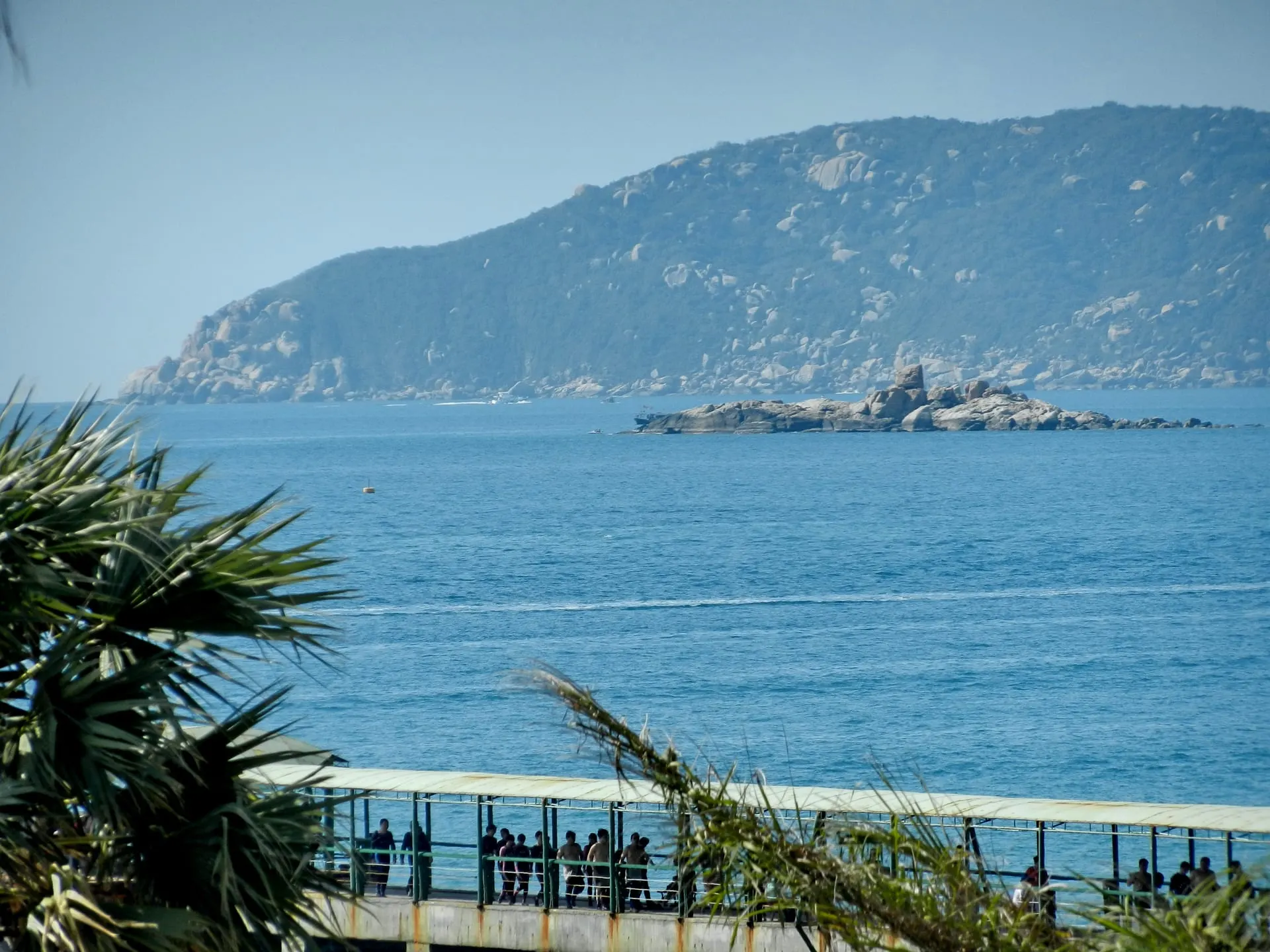
Yalong Bay (亚龙湾, Yàlóng Wān)
The best beach in Sanya — a 7.5 km crescent of fine white sand with clear, calm water. Lined with five-star resorts (Ritz-Carlton, MGM, Sheraton) but the central public beach section is free and accessible. Water sports, parasailing, and jet-ski rentals available (¥150-400). The sand is genuinely soft and the water genuinely warm — this is the Sanya you see in postcards.
Wikimedia Commons · CC-BY-SA

Nanshan Temple & Guanyin Statue (南山寺/南山海上观音, Nánshān Sì/Nánshān Hǎishàng Guānyīn)
A massive Buddhist complex 40 km west of Sanya city, anchored by the 108-meter three-faced Guanyin statue standing on an artificial island in the South China Sea. The statue is taller than the Statue of Liberty and visible from the plane on approach to SYX. The temple grounds include the Nanshan Temple itself, a vegetarian restaurant, and sprawling gardens. ¥129 as of June 2026. Allow 3-4 hours. The statue is genuinely awe-inspiring — one face looks inland, two face the sea.
Wikimedia Commons · CC-BY-SA
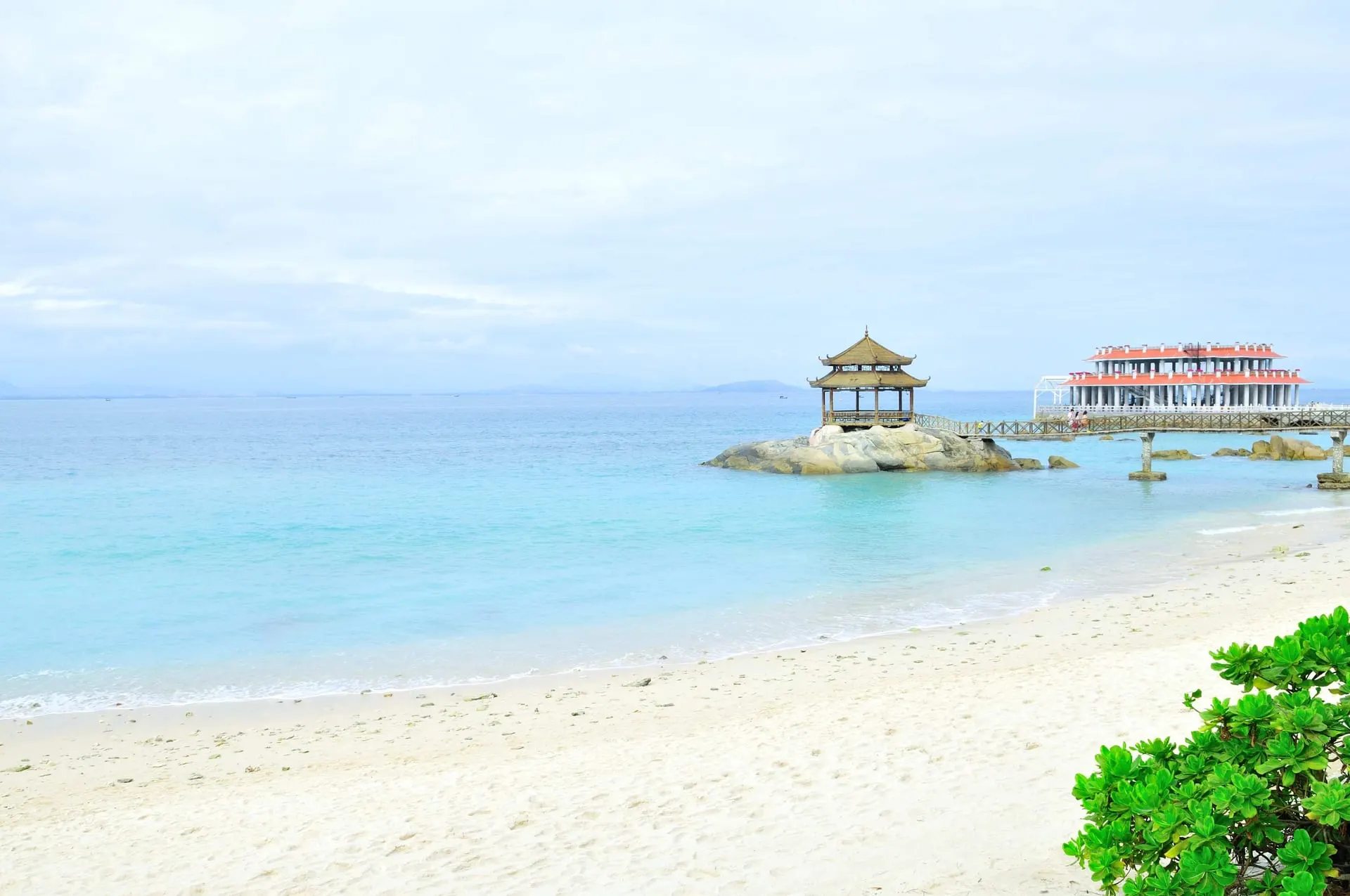
Wuzhizhou Island (蜈支洲岛, Wúzhīzhōu Dǎo)
A small island 30 km northeast of Sanya with the clearest water in Hainan and China's best tropical diving. Coral reefs, tropical fish, shipwreck dive sites, and a white-sand beach. Ferry from Wuzhizhou Dock (¥144 round-trip including island entry as of June 2026, 20 min each way). Diving packages ¥500-1,200. Snorkeling ¥180-300. The island gets crowded by 10 AM — take the first ferry at 08:00. Accommodation on the island is limited to one expensive resort (¥1,500+ per night).
Wikimedia Commons · CC-BY-SA
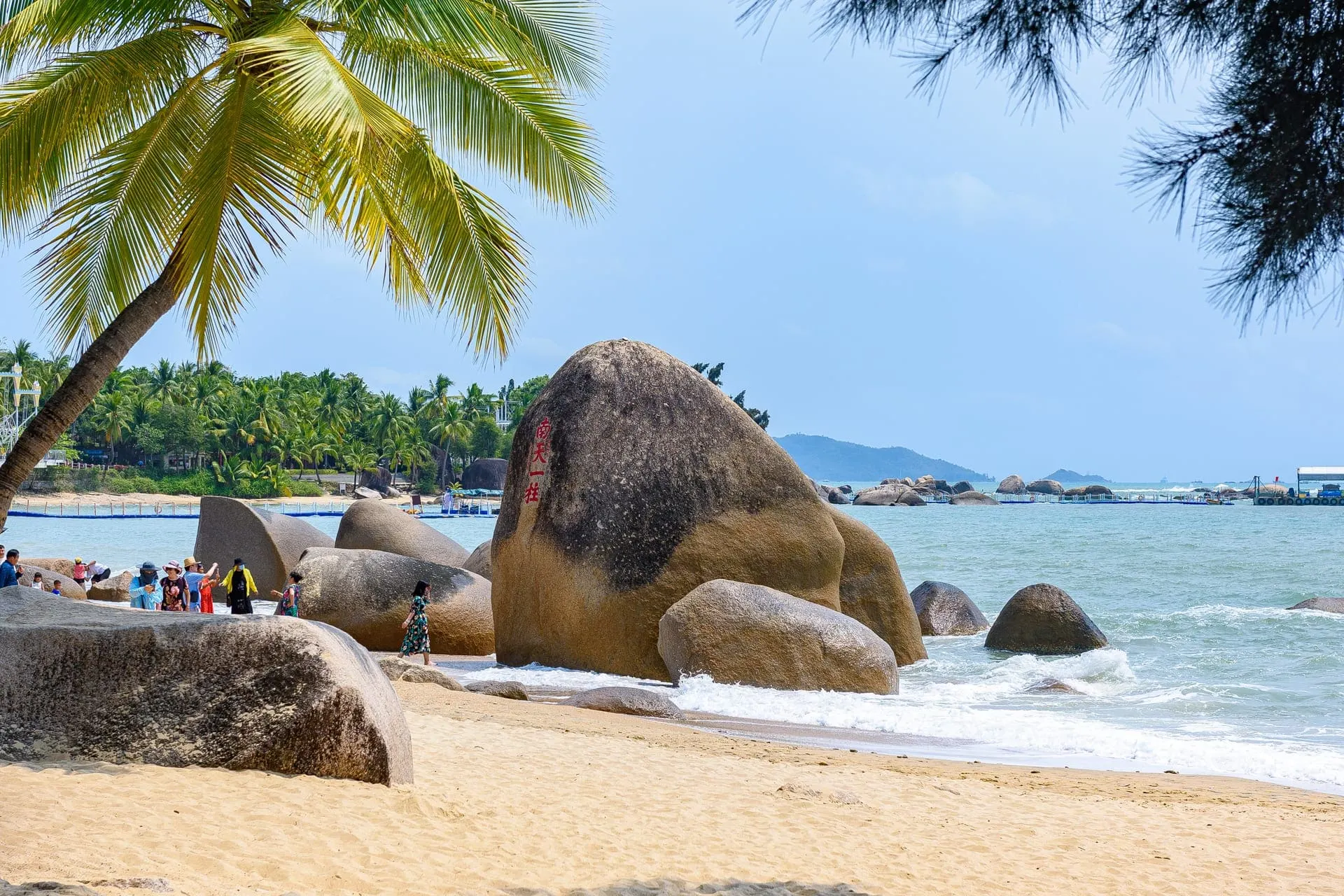
Tianya Haijiao (天涯海角, Tiānyá Hǎijiǎo)
Literally "Edge of the Sky, Rim of the Sea" — a scenic coastal park 24 km west of the city with dramatic granite boulders, weathered inscriptions, and sweeping sea views. The well-known boulders carved with "天涯" (Tiānyá) and "海角" (Hǎijiǎo) are among the most photographed landmarks in China. Historically, this was considered the southernmost edge of the Chinese world — exiled officials were sent here. ¥81 as of June 2026. The scenery is beautiful but the park is heavily touristed; go early.
Wikimedia Commons · CC-BY-SA

Luhuitou Park (鹿回头公园, Lùhuítóu Gōngyuán)
A hilltop park on a peninsula between Sanya Bay and Dadonghai, named after a Li ethnic legend about a hunter who chased a deer to this cliff — the deer turned around, transformed into a beautiful woman, and became his wife. The summit has a 12-meter statue of the deer-and-hunter legend, and the best panoramic view of Sanya city, both bays, and the skyline. ¥45 as of June 2026, plus ¥15 for the electric cart up (or walk 30 minutes). Best at sunset.
Wikimedia Commons · CC-BY-SA
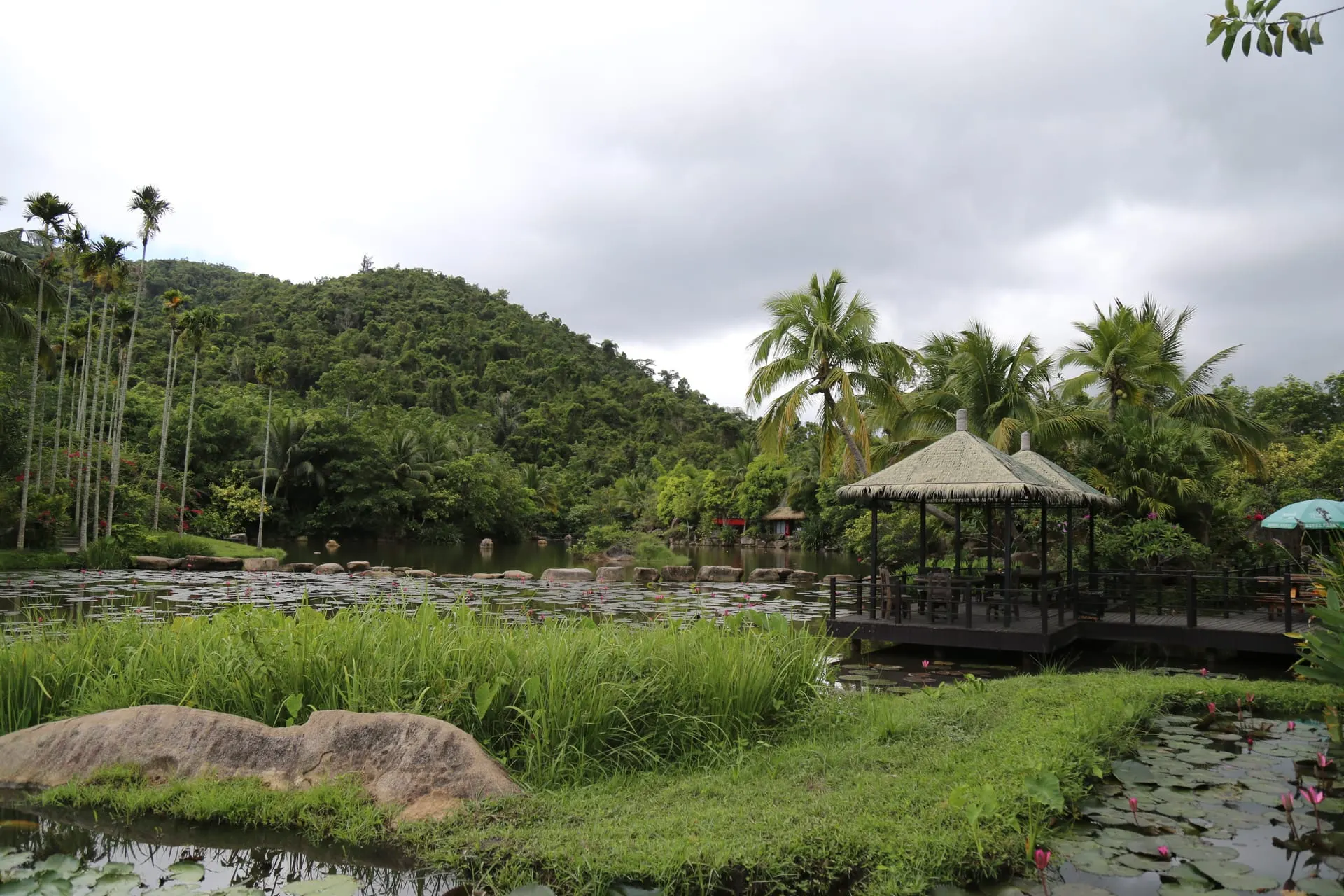
Yanoda Rainforest Cultural Tourism Zone (呀诺达雨林, Yānuòdá Yǔlín)
A tropical rainforest park 35 km north of Sanya with elevated walkways through the canopy, waterfalls, zip-lines (¥100), and a rock-climbing via ferrata route. The rainforest is genuine — Hainan's interior has some of China's best-preserved tropical forest — but the park is heavily developed with concrete paths and tourist facilities. ¥168 as of June 2026. The canopy walk is the highlight. Combine with a visit to the nearby Binglanggu Li & Miao Cultural Heritage Park if you want ethnic minority context.
Wikimedia Commons · CC-BY-SA
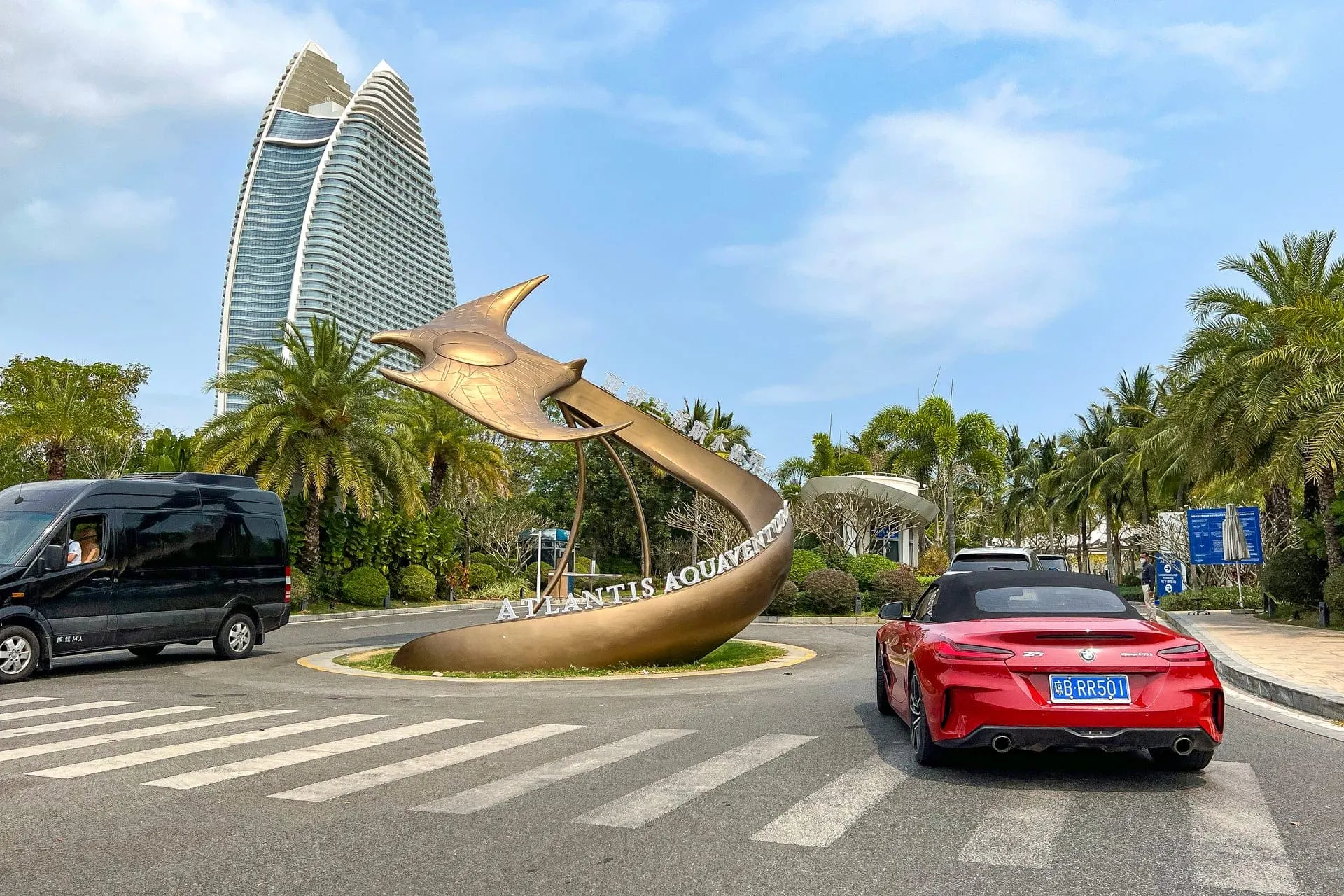
Atlantis Sanya (亚特兰蒂斯, Yàtèlándìsī)
A mega-resort on Haitang Bay with a massive water park (Aquaventure), an aquarium (The Lost Chambers, home to 86,000 marine animals), dolphin encounters, and the Ambassador underwater restaurant. The water park has two tower rides, a lazy river, and a wave pool. Water park day pass ¥358 (adult), ¥258 (child/senior) as of June 2026. The aquarium alone is ¥228. Expensive but genuinely impressive — this is where Chinese families with money take their kids.
Wikimedia Commons · CC-BY-SA
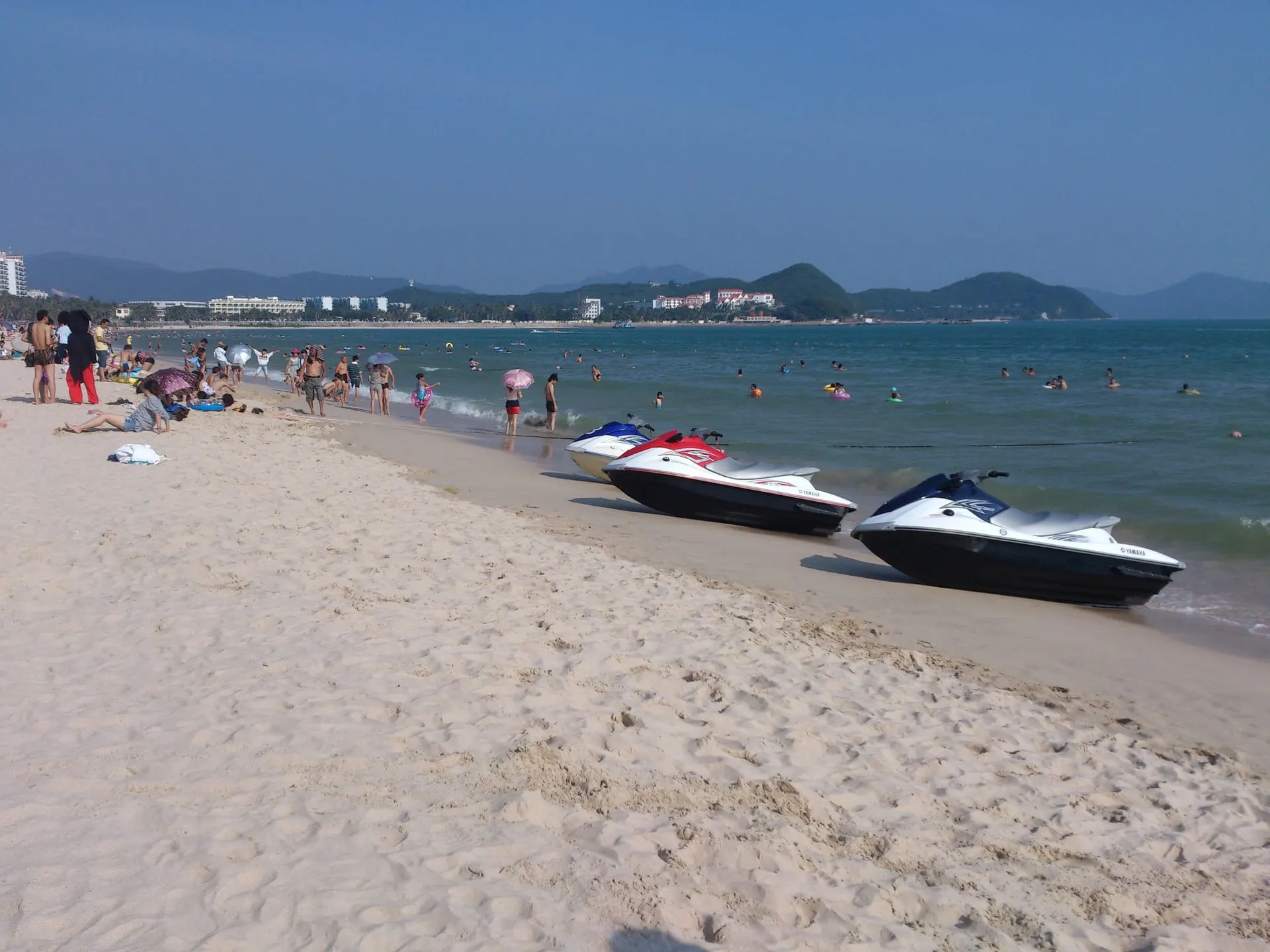
Dadonghai Beach (大东海, Dàdōnghǎi)
The most accessible and social beach in Sanya — a 2 km bay ringed with bars, seafood restaurants, backpacker hostels, and mid-range hotels. The beach is free, the water is warm, and the sand is decent (though coarser than Yalong Bay). This is where the Russian expat community, budget travelers, and young Chinese tourists converge. Beach bars serve cold beer (¥15-30) with your feet in the sand. The swimming area is roped off and lifeguarded. Best for atmosphere, not solitude.
Wikimedia Commons · CC-BY-SA
Problems travelers hit in Sanya
- Why is my Alipay not working?You linked a foreign Visa or Mastercard to Alipay but every transaction is rejected at the merchant.
- My China visa was denied — what now?Your L visa application was refused at the Chinese consulate and your trip is in 2–4 weeks.
- My passport was lost or stolen in China — what do I do?Your passport is gone (theft or loss) and you're in mainland China without travel documents.
- Why can't I book on 12306 with my foreign card?You tried to book a high-speed rail ticket on 12306.cn and your foreign Visa/Mastercard is rejected at checkout.
- Why is my VPN not working in China?You arrived in China, opened your VPN, and it will not connect at all or connects but no traffic loads.
- Why can't I book a Tibet trip on my own?You try to book Lhasa flights and hotels yourself but the booking fails, or you're turned away at the Lhasa airport without a permit.
Book activities in Sanya
These are licensed tour operators and booking platforms we've vetted independently. Booking through these links may earn us a commission — see our affiliate disclosure. This never affects our editorial recommendations or the price you pay.
Frequently asked questions
Is Sanya worth visiting or is it overhyped?
Which is the best bay to stay in Sanya?
Do I need a visa for Sanya?
How many days do I need in Sanya?
Is Sanya expensive compared to the rest of China?
What is the best time of year to visit Sanya?
Show all 22 FAQs
Can I drink the tap water in Sanya?
Is Sanya good for diving and snorkeling?
How do I get from Sanya airport to my hotel?
Is Sanya family-friendly?
What is the Nanshan Guanyin statue and is it worth visiting?
Can vegetarians eat well in Sanya?
Is Sanya safe?
Do I need to speak Chinese to visit Sanya?
What is the best seafood restaurant in Sanya?
What is Wuzhizhou Island and is it worth the trip?
What is the Yanoda Rainforest and is it worth visiting?
What is Luhuitou Park and why is it important?
What is the best day trip from Sanya?
How does Sanya compare to other tropical beach destinations in Asia?
What is the Hainan visa-free policy and how does it work?
What are the best value accommodation options in Sanya?
References

Related guides & destinations
Guide
How We Research 2026: NihaoVisit’s Methodology for China Travel Information
How NihaoVisit sources, verifies, and maintains 700+ pages of China travel information — our source hierarchy, fact-checking process, update
Guide
Fact-Checking Log 2026: Verified China Travel Information — NihaoVisit
A public log of fact-checking verification passes on NihaoVisit, showing what was verified, when, and against which sources — covering visa
Guide
Best Time to Visit China 2026: Month-by-Month Weather, Crowds, and Prices
The best time to visit most of China is April–May and September–October. Winter (Dec–Feb) is cold but cheap; summer (Jun–Aug) is hot and cro
Guide
VPN for China 2026: Which VPNs Work, eSIM Alternatives, and the Complete Pre-Trip Checklist
Most Western apps and websites are blocked in mainland China. A reliable VPN is essential for Google, Gmail, WhatsApp, Instagram, and most n
Guide
China SIM Card and eSIM Guide 2026: Stay Connected Without WeChat
A Chinese SIM or eSIM lets you use mobile data, maps, and ride-hailing without WiFi. Here is how to get one, the cost, and which provider to
Guide
Solo Female Travel in China 2026: Safety, Tips, and Real Experiences
China is one of the safer destinations for solo female travelers. Petty theft is rare, violent crime against tourists is extremely uncommon,