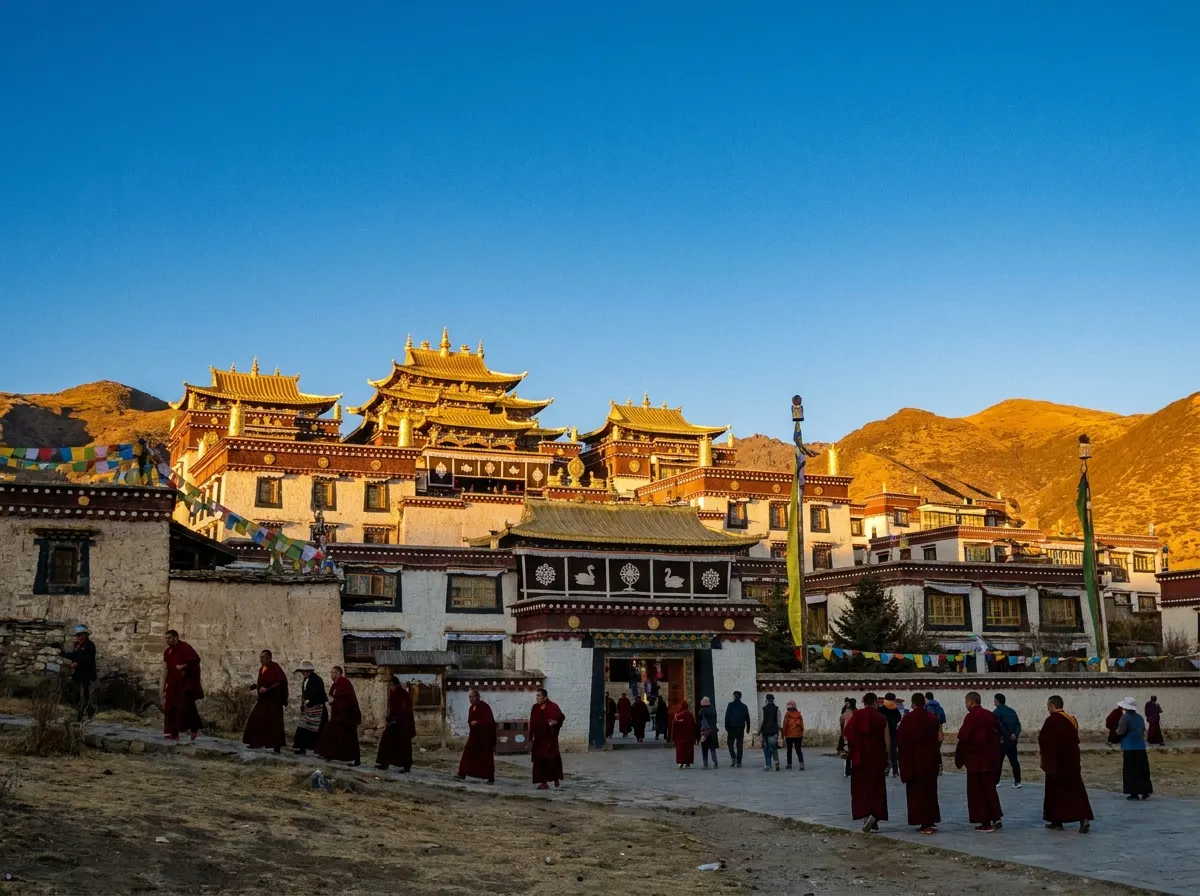
Shangri-La (Zhongdian) on the Edge of the Tibetan Plateau
Shangri-La (formerly Zhongdian) is the main Tibetan-cultural town in Yunnan province and a base for monastery visits, alpine scenery, and trekking on the edge of the Tibetan plateau. The town has a rebuilt old quarter with a giant prayer wheel and a working Tibetan monastery (Songzanlin), and it serves as the jumping-off point for Pudacuo National Park and, for serious trekkers, the Meili Snow Mountain range. Plan two to three nights and expect to acclimatize to the roughly 3,200m altitude before doing much. The town sits in a high valley at the edge of the Three Parallel Rivers UNESCO World Heritage area — home to deep gorges carved by the Jinsha, Lancang, and Nu rivers — and the surrounding alpine meadows, yaks grazing against snow peaks, and Tibetan Buddhist prayer flags give Shangri-La its distinctive cultural landscape. Most travelers arrive from Lijiang (3-4 hours by road) and use Shangri-La as either a cultural stop or a launching point for treks toward the Meili Snow Mountains and the Tibetan border. The airport (Diqing Shangri-La Airport, DIG) has daily flights from Kunming, Chengdu, and Lhasa, but most visitors arrive overland from Lijiang for the scenic drive through the Jinsha River gorges. The Tibetan food culture — yak meat, butter tea, momos, tsampa — is a defining experience alongside the monastery visits. October brings the clearest mountain views; May-June is wildflower season; winter is cold but peaceful with snow-capped peak photography at its best. Allow at least 3 days for a thorough visit, with the first day light for acclimatization before tackling higher elevations, and consider adding Deqin and the Meili Snow Mountain view if time allows. Songzanlin is the priority cultural sight for first-time visitors; Pudacuo the priority natural sight.
Why Shangri-La (Zhongdian) on the Edge of the Tibetan Plateau in 2026.
A Tibetan town at high altitude in northwest Yunnan — Songzanlin Monastery, alpine meadows, and a gateway to the Three Parallel Rivers region. Best visited April-October for mild weather and clear skies; winter brings cold temperatures and occasional snow. Lijiang is the practical gateway airport, with a scenic 3-4 hour drive to Shangri-La. Allow 3-4 days to acclimatize and see the major sights, and consider adding Deqin and Meili Snow Mountain if time permits. Bring layers, sunscreen, and a translation app for menus and signs. A short prayer-wheel walk in Dukezong Old Town is a good first-day activity at the lower elevation of 3,200m. The Diqing Shangri-La Airport (DIG) is small but has daily flights from major Chinese cities. Songzanlin Monastery morning prayer is the cultural highlight.
Quick Answer
Shangri-La (formerly Zhongdian) is the main Tibetan-cultural town in Yunnan province and a base for monastery visits, alpine scenery, and trekking on the edge of the Tibetan plateau. The town has a rebuilt old quarter with a giant prayer wheel and a working Tibetan monastery (Songzanlin), and it serves as the jumping-off point for Pudacuo National Park and, for serious trekkers, the Meili Snow Mountain range. Plan two to three nights and expect to acclimatize to the roughly 3,200m altitude before doing much. The town sits in a high valley at the edge of the Three Parallel Rivers UNESCO World Heritage area — home to deep gorges carved by the Jinsha, Lancang, and Nu rivers — and the surrounding alpine meadows, yaks grazing against snow peaks, and Tibetan Buddhist prayer flags give Shangri-La its distinctive cultural landscape. Most travelers arrive from Lijiang (3-4 hours by road) and use Shangri-La as either a cultural stop or a launching point for treks toward the Meili Snow Mountains and the Tibetan border. The airport (Diqing Shangri-La Airport, DIG) has daily flights from Kunming, Chengdu, and Lhasa, but most visitors arrive overland from Lijiang for the scenic drive through the Jinsha River gorges. The Tibetan food culture — yak meat, butter tea, momos, tsampa — is a defining experience alongside the monastery visits. October brings the clearest mountain views; May-June is wildflower season; winter is cold but peaceful with snow-capped peak photography at its best. Allow at least 3 days for a thorough visit, with the first day light for acclimatization before tackling higher elevations, and consider adding Deqin and the Meili Snow Mountain view if time allows. Songzanlin is the priority cultural sight for first-time visitors; Pudacuo the priority natural sight.
| Best time to visit | May-June (meadow wildflowers) and September-October (clear skies); winter has snow and limited high-pass access |
|---|---|
| Daily budget | $80 (backpacker) / $180 (mid-range) / $480+ (luxury) |
| Language | Mandarin and Tibetan; very limited English |
| Currency | CNY (¥) |
| Time zone | China Standard Time (UTC+8) |
| Last updated | 2026-06-16 |
Want a Shangri-La (Zhongdian) on the Edge of the Tibetan Plateau plan built for you?
What makes Shangri-La distinct within Yunnan?
Shangri-La sits in the northwest corner of Yunnan, where the province rises onto the eastern edge of the Tibetan plateau. Its culture is Tibetan rather than the Bai or Naxi cultures of Dali and Lijiang to the south. Monasteries, prayer flags, yak pastures, and alpine meadows define the landscape, and the air is thin — the town sits at roughly 3,200m. For travelers on the classic Yunnan route, it is the high-altitude, Tibetan-cultural terminus, and a dramatic contrast to the subtropical south of the province.
Is "Shangri-La" the real name?
The town was historically called Zhongdian and was renamed Shangri-La in the early 2000s, after the fictional Himalayan utopia from James Hilton's novel "Lost Horizon," to promote tourism. Both names still appear on maps and tickets. The renaming is a marketing choice, but the underlying Tibetan culture, monasteries, and plateau scenery are genuine and predate the name change. Locals may use either name.
How do I handle the altitude?
Acclimatization is the key consideration. The town sits near 3,200m and surrounding sights are higher, so arrive in the morning and take the first day slowly — mild headache, breathlessness, and fatigue are common in the first 12 to 24 hours. Drink plenty of water, avoid alcohol, eat lightly, and ascend gradually. Hotels can supply portable oxygen. Anyone with heart or lung conditions should consult a doctor beforehand, and travelers who feel severely unwell should descend to lower Dali or Lijiang.
Do I need a Tibet permit to visit Shangri-La?
No. Shangri-La is in Yunnan province, not the Tibet Autonomous Region, so the special Tibet Travel Permit required for foreign travel in Tibet does not apply here — standard China visa or visa-free rules cover it. The permit is only relevant if you plan to cross from this region into Tibet proper, which requires arranging a Tibet trip through a licensed operator in advance.
What are the must-see sights?
The three essentials are Songzanlin Monastery, the rebuilt Dukezong old town with its giant prayer wheel, and Pudacuo National Park. Songzanlin is the largest Gelug-school monastery in Yunnan, often called the "Little Potala"; Pudacuo holds alpine lakes and meadow. Most travelers cover all three over two days. Trekkers and those with more time push on toward Deqin and the Meili Snow Mountain range, one of the most sacred mountain areas in Tibetan culture.
How long do I need, and what can I combine it with?
Two full days covers Shangri-La town, Songzanlin, and Pudacuo. Three days adds a longer drive toward Meili or a Tibetan-village homestay. Most travelers combine Shangri-La with Lijiang and Dali to the south for a five-to-seven-day Yunnan loop, traveling between them by road or the high-altitude rail link that now connects Lijiang to Shangri-La, cutting what used to be a long bus ride.
When is the best time to visit?
May to June and September to October are the best windows — meadow wildflowers in late spring, and clear skies for mountain views in autumn. Summer is the rainy season, with lush green but cloudier peaks and possible road delays. Winter is cold with snow, and access to higher passes can be limited, though the clear, quiet days appeal to some. Build schedule flexibility for mountain weather at any time of year.
What cultural etiquette should I observe?
Shangri-La is a Tibetan Buddhist area, and respectful behavior matters. Walk clockwise around stupas and prayer-wheel circuits, remove hats and shoes where required in monasteries, and never photograph monks, religious rituals, or the inside of temples without permission. Refrain from touching religious objects, dress modestly, and keep voices low at monasteries. A small offering at temples is welcomed but never required, and haggling aggressively in markets is frowned on.
What should I pack for Shangri-La?
Pack for big temperature swings — days can be warm in sun but nights drop sharply at altitude, with a 15–20°C day-to-night range common. Bring layers, a warm jacket, sun protection (the high-altitude UV is intense), sturdy shoes for monastery steps and trails, and lip balm or moisturizer for the dry air. Consider altitude medication after medical advice, and carry any specialist toiletries, as selection in town is limited.
What is the best itinerary for Shangri-La?
A well-paced Shangri-La itinerary respects the altitude — do not cram too much into your first day. Two days (the minimum): On Day 1, arrive before noon if possible. Check into your hotel and spend the afternoon on light, flat-ground exploration of Dukezong Old Town. Walk the cobblestone alleys, browse Tibetan craft shops, and climb Guishan Hill to turn the giant prayer wheel with other visitors (you’ll need at least three people to move it). Stay for dusk when the prayer wheel lights up and the old town empties of day-trippers. Eat dinner at a yak-meat hotpot restaurant in the old town — several cluster near the main square. On Day 2, head to Songzanlin Monastery by 8:30 AM. Morning light hits the golden roofs from the east, and tour groups do not arrive in force until 10 AM. Spend two to three hours walking the kora circuit, visiting the main assembly hall, and climbing to the upper terraces for the panoramic view. Take a taxi back to town for lunch (try a Tibetan family restaurant for momo and butter tea). In the afternoon, go to Pudacuo National Park — aim to arrive by 1 PM so you have four hours before the last shuttle returns. Book Pudacuo tickets through your hotel the day before during peak seasons. Three days: Follow the two-day plan, then on Day 3 spend the morning at Napa Lake (best at 8–10 AM for birdwatching or golden-hour reflections, depending on the season). After lunch, either hire a driver (¥400–600 for a half-day) to visit a Tibetan village homestay in the Nixi area, known for its black pottery tradition, or drive toward the Baima Snow Mountain pass for alpine scenery before turning back. Four days: Add the long drive to Deqin and Feilai Temple for a Meili Snow Mountain sunrise — this requires an overnight near Feilai Temple and a very early start (roughly 5:30 AM) to catch the legendary golden sunrise on the peaks. Alternatively, use the fourth day for Balagezong Grand Canyon. Throughout, pace yourself: the first day should be the lightest, and even on later days, the altitude will make stairs and slopes feel harder than expected. Hire drivers through your hotel front desk rather than street touts — rates are standardized and hotels can arrange shared rides to reduce costs.
What is the Tibetan culture experience in Shangri-La?
Shangri-La is not a theme-park version of Tibetan culture — it is a lived, breathing Tibetan Buddhist community where religion, daily life, and the high-altitude landscape are intertwined. The most important cultural site is Songzanlin Monastery (Ganden Sumtseling), the largest Gelug-school monastery in Yunnan and an active monastic university, not a museum. Monks live, study, and pray here; visitors can observe morning prayer sessions from designated areas if they remain silent and do not photograph inside the halls. The kora — a circumambulation path that circles the monastery clockwise — is a central practice. Join local Tibetans walking the kora in the early morning, spinning the rows of prayer wheels as you go. At the monastery entrance, you can light butter lamps (small donation, usually ¥5–20) as an offering. Throughout town and on mountain passes, you will see lungta (prayer flags) strung between poles and trees — the five colors represent the five elements, and the belief is that the wind carries the printed prayers across the landscape. Never step on prayer flags or touch them disrespectfully. Tibetan festivals animate the region: Losar (Tibetan New Year, usually February) brings days of celebration, temple ceremonies, and family gatherings. Summer horse racing festivals — held in the grasslands outside town, typically July or August — are raucous, colorful events with traditional dress, dancing, and yak-racing, and they are among the most photogenic cultural events in northwest Yunnan. For hands-on cultural experiences, several guesthouses and small workshops offer thangka painting introductions — you spend an hour or two learning the basic techniques of this intricate Buddhist art form under a local artist’s guidance. Ask at your guesthouse; the Tibetan quarter of Dukezong (the quieter streets away from the main square) has more authentic workshops than the storefronts on the main drag. Traditional Tibetan clothing — chuba robes, colorful sashes, turquoise and coral jewelry — is still worn daily by older residents, not just for performances. Respect locals’ privacy: ask before photographing people, and if someone declines, accept it gracefully. Yak butter tea is the quintessential Tibetan drink — salty, rich, and calorific. It is served in homes and traditional tea houses; many guesthouses will prepare it if you ask. Finding authenticity in Shangri-La means stepping away from the rebuilt tourist core of Dukezong (which, post-2014 fire, is clean but commercial) and into the smaller alleys, the monastery at prayer time, and the villages beyond town where Tibetan life follows rhythms far older than tourism.
What are the best day trips from Shangri-La?
Shangri-La is a strong base for day trips into dramatic high-altitude landscapes, though distances are long and drivers are essential for most destinations. Balagezong Grand Canyon (巴拉格宗大峡谷), roughly 80km northwest of town (about 1.5 hours by car), is the standout day trip: a deep river gorge with sheer cliffs, boardwalk trails along the canyon floor, hanging coffins visible on rock ledges, and the ancient Bala Village still inhabited inside the valley. Entry is about ¥210 including internal shuttle. The full canyon walk runs about 5km on mostly flat paths. Best visited May through October; it may close or reduce operations in deep winter. A private driver costs ¥500–800 for the round trip. Baishuitai (白水台, White Water Terraces), roughly 100km southeast (2–2.5 hours’ drive), is a set of natural travertine terraces formed by calcium-rich spring water cascading down a hillside — a smaller, less-visited cousin to Turkey’s Pamukkale. The terraces are best photographed in morning light. Combine with a stop at a Naxi village en route. The drive is scenic, but the road is winding; plan a full day. Entry is about ¥30. A private car is the only practical option; public buses exist but are slow and infrequent. The road toward Deqin and Feilai Temple (飞来寺) for Meili Snow Mountain (梅里雪山) sunrise views is a longer commitment — roughly 180km and 4–5 hours’ drive through the Baima Snow Mountain pass at over 4,200m. This is more commonly done as an overnight trip (stay at Feilai Temple, wake before dawn for the sunrise over Meili’s peaks), but you can drive partway as a scenic day trip, turning around at the Baima pass for panoramic views without the full commit. For trekkers, the Haba Snow Mountain base area (哈巴雪山) offers serious hiking and climbing access; this is not a casual day trip and requires a guide, proper gear, and altitude readiness. Within Pudacuo National Park, Shudu Lake and Bita Lake are the two main zones accessible by the park shuttle and can fill a half-day each if you want to walk every boardwalk. For a gentler cultural day trip, the Tibetan villages around Nixi (尼西), about 30km from town, are famous for black pottery — handmade earthenware pots used for cooking and tea. Several village workshops welcome visitors; your guesthouse can arrange a visit and a driver (half-day, ¥300–400). For all day trips, book drivers the evening before through your hotel. Carry snacks and water — services are sparse outside town. Check road conditions with your driver before setting out, especially November through April when high passes may be snowbound.
How do I get to Shangri-La and get around?
Getting to Shangri-La has become much easier since the Lijiang-Shangri-La high-altitude rail line opened in late 2023, cutting the trip from Lijiang to roughly 1.5 hours (¥60-100). Buses still run and take about 4 hours on winding mountain roads for roughly ¥80. From Kunming, direct flights take about one hour (multiple daily departures, ¥400-800 one way); high-speed rail connects via Lijiang with a total journey of 5-6 hours. Shangri-La Diqing Airport (DIG) sits at 3,280m — you step off the plane already at altitude, so take it easy upon arrival, but note that flights can be disrupted by mountain weather, especially November through March. For getting around town, taxis are the main option and cost ¥10-20 for trips within the town center, though drivers rarely speak English — have your destination written in Chinese characters. For day trips to Pudacuo, Napa Lake, or Balagezong, hire a private driver through your hotel front desk (¥400-800 per day depending on distance) rather than negotiating with street touts. Hotels can also arrange shared minibus tours to reduce costs for solo travelers. Public buses serve major scenic areas but are slow and Chinese-only — practical mainly for travelers with language skills or a spirit of adventure. If self-driving, roads are paved and well-mapped, but mountain fog and high-altitude passes require caution.
What is the Tibetan Buddhist culture experience in Shangri-La?
Shangri-La is not a theme-park version of Tibetan culture — it is a lived, breathing Tibetan Buddhist community where religion, daily life, and the high-altitude landscape are intertwined. The most important cultural site is Songzanlin Monastery, the largest Gelug-school monastery in Yunnan and an active monastic university, not a museum. Monks live, study, and pray here; visitors can observe morning prayer sessions from designated areas if they remain silent and do not photograph inside the halls. The kora — a circumambulation path that circles the monastery clockwise — is a central practice. Join local Tibetans walking the kora in the early morning, spinning the rows of prayer wheels as you go. Throughout town and on mountain passes, you will see lungta (prayer flags) strung between poles and trees — the five colors represent the five elements, and the belief is that the wind carries the printed prayers across the landscape. Never step on prayer flags or touch them disrespectfully. Tibetan festivals animate the region: Losar (Tibetan New Year, usually February) brings days of celebration, temple ceremonies, and family gatherings. Summer horse racing festivals — held in the grasslands outside town, typically July or August — are raucous, colorful events with traditional dress, dancing, and yak-racing. For hands-on cultural experiences, several guesthouses and small workshops offer thangka painting introductions — you spend an hour or two learning basic techniques of this intricate Buddhist art form under a local artist's guidance. Traditional Tibetan clothing — chuba robes, colorful sashes, turquoise and coral jewelry — is still worn daily by older residents, not just for performances. Yak butter tea is the quintessential Tibetan drink — salty, rich, and calorific. It is served in homes and traditional tea houses. Finding authenticity in Shangri-La means stepping away from the rebuilt tourist core of Dukezong and into the smaller alleys, the monastery at prayer time, and the villages beyond town where Tibetan life follows rhythms far older than tourism.
What wildlife and nature can I see around Shangri-La?
Shangri-La sits at the heart of the Three Parallel Rivers UNESCO World Heritage site, one of the most biodiverse temperate regions on Earth. The star wildlife experience is Napa Lake, a Ramsar-listed wetland where black-necked cranes — one of the world's rarest crane species — winter from November to March, alongside bar-headed geese, ruddy shelducks, and dozens of other migratory waterbirds. Bring binoculars and arrive early morning for the best birdwatching. Pudacuo National Park protects old-growth spruce and fir forest, alpine meadows, and two high-altitude lakes where you may spot blue sheep grazing on slopes, Himalayan marmots popping up from burrows in summer, and golden eagles circling overhead. The park's forests are home to the rare Yunnan snub-nosed monkey, though sightings from the visitor route are extremely uncommon. In the higher country toward Deqin and the Meili Snow Mountain range, the wildlife shifts to high-altitude specialists — Himalayan griffon vultures, snow pigeons, and if you are extraordinarily lucky, a glimpse of a snow leopard (though sightings are so rare as to be essentially mythical). The wildflower bloom in late May and June transforms every meadow into a carpet of blue gentians, yellow buttercups, pink rhododendrons, and dozens of other alpine species — this is the single best natural spectacle accessible without trekking. The Baima Snow Mountain pass (4,200m+) on the road to Deqin offers panoramic views of rhododendron forests and snow peaks. For serious naturalists, the region rewards time and altitude — spend at least three days, get above 3,500m, and get out before dawn for the best wildlife encounters.
What are the practical logistics of getting around Shangri-La and to the major sights?
Shangri-La is a compact town where most of the central area is walkable, but the main sights are spread across a 20-50 km radius and require transport. Within town: taxis are unmetered but cheap (¥10-20 for most rides within town), DiDi works with Chinese apps, and the old town is best explored on foot. To Songzanlin Monastery (5 km north of town): taxi ¥20-30, public bus 3 (¥1), or bicycle (30-40 minutes uphill). To Pudacuo National Park (22 km east): direct shuttle buses run from the town's main bus station (¥30, 40 minutes, departures roughly every hour 08:00-15:00) or hire a private car for ¥200-300 round-trip including waiting time. To Napa Lake (8 km northwest): taxi ¥30-50 one-way, or rented bicycle (the loop road is flat and beautiful in summer). For multi-day treks toward Meili Snow Mountain and Deqin, you will need to arrange a private driver or join a shared tour through your guesthouse — the road climbs above 4,000m and is best done with someone who knows the route. Taxis and DiDi: use only the official taxi queue or the DiDi app — unmarked cars soliciting tourists in Dukezong are unofficial and may overcharge. Agree on a price before getting into an unmarked car. DiDi requires a Chinese phone number and the app set up in Chinese; your hotel concierge can help with a one-time booking. Buses: the Shangri-La bus station serves long-distance routes to Lijiang (4 hours), Dali (6-7 hours), Kunming (8-9 hours), and Chengdu (12+ hours, often overnight). HSR does not reach Shangri-La directly; the nearest HSR station is in Lijiang, requiring the 3-4 hour road connection. For most travelers, the bus or shared minibus from Lijiang is the practical route. Private drivers: the standard option for day trips to Pudacuo, Songzanlin combined with Napa Lake, or longer excursions to Deqin. Day rates ¥400-800 depending on destination. Your guesthouse can arrange a recommended driver — quality varies, and a good driver (English not required but knowledgeable, careful driving, fair pricing) is worth asking about by name. Self-driving: feasible for experienced China drivers, but high-altitude roads, occasional landslides, and aggressive Yunnan driving style make this challenging. Many rental agencies refuse to rent to tourists without a Chinese driver's license. Most foreign visitors use drivers rather than renting.
Top attractions
Songzanlin Monastery (松赞林寺)
The largest Tibetan Buddhist monastery in Yunnan, built in 1679 and modelled on the Potala Palace in Lhasa. 700 monks at its peak. The golden-roofed assembly hall is the highlight. ¥115.
Dukezong Ancient Town (独克宗古城)
A 1,300-year-old Tibetan trading town with whitewashed stone streets, the world's largest prayer wheel (21m, 60 tonnes), and a revival after the 2014 fire. Best walked at dusk.
Pudacuo National Park (普达措国家公园)
China's first national park — 1,300 km² of alpine lakes, old-growth forest, and high-altitude meadows with wildflowers in June–July. Shuttle buses connect the main scenic areas.
Tiger Leaping Gorge (虎跳峡)
One of the world's deepest gorges — the Jinsha River squeezed between Jade Dragon Snow Mountain (5,596m) and Haba Snow Mountain (5,396m). The 2-day high trail is China's most famous hike.
Napahai Lake (纳帕海)
A seasonal high-altitude wetland north of Shangri-La — a vast grassland in winter, a lake in summer. Migratory black-necked cranes winter here. Horseback riding available.
Shudu Lake (属都湖)
An alpine lake in Pudacuo National Park at 3,700m, surrounded by old-growth spruce forest and alpine meadows. The boardwalk loop takes 1.5 hours.
Shangri-La Grand Prayer Wheel (转经筒)
The world's largest prayer wheel at 21 metres and 60 tonnes, atop Dukezong Ancient Town. Requires several people to turn. Spin it clockwise three times for blessings.
Baishuitai (白水台)
Natural travertine terraces 100km from Shangri-La — white calcium-carbonate pools that cascade down a hillside. A smaller version of Turkey's Pamukkale. Naxi minority sacred site.
STAY
Where to stay in Shangri-La (Zhongdian) on the Edge of the Tibetan Plateau
Pick a base that matches the trip you want — imperial-central for sightseeing, hutong belt for character, Chaoyang for nightlife, or Qianmen for budget.
Dukezong Ancient Town
Tibetan old town with the prayer wheel, craft shops, courtyard guesthouses, and teahouses
#dukezongShangri-La New Town
Modern hotels, larger restaurants, and the bus station — less atmospheric but more practical for families
#new-townSongzanlin Monastery area
Quieter guesthouses near the monastery with valley views, 15 min from the old town
#songzanlin
ITINERARIES
Sample itineraries from Shangri-La (Zhongdian) on the Edge of the Tibetan Plateau
Three ready-made routes, from a 1-day imperial sprint to a 5-day deep dive. Copy the day-by-day plan and adapt to your own pace.
- 1 DAY
Shangri-La Express (1 Day)
A tightly paced single-day hit of the Shangri-La essentials — Songzanlin at dawn, Dukezong Old Town, and Napa Lake — for travellers with limited time who can handle the altitude on a compressed schedule.
- Travellers on a tight Yunnan loop
- Lijiang day-trippers using the new HSR
- Those acclimatised to altitude already
- Day 01
Morning
Arrive on the first HSR from Lijiang (depart ~7:30 AM, arrive ~9:00 AM). Go straight to Songzanlin Monastery by taxi (¥15) — you will beat the tour groups and catch morning prayer in the assembly hall. Walk the kora circuit clockwise and climb to the upper terraces for the panoramic view.
Afternoon
Taxi to Dukezong Old Town for lunch at a Tibetan family restaurant — order momo and butter tea. Climb Guishan Hill to see the giant prayer wheel up close. Spend an hour wandering the quieter alleys away from the main square. Mid-afternoon, take a taxi or rent an e-bike to Napa Lake (8km north) for an hour of lakeside walking and yak-spotting.
Evening
Return to Dukezong for an early yak hotpot dinner before catching the last HSR back to Lijiang (~7:00 PM departure). If staying overnight, watch the prayer wheel light up at blue hour from a rooftop cafe.
- 2 DAYS
Classic Shangri-La (2 Days)
The ideal Shangri-La short stay — Day 1 for gentle acclimatisation and old-town atmosphere, Day 2 for the big sights of Songzanlin and Pudacuo, paced for the altitude.
- First-time visitors
- Couples and solo travellers
- Those arriving from lower-altitude Lijiang or Dali
- Day 01
Morning
Arrive by late morning (HSR from Lijiang or flight from Kunming). Check into your hotel and resist the urge to do anything ambitious — your body needs to register 3,200m. Drink plenty of water.
Afternoon
Light, flat-ground exploration of Dukezong Old Town. Walk the cobblestone alleys, browse Tibetan craft shops, and climb Guishan Hill slowly to see the giant prayer wheel. Sit at a rooftop cafe with a view — this is your acclimatisation afternoon, not a sightseeing sprint.
Evening
Dinner at a yak-meat hotpot restaurant in the old town — the rich broth and warm copper pot are perfect for a cold high-altitude evening. Be in bed early; avoid alcohol completely on your first night at altitude.
- Day 02
Morning
Rise early and taxi to Songzanlin Monastery by 8:30 AM. Morning light hits the golden roofs from the east. Spend two to three hours — walk the kora, visit the assembly hall, climb to the upper terraces. If you are lucky, catch monks chanting. Taxi back to town for lunch.
Afternoon
Head to Pudacuo National Park — aim to arrive by 1 PM so you have four hours before the last shuttle returns. Ride the internal shuttle to Shudu Lake, walk the full boardwalk loop, then shuttle to Bita Lake for birdwatching. The park sits at 3,500m, so the altitude will make the boardwalks feel longer than they are — take it slowly.
Evening
Return to town. If energy permits, explore the quieter Tibetan-quarter alleys of Dukezong after dark. Dinner at a different Tibetan restaurant — try tsampa and yak yogurt for a lighter meal.
- 3 DAYS
Shangri-La Deep Dive (3 Days)
Three unrushed days covering the big sights plus a day-trip into the high country — monastery, national park, and a choice of gorge, canyon, or pottery village — with time to breathe at altitude.
- Travellers who want to go beyond the checklist
- Photographers seeking best light
- Those comfortable with longer drives on mountain roads
- Day 01
Morning
Arrive by late morning. Check in, hydrate, and take it easy. A short, flat wander through Dukezong — find the Guishan Hill stairs and climb them very slowly. The prayer wheel is at the top.
Afternoon
Continue Dukezong exploration at a relaxed pace. Visit the Tibetan Thangka Art Centre (if open) for a painting demonstration. Stop for butter tea and balep (Tibetan flatbread) at a back-alley tea house.
Evening
Yak hotpot dinner in the old town. Walk the lantern-lit alleys after dark. Early night — tomorrow is a full day.
- Day 02
Morning
Taxi to Songzanlin Monastery by 8:30 AM for the best light and fewest crowds. Spend a full two to three hours exploring the complex — walk the kora, observe morning prayer from the visitors' area, photograph the golden roofs from the lakeside viewpoint across the road.
Afternoon
Taxi or driver to Pudacuo National Park by 1 PM. Walk the Shudu Lake boardwalk loop, then shuttle to Bita Lake. The park is higher and colder than town — rent a jacket at the entrance if needed. Allow four hours inside the park.
Evening
Return to town. Try a different Tibetan restaurant — seek out momo and a sweet milk tea if butter tea was not to your taste. Pack for tomorrow's day trip.
- Day 03
Morning
Full-day excursion — choose one: (A) Balagezong Grand Canyon (80km, 1.5-hour drive, ¥210 entry, canyon boardwalk walk and ancient village) for dramatic gorge scenery; (B) Baishuitai White Water Terraces (100km, 2–2.5-hour drive, ¥30 entry) for travertine pools; or (C) Nixi pottery village (30km, half-day, ¥300–400 driver) for a gentler cultural morning followed by Napa Lake in the afternoon. Hire a driver through your hotel the night before.
Afternoon
Continue your chosen day trip. For Balagezong, walk the full 5km canyon boardwalk. For Baishuitai, photograph the terraces in afternoon sidelight. For Nixi + Napa, return to town by mid-afternoon and spend the remaining hours at Napa Lake for birdwatching or golden-hour photography.
Evening
Final dinner in Shangri-La — splurge on a slightly nicer Tibetan restaurant or try a Yunnan-style mushroom hotpot (雨季菌子火锅) if visiting in summer. Walk Dukezong one last time after dark. Prepare for an early departure tomorrow — the first HSR to Lijiang leaves around 7:30 AM.
BUDGET
What a Shangri-La (Zhongdian) on the Edge of the Tibetan Plateau trip costs
Per-person, per-day costs across three spending tiers. Excludes international flights and visa fees.
| Line item | Backpacker | Mid-range | Luxury |
|---|---|---|---|
| Accommodation (per night) | $20 | $80 | $300 |
| Meals (3 per day) | $12 | $35 | $90 |
| Local transport | $5 | $15 | $50 |
| Top attraction (Songzanlin, Pudacuo) | $35 | $50 | $70 |
| Daily essentials | $5 | $15 | $35 |
| Total per day | $77 | $195 | $545 |
$ USD per person per day, before international flights and visas. Last verified: Q3 2026.
STAY SAFE
Emergency contacts in Shangri-La (Zhongdian) on the Edge of the Tibetan Plateau
Save these three numbers before you board the plane. China uses different hotlines than most countries — there's no 911.
- POLICE
110
- AMBULANCE
120
- FIRE
119
- TOURIST HOTLINE
12301
- ENGLISH-SPEAKING ER
Shangri-La People's Hospital (Diqing Prefecture Hospital) on Changzheng Avenue — no dedicated international wing; for serious altitude sickness or critical conditions, descend immediately to Lijiang People's Hospital (2,400m, roughly 1.5 hours by HSR or 3.5 hours by road).
Problems travelers hit in Shangri-La (Zhongdian) on the Edge of the Tibetan Plateau
- Why is my Alipay not working?You linked a foreign Visa or Mastercard to Alipay but every transaction is rejected at the merchant.
- My China visa was denied — what now?Your L visa application was refused at the Chinese consulate and your trip is in 2–4 weeks.
- My passport was lost or stolen in China — what do I do?Your passport is gone (theft or loss) and you're in mainland China without travel documents.
- Why can't I book on 12306 with my foreign card?You tried to book a high-speed rail ticket on 12306.cn and your foreign Visa/Mastercard is rejected at checkout.
- Why is my VPN not working in China?You arrived in China, opened your VPN, and it will not connect at all or connects but no traffic loads.
- Why can't I book a Tibet trip on my own?You try to book Lhasa flights and hotels yourself but the booking fails, or you're turned away at the Lhasa airport without a permit.
Book activities in Shangri-La (Zhongdian) on the Edge of the Tibetan Plateau
These are licensed tour operators and booking platforms we've vetted independently. Booking through these links may earn us a commission — see our affiliate disclosure. This never affects our editorial recommendations or the price you pay.
Frequently asked questions
Is Shangri-La safe for foreign tourists?
Do I need a Tibet permit to visit Shangri-La?
What should I pack?
What is the Tibetan horse racing festival and should I plan around it?
What is Balagezong Grand Canyon and is it worth a full day?
What is Meili Snow Mountain and how do you visit it from Shangri-La?
Show all 57 FAQs
How do I experience authentic Tibetan village life near Shangri-La?
How does Shangri-La compare to Lijiang as a base in northwestern Yunnan?
What are the practicalities of visiting Songzanlin Monastery?
What is the best time of year for photography in Shangri-La?
What is Dukezong Old Town and is it worth exploring?
How does altitude sickness affect travelers in Shangri-La?
Is it family-friendly?
How do I get to Shangri-La?
Will I get altitude sickness?
Is Songzanlin Monastery worth visiting?
Can I trek to Meili Snow Mountain?
What is the food like?
How much does a Shangri-La trip cost?
Is Shangri-La good in winter?
What is the single biggest mistake travelers make in Shangri-La?
Tell me more about Songzanlin Monastery — what makes it special?
What is Pudacuo National Park like, and is it worth visiting?
Can I access Tiger Leaping Gorge from Shangri-La?
How long does it take to adjust to the altitude?
What is the absolute best season to visit Shangri-La?
How do I get to Shangri-La from Lijiang or Kunming?
What is there to do in Dukezong Old Town?
What Tibetan food should I try in Shangri-La?
What is the difference between Ganden Sumtseling Monastery and Songzanlin Monastery?
Is Napa Lake worth visiting, and what should I expect?
Is Balagezong Grand Canyon worth the trip?
What local Tibetan customs and etiquette should I follow?
Where are the best photography spots in Shangri-La?
How does Shangri-La fit into a broader Yunnan itinerary?
Is Shangri-La suitable for solo travelers?
How reliable is the Shangri-La airport?
Do I need to book Pudacuo National Park tickets in advance?
Can I visit Shangri-La with children?
What is Ganden Sumtseling Monastery and why is it significant?
What are the details of visiting Pudacuo National Park?
How does Napa Lake change with the seasons?
What can I do in Dukezong Old Town and what is the story of the giant prayer wheel?
How long should I budget for altitude acclimatization in Shangri-La?
What is the best season to visit Shangri-La month by month?
Can I access Tiger Leaping Gorge from the Shangri-La side?
What are the Baishuitai terraces and should I visit?
What Tibetan food specialties should I try in Shangri-La?
How much does a Shangri-La trip cost?
Where should I stay in Shangri-La?
Is Shangri-La safe for solo travelers?
What are the best photography spots and tips for Shangri-La?
Is Shangri-La suitable for families with children?
What should I pack for Shangri-La?
How do SIM cards and connectivity work in Shangri-La?
How can I find an English-speaking guide in Shangri-La?
What is Shangri-La like in winter?
References

Related guides & destinations
Guide
The China Hot Pot Guide 2026: Sichuan, Cantonese, Beijing, Yunnan & Chaozhou Styles, Equipment, Etiquette
A complete guide to Chinese hot pot (火锅) — the five major regional styles, equipment, ordering strategy, etiquette, and 8+ restaurant recomm
Guide
Yunnan Itinerary: Kunming to Shangri-La (11-14 Days) 2026
An 11-14 day Yunnan itinerary runs Kunming to Shangri-La through Dali, Lijiang, and Tiger Leaping Gorge. Highlights include the Stone Forest
Guide
How We Research 2026: NihaoVisit’s Methodology for China Travel Information
How NihaoVisit sources, verifies, and maintains 700+ pages of China travel information — our source hierarchy, fact-checking process, update
Guide
Fact-Checking Log 2026: Verified China Travel Information — NihaoVisit
A public log of fact-checking verification passes on NihaoVisit, showing what was verified, when, and against which sources — covering visa
Guide
Best Time to Visit China 2026: Month-by-Month Weather, Crowds, and Prices
The best time to visit most of China is April–May and September–October. Winter (Dec–Feb) is cold but cheap; summer (Jun–Aug) is hot and cro
Guide
VPN for China 2026: Which VPNs Work, eSIM Alternatives, and the Complete Pre-Trip Checklist
Most Western apps and websites are blocked in mainland China. A reliable VPN is essential for Google, Gmail, WhatsApp, Instagram, and most n