Will my phone and the internet work?+
Connectivity in cities is good, but some international apps are blocked in mainland China, so install any VPN or needed apps before you fly. Local SIMs and eSIMs are available; signal can be patchy in remote desert stretches.
What language is spoken?+
Mandarin is the official language and works in cities and tourist sites. Uyghur (a Turkic language) is widely spoken in Xinjiang. English is limited outside major hotels and sights, so a translation app is essential.
Are the Mogao Caves the highlight?+
For most travelers, yes — the Mogao Caves are one of the world's great Buddhist art sites, with centuries of murals and statues carved into a desert cliff. Book ahead, take the guided tour, and pair it with the nearby sand dunes and Crescent Lake.
How many days do I need?+
The classic Xi'an–Dunhuang–Turpan route needs about 7–10 days including travel time between distant stops. Adding Kashgar usually means 12–14 days. Rushing it in under a week means flying every leg and missing the overland experience.
Is the Silk Road good for families?+
It can be, for families with older children who tolerate long drives and heat. The dunes, caves, and markets are engaging, but the distances and climate are demanding for young kids. Build in rest time and avoid peak summer heat.
What is the single biggest mistake travelers make?+
Underestimating the distances. The stops are hundreds of kilometers apart across desert, so a "quick" hop often means a long drive or flight. Plan fewer stops with real travel time between them rather than trying to see everything.
What is the Jiayuguan Pass and is it worth a stop?+
Jiayuguan is the western terminus of the Ming-dynasty Great Wall, perched where the wall meets the desert at the edge of the Hexi Corridor. The fortress, the Overhanging Wall section, and the First Beacon Tower are all within a half-day visit. Most travelers add it as a stopover between Dunhuang and the eastern cities; trains and a short high-speed rail connection make it easy to slot in. Worth it for anyone interested in military history and the engineering of the Great Wall.
Are the Zhangye Danxia rainbow mountains worth the detour?+
Yes — the Zhangye National Geopark holds vivid rainbow-striped sandstone formations, especially dramatic at sunrise and sunset. It sits between Jiayuguan and Lanzhou, so it fits naturally on the eastern end of the route. Plan a half-day for the main viewing platforms and another half-day for the deeper colored sections.
When does the Kashgar Sunday Bazaar actually happen?+
The Sunday Bazaar runs every Sunday in Kashgar's eastern suburbs. The livestock market opens around 7 AM and runs until roughly mid-morning; the general market runs alongside from late morning into the afternoon. Arrive by 8 AM for the livestock section, which is the most photogenic and most culturally distinct part of the day.
Should I visit the Xinjiang Regional Museum in Urumqi?+
Yes — it is the single best introduction to Silk Road history, Uyghur culture, and the mummies of the Tarim Basin (the famous "Beauty of Loulan" and other well-preserved Bronze Age remains from the Taklamakan). Plan 2–3 hours; the museum is free but bring photo ID.
Can I ride a camel at Mingsha Sand Dunes?+
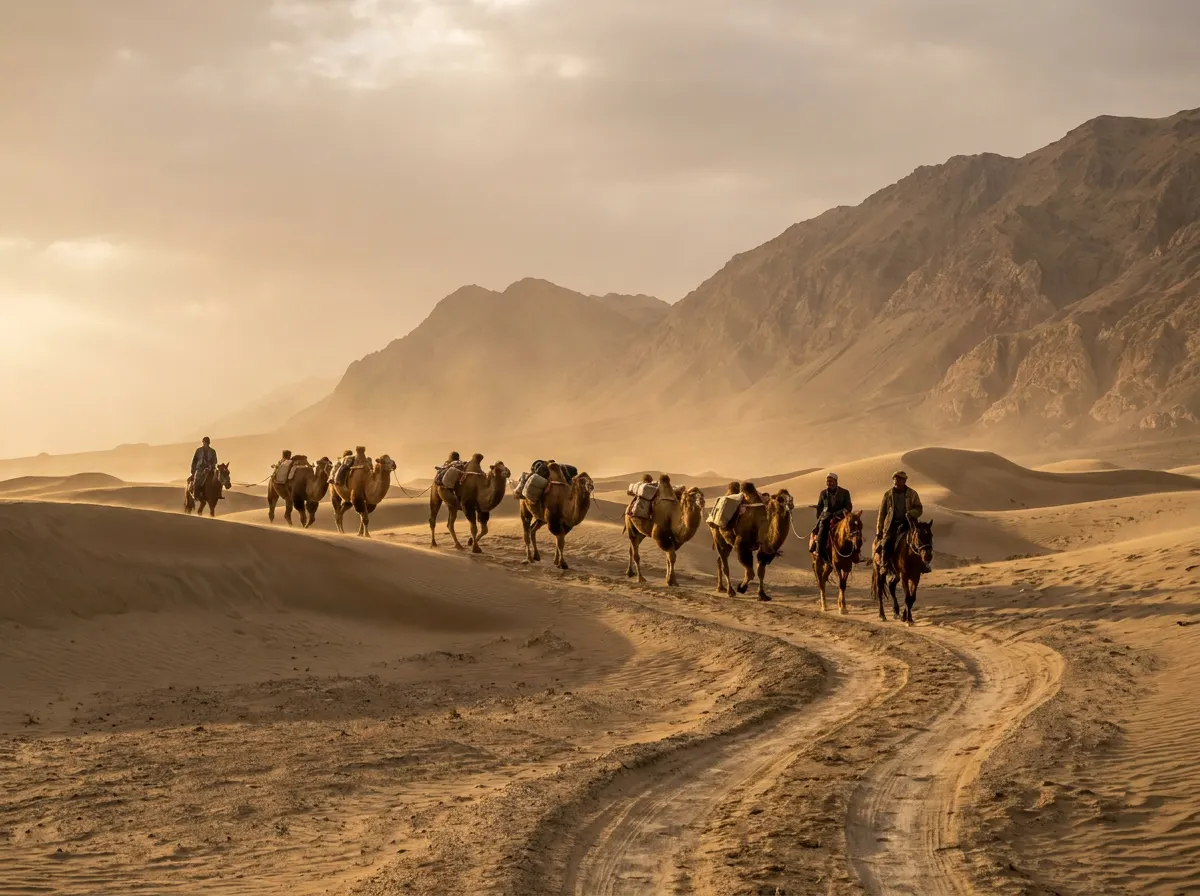
Yes. Camel rides operate at the Mingsha park gate, ranging from short 20–30 minute circuits near the entrance to longer one-hour sunset treks up the dune ridges. Bactrian two-hump camels are used, and the operation is well-managed. No advance booking is needed for individuals outside peak season.
What is the best way to cross the Taklamakan Desert?+
Most travelers do not cross the Taklamakan directly. The highway that rings the desert's northern edge (via Turpan and Hami) is paved and well-traveled; the southern route (via Hotan and Khotan) is rougher and far less served by buses. For a true Taklamakan crossing, join an organized 4–7 day expedition from Urumqi or Kashgar, ideally in October or November when temperatures are manageable.
Is the food in Xinjiang safe for Western travelers?+
Yes. Uyghur food is heavily meat-based but typically halal, fresh, and cooked to order. Street-stall food is generally safe in cities; follow the same rules as anywhere — busy stalls with high turnover, freshly cooked dishes, and bottled water. Vegetarian options exist but require some effort; vegans should carry snacks as backup.
How much cash should I carry on the Silk Road?+
In cities (Xi'an, Dunhuang, Urumqi) Alipay and WeChat Pay work almost everywhere and cash is rarely needed. In smaller oasis towns, at bazaar stalls, at rural restaurants, and for entrance fees at minor sites, cash is still preferred. Carry ¥2,000–3,000 in small notes for the full trip; ATMs are common in cities but rare in the smaller towns.
Can I take the high-speed rail all the way to Dunhuang?+
Not yet end-to-end. The HSR network reaches Lanzhou and now extends west of Lanzhou through the Hexi Corridor toward Dunhuang, with a transfer typically required at Jiayuguan. The full Lanzhou–Dunhuang high-speed line has been completed in stages; verify the current endpoint and transfer requirements when booking, as the network expands regularly.
What should I do if I get sick in remote Xinjiang?+
Cities (Urumqi, Kashgar, Turpan) have tier-3 hospitals with English-speaking staff at the international clinic. Smaller oasis towns have basic county hospitals. Carry any prescription medication you need, plus a small first-aid kit. Travel insurance with medical evacuation cover is strongly recommended for the more remote legs.
How do I plan a Hexi Corridor itinerary step by step?+
The Hexi Corridor is the 1,000-km narrow passage between the Tibetan Plateau and the Gobi Desert through which the Silk Road ran, and it contains the densest concentration of Silk Road sites in China. The classic westbound 7-day Hexi-only itinerary: start in Lanzhou (1 night, visit the Gansu Provincial Museum for the Han-dynasty bronze Flying Horse of Gansu and the Silk Road gallery), then take the HSR west to Zhangye (2 nights: Day 1 for the Danxia Rainbow Mountains at sunrise and sunset, Day 2 for the Giant Buddha Temple with its 34.5-meter reclining Buddha). Continue west to Jiayuguan (1 night: Jiayuguan Fort, the Overhanging Great Wall, and the First Beacon Tower). Proceed to Dunhuang (3 nights: Day 1 for the Mogao Caves in the morning and the Dunhuang Museum in the afternoon, Day 2 for the Mingsha Sand Dunes and Crescent Lake with a camel ride at sunset, Day 3 for the Yumen Pass, the Han-dynasty Great Wall remnants, and the Yardang Ghost City rock formations 180 km northwest of Dunhuang). Fly out from Dunhuang Airport. This 7-day plan covers all the corridor's UNESCO sites. For a 10-day version, add a stop at Wuwei (between Lanzhou and Zhangye) for the Leitai Han Tomb where the Flying Horse was excavated, and extend Dunhuang by a day for the Western Thousand Buddha Caves. The corridor is well-served by HSR (Lanzhou–Zhangye–Jiayuguan line), with all stops connected by trains running 10–20 times daily. Book the Mogao Caves and Zhangye Danxia at least a week ahead.
What are the best stops between Xi'an and Dunhuang?+
The 1,700-km stretch between Xi'an and Dunhuang contains several of the Silk Road's most important sites, and skipping straight from Xi'an to Dunhuang by flight misses most of them. In order from east to west: Tianshui (2.5 hours HSR from Xi'an) is home to the Maijishan Grottoes, one of China's four great Buddhist cave-art sites with 194 caves and 7,200 clay statues carved into a 142-meter cliff face — less famous than Mogao but equally important in art-historical terms, and far less crowded. Lanzhou (3 hours HSR from Xi'an) is the capital of Gansu and the gateway to the Hexi Corridor; the Gansu Provincial Museum holds the bronze Flying Horse of Gansu (China's national tourism symbol) and an outstanding Silk Road gallery. Wuwei (1.5 hours from Lanzhou by HSR) is the historical Liangzhou, a major Silk Road garrison with the Leitai Han Tomb and the Confucius Temple. Zhangye (2.5 hours from Lanzhou by HSR) has the Danxia Rainbow Mountains and the Giant Buddha Temple. Jiayuguan (1.5 hours from Zhangye by HSR) is the western end of the Ming Great Wall with the fortress and the Overhanging Wall. Most travelers on a 7–10 day itinerary see 3–4 of these stops in addition to Xi'an and Dunhuang. If you only have time for one intermediate stop, make it Zhangye for the Danxia landforms. If you have two, add Jiayuguan for the Great Wall.
What is the best way to see Jiayuguan Fort and the Overhanging Great Wall?+
Jiayuguan is the westernmost fortress of the Ming-dynasty Great Wall, built in 1372 at the narrowest point of the Hexi Corridor where the Qilian Mountains meet the Black Mountains. The site has three parts. Jiayuguan Fort itself is a restored trapezoidal walled citadel with inner and outer walls, gate towers, a commander's residence, and a small museum. Allow 90 minutes. The Overhanging Great Wall (Xuanbi Changcheng), 8 km north of the fort, is a restored 750-meter section of the Ming Wall that climbs a steep ridge of the Black Mountains at a 45-degree angle — one of the most photogenic sections of the Great Wall, with the fortress visible in the distance below. The climb is steep (roughly 400 steps) but rewards with panoramic views of the Gobi and the snow-capped Qilian Mountains. The First Beacon Tower (Di Yi Dun), 7 km south of the fort, is a restored Ming-dynasty signal tower on a 56-meter cliff above the Taolai River gorge. A combined ticket for all three sites costs ¥120. They can be visited in half a day — start at the fort at opening time (8:30am) to beat the tour buses, then taxi to the Overhanging Wall, and finish at the First Beacon Tower. The sites are 5–8 km apart; you will need a taxi or DiDi between them. Jiayuguan city has a small airport with flights to Dunhuang (1 hour), plus HSR connections to Zhangye and Lanzhou. Most travelers spend 1 night in Jiayuguan city.
How do I visit the Zhangye Danxia Rainbow Mountains?+
The Zhangye National Geopark is a 510-square-kilometer UNESCO Global Geopark 40 km west of Zhangye city, famous for its rainbow-striped sandstone formations — layers of red, orange, yellow, green, and gray sedimentary rock compressed over 24 million years and exposed by uplift and erosion. The park has four main viewing platforms connected by shuttle buses (¥75 entry including the bus). Platform 4 (Seven-Color Screen), the highest, is the most spectacular single viewpoint — layers of color fan out in a 180-degree panorama and it is the classic sunset spot. Sunrise and sunset are the best times; midday sun flattens the scene. In summer, sunrise is around 6am and sunset around 8:30pm. Most travelers spend half a day: arrive by 3pm, explore through sunset at Platform 4, and return to Zhangye city by 9pm. Zhangye is connected by HSR to Lanzhou (2.5 hours) and Jiayuguan (1.5 hours). Stay in Zhangye city (the Zhangye Hotel, ¥400) and take a DiDi to the geopark (¥80 one way, 40 minutes). A polarizing filter is essential for photography. Visit in April–May or September–October for the clearest air; summer haze and winter snow can obscure the formations.
Train vs car vs flight — which transport is best for each Silk Road leg?+
For Xi'an to Lanzhou: HSR is best at 3 hours (¥175). Flying takes 1 hour 15 minutes but airport transfers add 2+ hours on each end, making total door-to-door time similar at triple the cost. For Lanzhou to Zhangye: HSR takes 2.5 hours (¥150); driving takes 5–6 hours. For Zhangye to Jiayuguan: HSR takes 1.5 hours (¥65); driving takes 2.5 hours. For Jiayuguan to Dunhuang: the HSR runs part of the way with a bus transfer totaling roughly 3.5 hours (¥100–150). Driving takes 3.5–4 hours and is more flexible — you can stop at the Yulin Grottoes near Guazhou. This is the best leg for a private driver. For Dunhuang to Turpan: no direct flight exists — you must fly Dunhuang to Urumqi (1.5 hours, ¥500–800) and then HSR or drive 2 hours to Turpan. The overland drive is 800 km (9–10 hours) via Hami. Most travelers fly this leg. For Turpan to Urumqi: HSR takes 1 hour (¥50). For Urumqi to Kashgar: flying is the only realistic option at 1 hour 45 minutes (¥500–900); driving takes 18–20 hours. In summary: HSR for the eastern corridor, a mix of HSR and private driver for the Dunhuang approach, and flights for the long Xinjiang legs.
What is the best season for a Silk Road trip in detail?+
Late April through May is the best overall window. Daytime temperatures are 20–28°C, nights are cool but not freezing (8–15°C), the desert oases are green, wildflowers bloom in the Tianshan foothills, and the Pamir lakes are swollen with snowmelt. September through early October is the second-best: crisp, dry air with the clearest skies of the year, daytime 18–28°C, nights 5–12°C. The Turpan grape harvest runs through September, and the desert poplar forests turn gold in mid-to-late October. Avoid the October Golden Week (October 1–7). Summer (June–August) is hot — Dunhuang reaches 35°C, Turpan regularly exceeds 40°C. The trade-off is long daylight and full Pamir Highway access. Schedule outdoor sites for early morning and late afternoon. Winter (November–March) is cold — Dunhuang drops to -15°C at night, the Mogao Caves have reduced hours, and the Karakoram Highway closes. The advantage: near-empty sites and the cheapest hotels. Avoid March entirely — it is peak Gobi dust-storm season with frequent flight delays.
Is the Silk Road safe for solo female travelers?+
Yes, with normal travel precautions. The main corridor (Xi'an through Dunhuang and Turpan to Urumqi) is safe and accustomed to foreign tourists; solo women report feeling comfortable in hotels, on trains, and at tourist sites throughout this stretch. Uyghur and Hui communities along the route are generally welcoming and hospitable. Standard solo-travel practices apply: share your itinerary with someone at home, avoid walking alone in unlit areas late at night, keep a charged phone, and use DiDi rather than hailing unmarked taxis. In Kashgar, the Old City and Sunday Bazaar are safe during daylight hours. Modest dress — shoulders and knees covered — is appreciated throughout Xinjiang. The most common nuisance is friendly staring and requests for photos from local residents who see few foreigners. The remote sections — long desert drives, the southern Taklamakan rim — are best done with a guide or a group because of isolation, not crime: a breakdown on the desert highway without Chinese-language skills can be stressful. Avoid the border zones near Afghanistan, Pakistan, and Tajikistan without a registered guide who handles the required permits.
What is the best food to try in each Silk Road city?+
Xi'an: biangbiang noodles (thick hand-pulled wheat noodles in chili-oil broth with lamb) and yangrou paomo (crumbled flatbread in lamb broth), best eaten in the Hui Muslim Quarter night market. Lanzhou: Lanzhou beef noodles (Lanzhou lamian) — hand-pulled wheat noodles in clear beef broth with sliced beef, radish, chili oil, and cilantro, eaten for breakfast. The best shops open at 6am and close by 2pm. Zhangye: cuo mian (short hand-rolled noodles) stir-fried with lamb and peppers, plus local lamb hotpot. Dunhuang: donkey-meat yellow noodles (lü rou huang mian), a Gansu specialty found nowhere else, plus lamb skewers at the night market. Turpan: Uyghur lamb kebabs, naan flatbread, hand-pulled laghman noodles, and polo (rice cooked in lamb fat with carrots and raisins), best eaten at the Grape Valley orchard restaurants. Urumqi: dàpánjī (big plate chicken) — chicken and potato stewed with peppers, served over hand-pulled noodles. Kashgar: samsa (baked lamb-and-onion pastries from the tandoor), Kashgar polo with dried apricots, and fresh-baked naan from the Old City tandoor ovens, finished with tea at the century-old Old City Tea House.
What are the best photography tips for the Silk Road?+
The Silk Road is one of the world's great photography routes, but it demands preparation. Light: the best light is within 90 minutes of sunrise and sunset. Plan main sites for this window — the Mogao Caves exterior glows gold in late afternoon, the Mingsha dunes are best at sunset when shadows define the ridges, and the Zhangye Danxia is most vivid at sunset. Gear: a wide-angle zoom (16–35mm) for landscapes, a telephoto (70–200mm) for compressing desert landscapes and isolating cave-art details from the exterior, and a polarizing filter to cut sandstone glare. A tripod is useful for sunset at the Danxia and dunes, but is banned inside Mogao Caves. Dust protection is critical — the Gobi and Taklamakan dust is extremely fine. Bring a rain cover for your camera bag, a rocket blower for sensor dust, and sealed lens caps. Change lenses only indoors or inside a vehicle. Do not change lenses at all at the Mingsha dunes — wind-blown sand is a sensor killer. Subjects: the Uyghur markets and Kashgar Sunday Bazaar are extraordinary for portraits — always ask permission with a smile and gesture. The Old City lanes in Kashgar, with mud-brick walls and carved wooden doors, are street-photography gold. Interior photography of Mogao murals is strictly prohibited. Drones need registration and Xinjiang permits — do not fly one without researching current regulations. Carry extra memory cards and a portable backup drive.
How do I find an English-speaking guide on the Silk Road?+
English-speaking guides are available for all major stops but must be booked in advance — you cannot reliably find one on arrival. For the full corridor, book through a licensed Chinese travel agency such as China Highlights, China Discovery, or Travel China Guide, which offer private itineraries with English-speaking guides at each city (¥800–1,500 per day including guide, driver, and vehicle). For individual cities, Trip.com lists licensed English-speaking guides for Xi'an, Lanzhou, Zhangye, Dunhuang, Turpan, Urumqi, and Kashgar, bookable by the day. At the Mogao Caves, English-language tours are included in the foreign-visitor ticket (request when booking) — these are excellent and you do not need a separate guide. In Kashgar, English-speaking Uyghur guides can be arranged through the Kashgar Old City Visitor Center or John's Information Cafe (a long-standing traveler hub) for ¥500–800 per day. For remote western sections (southern Taklamakan, Tashkurgan, the Pamir Highway), a guide is essential — these areas require permits that only licensed agencies can arrange. Book all guides at least 2 weeks ahead for peak season and 1 week for shoulder season.
What are accommodations like along the Silk Road route?+
Accommodation standards vary dramatically. Xi'an has the full range from hostels (¥60–150) to international 5-star hotels (Hilton, Sofitel, ¥800–2,000). Lanzhou has mid-range hotels (¥300–500) near the railway station and the Crowne Plaza at the top end (¥700–1,200). Zhangye has simpler accommodations — the Zhangye Hotel (¥400) and Silk Road Hotel (¥300) are clean, comfortable mid-range options, but no international chains. In Jiayuguan, the Holiday Inn (¥500) is reliable; smaller Chinese hotels are ¥200–350. Dunhuang has good range: the Silk Road Dunhuang Hotel (¥800) is a desert-style resort, the Dunhuang Hotel (¥600) is solid mid-range, and the Dunhuang International Youth Hostel (¥80–120) has a rooftop terrace. Desert camps (¥300–600) offer camel-wool tents with campfire dinners. Turpan has the Silk Road Turpan Oasis Hotel (¥500) and grape-trellis courtyard guesthouses (¥200–350). Urumqi has international chains (Sheraton, Hilton, ¥700–1,500). Kashgar has the Radisson Blu (¥600) and atmospheric Old City courtyard guesthouses (¥200–400) with Uyghur decor and rooftop terraces. Book at least 2 weeks ahead for peak season and 1 month for Golden Week. As you move west from Xi'an, expect fewer English-speaking staff and simpler breakfasts. In the smallest oasis towns, the county government guesthouse may be the best available — basic but clean.
What is a realistic budget breakdown for a 10-day Silk Road trip?+
For a mid-range independent traveler on the Xi'an–Dunhuang–Turpan–Urumqi route over 10 days, budget roughly ¥15,000–22,000 (US$2,100–3,100) per person, excluding international flights to China. Breakdown: accommodation ¥4,000–7,000 (10 nights at ¥400–700), meals ¥1,500–3,000 (¥150–300 per day), domestic flights ¥1,500–2,500 (Xi'an–Dunhuang ¥500–900, plus optional Kashgar round-trip), HSR and train tickets ¥500–800, private drivers and local transport ¥2,000–3,000 (roughly ¥500–600 per full day), entrance fees ¥1,000–1,500 (Mogao Caves ¥200, Mingsha ¥110, Danxia ¥75, Jiayuguan ¥120, Jiaohe ¥70, plus smaller sites). Add 10–15% for incidentals (SIM card, laundry, tips, sunscreen). A backpacker can do the same trip for ¥8,000–10,000 using hostels (¥60–120), street food (¥50–100/day), conventional trains, and group excursions. A luxury trip runs ¥35,000–50,000 with 5-star hotels, private guides, and business-class domestic flights. All prices in CNY at mid-2026 rates; costs rise 30–50% during Golden Week and Spring Festival.
What should I know about Xinjiang-specific travel requirements?+
Xinjiang has additional security protocols compared to eastern China, but these are routine and applied equally to all travelers. Carry your passport at all times — you will need it at hotel check-in (every night), train station security, airport security, and occasionally at highway checkpoints between cities. Hotels must register foreign guests with the local Public Security Bureau within 24 hours; this is automatic at check-in. Expect bag X-ray and passport checks at train stations (arrive 30–40 minutes before departure) and at major bazaar entrances. Do not photograph security infrastructure — police stations, checkpoints, cameras, or security personnel. This rule is enforced. Drones require registration and additional Xinjiang permits — do not fly one without researching current regulations through your travel agency. Border zones — including the Karakoram Highway beyond the checkpoint, Tashkurgan, and areas near the borders with Afghanistan, Pakistan, Tajikistan, and Kyrgyzstan — require permits arranged by a licensed agency; you cannot obtain these independently. Mobile internet in Xinjiang can be slower and more intermittently blocked than in eastern China; VPN reliability varies. Download offline maps and essential documents before arriving. None of these requirements are new or specific to foreigners — they are standard domestic security measures.
How do I get from Xi'an to Dunhuang?+
Three options exist. The fastest is flying: direct flights from Xi'an Xianyang Airport (XIY) to Dunhuang Mogao Airport (DNH) take roughly 2 hours 15 minutes and cost ¥500–900 one way, with 2–4 daily departures on China Eastern and Sichuan Airlines. Book at least 2 weeks ahead in peak season. The best overland option uses the HSR: Xi'an North to Lanzhou West (3 hours, ¥175), then the Lanzhou–Zhangye–Jiayuguan HSR and onward by connecting bus to Dunhuang (total roughly 7–8 hours, ¥250–350). This is ideal if you want to see intermediate stops. The third option is the conventional overnight sleeper train from Xi'an to Dunhuang (roughly 20 hours, ¥300–400 for a soft sleeper) — the longest but cheapest, and you save a night's accommodation. If you plan to visit Zhangye, Jiayuguan, or other Hexi Corridor stops, use the HSR; flying is better only if you are going directly from Xi'an to Dunhuang without stops.
Can I visit the Mogao Caves without a tour group?+
Yes, independent visitors can book Mogao Caves tickets directly, but you must reserve in advance — there is no walk-up entry. Book through the official Mogao Caves website, the WeChat mini-program, or Trip.com for the foreign-visitor ticket (¥200), which includes an English-language guided tour of 8 caves lasting roughly 75 minutes, led by Mogao's own trained guides. Tours depart at set times; you join the next available English-language group. In peak season (May–October), book at least 2–3 weeks ahead; in shoulder season, a week ahead is usually sufficient. During Golden Week, tickets sell out weeks in advance — some travelers book their Mogao slot before booking flights. The Digital Exhibition Center screens two excellent 20-minute films; your tour bus then takes you to the cave site. Photography inside the caves is strictly prohibited. Tripods, large bags, and water bottles must be left in lockers. Allow 3 hours total from arrival at the Digital Exhibition Center through the return bus. For an extended visit, the special caves ticket (¥150–200 per additional cave) grants access to rarely visited caves with the finest murals — book these at the same time as your standard ticket, as they are limited to small groups.
What is the best way to experience the Taklamakan Desert?+
The Taklamakan is the world's second-largest shifting-sand desert at 337,000 square kilometers. Most travelers experience it in one of three ways. The Mingsha Sand Dunes near Dunhuang are the most accessible: climb the dunes, ride a camel, sand-sled, and watch the sunset without venturing deep into the desert — a half-day activity suitable for all fitness levels. The Yumen Pass and Yardang Ghost City day trip from Dunhuang (180 km northwest, ¥100–200 for a shared tour) takes you through the Gobi-Desert transition zone to wind-carved rock formations that served as landmarks for Silk Road caravans. Allow a full day. For the true Taklamakan experience, the desert highway on the G217 from Luntai to Minfeng (552 km, 8–10 hours) traverses the heart of the desert on a paved road with sand dunes on both sides. This is only feasible as part of an organized multi-day expedition from Urumqi or Kashgar, typically in October when temperatures are survivable. The southern rim route (Kashgar–Yarkand–Hotan–Minfeng–Qiemo–Ruoqiang) circles through Uyghur-majority oasis towns over 4–5 days by car. For any deep-desert expedition, travel with a licensed operator, carry 4+ liters of water per person per day, bring emergency food, and ensure your vehicle has satellite communication. Travel in October or November only — summer surface temperatures exceed 50°C.
What should I pack and wear for a Silk Road trip?+
Pack for extreme temperature swings between desert days and nights. Clothing: lightweight, breathable long-sleeved shirts and pants (sun protection and modesty in Muslim areas), a wide-brimmed hat, UV-rated sunglasses, a buff or scarf for dust and sun, and a light down jacket or fleece for evenings — even summer nights in Dunhuang can drop to 15°C. A waterproof shell is useful for April–May rain and Pamir snow. Footwear: sturdy broken-in walking shoes (not sandals — the desert sand and cave steps are unforgiving) and a pair of sandals for guesthouses. For mosques and Uyghur areas, shoulders and knees must be covered; women should bring a light scarf for mosque visits. Health: prescription medications in original packaging with a copy of the prescription, plus over-the-counter antidiarrheal, oral rehydration salts, painkillers, motion sickness pills for desert drives, high-SPF sunscreen, SPF lip balm, and insect repellent for oasis towns. A basic first-aid kit with bandages, antiseptic wipes, and blister plasters is essential — pharmacies are scarce between cities. Gear: a reusable water bottle or hydration bladder (1L minimum, 3L+ for desert walks), a 10,000+ mAh power bank (long drives and remote sites have no charging), a universal adapter (Type A/C/I, 220V), and a headlamp for desert camps and poorly lit guesthouses. Documents: passport (always — needed at every hotel, train station, and checkpoint), printed hotel and flight confirmations, a debit card that works with Chinese ATMs, ¥2,000–3,000 in cash for small towns, and a downloaded VPN with offline maps and translation data. A lightweight daypack for excursions rounds out the kit.
Is the Silk Road suitable for older travelers or those with limited mobility?+
Yes, with the right pacing and itinerary choices. The classic corridor cities are accessible by flights and HSR, eliminating the long desert drives that are the main physical demand. Xi'an, Lanzhou, and Urumqi have modern infrastructure with elevators, accessible hotel rooms, and flat city-center terrain. The Mogao Caves visitor experience is well-designed for all mobility levels: the Digital Exhibition Center is fully accessible, the shuttle buses have low floors, and the cave tour involves roughly 200 steps inside the complex — manageable with a walking aid for most visitors. The Mingsha Sand Dunes are not accessible for wheelchairs and require significant walking in soft sand; camel rides are available for those who can mount. The Zhangye Danxia has shuttle buses between platforms and paved paths, though some viewing platforms involve stairs. Jiayuguan Fort has ramps at the main gate but uneven cobblestones inside. The Jiaohe ruins in Turpan involve walking on exposed, uneven clay terrain with no shade — challenging for those with limited mobility. For an older-traveler-friendly itinerary, skip the remote sections (Pamirs, Taklamakan crossing, southern Xinjiang rim), limit daily driving to 3 hours, spend 2–3 nights per stop rather than 1, avoid July–August heat, and hire private guides and drivers throughout rather than using public transport. The best months for older travelers are May and September, with mild temperatures and thinner crowds than the summer peak. Many travel agencies offer "comfort" Silk Road itineraries with private cars, shorter days, and accessible hotels — China Highlights and Travel China Guide both list mobility-friendly options. Travel insurance with medical evacuation cover is essential for all Silk Road travelers, but especially for those with pre-existing conditions.
Can I travel from Kashgar into Kyrgyzstan or Pakistan overland?+
The Kashgar–Kyrgyzstan crossing via the Irkeshtam Pass or the Torugart Pass is possible but requires advance planning. Both passes connect Kashgar to the Kyrgyz city of Osh and onward to Bishkek. The Torugart Pass (3,752 meters) is the more scenic route, crossing the Tian Shan mountains with views of alpine lakes and snow peaks. The crossing requires: a valid visa for both China and Kyrgyzstan (most Western passports get visa-free entry to Kyrgyzstan for 30–60 days; check current rules), a pre-arranged transfer on both sides (Chinese drivers can only go to the border; a Kyrgyz driver meets you on the other side), and a border permit arranged by a travel agency — you cannot cross these passes independently. The drive from Kashgar to the Torugart Pass takes roughly 3–4 hours; the crossing itself takes 1–2 hours depending on queues. On the Kyrgyz side, it is another 4–5 hours to Osh. Total travel time Kashgar to Osh is roughly 10–12 hours. The Irkeshtam Pass (2,950 meters) is lower and slightly faster but less scenic. Both passes close from roughly November to April due to snow. The Kashgar–Pakistan crossing via the Khunjerab Pass (4,693 meters) on the Karakoram Highway is open seasonally (May–November) and connects to the Hunza Valley and Gilgit in northern Pakistan. This is one of the world's highest paved border crossings and requires permits on both sides, plus a Pakistani visa. The Chinese side of the Karakoram Highway to Tashkurgan and the Khunjerab Pass requires a border permit arranged by a licensed agency. Most travelers who do this crossing join an organized overland tour from Kashgar to Islamabad (10–14 days) or Kashgar to Bishkek (5–7 days). Add at least 2 extra days to your itinerary for border delays, which are common.
What should I see and do in Lanzhou as a Silk Road hub?+
Lanzhou, the capital of Gansu province, is the natural gateway to the Hexi Corridor and a Silk Road hub in its own right — do not treat it as just a transit point. The Gansu Provincial Museum (甘肃省博物馆, free, 2-3 hours) is the single best introduction to the Silk Road anywhere in China. Its headline exhibit is the bronze Flying Horse of Gansu (马踏飞燕, Eastern Han dynasty, 2nd century CE), which has become the symbol of Chinese tourism nationwide. The museum also holds an outstanding Silk Road gallery with Tang-dynasty silk fragments, Sogdian silverware, Han-dynasty bamboo slips recording frontier military dispatches, and an entire gallery of painted Neolithic pottery from the Majiayao culture. The English audio guide (¥20) is excellent. Second, the Yellow River (Huang He) runs through the centre of Lanzhou, and the Zhongshan Iron Bridge (中山铁桥, built 1907 by a German firm) is China's first iron bridge across the Yellow River, still in pedestrian use. Walk across it at sunset when the river turns gold and the White Pagoda Mountain (Baita Shan) on the north bank catches the last light. Third, a cable car (¥45 round-trip) climbs White Pagoda Mountain to the 17-metre, seven-story White Pagoda (白塔), a Yuan-dynasty stupa with a panoramic view of the Yellow River threading through the city. Fourth, the Waterwheel Park (水车园, ¥20) on the south bank has working replicas of Ming-dynasty irrigation waterwheels that once lined the Yellow River. Fifth, Lanzhou's famous beef noodles (兰州拉面, Lanzhou lamian) are the city's defining dish — hand-pulled wheat noodles in a clear beef broth with sliced beef, radish, chili oil, and cilantro, eaten for breakfast. The best shops open at 06:00 and close by 14:00; Mazi Jia (马子禄兰州牛肉面, founded 1915) on Zhangye Road is the historic standard-bearer. A bowl costs ¥15-25. Stay one full day in Lanzhou (two nights) to see the museum, walk the Yellow River, and eat the noodles before heading west. Lanzhou Zhongchuan Airport (LHW) has flights to Dunhuang, Urumqi, and Kashgar, and the HSR connects Lanzhou West Station to Zhangye, Jiayuguan, and beyond. The city sits at 1,520 metres elevation — altitude is not a factor for most travellers.
What lesser-visited grotto sites can I see beyond Mogao?+
While the Mogao Caves at Dunhuang are the Silk Road's most famous Buddhist cave-art site, four lesser-visited grotto complexes offer equally important art with a fraction of the crowds. (1) The Yulin Grottoes (榆林窟), 170 km east of Dunhuang near the town of Guazhou, are the direct artistic sibling of Mogao — 42 caves with Tang, Five Dynasties, Song, and Western Xia murals of comparable quality, including the famous "Samantabhadra" mural (Cave 3) and a complete Western Xia "Ten Kings of Hell" scroll (Cave 19). Only 6 caves are open to visitors, but the quality is world-class and the average group size is 5-10 people rather than 30. Entry ¥40; allow 2-3 hours. Reach by taxi from Dunhuang (2 hours, ¥400-600 round-trip) or as a stop on the drive from Jiayuguan. (2) The Western Thousand Buddha Caves (西千佛洞), 35 km west of Dunhuang on a cliff above the Dang River, have 16 surviving caves with Northern Zhou, Sui, Tang, and Five Dynasties murals. Smaller and rougher than Mogao, but the setting in a desert gorge is dramatic and you will likely be alone. Entry ¥30. (3) The Maijishan Grottoes (麦积山石窟), near Tianshui in eastern Gansu, are one of China's four great Buddhist cave-art sites alongside Mogao, Yungang, and Longmen. The 194 caves are carved into a 142-metre cliff and are famous for their clay sculptures — 7,200 figures, many life-size or larger — which survived better than the murals because of the drier microclimate inside the cliff. The caves date from the Later Qin (384-417 CE) through the Ming dynasty and represent the transition from Central Asian to Chinese Buddhist art styles. Entry ¥90; the site is 2.5 hours by HSR from Xi'an. (4) The Matisi Temple (马蹄寺, ¥74) near Zhangye is a unique blend of Buddhist cave temples and Tibetan-style grottoes carved into a red sandstone cliff, with multi-story internal passages connecting the caves. The "Thirty-Three Heavens" cave has seven levels of internal stairs and shrines, and the views across the Qilian Mountain foothills are spectacular. The site is 65 km south of Zhangye city (1 hour by taxi, ¥200-300 round-trip) and receives very few foreign visitors. For cave-art enthusiasts, a 5-day itinerary of Mogao + Yulin + Western Thousand Buddha Caves is self-recommending from Dunhuang; add Maijishan and Matisi for a complete Silk Road grotto-art circuit.
What is the Jiayuguan Great Wall Museum and should I visit it?+
The Jiayuguan Great Wall Museum (嘉峪关长城博物馆, free), located 500 metres east of Jiayuguan Fort, is one of China's best single-subject museums and an essential complement to visiting the fort itself. Opened in 2009 in a modern building designed to resemble a section of the Great Wall, the museum covers the full 2,000-year history of the Great Wall with a special focus on the Ming-dynasty western defences and the Hexi Corridor. The highlights: (1) a 1:500 scale model of the entire Ming Great Wall system from Shanhaiguan to Jiayuguan, showing every pass, beacon tower, and garrison along the 8,850 km route, (2) a gallery of original Ming-dynasty weapons, armour, and military documents recovered from Jiayuguan and nearby forts, (3) an immersive diorama of a Ming frontier battle with sound and lighting, (4) a full-scale re-creation of a beacon-tower signal system demonstrating how fire and smoke signals could relay a message from Jiayuguan to Beijing in under 24 hours, (5) a gallery of Han-dynasty wooden slips (竹简) — official military dispatches from the Han Great Wall that predates the Ming version by 1,500 years, and (6) the "Silk Road and the Great Wall" gallery explaining how the wall functioned not just as a military barrier but as a customs checkpoint regulating Silk Road trade. English signage is better than at most Chinese museums outside Beijing and Shanghai. Allow 1-1.5 hours. Visit the museum before Jiayuguan Fort (rather than after) — the context transforms how you see the fort, the Overhanging Wall, and the First Beacon Tower. The museum is free but requires a passport for entry. Open roughly 09:00-17:00, closed Mondays. It pairs with the fort visit for a half-day of the most concentrated Great Wall history anywhere in China.
What is the Zhangye Giant Buddha Temple and what makes it special?+
The Zhangye Giant Buddha Temple (张掖大佛寺, Dafo Si, ¥41) in central Zhangye city houses the largest indoor reclining Buddha statue in China — a 34.5-metre-long, 7.5-metre-high statue of Sakyamuni entering nirvana, carved from wood and clay and covered in gold leaf, built in 1098 during the Western Xia dynasty. The Buddha lies on his right side with his head propped on his right hand, surrounded by his ten disciples, and the wooden hall built around him (the Dafo Hall) is itself 900 years old and one of the few surviving Western Xia wooden structures in China. Behind the reclining Buddha, a two-story scripture hall holds a collection of 6,000 Buddhist sutras, some handwritten in gold and silver ink on blue paper during the Ming dynasty — the best-preserved sutra collection in Gansu. The temple complex also includes a small museum of Western Xia artifacts and a white stupa (the White Pagoda, 白塔) in the rear courtyard. The temple is a 10-minute walk from central Zhangye and is best visited in the morning (08:00-10:00) when the prayer halls are lit from the east and the incense is burning. The reclining Buddha is genuinely remarkable in scale and craftsmanship — it rivals the reclining Buddha at Bangkok's Wat Pho, and predates it by 700 years. Allow 1-1.5 hours. Photography is allowed but no flash. The temple pairs naturally with the Zhangye Danxia Rainbow Mountains for a half-day of history and scenery: visit the Giant Buddha Temple in the morning, rest in Zhangye city over lunch, and head to the Danxia for the afternoon and sunset. The temple also has a connection to Kublai Khan, who was born nearby and whose mother was a Nestorian Christian from the Kereit tribe — Zhangye was one of the Mongol Empire's administrative centres in Gansu.
What is the step-by-step strategy for booking Mogao Caves tickets in peak season?+
Mogao Caves tickets are the single most competitive booking on the Silk Road, and a clear strategy is essential for peak season (May-October, especially July-August and the October Golden Week). Step 1: determine your target date and set a calendar reminder for 30 days before it — this is when tickets are released on the official Mogao Caves website (www.mogaocaves.com) and the WeChat mini-program "莫高窟参观预约". Step 2: on release day, log in at 08:00 Beijing time (tickets release at 08:00) and book immediately. The foreign-visitor ticket (¥200, English-language guided tour of 8 caves) has a smaller allocation than the Chinese-language tickets and sells out within hours in July and August, within days in May and September. Step 3: if the standard foreign-visitor ticket is sold out, book the regular Chinese-language ticket (¥190, 8 caves) and add the English audio guide separately (¥20 at the Digital Exhibition Centre) — the caves are the same, and the audio guide covers the narrative. Step 4: if all tickets for your date are sold out, the "emergency ticket" (¥100) is released 1-2 days before the visit date and gives access to 4 caves (usually caves 96, 100, 138, and 148) without the guided tour — less comprehensive but still worthwhile. Emergency tickets sell out fast and should only be a backup. Step 5: for the special caves (特窟, ¥150-200 per additional cave, limited to 15-20 visitors per day), book these at the same time as your standard ticket — they are released in the same batch and sell out in minutes during peak season. The best special caves are Cave 45 (Tang dynasty, the finest surviving sculpture group at Mogao), Cave 158 (the 16-metre reclining Buddha), and Cave 217 (Tang dynasty, the "Western Paradise" mural). Step 6: arrive at the Mogao Digital Exhibition Centre 45 minutes before your tour time. The centre is at the Mogao Caves entrance 10 km southeast of Dunhuang city, not at the caves themselves — a common mistake. The shuttle bus from the centre to the caves takes 20 minutes. Step 7: confirm your ticket with your passport — the name on the ticket must match your passport exactly. If you are booking through Trip.com or a travel agency, confirm that they have submitted your passport details correctly. Step 8: for the absolute peak (Golden Week, October 1-7), book a half-day or full-day private tour through a licensed Dunhuang travel agency (¥600-1,200 per person) — agencies hold advance allocations of tickets that are not available to the public. This is the only reliable way to get Golden Week tickets.
What are the best Silk Road souvenirs to buy in each city?+
Xi'an: Tang-dynasty reproduction ceramics, especially sancai (three-colour) glazed horses and camels (¥80-300), from the shops on Shuyuanmen Street near the South Gate. Shadow puppets (¥30-100) from the Muslim Quarter. Terracotta warrior replicas — the small ones (¥30-80) are more practical than the life-size versions. Lanzhou: local Gansu dried red dates (¥20-50 per bag) and Lanzhou lily bulbs (baihe, 百合, ¥30-60 per bag), a local speciality. Hand-pulled noodle kits (¥15-30) from the supermarket near the railway station. Wuwei: replica bronze Flying Horse statuettes (¥50-150) at the Leitai Han Tomb gift shop. Zhangye: Danxia-inspired coloured sand bottles (¥20-50) made with layered sand from the rainbow mountains — touristy but a classic. Zhangye linze dried apricots (¥30-60 per kilo) from the farmers' market near the Giant Buddha Temple. Jiayuguan: small replica sections of the Great Wall in carved stone or bronze (¥50-200) from the Jiayuguan Fort gift shop, and desert rose crystal clusters (¥20-80) sold by vendors outside the fort — natural gypsum formations that look like stone flowers. Dunhuang: Mogao Caves reproduction murals on silk scrolls (¥100-500) from the Dunhuang Museum gift shop and the Mogao Caves shop are the most beautiful Silk Road souvenir — ask the shop to roll rather than fold the scroll. Mogao art books (¥150-400) from the Dunhuang Academy bookstore at the Digital Exhibition Centre — the best English-language Mogao catalogues exist only here. Small painted clay camel caravans (¥30-80) from the Dunhuang night market. Turpan: Uyghur dried grapes, raisins, and apricots (¥20-50 per bag) from the Grape Valley vendors — buy directly from the orchard stalls, not the tourist shops. Uyghur embroidered doppa hats (¥30-80) from the Turpan bazaar. Urumqi: Xinjiang jade (和田玉) from the Urumqi Jade Market — prices range from ¥50 for a small pendant to ¥5,000+ for a certified piece. Xinjiang carpets (¥200-2,000) — small, hand-knotted wool rugs with Uyghur geometric patterns, from the Erdaoqiao Bazaar. Kashgar: hand-hammered copper teapots and plates (¥100-500) from the Kashgar Old City coppersmiths' lane. Uyghur hand-embroidered textiles (¥50-200) and hand-carved wooden boxes (¥50-150) from the Sunday Bazaar craft section. Kashgar saffron and cumin (¥20-50 per small bag) from the spice section of the bazaar. Bargaining is expected at bazaars and street stalls (aim for 30-50% of the first price) but not in museum gift shops or fixed-price shops.
How does Uyghur food differ from Han Chinese food along the route?+
The food shift from Han Chinese to Uyghur cooking is one of the most dramatic cultural transitions on the Silk Road, and understanding it helps you eat better at every stop. The dividing line is roughly the Gansu-Xinjiang border. East of that line (Xi'an, Lanzhou, Zhangye, Jiayuguan, Dunhuang), the cuisine is Han Chinese and Hui Muslim Chinese with a strong wheat-and-noodle base: hand-pulled noodles in soup or stir-fry, lamb and beef dishes, flatbreads (bing), and the distinctive Hui-Muslim absence of pork. West of that line (Hami, Turpan, Urumqi, Kashgar), the cuisine shifts to Uyghur and Central Asian: meat-centric, bread (naan) as the staple rather than rice or noodles, lamb as the dominant protein, cumin and black pepper as the signature spices (rather than soy sauce and ginger), and eating with your right hand (for naan and fruit) as common as with chopsticks. Key differences: Han-noodle dishes (beef noodles in Lanzhou, biangbiang noodles in Xi'an) are served in individual bowls eaten quickly; Uyghur laghman noodles are often served on a communal platter and eaten family-style. Han bread (mantou, bing) is steamed or pan-fried; Uyghur naan is baked in a tandoor oven and has a chewy, smoky crust. Han meals centre on a bowl of rice or noodles with shared dishes; Uyghur meals centre on naan, polo (pilaf), and kebabs eaten together, with tea as the constant. Vegetarian options are more common in Han areas (tofu, vegetable stir-fries, Buddhist vegetarian restaurants); in Uyghur areas, vegetables exist (tomato-and-pepper laghman, pumpkin manti dumplings, various pickles) but are side dishes rather than mains. Pork is absent from Hui and Uyghur cuisine for religious reasons — do not order it or bring it into restaurants. Alcohol is available in Han cities and in Urumqi but rare in Turpan and Kashgar outside of tourist hotels. The most interesting food city on the corridor is Turpan, where Han, Uyghur, and Hui cuisines coexist and the grapes and melons are the best in China. The best single meal is the Kashgar Sunday Bazaar food section, where you can eat naan, kebabs, samsa, polo, and fresh pomegranates from a dozen stalls for under ¥50.
What do I need to know about a Silk Road road trip — car rental, petrol, road conditions?+
A self-drive road trip along the Silk Road is possible but significantly harder than in Europe or North America, and most foreign travellers hire a car with a private driver rather than driving themselves. Car rental for self-driving: foreign visitors need a Chinese driving licence, which requires passing a written test (available in English at major DMV offices in Beijing, Shanghai, and a few other cities). An International Driving Permit (IDP) is not recognised in China. Most foreign travellers therefore cannot legally self-drive. Car with private driver: the standard Silk Road model — hire a driver and vehicle through a local travel agency for ¥600-1,000 per day including fuel, tolls, and the driver's accommodation and meals. The driver speaks Chinese (rarely English), knows the roads, handles police checkpoints, and waits at each site. Book 1-2 weeks ahead through Ctrip, China Highlights, or a local Dunhuang/Urumqi agency. For the eastern corridor (Lanzhou-Zhangye-Jiayuguan-Dunhuang), the roads are excellent — the G30 Lianhuo Expressway is a modern, well-maintained 4-6 lane toll road with service stations every 50-80 km. Speed limit is 120 km/h on expressways and 80-100 km/h on national highways. Petrol stations (Sinopec and PetroChina) are common on the expressway and accept cash, Alipay, and UnionPay; foreign credit cards are not accepted. Fill up at every major town — the gaps between petrol stations on the desert stretches are 100-150 km. For the western section (Turpan-Kashgar and southern Xinjiang), road quality is more variable: the G30 expressway from Turpan to Urumqi is good, but south of Urumqi toward Korla and Kashgar, the roads are a mix of expressway, national highway, and rougher two-lane desert roads. The southern Taklamakan rim road (G315) is paved but remote, with long gaps between services. A 4WD is recommended for any off-pavement driving (Yardang formations, desert camps, Pamir side roads). Road checkpoints become more frequent in Xinjiang — the driver will handle these. Carry water, food, and a blanket in the car for every leg over 200 km; desert breakdowns are rare but serious. Mobile signal drops out between oasis towns — download offline maps. The ideal Silk Road road trip route (with driver, 10-14 days): Lanzhou-Zhangye-Jiayuguan-Dunhuang-Hami-Turpan-Urumqi, approximately 2,000 km of excellent to good roads, with the option to fly to Kashgar from Urumqi. For the true overland Kashgar extension, add 4-5 days and 1,500 km of more demanding driving on the southern route via Korla and Aksu.
Can I add Qinghai Lake as a detour on a Silk Road trip?+
Yes, Qinghai Lake (青海湖) is a natural 2-3 day detour that adds a high-altitude alpine lake — China's largest — to a Silk Road itinerary. The detour works best between Lanzhou and Zhangye, or as a loop from Xining (the capital of Qinghai province, 2.5 hours HSR from Lanzhou). From Xining, Qinghai Lake is 150 km west (2.5 hours by car). The lake sits at 3,205 metres elevation and is a vast, deep-blue inland sea ringed by grasslands, snow-capped mountains, and in July, a spectacular bloom of yellow rape flowers. The best visiting months are June-September; the lake freezes from December to March and the surrounding roads can close in snow. The standard 2-day Qinghai Lake detour: Day 1 — leave Lanzhou morning, HSR to Xining (2.5 hours, ¥60), private driver picks you up and drives 2.5 hours to the lake. Afternoon: walk the southern shore near Erlangjian Scenic Area (¥100), visit a Tibetan nomad camp, photograph the lake with the snow-capped Qilian Mountains behind. Overnight in a lakeside guesthouse (¥200-500). Day 2: sunrise at the lake (spectacular), then drive north through the Qilian Mountains to Zhangye (6-7 hours, one of China's most scenic drives — the Qilian pass reaches 3,800 metres, with glaciers visible from the road). Arrive Zhangye by early evening. A 3-day version adds a morning cycling loop on the lake's southern shore (rental bikes ¥50-80 per day) and an afternoon at Chaka Salt Lake (茶卡盐湖, 150 km west of Qinghai Lake), a shallow salt flat that produces mirror-like reflections — China's "Lake of the Sky." Chaka entry is ¥70. The lake sits at 3,200 metres and the Qilian pass at 3,800 metres — altitude sickness is a real risk. Spend a night in Xining (2,200 metres) before heading to the lake to acclimatise, stay hydrated, and avoid alcohol. The detour adds 2-3 days to a Hexi Corridor itinerary but is one of the most rewarding non-desert Silk Road extensions, and the Qilian Mountain drive is a highlight in itself.
How do I handle altitude on the Tibetan Plateau sections of the Silk Road?+
The classic Silk Road corridor cities (Xi'an, Lanzhou, Zhangye, Jiayuguan, Dunhuang, Turpan, Urumqi) are all low- to moderate-elevation and altitude is not a factor. Altitude becomes relevant on three specific side trips: Qinghai Lake (3,205 metres), the Qilian Mountain pass between Qinghai and Gansu (3,800 metres at the road summit), and the Kashgar-Pamir Highway toward Tashkurgan and the Khunjerab Pass (Karakul Lake at 3,600 metres, Tashkurgan at 3,100 metres, Khunjerab Pass at 4,693 metres). Symptoms of acute mountain sickness (AMS) typically begin above 2,500 metres and include headache, nausea, fatigue, dizziness, and shortness of breath. Prevention: (1) ascend gradually — spend a night at intermediate elevation (Xining at 2,200 metres for Qinghai Lake, Kashgar at 1,300 metres for the Pamir Highway) before going higher; (2) stay hydrated — drink 3-4 litres of water per day at altitude; (3) avoid alcohol and sedatives for the first 24-48 hours at altitude; (4) eat light, high-carbohydrate meals; (5) acetazolamide (Diamox, 125-250 mg twice daily starting 24 hours before ascent) is the standard prophylactic — bring it from home, as it is not widely available in Chinese pharmacies in Gansu or Xinjiang; (6) descend immediately if symptoms worsen — the rule is "go down, don't tough it out." The Qilian Mountain pass is a drive-through at 3,800 metres — you will spend 30-60 minutes at that elevation, and symptoms are rare for brief exposures. Karakul Lake (3,600 metres, reached from Kashgar in 4-5 hours of driving) triggers AMS in roughly 20-30% of travellers arriving from sea level in under 24 hours — the rapid ascent is the risk. Plan a rest day in Kashgar before heading to the Pamirs. Overnighting at Tashkurgan (3,100 metres) is safer than returning to Kashgar the same day. For the Qinghai Lake detour, altitude is manageable for most travellers if you spend a night in Xining (2,200 metres) first. Travel insurance with medical evacuation cover is essential for the Pamir Highway and for any overnight above 3,500 metres.
How do SIM cards and mobile internet work across Gansu and Xinjiang?+
Mobile connectivity on the Silk Road is good in cities and on major highways, but patchy or absent in remote desert stretches, mountain passes, and some Uyghur-majority areas where internet restrictions tighten. Buy a China Unicom or China Mobile tourist SIM at your arrival airport (Xi'an Xianyang, Lanzhou Zhongchuan, or Urumqi Diwopu) for ¥80-150 with 10-30 GB valid for 7-30 days. Bring your passport — SIM cards are tied to your identity document by law. China Unicom has slightly better coverage in remote Gansu; China Mobile has slightly better coverage in Xinjiang. Both work well in all Silk Road cities. eSIM is available for most modern phones at China Unicom airport counters. Coverage expectations: Xi'an, Lanzhou, Zhangye, Jiayuguan, Dunhuang city — strong 4G/5G throughout. The Mogao Caves and Mingsha Sand Dunes areas have signal near the visitor centres but drop on the dune ridges. The Yumen Pass and Yardang formations (180 km northwest of Dunhuang) have no signal — download offline maps before departing. Turpan city has good 4G; the Flaming Mountains and Jiaohe ruins have weak but usable signal. Urumqi has excellent 4G/5G. Kashgar city has good 4G; the Karakoram Highway loses signal 30 km south of Kashgar and has no coverage until Tashkurgan. The Pamir Highway, the southern Taklamakan rim, and the Qilian Mountain pass all have no signal for long stretches. A VPN is essential to access Google, Gmail, Facebook, Instagram, WhatsApp, and most Western news sites — install and test it before you depart for China. VPN reliability decreases in Xinjiang compared with eastern China; some VPNs work, some do not. Download offline maps (Maps.me or Google Maps with offline area), offline Google Translate Chinese, and essential documents (hotel bookings, flight confirmations, passport scan) before arriving in Xinjiang. Hotel Wi-Fi is generally reliable in all cities but subject to the same VPN requirements. Mobile payment (Alipay, WeChat Pay) works in cities but can fail when the signal drops — carry cash (¥2,000-3,000 in small notes) for remote restaurants, small-town bazaars, and entrance fees at outlying sites where card terminals are absent. In the smaller oasis towns (Guazhou, Hami, Shanshan), signal exists but data speeds can be slow. Assume you will be offline for several hours on any driving leg over 150 km. A printed map and a paper list of hotel addresses in Chinese characters is a sensible backup for the remote stretches.
What are the top 10 photography locations on the Silk Road, ranked?+
1. Mingsha Sand Dunes at sunset (Dunhuang): the crescent-shaped Crescent Lake oasis tucked against 200-metre sand dunes in golden light, best shot from the western dune ridge 45 minutes before sunset. Use a telephoto (70-200mm) to compress the dunes and the lake. Arrive 90 minutes before sunset to climb into position. 2. Zhangye Danxia Rainbow Mountains at sunset (Zhangye): the layered red, orange, yellow, and green sandstone formations from Platform 4 (Seven-Color Screen), best in the 30 minutes before sunset when the low sun saturates the colours. A polarising filter is essential. 3. Kashgar Sunday Bazaar livestock section (Kashgar, Sunday 08:00-10:00): Uyghur herders in traditional dress, Bactrian camels, sheep, and cattle in a dusty, chaotic, deeply photogenic market. Use a 35mm or 50mm prime for portraits — ask permission with a smile and gesture. 4. Mogao Caves exterior cliff face (Dunhuang, late afternoon): the nine-story temple facade and the honeycomb of cave openings in the sandstone cliff, best when the low western sun hits the cliff face. Photography inside the caves is prohibited; this is the exterior shot. 5. Jiaohe Ancient Ruins at sunset (Turpan): the 2,300-year-old clay city on a plateau above green vineyards, best from the southern viewing platform 30 minutes before sunset when the clay glows orange. 6. Karakul Lake with Muztagh Ata (Pamir Highway, Kashgar side, early morning): the 7,546-metre snow peak reflected in the still alpine lake at 3,600 metres, best at sunrise when the water is glassy. 7. Kashgar Old City lanes (early morning, 07:00-09:00): mud-brick walls, carved wooden doors, and Uyghur elders walking to morning prayer, best in the east-facing lanes when the first light slants down the alleys. 8. Flaming Mountains from Beileklik Thousand Buddha Caves (Turpan, late afternoon): the red sandstone ridge stretching 100 km, best from the caves' hillside platform when the setting sun hits the ridge side-on. 9. Jiayuguan Overhanging Great Wall (late afternoon): the wall climbing a 45-degree ridge of the Black Mountains with the fortress and the Gobi visible below, best with a wide-angle lens from the lower viewing platform. 10. Lanzhou Zhongshan Iron Bridge and Yellow River at blue hour (20 minutes after sunset): the illuminated 1907 iron bridge, White Pagoda Mountain, and the Yellow River below, best from the south bank promenade with a tripod. Kit recommendations: a 24-70mm zoom covers 80% of these scenes; a 70-200mm adds compression for dunes and mountains; a fast 35mm prime is invaluable for bazaar and Old City portraits. A polarising filter is essential for the Danxia and the Pamir lakes. A tripod is needed for the dunes, Danxia, and Lanzhou bridge. Dust protection is critical — bring a rocket blower, sealed lens caps, and a rain cover for the camera bag. Change lenses only indoors or in a vehicle.