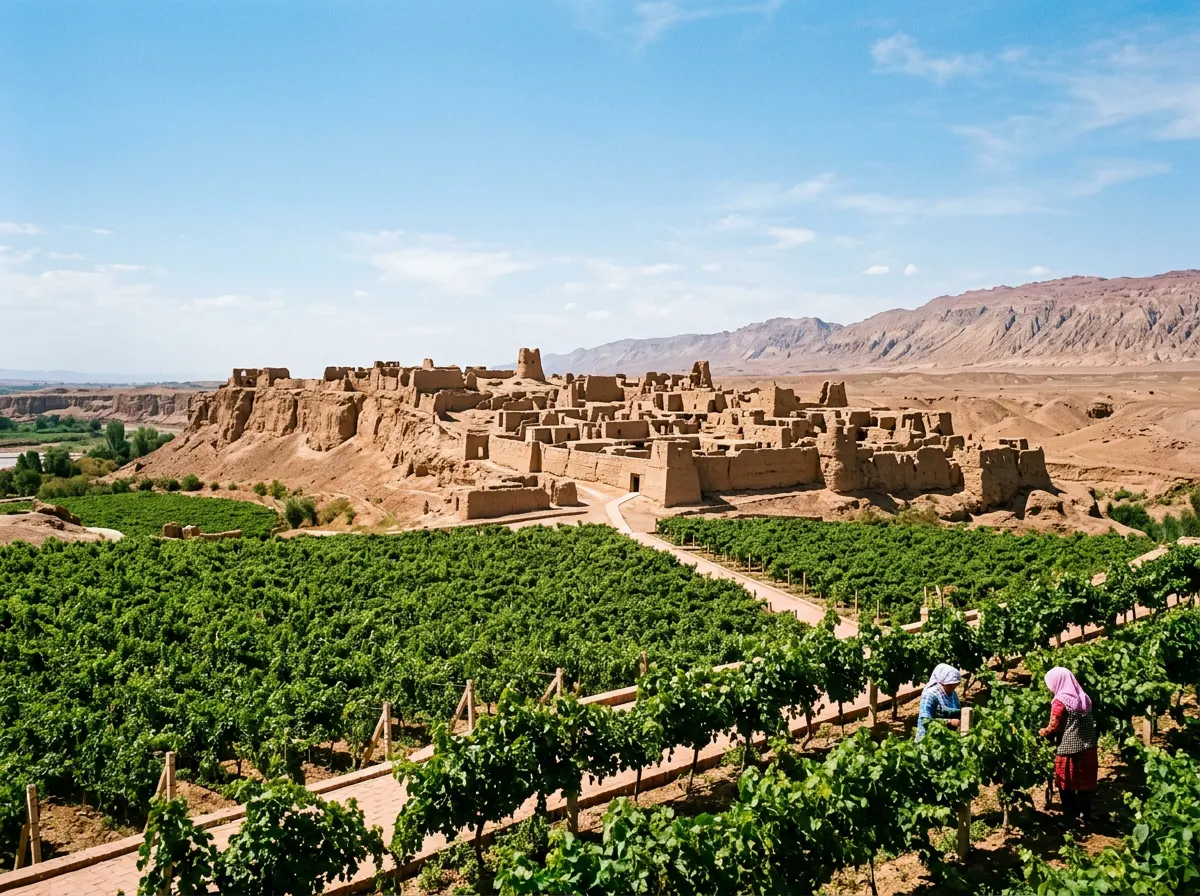
Turpan
Turpan (吐鲁番, Tǔlǔfān) sits in the Turpan Depression, at 154 meters below sea level — the second-lowest point on Earth after the Dead Sea and the lowest point in China. It is also the hottest place in China, with summer temperatures routinely exceeding 40°C and a recorded high of 50.2°C. The heat defines everything here: the grapes that grow sweeter than anywhere else in China, the Karez (坎儿井, kǎn'érjǐng) — an ancient underground irrigation system of 5,000 km of tunnels that brings meltwater from the Tianshan Mountains into the desert — and the clay-brick architecture designed to keep interiors bearable without air conditioning. The Flaming Mountains (火焰山, Huǒyàn Shān) glow red at sunset and look convincingly like fire. Jiaohe Ancient City (交河故城, Jiāohé Gùchéng), a Silk Road garrison carved from a plateau between two rivers, has been abandoned for 700 years and is one of the best-preserved ancient cities on the Silk Road. Turpan is a compact, manageable desert oasis — two full days covers the main sites, and it connects easily to Urumqi (1 hour by high-speed rail). Budget roughly ¥100-180 per day for mid-range comfort.
Why Turpan in 2026.
China's hottest place and the second-lowest depression on Earth — an oasis city of grape trellises, ancient Silk Road ruins, and the ingenious Karez irrigation system that made life possible in the desert.
Quick Answer
Turpan (吐鲁番, Tǔlǔfān) sits in the Turpan Depression, at 154 meters below sea level — the second-lowest point on Earth after the Dead Sea and the lowest point in China. It is also the hottest place in China, with summer temperatures routinely exceeding 40°C and a recorded high of 50.2°C. The heat defines everything here: the grapes that grow sweeter than anywhere else in China, the Karez (坎儿井, kǎn'érjǐng) — an ancient underground irrigation system of 5,000 km of tunnels that brings meltwater from the Tianshan Mountains into the desert — and the clay-brick architecture designed to keep interiors bearable without air conditioning. The Flaming Mountains (火焰山, Huǒyàn Shān) glow red at sunset and look convincingly like fire. Jiaohe Ancient City (交河故城, Jiāohé Gùchéng), a Silk Road garrison carved from a plateau between two rivers, has been abandoned for 700 years and is one of the best-preserved ancient cities on the Silk Road. Turpan is a compact, manageable desert oasis — two full days covers the main sites, and it connects easily to Urumqi (1 hour by high-speed rail). Budget roughly ¥100-180 per day for mid-range comfort.
| Worth visiting | Yes — Jiaohe Ancient City and the Karez wells are unique Silk Road sites, the grape culture is wonderful, and the desert-oasis contrast is dramatic |
|---|---|
| Recommended days | 2-3 days |
| Best time to visit | April-May and September-October (avoid July-August when temperatures exceed 40°C daily) |
| Daily budget | $35 (backpacker) / $110 (mid-range) / $280+ (luxury) |
| Family friendly | Moderate — the Grape Valley and Karez Museum are good for children, but summer heat limits outdoor activity severely |
| Solo friendly | Yes — compact city, walkable sites, straightforward logistics, and the food scene works well for solo travelers |
| Airport | Turpan Jiaohe Airport (TLQ) — 10 km northwest of the city, flights from Urumqi (1h), Xi'an (3.5h), limited schedule |
| High-speed rail | Yes — Urumqi (1h, ¥50-80 second class) via the Lanzhou-Urumqi HSR line. Also connects to Hami (1.5h) and Lanzhou (8h) |
| Language | Uyghur and Mandarin; English is very rare outside hotels |
| Currency | CNY (¥) — Alipay and WeChat Pay are widely accepted in the city; cash useful for grape farms and rural vendors |
| Time zone | Theoretically China Standard Time (UTC+8); locals unofficially use Xinjiang Time (UTC+6) — confirm tour times explicitly |
| Last updated | 2026-06-18 |
Want a Turpan plan built for you?
Jump to:
Jiaohe·Flaming Mountains·Grape Valley·Karez·History·Food·Getting There·Getting Around·Top Attractions·Where to Stay·Weather·Tips & Warnings·Itineraries·Practical Info·Emergency Contacts·Turpan Museum·Buddhism & Islam·Sugong Pagoda·Photography·Uyghur Culture·Grape Industry·Sand Therapy·Beitian Village·Jiaohe Ruins, Emin Minaret & Turpan Depression·FAQ
Why visit Turpan? Is it worth the heat?
Turpan is not a comfortable destination. In July and August, the temperature hits 40°C before 11 AM and stays there until after sunset. The Flaming Mountains can reach a surface temperature of 80°C — hot enough to cook an egg, which vendors at the scenic area will demonstrate for ¥10. The honest first thing to know about Turpan is that the heat is the experience. You come here to understand what it means to live in one of the hottest inhabited places on Earth, and to see the extraordinary human adaptations — the Karez irrigation, the grape trellises, the underground houses — that have made life possible here for 2,000 years. The reasons to endure the heat: Jiaohe Ancient City is one of the best-preserved Silk Road cities in existence, carved from a cliff-bound plateau and abandoned since the 13th century. The contrast between the lush Grape Valley — green, shaded, dripping with fruit — and the stark desert around it feels like a magic trick. The Flaming Mountains at sunset are genuinely spectacular — a 100-kilometer wall of red sandstone that glows like embers. The Uyghur food here is distinct from the Kashgar version — Turpan grapes are famous across China, the raisins are the best you will ever eat, and the lamb dishes incorporate the local fruit in ways that are unique to this oasis. Turpan is not a stand-alone destination. It works best as a 2-day stop on a Xinjiang or Silk Road itinerary — easy to reach from Urumqi (1 hour by HSR), easy to explore on your own, and a complete contrast to the alpine scenery of the Tianshan or the desert vastness of the Taklamakan further south. If you are already going to Xinjiang, Turpan is the easiest addition you can make, and Jiaohe alone justifies the detour.
What is the history of Turpan: Silk Road oasis and the Karez miracle?
Turpan has been an oasis settlement for over 3,000 years. It sits in the Turpan Depression, a geological trough 154 meters below sea level, surrounded by the Flaming Mountains to the north and the Taklamakan Desert to the south. Without water, it would be uninhabitable. The water comes from the Tianshan Mountains, 100 km to the north, where snowmelt and glacial runoff seep into the ground and flow through aquifers toward the depression. The Karez (坎儿井, kǎn'érjǐng) system is how Turpan's ancient inhabitants solved the water problem. It is a network of underground canals, vertical access wells, and surface channels — essentially a gravity-fed subterranean aqueduct — that carries water from the mountain aquifers to the oasis without evaporation loss in the desert heat. The total length of Turpan's Karez tunnels is estimated at 5,000 km. The system was developed around 2,000 years ago, possibly based on Persian qanat technology brought by Silk Road travelers, and is still partially functional today. It is a UNESCO-recognized engineering heritage site. Turpan was a major stop on the northern Silk Road route. Caravans crossing the Gobi Desert from Dunhuang would rest and resupply here before the final push across the Tianshan to Urumqi and beyond. The city was a Buddhist center — the Bezeklik Caves were painted over centuries by generations of monks — and later an Islamic one after the 14th-century conversion of the region. The city's strategic position made it a prize contested by Chinese, Turkic, Mongol, and Tibetan powers for centuries. The modern city is a prefecture-level city of about 600,000 people, predominantly Uyghur with a significant Han minority. The economy revolves around grapes (Turpan produces about 75% of China's seedless white grapes), tourism, and its position on the Lanzhou-Urumqi transport corridor. The HSR line, opened in 2014, has transformed access — what was once a punishing 3-hour bus ride from Urumqi is now a 1-hour train journey.
What to eat in Turpan: grapes, lamb, and oasis cuisine?
Turpan food is Uyghur oasis cuisine — similar to Kashgar in its Central Asian core (lamb, naan, polo, laghman) but with a strong emphasis on fruit, especially grapes and raisins. The food reflects the oasis ecology: grapes provide sugar and acidity, lamb provides protein and fat, and the tandoor oven is the universal cooking tool. The essential foods: Turpan grapes (吐鲁番葡萄, Tǔlǔfān pútáo). Turpan produces over 100 grape varieties, with the seedless white grape (无核白, wúhé bái) being the most famous. These are small, green-gold, intensely sweet grapes dried into raisins or eaten fresh. The Grape Valley is the place to try them — from August to October, you can eat grapes straight from the trellises. Fresh grapes cost ¥10-20 per kilogram in season; the best raisins (green, golden, and red varieties) are ¥30-60 per kilogram at the farmers' market. Grapevine-roasted lamb (葡萄架烤羊肉, pútáo jià kǎo yángròu). Lamb roasted over grapevine wood, which gives the meat a subtle fruity smokiness distinct from the charcoal-grilled version. Available at Uyghur restaurants in the Grape Valley and the city. ¥60-100 for a half-kilo portion. Turpan polo (吐鲁番抓饭, Tǔlǔfān zhuāfàn). The local version of Uyghur pilaf often includes raisins and sometimes chunks of fresh grapes, adding a sweet counterpoint to the savory lamb and cumin. ¥20-35 per plate. The raisins absorb the lamb fat during cooking and become plump little flavor bombs. Samsa (烤包子, kǎo bāozi). Flaky tandoor-baked lamb pastries — the same as in Kashgar, but Turpan versions tend to be larger and more generously filled. ¥3-5 each. The tandoor bakeries near the city center produce them in continuous batches. Cold noodles (凉面, liángmiàn). A genuinely useful summer dish — chilled wheat noodles with vinegar, chili, garlic, and shredded cucumber, sometimes topped with shredded lamb. ¥10-15 per bowl. It is one of the few things you will want to eat when the temperature is 42°C. Melon (哈密瓜, hāmì guā). Despite the Chinese name (Hami melon), the best melons in Xinjiang arguably come from the Turpan area, not Hami. The Turpan depression's heat and long growing season produce melons with extraordinary sugar concentration. A whole melon costs ¥10-25 in season (July-September). Grape wine (葡萄酒, pútáo jiǔ). Turpan has a small but growing wine industry. Local reds and whites are available at restaurants and some shops — the quality is variable but the experience of drinking Turpan wine in the Grape Valley is worth the risk of a mediocre bottle. For vegetarians: the same challenges as elsewhere in Xinjiang — lamb is everywhere. The Grape Valley restaurants are the best bet for vegetable-heavy meals. Fresh grapes, melons, naan, and yogurt are naturally vegetarian. A printed vegetarian card in Chinese and Uyghur is essential.
How to get to Turpan: high-speed rail, flights, and road connections?
Turpan North Railway Station (吐鲁番北站) is the high-speed rail station, about 15 km northwest of the city center. It is on the Lanzhou-Urumqi HSR line, making Turpan easily accessible. From Urumqi: 1 hour, ¥50-80 second class, trains roughly every 30-60 minutes throughout the day. From Hami: 1.5 hours, ¥90-120. From Lanzhou: 8 hours, ¥450-550. The HSR station is connected to the city by bus (¥5, 40 min) and taxi (¥30-40, 25 min). Turpan Jiaohe Airport (TLQ) has limited flights — primarily from Urumqi (1 hour, ¥300-500), Xi'an (3.5 hours, ¥600-1,000), and seasonal charters. For most travelers, the HSR from Urumqi is more practical than flying. From Urumqi, you can also drive — the expressway takes 2.5-3 hours and passes through the Tianshan foothills with wind-farm landscapes that are compellingly strange. Hire a car with driver for ¥500-700. The conventional Turpan Railway Station (吐鲁番站) in the city center handles slower K/T trains and is more convenient for the city but much slower. The HSR station (Turpan North) is the one you want. Turpan is a very easy day trip from Urumqi if you only want to see Jiaohe and the Flaming Mountains. Take the 08:00 HSR from Urumqi, arrive by 09:00, see Jiaohe and the Karez Museum before lunch, hit the Flaming Mountains and Bezeklik in the afternoon, take the 18:00 or 19:00 train back. But an overnight lets you see the Flaming Mountains at sunset (the whole point), eat dinner in the Grape Valley, and avoid rushing — I strongly recommend at least one night.
How to get around Turpan: taxis, buses, and site access?
Turpan's city center is compact and walkable — the market, the Karez Museum, the main restaurants, and the Emin Minaret are all within 30 minutes on foot. For the outer sites (Jiaohe, Flaming Mountains, Bezeklik, Gaochang, Aydingkol Lake, Grape Valley), you need wheels. Taxis are the easiest option. Flagfall is ¥5 for the first 3 km, then ¥1.5 per km. A taxi to Jiaohe (10 km west) costs ¥20-25. To the Flaming Mountains (30 km east) costs ¥50-70 one way. Most drivers are willing to wait or arrange a return pickup. Always negotiate the round-trip or waiting fee before setting off. The language barrier is high — have site names written in Chinese and agree on the price with fingers or a calculator app. For a full-day site circuit, hiring a taxi for the day costs ¥300-400. The driver will take you to Jiaohe, the Karez Museum, the Flaming Mountains, Bezeklik, and back — a 6-7 hour loop. You can arrange this through your hotel front desk. The driver speaks Uyghur or Mandarin; do not expect English. Public buses connect the city center to Jiaohe (bus 101 or 202, ¥2, about 30 min) and to the Grape Valley (bus 5, ¥2). Routes and announcements are Chinese-only. They work but require patience and a translation app. Bicycle rental exists at some guesthouses — Turpan is flat and the roads between sites are paved, making cycling viable in the cooler months. In summer (June-September), cycling is NOT recommended — the heat makes it dangerous. DiDi operates in Turpan but with limited supply. You may wait 10-20 minutes for a car. Metered taxis are more reliable.
What are the top attractions in Turpan, ranked and described?
1. Jiaohe Ancient City (交河故城). ¥70. The number one reason to come to Turpan. Jiaohe is a Silk Road city carved from a loess plateau between two dry riverbeds (hence the name: 交河, "river junction"). The city was built by digging down into the plateau — streets were excavated, buildings were carved from the earth, and the result is a city-shaped depression in the landscape rather than structures rising from it. It was inhabited from the 2nd century BCE until Genghis Khan's forces destroyed it in the 13th century. What survives is extraordinary: the main street, the central Buddhist temple, the government quarter, residential districts, and the city walls — all carved from the same yellow earth. The site is exposed and punishingly hot in summer. Arrive at 08:00 (opening time) or after 17:00. Allow 2 hours. Bring water and a hat. 2. Flaming Mountains (火焰山). ¥40 for the ticketed scenic area; the best view is free from the roadside. This 100-km range of eroded red sandstone glows crimson and orange in late-afternoon light — the effect is genuinely dramatic, not an exaggeration. The scenic area has a giant thermometer (a tourist photo prop showing the current surface temperature) and Journey to the West statues. You do not need to enter. The best photography is from the highway pullouts around sunset when the mountains catch the low light. Combine with Bezeklik (which is in a side canyon of the Flaming Mountains) for a morning or afternoon loop. 3. Grape Valley (葡萄沟). ¥75. An 8-km valley of grape trellises, orchards, and Uyghur villages east of the city. The contrast between the green shade of the valley and the stark desert rim is the reason this is worth doing — it demonstrates what the Karez irrigation makes possible. Inside, there are Uyghur restaurants, dance performances (touristy but fun), and endless opportunities to eat fresh grapes. The valley is split into several scenic zones connected by shuttle bus. Best in August-September when grapes are at peak ripeness. If you visit outside the grape season (November-June), the trellises are bare and the experience is diminished — lower your expectations accordingly. 4. Karez Wells Museum (坎儿井博物馆). ¥40. A well-designed museum built around an active section of the Karez irrigation system. You walk through restored underground canal sections, see the vertical access wells from above and below, and learn the engineering that sustained Turpan for two millennia. The exhibits explain the digging techniques, the water distribution system, and the social organization that maintained the canals. It is not a flashy attraction but it is genuinely educational and gives you an appreciation for every grape you eat afterward. Allow 1 hour. 5. Bezeklik Thousand Buddha Caves (柏孜克里克千佛洞). ¥40. A complex of Buddhist cave temples carved into a Flaming Mountains cliff, 45 km east of Turpan. The caves were painted between the 5th and 14th centuries — Buddhas, bodhisattvas, Uyghur donors in elaborate robes, scenes from the Buddha's life — but most of the best murals were cut out and removed by German (von Le Coq) and Japanese (Otani) expeditions in the early 20th century. The fragments are in museums in Berlin and Tokyo. What remains — faded but still legible — is atmospheric, and the cave setting in the red canyon is spectacular. Combine with the Flaming Mountains for a half-day loop east of the city. Allow 1 hour. 6. Emin Minaret (苏公塔). ¥30. A 44-meter brick minaret from 1777, elegant in its simplicity — a tapering cylinder of baked brick with 15 different geometric patterns, no tiles, no color, just extraordinary brickwork. The attached mosque is active and the courtyard is peaceful. It is 3 km east of the center — a 10-minute taxi ride or a 40-minute walk. Photograph in morning light when the brick patterns cast sharp shadows. Allow 30-45 minutes. 7. Gaochang Ruins (高昌故城). ¥70. A second Silk Road ruined city, larger than Jiaohe (200 hectares) but less well-preserved and built in a more conventional style (above-ground, not carved). It was a major Buddhist center — Xuanzang lectured here in 630 CE. The ruins include a palace, temples, and a monastery complex. The scale is impressive but the preservation is not as striking as Jiaohe. Visit only if you have a third day in Turpan or a strong interest in Silk Road archaeology. About 40 km southeast of the city. 8. Aydingkol Lake (艾丁湖). ¥30. China's lowest point at 154 meters below sea level. It is more of a salt pan than a lake for most of the year — in summer, the water recedes leaving a crust of white salt crystals. The landscape is stark, hot, and alien. A monument marks the low point. It is a geographical box to check, not a scenic destination. Worth it if you collect superlatives; skippable otherwise. About 50 km south of the city.
Where to stay in Turpan: neighborhoods, prices, and recommendations?
Turpan's city center around Qingnian Road (青年路) and the area near the Turpan Museum is the most convenient base. Hotels here are walking distance from restaurants, the market, and the Karez Museum. Mid-range options: Turpan Huozhou Hotel (吐鲁番火洲大酒店, ¥200-350), Jinjiang Inn Turpan (¥180-280). There is a Turpan Youth Hostel with dorm beds at ¥50-70 and a courtyard garden that is a lifesaver in summer. Near the Grape Valley (葡萄沟) there are several guesthouses and Uyghur family-run stays inside the valley itself. These are more atmospheric — grape trellis courtyards, home-cooked Uyghur dinners, the sound of irrigation channels — but they are further from the city center. Prices run ¥150-300 per night. The vineyard guesthouses are genuinely lovely in the evening when the heat breaks and the valley cools down. Book ahead in September (grape harvest season). The area around Turpan North Railway Station (吐鲁番北站) has a few budget chain hotels (¥120-200) that are convenient only for late-night arrivals or early HSR departures. The station is 15 km from the city center and there is nothing of interest nearby. A practical consideration: air conditioning quality varies significantly. The international-brand hotels and newer mid-range chains have reliable AC. Budget guesthouses, especially traditional courtyard houses, may rely on fans or have weak AC units. In July and August, a hotel with strong air conditioning is worth paying extra for. Check recent reviews specifically for AC performance. Foreigner registration: as everywhere in Xinjiang, hotels must register foreign guests with the Public Security Bureau. Small guesthouses may refuse foreign guests. Book through Trip.com with the foreign-guest filter or call ahead.
What is the weather in Turpan and when should I visit?
Turpan has an extreme continental desert climate. Summer is brutally hot — it is the hottest place in China and one of the hottest inhabited places on Earth. Winter is cold but dry. January: -10°C to -2°C. Cold, dry, grey. Minimal tourism. The Grape Valley trellises are bare. February: -5°C to 7°C. Still cold but warming. Spring Festival may bring domestic visitors. March: 2°C to 17°C. Warming up. The grapes begin to bud. Dust storms possible. April: 10°C to 26°C. Pleasant — warm days, cool nights. The comfortable window opens. Grapes leaf out. May: 16°C to 33°C. The last comfortable month before summer. Hot afternoons but bearable. Grape flowers bloom. June: 22°C to 38°C. Getting seriously hot. Manageable if you sightsee early morning and late afternoon only. July: 26°C to 42°C. Brutal. The average daily high is 40°C+. Surface temperatures on the Flaming Mountains can hit 80°C. Do not schedule outdoor activities between 11:00 and 17:00. On the plus side: grapes are ripening and the melons are at peak. August: 25°C to 41°C. Marginally less brutal than July. Peak grape harvest — the Grape Valley is at its best. Still dangerously hot for outdoor sightseeing midday. September: 17°C to 33°C. Excellent. Cooling down, grape harvest continues, the valley is green and productive. The best month to visit alongside May. October: 7°C to 22°C. Good — crisp mornings, warm afternoons, autumn colors in the valley. The second-best month. November: -2°C to 9°C. Getting cold. The grape leaves fall. Tourism quiets down. December: -8°C to -1°C. Cold, quiet, low season. Hotels are cheapest. The consensus best months are May, September, and October. April is good. June is marginal. July and August are for heat-tolerant travelers only — you can visit, but you must plan around the heat aggressively. November through March is the low season with the lowest prices and fewest tourists but bare grape trellises and cold temperatures.
What are the top tips, warnings, and things to know about Turpan?
1. THE HEAT IS NOT A JOKE. Turpan in July and August routinely exceeds 40°C. The Flaming Mountains scenic area posts surface temperatures of 70-80°C in summer. Heat stroke is a real risk. Plan outdoor sightseeing from 07:00-11:00 and 17:00-20:00. Spend the midday hours in the Karez Museum (underground and cool), your air-conditioned hotel, or a shaded Grape Valley restaurant. Carry at least 2 liters of water per person. Wear a wide-brimmed hat, sunglasses, and sunscreen. Electrolyte packets are worth bringing. 2. THE BEST VIEW OF THE FLAMING MOUNTAINS IS NOT AT THE SCENIC AREA. The ticketed scenic area (¥40) has a giant thermometer, Journey to the West statues, and an egg-cooking demonstration. It is not where you get the best view. The best view is from the highway pullouts between Turpan and Bezeklik, especially around sunset (20:00-21:00 in summer) when the mountains glow red and orange. Your taxi driver will know the spots — ask to stop at the roadside viewpoints rather than the ticketed gate. 3. JIAOHE IS EXPOSED — THERE IS NO SHADE. The ancient city has zero trees, zero shade structures, and the loess reflects heat. In summer, visit at 08:00 (opening time) or after 17:00. Bring an umbrella for portable shade — it looks ridiculous but you will be grateful. The site is 2 km from the entrance gate to the far end and back — on foot, in direct sun, on uneven terrain. Comfortable walking shoes are mandatory. 4. THE GRAPE VALLEY IS SEASONAL. From July to October, the valley is green, shaded, and dripping with fruit — it is worth the ¥75. From November to June, the trellises are bare sticks and the experience is significantly diminished. If you visit outside grape season, skip the ticketed Grape Valley scenic area and instead visit the free grape-drying houses (晾房, liàngfáng) — the distinctive honeycomb-brick buildings dotting the countryside where grapes are dried into raisins. 5. THE TIME ZONE CONFUSION APPLIES HERE TOO. Turpan is in Xinjiang, so locals unofficially use Xinjiang Time (UTC+6). Double-check tour pickup times, taxi arrangements, and restaurant hours — "Beijing Time or Xinjiang Time?" is a necessary question. 6. CASH FOR GRAPE FARMS AND SMALL VENDORS. Alipay and WeChat Pay work at tourist sites, larger restaurants, and hotels. Small grape farms, roadside fruit stalls, and rural food vendors may be cash-only. Carry ¥200-300 in small bills. 7. DO NOT DRINK THE TAP WATER. It is not potable. The Karez water in the irrigation channels looks clear but is untreated. Bottled water is ¥2-3 everywhere. Hotels provide kettles. 8. GAOCHANG VS. JIAOHE — PICK ONE. If you have limited time, choose Jiaohe. It is closer to the city, better preserved, more architecturally distinctive (carved from the earth), and a more efficient use of your time. Gaochang is larger but less well-preserved and further away. Only visit both if you are a dedicated Silk Road enthusiast with three days in Turpan. 9. THE RAISINS ARE THE BEST SOUVENIR. Turpan seedless green raisins, golden raisins, and red raisins are genuinely world-class — fat, sweet, and nothing like supermarket raisins. Buy them at the Turpan Farmers' Market (吐鲁番农贸市场) for ¥30-60 per kilogram. The vacuum-sealed packs travel well. Do not buy raisins at the scenic-area gift shops — they are marked up 2-3x. 10. MOST TOUR GROUPS DO TURPAN AS A URUMPI DAY TRIP. They arrive at 10:00, hit Jiaohe at the hottest part of the day, eat a rushed lunch, see the Flaming Mountains at noon (when they look least impressive), and leave by 16:00. You can do better by staying overnight and timing your visits to the cool hours. The Flaming Mountains at sunset alone justifies spending the night.
What are good 1-day, 2-day, and 3-day itineraries for Turpan?
1-day sprint (from Urumqi): Take the 08:00 HSR from Urumqi, arrive Turpan North by 09:00. Taxi to Jiaohe Ancient City (arrive 09:30, spend 2 hours). Midday: Karez Wells Museum (underground, cool — the right activity for the hot hours). Lunch at a city-center Uyghur restaurant (polo, kebabs). Afternoon: drive east to the Flaming Mountains scenic pullouts (not the ticketed area) for photos, then Bezeklik Caves (1 hour). Optional: quick stop at Grape Valley for fresh grapes if in season. Return to Turpan North for the 18:00 or 19:00 train back to Urumqi. This is a packed day but covers the essential sites. Total cost roughly ¥250-350 including transport and tickets. 2-day plan (recommended): Day 1 as above but slower — add the Emin Minaret and the farmers' market, and stay for the Flaming Mountains at sunset (the whole point). Overnight in Turpan city center. Evening dinner in the Grape Valley at a vineyard restaurant. Day 2 — Morning visit to Gaochang Ruins (if you want a second ancient city) or a relaxed Grape Valley exploration (if in season). Alternatively: a trip to Aydingkol Lake for the geographical low-point photo. Afternoon: Turpan Museum (free, 1 hour, good Silk Road exhibits). Late afternoon HSR back to Urumqi or onward to your next destination. 3-day plan (Silk Road deep dive): Day 1 — Jiaohe (early morning), Karez Museum (midday), Emin Minaret, Flaming Mountains at sunset, dinner in Grape Valley. Day 2 — Gaochang Ruins (morning), Bezeklik Caves (midday — the canyon setting is cooler than the open desert), afternoon visit to the Astana-Karakhoja Tombs (阿斯塔那古墓群, a Tang-dynasty cemetery with mummies and silk artifacts, ¥30, 30 min east of Gaochang). Day 3 — Aydingkol Lake morning, Turpan Museum, farmers' market for raisin shopping, afternoon departure. This pace lets you see everything without heat exhaustion and gives you the evening atmosphere of the oasis. The three-day version is for Silk Road enthusiasts and travelers who enjoy archaeological sites — if that is not you, the two-day version is the sweet spot.
What practical information do I need: visa, money, internet, language?
Visa-free entry: As of June 2026, citizens of 45+ countries can enter China visa-free for up to 30 days. This covers Xinjiang. Confirm your specific country's eligibility with the nearest Chinese consulate. Money: CNY (¥). ¥100 ≈ US$14. Alipay and WeChat Pay are accepted at hotels, larger restaurants, and tourist sites. Link a foreign Visa/Mastercard before traveling. Carry ¥200-300 in cash for grape farms, rural food stalls, and small vendors. ATMs at Bank of China and ICBC in the city center accept foreign cards. Internet: China's Great Firewall applies. Install and test a VPN before arriving. Internet speeds in Turpan are decent in the city center (better than Kashgar), weaker at rural sites. Download offline maps and translation packs before arriving. Language: Uyghur and Mandarin are both spoken. English is very rare — even hotel front desks have limited English. A translation app (Pleco for Chinese, Baidu Translate for Uyghur) is essential. Save your hotel address and key site names in Chinese characters. The phrase "rè sǐ le" (热死了, "it's killingly hot") will be universally understood and appreciated. Health: the heat is the main health risk. Heat exhaustion symptoms — headache, nausea, dizziness, heavy sweating — require immediate shade, water, and cooling. Heat stroke (hot dry skin, confusion, loss of consciousness) is a medical emergency — call 120. Sunburn happens fast at this latitude and altitude. High-SPF sunscreen, a hat, and long sleeves are essential. Opening hours note: many Turpan sites (Jiaohe, Bezeklik, Flaming Mountains) officially open 08:00-20:00 in summer, shorter hours in winter. The Karez Museum typically opens 09:00-18:30. These are Xinjiang Time hours in practice — confirm when booking.
What are the emergency contacts and health information for Turpan?
Police: 110. Ambulance: 120. Fire: 119. Traffic accident: 122. These work from any phone. English-speaking operators are unlikely — have your hotel make the call if possible. International medical care: Turpan People's Hospital (吐鲁番市人民医院) is the main hospital and can handle most emergencies. English-speaking staff are very limited. For serious medical issues, medical evacuation to Urumqi (1 hour by HSR or 2.5 hours by road) is necessary. Comprehensive travel insurance covering medical evacuation is essential. Heat-related illness: this is the most common health issue in Turpan. Heat exhaustion (headache, nausea, dizziness, heavy sweating) — move to shade or air conditioning, drink water, cool the body with wet cloths. Heat stroke (hot dry skin, confusion, possible loss of consciousness) — call 120 immediately, move the person to shade, cool aggressively with water and fanning while waiting for the ambulance. Tap water is not potable. Bottled water is widely available (¥2-3). Carry at least 2 liters per person during summer sightseeing. Air quality: better than eastern Chinese cities but spring dust storms (March-May) can push the AQI high. An N95 mask is useful in spring. Altitude: Turpan is below sea level — there are no altitude concerns here, which is a welcome relief after the higher elevations elsewhere in Xinjiang.
What should travelers know about the ancient Jiaohe ruins and the Emin Minaret before visiting Turpan?
The Jiaohe ruins and the Emin Minaret are the two monuments most travelers come to Turpan to see. Understanding the surrounding geography — the Turpan Depression, the Karez irrigation system, and the Flaming Mountains — is what makes the visit cohere into a single story. Each piece explains the others: Jiaohe exists because the Karez exists; the Karez exists because the Depression is below sea level; the Depression exists because the Tianshan snowmelt has nowhere to drain; and the Flaming Mountains exist because the same geology that sinks the basin lifts the red sandstone ridges on its rim. This section walks through the major sites in geographic and historical order, so by the end you understand why a Silk Road general chose to carve a city out of a leaf-shaped island of loess between two dry rivers, why a Uyghur ruler in 1778 built the tallest minaret in China out of bare brick, and why your grapes are sweet. Jiaohe Ancient City (交河故城, Jiāohé Gùchéng) is the headline monument of the Turpan basin, and one of the most unusual ancient cities anywhere along the Silk Road. Its name literally means "river junction" — the city sits on a 30-meter-high loess island roughly 1,650 meters long and 300 meters wide, shaped like a willow leaf, formed between two now-dry tributaries of the Yarwad (雅尔乃孜) river system. From above the city looks like a great warship: a long central spine (the main avenue) with residential and administrative blocks stepping down to the river-cliff edges on either side. The defensive position is obvious — the cliff faces drop sheer on both sides, and only the south end has a gentle approach, which is where the garrison gates and the main entrance are placed. The city was founded in the 2nd century BCE as a Han-dynasty military garrison and grew through the Tang dynasty (7th-9th centuries CE) into a major Silk Road regional capital — the seat of the Jiaohe Protectorate, the Western Yan state, and later the Uyghur Idiqut kingdom. The site was added to the UNESCO World Heritage List in 2014 as part of the "Silk Roads: the Routes Network of Chang'an-Tianshan Corridor" inscription, the first UNESCO listing that explicitly named the Turpan corridor as part of the trans-Eurasian trade system. UNESCO estimates the city was continuously inhabited for roughly 1,600 years before it was destroyed in the 13th century CE by Mongol forces under Genghis Khan's grandson Möngke, after which it was abandoned and never resettled. The dry desert climate preserved what fire and war could not — the earthen walls, sunken courtyards, and underground cellars survived for 700 years until modern excavation began in the 1960s and 1970s. The architecture of Jiaohe is unlike any other ancient Silk Road city because it is not built up from the ground — it is carved down into the plateau. Builders cut streets, courtyards, cellars, and house walls directly into the compacted loess, so a "building" at Jiaohe is really a series of negative spaces: rooms defined by the loess walls left standing after the surrounding earth was dug away. The most common dwelling form is the yaodong (窑洞, yáodòng), the cave-house found across the loess plateau of northern China — here adapted to a defensive island setting. A typical residence has a sunken central courtyard 4-5 meters below ground level, with rooms opening off it on three or four sides; stairs lead up to the roof, which served as a flat working surface. The yaodong construction gives Jiaohe extraordinary thermal mass: even in 42°C summer air temperatures, the interior of a yaodong cell can be 8-10°C cooler, and in winter the same walls retain enough heat from the day to keep the cell above freezing overnight. This is the same passive-cooling principle the Turpan basin still uses in its courtyard houses today. The major monuments at Jiaohe include: the main north-south avenue, 340 meters long and 8-10 meters wide, paved with packed earth and lined with what were once workshops and warehouses; the central Buddhist monastery at the highest point of the plateau, with a stupa base 7 meters across and the foundation outlines of the main hall; the government quarter to the east, with the largest single structure on the site — a 30-by-15-meter assembly hall; the military quarter to the west, with parade ground and barracks blocks; a residential district of perhaps 50 surviving yaodong courtyards in the southern third of the site; the underground cemetery area to the northwest, with documented child burials; and at the north end, the high official's residence, sometimes called the "governor's palace," though the term is a translation convenience for a complex of large courtyards and audience halls. There is also a child burial site (婴儿墓, yīng'ér mù) excavated in the 1990s, where the remains of more than 200 infants and young children were found in buried jars — interpreted as evidence of either a high local infant-mortality rate, an epidemic event, or a dedicated burial ground for the children of the garrison community. The jars themselves are on display in the Jiaohe site museum at the visitor center. Visiting Jiaohe requires a 2 km walk from the entrance gate to the far end of the site and back, on uneven compacted earth with no shade and almost no shelter. In summer, the heat is severe — surface temperatures on the loess exceed 60°C in July. The site opens at 08:00 and the strong recommendation is to be at the gate before 08:30 so you finish before 11:00. Bring 2 liters of water per person, a wide-brim hat, sunscreen, and walking shoes with grip. A folding umbrella for portable shade looks eccentric but is genuinely useful. The on-site museum, which is air-conditioned and well-curated, sits near the entrance and is worth 30-45 minutes before or after the walk. The Emin Minaret (苏公塔, Sūgōng Tǎ, also written 额敏塔, Émǐn Tǎ) is the second must-see monument, located 3 km east of the Turpan city center. The minaret was built in 1777-1778 CE under the Qianlong Emperor of the Qing dynasty, commissioned by Turpan's local ruler Emin Khoja in honor of his father. The structure is 37 meters tall (some sources round to 40 or 44 m — the discrepancy comes from whether the foundation platform is counted) and the tallest minaret in China. The attached mosque is a small, single-story prayer hall; the minaret itself is the architectural statement. What makes the Emin Minaret remarkable is the brickwork. The tower is a tapering cylinder built entirely of fired brick laid in lime mortar — no tiles, no glaze, no paint, no carved stone, no metal cladding. The bricks are arranged in 15 different geometric patterns that spiral up the shaft, each pattern produced by tilting the bricks at different angles and using corbelled recesses to create stripes, diamonds, and floral motifs. The patterns are still legible after 240 years because the local clay and the dry climate produced brick that has not eroded significantly. The visual effect is closest to Central Asian and Persian Islamic brickwork — the kind found in Samarkand and Isfahan — and reflects the cultural reach of Uyghur Turpan in the 18th century as a node in the wider Islamic architectural world. The minaret's profile — a single cylinder tapering to a dome-and-crescent finial, pierced at the top by a small circular window facing Mecca — is recognizable from several kilometers away and is one of the visual landmarks of the Turpan skyline. The mosque attached to the minaret is still active for daily prayers; non-Muslim visitors are not allowed inside during prayer times but can walk the courtyard and admire the minaret. The site is well-kept, the ticket is ¥30, and the visit takes 30-45 minutes. Photographers should come in the morning when the low eastern light strikes the brick patterns and casts the geometric shadows that make the surface legible. Late afternoon light from the west flattens the patterns and is the wrong time for photography. The Uyghur phrase for the minaret, Süggong塔, reflects the popular local pronunciation; the official government name is Emin Minaret, after the patron. The Turpan Depression (吐鲁番盆地, Tǔlǔfān Péndì) is the geographic frame for all of this. The basin is roughly 200 km east-to-west and 60 km north-to-south, a structural trough where the Earth's crust has been pulled apart by the same tectonic forces that lifted the Tianshan to the north. The lowest exposed point is Ayding Lake (艾丁湖, Àidīng Hú), at 154.31 meters below sea level — the lowest point in China, the lowest point in Asia, and the second-lowest land depression on Earth after the Dead Sea shore (about 430 m below sea level). Ayding Lake is a salt lake in the south of the basin that has shrunk dramatically in recent decades — the lake bed is now a white salt crust for most of the year, with a shallow brine pool only in the deepest spot. There is a monument and viewing area at the lake, about 50 km south of the city, where you can stand at the -154 m marker. The reading is genuinely strange — your phone's barometric altimeter, if it has one, will show a negative number. The basin is one of the hottest inhabited places on Earth because of the geography: the surrounding Tianshan, Bogda, and Kuruktag ranges trap hot air, and the basin floor is so low that the air heats by compression as it descends from the rim. July daily highs average 40-42°C, the all-time record at the Turpan weather station is 50.2°C set in July 2023, and ground temperatures in direct sun exceed 70°C routinely. Crucially for visitors, the heat is dry — the basin averages 30-40% relative humidity in summer, so the heat feels like a blast-furnace dry wind rather than the wet-bulb heat of eastern China. This makes the heat more bearable than the equivalent temperature in Shanghai or Guangzhou, but it also makes dehydration fast and easy. The dry heat is also why grapes and melons here develop such high sugar concentrations — the plant roots pull water from the Karez and concentrate it into fruit, and the dry air suppresses fungal disease. The Karez (坎儿井, kǎn'érjǐng) is the engineering system that made the Depression livable. A Karez is a gently sloping underground tunnel that taps the alluvial aquifer at the foot of the Tianshan and carries the water by gravity to the oasis below, where it surfaces as a spring or feeds into open irrigation channels. The Karez is a Chinese adaptation of the Persian qanat, and the technology is widely believed to have been brought into the Turpan basin via Silk Road transmission in the Han dynasty — though some Chinese engineering historians argue for indigenous development in the 1st-2nd centuries BCE. The earliest Karez in the Turpan area date to the Western Han period (roughly 100 BCE), and the system expanded steadily over the next 1,800 years. At its peak, the Turpan Karez network totaled about 5,000 km of active tunnels, with perhaps 1,500 vertical access shafts and several thousand surface channels. The Karez solves a problem specific to the Turpan Depression: any open canal or river carrying Tianshan snowmelt to the oasis would lose most of its water to evaporation in the 40°C summer heat before it reached the fields. By running the water underground through a cool, dark tunnel, the system eliminates evaporation loss. The Karez tunnels are typically 1-1.5 m wide and 1.5-2 m tall — just large enough for a person to walk upright — and are spaced every 20-30 meters along the tunnel length, with vertical access shafts that serve both as construction ports and as ventilation chimneys. The tunnels follow the hydraulic gradient, losing about 1-2 meters of elevation per kilometer, and surface at the oasis edge where the water is distributed to the fields by open channels. The system is essentially a pre-industrial underground aqueduct, and the total volume of water moved daily at the system's peak has been estimated at enough to irrigate roughly 100,000 mu (about 6,700 hectares) of cropland. The Karez Museum (坎儿井博物馆) in Turpan city, run by the Turpan Bureau of Water Resources, has a restored 600-meter section of tunnel that visitors can walk through — a genuinely good museum that explains the engineering, the construction technique (the tunnels were hand-dug with picks and oil lamps, working from the surface shafts and using plumb bobs to keep the alignment), and the social organization that maintained the system (a Karez was typically owned by a village or a wealthy family and required constant maintenance — a single collapse or silt-up could put a whole village out of production). The museum is ¥40 and worth 1 hour. The Karez as a system is on UNESCO's Tentative List as a candidate World Heritage site. The Flaming Mountains (火焰山, Huǒyàn Shān) form the northern rim of the Turpan basin and are the most photographed landscape feature in the area. The range runs roughly east-west for about 100 km, with the highest peak at Shengjinkou (胜金口) reaching 891 m above sea level — but only 600 m or so above the basin floor, so the range looks lower than it is. The mountain is red sandstone and conglomerate, deposited in the Jurassic and Cretaceous when the basin was a shallow inland sea, then lifted and eroded into the current jagged ridge. The red color comes from iron oxide cementing the sandstone, and the apparent "flames" in late-afternoon light are simply the way the low-angle sun catches the eroded ridges. The surface temperature on the bare rock in July exceeds 70°C, hot enough to fry an egg on a flat stone — a demonstration the local vendors at the scenic area will perform for ¥10, with the egg cooked in under five minutes on a piece of tinfoil. The Flaming Mountains' cultural claim to fame is their appearance in the 16th-century novel Journey to the West (西游记, Xī Yóu Jì). In the novel, the monk Tang Sanzang and his companions must pass the Flaming Mountains on the way to India, and only the magical fan of Princess Iron Fan can extinguish the fire. The route they take is the same route the modern G30 expressway takes today. The local folklore around the novel is extensive — vendors dress as Sun Wukong, the Monkey King, and the ticketed scenic area has a 6-meter-tall thermometer showing the current surface temperature as a photo prop, plus statues of the journey's characters. The most atmospheric way to see the mountains, however, is not the ticketed area but the highway pullouts east of Turpan between the city and Bezeklik, where the roadside views of the range at sunset are unmediated by the tourist infrastructure and the ridges glow with the genuine red-orange light that gave the mountains their name. Putting it all together: the practical answer to what travelers should know before visiting is to plan the sites in a way that respects the heat and the geography. Visit Jiaohe in the morning (08:00-11:00), when the loess is not yet lethally hot. Visit the Emin Minaret mid-morning for the best light on its brickwork. Visit the Karez Museum in the midday window when you would otherwise be hiding from the sun — it is air-conditioned, underground, and educational. Drive to the Flaming Mountains roadside pullouts 90 minutes before sunset and stay through the light change. Visit the Grape Valley late in the day when the heat is breaking and the evening breeze moves through the trellises. The Karez system has been delivering cool water to the basin for 2,000 years, and a thoughtful itinerary uses the same logic — follow the water, follow the shade, and you will see everything Turpan has to show. A few more practical notes for visitors who want to understand the deeper context: the Jiaohe site museum at the visitor center deserves more time than most travelers give it. Beyond the child-burial jars, the museum holds Tang-dynasty administrative documents on wood slips, a Sogdian-language merchant's letter recovered from one of the residential cellars (a vivid reminder that Sogdian traders from modern Uzbekistan were a routine presence on the Silk Road in the 7th-8th centuries), and a small but well-chosen collection of coins, ceramics, and textiles from the Jiaohe stratigraphy. The most striking object on display is a 1,300-year-old silk painting of a phoenix recovered from a tomb near Jiaohe, one of the few surviving examples of Tang figurative silk painting in any Xinjiang collection. Allow 45 minutes to an hour for the museum if you have any interest in Silk Road material culture. The Emin Minaret's construction has a practical engineering story that is easy to miss from the outside. The tower is built around a central hollow shaft that runs from the base to a small circular window near the top, and the shaft is connected to a 72-step internal spiral staircase. The brickwork on the exterior is not decorative veneer — it is the structural wall of the tower, and the 15 geometric patterns are produced by the way the bricks are tilted and offset in the load-bearing wall. This is a structural brick tradition found across the Persian and Central Asian Islamic world, from the minarets of Jam in Afghanistan to the Kalyan minaret in Bukhara, and the Emin Minaret is the easternmost large-scale example. The fact that the patterns are still legible after 240 years is a testament to the quality of the local clay and to the precision of the brick-laying — a typical minaret of this size would have been built by a master brick-mason directing a crew of 50-100 workers over a 12-18 month construction season. The Turpan Depression has a microclimate quirk that is worth understanding before you arrive. Because the basin floor is below sea level, the air column above it is slightly compressed relative to the surrounding plateau, and this compression creates a temperature inversion on most summer evenings. Hot air rising off the basin floor hits the cooler air of the rim and is trapped, creating a lid of warm air that holds the heat in overnight. The result is that summer nights in Turpan rarely drop below 25°C, even when the daytime high was 42°C. This is different from desert climates like the Gobi, where the diurnal temperature swing can be 25-30°C. In Turpan the swing is closer to 15-18°C. The practical effect is that the city does not get a true overnight cool-down in summer — it just gets less hot. Pack for warm nights as well as hot days. The Karez system has another important feature that is not always appreciated: it is essentially a sustainable water-harvesting system by design, in an era long before the term was coined. Because the tunnels tap the alluvial aquifer (a slow-recharging underground reservoir fed by Tianshan snowmelt), the water extracted in summer is replenished over the winter and spring. The Karez does not mine a non-renewable resource; it harvests a renewable one. The system has, however, been in decline since the 1950s, when the introduction of modern pumped wells in the oasis began to lower the water table and dry up shallower Karez tunnels. Of the original 5,000 km of Karez, perhaps 1,000-1,500 km is still functional, and many of the wells have been concreted and preserved as cultural heritage rather than as working infrastructure. The Karez Museum explicitly explains this transition. The lesson for the visitor is that the Karez is not just a historical curiosity — it is a working system that has been actively retired in living memory. The Flaming Mountains' geology is also more interesting up close than the roadside impression suggests. The red sandstone is layered with thin beds of greenish-grey mudstone and occasional gypsum veins, and the erosion has produced hoodoos, slot canyons, and natural arches that are best appreciated on foot in the Bezeklik side canyons rather than from the highway. The Bezeklik Thousand Buddha Caves are carved into one such side canyon, and the 1-km walk from the parking lot to the cave entrance passes through eroded sandstone formations that are as photogenic as anything in the main scenic area. If you have the time and the heat tolerance, the short walk into the Bezeklik canyon is the most rewarding landscape experience in the Turpan area outside of Jiaohe itself. Finally, on photography: the Jiaohe site is most photogenic in the first hour after opening (the loess glows gold), the Emin Minaret in mid-morning (the brick patterns catch sharp light), the Flaming Mountains in the hour before sunset (the red rocks flame), and the Grape Valley in the last hour of daylight (the green of the trellises deepens to emerald). Plan your camera around these four windows and you will get the canonical Turpan shots without having to fight the light. The Karez Museum, being underground, is photographically uninteresting — most visitors end up with no memorable images of it, which is appropriate because the system is meant to be experienced, not seen.
Top attractions
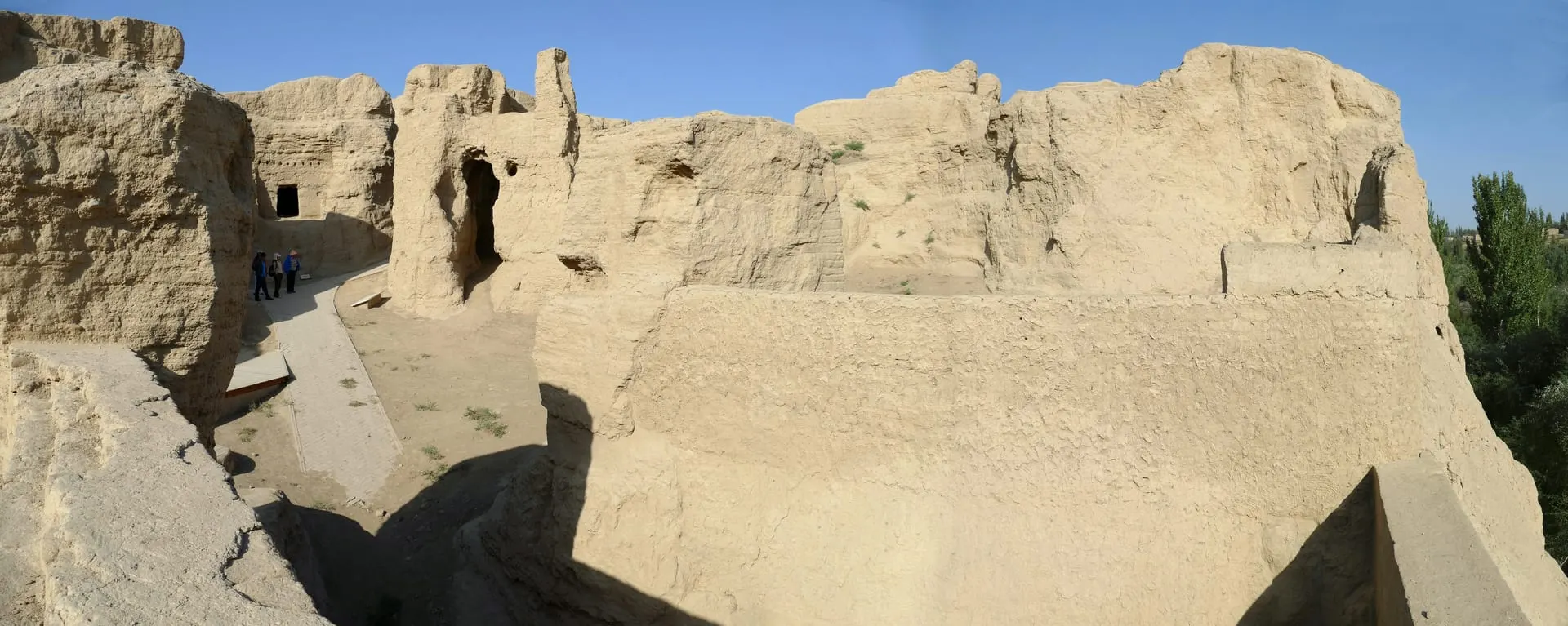
Jiaohe Ancient City (交河故城, Jiāohé Gùchéng)
A 2,300-year-old Silk Road city carved from a plateau between two rivers, abandoned after destruction by Genghis Khan's forces in the 13th century. The streets, temples, government offices, and residential quarters are remarkably intact — you walk the same lanes that Silk Road traders walked. ¥70. Best visited in early morning or late afternoon to avoid brutal midday heat. Allow 2 hours.
Wikimedia Commons · CC-BY-SA
Flaming Mountains (火焰山, Huǒyàn Shān)
A 100-km range of red sandstone hills that glow like fire in the late-afternoon sun, made famous in the classic novel Journey to the West (西游记). The surface temperature can reach 80°C in summer. ¥40. The best view is from the roadside viewpoint, not the ticketed scenic area — stop along the highway for photos. Arrive at sunset for the fire effect.
Wikimedia Commons · CC-BY-SA
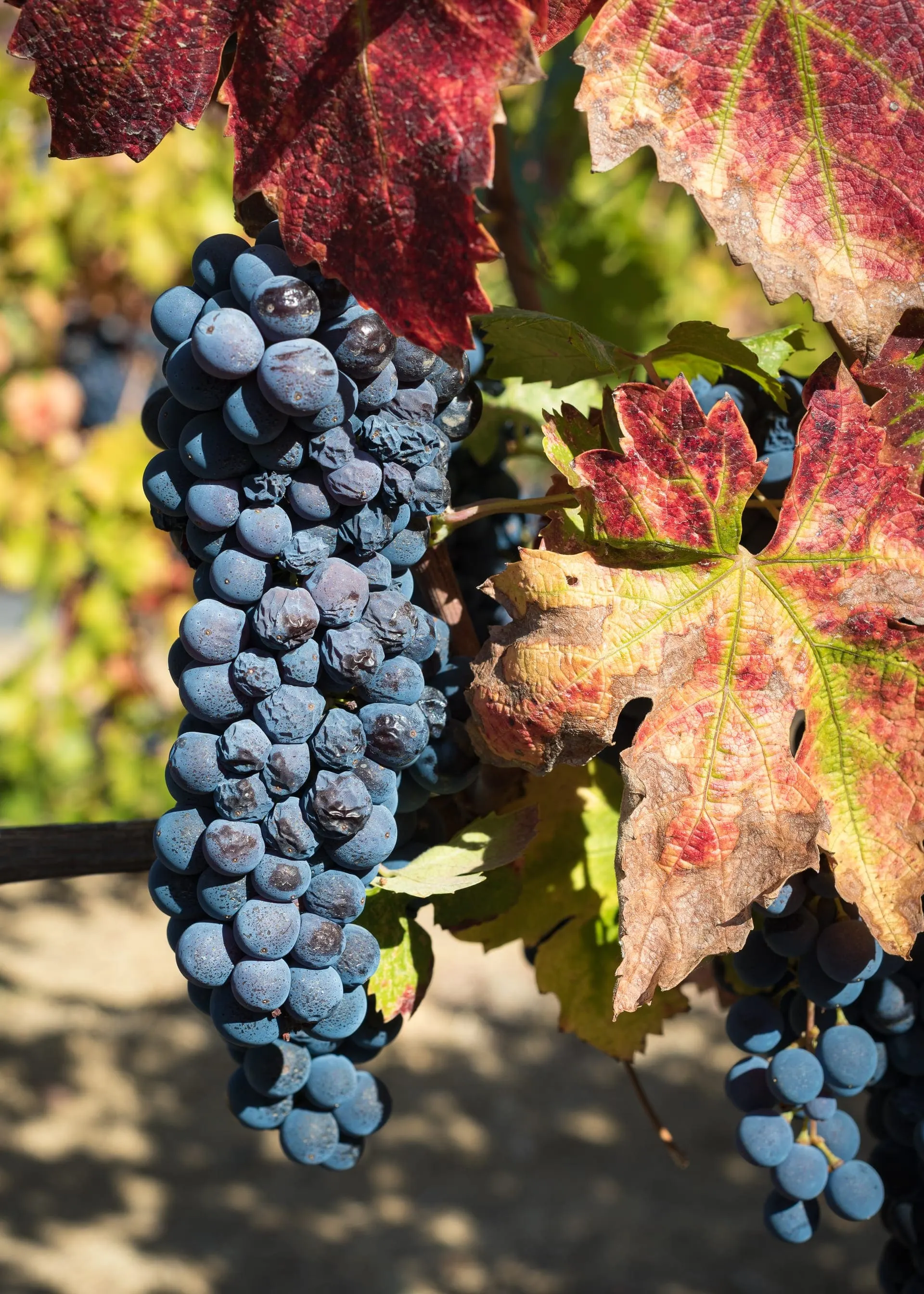
Grape Valley (葡萄沟, Pútáo Gōu)
An 8-km-long green valley of grape trellises, orchards, and Uyghur villages just east of the city. Over 100 grape varieties are grown here, and from July to October you can pick and eat grapes directly from the vines. ¥75. Tourist-oriented — restaurants and dance performances inside — but the contrast between the lush green valley and the stark desert around it is worth the price of admission. Best in August-September for peak grape season.
Wikimedia Commons · CC-BY-SA
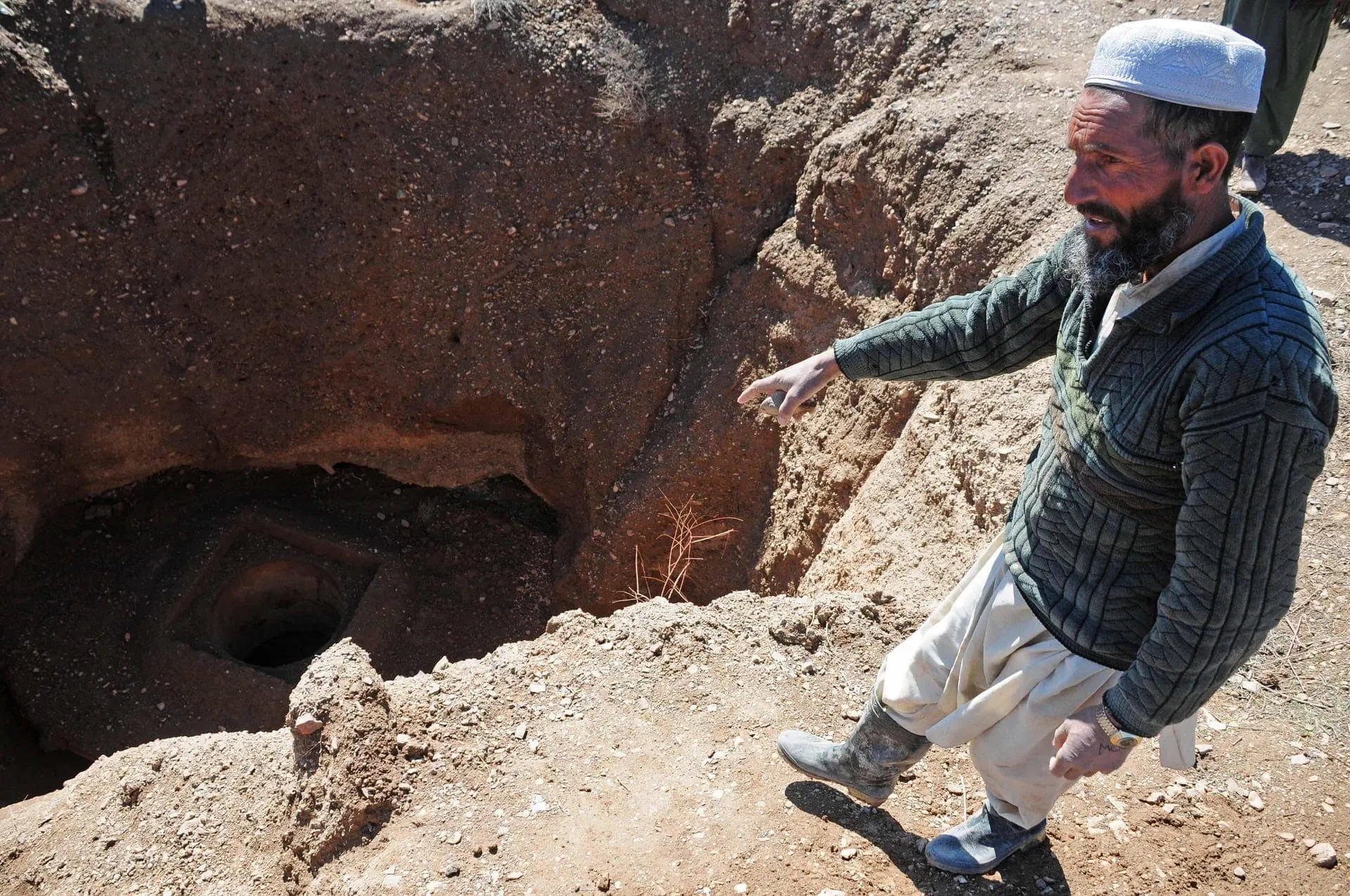
Karez Wells Museum (坎儿井博物馆, Kǎn'érjǐng Bówùguǎn)
A museum built around an active section of the Karez irrigation system — the 2,000-year-old network of underground canals, wells, and tunnels that brings Tianshan snowmelt to the Turpan oasis. You can walk through restored tunnel sections and understand the engineering that made desert agriculture possible. ¥40. Fascinating for anyone interested in pre-modern engineering. Allow 1 hour.
Wikimedia Commons · CC-BY-SA
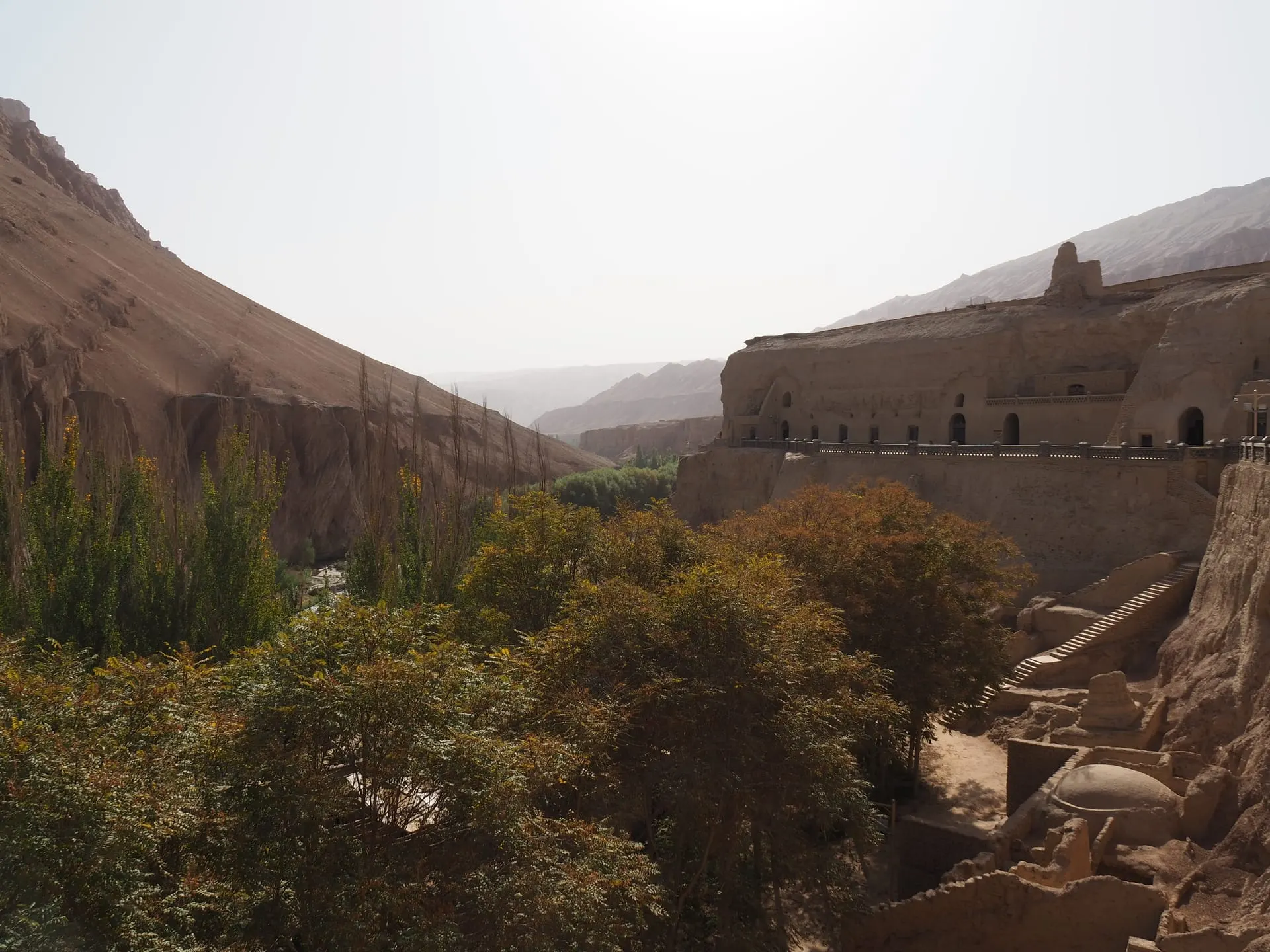
Bezeklik Thousand Buddha Caves (柏孜克里克千佛洞, Bózīkèlǐkè Qiānfó Dòng)
A complex of 57 Buddhist cave temples carved into a cliff face in the Flaming Mountains, dating from the 5th to 14th centuries. Many murals were removed by German and Japanese expeditions in the early 20th century (they are in Berlin and Tokyo now), but the remaining paintings — Buddhas, bodhisattvas, Uyghur donors — are evocative. ¥40. About 45 min east of Turpan by car. Combine with the Flaming Mountains for a half-day loop.
Wikimedia Commons · CC-BY-SA
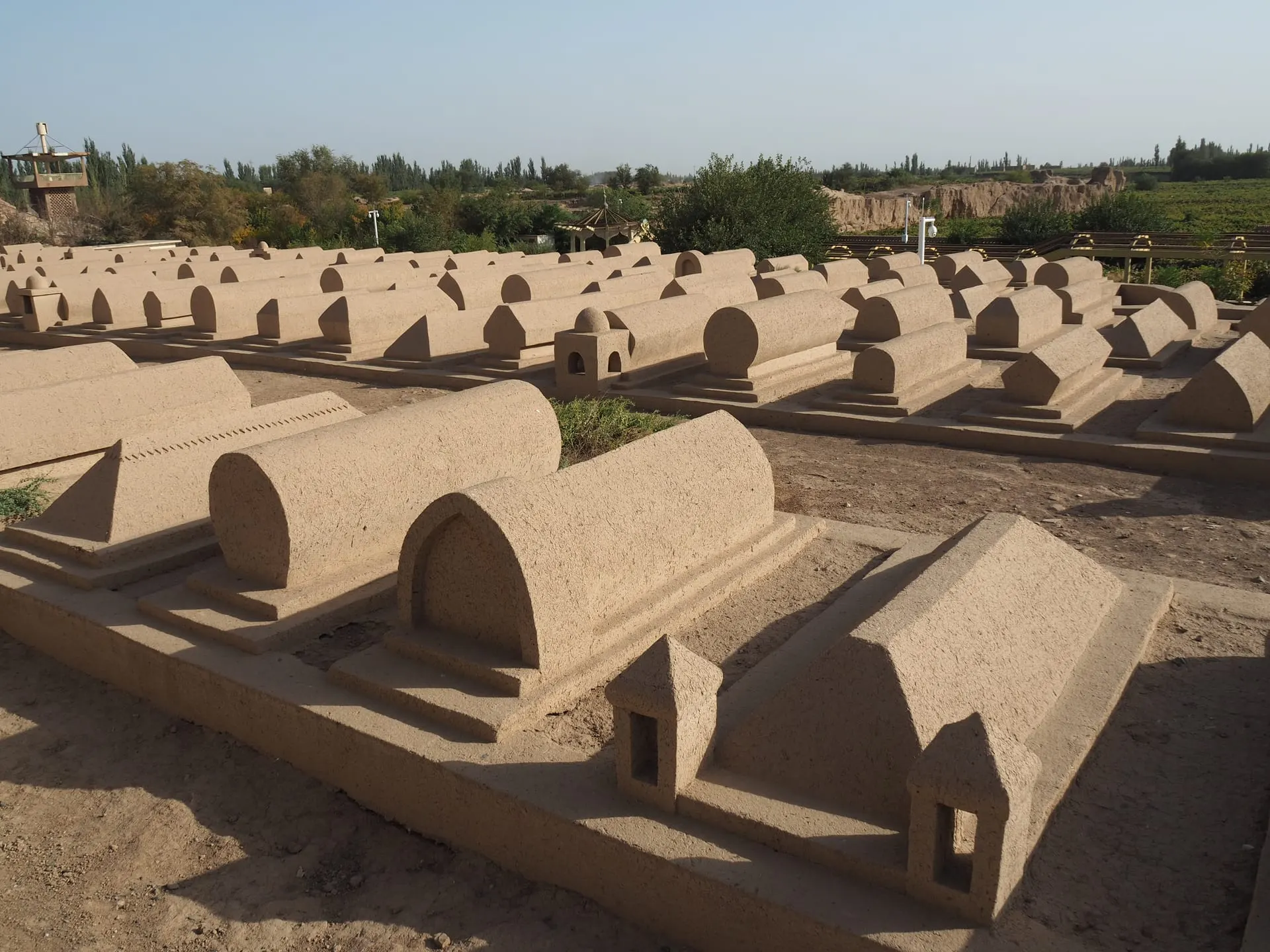
Emin Minaret (苏公塔, Sūgōng Tǎ)
A 44-meter brick minaret built in 1777, the tallest minaret in China. The tapering cylindrical tower is decorated with geometric brick patterns in 15 different designs — no tiles, just extraordinarily skilled brickwork. The attached mosque is still active. ¥30. About 3 km east of the city center. Best photographed in morning light.
Wikimedia Commons · CC-BY-SA
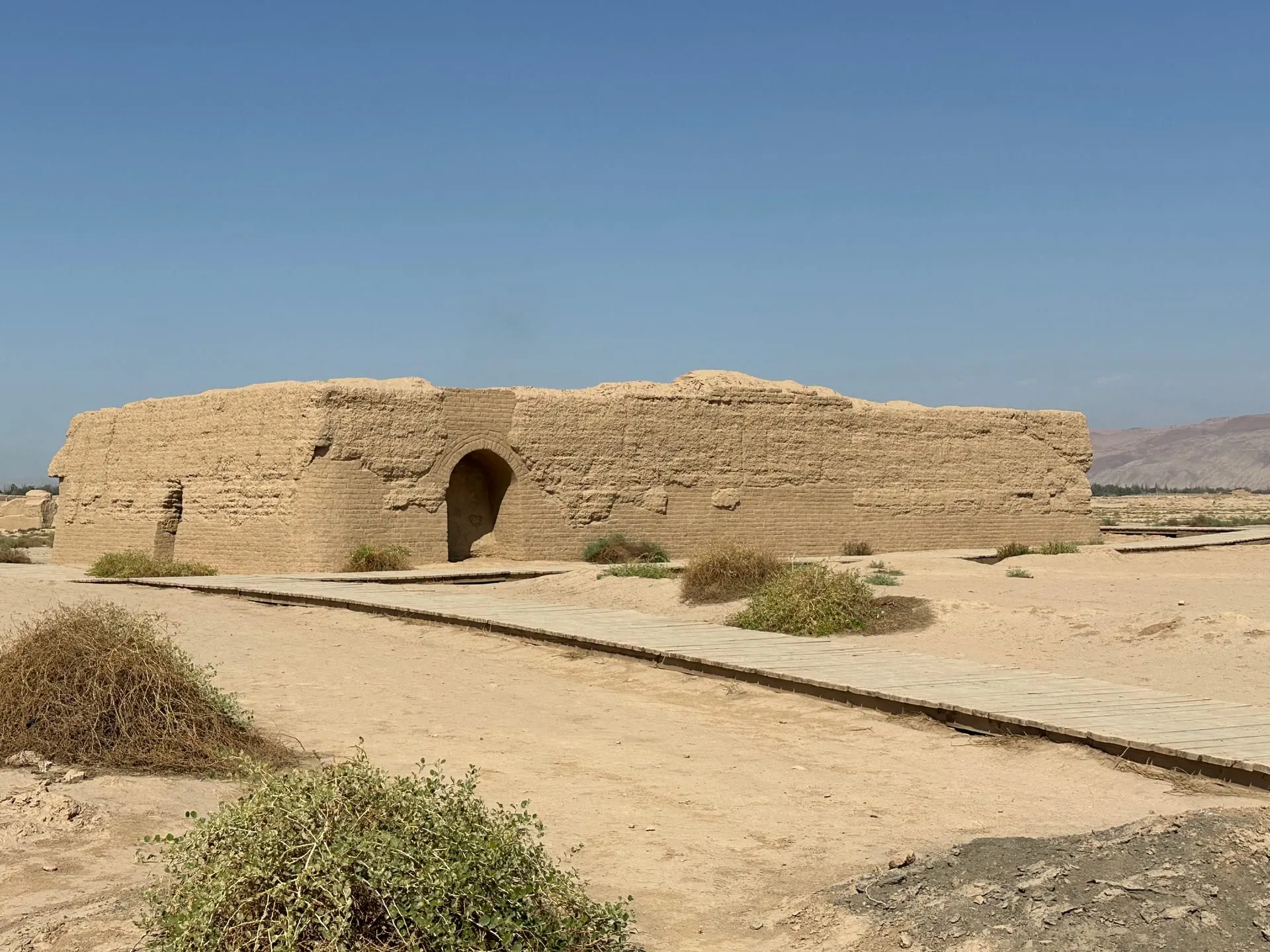
Gaochang Ruins (高昌故城, Gāochāng Gùchéng)
A second major Silk Road ruined city, larger than Jiaohe but less well-preserved. Founded in the 1st century BCE and destroyed in the 14th century, Gaochang was a major Buddhist center — the monk Xuanzang (the inspiration for Journey to the West) stayed here in 630 CE on his way to India. ¥70. About 40 km southeast of Turpan. Less visited than Jiaohe and more atmospheric for it.
Wikimedia Commons · CC-BY-SA
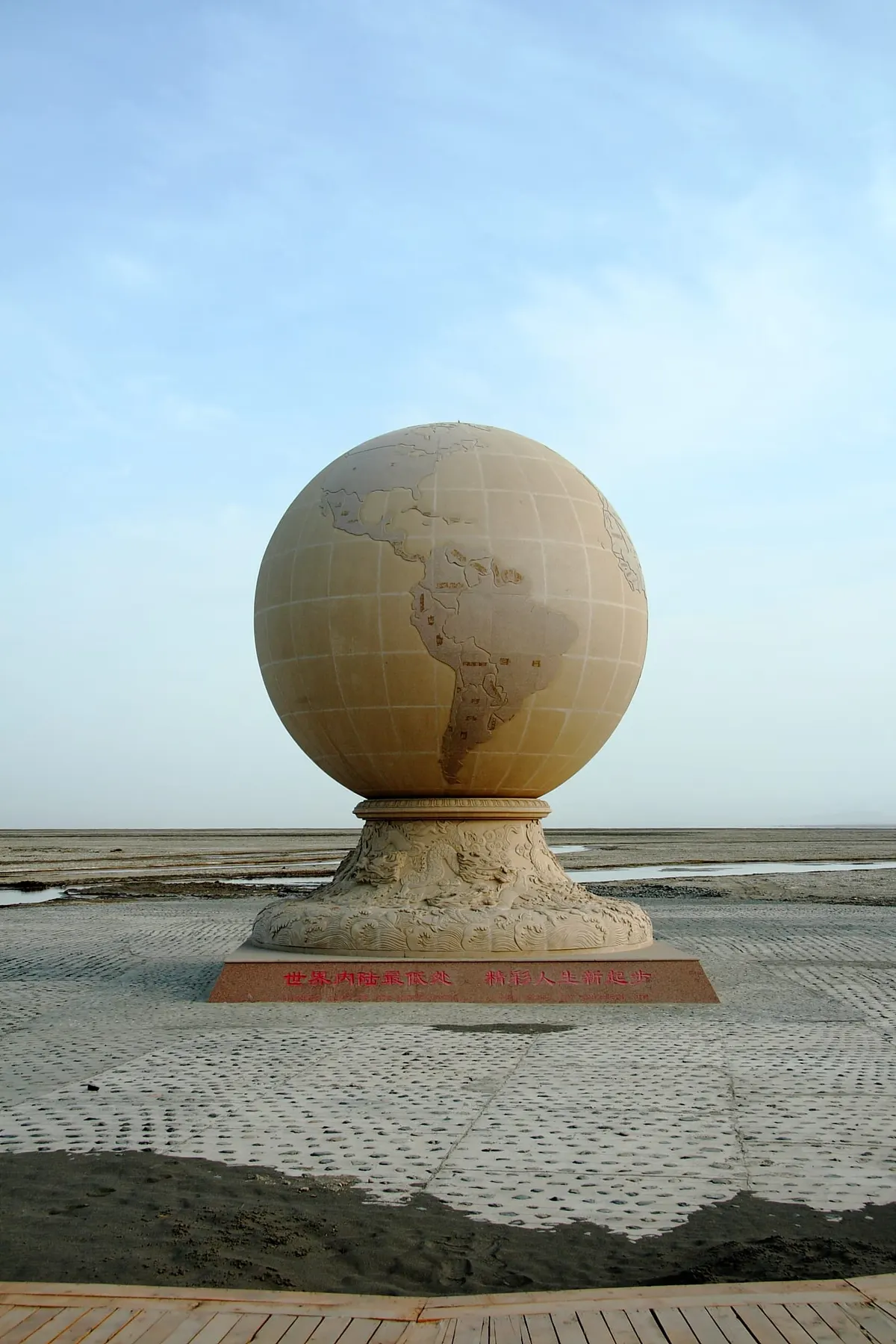
Aydingkol Lake (艾丁湖, Àidīng Hú)
The lowest point in China at 154 meters below sea level — second only to the Dead Sea globally. It is a salt lake that shrinks dramatically in summer, leaving a white salt crust. The landscape is stark and lunar. Not a scenic highlight but a geographical curiosity — you can say you have been to China's lowest point. ¥30. About 50 km south of the city.
Wikimedia Commons · CC-BY-SA
STAY
Where to stay in Turpan
Pick a base that matches the trip you want — imperial-central for sightseeing, hutong belt for character, Chaoyang for nightlife, or Qianmen for budget.
Turpan City Center
Walkable Uyghur city core with the bazaar, restaurants, and the Turpan Museum
#city-centerGrape Valley area
Vineyards, Uyghur farm guesthouses, and the shaded canyon 10km north of town
#grape-valley
ITINERARIES
Sample itineraries from Turpan
Three ready-made routes, from a 1-day imperial sprint to a 5-day deep dive. Copy the day-by-day plan and adapt to your own pace.
- 1 DAY
1-Day Turpan Sprint (from Urumqi)
The essential Turpan sites in a single long day from Urumqi via HSR. Covers Jiaohe, Karez, and the Flaming Mountains.
- Travelers based in Urumqi who have one day to spare
- Day 01
Morning
08:00 HSR from Urumqi. Arrive Turpan North 09:00. Taxi to Jiaohe Ancient City (¥70, 2h) — arrive by 09:30 for the coolest part of the day.
Afternoon
Karez Wells Museum (¥40, 1h) — underground escape from midday heat. Uyghur lunch in the city center (¥30-50). Drive east: Flaming Mountains roadside viewpoints, Bezeklik Caves (¥40, 1h).
Evening
Return to Turpan North. 18:00 or 19:00 HSR back to Urumqi. Arrive Urumqi by 20:00.
- 2 DAYS
2-Day Turpan Classic (Recommended)
The full Turpan experience with an overnight — see the Flaming Mountains at sunset, eat in the Grape Valley, and time your site visits to the cool hours.
- Most travelers — the sweet spot between efficiency and experience
- Day 01
Morning
Arrive morning via HSR or car. Jiaohe Ancient City (08:00-10:00). Karez Wells Museum (10:30-11:30).
Afternoon
Emin Minaret (¥30, 30 min). Uyghur lunch. Turpan Farmers' Market for raisins and dried fruit shopping.
Evening
Drive to Flaming Mountains roadside pullouts at 19:00 for sunset. Dinner at a Grape Valley vineyard restaurant. Overnight in Turpan.
- Day 02
Morning
Bezeklik Thousand Buddha Caves (¥40, 1h) in morning light. Grape Valley exploration (if in season, July-October) — grapes, shade, Uyghur music and dance.
Afternoon
Turpan Museum (free, 1h). Final Uyghur lunch. Afternoon HSR to Urumqi or next destination.
Evening
Departure.
- 3 DAYS
3-Day Silk Road Deep Dive
All major sites including Gaochang, Astana Tombs, and Aydingkol Lake. For Silk Road enthusiasts and travelers who want the complete Turpan archaeological picture.
- Archaeology and history enthusiasts
- travelers with a specific Silk Road focus
- Day 01
Morning
Jiaohe Ancient City (earliest possible, 2-3h). Karez Wells Museum (midday).
Afternoon
Emin Minaret. Turpan Farmers' Market. City-center mosque.
Evening
Flaming Mountains at sunset. Dinner in Grape Valley. Overnight.
- Day 02
Morning
Gaochang Ruins (¥70, 2h — leave early, 40 km southeast). Astana-Karakhoja Tombs (¥30, 1h — Tang-dynasty cemetery near Gaochang).
Afternoon
Bezeklik Thousand Buddha Caves (1h). Flaming Mountains roadside photography in different light.
Evening
Second dinner in the city center. Try different Uyghur dishes.
- Day 03
Morning
Aydingkol Lake (¥30, 1.5h round trip from city — China's lowest point). Turpan Museum (free, 1h).
Afternoon
Grape Valley relaxing final visit (if in season). Last raisin shopping. Afternoon departure.
Evening
Departure.
BUDGET
What a Turpan trip costs
Per-person, per-day costs across three spending tiers. Excludes international flights and visa fees.
| Line item | Backpacker | Mid-range | Luxury |
|---|---|---|---|
| Accommodation (per night) | $20 | $70 | $220 |
| Meals (3 per day) | $10 | $25 | $70 |
| Local transport | $5 | $15 | $40 |
| Top attraction (Jiaohe, Grape Valley, Karez) | $20 | $35 | $50 |
| Daily essentials | $5 | $12 | $30 |
| Total per day | $60 | $157 | $410 |
$ USD per person per day, before international flights and visas. Last verified: Q3 2026.
STAY SAFE
Emergency contacts in Turpan
Save these three numbers before you board the plane. China uses different hotlines than most countries — there's no 911.
- POLICE
110
- AMBULANCE
120
- FIRE
119
- TOURIST HOTLINE
0995-12301
- ENGLISH-SPEAKING ER
Turpan People's Hospital (吐鲁番市人民医院), 0995-8522724 — limited English, medical evacuation to Urumqi for serious cases
Problems travelers hit in Turpan
- Why is my Alipay not working?You linked a foreign Visa or Mastercard to Alipay but every transaction is rejected at the merchant.
- My China visa was denied — what now?Your L visa application was refused at the Chinese consulate and your trip is in 2–4 weeks.
- My passport was lost or stolen in China — what do I do?Your passport is gone (theft or loss) and you're in mainland China without travel documents.
- Why can't I book on 12306 with my foreign card?You tried to book a high-speed rail ticket on 12306.cn and your foreign Visa/Mastercard is rejected at checkout.
- Why is my VPN not working in China?You arrived in China, opened your VPN, and it will not connect at all or connects but no traffic loads.
- Why can't I book a Tibet trip on my own?You try to book Lhasa flights and hotels yourself but the booking fails, or you're turned away at the Lhasa airport without a permit.
Book activities in Turpan
These are licensed tour operators and booking platforms we've vetted independently. Booking through these links may earn us a commission — see our affiliate disclosure. This never affects our editorial recommendations or the price you pay.
Frequently asked questions
How hot does Turpan really get?
Is Turpan worth visiting if I am already going to Urumqi?
Can I visit Turpan as a day trip from Urumqi?
What is the best time of year to visit Turpan?
What should I wear in Turpan?
Is Jiaohe Ancient City worth the ¥70 entrance fee?
Show all 20 FAQs
What is the Karez irrigation system and why should I care?
Are the Flaming Mountains actually worth seeing?
Is the Grape Valley worth visiting outside grape season?
Can I eat well as a vegetarian in Turpan?
How do I get from Urumqi to Turpan?
Is Turpan safe for foreign tourists?
Do I need to book Jiaohe Ancient City tickets in advance?
What is the single best experience in Turpan?
Is Turpan really as hot as they say?
How do I get to Turpan?
How long should I plan for Turpan?
What is the Grape Valley and when is the best time to visit?
What is the Karez underground irrigation system?
Is it safe to visit Turpan in summer despite the extreme heat?
References

Related guides & destinations
Guide
How We Research 2026: NihaoVisit’s Methodology for China Travel Information
How NihaoVisit sources, verifies, and maintains 700+ pages of China travel information — our source hierarchy, fact-checking process, update
Guide
Fact-Checking Log 2026: Verified China Travel Information — NihaoVisit
A public log of fact-checking verification passes on NihaoVisit, showing what was verified, when, and against which sources — covering visa
Guide
Best Time to Visit China 2026: Month-by-Month Weather, Crowds, and Prices
The best time to visit most of China is April–May and September–October. Winter (Dec–Feb) is cold but cheap; summer (Jun–Aug) is hot and cro
Guide
VPN for China 2026: Which VPNs Work, eSIM Alternatives, and the Complete Pre-Trip Checklist
Most Western apps and websites are blocked in mainland China. A reliable VPN is essential for Google, Gmail, WhatsApp, Instagram, and most n
Guide
China SIM Card and eSIM Guide 2026: Stay Connected Without WeChat
A Chinese SIM or eSIM lets you use mobile data, maps, and ride-hailing without WiFi. Here is how to get one, the cost, and which provider to
Guide
Solo Female Travel in China 2026: Safety, Tips, and Real Experiences
China is one of the safer destinations for solo female travelers. Petty theft is rare, violent crime against tourists is extremely uncommon,