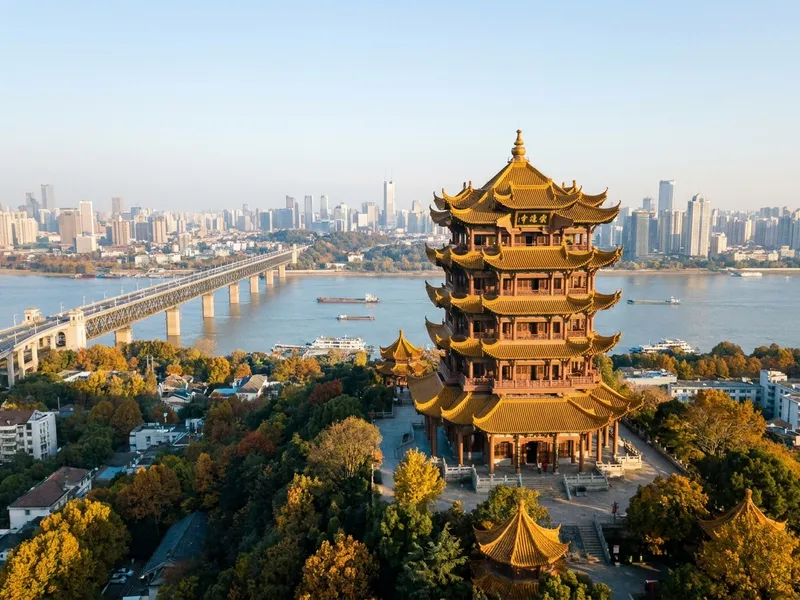
Wuhan
Wuhan is the capital of Hubei province, often called "the Chicago of China" for its central location and role as a transportation hub. The city is the convergence of the Yangtze and Han rivers, with the Yellow Crane Tower (one of China's four great classical towers) and East Lake (China's largest urban lake). Famous for hot dry noodles (热干面) and braised dishes. Plan 2-3 days. Excellent as a stopover between Beijing and Hong Kong via the high-speed rail, or as a base for day trips to the Three Gorges.
Why Wuhan in 2026.
Hubei's capital where the Yangtze meets the Han River. The Yellow Crane Tower, the spicy hot dry noodles, and 100+ universities make it central China's most dynamic city. Best visited spring and autumn for mild weather; summer is hot and humid, winter cold and damp.
Quick Answer
Wuhan is the capital of Hubei province, often called "the Chicago of China" for its central location and role as a transportation hub. The city is the convergence of the Yangtze and Han rivers, with the Yellow Crane Tower (one of China's four great classical towers) and East Lake (China's largest urban lake). Famous for hot dry noodles (热干面) and braised dishes. Plan 2-3 days. Excellent as a stopover between Beijing and Hong Kong via the high-speed rail, or as a base for day trips to the Three Gorges.
| Best time to visit | March-May and September-November; avoid July-August (extreme heat) |
|---|---|
| Daily budget | $45 (backpacker) / $110 (mid-range) / $280+ (luxury) |
| Language | Mandarin (Wuhan dialect; English in tourist areas) |
| Currency | CNY (¥) — Alipay/WeChat Pay universal |
| Time zone | China Standard Time (UTC+8) |
| Last updated | 2026-06-16 |
Want a Wuhan plan built for you?
Is Wuhan worth visiting?
Wuhan is one of China's underrated cities and rewards travelers who stop. The Yellow Crane Tower is one of the "three great towers of the south" and dates to the Three Kingdoms era. East Lake is larger than Hangzhou's West Lake. The food — hot dry noodles, duck neck, lotus root soup — is distinctive and cheap. Plan 2-3 days in the city, and combine it with a 1-2 day Three Gorges cruise departing from Yichang, just 1 hour west by high-speed rail.
How do I get to Wuhan?
Wuhan Tianhe International Airport (WUH) has direct flights from most major Chinese and Asian cities. Wuhan has 3 high-speed rail stations (Wuhan, Wuchang, Hankou), making it one of China's main rail hubs. From Beijing the train takes 4-5 hours. From Shanghai it is 4-5 hours. From Guangzhou it is about 4 hours. The Three Gorges cruise (Yichang to Chongqing) starts 1 hour west, making Wuhan a natural gateway to central China.
What is the best Wuhan food?
Wuhan is famous for "hot dry noodles" (热干面, rè gān miàn) — noodles served with sesame oil paste, pickles, and chili. Eat them for breakfast at Hubu Lane. Other must-tries include duck neck (鸭脖, yā bó), lotus root soup (排骨藕汤), steamed fish head with diced hot peppers (剁椒鱼头), and Wuhan-style "small hot pot" (小火锅) for late-night meals. The breakfast culture here is one of the richest in China, with a name — "guozao" (过早) — all its own.
Should I do a Three Gorges cruise from Wuhan?
Wuhan itself is not a Three Gorges departure point. Cruises leave from Yichang (downstream, smaller ships) or Chongqing (upstream, larger ships). You can take a 1-hour high-speed rail from Wuhan to Yichang to start a 4-day cruise. The Wuhan-Yichang-Chongqing combination is popular for travelers wanting to see central China and the Yangtze gorges in one trip, with Wuhan as the comfortable arrival city.
Is Wuhan a good base for day trips?
Wuhan is one of the best hubs in China for exploring the middle Yangtze region. Yichang and the Three Gorges Dam are 1 hour west by high-speed rail. Jingzhou, an ancient Three Kingdoms city with intact walls, is 1.5 hours. The Wudang Mountains — a major Taoist pilgrimage site with stunning temples — are about 4 hours away by high-speed rail. Wuhan's central location and dense rail network make almost everything in Hubei reachable as a day trip.
When is the best time to visit Wuhan?
Spring (March-May) and autumn (September-November) are the best seasons, with mild weather and clear skies. Mid-to-late March brings the famous cherry blossoms at Wuhan University and East Lake. Summer (June-August) is brutal — Wuhan is on China's "Four Furnaces" list of hottest cities, with 35-40°C heat and suffocating humidity. Winter is damp and grey but not severe, and hotel prices drop.
Why is Wuhan split into three towns?
Wuhan is unique in China: it was formed from three historic cities — Wuchang, Hankou, and Hanyang — merged into one municipality in 1927. The Yangtze and Han rivers divide the three towns, and more than a dozen bridges and tunnels connect them. Wuchang is the academic and cultural heart (universities, East Lake, Yellow Crane Tower). Hankou is the commercial center. Hanyang is the industrial quarter. Crossing the river between them is part of the fun.
Can I see cherry blossoms in Wuhan?
Wuhan is one of the best cherry blossom destinations in China. Wuhan University is famous for its cherry blossom avenue (樱花大道), with over 1,000 trees blooming mid-to-late March. The university opens to the public during peak bloom, but expect heavy crowds and free timed-entry tickets. East Lake's Moshan area has thousands more cherry trees with far fewer people, and the cherry blossom festival runs through all of March and April.
Where should I stay in Wuhan?
Stay near Jianghan Road in Hankou for nightlife, colonial-era architecture, and the riverfront walk — it is the most atmospheric base for first-timers. Wuchang (near the Yellow Crane Tower or East Lake) is better for sightseeing and universities. Opt for a hotel within 5 minutes of a metro Line 2 or Line 4 station, since these connect the airport, both high-speed rail hubs, and all major attractions. Avoid the outer industrial districts.
What are the best Wuhan foods and where should I try them?
Wuhan has one of China's richest breakfast cultures, captured in the local word guozao (过早), which means "passing the morning" — the habit of grabbing a quick, filling breakfast on the way to work. The undisputed king of guozao is hot dry noodles (热干面, reganmian): alkaline wheat noodles boiled until chewy, tossed in a sesame-paste sauce thickened with sesame oil, and topped with pickled radish, chopped scallions, and chilli oil. It is dry (no broth), nutty, spicy, and costs ¥5-10 at any street stall. The most famous historic shop is Cai Lin Ji (蔡林记), founded in 1928, with branches across the city — the Hubu Lane branch is the most convenient for visitors. Wuhan's second-most-famous breakfast is doupi (豆皮), a layered dish of sticky rice, minced pork, bamboo shoots, and shiitake mushrooms pressed between two sheets of tofu skin and pan-fried until crisp. The best doupi is found at Lao Tong Cheng (老通城) near Jianghan Road, in business since 1931. Wuhan's third signature snack is duck neck (鸭脖, ya bo), a spicy braised snack sold everywhere from street carts to the Zhou Hei Ya chain — it is chewy, numbing, and eaten cold with beer. A full Wuhan breakfast table also includes mianwo (面窝, a savoury fried doughnut ring), tangbao (汤包, soup dumplings), and doujiang (豆浆, fresh soy milk). For lunch or dinner, the city's freshwater fish dishes shine: steamed Wuchang fish (清蒸武昌鱼) is a Lake Tai classic, and lotus-root-and-pork-rib soup (排骨藕汤) is the comfort food of Hubei. Hubu Lane (户部巷), the 150-metre food street near the Yellow Crane Tower, packs 200+ vendors into a single alley and is the easiest one-stop introduction, though prices are higher than neighbourhood stalls and the crowds are intense on weekends. For a more local experience, walk the streets around Wuhan University or the Jiqing Street night market in Hankou after 8 PM. Allow ¥50-80 per person for a generous food crawl.
What are the top things to do in Wuhan?
Wuhan packs enough for a dense 2-3 day itinerary across its three historic towns. The essential stops are: the Yellow Crane Tower (黄鹤楼) on Snake Hill in Wuchang — climb the five storeys for Yangtze River views, see the Tang-dynasty poetry exhibits, and walk the surrounding park (¥70, 2 hours). The Hubei Provincial Museum (湖北省博物馆) in Wuchang — the Marquis Yi of Zeng bronze bell set (433 BC) and the Sword of Goujian are the star artefacts (free, timed reservation required, 3 hours, closed Mondays). East Lake (东湖) — China's largest urban lake, best experienced by cycling the 100-km Greenway or walking the Moshan scenic area (free to ¥60, half-day). The Wuhan Yangtze River Bridge — walk across the 1.6 km double-deck bridge for river views and a small museum at the Wuchang end (free, 45 minutes). The Hankou riverfront Bund (汉口江滩) — a 7-km promenade past early-20th-century European concession buildings, best at sunset (free, 2 hours). Hubu Lane (户部巷) — the 150-metre food street near the Yellow Crane Tower with 200+ vendors, the easiest introduction to Wuhan street food (pay per dish, 1-2 hours). The 1911 Revolution Museum (辛亥革命博物馆) — a striking red V-shaped building commemorating the Wuchang Uprising that toppled the Qing dynasty (free, 2 hours, closed Mondays). For a slower pace, add: Wuhan University campus (武汉大学) — one of China's most beautiful campuses on Luojia Hill overlooking East Lake, with early-20th-century architecture (free, 2 hours). Guiyuan Temple (归元寺) in Hanyang — a 17th-century Buddhist temple with 500 gilded arhat statues, each with a distinct expression (¥20, 1.5 hours). Tanhualin (昙华林) — a gentrified lane of restored brick houses turned into cafés and cocktail bars in Wuchang (free, 1-2 hours in the evening). Jiqing Street night market (吉庆街) in Hankou — the center of Wuhan's evening food scene with grilled skewers, spicy crayfish, duck neck, and cold beer until 2 AM (pay per dish). For travelers with a fourth day, add a day trip to Jingzhou (Three Kingdoms walled city, 1.5 hours by train) or the Wudang Mountains (Taoist temples, 4 hours by train, better as an overnight).
What is Wuhan's role in modern Chinese history?
Wuhan has been at the center of Chinese history multiple times, most famously as the birthplace of the 1911 Revolution. On 10 October 1911, republican soldiers in the Wuchang garrison mutinied against the Qing dynasty, seized the local arsenal, and declared a military government — the spark that ended 268 years of Manchu rule and over 2,000 years of imperial China. The event is commemorated at the 1911 Revolution Museum (辛亥革命博物馆, a striking red V-shaped building opened for the centenary) and the preserved Hubei Military Government building (the Red Chamber, 红楼) across the square, both free and walking distance from the Yellow Crane Tower. Wuhan was also a key site in the 1927 Northern Expedition, when the Nationalist government briefly made Wuhan (specifically Hankou) the capital of China — the former Nationalist government buildings still stand along Zhongshan Avenue. The Yangtze River Bridge, opened in 1957, was the first bridge ever built across the Yangtze and a flagship project of the early People's Republic. Chairman Mao swam across the Yangtze near the bridge site in 1956, an event commemorated in his poem "Swimming." The bridge museum at the Wuchang end tells this story. During the Second Sino-Japanese War (1937-1945), Wuhan was the temporary capital of China after the fall of Nanjing, and the 1938 Battle of Wuhan was one of the largest battles of the war. Beyond politics, Wuhan's Hankou foreign concessions (British, Russian, French, German, and Japanese) between 1861 and 1943 turned the city into one of China's most important treaty ports, and the concession-era architecture along the riverfront — customs houses, bank buildings, consulates, and the Dongzheng Orthodox Church — is the best-preserved collection of early-20th-century European architecture in inland China. Wuhan was also the epicenter of the COVID-19 pandemic in early 2020, an event that reshaped the city's global image. Today, the city has moved on, and there are no pandemic-specific memorials open to the public, but the experience is acknowledged in local memory. For history travelers, Wuhan's modern Chinese history is as rich as Beijing's or Shanghai's, and far less crowded.
How do I plan a Yangtze River cruise from Wuhan?
Wuhan is the most practical staging city for a Yangtze Three Gorges cruise, but the cruise itself does not depart from Wuhan. Cruises leave from Yichang (downstream, 4 nights to Chongqing) or Chongqing (upstream, 3 nights to Yichang), and Wuhan is your gateway to either. Step by step: decide your direction first. Downstream (Chongqing to Yichang, 3 nights) is more common, cheaper, and faster. Upstream (Yichang to Chongqing, 4 nights) goes against the current, giving more time in the gorges, and is preferred by photographers and travelers who want a slower pace. From Wuhan, take a high-speed train to Yichang East Station (1.5 hours, ¥100-130, roughly hourly) if starting an upstream cruise, or fly from Wuhan Tianhe Airport to Chongqing Jiangbei Airport (about 1.5 hours, ¥400-800) if starting a downstream cruise. Cruise operators include the transfer from Yichang or Chongqing city to the port — confirm this when booking. Book the cruise 1-4 weeks ahead through Trip.com (English), a Chongqing or Yichang travel agency, or directly with the cruise line. Prices range from about ¥1,500-3,000 per person for a 3-4 night standard cruise (cabin, meals, shore excursions included; re-check current pricing). Luxury cruises (Century, Victoria, President lines) run ¥3,000-6,000 and have better English service, Western food options, and smaller group excursions. The best cruise months are April-May and September-October, when the Yangtze water level is stable and the weather is pleasant. Avoid June-August (heavy rain, high water, potential schedule changes) and December-February (cold, low water, some facilities closed). The classic combined itinerary: 2-3 days Wuhan, high-speed train to Yichang, 4-night cruise to Chongqing, 2-3 days Chongqing — roughly 10-12 days total. Add 1-2 days in Wulong Karst as a Chongqing side trip if time allows. Wuhan's role in this itinerary is as the comfortable, English-friendly arrival city where you adjust to China before heading into the gorges.
What makes Wuhan's food culture unique?
Wuhan has one of China's richest food cultures, and it revolves around three things: breakfast, freshwater fish, and late-night street eating. The local word for breakfast is guozao (过早), which literally means "passing the morning" — the habit of grabbing a quick, cheap, filling breakfast on the way to work that is so central to Wuhan identity that locals say a city without guozao is not a real city. The breakfast trinity is hot dry noodles (热干面, reganmian), doupi (豆皮, sticky rice and pork pressed between tofu skin and pan-fried), and mianwo (面窝, a savoury fried doughnut ring). Together they cost about ¥15-25 and are eaten standing up or on a low stool on the pavement. The duck neck (鸭脖, ya bo) is Wuhan's most famous snack: duck necks braised in a chili-and-Sichuan-peppercorn broth, served cold, and eaten with the hands as a beer snack. The Zhou Hei Ya (周黑鸭) chain has turned duck neck into a national brand, but the best is from independent stalls at Jiqing Street night market. Lotus root (藕, ou) is the soul of Hubei cooking — the province's lakes produce some of China's best lotus root, and the signature dish is lotus-root-and-pork-rib soup (排骨藕汤), slow-cooked for hours until the root turns starchy and sweet. Steamed Wuchang fish (清蒸武昌鱼), a freshwater bream from the Yangtze system, is the city's most famous sit-down dish — mild, delicate, and served whole with ginger and scallions. Wuhan's food geography mirrors its three-town structure: Wuchang has the student eats (cheap, fast, near the universities), Hankou has the historic restaurants and night markets, and Hanyang has the fewest options but some of the best lotus-root dishes. The best single food experience is to do guozao at Hubu Lane in the morning, lotus-root soup for lunch, and duck neck with cold beer at Jiqing Street after 9 PM — one day, three meals, the full Wuhan arc.
Top attractions
Yellow Crane Tower (黄鹤楼)
5-story tower originally built 223 AD, rebuilt 1985. The most famous of China's three great towers. ¥70 entry.
East Lake (东湖)
33km² lake, China's largest urban lake. Free; the Moshan and Tingtao scenic areas are ¥60-90. Allow half-day.
Hubei Provincial Museum
Best museum in central China, with the Marquis Yi of Zeng tomb artifacts and a 2,400-year-old set of bronze bells (still played). Free.
Hubu Lane (户部巷)
150m food street with 200+ vendors specializing in Wuhan street food. ¥0 entry, ¥5-30 per dish.
Wuhan Yangtze River Bridge
The first bridge across the Yangtze (1957). 1.6km long, with viewing platforms and a museum. Free.
Hankou Riverfront Bund (汉口江滩)
A 7-km promenade along the Yangtze's north bank in the former concession district, lined with early-20th-century European bank buildings, consulates, and trading houses. Free. Best walked at sunset when the bridges light up and the cargo ships pass.
STAY
Where to stay in Wuhan
Pick a base that matches the trip you want — imperial-central for sightseeing, hutong belt for character, Chaoyang for nightlife, or Qianmen for budget.
Wuchang (武昌)
University and cultural district. Wuhan University cherry blossoms, Hubei Provincial Museum, East Lake. Hilton, Shangri-La.
#wuchangHankou (汉口)
Historic treaty-port concession area. Jianghan Road pedestrian street, colonial architecture, riverfront. Marco Polo, Sheraton.
#hankouHanyang (汉阳)
Industrial heritage and temples. Guiyuan Temple, Qingchuan Pavilion, Hanyang Arsenal. Budget to mid-range. InterContinental on the river.
#hanyangEast Lake Area (东湖)
China's largest urban lake. Resort hotels, cycling paths, cherry blossom gardens. InterContinental East Lake. Best for nature stays.
#east-lake
ITINERARIES
Sample itineraries from Wuhan
Three ready-made routes, from a 1-day imperial sprint to a 5-day deep dive. Copy the day-by-day plan and adapt to your own pace.
- 1 DAY
Wuhan in One Day
Yellow Crane Tower, hot dry noodles, and a Yangtze River bridge walk.
- HSR stopovers
- Business travellers
- Quick city breaks
- Day 01
Morning
Yellow Crane Tower ascent, Yangtze River Bridge walk across
Afternoon
Hubei Provincial Museum (bell set and chime performance), East Lake bike ride
Evening
Jianghan Road pedestrian street, Hankou riverfront, hot dry noodles and Wuchang fish dinner
- 3 DAYS
Classic 3-Day Wuhan
Three towns, cherry blossoms (in season), Hubei museums, and the Yangtze.
- First-time visitors
- History buffs
- Cherry blossom chasers (late March)
- Day 01
Morning
Yellow Crane Tower, Yangtze River Bridge walk
Afternoon
Hubei Provincial Museum (Marquis Yi bell set, Yue King Goujian sword), East Lake
Evening
Hubu Alley (户部巷) breakfast street, Wuchang night market
- Day 02
Morning
Wuhan University campus and cherry blossoms (late March), or Guiyuan Temple (any time)
Afternoon
Hankou riverfront — Jianghan Road, old concession buildings, Jianghan Guan customs house
Evening
Hankou Yangtze River night cruise, Jiqing Street (吉庆街) food and live music
- Day 03
Morning
Hanyang — Qingchuan Pavilion (晴川阁), Hanyang Arsenal Museum, Guiyuan Temple arhat count
Afternoon
Hubei Provincial Museum chime performance (book ahead), East Lake Tingtao scenic area
Evening
Farewell hot dry noodles, Yangtze River Bridge sunset, Wuchang fish dinner
- 4 DAYS
4-Day Wuhan & Wudang Mountains
Wuhan plus a day trip to the Wudang Mountains — UNESCO Taoist temples and kung fu.
- Taoist culture enthusiasts
- Kung fu fans
- Hikers
- Day 01
Morning
Yellow Crane Tower, Yangtze Bridge, Hubu Alley breakfast
Afternoon
Hubei Provincial Museum, East Lake bike
Evening
Jianghan Road evening walk, Hankou dinner
- Day 02
Morning
HSR to Wudang Mountains (2h from Wuhan) — Purple Cloud Palace, Nanyan Temple
Afternoon
Golden Summit (金顶) cable car, cliffside Taoist temples
Evening
Return to Wuhan, or stay overnight at Wudangshan town
- Day 03
Morning
Wuhan University / Guiyuan Temple, Qingchuan Pavilion
Afternoon
Hankou old town walk, Tanhualin art district
Evening
Yangtze River night cruise, Jiqing Street food night
- Day 04
Morning
East Lake deep exploration — Moshan Hill, Botanical Garden, Chu River Han Street
Afternoon
Last hot dry noodles, souvenir shopping, Yellow Crane Tower sunset
Evening
Depart
BUDGET
What a Wuhan trip costs
Per-person, per-day costs across three spending tiers. Excludes international flights and visa fees.
| Line item | Backpacker | Mid-range | Luxury |
|---|---|---|---|
| Hotel (per night) | $12 | $50 | $180 |
| Meals (per day) | $8 | $25 | $75 |
| Local transport | $3 | $8 | $22 |
| Attractions | $8 | $20 | $45 |
| Total per day | $31 | $103 | $322 |
$ USD per person per day, before international flights and visas. Last verified: Q3 2026.
STAY SAFE
Emergency contacts in Wuhan
Save these three numbers before you board the plane. China uses different hotlines than most countries — there's no 911.
- POLICE
110
- AMBULANCE
120
- FIRE
119
- TOURIST HOTLINE
12301 (China National Tourism Administration hotline)
- ENGLISH-SPEAKING ER
Wuhan Union Hospital International Clinic (武汉协和医院国际门诊) — English-speaking, +86 27 8572 6114, 1277 Jiefang Avenue. Also: Wuhan University Zhongnan Hospital International Department +86 27 6781 2888.
Problems travelers hit in Wuhan
- Why is my Alipay not working?You linked a foreign Visa or Mastercard to Alipay but every transaction is rejected at the merchant.
- My China visa was denied — what now?Your L visa application was refused at the Chinese consulate and your trip is in 2–4 weeks.
- My passport was lost or stolen in China — what do I do?Your passport is gone (theft or loss) and you're in mainland China without travel documents.
- Why can't I book on 12306 with my foreign card?You tried to book a high-speed rail ticket on 12306.cn and your foreign Visa/Mastercard is rejected at checkout.
- Why is my VPN not working in China?You arrived in China, opened your VPN, and it will not connect at all or connects but no traffic loads.
- Why can't I book a Tibet trip on my own?You try to book Lhasa flights and hotels yourself but the booking fails, or you're turned away at the Lhasa airport without a permit.
Book activities in Wuhan
These are licensed tour operators and booking platforms we've vetted independently. Booking through these links may earn us a commission — see our affiliate disclosure. This never affects our editorial recommendations or the price you pay.
Frequently asked questions
What is the best time to visit Wuhan?
Is Wuhan safe for tourists?
Do I need a guide for Wuhan?
How is Wuhan different from other Yangtze cities?
How many days do I need in Wuhan?
Can I use foreign credit cards in Wuhan?
Show all 47 FAQs
What is hot dry noodles (reganmian)?
Is the Hubei Provincial Museum free?
How do I get from Wuhan airport to the city?
What is there to do at night in Wuhan?
Are there English signs in Wuhan?
Can I swim in East Lake?
What is the history of the Yellow Crane Tower and is the current one authentic?
What are the must-see artefacts at the Hubei Provincial Museum?
What is there to do at East Lake besides look at it?
Why is the Wuhan Yangtze River Bridge historically significant?
When exactly is cherry blossom season at Wuhan University and how do I visit?
Where can I find the best hot dry noodles (reganmian) in Wuhan?
What is the best season to visit Wuhan overall?
How do I combine Wuhan with a Three Gorges cruise?
What are the best day trips from Wuhan?
What is there to see along the Hankou riverfront and the old concession district?
What is the 1911 Revolution Museum and why is Wuhan important to modern Chinese history?
How many bridges cross the Yangtze in Wuhan and can I walk across any of them?
Is Wuhan University worth visiting outside of cherry blossom season?
How do I get from Wuhan to the Wudang Mountains?
What is the best neighbourhood for nightlife and evening dining in Wuhan?
Is Wuhan a good destination for families with children?
What is Guiyuan Temple and should I visit it?
What is the complete cherry blossom viewing guide for Wuhan?
How do I get around Wuhan?
What are Wuhan's lakes beyond East Lake?
What is the Optics Valley and is it worth visiting?
What is Jiqing Street night market and when should I go?
Is the Yellow Crane Tower as good in reality as it looks in photos?
Is Wuhan safe for solo travelers?
What is a realistic daily budget for Wuhan?
What is Wuhan duck neck culture and where should I try it?
What are the best photography spots in Wuhan?
What makes Wuhan's university culture unique?
What are the best neighborhoods in Wuhan for different interests?
How does the Wuhan Metro work for visitors?
What should I pack for Wuhan by season?
What are vegetarian food options in Wuhan?
How much Chinese do I need to visit Wuhan?
Is tap water safe to drink in Wuhan?
What are the best day trips from Wuhan?
References

Related guides & destinations
Guide
8 Best Chinese Food Cities 2026: Chengdu, Guangzhou, Xi’an, Shanghai, Wuhan, Hangzhou, Changsha, Kunming
A ranked guide to the 8 essential Chinese food cities, from UNESCO-designated Chengdu to mushroom-mad Kunming. Each has signature dishes, wh
Guide
Wuhan Tianhe Airport Transfer 2026: Metro, Taxi, Bus & Train Options
Practical 2026 guide to getting from Wuhan Tianhe International Airport (WUH) to Hankou, Wuchang, and Wuhan Railway Station, with current me
Guide
How We Research 2026: NihaoVisit’s Methodology for China Travel Information
How NihaoVisit sources, verifies, and maintains 700+ pages of China travel information — our source hierarchy, fact-checking process, update
Guide
Fact-Checking Log 2026: Verified China Travel Information — NihaoVisit
A public log of fact-checking verification passes on NihaoVisit, showing what was verified, when, and against which sources — covering visa
Guide
Best Time to Visit China 2026: Month-by-Month Weather, Crowds, and Prices
The best time to visit most of China is April–May and September–October. Winter (Dec–Feb) is cold but cheap; summer (Jun–Aug) is hot and cro
Guide
VPN for China 2026: Which VPNs Work, eSIM Alternatives, and the Complete Pre-Trip Checklist
Most Western apps and websites are blocked in mainland China. A reliable VPN is essential for Google, Gmail, WhatsApp, Instagram, and most n