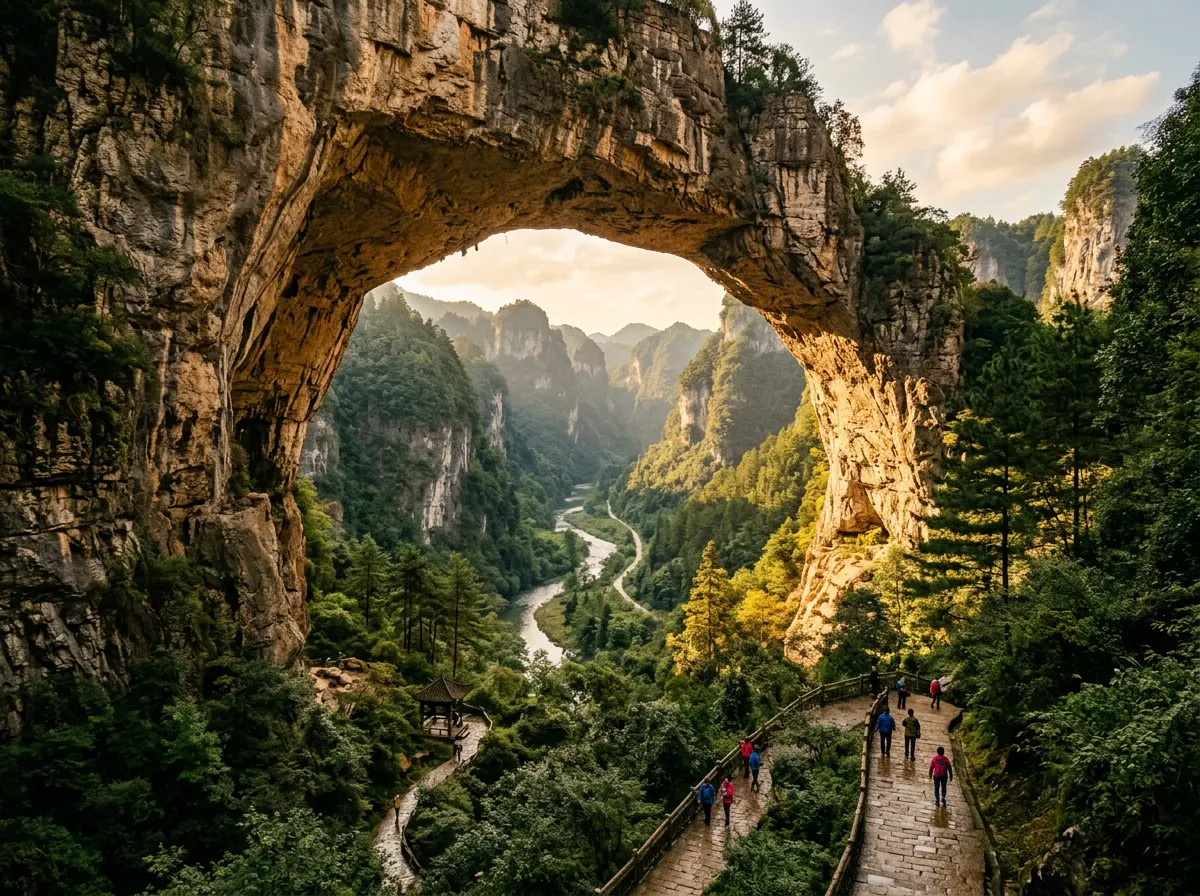
Wulong
Wulong in Chongqing municipality is a UNESCO World Heritage site featuring three natural limestone bridges (Tianlong, Qinglong, Heilong) over a 5km gorge — the filming location for Transformers: Age of Extinction (2014). The Wulong Karst also includes the Fairy Mountain grassland and a 1,200-year-old Tibetan village (Xiangguo) perched above a sinkhole. Plan 1-2 days as a side trip from Chongqing (1.5-2 hours by car). Best months: April-October. The three bridges span distances from 50 to 200 meters across the gorge, with the tallest arch exceeding 200 meters — among the largest natural limestone bridges anywhere. The sinkhole below Xiangguo village is over 300 meters deep and supports a small farming community that has been there for 12 centuries. Wulong is a side trip from Chongqing for travelers interested in karst geology, dramatic natural scenery, and quieter nature experiences. The drive from Chongqing city is one of China's most scenic mountain roads, passing through the Dalingshan tunnel and the Wujiang river gorge. The Wulong Fairy Mountain grassland offers summer hiking and winter skiing on small slopes, making Wulong a year-round destination. The Three Natural Bridges area has a small museum, walking paths, and an option to descend to the bottom of the gorge for a different perspective. Photography is best in the morning when the mist has lifted but the sun is not yet harsh. The 1,200-year-old Tibetan village Xiangguo is a working village and a fascinating window into the area's Tibetan heritage, with traditional homes, prayer wheels, and a small monastery. Wulong also has a small Three Natural Bridges museum explaining the geological formation of the bridges and the regional karst landscape. The Fairy Mountain grassland has hiking trails and a chairlift to the summit for views of the surrounding Wulong scenery. Most travelers visit Wulong on a day trip from Chongqing, but staying overnight at one of the local lodges or the Wulong Xiannu Mountain Hotel allows for evening and morning photography in the misty gorge atmosphere. The Tianlong Bridge is the largest of the three, with a single arch spanning 200 meters at a height of 150 meters above the valley floor — among the tallest natural arches in the world. The combination of Wulong's natural arches and sinkhole villages is what earned the area its UNESCO World Heritage status in 2007 as part of the South China Karst system. The karst geology continues through parts of Guangxi, Guizhou, and Yunnan, with Wulong representing one of the most accessible examples for travelers based in Chongqing. The local Tibetan and Miao ethnic minority villages around the karst formations add cultural depth to the natural scenery. The area is part of Chongqing municipality and benefits from good infrastructure compared to other remote karst regions in China.
Why Wulong in 2026.
The Three Natural Bridges used in 'Transformers: Age of Extinction.' A UNESCO karst landscape with sinkholes, gorges, and a stunning 1,200-year-old Tibetan village. Best visited April-October for mild weather; summer can be rainy. Direct access from Chongqing city in 1.5-2 hours. The Tianlong, Qinglong, and Heilong bridges span a 5km gorge.
Quick Answer
Wulong in Chongqing municipality is a UNESCO World Heritage site featuring three natural limestone bridges (Tianlong, Qinglong, Heilong) over a 5km gorge — the filming location for Transformers: Age of Extinction (2014). The Wulong Karst also includes the Fairy Mountain grassland and a 1,200-year-old Tibetan village (Xiangguo) perched above a sinkhole. Plan 1-2 days as a side trip from Chongqing (1.5-2 hours by car). Best months: April-October. The three bridges span distances from 50 to 200 meters across the gorge, with the tallest arch exceeding 200 meters — among the largest natural limestone bridges anywhere. The sinkhole below Xiangguo village is over 300 meters deep and supports a small farming community that has been there for 12 centuries. Wulong is a side trip from Chongqing for travelers interested in karst geology, dramatic natural scenery, and quieter nature experiences. The drive from Chongqing city is one of China's most scenic mountain roads, passing through the Dalingshan tunnel and the Wujiang river gorge. The Wulong Fairy Mountain grassland offers summer hiking and winter skiing on small slopes, making Wulong a year-round destination. The Three Natural Bridges area has a small museum, walking paths, and an option to descend to the bottom of the gorge for a different perspective. Photography is best in the morning when the mist has lifted but the sun is not yet harsh. The 1,200-year-old Tibetan village Xiangguo is a working village and a fascinating window into the area's Tibetan heritage, with traditional homes, prayer wheels, and a small monastery. Wulong also has a small Three Natural Bridges museum explaining the geological formation of the bridges and the regional karst landscape. The Fairy Mountain grassland has hiking trails and a chairlift to the summit for views of the surrounding Wulong scenery. Most travelers visit Wulong on a day trip from Chongqing, but staying overnight at one of the local lodges or the Wulong Xiannu Mountain Hotel allows for evening and morning photography in the misty gorge atmosphere. The Tianlong Bridge is the largest of the three, with a single arch spanning 200 meters at a height of 150 meters above the valley floor — among the tallest natural arches in the world. The combination of Wulong's natural arches and sinkhole villages is what earned the area its UNESCO World Heritage status in 2007 as part of the South China Karst system. The karst geology continues through parts of Guangxi, Guizhou, and Yunnan, with Wulong representing one of the most accessible examples for travelers based in Chongqing. The local Tibetan and Miao ethnic minority villages around the karst formations add cultural depth to the natural scenery. The area is part of Chongqing municipality and benefits from good infrastructure compared to other remote karst regions in China.
| Best time to visit | April-June and September-October; avoid summer holiday crowds |
|---|---|
| Daily budget | $50 (backpacker) / $130 (mid-range) / $320+ (luxury) |
| Language | Mandarin (English limited outside hotels) |
| Currency | CNY (¥) — Alipay/WeChat Pay in scenic areas |
| Time zone | China Standard Time (UTC+8) |
| Last updated | 2026-06-16 |
Want a Wulong plan built for you?
How do I get to Wulong from Chongqing?
By car: 1.5-2 hours (140km) on the G65 expressway, the most flexible option for exploring the broader Wulong area. By bus: from Chongqing Sigongli Bus Station, 2.5-3 hours, roughly ¥70-90, re-check before booking, with 8+ daily departures. By high-speed rail: from Chongqing North to Wulong Station, about 1 hour, then a connecting bus to the scenic area (40 minutes, ¥20). Self-driving is the most flexible for the Three Natural Bridges, Fairy Mountain, and Longshui Gorge loop.
What is the best Wulong itinerary?
Two days is the comfortable minimum. Day 1: Three Natural Bridges (morning) + Xiangguo Village (included in ticket) + Longshui Gorge (afternoon). Day 2: Fairy Mountain (full day) — grassland hikes, horse riding, and panoramic views. For a longer trip, add 1-2 days for deeper karst exploration or combine Wulong with the Three Gorges cruise, since Wulong sits on the Chongqing side and makes a natural pre- or post-cruise stop.
How fit do I need to be for the Three Natural Bridges?
Moderate fitness is required. The main walk is about 5km, mostly downhill through the gorge, with 1,000+ stone steps. There is an elevator option (roughly ¥20, re-check before booking) for the initial descent that skips the steepest section. The trail is well-maintained but can be slippery in rain. A shuttle bus runs from the bottom of the gorge back to the entrance. Allow 3 hours including photo stops and the elevator queue.
Should I visit Wulong on a day trip from Chongqing?
A day trip is possible but tight. Two to three hours each way leaves only 4-5 hours for sightseeing, which forces you to pick one of the two main areas (Three Natural Bridges or Fairy Mountain). Most travelers stay 1-2 nights in Wulong to see both. Wulong town has a few good hotels (¥200-500/night, re-check), and there are 2-3 hotels inside the Three Natural Bridges scenic area for early-morning access before tour buses arrive.
Is Wulong good for photographers?
Wulong is one of the most photogenic natural sites in China. The Tianlong (Heavenly Dragon) Bridge at the Three Natural Bridges is 200m tall and 300m wide, and morning light hits the eastern walls best. Longshui Gorge is best in the late afternoon, when sunlight penetrates the narrow canyon in dramatic shafts. Fairy Mountain is a year-round landscape subject — green in summer, red and yellow in autumn, snow-dusted in winter. Bring a wide-angle lens and a tripod for long exposures inside the gorges.
When is the best season to visit Wulong?
Spring (April-June) and autumn (September-October) are the best seasons, with comfortable temperatures and the best light. Summer (July-August) brings Chinese school holidays and big crowds at the Three Natural Bridges, plus afternoon thunderstorms on Fairy Mountain. Winter is the quiet season — Fairy Mountain gets snow and runs a small ski resort, and the gorges are nearly empty but cold. Avoid the October National Day holiday week, when crowds are overwhelming.
Why are the Three Natural Bridges famous?
The Three Natural Bridges are famous because they are the largest natural bridge cluster in Asia and a key component of the UNESCO-listed South China Karst. They are also the filming location for Transformers: Age of Extinction (2014), which put Wulong on the international map. The three bridges — Tianlong, Qinglong, and Heilong — span a 5km gorge and reach heights of 200m+, with a 1,200-year-old Tibetan village tucked into the sinkhole below them.
What is Fairy Mountain and is it worth visiting?
Fairy Mountain (仙女山) is a 2,033m grassland plateau 30km from the Three Natural Bridges, and it is absolutely worth a day. Unlike the gorges, the landscape is open alpine meadow — rolling green hills, horse-riding trails, and panoramic views. In winter it becomes a small ski resort. Entry is roughly ¥60 (re-check before booking), and the contrast with the dramatic gorges makes the two-site combo one of the most varied day-pair trips in China.
Can I visit Wulong and Zhangjiajie on the same trip?
Yes — both are karst landscapes in central China and can be combined via Chongqing and Zhangjiajie. Wulong is a 1-2 day stop focused on natural bridges and gorges; Zhangjiajie needs 3-4 days and is famous for the Avatar pillar forest. Fly between Chongqing and Zhangjiajie (about 1.5 hours). Allow 6-8 days total to do both justice, plus transit. Wulong is smaller and quieter; Zhangjiajie is larger and far more crowded.
What are the Three Natural Bridges in detail?
The Three Natural Bridges — Tianlong (Heavenly Dragon), Qinglong (Azure Dragon), and Heilong (Black Dragon) — are the centerpiece of the Wulong Karst UNESCO site. They formed over millions of years as the Yangshui River eroded a massive limestone plateau, carving a 5km gorge and leaving behind three colossal rock arches where the river found underground escape routes. The tallest, Tianlong Bridge, stands roughly 200m high with a span of about 300m — large enough that the entire gorge floor beneath it feels like a cathedral. It is the first bridge you encounter after descending into the gorge, and in rainy season a waterfall cascades through its arch, creating a mist curtain that transforms the scene. Qinglong Bridge, the middle bridge, is around 180m high and 250m wide, with the most dramatic acoustic echo effect — a single clap reverberates for several seconds. Heilong Bridge, the third and narrowest, sits deepest in the gorge where shadows linger longest and the rock walls close in, giving it the name Black Dragon. The walking route begins at the visitor center above the gorge. Most visitors take the glass elevator (roughly ¥20) down the cliff face — a 100m descent that deposits you near the gorge floor, skipping the steepest stair section. From there, a well-paved path winds 5km through all three bridges, with the ancient post road visible in sections — this was once a key trade route connecting Sichuan to Guizhou, and a Tang Dynasty-era post station (驿站) still stands beneath Tianlong Bridge, its weathered wooden courtyard now a photo stop and rest point. This post station doubled as a filming location for Transformers: Age of Extinction (2014), and a life-sized Optimus Prime statue remains on site. The walk is entirely downhill or flat, takes 3-4 hours at a comfortable pace with photo stops, or 2.5 hours moving quickly. A shuttle bus picks you up at the far end and returns you to the visitor center. The gorge's acoustics are remarkable — voices, running water, and even birdsong echo off the 200m vertical walls, giving the entire walk an otherworldly sonic dimension.
How do I get to Wulong from Chongqing in detail?
By high-speed rail: Depart from Chongqing North Station (重庆北站), where trains to Wulong Station run roughly hourly from 7:00 AM to 8:00 PM. The journey takes about 1 hour and costs ¥50-80 for a second-class seat. From Wulong Station, a public shuttle bus runs to the Three Natural Bridges visitor center — 40 minutes, ¥20, departing when full. A taxi from Wulong Station to the scenic area takes 30 minutes and costs ¥80-100. The high-speed rail is the recommended option for most travelers: it is faster than the bus, cheaper than a private car, and the station-to-scenic-area connection is straightforward. By long-distance bus: Depart from Chongqing Sigongli Bus Station (四公里汽车站), reachable by Metro Line 3. Buses to Wulong County bus station depart roughly every 30-60 minutes from 7:00 AM to 6:00 PM. The journey takes 2.5-3 hours and costs ¥70-90. From Wulong County bus station, take a local bus (¥10-15, 40 minutes) or taxi (¥60-80, 25 minutes) to the Three Natural Bridges scenic area. The bus is the cheapest option but the slowest and least comfortable. By private car or hired driver: A full-day hire from Chongqing costs ¥500-800 including the return trip. The drive takes 1.5-2 hours on the G65 expressway. This is the most flexible option — you control timing, can visit Fairy Mountain and the gorges in one efficient loop, and avoid shuttle bus transfers entirely. Book through your hotel or a Chongqing tour agency at least a day ahead. For peak season (July-August, National Day, Labor Day), book return train tickets before heading to the scenic area; afternoon trains fill up and you may face a long wait or a bus alternative.
What other natural sights are near Wulong beyond the Three Natural Bridges?
Furong Cave (芙蓉洞), about 50km from the main Wulong Karst scenic area, is a massive limestone show cave and part of the same UNESCO listing. Its main chamber extends over 2.5km through a sequence of halls filled with stalactites, stalagmites, flowstone curtains, helictites, and giant columns — the full catalogue of speleothem formations accumulated over millions of years. The cave is lit with colored lights, which divides opinion: some find it atmospheric, others artificial. Allow 2-3 hours for the visit. Entry is roughly ¥120. Furong Cave pairs well with the Three Natural Bridges over two days; trying to see both in one day means rushing through both. Longshui Gorge (龙水峡地缝), also within the core Wulong Karst area, is a 2km-long narrow slot canyon where the walls close to just a few meters apart in places and waterfalls shoot from the rim high above, raining down into the fissure. Steel walkways cling to the walls, and the experience is more intimate and dramatic than the wider Three Natural Bridges gorge. Entry is roughly ¥105, and the walk takes 1.5-2 hours. It shares a shuttle system with the Three Natural Bridges, making them easy to combine in one day. Houping Tiankeng (后坪天坑) is a cluster of five giant natural sinkholes in a remote northwestern section of Wulong county. These are less developed and less visited — ideal for travelers wanting a rougher karst experience. Access is by car only, about 2 hours from Wulong town on mountain roads, and facilities are minimal. Go with a local driver and bring food and water. Fairy Mountain (仙女山) beyond the basics: the 2,033m plateau has wildflower meadows in spring, horse riding (roughly ¥80-150 per ride), and a small ski resort in winter with artificial and natural snow. Baima Mountain (白马山), 40km from Wulong town, is an emerging scenic area with ridge-top views, a glass walkway called the Feitian Kiss platform, and working tea terraces — quieter than the main areas and best in spring and autumn. The Wulong Karst Geological Park Museum near the visitor center is free and provides useful geological context in about an hour.
What is Fairy Mountain (Xiannv Shan) like in detail?
Fairy Mountain (仙女山, Xiannv Shan) is a 2,033-metre-high grassland plateau about 30 km from the Three Natural Bridges, and it is the unexpected counterpoint to the dramatic gorges below. While the bridges and sinkholes are all about vertical drama — looking down into abysses, walking through narrow fissures — Fairy Mountain is open, horizontal, and gentle. The landscape is alpine meadow: rolling green hills that look more like Switzerland or New Zealand than the karst China you have just come from, dotted with grazing horses, wildflower meadows in spring, and a scattering of pine forest. The contrast is what makes the two-site combo work so well. Fairy Mountain has a network of marked walking trails across its plateau ranging from 3 km to 10 km, all on gentle terrain suitable for any fitness level. Horse riding is available: short rides (about 30 minutes, roughly ¥80-120) or longer treks across the meadow (1-2 hours, ¥200-400). The horses are well-cared-for and led by local guides. In spring (April-May), the plateau blooms with wildflowers — azaleas, irises, and dozens of alpine species. In summer, the meadow is a green escape from Chongqing's heat, with plateau temperatures 10-15°C cooler than the city. In autumn (October-November), the grass turns golden and the air is the clearest of the year. In winter (late December to February), Fairy Mountain runs a small ski resort — one of the southernmost in China — with a few runs, a beginner area, and gear rental. The snow is partly artificial, but the novelty of skiing in subtropical China is real. Entry to Fairy Mountain is roughly ¥60 (re-check before booking). Allow a full day for hiking, horse riding, and the panoramic views. There is one resort hotel on the plateau and a few basic guesthouses; most visitors do Fairy Mountain as a day trip from Wulong town and return by evening. The plateau restaurant serves hot pot and noodle soups — basic but warm and welcome at altitude. The best views are from the western edge of the plateau at sunset, looking back toward the karst peaks. Bring layers even in summer — at 2,033 metres, the wind is cool.
How was the Wulong karst landscape formed?
The Wulong karst is the result of roughly 300 million years of geological work — deposition, uplift, and dissolution — and understanding the story transforms how you see the landscape. The story begins in the Permian period (about 270 million years ago) when the region lay under a shallow tropical sea. Over millions of years, the accumulated shells and skeletons of marine organisms compacted into massive layers of limestone and dolomite, some hundreds of metres thick. In the Triassic period (about 200 million years ago), tectonic collision — the same forces that built the Himalayas — began uplifting the seabed, pushing the limestone layers above sea level and tilting them at angles. Once exposed, water took over. Rainwater, slightly acidic from dissolved carbon dioxide, seeped into cracks in the limestone and began dissolving it — a process geologists call chemical weathering. Over millions of years, the cracks widened into fissures, the fissures into gorges, and the gorges into the colossal arches of the Three Natural Bridges. The bridges formed differently from typical erosion: the Yangshui River, flowing across the limestone plateau, found underground escape routes through weakened rock layers, carving subterranean channels. The roofs of these channels — the remaining rock arches — are what we now call Tianlong, Qinglong, and Heilong bridges. They are not bridges in the construction sense; they are the surviving remnants of an ancient cave system whose ceilings collapsed everywhere except at these three points. The giant sinkholes (tiankeng) of Houping formed by the same dissolution process, but vertically — underground caverns grew so large their roofs collapsed, creating the massive bowl-shaped depressions visible today. Longshui Gorge and Furong Cave are different expressions of the same process: the gorge is where dissolution and river erosion cut a narrow slot through the limestone; the cave is where water dissolved a vast underground chamber and then decorated it with stalactites and stalagmites precipitated from mineral-rich drips. The entire Wulong landscape — bridges, gorges, sinkholes, and caves — is a unified karst system, shaped by water dissolving rock over timescales the human mind cannot grasp. The best place to understand this is the Wulong Karst Geological Park Museum near the visitor center (free, 1 hour, good diagrams), ideally visited before entering the gorges.
What are the best Wulong hiking trails ranked by difficulty?
Wulong's trails range from easy paved walks to rugged backcountry routes, and matching the trail to your fitness and time makes the difference between a memorable day and an exhausting one. Easy: The Three Natural Bridges gorge walk (5 km, downhill, paved path, 2.5-3.5 hours with stops) is the essential Wulong walk and suitable for most fitness levels. The elevator skips the steepest stairs, and the shuttle bus returns you from the exit. Longshui Gorge (2 km, mostly downhill with stairs, steel walkways bolted to walls, 1.5-2 hours) is easy to moderate — the path is well-maintained but includes many stair sections and can be slick. Fairy Mountain meadow trails (3-10 km, flat to gentle gradients, wide paths) are easy and suitable for all ages. Moderate: The connector trail from the Three Natural Bridges exit to the Longshui Gorge entrance (about 8 km total when linked, confirm locally as sections occasionally close for maintenance) combines the two gorges into a longer day with more elevation change. The Fairy Mountain rim trails that descend from the plateau edge into the forested slopes are steeper and less maintained but offer solitude and different perspectives. Challenging: The Houping Tiankeng area (unmarked trails, no facilities, route-finding required) is for experienced hikers with GPS and offline maps. The hills around the tiankengs have paths between sinkholes but no signage and steep, uneven terrain. The backcountry trails connecting Baima Mountain to the surrounding tea terraces are moderately challenging and best done with a local guide. For all trails: wear sturdy shoes with good grip — limestone is slick when wet, and rain is common. Carry at least 1 liter of water per person for the gorge trails, more for longer routes. Download offline maps (Amap with Chongqing offline pack or Maps.me) before entering any trail. Tell someone your planned route. Trail conditions are best in spring and autumn; summer rain makes the gorge steps slippery, and winter ice closes some upper sections.
Top attractions
Three Natural Bridges (天生三桥)
UNESCO site with three giant limestone bridges over a 5km gorge. ¥135 entry. Allow 3-4 hours. Famous from Transformers.
Fairy Mountain (仙女山)
2,033m grassland mountain with hiking trails, horse riding, and a small ski resort in winter. ¥60.
Longshui Gorge (龙水峡地缝)
A 2km-long narrow karst gorge with waterfalls and walking trails. ¥105.
Xiangguo Tibetan Village (相国古寨)
1,200-year-old Tibetan village perched above a sinkhole. ¥0 (within Three Natural Bridges ticket).
Wulong Karst Geological Park Museum
Free museum explaining the karst geology. Allow 1 hour.
Problems travelers hit in Wulong
- Why is my Alipay not working?You linked a foreign Visa or Mastercard to Alipay but every transaction is rejected at the merchant.
- My China visa was denied — what now?Your L visa application was refused at the Chinese consulate and your trip is in 2–4 weeks.
- My passport was lost or stolen in China — what do I do?Your passport is gone (theft or loss) and you're in mainland China without travel documents.
- Why can't I book on 12306 with my foreign card?You tried to book a high-speed rail ticket on 12306.cn and your foreign Visa/Mastercard is rejected at checkout.
- Why is my VPN not working in China?You arrived in China, opened your VPN, and it will not connect at all or connects but no traffic loads.
- Why can't I book a Tibet trip on my own?You try to book Lhasa flights and hotels yourself but the booking fails, or you're turned away at the Lhasa airport without a permit.
Book activities in Wulong
These are licensed tour operators and booking platforms we've vetted independently. Booking through these links may earn us a commission — see our affiliate disclosure. This never affects our editorial recommendations or the price you pay.
Frequently asked questions
When is the best time to visit Wulong?
Can I see all of Wulong in one day?
What is the difference between the Three Natural Bridges and Fairy Mountain?
How is Wulong different from Zhangjiajie?
Is Wulong safe?
How much does it cost to visit Wulong?
Show all 48 FAQs
Do I need a guide for Wulong?
Can I get to Wulong by high-speed rail?
What should I wear for the Three Natural Bridges?
Is the Xiangguo Tibetan village really 1,200 years old?
Can I ski at Fairy Mountain?
Where should I stay in Wulong?
Tell me more about Furong Cave — is it worth seeing?
What is Houping Tiankeng and how do I visit it?
What are the best hiking routes in Wulong?
What is Baima Mountain and should I visit it?
What is the best season to visit Wulong in detail?
How many days do I need in Wulong?
Where should I stay in Wulong?
What is the local food in Wulong?
Is Wulong good for photography?
What is the weather like in Wulong?
Is Wulong safe for solo travelers?
Is Wulong family-friendly?
How much does a Wulong trip cost?
Can I visit Wulong as a day trip from Chongqing?
Do I need a guide for Wulong?
What should I wear and pack for Wulong?
Can I combine Wulong with a Three Gorges cruise?
Is Wulong accessible for travelers with limited mobility?
What is Longshui Gorge like in detail?
How do I get to Houping Tiankeng and what should I expect?
What are the best viewpoints in Wulong and when should I visit each?
How does Wulong compare to Guilin and Yangshuo?
What are the seasonal differences in Wulong's scenery?
What should I pack for Wulong by season?
How much fitness do I need for each Wulong trail?
What is the best photography approach for the Wulong karst landscape?
Is Wulong worth visiting for non-hikers?
What is Wulong like in winter?
How were the Three Natural Bridges formed geologically?
What is the Xiangguo Tibetan Village like in detail?
What are the best budget tips for Wulong?
What local dishes should I try in Wulong?
Is Wulong family-friendly for different age groups?
What is the best 2-day Wulong itinerary?
What are the best photo spots in Wulong and the best times to shoot them?
Do I need a tour or can I do Wulong independently?
References

Related guides & destinations
Guide
China in November 2026: Crowds Gone, Prices Drop, and Where to Chase the Light
November is the calmest, cheapest month of autumn shoulder — Golden Week crowds are gone, prices drop 30–40%, and the south stays warm enoug
Guide
How We Research 2026: NihaoVisit’s Methodology for China Travel Information
How NihaoVisit sources, verifies, and maintains 700+ pages of China travel information — our source hierarchy, fact-checking process, update
Guide
Fact-Checking Log 2026: Verified China Travel Information — NihaoVisit
A public log of fact-checking verification passes on NihaoVisit, showing what was verified, when, and against which sources — covering visa
Guide
Best Time to Visit China 2026: Month-by-Month Weather, Crowds, and Prices
The best time to visit most of China is April–May and September–October. Winter (Dec–Feb) is cold but cheap; summer (Jun–Aug) is hot and cro
Guide
VPN for China 2026: Which VPNs Work, eSIM Alternatives, and the Complete Pre-Trip Checklist
Most Western apps and websites are blocked in mainland China. A reliable VPN is essential for Google, Gmail, WhatsApp, Instagram, and most n
Guide
China SIM Card and eSIM Guide 2026: Stay Connected Without WeChat
A Chinese SIM or eSIM lets you use mobile data, maps, and ride-hailing without WiFi. Here is how to get one, the cost, and which provider to