Wuyuan
Wuyuan in Jiangxi province is the unofficial "most beautiful countryside in China" — a 2,947km² county with 4,500+ preserved Ming-Qing villages, traditional Huizhou architecture (white walls, black tile roofs, gray brick), terraced rice fields, and tea plantations. Famous for the spring canola flower fields (March-April) and autumn foliage (October-November). Plan 2-3 days. High-speed rail from Shanghai to Wuyuan takes 2.5-3 hours. The villages were built by wealthy Huizhou merchants who returned home after making fortunes in the Yangtze trade, and the architecture reflects their prosperity. The most-photographed villages are Likeng, Qingyuan, Jiangling (with canola fields), and Huangling (the terraced village). The combination of Huizhou architecture, terraced fields, and seasonal color makes Wuyuan a top photography destination in China, with peak crowds in March-April during the canola season. Local homestays offer immersive overnight stays in villages that many day-trippers miss. The tea harvested in Wuyuan's mountain plantations is among China's most prized green teas. Visitors can tour working tea farms and participate in harvest during the spring tea season. The local green tea is famous throughout Jiangxi. Bring home some tea as a souvenir. Allow extra luggage space for souvenirs and gifts.
Why Wuyuan in 2026.
China's most beautiful countryside. 4,500+ Ming-Qing villages with white-walled, black-tiled Huizhou architecture, surrounded by canola flower fields in spring. Best visited March-April for canola blooms or October-November for autumn foliage. Huangling and Jiangling are the most photographed villages. Combine with Huangshan in 5-7 days. Direct HSR from Shanghai (2.5-3h), Hangzhou (2h), and Nanchang (2.5h). Travel insurance recommended.
Quick Answer
Wuyuan in Jiangxi province is the unofficial "most beautiful countryside in China" — a 2,947km² county with 4,500+ preserved Ming-Qing villages, traditional Huizhou architecture (white walls, black tile roofs, gray brick), terraced rice fields, and tea plantations. Famous for the spring canola flower fields (March-April) and autumn foliage (October-November). Plan 2-3 days. High-speed rail from Shanghai to Wuyuan takes 2.5-3 hours. The villages were built by wealthy Huizhou merchants who returned home after making fortunes in the Yangtze trade, and the architecture reflects their prosperity. The most-photographed villages are Likeng, Qingyuan, Jiangling (with canola fields), and Huangling (the terraced village). The combination of Huizhou architecture, terraced fields, and seasonal color makes Wuyuan a top photography destination in China, with peak crowds in March-April during the canola season. Local homestays offer immersive overnight stays in villages that many day-trippers miss. The tea harvested in Wuyuan's mountain plantations is among China's most prized green teas. Visitors can tour working tea farms and participate in harvest during the spring tea season. The local green tea is famous throughout Jiangxi. Bring home some tea as a souvenir. Allow extra luggage space for souvenirs and gifts.
| Best time to visit | March-April (canola flowers) and October-November (autumn foliage) |
|---|---|
| Daily budget | $40 (backpacker) / $100 (mid-range) / $250+ (luxury) |
| Language | Mandarin (Wuyuan dialect; English limited outside hotels) |
| Currency | CNY (¥) — Alipay/WeChat Pay in larger villages; cash useful in rural areas |
| Time zone | China Standard Time (UTC+8) |
| Last updated | 2026-06-16 |
Want a Wuyuan plan built for you?
When is the best time to see the canola flowers?
Peak bloom runs mid-March to early April, usually between March 15 and April 5, with timing shifting 7-10 days each year based on temperature and rainfall. The flowers carpet the terraced fields of Jiangling, Huangling, and Likeng villages, framing the white-walled Huizhou houses in yellow. Photographers should arrive at sunrise for the well-known shots before tour buses reach the fields around 9 AM. Some villages charge ¥60-145 entry during the peak window, and prices fall outside it. Monitor the official Wuyuan Tourism social channels one to two weeks ahead for bloom updates, because arriving a week early or late dramatically changes the view.
How do I get to Wuyuan?
High-speed rail is the easiest route. Wuyuan Station sits on the Hefei-Fuzhou line and connects to Shanghai in 2.5-3 hours (¥180-220), Hangzhou in 1.5-2 hours, Nanchang in about one hour, and Huangshan in roughly 1.5 hours, with 20-plus daily trains each direction. The station sits 8 km from the county town — a taxi costs ¥30 and a public bus ¥5. From Huangshan Tunxi Airport, allow 2-3 hours by road via Jingdezhen. Domestic flights also serve Jingdezhen Airport (about 80 km south) and Nanchang Changbei Airport (about 230 km west). Buy rail tickets 1-2 weeks ahead during flower season, when trains sell out.
How many days do I need in Wuyuan?
Two to three days covers the highlights without rushing. Day 1: Spend a full day at Huangling Village, the most famous site, reached by cable car above terraced canola fields. Day 2: Combine Jiangling for sunrise flower fields with Likeng, a compact canal village good for an afternoon stroll. Day 3: Drive to the Rainbow Bridge and Qingyuan Village for forested streams and fewer crowds. The county holds more than 30 named villages, so focus on the eastern route (Huangling, Jiangling, Likeng) and the northern route (Rainbow Bridge, Sixi) for the best photogenic pairings. Travelers short on time can compress the essentials into one very full day starting at dawn.
Can I stay in a traditional Huizhou village?
Yes, and it is one of the best ways to experience Wuyuan. Many villages offer traditional courtyard guesthouses (民宿) for ¥200-500 per night, roughly $28-70, often including breakfast. Huangling has the most developed options and the strongest photography value, since guests see the village at dawn before day-trippers flood in. Likeng and Qingyuan offer quieter, smaller-scale stays. Downsides include limited English, basic amenities, and the fact that the ¥60-145 village entry fee usually still applies (sometimes waived for overnight guests — confirm when booking). Book directly through Trip.com or the guesthouse WeChat account one to two weeks ahead during peak flower season.
Is Wuyuan family-friendly?
It is mixed. The scenery rewards all ages, but the walks between villages are long and the paths uneven, which tires young children. Older children aged eight and up usually enjoy the photography, cable car rides, and boat trips on the canals. For families with younger kids, base yourself in Wuyuan County town and do one to two day trips to specific villages rather than attempting a full countryside loop. Huangling works well because the cable car reduces walking, and the village has toilets and food stalls. Bring snacks, water, and a stroller only if your child will stay in it on rough ground.
What is Huizhou architecture and why does it matter here?
Huizhou architecture is the building style of the historic Huizhou region, which spanned southern Anhui and parts of northeastern Jiangxi, including Wuyuan. Its hallmarks are white-washed walls, dark gray tile roofs, horse-head gables (马头墙) that step upward at the ends, and intricate wood, brick, and stone carving around doorways and courtyards. Wuyuan preserved more than 4,500 Ming and Qing dynasty villages in this style, partly because the region was remote and partly because local merchant wealth funded grand construction. UNESCO inscribed several Anhui Huizhou villages (Hongcun, Xidi) in 2000; Wuyuan sits just across the provincial border and shares the same tradition, but on a much larger, more rural scale.
Which villages should photographers prioritize?
Four villages deliver the strongest images. Huangling, viewed from the cable car approach, gives the well-known shot of a white-and-black village floating in a sea of yellow canola. Jiangling at sunrise shows layered terraces wrapping around scattered houses, with mist rising from the valleys. Likeng offers canal reflections and arched stone bridges ideal for low-light shots. The 800-year-old Rainbow Bridge photographs best in early morning mist. Bring a tripod, a wide-angle lens for landscapes, and a telephoto for compressing the terraces. Golden hour runs roughly 6-8 AM in spring and 5-7 PM in autumn, and the light is soft and directional then.
What should I budget for a Wuyuan trip?
Wuyuan is one of China's more affordable rural destinations. Backpackers can travel on roughly $40 per day by staying in county-town hostels (¥80-150), eating at local noodle shops, and visiting free villages like Jiangling. Mid-range travelers spend about $100 per day, covering a comfortable hotel, two village entry fees, and a private car for one day. Luxury travelers budget around $250 per day for boutique guesthouses, a dedicated driver, and guided photography tours. The biggest cost levers are transport (a private driver runs ¥500-800 per day) and peak-season lodging. Always re-check prices before booking, since canola-season rates can double.
How is autumn in Wuyuan different from spring?
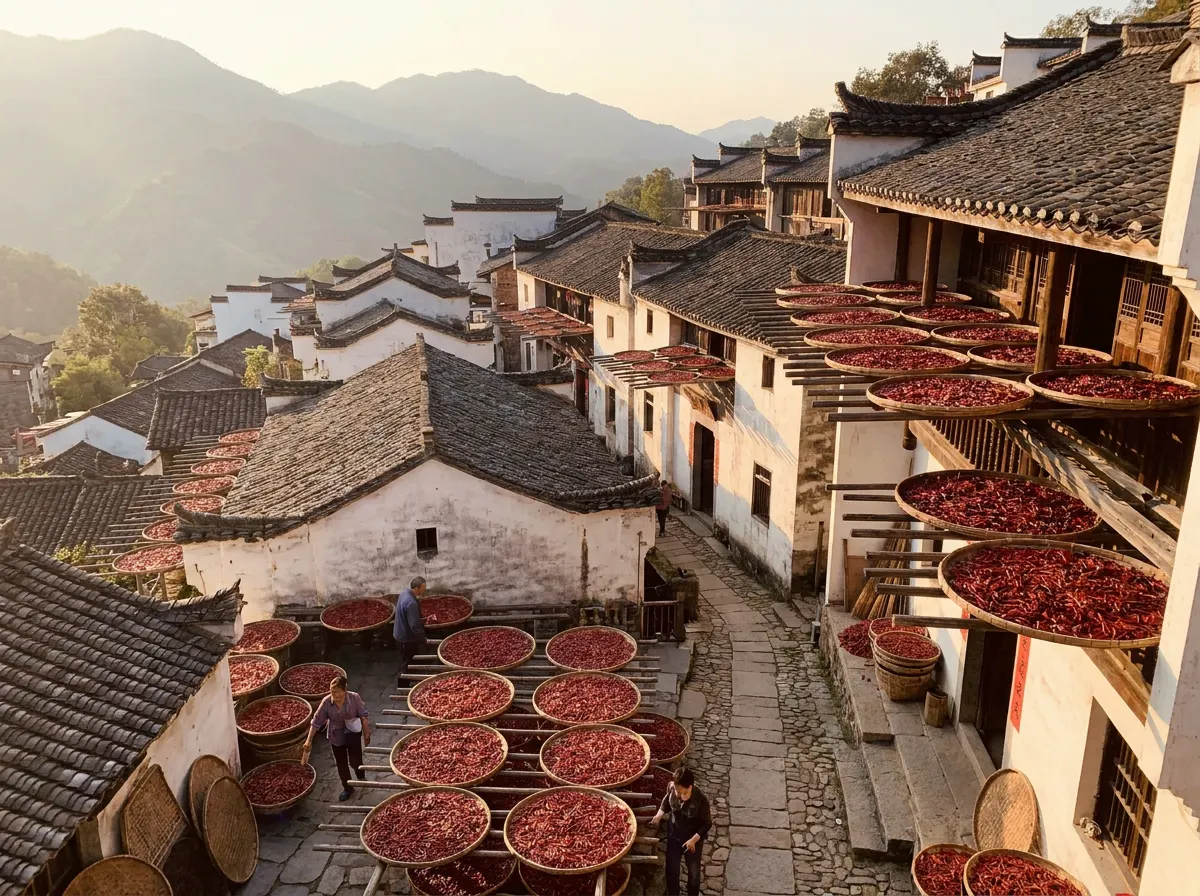
Autumn (October-November) replaces yellow canola with red maple and golden ginkgo leaves, set against the same white-walled villages. The crowds are smaller than in spring, the air is dry and clear, and Huangling hosts its annual "shai qiu" (晒秋) harvest-drying festival, where villagers spread red chilies, yellow corn, and orange persimmons on rooftop bamboo trays — a photographer's dream. Temperatures run 12-22°C, ideal for hiking between villages. The downside is that the dramatic yellow-flower vistas disappear. Travelers who want both seasons often pair an autumn trip to Wuyuan with a Huangshan summit hike, since the two are 1.5 hours apart by rail.
What is the best season for Wuyuan's rapeseed fields?
Peak bloom is typically March 15 to April 5, but the exact window shifts 7-10 days each year based on winter temperatures and spring rainfall. The bloom progresses in elevation bands: lower-elevation fields around Jiangling and Likeng open first, around March 10-15, while the higher terraces at Huangling peak around March 20-30, and the latest fields near the mountain foothills flower into early April. At peak, the terraces turn solid yellow, framing white-walled villages in a continuous carpet of color — this is what the well-known photographs capture. Arrive mid-week (Monday through Thursday) if possible, because weekends in late March are overwhelmed with domestic tourists, and book trains and hotels 2-3 weeks ahead for the peak window. Monitor the Wuyuan Tourism WeChat account for real-time bloom reports. If you arrive too early, the fields are patchy green and yellow — still beautiful but not the well-known carpet. If you arrive too late, seed pods begin forming and green returns to the terraces, though the villages remain worth visiting. Photographically, the 2-3 days just before absolute peak are often better than peak itself, because the light and crowds are more manageable while the bloom is already at 90-95%. Serious photographers sometimes book a flexible 5-day window and move their itinerary once bloom reports confirm the timing.
What are the best ancient villages to visit in Wuyuan?
Huangling (篁岭) is the star attraction — a 580-year-old village perched on a ridge and accessed by cable car. It is famous for terraced flower fields in spring, the shai qiu harvest-drying displays in autumn, and the best-preserved Huizhou architecture in the county. Entry is ¥145 including the cable car; allow 4-5 hours. Likeng (李坑) is a 1,100-year-old waterside village with arched stone bridges crossing a clear stream, narrow cobblestone alleys, and Ming-Qing houses lining both banks. It is compact and walkable in 2 hours; ¥60 entry; best for canal reflections and village atmosphere. Jiangling (江岭) is the premier photography site, with layered terraces wrapping around scattered houses in a natural amphitheater — free entry and best visited at dawn for mist-on-terraces shots before tour buses arrive. Xiaoqi (晓起) consists of two connected villages, Upper and Lower Xiaoqi, separated by a 1km walking path through tea fields, with ancient camphor trees over 1,000 years old and traditional woodcarving workshops; ¥60 entry; quieter than Likeng. Sixi Yancun (思溪延村) is a pair of adjacent Ming-Qing villages with elaborate merchant mansions, the best architectural detail in Wuyuan for students of Huizhou style; ¥60 entry. Rainbow Bridge (彩虹桥) is an 800-year-old Song-dynasty covered bridge spanning 140 meters, the longest in China, with free entry and best photographed in morning mist. Qingyuan (庆源) is a remote village further from the main circuit, less restored and more authentic, with a stream through the center and peach blossoms in spring; free or small donation; harder to reach but rewards the effort with genuine village life.
How do I photograph Wuyuan at its best?
Jiangling at sunrise (5:30-6:30 AM in spring) delivers the essential photograph — mist rising from illuminated canola terraces. Set up at the upper viewing platform and wait for the light to break over the ridges. Huangling from the cable car approach at mid-morning (8-9 AM) for the classic village-in-a-sea-of-yellow shot with side lighting that sculpts the rooftops. Likeng in late afternoon (3-5 PM) for canal reflections and low-angle light through the narrow alleys, when the stone bridges cast long shadows across the water. Rainbow Bridge in early morning (6-7 AM) with mist on the water and the covered bridge reflected in still surfaces. Equipment recommendations: a wide-angle lens (16-35mm) for terraced landscapes and village overviews, a telephoto (70-200mm) for compressing the layered terraces and isolating architectural details, and a sturdy tripod for sunrise mist and low-light canal shots. The shai qiu displays at Huangling require a mid-range zoom (24-70mm) to capture the colorful rooftop trays against the village background. Crowd strategy: arrive at villages by 6 AM for sunrise shots — tourist groups begin arriving around 9 AM, and the best light happens while most visitors are still eating breakfast. Shoot Huangling on weekdays. Golden hour in spring runs roughly 5:30-7:30 AM and 4:30-6:30 PM. Bring extra batteries and memory cards — you will shoot far more than you expect. A polarizing filter helps cut glare on canal water and damp rooftops, and a neutral density filter is useful for smoothing water flow in stream shots. A drone, if you have one and can fly it legally, opens up an entirely different perspective on the terraced landscapes, though check local restrictions around villages.
When is the best time to see Wuyuan's rapeseed fields?
Peak bloom runs mid-March to early April, typically between March 15 and April 5, with the exact timing shifting 7-10 days each year based on winter temperatures and spring rainfall. The bloom progresses in elevation bands: lower-elevation fields around Jiangling and Likeng open first around March 10-15, while the higher terraces at Huangling peak around March 20-30, and the latest fields near the mountain foothills flower into early April. At peak, the terraces turn solid yellow, framing white-walled villages in a continuous carpet of color. The key planning insight: the 2-3 days just before absolute peak are often photographically better than peak itself, because the light and crowds are more manageable while the bloom is already at 90-95%. Arrive mid-week (Monday through Thursday) if possible — weekends in late March are overwhelmed with domestic tourists, and the narrow village lanes become single-file crowds. Book trains, hotels, and Huangling cable car tickets 2-4 weeks ahead for the peak window. Monitor the official Wuyuan Tourism WeChat account for real-time bloom reports starting in late February. If you arrive too early (before March 10), the fields are patchy green and yellow — still scenic but not the well-known carpet. If you arrive too late (after April 10), the flowers have gone to seed and green returns to the terraces, though the villages remain beautiful. Serious photographers sometimes book a flexible 5-day window and adjust their itinerary once bloom reports confirm the timing. The bloom is not the only season worth visiting — see autumn (October-November) for red maple, golden ginkgo, and the shai qiu harvest-drying displays, which many repeat visitors prefer for the smaller crowds and different palette.
What is the history and culture of Wuyuan?
Wuyuan's cultural identity is rooted in its position at the intersection of Huizhou merchant history, Jiangnan landscape aesthetics, and rural Chinese tradition. The county was historically part of Huizhou (徽州), a prefecture that spanned southern Anhui and parts of northeastern Jiangxi, and the wealthy Huizhou merchants who made fortunes in salt, tea, and timber trades during the Ming (1368-1644) and Qing (1644-1912) dynasties invested heavily in their home villages. They built grand ancestral halls, elaborate courtyard mansions, and arched stone bridges, decorated with intricate wood, brick, and stone carvings depicting scenes from Chinese literature, mythology, and daily life. This is why Wuyuan has over 4,500 Ming-Qing villages — it was one of the richest corners of rural China. Architecturally, the Huizhou style is defined by whitewashed walls (a lime-and-clay plaster over brick), dark grey tile roofs with sweeping eaves, horse-head gables (马头墙) that step up at the gable ends as firebreaks, and carved doorways and window lintels. The villages are built according to feng shui principles, typically tucked with a mountain at the back, a stream in front, and south-facing orientation. Culturally, Wuyuan was also a prominent center of Confucian scholarship and produced a disproportionate number of imperial examination graduates — the study halls and private academies in several villages attest to this scholarly tradition. The county is famous for several intangible cultural traditions: Wuyuan green tea cultivation (婺源绿茶), recognized as one of China's great green teas; Huizhou woodcarving, passed down through generations of craftsmen; the shai qiu harvest-drying tradition, which is both practical food preservation and a visual spectacle; and Wuyuan opera, a regional form of Chinese opera performed at temple festivals. Today, Wuyuan walks a careful line between tourism development and preservation — Huangling is the most commercially developed, while villages like Qingyuan and Sixi Yancun remain quieter and more lived-in. The county's UNESCO-level cultural value lies in the density and completeness of its preserved villages — you are not seeing one or two restored showpieces but an entire cultural landscape where dozens of settlements retain their Ming-Qing fabric.
How do I plan a photography trip to Wuyuan?
A successful Wuyuan photography trip is all about timing, light, and logistics. The definitive shot sequence: Day 1 — arrive the night before and stay near Jiangling to be on the upper viewing platform by 5:30 AM (spring) or 6:00 AM (autumn) for sunrise mist on the layered terraces. This is the essential Wuyuan photograph — mist rising from canola fields, scattered houses, and angled morning light. Shoot for about 90 minutes, then head to Huangling by 9 AM for the cable-car approach and the classic village-in-a-sea-of-yellow (or red-in-autumn) composition with side lighting. Spend the afternoon exploring Huangling's alleyways and the shai qiu drying displays. Day 2 — Likeng at sunrise for canal reflections before the water surface is disturbed by the day's first boats. Move to Xiaoqi by mid-morning for the ancient camphor trees and tea-field path between Upper and Lower villages. Afternoon at Sixi Yancun for architectural detail. Day 3 — Rainbow Bridge at dawn for the covered bridge in mist (the single most serene shot in Wuyuan). If you have a fourth day, add Moon Bay (月亮湾) at sunrise for the crescent-shaped river bend with mist and a bamboo raft, and Qingyuan for authentic village life. Equipment priorities: a sturdy tripod (essential for sunrise mist and low-light canal shots), a wide-angle zoom (16-35mm for terraced landscapes and village overviews), a telephoto zoom (70-200mm for compressing the layered terraces and isolating architectural details), a mid-range zoom (24-70mm for general walk-around), a polarizing filter (cuts glare on canal water and wet rooftops), and an ND filter (for smoothing water flow in stream compositions). Bring at least twice as many batteries and memory cards as you think you need. A drone, if legal and permitted, opens up an entirely different perspective on the terraced landscapes. Crowd strategy: arrive at villages by 5:30-6:00 AM for sunrise shots — tourist groups begin arriving around 9 AM, and the best light happens while most visitors are still eating breakfast. Shoot Huangling on weekdays. Golden hour in spring runs roughly 5:30-7:30 AM and 4:30-6:30 PM. The cable car at Huangling starts operating around 7:30 AM; if you stay overnight in Huangling, you can shoot the village before the first cable car arrivals. Book a private driver for your entire photography stay — the ability to arrive at locations before dawn, move between villages on your own schedule, and stay until the last light is the single biggest factor in getting good images. Budget roughly ¥500-800 per day for a driver. Stay overnight inside Huangling for at least one night — the village at dawn and dusk, after day-trippers leave, is the definitive experience.
Top attractions
Huangling Village (篁岭)
Famous 580-year-old village with terraced canola flower fields. Cable car + village combo ¥145. Allow 4-5 hours.
Likeng Village (李坑)
1,100-year-old canal village with Ming-Qing architecture. ¥60. Small but atmospheric.
Jiangling Village (江岭)
Terraced canola flower fields with Huizhou-style villages scattered throughout. Free entry. Best for photographers.
Wuyuan Museum
Free museum in the county town, with Huizhou artifacts, ancient wedding customs, and Ming-Qing furniture. Allow 1.5 hours.
Rainbow Bridge (彩虹桥)
800-year-old Song-dynaxy covered bridge, China's longest. ¥0 entry. 30km from Wuyuan town.
Problems travelers hit in Wuyuan
- Why is my Alipay not working?You linked a foreign Visa or Mastercard to Alipay but every transaction is rejected at the merchant.
- My China visa was denied — what now?Your L visa application was refused at the Chinese consulate and your trip is in 2–4 weeks.
- My passport was lost or stolen in China — what do I do?Your passport is gone (theft or loss) and you're in mainland China without travel documents.
- Why can't I book on 12306 with my foreign card?You tried to book a high-speed rail ticket on 12306.cn and your foreign Visa/Mastercard is rejected at checkout.
- Why is my VPN not working in China?You arrived in China, opened your VPN, and it will not connect at all or connects but no traffic loads.
- Why can't I book a Tibet trip on my own?You try to book Lhasa flights and hotels yourself but the booking fails, or you're turned away at the Lhasa airport without a permit.
Book activities in Wuyuan
These are licensed tour operators and booking platforms we've vetted independently. Booking through these links may earn us a commission — see our affiliate disclosure. This never affects our editorial recommendations or the price you pay.
Frequently asked questions
Is Wuyuan worth visiting outside of spring?
Do I need a car in Wuyuan?
What is the best photo spot in Wuyuan?
How is Wuyuan different from Anhui's Hongcun and Xidi?
Is Wuyuan safe?
What should I eat in Wuyuan?
Show all 53 FAQs
Can I visit Wuyuan as a day trip from Huangshan?
Do I need to book the Huangling cable car in advance?
Are credit cards accepted in Wuyuan villages?
What is the "shai qiu" harvest festival?
Is Wuyuan crowded during canola season?
What should I pack for Wuyuan?
Tell me more about Likeng Village — what makes it special?
What is Jiangwan Village and is it worth visiting?
What is Xiaoqi Village like?
What is Sixi Yancun and why is it important?
Tell me about the Rainbow Bridge — is it worth the drive?
What is Mandarin Duck Lake and should I visit?
How do I get to Wuyuan from Huangshan?
How do I get to Wuyuan from Jingdezhen?
Where is the best place to stay in Wuyuan?
What should I eat in Wuyuan?
What is the "shai qiu" autumn tradition in detail?
What are the best photo spots in Wuyuan?
How many days do I need in Wuyuan?
What is the best season to visit Wuyuan in detail?
How much does a Wuyuan trip cost?
Do I need a car or driver in Wuyuan?
Is Wuyuan safe for solo travelers?
Can I visit Wuyuan with young children?
What is the best village for someone who only has one day?
What is Huangling Village and why is it the must-see?
What makes Likeng Village special?
What is Jiangwan Village and is it worth visiting?
What is Xiaoqi Village like?
Tell me about the Rainbow Bridge — what makes it special?
What are Likeng's streams and bridges like for photography?
What is the best season breakdown for Wuyuan?
How do I get to Wuyuan from major cities?
Where should I stay in Wuyuan?
What is Huizhou architecture in detail?
What local food specialties should I try in Wuyuan?
How much does a Wuyuan trip cost?
Is Wuyuan family-friendly?
Is Wuyuan safe for solo travelers?
What should I pack for Wuyuan?
What photography equipment do I need for Wuyuan?
How does Wuyuan compare to other ancient villages in China?
Can I combine Wuyuan with Huangshan in one trip?
What are the most photographed villages in Wuyuan and which are worth visiting?
What is the best photography season and technique for Wuyuan?
What is the Huizhou architecture style and why is Wuyuan different from Anhui Hongcun?
How do you get to Wuyuan and what is the internal transport like?
References

Related guides & destinations
Guide
How We Research 2026: NihaoVisit’s Methodology for China Travel Information
How NihaoVisit sources, verifies, and maintains 700+ pages of China travel information — our source hierarchy, fact-checking process, update
Guide
Fact-Checking Log 2026: Verified China Travel Information — NihaoVisit
A public log of fact-checking verification passes on NihaoVisit, showing what was verified, when, and against which sources — covering visa
Guide
Best Time to Visit China 2026: Month-by-Month Weather, Crowds, and Prices
The best time to visit most of China is April–May and September–October. Winter (Dec–Feb) is cold but cheap; summer (Jun–Aug) is hot and cro
Guide
VPN for China 2026: Which VPNs Work, eSIM Alternatives, and the Complete Pre-Trip Checklist
Most Western apps and websites are blocked in mainland China. A reliable VPN is essential for Google, Gmail, WhatsApp, Instagram, and most n
Guide
China SIM Card and eSIM Guide 2026: Stay Connected Without WeChat
A Chinese SIM or eSIM lets you use mobile data, maps, and ride-hailing without WiFi. Here is how to get one, the cost, and which provider to
Guide
Solo Female Travel in China 2026: Safety, Tips, and Real Experiences
China is one of the safer destinations for solo female travelers. Petty theft is rare, violent crime against tourists is extremely uncommon,