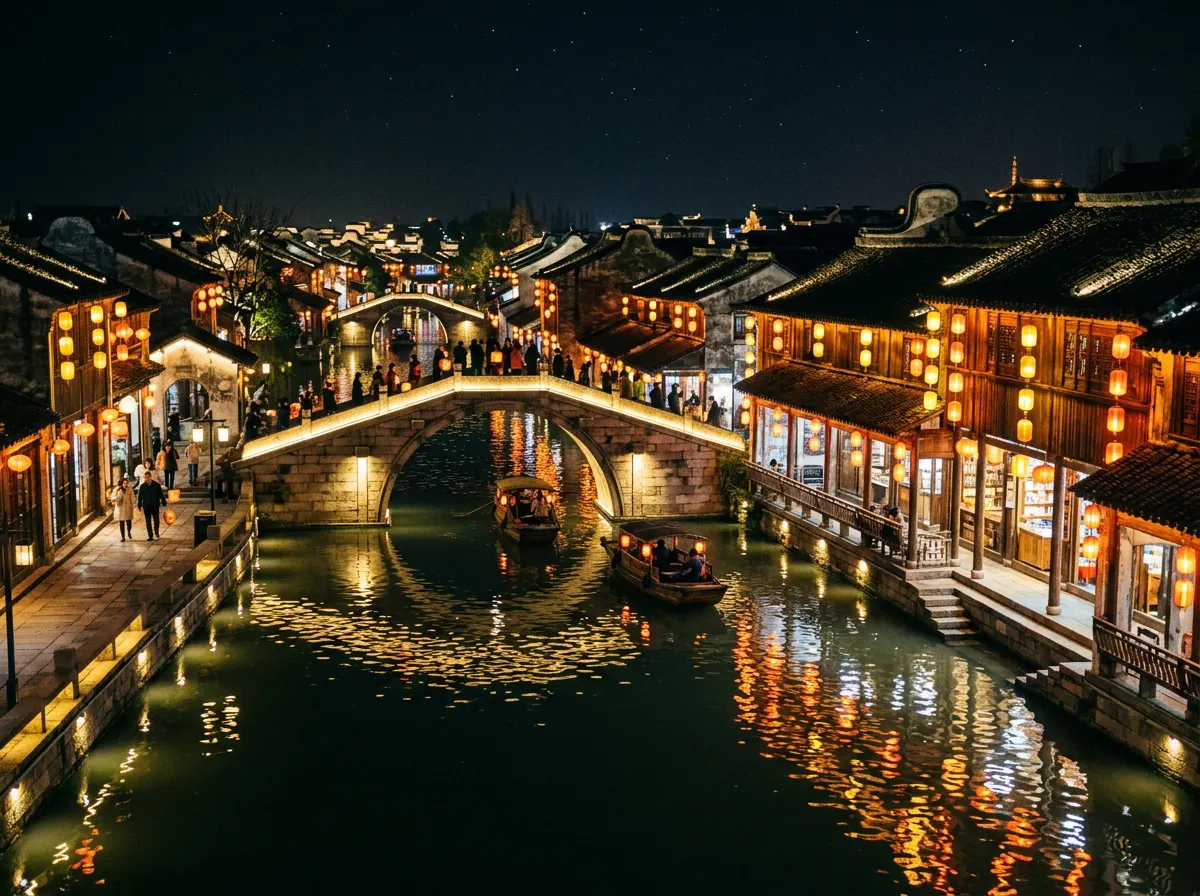
Wuzhen Water Town
Wuzhen is the most accessible of the Jiangnan water towns from Shanghai and Hangzhou, and one of the most polished. It has two distinct zones: Dongzha (the East) is smaller and busier with traditional craft workshops, while Xizha (the West) is larger, more atmospheric, and has boutique hotels inside the canals so travelers can stay overnight. Half a day covers the highlights; one overnight lets you experience the town after the day-trippers leave, when lanterns light the water. Best paired with a Hangzhou or Shanghai trip.
Why Wuzhen Water Town in 2026.
A centuries-old canal town in Zhejiang — stone bridges, whitewashed houses, and a slower pace that anchors many Jiangnan itineraries.
Quick Answer
Wuzhen is the most accessible of the Jiangnan water towns from Shanghai and Hangzhou, and one of the most polished. It has two distinct zones: Dongzha (the East) is smaller and busier with traditional craft workshops, while Xizha (the West) is larger, more atmospheric, and has boutique hotels inside the canals so travelers can stay overnight. Half a day covers the highlights; one overnight lets you experience the town after the day-trippers leave, when lanterns light the water. Best paired with a Hangzhou or Shanghai trip.
| Best time to visit | April-May and September-November; summer is hot and crowded |
|---|---|
| Daily budget | $70 (backpacker) / $180 (mid-range) / $500+ (luxury) |
| Language | Mandarin and Wu dialect; English signage in the scenic area |
| Currency | CNY (¥) |
| Time zone | China Standard Time (UTC+8) |
| Last updated | 2026-06-16 |
Want a Wuzhen Water Town plan built for you?
What makes Wuzhen different from other water towns?
Wuzhen is one of several historic canal towns in the Jiangnan region south of the Yangtze, but it is the most uniformly restored and the most foreigner-friendly. The whole scenic area is managed as a single attraction, which means consistent ticketing, signage, and maintained buildings — less "authentic working town" than some neighbors, but more atmospheric and easier to navigate for visitors. Its other distinction is the West Zone's boutique hotels built inside the old canal houses, which lets you sleep inside the postcard and see the town empty out at night.
Which Wuzhen zone should I prioritize — East or West?
Prioritize Xizha (the West) for most travelers. It is larger, better preserved, has the canal-side boutique hotels, and the famous night-lantern atmosphere. Dongzha (the East) is the older, busier zone with traditional craft workshops — worth a half-day add-on but not a standalone destination. A common plan is a Dongzha morning followed by a Xizha afternoon and overnight.
Is it worth staying overnight inside the scenic area?
Yes, if you can spare one night. The day-trippers leave by early evening and the town transforms into lantern-lit quiet canals — the experience most visitors remember. The boutique hotels are restored Ming- and Qing-era buildings, atmospheric but simple. It costs more than staying outside, but the after-hours access is the point. If budget is tight, day-trip instead; the daytime charm is still strong.
How do I get to Wuzhen?
Wuzhen sits between Shanghai and Hangzhou. The fastest route is high-speed rail to Tongxiang station, then a short taxi to the scenic area; from Hangzhou the rail leg is under an hour, from Shanghai around an hour and a half. There are also direct buses from Shanghai. Most travelers come as a day trip from Hangzhou, or as a Hangzhou–Wuzhen overnight woven into a longer Jiangnan itinerary. Confirm current transport options before traveling, as schedules adjust.
How many days do I need?
Half a day covers one zone; a full day lets you see both East and West; one overnight is the recommended minimum to catch the town after dark and re-enter the next morning. Wuzhen is compact, so even a relaxed visit rarely needs more than a night. Pair it with Hangzhou or Suzhou rather than treating it as a standalone long trip.
When is the best time to visit?
April to May and September to November are the most pleasant, with mild weather and manageable crowds. Summer is hot, humid, and the busiest domestic season. Winter is cold and quiet — fewer crowds and a misty, atmospheric canal, but dress warmly, as the stone bridges and open boats are exposed. Avoid the October Golden Week and Chinese New Year, when domestic tourist numbers surge.
What should I eat in Wuzhen?
Wuzhen's food is classic Jiangnan — fresh-water fish and shrimp, rice dishes, and local snacks. Signature items include braised lamb (a local specialty traditionally eaten in autumn), sweet lotus root, deep-fried stinky tofu, and rice wine. The West Zone has restaurants and teahouses along the canals, pricier than outside but atmospheric. For cheaper, more local food, eat in the non-scenic parts of town before or after your visit.
What other water towns can I visit instead?
Several Jiangnan water towns offer a similar experience. Zhouzhuang, closest to Shanghai, is the most famous and most crowded. Tongli, near Suzhou, is smaller and quieter. Xitang is known for its covered lanes. Wuzhen is the best-developed and most foreigner-friendly; if you prefer fewer crowds and a more lived-in feel, Tongli is the usual alternative. You do not need to visit more than one — pick based on your route.
Is Wuzhen family-friendly and accessible?
It is family-friendly in atmosphere — gentle, scenic, and easy to pace — but the cobblestone lanes, many small bridges, and steps make it challenging for strollers and wheelchair users. With children, the West Zone's manageable size and boat rides work well. Older travelers should expect uneven surfaces and lots of walking. Comfortable shoes and a slow pace matter more here than at any other Chinese sight.
What is the best step-by-step way to experience Wuzhen?
The ideal visit follows a clear rhythm. Arrive mid-morning and start in Dongzha (the East Zone), which is smaller, busier, and best seen in a few hours. Walk the main canal street, duck into the indigo-dye workshop and the hundred-bed museum, and pause at a teahouse. Around noon, head to Xizha (the West Zone). Check into your canal-side boutique hotel if staying overnight, then spend the afternoon walking the wider, quieter lanes — the water market, the old post office, the wedding museum, and the Grand Theatre exterior. As dusk falls, find a canal-side restaurant for braised lamb and freshwater fish, the local specialties, then walk the lantern-lit canals. The next morning, wake before the day-trippers arrive — around 7 a.m. the canals are misty and empty, and the light is excellent for photography. This overnight rhythm — Dongzha morning, Xizha afternoon and night, early-morning stroll — is the sequence regular visitors recommend.
How does staying inside the Wuzhen scenic area actually work?
Staying overnight inside Xizha is the signature Wuzhen experience. The boutique hotels are restored Ming- and Qing-era canal houses operated by the scenic-area management company. Book through the official Wuzhen tourism website or a Chinese booking platform. At the Xizha entrance, check in at the visitor center, where staff arrange luggage transfer by boat or cart — you walk in unencumbered. Your room key or wristband serves as your scenic-area pass, with a combined room-and-entry rate covering multi-day access. The hotels range from simple guesthouses in old wooden buildings to higher-end boutique properties with modern bathrooms behind historic facades. Expect character — uneven floors, wooden lattice windows, canal views — rather than five-star luxury. Dongzha and Xizha are ticketed separately, so a next-morning Dongzha visit needs a separate ticket unless you bought a combo pass. Budget roughly an extra ¥400–1,000 per night depending on room grade and season.
How does the World Internet Conference affect a Wuzhen visit?
Wuzhen has hosted the annual World Internet Conference (WIC) since 2014, drawing government officials and global tech executives for several days, usually in November or December, though dates shift. During the conference, parts of the scenic area — especially Xizha — face access restrictions or full closure to regular visitors. The Wuzhen Grand Theatre and the permanent internet conference center designed by Wang Shu are the focal points. If your travel dates overlap, expect higher accommodation prices, restricted entry to parts of Xizha, larger crowds in unaffected areas, and a less atmospheric experience. Check WIC dates before booking. If they fall during your intended window, shift your dates or swap Wuzhen for Tongli, Xitang, or another water town. Outside of conference week, the internet center has no impact on a regular visit.
What is the difference between East Gate and West Gate?
Wuzhen is divided into two separately ticketed scenic zones — Dongzha (East Gate, 东栅) and Xizha (West Gate, 西栅) — and they offer fundamentally different experiences. Dongzha (East Gate) is the original tourist zone, opened first, and is smaller, busier, and more concentrated. Its lanes are narrower, the canal is tighter, and the atmosphere is livelier and more commercial. This is where you find the traditional craft workshops that Wuzhen is famous for: the indigo-dye fabric workshop with drying racks hung with long bolts of blue-and-white cloth, the hundred-bed museum with antique carved rosewood beds, the woodcarving workshop, and the former residence of writer Mao Dun. Dongzha feels like a working museum — compact, dense with attractions, and best seen in 2-3 hours. Entry is roughly ¥110. Xizha (West Gate) is the larger, later-developed zone and the one that most travelers prioritize. It has wider canals, more open squares, better restaurants and teahouses, and the signature canal-side boutique hotels built inside restored Ming- and Qing-era buildings. This is where you go for the atmospheric overnight experience — the lantern-lit canals after dark, the misty early mornings, and the quieter, more spread-out pace. Xizha attractions include the water market, the old post office, the wedding museum, and the Grand Theatre. Entry is roughly ¥150. A combo ticket for both zones costs roughly ¥190 and is valid for one day. The classic plan: Dongzha in the morning (2-3 hours), Xizha in the afternoon and overnight. The two zones are about 1.5km apart, connected by a free shuttle bus or a 20-minute walk. If you only have time for one zone, choose Xizha. If you are on a day trip and want the highest density of attractions per hour, Dongzha delivers more in less time.
What is the best way to experience Wuzhen?
The ideal Wuzhen visit follows a clear rhythm that maximizes atmosphere. Start your day around 9 AM at Dongzha (East Gate). Walk the main canal street, duck into the indigo-dye workshop early before it gets crowded (the drying racks photograph best with morning light), visit the hundred-bed museum to see the astonishing detail of Ming-Qing furniture craftsmanship, and pause at Mao Dun's former residence for a dose of literary history. The Dongzha circuit takes about 3 hours at a relaxed pace. Around noon, take the free shuttle bus or walk (20 minutes) to Xizha (West Gate). If staying overnight, check into your hotel at the visitor center — staff will transfer your luggage by boat. Spend the afternoon exploring Xizha's wider, quieter lanes: the water market with its teahouse terraces over the canal, the old post office (send a postcard — the stamps are a nice souvenir), the wedding museum, and the Grand Theatre exterior. Around 4 PM, find a canal-side teahouse for a pot of Longjing tea — this is the golden hour for people-watching and photography as the sun angles across the water. For dinner, choose a canal-side restaurant for braised lamb, freshwater fish, and a glass of Wuzhen rice wine. After dinner, walk the lantern-lit canals — this is the experience most visitors remember. The red lanterns reflect in the dark water, the stone bridges are silhouetted against the night sky, and the day-trippers are gone. The next morning, wake before 7 AM and walk the canals again. The water is still, mist hangs over the surface, and the first boats glide silently under the bridges. At this hour, Xizha feels like a different place — quiet, timeless, and entirely yours. After a morning stroll, have breakfast at a canal-side café and depart. This overnight rhythm — Dongzha morning, Xizha afternoon and night, early-morning stroll — is the sequence that repeat visitors recommend without exception.
How does Wuzhen compare to other water towns?
The Jiangnan (south of the Yangtze) region holds several historic canal towns, and each has a distinctive character. Wuzhen: the most polished, best-managed, and most foreigner-friendly of the water towns. Its two-zone setup and canal-side boutique hotels make it uniquely suited to overnight stays. It is the most consistent, the easiest to navigate, and the best choice for first-time water-town visitors — but it is also the most deliberately curated, which some travelers find too managed. Zhouzhuang: the most famous, the oldest (900+ years), and the most crowded. Its twin bridges (Shuang Qiao) are arguably the most photographed canal-town scene in China, and the Shen House and Zhang House are excellent examples of Ming-Qing merchant architecture. Zhouzhuang is the closest water town to Shanghai (about 1.5 hours). It is more chaotic, more commercial, and more authentically busy than Wuzhen. Choose Zhouzhuang for the well-known bridge shot and the historical weight; avoid it on weekends and Chinese holidays. Tongli: near Suzhou, smaller and quieter than either Wuzhen or Zhouzhuang, with a more lived-in feel. Its Retreat and Reflection Garden (Tuisi Yuan) is a UNESCO World Heritage site, a masterpiece of classical Chinese garden design. Tongli is the best choice for travelers who find Wuzhen too polished and Zhouzhuang too crowded — it feels more like a real town with a tourism layer rather than a fully managed scenic area. Xitang: known for its covered corridors (langpeng) — continuous roofed walkways along the canals that let you walk the town even in rain. It is the most atmospheric in wet weather and the best for nighttime photography, with thousands of red lanterns reflected in the water. Xitang is halfway between Shanghai and Hangzhou, slightly less accessible than Wuzhen. Nanxun: the least touristy of the major water towns, with a mix of Chinese and Western architectural influences (some merchant mansions have European-style details), and quieter, less commercial lanes. Best for travelers who want the least curated experience. The bottom line: you only need to visit one water town, and Wuzhen is the safest choice for most foreign travelers. If you want something grittier and more authentic, choose Tongli or Nanxun. If you want the most well-known photographs, Zhouzhuang delivers. If you are traveling in rain, Xitang is uniquely suited.
What is Wuzhen's cultural heritage?
Wuzhen's cultural heritage is rooted in its history as a prosperous Jiangnan canal town — a center of trade, craftsmanship, and literary culture that flourished for centuries before tourism arrived. The town's recorded history stretches back over 1,300 years. Its economic foundation was the Grand Canal and the network of waterways that connected it to Hangzhou, Suzhou, and Shanghai, making it a hub for silk, rice, and tea. The cultural heritage visible today spans several dimensions. Craft traditions: Wuzhen preserves working demonstrations of traditional Jiangnan crafts, most famously indigo-dye fabric production using wooden looms and natural indigo dye — the blue-and-white calico (蓝印花布) was a staple textile of the region. The hundred-bed museum displays the woodcarving and lacquerwork traditions applied to furniture, with elaborately carved wedding beds, canopy beds, and daybeds from the Ming and Qing dynasties. There are also workshops for woodcarving, silk production, and traditional brewing. Literary heritage: Wuzhen is the hometown of Mao Dun (1896-1981), one of modern China's most important writers and a key figure in 20th-century Chinese literature. His former residence — a modest Qing-dynasty courtyard house with his study, garden, and a small museum — is preserved in Dongzha. Wuzhen also hosts an annual theater festival (usually October) founded by leading Chinese theater director Stan Lai, drawing avant-garde performances and international theater companies. The Wuzhen Grand Theatre, designed by Pritzker Prize-winning architect Wang Shu, is a modern wood-and-water structure that echoes the canal-town aesthetic in a contemporary vocabulary. Wedding customs: the Wuzhen Wedding Museum in Xizha preserves the elaborate traditions of Jiangnan weddings — the red sedan chair, embroidered bridal costumes, and the ritual objects that accompanied a traditional marriage. Water-town life: beyond the specific attractions, the cultural heritage is embedded in the layout of the town itself — the stone bridges, the waterfront teahouses, the rhythm of boat traffic, and the architecture adapted to life on the water. The scenic-area management has preserved the physical fabric, though the working life of a real canal town has largely been replaced by tourism. For the most authentic surviving elements, visit the Dongzha craft workshops, the hundred-bed museum (genuinely impressive craftsmanship), and the Mao Dun residence, and walk the early-morning canals before the tourism machinery wakes up.
What is the history of Wuzhen?
Wuzhen's recorded history stretches back over 1,300 years to the Tang dynasty, when the settlement grew around the Grand Canal and the waterways linking it to Hangzhou, Suzhou, and the wider Yangtze River Delta. The town was originally divided by a river into two administrative halves — one belonging to Wucheng County, the other to Tongxiang County — and this split identity persisted for centuries, giving the town its name (Wu + Zhen, roughly the town between two Wus). Through the Song (960–1279) and Yuan (1271–1368) dynasties, Wuzhen prospered as a regional market town where rice, silk, and tea were traded from canal boats, and its merchant class built the courtyard houses, stone bridges, and waterfront teahouses that define its architecture today. The Ming (1368–1644) and Qing (1644–1912) dynasties were Wuzhen's golden age — the period that produced the elaborately carved wedding beds now displayed in the hundred-bed museum, the indigo-dye workshops, and the silk-production infrastructure that made Jiangnan the textile center of imperial China. Mao Dun, one of modern China's most important writers, was born in Wuzhen in 1896, and his childhood home and the school where he studied are preserved in Dongzha. Through the twentieth century, Wuzhen declined — its canal economy was replaced by roads and railways, its merchant houses fell into disrepair, and by the 1990s it was a fading backwater. The restoration that created the modern scenic area began in 1999, led by a local entrepreneur with government backing, and was completed in two phases: Dongzha opened first in 2001, Xizha in 2007. The restoration was unusually thorough — hundreds of families were relocated to modern housing outside the scenic area, and the historic buildings were renovated to rigorous conservation standards, with utilities buried underground and a centralized management company operating the entire scenic zone. The result is the most polished water town in Jiangnan, though the thoroughness of the restoration means it is more a curated historic environment than a living, evolving town. The World Internet Conference, hosted annually in Wuzhen since 2014, added a layer of contemporary significance — a permanent conference center designed by Pritzker Prize-winning architect Wang Shu sits in Xizha, and during the conference the town becomes a stage for global technology diplomacy. The history that travelers encounter today sits at the intersection of Song-dynasty canal commerce, Ming-Qing craftsmanship, twentieth-century literary modernism, and twenty-first-century heritage tourism.
What are the best photo spots and times in Wuzhen?
The best Wuzhen photographs come from targeting specific locations at their optimal light rather than wandering and hoping, and the single most important factor is time of day. Early morning (6:30–8:00 AM) in Xizha is the prime window — the canals are still, mist hangs over the water, the first boats glide silently under stone bridges, and there are no day-trippers in frame. Walk the main Xizha canal from the water market to the old post office during this window for the cleanest compositions. The stone arch bridges at blue hour (roughly 30–45 minutes after sunset) with red lanterns reflected in the canal are the classic Wuzhen shot. The bridges in Xizha around the water market area — especially the Tongji Bridge and the Ruyi Bridge — are the most photogenic for this composition, with the lanterns lit and the sky holding a deep blue before going fully dark. A tripod or a camera with excellent high-ISO performance is essential for blue hour and night shots; the lantern light is atmospheric but dim. A fast lens (f/1.8 or faster) helps. The indigo-dye workshop in Dongzha, with long bolts of blue-and-white cloth hanging from tall wooden drying racks, is one of China's most photographed craft scenes. The best time is 9–10 AM, when the morning light angles through the hanging cloth and the yard is not yet crowded. A wide-angle lens captures the full drying-rack composition; a telephoto lens isolates patterns in the billowing fabric. Late afternoon (3–5 PM) in Xizha is the best light for the water market area, the whitewashed walls reflecting golden light, and the teahouse terraces over the canal. The Grand Theatre exterior from across the canal works well in the late afternoon when the wood facade glows in the low sun, and again at blue hour when its interior lights begin to show. The water market teahouses, with boats passing below and lanterns above, make strong layered compositions from the bridges at any time of day. The old post office facade, the wedding museum courtyard, and the Mao Dun residence garden are smaller-scale subjects that reward a medium telephoto lens for isolating architectural detail. Avoid midday (roughly 11 AM–2 PM) when the light is harsh and overhead, the lanes are most crowded, and the white walls blow out. A polarizing filter helps manage reflections on the canal water. The west side of Xizha — the quieter lanes away from the main canal — offers uncrowded architectural details at any time of day. If you are staying overnight, the 6:30 AM window is your single biggest photographic advantage over day-trippers.
What is the Wuzhen Theatre Festival and how do I attend?
The Wuzhen Theatre Festival, held annually in October (dates shift each year), is one of China's most important performing-arts events and a distinctive reason to visit Wuzhen outside the usual tourist rhythm. Founded in 2013 by leading Chinese-American theatre director Stan Lai (Lai Shengchuan) with support from actors Huang Lei and Meng Jinghui, the festival brings avant-garde theatre, experimental performance, international productions, and open-air street theatre to the water town, transforming its lanes, squares, and stages into a ten-day arts campus. The festival uses multiple venues: the Wuzhen Grand Theatre (the main venue, designed by Wang Shu), smaller indoor stages in restored halls, and pop-up outdoor stages in squares, on bridges, and along the canals. The outdoor street performances are free and open to all, and they are the most accessible layer of the festival — you can walk the town and encounter acrobats, musicians, dancers, and installation art in the lanes without a ticket. The indoor productions require tickets, which go on sale roughly one to two months before the festival and sell out quickly for headline shows. Ticket prices range from roughly one hundred yuan for smaller productions to five hundred yuan or more for the main-stage shows. The festival's program is published on its official website and WeChat account roughly six to eight weeks before the event. Most performances are in Mandarin, though the festival regularly includes international productions with surtitles. The festival adds a vibrant, youthful energy to Wuzhen — the lanes fill with theatre professionals, students, and arts audiences rather than the usual domestic tour groups, and the atmosphere is closer to Edinburgh or Avignon than a typical Chinese tourist sight. The downside: accommodation prices spike, the scenic area is busier than in any other October week, and Xizha hotels book out months in advance. If you want to attend, plan your accommodation as soon as the festival dates are announced, book tickets the day they go on sale, and target weekdays within the festival period for slightly thinner crowds. If you are not attending the festival, check the dates and avoid Wuzhen during those ten days — the experience for non-festival visitors is more crowded and more expensive than a normal autumn week.
Top attractions
Xizha (West) Scenic Area
The larger, more atmospheric zone, with canal-side boutique hotels in restored buildings and the best night-lantern views. A combo ticket covers daytime entry.
Dongzha (East) Scenic Area
Smaller and busier, with traditional craft workshops (silk, indigo dye, beds). Good for a half-day.
Night Lantern Walk
After dark, the West Zone is lit by red lanterns along the canals — the most photogenic time. Included with the Xizha ticket.
Wuzhen Grand Theatre
Modern wood-and-water theatre by Pritzker-laureate architect Wang Shu. Free to view the exterior; tickets for performances.
Hundred-Bed Museum
A collection of antique beds from the Ming and Qing dynasties housed in a restored canal-side mansion. The carved rosewood and lacquer pieces show the craftsmanship of wealthy Jiangnan families. Included in Dongzha entry.
Indigo Fabric Workshop (Hongyuantai Dyehouse)
A working indigo-dye workshop where blue-and-white calico is made using traditional wooden looms and natural dyes. The drying racks hung with long bolts of blue cloth are one of Wuzhen's most photographed scenes. In Dongzha.
Mao Dun's Former Residence
The childhood home of Mao Dun, one of modern China's most important writers. A modest Qing-dynasty courtyard house with study, garden, and a small museum about his literary career. Free with Dongzha entry.
Water Market and Riverside Teahouses
The stretch of canal in Xizha where boats once traded produce. Now lined with teahouses and viewing platforms over the water. Best in late afternoon with a pot of Longjing tea. Included in Xizha entry.
Wuzhen Wedding Museum
A small, atmospheric museum in Xizha dedicated to Jiangnan wedding customs — traditional sedan chairs, embroidered bridal costumes, and a recreated bridal chamber. Included in Xizha entry.
Problems travelers hit in Wuzhen Water Town
- Why is my Alipay not working?You linked a foreign Visa or Mastercard to Alipay but every transaction is rejected at the merchant.
- My China visa was denied — what now?Your L visa application was refused at the Chinese consulate and your trip is in 2–4 weeks.
- My passport was lost or stolen in China — what do I do?Your passport is gone (theft or loss) and you're in mainland China without travel documents.
- Why can't I book on 12306 with my foreign card?You tried to book a high-speed rail ticket on 12306.cn and your foreign Visa/Mastercard is rejected at checkout.
- Why is my VPN not working in China?You arrived in China, opened your VPN, and it will not connect at all or connects but no traffic loads.
- Why can't I book a Tibet trip on my own?You try to book Lhasa flights and hotels yourself but the booking fails, or you're turned away at the Lhasa airport without a permit.
Book activities in Wuzhen Water Town
These are licensed tour operators and booking platforms we've vetted independently. Booking through these links may earn us a commission — see our affiliate disclosure. This never affects our editorial recommendations or the price you pay.
Frequently asked questions
How do I get to Wuzhen from Shanghai or Hangzhou?
How long do I need in Wuzhen?
Are there other water towns worth visiting instead?
Can I visit in winter?
Is Wuzhen expensive?
Do I need to book the Xizha hotels in advance?
Show all 65 FAQs
Is photography allowed?
Can I take a boat ride on the canals?
What is the Wuzhen Internet Conference?
Is Wuzhen accessible for wheelchair users?
Should I visit Wuzhen or one of the bigger cities?
What is the single biggest mistake travelers make in Wuzhen?
How do I get to Wuzhen from Suzhou?
When is the very best season for Wuzhen?
Is a day trip enough, or should I stay overnight?
What are the best photo spots in Wuzhen?
What is Wuzhen's most famous local food?
Is Wuzhen safe for solo female travelers?
Can I combine Wuzhen with Suzhou in one trip?
What is the weather like across the year in Wuzhen?
Are there English signs and English-speaking staff in Wuzhen?
Can I use credit cards or mobile payment in Wuzhen?
When is Wuzhen quietest?
Can I visit Wuzhen with young children?
What should I wear and pack for Wuzhen?
Is the canal water clean? Is there a smell?
Can I take the high-speed train directly to Wuzhen?
How far in advance should I plan a Wuzhen visit?
What exactly is the difference between Dongzha and Xizha in Wuzhen?
Where are the best photo spots in Wuzhen?
What is the hundred-bed museum and is it worth visiting?
What is the indigo fabric workshop and why is it so photographed?
What is Mao Dun's former residence and why does it matter?
What is the water market and where is the best teahouse?
What is the best season to visit Wuzhen?
Is a day trip enough for Wuzhen, or should I stay overnight?
How do I get to Wuzhen from Shanghai, Hangzhou, or Suzhou?
How much does a Wuzhen trip cost?
Should I stay inside the scenic area or outside?
What local food specialties should I try in Wuzhen?
What is the World Internet Conference and how does it affect my visit?
What is Wuzhen like at night?
Is Wuzhen family-friendly?
Is Wuzhen safe for solo travelers?
What should I pack for Wuzhen?
How do SIM cards and payment work in Wuzhen?
How do I book Wuzhen scenic-area entry and hotels?
What are the best boat rides in Wuzhen?
Can I visit Wuzhen with mobility limitations?
What is the Wuzhen Theatre Festival and how do I get tickets?
What is Wuzhen like in the rain?
Can I see a performance at the Wuzhen Grand Theatre?
What is the Wuzhen Wedding Museum?
What is Wuzhen's connection to the silk industry?
Should I visit Wuzhen with a guide or self-guided?
Are drones allowed in Wuzhen?
What are the morning hours and routines in Wuzhen?
What are the best restaurants inside Xizha?
Is Wuzhen suitable for elderly travelers?
Can I swim in the Wuzhen canals?
What should I buy as souvenirs in Wuzhen?
Is there luggage storage at Wuzhen?
What is the best way to experience Wuzhen's tea culture?
How do I get from Wuzhen to my next destination?
Can I visit Wuzhen and another water town on the same trip?
References

Related guides & destinations
Guide
How We Research 2026: NihaoVisit’s Methodology for China Travel Information
How NihaoVisit sources, verifies, and maintains 700+ pages of China travel information — our source hierarchy, fact-checking process, update
Guide
Fact-Checking Log 2026: Verified China Travel Information — NihaoVisit
A public log of fact-checking verification passes on NihaoVisit, showing what was verified, when, and against which sources — covering visa
Guide
Best Time to Visit China 2026: Month-by-Month Weather, Crowds, and Prices
The best time to visit most of China is April–May and September–October. Winter (Dec–Feb) is cold but cheap; summer (Jun–Aug) is hot and cro
Guide
VPN for China 2026: Which VPNs Work, eSIM Alternatives, and the Complete Pre-Trip Checklist
Most Western apps and websites are blocked in mainland China. A reliable VPN is essential for Google, Gmail, WhatsApp, Instagram, and most n
Guide
China SIM Card and eSIM Guide 2026: Stay Connected Without WeChat
A Chinese SIM or eSIM lets you use mobile data, maps, and ride-hailing without WiFi. Here is how to get one, the cost, and which provider to
Guide
Solo Female Travel in China 2026: Safety, Tips, and Real Experiences
China is one of the safer destinations for solo female travelers. Petty theft is rare, violent crime against tourists is extremely uncommon,