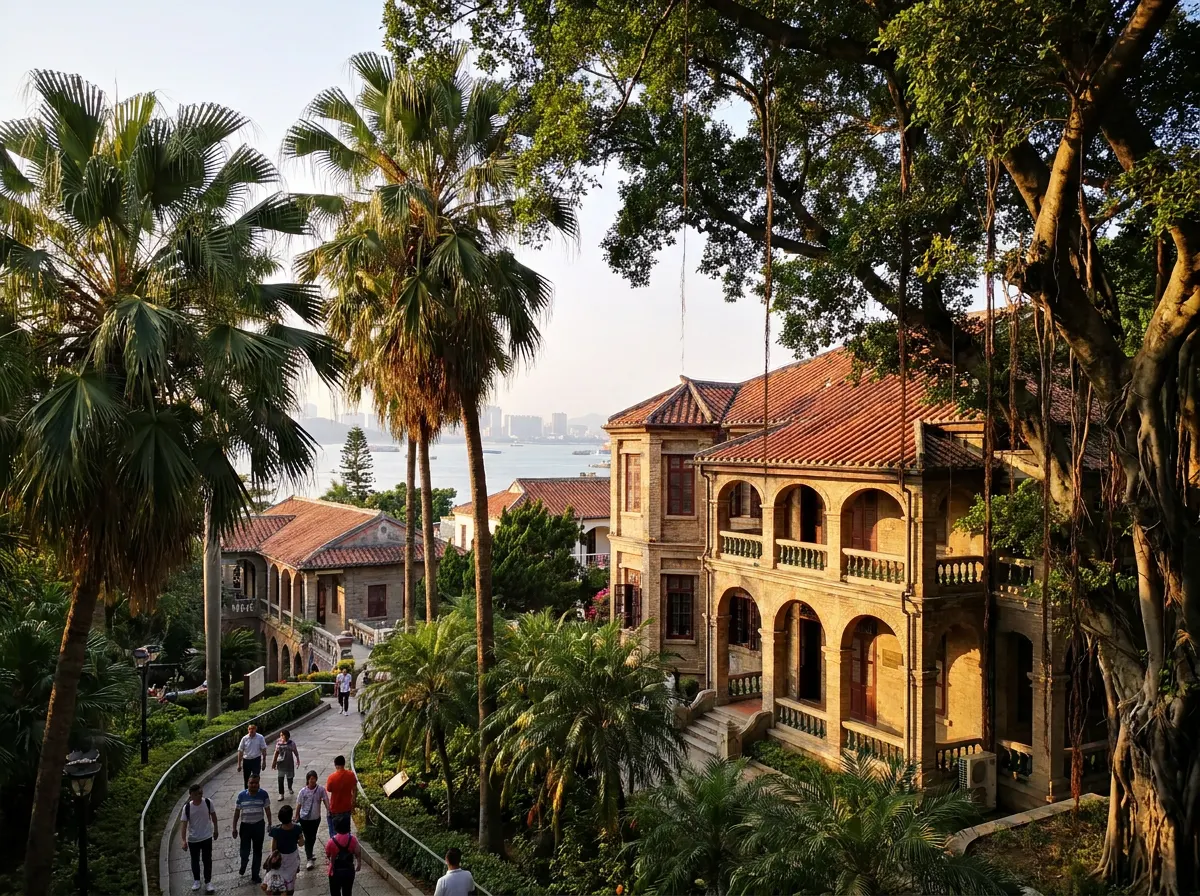
Xiamen and Gulangyu Island
Xiamen is the most livable Chinese coastal city and a top weekend escape from Hong Kong and Shanghai. The highlight is Gulangyu Island (鼓浪屿) — a 20-minute ferry ride, no cars, piano museums, colonial-era architecture, and winding lanes. Spend 2–3 days: Day 1 Gulangyu, Day 2 Xiamen University and Nanputuo Temple, Day 3 day trip to the Tulou earthen-walled villages of Fujian (UNESCO). The food is seafood-heavy and lighter than inland Chinese cuisine. Best October–April; summers are hot and typhoon-prone.
Why Xiamen and Gulangyu Island in 2026.
Fujian's coastal gem — a leafy seaside city with the car-free Gulangyu island, seafood cuisine, and a more relaxed pace than mainland metropolises.
Quick Answer
Xiamen is the most livable Chinese coastal city and a top weekend escape from Hong Kong and Shanghai. The highlight is Gulangyu Island (鼓浪屿) — a 20-minute ferry ride, no cars, piano museums, colonial-era architecture, and winding lanes. Spend 2–3 days: Day 1 Gulangyu, Day 2 Xiamen University and Nanputuo Temple, Day 3 day trip to the Tulou earthen-walled villages of Fujian (UNESCO). The food is seafood-heavy and lighter than inland Chinese cuisine. Best October–April; summers are hot and typhoon-prone.
| Best time to visit | October–April (cool, dry; avoid July–September typhoon season) |
|---|---|
| Daily budget | $60 (backpacker) / $130 (mid-range) / $380+ (luxury) |
| Language | Mandarin and Minnan (Hokkien); English in tourist areas |
| Currency | CNY (¥) |
| Time zone | China Standard Time (UTC+8) |
| Last updated | 2026-06-16 |
Want a Xiamen and Gulangyu Island plan built for you?
What makes Xiamen and Gulangyu worth visiting?
Xiamen is a leafy, livable Fujian coastal city with a noticeably relaxed pace, and its standout attraction is Gulangyu — a small, car-free island a short ferry ride from the center. Gulangyu's winding lanes, colonial-era architecture, piano museums, and seafront give it an atmosphere found nowhere else in mainland China. Together, the city and the island make a popular weekend escape and one of the most pleasant soft-landing destinations in China for first-time visitors. Jump to: Why Visit·Getting to Gulangyu·Typhoon Season & Weather·Where to Stay·Best Time·Tulou Day Trip·What to Eat·How Many Days·Families·Getting to Xiamen·Gulangyu Etiquette·Beaches·Food Streets·Quanzhou & Fujian·Gulangyu UNESCO·Food Experiences·Xiamen vs Other Cities·Tulou Step by Step·Itinerary·Minnan Culture·Treaty Port History·Quanzhou Day Trip
How do I get to Gulangyu Island?
Gulangyu is reached by a roughly 20-minute ferry from Xiamen, with tickets best bought in advance through the official ferry booking channel to avoid long queues. The island is small and entirely pedestrian — there are no cars — so it is walked end to end in a day. Return ferries run into the evening; skip the final departures if you want to avoid the late crush. Tickets and pier assignments sometimes change, so confirm the current setup before you go.
What should I know about Xiamen's typhoon season and weather?
Xiamen sits directly on the Taiwan Strait and is the most typhoon-exposed major city on the Chinese mainland. The typhoon season runs roughly from June through September, with the peak risk concentrated in July, August, and early September. Tropical storms do not necessarily hit Xiamen every year, but in a typical year two or three named systems brush the city closely enough to cause flight cancellations, ferry suspensions to Gulangyu, and brief flooding in low-lying coastal roads. Authorities issue typhoon warnings through the standard four-color system (blue, yellow, orange, red), and the practical response is straightforward: when an orange or red warning is in force, expect Gulangyu ferries to be suspended, the airport to ground or divert flights, and some tourist sights to close. The city recovers quickly once the storm passes — within 24 to 48 hours the ferries resume and most sights reopen — but a one-or-two-day buffer in your itinerary during typhoon season is wise. Outside the typhoon window, the shoulder months of October, November, March, and April are the most reliable: cool mornings, mild afternoons, low humidity, and the sea calm enough for ferry crossings to run on schedule. December and January are cooler and occasionally wet but rarely disruptive, and a sweater or light jacket is sufficient. The combination of mild winters, low summer humidity compared to inland cities, and the sea breeze makes Xiamen noticeably more comfortable than most of China for much of the year, which is part of why the city attracts so many domestic and international visitors. For travelers planning a Gulangyu overnight, the relevant weather question is not the city temperature but the visibility from the island back to the Xiamen skyline: heavy haze or low cloud turns the famous harbor view into a grey wall, while a clear morning reveals the full city and the bridges across the water. Photography-focused travelers should ask locals or hotel staff about the visibility forecast before committing to a sunrise shoot on the island. For day-to-day comfort beyond typhoons: in summer carry a small folding umbrella or light rain jacket, since brief tropical downpours are common even on otherwise fine days. Sunscreen matters year-round — the latitude is low and the sea reflection intensifies UV exposure. Mosquitoes are present in the mangrove edges and Hulishan Fortress area in the warmer months; a small repellent is worth packing if you plan to spend time at the coast in the evening.
Where should I stay in Xiamen: neighborhoods compared?
Xiamen's accommodation is spread across three main areas, each with a distinct character, and the right choice depends on what you want to do most. The Zhongshan Road / ferry terminal area is the most convenient for first-time visitors who want to be walking distance from Gulangyu ferries, the Eighth Market, and the main pedestrian shopping street. Hotels here range from international chains to small local guesthouses, and the area has the widest range of restaurants and street food within a short walk. The trade-off is noise from the commercial streets and limited greenery. The Siming / Xiamen University area on the southern part of the main island is quieter and more residential, with the bonus of being next to Nanputuo Temple, the university campus, and Baicheng Beach. This area suits families and travelers who want a more relaxed evening, though it is a 15-to-20-minute taxi ride to the ferry terminal. The Zengcuoan neighborhood east of the university has a dense cluster of guesthouses, hostels, and small boutique hotels in a former fishing village, popular with younger domestic travelers and budget-conscious visitors. It is walkable to the university and beach, and the lanes are full of small cafés and snack stalls, though it is noticeably crowded on weekends. The Gulangyu overnight is worth considering for travelers who want to experience the island after the day-trippers leave. Hotels on Gulangyu are more expensive than equivalent options on the mainland and tend to be in restored colonial buildings, but the trade is the quiet evening and the misty morning. Most first-time visitors stay two nights on the mainland and one night on Gulangyu. Price ranges as of 2026: international luxury brands (Marriott, Westin, Conrad, InterContinental) cluster along the coast near the ferry terminal and in the Huandao Road area, typically 800 to 1,500 yuan per night. Mid-range options in the 400 to 800 yuan range are abundant, especially around Zhongshan Road and the Siming district, with reliable Chinese chains (Hanting, Home Inn, Jinjiang) and a growing number of local boutique hotels. Budget travelers can find clean, basic rooms from 150 to 300 yuan, particularly in the Zengcuoan alleys and in the older areas around the train station. Apartment-style rentals through Tujia, Airbnb, and Meituan offer more space and a kitchen for longer stays, typically 300 to 600 yuan per night for a one-bedroom near the university or the ferry. Book 2 to 4 weeks ahead for the National Day and Spring Festival periods, when the city fills with domestic travelers. Outside the holidays, walk-in rates are usually available. Confirm ferry and sightseeing schedules at check-in: front desks in the larger hotels keep printed timetables and can call ahead to reserve Gulangyu ferry slots for guests, which is a useful time-saver during peak periods. The hotel tax is included in the quoted rate, and tipping is not customary in Xiamen or anywhere in China.
When is the best time to visit Xiamen?
October to April is the best window — cool, dry, and pleasant for walking Gulangyu's lanes and the seaside. Summer (June to August) is hot, humid, and rainy, and July to September is typhoon season, when ferries to Gulangyu can be suspended for a day or two. Spring is mild and the city's many banyan trees are at their greenest. If you are flexible, aim for the shoulder months on either side of winter for comfortable weather and thinner crowds.
Should I do a Tulou day trip from Xiamen?
Yes, if you have three or more days. The Fujian Tulou are massive circular and rectangular earthen-walled compounds built by Hakka families from the 12th century onward, and several clusters are UNESCO-listed. The closest well-known clusters are a long drive away, so most travelers take an organized day tour that bundles transport, lunch, and a guide rather than attempting it independently. The buildings are architecturally unique and a strong contrast to coastal Xiamen.
What should I eat in Xiamen?
Xiamen's food is Minnan (Hokkien) cuisine — lighter and more seafood-driven than inland Chinese cooking, with strong southern Chinese and Southeast Asian influences. Look for oyster omelets, satay-style noodles, fish-ball soup, spring rolls, and a wide range of fresh seafood around the harbor and night markets. Peanut soup is a local sweet. Gulangyu has its own café and snack scene, though prices are higher on the island than on the mainland.
How many days do I need?
Two days covers Gulangyu plus Xiamen's city highlights (Nanputuo Temple, the Xiamen University area, the seaside). Three days adds a Tulou day trip. The city also pairs well with Wuyishan, reached by high-speed rail, for a Fujian-focused week. Gulangyu deserves a full day rather than a rushed half-day, since its appeal is wandering the lanes.
Is Xiamen suitable for families and relaxed travel?
Yes — Xiamen is one of the most family-friendly and low-stress cities in China. It is flat, the streets are clean and safe, the seafood suits most palates, and Gulangyu's car-free lanes are ideal for children. The seaside, aquarium, and easy ferry crossing all work well for a relaxed pace. It is a good choice for travelers who want a gentler introduction to China than the big northern cities.
How do I get to Xiamen?
Xiamen is well connected by air and rail. Gaoqi International Airport sits close to the city center, with flights from across China and East Asia. High-speed rail links Xiamen to major cities including Shanghai, Shenzhen, and Hangzhou, and to Fujian neighbors like Wuyishan. The city has a metro and the ferry to Gulangyu is the main transport quirk to plan around. Most international visitors arrive via a Chinese gateway city.
What should I know about Gulangyu etiquette and crowds?
Gulangyu caps daily visitor numbers and ferries can sell out on weekends and holidays, so book ahead. The island's charm is in quiet lanes and colonial architecture, so respect the residential character — many buildings are private homes — and follow photography rules at museums and temples. Going early or staying late lets you experience the island after the day-trip crowds thin, which is when it is most atmospheric.
What are the best beaches in Xiamen?
Xiamen has several beaches, though they are urban beaches rather than tropical escapes. Gulangyu's Gangzaihou Beach, near Shuzhuang Garden, is the most scenic — a small, clean crescent with views back to the Xiamen skyline. On the main island, Baicheng Beach near Xiamen University is the most accessible and popular, with a boardwalk and evening food stalls. Huangcuo Beach, further east, is longer, quieter, and has cleaner water, popular with locals for weekend picnics. All are free. Swimming is best from June to September, though water quality varies — check local conditions. The beaches are more about walking, photography, and sunset views than serious swimming.
What are the best food streets and night markets in Xiamen?
Zhongshan Road (Zhongshan Lu) is Xiamen's main pedestrian street and the best introduction to local street food. The colonnaded strip is lined with snack stalls and small restaurants serving oyster omelets, satay noodles, fish-ball soup, spring rolls, and peanut soup. For a more local experience, the Eighth Market (Ba Shi), a traditional wet market near the ferry terminal, has raw seafood stalls and tiny eateries where you can pick your seafood and have it cooked on the spot — chaotic, authentic, and best in the morning. The Zengcuoan neighborhood, a former fishing village east of the university, has become a dense alleyway of snack stalls popular with younger Chinese travelers, though it is crowded on weekends. Taiwan Food Street near the ferry terminal offers a cross-strait snack selection. Most stalls open from late morning until around 10 p.m.
How do I combine Xiamen with Quanzhou and other Fujian destinations?
Xiamen and Quanzhou are a natural pair: two coastal Fujian cities about an hour apart by high-speed train, with complementary personalities. Xiamen is the polished, livable city with Gulangyu; Quanzhou is the grittier, historically deeper port that was the starting point of the Maritime Silk Road and has UNESCO-listed sites including the Kaiyuan Temple, the Qingjing Mosque (one of China's oldest), and a maritime museum. A three- to four-day combined itinerary works well: Xiamen (2 days, including Gulangyu) then Quanzhou (1–2 days). For a longer Fujian trip, add the Fujian Tulou (day trip from Xiamen) and the Wuyi Mountains (Wuyishan, reachable by high-speed rail from both Xiamen and Fuzhou) for a full week. Fuzhou, the provincial capital, is a quieter stop with historic lanes and hot springs and is on the same rail line.
What is Gulangyu Island and why is it a UNESCO site?
Gulangyu Island earned UNESCO World Heritage status in 2017 for its rare fusion of Chinese, European, and Southeast Asian architecture, preserved on a compact car-free island twenty minutes by ferry from downtown Xiamen. The UNESCO inscription, under the formal name Kulangsu: a Historic International Settlement, recognizes the island as the product of a distinctive historical moment. After the First Opium War, Xiamen (then Amoy) became one of the first treaty ports opened to foreign trade in 1842, and Gulangyu became the preferred residential enclave for Western consulates, merchants, and missionaries. Over the following decades, thirteen countries established consulates on the island, and the architecture that accumulated — Victorian villas, neoclassical mansions, Spanish-style colonnades, and Chinese courtyard houses — created a built landscape that exists nowhere else in China. The island is also famous for its piano culture: by the early 20th century Gulangyu had the highest concentration of pianos per capita in China, earning it the nickname Piano Island. The piano museum in Shuzhuang Garden and the organ museum house antique instruments from around the world. Today the island has no cars and no bicycles — only pedestrian lanes and electric service carts — which preserves the quiet, pre-industrial atmosphere that UNESCO cited as part of its outstanding universal value. The island is small, roughly two square kilometers, and can be walked end to end in a day. The key to appreciating Gulangyu is understanding it not as a collection of individual sights but as an intact historic environment where the lanes, the sea views, the colonial-era facades, and the piano music drifting from windows combine into an atmosphere that has no parallel in mainland China.
What are the best Xiamen food experiences?
Xiamen's food scene rewards travelers who venture beyond restaurant menus into the city's markets, street stalls, and specialist eateries where Minnan culinary traditions are most alive. The single best food experience in Xiamen is the Eighth Market, known locally as Ba Shi, a traditional wet market near the ferry terminal where vendors sell live seafood from tanks and trays. The signature move here is to pick your seafood — crab, prawns, razor clams, grouper — and hand it to one of the tiny adjacent kitchens, which cook it to order for a small fee. It is chaotic, loud, and entirely local; go in the morning when the seafood is freshest and the market is at full energy. A second essential stop is a street-side oyster omelet stall: the Minnan version uses sweet potato starch for a chewy-crisp texture, fresh oysters, eggs, and a tangy chili sauce. The best stalls are on Zhongshan Road and in the small lanes around the Eighth Market. Satay noodles — wheat noodles in a rich, mildly spicy peanut-and-seafood broth topped with pork, tofu, and squid — are Xiamen's defining comfort dish, served at specialist noodle shops throughout the city. For breakfast, seek out peanut soup, a sweet, creamy soup made from slow-cooked peanuts that is a local morning staple, often paired with youtiao (fried dough sticks). The street-food stretch of Zhongshan Road is the best one-stop introduction, where you can sample oyster omelet, spring rolls, fish-ball soup, peanut soup, and satay noodles within a few blocks. For a sit-down meal, the restaurants around the harbor and the Zengcuoan neighborhood serve larger seafood spreads — whole steamed fish, salt-and-pepper shrimp, and Fujian-style braised dishes. Gulangyu has its own food culture, more expensive than the mainland, but the island's cafés and snack shops in restored colonial buildings offer a different atmosphere. The local sweet specialties include peanut candy and dried persimmon cakes. The food is lighter, sweeter, and more seafood-forward than the heavy, oily fare of northern China, and it shares DNA with the cuisines of Taiwan and Southeast Asia.
What makes Xiamen different from other Chinese cities?
Xiamen occupies a distinctive niche among Chinese cities — a compact, green coastal city shaped by its Minnan heritage, its treaty-port history, and its enduring ties to Taiwan and Southeast Asia. Unlike the sprawling megacities of Shanghai or Shenzhen, Xiamen feels manageable: the core city sits on an island connected to the mainland by causeways and bridges, with a population of roughly five million in the wider prefecture, and a center compact enough that most sights are within a thirty-minute taxi ride. The Minnan (southern Fujian) cultural identity sets it apart from both the Mandarin-speaking north and the Cantonese-speaking south. The local language is Hokkien, the architecture uses distinctive swallowtail roof ridges and red brick, and the food — lighter, sweeter, seafood-focused — is fundamentally different from Sichuan, Cantonese, or northern Chinese cooking. Xiamen's history as a treaty port left a visible architectural layer: the Gulangyu colonial villas, the arcaded shopfronts on Zhongshan Road and the old commercial streets, and the European-influenced campus of Xiamen University. This gives parts of the city a hybrid, almost Southeast Asian feel — more like George Town in Penang or parts of Singapore than a typical mainland Chinese city. The city's economy is driven by trade, technology, and tourism rather than heavy industry, and its streets are noticeably cleaner and greener than Chinese cities of comparable size. The university presence — Xiamen University is one of China's top institutions — gives the city a youthful, educated energy, especially around the Siming district. The pace of life is slower. Traffic is lighter. The air quality is better than most Chinese cities. These factors have made Xiamen the top choice for Chinese domestic travelers seeking a relaxed coastal weekend and an increasingly popular soft-landing destination for international visitors. Xiamen is not a city of blockbuster individual sights in the way Beijing or Xi'an are — its appeal is cumulative, and travelers who approach it as a place to slow down and absorb will find it one of the most pleasant cities in China.
How do I visit the Fujian Tulou from Xiamen step by step?
Visiting the Fujian Tulou from Xiamen is a full-day commitment — the closest UNESCO-listed clusters are a two-to-three-hour drive each way, so most travelers choose an organized tour over navigating rural Fujian buses independently. The Fujian Tulou are massive circular and rectangular earthen-walled compounds, some centuries old and several storeys tall, built by Hakka families as communal fortresses in the mountainous interior of Fujian province. UNESCO inscribed forty-six Tulou clusters in 2008. The two most visited clusters from Xiamen are in Nanjing County: Tianluokeng, famous for its cluster of four round Tulou and one square one arranged like a constellation on a hillside, and Yunshuiyao, a scenic village with a long history, ancient banyan trees, and stone-paved lanes alongside Tulou structures. Yongding County, further west, has the Chuxi Tulou cluster and the massive Chengqi Lou, but adds more driving time. An organized day tour is the simplest approach: booked through Trip.com, Viator, or your hotel, a typical tour costs four hundred to six hundred yuan per person and includes hotel pickup around seven to eight in the morning, a roughly two-and-a-half-hour drive to Nanjing County, visits to one or two Tulou clusters with a guide, a local Hakka lunch, and return to Xiamen by six or seven in the evening. Entry tickets are included. Guide quality varies; read recent reviews and prefer tours that cap the group size. For independent travelers, take a long-distance bus from Xiamen's Hubin or Fanghu long-distance bus station to Nanjing County (about two and a half to three hours), then a local bus or taxi to the specific Tulou cluster. The local bus service is infrequent and signage is mostly in Chinese, so this requires patience and a translation app. Budget roughly two hundred to three hundred yuan for transport and about a hundred yuan for Tulou entry tickets if going independently. The independent option costs less but burns more time and mental energy. Either way, wear comfortable walking shoes, bring snacks, and charge your phone — the scenery is spectacular. The Tulou are still inhabited — people live and farm inside these structures — so be respectful: ask before photographing residents and do not enter private quarters. The best months for a Tulou day trip are October to April; summer heat makes the long drive less pleasant. If you only have two days in Xiamen, skip the Tulou — they are worth a full day but not at the expense of Gulangyu.
What is the best Xiamen itinerary?
A well-paced Xiamen itinerary covers Gulangyu Island, the city's main cultural and culinary sights, and a Fujian Tulou day trip across three to four days, with the overnight on Gulangyu optional but rewarding. Day 1: Start at Nanputuo Temple in the morning — the thousand-year-old Buddhist complex at the foot of a hillside with halls, courtyards, and a short climb to a viewing platform overlooking the university and the sea. Walk next door to Xiamen University campus, one of China's most beautiful, with Furong Lake, palm-lined paths, and the famous Furong Tunnel covered in student murals; bring your passport for visitor registration at the gate. Lunch at a restaurant near the university or Zhongshan Road. Spend the afternoon on Zhongshan Road, the colonnaded pedestrian street, sampling street food: oyster omelet, satay noodles, peanut soup, and spring rolls. In the evening, walk to the ferry terminal area and try the Eighth Market for a pick-your-own seafood dinner. Day 2: Take the early-morning ferry to Gulangyu Island. Walk the lanes before the day-trippers arrive in force around ten in the morning. Visit Shuzhuang Garden, a classical seaside garden cascading down a hillside to the sea with a piano museum. Continue to the Gulangyu Organ Museum if interested in antique instruments. Walk to Gangzaihou Beach for a view of the Xiamen skyline across the water. Lunch at one of Gulangyu's café-restaurants in a restored colonial building. In the afternoon, explore the quieter northern end of the island, the old consulate buildings, and the residential lanes. Either take the late-afternoon ferry back or stay overnight on the island to experience the lanes after the day-trippers leave. Day 3: Tulou day trip — book an organized tour that departs around seven to eight in the morning for the Nanjing County Tulou clusters and returns by early evening. This is a long day in a vehicle; bring snacks, water, and patience. Return to Xiamen for a relaxed dinner. Day 4 (optional): Morning at Hulishan Fortress with its giant German-made Krupp cannon and sea views, then explore the Huandao Road by bicycle — rent a shared bike or a rental-shop bike near Baicheng Beach and ride the dedicated coastal path. Afternoon visit to the Xiamen Botanical Garden, especially the misty Dawn Valley section. For a shorter three-day version, drop Day 4. For a two-day version, do Day 1 and Day 2 as described and skip the Tulou. The Gulangyu overnight is optional: it adds cost but lets you walk the lantern-lit lanes after dark and the misty canals at dawn, which is the experience most repeat visitors recommend.
What is Minnan culture and how does it shape Xiamen?
Minnan — literally "Southern Fujian" (闽南, Mǐn Nán) — is the regional culture of southern Fujian province, centered on Xiamen, Quanzhou, and Zhangzhou, and it is one of the most distinctive regional identities in China. The Minnan language, also called Hokkien, is spoken natively by the roughly thirty million people in the region and is the same language spoken across the strait in Taiwan and by overseas Chinese communities in Singapore, Malaysia, the Philippines, and Indonesia. If you have eaten in a Hokkien restaurant, watched a Taiwanese drama, or visited a Chinatown in Southeast Asia, you have already encountered Minnan culture. Xiamen is the most internationally accessible Minnan city and the closest point of contact for foreign travelers interested in this culture. The architecture of the region is immediately recognizable. The southern Fujian vernacular style uses red brick, granite, and the distinctive swallowtail roof ridge (燕尾脊, yànwěi jǐ) — the upturned, forked roof corner that is a marker of Minnan identity from Taiwan to Malaysia. Look for it on temples, ancestral halls, and the older buildings in the Jimei School Village, Zhongshan Road, and the lanes around Nanputuo Temple. The decorative art of Minnan is also distinctive: cut-and-paste ceramic mural work called jian nian (剪黏) covers the roofs of major temples with dragons, phoenixes, and operatic figures in colored porcelain shards. The combination of red brick, swallowtail ridges, and jian nian decoration is uniquely Minnan and is found almost nowhere else in mainland China. The food is the other way most visitors encounter Minnan culture. Oyster omelet, satay noodles, peanut soup, and the heavier Fujian braises are Minnan dishes; if you have eaten in a Taiwanese, Singaporean, or Penang restaurant, you have eaten the same culinary tradition. The Hokkien diaspora carried their food across Asia — Hokkien mee in Singapore, oyster omelet in Taiwan, bak kut teh next door in Malaysia, and Xiamen-style fish-ball soup in Hong Kong are all branches of the same Minnan culinary tree. The lighter, sweeter, seafood-heavy style of Minnan food is fundamentally different from the spicier, oilier cuisines of Sichuan, Hunan, or northern China. The local preference is for clear broths, fresh seafood, and subtle seasoning that lets the ingredient speak. Travelers with dietary restrictions find Minnan cuisine easier to navigate than the more aggressive regional cuisines of the mainland interior. The diaspora connection is the third layer. Southern Fujian is one of the great emigrant regions of China. Beginning in the Ming and accelerating in the Qing, Minnan people left the crowded coastal region for Taiwan, the Philippines, Malaysia, Singapore, and Indonesia, where many became merchants, traders, and laborers. The money they sent home, called huaqiao remittances (华侨汇款, huáqiáo huìkuǎn), built much of the early-twentieth-century architecture of Quanzhou, Xiamen, and the surrounding villages. Tan Kah Kee, the philanthropist who built the Jimei School Village, was a Minnan man from Singapore; his fortune funded schools across Fujian. Today the Minnan diaspora and the mainland cities maintain a dense web of family, business, and religious connections, and a surprising number of Xiamen residents have relatives abroad. The Minnan language is the heart of the identity. Mandarin is the lingua franca for business and education, but in the markets, the older neighborhoods, and around the temples you will hear Hokkien spoken. The tones, vocabulary, and idioms are recognizably the same as Taiwanese Hokkien and Penang Hokkien, which makes the region feel familiar to Taiwanese, Singaporean, and Malaysian Chinese travelers in a way that other Chinese cities do not. For foreign visitors, learning a few Hokkien phrases — like "lō ho" (good, 老好) or the local "to si" (多謝) — earns genuine smiles. A short crash course in Hokkien is rewarding if you are spending more than a couple of days in Xiamen; the cultural resonance is much stronger than learning Mandarin phrases in a city where the local vernacular is so distinct.
What is Xiamen's history as a treaty port and maritime gateway?
Xiamen's modern identity was forged in the nineteenth century, when the city became one of the first Chinese ports forcibly opened to foreign trade and grew into one of East Asia's most important entrepôts. Understanding this history is essential to making sense of Gulangyu's architecture, the Xiamen University campus, the city's openness to the outside world, and its enduring connections to Taiwan and Southeast Asia. The port of Xiamen, then known to Westerners as Amoy, was already an active trading center before the Opium Wars. The Ming-dynasty anti-piracy admiral Zheng Chenggong (Koxinga) used Xiamen as a base in the seventeenth century; the ruins of his fortifications are still visible on Gulangyu. The city traded with Southeast Asia and Japan throughout the Qing dynasty, and a small foreign community — chiefly British merchants dealing in tea and porcelain — was present in the port long before the treaty-port era. The first Opium War (1839-1842) and the subsequent Treaty of Nanjing in 1842 changed everything. Xiamen was one of the five treaty ports (通商口岸, tōngshāng kǒu'àn) opened to foreign trade under the treaty, alongside Shanghai, Guangzhou, Ningbo, and Fuzhou. Britain, the United States, France, and later ten other countries established consulates on Gulangyu Island, which became the preferred foreign residential enclave separated from the Chinese city by the harbor. The thirteen-nation presence on a single tiny island gave Gulangyu the layered architectural character that earned it UNESCO status in 2017 — Victorian villas beside neoclassical mansions beside Spanish-style colonnades beside Chinese courtyard houses. The treaty-port era also brought missionaries, doctors, and educators. The first American Presbyterian missionaries arrived in 1842 and over the following decades established hospitals, schools, and churches in Xiamen. The American physician Patrick Manson, often called the father of tropical medicine, practiced in Xiamen in the 1870s and used the local population for his groundbreaking research on elephantiasis (filariasis) — Manson's mosquito-transmission hypothesis was developed here in Xiamen. The missionary schools later became Xiamen University, which was founded in 1921 by the overseas Chinese rubber magnate Tan Kah Kee. The university's distinctive campus, with its mix of southern Fujian architecture and Western-style buildings, is a direct legacy of this treaty-port, missionary, and overseas-Chinese history. Trade boomed through the late nineteenth century. Xiamen was a major export point for Fujian tea (the oolong that would become known in the West as "Bohea," from the nearby Wuyi Mountains), and the port handled significant volumes of sugar, paper, and porcelain. Coolie emigration was another trade: the port was one of the main departure points for Chinese laborers bound for the Straits Settlements, the Philippines, and the American West. Many of the Minnan families with relatives today in Singapore, Malaysia, and the Philippines trace their departure to a specific Xiamen or Quanzhou shipping house from this period. The treaty-port era ended in stages. The 1920s and 1930s saw a gradual retreat of foreign presence as Chinese nationalism rose; the Japanese occupation of Xiamen in 1938 closed the port for the duration of the war. After 1949, Xiamen became a front-line city in the Cold War — the offshore islands of Kinmen, just a few kilometers from the city, were held by the Nationalists and shelled intermittently through the 1950s and 1960s. The famous 1958 artillery duels across the strait are still remembered in the city's collective memory, and the small military museum on the mainland side preserves the period. The post-1980 opening changed Xiamen again. The city was designated one of China's first four Special Economic Zones in 1980, alongside Shenzhen, Zhuhai, and Shantou, and has since become a showcase of reform-era coastal development. The Xiamen of today — clean, green, prosperous, and unusually open to foreign visitors — is the product of three overlapping layers: the Minnan regional culture that goes back centuries, the nineteenth-century treaty-port and missionary encounter with the West, and the post-1980 reform-era opening to global investment and tourism. The visible legacy of all three is on display: the colonial-era villas on Gulangyu (treaty port), the red-brick swallowtail ridges in Jimei (Minnan vernacular), the new Special Economic Zone skyline along the eastern shore (reform era). Travelers who read the city in layers find a much richer Xiamen than the one most guidebooks describe.
How do I plan a day trip to Quanzhou from Xiamen?
Quanzhou is the most worthwhile day trip from Xiamen, and a same-day return is straightforward thanks to the frequent and fast high-speed rail connection between the two cities. The two cities are about a hundred kilometers apart by road, and the fastest trains cover the distance in roughly half an hour, with a slower and cheaper older-train option taking about an hour. From the perspective of foreign visitors, the two cities complement rather than overlap: Xiamen is the polished, livable city with Gulangyu and a beach-resort atmosphere; Quanzhou is the grittier, historically deeper port with a UNESCO-listed old town and a thicket of religious and maritime-heritage sites. Quanzhou was for centuries one of the largest ports in the world. Marco Polo, in his description of his late-thirteenth-century journey, called Quanzhou "Zayton" and ranked it alongside Alexandria and Constantinople as one of the three great ports of the medieval world. The city was the starting point of the Maritime Silk Road and a meeting ground for Arab, Persian, Indian, Southeast Asian, and European merchants, missionaries, and travelers. A remarkable density of religious heritage survives from that era: the Kaiyuan Temple (开元寺, Kāiyuán Sì), founded in 686 CE and one of the largest Buddhist temples in Fujian; the Qingjing Mosque (清净寺, Qīngjìng Sì), one of the oldest surviving mosques in China, built by Arab merchants in 1009; the Confucian Temple; a Manichaean temple; a Hindu temple remnant; and Christian sites from later centuries. The city is also home to the Fujian Maritime Museum (泉州海外交通史博物馆, Quánzhōu Hǎiwài Jiāotōngshǐ Bówùguàn), which has one of the best collections of recovered Song- and Yuan-dynasty seafaring artifacts in China. The practical day-trip plan is simple. Take an early-morning high-speed train from Xiamen Station to Quanzhou Station (about thirty minutes, ¥20-40 second class). The first trains depart around 6:30 AM; aim to arrive in Quanzhou by 8:30 or 9:00 to have a full day. The historic core of Quanzhou is compact and walkable; most of the major sights are within a radius of two kilometers of the old Kaiyuan Temple. The recommended route is to start at the Kaiyuan Temple and the twin pagodas, then walk north to the Qingjing Mosque and the Confucian Temple. Spend an hour or two at the Maritime Museum, which is a short taxi ride from the old town. Lunch in the old town — Quanzhou cuisine is Minnan with even heavier emphasis on local specialties like misua soup (面线糊, mìxiàn hú), beef soup, taro buns, and zongzi filled with savory broth. In the afternoon, walk the old city streets, visit the Tianhou Temple (天后宫) to the maritime goddess Mazu, the Guanyue Temple, and if time permits climb Qingyuan Mountain (清源山, Qīngyuán Shān) for views of the city and the coast. Take an evening train back to Xiamen; trains run at least hourly until late evening, so there is no need to commit to a specific return time. The two practical issues for a Quanzhou day trip are language and time. English signage is spottier than in Xiamen, and many of the smaller heritage sites have only Chinese interpretation. A translation app is essential. The day is genuinely full — Quanzhou rewards unhurried exploration, and trying to compress it into a rushed eight-hour visit means you will see the main sights without understanding the layered history that connects them. If you have the option, an overnight in Quanzhou is more rewarding: the city is dramatically quieter in the evening, the night market is excellent, and you can add the Luoyang Bridge (洛阳桥, Luòyáng Qiáo), a Song-dynasty stone bridge a few kilometers from the center, which is one of China's most important early engineering works. Quanzhou's food scene is also a highlight. The local snacks — particularly misua soup, a thin rice-noodle porridge often eaten for breakfast with oysters, intestines, or pork; beef noodle soup with a distinctive Fujian flavor profile; the local specialty called "earthworm jelly" (土笋冻, tǔsǔn dòng, which is actually made from a kind of marine worm and is more pleasant than the name suggests); and the variety of sweet pastries — are Minnan traditions taken to a higher level than you find in Xiamen. Quanzhou is a quieter, less touristy city than Xiamen and gives a stronger sense of how southern Fujian lived before the treaty-port era and the special economic zones. A combined Xiamen-Quanzhou itinerary is recommended for any traveler with three or more days in Fujian. The natural split is two days in Xiamen (covering Gulangyu and the city sights) and one to two days in Quanzhou (covering the historic old town and the maritime heritage). The high-speed rail connection makes the pair easy to combine, and the two cities offer different angles on the same Minnan cultural region.
Top attractions
Gulangyu Island
UNESCO World Heritage site. Car-free island 20 min by ferry from Xiamen. Piano museums, colonial architecture, beach. ¥35 ferry + island ticket ¥90.
Nanputuo Temple
1,000-year-old Buddhist temple at the base of Xiamen University. Free entry. Active worship site, not a museum.
Fujian Tulou (Earthen Buildings)
UNESCO cluster of Hakka earthen-walled villages 2–3h drive from Xiamen. Day trip with tour (¥400–600) or DIY by public bus.
Xiamen University (Xia Da)
One of China's most beautiful campuses. Tunnel of Furong Lake, palm-lined walks. Daytime entry only with passport registration.
Shuzhuang Garden
A classical seaside garden on Gulangyu Island built by a wealthy Taiwanese merchant in 1913. It cascades down a hillside to the sea, with rockeries, pavilions, and a piano museum housing antique instruments. ¥30, included in some Gulangyu combo tickets.
Xiamen Botanical Garden
A sprawling hillside garden above the city center with tropical and subtropical plant collections, a cactus house, and a bonsai garden. The misty Dawn Valley section is the most photogenic. ¥40. Budget 2–3 hours on foot or use the internal shuttle.
Hulishan Fortress
A 19th-century coastal artillery fortress with a huge German-made Krupp cannon still in place. Overlooks the sea at the southern tip of Xiamen Island. Small museum on the Opium War-era coastal defences. ¥25.
STAY
Where to stay in Xiamen and Gulangyu Island
Pick a base that matches the trip you want — imperial-central for sightseeing, hutong belt for character, Chaoyang for nightlife, or Qianmen for budget.
Gulangyu Island
Car-free UNESCO island with colonial architecture, piano museums, and sea views — the most atmospheric place to stay
#gulangyuZhongshan Road / Ferry Terminal
Central location near the Gulangyu ferry, street food, and the historic colonnaded pedestrian street
#zhongshan-roadXiamen University / Nanputuo
Green, scenic area near the university campus, Nanputuo Temple, and Baicheng Beach
#xiamen-universityHuangcuo Beach
Quieter eastern beach area with guesthouses, the Huandao Road cycling path, and a more relaxed coastal vibe
#huangcuo
ITINERARIES
Sample itineraries from Xiamen and Gulangyu Island
Three ready-made routes, from a 1-day imperial sprint to a 5-day deep dive. Copy the day-by-day plan and adapt to your own pace.
- 1 DAY
Xiamen in a Day
A quick-hit day covering Gulangyu Island, Zhongshan Road street food, and Nanputuo Temple.
- Short layovers
- Weekend escapes
- First-time orientation
- Day 01
Morning
Take the early-morning ferry to Gulangyu Island. Walk the lanes before the day-trippers arrive around 10am. Visit Shuzhuang Garden and the piano museum. Walk to Gangzaihou Beach for skyline views.
Afternoon
Return to the main island. Lunch on Zhongshan Road — oyster omelet, satay noodles, and peanut soup from the street stalls. Walk the colonnaded pedestrian strip.
Evening
Visit Nanputuo Temple in the late afternoon light, climb the hill path behind the temple for city views. Dinner at the Eighth Market — pick your seafood and have it cooked to order.
- 2 DAYS
Xiamen Weekend
Gulangyu, the city's food and culture, and a full Huandao Road cycle.
- Weekend travellers
- Food lovers
- Couples
- Day 01
Morning
Early ferry to Gulangyu. Walk the lanes, visit Shuzhuang Garden and the Organ Museum. Explore the quieter northern end of the island.
Afternoon
Return by mid-afternoon. Walk Nanputuo Temple, then stroll the Xiamen University campus — Furong Lake and the Furong Tunnel murals.
Evening
Zhongshan Road food crawl: oyster omelet, satay noodles, fish-ball soup, spring rolls. End with peanut soup for dessert.
- Day 02
Morning
Visit the Eighth Market (Ba Shi) in the morning for the wet-market atmosphere and a pick-your-own seafood brunch.
Afternoon
Rent a bike and cycle the Huandao Road from Baicheng Beach to Huangcuo Beach. Stop at the Hulishan Fortress for the giant Krupp cannon and sea views. Swim at Huangcuo Beach if the season is right.
Evening
Sunset ferry to Gulangyu for one last look at the island lit up. Dinner near the ferry terminal.
- 3 DAYS
Xiamen Explorer
The full Xiamen experience adding a Fujian Tulou day trip to the Gulangyu and city highlights.
- Culture enthusiasts
- First-time Fujian visitors
- Photographers
- Day 01
Morning
Early ferry to Gulangyu. Shuzhuang Garden, piano museum, the colonial consulate lanes, Gangzaihou Beach.
Afternoon
Nanputuo Temple, Xiamen University campus walk, Baicheng Beach.
Evening
Zhongshan Road food crawl. Walk the lit colonnades.
- Day 02
Morning
Fujian Tulou day trip — depart 7–8am for the Nanjing County Tulou clusters (Tianluokeng and Yunshuiyao). Hakka lunch included.
Afternoon
Continue exploring the Tulou. Return to Xiamen by 6–7pm.
Evening
Relaxed dinner near the hotel. Explore the Zengcuoan night market for late-night snacks.
- Day 03
Morning
Eighth Market in the morning. Hulishan Fortress. Huandao Road cycle or walk.
Afternoon
Xiamen Botanical Garden — the misty Dawn Valley section. Jimei School Village if time permits.
Evening
Farewell seafood dinner at a harbour-view restaurant. Last walk along the waterfront.
BUDGET
What a Xiamen and Gulangyu Island trip costs
Per-person, per-day costs across three spending tiers. Excludes international flights and visa fees.
| Line item | Backpacker | Mid-range | Luxury |
|---|---|---|---|
| Budget Guesthouse / Hostel Dorm | $10 | $25 | $50 |
| Mid-range Hotel (3-4 star) | $30 | $55 | $100 |
| Luxury / 5-star Hotel | $70 | $120 | $250 |
| Local Meal (per person) | $4 | $8 | $15 |
| Mid-range Restaurant Meal | $10 | $20 | $40 |
| Local Transport (daily) | $4 | $10 | $25 |
| Attraction Entry Fees (daily avg) | $8 | $20 | $35 |
| Daily Total (per person) | $35 | $90 | $280 |
| Total per day | $171 | $348 | $795 |
$ USD per person per day, before international flights and visas. Last verified: Q3 2026.
STAY SAFE
Emergency contacts in Xiamen and Gulangyu Island
Save these three numbers before you board the plane. China uses different hotlines than most countries — there's no 911.
- POLICE
110
- AMBULANCE
120
- FIRE
119
- TOURIST HOTLINE
12301
- ENGLISH-SPEAKING ER
Zhongshan Hospital Xiamen (厦门中山医院) — VIP ward with English-speaking staff; First Affiliated Hospital of Xiamen University also serves foreign patients
Problems travelers hit in Xiamen and Gulangyu Island
- Why is my Alipay not working?You linked a foreign Visa or Mastercard to Alipay but every transaction is rejected at the merchant.
- My China visa was denied — what now?Your L visa application was refused at the Chinese consulate and your trip is in 2–4 weeks.
- My passport was lost or stolen in China — what do I do?Your passport is gone (theft or loss) and you're in mainland China without travel documents.
- Why can't I book on 12306 with my foreign card?You tried to book a high-speed rail ticket on 12306.cn and your foreign Visa/Mastercard is rejected at checkout.
- Why is my VPN not working in China?You arrived in China, opened your VPN, and it will not connect at all or connects but no traffic loads.
- Why can't I book a Tibet trip on my own?You try to book Lhasa flights and hotels yourself but the booking fails, or you're turned away at the Lhasa airport without a permit.
Book activities in Xiamen and Gulangyu Island
These are licensed tour operators and booking platforms we've vetted independently. Booking through these links may earn us a commission — see our affiliate disclosure. This never affects our editorial recommendations or the price you pay.
Frequently asked questions
How long do I need in Xiamen?
Is Xiamen good for kids?
When is typhoon season?
Is Gulangyu worth an overnight stay?
Do I need to book Gulangyu ferry tickets in advance?
Do I need a permit or visa for Xiamen?
Show all 51 FAQs
What is the Fujian Tulou, and is it worth it?
Is Xiamen expensive?
What should I pack for Xiamen?
Can I visit Xiamen University?
How is Xiamen different from other Chinese coastal cities?
What is the single biggest mistake travelers make in Xiamen?
How do I buy Gulangyu ferry tickets step by step?
What are the best beaches in Xiamen?
How do I get from Xiamen to the Tulou independently?
Can I combine Xiamen with Quanzhou in one trip?
Is Xiamen safe for solo female travelers?
What is the best area to stay in Xiamen?
What is Zhongshan Road Pedestrian Street?
What is the best season to visit Xiamen?
How do I get from Xiamen Gaoqi Airport to the city center?
Is English widely spoken in Xiamen?
Can I rent a bicycle in Xiamen?
What is Xiamen's café and coffee culture like?
Are there day trips from Xiamen besides the Tulou?
What is the weather like month by month in Xiamen?
Can I visit Xiamen during Chinese New Year?
How vegetarian-friendly is Xiamen?
What can I see at Nanputuo Temple?
What is Shuzhuang Garden and is it worth visiting?
What is the Hulishan Fortress?
What is the Huandao Road (Island Ring Road) and how do I cycle it?
How do I get a SIM card and stay connected in Xiamen?
What is the Xiamen Botanical Garden like?
What should I buy in Xiamen as souvenirs?
What is the Zengcuoan neighborhood?
Where are the best sunset spots in Xiamen?
Is Xiamen a good layover or transit stop?
How walkable is Xiamen?
What is the Jimei School Village?
What is Xiamen's Mid-Autumn Festival tradition?
Is tap water safe to drink in Xiamen?
Do I need to tip in Xiamen?
What medical care is available for travelers in Xiamen?
How do I avoid crowds on Gulangyu Island?
What is the weather like month by month in Xiamen?
Is Xiamen good for digital nomads and remote work?
What are the best photo spots in Xiamen beyond Gulangyu?
What public transport should I use in Xiamen?
How do I handle the language barrier in Xiamen?
Can I use Xiamen as a base for visiting Kinmen (Taiwan)?
References

Related guides & destinations
Guide
Courtyard Hotels and Traditional Guesthouses in China: Siheyuan, Kezhan, and Heritage Stays (2026)
China’s most atmospheric accommodations are not hotels — they are siheyuan courtyard houses in Beijing, kezhan inns in Pingyao, Naxi guestho
Guide
Unique Places to Stay in China 2026: Tulou, Yurts, Cave Dwellings, Temple Stays, and More
China has some of the most extraordinary accommodations on earth: Fujian tulou earthen roundhouses, Shaanxi cave dwellings, Mongolian yurts,
Guide
Xiamen Gaoqi Airport Transfer Guide 2026
Practical 2026 transfer options from Xiamen Gaoqi International Airport (XMN) to downtown, Xiamen Railway Station, and ferry piers, covering
Guide
How We Research 2026: NihaoVisit’s Methodology for China Travel Information
How NihaoVisit sources, verifies, and maintains 700+ pages of China travel information — our source hierarchy, fact-checking process, update
Guide
Fact-Checking Log 2026: Verified China Travel Information — NihaoVisit
A public log of fact-checking verification passes on NihaoVisit, showing what was verified, when, and against which sources — covering visa
Guide
Best Time to Visit China 2026: Month-by-Month Weather, Crowds, and Prices
The best time to visit most of China is April–May and September–October. Winter (Dec–Feb) is cold but cheap; summer (Jun–Aug) is hot and cro