Xishuangbanna
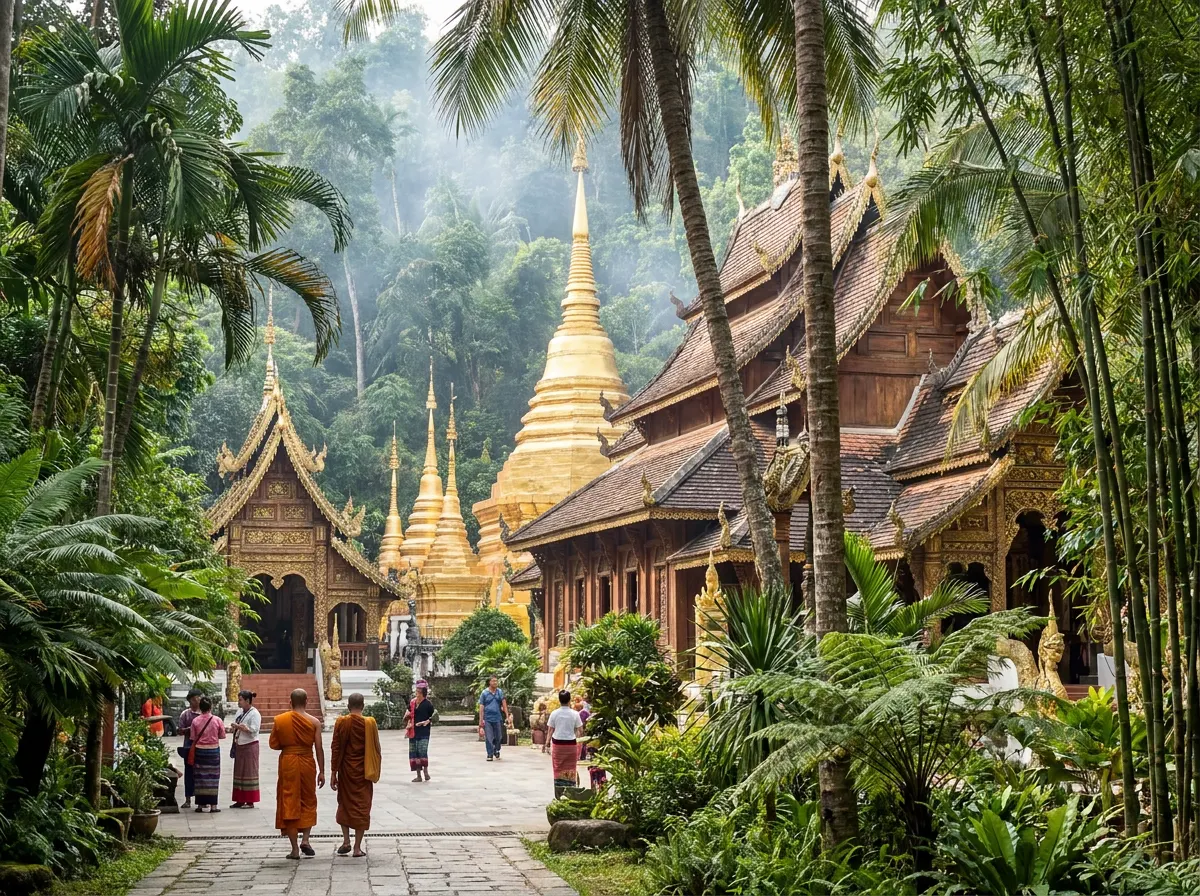
Xishuangbanna (西双版纳, Xīshuāngbǎnnà) is the China that does not feel like China. In the far south of Yunnan province, bordering Laos and Myanmar, the Dai people have built a culture of golden-roofed Buddhist temples, stilted bamboo houses, and lush tropical gardens in a climate where bananas, pineapples, and rubber trees grow year-round. The temperature rarely drops below 15°C. The Mekong River (called the Lancang here, 澜沧江, Láncāng Jiāng) runs through the heart of the prefecture, wide and brown and lined with night markets. This is the only part of China where wild Asian elephants still roam — at Wild Elephant Valley (野象谷, Yěxiàng Gǔ) you can watch them from elevated walkways in the rainforest. The Xishuangbanna Tropical Botanical Garden (中科院西双版纳热带植物园), run by the Chinese Academy of Sciences, is one of the world's most biodiverse botanical gardens with over 13,000 plant species on a site the size of a small town. The capital, Jinghong (景洪), is a relaxed city of about 500,000 where the Dai Water-Splashing Festival (泼水节, Pōshuǐ Jié) in April turns the streets into a city-wide water fight. Xishuangbanna is not a Silk Road destination or a classic China itinerary stop — it is tropical, Southeast Asian, and unlike anywhere else in the country. Budget roughly ¥120-200 per day for mid-range comfort, and give yourself 3-4 days. Xishuangbanna also works as a slow base for day trips into the tropical forests of the Lancang (Mekong) River basin, with overnight options in Dai villages that combine homestay, jungle walks, and traditional tea ceremonies. Xishuangbanna also rewards travelers who stay for a full week rather than 2-3 days. The slower pace lets the tropical environment, the Dai cultural rhythm, and the Mekong riverside life sink in — and a week allows the deeper day trips to Jinuo Mountain, the Bama longevity villages, and the Mekong border crossings into Myanmar.
Why Xishuangbanna in 2026.
Tropical Yunnan at its most vivid — Dai Buddhist temples, wild elephants in the rainforest, the Mekong River at night, and a culture closer to Southeast Asia than to Han China.
Quick Answer
Xishuangbanna (西双版纳, Xīshuāngbǎnnà) is the China that does not feel like China. In the far south of Yunnan province, bordering Laos and Myanmar, the Dai people have built a culture of golden-roofed Buddhist temples, stilted bamboo houses, and lush tropical gardens in a climate where bananas, pineapples, and rubber trees grow year-round. The temperature rarely drops below 15°C. The Mekong River (called the Lancang here, 澜沧江, Láncāng Jiāng) runs through the heart of the prefecture, wide and brown and lined with night markets. This is the only part of China where wild Asian elephants still roam — at Wild Elephant Valley (野象谷, Yěxiàng Gǔ) you can watch them from elevated walkways in the rainforest. The Xishuangbanna Tropical Botanical Garden (中科院西双版纳热带植物园), run by the Chinese Academy of Sciences, is one of the world's most biodiverse botanical gardens with over 13,000 plant species on a site the size of a small town. The capital, Jinghong (景洪), is a relaxed city of about 500,000 where the Dai Water-Splashing Festival (泼水节, Pōshuǐ Jié) in April turns the streets into a city-wide water fight. Xishuangbanna is not a Silk Road destination or a classic China itinerary stop — it is tropical, Southeast Asian, and unlike anywhere else in the country. Budget roughly ¥120-200 per day for mid-range comfort, and give yourself 3-4 days. Xishuangbanna also works as a slow base for day trips into the tropical forests of the Lancang (Mekong) River basin, with overnight options in Dai villages that combine homestay, jungle walks, and traditional tea ceremonies. Xishuangbanna also rewards travelers who stay for a full week rather than 2-3 days. The slower pace lets the tropical environment, the Dai cultural rhythm, and the Mekong riverside life sink in — and a week allows the deeper day trips to Jinuo Mountain, the Bama longevity villages, and the Mekong border crossings into Myanmar.
| Worth visiting | Yes — Xishuangbanna offers a tropical, Southeast Asian cultural experience within China, with rainforest, elephants, and Dai Buddhist temples |
|---|---|
| Recommended days | 3-4 days |
| Best time to visit | November-April (dry season, comfortable temperatures; avoid June-September rainy season and April Water-Splashing Festival crowds unless you want to join the water fight) |
| Daily budget | $40 (backpacker) / $120 (mid-range) / $320+ (luxury) |
| Family friendly | Yes — the botanical garden, Wild Elephant Valley, and night markets are excellent for children; the Dai cultural shows are family-oriented |
| Solo friendly | Yes — Jinghong is walkable, the night markets are great for solo dining, and the rainforest sites have good infrastructure |
| Airport | Xishuangbanna Gasa International Airport (JHG) — 6 km south of Jinghong, flights from Kunming (1h), Chengdu (2h), Bangkok (2h), Chiang Mai (1.5h) |
| High-speed rail | Yes — Kunming (3-4h, ¥200-280) via the China-Laos Railway. Also connects to Pu'er (1h) and continues to Luang Prabang, Laos (5h from Jinghong) |
| Language | Dai (Tai Lue language, related to Thai and Lao), Mandarin; English is rare outside hotels |
| Currency | CNY (¥) — Alipay and WeChat Pay widely accepted in Jinghong; cash useful for rural markets and village vendors |
| Time zone | China Standard Time (UTC+8) |
| Last updated | 2026-06-18 |
Want a Xishuangbanna plan built for you?
Jump to:
Botanical Garden·Wild Elephant Valley·Night Market·History·Food·Getting There·Getting Around·Top Attractions·Where to Stay·Weather·Tips·Itineraries·Practical Info·Emergency Contacts·Thailand/Laos Comparison·Water-Splashing Festival·Day-Trips From Jinghong·Dai Buddhist Temple Architecture·Dai Villages & Stilted Houses·Tropical Rainforest & Wildlife·FAQ
Why visit Xishuangbanna? Is it really part of China?
Xishuangbanna feels like a different country. The architecture is golden-roofed Theravada Buddhist temples and stilted bamboo houses, not concrete towers and curved eaves. The language on the street is Dai — a Tai-Kadai language related to Thai and Lao, not Mandarin. The food is sour, spicy, herbal, and grilled — banana-leaf-wrapped fish, papaya salad, lemongrass-scented soups. The climate is tropical: 25-35°C year-round, monsoon rains in summer, dry warmth in winter. The Mekong River runs through it, wide and brown, lined with night markets and palm trees. This is the southernmost prefecture in Yunnan, bordering Laos and Myanmar. The Dai people are the largest ethnic group, with significant Hani, Bulang, Jinuo, and Han populations. Xishuangbanna (西双版纳) means "twelve thousand rice fields" in Dai — a reference to the ancient Dai kingdom of Sipsongpanna that ruled this region for centuries before Chinese incorporation. The three reasons to come, ranked: the tropical biodiversity (the CAS Botanical Garden is world-class, and this is the only place in China with wild elephants), the Dai culture (Theravada Buddhism, water-splashing festivals, stilted villages, a visual and cultural world closer to Chiang Mai than to Beijing), and the food (a blend of Dai, Thai, Lao, and Yunnan influences that exists nowhere else). The honest cautions: Xishuangbanna has been heavily developed for domestic Chinese tourism. The Gaozhuang district where most tourists stay is a purpose-built tourist zone — photogenic but inauthentic. The Dai Minority Park is a cultural theme park, not a living village in the organic sense. The rainy season (June-September) is genuinely wet — afternoon downpours that can last hours. And the distance from the rest of China means this is a destination you fly to, not one you pass through on the way to somewhere else. But on a December evening, sitting by the Mekong with a plate of grilled fish and a fresh mango shake, the golden stupa of the night market reflected in the river, the air warm and the crowd a mix of Dai, Han, Thai, and Lao — it is hard to believe you are in China. That is the point.
What is the history of Xishuangbanna: Dai kingdom, Theravada Buddhism, and the Mekong?
Xishuangbanna was an independent Dai kingdom for centuries before becoming part of China. The name in Dai is Sipsongpanna (ສິບສອງພັນນາ), meaning "twelve thousand rice fields" — a reference to the twelve administrative districts of the traditional Dai state. The kingdom was a tributary of various larger powers — the Burmese, the Thai, the Chinese — but maintained its own rulers, culture, and Theravada Buddhist religion until the mid-20th century. The Dai people are ethnically and linguistically related to the Thai, Lao, and Shan peoples. Their migration into the Mekong basin occurred over 1,000 years ago. Theravada Buddhism arrived from Sri Lanka via Burma and Thailand around the 14th-15th centuries, replacing earlier animist and Hindu-influenced beliefs. The golden stupas, the orange-robed monks, and the temple-centered village life that define Xishuangbanna visually all trace to this Theravada heritage — it is the same Buddhist tradition found in Thailand, Laos, Myanmar, and Cambodia. Xishuangbanna was formally incorporated into the People's Republic of China in 1950 as an autonomous prefecture (西双版纳傣族自治州). The Chinese government recognized the Dai people as one of China's 56 official ethnic groups and granted limited cultural autonomy. The region remained remote and undeveloped until the 1990s, when tourism, rubber plantations, and cross-border trade with Laos and Myanmar transformed the economy. The China-Laos Railway, opened in December 2021, has been the biggest recent change. Jinghong is now 3-4 hours from Kunming by HSR and 5 hours from Luang Prabang, Laos. The railway has dramatically increased domestic tourism — Xishuangbanna is now a mass tourism destination for Chinese travelers, especially during the winter months when northern China is freezing and Xishuangbanna is 28°C. The tension between development and cultural preservation is visible everywhere. The Gaozhuang tourist district is a constructed version of Dai culture — photogenic but not lived-in. The Dai villages that remain authentic are further from Jinghong and harder to reach. The rubber plantations have replaced large areas of original rainforest. Visitors see a Xishuangbanna that is both genuine (the temples, the food, the language, the climate) and packaged (the night markets, the cultural parks, the elephant shows). The best way to find the genuine version is to get out of Gaozhuang and into the smaller towns — Menghai (勐海), Mengla (勐腊), the villages along the Mekong.
What to eat in Xishuangbanna: Dai, Thai, Lao, and Yunnan fusion?
Xishuangbanna food is unlike anything else in China. The Dai culinary tradition is related to Thai and Lao cuisines — sour, spicy, herbal, built around fresh herbs (lemongrass, cilantro, mint, basil), grilled meats and fish, fermented sauces, and sticky rice. The Chinese influence adds Yunnan mushrooms, Sichuan chili, and Han cooking techniques. The result is one of the most distinctive regional cuisines in the country. The essential foods: Grilled Mekong fish with lemongrass (香茅草烤鱼, xiāngmáocǎo kǎo yú). Whole fish — typically tilapia or snakehead — stuffed with lemongrass, cilantro, chili, and garlic, wrapped in banana leaves, and grilled over charcoal. The fish is moist, fragrant, and the skin crisps against the banana leaf. ¥30-50 per fish. The best is at the Gaozhuang night market, grilled to order. Dai-style papaya salad (傣味木瓜沙拉, Dǎiwèi mùguā shālā). Similar to Thai som tam but with local twists — shredded green papaya, cherry tomatoes, long beans, dried shrimp, peanuts, lime, fish sauce, and fresh chili, pounded in a mortar. It is fiercely sour-spicy and the single best thing to eat on a hot day. ¥15-25 per plate. Pineapple rice (菠萝饭, bōluó fàn). Sticky rice steamed inside a hollowed pineapple with coconut milk, sugar, and sometimes dried fruit. Sweet, fragrant, and served in the pineapple shell. ¥20-30. A Dai specialty — more a dessert than a main dish, but often eaten alongside savory dishes. Lemongrass grilled chicken (香茅草烤鸡, xiāngmáocǎo kǎo jī). Chicken marinated in lemongrass, garlic, turmeric, and fish sauce, then grilled over charcoal. The skin is crisp, the meat is juicy, and the lemongrass perfume penetrates deeply. ¥40-60 for a half chicken. Dai-style sour soup (傣味酸汤, Dǎiwèi suān tāng). A sour broth made with tamarind or fermented bamboo shoot, with fish or shrimp, tomatoes, chili, and fresh herbs. It is light, tangy, and restorative — the Dai equivalent of Thai tom yum. ¥20-35 per bowl. Sticky rice in bamboo (竹筒饭, zhútǒng fàn). Glutinous rice packed into green bamboo tubes and roasted over charcoal until the bamboo chars and the rice steams inside. You crack open the bamboo and eat the rice — slightly smoky, faintly sweet from the bamboo sap. ¥10-15 per tube. Sold at night markets and roadside stalls. Tropical fruit (热带水果). Xishuangbanna's climate produces extraordinary fruit: mango, pineapple, dragon fruit, mangosteen, rambutan, durian (in season May-August), jackfruit, passion fruit, and bananas of a dozen varieties. The fruit shakes at the night market (¥10-15) — fresh mango, pineapple, or passion fruit blended with ice — are essential. Pu'er tea (普洱茶, Pǔ'ěr chá). Xishuangbanna is one of the original homes of Pu'er tea, the fermented tea from Yunnan's ancient tea trees. You can visit tea plantations around Menghai (勐海) and sample aged Pu'er at tea houses in Jinghong. A session at a tea house costs ¥30-80 per person. For vegetarians: Xishuangbanna is one of the more vegetarian-friendly destinations in China. Dai cuisine uses less meat fat than Han Chinese cooking. Papaya salad, pineapple rice, sticky rice in bamboo, vegetable curries, and fresh fruit are naturally vegetarian. The phrase "wǒ chī sù" (我吃素, I eat vegetarian) is useful. Grilled vegetables and tofu are available at the night market.
How to get to Xishuangbanna: flights, high-speed rail, and the China-Laos Railway?
Xishuangbanna Gasa International Airport (JHG) is 6 km south of Jinghong city center, connected by taxi (¥20-30, 15 min) and airport bus (¥10, 25 min). This is the arrival point for most foreign visitors. Direct flights from Kunming (1 hour, ¥300-600, 15+ daily), Chengdu (2 hours, ¥500-900), Chongqing (2 hours, ¥500-900), and international flights from Bangkok (2 hours, ¥600-1,200), Chiang Mai (1.5 hours, ¥500-1,000), and Luang Prabang (1 hour, ¥400-800). Jinghong Railway Station (景洪站), opened with the China-Laos Railway in December 2021, has transformed access. From Kunming South (昆明南站): 3-4 hours, ¥200-280 second class, multiple daily trains. From Pu'er: 1 hour, ¥50-80. The line continues south to Mohan (the Laos border, 1 hour from Jinghong) and onward to Luang Prabang (5 hours from Jinghong) and Vientiane. The railway station is 5 km west of the city center — taxi ¥15-20, 15 min. From Laos: the China-Laos Railway makes Xishuangbanna accessible from Luang Prabang (5 hours, ¥250-350) and Vientiane (9 hours, ¥400-500). You need a Chinese visa or visa-free eligibility to enter at Mohan/Boten border. The railway crosses the border with a stop for immigration checks on both sides. Xishuangbanna works well as a standalone destination (fly in, spend 3-4 days, fly out) or as part of a Yunnan loop: Kunming (2 days) → HSR to Pu'er (1 day, tea mountains) → HSR to Jinghong/Xishuangbanna (3-4 days) → fly out from Jinghong or return to Kunming. It also connects to the Southeast Asia backpacker trail: northern Thailand → slow boat or flight to Luang Prabang → HSR to Jinghong → onward to Kunming and the rest of China.
How to get around Xishuangbanna: taxis, DiDi, and site transport?
Jinghong city center is walkable. Manting Park, the Mekong riverfront, and the Gaozhuang night market are all within 30 minutes on foot from each other. The Gaozhuang district is on the west bank of the Mekong, connected to the city center by the Xishuangbanna Bridge (步行 or short taxi). For outer sites: the Botanical Garden is 60 km east of Jinghong (about 1 hour by car). You can take a bus from Jinghong Bus Station to Menglun (勐仑, ¥25, 1.5 hours) and walk 15 minutes to the garden entrance, or hire a taxi for the day (¥300-400 round trip). Wild Elephant Valley is 40 km north (about 45 minutes by car). A taxi round trip costs ¥200-250. The Dai Minority Park is 30 km east (about 40 minutes). Bus or taxi (¥150-200 round trip). For a full day covering the Botanical Garden + Wild Elephant Valley: hire a car with driver for ¥500-600. These two sites are in opposite directions (garden east, elephants north) so the driving time adds up — this is a long day. DiDi operates in Jinghong with good supply. The app works with a foreign phone number. For the outer sites, arrange a return pickup with the driver — DiDi supply is thin at the Botanical Garden and Wild Elephant Valley. Taxis in Jinghong are metered — flagfall ¥8 for the first 3 km, then ¥2 per km. Rides within the city cost ¥10-20. Always have your destination written in Chinese. Scooter rental is available in Jinghong (¥50-80 per day) and is a popular way to explore the countryside around Menghai and the tea mountains. You need a Chinese driving license or an International Driving Permit — enforcement is inconsistent, but technically you need a license. Wear a helmet — the roads are winding and traffic is unpredictable.
What are the top attractions in Xishuangbanna, ranked and described?
1. Xishuangbanna Tropical Botanical Garden (中科院西双版纳热带植物园). ¥80. This is the must-see. The garden covers 1,125 hectares on an island in the Luosuo River — it is the size of a small town — with over 13,000 plant species in themed collections. The palm garden has 400+ palm species from around the world. The orchid garden has thousands of orchids in bloom (best March-May). The medicinal plant section explains Dai herbal medicine. The tropical fruit orchard lets you see durian, mangosteen, rambutan, and jackfruit trees bearing fruit. The highlight is the "dancing grass" (跳舞草, tiàowǔ cǎo) — a plant whose leaves move visibly in response to sound. Allow 4-5 hours. The electric cart (¥50) is worth it — the garden is enormous and walking the whole thing is a full day. The garden is 60 km east of Jinghong — leave by 08:00 for a full morning and afternoon. There is a basic restaurant inside (¥30-50 for lunch). 2. Wild Elephant Valley (野象谷). ¥85. The only place in China where you can reliably see wild Asian elephants. The reserve protects a stretch of rainforest where elephants come to natural mineral licks. Elevated walkways run through the canopy — you walk above the forest floor, watching for elephants below. The best viewing is November through February when elephants visit the mineral licks more frequently. Morning visits (08:00-11:00) have the highest chance of sightings. The captive elephant section has shows and elephant rides, but the ethics are questionable — the wild observation from the walkways is the better experience. Allow 3-4 hours. The reserve is 40 km north of Jinghong — about 45 minutes by car. 3. Gaozhuang Night Market / Starlight Night Market (告庄星光夜市). Free. The largest night market in Xishuangbanna, in the purpose-built Gaozhuang tourist district on the west bank of the Mekong. The market is centered on a golden stupa that lights up at night, with stalls radiating outward along the riverfront. Hundreds of food stalls — grilled Mekong fish, Dai papaya salad, pineapple rice, tropical fruit shakes, Lao-style sausages, Thai-inspired curries — plus clothing, handicrafts, and souvenirs. It is touristy and self-aware about it, but the scale, the setting by the Mekong, and the food quality make it genuinely enjoyable. Best from 19:00-23:00. Go hungry. The market is busiest on Friday and Saturday nights; weeknights are calmer. 4. Manting Park (曼听公园). ¥40 daytime, ¥200 evening show. A 400-year-old Dai royal garden in central Jinghong — tropical landscaping, a lake, a Dai palace replica, and a Buddhist temple. It is a peaceful green space during the day. The evening cultural show is the draw — Dai dance, music, a buffet dinner of Dai cuisine (included in the ¥200 ticket), and a lantern-floating ceremony on the lake at the end where hundreds of paper lanterns drift across the water. It is touristy but the lantern ceremony is genuinely beautiful. Allow 1-2 hours daytime, 3 hours for the evening show. 5. Mengle Buddhist Temple (勐泐大佛寺). ¥120. A massive modern Theravada temple on a hill south of Jinghong, with a 49-meter golden seated Buddha visible from across the city. Built in 2007, it is not ancient, but the scale is impressive — the Buddha is one of the largest in Southeast Asia and the hilltop setting offers panoramic views of Jinghong, the Mekong, and the surrounding mountains. The temple is active — monks live and study here. ¥120 is expensive for what it is, but the view and the golden Buddha against the tropical sky make for the most well-known Xishuangbanna photograph. Allow 1.5 hours. Best in morning light when the Buddha glows. 6. Dai Minority Park (傣族园). ¥65. A cultural park 30 km east of Jinghong preserving five traditional Dai villages with stilted bamboo houses, village temples, and daily water-splashing ceremonies. You can see traditional weaving, silversmithing, and Dai cooking demonstrations. The water-splashing ceremony (泼水) happens twice daily — it is a tourist version of the real Water-Splashing Festival, but it is fun and wet. Bring a change of clothes or a rain poncho. The park is touristy — it is a managed cultural experience, not an organic village — but it is informative and the village architecture is genuine. Allow 2-3 hours. 7. Jingzhen Octagonal Pavilion (景真八角亭). ¥20. An exquisite 18th-century Theravada Buddhist pavilion 70 km west of Jinghong near Menghai. Built in 1701, the eight-sided multi-tiered roof is a masterpiece of Dai Buddhist architecture — gold leaf, intricate wood carving, and a spire that catches the sun. The pavilion sits in a working monastery courtyard. Few tourists make it this far west, so the atmosphere is quiet and contemplative. Combine with a visit to the Menghai tea plantations — this is Pu'er tea country, and the ancient tea trees on the surrounding hills are 500-1,000 years old. Allow 1 hour for the pavilion, 2-3 hours for the tea plantation visit.
Where to stay in Xishuangbanna: neighborhoods, prices, and recommendations?
The Gaozhuang (告庄) district on the west bank of the Mekong is where most tourists stay. It is a purpose-built tourist zone with Dai-style architecture, the Starlight Night Market, hundreds of restaurants, and hotels at every price point. It is convenient, photogenic, and completely inauthentic — you are staying in a constructed version of Xishuangbanna. If convenience and the night market are your priorities, this is the right choice. Mid-range hotels: Anantara Xishuangbanna (安纳塔拉, ¥800-1,500), InterContinental Xishuangbanna (洲际, ¥600-1,000), or local boutique hotels (¥200-400). Jinghong city center (景洪市中心) around Manting Park and the riverfront is less touristy, more Chinese, and closer to the real city. Hotels are cheaper (¥150-300 for mid-range chains like Jinjiang Inn, Atour, Ji Hotel). You are a 15-minute walk or ¥10 taxi from Gaozhuang. This is the better choice if you prefer a less packaged experience. Near the Botanical Garden (Menglun town, 60 km east of Jinghong): the Anantara Xishuangbanna Resort is a luxury option (¥1,200-2,500) set in tropical gardens next to the Luosuo River — it is the top hotel in the region. Staying here puts you at the garden for early-morning exploration before the day-trippers arrive. There are also budget guesthouses in Menglun town (¥100-200). For backpackers: the Xishuangbanna International Youth Hostel in Gaozhuang has dorm beds at ¥50-70 and a rooftop with Mekong River views. The Jinghong Old Town Youth Hostel near Manting Park has dorm beds at ¥40-60. Foreigner registration: hotels must register foreign guests. Gaozhuang hotels are accustomed to foreigners. Smaller guesthouses in Menghai or rural areas may not accept foreign guests — book through Trip.com with the filter.
What is the weather in Xishuangbanna and when is the best time to visit?
Xishuangbanna has a tropical monsoon climate. It is warm to hot year-round — the temperature rarely drops below 15°C or exceeds 38°C. The year divides into a dry season (November-April) and a rainy season (May-October). January: 12°C to 25°C. Cool, dry, sunny. The best month. Mornings are cool enough for a light jacket; afternoons are warm and comfortable. Peak tourism season — book ahead. February: 13°C to 28°C. Excellent — warming up, dry, clear skies. Spring Festival crowds (dates vary) make this the busiest period. Book everything well ahead. March: 16°C to 32°C. Hot but still dry. The orchids in the Botanical Garden begin to bloom. Good visiting month. April: 20°C to 35°C. Hot. The Dai Water-Splashing Festival (泼水节, April 13-15) is the biggest event of the year — the entire city turns into a water fight. Fun if you want to participate, chaotic if you do not. Hotels sell out and prices spike. May: 22°C to 34°C. The rainy season begins. Afternoon thunderstorms become regular. The rainforest is lush and green. Fewer tourists, lower prices. June: 23°C to 33°C. Rainy — afternoon downpours most days, high humidity. The Botanical Garden is at its greenest. Fewer tourists. July: 23°C to 32°C. Peak rainy season. Heavy rain, high humidity. The rainforest is spectacularly green. Not ideal for outdoor sightseeing. August: 23°C to 32°C. Similar to July. Rain and humidity. Durian season at its peak. September: 22°C to 32°C. Rainy season tapering. Still wet but improving. Fewer tourists. October: 19°C to 30°C. Transition month — rain decreasing, temperatures cooling. Late October is the start of the comfortable window. November: 15°C to 27°C. Excellent — dry, comfortable, clear skies. The start of peak season. The second-best month after January. December: 12°C to 24°C. Excellent — cool, dry, sunny. Christmas and New Year bring international tourists. The consensus best months are November through February — dry, comfortable, and clear. March and April are hot but dry (April's Water-Splashing Festival is a plus or minus depending on your tolerance for being soaked). May through October is the rainy season — the rainforest is lush and the tourists are fewer, but outdoor sightseeing is disrupted by afternoon downpours. The Botanical Garden and Wild Elephant Valley are visitable year-round with an umbrella.
What are the top tips, warnings, and things to know about Xishuangbanna?
1. THE RAINY SEASON IS REAL. From May through October, expect afternoon downpours — often heavy, lasting 1-3 hours. The rain is warm and usually predictable (after 14:00), but it will disrupt outdoor plans. Schedule outdoor activities for the morning (08:00-13:00) and keep indoor or covered options for the afternoon. Bring a compact umbrella and a waterproof bag for electronics. The Botanical Garden and Wild Elephant Valley are both largely outdoors — check the forecast and plan accordingly. 2. GAOZHUANG IS A TOURIST CONSTRUCT. The Gaozhuang district is photogenic — golden stupas, Dai-style architecture, the Mekong riverfront — but it was built for tourists. The "Dai" buildings house souvenir shops and hotpot restaurants. The night market is real in the sense that the food is real and good, but the setting is designed. If you want authentic Xishuangbanna, spend time in Jinghong city center, visit the smaller towns (Menghai, Mengla, Menglun), and explore the tea mountains. Gaozhuang is a comfortable base, not a cultural experience. 3. ELEPHANT ETHICS. Wild Elephant Valley has both wild elephant observation (good) and captive elephant shows with rides (ethically questionable). The wild observation from the elevated walkways is the better experience — you watch elephants behaving naturally in the rainforest. The captive section involves elephants performing tricks and giving rides. Many international visitors find this distressing. You can skip the captive section entirely — the wild walkways are the reason to come. 4. THE WATER-SPLASHING FESTIVAL IS INTENSE. If you are in Xishuangbanna during the Dai Water-Splashing Festival (April 13-15), you will get wet. Everyone gets wet. The entire city — streets, markets, parks — becomes a water fight with buckets, hoses, water guns, and elephants spraying water. It is joyful and chaotic. Protect your phone and passport in waterproof bags. If you do not want to participate, stay in your hotel or leave Jinghong during those three days. Hotels sell out and prices spike — book 1-2 months ahead. 5. MOSQUITOES ARE A CONCERN. The tropical climate means mosquitoes year-round, especially in the rainy season. Xishuangbanna is in a malaria-risk zone (low risk, but present) and dengue fever occurs sporadically. Use insect repellent with DEET, wear long sleeves and pants in the evening, and sleep under a mosquito net or in a screened room. Most mid-range and above hotels have screened windows and mosquito nets. 6. THE BOTANICAL GARDEN IS HUGE. The garden covers 1,125 hectares — it is the size of a small town. Walking the entire garden is a full-day expedition. The electric cart (¥50) is worth it for covering distance between the major sections. Wear comfortable walking shoes, bring water, and plan your route using the map at the entrance. The palm garden, orchid garden, and tropical fruit orchard are the highlights — prioritize these if you have limited time. 7. THE CHINA-LAOS RAILWAY HAS CHANGED EVERYTHING. The railway, opened in 2021, has made Xishuangbanna dramatically more accessible to domestic Chinese tourists. The Gaozhuang district is packed during Chinese holidays and winter weekends. The Botanical Garden is busy by 10:00. Book hotels and train tickets ahead during peak periods (November-February, Chinese holidays). The railway also means you can now travel from Jinghong to Luang Prabang, Laos in 5 hours — a genuinely exciting itinerary possibility. 8. THE BEST TEA IS IN MENghai. Xishuangbanna is one of the original homes of Pu'er tea, and the best tea mountains are around Menghai (勐海), 50 km west of Jinghong. You can visit tea plantations with ancient tea trees (500-1,000 years old), watch the processing, and taste aged Pu'er at family-run tea houses. A day trip to Menghai combines well with the Jingzhen Octagonal Pavilion. Arrange a driver for the day (¥300-400). 9. CASH FOR RURAL AREAS. Alipay and WeChat Pay work everywhere in Jinghong and Gaozhuang. In rural markets, small village shops, and tea farms, cash is still preferred. Carry ¥200-300 in small bills for these situations. 10. SUN PROTECTION IS ESSENTIAL. Xishuangbanna is at 21° north latitude — the sun is strong year-round. Even on cloudy days, UV radiation is high. Sunscreen, hat, and sunglasses are essential. The Botanical Garden has shade in some sections but long exposed walks between them.
What are good 2-day, 3-day, and 4-day itineraries for Xishuangbanna?
2-day plan: Day 1 — Morning: Tropical Botanical Garden (leave Jinghong at 07:30, arrive 08:30, spend 4-5 hours — palm garden, orchid garden, dancing grass, fruit orchard). Lunch at the garden restaurant. Afternoon: Manting Park (return to Jinghong, spend 1-2 hours in the garden). Evening: Gaozhuang Starlight Night Market for dinner — grilled Mekong fish, papaya salad, fruit shakes. Day 2 — Morning: Wild Elephant Valley (leave 07:30, arrive 08:15, spend 3-4 hours on the elevated walkways — skip the captive elephant shows). Afternoon: Mengle Buddhist Temple for the golden Buddha and panoramic views. Evening: second night market visit or a Dai cultural dinner show. 3-day plan: Days 1-2 as above. Day 3 — Morning: Dai Minority Park (30 km east, leave 08:00, spend 2-3 hours — stilted villages, weaving demonstrations, water-splashing ceremony at 13:30). Afternoon: free time in Jinghong — walk the Mekong riverfront, visit the Xishuangbanna National Museum (free, 1 hour, good exhibits on Dai culture and tropical ecology). Evening: final night market dinner or a Pu'er tea tasting at a Jinghong tea house. 4-day plan: Days 1-3 as above. Day 4 — Full-day excursion to Menghai (勐海, 50 km west). Morning: Jingzhen Octagonal Pavilion (¥20, 1 hour) and a nearby Dai temple. Late morning and afternoon: tea mountain tour — visit an ancient tea tree plantation, see Pu'er tea processing, taste aged Pu'er at a family-run tea house. Lunch in Menghai town (Dai and Bulang cuisine). Return to Jinghong by 17:00. This day adds the quieter, more authentic side of Xishuangbanna away from the Gaozhuang tourist bubble. Combine with Laos: Jinghong is 5 hours by HSR from Luang Prabang, Laos. A 7-8 day Xishuangbanna + Luang Prabang itinerary is a natural combination — 3-4 days in Xishuangbanna, then the HSR south across the border to Luang Prabang for 3-4 days of Lao temples, waterfalls, and Mekong sunsets. You need a Chinese visa (or visa-free eligibility) to re-enter China if returning, plus a Laos visa (available on arrival for most nationalities).
What practical information do I need: visa, money, internet, language?
Visa-free entry: As of June 2026, citizens of 45+ countries can enter China visa-free for up to 30 days. This covers Xishuangbanna. If you are entering China from Laos via the China-Laos Railway at Mohan/Boten, visa-free entry applies if your nationality is eligible. Confirm with the nearest Chinese consulate. Money: CNY (¥). ¥100 ≈ US$14. Alipay and WeChat Pay are accepted everywhere in Jinghong and Gaozhuang. Link a foreign Visa/Mastercard before traveling. Carry ¥200-300 in cash for rural markets, village vendors, and tea farms. ATMs at Bank of China and ICBC accept foreign cards. Internet: China's Great Firewall applies. Install and test a VPN before arriving. Internet speeds in Jinghong are good. Mobile signal is weak at the Botanical Garden's outer sections and at Wild Elephant Valley — download offline maps. Language: Dai (Tai Lue) is the local language. Mandarin is spoken by everyone in the tourism industry and by the Han population. English is rare — even hotel front desks have limited English. A translation app (Pleco, Baidu Translate) is essential. Useful phrases: "sawatdee" (hello in Dai, same as Thai), "khop chai" (thank you in Dai/Lao). Save your hotel address and site names in Chinese characters. Health: The main health concerns are mosquitoes (malaria and dengue risk — use DEET repellent, wear long sleeves in the evening), sun exposure (strong tropical sun — sunscreen, hat, sunglasses), and food/water hygiene (stick to bottled water, eat at busy stalls with high turnover). Tap water is not potable. Bottled water is widely available (¥2-3). Travel to Laos: The China-Laos Railway crosses at Mohan/Boten. You need a Laos visa (available on arrival for most nationalities, US$30-42, bring passport photos) and a Chinese visa or visa-free eligibility to exit and re-enter. The train stops at both border stations for immigration — allow about 1.5 hours for the border crossing.
What are the emergency contacts and health information for Xishuangbanna?
Police: 110. Ambulance: 120. Fire: 119. Traffic accident: 122. These work from any phone. English-speaking operators are unlikely. International medical care: Xishuangbanna People's Hospital (西双版纳傣族自治州人民医院) in Jinghong is the main hospital. English-speaking staff are very limited. For serious medical issues, medical evacuation to Kunming (1 hour by air) or Bangkok (2 hours by air) may be necessary. Comprehensive travel insurance covering medical evacuation is essential — the nearest truly international-standard hospital is in Bangkok. Mosquito-borne illness: Xishuangbanna is in a low-risk malaria zone and dengue fever occurs sporadically. Use DEET-based insect repellent, wear long sleeves and pants in the evening, sleep under mosquito nets or in screened rooms. If you develop fever, severe headache, or joint pain within two weeks of visiting Xishuangbanna, seek medical attention and mention your travel history. Tap water is not potable. Bottled water is cheap and available everywhere. Avoid ice in drinks from street stalls unless you are confident it is made from purified water. Air quality: Xishuangbanna has excellent air quality compared to Chinese cities — the tropical rainforest and lack of heavy industry keep the AQI low. The exception is March-April when farmers in neighboring countries burn fields, causing regional haze. Check the AQI on aqicn.org during these months. Sun exposure: tropical sun at 21° north latitude is strong year-round. Sunscreen, hat, and sunglasses are essential. Heat exhaustion is a risk in April-May when temperatures can reach 35°C with high humidity.
What are the best day-trips from Jinghong beyond the main sites?
Once you have seen the Botanical Garden, Wild Elephant Valley, and the Jinghong-area temples, the next layer of Xishuangbanna opens up in the smaller towns and countryside around the prefecture. The four best day-trips, each doable in a long day with a hired car and driver (¥400-600 round trip): 1. Menghai and the Jingzhen Octagonal Pavilion (勐海, 50 km west). Already described above for the tea mountains, but worth emphasizing as a half-day on its own. The 1701 Jingzhen Octagonal Pavilion is the finest surviving example of traditional Dai Buddhist architecture in Yunnan, an eight-sided multi-tiered wooden pavilion with gold leaf and intricate carvings. The pavilion sits in a working monastery courtyard surrounded by rubber plantations and banana groves. The town of Menghai itself is a real working market town — far more authentic than Gaozhuang — with Dai and Bulang residents, a wet market selling tropical fruit and river fish, and a smattering of small Dai and Hui restaurants serving local food at local prices. If you only have time for one out-of-Jinghong excursion beyond the main sites, make it this one. 2. Mengla and the China-Laos border (勐腊, 130 km southeast). Mengla is a small border town 130 km from Jinghong and the last substantial settlement before the China-Laos Railway crosses into Laos at the Mohan/Boten crossing. The town itself is unremarkable, but the road between Jinghong and Mengla is one of the most scenic in the prefecture — rubber plantations, banana groves, Dai villages, and the Bulang mountains in the distance. Along the way, the Mengla Tropical Rainforest National Park (西双版纳热带雨林国家公园) offers guided walks through primary rainforest with chances to see hornbills, gibbons, and wild orchids. The park is far less developed than Wild Elephant Valley and feels genuinely wild. Continue to the border at Mohan (磨憨) to look across the Mekong into Laos — the new China-Laos Railway station at Boten is visible on the far bank. Round trip Jinghong to Mengla and back is 5-6 hours of driving, so an early start (07:00) is essential. 3. Pu'er and the Tea Horse Road (普洱, 90 km north). Pu'er is the city that gave its name to China's most famous fermented tea, and it sits 90 km north of Jinghong along the new China-Laos Railway. The town has the Tea Horse Road Monument, the Pu'er Tea Museum, and the Jingmai Mountain ancient tea plantations (a 30 km detour from Pu'er, now a UNESCO World Heritage cultural landscape inscribed in 2023 for its thousand-year-old tea tree forests and the Dai, Bulang, and Hani communities that have cultivated them for generations). The town is a relaxed small city — cheaper and less touristy than Jinghong — with excellent tea houses serving fresh Pu'er from the surrounding mountains. A day trip is feasible (1.5 hours each way by HSR or car), or stay overnight in a tea mountain guesthouse for a quieter experience. Combined with the HSR connection, Pu'er is the easiest add-on from Jinghong. 4. Damenglong and the rubber-plantation countryside (大勐龙, 70 km southwest). Damenglong is a small town deep in the Dai countryside, surrounded by rubber and banana plantations. The Manfeilong White Pagoda (曼飞龙塔, Mǎnfēilóng Tǎ), sometimes called the Bamboo Shoot Pagoda, is a cluster of nine white-washed Theravada stupas from the 19th century set on a hilltop, surrounded by tropical forest. The pagodas are smaller and less famous than the Mengle golden Buddha, but the setting is more authentic — a real working village, a real monastery, real prayer flags flapping in the tropical wind. The drive from Jinghong passes through some of the most unspoiled Dai countryside in the prefecture. Combine with a stop at a working rubber plantation to see how the latex is tapped and processed. Allow 5 hours for the round trip. Hiring a driver is straightforward. Hotels and travel agencies in Gaozhuang and Jinghong can arrange a car with driver for ¥400-600 per day. The drivers are accustomed to the main tourist routes and speak basic Mandarin. For the Menghai and Mengla routes, ask the driver to wait for you at each stop — they do not charge extra for the wait time. DiDi is unreliable outside Jinghong city limits. A practical caution: the road from Jinghong to Mengla passes through several military and border security checkpoints. Carry your passport at all times. Police checks are routine, especially in the 30 km approaching the Mohan border crossing. The checkpoints are quick and professional, but the lack of a passport will turn a 15-minute stop into a 2-hour detour to the nearest police station.
What are Dai villages like: stilted houses, village temples, and daily life?
Beyond the cultural parks and the Gaozhuang tourist zone, the Dai villages of Xishuangbanna are where the actual culture lives. A traditional Dai village is a small settlement of 30-200 households built along a river or stream, shaded by bamboo and fruit trees, with a Buddhist temple (the wǎng, 奘房) at the center, a community spirit house (the zhá lín, 寨心), and a village gate (the zhá mén, 寨门) marking the boundary. The architecture is the most visually distinctive thing — wooden houses raised on stilts 1-2 meters off the ground, with steep thatched or tile roofs, open ground-floor spaces for storage and livestock, and living quarters on the upper floor. Why stilted houses (干栏, gān lán)? The tropical climate is the answer. Raising the house off the ground provides ventilation in the humid heat, protection from flooding during the rainy season, and a cool shaded space underneath for working, cooking, and keeping animals. The construction is bamboo and timber — the walls are woven bamboo mat or split-bamboo planks, the floors are polished wood, and the roof is a steep pitch of thatch or fired tile. Modern Dai houses retain the stilted form but use concrete pillars, brick walls, and corrugated metal or tile roofs. The traditional bamboo version is increasingly rare, preserved mainly in the cultural parks and the remoter villages around Menghai and Mengla. A traditional Dai house has three parts: the front veranda (the most social space, where the family greets guests, eats, and spends the evening), the central living and sleeping rooms, and the rear veranda, which is usually the kitchen and a second social space. There is no formal dining room — meals are eaten on the floor mat, often on the front veranda. A typical family lives in 2-3 rooms with the elderly couple, their adult children, and grandchildren sharing the space. The stilted form means the house feels cooler inside than the outside temperature — a relief in April when the mercury hits 35°C. Villages in Xishuangbanna organize life around three institutions: the Buddhist temple, the village spirit house, and the village council of elders. The temple is the religious and social center — young Dai men traditionally spend 1-3 years as novice monks between childhood and adulthood, learning to read Pali (the sacred language of Theravada Buddhism), Buddhist teachings, and village history. The monkhood is a rite of passage, not a permanent commitment. Most men return to village life after their temple period. The village spirit house (zhá lín) is a small shrine containing a carved wooden post or stone that represents the founding spirit of the village. Each year on a designated day, the village holds a sacrifice ceremony at the spirit house to renew the relationship with the founding ancestor. Outsiders are usually welcome to observe the ceremony from a respectful distance. The spirit house is usually a small unassuming structure — nothing like the elaborate golden temples — and is often overlooked by visitors. Daily life in a Dai village is structured by the Buddhist calendar. The lunar month dictates festival days (the Water-Splashing Festival in April, the boat racing festival in October, the kai mén zhài — "open village gate" — ceremony at the start of the dry season). The day begins with the monks' alms round at dawn, when villagers offer sticky rice and other food to the monks walking barefoot through the village. The monks eat what is offered and cannot store or select — this is a foundational practice in Theravada Buddhism. Visitors who rise early in a Dai village will see the alms round and hear the morning chant from the temple. How to visit a real Dai village: the cultural parks (Dai Minority Park) are managed experiences and not the real thing. To see an actual living village, you need to go further afield. Several villages around Menghai (such as Manhe and Mangjing) and along the road to Damenglong welcome visitors with prior arrangement through a homestay program. The Jinghong-based community tourism cooperative runs one- and two-day village homestay experiences (¥200-400 per person per day including meals and a local guide) where you stay with a Dai family, join in the cooking, and walk to the village temple for the morning alms round. This is the most ethical and rewarding way to see Dai village life — you are a guest in someone's home, not a customer at a cultural park. Respectful behavior in a Dai village: remove your shoes before entering a house or the temple. Do not point your feet at people or at Buddha images when sitting on the floor — tuck your feet behind you or sit cross-legged. Do not touch the monks, especially women touching monks. Do not photograph the alms round or the morning prayer ceremony without asking — many villages consider this intrusive. The phrase "nóng" (侬) is a friendly Dai greeting; "sǎ wǎdī" (萨瓦迪, sawatdee) also works as it is the same word as Thai.
What is the tropical rainforest and wildlife like in Xishuangbanna?
Xishuangbanna contains the largest remaining tropical rainforest in China — a fragment of the once-vast forest that stretched from Yunnan through mainland Southeast Asia. The prefecture sits at the meeting point of the Indo-Burmese and Indo-Chinese biogeographic regions, and the result is a biological inventory that is wildly disproportionate to its size: over 5,000 plant species, 600+ bird species, and more than 100 mammal species in an area smaller than Switzerland. The elevation gradient (from 500 meters in the Mekong valley to over 2,000 meters on the surrounding mountains) creates layered habitats that compress what would normally be 1,000 km of latitude into a 90 km drive. The plant life is the headline. The CAS Tropical Botanical Garden exists to study and preserve it. A short walk in the rainforest passes through several layers — the canopy at 30-50 meters (dipterocarps, figs, and wild mangoes), the understory at 10-20 meters (palms, tree ferns, and woody climbers), the shrub layer (gingers, begonias, and dwarf palms), and the forest floor (mosses, lichens, and the strange saprophytic plants that feed on decaying matter). The "dancing grass" (跳舞草) you can see in the Botanical Garden is one example of the unusual flora — its leaflets move visibly in response to sound, possibly as a defense against herbivores. The mammals are the bigger draw for most visitors. The flagship is the Asian elephant (亚洲象, Yàzhōu Xiàng). The wild population in Xishuangbanna is small (around 200-300 individuals, fragmented into several herds) but it is the only wild population of Asian elephants in China. The herds move between protected reserves and unprotected forest corridors that cross into Myanmar and Laos, and human-elephant conflict is a real and growing issue as rubber plantations expand. Wild Elephant Valley is set up around a mineral lick that the elephants visit — the elevated walkways give visitors a chance to see them in the wild without disturbing them. Other notable mammals: the gibbon (长臂猿) — three species live in Xishuangbanna, including the endangered Skywalker hoolock gibbon, discovered in this region. Gibbons are heard more often than seen — their long resonant calls echo across the forest in the early morning. The Asian black bear and the sun bear are present in the more remote forests but rarely seen. The wild boar, sambar deer, and several species of monkeys (macaques and langurs) are relatively common. Leopards are present but extremely rare and shy. The bird life is exceptional. Xishuangbanna is on the migration route for many East Asian birds and is a wintering ground for species from as far north as Siberia. The great hornbill (双角犀鸟) — a striking black-and-yellow bird with a massive casque on its bill — is the signature species. It nests in tree cavities high in the canopy, and the female seals herself inside for months while the male brings food. Several hornbill species live in Xishuangbanna, and the Botanical Garden runs a hornbill conservation project. Other notable birds: the green peafowl (still wild in some reserves), the silver pheasant, the great barbet, and dozens of species of warblers, flycatchers, and babblers that fill the forest with sound at dawn. The reptiles and amphibians are diverse. The tokay gecko calls loudly from house walls at night — its call is the dominant evening sound in the rainforest. Various pit vipers, including the rare mangrove pit viper, live in the forest. The Chinese giant salamander is present in the mountain streams, though rarely seen. Several species of flying frogs glide between trees using webbed feet. The insect life is overwhelming at certain times of year — the rainy season brings clouds of mosquitoes (the main reason for the malaria concern), but also spectacular moths, beetles, and the giant atlas moth, one of the largest moths in the world. The best places to experience the rainforest: The CAS Botanical Garden (¥80) is the most accessible. The western section of the garden is a preserved fragment of primary rainforest, with a 2-km elevated boardwalk through the canopy. The "dancing grass" and the giant water lily pools are in this section. The boardwalk is wheelchair-accessible and an easy walk for any fitness level. Wild Elephant Valley (¥85) is the best for mammals. The elevated walkways through the canopy put you in elephant height, and the mineral lick viewpoint is where you wait for sightings. The forest here is regenerating secondary rainforest, not pristine primary forest, but the wildlife density is high. The Mengla Tropical Rainforest National Park (西双版纳热带雨林国家公园, ¥100-120) is the most authentic. It is 130 km from Jinghong, which limits day-trippers. The park has a 5-km guided rainforest walk with a botanist guide who can identify plants, point out animal tracks, and explain the ecology. The walk is moderately strenuous — muddy in the rainy season, and you cross several streams on stepping stones. The Ailao Mountain Nature Reserve (哀牢山自然保护区) west of Jinghong around Chuxiong is a higher-elevation temperate rainforest with different wildlife, including the black gibbon and the Yunnan snub-nosed monkey. It is a longer excursion (4-5 hours by car from Jinghong) and more of a specialist interest, but the bird life is the best in the prefecture. Practical rainforest advice: hire a guide, do not go alone. The trails are not well-marked, the wildlife is cryptic, and the plant life is unrecognizable to anyone without a tropical botany background. The CAS Botanical Garden has a list of recommended local guides who can be hired by the day (¥300-500). Wear long pants and closed shoes — leeches are present in the rainy season, especially in the undergrowth. DEET repellent is essential. The forests are safe in terms of dangerous mammals (there are no tigers or large predators in Xishuangbanna), but the trails can be slippery and the streams can rise quickly after heavy rain. The conservation picture: Xishuangbanna has lost roughly 60% of its original tropical rainforest since the 1970s, mostly to rubber plantations, banana cultivation, and tea expansion. The remaining forest is fragmented into protected reserves separated by agricultural land. Wildlife corridors — strips of forest connecting the reserves — are an active conservation project, and the Chinese government has been investing in corridor restoration since the late 2010s. The wild elephant population is stable but vulnerable — a single herd loss would be a major setback. Visiting the reserves and paying entry fees directly supports the conservation effort.
How does Xishuangbanna compare to Thailand and Laos, and should I choose one or visit all?
The most common question from visitors who have already been to Thailand or Laos is whether Xishuangbanna is worth a separate trip. The honest answer is that it depends on what you want.
Top attractions
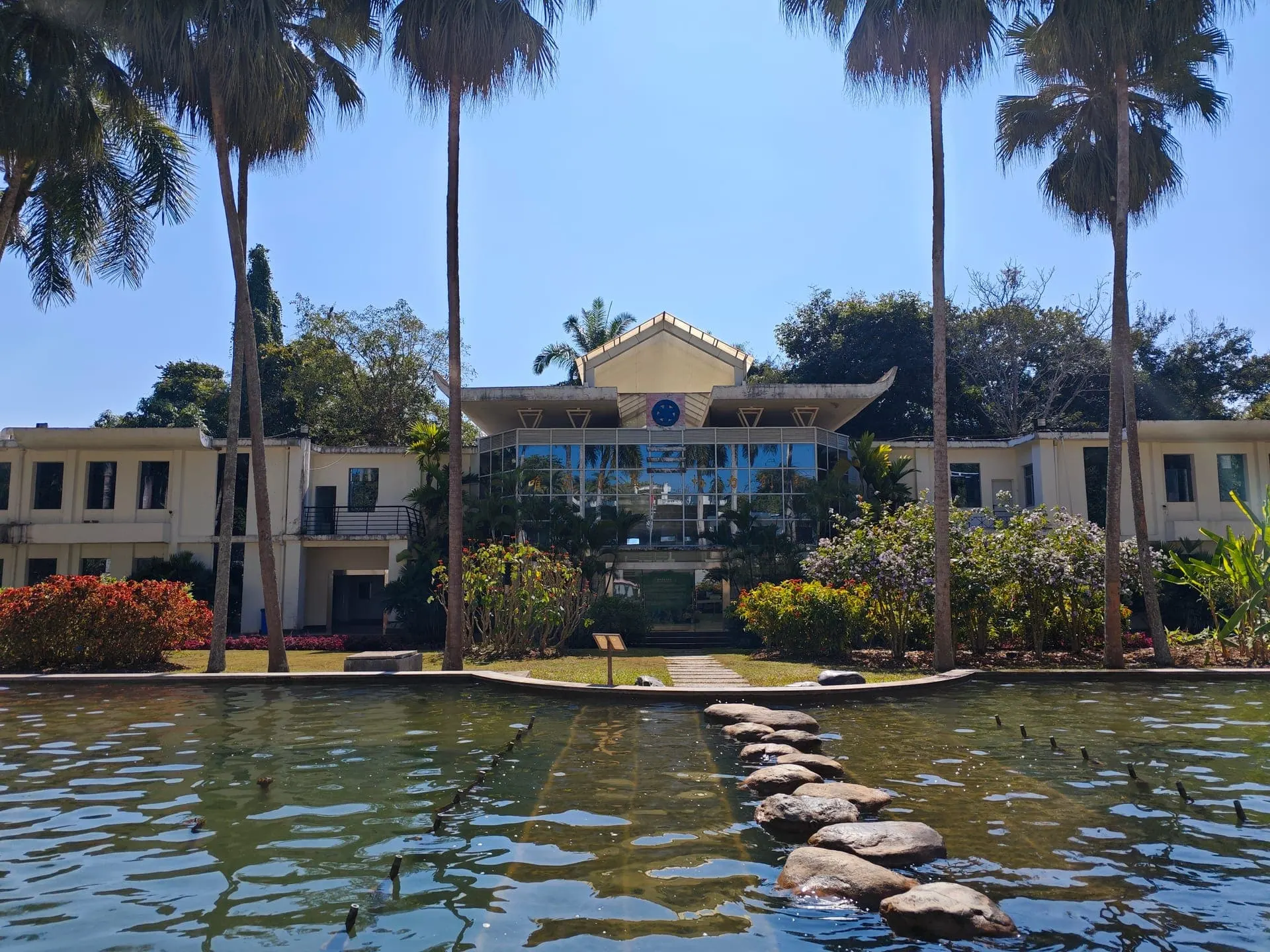
Xishuangbanna Tropical Botanical Garden (中科院西双版纳热带植物园)
A 1,125-hectare botanical garden run by the Chinese Academy of Sciences, 60 km east of Jinghong on an island in the Luosuo River. Over 13,000 plant species in themed collections — palm garden, orchid garden, medicinal plants, bamboo grove, tropical fruit orchard. One of the world's most biodiverse botanical gardens. ¥80. Allow 4-5 hours. Best visited on a clear day — the garden is huge and mostly outdoors. The electric cart (¥50) saves significant walking.
Wikimedia Commons · CC-BY-SA
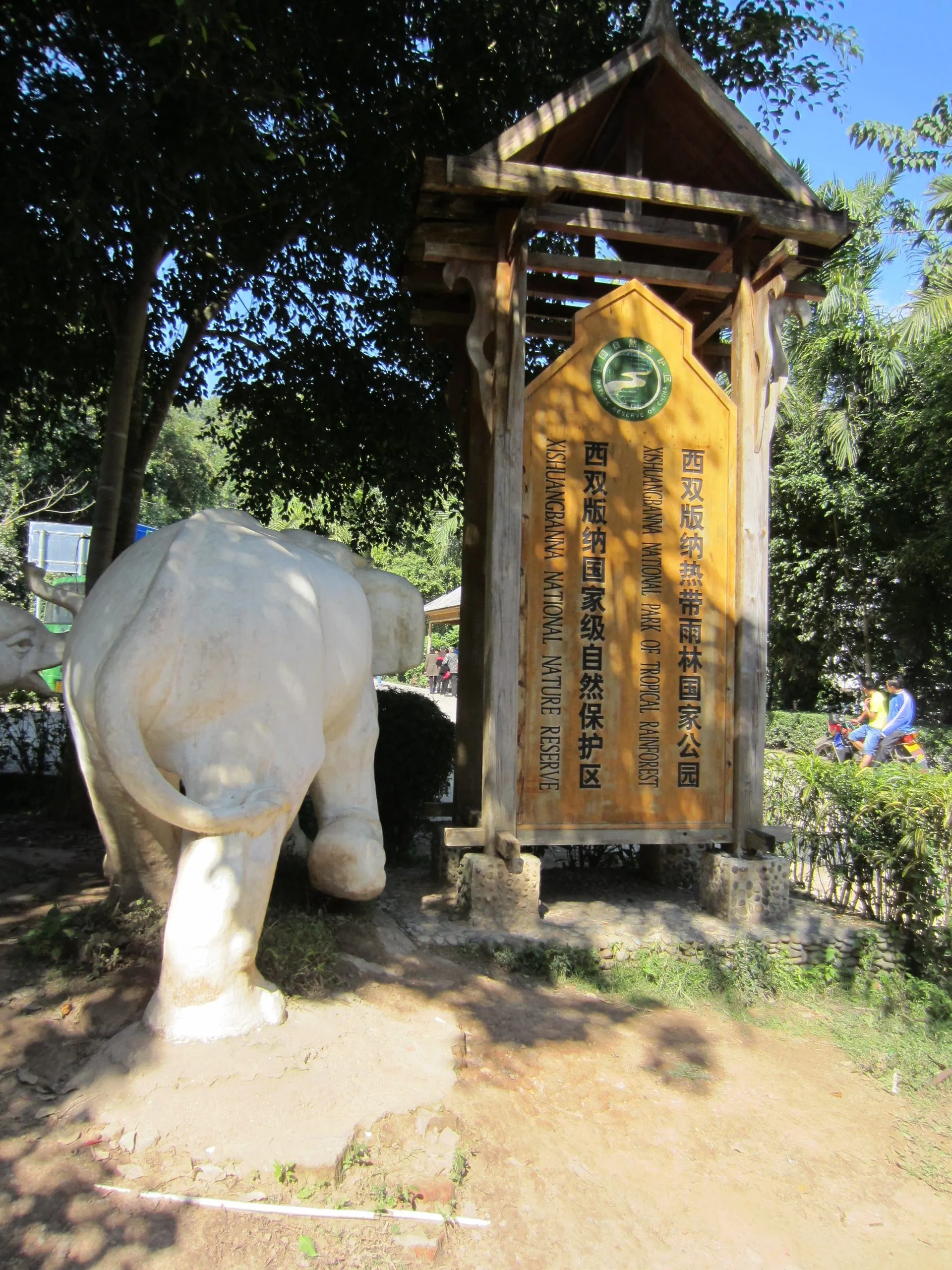
Wild Elephant Valley (野象谷, Yěxiàng Gǔ)
A rainforest reserve 40 km north of Jinghong where wild Asian elephants come to feed at mineral licks. Elevated walkways through the canopy allow observation without disturbing the animals. There is also a captive elephant section with shows (ethical concerns apply — the wild observation is the better experience). ¥85. Allow 3-4 hours. Best elephant-viewing months: November-February. Morning visits have the highest chance of sightings.
Wikimedia Commons · CC-BY-SA
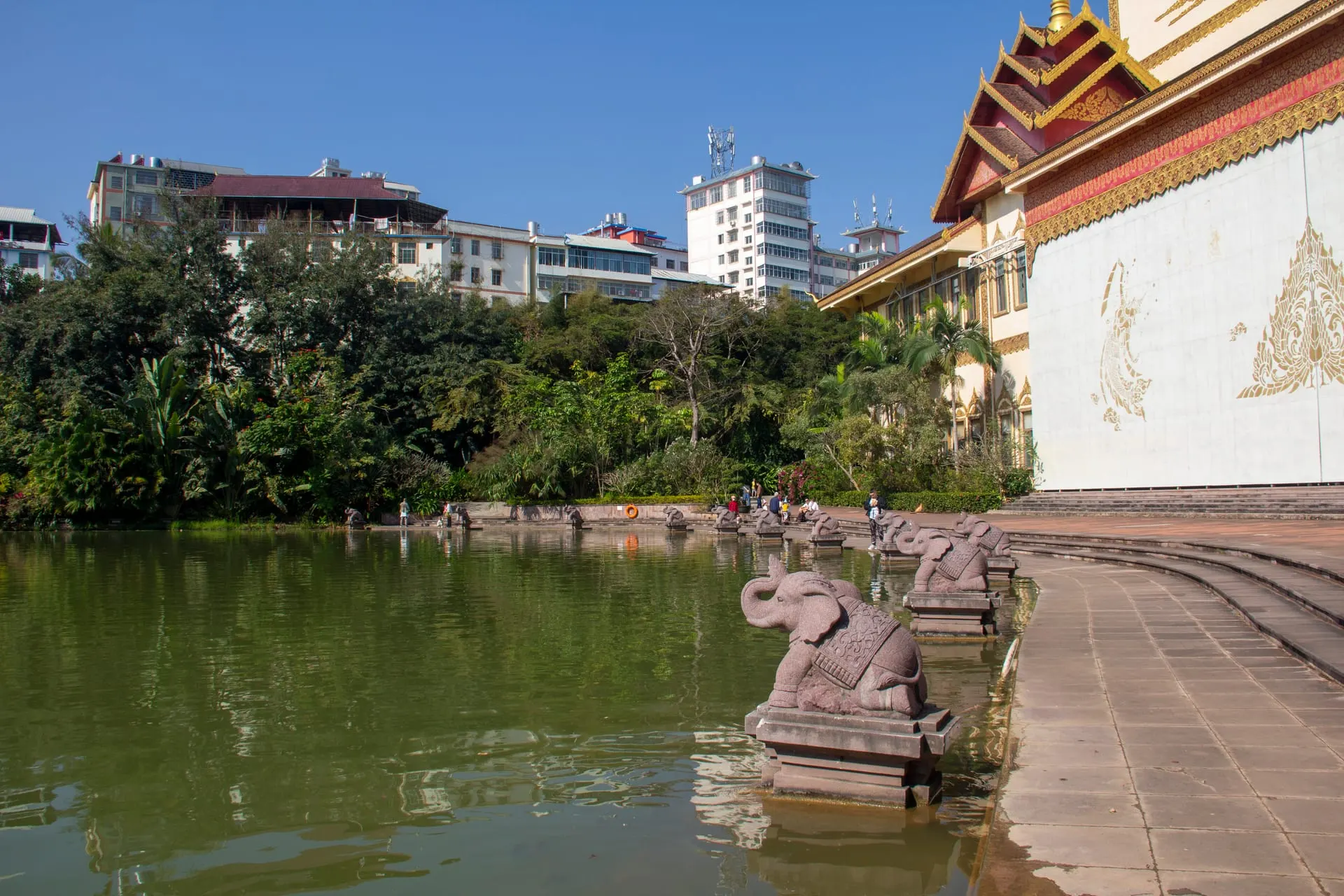
Manting Park (曼听公园, Màntīng Gōngyuán)
A 400-year-old Dai royal garden in central Jinghong, with tropical landscaping, a Dai palace replica, a Buddhist temple, and a lake. The evening cultural show (¥200) features Dai dance, music, and a lantern-floating ceremony on the lake. ¥40 daytime entry. Allow 1-2 hours. The evening show is touristy but genuinely enjoyable — the lantern ceremony at the end is beautiful.
Wikimedia Commons · CC-BY-SA
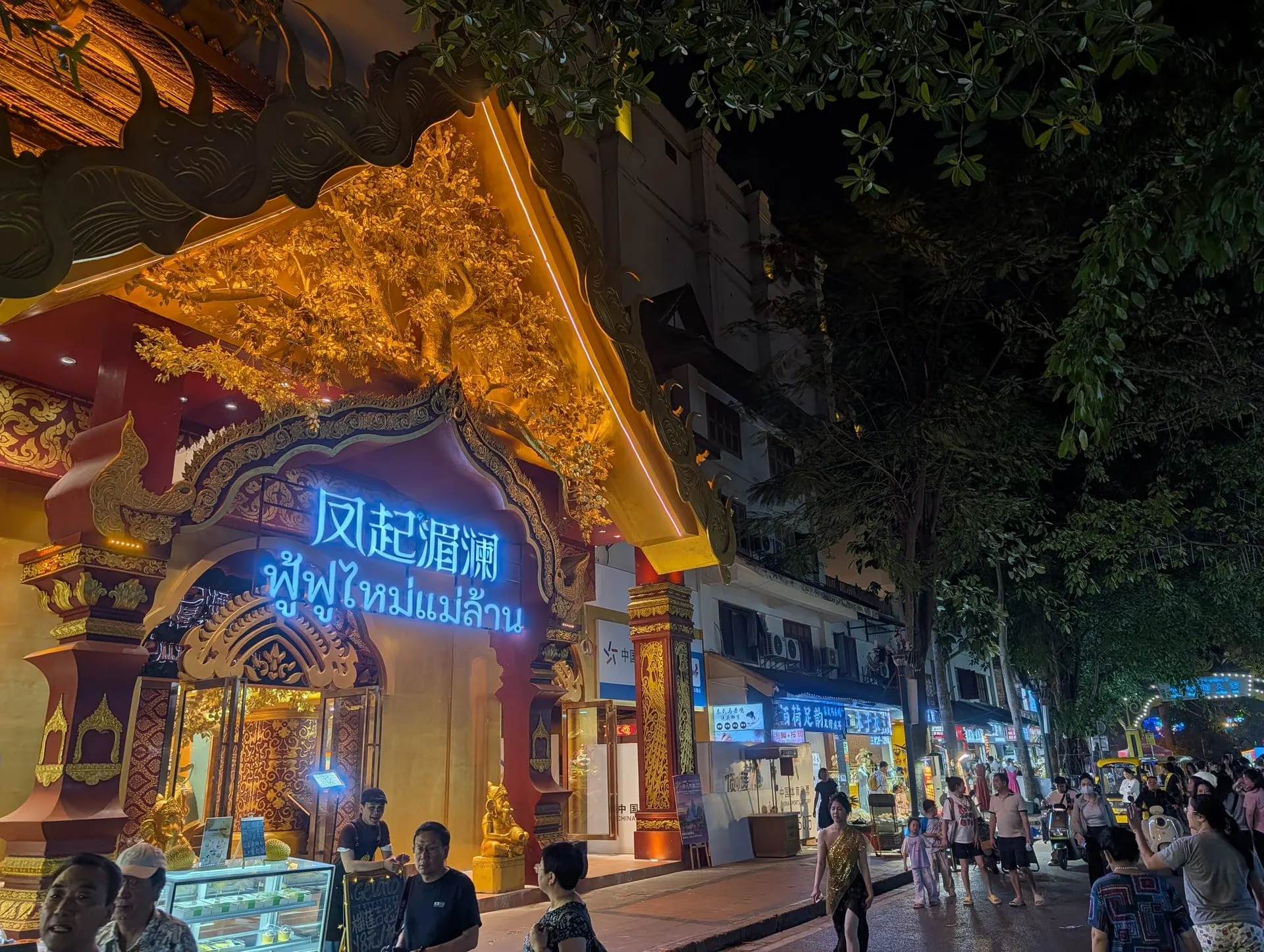
Gaozhuang Night Market / Starlight Night Market (告庄星光夜市)
The largest night market in Xishuangbanna, on the west bank of the Mekong in the Gaozhuang (告庄) tourist district. Hundreds of stalls selling Dai, Thai, Lao, and Chinese street food, plus clothing, handicrafts, and souvenirs. The market stretches along the river and the golden stupa at its center is illuminated at night. Free entry. Best from 19:00-23:00. The food is the draw — grilled Mekong fish, Dai-style papaya salad, tropical fruit shakes.
Wikimedia Commons · CC-BY-SA

Mengle Buddhist Temple (勐泐大佛寺, Měnglè Dàfó Sì)
A massive Theravada Buddhist temple complex on a hill south of Jinghong, with a 49-meter golden Buddha statue visible from across the city. The temple was built in 2007 and is not ancient, but the scale is impressive — the seated Buddha is one of the largest in Southeast Asia. ¥120. Allow 1.5 hours. The hilltop location offers panoramic views of Jinghong and the Mekong River. Best in morning light.
Wikimedia Commons · CC-BY-SA
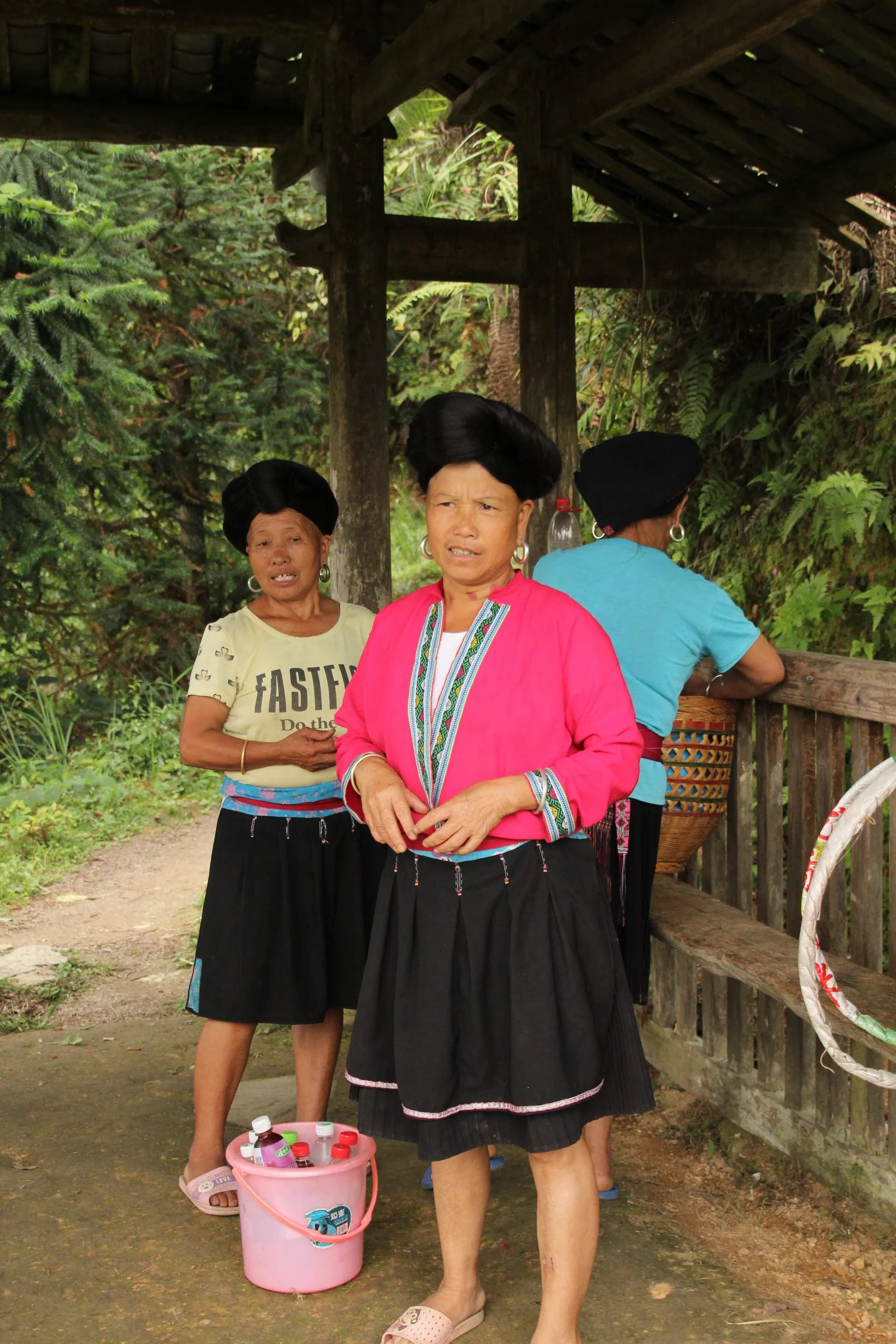
Dai Minority Park (傣族园, Dǎizú Yuán)
A cultural park 30 km east of Jinghong preserving five traditional Dai villages with stilted bamboo houses, Buddhist temples, and daily water-splashing ceremonies. Touristy but informative — you can see traditional Dai weaving, silversmithing, and cooking. ¥65. Allow 2-3 hours. The water-splashing ceremony happens twice daily (13:30 and 15:30) — bring a change of clothes or a rain poncho if you want to participate.
Wikimedia Commons · CC-BY-SA
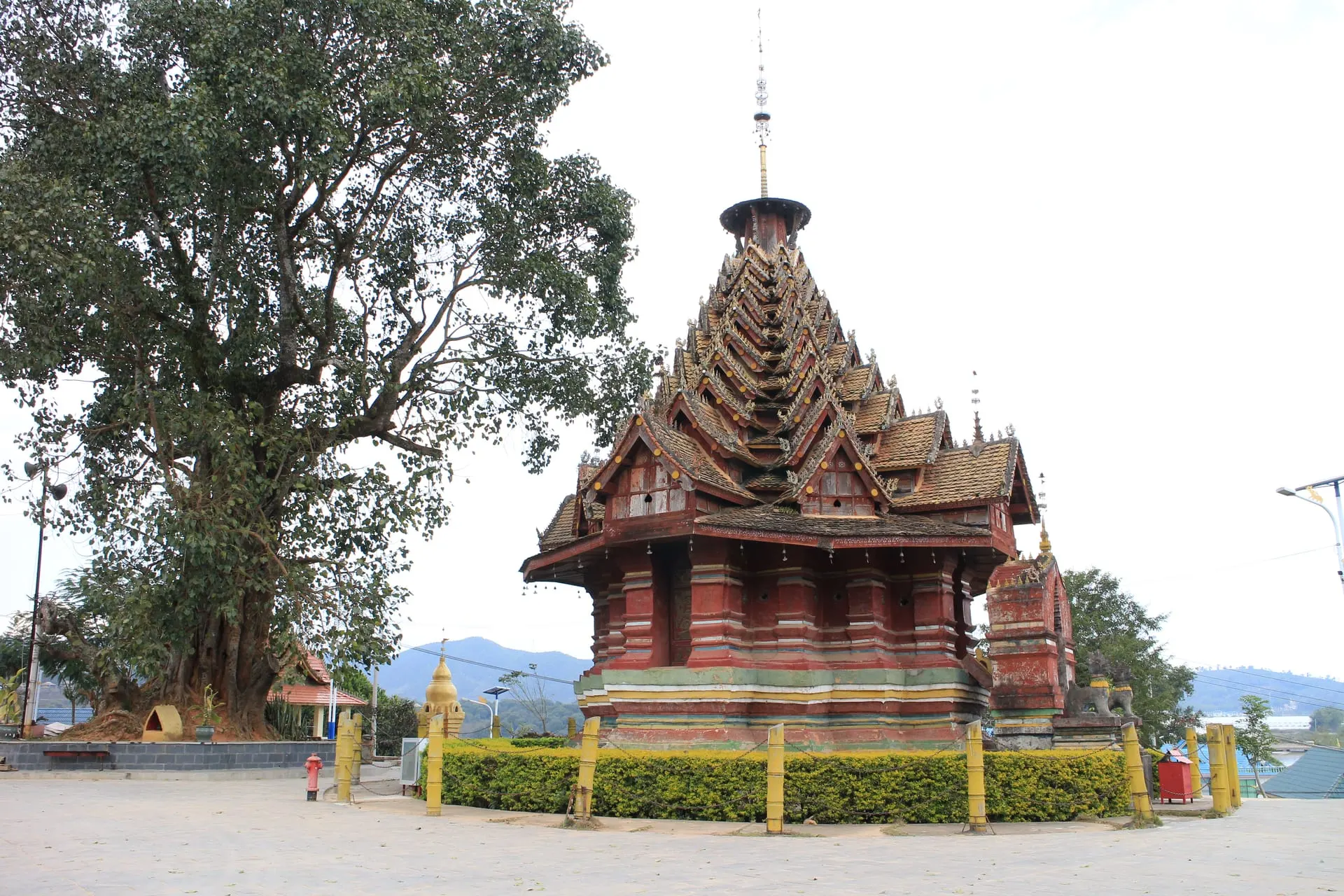
Jingzhen Octagonal Pavilion (景真八角亭, Jǐngzhēn Bājiǎo Tíng)
An exquisite 18th-century Theravada Buddhist pavilion with an eight-sided multi-tiered roof, 70 km west of Jinghong near Menghai. Built in 1701, it is one of the finest examples of Dai Buddhist architecture in Yunnan. ¥20. Allow 1 hour. Few visitors make it this far west — the pavilion is quiet, elegant, and surrounded by a working monastery. Combine with a visit to Menghai's tea plantations.
Wikimedia Commons · CC-BY-SA
STAY
Where to stay in Xishuangbanna
Pick a base that matches the trip you want — imperial-central for sightseeing, hutong belt for character, Chaoyang for nightlife, or Qianmen for budget.
Gaozhuang / Starlight District (告庄西双景)
Purpose-built tourist zone with Dai architecture, the night market, and Mekong riverfront — convenient and photogenic
#gaozhuangJinghong City Center / Manting (景洪市中心/曼听)
The real city — cheaper hotels, local restaurants, Manting Park, and the riverfront promenade
#jinghong-centerMenglun / Botanical Garden Area (勐仑)
Riverside resort and guesthouses next to the CAS Botanical Garden — best for early-morning garden access
#menglunMenghai Tea Mountains (勐海)
Pu'er tea country 50 km west — tea plantations, ancient tea trees, and Dai/Bulang villages
#menghai
ITINERARIES
Sample itineraries from Xishuangbanna
Three ready-made routes, from a 1-day imperial sprint to a 5-day deep dive. Copy the day-by-day plan and adapt to your own pace.
- 2 DAYS
2-Day Xishuangbanna Highlights
Botanical Garden and Wild Elephant Valley — the two essential Xishuangbanna experiences plus the night market.
- Travelers with limited time who want the core experience
- Day 01
Morning
CAS Tropical Botanical Garden (leave Jinghong 07:30, arrive 08:30, 4-5 hours — palm garden, orchid garden, dancing grass, fruit orchard).
Afternoon
Lunch at garden restaurant (¥30-50). Return to Jinghong by 15:00. Manting Park (¥40, 1-2h).
Evening
Gaozhuang Starlight Night Market — grilled Mekong fish, papaya salad, fruit shakes. Walk the Mekong riverfront.
- Day 02
Morning
Wild Elephant Valley (leave 07:30, arrive 08:15, 3-4h on elevated walkways — skip captive shows).
Afternoon
Mengle Buddhist Temple (¥120, 1.5h) — golden Buddha and panoramic views. Xishuangbanna National Museum (free, 1h).
Evening
Final night market dinner or Pu'er tea tasting at a Jinghong tea house.
- 3 DAYS
3-Day Xishuangbanna Complete
All major Jinghong-area sites plus Dai cultural experiences at a comfortable pace.
- Most travelers — the recommended plan
- Day 01
Morning
CAS Botanical Garden (full morning, 08:30-13:00). Electric cart (¥50).
Afternoon
Return to Jinghong. Manting Park afternoon visit. Free time along the Mekong riverfront.
Evening
Gaozhuang night market dinner. Walk the illuminated riverside.
- Day 02
Morning
Wild Elephant Valley (08:00-12:00 — wild walkways only).
Afternoon
Mengle Buddhist Temple. Xishuangbanna National Museum.
Evening
Manting Park evening cultural show (¥200) — Dai dance, buffet dinner, lantern ceremony on the lake.
- Day 03
Morning
Dai Minority Park (leave 08:00, 30 km east — stilted villages, weaving, silversmithing). Stay for the 13:30 water-splashing ceremony.
Afternoon
Return to Jinghong. Free afternoon — walk the city, visit a tea house, explore local markets.
Evening
Final Gaozhuang night market visit. Try dishes you missed on previous nights.
- 4 DAYS
4-Day Xishuangbanna + Tea Mountains
The complete Xishuangbanna experience plus the Menghai tea mountains — the quieter, more authentic side of the region.
- Travelers who want depth beyond the main tourist sites
- Day 01
Morning
CAS Botanical Garden (full morning).
Afternoon
Return to Jinghong. Manting Park.
Evening
Gaozhuang night market.
- Day 02
Morning
Wild Elephant Valley (morning).
Afternoon
Mengle Buddhist Temple. Xishuangbanna National Museum.
Evening
Manting Park evening show or second night market visit.
- Day 03
Morning
Dai Minority Park (morning + water-splashing ceremony).
Afternoon
Return to Jinghong. Free time.
Evening
Pu'er tea tasting at a Jinghong tea house.
- Day 04
Morning
Drive to Menghai (50 km west). Jingzhen Octagonal Pavilion (¥20, 1h). Visit a Dai temple in Menghai.
Afternoon
Tea mountain tour — ancient tea trees, Pu'er processing, tea tasting at a family-run tea house. Lunch in Menghai.
Evening
Return to Jinghong. Final dinner.
BUDGET
What a Xishuangbanna trip costs
Per-person, per-day costs across three spending tiers. Excludes international flights and visa fees.
| Line item | Backpacker | Mid-range | Luxury |
|---|---|---|---|
| Backpacker (per day) | $140 | $0 | $0 |
| Mid-range (per day) | $0 | $400 | $0 |
| Luxury (per day) | $0 | $0 | $1100 |
| Total per day | $140 | $400 | $1100 |
$ USD per person per day, before international flights and visas. Last verified: Q3 2026.
STAY SAFE
Emergency contacts in Xishuangbanna
Save these three numbers before you board the plane. China uses different hotlines than most countries — there's no 911.
- POLICE
110
- AMBULANCE
120
- FIRE
119
- TOURIST HOTLINE
0691-12301
- ENGLISH-SPEAKING ER
Xishuangbanna People's Hospital (西双版纳傣族自治州人民医院), 0691-2123849 — limited English, medical evacuation to Kunming or Bangkok for serious cases
Problems travelers hit in Xishuangbanna
- Why is my Alipay not working?You linked a foreign Visa or Mastercard to Alipay but every transaction is rejected at the merchant.
- My China visa was denied — what now?Your L visa application was refused at the Chinese consulate and your trip is in 2–4 weeks.
- My passport was lost or stolen in China — what do I do?Your passport is gone (theft or loss) and you're in mainland China without travel documents.
- Why can't I book on 12306 with my foreign card?You tried to book a high-speed rail ticket on 12306.cn and your foreign Visa/Mastercard is rejected at checkout.
- Why is my VPN not working in China?You arrived in China, opened your VPN, and it will not connect at all or connects but no traffic loads.
- Why can't I book a Tibet trip on my own?You try to book Lhasa flights and hotels yourself but the booking fails, or you're turned away at the Lhasa airport without a permit.
Book activities in Xishuangbanna
These are licensed tour operators and booking platforms we've vetted independently. Booking through these links may earn us a commission — see our affiliate disclosure. This never affects our editorial recommendations or the price you pay.
Frequently asked questions
Is Xishuangbanna worth visiting compared to other parts of Yunnan?
Can I see wild elephants in Xishuangbanna?
How many days do I need in Xishuangbanna?
What is the Water-Splashing Festival and should I plan my trip around it?
Is Xishuangbanna suitable for families with children?
Can I travel from Xishuangbanna to Laos?
Show all 20 FAQs
Is the Gaozhuang night market worth it or is it a tourist trap?
What is the best time of year to visit Xishuangbanna?
Do I need a guide for Xishuangbanna?
What should I pack for Xishuangbanna?
Is the Botanical Garden worth the 1-hour drive from Jinghong?
Is Xishuangbanna safe?
What is the single best experience in Xishuangbanna?
What is Dai Buddhist temple architecture like and how is it different from Tibetan Buddhism?
Is it worth visiting a Dai village or is the cultural park enough?
What is the Menghai tea mountain day-trip like and is it worth a full day?
How does the China-Laos Railway change the trip to Xishuangbanna?
What should I know about the wild Asian elephants at Wild Elephant Valley?
Is Jinghong walkable and what is the city center like?
What is the best time of day to visit the Gaozhuang night market and how do I get there?
References

Related guides & destinations
Guide
How We Research 2026: NihaoVisit’s Methodology for China Travel Information
How NihaoVisit sources, verifies, and maintains 700+ pages of China travel information — our source hierarchy, fact-checking process, update
Guide
Fact-Checking Log 2026: Verified China Travel Information — NihaoVisit
A public log of fact-checking verification passes on NihaoVisit, showing what was verified, when, and against which sources — covering visa
Guide
Best Time to Visit China 2026: Month-by-Month Weather, Crowds, and Prices
The best time to visit most of China is April–May and September–October. Winter (Dec–Feb) is cold but cheap; summer (Jun–Aug) is hot and cro
Guide
VPN for China 2026: Which VPNs Work, eSIM Alternatives, and the Complete Pre-Trip Checklist
Most Western apps and websites are blocked in mainland China. A reliable VPN is essential for Google, Gmail, WhatsApp, Instagram, and most n
Guide
China SIM Card and eSIM Guide 2026: Stay Connected Without WeChat
A Chinese SIM or eSIM lets you use mobile data, maps, and ride-hailing without WiFi. Here is how to get one, the cost, and which provider to
Guide
Solo Female Travel in China 2026: Safety, Tips, and Real Experiences
China is one of the safer destinations for solo female travelers. Petty theft is rare, violent crime against tourists is extremely uncommon,