Yunnan
Yunnan is a 5-day minimum, ideally 1-2 weeks. The classic Kunming → Dali → Lijiang triangle is the most accessible: Kunming for the Stone Forest, Dali for Erhai Lake and Bai culture, Lijiang for the UNESCO Old Town and the Naxi minority. Beyond the triangle: Shangri-La (Tibetan plateau), Yuanyang Rice Terraces, Xishuangbanna (tropical). The province spans tropical to alpine climates so any time of year works somewhere. Less crowded and more affordable than Beijing/Shanghai.
Why Yunnan in 2026.
China's most diverse province — 25 of China's 56 ethnic minorities, three UNESCO sites, and landscapes ranging from snow mountains to tropical jungle.
Quick Answer
Yunnan is a 5-day minimum, ideally 1-2 weeks. The classic Kunming → Dali → Lijiang triangle is the most accessible: Kunming for the Stone Forest, Dali for Erhai Lake and Bai culture, Lijiang for the UNESCO Old Town and the Naxi minority. Beyond the triangle: Shangri-La (Tibetan plateau), Yuanyang Rice Terraces, Xishuangbanna (tropical). The province spans tropical to alpine climates so any time of year works somewhere. Less crowded and more affordable than Beijing/Shanghai.
| Best time to visit | March-May, September-November (year-round possible, depends on region) |
|---|---|
| Daily budget | $45 (backpacker) / $110 (mid-range) / $320+ (luxury) |
| Language | Mandarin (Cantonese speakers common in Kunming; Naxi, Bai, Tibetan, Dai in countryside) |
| Currency | CNY (¥) |
| Time zone | China Standard Time (UTC+8) |
| Last updated | 2026-06-16 |
Want a Yunnan plan built for you?
Jump to:
What makes Yunnan different·Is Yunnan worth the detour·Classic route·Altitude·Best time·Getting around·What to eat·Minority cultures·Trip cost·Day-by-day Kunming-Dali-Lijiang·Beyond the triangle·Respectful cultural visits·Food deep dive·Regional timing·Yuanyang terraces·Shangri-La primer·Water-Splashing Festival
What makes Yunnan different from the rest of China?
Yunnan is China's most southwesterly province and its most diverse, bordering Vietnam, Laos, and Myanmar and rising from tropical river valleys in the south to Tibetan plateau in the north. It is home to around half of China's recognized ethnic minorities — including the Bai, Naxi, Yi, Dai, and Hani — each with distinct languages, dress, and festivals. For travelers this means a single province holds a car-free old town (Lijiang), a vast lake and Bai culture (Dali), a limestone "stone forest" (Kunming), terraced rice fields carved over centuries (Yuanyang), tropical rainforest (Xishuangbanna), and Tibetan monasteries (Shangri-La). The range of landscapes and cultures in one province is unmatched elsewhere in China.
Is Yunnan worth the detour?
Yes, for travelers with seven or more days in China. The Kunming–Dali–Lijiang triangle is the best counterpoint to the eastern megacities: Naxi and Bai culture, snow peaks, alpine lakes, and a slower pace at lower prices than Beijing or Shanghai. If you only have a week total in China, prioritize the cities and save Yunnan for a return trip; if you have ten days or more, Yunnan rewards the journey.
What is the classic Yunnan route?
The most popular circuit is the Kunming–Dali–Lijiang triangle, usually traveled northward over five to seven days. Travelers with more time push on to Shangri-La on the Tibetan plateau, or detour south to the Yuanyang rice terraces or tropical Xishuangbanna. Distances are real, so pace the route rather than rushing.
Is altitude sickness a problem in Yunnan?
Usually mild and only at the upper end of the route. Kunming (around 1,900m) and Dali (around 2,000m) are fine for almost everyone. Lijiang sits near 2,400m, and the Jade Dragon Snow Mountain cable car reaches roughly 4,500m, where some travelers feel shortness of breath or headache. Drink plenty of water, skip alcohol the night before ascending, go slowly at the top, and descend if you feel unwell. Most people acclimatize within a day or two.
When is the best time to visit Yunnan?
Yunnan is visitable year-round because its regions peak in different seasons, but March to May and September to November are the most reliably pleasant across the province. Summer (June to August) is the rainy season — green and lush, with afternoon showers and occasional mountain-road delays. Winter is cold in Lijiang and Shangri-La (with snow on the high peaks) but Kunming stays mild, earning its "Spring City" nickname. The Yuanyang terraces are most photogenic when flooded, roughly November to April.
How do I get around Yunnan?
A mix of high-speed rail, regional flights, and road transport links the main stops. High-speed rail connects Kunming to Dali and Lijiang, cutting what used to be long bus rides to a couple of hours. Shangri-La is reachable by rail and road; more remote areas like Yuanyang and Xishuangbanna often need a flight into a regional airport plus a drive. Many travelers hire a driver or join small-group tours for the scenic mountain stretches. Build travel time into the itinerary — the province is large and mountainous.
What should I eat in Yunnan?
Yunnan food is one of China's most varied regional cuisines, reflecting its many ethnic groups and its border with Southeast Asia. Expect crossing-the-bridge noodles (a hot broth you add ingredients to at the table), rice noodles generally, mushrooms (a summer obsession, harvested from the mountains), cured ham, flower cakes, and Dai-style sour and spicy dishes in the tropical south. Food is generally fresh and lighter than the heavy, oily fare of northern China. Vegetarians eat well here thanks to the Buddhist and minority traditions.
Which ethnic-minority cultures will I encounter?
Several, depending on your route. Around Dali, the Bai people are known for their tie-dye, tea culture, and white-and-blue architecture. In Lijiang, the Naxi developed one of the world's last living pictographic writing systems and a distinct musical tradition. North of Lijiang, Tibetan culture dominates around Shangri-La. In the south, the Dai people (closely related to the Thai) celebrate a water-splashing new year. Markets, festivals, and village visits are the best way to see these cultures respectfully — always ask before photographing people.
How much does a Yunnan trip cost?
Yunnan is more affordable than Beijing or Shanghai. A mid-range traveler can manage on roughly $80–140 a day including mid-range hotels, local food, entrance tickets, and inter-city transport; budget travelers spend less, and luxury travelers more. The biggest variables are the Jade Dragon Snow Mountain cable car and ticket bundle and any private drivers for remote areas. Prices shift seasonally, so re-check before booking.
How do I plan a Kunming-Dali-Lijiang itinerary day by day?
A well-paced Kunming-Dali-Lijiang itinerary spans five to seven days, moving northward from Kunming through Dali to Lijiang, with each stop adding altitude, scenery, and a distinct minority culture. Day 1: Arrive in Kunming. If you land in the morning, head to the Stone Forest (a one-and-a-half-hour drive each way, budget a half-day) to see the UNESCO-listed karst formations. Evening in central Kunming at Green Lake Park, where locals dance, sing, and fly kites at dusk. Day 2: Morning in Kunming — visit Yuantong Temple, the city's oldest Buddhist temple with a rare octagonal hall, and walk the flower-and-bird market. Afternoon high-speed train to Dali (two hours). Evening stroll through Dali Old Town, dinner at a Bai-minority restaurant, and a drink on Foreigner Street (Huguo Lu). Day 3: Full day in Dali. Rent a bicycle or e-scooter (thirty to eighty yuan) and ride the Erhai Lake loop, stopping at Xizhou village for Bai courtyard mansions and the morning market, and at Zhoucheng for traditional tie-dye workshops. The full Erhai loop is roughly one hundred and twenty kilometers — most travelers ride a section and skip the far side. Return for sunset over the Cangshan Mountains from the old-town walls. Day 4: Morning in Dali (the Three Pagodas of Chongsheng Temple are the postcard sight, though the ¥121 ticket is steep for what you see; many travelers view them from outside). Afternoon high-speed train to Lijiang (two hours). Evening walk through Lijiang Old Town — at this hour the day-trippers are thinning and the cobblestone lanes are lit by lanterns. Day 5: Lijiang Old Town in the early morning (before nine, when it is quiet and the mountain light hits the tiled roofs), then Black Dragon Pool park for the classic Jade Dragon Snow Mountain reflection shot. Afternoon at Shuhe Ancient Town, a smaller, quieter Naxi settlement a few kilometers north. Evening Naxi ancient music performance. Day 6: Jade Dragon Snow Mountain — take the cable car to roughly 4,500 meters for glacier views, then see the Impression Lijiang cultural show in the valley below. This is a full day and the single most expensive sight in Yunnan (over ¥300 for the cable car and ticket bundle). Day 7: Depart from Lijiang, or extend to Tiger Leaping Gorge (two-day trek) or Shangri-La (two to three days). This pace gives you the triangle without rushing. If you have only five days, drop Day 2's Kunming morning and take an early train to Dali instead.
What are the best places to visit in Yunnan beyond the classic triangle?
Beyond the Kunming-Dali-Lijiang triangle, five destinations reward the extra travel time with a different face of Yunnan. Shangri-La (Zhongdian), at roughly 3,200 meters on the edge of the Tibetan plateau, is the most popular extension from Lijiang, reached in about one and a half hours by high-speed rail. It has the Songzanlin Monastery (the largest Tibetan Buddhist monastery in Yunnan, often called the Little Potala), yak pastures, Tibetan villages, and a stretch of the old Tea Horse Road. Budget two to three days. The altitude is high enough that you should spend the first day acclimatizing. Xishuangbanna, in the tropical south bordering Laos and Myanmar, is Yunnan's most dramatic climate shift — Dai minority culture, rainforest, wild-elephant reserves, and the Manting Park temple complex. It is reached by a one-hour flight from Kunming or Lijiang to Jinghong. The best months are November to April (dry, warm, pleasant); summer is extremely hot and rainy. Budget three days. The Yuanyang Rice Terraces, carved by the Hani people over centuries into the Ailao Mountains in southern Yunnan, are among the world's most photogenic agricultural landscapes. They are most spectacular when flooded (roughly November to April), when the water-filled terraces mirror the sky at sunrise. Reached by a long road journey from Kunming (six to seven hours, no train). Budget two days with an overnight in the area. Dongchuan Red Land, northeast of Kunming, is a photography destination where iron-rich red soil contrasts with green crops and yellow buckwheat flowers. Best April to June and September to November. Requires an overnight in basic guesthouses. Shaxi Ancient Town, roughly halfway between Dali and Lijiang, is a restored market town on the old Tea Horse Road with a cobblestone square, a temple complex, and a Friday morning market. It is smaller, quieter, and less commercial than the main old towns. Reachable by road from Dali or Lijiang. Budget one night.
How should I experience Yunnan's minority cultures respectfully?
Yunnan's minority cultures are its greatest distinction, and experiencing them well requires a different approach from ticking off sights — one built around markets, festivals, and respectful village visits with a local guide. The most natural and least intrusive way to encounter minority culture is through markets. The Dali area has daily rotating markets in different Bai villages: Xizhou's morning market (best before 10 AM), Shaping's Monday market, and Shaxi's Friday market are the most rewarding for seeing traditional dress, local produce, and daily commerce without a staged performance. Festivals are the second-best window: the Bai Third Month Fair (April, Dali), the Dai Water-Splashing Festival (April, Xishuangbanna), and the Yi Torch Festival (usually July or August) are the most spectacular, though they draw large domestic crowds. For village visits, go with a local guide who can explain customs and facilitate respectful interaction. In Bai villages, the tie-dye workshops at Zhoucheng near Dali are authentic working demonstrations, not just tourist shows. In Naxi villages around Lijiang, the Dongba cultural center in Baisha village is a more genuine introduction to the pictographic script and animist traditions than the staged performances in Lijiang Old Town. When visiting: ask before photographing people, especially elders and monks; dress modestly at monasteries and temples; walk clockwise around Tibetan stupas, prayer wheels, and temple circuits; do not touch religious objects or altar offerings; and avoid pointing your feet at people or Buddha images (considered disrespectful across Buddhist cultures). The key principle: minority communities in Yunnan are not museum exhibits — they are living cultures, and the best experiences come from treating interactions as encounters, not photo opportunities. Markets, teahouses, and festivals are where those encounters happen most naturally.
What should I eat in Yunnan and where do I find the best food?
Yunnan cuisine is one of China's most varied, shaped by ethnic diversity and an extraordinary range of ingredients — mushrooms, flowers, wild herbs, and fermented teas are as central here as rice and noodles. The single dish every traveler should try is crossing-the-bridge noodles (guo qiao mi xian), a Kunming specialty: a bowl of scalding chicken broth is brought to your table, and you add thin slices of raw meat, quail eggs, vegetables, and rice noodles, which cook in the broth. The best versions are at specialist noodle shops in Kunming (look for Mengzi-style, considered the original). In Dali, Bai cuisine is the focus: cured ham (similar to the famous Xuanwei ham), grilled erythropus fish from Erhai Lake, rushan (a grilled cheese-like dairy product unique to the Bai, often served with rose petal jam), and a wide range of wild-vegetable dishes. The restaurants along Foreigner Street and the lanes south of the old town are the most traveler-friendly. In Lijiang, Naxi cuisine includes baba (a thick grilled flatbread with sweet or savory fillings) and hot pots using local yak meat and mountain mushrooms. In the tropical south (Xishuangbanna), Dai food turns sour, spicy, and Southeast Asian — grilled fish in banana leaves, sour bamboo-shoot soup, pineapple rice, and fresh herb salads. Across the province, Yunnan's mushroom culture is an obsession: from roughly June to September, dozens of wild mushroom species — including the prized matsutake and the rare junsun — appear in markets and on menus. Kunming has the best mushroom hot-pot restaurants. Yunnan coffee, grown in the southern mountains around Pu'er and Baoshan, is China's best and is increasingly served at specialty coffee shops in Dali, Lijiang, and Kunming. Pu'er tea, a fermented dark tea from southern Yunnan, is available at teahouses throughout the province — the best tea-tasting experiences are in Kunming's tea markets and specialist teahouses, where you can taste aged Pu'er vintages.
When should I visit each specific region of Yunnan?
Yunnan spans tropical to alpine climates, so there is no single best time for the whole province — regions peak in different seasons, and you can find good weather somewhere in the province year-round. The Kunming-Dali-Lijiang triangle is most reliably pleasant in March to May and September to November. Spring (March–April) brings clear skies, blooming flowers, and green hillsides; autumn (September–November) has crisp air, golden light, and the most stable weather of the year. Summer (June–August) is the rainy season across the triangle — afternoon showers, occasional mountain-road delays, and high humidity, but the landscape is at its greenest and the crowds are thinner. Kunming stays mild year-round (its nickname is Spring City), making it a good fallback in any month. Shangri-La and the Tibetan plateau are best May to October — the high-altitude winter (November–March) is extremely cold, with temperatures well below freezing at night and many guesthouses closed. Wildflowers on the plateau peak in June and July. Xishuangbanna in the tropical south is best November to April, when it is dry, warm (20–30°C), and pleasant; summer (May–October) is the rainy season, hot and humid, with mosquito activity at its peak. The Yuanyang Rice Terraces are most photogenic when flooded, roughly November to April — this is when the water-filled terraces mirror the sky at sunrise and create the well-known images. The terraces are planted and green from May to October, which is less photogenic but still scenic. The Dongchuan Red Land is best April–June (plowing season, red soil freshly turned) and September–November (harvest, buckwheat flowers bloom in gold). Tiger Leaping Gorge trekking is best April–May and September–November; summer rains make the trail slippery, and winter can close sections. The practical takeaway: pick two or three regions that align with your travel dates rather than trying to cover the whole province in one trip outside the universal shoulder windows.
What should I know before visiting the Yuanyang Rice Terraces?
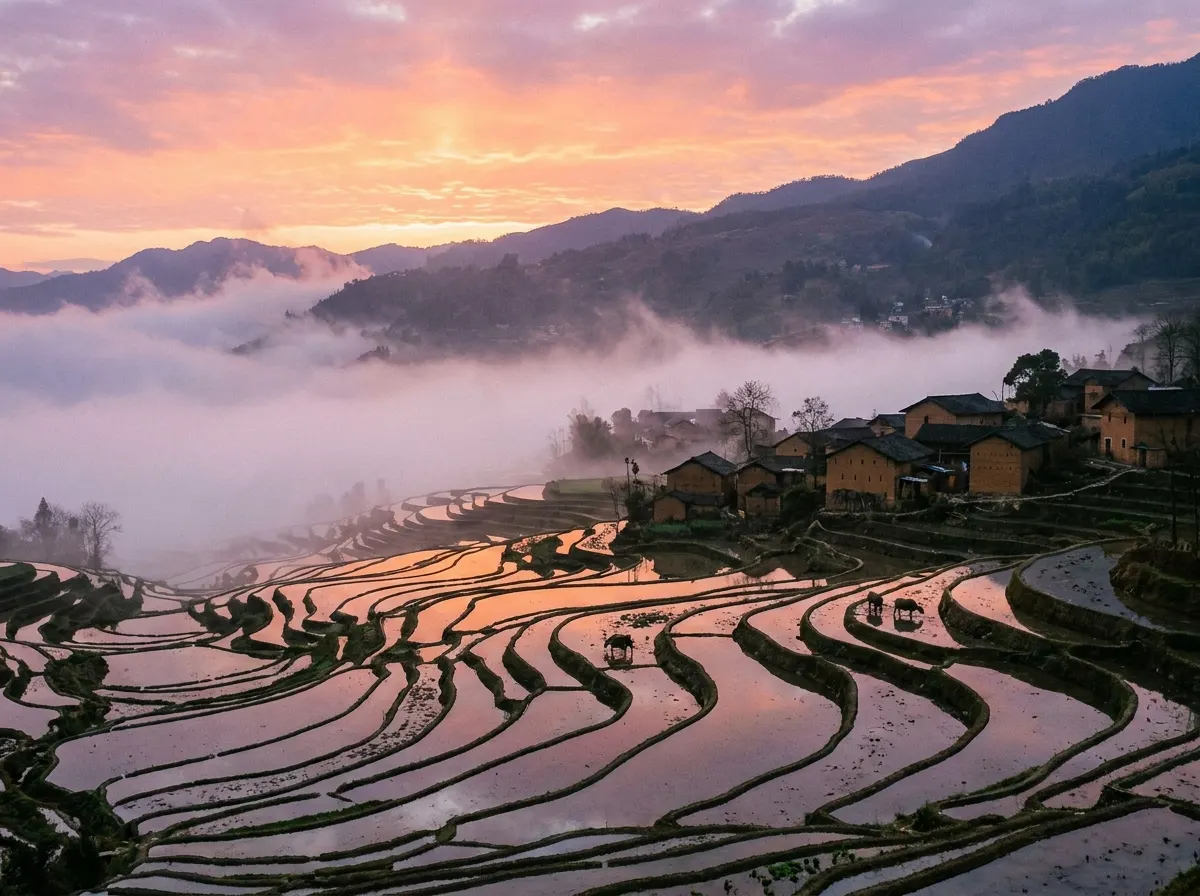
The Yuanyang Rice Terraces, a UNESCO Cultural Landscape in southern Yunnan, are one of the world's most extraordinary agricultural sites — and visiting them well requires planning around timing, transport, and altitude. The terraces were carved into the Ailao Mountains by the Hani people over more than 1,300 years, creating a stepped landscape of water-filled paddies that cascades down forested slopes for kilometer after kilometer. The most photogenic season is the flooded period from late November through April, when the terraces hold mirror-still water that reflects the sky at sunrise — the well-known shot. In May, the fields are planted and turn vivid green; in September and October, the rice ripens to gold. The two best sunrise viewpoints are Duoyishu (the most famous, with a clear view across multiple terrace levels) and Bada (a quieter, slightly higher vantage). For sunset, the Laohuzui ("Tiger Mouth") viewpoint throws dramatic light into a deep U-shaped curve of terraces. The nearest town is Yuanyang (Xinjie), about three hours by road from the terraces, with simple hotels and restaurants; most travelers stay one or two nights in village guesthouses closer to the viewpoints for early-morning access. The road journey from Kunming is six to seven hours one-way, with no train — most travelers either join a small-group photography tour or hire a private driver for two to three days (roughly 600–900 yuan per day for the car and driver). Altitude is moderate (around 1,800–2,000m at the main viewpoints), so acclimatization is rarely an issue. Pack layers: the mountain mornings are cold in winter, the midday sun is strong, and fog can roll in by late afternoon. A tripod is essential for serious photographers. The terraces are a working landscape, not a museum — be respectful of the Hani farmers working the fields, stay on designated paths, and avoid blocking irrigation channels. The entry fee is around 100 yuan for a multi-day pass covering the main viewpoints, with separate tickets for some sections. Two to three days is the right visit length: one day for the Duoyishu sunrise and the surrounding villages, a second day for Bada and Laohuzui, and optionally a third day to walk between the terraces or visit a Hani market day. Direct buses between Kunming and Yuanyang are limited; the most reliable options are pre-booked drivers, organized photography tours, or a bus to Jianshui followed by a local transfer. For travelers whose time is limited to the Kunming-Dali-Lijiang triangle, the Yuanyang terraces are a hard detour — six to seven hours one-way plus a two-night stay. They are worth it only if you are a serious photographer, deeply interested in Hani culture, or building a longer southern-Yunnan route that also includes Jianshui or the Vietnam border.
What is Shangri-La like and how should I plan a visit?
Shangri-La (formerly Zhongdian) sits at around 3,200 meters on the northern edge of Yunnan where the province meets the Tibetan plateau, and it is the cultural and climatic counterpoint to the Dali-Lijiang corridor. The town itself is a small, modernizing Tibetan town of around 100,000 people with a rebuilt old quarter (the original burned in a 2014 fire and has been partially restored), monasteries, prayer flags, and yak-meat hot pot on most menus. It is the most popular side trip from Lijiang, reached in about 1.5 hours by the Lijiang–Shangri-La high-speed rail that opened in 2023, and the high-altitude weather, landscape, and architecture make it feel like a different country from the subtropical lowlands further south. The single most rewarding sight is the Songzanlin Monastery — a 1679 Tibetan Buddhist monastery often called the Little Potala, with several hundred monks in residence, golden roofs, white walls, and a hillside position overlooking the town. The ¥115 ticket is worth it; the morning chanting session (around 11 AM, when monks gather) and the late-afternoon light are the best times. The atmospheric detail: walk clockwise around the main stupa and prayer wheels, do not point your feet at the Buddha images, and never step on the threshold of a temple door. Beyond the monastery, the most rewarding activities are: a half-day visit to Napa Lake (a seasonal wetland and horse pasture just outside town, where Tibetan herders graze yaks in summer), a drive through the surrounding Tibetan villages, and a meal of yak meat dumplings or barley wine in a small family restaurant in the old quarter. The old town itself has been heavily rebuilt, but the giant prayer wheel in the central square (one of the largest in the world, requiring several people to turn) and the moon-shaped reflecting pool in front of it are worth a stroll. Altitude is the most important practical consideration. At 3,200m, most travelers feel mild symptoms on arrival — headache, shortness of breath on stairs, disturbed sleep. Spend the first day doing almost nothing, drink plenty of water, skip alcohol, and avoid strenuous activity. Symptoms usually clear in one to two days. The best months to visit are May to October; the high-altitude winter (November through March) is brutally cold, with night temperatures below freezing, snow on the plateau, and many simple guesthouses closed. Wildflowers on the surrounding meadows peak in June and July. The Tibetan Horse Racing Festival (typically late June or early July, dates set by the lunar calendar) at Napa Lake is the most spectacular local festival, with yak-hide boat races, traditional horse racing, and large crowds. For practicalities, the Shangri-La airport has regular flights to Kunming, Lhasa, and Chengdu; high-speed rail connects directly to Lijiang (1.5h) and onward to Kunming. Hotels range from basic Tibetan-style guesthouses (¥150–300 per night) to comfortable mid-range options (¥400–700). The most common mistake travelers make is treating Shangri-La as a day trip from Lijiang — the altitude, the two-hour each-way transit, and the cultural depth of the Tibetan plateau all reward at least one overnight, ideally two.
What is the Dai Water-Splashing Festival like?
The Dai Water-Splashing Festival (Po Shui Jie), held in mid-April in Xishuangbanna, is the most exuberant celebration in Yunnan — and one of the most photogenic festivals anywhere in China. It marks the Dai new year, coincides with the Thai Songkran and the Burmese Thingyan, and lasts for three to seven days depending on the town. The premise is simple: water washes away the bad luck of the previous year, and the more you get splashed, the more luck you receive in the new one. The reality is wetter, louder, and more joyful than any expectation. On festival days, the streets of Jinghong (the capital of Xishuangbanna) and the smaller Dai towns along the Mekong — including Ganlanba, Damenglong, and Mengla — fill with crowds in traditional Dai dress, carrying buckets, water guns, hoses, and anything else that can move water. Trucks parade through the streets spraying everyone in reach. Strangers, friends, monks, and tourists all douse each other. The water is usually clean and sometimes infused with flower petals or rice flour for blessing. By mid-afternoon, no one is dry. The festival is rooted in a Buddhist legend: after a year of drought, the people appealed to the gods, and seven women were chosen to carry water from a sacred well; the journey was so difficult that they died in the act, and the festival commemorates their devotion. Today, the religious and the playful blend. Beyond the water-throwing, the festival includes dragon-boat races on the Lancang (Mekong) River, peacock dances, traditional Dai music and dance performances, sand pagodas built at the temples, and a market fair selling Dai textiles, tropical fruit, and grilled river fish. The main temple complex, Manting Park in Jinghong, hosts the most concentrated events, and the Wat Sipsongpanna (the most important Dai Buddhist temple in town) holds chanting and blessing rituals. The practical side: travel early. Hotel prices in Jinghong triple or quadruple for the festival, and rooms book out one to three months in advance. The high-speed rail extension from Kunming to Xishuangbanna (opened 2023) has made the journey easier, but flights and trains also fill early for the festival. Pack a dry bag for phone, wallet, and passport; wear quick-drying clothes you do not mind getting soaked; bring water-resistant shoes (the streets run with water); and plan to spend at least two full days in the area to catch the main events. The festival officially runs three days, but celebrations in surrounding towns often continue for a week. Outside the festival period, Xishuangbanna is a worthwhile destination on its own — the tropical climate, the Dai Buddhist temples (visually closer to Thai wats than to Chinese Buddhist monasteries), the botanical gardens (the Menglun Tropical Botanical Garden of the Chinese Academy of Sciences is one of the best in China), and the wild elephant and peacock reserves give it a feel far from any other province. The best months to combine a Water-Splashing visit with broader Xishuangbanna sightseeing are November through April, when the weather is dry and warm. April is the most rewarding for the festival, but expect crowds, higher prices, and full hotels. For a quieter version of the same culture, the smaller towns along the Mekong — Damenglong, Mengyang, or the villages around Menglun — hold their own water-splashing events with more local character and far fewer tourists. Travelers without a fixed date should consider shifting a Yunnan trip by a year to coincide with the festival — it is the single most distinctive cultural event in the province, and missing it by a few days means missing the main spectacle entirely. Worth noting: the official dates follow the Dai calendar and are announced only a few weeks in advance, so confirm current dates with your hotel or a local tourism office before booking.
Top attractions
Lijiang Old Town
UNESCO-listed 800-year-old Naxi minority town. Cobblestone streets, canal, Naxi music. Free to walk, ¥80 for the main square.
Jade Dragon Snow Mountain
5,596m snow-capped peak 30 min from Lijiang. Cable car to 4,506m. Day trip with cultural show. ¥200.
Erhai Lake (Dali)
250km² lake with Bai minority villages around the shore. Bike ride or e-scooter loop is the classic Dali day. ¥100 bike rental.
Stone Forest (Kunming)
UNESCO karst rock formation 1.5h drive from Kunming. 270M years old. ¥175 with shuttle.
Tiger Leaping Gorge
One of the world's deepest river canyons, where the Jinsha River (upper Yangtze) cuts between Jade Dragon Snow Mountain and Haba Snow Mountain. A 2-day trek along the high trail passes guesthouses with mountain views. Accessible from Lijiang (2h drive). ¥65 entry.
Songzanlin Monastery (Shangri-La)
The largest Tibetan Buddhist monastery in Yunnan, often called the "Little Potala." Built in 1679, it houses several hundred monks and sits on a hillside overlooking Shangri-La. ¥115. A 30-minute walk or short taxi from Shangri-La town.
STAY
Where to stay in Yunnan
Pick a base that matches the trip you want — imperial-central for sightseeing, hutong belt for character, Chaoyang for nightlife, or Qianmen for budget.
Green Lake Park (Cuihu)
A central park in Kunming with locals dancing, playing instruments, and feeding seagulls.
#green-lake-parkStone Forest (Shilin)
A UNESCO karst formation 90 km southeast of Kunming — pillars shaped by 270 million years of erosion.
#stone-forest
Problems travelers hit in Yunnan
- Why is my Alipay not working?You linked a foreign Visa or Mastercard to Alipay but every transaction is rejected at the merchant.
- My China visa was denied — what now?Your L visa application was refused at the Chinese consulate and your trip is in 2–4 weeks.
- My passport was lost or stolen in China — what do I do?Your passport is gone (theft or loss) and you're in mainland China without travel documents.
- Why can't I book on 12306 with my foreign card?You tried to book a high-speed rail ticket on 12306.cn and your foreign Visa/Mastercard is rejected at checkout.
- Why is my VPN not working in China?You arrived in China, opened your VPN, and it will not connect at all or connects but no traffic loads.
- Why can't I book a Tibet trip on my own?You try to book Lhasa flights and hotels yourself but the booking fails, or you're turned away at the Lhasa airport without a permit.
Compare Yunnan with
Book activities in Yunnan
These are licensed tour operators and booking platforms we've vetted independently. Booking through these links may earn us a commission — see our affiliate disclosure. This never affects our editorial recommendations or the price you pay.
Frequently asked questions
How many days do I need in Yunnan?
When is the best time for Yunnan?
Is it safe to travel in Yunnan?
Should I visit Shangri-La?
Do I need a permit for Yunnan?
What is the Jade Dragon Snow Mountain cable car like?
Show all 51 FAQs
Are the Yuanyang rice terraces worth the detour?
What should I pack for Yunnan?
Is Yunnan good for families?
How is Yunnan different from neighboring Sichuan or Guizhou?
Can I cross from Yunnan into Southeast Asia?
What is the single biggest mistake travelers make in Yunnan?
How should I plan a Kunming–Dali–Lijiang itinerary?
What is the Tiger Leaping Gorge hike like?
What is Xishuangbanna and is it worth the detour?
What are the Dongchuan Red Lands?
Where can I experience Yunnan's tea culture?
How do I get around Yunnan practically?
What minority cultures will I encounter and how should I interact respectfully?
Is altitude a real concern in Yunnan?
What are the distances between Yunnan's main stops?
Is Yunnan safe for solo female travelers?
What is Lijiang Old Town really like?
What is unique about Dali?
How much should I budget for a Yunnan trip?
Can I use mobile payment and get internet access in Yunnan?
Is Yunnan good for vegetarian travelers?
What is the Ancient Tea Horse Road and where can I see it?
What should I know about Shaxi Ancient Town?
What is Kunming like and how many days do I need there?
What is Dali Old Town really like?
How do I cycle around Erhai Lake?
Is the Stone Forest worth visiting?
Where are the best photography spots in Yunnan?
Is Jade Dragon Snow Mountain worth the high cost?
What is the Naxi Dongba script and where can I see it?
What local festivals should I plan around in Yunnan?
How do I handle the language barrier in rural Yunnan?
How do I book trains and buses in Yunnan?
What should I avoid or watch out for in Yunnan?
Is Yunnan good for cycling beyond Erhai Lake?
How do I get reliable internet and use a VPN in Yunnan?
Is Lugu Lake worth the detour?
What are the best temples and monasteries in Yunnan?
What hiking is available beyond Tiger Leaping Gorge?
What should I know about Yunnan's flower markets and spring blossoms?
Is medical care available for travelers in Yunnan?
How do I combine Yunnan with Sichuan or Guangxi?
What is Yunnan's coffee scene like?
How much should I budget for specific items in Yunnan?
How do I avoid crowds at Yunnan's popular sights?
References

Related guides & destinations
Guide
Yunnan Itinerary: Kunming to Shangri-La (11-14 Days) 2026
An 11-14 day Yunnan itinerary runs Kunming to Shangri-La through Dali, Lijiang, and Tiger Leaping Gorge. Highlights include the Stone Forest
Guide
The China Hot Pot Guide 2026: Sichuan, Cantonese, Beijing, Yunnan & Chaozhou Styles, Equipment, Etiquette
A complete guide to Chinese hot pot (火锅) — the five major regional styles, equipment, ordering strategy, etiquette, and 8+ restaurant recomm
Guide
China in November 2026: Crowds Gone, Prices Drop, and Where to Chase the Light
November is the calmest, cheapest month of autumn shoulder — Golden Week crowds are gone, prices drop 30–40%, and the south stays warm enoug
Guide
Courtyard Hotels and Traditional Guesthouses in China: Siheyuan, Kezhan, and Heritage Stays (2026)
China’s most atmospheric accommodations are not hotels — they are siheyuan courtyard houses in Beijing, kezhan inns in Pingyao, Naxi guestho
Guide
How We Research 2026: NihaoVisit’s Methodology for China Travel Information
How NihaoVisit sources, verifies, and maintains 700+ pages of China travel information — our source hierarchy, fact-checking process, update
Guide
Fact-Checking Log 2026: Verified China Travel Information — NihaoVisit
A public log of fact-checking verification passes on NihaoVisit, showing what was verified, when, and against which sources — covering visa