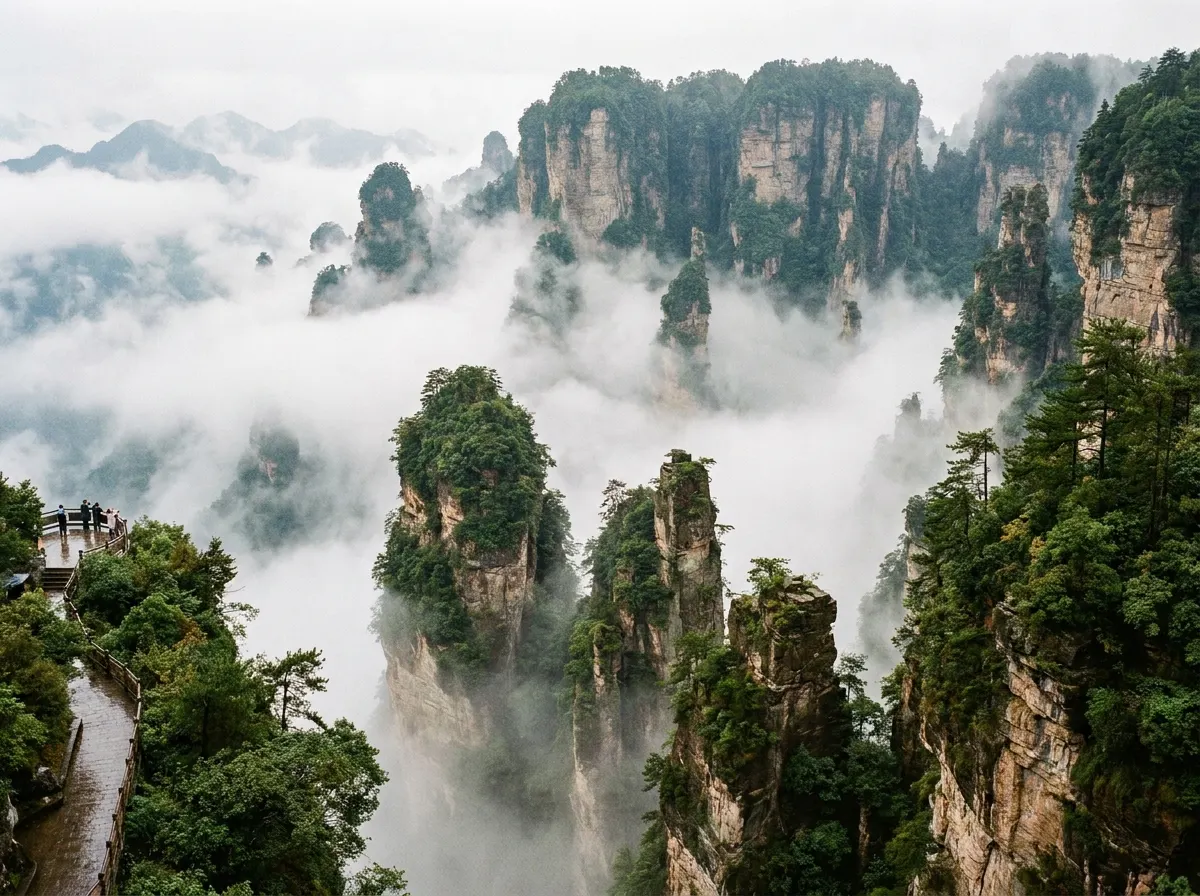
Zhangjiajie
Zhangjiajie National Forest Park is a UNESCO World Heritage site in Hunan province with thousands of vertical quartz-sandstone pillars — the inspiration for the floating mountains in Avatar (2009). The park system includes Tianmen Mountain (with the famous glass skywalk), the world's longest glass bridge at Grand Canyon, and Yellow Dragon Cave. Plan 3-4 days to cover the highlights. Best visited April-October; winter brings ice and occasional closure of high-altitude areas.
Why Zhangjiajie in 2026.
Avatar's Pandora come to life. Quartz-sandstone pillars, glass bridges, and mist-shrouded canyons that inspired the floating mountains in James Cameron's film.
Quick Answer
Zhangjiajie National Forest Park is a UNESCO World Heritage site in Hunan province with thousands of vertical quartz-sandstone pillars — the inspiration for the floating mountains in Avatar (2009). The park system includes Tianmen Mountain (with the famous glass skywalk), the world's longest glass bridge at Grand Canyon, and Yellow Dragon Cave. Plan 3-4 days to cover the highlights. Best visited April-October; winter brings ice and occasional closure of high-altitude areas.
| Best time to visit | April-June and September-October (avoid summer holidays and Golden Week) |
|---|---|
| Daily budget | $50 (backpacker) / $130 (mid-range) / $320+ (luxury) |
| Language | Mandarin and local Tujia minority dialect; English limited outside main scenic areas |
| Currency | CNY (¥) — most places cash-only |
| Time zone | China Standard Time (UTC+8) |
| Last updated | 2026-06-16 |
Want a Zhangjiajie plan built for you?
How many days do I need in Zhangjiajie?
Three to four days minimum covers the core sites. Day 1: Spend a full day at Tianmen Mountain, riding the world's longest passenger cableway and walking the glass skywalk. Days 2-3: Devote two days to Zhangjiajie National Forest Park — overnight inside the park at Wulingyuan to catch the pillar sunrise from Tianzi Mountain. Day 4: Add the Grand Canyon Glass Bridge and Yellow Dragon Cave, with Baofeng Lake if time allows. A rushed traveler can compress the highlights into two long days, but the park is enormous and trail connections are confusing, so an extra night reduces stress. Budget roughly $90-200 per day mid-range including lodging, transport, and tickets — re-check before booking.
Where should I stay in Zhangjiajie?
Two main bases serve visitors, each with trade-offs. Staying in Zhangjiajie city is cheaper, has more restaurants and nightlife, and sits closer to Tianmen Mountain and the airport, but it adds 30-40 minutes of bus travel each way to the National Forest Park. Staying in Wulingyuan town, right outside the park entrance, puts you walking distance from the trails and ideal for pillar sunrise, but costs more and has fewer dining options. In-park hotels (¥300-600) inside Wulingyuan are basic and book out 1-2 weeks ahead in peak season; outside-the-park hotels run ¥150-400. First-time visitors should split the stay: one night in the city for Tianmen, two nights in Wulingyuan for the park.
How do I get to Zhangjiajie?
Zhangjiajie Hehua International Airport (DYG) receives direct flights from Beijing, Shanghai, Guangzhou, and 30-plus other Chinese cities, with flight times of 1.5-2.5 hours. High-speed rail links Changsha (Hunan's capital) to Zhangjiajie West Station in about 2.5-3 hours, with frequent daily trains (¥150-220). From Changsha Huanghua Airport, a direct long-distance bus runs to Zhangjiajie in about four hours. The airport sits 5 km from downtown and 30 km from the national park — a taxi to Wulingyuan costs roughly ¥100-120. Buy rail tickets 1-2 weeks ahead, especially around Golden Week, via Trip.com or the official 12306 system.
Is Zhangjiajie suitable for older travelers or kids?
It is mixed and depends on the site. The National Forest Park offers cable cars, the 326-meter Bailong Elevator (the world's tallest outdoor lift), and free shuttle buses that cut walking dramatically, so older travelers can reach the main viewpoints with moderate effort. Tianmen Mountain's glass skywalk and the 999 stairs to Heaven's Gate are the most physically demanding sections and may challenge anyone with vertigo or knee issues. Kids usually love the cable cars, elevators, and glass bridge, but supervise them closely at heights and on steep stairs. Travelers with mobility limits can still enjoy Baofeng Lake (flat boat ride) and the lower viewpoints of Tianzi Mountain.
What is the best photo spot in Zhangjiajie?
Several viewpoints deliver the postcard shots. Tianzi Mountain (天子山) lookout gives the classic pillar panorama and is best at sunrise, when mist weaves between the columns. The Bailong Elevator ride itself frames pillars from below. Hallelujah Mountain (formerly Southern Sky Pillar, renamed after Avatar) is the single most-photographed pillar and the one that inspired the film's floating mountains. For atmospheric mist shots, take the cable car up early and walk the eastern trails (Golden Whip Stream, Ten-Mile Gallery) before crowds arrive. Photographers should target April-May and September-October, when post-rain mist is most reliable.
When is the best season to visit Zhangjiajie?
April through June and September through October offer the best combination of weather, mist, and manageable crowds. Spring brings blooming mountain flora and frequent morning mist between the pillars. Autumn delivers dry, clear skies and golden foliage at the canyon floor. Summer (July-August) is hot, humid, and packed with domestic tourists on school holidays — queues at the Bailong Elevator and cable cars can exceed two hours. Winter (December-February) is quiet and beautiful when pillars wear ice, but high-altitude sections sometimes close and fog can obscure views. Avoid the early-October Golden Week at all costs; crowds double and hotel prices spike.
What is the Bailong Elevator and should I ride it?
The Bailong Elevator (百龙天梯) is the world's tallest outdoor glass elevator, climbing 326 meters up a cliff face inside the National Forest Park. It opened in 2002 and carries 50 passengers per car, whisking visitors from the valley floor to the Yuanjiajie summit in under two minutes. The ride offers dramatic pillar views through the glass walls. Tickets cost roughly ¥72 ($10) per person one way, often bundled with park entry — re-check current pricing. Queues build by mid-morning, so ride early or late. Travelers with vertigo can take the free shuttle bus plus a 30-minute hike instead, though it is steeper and longer.
How does the glass bridge work and is it safe?
The Zhangjiajie Grand Canyon Glass Bridge spans 430 meters and hangs 300 meters above the canyon floor, making it the longest and highest glass-bottom bridge in the world when it opened in 2016. Israeli architect Haim Dotan designed it to hold 800 people at once, with built-in sway buffers and load sensors that monitor capacity in real time. The glass panels are layered and shatter-resistant; visitors receive shoe covers to prevent scratching. The bridge occasionally closes for maintenance or in high winds, so check the official site the day before. Travelers with severe vertigo can use the adjacent non-glass walkway.
What should I budget for a Zhangjiajie trip?
A 3-4 day mid-range trip runs roughly $400-700 per person excluding long-haul flights to China. Park entry is the biggest fixed cost: a 4-day pass to the National Forest Park costs about ¥225 ($32), Tianmen Mountain runs ¥235-260 ($33-37) including cable car, the glass bridge is ¥138 ($19), and Yellow Dragon Cave is ¥100 ($14). Lodging in Wulingyuan runs ¥300-700 ($42-98) mid-range; city hotels cost less. Food is inexpensive — ¥40-80 ($6-11) per meal at local restaurants. Backpackers can manage on about $50 per day; luxury travelers should budget $300-plus for boutique stays and private guides. Always re-check prices before booking.
What are the best hiking routes in Zhangjiajie National Forest Park?
The park has trails for every fitness level. The Golden Whip Stream (金鞭溪) is the easiest and most popular: a 7.5 km flat path along a crystal-clear stream, with pillar views on both sides, taking about 2.5 hours one way. The Ten-Mile Gallery (十里画廊) is another easy route, a 5 km paved path along a valley floor with pillar formations, also doable by monorail tram for ¥38. For moderate hikers, the route from the rear mountain entrance up to Yuanjiajie takes about 2 hours uphill on stone steps and offers pillar views without the Bailong Elevator queue. The most challenging and rewarding hike is the climb from the Golden Whip Stream up to Yellow Stone Village (黄石寨): 3,800 stone steps, roughly 2-3 hours uphill, delivering a 360-degree panorama of the entire park at the top. The Yangjiajie area, west of Yuanjiajie, has the most rugged trails with steep ladders and fewer crowds. Download the ¥5 park map from the ticket office and use Amap for trail navigation.
How can I avoid the crowds at Zhangjiajie?
Zhangjiajie is one of China's busiest scenic areas, drawing over 80 million annual visitors, and crowds can overwhelm the experience. The single most effective strategy is timing: arrive at park gates by 7 AM (gates open at 7), take the first Bailong Elevator or cable car up, and you will have 90-120 minutes of relative calm before the tour groups arrive around 9-10 AM. Reverse the route direction: most tours go Yunnanjaijie to Tianzi Mountain; go in the opposite direction. Visit Tianmen Mountain on weekday afternoons (the morning queue for the cable car can exceed two hours even on regular days) and board from the city station by 7:30 AM. Avoid weekends, all of Chinese Golden Week (first week of October), Chinese New Year, and the July-August school holidays. The Yangjiajie area and the rear mountain entrance see a fraction of the crowds of the main eastern gate. In peak season, prioritize the park over Tianmen Mountain; you can skip the glass skywalk, but you cannot skip the pillars.
What is the best 3-day Zhangjiajie itinerary?
A well-paced 3-day itinerary covers all three well-known sites without rushing. Day 1 (National Forest Park, Yuanjiajie and Tianzi Mountain): enter through the east gate (Wulingyuan) at 7 AM. Ride the Bailong Elevator up to Yuanjiajie — the early start means a 15-30 minute queue instead of two hours. Walk the Yuanjiajie circuit (Avatar Hallelujah Mountain, the First Bridge Under Heaven, the viewing platforms). Take the shuttle bus to Tianzi Mountain (30 minutes) and walk the lookout circuit for the classic pillar panorama. Descend via the Tianzi Mountain cable car (¥72) or hike down the stone steps (roughly 2 hours). If energy permits, walk a section of the Ten-Mile Gallery (5 km, flat, shuttle bus available) in the late afternoon. Day 2 (Tianmen Mountain): take the 7:30 AM cable car from the city station. Walk the cliff-hugging glass skywalk, visit the Tianmen Mountain Temple, and descend via the 999 stairs through Heaven's Gate (or the escalator for ¥32). Take the shuttle bus down the 99-bend road. You will be back in the city by 2-3 PM. Use the afternoon for a relaxed visit to the Zhangjiajie Museum or a walk along the Li River. Day 3 (Grand Canyon Glass Bridge and Yellow Dragon Cave): arrive at the Grand Canyon by 8 AM for the first entry slot onto the glass bridge. Walk the bridge, then descend into the canyon for the 2-3 hour trail along the stream, past waterfalls, and through the narrowest gorge section. The exit is a boat ride across a reservoir (included in the ticket). After lunch, head to Yellow Dragon Cave (30 minutes by bus) for the afternoon — the cave takes about 3 hours and is a natural air-conditioned respite. With a fourth day, add Baofeng Lake (half-day, Tujia boat performances) and the Golden Whip Stream hike (full morning). This itinerary assumes spring or autumn. In summer, shift all starts to 6:30 AM and avoid midday outdoor walking. In winter, Tianmen Mountain may close sections in ice; check conditions the day before. Book park tickets 1-3 days ahead in peak season.
How does the Zhangjiajie ticketing system and reservation process work in detail?
Zhangjiajie's ticketing system is fragmented across four separate sites, each with its own ticket, pricing, and booking channel. Understanding it before arrival saves hours of confusion. The Zhangjiajie National Forest Park (Wulingyuan) sells only a 4-day pass for ¥225. There is no 1-day, 2-day, or 3-day discount — you pay for four days whether you use them all or not. The pass covers all areas within the Wulingyuan Scenic Area (Yuanjiajie, Tianzi Mountain, Golden Whip Stream, Ten-Mile Gallery, Yangjiajie, Yellow Stone Village) and the internal shuttle buses. The pass is activated on first use and expires at midnight on the fourth day. The Bailong Elevator (¥72 one way), Tianzi Mountain cable car (¥72 one way), and Yellow Stone Village cable car (¥65 one way) are separate tickets purchased at each boarding point. Tianmen Mountain costs ¥235-260 depending on the season, including the cable car ride from the city and the shuttle bus down the 99-bend road. You must select an entry time slot (A: 7-9 AM, B: 9-11 AM, C: 11 AM-1 PM, D: 1-3 PM) when booking. Slot A sells out first — book 2-3 days ahead. The Grand Canyon Glass Bridge costs ¥138 and also requires a time-slot reservation. Book at least 1-2 days ahead in peak season; same-day tickets are sometimes available on weekdays in low season. Yellow Dragon Cave (¥100) and Baofeng Lake (¥96) can usually be bought on the day. All tickets require real-name registration with your passport number. You can book through Trip.com (English interface, small service fee), the Zhangjiajie Tourism official WeChat mini-program (Chinese only), your hotel, or at each site's ticket office. Ticket offices accept Alipay, WeChat Pay, UnionPay, and cash; foreign Visa and Mastercard are unreliable. Students with valid ISIC cards get roughly 50% off at most sites; seniors over 60 and children under 1.3 m also qualify for discounts. Bring your passport to every ticket office and gate. Tickets are non-transferable and linked to your passport number. In peak season (July-August, Golden Week, Chinese New Year), book all tickets 3-7 days ahead; the Bailong Elevator and Tianmen Mountain cable car slots sell out completely. In low season, you can buy most tickets on arrival, though booking Tianmen Mountain a day ahead is still wise.
What is the Grand Canyon Glass Bridge experience really like?
The Zhangjiajie Grand Canyon Glass Bridge is more than a walk across glass — it is a carefully choreographed visitor experience that takes about 3-4 hours from start to finish. Here is what to expect. You arrive at the Grand Canyon scenic area (about 30 km from Wulingyuan, 15 km from the city; shuttle buses run from both) and pass through a security check where large bags, cameras with detachable lenses (officially), and selfie sticks may need to be checked into lockers. You receive fabric shoe covers to prevent scratching the glass panels. The bridge itself spans 430 metres and hangs roughly 300 metres above the canyon floor. Walking onto the glass for the first time is genuinely disorienting — your brain knows the glass is safe but your body does not, and most people take the first few steps on tiptoe, gripping the railing. After a few minutes the vertigo fades and the panorama takes over: the canyon walls dropping away on both sides, the stream a silver thread far below, and the karst peaks of the Wulingyuan range on the horizon. The bridge is busiest between 10 AM and 2 PM. For the most intense experience, go at 8 AM (first slot) when fewer people are on the bridge and the glass is cleanest. The glass panels are layered, shatter-resistant, and replaced regularly; they do flex slightly underfoot, which adds to the sensation. After crossing the bridge (allow 20-30 minutes for photos and the walk), you descend into the canyon via a staircase or a slide (¥30, fun but optional). The canyon trail runs for about 3 km along a stream, past small waterfalls and through a narrow slot gorge where the walls close to less than 3 metres apart. The trail is downhill and takes 1.5-2.5 hours depending on pace. The final section is a short boat ride across a jade-green reservoir to the exit, included in the ticket. The bridge occasionally closes for high winds (above force 6) or heavy rain, and in winter ice can close it for days. Check conditions the evening before. Travelers with severe vertigo can use the non-glass side walkways with opaque panels. Bring a phone or small camera only — the official rule bans large cameras and drones, though enforcement varies. There is a professional photo service on the bridge (¥30-50 per shot) if you want a shot of yourself without holding the camera. Lockers at the entrance cost ¥10-20.
What is Tujia minority culture and where can I experience it around Zhangjiajie?
The Tujia (土家族) are one of China's 55 officially recognised ethnic minorities and the indigenous people of the Wuling mountain range that Zhangjiajie occupies. Numbering roughly 8 million, they are the eighth-largest minority in China, with their own language (Tujia, a Tibeto-Burman language, now spoken fluently only by elders), distinct architecture, textile traditions, and a rich folklore that permeates the Zhangjiajie region. Their presence adds a cultural layer to what is otherwise a landscape-focussed trip, and travellers who engage with it leave with a much richer experience. The most visible Tujia tradition is xilankapu (西兰卡普), the hand-woven brocade recognised as a national intangible cultural heritage. Woven on a simple backstrap loom, xilankapu uses geometric patterns in deep red, black, indigo, and white to depict animals, plants, and mythological scenes. Each piece takes weeks or months to weave. You can watch weavers at work in Wulingyuan town's Tujia Brocade Workshop (土家织锦坊) and buy wall hangings, scarves, and table runners (¥100-500). The Tujia Folk Customs Park (土家风情园) in Zhangjiajie city, about 15 minutes from the centre, is a reconstructed Tujia village centred on a nine-storey wooden stilt-house tower (diaojiaolou, 吊脚楼) built without a single nail. It houses a small museum of Tujia costumes, farming tools, and musical instruments, with hourly performances of Tujia song and dance. Entry is roughly ¥80 and 2 hours is enough. The performances include the baishou dance (摆手舞, hand-waving dance), the most famous Tujia tradition, originally performed at funerals and harvest festivals, with hundreds of dancers moving in concentric circles. For food, Tujia cuisine is distinct from both Hunan Chinese and the minority cuisines of Yunnan and Guizhou. The must-try dishes are Tujia smoked bacon (土家腊肉), cured over pine and cypress wood for months until it is dark, dense, and intensely savoury, stir-fried with dried tofu or wild garlic shoots; hezha (合渣), a soup of ground soybeans and chopped greens, the Tujia everyday staple; and sticky rice cakes (糍粑) grilled and dipped in brown sugar. The best Tujia restaurants are in Wulingyuan town; look for places with "土家" in the name. For a deeper immersion, the village of Shidai (石堤村) about 40 km north of Zhangjiajie city has traditional Tujia wooden houses, a working water-powered rice mill, and homestays (¥100-150 per person including dinner and breakfast). Tujia guides (¥300-500 per day) can take you to villages that see few foreign visitors and explain the folklore — the Tujia creation myth, the legend of the weeping bride, and the story of how the Tujia people hid in the Wuling mountains during the Qin dynasty wars. A half-day at the Folklore Park plus a Tujia dinner is the minimum; a village homestay and a brocade workshop visit make a full cultural day that complements the pillar landscapes.
How do I get to Zhangjiajie from other Chinese cities?
Zhangjiajie is reachable from most major Chinese cities in a single travel day, with the choice between flying directly into Zhangjiajie Hehua Airport (DYG) or taking the high-speed rail via Changsha, Hunan's capital. From Beijing: direct flights take about 2.5 hours (¥800-1,500 one way). The high-speed rail alternative is to take a Beijing-Guangzhou line train to Changsha South (5.5-6.5 hours, ¥650-900), then transfer to the Changsha-Zhangjiajie high-speed train (2.5-3 hours, ¥150-220). Flying is faster, but the rail route lets you add a Changsha stopover. From Shanghai: direct flights take about 2.5 hours (¥600-1,200). By rail, take a Shanghai-Changsha high-speed train (4.5-5.5 hours, ¥480-700) and connect to Zhangjiajie — budget 8-9 hours total. From Guangzhou and Shenzhen: direct flights take about 1.5 hours (¥400-900). High-speed rail routes run from Guangzhou South to Changsha South (2.5-3 hours, ¥310-470), then connect to Zhangjiajie. From Chengdu or Chongqing: direct flights take about 1.5 hours; high-speed rail from Chongqing via the Qianjiang route takes 4-5 hours. From Xi'an: direct flights take about 1.5 hours; rail via Changsha takes 7-9 hours. From Kunming: high-speed trains connect to Changsha (about 6 hours), then transfer to Zhangjiajie — a long but scenic overland route. From Changsha itself: the most common gateway, with high-speed trains running roughly hourly from Changsha South to Zhangjiajie West in 2.5-3 hours (¥150-220). Changsha Huanghua Airport also runs direct long-distance buses to Zhangjiajie (about 4 hours). From Hong Kong: take the high-speed train from West Kowloon to Shenzhen North or Guangzhou South, then connect to Changsha and onward to Zhangjiajie — roughly 7-9 hours total. Zhangjiajie West Station sits about 10 km from the city center and 35 km from Wulingyuan; taxis (¥100-120 to Wulingyuan) and shuttle buses wait outside. Book rail tickets at least a week ahead in peak season via Trip.com or 12306. If combining cities, the most efficient loop is Changsha-Zhangjiajie-Fenghuang-Changsha, all linked by high-speed rail.
Top attractions
Zhangjiajie National Forest Park
UNESCO site with 3,000+ vertical sandstone pillars, including the well-known Avatar Hallelujah Mountain. Allow 2-3 days.
Tianmen Mountain
1,500m peak with the 99-bend road, glass skywalk, and "Heaven's Gate" natural arch. Cable car is the world's longest passenger cableway.
Zhangjiajie Grand Canyon Glass Bridge
430m glass-bottomed bridge, the world's longest and highest when opened in 2016. Suspended 300m above the canyon.
Yellow Dragon Cave
One of China's largest caves, with underground rivers, stalactites, and a 50m waterfall inside. Allow 3 hours.
Baofeng Lake
Mountain lake with traditional Tujia minority boat performances. Peaceful 2-hour boat ride.
STAY
Where to stay in Zhangjiajie
Pick a base that matches the trip you want — imperial-central for sightseeing, hutong belt for character, Chaoyang for nightlife, or Qianmen for budget.
Wulingyuan Town
The most convenient base — walking distance to the National Forest Park east gate, with hotels and Tujia restaurants
#wulingyuanZhangjiajie City Centre
Cheaper hotels, more dining, and closest to Tianmen Mountain cable car and the airport; 30–40 min from the park
#zhangjiajie-cityInside the Park (Wulingyuan villages)
Basic in-park guesthouses for early-morning pillar access; book 1–2 weeks ahead in peak season
#park-interior
ITINERARIES
Sample itineraries from Zhangjiajie
Three ready-made routes, from a 1-day imperial sprint to a 5-day deep dive. Copy the day-by-day plan and adapt to your own pace.
- 1 DAY
Zhangjiajie in a Day (Whirlwind)
Hit the absolute essentials — National Forest Park highlights in a single long day.
- Short layovers
- Travellers on a tight Hunan schedule
- Those who cannot stay overnight
- Day 01
Morning
Enter east gate at 07:00; Bailong Elevator up to Yuanjiajie (Avatar Mountain, First Bridge Under Heaven); 2 hours
Afternoon
Shuttle bus to Tianzi Mountain; pillar panorama; descend by cable car (¥72); late lunch in Wulingyuan
Evening
Return to Zhangjiajie city; dinner; walk the Li River promenade
- 2 DAYS
Classic Zhangjiajie (3 Days)
The gold-standard itinerary — National Forest Park, Tianmen Mountain, and the glass bridge at a comfortable pace.
- First-time visitors
- Photographers
- Most travellers
- Day 01
Morning
National Forest Park: enter east gate at 07:30; Bailong Elevator up; Yuanjiajie circuit (Avatar Mountain)
Afternoon
Shuttle bus to Tianzi Mountain; pillar panorama; descend by cable car; Golden Whip Stream late afternoon walk (first 3 km)
Evening
Wulingyuan dinner — try Tujia smoked bacon and sanxiaguo hot pot
- Day 02
Morning
Tianmen Mountain: board city cable car station at 07:30; glass skywalk; Tianmen Mountain Temple
Afternoon
Descend via 999 stairs through Heaven's Gate (or escalator ¥32); shuttle bus down 99-bend road; free afternoon
Evening
City dinner; explore Zhangjiajie night market
- 3 DAYS
Complete Zhangjiajie + Fenghuang (6 Days)
The full Hunan experience — all three Zhangjiajie sites plus Fenghuang Ancient Town.
- Culture and nature combo
- Photographers
- Travellers with a week
- Day 01
Morning
National Forest Park: east gate at 07:30; Yuanjiajie and Avatar Mountain
Afternoon
Tianzi Mountain; Golden Whip Stream; overnight in Wulingyuan
Evening
Tujia dinner in Wulingyuan
- Day 02
Morning
Tianmen Mountain: 07:30 cable car; glass skywalk; Heaven's Gate
Afternoon
Grand Canyon Glass Bridge (14:00 slot); canyon trail below the bridge (1.5–2 hours)
Evening
City dinner; rest
- Day 03
Morning
Bus to Fenghuang Ancient Town (3 hours, ¥80–100); arrive by midday
Afternoon
Walk the Tuo River stilt houses; stone bridges; Yang Family Ancestral Hall
Evening
Fenghuang at dusk — lanterns light up, stilt houses reflect in the river; riverside guesthouse overnight
BUDGET
What a Zhangjiajie trip costs
Per-person, per-day costs across three spending tiers. Excludes international flights and visa fees.
| Line item | Backpacker | Mid-range | Luxury |
|---|---|---|---|
| Budget Guesthouse / Hostel Dorm | $10 | $25 | $60 |
| Mid-range Hotel (3-4 star) | $20 | $50 | $120 |
| Luxury / 5-star Hotel | $40 | $100 | $250 |
| Local Meal (per person) | $4 | $8 | $18 |
| Mid-range Restaurant Meal | $10 | $22 | $50 |
| Local Transport (daily) | $5 | $15 | $40 |
| Attraction Entry Fees (daily avg) | $20 | $35 | $55 |
| Daily Total (per person) | $50 | $130 | $320 |
| Total per day | $159 | $385 | $913 |
$ USD per person per day, before international flights and visas. Last verified: Q3 2026.
STAY SAFE
Emergency contacts in Zhangjiajie
Save these three numbers before you board the plane. China uses different hotlines than most countries — there's no 911.
- POLICE
110
- AMBULANCE
120
- FIRE
119
- TOURIST HOTLINE
12301
Problems travelers hit in Zhangjiajie
- Why is my Alipay not working?You linked a foreign Visa or Mastercard to Alipay but every transaction is rejected at the merchant.
- My China visa was denied — what now?Your L visa application was refused at the Chinese consulate and your trip is in 2–4 weeks.
- My passport was lost or stolen in China — what do I do?Your passport is gone (theft or loss) and you're in mainland China without travel documents.
- Why can't I book on 12306 with my foreign card?You tried to book a high-speed rail ticket on 12306.cn and your foreign Visa/Mastercard is rejected at checkout.
- Why is my VPN not working in China?You arrived in China, opened your VPN, and it will not connect at all or connects but no traffic loads.
- Why can't I book a Tibet trip on my own?You try to book Lhasa flights and hotels yourself but the booking fails, or you're turned away at the Lhasa airport without a permit.
Decisions Zhangjiajie informs
Book activities in Zhangjiajie
These are licensed tour operators and booking platforms we've vetted independently. Booking through these links may earn us a commission — see our affiliate disclosure. This never affects our editorial recommendations or the price you pay.
Frequently asked questions
Is the glass bridge safe?
Do I need a guide for Zhangjiajie?
What is the best time to see the Avatar pillars?
Can I visit on a day trip from Changsha?
What should I wear to Zhangjiajie?
Are credit cards accepted in Zhangjiajie?
Show all 60 FAQs
How high is Tianmen Mountain?
Can I see the Avatar pillars without hiking?
Is Zhangjiajie crowded in summer?
What is the difference between Tianmen Mountain and the National Forest Park?
Can I visit Zhangjiajie in winter?
Do I need to book park tickets in advance?
What is the 72-curves road on Tianmen Mountain?
How does the Tianmen Mountain cable car work and how long is it?
What are the best photography tips for Zhangjiajie?
What level of fitness do I need for Zhangjiajie?
What is the weather really like and how often does fog obscure the views?
How do I buy park tickets and can I get combined deals?
Can I get a local SIM card and does mobile data work in the park?
What is the best local food to try in Zhangjiajie?
What are vegetarian food options in Zhangjiajie?
What are the best souvenirs from Zhangjiajie?
What is the tipping culture in Zhangjiajie?
Are there altitude concerns at Zhangjiajie?
Is Zhangjiajie safe for solo travelers?
How strict are the queues at the Bailong Elevator and how can I beat them?
Do I need travel insurance for Zhangjiajie?
Is the Avatar Hallelujah Mountain as impressive in reality as the hype suggests?
What are the best hiking trails in Zhangjiajie ranked from easiest to hardest?
Is Zhangjiajie good for families with young children?
What can I do in Zhangjiajie on a rainy day?
How do I get from Zhangjiajie city centre to Wulingyuan and between the sites?
What is the best strategy for visiting Zhangjiajie during Golden Week or peak domestic holidays?
What are the best quieter alternatives to the main Zhangjiajie sites?
How reliable is the Zhangjiajie weather forecast and should I plan flexible days?
Can I see all three main sites (National Forest Park, Tianmen Mountain, Grand Canyon) in 2 days?
What is the safety record of the Bailong Elevator and Zhangjiajie's cable cars?
How do I buy Zhangjiajie tickets if I cannot read Chinese?
What is the best time of day to visit each major Zhangjiajie site?
Are there English-speaking guides in Zhangjiajie and how do I book a reliable one?
What is the nearest major international airport for long-haul arrivals to Zhangjiajie?
Can I combine Zhangjiajie with Fenghuang Ancient Town in one trip?
How does Zhangjiajie compare to Huangshan (Yellow Mountain)?
How does Zhangjiajie compare to Guilin and Yangshuo?
What should I pack for Zhangjiajie by season?
What are the quietest hiking trails in Zhangjiajie away from the crowds?
Which cable car should I take for each Zhangjiajie site?
Is the Grand Canyon trail below the bridge worth doing, or should I just cross the bridge and leave?
What are the must-try Tujia food specialties in Zhangjiajie?
Are there any free or low-cost viewing spots in Zhangjiajie?
Can I visit Zhangjiajie independently without speaking Chinese?
How reliable is the Zhangjiajie weather forecast for planning photography?
Is Zhangjiajie worth visiting?
How many days should I spend in Zhangjiajie?
Can I visit Zhangjiajie without a guide?
Can foreigners buy Zhangjiajie tickets online?
Is Zhangjiajie crowded?
What is the best season for Zhangjiajie?
Is Zhangjiajie expensive for tourists?
How do I avoid the crowds in Zhangjiajie?
References

Related guides & destinations
Guide
How We Research 2026: NihaoVisit’s Methodology for China Travel Information
How NihaoVisit sources, verifies, and maintains 700+ pages of China travel information — our source hierarchy, fact-checking process, update
Guide
Fact-Checking Log 2026: Verified China Travel Information — NihaoVisit
A public log of fact-checking verification passes on NihaoVisit, showing what was verified, when, and against which sources — covering visa
Guide
Best Time to Visit China 2026: Month-by-Month Weather, Crowds, and Prices
The best time to visit most of China is April–May and September–October. Winter (Dec–Feb) is cold but cheap; summer (Jun–Aug) is hot and cro
Guide
VPN for China 2026: Which VPNs Work, eSIM Alternatives, and the Complete Pre-Trip Checklist
Most Western apps and websites are blocked in mainland China. A reliable VPN is essential for Google, Gmail, WhatsApp, Instagram, and most n
Guide
China SIM Card and eSIM Guide 2026: Stay Connected Without WeChat
A Chinese SIM or eSIM lets you use mobile data, maps, and ride-hailing without WiFi. Here is how to get one, the cost, and which provider to
Guide
Solo Female Travel in China 2026: Safety, Tips, and Real Experiences
China is one of the safer destinations for solo female travelers. Petty theft is rare, violent crime against tourists is extremely uncommon,