Changsha · history museum
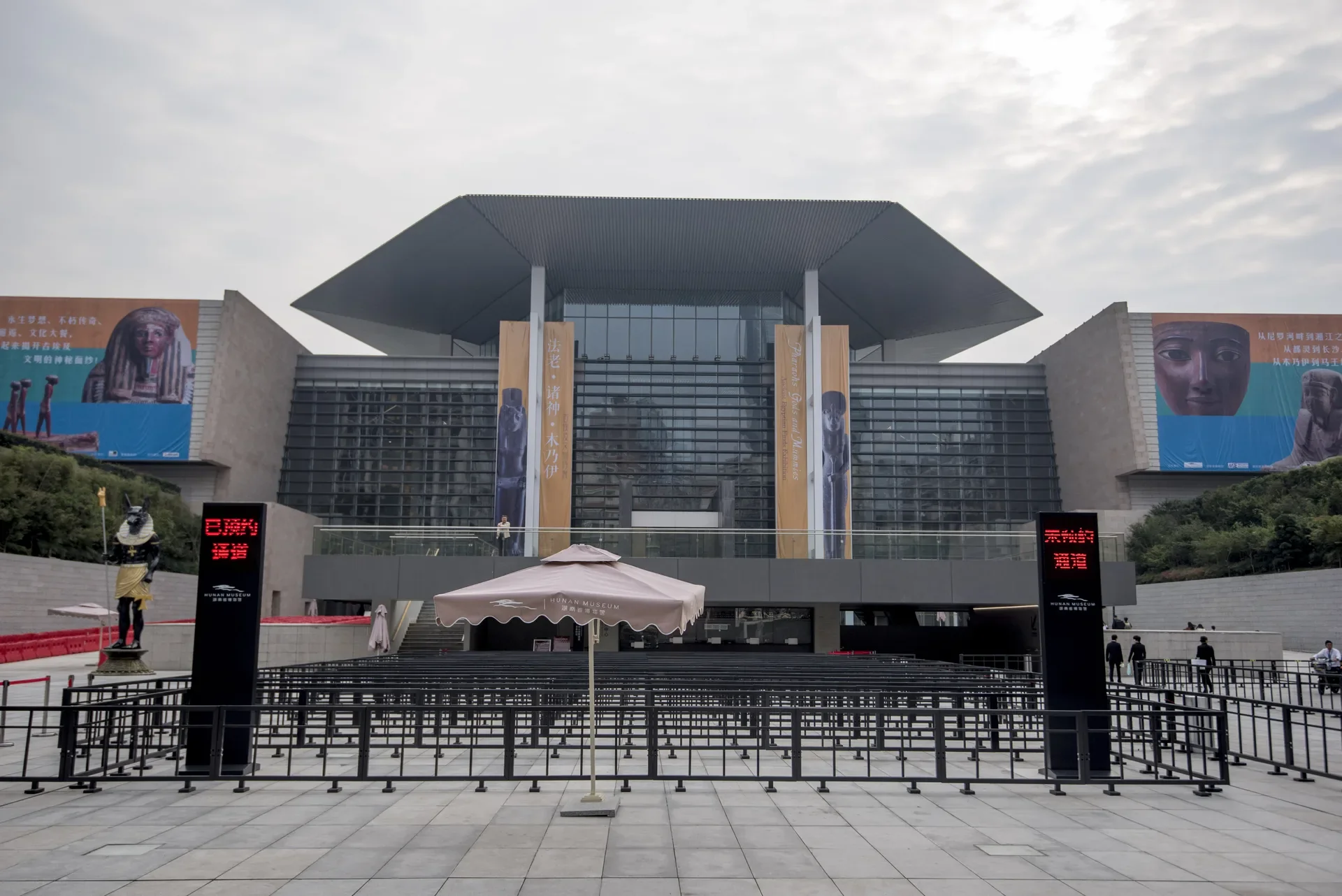
Hunan Provincial Museum (湖南省博物馆, Húnán Shěng Bówùguǎn)
"\"The Hunan Provincial Museum (湖南省博物馆) opened its current building in 2017 and immediately became China's most-visited provincial museum, drawing over 3 million visitors annually. The museum's fame rests almost entirely on the Mawangdui Han Dynasty Tombs (马王堆汉墓), a trio of 2nd century BCE tombs discovered intact in 1972 near Changsha. The tomb's occupant — Lady Xin Zhui (辛追夫人), a Han Dynasty noblewoman — was so perfectly preserved that her body contained intact internal organs. The tombs produced: the world's oldest anatomical maps (导引图), perfectly preserved silk textiles, lacquored wooden coffins, and astronomical texts that predate the discovery of the Chinese star maps by 200 years.\".".
Last updated:
Quick Answer
Is Hunan Provincial Museum worth visiting?
"China's most-visited provincial museum, famous for the 2,000-year-old Mawangdui Han Dynasty tomb discoveries — including perfectly preserved lacquored coffins, silk banners,.".
Quick facts
| Category | history |
|---|---|
| Ticket | Free. Passport required. Timed entry reservation via the Hunan Provincial Museum WeChat mini-program or website. Limited same-day tickets available from the east gate. |
| Hours | 9:00-17:00 (last entry 16:00). Closed Mondays. Extended hours on weekends (to 18:00) during peak season. |
| Recommended duration | 3-5 hours. |
| Best time to visit | Tuesday-Thursday mornings (9:00-11:00) when the Mawangdui galleries are least crowded. Avoid weekends and school holiday periods when queues can exceed 2 hours. Best seasons: spring (March-May) and autumn (September-November) for Changsha weather. |
| How to get there | Metro Line 1 to Mawangdui Station (马王堆站), then walk 5 minutes. Metro Line 6 to Tangjialing Station (唐家岭站), Exit 2, then walk 10 minutes. Bus routes 3, 5, 112, 303 to Hunan Provincial Museum stop. DiDi from Changsha Railway Station: ¥20-30. From Changsha South Station: ¥35-45. |
| English signage | partial |
Why visit
Mawangdui is one of the most significant archaeological discoveries in 20th-century Chinese archaeology. Lady Xin Zhui's preserved body, her silk coffin funerary banners, and the medical/anatomical texts are irreplaceable. The Han Dynasty silks and lacquer ware in the collection are also the finest in the world. This is a museum whose contents appear in world archaeology textbooks.
Collection highlights
- Lady Xin Zhui's preserved body (马王堆女尸) — the 2,000-year-old remains of a Han Dynasty noblewoman, so perfectly preserved that doctors were able to perform an autopsy on her in the 1970s
- Silk funerary banner (T型帛画) — a magnificent silk banner covering Lady Xin Zhui's coffin, depicting her journey to the afterlife through three celestial realms
- Guided Body Diagram anatomical map (导引图) — the world's oldest anatomical/medical exercise chart, predating similar Western documents by centuries
- Mawangdui Han Dynasty lacquerware collection — the world's largest and finest collection of Han Dynasty lacquer, including functional objects with painted scenes and inscriptions
- Han Dynasty silk textiles — 49 pieces of perfectly preserved silk fabric including robes, scarves, and embroidered textiles, extremely rare because silk normally decomposes
- Changsha kiln ceramics — a distinctive "Changsha type" of Tang Dynasty export ceramics found in sites across Southeast Asia, the Middle East, and East Africa
Tips
- The Mawangdui galleries are on the 2nd floor — they get very crowded; go right when doors open
- The Mawangdui tombs themselves (archaeological site) are NOT at this museum — they are at the Mawangdui archaeological site in Changsha's eastern suburbs, a separate visit
- Allocate at least 3 hours — the Mawangdui collection alone deserves 2 hours
- The Hunan Provincial Museum has the most visitors of any provincial museum in China — book your slot 3-7 days in advance, especially for weekend visits
- Combine with the Du Fu Memorial Hall (杜甫江阁) along the Xiang River for a Changsha cultural afternoon
- Photography is prohibited inside the Mawangdui galleries
Frequently asked questions
What was preserved in the Mawangdui Han Tombs?
Three tombs (马王堆汉墓) were discovered in 1972 near Changsha. Tomb #1 contained Lady Xin Zhui (辛追夫人), a Han Dynasty noblewoman whose body was so perfectly preserved that her skin, organs, and blood vessels were intact. The tomb also contained: silk textiles (49 pieces), lacquer ware (over 1,000 pieces), ceramics, and bronze objects. Tomb #2 contained the remains of a man believed to be the Marquis of Dai (利狶); Tomb #3 contained the library of the Marquis — bamboo slip texts covering philosophy, history, and medicine.
How significant is the Mawangdui anatomical chart?
The "Guided Body Diagram" (导引图) is the world's oldest anatomical chart, showing 44 human figures in exercise poses. It predates the earliest known similar Western documents by several centuries and provides key evidence for understanding early Chinese medical practices.
Is the Mawangdui archaeological site the same as the museum?
No — the Hunan Provincial Museum has the artifacts. The actual Mawangdui tomb site (马王堆汉墓遗址) is in Changsha's eastern suburb, about 45 minutes away by metro + bus. It is a separate attraction and much smaller — the museum is the primary destination.
Does Hunan Provincial Museum have English signage?
Partial — major Mawangdui artifacts have English labels; the general history galleries have some English. The best English interpretation is in the Mawangdui silk textile and lacquerware sections. No English audio guides as of 2026 — bring a translation app.
How far in advance should I book?
Book at least 3 days ahead for weekday visits, 7 days ahead for weekends and holidays. Same-day tickets are extremely limited. The WeChat mini-program (湖南省博物馆) is the most reliable booking method.