Dunhuang · history museum
Dunhuang Academy Research Center (敦煌研究院, Dūnhuáng Yánjiūyuàn)
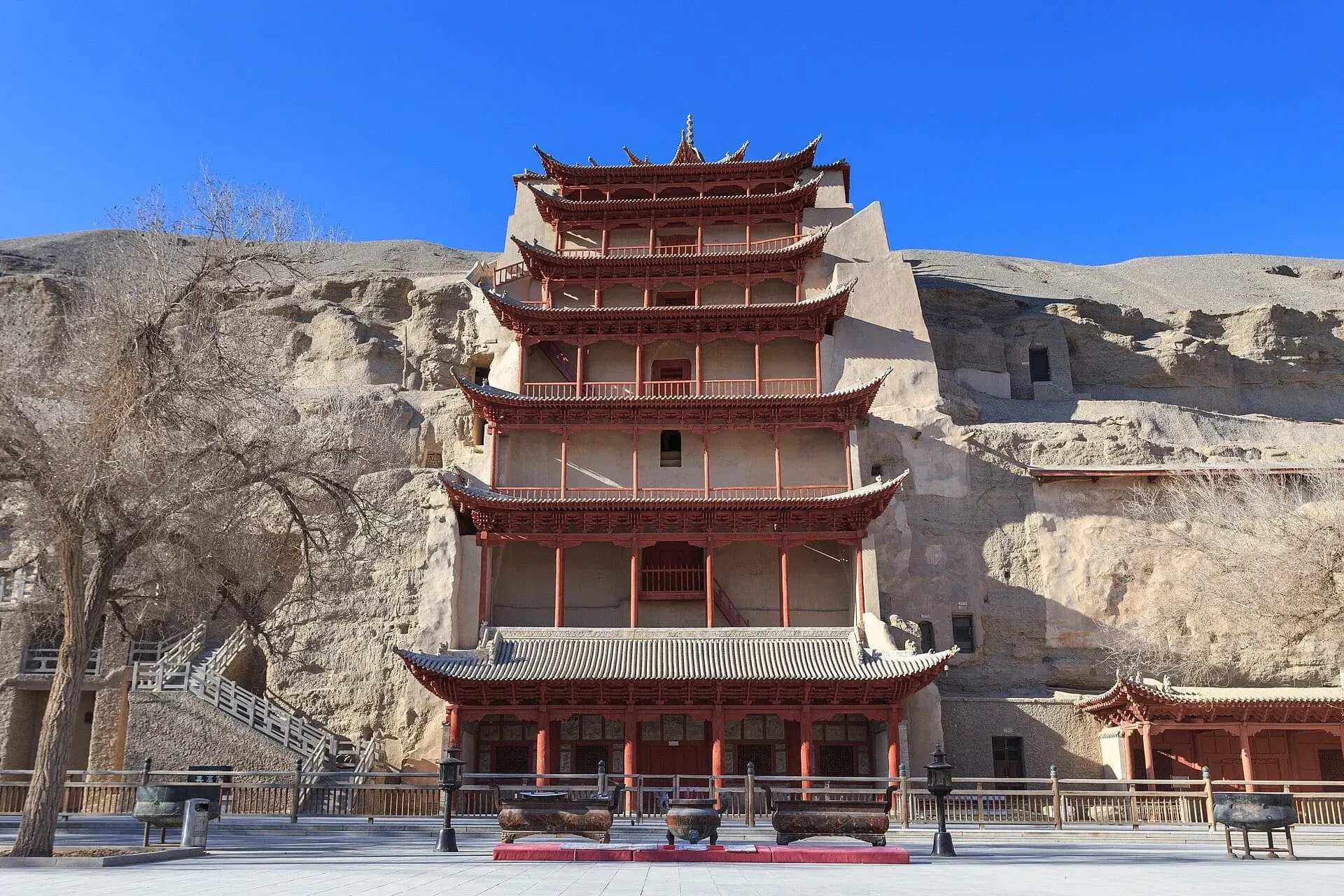
The Dunhuang Academy (敦煌研究院) is the research institute responsible for the conservation and study of the Mogao Grottoes (莫高窟), one of the world's greatest Buddhist art sites. While the Mogao Caves themselves contain the art, the Dunhuang Academy museum displays: (1) manuscripts and texts recovered from the cave library — including the famous Diamond Sutra (金刚经) printed in 868 CE, the oldest surviving dated printed book; (2) replica cave reconstructions showing cave architecture and mural details; (3) conservation archaeology documentation — showing the history of cave preservation and the challenges of tourism and sand erosion; (4) Dunhuang Buddhist art research materials.
Last updated:
Quick Answer
Is Dunhuang Academy Research Center worth visiting?
The research institute for the Mogao Caves (莫高窟) — the definitive collection of Dunhuang Buddhist art manuscripts, paintings, and artifacts, plus the cave conservation history. ¥160 (cave ticket includes this museum).
Quick facts
| Category | history |
|---|---|
| Ticket | ¥160 for the cave ticket includes access to the research institute museum. Separate exhibition hall tickets may charge additional fees (¥40-80). The "Digital Cinema" (数字影院) requires a separate ticket (¥50). |
| Hours | 8:00-18:00 (cave entry times are scheduled in 2-hour windows). Digital Cinema shows at 10:00, 12:00, 14:00, 16:00. Closed only on Chinese New Year. |
| Recommended duration | 3-4 hours (including cave visit + museum + digital cinema). |
| Best time to visit | May through October. Dunhuang is in the Gobi Desert — extremely hot in summer (35-45°C in the caves, even hotter on the desert), very cold in winter (-15°C to 5°C). May-June and September-October are ideal. The caves are less crowded outside peak season. |
| How to get there | The Dunhuang Research Academy is 25km south of Dunhuang city, next to the Mogao Grottoes. Bus Route 3 (敦煌3路) departs from the Dunhuang city center near the famous '沙洲夜市' (Shazhou Night Market). A DiDi from Dunhuang city costs ¥40-60. From Dunhuang Airport: ¥60-80. |
| English signage | partial |
Why visit
The Diamond Sutra (金刚经) manuscript printed in 868 CE — the oldest surviving dated printed book in the world — is the single most historically significant document on display in any museum in China. The cave replica section also provides the best introduction to the Mogao Caves before entering the actual caves.
Collection highlights
- Diamond Sutra (金刚经) — the world's oldest surviving dated printed book, printed in 868 CE, discovered in the Mogao Cave library in 1900 and now displayed in the academy museum
- Cave replica reconstruction — full-scale replica of Cave 17 (the library cave) showing the original arrangement of manuscripts as they were found
- Buddhist manuscript fragments — thousands of texts in Chinese, Tibetan, Sanskrit, Uighur, and other scripts recovered from the cave library, documenting Buddhism's spread along the Silk Road
- Cave conservation history — documentation of the 1900-1940s foreign expeditions (Aurel Stein, Paul Pelliot) that removed manuscripts and the subsequent Chinese conservation efforts
- Dunhuang mural photography archive — large-format photographs of Dunhuang murals from the 1940s-1980s documenting the condition of the caves over time
- Tang Dynasty Buddhist paintings — replica paintings of the famous Tang Dynasty Dunhuang mural compositions including the "Thousand Buddha" (千佛) motifs
Tips
- The museum and digital cinema are included in the ¥160 cave ticket — but you must first visit the caves, then the museum afterward
- Book cave tickets at least 1 month in advance (May-October) — the Mogao Caves limit daily visitors to 6,000 and tickets sell out
- The "Digital Cinema" (数字影院) is worth watching before entering the caves — it shows the full 3D reconstruction of cave interiors
- Combine with the "Echoing-Sand Mountain" (鸣沙山) sand dunes and the "Crescent Spring" (月牙泉) oasis — 10km from Dunhuang city center
- The Western Thousand Buddha Caves (西千佛洞) and the Yulin Grottoes (榆林窟) are less-crowded alternatives near Dunhuang
- Dunhuang is the western terminus of the Gansu Silk Road corridor — connect with Zhangye Danxia (七彩丹霞) and the Maijishan Grottoes
Frequently asked questions
What is the Diamond Sutra?
The Diamond Sutra (金刚经, "Vajra Prajna Paramita Sutra") is a Buddhist scripture. The Dunhuang copy dated to 868 CE is the oldest surviving dated printed book in the world. It was discovered in 1900 in Cave 17 (the library cave) by a Taoist monk and later acquired by Aurel Stein during his 1907 expedition. It is printed in Chinese woodblock print, showing that book printing was established in China by the 9th century.
How does the Mogao Caves ticket work?
The standard ¥160 ticket includes: a 4D digital cinema show, a museum visit, and visiting 8-10 caves (the specific caves vary by ticket). You are assigned a 2-hour entry window. The caves are visited with a guided group (English-speaking guides available but limited). Book at least 1 month ahead for peak season.
Can I visit without booking?
Very difficult in peak season (May-October) — the caves limit visitors and sell out weeks in advance. November-April has fewer visitors and same-day tickets may be available.
Does the museum have English signage?
Partial — the Diamond Sutra section has English labels. The conservation history section has limited English. No English audio guide as of 2026.
Is the Dunhuang Research Academy the same as the Mogao Caves?
Yes and no. The Mogao Caves (莫高窟) are the actual cave temple site. The Dunhuang Research Academy (敦煌研究院) is the institute that manages the caves. Its museum is located next to the caves and is visited as part of the cave ticket. The Dunhuang Museum (敦煌博物馆) is in Dunhuang city center and is a separate, free museum.
Read next
Other things to do in Dunhuang
Mingsha Mountain & Crescent Moon Spring
A 40 km belt of singing sand dunes rising ~200 m above the Gobi, with a spring-fed crescent lake at the base that has held water for at least 1,000 years. ¥120 in peak season, 5 km south of Dunhuang — allow a half-day, and time it for sunset.
Mingsha Sand Dunes & Crescent Moon Lake
Singing sand dunes and a spring-fed crescent lake in the Gobi Desert. Sunset camel rides, sandboarding. 5 km from Dunhuang. ¥120. Half-day to full day.
Mogao Caves
492 cave temples carved into a desert cliff — the world's greatest repository of Buddhist art spanning 1,000 years on the ancient Silk Road. ¥238. Book weeks ahead.
Mogao Caves
A 1,600-year-old cliff-face complex of 492 painted Buddhist cave-temples holding 45,000 m² of murals and about 2,400 clay statues, 25 km southeast of Dunhuang. Tickets are ¥238 peak season (as of 2026) and visits are guided-only — you see 8 to 12 caves in roughly 3 to 4 hours.
Yardang National Geopark
Wind-carved rock spires spread across ~346 km² of Gobi, 180 km northwest of Dunhuang. ¥190 (entrance + shuttle). The park takes 2–3 hours, but the round-trip drive is ~6 hours — budget a full day.
Yumen Pass (Jade Gate Pass)
A 2,100-year-old rammed-earth frontier post 90 km northwest of Dunhuang, marking where the Han empire's Silk Road ended and the Western Regions began. Budget 1–2 hours on site, though most travellers fold it into a full-day Yardang loop.