
Jiuquan at a Glance
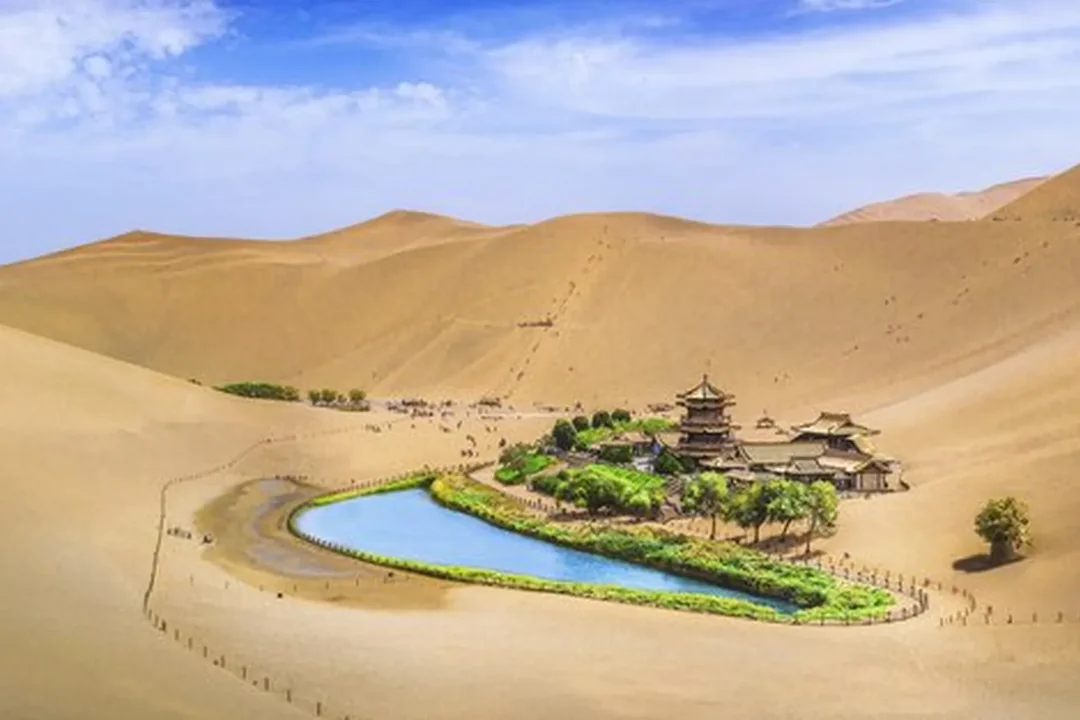
Jiuquan (酒泉) — "Wine Spring" — is the western Gansu prefecture whose name alone tells you the register of the place: a Han-dynasty garrison line where the empire's wine legend, desert agriculture and Great Wall geography all sit on one road. The prefecture is wide — its postcard, the crescent of water among the dunes in the photo above, is at Dunhuang four hours west — but the city itself earns 2-3 days: a bell tower standing since the year 346 on its brick base at the crossroads of four streets, the park built around the spring tied to the general Huo Qubing's 121 BC wine toast, a city museum, and a day each north to the golden poplars of Jinta and west to the 1372 fort at Jiayuguan.
A mid-range day runs 500-1000 CNY per person — accommodation 300-600 CNY, food 100-200 CNY, transport 30-60 CNY, tickets 50-150 CNY. May-June and September-mid October are the working windows; the poplars turn gold around mid-October.
Why Jiuquan
The Hexi corridor is the strip of habitable land between the Qilian mountains and the deserts, and for two thousand years it was the road west — garrisons, beacon towers, granaries, and the towns that fed them. Jiuquan sits about two-thirds along it, and the layers stack: Han dynasty river-march names, Ming wall construction, twentieth-century rocket bases up the road, and now a tourism economy running on the older stories.
The honest pitch for the city proper is quieter than Dunhuang's: an honest bell tower, a decent museum, a spring-fed park, food worth the stop. What makes the stay worthwhile is position — Jiuquan is the practical base for Jiayuguan (22 km west), Jinta's poplars (60 km north) and, with a longer trip, the corridor's headline sights westward. The Wenshushan grottoes south of the city add a quiet carved-stone morning for those with a fourth day.
The Bell Tower and the Old Crossroads
The Jiuquan Bell and Drum Tower holds the city's central crossroads exactly as it has since the tower was rebuilt above a brick base dated to 346 — the Sixteen Kingdoms era, when the town was called Fu Lu. A three-storey wooden tower rides the masonry over four streets, and the traffic still circles it. Climb to the walkway if the ticket window is open — the view explains the town in one look: flat, green-edged, desert waiting at the edges.
Half an hour to an hour, then walk the commercial streets around it — this is the most concentrated slice of the city.
The Wine Spring: Huo Qubing's Park
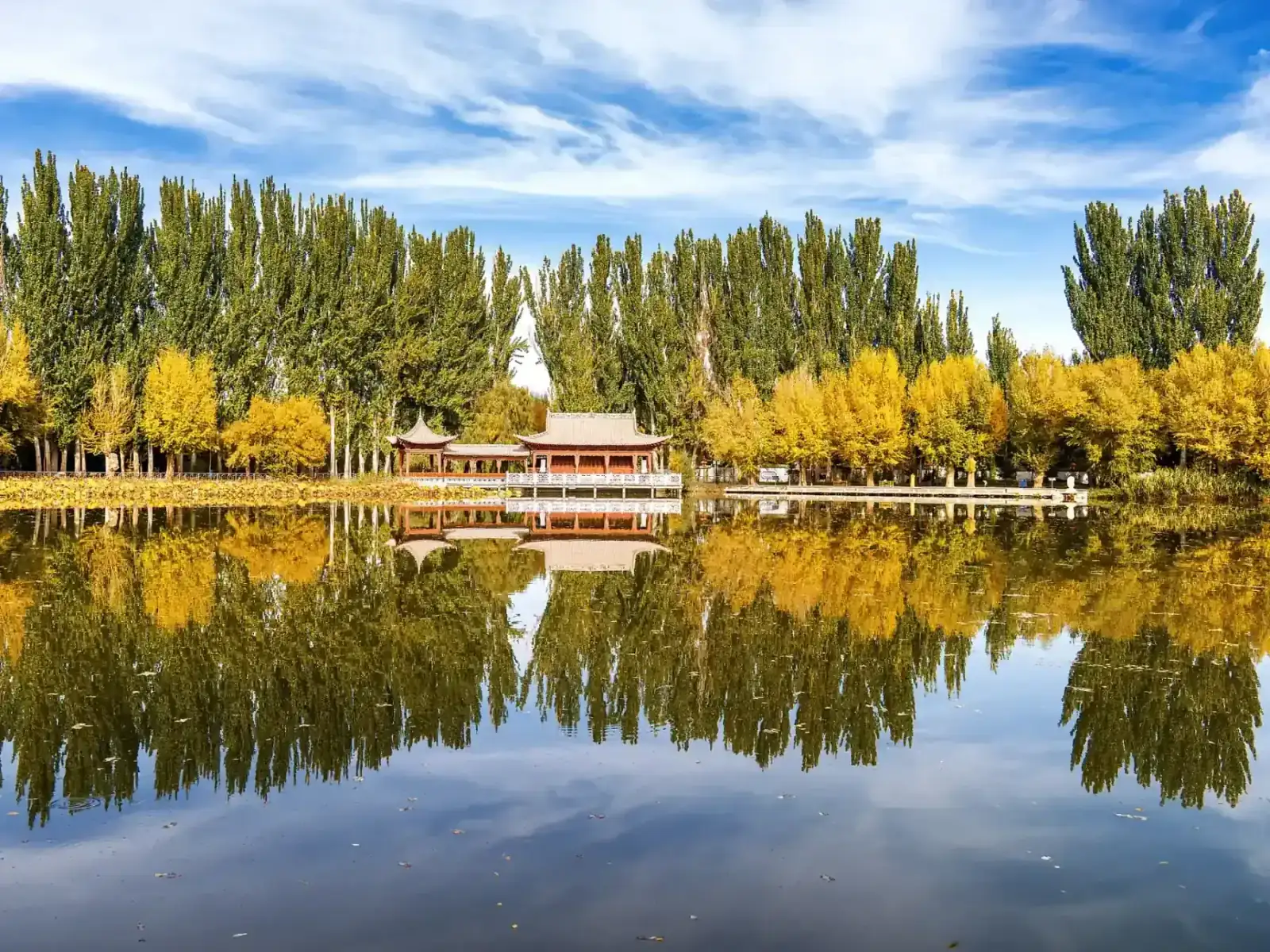
The Western Han Jiuquan scenic spot is the park built around the spring that gave the city its name. The story locals tell: in 121 BC, after campaigns against the Xiongnu, the general Huo Qubing received a jar of imperial wine and, having too little for his men, poured it into the spring so all could drink. Whether or not the toast happened, the spring is real, the lake it feeds is calm and willow-shaded, and pavilions ring the water — in autumn, poplars like the ones below turn gold over the reflection.
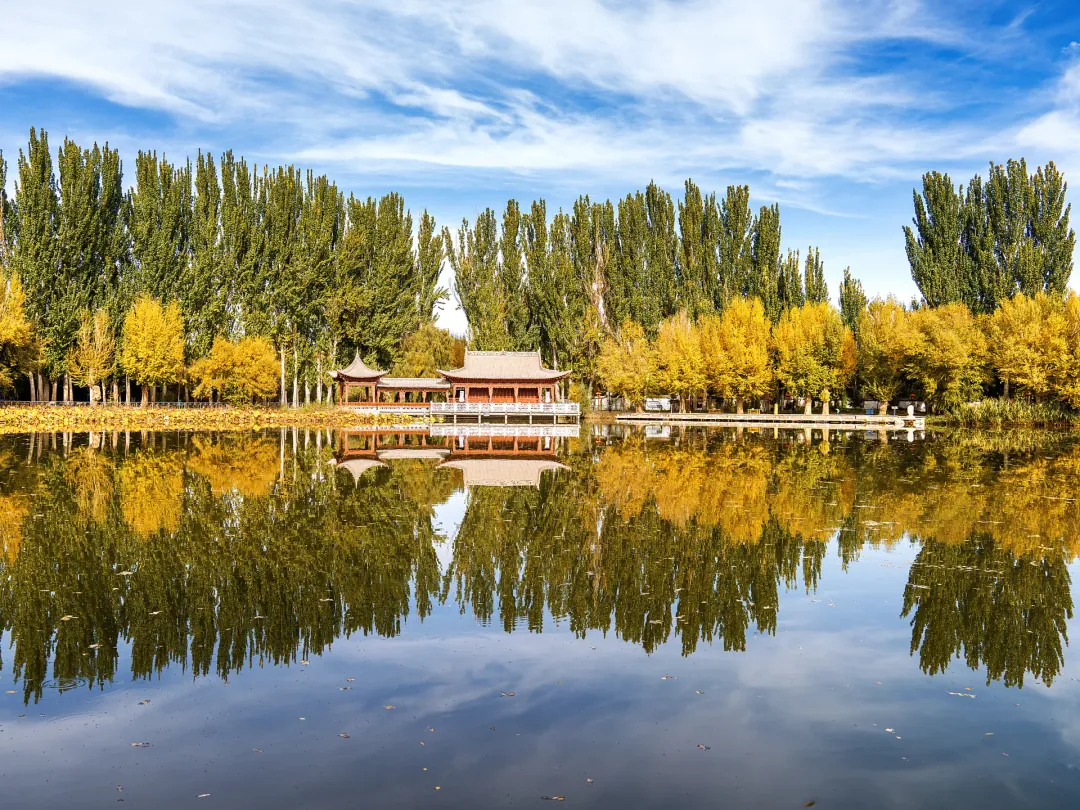
Give the park and the city museum a shared morning — the museum fills in the corridor story, from beacon towers to the modern space town, in an hour.
North to Jinta: the Poplar Forest
About 60 km north in Jinta County runs a man-made poplar belt planted from the 1980s as a sand-fixing windbreak — and it has become one of the corridor's autumn sights. The trees turn gold around mid-October; boardwalks and water channels thread the belt, and the reflections on a still morning are the shot everyone drives out for. Outside the colour window the forest is a green windbreak walk — pleasant, not pilgrim-worthy.
Half a day from the city by car; there is no practical public transport for the last leg.
West to Jiayuguan: the Wall's Western Gate
The neighbouring city of Jiayuguan sits roughly 22 km west, and its 1372 fort — the westernmost strongpoint of the Ming Great Wall — is the corridor's single greatest sight: a full fortress of rammed earth and brick at the throat between mountains and desert, with the Overhanging Wall climbing the ridge to the north (1540s) and the First Beacon Tower of the 1530s out by the Gobi. Our Jiayuguan guide covers the fort in detail; from Jiuquan it runs as a half-day or a full day with the grottoes.
Day Trips and the Wider Corridor
With a fourth day, the options fan out. The Wenshushan grottoes, south of the city, hold carved caves in a quiet river valley — a morning. And westward, the corridor runs to Dunhuang by train — the Mogao caves and the dunes-and-crescent landscape of the hero photo — and to Zhangye east, with its danxia colour hills; the whole corridor is framed in our Gansu guide.
A Three-Day Plan (and a Fourth)
- Day 1 — the city. Bell tower at the crossroads, the wine-spring park, city museum after lunch, evening food streets.
- Day 2 — Jiayuguan. The 1372 fort in the morning, Overhanging Wall and First Beacon after lunch, back by evening.
- Day 3 — Jinta or Wenshushan. The poplar forest in the colour weeks (mid-October), otherwise the grottoes and a slow city day before the train.
Our 3-day Jiuquan trip builder lays this out hour by hour; the 5-day and 7-day versions push west to Dunhuang.
Getting There and Around
Jiuquan shares its rail access with Jiayuguan's station; inside the prefecture, the sights are car days.
| Route | Time | Notes |
|---|---|---|
| Jiuquan ↔ Jiayuguan (car or train) | about 30-40 min | roughly 22 km |
| Jiuquan → Jinta poplar forest (car) | about 1 h | roughly 60 km; no easy bus for the last leg |
| City → Wenshushan grottoes | half day | road transfer south |
| Jiuquan ↔ Dunhuang (train) | about 4 h | times on 12306 |
| Jiuquan ↔ Lanzhou (train) | half a day | times on 12306 |
| Bell tower → wine-spring park (taxi) | about 10 min | ¥10-15 |
Write destinations in Chinese — 酒泉, 金塔胡杨林, 嘉峪关 — and reconfirm poplar-season road conditions if a cold snap lands early.
Where to Stay
Stay within a short taxi arc of the bell tower: mid-range rooms run about 300-600 CNY a night, the food streets are walkable, and both day-loops start from the same roads. Reserve 1-2 weeks ahead for the early-October holiday week; the poplar weeks of mid-October fill Jinta's small hotel stock too.
What to Eat
Hexi corridor cooking is wheat, lamb and the preserved vegetable culture of an old garrison line: hand-pulled noodles with lamb, stuffed skins, roast flatbread, and the sweet dried apricots and melons the oasis grows. Jiuquan's own signature is guoguo — a hotpot-style simmer where everything goes into one spiced broth — best eaten in the streets around the tower. The melon rows of autumn are worth planning around.
Eat where the queues are local, pay by Alipay or WeChat Pay linked to an international card, and carry 50-100 CNY in small notes for the market stalls that do not scan.
What a Day Costs
| Item | Price | Notes |
|---|---|---|
| Bell tower climb | within the 50-150 CNY ticket band | hours vary by season |
| Wine-spring park | within the 50-150 CNY ticket band | free window in early mornings in some seasons |
| Jiayuguan fort | within the 50-150 CNY ticket band | the corridor's big ticket |
| Jinta poplar forest | within the 50-150 CNY ticket band | colour weeks price up |
| Mid-range hotel | 300-600 CNY/night | bell tower quarter |
| Meals | 100-200 CNY/day | noodles and lamb |
| Local transport | 30-60 CNY/day | taxis; day-loops are car days |
The mid-range total of 500-1000 CNY per person per day matches our roster's estimate. A backpacker day on buses and noodle shops holds near 40 CNY — the fort and the forest are where the budget lands.
When to Go
May-June is green, warm and pre-crowd; September-mid October is the corridor's best month — harvest melons, gold coming into the poplars by mid-October, and the summer heat gone. July-August is hot and busy; December-March is cold with short days but honest light. Avoid the national holiday week of early October unless you enjoy queues at the fort.
Practical Tips
- Payment: link an international card to Alipay or WeChat Pay before arrival; keep 50-100 CNY in small notes for market stalls.
- eSIM: a tourist data eSIM (about 5-30 USD) avoids the phone-shop passport queue; install a VPN before you fly, since Google, WhatsApp and Instagram are blocked on the mainland.
- Dry air: the corridor is desert-dry — water bottle, lip balm and a windshell earn their space, especially on the Jiayuguan day.
- Tickets: Jiayuguan and Jinta sell timed entries in the colour and holiday weeks — book online the night before.
- Emergencies: police 110, ambulance 120, fire 119, national tourist hotline 12301.
Frequently Asked Questions
How many days do I need in Jiuquan?
Two to three: one for the city (tower, spring, museum), one for Jiayuguan's 1372 fort, and a third for Jinta's poplars or the Wenshushan grottoes. The corridor versions — Dunhuang, Zhangye — run on the 5-day and 7-day itineraries.
Is the hero photo in Jiuquan?
The crescent of water among the dunes is Dunhuang's Crescent Spring — Dunhuang sits inside Jiuquan prefecture, four hours west by train, which is why it fronts the prefecture's page. The city itself is a different register: tower, spring park and food streets.
What is the story of the wine spring?
In the telling, the general Huo Qubing, honoured in 121 BC after his campaigns, received imperial wine, found it too little for his men, and poured it into the spring so the whole army could drink. The spring is real and sits in the Western Han Jiuquan scenic spot park.
When do the Jinta poplars turn?
Around mid-October, give or take a week with the frost. The belt was planted from the 1980s as a windbreak roughly 60 km north of the city, and boardwalks thread it; outside the colour weeks it is a green, not golden, walk.
Can I see Jiayuguan and Dunhuang from Jiuquan?
Jiayuguan easily — the fort sits roughly 22 km west, a half-day loop, and our Jiayuguan guide covers it. Dunhuang is about 4 hours west by train; give it its own two days — the frame is in our Gansu guide.
Do I need cash in Jiuquan?
Mostly no: Alipay or WeChat Pay linked to an international card covers tickets, restaurants and taxis. Keep 50-100 CNY in small notes for melon stalls and small-town ticket windows.
Is Jiuquan worth it if I have already seen Dunhuang?
As a base, yes: the 1372 fort of Jiayuguan and the Jinta poplars are corridor sights Dunhuang cannot substitute, and the city's food is a genuine stop rather than a pass-through.
Useful Phrases
| Chinese | Pinyin | Meaning |
|---|---|---|
| 你好 | nǐhǎo | hello |
| 谢谢 | xièxie | thank you |
| 多少钱 | duōshǎo qián | how much |
| 酒泉 | Jiǔquán | Jiuquan, "Wine Spring" |
| 嘉峪关 | Jiāyùguān | Jiayuguan Pass |
| 金塔 | Jīntǎ | Jinta (county) |
| 胡杨 | húyáng | desert poplar |
| 钟鼓楼 | Zhōnggǔlóu | Bell and Drum Tower |
Final Notes
Every figure above — the 346 brick base, the 121 BC toast, the 60 km to Jinta and its 1980s-planted poplars, the 1372 fort and the 1540s Overhanging Wall and 1530s First Beacon, the 22 km to Jiayuguan — was checked in October 2026 against our trip-days data for the prefecture. Prices move; reconfirm within a fortnight of travel.
- Source: China National Tourism Administration — policy and seasonal notices.
- Source: Trip.com — live transport and hotel listings for cross-checks.
Last verified 2026-10-16.