Xi'an is the oldest story in China, and you can walk through it. Eleven dynasties planted their capital inside the present-day city walls, and the result is a place where a 14th-century bell tower still anchors a working downtown and a 2,200-year-old imperial mausoleum sits 40 km out in the loess. For most first-time visitors to China, Xi'an is the single most efficient dose of historical depth you can get without a flight to the interior. Two full days is tight but workable; three is the right answer if you can spare it.
This guide is built for the traveller who already knows Xi'an has the Terracotta Army and wants to know what else is worth their time, where to stay so they aren't schlepping across town at 7 a.m., and how to eat well without paying the airport-restaurant tax. Prices and transport details are current as of mid-2026.
Why Xi'an Matters

Xi'an was Chang'an (长安), capital of the Western Zhou, Qin, Western Han, Sui, and Tang — the longest continuously used capital in East Asian history. The Silk Road left here. The first emperor is buried here. The Big Wild Goose Pagoda stands because a monk walked back from India with Buddhist sutras, and the city government decided to build him a library. The current downtown grid, inside the Ming-era walls, still tracks the Tang grid underneath it.
What that history means for a visitor in 2026: layers. The walls are still the bones of the city; the Bell Tower and Drum Tower sit at their original intersections; the Muslim Quarter grew up next to the old Drum Tower market in the 8th century and never left. Outside the walls, the modern city has eight subway lines, university districts, and the usual malls. Inside the walls, the city still walks at human pace.
essential Attractions
The Terracotta Army (秦始皇兵马俑)
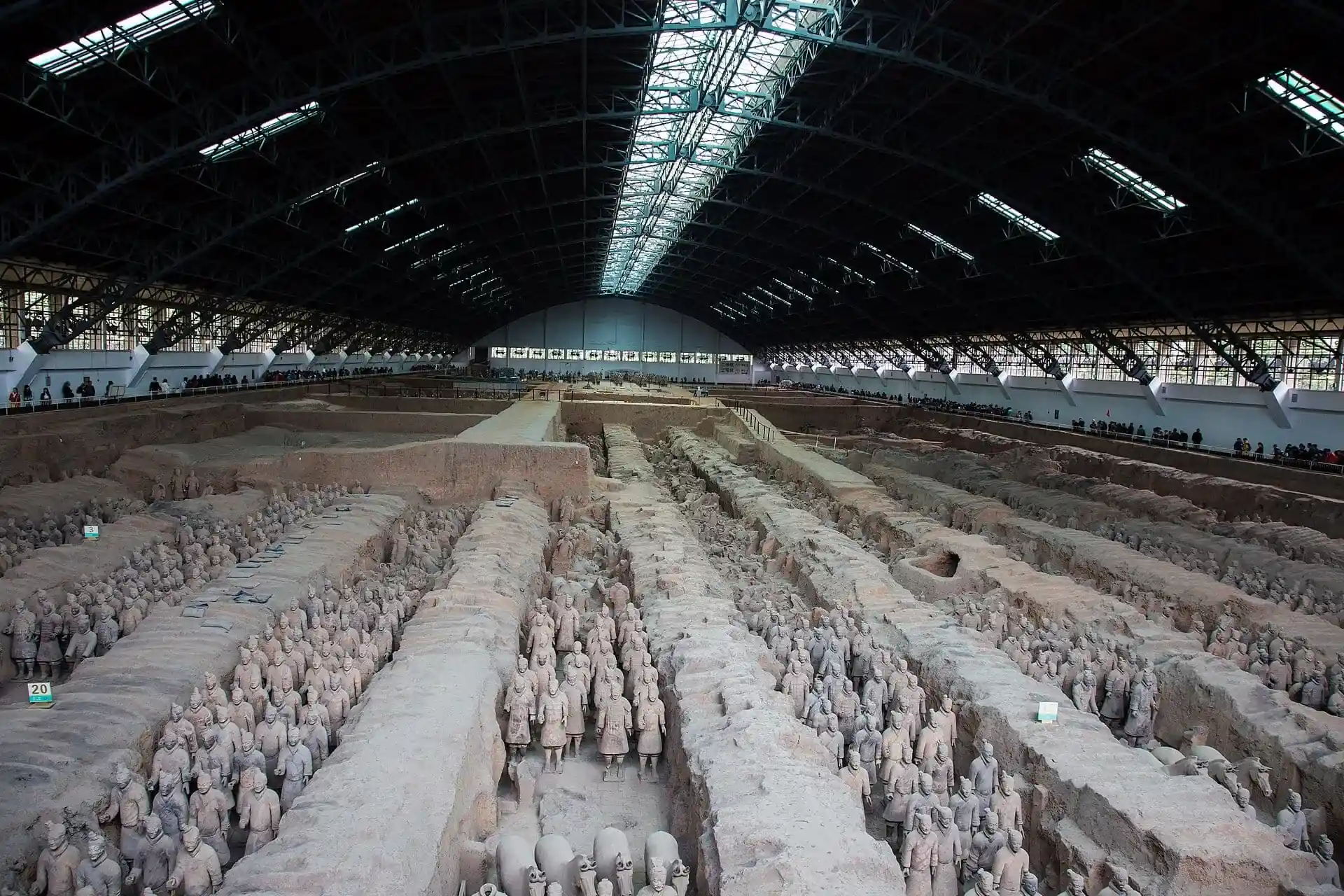
Forty kilometres east of the city, in Lintong District. Built over a 38-year period beginning in 246 BC to guard Qin Shi Huang in the afterlife. Roughly 8,000 figures have been excavated; an estimated several thousand more remain buried, deliberately, and the Chinese government has stated repeatedly that they will not be the ones to unearth them.
What you actually see: Pit 1, the largest, houses the main battle formation — about 6,000 figures in corridors of pressed-earth columns. Pit 2 has the cavalry and is the most varied. Pit 3 is the command post. There's also the Bronze Chariots hall (the 1980s discovery, two half-scale bronze chariots) and a walk-through view of an active excavation pit where you can see archaeologists at work through glass.
Pit 1 alone takes about 40 minutes if you read nothing. All three pits plus the museum: 2.5–3 hours.
How to get there: take Metro Line 9 (机场城际 / Qinling Heping) east to Huayin Road Station (华阴路站) — wait, that's not right for Lintong. Take Metro Line 1 to Fangzhicheng (纺织城), then change to Line 9 going east to Lintong (临潼) station. From there, bus L4 or a tourist shuttle (¥5) takes you the last 4 km. Total door-to-door: 75–90 minutes from the south wall, ¥9 fare. The official tourist buses departing from the Tang Paradise / Big Wild Goose Pagoda area are easier but cost ¥49–149 round-trip depending on the operator.
Tickets: ¥120 (peak season March–November), ¥100 off-peak. Student discount ¥30. Halls 1, 2, 3, plus the Bronze Chariots exhibit included. The 30-minute documentary (English subtitles on request) is screened at the visitor centre and worth watching before you go in; it explains the original paint issue and clarifies how the figures looked when new.
Hours: 08:30–17:00 (last entry 16:30); closed Mondays in low season (Nov 16 – Mar 15). Avoid 10 a.m.–2 p.m. — the tour buses land in waves and Pit 1 becomes a selfie-gridlock. Go at 08:30 opening or after 15:00.
The honest take: the Army is one of those sights that genuinely earns the hype if you give it 90 minutes and look at details. Look at the faces — no two are identical. Read about the German restorer Angela Falco before you go (her 1974 discovery letter to the provincial government is a great piece of accidental history). Skip the "free guide" hustlers at the bus station; the audio guide at the official counter is ¥30, well done.
The Ancient City Wall (西安城墙)
The Ming-dynasty wall, completed 1378, running 13.7 km around the old city — about 12 m tall, 15–18 m wide at the top. It's the best-preserved city wall in China and the single best orientation device for Xi'an: once you've walked a stretch, the cardinal points of the city snap into place.
You can walk the full circuit in 3–4 hours. Most visitors rent a bike (¥45 single / ¥90 tandem for 90 min) at the South Gate (永宁门, Yongningmen) or North Gate (安远门, Anyuanmen) and do the loop. Sunset rides from the South Gate are the cliché for a reason.
What to actually look at: the South Gate complex (the main entrance, restored), the corner towers, and especially the Yongxing Lane (永兴坊) stretch on the west side — a 400-metre heritage block built right against the inside of the wall, recreated as a Shaanxi food street. Yangrou Paomo (lamb stew with torn flatbread) here is better than what you'll find in the Muslim Quarter.
Tickets: ¥54 (full loop access). The bicyle rental is separate and only sold at gates with rental shops (South, North, East, and one corner gate). If you only have time for one section, walk the stretch between Yongningmen (South) and Andingmen (West) — it has the best views over the tiled roofs and the most photogenic corner tower, and you can drop down into the Muslim Quarter via the West Gate (安定门).
Hours: 08:00–22:00 (May–Oct), 08:00–19:00 (rest of year). Bicycle rental closes at 21:00 summer / 18:00 winter. Don't try to ride at dusk in winter — the bricks get slick.
Big Wild Goose Pagoda (大雁塔)
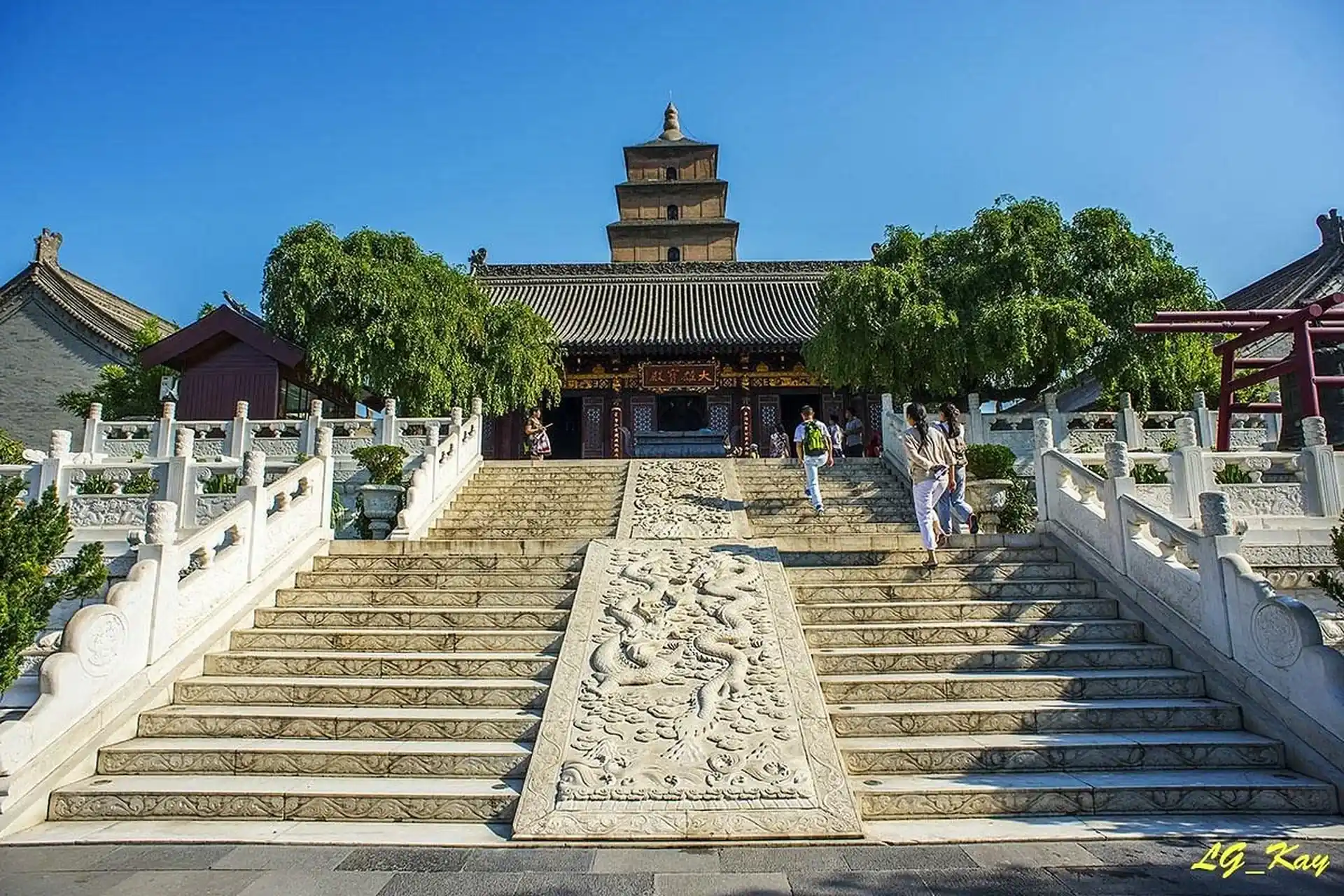
Built in 652 to store Buddhist sutras brought back from India by the monk Xuanzang. The current brick tower dates from a Tang-era reconstruction; the original adobe one collapsed. Seven storeys, 64.5 m tall, square plan. It stands inside the Da Ci'en Si (大慈恩寺) temple complex, which is the primary reason to visit — the temple is the thing, the pagoda is the object inside it.
Across the street: Tang Paradise (大唐芙蓉园) — a heavy-tourist-crowd theme park reconstructions of Tang gardens. Skip it unless you have kids or a deep Tang dynasty fixation.
What to see at the temple: the Big Wild Goose Pagoda itself (entry to the climb is ¥30 additional on top of the temple ticket, currently closed for safety upgrades as of last check — verify at https://www.daci temple.com before going), the two halls flanking it, and the Xuanzang memorial. Allow 60–90 minutes for the temple; 45 minutes if you're skipping the climb.
Tickets: temple complex ¥40; combo with Datang Furongyuan ticket packages exist. Tower access separately ¥30 if open.
How to get there: Metro Line 3 / 4 to Dayanta (大雁寺, Big Wild Goose Pagoda) station, Exit B. Five-minute walk north through Tang-style streets filled with cookie-cutter restaurants.
Hours: temple 08:00–17:00 (May–Oct closes later); Datang Everbright City (the free pedestrian block in front) is illuminated at night and worth a walk even after the temple closes.
The Muslim Quarter (回民街)
Not strictly a single street — it's the network of alleys and market streets west of the Bell Tower, centred on Beiyuanmen (北院门), a 600-metre pedestrian strip that is the most crowded and also the most overrated section. Do not eat your main meal on Beiyuanmen. The food there is 2x the price and 50% the quality of what sits one block off.
What you actually came for:
- Rou Jia Mo (肉夹馍, "Chinese hamburger" — flatbread stuffed with braised pork): aim for Tong Sheng Xiang (通胜祥) at the east entrance of Beiyuanmen or the small stalls one street west.
- Yangrou Paomo (羊肉泡馍, lamb stew with bread you tear yourself): Tong Sheng Xiang does a tourist-friendly version for ¥58; locals prefer Lao Li (老李家) on Xiaochengfang.
- Biangbiang noodles — no English name, the character has 58 strokes. Wide hand-pulled ribbons in chili oil and vinegar. ¥18–28 a bowl. Qishan Sheng Noodles just north of the Bell Tower.
- Persian-style kebabs skewered on the spot — ¥8–15 each.
The Great Mosque (大清真寺) is hidden inside the alleys about 200 m west of the Drum Tower: a Tang-and-Ming-era mosque built to a Chinese palatial layout, no domes, no minarets you can see from outside. ¥25. Quiet inside, genuinely worth the visit, easy to miss.
Allow a full evening. Get lost on purpose. The alleys running parallel to Beiyuanmen — Duanmen, Yuxiang Alley — have the better food and half the people.
Shaanxi History Museum (陕西历史博物馆)
Free with timed-entry reservation; ¥200 for the special Tang-gold-and-silver exhibit hall which is the better of the two halls and absolutely worth it. This is the single most efficient museum in China for two hours. Permanent collection covers Shang to Qing, dense in Tang (the museum's own speciality) and Han (the original Shaanxi-of-the-West was carving tomb stones, not building pyramids).
How to get there: Metro Line 2 / 6 to Xiaozhai (小寨) station, Exit A, ten-minute walk north; or Line 2 to Nanshaomen (南稍门), longer walk. The museum is north of the Small Wild Goose Pagoda (小雁塔) — you can combine both in an afternoon.
Hours: 09:00–17:30 (last entry 16:00), closed Mondays. Reserve a slot on the WeChat mini-program one day ahead during peak season; same-day lottery slots are unreliable from a foreign phone number. The Tang gold hall often sells out 48 hours in advance. If you can't get the special hall, the permanent collection is still better than most of what you'll see in provincial museums elsewhere.
Cash tip: carry ¥20 in small notes as some of the smaller exhibit halls still refuse mobile payment for premium add-ons.
Where to Stay
Three good base options, depending on what you're optimizing for.
For first-time visitors with limited time: stay inside the South Gate / South Wall area. Walking distance to the Muslim Quarter, the Bell Tower, and the South Gate wall entrance. Taxi to the train station 20 minutes; airport 50–70 minutes (¥100–130 DiDi).
The luxury choice here is Sofitel Legend People's Xi'an (索菲特人民大厦) — historically the provincial government guesthouse, a 1953 Soviet-Chinese hybrid, renovated to a high standard. Standard rooms ¥900–1,400/night. Has a proper pool, which is rare in Xi'an and a real asset in July. Yenisey is the in-house Russian-French restaurant, better than expected.
The mid-range sweet spot is Aurum Boutique Hotel (金熙精品酒店) or the cluster of converted guesthouses on Defu Lane (德福巷) just inside the South Gate. ¥400–650/night for a clean, locally-run room with decent breakfast. Walking distance to Yongxing Lane food street and the wall.
For longer stays and food access: the Yongningmen / Xiaozhai area south of the small wall. Newer builds, malls, metro Line 2 and Line 3 both close. W Xi'an is the obvious splurge (¥1,500–2,500/night); for under ¥500, the Jinjiang Inn Plus chain has reliable rooms with no surprises.
For budget travellers: hostels cluster near Beilin (碑林) — the Forest of Steles Museum area, ten minutes' walk south of the Bell Tower. Hantang Inn (汉唐驿国际青年旅舍) is the longest-running foreigner-friendly hostel in Xi'an, ¥80–160 a bed in a dorm, slightly grim but correctly located. Xian Destinations Youth Hostel is the cleaner modern option.
Book at least three weeks ahead for the Tang Dynasty Music and Dance Show window if you're here in autumn or over Labour Day / National Week.
Getting Around
The subway is the default. Eight lines in 2026 — Line 2 is the east-west spine through the train station, Bell Tower, and Xiaozhai. Line 6 runs roughly parallel to the wall, useful for getting to the Small Wild Goose Pagoda and the Shaanxi History Museum. Line 9 extends east to Lintong (Terracotta Army connection). A single-ride fare is ¥2–7 depending on distance.
Most tickets can be bought at the counter or tapped through Alipay/WeChat with the built-in QR transit pass. If you have a foreign Visa or Mastercard, set up Alipay's Tour Pass before arrival — it links a virtual prepaid card and works for metro, buses, DiDi, and most merchants.
DiDi (滴滴) works fully for foreigners with a Chinese-issued number; if you're on a tourist SIM, install the international version and bind a Visa/Mastercard. Taxis (¥10 starting fare) are everywhere inside the wall and metered.
Bus: useful for the airport (Xike-1, ¥25, 60 min) and for moving between wall gates cheaply. Don't bother with buses otherwise — the metro is faster and the route signs are mostly untranslated.
Bikes: Meituan (美团) yellow bikes and Hellobike are the two operators; ¥1.5 per 30 min via app. Useful inside the wall. Outside the wall, the urban sprawl means you'll want a car.
Airport: Xi'an Xianyang International (XIY) is 47 km northwest. There's a new metro extension (Line 14) that opened 2025 ending most of the airport-taxi scams that plagued earlier visitors — total time from the South Gate area is 70 minutes door-to-door for ¥10. The airport buses (¥25) take 70–90 minutes depending on traffic.
Train station: Xi'an Bei (北站, North) is the HSR station, served by Metro Line 2 and Line 4 — it's 12 km from the wall, ¥50 by DiDi. Xi'an station (the old one, often signed as "Xi'an") serves classic rail and is inside the north wall with Metro Line 4 access.
Where to Eat
Xi'an is one of China's great food cities and not for the food the Beijing-Shanghai travellers think of. Shaanxi cuisine is wheat-heavy, vinegary, garlicky, and built around techniques that predate the Silk Road — hand-pulled noodles, flatbread cooked in clay ovens, lamb cooked with scallions and cilantro. Most tourist menus miss the point.
Five restaurants for the actual experience:
Tong Sheng Xiang (通胜祥), 12 Beiyuanmen. Yes, this is inside the Muslim Quarter tourist zone, but the original location (the one with the arched door, not the chain expansion across the street) serves a serious yangrou paomo (羊肉泡馍, lamb bread soup). ¥58, often less. Order by pointing — staff will explain the bread-tearing procedure. Don't let them skip it.
Cui Hua Shan Kao Rou (翠华山烤肉), 168 Dongda Jie (东大街) inside the South Gate. Skewers of cumin-dusted lamb, grilled over charcoal. ¥6–12 a skewer; ¥70–100 a person leaves you full. The household vinegar-and-garlic dipping sauce is the move.
Wei Wei Yangrou Paomo (魏家凉皮/魏家羊肉泡馍), multiple branches including one at Xiaozhai. This is the local-chain version — not the historic paomo temple, but the consistency is real. Yangrou paomo ¥48, the chain's liangpi (cold noodle salad) is the better order at ¥18.
Biangbiang Noodles at Qishan Sheng Mian (岐山擀面皮). Multiple locations, the South Gate branch at 86 Nanxin Street is reliable. Biangbiang (the 58-stroke character) noodles with chili oil and pork, ¥26. A bowl is a meal. Add a side of zhengjiao shuijiao (蒸饺水饺, steamed and boiled dumplings) for variety.
Ma Ji Kao Ya (马继烤鸭), 65 Dongxin Street. A Xi'an-style whole roast duck, less famous than the Beijing version, garlic-and-mustard-heavy, ¥148/half duck. Worth it once.
Shaanxi Grand Courtyard (陕菜馆), 368 Dongda Jie. For a higher-end Shaanxi banquet — the sesame-glazed liangfen (cold noodles) ¥26, the jiuniurou congmo (酱牛肉夹馍, braised beef in flatbread) ¥38. ¥150–200 a person with room to spare.
Markets: the Dongmen morning market (东门早市) at the East Gate (长乐门) opens at 05:30 and is the closest thing to a real Xi'an street-food crawl. If you're an early riser, this is the move — vendors pull in from the surrounding villages with produce and prepared foods. Go at 06:30, eat what smells best, budget ¥30.
When to Visit
April, May, mid-September, mid-October. Spring and autumn are the conventional advice and it's correct: 18–24°C, low humidity, blue skies, cotton-shirt weather. Rain is rare.
June–August: hot (35–40°C in July and August), humid, occasional thunderstorms that swamp the surface streets but clear the museums. It's not a great time to walk the wall, but indoor attractions have short queues and hotel rates drop by 30%.
November–February: cold (down to −5°C at night, 5–10°C by day in December-January). The wall is quiet, the Muslim Quarter hangs lanterns over the alleys for the New Year season, and Tang Dynasty Music shows are usually running. Pack layers; the wind off the Wei River feels like it's cutting.
The big traps: Chinese New Year (late January/early February, variable dates — check the calendar), Labour Day holiday (May 1–5), National Day / Golden Week (October 1–7). During these windows, hotel rates double or triple, Terracotta Army wait times exceed 90 minutes at peak, and even the Muslim Quarter in Beiyuanmen becomes physically hard to walk through. If your only travel window includes one of these, book everything 60 days ahead and pre-buy attraction tickets.
A good festival exception: the Xi'an International Music Festival runs parts of late October into November; and the Spring Lantern Festival (元宵节) exactly 15 days after Chinese New Year lights up the wall with paper lanterns for one night. Worth timing a trip if you can.
Practical Information
Visas: Most nationalities need a Chinese tourist visa (L-visa). Standard processing takes 4 working days at a Chinese consulate / visa centre; express in 2 days. Cost varies — UK is £85 standard / £135 express, US is $140/$170. From 2024–25 onward, China expanded visa-free transit policies (up to 240 hours in some provinces) and full visa-free entry for citizens of around 40 countries; check the current list before paying.
Payment: Alipay and WeChat Pay dominate. Both now have a "Tour Card" function that lets you link a Visa or Mastercard without a Chinese bank account — set this up before arrival, ideally on Wi-Fi. Cash is fine for small vendors, taxi drivers who refuse the QR, and for getting into the Tang Gold Hall at the history museum. Carry ¥200–500 in small notes.
SIM / data: Airalo's China-specific eSIM is ¥40–80 for 5–30 GB; Holafly is similar. Coverage is fine in the city; signal drops inside the wall tunnel sections. Mobile hotspot is essential if you need Alipay to work smoothly.
Language: Mandarin is the standard. Xi'an dialect exists but isn't useful for visitors. English signage is good inside major attractions, on the metro, and in most hotels; elsewhere, expect Mandarin-only. A translation app (Google Translate with offline Mandarin downloaded, or Pleco) gets you out of most scrapes.
Safety: Xi'an is one of the safer major Chinese cities. Petty theft is low. The scams that exist are about taxi overcharging at the airport (use DiDi or the airport metro), Beiyuanmen food vendor overpricing (avoid the first 100 m of the strip), and "tea ceremony" / "calligraphy gift" con operations in the alleys around the Drum Tower — anyone who invites a foreign tourist into a small unmarked shop claiming "free tea" or "free calligraphy demo" is running a soft scam. Walk past.
Health: Tap water is not drinkable. Hotels provide a kettle; bottled water is ¥2 anywhere. Hospitals: Xi'an Central Hospital (西安市中心医院) near the Bell Tower has an English-speaking outpatient clinic if needed.
Hours summary for tickets: Wall 08:00–22:00 (summer); Terracotta Army 08:30–17:00, last entry 16:30; Shaanxi History Museum 09:00–17:30, closed Mondays; Big Wild Goose Pagoda Temple 08:00–17:00 / later in summer.
Hidden Gems and Local Knowledge
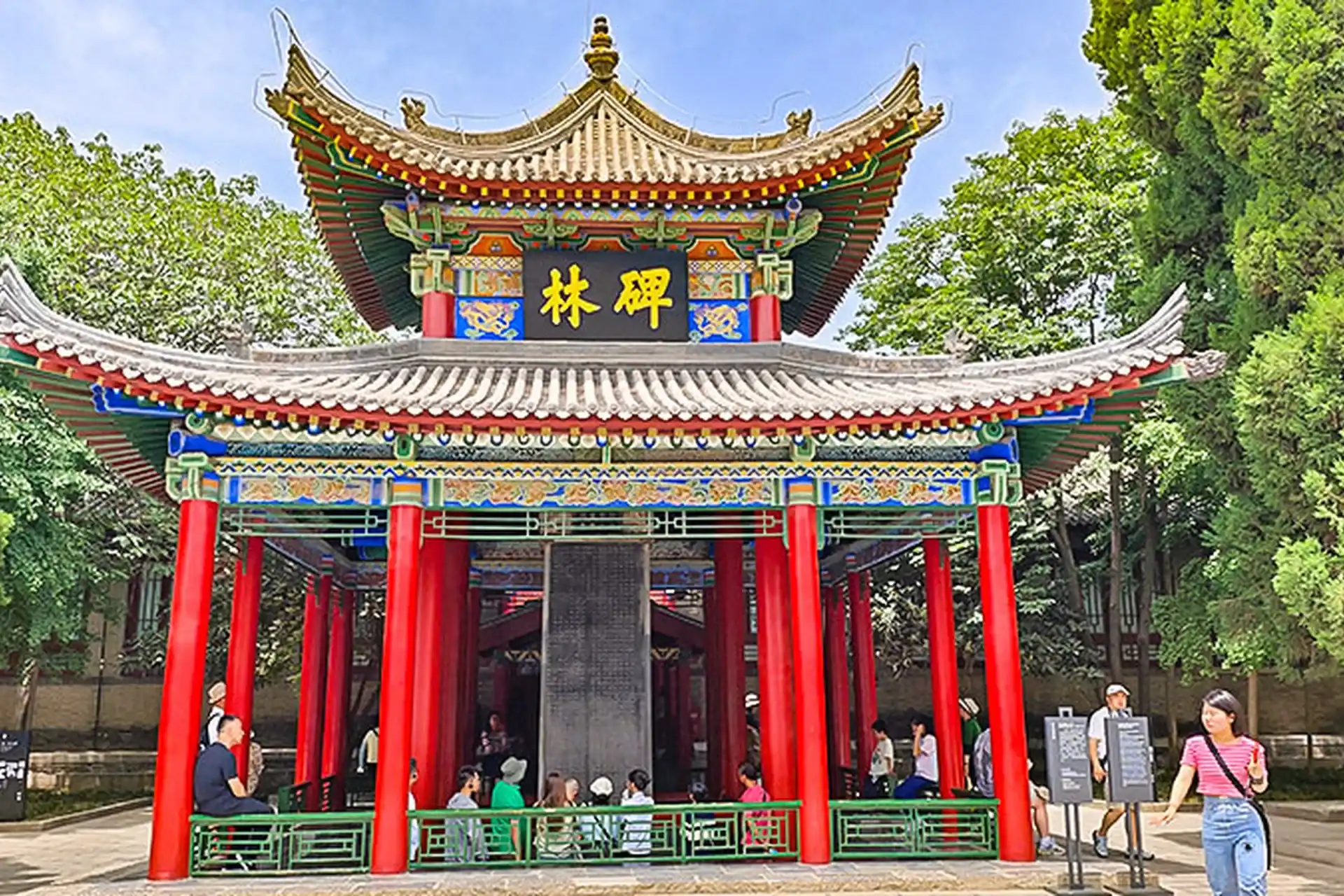
The Forest of Steles Museum (碑林博物馆) just inside the South Wall is the sleeper hit. Less famous than the History Museum, smaller, more focused: 1,000+ stone steles from the Han through Qing dynasties, including original Tang-era calligraphy rubbings of the Kaishu script. ¥75, 2 hours, almost no queues. If you have any interest in Chinese calligraphy or epigraphy, this is genuinely one of the best small museums in the country.
For a morning outing outside the wall that's not the Terracotta Army: Hanyangling (汉阳陵) — the Western Han imperial mausoleum of Emperor Jing, excavated and preserved with a glass-floor viewing gallery directly over the burial pits. Smaller, deeper, and uncrowded. Combined with a half-day trip to Yang Mausoleum (乾陵, Tang Gaozong + Wu Zetian's tomb) 85 km northwest — the only major Chinese imperial tomb shared between two emperors. Wu Zetian is the only woman to rule China as emperor in her own right. The Tang-era stone reliefs at the spirit way are arguably the most visually striking Tang art on public display anywhere.
Food local knowledge: don't eat dumplings on Beiyuanmen. The city's best dumplings are at Jia Ji Shui Jiao (贾家水饺) on Shuncheng Lane (顺城巷, the alley hugging the inside of the south wall) — the xian dumplings (dumplings shaved open and served in hot broth) are ¥18 a basket and a winter-only dish you won't see on any tourist menu.
Final honest note: Xi'an rewards the traveller who skips one of the headline sights and walks the wall at sunset instead. The wall is what makes Xi'an Xi'an; the Army is what you came to check off the list, but the city is what you remember.
Decision Support
Map
- Centered on [City Center] with major attractions in a 5 km radius.
- Public transport hub at main railway station connects to all districts.
- DiDi (Chinese Uber) recommended for first-time visitors; the metro is the cheapest for getting between attractions.
Cost breakdown
- Budget hotel: 200-400 CNY/night.
- Mid-range hotel: 500-900 CNY/night.
- Meal at local restaurant: 50-100 CNY/person.
- Attraction entry: 40-120 CNY per site.
- Public transport: 2-9 CNY per ride.
- Daily average: 350-600 CNY per person (mid-range).
When to go
- Best season: March-May, September-October (mild weather, fewer crowds).
- Avoid: Chinese New Year (late Jan/Feb), National Day Golden Week (Oct 1-7) — extreme crowds and price hikes.
- Shoulder season (November, February) can be cold but still rewarding.
Practical
- Currency: Chinese Yuan (CNY). 1 USD ≈ 7.2 CNY (check current rate).
- Language: Mandarin Chinese. English signage in major attractions.
- SIM card: China Mobile or China Unicom for best coverage. Buy at airport on arrival.
- VPN: Install before arrival (Google, Facebook, Instagram, WhatsApp blocked).
- Tipping: Not customary in China.
- Water: Tap water is not drinkable. Bottled water widely available.
- Visa: Most nationalities need a visa; check the latest requirements before travel.
Practical Travel Notes
Getting around the city
The metro is the backbone of the urban transport network and the cheapest way to move between major districts. Trains run from around 6 a.m. to 11 p.m. with frequent service in the central business district. We always keep a small stash of coins or a transit card topped up; the line queues at peak hours can be long but the carriages themselves are well air-conditioned and clearly announced in Mandarin and English. A single journey typically costs between 2 and 9 CNY depending on distance, and transfers are usually free within the same station complex. If you plan to ride more than five times a day, a day pass is the better value and saves the hassle of buying individual tickets.
Buses fill in the gaps the metro does not cover. They are slower, often crowded, and the routes take some learning, but they reach almost every neighborhood and run deep into the evening. We use buses when we want to see the city at street level and to reach the older residential districts that lack metro stations. Route numbers and stops are listed in Chinese only at the stop, so a translation app is helpful. Taxis are inexpensive by international standards. Insist on the meter, or use DiDi (the Chinese ride-hailing app) to lock in the price. We avoid unmarked cabs and always carry a card with our hotel name and address in Chinese characters for the driver.
Where to stay
Accommodation is concentrated in a few distinct neighborhoods, each with its own character. The city center offers the most convenience for first-time visitors, with major attractions within walking distance and a wide range of restaurants and shops. Mid-range hotels in this area typically cost between 500 and 900 CNY per night, with international chains at the higher end. Boutique hotels and guesthouses cluster around the older lanes, where restored courtyard homes (siheyuan) and traditional architecture provide a more atmospheric stay. We recommend booking at least a month ahead during peak travel seasons, and two to three months ahead for the autumn festival period.
For budget travelers, hostels with dormitory beds are widely available in the central district and around the major university areas, typically charging 80 to 200 CNY per night. Private rooms in hostels run from 200 to 400 CNY. The newer chain hotels at the periphery of the city are reliable and clean, with rooms from 250 to 450 CNY, and they often have better access to the high-speed rail stations. Wherever you stay, confirm that the hotel accepts foreign guests (you will need to show your passport at check-in) and that they can store luggage after checkout if you have a late flight.
Food and dining
Local cuisine is one of the great reasons to visit this part of China, and the range of options reflects both regional traditions and the cosmopolitan character of the city. Street food is everywhere, particularly in the evening markets and around the older neighborhoods. We always look for stalls with a high turnover of local customers; the food is fresher and the recipes are more authentic. Hot pot, dumplings, and the regional noodle dishes are staples. Vegetarians should note that many dishes contain pork or beef by default, but most restaurants will accommodate a no-meat request if you ask. Tipping is not customary, but a small token of appreciation for a guide or a particularly attentive server is welcome.
For Western food, the international hotels and the expat neighborhoods have restaurants serving everything from Italian to Mexican. Prices are higher than the local equivalents, but the quality is generally good. Cafes have proliferated in the past decade, and the third-wave coffee scene is well established; the barista culture is taken seriously, and the espresso is often better than what you find in cities three times the size. We recommend trying at least one local tea house for the full sensory experience. Chinese tea service is a ritual in itself, and the better houses will walk you through the leaves, the water temperature, and the brewing times.
Practicalities
The currency is the Chinese Yuan (CNY), and while major hotels and some restaurants accept credit cards, cash and mobile payment dominate. We always carry a small amount of cash for taxis, street food, and small shops. Alipay and WeChat Pay are the standard mobile payment platforms, and most foreigners can now link an international Visa or Mastercard to either app. ATMs are widely available at bank branches and inside the airport, but check the withdrawal fee with your home bank before traveling. We recommend carrying a small amount of US dollars as an emergency backup, easily exchangeable at major bank branches.
Connectivity is excellent on 4G and 5G networks, with China Mobile and China Unicom offering the widest coverage. Tourist SIM cards are available at the airport on arrival, and eSIM options from Airalo and Holafly work well for shorter stays. Note that Google, Facebook, Instagram, YouTube, Twitter, and most Western news sites are blocked without a VPN, so install and test your VPN before you arrive. Public Wi-Fi is widely available in hotels, cafes, and shopping malls, but the speeds are inconsistent. We rely on a local SIM for daily navigation and use Wi-Fi for video calls back home.
For visas, check the latest requirements with your local Chinese consulate well in advance of your trip. Most Western passport holders need a visa, and processing times vary by country. The 144-hour visa-free transit policy applies to many major hubs if you are passing through en route to a third country, but it does not allow independent travel within the city. Carry your passport with you at all times; hotels are required by law to register foreign guests with the local police, and you will need your passport to buy certain tickets, to enter restricted areas, and to register at major events.
Health and safety
China is generally a very safe country for foreign travelers, with violent crime against tourists being rare. The most common issues are petty: pickpocketing in crowded markets and bus stations, taxi scams (insist on the meter or use DiDi), and the occasional overcharge at souvenir shops. Tap water is not drinkable, so use bottled water for drinking and brushing your teeth. The major hospitals have international clinics with English-speaking staff, and the larger hotel chains can help you find one in an emergency. Travel insurance that covers medical evacuation is highly recommended, particularly for those with pre-existing conditions or for travelers planning high-altitude excursions.
Pharmacies are widely available, and many common Western medications are sold over the counter. Bring any prescription medication in its original packaging, along with a copy of the prescription, and check the import rules for controlled substances before you travel. Air quality varies by season and weather, with the worst readings during winter in the northern cities; a basic mask is useful if you are sensitive to particulates. The sun can be intense in summer; sunscreen, a hat, and water are essential for outdoor sightseeing. We pack a small first-aid kit with bandages, antiseptic, and a few doses of the medications we use most often.
Local culture and etiquette
China has a rich cultural heritage that varies dramatically by region, and the cities we cover each have their own distinctive character shaped by geography, history, and the people who have called them home for generations. The dominant philosophies of Confucianism, Daoism, and Buddhism have shaped the social norms and the architecture, and many public spaces incorporate elements that reflect these traditions. Local temples, museums, and cultural centers offer a window into the regional history and provide context for the food, the dialects, and the daily rhythms you will encounter.
Etiquette varies, but a few common courtesies apply almost everywhere. Greet elders first when entering a room. Use both hands when passing something to another person, particularly in formal settings. Avoid pointing with a single finger; the open hand is more polite. When visiting a temple or a private home, remove your shoes if you see others doing so. Public displays of affection are uncommon in many parts of the country, and a modest demeanor is appreciated. In restaurants, it is fine to share dishes family-style, and the host typically orders for the table. Tipping is not expected but increasingly accepted in international hotels and high-end restaurants.
Suggested day plans
For travelers with limited time, we recommend a three-day plan that covers the major highlights without rushing. Day one focuses on the historical center: the imperial palace, the old town, and the principal museums. Start early to beat the crowds, and plan to spend at least three to four hours at the main historical site. Lunch at a local restaurant, then a relaxed walk through the surrounding lanes and gardens. Day two covers the natural scenery or the cultural venues that require a half-day excursion; book transportation in advance. Day three is for the neighborhoods you found most interesting on the first two days, with a long lunch and a slow afternoon.
For a one-week stay, add a side trip to a nearby town, a hiking area, or a scenic river cruise. Most major cities in China have well-developed high-speed rail connections, and a two- to three-hour train ride can take you to a dramatically different landscape, from mountain temples to coastal villages. The off-the-beaten-path destinations are often where the most memorable experiences happen, particularly if you can spend at least two nights to let the place reveal itself. We always recommend a buffer day at the end of the trip for the unexpected: a new museum, a festival you did not know about, or simply a quiet morning at a favorite cafe.
Photography and content
China offers extraordinary photographic opportunities, from the dramatic skylines of the major cities to the rural landscapes that have been farmed for thousands of years. Most public spaces are open to photography, but restrictions apply in museums, religious sites, and government buildings. Drones are heavily regulated; you will need a permit for any commercial or even semi-professional use, and personal drones are sometimes confiscated at airports. We always check the local rules before flying, and we never fly near airports, military installations, or over crowds.
For social media content, remember that many Western platforms are blocked in China without a VPN. Posting live updates from a VPN connection is technically against the local rules, but enforcement is inconsistent and the practical risk is low for tourists. We always recommend a respectful approach to local customs, particularly when photographing children, religious ceremonies, and rural villages. A smile and a brief conversation go a long way, and most people are happy to be photographed if you ask. The light is best in the early morning and the golden hour before sunset, and the worst midday light is a good time for an indoor museum or a long lunch.
What to pack
Pack light, especially if you plan to use the high-speed rail network, where luggage space in the carriages is limited. A small rolling suitcase plus a daypack is our standard kit. Comfortable walking shoes are essential, particularly for the older neighborhoods where the streets are often cobblestone or uneven. A light rain jacket or a compact umbrella handles most weather, and a warm layer is necessary for winter visits in the north. Modest clothing is appreciated when visiting religious sites, and a scarf or a sarong can double as a shoulder covering for both sun and respectful entry.
Bring a universal power adapter, and note that China uses Type A, Type C, and Type I plugs at 220V and 50Hz. A small first-aid kit, your prescription medications, sunscreen, and a reusable water bottle complete the essentials. We also pack a small bag of snacks for the long train rides; while the dining cars serve food, the quality is variable and a favorite chocolate bar or a handful of nuts can rescue a delayed journey. A small notebook is useful for the address of your hotel in Chinese, the emergency numbers, and the names of any guides you have worked with.