Datong · Visitor Guide
Yungang Grottoes (云冈石窟, Yúngāng Shíkū)
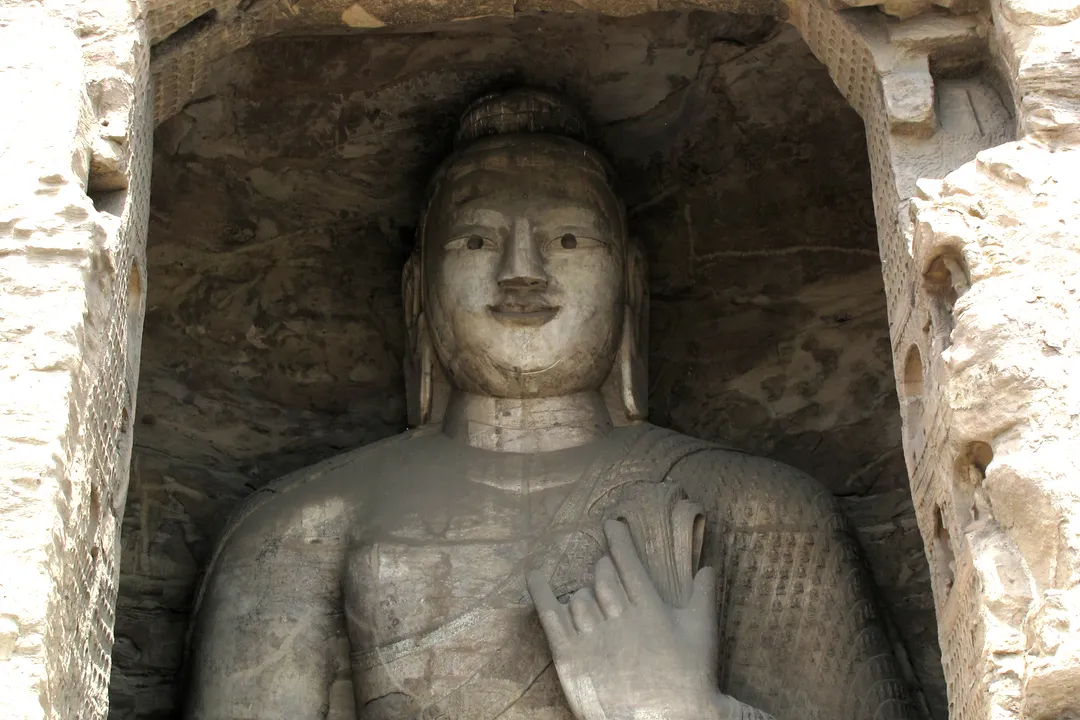
"\"The Yungang Grottoes (云冈石窟) are one of the three great Buddhist cave art sites in China (alongside Mogao and Longmen) and the oldest of the three. Carved between 460 and 525 AD under the Northern Wei Dynasty, the site spans 1 km of sandstone cliff face near Datong, containing 252 caves, 51,000 statues, and some of the earliest large-scale Buddhist sculpture in China. The five colossal Buddhas (Caves 16–20, commissioned by five successive emperors) are the signature images: the largest is 17.4 meters tall, a seated Buddha with hands in the teaching gesture, watching over visitors for 1,550+ years.\".".
Last updated:
Quick Answer
Is Yungang Grottoes worth visiting?
"51,000 Buddhist statues carved into 252 caves across a 1 km sandstone cliff — the largest 5th-century rock-cut temple complex in the world. UNESCO. ¥120. 3–4 hours.".
Quick facts
| Ticket | ¥120 (as of June 2026). Audio guide ¥30. Electric cart from entrance to caves: ¥15 (optional but helpful in summer heat). |
|---|---|
| Hours | 8:30–17:30 (Apr–Oct), 8:30–17:00 (Nov–Mar). Last entry 30 min before close. |
| Recommended duration | 3–4 hours for a thorough visit. 2 hours at a rapid pace. |
| Best time to visit | May and September for mild weather and clear skies. Mornings (8:30–10:00 AM) for the best light on the western-facing cliff. Avoid July–August (extreme heat, Datong can hit 38°C) and Chinese holidays. |
| How to get there | From Datong city center: bus 3 or 12 to Yungang Grottoes stop (40–50 min, ¥2). DiDi: ¥40–60, 30 minutes. Datong has HSR connections from Beijing (2–2.5 hours). |
| English signage | yes |
| Wheelchair accessible | partial |
| Carved | 460–525 AD (Northern Wei Dynasty) |
| Total statues | 51,000 |
| Caves | 252 (45 major caves) |
| Colossal Buddhas | Caves 16–20, largest is 17.4 m |
| UNESCO | 2001 |
What to expect
The grottoes are carved into a south-facing sandstone cliff, and the light plays across the facade throughout the day. The five colossal Buddhas of Caves 16–20 (collectively the "Tanyao Caves," named after the monk who proposed them) each represent a Northern Wei emperor, fusing political power with Buddhist devotion. Cave 20 is the most photographed — the outer wall collapsed centuries ago, leaving the 13.7-meter seated Buddha exposed to the sky, an accidental masterpiece of open-air sculpture.
The smaller caves reward close attention. Cave 12 (the "Music Cave") has a ceiling carved with flying apsaras playing instruments brought from Central Asia along the Silk Road — lutes, harps, flutes — a frozen orchestra from 500 AD. Cave 6 is the most elaborate interior: a square central pillar carved floor-to-ceiling with scenes from the Buddha's life. The polychrome pigment that still clings to many statues is original — faded but unmistakably red, blue, and gold after 15 centuries. I spent an hour in Cave 6 alone and could have stayed longer if other visitors were not queuing behind me.
How to get there
From Datong city center (鼓楼 area): take bus 3 or bus 12 from the main bus station near the Drum Tower — 40–50 minutes, ¥2. DiDi is simpler: ¥40–60, 30 minutes. From Datong South HSR station: DiDi ¥70–90, 40–45 minutes. If you are coming from Beijing, take the morning HSR from Beijing North (北京北站) or Qinghe (清河站) to Datong South (大同南站), ~2 hours, ~¥160. Then DiDi to the grottoes.
Best photo spots
- Cave 20 — the open-air seated Buddha, best in morning light (8:30–10:00 AM)
- Cave 12 (Music Cave) ceiling — flying apsaras with instruments (use a wide-angle lens)
- The full cliff facade from the south side of the road — shows the scale of the excavation
- Cave 6 central pillar — the narrative carvings of the Buddha's life story
Tips
- Arrive at 8:30 AM opening — the cliff faces east-southeast and the morning light on the facade is significantly better than afternoon light
- Total visit is about 5 km of walking from the entrance, through the caves, to the museum and back — wear comfortable shoes
- The on-site museum (included in ticket) is excellent and air-conditioned — save it for the last hour when you need a cooling break
- Datong is surprisingly cold October–March (can drop below -20°C in January) — dress for winter if visiting outside summer months
- Combine with the Hanging Temple (75 km, 1.5 hours by car) on a separate half-day — both can be done in one day with a private DiDi (¥400–500 for the day)
Scams to avoid
- Touts at Datong South HSR station offering "Yungang + Hanging Temple combo tour ¥600" — you can DiDi yourself for half the price
- Unofficial "guides" inside the grottoes offering to show you "secret caves" — all accessible caves are signed and open; there are no secret ones
Frequently asked questions
How do Yungang compare to Mogao and Longmen?
Yungang (Datong, 460–525 AD): earliest, largest individual statues, majestic scale, 51,000 figures across 1 km of cliff. Mogao (Dunhuang, 366–1300s AD): most famous for wall paintings rather than sculpture, 492 decorated caves with murals spanning 1,000 years — the art historical archive of the Silk Road. Longmen (Luoyang, 493–1100s AD): smaller individual caves but more of them (2,300+ caves, 100,000+ statues), set along a river which makes the walk more scenic. All three are UNESCO and all three are worth visiting. Yungang is the best for colossal sculpture; Mogao for mural painting; Longmen for sheer quantity and atmospheric setting.
How long is the drive from Datong to Yungang?
16 km west of Datong city center. DiDi: 30 minutes, ¥40–60. Public bus: 40–50 minutes, ¥2. The site is well within a half-day trip from any Datong hotel.
Is Datong worth visiting just for the grottoes?
For the grottoes + the Hanging Temple (1.5 hours southeast), yes — together they justify a 2-day stop on a Beijing–Datong–Pingyao–Xi'an route. Both are unique sights with no equivalent elsewhere in China. Datong itself is not a charming city (industrial, rebuilt in the 2000s), but the historical sites make it an essential stop on any northern China itinerary.
Are all 252 caves open to the public?
No — about 45 major caves are open, and 20 of those are the highlight. Many smaller caves are gated (you can peer in but not enter) or closed for conservation. The accessible caves are more than enough for 3–4 hours. The closed caves protect fragile pigment and sandstone from humidity and CO2.
What is the best day trip combination from Datong?
Morning: Yungang Grottoes (8:30–12:00). Afternoon: Hanging Temple (1.5-hour drive southeast, 1–1.5 hours on site). This requires a private car or DiDi (¥400–500 for the day). Do NOT try to combine both with public transport in one day — it is not feasible. If you have only one day and no car, choose the grottoes.
Why were the caves carved here specifically?
Datong was the capital of the Northern Wei Dynasty (a Xianbei people, not Han Chinese) from 398–494 AD. The emperors adopted Buddhism as a state religion and commissioned the caves to demonstrate their piety and political legitimacy. When the capital moved south to Luoyang in 494, the carving tradition followed — which is why Longmen Grottoes near Luoyang pick up chronologically where Yungang leaves off.
Can I touch the statues?
No — and please do not try. The sandstone is 1,550+ years old and human skin oils accelerate deterioration. Touching statues in accessible caves (especially the colossal Buddhas) is the primary cause of surface erosion beyond natural weathering. Security guards will stop you. Photography is allowed without flash throughout.
Read next
Other things to do in Datong
Hanging Temple (Xuankong Temple)
"A 1,500-year-old temple fused into a sheer cliff face 75 meters above the ground — the only temple in China combining Buddhist, Taoist, and Confucian halls. ¥130. 1–1.5 hours.".
Huayan Temple
"A pair of Liao-dynasty (907–1125) wooden temples holding one of China's largest surviving ancient halls and a celebrated 1,000-year-old smiling bodhisattva. ¥65. 1.5–2 hours.".
Mount Wutai
"Holiest Buddhist mountain — 53 temples, Manjusri bodhisattva's seat. UNESCO site. ¥135 entry. Cool summer retreat at 3,058 m. From Datong or Taiyuan.".
Nine-Dragon Wall
"China's oldest and largest Nine-Dragon Wall — 45.5 m of Ming glazed tile built in 1392 for a prince's mansion, viewable in about 30 minutes. Pair it with Huayan Monastery around the corner.".
Yingxian Wooden Pagoda (Sakyamuni Pagoda of Fogong Temple)
A 67-meter all-timber pagoda built in 1056 without a single nail — the oldest and tallest surviving wooden pagoda in the world, 70 km south of Datong. ¥60.…
Yungang Grottoes
"A ~1-km sandstone cliff holding some 51,000 Buddhist carvings begun in 460 AD under the Northern Wei — allow 3–4 hours, and arrive before 10:00 to beat the tour-bus waves.".
Museums in Datong
Datong Museum
The museum of the ancient capital of the Northern Wei Dynasty — providing context for the Yungang Grottoes and the Pingyao connection. Allow 1 hour.
Yungang Grottoes Museum
One of China's four great Buddhist cave temple sites — Yungang (云冈石窟) with 51,000+ Buddhist images carved 460-525 CE. ¥120.