
Baoji at a Glance
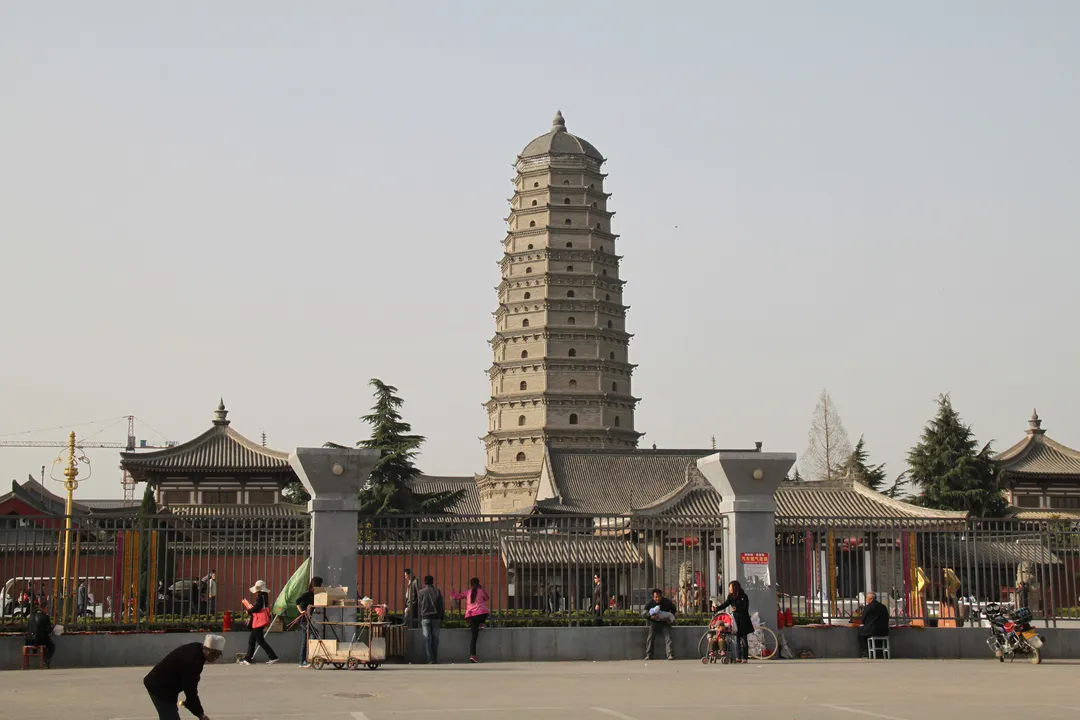
Give Baoji two to three days off the high-speed rail: one for the Baoji Bronze Ware Museum and the market streets along the Wei River, one for the run east to Famen Temple and the Zhouyuan fields in Fufeng County, and, if a third day exists, the 3,771-metre summit country of Mount Taibai in the Qinling. April-May and September-October are the dependable windows. Mid-range spending runs about 500-1,000 CNY per person per day, and only two tickets really bite: Famen Temple at roughly 78-100 CNY in season and the Taibai entry-plus-shuttle combination at about 160 CNY.
Why Baoji
Baoji sits where the Wei River leaves the Gansu hills and opens into the Guanzhong plain — the western gate of Shaanxi, one hour by high-speed rail from Xi'an and about 40 minutes east of Tianshui. The city traded under the name Chencang for most of its life; the Tang court renamed it Baoji in 757, in the middle of the An Lushan rebellion, after a legend in which a rooster's cry on the local mountain announced good fortune. The idiom "openly repair the plank roads, secretly cross at Chencang" still carries the old name through every Chinese conversation about strategy.
The deeper claim is older. The plain east of the city — Zhouyuan — is where the Zhou people built the capital they ruled from before toppling the Shang around 1046 BC, and the Qin state grew up on the same ground before it unified China in 221 BC. When the Western Zhou court collapsed in 771 BC, its bronze-holding families buried their ritual vessels in these fields and never came back; farmers have been turning them up ever since. No region of China has yielded more inscribed Zhou bronzes, and one of them — the He zun, ploughed out of a Baoji field in 1963 — carries a 122-character inscription with the earliest known writing of the two characters that now name the country.
The honest trade-offs: Baoji is a working grid city, not a preserved old town; English signage thins out within metres of the ticket halls; and the headline sights are spread across three counties, so the schedule lives or dies on early starts and the odd hired driver. Two real days reward the trip. A rushed dash between two trains rewards almost nobody.
Top Sights
| Sight | Highlight | Entry | Time needed |
|---|---|---|---|
| Baoji Bronze Ware Museum | He zun (1963, 122 characters), galleries of Western Zhou ritual bronzes | Free with ID reservation; closed Mondays | 2-3 hours |
| Famen Temple (Fufeng) | 148 m stupa of 2009, finger-bone relic, underground palace cleared in 1987 | About 78-100 CNY in season, at current listings | Half day |
| Zhouyuan site (Fufeng-Qishan) | Fields that gave up a 1976 hoard of more than 100 bronzes; protected since 1982 | Free fields; small site museum | 2-3 hours |
| Mount Taibai (Meixian) | The Qinling's 3,771 m crown, cable cars, alpine meadows, relic glaciers | About 100 CNY; entry-plus-shuttle about 160 CNY, at current listings | Full day |
| Qishan: Zhougong Temple & Wuzhang Plains | Duke of Zhou shrine in old cypresses; Zhuge Liang's last campaign, 234 AD | Modest gate fees at each | Half day |
| Guanshan Grassland (Longxian) | Meadows around 2,200 m, horses, herder camps | Gate ticket; reconfirm on arrival | Full day |
Famen Temple: the Finger Bone and the 148-Metre Stupa
Famen Temple lies about 100 km east of downtown, near Fufeng's county seat, and it deserves the half day it costs. The temple's Tang-era crypt held the finger bone of the Buddha — the relic emperors from Wu Zetian onward hauled to the capital in procession — and when the last Tang burial sealed the underground palace in 874, nobody opened it again for more than a thousand years. The Ming brick pagoda built above the crypt stood until 1981, when its western half collapsed after weeks of rain. The clearance that followed, in 1987, found the Tang palace intact: four finger bones, three jade "shadow" replicas and one true relic, packed with gilt-silver caskets and silk that still held its colour.
Today the complex reads west to east as Tang-style halls, the pagoda rebuilt in 1988, and the Namaste Stupa — a 148-metre joined-hands silhouette finished in 2009 that now enshrines the relic. The gate runs roughly 08:30-17:30; admission sits around 78-100 CNY in season at current listings, and prices have moved more than once, so check the ticket window rather than an older guide. Close-up viewing of the relic opens only on significant religious dates — if that is the point of your visit, check the scenic area's notices first. Pair the temple with the Zhouyuan fields after lunch and the day closes itself.
Bronze Ware Museum: Where "China" Was Cast
The Baoji Bronze Ware Museum occupies a purpose-built home on the Stone Drum hill above the Wei River, moved here in 2010; entry is free with an ID reservation and the galleries close on Mondays. The building matters less than one vessel. The He zun — cast in the early decades of the Western Zhou, about 3,000 years ago — turned up in 1963 when a Baoji farmer's spade hit bronze behind his house. Inside, twelve lines and 122 characters record King Cheng's speech about founding a capital in the centre, and four of them read zhai zi zhong guo: "dwell in this central region". It is the earliest known appearance of the word "China" written down anywhere.
The rest of the collection explains why it surfaced here: gallery after gallery of Zhou ritual vessels, inscriptions naming the families who commissioned them, the record of a civilisation that wrote its laws on bronze. Take the two to three hours it deserves, then walk the neighbouring Stone Drum park, named for the Qin stone drums whose inscriptions are counted among the earliest poems in the language.
Zhouyuan and Qishan: Fields of the First Zhou
The Zhouyuan is the flat country between Fufeng and Qishan where the Zhou built their pre-dynastic capital, and it is still a working farm landscape — the kind of place where a 1976 hoard gave up more than 100 Western Zhou bronzes in a single pit, their inscriptions naming generations of one family. The fields have carried national-level site protection since 1982, and a small museum by the site displays finds that never left the county. There is no fence-and-ticket spectacle here; the interest is standing on the ground that produced the museum pieces you saw in the city.
Qishan county, next door, fills a half day on its own. The Zhougong Temple honours the Duke of Zhou — the regent who wrote the rituals Confucius later canonised — under cypress groves the locals will tell you are older than the temple. The Wuzhang Plains south of town mark where Zhuge Liang's last northern campaign ran out in 234 AD, the Shu chancellor dying in camp on the Wei River's south bank. Lunch resolves itself: this is Qishan, the home county of saozi noodles.
Mount Taibai: 3,771 Metres on the Qinling Roof
Taibai Mountain closes the Wei valley's southern horizon, and its summit block, Baxiantai, tops out at 3,771 metres — the highest point between nowhere and the Himalaya-scale country to the west, the roof of the Qinling. The visitor side sits in Meixian, about 1.5 hours from downtown Baoji. Cable cars do the work that used to take days: boardwalks cross alpine meadows, and above the treeline the trail passes relic glaciers and the stone seas that glaciers left behind, within reach of the summit in a long day.
Entry runs about 100 CNY, or about 160 CNY with the shuttle inside the park, at current listings. Start by 08:00: the valley heat rises into afternoon cloud, wind closes the cableways before rain does, and the upper mountain keeps winter temperatures even in July — pack a layer whatever the forecast says. Cableways and high sections can close from late autumn into spring. If the day runs long, a mountain guesthouse beats a midnight drive back to the city.
Guanshan Grassland: Meadows at 2,200 Metres
Two hours west, past Longxian's county town, the landscape gives up on farming: the Guanshan Grassland rolls for kilometres at around 2,200 metres, all fescue slopes, horse trails and herder camps that look borrowed from a different latitude. Overnight temperatures drop even in summer; bring a jumper year-round. The day pairs naturally with the Longmen Cave, a Daoist complex hung on cliffs above the county and tied to the early centuries of the Quanzhen school — the morning on the cliffs, the afternoon on the grassland, a night in Longxian town, and the plateau road back to Baoji the next day.
A Two-Day Plan
Work it in this order and swap only if rain moves in:
- Day 1 — City and bronzes. Bronze Ware Museum at opening (free, ID reservation; closed Mondays), the Stone Drum park after it, then the old-town market streets — saozi noodles at noon, a Chen Cang Old Street stroll and a guokui from a griddle for the evening.
- Day 2 — East to Famen. A hired driver (about 400-600 CNY for the day) makes the eastern loop simple: Famen Temple for the 08:30 gate, the Tang crypt story and the 148 m stupa, lunch in Fufeng, then the Zhouyuan fields and site museum before the road back to Baoji South for an evening train.
With a third day, go up — Mount Taibai takes a full one. A fourth puts Qishan's temples and the Wuzhang Plains in their own unhurried half-week slot, and a fifth hands the west to Guanshan and Longmen Cave. The day-by-day versions are already built in our 3-day, 5-day and 7-day Baoji itineraries.
Food: Saozi Noodles, Ganmianpi and Guokui
Baoji eats wheat, and Qishan county — an hour east, administratively part of Baoji — owns the canon. Qishan saozi noodles are the signature: thin, hand-cut strands swimming in a sour, chili-red broth with dice of stewed pork, wood ear and carrot — "one bowl of noodles, two spoons of soup", priced at about 10-15 CNY a bowl where locals queue. Ganmianpi, the cold-dressed wheat sheets with vinegar, garlic and a spoonful of chili oil that steams off the griddle, is the same county's street snack and the summer counterpart, 8-12 CNY a serving. Guokui — a hard-baked griddle bread the size of a hubcap — rounds out the trio and travels better than either.
In town, the old-town market streets do a running breakfast-to-dinner circuit of all three, plus Shaanxi standards: liangpi, roujiamo, lamb soup with bread to crumble in. Count 15-25 CNY for a noodle breakfast, 60-100 CNY a head for a proper dinner. Pay by Alipay or WeChat almost everywhere; keep about 100 CNY in small notes for the market stalls.
Getting There and Around
Baoji South station is the rail gateway: the city sits on the Xuzhou-Lanzhou high-speed corridor, with the Xi'an-Baoji section running since 2013 and the Baoji-Lanzhou section since July 2017. The old central station keeps the slower stopping trains; almost everything you need is at Baoji South.
| Route | Typical time | Notes |
|---|---|---|
| Xi'an North → Baoji South | HSR, about 1 h | Frequent departures all day |
| Tianshui South → Baoji South | HSR, about 40 min | The easy Maijishan side day, west into Gansu |
| Lanzhou West → Baoji South | HSR, about 2 h | The corridor's western leg |
| Baoji South → downtown | Taxi, 20-30 min | Taxis and the Didi app cover the city for 10-20 CNY a ride |
| Downtown → Famen Temple | Road, about 1.5 h | Pairs with Zhouyuan on a driver day |
| Downtown → Taibai gate (Meixian) | Road, about 1.5 h | Start by 07:30 for a full mountain day |
Inside the city there is no metro: buses, taxis and Didi handle everything the visitor needs. Long-distance legs — Famen, Zhouyuan, Qishan, Taibai, Guanshan — are bus routes on paper and driver days in practice; hiring one for 400-600 CNY and splitting it is the sane arithmetic for two or more travellers.
Where to Stay
Base in the riverside centre of Weibin district: mid-range chains run about 200-350 CNY a night, the market streets and the Bronze Ware Museum are minutes away, and the eastbound roads to Fufeng and Meixian start from here. Hotels cluster around Baoji South suit travellers bending straight through by rail. Two out-nights earn their keep: a guesthouse on Taibai's lower slopes if the mountain owns the next morning, and Longxian county town if the grassland does. Book two to three weeks out for the first weeks of May and October; walk in the rest of the year.
Budget: What a Day Costs
| Per person, per day, 2026 | Backpacker | Mid-range | Comfort |
|---|---|---|---|
| Accommodation | 100-150 CNY | 300-600 CNY | 700+ CNY |
| Food | 50-80 CNY | 100-200 CNY | 250+ CNY |
| Local transport | 20-30 CNY | 30-60 CNY | 100+ CNY (car with driver) |
| Attractions | 0-100 CNY | 80-180 CNY | 200+ CNY |
| Daily total | About 170-360 CNY | About 500-1,000 CNY | 1,200+ CNY |
The two big-ticket days reset the math: Famen adds roughly 80-100 CNY and Taibai roughly 160-260 CNY with shuttle and cable car, then nothing for the next day's free museum circuit. The numbers above line up with the roster's mid-range benchmark of roughly 100 units per standard day, excluding tickets.
When to Go
Ranked: first, April-May, when the Wei valley is green and the mountain air still carries winter clarity; second, September-October, the driest light and the harvest tables. June-September is the season for Taibai's meadows — the city bakes, the summit does not. Winter is honest and quiet: museum days in town, the high mountain shut, hotel prices at the floor. Skip the first weeks of May and October entirely; the same corridor that is empty in June queues for hours in holiday weeks.
Practical Tips
Five calls carry the trip. One: reserve the Bronze Ware Museum with your passport and respect the Monday closure — Tuesday mornings are quiet. Two: buy the Famen ticket at the window on the day and check the relic-viewing calendar if the bone is the point. Three: start mountain days by 08:00 and carry a layer; the cableways answer to wind, not rain. Four: agree the driver day rate before the engine starts (400-600 CNY is the fair band for an eastern or mountain loop). Five: carry about 200 CNY in small notes — market stalls and county buses still prefer cash to cards, even in the Alipay era.
Alipay and WeChat Pay both bind international cards and work at every ticket window. A tourist eSIM (about 5-30 USD) skips the ID-and-queue routine at phone shops; ICBC and Bank of China ATMs cluster downtown. Police 110; ambulance 120; fire 119; national tourist hotline 12301.
Frequently Asked Questions
How many days does Baoji need?
Two cover the core — the Bronze Ware Museum and market streets on day one, Famen Temple and Zhouyuan on day two. Three days add Mount Taibai; five make room for Qishan, Guanshan and the Longmen Cave without rushing. Our 3-day Baoji itinerary shows the sequencing.
Is Baoji in Gansu?
No. Baoji belongs to Shaanxi — it is the province's westernmost prefecture, on the Gansu border but firmly on the Wei River side of it. The confusion is understandable: Tianshui, the nearest Gansu city, is about 40 minutes west by high-speed rail, and Maijishan's grottoes make an honest side day. The province line sits between them.
Is Famen Temple worth the detour?
For the crypt story and the bronzes-and-silk finds of 1987, yes — there is nothing else like the 148 m stupa-and-crypt pairing on the corridor. Go on a driver day that also takes Zhouyuan, arrive for the 08:30 gate, and budget a half day. If a relic close-up is the goal, check the viewing calendar first; it opens only on significant dates.
What is the difference between saozi noodles and ganmianpi?
Temperature and broth. Saozi noodles are served hot — thin strands in a sour, chili-red pork broth, the Qishan signature. Ganmianpi is cold: steamed wheat sheets torn into strips and dressed with vinegar, garlic and chili oil. Both come from Qishan county under Baoji, and a market street will happily serve you both in one meal.
Can I visit Mount Taibai in one day from Baoji?
Yes, with the cable cars: about 1.5 hours each way by road, meadows and stone seas within a few hours of the top station, back in the city by dinner. Start by 08:00, carry a warm layer — the summit sits at 3,771 metres — and keep the day flexible: wind stops the cableways before weather warnings do, and high sections close from late autumn into spring.
Useful Phrases
| Chinese | Pinyin | Meaning |
|---|---|---|
| 宝鸡 | Bǎojī | Baoji |
| 法门寺 | Fǎménsì | Famen Temple |
| 何尊 | Hé Zūn | the He zun bronze |
| 宅兹中国 | zhái zī Zhōngguó | "dwell in this central land" — the He zun inscription |
| 臊子面 | sàozi miàn | saozi noodles |
| 擀面皮 | gǎnmiànpí | ganmianpi, cold wheat sheets |
| 多少钱 | duōshǎo qián | how much |
| 谢谢 | xièxie | thank you |
Final Notes
Every figure in this guide — the 1963 He zun and its 122 characters, the 874 sealing and 1987 clearance of Famen's crypt, the 148 m stupa of 2009, Taibai's 3,771 m, the 2,200 m grassland, the 40-minute hop to Tianshui — is checked against our trip-day data for Baoji; ticket figures were cross-checked against current listings in October 2026 and move with the seasons, so reconfirm within a fortnight of travel.
Baoji rewards travellers who give it two real days: bronzes with the first writing of "China" on them, a crypt that kept its secret for 1,113 years, a meadow summit over the Wei valley, and a bowl of Qishan noodles at the end of it. Last verified 2026-10-12.