
Summary
Give Guang'an two full days and buy a third: day one for the former-residence estate 7 km north of the city plus the riverside square in the evening, day two for Huaying Mountain and its stone forest, day three for either the Tianyi Valley canyon or the Wusheng river towns. The working weather windows are March-May and September-November, with April-May and September-October the comfortable core. Mid-range spending lands around 500-1000 CNY per person per day, transport included.
This guide is organized around the decisions that shape the trip: how to split days across sights that sit 7-70 km apart, which rail station the trains from Chongqing and Chengdu use, where to base two nights, and what to eat first. Numbers below were checked in October 2026 against our trip-days data for Guang'an and the city roster.
Why Guang'an
Guang'an is a prefecture-level city in northeastern Sichuan province — in Sichuan, not in Chongqing, even though the Chongqing border sits roughly an hour away by rail and the two are constantly confused. The prefecture spreads across two landscapes: the Huaying Shan range, a karst mountain block that separates Guang'an's counties from Linshui, and the river plains, where the Jialing crosses Wusheng in the west and the Qujiang passes Xiaoxi in the north.
Three practical consequences follow. First, the sights are spread out — the residence estate is 7 km north of downtown, Huaying Mountain about 40 km east, Wusheng an hour west — so the trip is planned as a base in the city plus day trips, not a walking itinerary. Second, the headline day trips are different in kind: a mountain with a stone forest above 1,000 m, a canyon of pools and waterfalls, and two or three river towns with Ming-Qing street grids. Third, the food is specific: salted preserved eggs, Yuechi rice noodles and fern shoots off the Huaying slopes — not a generic Sichuan menu.
The residence estate in Paifang village
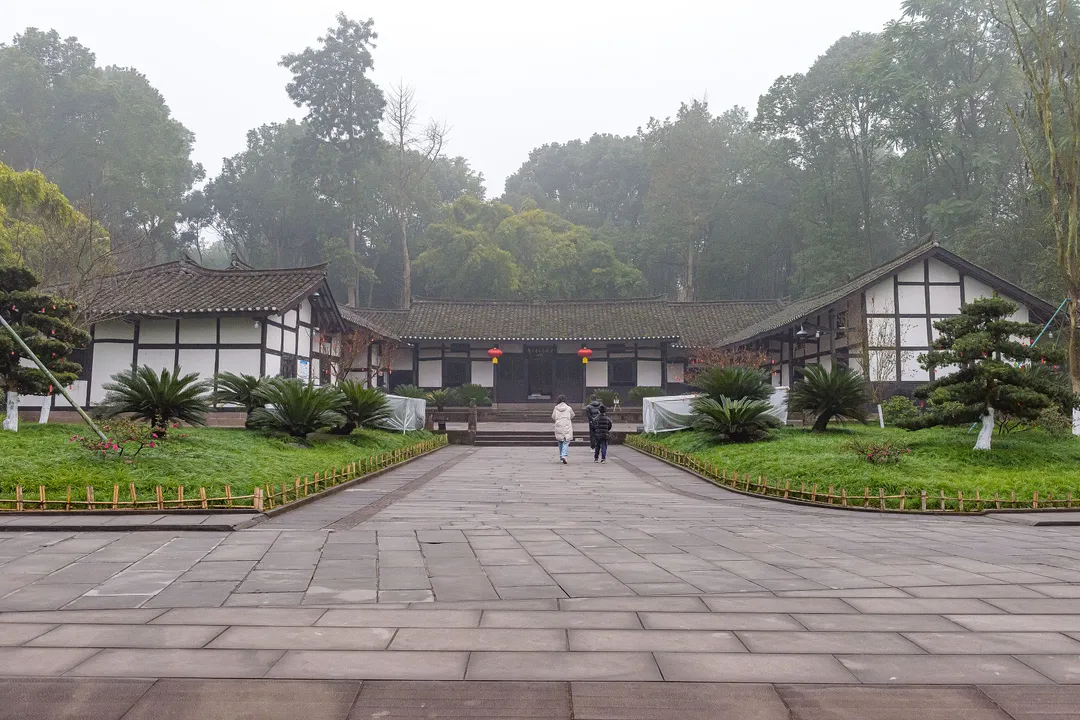
The former residence sits in Paifang village, about 7 km north of downtown, and entry is free with ID — carry your passport, since tickets are issued against it. The main house is a Sichuan courtyard building of white walls, dark timber framing and gray tile roofs, and the estate around it takes a unhurried half day: the collections museum (opened 2004), the Hanlin Courtyard and the old village school, both a short ride from the main house, and Foshou Hill, a wooded hill on the estate fringe.
Practical rhythm: go in the morning, before coach groups, and keep the evening for Siyuan Square downtown. There is no entrance fee anywhere in the estate, so the day's only real cost is transport — a taxi or ride-hail from the city covers the 7 km in about 20 minutes.
Siyuan Square and the riverside
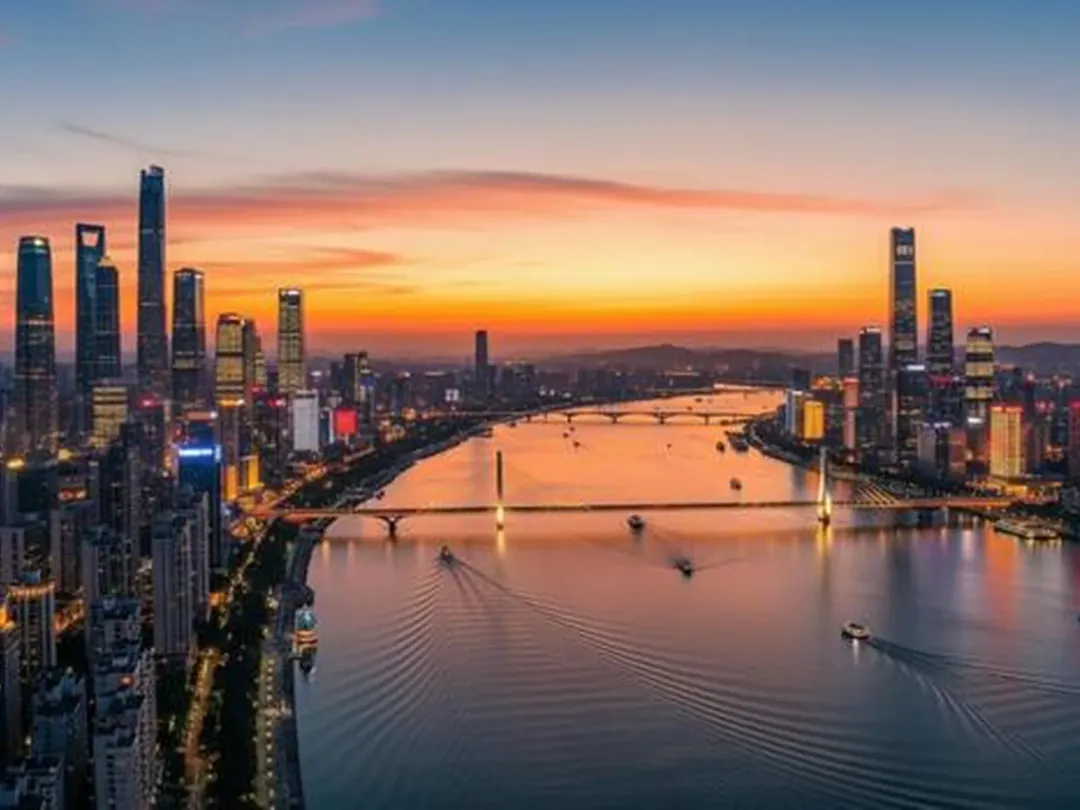
Siyuan Square is the city's riverside living room: a broad square on the water with a bronze ding cast in 2004 and a fountain show in the evening. It costs nothing, runs at all hours, and needs 1-2 hours including a walk along the river embankments. It pairs naturally with dinner — the market breakfast crowd has its own haunts, but the evening square is where the city eats out.
Huaying Mountain and the stone forest
Huaying is a county-level city under Guang'an, about 40 km east — under 1.5 hours by road. The mountain above it is the prefecture's headline landscape: a karst stone forest above 1,000 m and a main peak of 1,704 m, with a cable car that saves the steepest climb and boardwalks across the top.
Budget a full day. The practical notes: take the cable car up and walk the boardwalks; the air stays cool even in July, so bring a layer in any season; and the road climb means morning departure — arriving at noon cuts the summit short. A realistic all-in day (transport, cable car, lunch) fits inside the attractions line of the cost table below.
Tianyi Valley: the Linshui canyon day
Tianyi Valley sits in Linshui County, on the far side of Huaying Mountain — roughly 1.5 hours by road from Guang'an. It is a gorge walk, not a summit: a trail of pools and waterfalls that takes 3-4 hours at an easy pace. The path is wet and slippery for most of its length, so shoes with grip matter more than any other piece of equipment.
Two planning notes. First, the canyon and the mountain can pair in one long day only if you drive; by public transport they are two separate days. Second, Linshui is the far county — keep the return in mind, since the last stretch of road adds time after dark.
Shenlong Mountain stone city
Above the city, Shenlong Mountain carries a rebuilt Ba-people stone fortress — walled enclosures, gate towers and stone lanes assembled in the local gray stone. It is a half-day sight best taken in the morning, and it chains naturally with the city markets for lunch afterward. Entry is modest and the views over the urban plain are the reason locals go up at dusk.
Yankou old town and the Baozhen fortress
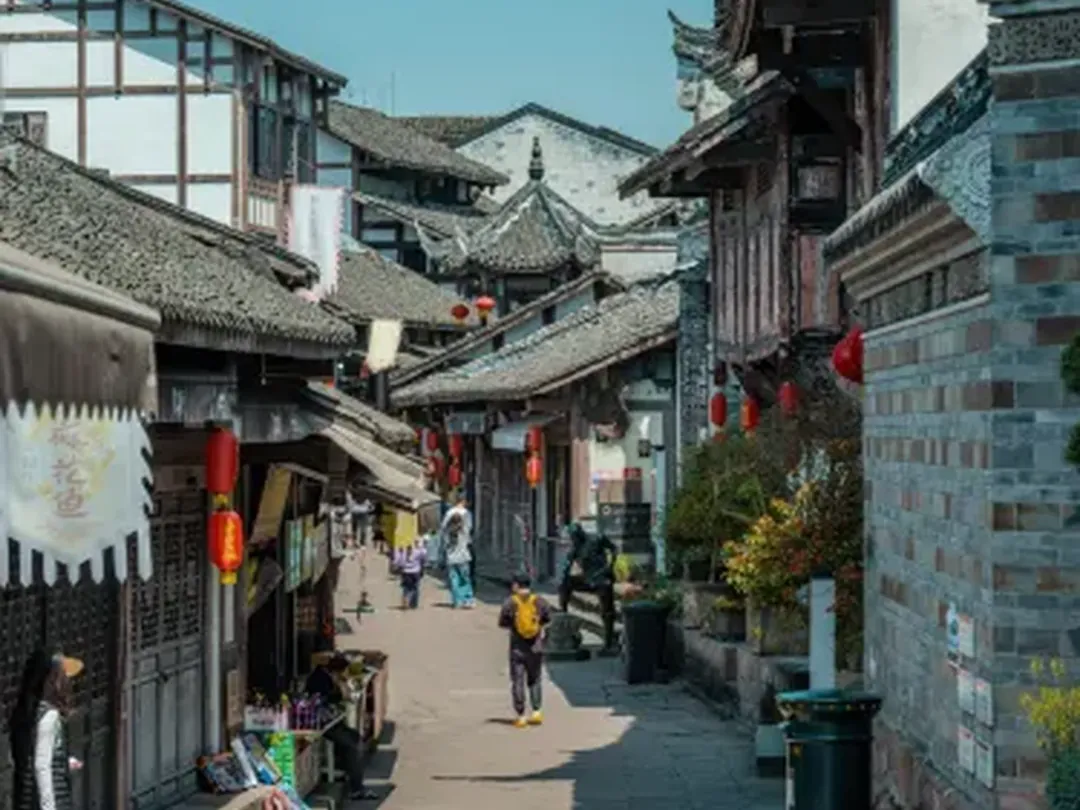
Wusheng County lies about an hour west, and it holds two sights worth one long day. Yankou old town lines the Jialing River with Ming-Qing streets and an old Hui quarter above the water — free to walk, best in the morning light. The Baozhen fortress, begun around 1910 and extended through the 1930s, joins a walled manor to gun towers on a ridge about 40 km from the county town.
The two make a loop: Yankou first, the fortress after lunch, back to Guang'an by evening — or sleep in the Wusheng county town and keep the second day short. By bus the connections take patience; with a car or a hired driver the day fits comfortably.
Xiaoxi old town on the Qujiang
Xiaoxi sits about 70 km north of the city, above the Qujiang River — a market street that has kept its Qing-era layout, reached by car or country bus. It is the quietest of the river towns and the most sensitive to the calendar: the market is the sight, so go on a market morning and plan a river-fish lunch. Half a day, paired with the drive north.
Yuechi and the orchards north of town
Yuechi County is half an hour west and is the reason a bowl of rice noodles in Guang'an comes with a county name attached: Yuechi noodles grew out of village feasts and became the county's calling card. Order a bowl in the county town, then walk the farmland park on the town's edge. In autumn the longan pomelo orchards north of the city open for tasting — the season runs roughly October into November, and it pairs with the salted-egg stalls in the same markets.
A two- to four-day plan
Work it in this order and swap only if rain moves in:
- Day 1 — estate and square. Paifang village in the morning (free with ID), collections museum after lunch, Siyuan Square and the fountain for the evening. All transfers inside 20 minutes.
- Day 2 — Huaying Mountain. Cable car up, boardwalks across the stone forest, the 1,704 m peak if the weather holds. Leave by 08:00; back in the city for dinner.
- Day 3 — the canyon or the river towns. Tianyi Valley (3-4 hours on the trail, grip shoes) or Wusheng (Yankou plus the Baozhen fortress). Pick one, not two — they sit in opposite directions.
- Day 4 — markets and departure, or the Xiaoxi drive. Salted eggs and noodles for breakfast, then the train: about an hour to Chongqing, two to Chengdu.
With a fifth day, add Yuechi or the orchards; with a full week, a rail day into Chongqing — an honest neighbor day, since Chongqing is a separate municipality — or north to Langzhong, which belongs to Nanchong, about two rail stops away.
Food: salted eggs, rice noodles and mountain ferns
The local table runs on three names. Salted preserved eggs (yanpidan) are the city's snack — eggs cured in salt brine, sold in markets and boxed as gifts. Yuechi rice noodles are the breakfast: bowls served in the county itself and all over Guang'an, the dish that came out of village feasts. And from the Huaying slopes come fern shoots (wei cai), a mountain vegetable that turns up stir-fried or cold-dressed in the cooler months.
Practical mechanics: breakfast at the markets, where the noodle stalls and egg sellers cluster; mobile payment (Alipay / WeChat Pay) works at virtually every stall, with small cash for the exceptions; and the queue rule holds — where locals line up, the noodles are right.
Getting there and around
Guang'an has no airport of its own; the practical entries are Chongqing or Chengdu by air, then rail. Guang'an South station handles the main lines, and the times are short:
| Route from Guang'an South | Time | Use it when |
|---|---|---|
| To Chongqing | about 1 h | arriving from the southwest; an honest "separate municipality" day |
| To Chengdu | about 2 h | coming from the west |
| To Nanchong | about 2 rail stops north | a Langzhong day trip |
Inside the prefecture, taxis and ride-hailing cover the city and the 7 km out to Paifang village in about 20 minutes; the outlying sights — Huaying (40 km), Linshui (1.5 h), Wusheng (1 h), Xiaoxi (70 km) — run by scheduled bus at local prices or by car at clearly better speed. For the canyon and the mountain in one day, hire a car; buses will not stack them.
Where to stay
Two nights, one base: the rooms around Siyuan Square and the riverside put the evening square, the markets and the restaurant streets within a short walk, which is what a day-trip pattern wants. Mid-range business hotels are the default tier here, hostels are few, and the mountain has its own small hotel stock if you would rather wake up above the stone forest. Book two to three weeks ahead for the holiday weeks flagged under When to go; the rest of the year the city sells out late, if at all.
When to go
Ranked. First: April-May — mild air on the mountain, the estate green, canyon trails at their most walkable. Second: September-November, the longer window, with October the single best month and the pomelo season running into it. Third: March and late November — thin crowds, workable weather, cooler trails. July-August is the honest trade: the city is hot, the mountain stays cool above 1,000 m, and the canyon is at its wettest. Skip the first weeks of February, May and October outright — national holiday travel doubles prices and queues everywhere in China, and the small-city infrastructure feels it first.
Cost breakdown
| Per person, per day, 2026 | Backpacker | Mid-range | Comfort |
|---|---|---|---|
| Accommodation | 80-150 CNY | 300-600 CNY | 600+ CNY |
| Food | 40-80 CNY | 100-200 CNY | 250+ CNY |
| Local transport | 15-30 CNY | 30-60 CNY | 100+ CNY |
| Attractions | 0-50 CNY | 50-150 CNY | 150-300 CNY |
| Daily total | about 150-350 CNY | about 500-1000 CNY | 1000+ CNY |
The mid-range column follows our roster benchmark for Guang'an: accommodation 300-600 CNY, food 100-200 CNY, local transport 30-60 CNY, attractions 50-150 CNY. Two line items bend the budget: holiday-week rooms and hired-car days for the canyon loop — the sights themselves are mostly free or modest, and the residence estate costs nothing.
Practical tips
- Payments and papers. Alipay with an international card works across markets, taxis and ticket gates; carry your passport — the residence estate issues free tickets against ID. ATMs of ICBC and Bank of China are widespread.
- Connectivity. A tourist eSIM (5-30 USD) set up before landing beats airport queues; English signage thins out fast outside hotels and the main ticket offices.
- Shoes and layers. Two terrain rules: grip-soled shoes for the Tianyi Valley trail (wet for most of its length), and a layer for Huaying Mountain — cool above 1,000 m even in July, with the 1,704 m peak windier than the forest below.
- Holiday math. The first weeks of February, May and October are the national crush: rooms reprice, buses fill, and the estate's free tickets queue. Shift the trip by a week if the calendar allows.
- Map apps. Amap (Gaode) or Baidu Maps for walking and bus routing; download the offline pack for Linshui, where valley signal drops.
Frequently asked questions
How many days does Guang'an need?
Two full days cover the essentials: the residence estate with Siyuan Square, then Huaying Mountain. The third day is the real choice — Tianyi Valley or the Wusheng river towns — and a fourth absorbs Yuechi, Xiaoxi or a rail day into Chongqing. Beyond four days, most travelers move the base rather than extend it.
Is Guang'an in Sichuan or Chongqing?
In Sichuan. The confusion is understandable — Chongqing's border is close, and the rail ride from Guang'an South to Chongqing takes about an hour — but Guang'an is a prefecture-level city of Sichuan province, and Chongqing is a separate municipality. Tickets, buses and area codes all follow the Sichuan side.
What does the residence area cost?
Nothing in tickets: entry to the estate in Paifang village is free with ID, the collections museum included. The day's only costs are the 7 km transfer from the city and whatever the market lunch runs.
Can I visit Huaying Mountain without a long hike?
Yes — the cable car takes out the steepest climb, and the stone forest sits on boardwalks across the top, so the summit day works for mixed-age groups. What remains is walking on stone at 1,000-1,704 m: bring the layer, and keep the pace honest on the steeper boardwalk sections.
What should I eat first?
Yuechi rice noodles for breakfast, salted preserved eggs from the market for the road, and — in the cool months — fern shoots off the Huaying slopes. All three are ordinary, daily foods here, which is the point: the city's table is its markets, not its banquet halls.
Useful phrases
| Chinese | Pinyin | Meaning |
|---|---|---|
| 广安 | Guǎng'ān | Guang'an, the city |
| 华蓥山 | Huàyíng Shān | Huaying Mountain |
| 盐皮蛋 | yán pídàn | salted preserved eggs, the local snack |
| 岳池米粉 | Yuèchí mǐfěn | Yuechi rice noodles |
| 多少钱 | duōshǎo qián | how much |
| 谢谢 | xièxie | thank you |
Emergency contacts
- Police: 110
- Ambulance: 120
- Fire: 119
- Tourist hotline: 12301
Sources and verification
Figures were checked in October 2026 against our Guang'an trip-days data (the 3-, 5-, 7- and 14-day plans) and the city roster: the estate at 7 km north with free ID entry and the collections museum's 2004 opening; Huaying Mountain at 40 km east with the stone forest above 1,000 m and the 1,704 m main peak; Tianyi Valley in Linshui at 1.5 hours with a 3-4 hour trail; Wusheng an hour west with Yankou's Ming-Qing streets and the Baozhen fortress begun around 1910 and extended in the 1930s; Xiaoxi at 70 km; Yuechi half an hour west; rail times of about 1 hour to Chongqing and 2 hours to Chengdu; and the cost table's mid-range column, which follows the roster benchmark of 500-1000 CNY per day.
Known soft spots: published opening hours for the estate, the mountain and the canyon are not consolidated in any single source, so treat on-the-ground postings as authoritative; bus frequencies to Linshui and Xiaoxi change with the season; and the fern-shoot (wei cai) seasonality rests on local menus rather than a dated source. Guang'an sits in Sichuan province; Chongqing is a separate municipality. Reconfirm prices and hours within a fortnight of travel. Last verified 2026-10-12.