Chongqing Travel Guide
Summary
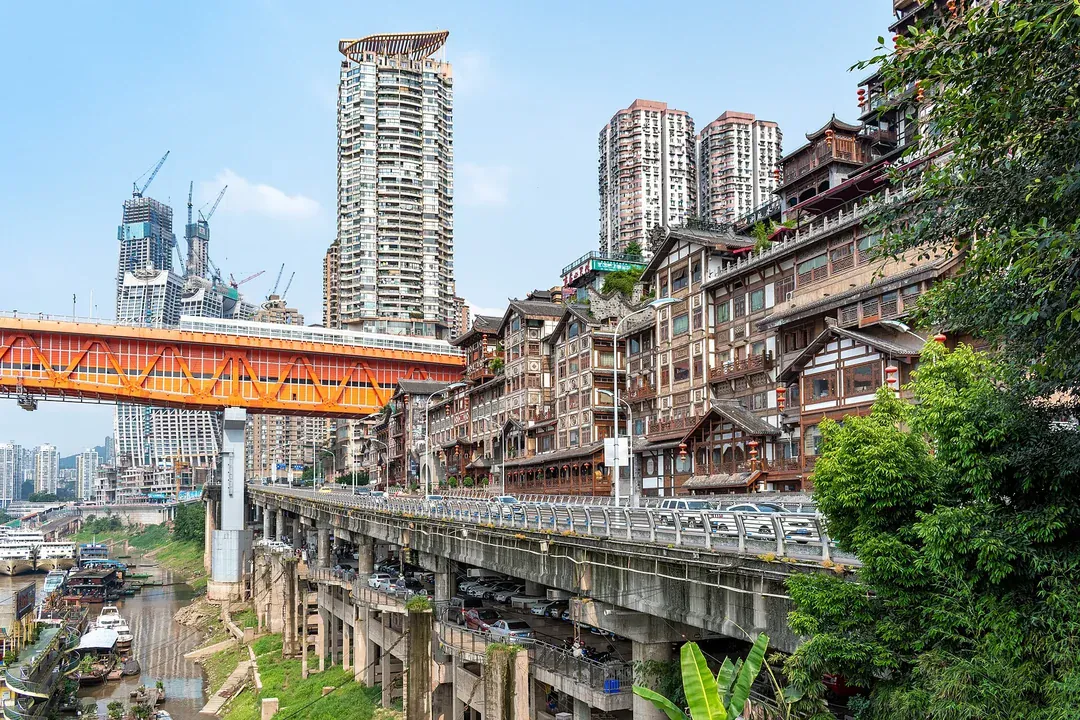
Chongqing (重庆) is the largest of China's four directly-administered municipalities and the most vertically dramatic big city in the country. The urban core is stacked along steep ridges at the junction of the Yangtze and Jialing rivers, which produces the disorientation visitors remember longest: the road you are standing on is frequently the roof of a building whose entrance sits one or two streets below. Locals call it the Mountain City (山城); the internet calls it the "8D city". Both names are accurate, and both explain most of what makes planning here different from planning for Beijing or Shanghai.
We wrote this guide for travelers who have already decided to come and now face the practical questions: whether two days is enough (yes, though three is comfortable), where to base yourself (Jiefangbei for a first visit, Nanbin Road for the river panorama), what a hotpot dinner actually costs (60-120 CNY per person at a solid neighborhood pot), and how to reach the two big detours — the Dazu Rock Carvings and the Wulong karst country — without burning a full day on transport alone. Prices and schedules below reflect conditions as of September 2026; where a figure swings by season, we give the range rather than a single number.
This is not a tourist brochure. Where a sight underdelivers at the wrong hour — Hongya Cave in flat daylight, Ciqikou after ten on a Saturday morning — we say so and suggest what to do instead. Our bias is toward decisions you can act on: exact metro lines, realistic budgets, timing windows that avoid the worst crowds.
Why Chongqing
Chongqing became a directly-administered municipality in 1997, carved out of Sichuan province to anchor development along the upper Yangtze. The municipality holds over 30 million people across an area the size of Austria, but almost everything a visitor wants sits inside the Yuzhong peninsula and the districts immediately across the two rivers. That core is where the city's personality lives: apartment towers rising straight out of cliff faces, elevated expressways threading between residential blocks, and a metro system that occasionally passes through them.
The geography is the attraction. Because the peninsula is too steep for a conventional street grid, the city built upward and sideways simultaneously — a bank lobby can sit on the 1st floor from one direction and the 10th from another. The Liziba train-through-building photo, the cable car crossing the Yangtze, and the stacked night view of Hongya Cave all come from the same condition. You do not need to hunt for viewpoints in Chongqing; the city is a viewpoint.
There is weight behind the scenery. From 1937 to 1946 Chongqing served as China's wartime capital, absorbing years of air raids and emerging as the supply and command base for the country's west. Traces survive in the Stilwell Museum near Eling, in the former prison sites on Gele Mountain, and in the stubborn, loud character of the local food culture, which grew out of dock workers and migrants feeding themselves cheaply and intensely.
The city has also become a visual shorthand. Chinese cinema has used its overpasses, tunnels and stacked housing for two decades — the caper film Crazy Stone, shot here in 2006, did much to fix the image — and in the short-video era Chongqing's night skyline is among the most filmed in the country. The practical consequence for a visitor is simple: crowds cluster around a dozen photogenic nodes at photogenic hours, and ten minutes' walk in any direction puts you back in an ordinary, unbothered city.
Finally, logistics favor the city. Chongqing is the departure port for Three Gorges cruises down the Yangtze, a high-speed rail node between Chengdu (as fast as roughly 1.5 hours) and the southwest, and a food destination that most domestic travelers rank above nearly every other Chinese city. If your trip to China has room for exactly one non-first-tier city, the practical case for this one is strong.
Top Attractions
The six sights below cover the essential city. With the exception of Dazu, all of them sit inside the central peninsula or one river crossing away, and four of the six are free. We list them roughly in the order a first-time visitor should tackle them, with timing notes that matter more here than in flatter cities.
Hongya Cave (洪崖洞)
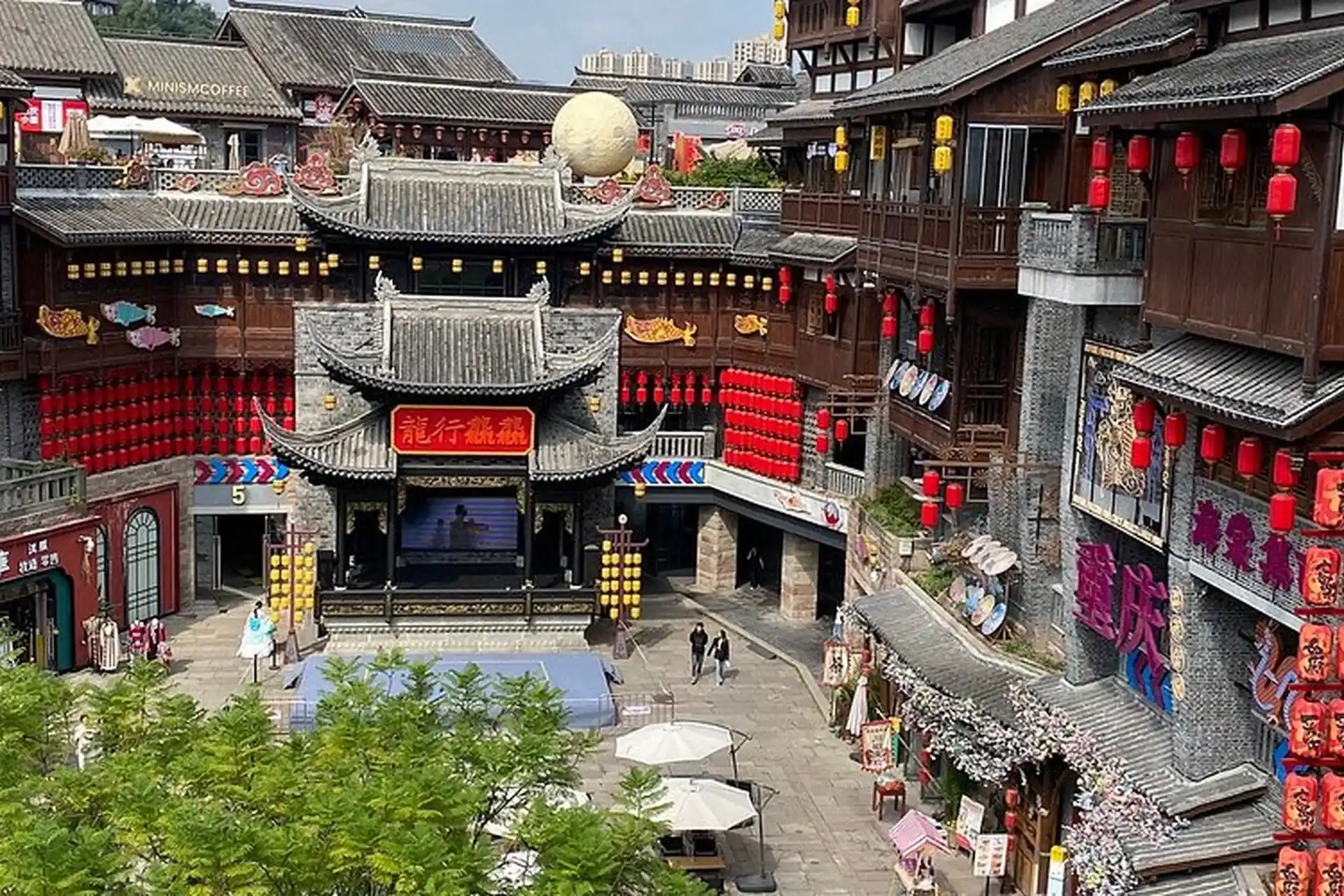
An 11-storey complex of stilted wooden buildings clinging to a cliff above the Jialing River, rebuilt in its current form and opened in 2006 as a homage to traditional diaojiaolou river architecture. Entry is free, though during peak periods (Golden Weeks, summer evenings) the management sometimes activates a timed-entry reservation through its WeChat account — worth checking before you go.
Here is the critical point: Hongya Cave is a night attraction. In daylight it reads as a commercial complex of snack stalls and souvenir shops stacked on scaffolding. From roughly dusk until the lights cut out — typically around 22:00, sometimes 23:00 on weekends and holidays — it becomes the single most photographed scene in western China. The correct strategy is to arrive at 17:30-18:00, walk through the interior levels while they are still navigable, then cross to the Qiansimen Bridge pedestrian deck for the exterior view. The bridge, not the cave itself, is where the postcard photo is taken. Expect serious crowds after 19:00 on any Friday or weekend.
The building also delivers the city's best demonstration of its own geometry. Enter on the 1st floor at river level, ride up inside, and the 11th floor opens onto an ordinary city street — the upper town was there all along, a full commercial district above your head. Levels 4 and 5 hold the better teahouses and small bars; a seat on a river-side terrace inside the complex gives you the Jialing view without the bridge crush. Allow 60-90 minutes including the walk-through.
Jiefangbei (解放碑)
The People's Liberation Monument, a 27-metre clock tower at the heart of the peninsula's pedestrian shopping district. The structure was first raised in 1940 as a wooden "spirit fortress" rallying resistance during the war, rebuilt in stone in 1947, and given its current name in 1950. Today it is less a monument you visit than a landmark you orbit: the surrounding blocks form the densest concentration of malls, hotels, and food streets in the city.
There is no ticket and no gate; the value is in the surroundings. Two blocks east runs Bayi Road Good Food Street (八一好吃街), the most convenient single place to sample xiaomian, suanlafen (hot and sour sweetpotato noodles) and grilled skewers in one pass. We suggest passing through Jiefangbei in the late afternoon, eating along Bayi Road, then walking 15 minutes down to Hongya Cave for dusk. That sequence is the standard first evening in Chongqing and it works.
Yangtze River Cableway (长江索道)
A commuter cable car that has carried passengers across the Yangtze since 1987, running just over 1,100 metres from Xinhu Road on the peninsula to Shangxin Street on the south bank. It was built as working transit and became a tourist fixture because the ride delivers what observation decks charge for: a mid-river view of the stacked city on both banks. The fare runs about 20 CNY one-way and 30 CNY round trip — inside the range most guides quote, and cash-free: scan an Alipay or WeChat QR at the gate.
Queues are the real cost. On clear evenings the line at the north (Xinhu Road) station can exceed an hour. Ride at opening (around 7:30) or mid-afternoon, or book a slot through the official WeChat mini-program. If you only care about the view and not the ride, the free observation terraces along Nanbin Road give you the same skyline from the opposite bank. Our preference: take the cableway south in late afternoon, have dinner on Nanbin Road, and return by metro Line 6 or taxi after dark.
Ciqikou Ancient Town (磁器口)
A Ming-and-Qing river port town on the Jialing, named for the porcelain trade that once moved through its docks, now a dense lattice of flagstone lanes, teahouses, and snack vendors about 25 minutes by metro Line 1 from Jiefangbei. Entry is free. The main street is genuinely crowded — on weekends it is a slow human current — but the town rewards early arrival and a willingness to turn off the spine: the lanes running uphill behind the main drag hold hand-peeled noodle shops, woodblock printers, and temple courtyards that see a fraction of the foot traffic.
Two local specialties anchor a visit. Chen Mahua (陈麻花), twisted fried dough sold from competing storefronts whose queues are the town's running joke, costs roughly 10-20 CNY a bag and travels well as a gift. Bowls of suanlafen run 8-12 CNY. Arrive before 9:30, budget two to three hours, and be out before the tour buses land around 11:00.
For the quieter half of the town, use the temple as your compass: Baolun Temple, the Ming-era complex at the top of the hill, still holds a hall of iron Buddhas and a courtyard of old steles, and the lanes behind it drop toward the river through workshops rather than gift shops. A teahouse hour here — bamboo chairs, covered cups of jasmine tea, a 10-20 CNY seat fee — is the most efficient culture-per-yuan purchase in the city.
Liziba Monorail Viewing Deck (李子坝)
The image most people have of Chongqing — a train gliding through the middle of a residential tower — happens at Liziba on Metro Line 2, where the monorail track passes through the 6th to 8th floors of a 19-storey apartment block. The building predates the line, which opened in 2005 as the city's first rail transit; engineers threaded the station through the structure with rubber padding to dampen vibration, which is why residents upstairs live with it.
The viewing platform directly beneath the pass-through is free and built for exactly this photo. Trains run every few minutes in both directions; you will get your shot within ten minutes of arriving. The deck faces west, so morning light hits the building cleanly. Go before 9:00 or you will share the platform with every tour group doing a one-sight stop. Pair it with Eling Park and the Testbed 2 creative district two monorail stops away — that cluster makes a coherent half-day in the peninsula's high ground.
Dazu Rock Carvings (大足石刻)
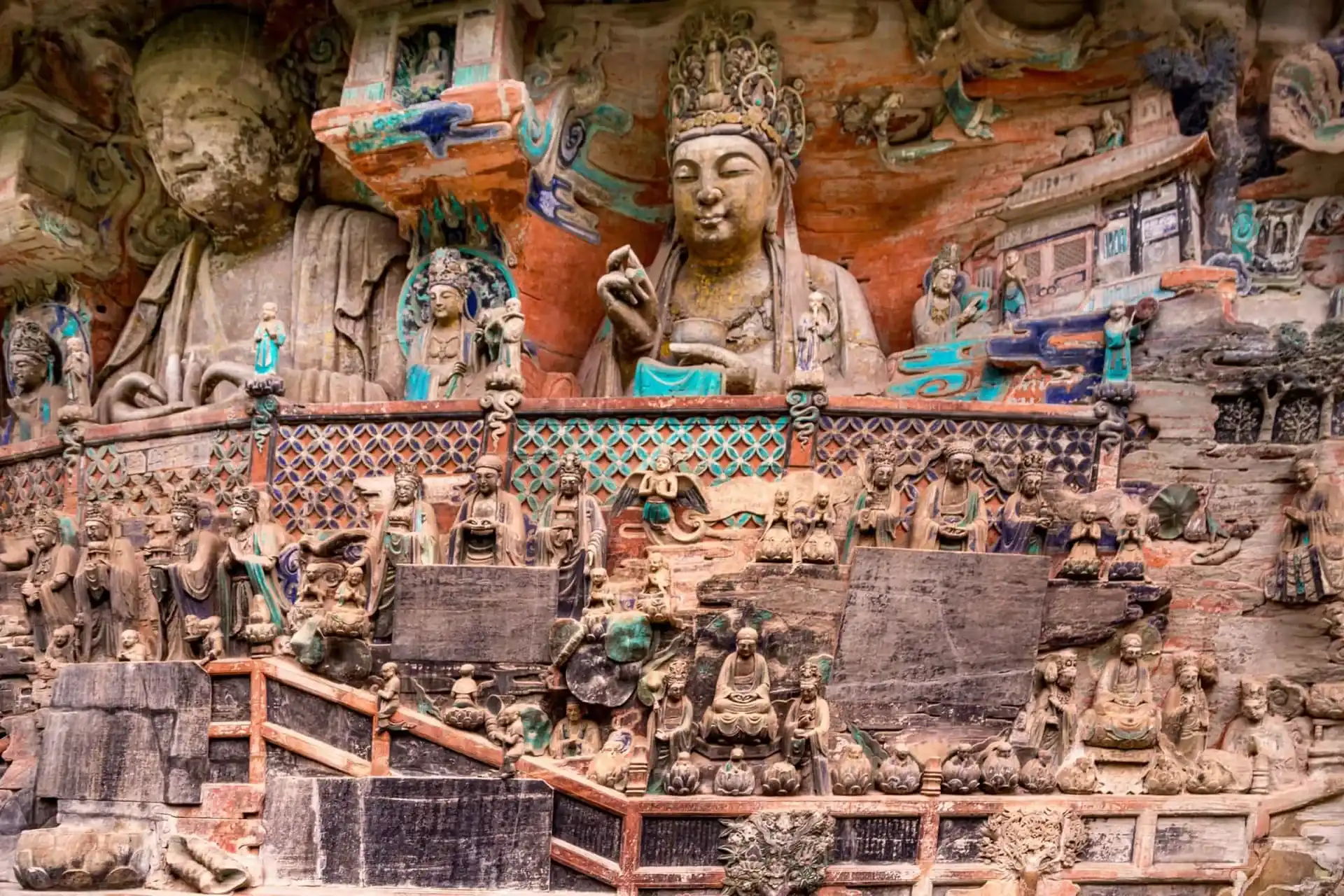
The one essential sight outside the city proper, and worth a full day. The cliff sculptures of Baodingshan, carved between 1174 and 1252 under the monk Zhao Zhifeng, form a 500-metre sandstone gallery of Buddhist teaching scenes — including a 31-metre reclining Sakyamuni and the gold-leafed Thousand-Hand Guanyin, restored over most of a decade and re-unveiled in 2015. The site joined the UNESCO World Heritage list in 1999 and is the strongest single argument for adding a third day to a Chongqing trip.
Logistics: the carvings sit 80-100 km west of the city. A private driver costs roughly 600-900 CNY for the round trip; the alternative is high-speed rail from Chongqing West or Shapingba to Dazu South (about 40-50 minutes) plus a 20-30 minute taxi. Admission runs roughly 70-115 CNY for Baodingshan depending on season, with combined Baodingshan-plus-Beishan tickets around 115-140 CNY — confirm current pricing when booking, as the sites adjusted schedules after recent restoration work. Go on a weekday, carry water, and walk the cliff path slowly; the carving detail rewards an hour of actual looking, not a drive-by.
Where to Stay
Three neighborhoods cover almost every traveler, and the choice matters more here than in most cities because the terrain punishes wrong bases — a "nearby" hotel can sit a 40-minute detour around a cliff away.
Jiefangbei / Yuzhong peninsula is the correct base for a first visit. You can walk to Hongya Cave, Bayi Road, the cableway's north station, and the riverside promenades, and Lines 1, 2 and 6 pass through or near the district. Mid-range hotels run 300-600 CNY per night; international five-star properties cluster between 800 and 1,500. Hostel beds in the surrounding lanes run 60-120 CNY. The tradeoff is noise and weekend crowds on the ground floor of the city.
Nanbin Road (south bank) trades walkability for the view. Hotels along the riverfront face the peninsula skyline across the Yangtze — the same panorama the cruise boats sell — and rooms with a river view run 400-900 CNY depending on floor and season. The strip is quieter at street level, lined with restaurants and bars, and connected by Line 6 plus short taxi hops. Best for couples, photographers, and anyone whose priority is waking up to the skyline rather than standing under it.
Guanyinqiao (Jiangbei district) is the value pick and the local-life option. A major commercial district 15-20 minutes from Jiefangbei by Line 3, with business hotels from 250-500 CNY, less tourist pricing, and Jiujie — the city's main late-night bar and club zone — on its doorstep. Pick it if you want nightlife within walking distance or your budget favors accommodation over address.
One practical warning: check which exit your hotel sits near before booking, because a station's exits in this city can be separated by 60 metres of elevation. A hotel "50 metres from Exit B" may be three escalator flights and a skybridge from where you surface.
Timing matters as much as district. In ordinary weeks, rooms are bookable a few days ahead at list price; during Golden Weeks, the spring and autumn conference peaks, and any hotpot-festival weekend, the good mid-range stock in Jiefangbei sells out three to four weeks ahead, and river-view rooms in Nanbin Road go first. Serviced apartments (operated by the big Chinese apartment chains) are a viable family option in Guanyinqiao and around Jiefangbei at 350-600 CNY per night with a washer, which matters if hotpot is a twice-daily habit.
Gastronomy
Chongqing eating is the reason many domestic travelers come at all. The register is hot, numbing, and fast, built on beef-tallow chili base and green Sichuan peppercorn, and priced for volume. Three categories structure a food-focused trip.
Hotpot (火锅) is the civic religion. The canonical format is the nine-grid pot (九宫格): a single boiling vat divided into nine zones at different temperatures, so tripe blanches in the fierce center while potatoes stew at the edges. Order the sesame-oil dish (油碟) with minced garlic as your coolant — it is not optional equipment. Standard order of operations: maodu (tripe, 15-20 seconds), duck intestine (10-15 seconds), then lotus root, potato, tofu skin and mushrooms to finish. A serious neighborhood laohuoguo (old-style hotpot restaurant) runs 60-120 CNY per person including beer; the famous chains — Peijie, Zhou Shixiong and their imitators — run similar money with longer queues. Tourist-facing restaurants offer yuanyang (split mild and hot) pots; locals will not judge, but the mild half is a different and duller dish.
Xiaomian (小面) is the breakfast backbone: dry wheat noodles tossed with chili oil, peppercorn, preserved vegetable and sesame paste, made to order in storefronts that seat eight. A bowl costs 8-15 CNY depending on toppings (a fried egg or braised beef adds a few yuan). There is no canon — every block defends its own counter — so the working method is to join the longest morning queue within sight of your hotel. Customization matters: say "wei la" (微辣, mildly hot) if you want to survive until dinner.
Jianghu cuisine (江湖菜) is the third pillar: big-plated, aggressive folk cooking that grew out of dockside restaurants. The dishes to know are laziji (mountains of fried chicken buried in dried chilis, 50-80 CNY and meant for sharing), Wanzhou-style grilled fish finished in a tray of chili broth (70-110 CNY per fish), and maocai — individual hotpot-in-a-bowl skewer stew at 25-40 CNY. Between meals, Ciqikou's suanlafen (8-12 CNY) and Bayi Road's skewers cover snacking.
Budgeting is simple: 100-200 CNY per day eats very well at local prices, and the ceiling is self-imposed. Two rules we follow everywhere in the city: eat where the queue is local, and treat any restaurant with a hostess on the street as a tourist tax.
Two supporting notes. Breakfast is not only noodles: steamed buns, soy milk and guokuai (锅盔) — flatbread stuffed with minced pork, folded and pressed in a barrel oven — cover the same streets at 5-10 CNY, and a morning walk through any residential market answers breakfast better than any list. And dessert in this climate is an engineering problem the city solved with bingfen (冰粉), cold ice jelly under brown-sugar syrup and crushed peanuts, sold for 8-12 CNY from street carts and always ordered alongside hotpot; it is the correct way to end a meal that fought back.
Practical Information
Visa
China's unilateral visa-free entry policy now covers several dozen countries — most of the EU plus the UK, Australia, New Zealand, Japan and others — for stays up to 30 days, and Chongqing Jiangbei Airport is a designated port of entry. Separately, 240-hour (10-day) visa-free transit is available to travelers from a longer list of countries connecting through China onward to a third country. Both frameworks change; verify your country's current status on the Chinese embassy or consular site before booking. Standard L tourist visas, where required, typically process in 4-7 business days.
Currency and Payments
The currency is the renminbi yuan (CNY), trading around 7.0-7.3 to the US dollar. Alipay and WeChat Pay both bind international cards and work almost everywhere in Chongqing, including metro gates, cableway turnstiles and street noodle counters — set one up before arrival. Keep 200-300 CNY in cash as backup for rural day trips and small vendors. ATMs at ICBC and Bank of China branches take foreign cards; machines inside malls are less reliable than branch-lobby machines.
Getting Around
The metro (CRT) is the spine: fares run 2-10 CNY by distance, stations have bilingual signage, and Alipay's ride code works directly at the gate. Learn three lines. Line 2 is the tourist line — an older straddle monorail with window views from elevated track, passing through Liziba. Line 6 crosses between the peninsula, the south bank (Nanbin Road) and Jiangbei. Line 3 runs north to Jiangbei Airport (roughly 45-60 minutes from the core) and is one of the longest monorail lines in the world; Line 10 is the faster airport alternative from the north.
Taxis start around 10 CNY and are plentiful; Didi (via the Alipay app) works with international cards and is the sane option for cross-river trips at night. The two-rivers night cruise (两江游) departs from Chaotianmen docks, costs roughly 100-300 CNY depending on deck class, and lasts about an hour. Walking is the best and worst transport in the city: distances are short, but "short" is horizontal — assume stairs.
Arriving from elsewhere in China, you will land at one of three rail stations: Chongqing North (high-speed services to Wulong, Wanzhou and points east), Chongqing West (longer-distance high-speed lines including the Dazu direction), and Shapingba (central, on Line 1, handiest for the peninsula). Trains from Chengdu arrive in as little as 1-1.5 hours. Metro operating hours run roughly 6:30 to 23:00 depending on the line — late arrivals after 23:00 should budget for Didi from any station. At the airport, follow signs for Line 3 or Line 10; the airport station is inside walking distance of both terminals via corridor.
Best Time to Visit
Spring (April-May) and autumn (September-November) are the right answers. Summer is the trap: Chongqing is one of China's canonical "furnace cities," with July-August temperatures regularly at 35-40°C and nights that cool by only a few degrees; locals leave for Guizhou if they can. Winter is damp, foggy — the old "Fog Capital" reputation comes from this season — and gray, though hotel prices drop sharply. Avoid the three Golden Week windows (Chinese New Year in late January or February, May 1-5, October 1-7) unless night-long hotpot is the entire point of your trip; during those weeks Hongya Cave and the cableway operate at crush capacity.
Cultural Considerations
Spice is negotiable, and being honest helps. Asking for wei la (mild) or bu la (no heat) is normal; pretending you can handle zhong la (medium) when you cannot ends your evening early. Locals respect a straight answer over a brave one.
Queueing is a contact sport. At the cableway, famous noodle counters, and Ciqikou's mahua shops, lines are tight and fast-moving. Take a place, hold it, and expect people to arrive "joining friends" ahead of them. Aggressive-but-orderly is the local register.
Smoking indoors is still common, especially in older restaurants and hotpot joints. Nonsmoking sections are rare outside malls; vote with your feet rather than with confrontation.
Tipping is not practiced and can create awkwardness. Service is included everywhere from taxis to hotel breakfasts.
The war is local history. From 1938 to 1943 Chongqing was bombed relentlessly as wartime capital; sites like Gele Mountain's former prisons and the bomb-shelter museums are solemn national memory for the people around you. Visit respectfully, photograph modestly, and treat the era as history rather than politics — contemporary political commentary is unwelcome everywhere in China and best left entirely off the table.
Language reality: Mandarin is universal, but the local dialect (Chongqing hua) is loud, fast and initially impenetrable even to other Chinese speakers. Numbers, destination names and a smile cover most transactions. Have hotel addresses saved in Chinese characters for taxi drivers; English signage exists on the metro but thins out fast at street level.
Two-Day Itinerary
Day 1 — The peninsula and the night view. Start at 8:00 with xiaomian near your hotel. Take Line 2 to Liziba for the train-through-building shot before the tour groups land (trains run every few minutes; you need 30 minutes). Continue two stops to Eling: climb Eling Park for the two-rivers view, then wander Testbed 2 (鹅岭二厂), a former printing works turned design shops and cafés. Lunch in the lanes around Shangqing Temple or head back toward the core. Mid-afternoon, metro Line 1 to Ciqikou for the ancient town at its most tolerable — or skip it if arriving off-peak season. By 17:00 be at Jiefangbei, eat your way down Bayi Road, then walk to Hongya Cave at dusk. Cross Qiansimen Bridge for the exterior view, and if energy remains, finish with the two-rivers cruise from Chaotianmen (book the 20:00-21:00 sailing).
Day 2 — River crossings and the south bank. Morning at the Yangtze River Cableway: ride the first departures south from Xinhu Road. Walk or taxi up Shangxin Street through old south-bank lanes, then descend to Nanbin Road for a river-view lunch. Afternoon options fork here: culture-first travelers should take a taxi to the Gele Mountain sites or the Three Gorges Museum across the river in Yubei; shoppers should loop back through Guanyinqiao. In the evening return to Nanbin Road's west end for the skyline at full illumination, dinner at a riverside jianghu restaurant, and either an early night or Jiujie's bar strip depending on temperament.
Day 3 (optional) — pick one detour. Dazu Rock Carvings for the heritage answer, Wulong for the landscape answer. Both are full days; neither compresses well into an afternoon. If you cannot spare the day, substitute the Wulong-scale experience with Eling at sunset and hotpot on a high floor — verticality is the same, price is lower.
Beyond the Highlights
After the checklist sights, four slower experiences show the city at resident pace.
Shancheng Alley (山城巷) is a restored stepped lane climbing the peninsula's west cliff above the Yangtze. Stone stairs, Republican-era house fronts, small teahouses and rooftops facing the river — it is what Ciqikou was before commercialization, managed by the city rather than by snack brands. Go in the morning; the walk takes 60-90 minutes and connects down to the Tongyuanmen old city gate, one of the few surviving fragments of the Ming wall.
Eling Park and Testbed 2 reward a second, unhurried visit. The park's Liangjiang Pavilion terrace is the classical two-rivers panorama — both the Yangtze and Jialing visible in one frame — and costs nothing. Testbed 2 below it, the printing-factory creative park, holds bookshops, studios and the best coffee in the district; on weekday afternoons it is one of the few calm spaces in the core city.
Huangjueping Graffiti Street (黄桷坪涂鸦一条街), beside the Sichuan Fine Arts Institute's old campus east of the peninsula, covers roughly a kilometre of residential buildings in student-painted murals — an open-air gallery that is equal parts art school and lived-in neighborhood. There is no ticket, no fence and few tourists. Combine it with the institute's art museum when open, and eat at the student-priced restaurants around the campus gates.
The wartime layer sits mostly on Gele Mountain in Shapingba: the Bai Mansion and Zhazidong former prison sites and their accompanying museums document the 1940s history of the location with blunt exhibits. It is heavy material, presented from the Chinese state perspective, but it explains a piece of why this city regards itself the way it does. Reachable via Line 1 plus a short taxi; allow half a day with transport.
Finally, the city has formalized its stairways into the numbered "Shancheng trails" (山城步道) system — marked heritage walking routes that stitch together lanes, lookouts and old residential steps above the two rivers. The Third Trail is the best known and overlaps with Shancheng Alley's lower reaches. They cost nothing, they are signposted in English as well as Chinese, and they are the honest way to understand the vertical city: not from a viewing deck, but from its stairs.
Nightlife
Chongqing's after-dark economy runs on two stages, both built around the view that daytime gives away for free.
Nanbin Road is the front row: a kilometers-long riverfront strip of bars and restaurants directly facing the illuminated peninsula. Beer runs 30-60 CNY, cocktails 60-100, and many venues put tables outdoors in warm months. This is where you drink when the goal is the skyline doing its work behind your conversation. Arrive by 20:30 to get a rail-side table on weekends.
Jiujie (九街) in Guanyinqiao is the loud answer: a compact district of clubs, livehouses and late kitchens that fills after 22:00 and runs past 3:00 on weekends. Cover charges are uncommon; drinks pricing is standard big-city. Nuts Live House, a long-running independent venue, books touring Chinese rock and indie acts and is the best single ticket in the city for a music-minded traveler.
Between those poles sit the rooftops: hotel bars in the upper floors of the towers around Jiefangbei and the Raffles City complex at Chaotianmen, where a cocktail buys you the aerial version of the same panorama. Prices are the expected 80-150 CNY. Craft beer has a foothold — small breweries and taprooms cluster around Jiefangbei's side streets and Eling, with pints at 40-60 CNY — and karaoke (KTV) rooms, booked by the hour with drinks delivered, remain the default group celebration if you are traveling with Chinese friends or colleagues. One recurring local pattern worth adopting: hotpot as the first act (ending 21:00-22:00), riverside drinks as the second, and the lit skyline as the stage throughout — the city is at its best between 20:00 and midnight, and early sleep is a waste of the show.
Day Trips
Dazu Rock Carvings — the heritage day
Covered in the attractions section above; as a day trip, the mechanics are: depart 8:00-8:30, arrive Baodingshan by 10:30 with a driver (600-900 CNY round trip) or via high-speed rail to Dazu South plus taxi, spend 2-3 hours on the cliff path, lunch in Dazu town, and return to the city by 17:00-18:00. If you have energy left on return, this is the evening to book the two-rivers cruise — you will already be moving in that direction. Weekdays are materially quieter than weekends.
Wulong Karst — the landscape day
The Three Natural Bridges at Wulong, about 130 km southeast of the city, are the headline of a UNESCO-listed karst region (inscribed 2007 as part of the South China Karst). Three enormous natural arches — Tianlong, Qinglong and Heilong — span a gorge you descend into by sightseeing elevator and walk through on a paved riverside path, about 1.5 km end to end with the scale of the cliffs doing the convincing. Chinese film audiences know the location from Curse of the Golden Flower and a Transformers installment; geology is the actual draw. Budget 3-4 hours on site.
Transport: high-speed trains from Chongqing North to Wulong station take roughly an hour, followed by a 30-40 minute taxi or shuttle to the scenic area entrance; total door-to-door around 2.5 hours each way, or about 2.5-3 hours by direct tour bus. Admission for the bridges area runs roughly 100-140 CNY depending on season, plus a mandatory sightseeing shuttle (a few tens of yuan); the neighboring Longshuixia gorge walk and Furong Cave are separate tickets. Do the bridges first, and only add the others if your legs and the light agree. Start early — the last return trains matter more than the first departure.
Two planning notes. First, do not attempt Dazu and Wulong on the same day — they point in opposite directions from the city, and the combined transport would consume ten hours. Second, during Golden Weeks, driver prices roughly double and both sites run at capacity; if your dates collide with October 1-7, book a licensed guide or driver several days ahead, or substitute a city day and save the karst for a less contested date. Travelers with an extra night can sleep in the Wulong county town or at the Xiannv Mountain resort area and walk the gorge at opening, which is the single best crowd decision available at this site.
Events and Festivals
The calendar worth planning around is short but concentrated.
Chinese New Year (late January or February) transforms Hongya Cave and Jiefangbei into lantern installations, and Ciqikou runs a traditional temple fair with opera stages and street performances. It is peak domestic travel season: crowds are extreme and train tickets sell out weeks ahead, but the light displays are the city's best of the year.
The Chongqing Marathon, usually run on a March or early-April Sunday with the course looping the south bank, closes riverside roads for a morning and brings a citywide running crowd; spectators line Nanbin Road and the mood is festive. Register well ahead if you want a bib, or simply plan around the road closures if you do not.
The Chongqing International Hotpot Festival — held most years, generally in autumn, with the venue shifting between expo sites — gathers hundreds of pot vendors in one place for a few days of organized overeating. Dates vary; check the culture and tourism administration's announcements close to your travel window.
Qingming (early April), Dragon Boat (June) and Mid-Autumn (September or October) bring smaller localized activity: river events, park gatherings, mooncake gift economies. None require itinerary changes, but Mid-Autumn evenings on the riverbanks are genuinely pleasant.
Golden Weeks (May 1-5, October 1-7) are the double-edged dates: maximum festivity, maximum humanity. If you travel then, book hotels a month ahead, reserve the cableway and cruise online, and shift sightseeing hours early — 7:00-10:00 belongs to the patient.
For a running list, the municipal culture and tourism channels publish event schedules each quarter, and mall districts (Jiefangbei, Guanyinqiao) host pop-up markets and light shows that never make the English-language calendar at all.
Shopping
Chongqing is a consumption city, and most shopping organizes into three zones with different purposes.
Jiefangbei and Jiefangbei-adjacent (including the Raffles City complex at Chaotianmen, whose horizontal skyscraper span sits atop six towers and houses an paid observation deck, roughly 100-180 CNY) covers the full mall ladder from Uniqlo to luxury flagships. Prices match the rest of China — no meaningful discount for being here — so treat it as entertainment and weather shelter, not a bargain hunt.
Guanyinqiao is where the city itself shops: the same brands at the same prices with fewer tourists, plus the densest concentration of mid-priced local fashion and phone accessories. If you need something practical — a power bank, walking shoes, luggage — this is the efficient district.
Food gifts are the real cargo. The correct souvenirs are hotpot base packets (15-40 CNY per bag at any supermarket; the Qiaotou and Dezhuang brands are the classic local names), vacuum-packed Sichuan peppercorns, Ciqikou mahua, and Hechuan peach-slice pastries. All survive a week in a suitcase; the hotpot base travels for a year. Buy at supermarkets rather than scenic-area stalls for the same products at half the price. Bargaining applies at markets and independent stalls only — never in malls or chain stores — and even there, a modest discount is the realistic outcome, not half price.
Evening shopping has its own map: the night markets around Guanyinqiao's food streets and the late stalls on the edges of Jiefangbei sell skewers, fruit cups and phone accessories past midnight, and the atmosphere after 21:00 is arguably better commerce than anything the malls do. Bring small bills — or rather, a working QR code, which is the modern equivalent here.
One honest note: the specialty-shopping ceiling here is lower than Chengdu's or Beijing's. Come for the food and the topography, not for a wardrobe.
Decision Support
Map
Orientation is simple once you accept the rivers: the Yuzhong peninsula sits between the Jialing (north side) and the Yangtze (south and east); Nan'an is across the Yangtze to the southeast; Jiangbei and Guanyinqiao are north of the Jialing; the airport is far northeast. Jiefangbei marks the peninsula's center, Chaotianmen its eastern tip where the rivers meet, Hongya Cave its northeastern edge. For navigation, Amap (Gaode) and Baidu Maps are the working tools with accurate metro and walking data; OpenStreetMap covers the city reasonably; Google Maps is unreliable inside China. Every metro station lists exit letters — memorize yours, because exits can be separated by a vertical city block.
Cost breakdown
Mid-range daily budget per person (2026): accommodation 300-600 CNY, food 100-200 CNY, local transport 20-50 CNY (metro trips 2-10 CNY each), attractions 50-150 CNY (cableway 20-30, cruise 100-300, most headline sights free). Working total: roughly 500-1,000 CNY per day. Backpacker floor: hostel bed 60-120, noodle meals 10-15 each, metro only — 250-400 CNY per day is genuinely livable. Luxury runs from 1,500 CNY upward with river-view rooms and drivers. Big-ticket add-ons that change the math: Dazu private driver 600-900 per group, Wulong day with tickets and transport roughly 300-500 per person, Raffles observation deck 100-180.
When to go
First choice: October into early November — warm days, low rain, the skyline clearest before winter fog settles. Second: April-May, equally pleasant with a chance of rain; if you land in mid-to-late March, the cherry and peach blossoms on Nanshan above the south bank add a half-day outing that most visitors miss. Avoid July-August unless heat is your hobby: 35-40°C with humidity, though hotel discounts are real and the night scene compensates. Winter (December-February) is foggy and damp but uncrowded and cheap — acceptable if your itinerary is food-weighted. Regardless of season, avoid the Golden Week blocks (CNY week, May 1-5, October 1-7) for any first visit; crowd levels at Hongya Cave and the cableway during those windows defeat the purpose.
Practical
Payments: set up Alipay or WeChat Pay with your foreign card before landing; they cover 95% of transactions including transit. Cash: 200-300 CNY buffer. Connectivity: a tourist eSIM (Airalo and similar, 5-30 USD) covers normal use; install any VPN you need before arrival, since Google, Instagram and Western social platforms are blocked. Water: tap water is not potable — bottled water is cheap and everywhere. Emergencies: police 110, ambulance 120, fire 119, national tourist hotline 12301. Language: save your hotel's name and address in Chinese characters. Shoes: bring the comfortable pair; this city is stairs wearing a skyline.
Sources
- https://www.cqta.gov.cn — official Chongqing culture and tourism administration (Chinese-language; attraction notices, festival schedules, holiday reservation requirements).
- https://whc.unesco.org/en/list/912 — UNESCO World Heritage listing for the Dazu Rock Carvings, with site history and conservation records.
- https://www.trip.com/travel-guide/chongqing/ — aggregated ticket prices, opening hours and recent traveler reports, useful for cross-checking current cableway and cruise fares.