Xi'an · history museum
Terracotta Army Museum (Museum of the Terracotta Army and Mausoleum of Qin Shi Huang) (秦始皇兵马俑博物馆, Qínshǐhuáng Bīngmǎyǒng Bówùguǎn)
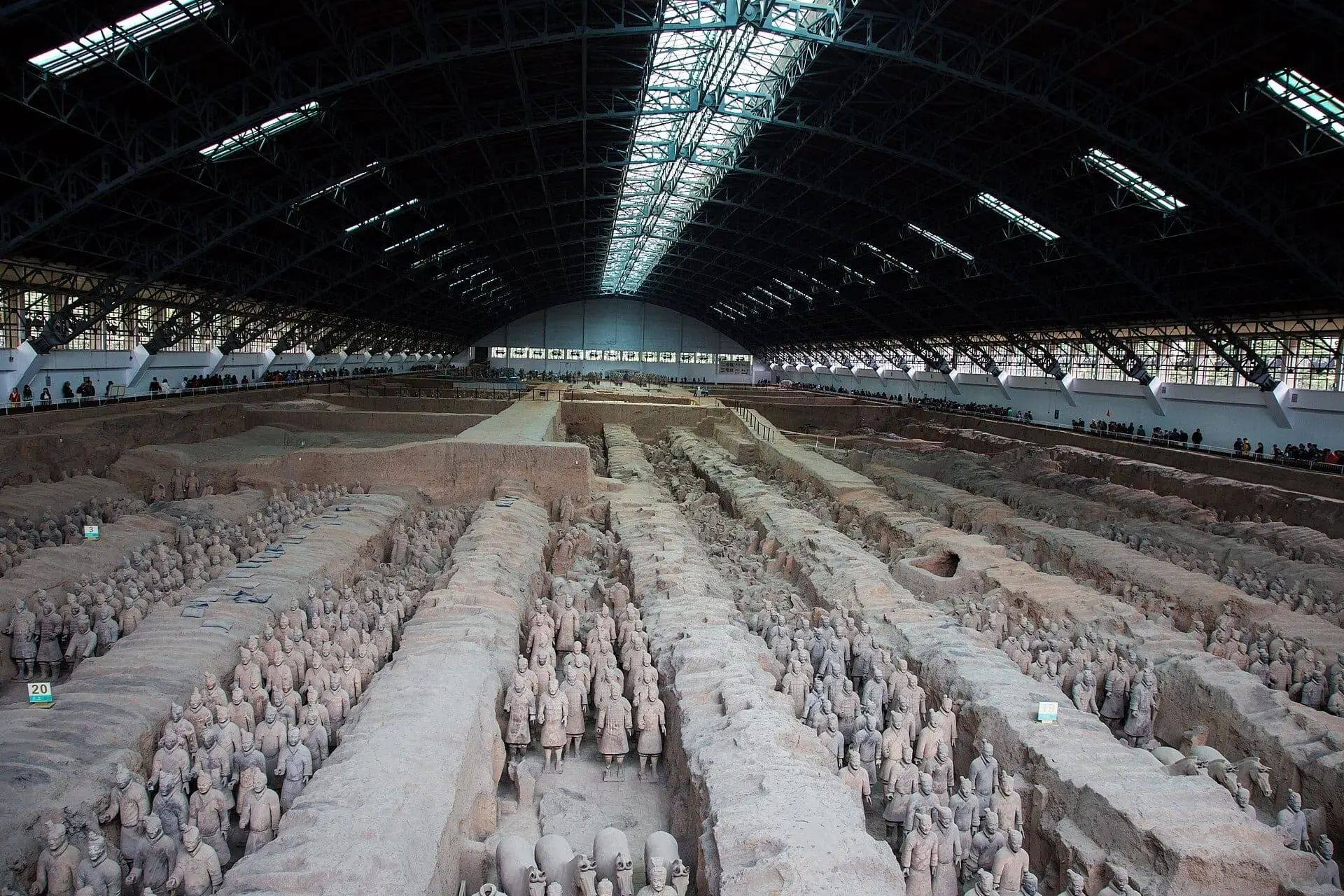
The Terracotta Army Museum (秦始皇兵马俑博物馆), also known as the Museum of the Terracotta Army and the Mausoleum of Qin Shi Huang, is the museum built around the excavation of the underground army buried to guard the tomb of Qin Shi Huang (秦始皇), China's first emperor. Discovered in 1974 by local farmers drilling a well, the site covers 22,000 sqm and contains an estimated 8,000+ terracotta warriors, 130 chariots, and 670 horses in three underground pits. The army was buried in 210-209 BCE as a funerary offering to protect the emperor in his afterlife. Each warrior was individually sculpted — no two faces are identical — making this the largest and most detailed sculptural group in the ancient world.
Last updated:
Quick Answer
Is Terracotta Army Museum (Museum of the Terracotta Army and Mausoleum of Qin Shi Huang) worth visiting?
The 8th Wonder of the World — 8,000+ life-size terracotta warriors, horses, and chariots buried to guard the tomb of China's first emperor (210 BCE). One of the most significant archaeological discoveries in human history. ¥120.
Quick facts
| Category | history |
|---|---|
| Ticket | ¥120 (adult), ¥60 (students). Ticket valid for the Terracotta Army pits 1, 2, and 3 and the Museum of Exhibit Halls. A combined ticket including the Emperor Qin's Mausoleum is available (¥150). Book via the official website or at the gate. Peak days — book ahead online. |
| Hours | March 16-November 15: 8:30-18:30 (last entry 17:00). November 16-March 15: 8:30-18:00 (last entry 16:30). Open year-round. |
| Recommended duration | 3-5 hours including all three pits and the museum exhibition. |
| Best time to visit | October through April. Xi'an is extremely hot and humid in summer (June-August, 35-40°C). Winter (December-February) is cold but the pits are climate-controlled. The museum is extremely crowded during Chinese New Year (January/February) and Golden Week (Oct 1-7). |
| How to get there | The museum is 35km northeast of Xi'an's city center. Bus Route 306 (游5) departs from Xi'an Railway Station (near the South Square) and costs ¥7. Bus Route 307 (游7) departs from the Fangzhicheng (纺织城) area. A DiDi from central Xi'an costs ¥80-120 (one-way, 45-60 minutes in traffic). The museum is a 15-minute walk from the Highway 108 stop of the suburban bus. Combine with the Huaqing Pool (华清池) hot springs site on the same bus route. |
| English signage | partial |
Why visit
This is one of the most significant archaeological discoveries in human history and one of the world's great tourist experiences. The sight of thousands of life-size warriors standing in formation in their underground vault is genuinely awe-inspiring. The scale, the individuality of each face, and the historical significance (8,000 warriors representing the army of China's first emperor) make this a genuinely irreplaceable experience.
Collection highlights
- Pit 1 — the largest pit, containing 6,000+ warriors in battle formation, discovered in 1974. The original pit excavation is visible — archaeologists still work in the eastern section.
- Pit 2 — the command section with cavalry, infantry, and archers in a more complex formation. Contains the famous "General" figure and kneeling archers.
- Pit 3 — the command headquarters, containing the highest-ranking officers and the only complete bronze chariot in the complex.
- "General" figure — the largest and most detailed terracotta figure, over 1.9m tall with detailed armor and facial features, from Pit 1
- Bronze chariot and horses — the two complete bronze chariots (each pulled by four horses) recovered from Pit 2, displayed in the museum's climate-controlled hall
- Museum of Exhibit Halls — artifacts recovered from the pits including weapons, armor, and the original bronze weapons (still sharp after 2,200 years due to chromium plating)
Tips
- Arrive right at opening (8:30) to beat the massive crowds — Pit 1 gets filled with tour groups by 10:00
- Combine with the Huaqing Pool (华qing池) hot springs imperial bathing complex on the same bus Route 306 — both can be done in one day
- The Terracotta Army is one of the few major sites with English signage throughout
- Wear comfortable shoes — the museum grounds are large and involve significant walking
- Photography is allowed in the pits (no flash)
- The "Bingmayong" (兵马俑) site requires significant walking in the open air between pits — bring sun protection in summer
- Audio guides in English are available at the entrance (¥40 deposit)
- The Qin Emperor's Mausoleum mound (秦始皇帝陵) is adjacent but not open to visitors — it is the world's largest unexcavated tomb
Frequently asked questions
How significant is the Terracotta Army?
The Terracotta Army is one of the most significant archaeological discoveries in human history. It is the largest sculptural group in the ancient world — 8,000+ life-size figures in three underground pits — and each figure was individually sculpted with unique facial features. It was buried in 210-209 BCE and remained undiscovered until 1974. It has been designated a UNESCO World Heritage Site and is sometimes called the \"Eighth Wonder of the World.\"
How does the Terracotta Army Museum compare to the Shaanxi History Museum?
Complementary. The Terracotta Army Museum shows ONE specific archaeological site — the underground army of Qin Shi Huang. The Shaanxi History Museum (陕西历史博物馆) in Xi'an shows objects from ALL of Shaanxi's 13 dynasties. Both are essential for Xi'an — ideally visit the Shaanxi History Museum first for context, then the Terracotta Army.
Is ¥120 for the ticket worth it?
Unquestionably yes. This is one of the few genuinely irreplaceable experiences in world heritage tourism. The ticket covers all three pits and the museum exhibition halls. The combined ticket with the Emperor Qin's Mausoleum (¥150) is optional — the mausoleum mound is not open to visitors.
Does the museum have English signage?
Yes — the Terracotta Army Museum has English signage throughout all three pits and the exhibition halls, one of the better English-signaged major tourist sites in China. Audio guides in English are available (¥40 deposit).
Can I combine the Terracotta Army with Huaqing Pool?
Yes — both are on Bus Route 306 (游5) from Xi'an Railway Station. The Huaqing Pool (华清池) is the site of the "Eternal Spring Pool" (华清池) where the Tang Dynasty Emperor Xuanzong met his consort Yang Guifei, and is famous for its Tang Dynasty palace ruins and hot springs. A combined day trip covering both is the standard Xi'an day trip itinerary.
Read next
Other things to do in Xi'an
Anren Fang (Tang Dynasty Residential Complex)
唐长安城坊遗址,展示唐代居民生活。2023年开放新景区。唐风体验新选择。必去指数★★★
Banpo Museum
仰韶文化遗址,六千年前母系氏族村落。门票0元。了解新石器时代必去。必去指数★★★
Beilin Museum
西安碑林博物馆别名,收藏历代碑石书法瑰宝。门票65元。书法爱好者圣地。必去指数★★★★★
Bell Tower
西安市中心地标,明代建筑。登楼票30元。与鼓楼相距200米,联票50元。夜景绝美。必去指数★★★★
Big Wild Goose Pagoda
7th-century Buddhist pagoda built to house scriptures brought from India by the monk Xuanzang (the real Tripitaka). ¥50. Evening fountain show is free.
Xi'an City Wall
中国现存最完整古代城垣。明代建成,周长13.7公里。骑车环城约2小时。门票54元。必去指数★★★★★
Da Ci'en Temple
唐代皇家寺院,玄奘主持修建。大雁塔所在地。门票40元。玄奘法师纪念地。必去指数★★★★
Drum and Bell Towers
Two 14th-century Ming-dynasty towers anchoring Xi'an's old-city centre — the Bell Tower (1384) at the crossroads, the Drum Tower (1380) at the Muslim Quarter gate. ¥30 each to climb, 1-1.5 hours total, best at dusk when both light up.
Drum Tower
西安明代建筑,与钟楼东西相望。登楼票30元,击鼓表演10元/次。与钟楼联票50元。必去指数★★★★
Xi'an Beilin Museum (Forest of Steles)
中国最大石碑博物馆,书法爱好者圣地。门票65元,孔庙古建筑群。必去指数★★★★★
Giant Wild Goose Pagoda
唐代佛塔地标,玄奘译经之所。门票50元,登塔另付。建议傍晚前往看夜景。必去指数★★★★★
Grand Tang Mall (Datang Everbright City)
A 1.5-km free pedestrian avenue of lit-up Tang-style pavilions, costumed performers, and food stalls running south from the Big Wild Goose Pagoda through Xi'an's Qujiang district. Budget 2–3 hours after dusk; the lights and shows peak 19:00–21:00.
Great Mosque of Xi'an
西安最古老清真寺,唐代建立。门票25元。回坊核心景点,非穆斯林可参观。必去指数★★★
Great Mosque of Xi'an
A 1,280-year-old mosque site down Huajue Lane that looks like a Ming temple but serves Xi'an's Hui Muslim community — four courtyards, a pagoda-style minaret, no domes. ¥25 entry (as of 2026), allow 45–60 minutes; go at the 8:00 opening, not noon.
Han and Tang Dynasty Street
大唐不夜城核心段,全长约2.1公里,2008年建成,免费。灯光秀19:00-23:00璀璨。地铁3号线/4号线大雁塔站A口出,与大雁塔相邻。
Huaqing Palace
Tang Dynasty imperial hot springs resort — Yang Guifei's bathing pool, scene of the 1936 Xi'an Incident. ¥120 entry. 30 km east of Xi'an. Combine with Terracotta Army.
Huaqing Pool
唐玄宗与杨贵妃爱情故事发生地,周秦汉唐皇家温泉。门园一票通120元,内有《长恨歌》演出。必去指数★★★★
Mount Hua
五岳最险,天下第一奇险。徒步登顶约5-6小时,乘索道省力。门票160元+摆渡车40元+索道另行。必去指数★★★★★
Muslim Quarter
Xi'an's 1,200-year-old Hui Muslim food district — 10+ blocks of lamb skewers, hand-pulled noodles, persimmon cakes, and the 1,300-year-old Great Mosque. Free entry. Food ¥5–50 per item.
Muslim Street (Huimin Street)
西安著名美食街,回坊核心区,唐代(回坊形成于明代)。免费进入,商铺约09:00-23:00。地铁2号线钟楼站B口步行10分钟。美食丰富,泡馍凉皮羊肉串。
Shaanxi Grand Theater
西北最大综合性剧院,2017年建成,1800座。演出票80-380元,唐代风格现代建筑。地铁3号线/4号线大雁塔站C口步行10分钟。大唐不夜城核心区。
Shaanxi History Museum
中国第一座大型现代化历史博物馆,1991年建成,馆藏171万余件。免费需提前3天预约,何家村特展30元,壁画馆270元。08:30-18:00,周一闭馆。地铁1号线/2号线小寨站F口步行15分钟。
Small Wild Goose Pagoda
唐代古塔,建于707-710年,高43米,十五层密檐式砖塔。免费需预约,登塔另付30元(限流)。9:00-17:00,周二闭馆。地铁2号线或5号线南稍门站步行10分钟。
The Song of Everlasting Sorrow
华清池实景舞剧,唐玄宗与杨贵妃绝世恋歌。演出188-588元。视觉盛宴,建议观看。必去指数★★★★★
Tang West Market Site
唐代长安城商业中心遗址,买东西典故来源。博物馆展示丝路贸易盛况。免费参观。必去指数★★★
Terracotta Army
UNESCO site with 8,000+ life-sized warriors buried 2,200 years ago. 1.5 hours from Xi'an. Allow 3-4 hours.
Xi'an City Wall
The best-preserved ancient city wall in China — 13.7 km of Ming Dynasty fortifications you can bike on top of. ¥54 entry, ¥45 bike rental. 2–3 hours to bike the full loop.
Yanmenguan Pass
长城重要关隘,天下九塞之一。门票50元。位于太原以北,路途较远。建议自驾或跟团。必去指数★★★
Museums in Xi'an
Banpo Museum
A 6,000-year-old Neolithic village preserved in situ — walk through a matriarchal Yangshao Culture settlement with houses, kilns, and a burial ground. ¥65. China's first prehistoric site museum.
Emperor Qinshihuang's Mausoleum Site Museum (Terracotta Warriors)
About 8,000 life-size clay soldiers buried in 210 BCE to guard China's first emperor — plan 3 to 4 hours on site plus 90 minutes each way from central Xian.
Shaanxi History Museum
China's most historically significant provincial museum for ancient Chinese civilization — built on the Shaanxi province that hosted 13 imperial dynasties. The Western Zhou, Han, and Tang Dynasty collections are the finest in the world. Free (basic gallery).
Shaanxi History Museum — Qin-Han Branch
New branch opened 2024 near the Qin Dynasty palace ruins. Focuses exclusively on the Qin and Han dynasties (221 BC-220 AD). Free. Book ahead.
Emperor Qinshihuang's Mausoleum Site Museum
The world-famous Terracotta Army viewed through the museum lens: excavation in progress, bronze chariot conservation, and the science behind 2,200-year-old polychrome preservation. ¥120.
Forest of Steles Museum (Xi'an Beilin Museum)
Xi'an's 1,094-year-old "Forest of Steles" holds more than 3,000 carved stone tablets and rewards 2–3 hours of close looking — most visitors should skip the calligraphy trance and head straight for the six horses of Zhaoling Tangseng.
Xi'an City Wall Museum
The museum on top of China's most complete Ming Dynasty city wall — documenting the wall's construction, military history, and the "Ming Great Wall" system. Included in wall ticket.
Xi'an Museum
Tang Dynasty artifacts inside the Small Wild Goose Pagoda temple complex — a calmer, more intimate alternative to the Shaanxi History Museum. Free entry with garden and pagoda access. Allow 2–2.5 hours. Jianfu Temple grounds.
Xi'an Beilin Museum (Stele Forest)
The "Stele Forest" (碑林) — China's largest collection of stone steles and calligraphy, including the famous "Classic of Tea" (茶经) and Tang Dynasty calligraphy. ¥65.