
Shandong Provincial Museum
The Shandong Provincial Museum (山东博物馆) opened in 2010 in Jinan's Luzhongbin Cultural District, replacing the 1954 museum as the largest cultural institution in the Confucius home province. Shandong's archaeology is unique because the province was the center of the Eastern Zhou (especially Qi and Lu states), the birthplace of Confucius and Mencius, and home to several distinctive Neolithic cultures that differ from the Central China (Henan) traditions. The core collections are: (1) Dawenkou and Dawidun Neolithic cultures (5000-3000 BCE) — the distinctive black pottery and burial customs of coastal Shandong; (2) Western Zhou bronze inscriptions — the largest collection of inscribed Zhou bronze vessels in Shandong, including documents from the Qi and Lu states; (3) Han Dynasty jade burial suits — the famous Shandong jade burial traditions; (4) Buddhist stone carving from the Longxing and Bianyun temple sites.
Jinan · history museum2026-10-18
Quick Answer
Is Shandong Provincial Museum worth visiting?
The museum of Confucius's home province — strong in Shandong's Dawenkou Neolithic cultures, Western Zhou bronze inscriptions, and Han Dynasty treasures. Free with passport; 2.5–3.5 hours.
Quick facts
| Category | history |
|---|---|
| Ticket | Free. Passport required. Walk-in tickets from the south gate. |
| Hours | 9:00-17:00 (last entry 16:00). Closed Mondays. |
| Recommended duration | 2.5-3.5 hours. |
| Best time to visit | April-June and September-October. Jinan is hot and humid in summer (June-August, 35°C+) and cold in winter (December-February, -5°C to 8°C). Spring and autumn are ideal. |
| How to get there | Metro Line 3 to Shandong Provincial Museum Station (省博物馆站), Exit A. Bus routes 18, 43, 63, 110, 123, 150, 151, 165, 202 to Shandong Museum stop. From Jinan Railway Station by DiDi: ¥20-30. From Jinan East Station by DiDi: ¥25-40. |
| English signage | Partial |
Why visit
The Dawenkou/Dawidun Neolithic black pottery collection is the most significant in China for this culture — Shandong's coastal Neolithic people developed a distinct civilization with sophisticated pottery, jade carving, and burial practices that prefigure the later Shandong (Qi/Lu) Bronze Age civilization. The Western Zhou bronze inscription collection documents the history of the Confucius home states (Lu and Qi) in their own words.
Collection highlights
- Dawenkou/Dawidun Neolithic black pottery — 5,000-year-old black pottery vessels and burial objects from Shandong's distinctive coastal Neolithic cultures, including the famous "egg-shell" black pottery cups
- Western Zhou bronze inscriptions from Qi and Lu states — inscribed bronze vessels documenting the history of Confucius's home states (Lu State) and the powerful Qi State in their own words
- Han Dynasty jade burial suits — jade burial suits (玉衣) from Han Dynasty tombs in Shandong, following the practice of preserving the body through jade burial
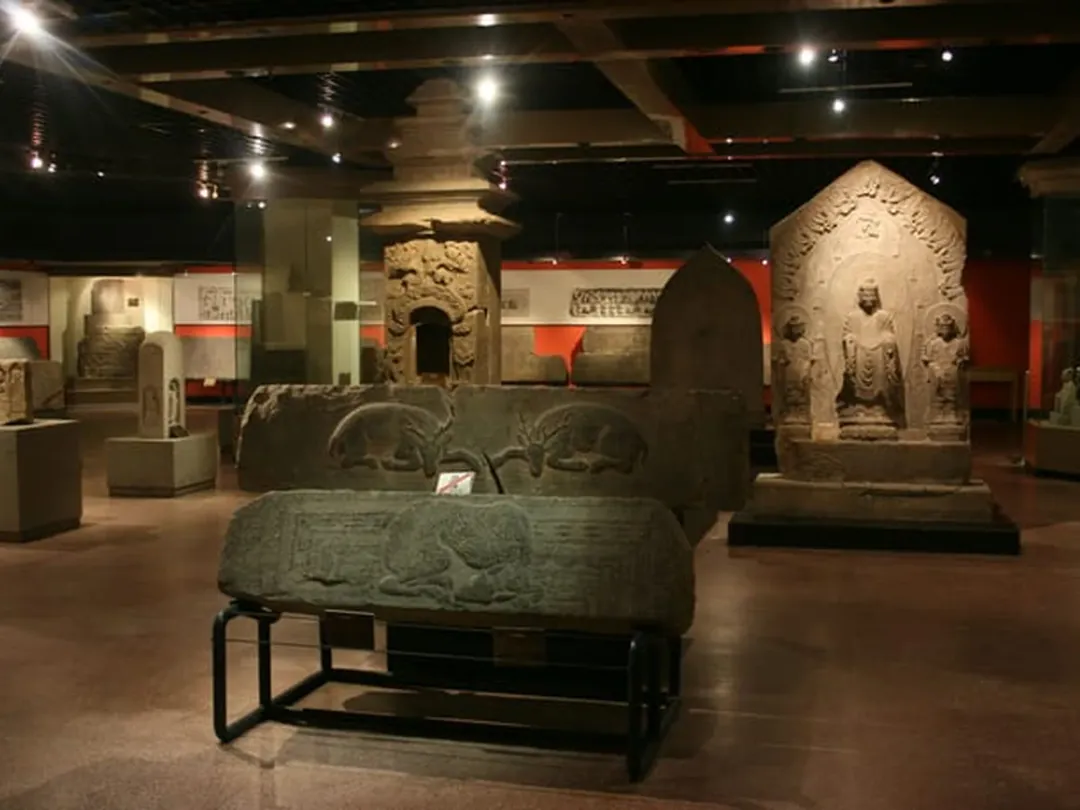
- Buddhist stone carving gallery — stone steles and cave fragments from the Longxing Temple and Bianyun Temple sites in Shandong, 5th-8th century
- Shandong "Egg-shell" black pottery — the extraordinary thin-walled black pottery cups from the Dawenkou culture, some with walls less than 0.5mm thick, a technical marvel of Neolithic pottery
- "Qi Daxiong" bronze chime bells — a complete set of bronze bells from the Qi State Warring States period, tuned and playable after 2,500 years
Tips
- Combine with a visit to the Daming Lake (大明湖) and the Qushui (曲水) area for a traditional Jinan cultural afternoon — Jinan is famous for its "City of Springs" (泉城)
- The Confucian/Confucius-related galleries are on the 2nd floor — these provide essential context if you plan to visit Qufu (曲阜, Confucius's hometown, 1.5 hours by bus from Jinan)
- Jinan's famous spring water culture — drink from the springs at Black Tiger Spring (黑虎泉) before or after your museum visit
- The Dawenkou pottery gallery is on the 1st floor — go early before tour groups
- The museum has an excellent bookshop with replica Shandong black pottery pieces
Frequently asked questions
What is the Dawenkou culture?
The Dawenkou culture (大汶口文化, 5000-3000 BCE) was a Neolithic culture centered on coastal Shandong and Jiangsu. It is distinguished by: (1) black pottery — the finest black pottery of any Neolithic culture; (2) sophisticated jade carving; (3) custom of wooden coffin burial; (4) early jade cong and bi ritual objects. The later Dawidun culture (龙山文化, 3000-1900 BCE) refined these traditions and produced the famous "egg-shell" black pottery cups. The Shandong Provincial Museum has the world's largest collection of Dawenkou/Dawidun artifacts.
How does Shandong Museum compare to the Qufu (Confucius) temples?
The Shandong Provincial Museum in Jinan shows the archaeology and art of the entire Shandong region across all periods. The Qufu temples (Confucius Temple, Mansion, and Cemetery / 三孔) are specifically about Confucius and the Confucian tradition. For pre-Confucian archaeology (Neolithic, Shang, Zhou), start at the museum. For the Confucian tradition itself, visit Qufu.
What makes Shandong black pottery special?
Shandong's Dawenkou and Dawidun black pottery (黑陶) is the finest pottery of China's Neolithic cultures. The "egg-shell" black pottery cups from the Dawidun period have walls as thin as 0.5mm — a technical achievement unmatched anywhere in the world for 4,000 years. These were burial objects indicating elite status, not everyday vessels.
Does Shandong Provincial Museum have English signage?
Partial — the Dawenkou pottery and Western Zhou bronze sections have English labels. The Han jade and Buddhist sections have limited English. No English audio guides as of 2026.
Can I combine a Jinan museum visit with Qufu (Confucius)?
Yes — Jinan to Qufu is 1.5 hours by bus or high-speed train. A typical itinerary: morning at Shandong Museum in Jinan + afternoon at Daming Lake; Day 2: full day at Qufu's Three Kongs (三孔) — the Temple, Mansion, and Cemetery of Confucius.
Read next
Other things to do in Jinan
Baotu Spring
The signature karst spring of Jinan erupts up to 240,000 cubic meters a day at the center of a compact park of pavilions and springs. Allow 1-2 hours; combine with nearby Daming Lake.
Daming Lake
Jinan's 46-hectare downtown lake, free to enter and walkable in 90 minutes, sits inside the old city wall next to Baotu Spring and is most photogenic in lotus season (July–August).
Daming Lake
Jinan's spring-fed lake at the north end of the classic spring walk: lotus ponds, willow causeways, pavilions and lake views of the old city — free, open late, 1 km from Baotu Spring.
Shandong Museum
Jinan's provincial museum holds 40,000+ artifacts including a 2,500-year-old bronze shell-shaped cup and a 9-meter dinosaur; plan 2-3 hours and it's free with ID.
Thousand Buddha Mountain
Climb 288 meters to see more than 130 Tang-era stone Buddhas carved into the cliffs; budget 2.5 hours including the cable car and Xingguang Temple.