
Chenzhou at a Glance
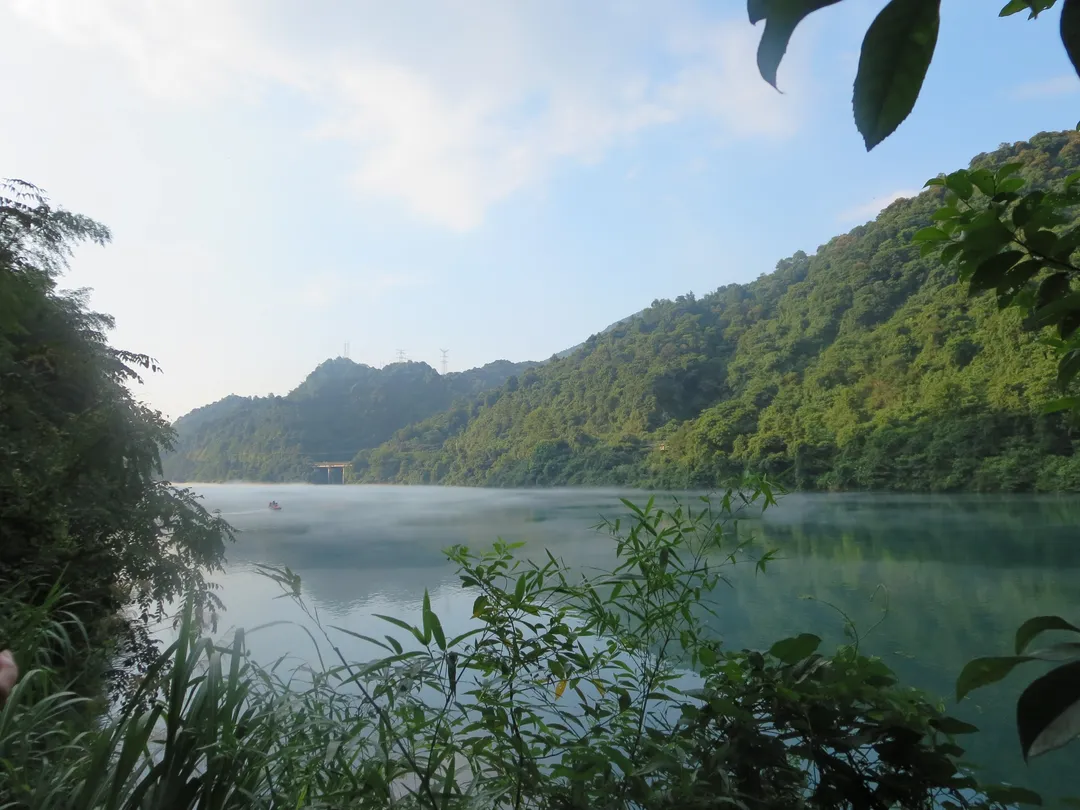
Give Chenzhou two to three days and let the water set the schedule. Day one goes to Dongjiang Lake in Zixing: the Xiao Dongjiang mist shows between roughly 6:00 and 8:00 in the morning from mid-April to mid-October, and the same day can add a cave visit and a lakeside fish lunch. Day two picks between the barrier-free skywalks of Mangshan (about 2 hours south by road) and the Danxia ridges of Gaoyiling (about 50 minutes from downtown). A third morning covers Suxian Ridge and the old riverside streets in the city itself. Mid-range spending runs about 500-1000 CNY per person per day, and the whole region hangs off one high-speed rail stop — Chenzhou West on the Beijing-Guangzhou line, running since December 2009.
Why Chenzhou
Chenzhou is Hunan's southern gate, a prefecture-level city that presses right up against Guangdong's Shaoguan — yet it doesn't behave like a border town. Its wealth is vertical: a 160 km² reservoir lake famous for dawn fog, a Danxia shelf of red ridges over emerald ponds, and a granite massif whose summit ridge was, in 2020, certified as China's first barrier-free mountain scenic area. None of these headline sights sit in the city; all of them sit within about two hours of the HSR platform.
The honest trade-offs: the urban core is a modern working grid with one good hill (Suxian Ridge) and one good old street (Yuhou Street), not a preserved town; attractions are scattered, so distances eat time; and summer days regularly push past 35 °C between the mist hours. Chenzhou rewards travelers who pick two anchors and build days around early starts — not those who expect a walkable sightseeing core.
Top Sights
| Sight | Highlight | Entry (reference) | Time needed |
|---|---|---|---|
| Dongjiang Lake / Xiao Dongjiang | Dawn mist 6:00-8:00, mid-April to mid-October; 5A scenic area | A-line about CNY 100; lake-and-cave line about CNY 171 (discounted tiers CNY 50-85) | 1 full day |
| Mangshan Wuzhi Peak | Skywalks at 1,400-1,600 m, China's first barrier-free mountain area (2020) | about CNY 150; combos with cableway CNY 250-300 | 1 full day |
| Gaoyiling | Danxia ridges above green ponds, little shade | about CNY 80-98 with shuttle | 3-4 hours |
| Suxian Ridge + Yuhou Street | 526 m city hill, the "Three Masterpieces" stele, riverside old street | tens of CNY for the hill; street free | half day |
| Rucheng Reishui hot springs | Springs up to about 98 °C — eggs boil in the outflow | soak pricing varies by resort | half day to an overnight |
Figures above are reference listings checked in October 2026; sources are listed at the end of this guide.
Dongjiang Lake: Chasing the Mist
The lake is the reason most people come. Dongjiang is a reservoir behind the 157 m Dongjiang Dam, and its surface covers roughly 160 km² of drowned valleys in Zixing, a county-level city under Chenzhou. The famous fog forms on the Xiao Dongjiang river stretch just below the dam: water released from the reservoir bottom runs cold all summer, meets warmer dawn air, and condenses into a white ribbon that hangs over the channel until the sun burns it off.
The window matters more than the forecast. From mid-April to mid-October, gates open at 6:00 and the mist peaks between 6:00 and 8:00; a second, thinner show sometimes returns around dusk. Local boatmen stage net-casting photo sessions in the early hours. Miss the morning and the same stretch reads as a pretty green river — worth seeing, but not the picture you came for.
Tickets are tiered by route: the walking A-line (mist stretch, Hougu Mountain waterfall, the dam face, Longjing Gorge) lists at about CNY 100, while the lake-cruise line that adds a boat ride and the Doushuai Lingyan cave runs about CNY 171. Discounted tiers around CNY 50-85 circulate on official and platform channels, so compare before you pay. The cave sits on Doushuai Island, half an hour by boat; it is one of the larger limestone caverns in the region and trades under the old epithet "first cave of Jiangnan". Boats also call at Huangcao town on the far shore — a working ferry town whose restaurants serve the lake's cold-water fish, and a sensible lunch stop between the mist and the cruise.
Mangshan: the Mountain You Don't Have to Climb
Mangshan fills the far south of Yizhang county, where Hunan narrows to a point against Guangdong. Its highest summit, Mengkengshi, tops out at 1,902 m, and forests of the cold-tolerant Mangshan pine hold slopes that never got the crowds of Zhangjiajie. What changed the calculus is infrastructure: in 2020 the Wuzhi Peak (Five Finger Peak) area was certified as China's first barrier-free mountain scenic area — a cableway, escalator flights and vertical lifts carry visitors up to about 8 km of cliff walkways strung between 1,400 and 1,600 m, and wheelchair users can ride the whole system without leaving the chair.
Entry lists at about CNY 150, and combination tickets with the cableway and lifts circulate around CNY 250-300. The drive from downtown Chenzhou takes about two hours, so this is a full day with an early start; fog can swallow the ridge views even on days when the lake mist performs, which is the mountain's own version of the same bet.
Gaoyiling: Danxia Ridges over Green Water
Gaoyiling, in Suxian district about 50 minutes from downtown, is the geology stop that photographs itself: rust-red Danxia ridges dropping into emerald ponds, a skyline with almost no trees on it. Now a 4A scenic area with shuttles and boardwalk sections, it lists tickets around CNY 98 at the gate and a little less on platforms. The trail has little shade, so the trip-days data and every local will tell you the same thing: go early, carry water, and keep to the marked ridge path — the wet rock near the water is where people slip. Nearby Feitian Mountain extends the same Danxia theme if the legs still work after lunch.
Hot Springs at Rucheng
For the third flavor of water, head southeast to Rucheng county, where Reishui town ("hot water", literally) sits on springs that emerge at up to about 98 °C — hot enough that vendors boil eggs in the outflow channels. This is a working spa town rather than a resort strip: several bathhouses and guesthouses tap the same source, soak pricing varies by house, and an overnight pairs naturally with the drive back. The road from downtown takes about two and a half to three hours, so Rucheng makes sense as the anchor of a second night rather than a day trip.
Suxian Ridge and the Old Streets
Keep half a day for the city itself. Suxian Ridge rises about 526 m inside the urban grid — temple paths through forest, a view over the Chen River, and the "Three Masterpieces" stele, which folds Qin Guan's Song-dynasty poem, Su Shi's colophon and Mi Fu's calligraphy into one stone. A small room on the hill preserves the record of Zhang Xueliang's 1938 detention here. Down at the water, Yuhou Street is the oldest surviving lane in town, restored along the riverfront — evening is its best hour. Neither stop demands more than an unhurried morning, which is precisely the point after two dawn starts.
A Two-Day Plan
Work it in this order and swap only if rain moves in:
- Day 1 — Dongjiang Lake. Out of the hotel by 5:30, gates at 6:00, mist hours 6:00-8:00 with the net-casting boats. Boat to Doushuai Lingyan cave, lunch on lake fish at Huangcao, and the dam viewpoint on the way back. If the evening mist appears, it appears on the drive home.
- Day 2 — Gaoyiling, then the city. Gaoyiling by 8:30 before the heat and the coaches, ridge walk of two to three hours, late lunch back downtown, then Suxian Ridge and Yuhou Street from mid-afternoon into the evening.
With a third day, put Mangshan first on the list — it deserves the full morning-to-dusk envelope — or hand the day to Rucheng's springs. Our 3-day Chenzhou trip builder lays out the same stops in 3, 5 and 7-day versions.
Fish Noodles and Cold-Water Fish
Two dishes explain the region. The first is Qifengdu fish noodles, breakfast in Suxian district's Qifengdu town and now a citywide habit: rice noodles in a broth built on river fish, tea oil and a serious amount of chili, about ten-odd yuan a bowl. The second is Dongjiang fish itself — the lake's cold, clean water grows firm-fleshed fish, and kitchens around Zixing and Huangcao serve it steamed, in soups, or as the farmed rainbow trout sold as "Dongjiang salmon", typically one fish in three preparations. Hunan cooking runs hot; if you order mild, say so early. Alipay and WeChat Pay cover nearly everything, but keep CNY 50 in small notes for noodle stalls and roadside fruit.
Getting There and Around
Chenzhou West station sits on the Beijing-Guangzhou high-speed line, open since 26 December 2009 when the Wuhan-Guangzhou section launched; the Wuhan-Guangzhou segment returned to 350 km/h operation in June 2024. The slower conventional trains use the older Chenzhou station on the classic Beijing-Guangzhou railway.
| Route | Typical time | Reference fare (second class) |
|---|---|---|
| Changsha South → Chenzhou West | HSR, about 1-1.5 h | roughly CNY 150 |
| Wuhan → Chenzhou West | HSR, about 2-2.5 h | roughly CNY 230 |
| Guangzhou South → Chenzhou West | HSR, about 1.5-2 h | roughly CNY 200 |
| Chenzhou West → downtown | taxi, about 20 min | about CNY 25-35 |
| Downtown → Dongjiang Lake (Zixing) | car or bus, about 1-1.5 h | bus a few tens of CNY |
| Downtown → Gaoyiling | car, about 50 min | taxi or Didi |
| Downtown → Mangshan | car, about 2 h | rental or chartered car |
Fares move with demand — treat them as ranges and reconfirm on 12306 close to travel. There is no metro: buses, taxis and Didi cover the city, and the scattered sights make a chartered car the practical choice for the Mangshan or Rucheng days.
Where to Stay
Base in the city center for a two-night trip: business hotels a short walk from the Wuling Square area run roughly 200-350 CNY, and both the Zixing road and the Yizhang road start from there. The alternative that many travelers prefer is one night lakeside near Dongjiang Lake — mist-chasing means a 5:30 start, and sleeping twenty minutes from the gate beats a pre-dawn drive from the city; lakeside guesthouses run about 150-400 CNY. Spa hotels around Rucheng's Reishui town serve the springs circuit. Book ahead for the first weeks of May and October; walk in otherwise.
What a Day Costs
| Per person, per day, 2026 | Backpacker | Mid-range | Comfort |
|---|---|---|---|
| Accommodation | 100-150 CNY | 300-600 CNY | 700+ CNY |
| Food | 40-80 CNY | 100-200 CNY | 250+ CNY |
| Local transport | 20-40 CNY | 30-60 CNY | 100+ CNY (chartered car) |
| Attractions | 0-100 CNY | 80-200 CNY | 250+ CNY |
| Daily total | about 160-370 CNY | about 500-1000 CNY | 1200+ CNY |
The mid-range column follows our roster benchmark of about 100 units per standard day (excluding tickets). The big swing factor is the chartered-car day: Mangshan or Rucheng with a driver resets the transport line, which is why pairing strangers on tours is common at both.
When to Go
The mist calendar decides it: Xiao Dongjiang fogs reliably from mid-April to mid-October, and our trip-days data scores April-June and September-November as the comfortable windows — green slopes, walkable temperatures, mist still on the menu. July-August brings heat past 35 °C by mid-morning, which narrows sightseeing to the early hours. Winter is quiet and often grey; the mist machinery mostly shuts down below about 15 °C water-air gap. Whatever the season, avoid the national holiday weeks in early February, early May and early October — the 6:00 mist queue is the calm part of those days.
Practical Tips
- Set two alarms for the lake day; the 6:00-8:00 window does not wait for late risers, and gates open at 6:00 sharp in mist season.
- Buy attraction tickets on official or major platforms before travel — the discounted lake tiers (CNY 50-85) sell out on mist-peak weekends.
- Carry CNY 100 in small notes for noodle stalls, boat-side snacks and rural bathhouses.
- Sun protection and real shoes for Gaoyiling: the ridge is exposed and the red rock is slick when wet.
- Download offline maps before leaving downtown; signal thins in the Mangshan valleys and around the lake's far shore.
- Police 110; ambulance 120; fire 119; national tourist hotline 12301.
Frequently Asked Questions
How many days does Chenzhou need?
Two full days cover the essential pair — one Dongjiang Lake day (mist, cave, dam) and one flexible day that splits between Gaoyiling and the city. A third day belongs to Mangshan or the Rucheng springs; most travelers then move on to Changsha or Guangzhou by HSR.
When and where exactly is the Xiao Dongjiang mist?
Mid-April to mid-October, best between 6:00 and 8:00 in the morning, on the river stretch below Dongjiang Dam in Zixing — about an hour's drive from downtown Chenzhou. A weaker show sometimes repeats at dusk. Mist is weather-dependent: cool overcast dawns after a warm day perform best.
Can I see Chenzhou without a car?
Partially. The HSR station, city sights, and the buses to Zixing work fine without one, and drivers cost little for a single Dongjiang day. But Mangshan and Rucheng are two-hour drives with thin public transport, so car-free trips usually trade those two for a deeper Dongjiang-and-city visit or a group tour.
How accessible is Mangshan, really?
It was certified in 2020 as China's first barrier-free mountain scenic area: cableway up, escalator and lift segments on the way, and about 8 km of cliff walkways between 1,400 and 1,600 m engineered so wheelchair users can traverse without leaving the chair. Expect security-checked boarding and book the accessibility services through the scenic area in advance.
Is Chenzhou worth it between Changsha and Guangzhou?
That bracket is exactly its use case. The city sits between the two hubs on the Beijing-Guangzhou line — about 1-1.5 hours from Changsha South and about 1.5-2 hours from Guangzhou South — and the landscape is nothing like either city. Two days here break the rail journey without adding a major-city itinerary.
Useful Phrases
| Chinese | Pinyin | Meaning |
|---|---|---|
| 郴州 | Chēnzhōu | Chenzhou — note the unusual character |
| 雾漫小东江 | wù màn Xiǎo Dōngjiāng | the mist over Xiao Dongjiang |
| 东江湖 | Dōngjiāng hú | Dongjiang Lake |
| 栖凤渡鱼粉 | Qīfèngdù yúfěn | Qifengdu fish noodles |
| 高椅岭 | Gāoyǐlǐng | Gaoyiling |
| 莽山 | Mǎngshān | Mangshan |
| 多少钱 | duōshǎo qián | how much |
| 谢谢 | xièxie | thank you |
Emergency Contacts
- Police: 110
- Ambulance: 120
- Fire: 119
- Tourist hotline: 12301
Sources and Verification
Ticket tiers for Dongjiang Lake (A-line about CNY 100, lake-cave line about CNY 171, discounted CNY 50-85 tiers), the mist calendar (mid-April to mid-October, 6:00-8:00) and the Doushuai Lingyan cave were checked against the scenic area's published price notices and Hunan provincial listings in October 2026; Mangshan figures (about CNY 150 entry, 2020 barrier-free certification, walkways at 1,400-1,600 m, 1,902 m highest summit) against Hunan government and scenic-area notices; Gaoyiling pricing (about CNY 80-98) against current aggregator listings; the Beijing-Guangzhou HSR dates and 2024 speed restoration against railway references. Train fares are ranges and move with demand. Prices were correct when checked but change — reconfirm within a fortnight of travel.
Chenzhou repays early alarms: two dawns buy you a lake that vanishes into fog and a mountain ridge you can roll across. Last verified 2026-10-12.