
Summary
Give Chifeng three days: one for the Hongshan culture collections and the sand lake where the jade dragon surfaced, two for the Hexigten highlands — Asihatu's granite pinnacles, the Dada road and Dali Nur — or spend two nights of it on the Ulan Butong grassland instead. Come June through September for green steppe around 20 °C in the daytime; come late December to February for swan lake ice and winter net fishing. Mid-range spending runs about 500-1000 CNY per person per day, and the high-speed rail puts Beijing within roughly 2.5 hours.
This guide is written for travelers deciding how much of Inner Mongolia's southeastern corner to claim for one trip, and in what order. Every figure below was cross-checked against our trip-day data for Chifeng and current price notices in October 2026.
Why Chifeng
Chifeng is a prefecture-level city of about 4 million people in southeastern Inner Mongolia — the region's most populous — wedged between Hebei and Liaoning rather than inside the three northeastern provinces, even if its tables and accents lean that way. The name means "red peak", after the sandstone hill at the northeastern edge of town; the Mongolian name, Ulanhad, says the same thing. Until 1955 this was Jehol (Rehe) province, and the city still behaves like a frontier market town that grew up: a practical grid along the Yinhe, with the grasslands and the mountains a few hours' drive out.
The deeper claim is chronological. The Hongshan culture, which flourished here some 5,000-6,000 years ago, gave archaeology some of China's earliest jade carving, and the city itself named the culture — the type site is the red hill. A C-shaped jade dragon dug up in 1971 near Wudan, 26 cm of dark green jade now held in the National Museum in Beijing, turned "Chinese dragon" from a legend into an object with an excavation record. Between that antiquity and the Qing-era princes' mansion at Kalaqin, Chifeng is one of the few places where a grassland holiday comes with a museum-grade storyline attached.
The honest trade-offs: the headline sights are spread across a banner the size of a small province, so this is a driving destination — no metro, long distances, early starts. English signage is thin outside ticket halls. And in July-August the grassland cools the day but the tour coaches run thick on the Ulan Butong loops. The city rewards travelers who pick two anchor areas and accept some hours behind a windscreen.
Ulan Butong: the film-set grassland
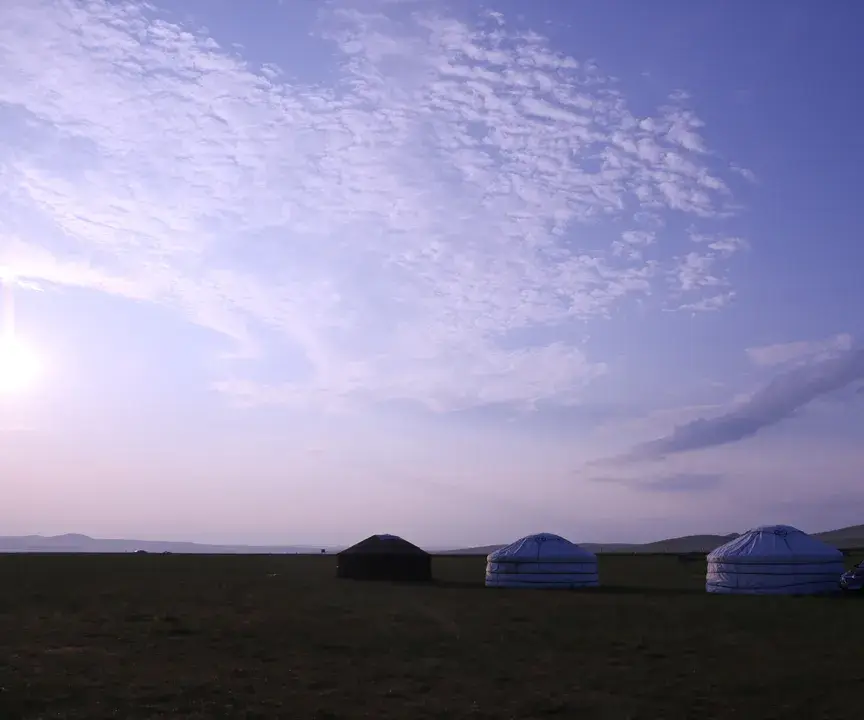
Ulan Butong sits in the southwest corner of Hexigten (Keshiketeng) Banner, about two hours of rolling steppe road south of Jingpeng town and roughly four hours from Chifeng city. administratively Inner Mongolian to the last meter — the border with Hebei's Saihanba forest farm runs along the Tuligen river at the valley's edge, so "Saihanba grassland" itineraries and this one are looking across the same water. It is administratively Inner Mongolian to the last meter. Rolling meadow, birch and larch groves, and wetland ponds make it the most photographed corner of the banner; film crews noticed decades ago, and the area doubles as an outdoor set for period dramas — the "film base" (yingshiji) plot inside the gate keeps props and mock village fronts you can walk around.
Practicalities first: the through ticket costs CNY 120 (discounted online listings run a few yuan under) and stays valid about 72 hours, covering the core plots — General's Pond (Jiangjun Paozi), the wetland where the tour buses park for sunset; Princess Lake (Gongzhu Hu), ringed by reeds; Wuse Shan, the "five-color hill" that earns its name in late September; and the film base. Hama Ba, the photographers' valley of birch scrub and folded meadows on the northern side, takes a separate gate of about CNY 30-40.
Two ways to see it beyond the bus loops. Horse rides run about CNY 75-80 an hour at the paddocks near the main sights — negotiate the route before mounting. And jeep tours with local drivers are the standard way into the trackless interior at dawn, when mist sits in the hollows; pricing is per vehicle for a half-day circuit, typically a few hundred CNY split between four seats. A one-night stay in a ger camp or a guesthouse in the village turns the visit from a long day trip into two light halves — sunset at the ponds, sunrise on the ridges.
Asihatu and the Hexigten highlands
The Re-A scenic road (Reshui to Asihatu) is the best hour-and-a-half of driving in the region: it climbs out of the hot-spring town of Reshui, passes Huanggangliang — at 2,029 m the high point of the whole Greater Khingan range, marked by a summit boardwalk above treeline — and drops into the granite field of Asihatu at about 1,700 m. "Asihatu" is Mongolian for "steep rock": sheets of Cretaceous granite, fractured vertically by frost, stand in stacked ridges like walls sliced by giants, with larch and birch filling the joints. Boardwalks loop through four or five sectors; an unhurried visit takes two to three hours.
The stone forest is the headline sight of the Hexigten Global Geopark, which UNESCO listed in 2005, and the scenic area has held a national 5A rating since 2017. Entry runs in the CNY 140-160 range depending on season, with the park shuttle included in most listings — reconfirm at the gate, as pricing notices change. Come in late September for larch gold or in June for greens; come at opening hour and you will often have the first sector to yourself.
The highlands around it reward a slow loop: the Dada scenic road rolls about 90 km of open grassland from Asihatu's side toward the lake country, past Gongger grassland where the steppe runs flat to the horizon and herder fences mark nothing but sheep arithmetic. Fuel up in Jingpeng, the banner's workaday seat — it is the practical overnight base for both roads, with supplies, banks and the region's densest cluster of mid-range hotels.
Dali Nur: swans and the winter haul
Dali Nur — "ocean-like lake" in Mongolian — spreads roughly 230 square kilometres at about 1,200 m above sea level, a shallow, mineral-brackish sheet that behaves more like an inland sea: you rarely see all of it at once. In migration seasons (April-May, September-November) swans and other waterfowl rest on the shallows in numbers that justify the binoculars; in June-September the lakeshore tracks make an easy cycling or driving loop off the Dada road.
The lake's working identity is fish. Hua-zi yu, a small robust minnow that schools in the millions, runs up the lake's inflows to spawn, and the same stocks support a net fishery conducted through the ice — the winter haul, usually launched from late December, when horse-drawn winches pull nets from cut channels and the day's catch is sorted on the ice. It runs December through February in some form; exact festival dates move with ice thickness each year, so check locally before planning a specific morning. On the lake's south shore, the low earth walls of Yingchanglu mark a Yuan-era town founded in the 1200s where the last Yuan court retreated in 1369 — a quiet, unfenced site that historians rate far above its present obscurity.
Tickets for the lakeshore scenic sections run about CNY 90 in season; access points and opening arrangements shift between the main shore gates, so treat the Dada-road side as the default entry. Stay lakeside for dawn light, or drive back to Jingpeng — about an hour — for the wider choice of rooms.
Yulong Sand Lake: where the dragon surfaced
About 100 km north of the city — a 1.5-hour drive, most of it on a straight fast road to Wudan — Yulong Sand Lake sets dunes against open water in a way that photographs as if two landscapes had been pasted together. Camel loops, sand sledding and boat circuits fill the activity menu; the park's entry starts around CNY 80-100 with rides priced separately, so a family day with the full toy box can run several hundred.
The name is not marketing. In 1971, in a village near Wudan, farmers turned up the C-shaped jade dragon — 26 cm, dark green, now in the National Museum of China in Beijing — and the find anchored the Hongshan culture's claim to China's earliest jade-carving tradition. The lake took the dragon into its name; the real object stays in Beijing, and the museum-quality account of it belongs to the Chifeng Museum downtown. Plan the sand lake as an outdoors day and give the backstory its own morning in the city.
Kalaqin Prince's Mansion
An hour southwest of the city, in the seat of Kalaqin Banner, stands the mansion of its Qing-era princes — begun in 1679 and expanded over the following two centuries into the largest and best-preserved princely residence of the Mongolian banners. Halls, courtyards and stelae run up the slope in the manner of a minor imperial palace; the site museum explains how the Kalaqin princes administered the frontier. Its last occupant, Gungsangnorbu, opened modern schools here in the first years of the 1900s — a reformist streak that makes the mansion more than furniture and gateways.
Entry runs about CNY 50, and the halls fill an unhurried morning. Pair it with Meilin Valley, a forested mountain valley another short hop into the hills that cools the afternoon — in winter it doubles as a small ski field — and you have the sensible day-triangle southwest of the city before the evening train.
The City: museum days and the red hill
Chifeng's urban half deserves the first morning of any itinerary. The Chifeng Museum lays out the Hongshan culture and its successors in well-lit jade and pottery rooms — free entry with ID, closed Mondays — and within a short drive stand the red sandstone hill that named both city and culture, and the Erdaojingzi site, a walled settlement about 4,000 years old, excavated in 2009-2010 and preserved under a protective hall south of town. None of it takes a full day alone; together they give the grassland days their meaning. Evening belongs to the markets and food streets around the station district.
Where to Stay
Base the city nights in Hongshan district, around the pedestrian streets between the museum quarter and Chifeng railway station: mid-range chains run roughly 200-350 CNY, breakfast noodle shops open within two blocks, and both the north road to Wudan and the southwest road to Kalaqin start from here. For the highlands, overnight in Jingpeng town — unglamorous, practical, central to the Re-A and Dada roads — or in a lakeside guesthouse at Dali Nur in season. For Ulan Butong, book a ger camp or one of the village guesthouses inside the scenic area for the sunrise and sunset halves. Grassland-season weekends (July-August) sell out; book those two or three weeks ahead.
Food: duijia, hand-held lamb and a Dongbei streak
Chifeng eats at the seam between Inner Mongolia and the Northeast. The city's own snack is duijia — a crisp, layered wheat bun split and stuffed with sweet-smoked meat, a century-old formula that locals buy by the paper bag; a pair with soy milk runs under CNY 15. Hand-held lamb (shourou) is the grassland plate: boiled mutton on the bone, salt on the side, judged by texture rather than spice — order by the jin and expect CNY 70-90 per person in a mid-range Mongolian restaurant. And because the border is close, Dongbei standards appear everywhere: guobaorou, the sweet-sour crisp pork, dumplings by the tray, sour-cabbage stews. Milk tea here is the salted Mongolian kind — try a small bowl before committing to a large. Pay by Alipay or WeChat almost everywhere; keep CNY 50 or so in small notes for ger-camp and roadside stalls.
Getting There and Around
The rail story is recent. The Kazuo-Chifeng high-speed link opened on 30 June 2020, and through service to Beijing Chaoyang station began on 22 January 2021 once the Beijing-Harbin HSR was completed — the combined run is about 510 km and the fastest Beijing trains now take roughly 2.5 hours. Chengde sits 1-1.5 hours away by the same line, Shenyang about 2.5-3 hours. Chifeng railway station, the new high-speed terminus by the Yinhe, handles them all; the older station south of the center keeps a few conventional services.
Flyers use Chifeng Yulong Airport (CIF), rebuilt at a new site in Kalaqin Banner and opened there in 2021, about 15 km from downtown — a taxi runs 30-40 CNY and 25-30 minutes. Flights to Beijing take about an hour; connections run to Shenyang, Hohhot and a handful of other cities.
| Route | Typical time | Typical cost |
|---|---|---|
| Beijing Chaoyang → Chifeng | HSR, about 2.5 h | from about CNY 200 |
| Chengde South → Chifeng | HSR, 1-1.5 h | from about CNY 90 |
| Shenyang → Chifeng | HSR, about 2.5-3 h | from about CNY 150 |
| Chifeng Yulong Airport → downtown | taxi, 25-30 min | about CNY 30-40 |
| Downtown → Yulong Sand Lake (Wudan) | car, 1.5 h | rental or car with driver |
| Jingpeng → Asihatu (Re-A road) | car, 1.5 h | rental or car with driver |
| Downtown → Ulan Butong | car, about 4 h | rental or tour transfer |
Fares are second-class listings and move with demand — reconfirm close to travel. Inside the region distances are real: there is no metro and intercity buses are slow, so the practical choice is a rental car, a hired driver for a Hexigten loop (several hundred CNY a day, splitable), or a packaged grassland tour from the city.
When to Go
Ranked: first, June-September — the grassland season the trip-day planners all assume, when the steppe is green, daytime highs sit around 20-25 °C and every gate runs full hours; within that, late September turns Asihatu's larches gold and Ulan Butong's birch scrub amber, and light is at its annual best. Second, December-February, the honest-weather season: temperatures from around -10 °C down past -20 °C, but the Dali Nur ice fishery works, swans overwinter on open water, and the region's few ski runs spin. Spring (April-May) is windy with early swans; autumn October is short and clear. Whatever the season, skip the national holiday weeks in early February, early May and especially early October — grassland-room prices triple and the 120 CNY Ulan Butong gate sells beside long queues.
A Three-Day Plan
Work it in this order and swap only if weather moves in:
- Day 1 — the city and the sand lake. Chifeng Museum at opening (free, closed Mondays), the red hill or Erdaojingzi if the morning has slack, then the 1.5-hour drive north to Yulong Sand Lake for dunes and a boat loop. Sleep in the city or push on to Reshui's hot springs.
- Day 2 — the highlands. Re-A road up past Huanggangliang (2,029 m) to Asihatu's granite loops (allow 2-3 hours), overnight in Jingpeng or on the Dada road.
- Day 3 — Dada road and Dali Nur. The 90 km grassland roll, lakeshore swan shallows, Yingchanglu's earth walls, then the three-hour drive back for the evening train.
With a fourth day, substitute Ulan Butong for day 3's lake loop — two hours south of Jingpeng, overnight in a ger camp, and the four-hour run back to the city makes it the natural closer. Our trip-day planners for Chifeng spread the same stops across 3, 5, 7, 10 and 14 days.
Costs
| Per person, per day, 2026 | Backpacker | Mid-range | Comfort |
|---|---|---|---|
| Accommodation | 100-150 CNY | 300-600 CNY | 700+ CNY |
| Food | 50-80 CNY | 100-200 CNY | 250+ CNY |
| Local transport | 20-40 CNY | 30-60 CNY (city) + shared tours | 100+ CNY (car with driver) |
| Attractions | 0-120 CNY | 120-300 CNY | 300+ CNY |
| Daily total | about 170-390 CNY | about 550-1160 CNY | 1350+ CNY |
Gate arithmetic, for calibration: Ulan Butong's 120 CNY through ticket and Asihatu's roughly 150 CNY entry land on the same day only if you rush — most itineraries spend them a day apart. The numbers above line up with the roster's mid-range benchmark of roughly 100 units per standard day, excluding tickets and intercity driving.
Practical Tips
Five calls carry the trip. One: rent a car or line up a driver before leaving the city — Hexigten's sights do not chain together on public transport. Two: carry your passport for the museum (free entry) and for hotels. Three: pack layers even in August — highland nights drop toward 10 °C and winter days sit far below zero. Four: download offline maps; grassland roads lose signal for long stretches, and fuel stations thin out past Jingpeng. Five: time Ulan Butong for a weekend-adjacent weekday if you can — July-August coach traffic is the region's one genuine crush.
Frequently Asked Questions
How many days does Chifeng need?
Three days cover the sensible triangle — city museums, one Hexigten highland loop (Asihatu plus Dali Nur), and either Yulong Sand Lake or Ulan Butong. Two days force a choice between highlands and grassland; a fifth day lets you do both without driving after dark.
Is Ulan Butong the same as Saihanba?
No, but they are neighbors. Ulan Butong belongs to Hexigten Banner in Chifeng, Inner Mongolia; Saihanba is the forest farm just across the boundary in Hebei, on the far bank of the Tuligen river. The scenery is continuous — the through ticket (CNY 120, valid about 72 hours) is valid only on the Inner Mongolia side.
Can I see Chifeng without a car?
Partially. The rail line, the airport bus and city taxis cover the urban half — museum, food streets, Kalaqin mansion by a local bus or a hired taxi day. The highlands and the grassland realistically need a rental, a hired driver (several hundred CNY a day, splitable), or an organized tour; buses between towns exist but eat whole days.
When is the winter net fishing on Dali Nur?
The ice fishery usually launches from late December and works through January-February, with horse-drawn winches and nets pulled through cut channels; exact opening dates move with ice thickness each year, so confirm locally in-season. Temperatures of -15 °C to -25 °C are normal on the ice — full winter kit, not city winter wear.
Is the jade dragon in Chifeng?
The original is not: the 26 cm C-shaped jade dragon unearthed near Wudan in 1971 is held by the National Museum of China in Beijing. The Chifeng Museum's Hongshan jade rooms tell the story properly, and Yulong Sand Lake — named for the find — is the landscape piece of the same trip.
Useful Phrases
| Chinese | Pinyin | Meaning |
|---|---|---|
| 赤峰 | Chìfēng | Chifeng, "red peak" |
| 乌兰布统 | Wūlánbùtǒng | Ulan Butong grassland |
| 对夹 | duìjiā | duijia, the smoked-meat bun |
| 手把肉 | shǒubǎròu | hand-held boiled lamb |
| 华子鱼 | huázǐyú | hua-zi fish of Dali Nur |
| 蒙古包 | měnggǔbāo | ger, the felt tent |
| 多少钱 | duōshǎo qián | how much |
| 谢谢 | xièxie | thank you |
Emergency Contacts
- Police: 110
- Ambulance: 120
- Fire: 119
- Tourist hotline: 12301
Sources and Verification
Transport figures were checked in October 2026 against the Kazuo-Chifeng HSR opening notices of 30 June 2020 and the Beijing through-service launch of 22 January 2021 (about 510 km, fastest roughly 2.5 hours), and the Chifeng Yulong Airport relocation to Kalaqin Banner in 2021 (about 15 km from downtown). Ticket figures — Ulan Butong's CNY 120 through ticket with about 72-hour validity, the separate CNY 30-40 Hama Ba gate, horse rides at about CNY 75-80 an hour, Asihatu in the CNY 140-160 range — were checked against aggregator listings; heritage dates (Hongshan culture, the 1971 jade dragon, the 1679 mansion, Yingchanglu 1369) against our own trip-day data for Chifeng. Prices move with the seasons — reconfirm within a fortnight of travel.
Chifeng rewards travelers who trade a little windscreen time for scale: granite walls above the larch line, swans on a high lake, nets pulled through ice, and a jade dragon old enough to make the grasslands feel young. Last verified 2026-10-12.