Summary
Dalian (大连) is China's most convincing summer seaside city: a peninsula port in Liaoning where the Yellow Sea and Bohai Bay meet, built around huge stone squares, a coastal walking road, and one of the last working tram networks in the country. It is where millions of northeastern Chinese families take their beach holiday, and it works just as well for a foreign traveler who wants ocean air without leaving the urban grid.
We have written this guide around decisions, not superlatives. Which square deserves your morning, which stretch of Binhai Road is worth your knees, whether Laohutan Ocean Park justifies its 190-220 CNY ticket, where to sleep between the old quarter and the new east port, and how to escape the city for a day at Lushun or Jinshitan without burning hours in transit. Where prices float, we give ranges and say so.
Our recommendation for a first visit is three days: two for the city and one day trip. Two days is enough if you skip the theme park; four lets you add both Lushun and Jinshitan without rushing. The city is compact, the metro covers most of what you need, and the seafood alone justifies the latitude.
Why Dalian
Three things make Dalian worth the trip, and none of them is a single monument.
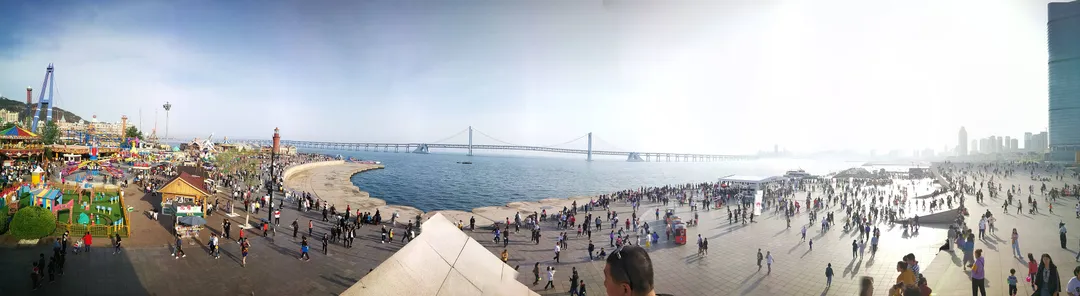
The first is the squares. Dalian was laid out by Russian planners in 1899 and rebuilt under Japanese rule from 1905 to 1945, and both eras left a city of radial avenues and round plazas rather than the rectangular grid of most Chinese cities. Zhongshan Square is a ring of century-old bank buildings around a traffic circle; Xinghai Square is a paved expanse of roughly 1.1 million square meters on the south shore, routinely cited as the largest city square in Asia. Public space here is not decoration — it is where the city actually lives, with dancers, kite flyers, wedding photographers, and rollerbladers occupying it from dawn to dark.
The second is Binhai Road, the coastal road that wraps the southern shore for more than 30 kilometers, stitched together with wooden boardwalk, stairs, and viewing platforms above coves where locals swim from June to September. You can walk a demanding section in the morning and be eating sea urchin at lunch. Few large Chinese cities hand you a half-wild coastline this close to the center.
The third is texture you cannot fake: 1930s tram cars still in daily service, a Japanese-era villa district in Nanshan, a Russian concession street near the station, and a harbor that is ice-free in winter. The colonial layer is complicated, and the city presents it plainly in museums rather than hiding it. Add the fact that summer highs sit in the mid-20s Celsius when inland China is roasting, and the logic of the place becomes obvious.
Dalian is not a museum-city like Beijing or a food-capital like Chengdu. It is a city for walking the shore, eating from tanks, riding a rattling tram through a century of architecture, and doing very little at maximum effort. If that appeals, it delivers.
Equally, be honest about the mismatch cases. If your ideal China is imperial palaces, temple complexes, and UNESCO-listed old towns, Dalian has little of that — its monuments are squares and shorelines, and its history is a port history. If you are chasing nightlife till 4:00, you will run out of city by midnight. And if you come between November and April expecting beach weather, the wind off the Bohai will correct you within an hour. Come in the right season with the right expectations — sea, squares, trams, seafood — and it is one of the most livable-feeling big cities in the country.
Top Attractions
We rank the five below as the core set. Spread them over two days rather than one; the distances are short but the walking adds up, and the two paid sights each eat half a day.
Xinghai Square (星海广场)
Built on reclaimed land in the 1990s to mark the city's centenary, Xinghai Square is less a square than a horizontal district: a vast paved ellipse running down to Xinghai Bay, with a tall centenary column at its heart and bronze footprints set into the pavement tracing a century of residents. Come at dawn to watch runners and tai chi groups own the space, or at dusk when the kite flyers and buskers take over. Entry is free and it never closes.
The practical reason to come here is orientation. The square anchors the western end of the city's southern shore: the convention center and Dalian Shell Museum — housed in a castle-like building a short walk away — sit on its flanks, and the beach below the square, Xinghai Bay bathing beach, is the most accessible stretch of sand for anyone staying downtown. Give it ninety minutes, more if you swim. On summer weekends the square hosts festival stages and, in late July, the Dalian International Beer Festival takes it over completely.
Binhai Road (滨海路)
Binhai Road is the 30-plus-kilometer coastal road that traces the southern rim of the city peninsula. It is formally split into west, middle, and east sections, and you are not meant to drive it end to end; you walk a section and let the rest go by on a bus window. The classic walks are Fujiazhuang to Beidaqiao (North Bridge) in the west and the wilder Yanwo Ridge stretch in the middle, where the boardwalk climbs over headlands and drops into coves. Terrain is steep in places — wear real shoes, carry water, and start before 10:00 in July and August.
The road is also the city's outdoor social calendar. On summer mornings you will pass fishing lines off the rocks, retirees doing stair repeats, and couples photographing the sea stacks; on October weekends the same path is quiet enough to hear the surf the whole way. The tourist loop bus that circles the road in peak season stops at the main trailheads — have your hotel write the stop names in Chinese, because the signage at the stops is mostly domestic.
Our honest advice: pick one section of 5-8 kilometers rather than attempting the whole thing. The boardwalk between Fujiazhuang and Beidaqiao takes about two hours at a relaxed pace, ends at a photogenic suspension footbridge, and can be exited to a main road for a taxi or bus back. In peak season a tourist loop bus runs the road; ask your hotel to write the stop names in Chinese. Sunset from Beidaqiao is the reliable finish. There is no ticket; the cost is your calves.
Laohutan Ocean Park (老虎滩海洋公园)
Laohutan is Dalian's 5A-rated marine park on the southeastern corner of the peninsula — polar aquarium, coral hall, sea lion theater, and a bird park across the road. The combined ticket runs about 190-220 CNY depending on season and channel, and children under 1.2 meters enter free. It is unapologetically family-oriented: beluga and penguin feeding sessions, dolphin shows at fixed times, and a lot of strollers. Check the show schedule at the gate and plan backward from it, because the shows are the product.
Is it worth it for adults traveling without children? Partially. The polar building is genuinely good — the beluga tank is among the largest of its kind in China — but four hours here competes with four hours of coastline you can walk for nothing. Our split decision: with kids, it is a full and easy half-day; without them, only if the weather turns wet, and in that case buy tickets online in the morning for a discount and skip the on-site queue. Metro Line 5's southern end plus a short taxi hop covers the approach. Practical notes for the visit: the park opens around 8:30-9:00 and winds down by late afternoon, the animal shows are spread across the day so photograph the schedule board at the gate, and the terrain slopes downhill from the entrance toward the sea — do the shows first and the aquarium walk after, or you will climb everything twice. There are decent food counters inside at theme-park prices; a smarter move is the cluster of seafood restaurants outside the gate for dinner afterward.
Russian Style Street (俄罗斯风情街)
A 200-meter pedestrian street at the north end of the old Russian quarter, a few minutes' walk from Dalian Railway Station. The original buildings date from the Dalniy concession years around 1900, and the street was restored and themed in the 2000s: pastel facades, onion domes added in places, and a dense strip of shops selling Russian chocolate, vodka, amber, and matryoshka dolls — much of it generic import stock aimed at domestic tourists, so treat it as street theater rather than a shopping mission.
It costs nothing and takes 30-45 minutes, which is exactly the right dose. Combine it with the railway station itself — a substantial 1930s building worth a slow lap — and the tram stop outside, where Line 201's heritage cars turn. Late afternoon light is the best time for photographs. Vendors accept cash and QR payment; prices for souvenirs are soft, so a polite counter-offer is expected on anything not marked fixed-price.
Donggang Music Fountain (东港音乐喷泉)
Donggang is the newest district, east of the center along the working harbor, and its plaza fronts the angular Dalian International Conference Center — the building that looks like a collapsed silver sculpture and hosts the Summer Davos forum when it is in town. In the warm season, roughly April or May through October, the plaza's musical fountain runs evening shows, typically starting between 19:30 and 20:30 depending on the month and the day. Shows are free, timed to music, and genuinely large; locals treat them as the default evening out.
Verify the show schedule for your exact date — the city publishes it and your hotel will know — because it does not run every evening outside July and August. Make a loop of the neighborhood: harbor promenade, conference center exterior, fountain, then dinner at one of the Donggang restaurants facing the water. Metro Line 2 serves the conference-center area, or it is a 15-20 minute taxi ride from Zhongshan Square. Bring a layer; the sea breeze after dark is real even in August.
Where to Stay
Dalian's hotel geography is simple: the historic core around Zhongshan Square and Qingniwaqiao, the resort-adjacent zone at Xinghai Square, and the new business district at Donggang. All three are within 20-30 minutes of each other by taxi, so you cannot go badly wrong — but the trade-offs differ.
Zhongshan Square and Qingniwaqiao (中山路/青泥洼桥). The oldest downtown: radial streets, colonial-era bank buildings, the main shopping malls, and Dalian Railway Station with its tram connections. Staying here puts Russian Style Street, the station, and the metro's Line 2 within walking distance, and street food is never far. Business-standard doubles run roughly 250-500 CNY, with hostels near the station from 60-120 CNY for a dorm bed. This is our default recommendation for first-time visitors without a car: maximum walkability at mid prices.
Xinghai Square (星海广场). The leisure zone. Hotels sit between the square and the bay, breakfast crowds are families, and the beach is downstairs. Expect 300-700 CNY for solid four-star comfort, more during the July-August school holidays and beer festival. The trade-off is distance from the old quarter's eating streets — budget for taxis in the evening. Choose it if beaches and evening square life outrank restaurants on your list, or if you are traveling with children.
Donggang (东港). The newest CBD: conference center, harbor promenade, upscale international-chain hotels typically 400-900 CNY, and the fountain on your doorstep. Rooms are newer and quieter, but late-night cheap eating is thinner and the district can feel sterile on weekends. Choose it for business, honeymoon comfort, or if your evenings revolve around the fountain shows.
Book two to three weeks ahead for July and August, and re-check prices if the Summer Davos forum lands on your dates — when it does, business-district rates spike hard.
Two more booking notes. Apartment-style rentals via the domestic platforms are plentiful and cheap in Dalian, but most require a Chinese ID for self-check-in; international travelers should filter for listings that explicitly handle passport registration or stick to hotels, which handle it automatically at check-in. And if your dates overlap any holiday week — October Golden Week above all — book the moment the dates are fixed: the good mid-range rooms in the old core sell out first, and what remains is priced for desperation.
Gastronomy
Dalian eats from the sea first and from the Northeast second. The city sits between two fisheries, the Yellow Sea and Bohai Bay, and the local orthodoxy is minimal cooking: steamed, boiled, raw on ice, or grilled over charcoal. Come hungry for the following.
Seafood, ordered from the tank. The correct format is a restaurant with live tanks where you point, and the kitchen steams or boils what you chose. Sea urchin (海胆) is the local pride, best in late spring; oysters (海蛎子) are a winter obsession; swimming crab (飞蟹) peaks in autumn; mantis shrimp (虾爬子) is the messy summer favorite. Always ask the price per jin (500 grams) before the animal leaves the tank, and confirm whether the quoted price is per jin or per piece — this is the single most common tourist surcharge. A tank-dinner for two runs 300-600 CNY if you behave, more if you do not.
Mackerel dumplings (鲅鱼水饺). Spanish mackerel minced into juicy dumplings is the one dish that defines Dalian home cooking. Any neighborhood dumpling house does them well for 25-50 CNY a platter; they are the correct lunch between sights.
Menzi (焖子). A slab of sweet-potato starch jelly, pan-fried until crisp at the edges and served with a spoon of sesame paste and garlic sauce. It is street food, it costs 5-10 CNY, and Dalian people will defend it against all doubters. Find it at night-market stalls and eat it standing.
Iron-plate squid (铁板鱿鱼). Whole squid flattened on a hot plate, brushed in sweet bean sauce, 10-15 CNY on a stick. It is the smell of every Dalian seaside evening, Xinghai to Donggang.
Salted fish with corn cakes (咸鱼饼子). The old fisherman's plate: salty dried fish steamed and paired with coarse cornmeal cakes. Old-school restaurants around Qingniwaqiao serve it; it is heavy, cheap, and honest.
Beyond those, the Northeast canon — sweet-and-sour guobaorou, disanxian, and charcoal barbecue with warm beer — is everywhere, and barbecue alleys run late into the night.
Breakfast is its own ritual and worth keeping: steamed mackerel buns, soy milk, fried dough sticks, and congee from morning stalls around Qingniwaqiao and the station, 10-20 CNY eaten standing. For a sit-down anchor, the streets immediately north of the station and the lanes off Tianjin Street hold decades-old dumpling houses and seafood restaurants with laminated photo menus — pick the ones where the staff are eating their own dinner. Practical notes: pay by QR code everywhere including most stalls; menus with pictures are standard; and the tourist-heavy seafood restaurants with hosts dragging you in near the squares are best declined — walk two blocks inland to where the queues are local.
Practical Information
Visa
China's unilateral visa-free entry scheme covers a long list of European, Asia-Pacific, and American countries for stays of up to 30 days, and it has been extended repeatedly — verify your nationality against the current list before booking, because the scheme carries an expiry date that keeps being rolled forward. Separately, the 240-hour (10-day) transit-without-visa scheme applies to travelers from 54 countries arriving with onward tickets to a third country; Dalian's airport is an eligible port, but the routing rules (a genuine third-country destination, not a return to where you came from) are enforced, so check your itinerary against them. Standard L tourist visas through embassies and visa centers remain the fallback, and 10-year multiple-entry visas are issued to some nationalities. Your passport needs six months of validity and blank pages.
Currency and Payments
The currency is the renminbi (CNY); the exchange rate has hovered around 7 CNY to 1 USD. Cash matters less every year, but not zero: bind a foreign Visa or Mastercard to Alipay or WeChat Pay and it will cover 95 percent of your spending, including stalls, taxis via the Didi app, and metro QR tickets. Carry a few hundred CNY in cash for the remaining five percent — old-stall snacks, temple doors, emergency taxis. ATMs at Bank of China and ICBC branches accept foreign cards for cash withdrawal. Tipping is not practiced anywhere, and attempts are usually refused.
Getting Around
The metro is the backbone. Lines 1, 2, 3, and 5 cover the city: Line 1 runs north-south past the convention-center side of Xinghai, Line 2 links the airport and the Donggang area, Line 3 is the suburban line to Jinshitan (8 CNY, about 50 minutes from Dalian Station), and Line 5 — opened in 2023 — dives under Dalian Bay and serves the Laohutan end of town. Fares are distance-based from 2 CNY (up to 6 km) to about 8-10 CNY at the far ends. Buy single-journey tickets from machines or use Alipay's transit QR.
The trams are the pleasure. Lines 201 and 202 survive from a network over a century old, and Line 201 still runs heritage 1930s-style cars in cream and burgundy alongside modern stock. Since October 2025 the fare is a flat 2 CNY for the whole route (short hops were 1 CNY before that reform) — pay coins on board or scan. Ride it from near Dalian Station toward the eastern end at least once, ideally in late-afternoon light.
Buses cost 1-2 CNY. Taxis start around 10 CNY and are honest; Didi hails the same cars slightly cheaper and removes the language problem. City bikes are of limited use — Dalian is built on hills and slopes. Ferries from the port run overnight to Yantai in Shandong (six to eight hours) if you want to continue south by sea.
For arrivals: Zhoushuizi Airport (DLC) sits 10 kilometers northwest of the center, and Line 2 makes the transfer trivial — about 30 minutes to the Zhongshan side. Rail travelers arrive at Dalian Station downtown or Dalian North for most high-speed services; from Dalian North, a metro or a 20-minute taxi bridges to the old core. If you are building a regional trip, Shenyang is two to two-and-a-half hours by high-speed rail, Beijing four to five, and the Harbin side connects through Shenyang — Dalian pairs naturally as the coastal finish to a northeastern loop.
Best Time to Visit
May through September is the honest window. Late May brings the locust blossom the city is famous for — the Locust Flower Festival (槐花节) celebrates streets that smell of flowers for two weeks — and the sea has warmed by late June. July and August are peak: beach weather, the beer festival, school holidays, and the year's highest prices. September is our favorite month — the sea is still swimmable early on, the light is clean, and the crowds halve. October turns windy and cool; the October Golden Week holiday should be avoided entirely. Winter is quiet, cold without being brutal (roughly -5 to 3 degrees Celsius), and the harbor never freezes — a fair trade if you dislike crowds more than wind.
Cultural Considerations
Dalian is relaxed by Chinese standards, but a few things help. Squares are living rooms: Zhongshan Square in the evening fills with dancers, saxophone players, and badminton games, and joining a dance circle as a foreign guest will get you applause, not side-eye. Walk around the activity rather than through it.
The colonial past is handled openly. Museums and street plaques present the Russian concession and the Japanese-era decades factually, and Lushun's battlefields are taught as history. Questions are welcome; flippancy about the wars is not. One firm rule at Lushunkou: the naval base is active, and photographing warships or restricted waterfront zones is genuinely prohibited — signage is posted and enforced, so zoom lenses stay down around military vessels.
At the beach, locals often swim in shorts and t-shirts rather than swimwear, especially older people; bikinis are normal at resort beaches but draw attention at neighborhood ones. Do as the mood of the beach suggests. Drinking culture is northeastern: at a barbecue table you may be offered baijiu and a ganbei toast — sip if you must, but matching a local shot for shot is a losing strategy. Tap water is not for drinking; boiled or bottled only. Smoking is common outdoors and rare enforcement; simply step away from crowds. English is thin outside hotels — have destinations written in Chinese characters, which fixes 90 percent of taxi and counter interactions. The local dialect, Dalianhua, descends from Shandong migration and sounds closer to Yantai than to Harbin; standard Mandarin is universally understood, and a few words of thanks in the local accent will get you further than fluent textbook phrases.
Small courtesies carry weight here as everywhere in the Northeast: accept what is offered, hot tea included; let elders board first; and if someone insists on paying for your meal at a shared table, that is not an error — it is the region working as designed. Museums close on Mondays as a national habit, so front-load indoor sights on other days. Photography is welcome almost everywhere except the military-adjacent zones noted above; ask before aiming a camera at dancers and street performers, and the answer is nearly always yes.
Two-Day Itinerary
Day 1 — old city, tram, and the fountain. Start at Zhongshan Square at 8:30, while the bank buildings glow and the morning dancers are out; walk the ring slowly. From there it is 15 minutes on foot to Russian Style Street — do it before the souvenir shops fully wake, then look at the 1930s railway station. Lunch: mackerel dumplings near the station. Ride tram Line 201 east as your afternoon transit-and-attraction in one (2 CNY, sit by the window). If you have children or the weather is wet, spend the afternoon at Laohutan Ocean Park (190-220 CNY, shows timed — confirm the last dolphin show); if not, walk the Fujiazhuang stretch of Binhai Road instead. Dinner at a barbecue street, then the Donggang music fountain show (free; verify tonight's start time). This day works entirely on foot, tram, and one taxi.
Day 2 — seafront west. Early at Xinghai Square before the tour groups: kites, runners, and the centenary column, then the Shell Museum if the sky is grey or the kids need it. Walk or bus down to the Fujiazhuang-Beidaqiao boardwalk if you did not do it on Day 1, or swim at Xinghai Bay beach if you did. Lunch: pick-your-tank seafood two blocks inland from the square. Afternoon options in order of our preference: Yanwo Ridge headland walk, People's Square and the Nanshan villa streets with a coffee stop, or Forest Zoo if the children vote. Evening: Qingniwaqiao malls for people-watching, then menzi and iron-plate squid from street stalls. Total cost of the two days per person, mid-range: roughly 700-1,200 CNY including one paid attraction and a seafood dinner.
Day 3 — choose one escape: Lushun for war history and cherries, or Jinshitan for rocks, beach, and the theme park. Both are covered below. Trying to do both in one day is possible by car but miserable.
If you have a fourth day, do not add another sight — spend it on the version of Dalian the itineraries skip: a slow tram-loop morning, the Nanshan lanes, a long seafood lunch, an afternoon swim, and the fountain again. The city rewards repetition more than coverage; the second evening at Xinghai Square is better than the first, because by then you know where the wind comes from.
Beyond the Highlights
A handful of places most one-day visitors miss, all inside the city.
Nanshan villa streets (南山风情街). A quiet district of 1920s-30s Japanese-era houses, restored as a low-key heritage block with cafes in the old walls. Come on a weekday morning; it is ten minutes from the noise and a century away in mood. Free.
People's Square (人民广场). The administrative heart, framed by government buildings in grand mid-century style, with pigeon flocks and, in the evening, dance groups that out-draw the tourists. Free, and a good shortcut between Qingniwaqiao and the tram.
Labour Park (劳动公园). A hill park in the city center with fountains, a small amusement area, and a viewpoint that frames the downtown towers. Locals run its stairs at dawn. Free.
Bangchui Island (棒棰岛). A state-guesthouse beach and cove on the eastern shore, quiet and groomed, entry about 20 CNY. The offshore islet gives it the name; the pebble-sand mix underfoot is unusual for the city. Half a morning is right.
Dalian Modern Museum (大连现代博物馆), by Xinghai Square. The city's history told straight, from concession to shipyard to software park, with competent English labeling on the main line. Free or nearly so with passport; closed Mondays, like most Chinese museums.
Forest Zoo (森林动物园). Pandas on a forested slope above Binhai Road, roughly 100-120 CNY, and a cable car connection that is half the fun. With children it competes with Laohutan for your paid half-day; without them, skip it for the coast.
Nightlife
Dalian's night is a seaside night, not a clubbing capital. The spine of it is eating late: barbecue alleys and night markets run until midnight and past it, tables on the sidewalk, squid on the iron plate, warm beer by the crate. The Taiyuan Street night market and the snack lanes near the universities are where students and families spend their evenings; go with an empty stomach and a QR wallet.
The other pillar is the free show: Donggang's fountain in the warm months, and the Zhongshan Square circle afterward, where the saxophones and dance groups hold court past 22:00. The harbor promenade in Donggang is the city's best after-dark walk, sea on one side, lit towers on the other, and the conference center glowing like a beached spacecraft.
For bars, Donggang and the Xinghai hotel belt hold the cocktail and craft-beer rooms, mostly in or near four-and-five-star hotels, with a scattering of livehouse venues and KTV parlors in between — ask your hotel front desk what is on that week, because the live-music calendar moves. In late July the beer festival at Xinghai Square is effectively a two-week citywide party with festival-priced mugs. One expectation to set: this is not Shanghai or Shenzhen; most streets empty by 23:00, and the nightlife that matters happens between 19:00 and midnight, ideally outdoors, usually with shellfish involved.
Day Trips
Lushunkou (旅顺口)
The port city at the peninsula's southwestern tip, 45 kilometers from downtown and a name written deep into modern Asian history — the Sino-Japanese War of 1894-95 and the Russo-Japanese War of 1904-05 both turned on this harbor. Getting there is genuinely easy now: Metro Line 1 to Hekou, transfer to Line 12 toward Lushun, roughly 90 minutes end to end; a Didi runs it in about an hour for several hundred CNY round trip if you value time.
Spend the morning at 203 Hill, where trenches from the 1904 siege are preserved on a grassy ridge, and Baiyu Hill, whose tower gives the classic view over the harbor mouth. Lushun Museum, in a striking historic building, is worth an hour. The Russo-Japanese prison site is the heaviest ticket in the region — go if you want the full history at full weight. Two rules: do not photograph the naval base or anything gray and anchored, and do not try to rush this as a half-day; leave at 8:00, return by 17:00. From late May into June, add a pick-your-own cherry orchard — Lushun cherries are the local luxury, and orchard entry plus all-you-can-eat runs a few tens of CNY on top of what you carry home.
Jinshitan (金石滩)
The national geopark and resort coast on the city's far eastern side, and the easy one: Metro Line 3 runs direct from Dalian Station to Jinshitan, 8 CNY, about 50 minutes, no transfers. The geopark's sea stacks and wave-cut rock formations — the "dinosaur drinking at the sea" arch is the postcard — sit on a dramatic cliff walk; combination tickets for the core geological sights run roughly 60-100 CNY. The Golden Coast beach is the city's best sand and free.
The complicating factor is Discovery Kingdom (发现王国), the amusement park that anchors the resort zone: a full-day adult ticket runs roughly 210-260 CNY, with night-entry tickets around 150 CNY and online channels reliably cheaper than the gate. With teenagers, this decision makes itself. Without them, we would give the day to the geopark walk in the morning, the beach after lunch, and the Line 3 ride home. Summer weekends crowd both park and beach; a weekday visit is a different experience and the same price.
Events and Festivals
The Dalian calendar is built around summer. The Locust Flower Festival (槐花节) in late May celebrates the city tree with two weeks of fragrance and small street events — it costs nothing and scents every walk. The Dalian International Marathon, one of China's older city marathons, runs in May and finishes in the squares; even as a spectator you inherit the crowd energy and the road closures, so check the course map if you have a morning train. The big one is the Dalian International Beer Festival in late July and early August at Xinghai Square — festival halls from brewers domestic and imported, staged music nightly, and a crowd that behaves exactly as you would expect a city of 7.5 million on summer holiday to behave.
September brings the Dalian International Fashion Festival, a civic institution since the late 1980s, with runway events and a citywide sales season that folds neatly into a shopping trip. The quieter calendar note we like most: cherry season in Lushun from late May into June, when orchards open for pick-your-own and the price per basket beats any fruit shop in the country. Autumn's unmarked festival is the seafood — crab season opens properly in September, and every restaurant's tanks improve overnight.
One recurring planning wrinkle: the World Economic Forum's Summer Davos alternates between Dalian and Tianjin, most recently here in 2024. When the forum is in town, hotel capacity tightens and business-district rates spike for about a week — check the forum dates against your trip if you are coming in late June.
Shopping
Shopping in Dalian is practical, not precious. The core is Qingniwaqiao (青泥洼桥), the pedestrian-and-mall district between the railway station and Zhongshan Square: department stores such as the long-running Dalian Department Store, international-flag malls, and the food courts and basements where the useful buying happens — local snacks, tea, and vacuum-packed seafood. Tianjin Street, the old commercial street, has faded and revived and faded again; walk it for the architecture and low prices rather than for fashion.
The two Dalian-specific buys are dried seafood and shells. Dried scallop adductor (瑶柱), shredded squid, and kelp make cheap, light gifts; sea cucumber is the serious-money version and only worth buying from a proper shop with a receipt, because grading is opaque and prices run from hundreds to thousands of CNY per jin. Shell carving (贝雕), the city's traditional craft, survives in workshop shops near Xinghai — a small carved panel beats a fridge magnet. On Russian Style Street, the matryoshka-and-chocolate trade is fun for an hour; bargain politely on anything unmarked. In cherry season (late May-June), roadside stalls on the Lushun road sell fruit that elsewhere in China is imported and twice the price.
Malls open 10:00-22:00; street stalls and night markets take over after dark. Prices in fixed shops are fixed; in markets, a friendly counter-offer starting around 70 percent is normal procedure, delivered with a smile.
Decision Support
Map
Dalian occupies the tip of the Liaodong Peninsula, the city wrapped around its southern and eastern shores. The three useful mental pins: Zhongshan Square and Qingniwaqiao form the old core on the east side; Xinghai Square anchors the southern shore about 20 minutes west by taxi; Donggang is the new harborfront district immediately northeast of the old core. Binhai Road strings along the southern rim between and beyond them. Lushunkou is the peninsula's southwest tip (Line 1 to Line 12, about 90 minutes); Jinshitan is far to the east in Jinzhou district (Line 3 direct, about 50 minutes). Download offline maps in Amap or Baidu Maps before arrival — Google Maps is unreliable for navigation inside China, and English signage thins fast outside the core. Every attraction in this guide is within the transit grid described above; nothing requires a rented car, though a day with a Didi at your disposal pays for itself at Lushun.
Cost breakdown
Mid-range daily budget per person, 2026 prices: accommodation 300-600 CNY (hostel dorm 60-120; business four-star 250-500; Donggang five-star 400-900); food 100-200 CNY if you eat local, with one tank-seafood dinner for two at 300-600 CNY as the exception; local transport 30-60 CNY (metro 2-10 CNY per ride, tram 2 CNY flat, short Didi hops 10-20 CNY); attractions free to 260 CNY — all squares, the fountain, beaches, Binhai Road, and the modern museum are free, Laohutan runs 190-220 CNY, Discovery Kingdom 210-260 CNY, the Jinshitan geopark core 60-100 CNY. Realistic totals: backpacker 250-350 CNY per day, mid-range 500-1,000 CNY, comfortable-with-five-star 1,200-2,000 CNY. July-August adds 20-50 percent on rooms; September gives the same city for less.
When to go
The five-month honest window is May through September. Our two picks: late May into early June, for the locust blossom, cherries in Lushun, and pre-peak prices; and September, for warm seas early in the month, crab season, clean light, and half the crowds. July and August are the full summer package — swimmable water, the beer festival, every square alive — at peak prices and peak humanity; fine if beaches are the point, miserable if queues are not. Avoid October 1-7 (Golden Week) absolutely, and re-check dates against Summer Davos and the marathon. Winter (December-February) is quiet, windy, and around -5 to 3 degrees Celsius — a defensible choice for travelers who want museums, hotpot, and empty boardwalks.
Practical
Three days is the sweet spot: two city days plus one day trip (Lushun for history, Jinshitan for coast). Arrive via Zhoushuizi Airport (DLC), 20-30 minutes from the center on Metro Line 2; high-speed rail connects Shenyang in about two hours and Beijing in four to five; overnight ferries run to Yantai if you are continuing down the coast. Set up Alipay or WeChat Pay with a foreign card before you arrive; carry a few hundred CNY cash as backstop; buy a tourist eSIM (Airalo and similar, from about 5 USD) or a local SIM at the airport. Book Laohutan and Discovery Kingdom online the night before for discounts. Keep your passport on you — museums and hotels require it. Pack for the wind rather than the calendar: even in August a light jacket earns its place on the seafront after dark, and in May and October you will want a real layer. Emergency numbers: police 110, ambulance 120, fire 119, national tourist hotline 12301. And when in doubt about any evening plan in warm months: the fountain, then squid, in that order.
Sources
- https://www.trip.com/travel-guide/dalian/ — Trip.com's Dalian destination hub, useful for current attraction tickets, opening hours, and recent traveler reviews.
- https://www.laohutan.com.cn/ — Laohutan Ocean Park official site: show schedules, hours, and current ticket tiers.
- https://www.dalian.gov.cn/ — Dalian municipal government portal for city notices, event calendars, and transport announcements.