Quick answer
Gulangyu is a car-free island of 1.88 km² ten ferry-minutes off Xiamen: 931 historic buildings left by an international settlement, a piano culture dense enough to earn the nickname "Piano Island", and UNESCO listing since 2017 as "Kulangsu, a Historic International Settlement". Round-trip ferries start at ¥35, the five-sight combo ticket costs ¥90, and the island rewards 1–2 days — a full day for the sights, or an overnight to hear the lanes go quiet after 18:00. Book the ferry 1–7 days ahead: the island has a daily visitor cap, and boats sell out on weekends.
Why this matters in 2026
Gulangyu changed rules after the UNESCO inscription in 2017: a daily visitor cap, ferries that sell out days ahead on holidays, and timed ticketing through the official WeChat mini-program. That turns what used to be a spontaneous side-trip into something you book — and it makes the timing strategy the difference between a gauntlet of tour groups and the quiet island the architecture was built for. In 2026 the practical kit is straightforward: ticket booking through Trip.com or the "Xiamen Ferry" mini-program, English signage at the main sights, and mobile payment at every ticket window and most stalls.
Key facts at a glance
- UNESCO: listed 2017 as "Kulangsu, a Historic International Settlement"
- Ferry: round trip from ¥35 (¥50 premium cabin); daytime sailings from the cruise-center terminal, night sailings to Sanqiutian; every 20–30 minutes, roughly 5:30–24:00 in summer and 6:00–23:00 in winter
- Tickets: five-sight combo ¥90; standalone sights ¥10–30; Sunlight Rock ¥60; Haoyue Garden ¥15
- Time needed: 1 full day for the essentials; 2 days with an overnight for the quiet evening and morning
- Walking: the island is 30 minutes end to end on foot, all of it car-free — no cars, no bicycles
- Best time: March–May and October–November; weekday mornings; overnight if you can
- Booking: ferry tickets 1–7 days ahead via the "Xiamen Ferry" WeChat mini-program; passport required for foreign visitors
Getting there: the ferry from Xiamen
All visitors arrive by ferry, and the rules matter more than the distance. Round-trip tickets start at ¥35, with a ¥50 premium cabin that shortens queues on busy days. Daytime sailings leave from the cruise-center terminal (厦鼓码头, reached by Metro Line 2) and cross in 10–20 minutes depending on the route, arriving at Sanqiutian or Neicuo'ao pier — choose Neicuo'ao if you want to start in the quieter north. In the evening the city-side departure moves back to the old Lundu ferry pier below Zhongshan Road, with night arrivals at Sanqiutian. Boats run every 20–30 minutes, from about 5:30 to midnight in summer and 6:00 to 23:00 in winter.
Book 1–7 days ahead through the official "Xiamen Ferry" (厦门轮渡) WeChat mini-program — the island has a daily visitor cap, holiday queues at the pier can run past 2 hours, and the ticket is round-trip and stays valid for 20 days, so keep it for the return. Foreign visitors book with a passport, which is checked at the gate.
The architecture: 931 buildings and 13 flags
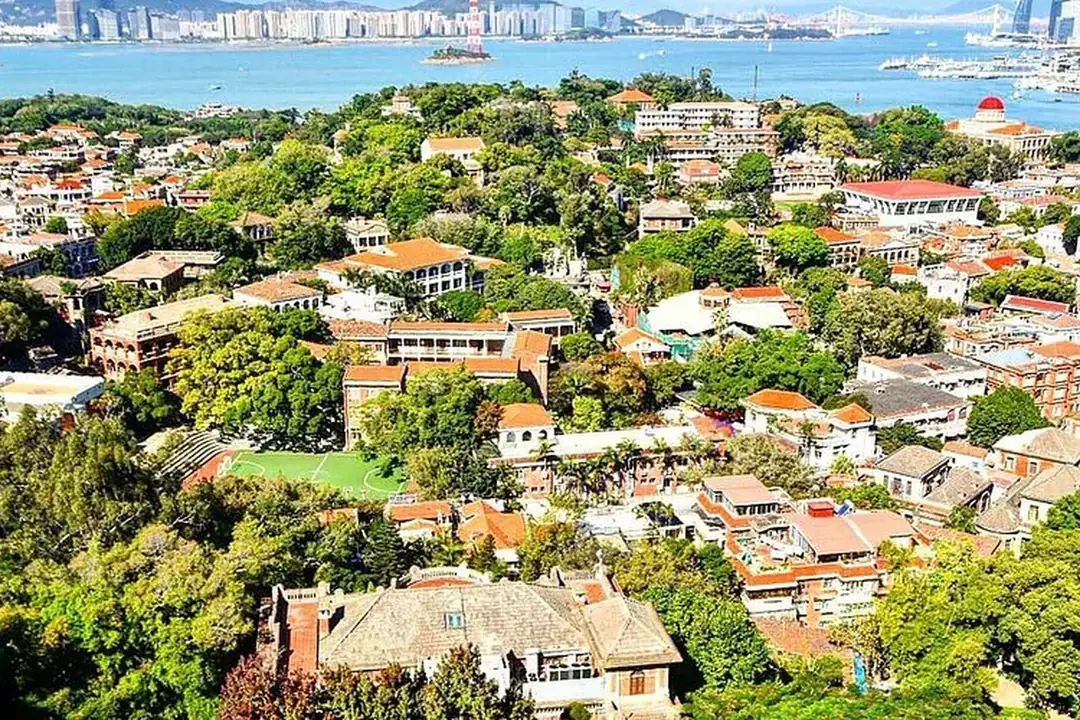
Xiamen opened as a treaty port after 1842, and in 1903 Gulangyu formally became an international settlement: 13 nations set up consulates, churches, schools and trading houses on the hillside. The result is the densest concentration of colonial-era architecture in China — 931 historic buildings in walking distance of each other, from Gothic revival and baroque churches to Spanish-Mediterranean villas, British veranda mansions and red-brick Fujian houses with tropical courtyards. The local specialty is "Amoy Deco", a 1920s–30s blend of Art Deco lines with southern-Fujian motifs; look for it along Longtou Road and in the villas above it. The island's most recognizable silhouette is the Bagua Building, the red-domed tower that houses the Organ Museum.
Walk the back lanes rather than the checklist: the southern half near the ferry piers carries the crowds, while the northern half around Neicuo'ao keeps shaded lanes, boarded-up villas and banyan roots over walls — with almost nobody in them before noon.
Piano Island: Shuzhuang Garden and the museums
The piano came with the missionaries and the returned overseas Chinese, and by the 1930s Gulangyu had China's highest per-capita piano ownership — the origin of the "Piano Island" nickname. The tradition produced pianists of the rank of Yin Chengzong, and it still shows: an international piano festival runs every October, and open windows leak practice scales on quiet afternoons.
The musical heart is Shuzhuang Garden (菽庄花园), a seaside garden built into the shoreline by a Taiwanese merchant in 1913, with a bridge that appears to walk on water. Inside it sits the Piano Museum (¥20), holding 100+ antique instruments including an 1843 Broadwood grand. The Organ Museum occupies the red-domed Bagua Building at the island's north — a complement to the piano collection, with instruments tall enough to fill a chapel.
Sunlight Rock, Haoyue Garden and the shoreline
Sunlight Rock (日光岩) is the island's summit at 92.6 m and the one unmissable view: a 360-degree sweep of red roofs, the strait and the Xiamen skyline. Entry is ¥60, included in the combo ticket, and the stairs are steep enough to justify going early. Haoyue Garden (皓月园, ¥15) at the island's east end faces the sea with its giant granite statue of Koxinga, the Ming loyalist who staged his fleet here in the 1600s. Between the two, the southern shoreline walks a promenade past Gangzaihou beach — the standard sunset spot, with the skyline across the water.
Longtou Road and eating on the island
Longtou Road is the commercial spine: snack stalls, tea shops, the pastry lines, and most of the island's foot traffic. Eat one meal here if you like the buzz, then take the standing advice — walk 10 minutes inland from the pier-side food street and the seafood gets better and cheaper at the small family places. Gulangyu's signature snacks are the ones you can carry: fish balls in broth, shacha noodles, and the tiny pastry shops that ship boxes across the strait. Prices on the island run above the mainland — bottled water and "special" coconut juice can cost 3–4 times the Xiamen price, so carry what you need.
Where to stay
The single best upgrade to a Gulangyu visit is sleeping on it. Boutique hotels in restored colonial villas run ¥300–1,500 a night, and the payoff is structural: after 18:00 the day-trippers' ferries thin out, by 21:00 the lanes are quiet enough to hear the sea, and the morning — before the first big boat arrivals around 9:00 — is an island with residents only. One night covers it: arrive in the morning, do the sights before the crowds peak, watch the sunset from Gangzaihou, dinner on Longtou Road, and a slow dawn walk before the ferry back. See the Xiamen city guide for mainland bases and the visit-Xiamen decision guide for the stay-vs-day-trip call.
Step-by-step walkthrough
1. Book the ferry, not just the trip
1–7 days ahead in the "Xiamen Ferry" mini-program, passport details ready. Weekends and holidays sell out first; the ¥50 premium cabin buys shorter queues.
2. Land early and go up first
Take a morning sailing to Neicuo'ao for the quiet north, and climb Sunlight Rock (92.6 m, ¥60) before the tour groups arrive mid-morning — the summit is small and the view is the island's signature.
3. Come down through the back lanes
Descend north or east through the villa lanes rather than returning the way you came: 931 buildings reward the wander, and the northern half is where the quiet is.
4. Make Shuzhuang Garden the midday anchor
The 1913 seaside garden and the Piano Museum (100+ instruments, including the 1843 Broadwood) hold 1.5–2 hours together, and the sea-wall paths carry a breeze at noon.
5. Handle Longtou Road on your terms
Lunch or snacks mid-afternoon when the lanes are fullest and you are heading the other way; then walk 10 minutes inland for the better-value seafood.
6. Stay for the evening — or time the last ferry
Overnight if you can (¥300–1,500 for a villa room): after 18:00 the island empties, and dawn before the 9:00 boat arrivals belongs to residents. On a day trip, watch the sunset at Gangzaihou and keep your ticket for the return.
Common scenarios and use cases
1. The day-tripper
First ferry out, Sunlight Rock early, Shuzhuang Garden and the Piano Museum midday, Longtou Road late afternoon, sunset at Gangzaihou, last ferry back. The ¥90 combo covers the five major sights in one day.
2. The overnighter
Day one as above, then the evening lanes, a villa night, and a second morning for Haoyue Garden (¥15), the Organ Museum in the Bagua Building, and the northern back lanes without a crowd in them.
3. The family with children
The car-free lanes make Gulangyu one of China's easiest sights with kids: no traffic, beaches to burn energy, and the piano museum's playable demonstrations. Skip the Sunlight Rock stairs with small children and hold the combo ticket for the garden sights.
4. The architecture and music traveler
Two days minimum. Amoy Deco on Longtou Road, the consulate row, the villa lanes of the north, the Piano Museum's 1843 Broadwood, the Organ Museum's chapel-scale instruments — and October, if you can time it, for the piano festival.
Costs and pricing breakdown
- Ferry: from ¥35 round trip (¥50 premium cabin)
- Five-sight combo ticket: ¥90
- Standalone sights: ¥10–30 (Piano Museum ¥20, Haoyue Garden ¥15)
- Sunlight Rock: ¥60
- Boutique hotel in a historic villa: ¥300–1,500 per night
- Sightseeing electric buggy: ¥200–300 per hour if the hills win
- Budget traps: island-priced drinks and snacks at 3–4 times mainland prices
- Holiday buffer: pier queues past 2 hours without an advance booking
Pitfalls to avoid
- No ferry reservation: the visitor cap sells out days ahead on weekends and holidays. Book 1–7 days ahead and carry the passport used to book.
- Losing the return ticket: the ferry is round-trip and valid for 20 days — screenshot it, because the return gate wants it back.
- The pier-side food street: the busiest stretch sells the island's worst-value seafood. Walk 10 minutes inland.
- Island pricing: bottled water and "special" coconut juice at 3–4 times the Xiamen price. Carry what you need from the mainland.
- Ferry-terminal myopia: the southern half by the piers is the commercial gauntlet. The 931 buildings include a whole quiet northern half that day-trippers never reach.
Alternatives and trade-offs
- Day trip: complete at a pace, but you see the island at its most crowded hours.
- Overnight: the same sights plus the quiet evening, the empty dawn, and villa-lane mornings — the version the architecture was built for.
- Sanqiutian vs Neicuo'ao arrival: Sanqiutian is central and busy; Neicuo'ao starts you in the calm north and works best for the early climb.
- Combo ticket vs singles: ¥90 pays off at 3+ sights; if you only want Sunlight Rock, pay the ¥60.
- Buggy vs walking: ¥200–300 an hour buys the hills, but the lanes — the actual sight — are pedestrian only.
Local context and customs
Gulangyu is a residential island first: people live their days around the visitor economy, goods arrive by electric cart, and the no-cars rule is civic identity, not just a tourist policy. Music runs deep — school orchestras, church choirs, the October festival — and open-window practice is ordinary, so listen as you walk and applaud only if invited. Sunday mornings fill the historic churches with congregations, not tourists; give the doorways room. And treat the lanes as someone's street: the island's charm is exactly that it never became a mall.
Verifying current information
Ferry schedules, prices and the visitor cap adjust with seasons and policy. Confirm before you go:
- Xiamen Ferry official booking: https://www.xmferry.com/
- Gulangyu tourism site: https://www.gly.cn/
- UNESCO World Heritage listing: https://whc.unesco.org/en/list/1541
- Trip.com attractions: https://www.trip.com/attractions
- Your hotel's front desk for same-day pier queues and last-sailing times
Related itineraries and guides
- Xiamen city guide — mainland bases, food and transport
- 2-day Xiamen itinerary — the city and the island in one weekend
- 3-day Xiamen itinerary — the island, the temples and the coastline
- Visit Xiamen decision guide — when Gulangyu is worth the ferry and when to skip
Putting it all together
Book the ferry 1–7 days out (from ¥35 round trip, passport in hand), sail to Neicuo'ao in the morning, and climb Sunlight Rock before the boats unload. Walk the villa lanes north, make Shuzhuang Garden and the Piano Museum your midday, and let Longtou Road handle lunch — then eat dinner 10 minutes inland instead. The ¥90 combo covers the five major sights, Haoyue Garden's Koxinga statue earns its ¥15, and if you can stay, a villa room between ¥300–1,500 buys the two things a day trip never sees: the lanes after 18:00 and the island before 9:00. UNESCO recognized this as a historic international settlement in 2017; you will recognize it as the easiest 1.88 km² walk in China.
FAQ
How do I get to Gulangyu from Xiamen?
Ferry only. Daytime sailings leave the cruise-center terminal (厦鼓码头, Metro Line 2) and arrive at Sanqiutian or Neicuo'ao in 10–20 minutes; night departures move to the old Lundu pier with arrivals at Sanqiutian. Round trip from ¥35.
Do I need to book ferry tickets in advance?
Yes — the island has a daily visitor cap and boats sell out, especially weekends and holidays. Book 1–7 days ahead in the official "Xiamen Ferry" WeChat mini-program with your passport; the ticket is round-trip and valid for 20 days.
What does Gulangyu cost?
The ferry starts at ¥35 round trip. The five-sight combo ticket is ¥90; standalone sights run ¥10–30, with Sunlight Rock at ¥60 and Haoyue Garden at ¥15. An overnight in a historic-villa hotel adds ¥300–1,500.
How much time should I plan?
One full day covers the sights at a good pace. Two days with an overnight is the better trip: the evening lanes after 18:00 and the morning before the 9:00 boat arrivals are the island at its best.
Why is Gulangyu full of pianos?
Missionaries and returned overseas Chinese made piano ownership a status symbol, and by the 1930s the island had China's highest per-capita piano ownership. The Piano Museum holds 100+ antique instruments, including an 1843 Broadwood grand, and a piano festival runs every October.
Is Gulangyu too crowded and commercial?
The southern half near the piers and Longtou Road is — seafood stalls, snack lines, tour groups. The northern half around Neicuo'ao keeps quiet lanes and most of the 931 historic buildings. Go on a weekday morning or stay overnight to tip the balance.
What should I climb, and what does it cost?
Sunlight Rock, the island's summit at 92.6 m — ¥60, included in the combo ticket, best before the mid-morning groups. For a flat alternative, Haoyue Garden's Koxinga statue at the east end costs ¥15.
Can I bring a bike or stroller?
No bicycles — the island is car-free for everyone, with goods moved by electric cart. Strollers work on the main paths but struggle on steps and steep lanes; a carrier is the better tool, or the sightseeing buggy at ¥200–300 per hour.