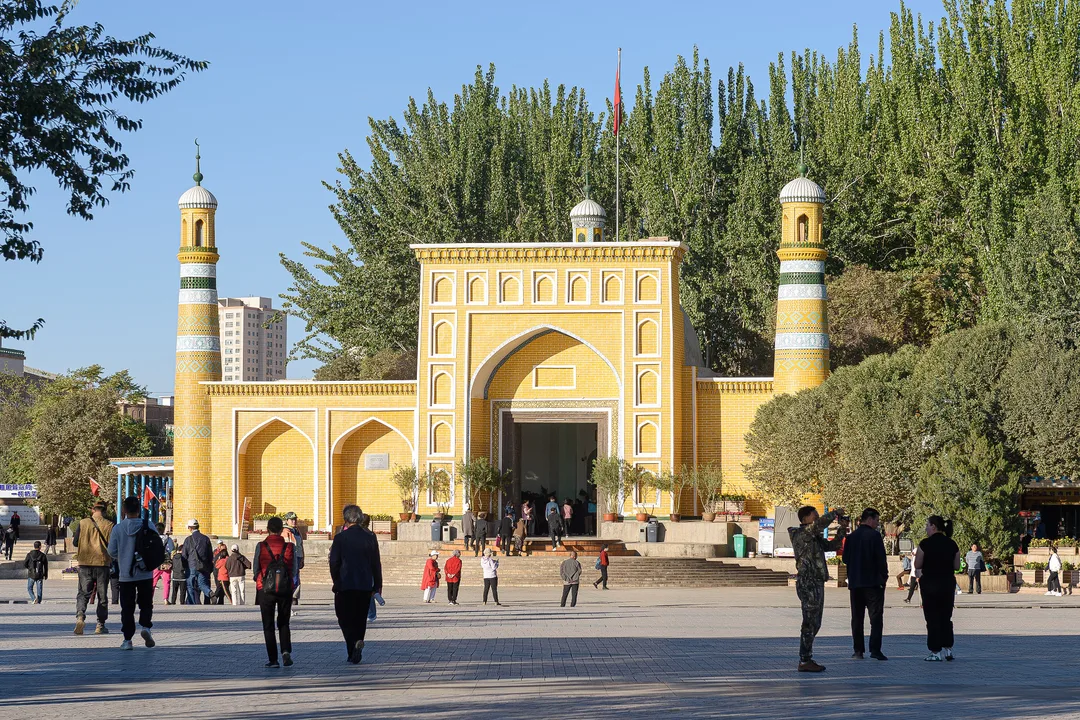
Id Kah Mosque艾提尕尔清真寺
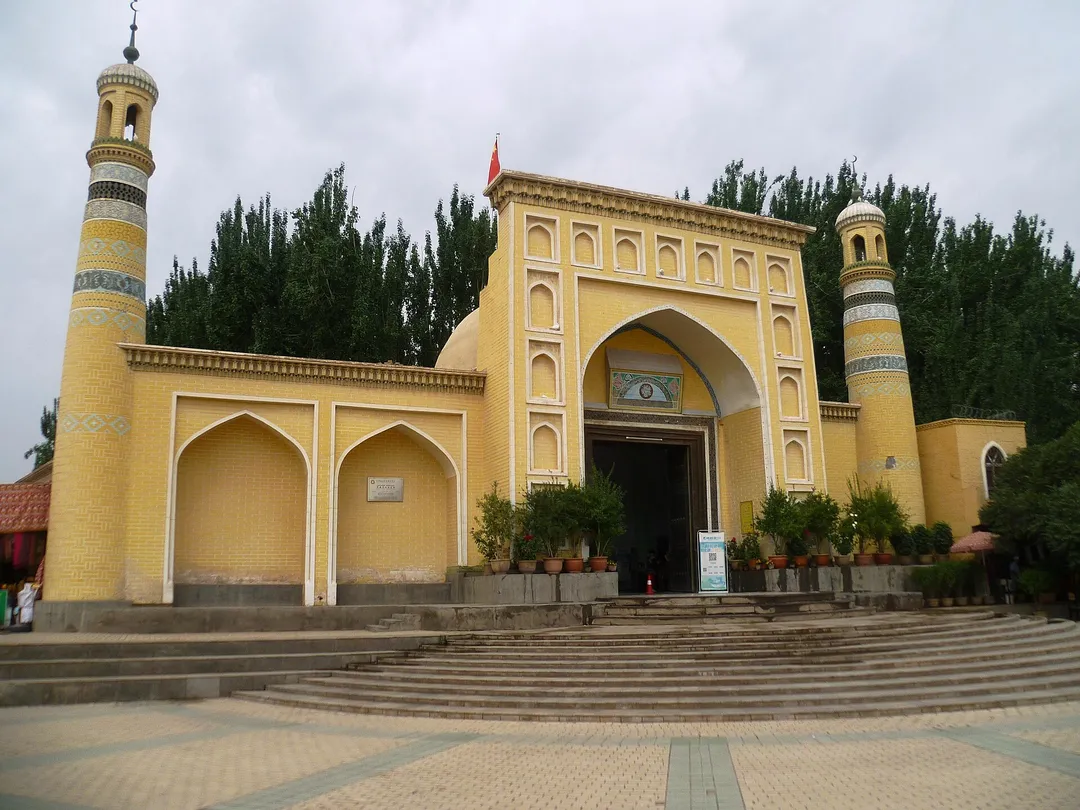
The Id Kah Mosque ('Id Kah' means 'festival place') has anchored Kashgar's main square since the mid-15th century and is one of the largest mosques in China, a complex of courtyards, pine-shaded prayer halls and the iconic yellow iwan gate facing the square where Friday crowds and festival dancers gather. Non-Muslim visitors are admitted outside the five prayer times — buy a ticket at the gate, dress modestly, and walk the outer courtyard, the main hall with its carved pillars and the gardens behind. The mosque sits at the exact pivot of the Old City: the artisan lanes start beside it, the Grand Bazaar lies across the river to the north, and the evening square is the liveliest people-watching spot in the city.
Kashgar · Visitor Guide2026-11-17
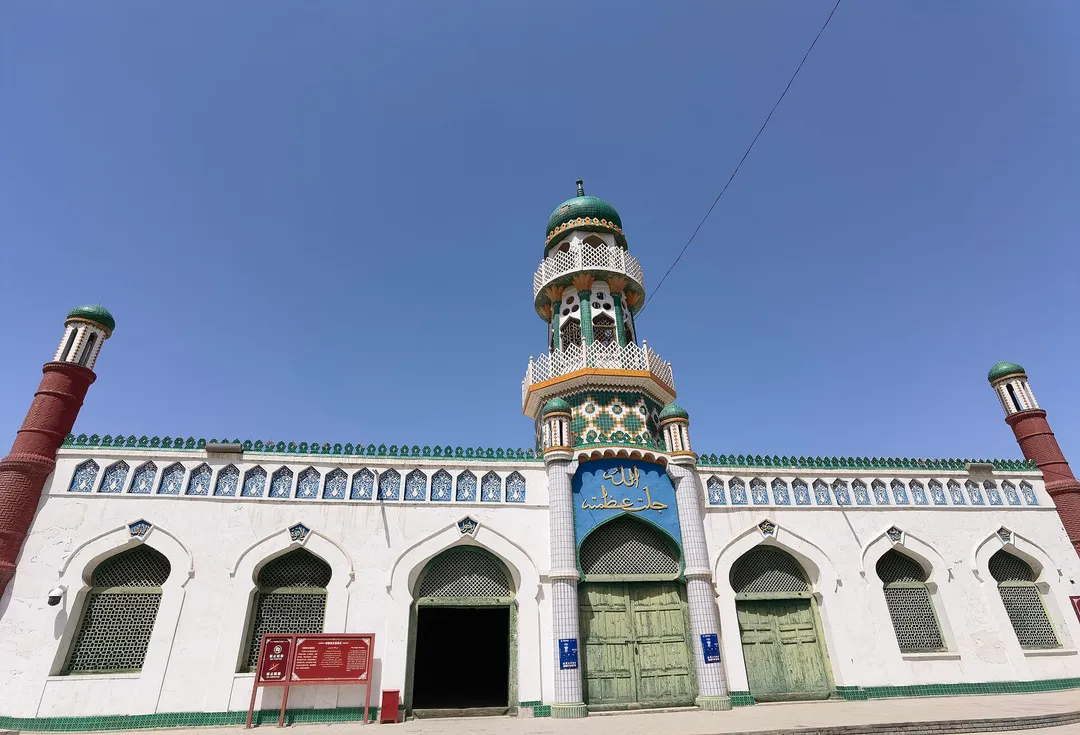
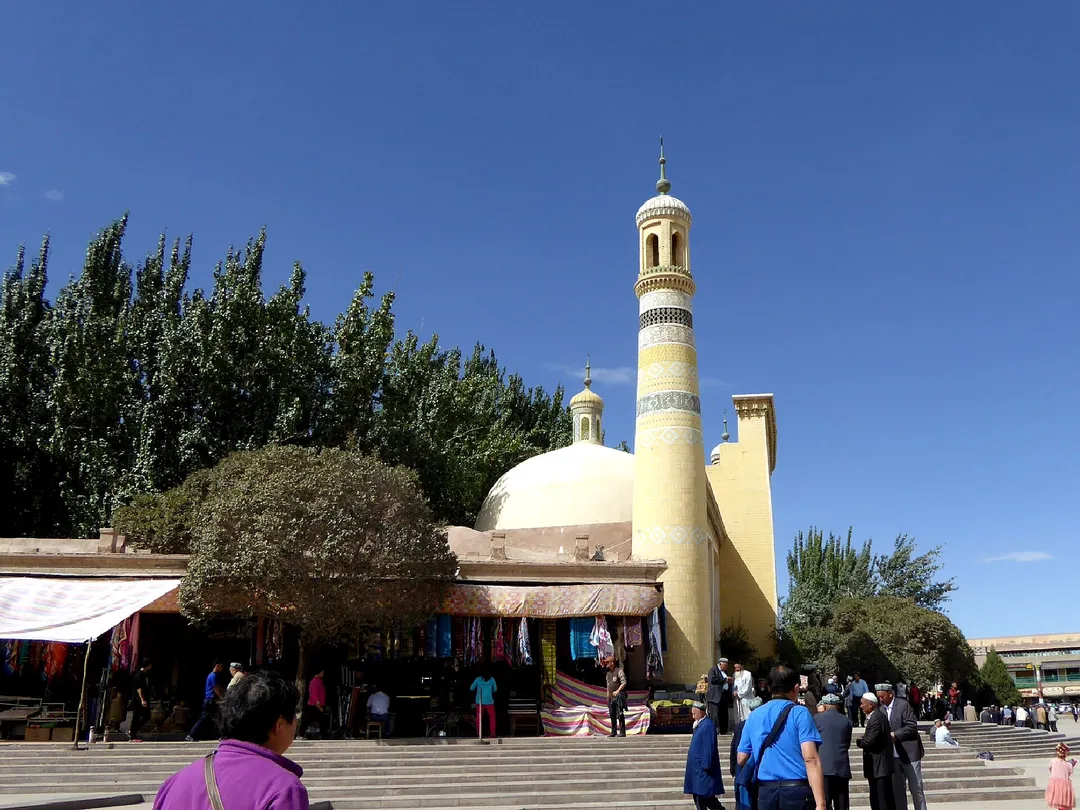
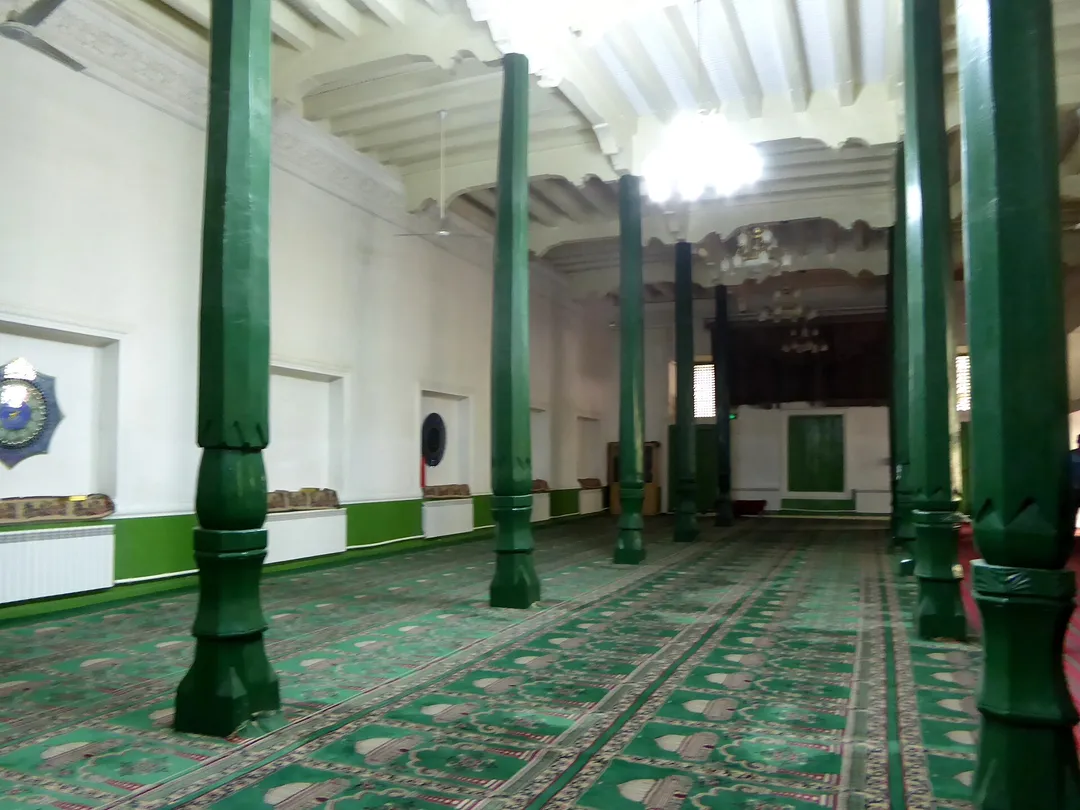
Quick Answer
Is Id Kah Mosque worth visiting?
The largest mosque in China's far west and the heart of Kashgar — a yellow-gated prayer hall complex on Id Kah Square since the 1440s. Visitor ticket ~¥20; about 1 hour.
Quick facts
| Ticket | About ¥20 for visitors (Muslims worship free). Buy at the gate — cash ready. |
|---|---|
| Hours | Split visitor windows that dodge the five prayer times — typically 10:00–14:00 and 16:00–19:00; Friday is busiest and partly closed to sightseers. Confirm on the day. |
| Recommended duration | 1 hour. |
| Best time to visit | Mid-morning on a weekday; evening for the square's street life (outside the mosque). Avoid Friday midday entirely. |
| How to get there | On Id Kah Square, Jiefang North Road, the center of the Old City — 10–15 minutes' walk from Kashgar's main hotels; taxi from the airport ~10 km. Buses stop on Jiefang Road beside the square. |
| English signage | Partial |
| Wheelchair accessible | Partial |
| Meaning of name | 'Id Kah' (عيد كا) — 'place of the festival', where Eid gatherings and dancing happen |
| Founded | Mid-1400s (traditionally 1442); enlarged to the present complex through the 18th–19th centuries |
| Scale | One of China's largest mosque complexes — around 16,800 m², courtyards, halls and gardens |
| Visitor ticket | About ¥20; worship free for Muslims |
| Location | Id Kah Square, the pivot of the Old City |
What to expect
The Id Kah Mosque grew from a mid-15th-century foundation — tradition dates the mosque's origin to 1442, when the ruler of the day endowed a prayer ground on what is now Id Kah Square — into the largest mosque complex in China's far west, roughly 16,800 square meters of courtyards, side halls, religious schools and gardens. Its face to the city is the great yellow iwan gate, flanked by an 18-meter minaret tower, fronting a square that has always been Kashgar's public stage: prayer crowds at festival time, families and fruit sellers every evening.
Non-Muslim visitors enter outside the five daily prayer times through the ticket gate on the square. The route crosses the tree-shaded outer courtyard — poplar shade, stone pools, queues of prayer shoes — into the main prayer hall, an open hall of carved wooden pillars under a painted coffered ceiling, orientation niches and hanging lamps. The atmosphere is a working place of worship, not a museum: visitors are welcome to look, sit quietly on the veranda edges, and photograph the architecture but not worshipers at prayer. Modest dress is expected, shoes come off in the halls, and female visitors are offered shawls at the gate if needed.
What makes Id Kah special is the setting more than any single object. The mosque is the center of gravity for everything Kashgar does: the artisan lanes begin a few steps west, the Old City alleys spread all around, tea houses within a two-minute walk pour bowls for the after-prayer crowd, and across the Tuman River the Grand Bazaar fills on Sunday. Come once inside in daylight, then return to the square at dusk, when the yellow gate glows and the square fills with playing children — that combination is the city's signature image.
How to get there
The mosque fronts Id Kah Square on Jiefang North Road in the middle of the Old City. Most travelers in Kashgar walk there (10–20 minutes from central hotels). From the airport (~10 km) or railway station (~6 km) take a taxi to Id Kah Square. City buses stop along Jiefang Road.
Best photo spots
- The yellow iwan gate and minaret from across Id Kah Square
- The outer courtyard under poplar shade with rows of shoes at the hall doors
- The carved wooden pillars and painted ceiling of the main prayer hall (no people shots during prayer)
- The square at dusk with the lit gate and evening crowd
Tips
- Check the five prayer times before you go — sightseeing windows open between them, and Friday midday is closed to casual visitors
- Dress modestly (covered shoulders and knees); shawls are lent at the gate, and shoes come off before the halls
- Keep quiet inside and do not photograph worshipers at prayer — shoot architecture instead
- Combine with the craft lanes beside the mosque and the old teahouse within a two-minute walk
- Return to the square at night for the yellow gate lit up and the free street show of the evening crowd
Scams to avoid
- Self-appointed guides at the square's edge selling 'special access' — the mosque has a single official ticket gate
- Postcard sellers and 'donation collectors' outside the gate are unrelated to the mosque — give nothing at the door
- Taxi drivers claiming the mosque is at prayer and closed all day — visitor windows reopen between prayer sessions
Frequently asked questions
Can non-Muslims visit the Id Kah Mosque?
Yes — outside the five daily prayer times and outside the Friday midday closure for sightseers. Buy a ticket at the official gate, dress modestly and remove shoes in the halls.
How much is the ticket?
About ¥20 for visitors; worship is free for Muslims. Prices occasionally change — confirm at the gate.
How long does a visit take?
Around an hour for courtyards and the main hall; many travelers then linger on the square itself at dusk.
What else is right around it?
The artisan craft lanes start beside the mosque; a century-old Uyghur teahouse and the Old City alleys are a couple of minutes away; the Grand Bazaar is across the Tuman River to the north.
Is photography allowed?
Yes for architecture, no for worshipers at prayer. Keep quiet inside the halls and ask before photographing anyone close-up.
Read next
Other things to do in Kashgar
Apak Khoja Mausoleum — alias page
Alias page — see kashgar-xiangfei-garden for the full guide.
Id Kah Mosque — alias page
Alias page — see kashgar-id-kah-mosque for the full guide.
Karakul Lake — alias page
Alias page — see kashgar-karakul-lake for the full guide.
Kashgar Craft Lanes (Wusitang Boyi Artisan Street)
The ~1 km artisan street beside the Id Kah Mosque where hundreds of family workshops still hammer copper, string dutars and forge iron — Kashgar's living craft tradition.
Gaotai Ancient Dwellings
Six centuries of stacked Uyghur homes on a 40-meter loess cliff above the Tuman River — Kashgar's legendary 'over-street rooms' quarter, reopened in 2023 after years of restoration. 1–2 hours.
Alar Golden Grassland (Tashkurgan)
The alpine wetland at the foot of Tashkurgan's Stone City — boardwalks looping through marsh meadows under 7,000-metre snow peaks; one ticket with Stone City (about ¥40–51), 1–2 hours.
Kashgar Grand Bazaar
The Central Asia trade market on the Tuman River's east bank — 'the East Gate Bazaar', one of the largest in the region. hours roughly 10:30–21:00.
Hotan Jade Bazaar (Zongzhakou)
The world's largest raw-jade market, in Hotan on the Yurungkash river — riverside stonesets where mutton-fat white jade is traded over tea. A 1-hour flight from Kashgar, or about 500 km by rail.
Hotan Cultural Museum
Hotan's flagship museum — free with reservation — holding the jade and Buddhist art of the ancient Khotan kingdom; split sessions 10:00–13:30 and 16:00–19:30, closed Mondays, 1–2 hours.
Hotan Tuancheng Old Quarter
Hotan's renovated Uyghur old quarter — a 4A-rated maze of carved courtyards and poplar-shaded lanes in the city core, free to wander.
Karakul Lake
A 3,600 m glacier-fed lake on the Karakoram Highway about 190 km from Kashgar, famous for mirror reflections of Muztagh Ata (7,546 m), the 'Father of Ice Mountains'. Entry about CNY 45.
Mor Temple Ruins
Kashgar's most important Buddhist site — two adobe stupas, one round and one square, standing like giant seals on the gobi 30-odd km northeast of the old city.
Kashgar Old City
A maze of mud-brick alleys and Uyghur courtyard houses on the western edge of Kashgar (1,289 m), rebuilt under a 2009-2015 quake-safety program but still lived in.
Kashgar Old Teahouse
The century-old teahouse of Kashgar's old city. No entry fee — pay for the tea, from around ¥10 a pot.
Panlong Ancient Road (Wacha Highway)
The famous 600-plus-hairpin road of the Pamirs — a 30–36 km mountain stretch climbing from ~3,000 m to over 4,200 m on the road to Wacha, its S-bends stacked like a black dragon on the hillsides.
Kashgar Sunday Livestock Bazaar
One of Central Asia's largest live-animal markets, where sheep, cattle, goats. Free entry, liveliest from about 10:00 with trading fading after lunch - go early, bring a dust mask.
Tashkurgan Stone City
Ruins of the ancient Puli/Qipantuo kingdom capital on a hill above Tashkurgan — 2,000+ years of Silk Road fortification at 3,100 metres, with broken stone walls.
White Sand Lake (Baisha Lake)
A 3,300 m glacier-fed lake backed by white sand dunes on the G314 Pamir road - the classic first stop between Kashgar and Tashkurgan, about 200 km out. pair it with Karakul Lake on the same drive.
Xiangfei Garden (Fragrant Concubine Garden)
The green-glazed domed mausoleum of the Khoja family (c. 1640) wrapped in a park of gardens and shows — Kashgar's grandest tomb and the legend of the Fragrant Concubine. Ticket ¥40; 2–3 hours.