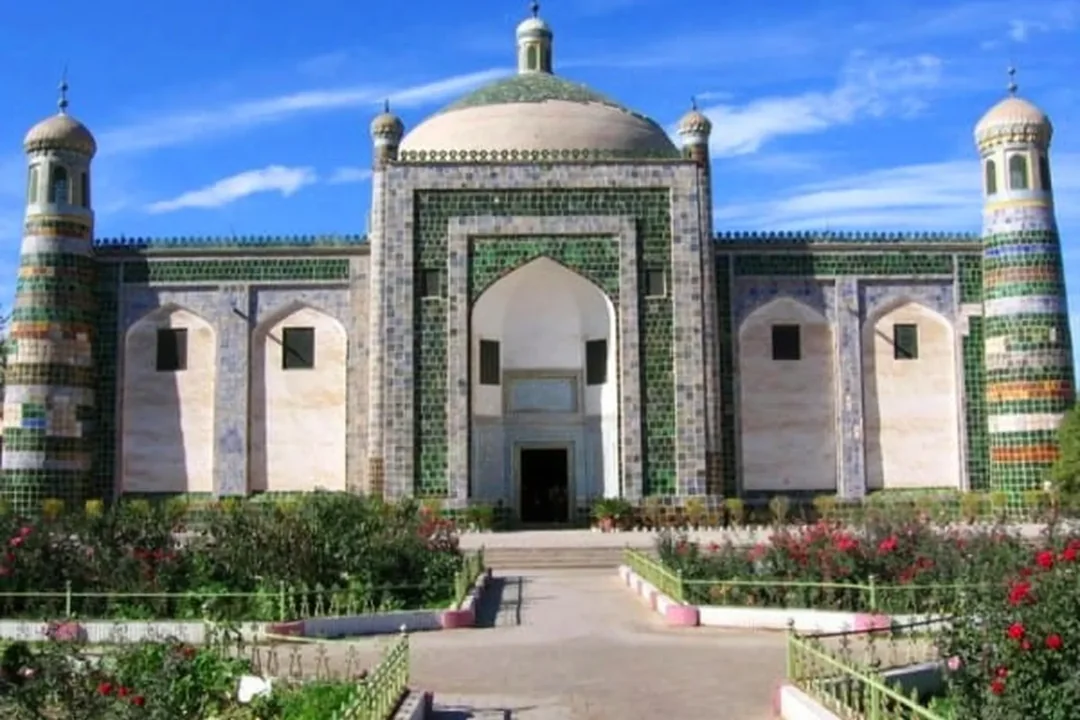
Xiangfei Garden (Fragrant Concubine Garden)香妃园(阿帕克霍加麻扎)
Xiangfei Garden is the scenic park around the Apak Khoja Mausoleum (Apa Khoja Mazar), the 17th-century tiled tomb of the powerful Khoja family about 5 km northeast of central Kashgar. The mausoleum itself — a green-glazed dome over a hall holding dozens of family catafalques, raised around 1640 and designated a national key relic in 1988 — is the finest piece of Islamic funerary architecture in Xinjiang. Its fame doubles on the legend of Xiang Fei, the 'Fragrant Concubine', a Kashgar-born beauty of the family said to have been taken into the Qing emperor's harem — hence the park's name. Around the tomb the city has built out a full scenic zone: formal gardens, a mirror pool, folk performances re-enacting Uyghur courtship and weddings, and craft displays. Ticket ¥40 since 2025; allow 2–3 hours with the shows.
Kashgar · Visitor Guide2026-11-17
Quick Answer
Is Xiangfei Garden (Fragrant Concubine Garden) worth visiting?
The green-glazed domed mausoleum of the Khoja family (c. 1640) wrapped in a park of gardens and shows — Kashgar's grandest tomb and the legend of the Fragrant Concubine. Ticket ¥40; 2–3 hours.
Quick facts
| Ticket | ¥40 adult (raised from ¥30 in January 2025); students and seniors ~¥20. Show packages cost more — optional. |
|---|---|
| Hours | Roughly 10:00–19:30 (sources vary 9:30–20:00); welcome performance about 10:30 and 16:30, wedding show about 11:30 — confirm on the day. |
| Recommended duration | 2–3 hours with gardens and shows; 1 hour for the tomb alone. |
| Best time to visit | Late spring through autumn; morning welcome show then quiet tomb time, or late afternoon for the mirror-pool reflections. |
| How to get there | On Xiangfei Road, about 5 km northeast of downtown Kashgar — taxi 15–20 minutes; bus routes toward Haohan township stop near the gate. Combine with the Old City in one morning. |
| English signage | Partial |
| Wheelchair accessible | Partial |
| Core monument | Apak Khoja Mausoleum — green-glazed domed tomb of the Khoja family, built c. 1640 |
| National status | National Key Cultural Relic since 1988 |
| The legend | Xiang Fei, the 'Fragrant Concubine' of Qing folklore, a Kashgar-born beauty linked to the family |
| Ticket | ¥40 (since January 2025; was ¥30) |
| Shows | Fragrant Concubine welcome act (~10:30, ~16:30) and Uyghur wedding show (~11:30) |
What to expect
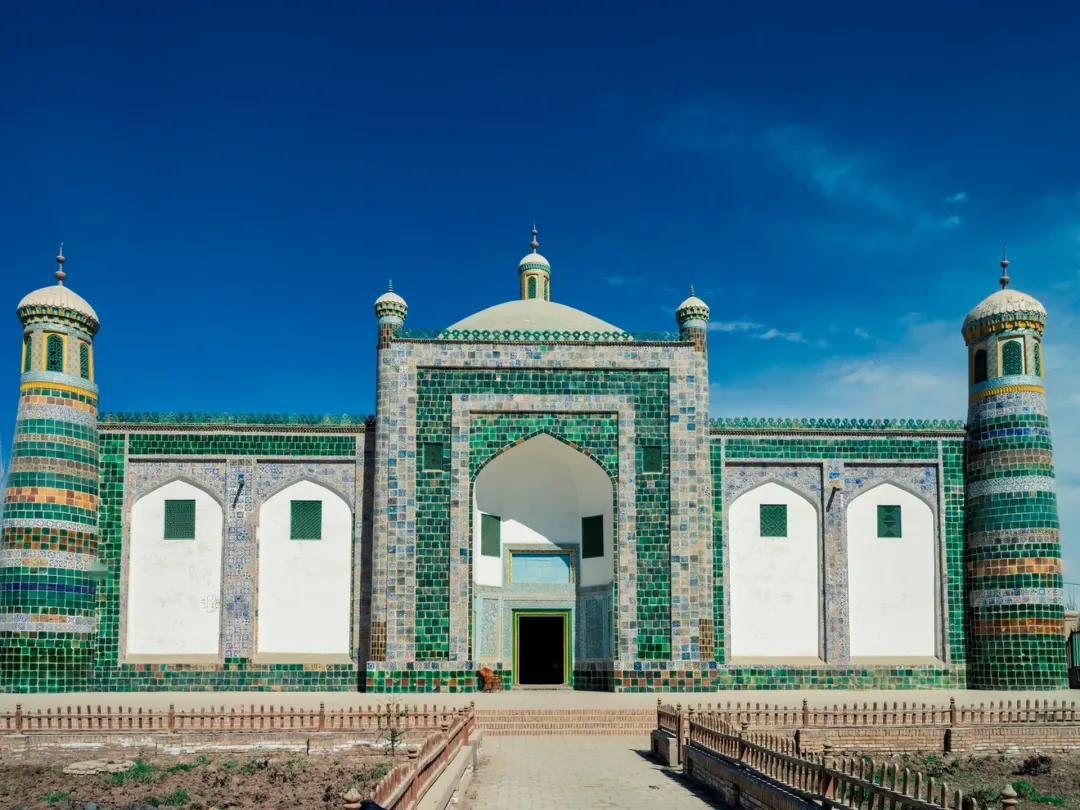
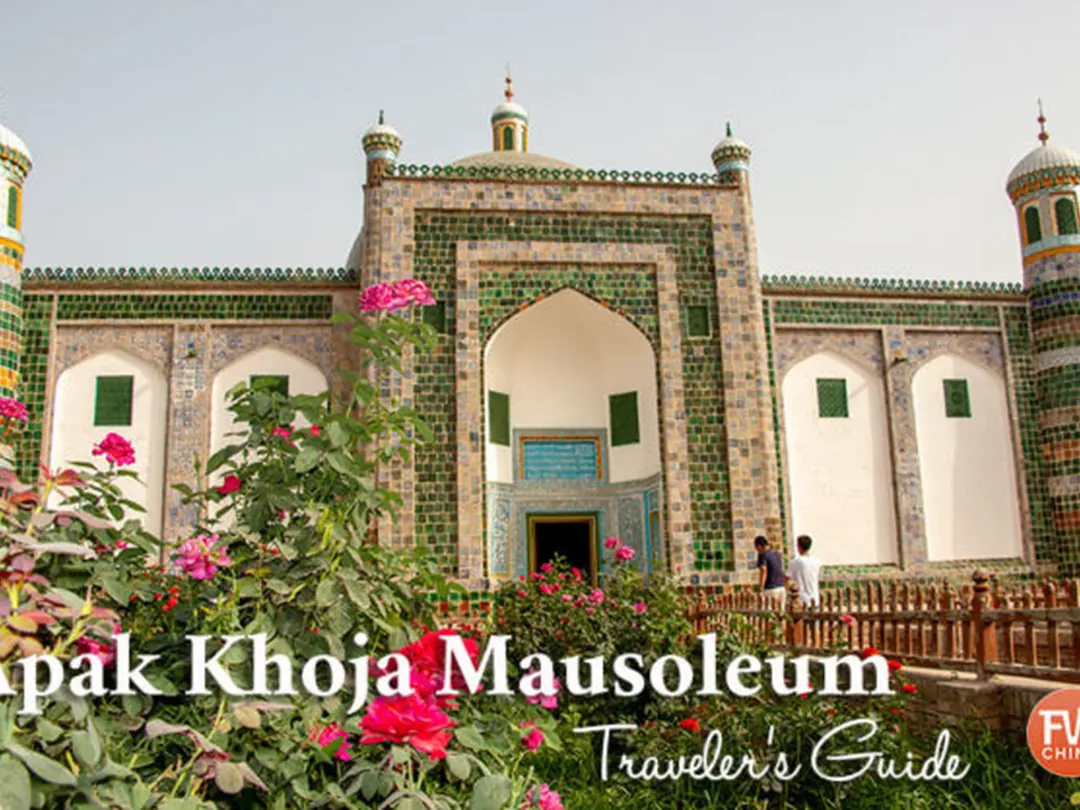
Five kilometers northeast of the old city, theApak Khoja Mausoleum rises from fields into open sky: a rectangular hall of green-glazed tile crowned by a drum and dome, tiled edge to edge in emerald, turquoise and white — the largest and most accomplished Islamic tomb in Xinjiang. It was raised around 1640 for Muhammad Yusuf, father of Apak Khoja, the religious and political potentate of 17th-century Kashgar; Apak himself and five generations of the family lie within, under dozens of catafalques draped in brocade — around seventy burials in one hall, each marked, in the local custom, by cloth rather than portraits.
The tomb's popular fame owes as much to a woman buried elsewhere as to the Khojas themselves. The legend of Xiang Fei — the 'Fragrant Concubine', Iparhan in Uyghur — tells of a Kashgar-born beauty of the Khoja line taken into the harem of the Qing emperor Qianlong, pining for home, her body returned and buried here (in the story) or at Hebei's Eastern Tombs (in the archives). Historians treat the genealogy skeptically, but the legend stuck: the scenic zone around the tomb was renamed Xiangfei Garden, and performances, statues and gift shops trade on the romance.
The park wrapper is modern but pleasant. Formal gardens and a long mirror pool face the tomb's facade — the low-angle reflection shot is the site's classic photo — while side courtyards hold a smaller mosque, a lecture hall (jiali ke) once used by the Khojas, old orchards and exhibition rooms. Scheduled folk performances retell the Fragrant Concubine story and stage Uyghur wedding ritual with dance and costume; they are optional add-ons to the ticket. Visit the tomb first for quiet, then drift the gardens — by mid-morning tour buses fill the forecourt.
How to get there
From central Kashgar take a taxi to Xiangfei Road (about 5 km, 15–20 minutes) or a bus toward Haohan (浩罕乡) that stops near the gate. Most itineraries pair the garden with a morning in the Old City — do the Old City early, the tomb late morning, and return for the teahouse lunch.
Best photo spots
- The green dome and tiled facade from across the mirror pool — the classic low-angle reflection
- Brocade-draped catafalques inside the tomb hall (respect the no-flash rules)
- The emerald tilework in close-up — geometric bands and calligraphic panels
- Performance courtyard during the wedding show, dancers in full Uyghur dress
Tips
- Go before the tour buses — around opening time the tomb is quiet and the light best on the green tile
- The ¥40 ticket covers the garden and tomb; show packages cost extra and are skippable if you are short on time
- Catch the mirror-pool reflection early, before midday wind wrinkles the water
- Inside the tomb, keep voice low and ask before photographing the catafalques up close
- Pair with the Old City in one morning — it is a 15–20 minute taxi hop back to the teahouses
Scams to avoid
- Souvenir sellers near the exit claiming 'authentic Xiang Fei perfume' — the legend's fragrance is folklore, the price is real
- Unlicensed guides at the gate selling inflated 'family history' tours — the site's boards cover the basics
- Taxi drivers offering round-trip 'waiting fees' far above meter — agree the fare before boarding
Frequently asked questions
Is Xiangfei Garden the same as the Apak Khoja Tomb?
The tomb is the core of it. Xiangfei Garden is the scenic park built around the Apak Khoja Mausoleum — gardens, mirror pool and performances wrapping the 17th-century family tomb.
Is the Fragrant Concubine really buried here?
Historically doubtful — Qing records place her burial at the Eastern Qing Tombs in Hebei. The Kashgar legend that she rests among the Khojas is folklore, but it gave the park its name.
How much is the ticket?
¥40 for adults since January 2025 (previously ¥30); discounted tickets around ¥20 for students and seniors. Folk-show packages are extra.
How long should I plan?
1 hour for the tomb alone, 2–3 hours if you walk the gardens and catch a performance.
How do I get there from the Old City?
A taxi takes 15–20 minutes (about 5 km); buses toward Haohan township stop near the gate. It pairs naturally as a late-morning add-on to an Old City morning.
Read next
Other things to do in Kashgar
Apak Khoja Mausoleum — alias page
Alias page — see kashgar-xiangfei-garden for the full guide.
Id Kah Mosque — alias page
Alias page — see kashgar-id-kah-mosque for the full guide.
Karakul Lake — alias page
Alias page — see kashgar-karakul-lake for the full guide.
Kashgar Craft Lanes (Wusitang Boyi Artisan Street)
The ~1 km artisan street beside the Id Kah Mosque where hundreds of family workshops still hammer copper, string dutars and forge iron — Kashgar's living craft tradition.
Gaotai Ancient Dwellings
Six centuries of stacked Uyghur homes on a 40-meter loess cliff above the Tuman River — Kashgar's legendary 'over-street rooms' quarter, reopened in 2023 after years of restoration. 1–2 hours.
Alar Golden Grassland (Tashkurgan)
The alpine wetland at the foot of Tashkurgan's Stone City — boardwalks looping through marsh meadows under 7,000-metre snow peaks; one ticket with Stone City (about ¥40–51), 1–2 hours.
Kashgar Grand Bazaar
The Central Asia trade market on the Tuman River's east bank — 'the East Gate Bazaar', one of the largest in the region. hours roughly 10:30–21:00.
Hotan Jade Bazaar (Zongzhakou)
The world's largest raw-jade market, in Hotan on the Yurungkash river — riverside stonesets where mutton-fat white jade is traded over tea. A 1-hour flight from Kashgar, or about 500 km by rail.
Hotan Cultural Museum
Hotan's flagship museum — free with reservation — holding the jade and Buddhist art of the ancient Khotan kingdom; split sessions 10:00–13:30 and 16:00–19:30, closed Mondays, 1–2 hours.
Hotan Tuancheng Old Quarter
Hotan's renovated Uyghur old quarter — a 4A-rated maze of carved courtyards and poplar-shaded lanes in the city core, free to wander.
Id Kah Mosque
The largest mosque in China's far west and the heart of Kashgar — a yellow-gated prayer hall complex on Id Kah Square since the 1440s. Visitor ticket ~¥20; about 1 hour.
Karakul Lake
A 3,600 m glacier-fed lake on the Karakoram Highway about 190 km from Kashgar, famous for mirror reflections of Muztagh Ata (7,546 m), the 'Father of Ice Mountains'. Entry about CNY 45.
Mor Temple Ruins
Kashgar's most important Buddhist site — two adobe stupas, one round and one square, standing like giant seals on the gobi 30-odd km northeast of the old city.
Kashgar Old City
A maze of mud-brick alleys and Uyghur courtyard houses on the western edge of Kashgar (1,289 m), rebuilt under a 2009-2015 quake-safety program but still lived in.
Kashgar Old Teahouse
The century-old teahouse of Kashgar's old city. No entry fee — pay for the tea, from around ¥10 a pot.
Panlong Ancient Road (Wacha Highway)
The famous 600-plus-hairpin road of the Pamirs — a 30–36 km mountain stretch climbing from ~3,000 m to over 4,200 m on the road to Wacha, its S-bends stacked like a black dragon on the hillsides.
Kashgar Sunday Livestock Bazaar
One of Central Asia's largest live-animal markets, where sheep, cattle, goats. Free entry, liveliest from about 10:00 with trading fading after lunch - go early, bring a dust mask.
Tashkurgan Stone City
Ruins of the ancient Puli/Qipantuo kingdom capital on a hill above Tashkurgan — 2,000+ years of Silk Road fortification at 3,100 metres, with broken stone walls.
White Sand Lake (Baisha Lake)
A 3,300 m glacier-fed lake backed by white sand dunes on the G314 Pamir road - the classic first stop between Kashgar and Tashkurgan, about 200 km out. pair it with Karakul Lake on the same drive.