Esta página está archivada y ya no se actualiza — consulta la guía actual: Ver la guía actual
Zhouzhuang Water Town周庄古镇
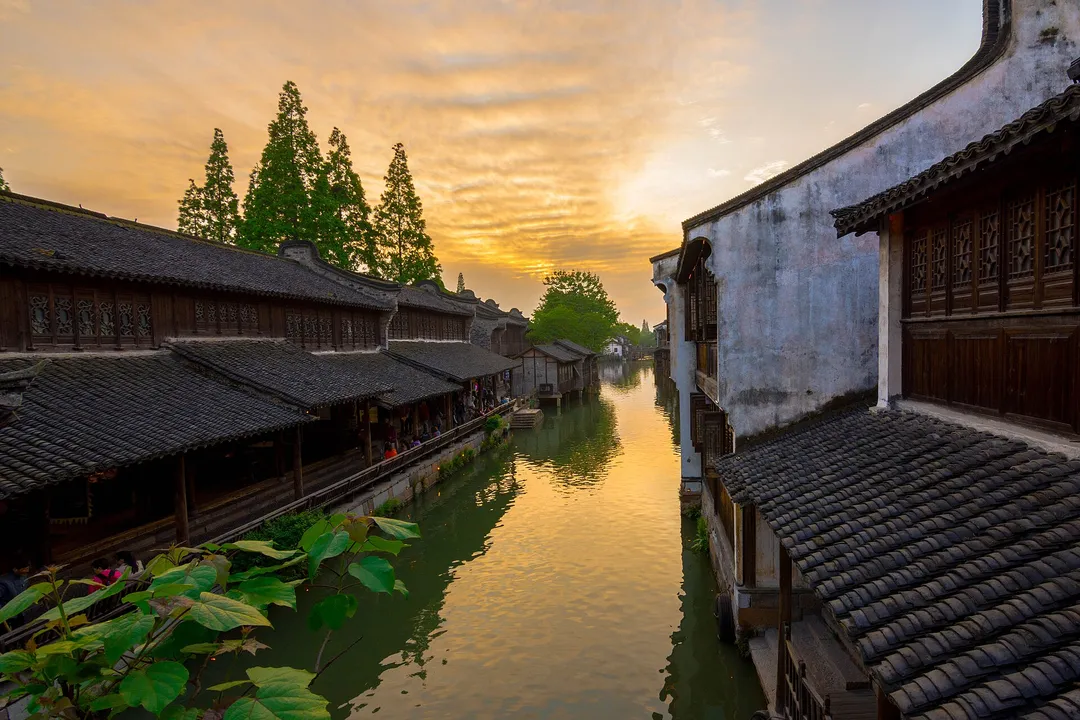
Zhouzhuang es el más famoso de los seis pueblos de agua jiangnan, a 30 km al nordeste de Suzhou, en el distrito de Kunshan. El pueblo cubre aproximadamente 1 km² y se articula en torno a una red de canales alimentada por el sistema del río Wangyu, unida por 100 puentes de piedra (en su mayoría Ming y Qing) y dividida en 10 islas por los cursos de agua. Conocida como la Venecia de Oriente, Zhouzhuang es destino turístico desde los años 80 y el más comercializado de los grandes pueblos de agua — pero sus canales, puentes y arquitectura histórica impresionan de verdad y las multitudes se llevan bien a primera hora y al anochecer.
Suzhou · guía de visita2026-10-19
Respuesta rápida
¿Merece la pena visitar Zhouzhuang Water Town?
El pueblo de agua jiangnan más famoso — 1 km² de canales, 100 puentes y arquitectura de 800 años. Entrada ¥100. Mínimo 3-4 horas. Se puede ir de excursión desde Shanghái.
Datos rápidos
| Entrada | ¥100 (entrada, incluye la mayoría de los puentes y las principales casas históricas). La entrada combinada de ¥150 añade atracciones extra. Compre por WeChat o en taquilla. |
|---|---|
| Horario | El pueblo abre 24 horas. La mayoría de atracciones: 8:00-17:00 (16:30 en invierno). Mejores ventanas: primera hora (antes de las 9:00) y tarde-noche (después de las 17:00). |
| Duración recomendada | 3-4 horas para lo esencial. Medio día (5-6 horas) para cubrir bien las principales atracciones. Se recomienda pasar la noche. |
| Mejor época para visitar | Primavera (marzo-mayo) y otoño (septiembre-noviembre) por clima y paisaje. El verano es caluroso y masificado. El invierno trae menos visitantes y unos canales de belleza sobria. Evite las fiestas nacionales chinas. Primera hora (antes de las 9:00) es el momento con menos multitudes. |
| Cómo llegar | Desde Shanghái: autobús desde la estación del Estadio de Shanghái — unos 90 minutos, ¥30. Desde Suzhou: autobús desde la estación de la estación de tren de Suzhou — unos 60 minutos, ¥20. Alternativa: DiDi desde Suzhou ¥100-150 (45-60 minutos). |
| Señalización en inglés | yes — Zhouzhuang's tourism infrastructure is the most developed of all the water towns; English signs at major attractions. |
| Acceso en silla de ruedas | limited — narrow lanes, stone bridges with steps, canals without barriers. Not suitable for wheelchairs. |
| Antigüedad | Más de 800 años (fundado en 1086, dinastía Song) |
| Superficie | ~1 km² |
| Puentes | 100 puentes de piedra (dinastías Ming y Qing) |
| Islas | 10 islas divididas por la red de canales |
| Famoso por | La Venecia de Oriente — el pueblo de agua jiangnan más fotografiado |
Qué esperar
La historia de Zhouzhuang se remonta al año 1086, cuando era conocida como Yuanjing — un pequeño pueblo de mercado junto a un nudo de canales. La actual red de canales tomó forma sobre todo en las dinastías Ming y Qing, cuando la villa prosperó con el comercio de seda y grano. Los Puentes Dobles (Shuangqiao), formados por el puente Shenyuan (1573) y el Yong'an (1729), se cruzan en ángulo recto y se convirtieron en la imagen más célebre de Zhouzhuang: el puente en zigzag y el cuadrado, con una barca pasando entre ellos. El cuadro que pintó el artista Chen Yifei en 1984 se reproduciría por doquier y lanzó el turismo de Zhouzhuang.
El pueblo está en su momento más evocador a primera hora y al anochecer, cuando los excursionistas se han ido y los lugareños recuperan los canales: las mujeres aún lavan ropa en las escaleras de piedra, pequeñas barcas de madera reparten provisiones a los restaurantes y los ancianos juegan al ajedrez junto al agua. La zona de los Puentes Dobles es el centro turístico; desde ahí, los 100 puentes y los edificios de 800 años se despliegan en todas direcciones. Las principales mansiones (Shen Ting, Zhang Ting) son residencias Ming y Qing restauradas con el patrón urbano característico de 'un río, dos orillas'.
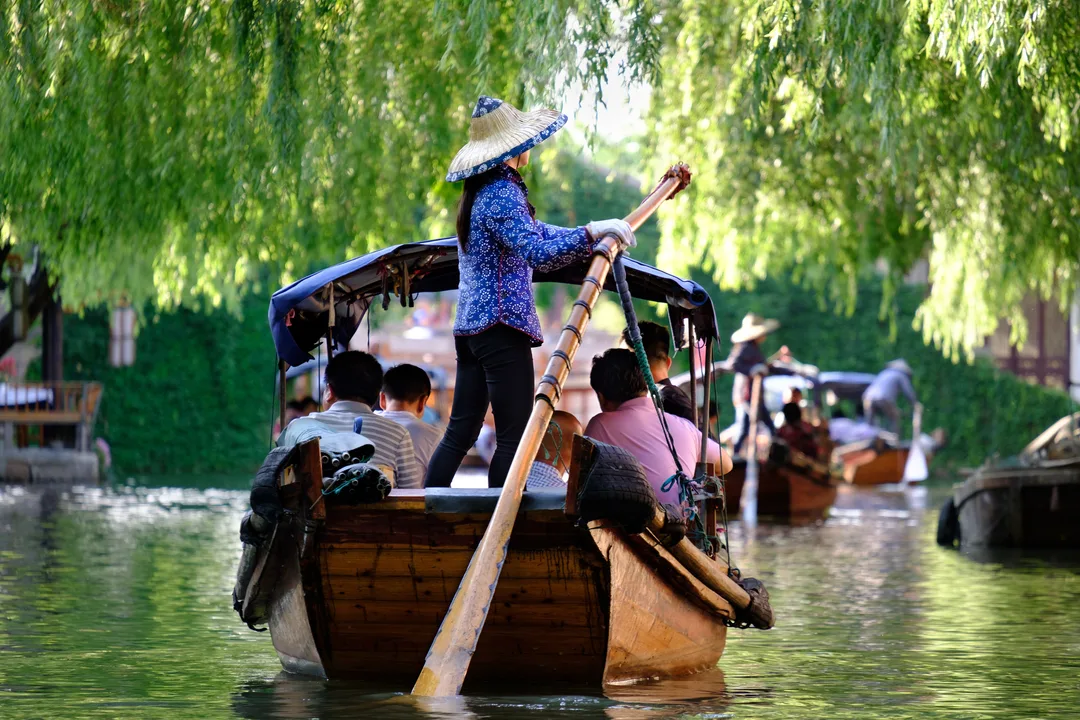
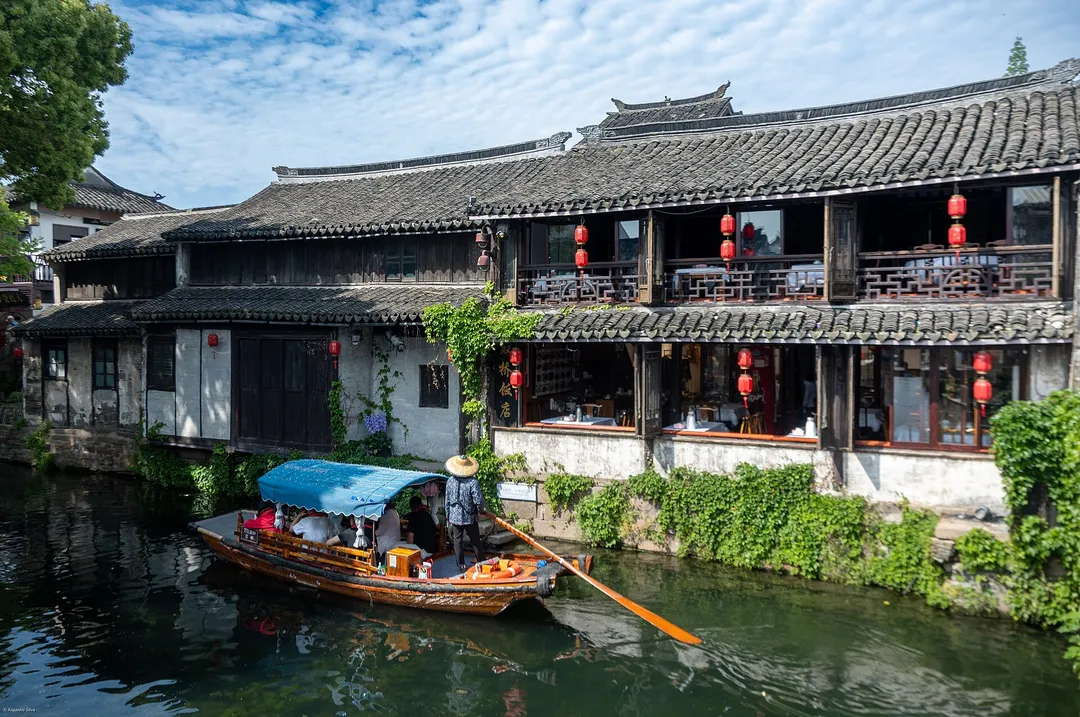
Zhouzhuang es el más comercializado de los pueblos de agua jiangnan, pero esa comercialización lo hace el más accesible: bien señalizado, con inglés en las atracciones principales, amplia oferta de restaurantes y alojamientos y un servicio de barcas fiable. El paseo en barca (¥120-150 por barca, 6 pasajeros) es lo más destacado: el barquero impulsa la barcaza plana con la pértiga por los canales estrechos, y la perspectiva desde el nivel del agua es radicalmente distinta a la vista desde los puentes. De noche, el pueblo se ilumina y los canales cobran otro carácter.
Cómo llegar
Desde Shanghái: autobús desde la estación del Estadio de Shanghái, unos 90 minutos, ¥30; salidas cada 30-60 minutos. Desde Suzhou: autobús desde la estación de autobuses de la estación de tren de Suzhou, unos 60 minutos, ¥20; los de vuelta hasta alrededor de las 17:30. Alternativa: DiDi desde Suzhou, ¥100-150, 45-60 minutos. No hay conexión de tren — solo autobús o coche.
Mejores puntos fotográficos
- La zona de los Puentes Dobles (Shuangqiao) — la imagen más famosa de Zhouzhuang, con barcas pasando entre ellos
- Los canales desde una barca, a ras de agua — una perspectiva totalmente distinta a la de los puentes
- El salón principal de la mansión Shen — el interior histórico más impresionante
- Primera hora (antes de las 8:30) — canales vacíos antes de que lleguen los excursionistas
Consejos
- Llegue a las 8:00 (apertura) o quédese a dormir: son los momentos con menos multitudes
- Tome la barca — es la experiencia definitoria de Zhouzhuang y vale los ¥120-150
- Los mejores restaurantes están en las calles laterales lejos de los Puentes Dobles — pregunte a los locales o vaya dando tumbos
- Las noches de verano (después de las 19:00) tienen menos gente y la mejor luz para fotos
- Combine con el pueblo de agua de Tongli para la experiencia jiangnan completa (caracteres distintos, merecen ambos)
Estafas que evitar
- Touteros de 'entrar sin pagar' — ignórelos; las entradas oficiales cuestan ¥100 y cubren las atracciones reales
- Barqueros informales — use los embarcaderos oficiales junto a los puentes principales
- 'Especialidades auténticas de Zhouzhuang' infladas en los restaurantes del núcleo turístico — la misma comida cuesta un 40% menos a 100 m de distancia
Preguntas frecuentes
¿Vale la pena Zhouzhuang si voy a ir a Tongli?
Sí — Zhouzhuang y Tongli tienen caracteres distintos pese a ser ambos pueblos de agua. Zhouzhuang es más grande, más famoso, más comercializado y con mejor infraestructura turística. Tongli es más pequeño, más auténtico como comunidad viva y tiene el jardín UNESCO. Vea primero Zhouzhuang para la experiencia 'clásica' y luego Tongli para la profunda; o véalos ambos en un viaje de dos días.
¿Se puede ir a Zhouzhuang desde Shanghái en excursión de un día?
Sí — es una de las excursiones más populares desde Shanghái, unos 90 minutos en autobús desde el Estadio de Shanghái. Muchas agencias venden paquetes con transporte y entrada. Aun así, el pueblo vive su mejor momento al anochecer y a primera hora, así que si quiere la experiencia auténtica conviene pernoctar.
¿Qué son los Puentes Dobles?
Los Puentes Dobles (Shuangqiao) son el puente Shenyuan (arco de 40 metros) y el Yong'an (puente cuadrado) cruzándose en ángulo recto y formando la configuración de 'llave y candado' (yaosiqiao). La imagen se convirtió en el símbolo de Zhouzhuang tras pintarla Chen Yifei en 1984, y desde entonces se ha reproducido por doquier.
¿Es accesible Zhouzhuang en silla de ruedas?
Muy limitado. Los callejos empedrados del pueblo son estrechos (1-1,5 m), todos los puentes tienen escalones y los canales carecen de barandillas. Las sillas de ruedas estándar no pueden moverse por el pueblo. No es apto para usuarios de silla de ruedas.
¿Qué comer en Zhouzhuang?
Los platos insignia incluyen: sopa de wantán, el té de tres vasos (sandaocha — ritual de té con vino de arroz dulce), el pie de cerdo Wansan (codillo braseado) y el té Longjing de la cercana Hangzhou. La cocina es parecida a la de Tongli y Luzhi — los pueblos de agua jiangnan comparten tradiciones culinarias.
Leer después
Otras cosas que hacer en Suzhou
Guanqian Street
La calle comercial peatonal más famosa de Suzhou — 800 m de moda, casas de té tradicionales y aperitivos locales, desde el Jardín de la Persistencia hasta el Mercado Yuhe. Gratis. 1–2 horas.
Hanshan Temple
El templo inmortalizado por el poema del siglo VIII de Zhang Ji, 'Noche de amarre junto al Puente del Arce': la campana que suena a medianoche en Nochevieja. Entrada gratuita, 20 CNY por tocar la campana. 1–1,5 horas.
Humble Administrator's Garden
El mayor y más famoso de los jardines clásicos de Suzhou, Patrimonio de la Humanidad. Construido en 1513 y restaurado a lo largo de los siglos. Lotos en verano, silencio en invierno.
Jinji Lake
Un lago urbano gratuito y abierto 24/7, rodeado por un paseo marítimo de ~10 km en el Parque Industrial de Suzhou — reserva 2-4 horas y ven al anochecer para el espectáculo de fuentes.
Lingering Garden
El jardín clásico de Suzhou con el detalle más exquisito: más pequeño que el Jardín del Administrador Humilde, pero considerado el mejor en tallas de piedra y riqueza arquitectónica. … Verificado en 2026.
Luzhi Water Town
Un pueblo de agua vivo a 25 km de Suzhou: menos turístico que Zhouzhuang o Tongli, con auténtica vida de canal, 41 puentes y un famoso mercado matinal. Gratis pasear. ¥78 por las atracciones. 2–3 horas.
Master of Nets Garden
El más pequeño y elegante de los tres grandes jardines Unesco de Suzhou: media hectárea repleta de ingenio espacial. ¥40. Ópera nocturna ¥100 (marzo–noviembre). 1–2 horas.
Pan Gate Scenic Area
El último complejo de puertas de la ciudad antigua que sobrevive en Suzhou — un sistema doble de puerta de agua y puerta de tierra del siglo XIV con una pagoda de 40 m. ¥45. 1.5–2 horas.
Pingjiang Road Historic District
El barrio de canales conservado más auténtico de Suzhou — 1,6 km de canales Ming, puentes antiguos y tiendas con carácter en una zona residencial viva. Gratis. 1–2 horas.
Qinghua Temple
Un sereno templo budista del siglo VI en las colinas del oeste de Suzhou — mucho menos visitado que el templo Hanshan, con pagodas antiguas, jardines de camelias y senderos de montaña. Gratuito. 2–3 horas.
Shantang Street
La calle de canal más famosa de Suzhou: 360 m de arquitectura Ming-Qing a lo largo de una vía navegable viva, desde Pan Gate hasta Tiger Hill. Gratis a pie. 1–2 horas.
Suzhou Museum
El museo que I.M. Pei diseñó saliendo de su retiro (abierto en octubre de 2006), donde la geometría modernista dialoga con la estética de los jardines de Suzhou: el muro de piedra tallada del patio es la imagen por antonomasia.
Tiger Hill (Huqiu)
La colina con más historia de Suzhou, coronada por la pagoda Yunyan de mil años, inclinada 3,59 grados. Aquí descansa el rey Helü de Wu (496 a. C.). Merece los ¥70 y media jornada.
Tongli Water Town
Pueblo de agua milenario a 30 km de Suzhou: 15 ríos, 49 puentes, 7 islas. Entrada única de ¥100 para todas las atracciones. Mínimo 3–4 horas.
Museos en Suzhou
Museo de Suzhou
Un museo de arte de clase mundial de Suzhou, en un edificio diseñado por I. M. Pei.
Museo de la Seda de Suzhou
Junto a la pagoda North Temple de Suzhou, el Museo de la Seda permite ver gusanos de seda tejer capullos y seguir 4.000 años de seda, de la hoja de morera a la túnica imperial del dragón, todo gratis.